What is your legacy? It’s Bid Day. The recruitment songs and cheers have quieted, and after an emotional few days, you will finally learn which young women will join Zeta Tau Alpha. The experience is exciting and stressful all at the same time— and not just for the potential new members. You are anxious to hear if your legacy is now your ZTA sister. For many women, having your daughter, granddaughter or other family member join ZTA is the perfect dream. Sorority membership is a unique experience with traditions and symbolism that bind members together for a lifetime. Imagine the joy of being able to share that with family. The Fraternity’s legacy policy (found on page 27) exists to make sure collegiate chapters spend extra time learning about those women with a familial tie to ZTA. When hundreds of potential new members are met during Formal Recruitment, that extra time spent with legacies is valuable. But what happens when your legacy does not join ZTA? Darlene Anderson Oswalt (Beta Zeta Chapter, Iowa State University), Province President IV-A, is one of those Zetas whose daughter did not join ZTA. When Emily Oswalt enrolled at Appalachian State University, ZTA was not yet on campus—Lambda Kappa Chapter was installed in Dec. 2012. Before Emily even went through Formal Recruitment, Darlene had to come to terms with her legacy not becoming a Zeta. “There was a little sadness that she would not be a Zeta,” Darlene said. “But she explained to me that no matter what organization she joined, ZTA would always be a part of her because I raised her on ZTA’s values. From that point on, it was more important to me that she found a place that felt like home.” In her job at the National Panhellenic Conference, Emily Ruch (Beta Theta Chapter, Franklin College) helps promote the sorority experience, not just the ZTA experience.
28 · Themis
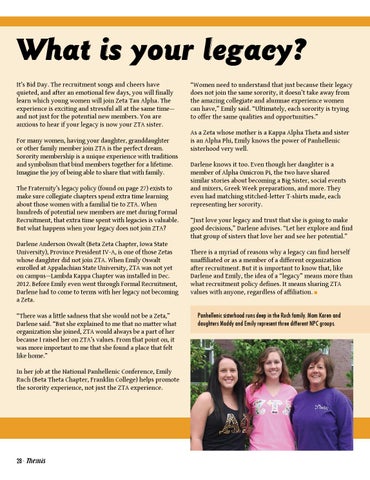
“Women need to understand that just because their legacy does not join the same sorority, it doesn’t take away from the amazing collegiate and alumnae experience women can have,” Emily said. “Ultimately, each sorority is trying to offer the same qualities and opportunities.” As a Zeta whose mother is a Kappa Alpha Theta and sister is an Alpha Phi, Emily knows the power of Panhellenic sisterhood very well. Darlene knows it too. Even though her daughter is a member of Alpha Omicron Pi, the two have shared similar stories about becoming a Big Sister, social events and mixers, Greek Week preparations, and more. They even had matching stitched-letter T-shirts made, each representing her sorority. “Just love your legacy and trust that she is going to make good decisions,” Darlene advises. “Let her explore and find that group of sisters that love her and see her potential.” There is a myriad of reasons why a legacy can find herself unaffiliated or as a member of a different organization after recruitment. But it is important to know that, like Darlene and Emily, the idea of a “legacy” means more than what recruitment policy defines. It means sharing ZTA values with anyone, regardless of affiliation. Panhellenic sisterhood runs deep in the Ruch family. Mom Karen and daughters Maddy and Emily represent three different NPC groups.