The Founders in the working world By Patti Cords Levitte, Beta Phi, Director of Archives & Historical Education and Susan Beard, Delta Psi, Archives Chairman At the turn of the 20th century, careers for women were still very limited in the South. There were few acceptable career paths for women with backgrounds like those of our Founders to pursue at that time. Most women were expected to marry and stay home to raise a family. One of the first things Zetas learn about our Founders is that they all attended college in Farmville, Virginia. In 1884, the college was renamed the State Female Normal School. “Normal” schools originated in France in the 19th century for the purpose of teaching educators the skills that were considered the “norm,” or standards, for educating children. Although all of our Founders entered college with the intention of becoming teachers, they were much like the college students of today. For many of them, their career paths diverged from their original plans.
Ruby Leigh Orgain entered the Normal School at the age of 15 and was one of the first of the Founders to graduate in 1899. While teaching for a short time after college in Dinwiddie, Virginia, Ruby started dating Albert M. Orgain II. After they married in 1906, Ruby became a homemaker and raised their three children. Albert was the president of a bank and the Dinwiddie Circuit Court Clerk for 20 years. When he died unexpectedly in 1928, Ruby was appointed to fill his unexpired term. Although she had no formal training in government work, she had worked closely with her husband and had learned what was required of the position. She served seven years as Circuit Court Clerk. Ruby was later elected the Clerk of the Dinwiddie Trial Justice Court, which she served for 10 more years. Her detour into local government work was a natural extension of her community involvement, and although it was unplanned, it became a satisfying second career for Ruby. Helen May Crafford, on the other hand, had teaching in her blood. She came from a long line of educational professionals. Her father spent the bulk of his career as a school superintendent until his death in 1907. Helen’s mother, grandmother, grandfather and many other relatives were also teachers, making it a natural career for her. In 1909, Helen was elected by the county school board to be the principal of the new Denbigh High School in Warwick County, Virginia. She was passionate about teaching and loved her students. The History of Zeta Tau Alpha quoted a note from Helen to the parents of her students: “I thank you for lending me your child today. All the years of love and care you have given him, I see in his body and soul, and I have used these today in work and play. I send him home to you tonight, I hope, a little stronger, a little better, a bit more free in body, intellect, and soul, a little nearer his human goal.”
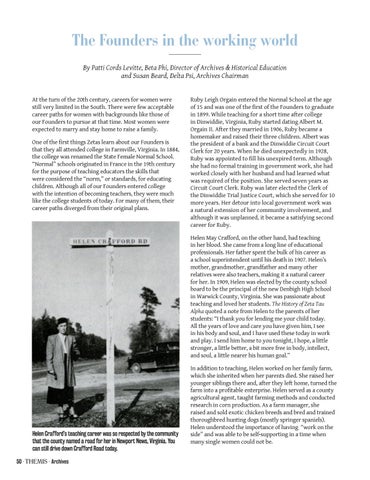
Helen Crafford’s teaching career was so respected by the community that the county named a road for her in Newport News, Virginia. You can still drive down Crafford Road today. 50 · THEMIS · Archives
In addition to teaching, Helen worked on her family farm, which she inherited when her parents died. She raised her younger siblings there and, after they left home, turned the farm into a profitable enterprise. Helen served as a county agricultural agent, taught farming methods and conducted research in corn production. As a farm manager, she raised and sold exotic chicken breeds and bred and trained thoroughbred hunting dogs (mostly springer spaniels). Helen understood the importance of having “work on the side” and was able to be self-supporting in a time when many single women could not be.