Scarborough Review
18
December - Issue 40
Seamer Beacon, Wee Willy Winky and GCHQ Words and artwork by Dav White, photos by Dave Barry AYTON CASTLE was a satellite of S c a r b o r o u g h ’s , probably used as an early-warning station. It was more of a Dav White fortified tower house than a castle, sitting in a prominent position overlooking the Vale of Pickering. Scarborough castle could be given a warning signal of approaching inland dangers by the lighting of Seamer Beacon on Seamer Moor. Following the track of Moor Lane over Seamer Moor from Ayton Castle to Seamer Beacon, warning signals could be transmitted quickly to the castle and surrounding area. The clump of Scots pine that sits on top of the beacon can be seen from as far away as Malton. When lit, the beacon must have been an imposing sight and the distance it would have been visible from is anybody’s guess. Seamer Beacon is a large group of Bronze
Age round barrows, or tumuli, joined together to make a large prominent feature in the landscape. It can be seen from just about anywhere in town. At an elevation of 189m, it is the most prominent location around Scarborough, beaten only by the stone circle on Standing Stone Rigg, at 206m. Oliver’s Mount is a mere 155m. Historic England reckons “the deliberate use of such a prominent location implies that this location was seen as important during the prehistoric period”. The main barrow contained a ring of curb stones round the base. They were removed and the top of the beacon levelled when Albert Denison, the first baron of Londesborough, took full advantage of the beacon’s elevated position to make his folly, Baron Albert’s Tower. It is now derelict but the ancient stones still litter the top of the beacon. Earlier generations took advantage of Scarborough's elevated locations for security reasons. A settlement a little further up the moor, near the corner of the A170 that becomes Stepney Road, was used during the Roman occupation and civil war and possibly
Ayton castle
as far back as the Iron Age. It is an excellent halfway point between the castle fortifications in Scarborough (also with Iron Age, Roman and civil-war settlements) and the camps at West Heslerton and Malton, which could have provided the other links in the chain of communication relaying information around the area. The tradition continues to this day, as the moor is home to GCHQ. The base, established in 1912 by the Royal Navy as a wireless telegraph station, supported the defence of the UK and our armed forces abroad. It played a key role in the destruction of the German battleship Bismarck in 1941; it relayed Enigma traffic to Bletchley Park in 1943; and it monitored Soviet naval traffic during the Cold War. The watch or look-out is an ancient job indeed. An old name for the town look-out was the town wait. There is a wait on Scarborough’s 13th century common seal. The design can be seen on the Newborough clock near Bar Street, above the doors of the old Dean Road jail and on the tiled floor in the entrance to the town hall. This individual in armour could really represent any number of noblemen to have had a vested interest in our town, but the
metaphor is still the same. Scarborough castle held an important defensive position in England and the trusted role of watchman was on the front line of this defence. Oddly enough, over time the town wait / watchman became the town musician. The watch would originally play or sing a tune while wandering around medieval towns at night, giving the call that “All is well”. But as English town life changed, so the job of the town wait changed. These ‘security minstrels’ adapted their profession to favour performing music. Medieval town waits would have become wassailers and mummers, passing on and relaying knowledge and information by telling stories and singing songs. I wonder if any GCHQ employees are musicians? The nursery rhyme Wee Willy Winky has its roots in the medieval town waits, and I guess on a basic level so did the early morning / twilight sounds of the milkman delivering bottles and the sound of the postman's bike. Reassuring sounds, strumming a chord in old memory, assuring us that we can sleep safe and comfy in our beds during the dark winter mornings.
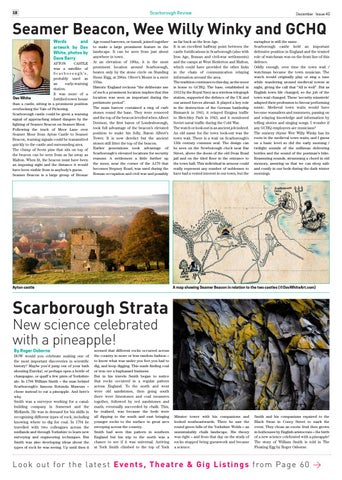
A map showing Seamer Beacon in relation to the two castles (©DavWhiteArt.com)
Scarborough Strata New science celebrated with a pineapple! By Roger Osborne HOW would you celebrate making one of the most important discoveries in scientific history? Maybe you’d jump out of your bath shouting Eureka!, or perhaps open a bottle of champagne, or quaff a few pints of Yorkshire ale. In 1794 William Smith – the man behind Scarborough’s famous Rotunda Museum – chose instead to eat a pineapple. And here’s why. Smith was a surveyor working for a canalbuilding company in Somerset and the Midlands. He was in demand for his skills in recognising different types of rock, including knowing where to dig for coal. In 1794 he travelled with two colleagues across the midlands and through Yorkshire to learn new surveying and engineering techniques. But Smith was also developing ideas about the types of rock he was seeing. Up until then it
seemed that different rocks occurred across the country in more or less random fashion – to know what was under you feet you had to dig, and keep digging. This made finding coal or iron ore a haphazard business. But in his travels Smith began to notice that rocks occurred in a regular pattern across England. To the north and west were old sandstones, then going south there were limestones and coal measures together, followed by red sandstones and marls, eventually succeeded by chalk. This, he realised, was because the beds were all dipping to the south and east bringing younger rocks to the surface in great arcs sweeping across the country. Smith had seen this pattern in southern England but his trip to the north was a chance to see if it was universal. Arriving at York Smith climbed to the top of York
Minster tower with his companions and looked southeastwards. There he saw the round green hills of the Yorkshire Wolds – an unmistakably chalk landscape. His theory was right – and from that day on the study of rocks stopped being guesswork and became a science.
Smith and his companions repaired to the Black Swan in Coney Street to mark the event. They chose an exotic fruit then grown in hothouses by English aristocrats – the birth of a new science celebrated with a pineapple! The story of William Smith is told in The Floating Egg by Roger Osborne.
L o o k o u t fo r t h e l a t e st E ve n t s , T h e a t re & G i g L i st i n g s f ro m Pa g e 6 0 >