A Commentary by
Leslie Brothers
Why ART
Before McDonough – Limited Exhibit Space
Susan Russo remembers how the art department struggled with its limited exhibition space before the McDonough opened. Russo served as chair of the department from 1991, the year the museum opened, until she retired from the position in 2007. Before the McDonough, she said, art and design students had a one-room gallery in Kilcawley Center and another small gallery in Bliss Hall. The department couldn’t offer “capstone” exhibit experiences for seniors and therefore could not qualify for an important accreditation by the National Association of Schools of Art and Design. YSU has maintained NASAD accreditation since 1994 – the credential was a goal that Russo began pursuing when the museum opened. Now, Russo performs accreditation visits and offers training for the NASAD at art colleges all over the country, so she’s had plenty of opportunity to compare YSU to other schools. “I would say that the McDonough puts us in the top 5 percent nationally in terms of size of the facility, staff and design,” she said. “We take it for granted now that we have this amazing space, but it was truly a wonderful gift.” Susan Russo
Philanthropist’s Gift Russo recalls the excitement on campus following the announcement that Dr. John J. McDonough, a well-known Youngstown physician and art collector, planned to sell a painting and donate the proceeds to YSU to help fund construction of a university art museum. The painting, “Gloucester Harbor” by Childe Hassam, was sold at auction for just over $1 million; another $1.5 million came from the state of Ohio’s capital budget, to cover the total $2.5 million construction cost for the project. Youngstown architect Paul J. Ricciuti is credited with recruiting the prestigious Gwathmey Siegel architectural firm to design the museum. “I knew John (McDonough) wanted a special building, so I contacted Charles Gwathmey, the founding partner,
Matters
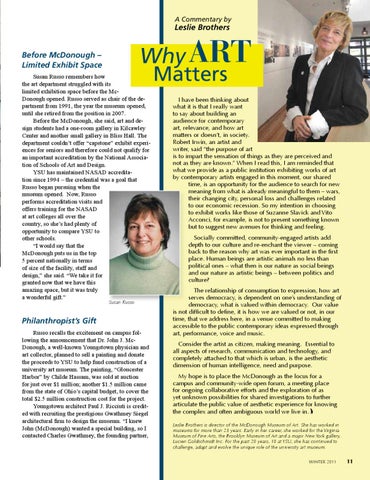
I have been thinking about what it is that I really want to say about building an audience for contemporary art, relevance, and how art matters or doesn’t, in society. Robert Irwin, an artist and writer, said “the purpose of art is to impart the sensation of things as they are perceived and not as they are known.” When I read this, I am reminded that what we provide as a public institution exhibiting works of art by contemporary artists engaged in this moment, our shared time, is an opportunity for the audience to search for new meaning from what is already meaningful to them – wars, their changing city, personal loss and challenges related to our economic recession. So my intention in choosing to exhibit works like those of Suzanne Slavick and Vito Acconci, for example, is not to present something known but to suggest new avenues for thinking and feeling. Socially committed, community-engaged artists add depth to our culture and re-enchant the viewer – coming back to the reason why art was ever important in the first place. Human beings are artistic animals no less than political ones – what then is our nature as social beings and our nature as artistic beings – between politics and culture? The relationship of consumption to expression, how art serves democracy, is dependent on one’s understanding of democracy, what is valued within democracy. Our value is not difficult to define, it is how we are valued or not, in our time, that we address here, in a venue committed to making accessible to the public contemporary ideas expressed through art, performance, voice and music. Consider the artist as citizen, making meaning. Essential to all aspects of research, communication and technology, and completely attached to that which is urban, is the aesthetic dimension of human intelligence, need and purpose. My hope is to place the McDonough as the locus for a campus and community-wide open forum, a meeting place for ongoing collaborative efforts and the exploration of as yet unknown possibilities for shared investigations to further articulate the public value of aesthetic experience for knowing the complex and often ambiguous world we live in. Leslie Brothers is director of the McDonough Museum of Art. She has worked in museums for more than 25 years. Early in her career, she worked for the Virginia Museum of Fine Arts, the Brooklyn Museum of Art and a major New York gallery, Lucien Goldschmidt Inc. For the past 20 years, 10 at YSU, she has continued to challenge, adapt and evolve the unique role of the university art museum.
WINTER 2011
11