Connection
The Thearchitecture architectureand anddesign designjournal journalof ofthe theYoung YoungArchitects ArchitectsForum Forum
This issue: Citizen architect Building on design and professional leadership experience, emerging professionals are making meaningful contributions in their communities. Learn how they are increasing the visibility of the profession and demonstrating the value of architects in unique ways.
This issue: Redefining value
Enter description copy: Andis milibus, sit et ant ut quatestempor sum aute in enectinctem. Ga. Ut lam conse reicil mil magnatem destet quiandest, voloreprovid que cusandignis explaut acero dem aligend itatecaes elitiur
2020 2019
Q2 Q2 Vol.1718 Vol. Issue02 02 Issue
Connection
2020 Connection editorial committee Editor-in-chief, graphic editor Senior editor Senior editor Senior editor Journalist Journalist Journalist Journalist Journalist Journalist Journalist
John J. Clark, AIA Amaya Labrador, AIA Beresford Pratt, AIA Clarice Sollog, AIA Arash Alborzi Gabriela Baierle, AIA Robyn Engel, AIA Jennifer Hardy, AIA Katie Kangas, AIA Miranda Moen Katelyn Rossier, AIA
2020 Q2 contributors Contributing journalist Contributing journalist Contributing journalist Contributing journalist Contributing journalist Contributing journalist Contributing journalist Contributing journalist Contributing journalist Contributing journalist Contributing journalist Contributing journalist Contributing journalist Contributing journalist
Katelyn Chapin, AIA Ashley Hartshorn, AIA Marie McCauley, AIA Anna McCorvey Vin Minkler, AIA Hirbod Norouzianpour Jessica O’Donnell, AIA Caitlin Osepchuk, AIA Jonathan Oswald, AIA Stephen Parker, AIA Amy Rosen, AIA Jason Takeuchi, AIA Matt Toddy, AIA Sarah Wahlgren Wingo, AIA
2020 YAF advisory committee Chair Vice chair Past chair Advocacy director Communications director Community director Knowledge director Strategic vision director AIA National Strategic Council representative College of Fellows representative AIA staff liaison
Ryan McEnroe, AIA Abi Brown, AIA Lora Teagarden, AIA Jennie West, AIA John J. Clark, AIA Katelyn Chapin, AIA Jessica O’Donnell, AIA Matt Toddy, AIA Laura Lesniewski, AIA Frances Halsband, FAIA Jessica Rogers, Assoc. AIA
Young Architects Forum an AIA member group Connection is the official quarterly publication of the Young Architects Forum of AIA. This publication is created through the volunteer efforts of dedicated Young Architect Forum members. Copyright 2020 by The American Insititute of Architects. All rights reserved Views expressed in this publication are solely those of the authors and not those of The American Institute of Architects. Copyright © of individual articles belongs to the author. All images permissions are obtained by or copyright of the author.
2
Vol. 18, Issue 02 2020
Contents 05 Editor’s note John J. Clark 06 President’s message Jane Frederick, FAIA 08 YAF chair message Ryan McEnroe, AIA 09 Roadmap to Philly: How to present at A’21 10 Strategic Council update Amy Rosen, AIA and Stephen Parker, AIA 12 YAF leadership response to COVID-19 14 Citizen architects during COVID-19 Katelyn Rossier, AIA 16 Embracing change Katie Kangas, AIA 18 What it means to be an architect in a time of crisis Jonathan Oswald, AIA 20 Community First Village Katie Kangas, AIA 24 Innovation spotlight: Betterhood Matt Toddy, AIA
36
Young architect award spotlight: How to empower neighbors and transform communities, an interview with Wayne Mortensen, AIA Clarice Sollog, AIA
40 Meet community-focused architect Lisa Sauvé, Caitlin Osepchuk, AIA 44 Meet justice architect Christine V. Smith Ashley Hartshorn, AIA 46 The philosophical shift in justice architecture: Meet justice architect Andre Voss Jessica O’Donnell, AIA 50 Meet justice architect Tommy Sinclair Jason Takeuchi, AIA 53 Multifaceted leadership: An interview with Michael Ayles, FAIA Katelyn Chapin, AIA 56 The YES! House: Rural advocacy and the power of creative people Miranda Moen 61
The challenge is the opportunity Anna McCorvey, RA
62 Practicing architecture in small town America Marie McCauley, AIA
28 GrowHub: A case study on community-based urban agriculture Arash Alborzi, AIA
66 Where can I serve? Sarah Wahlgren Wingo, AIA
32 AIA Pittsburgh facade improvement program John J. Clark, AIA
68 Teaching architecture through community engagement Hirbod Norouzianpour 72 Starting your own firm: A young architect perspective Vin Minkler, AIA
Cover image: The YES! House; Courtesy: Homeboat and Miranda Moen
3
Connection
Editorial team John J. Clark, AIA, NCARB Editor in chief Clark is an architect with RMKM Architecture in Albuquerque, N.Mex. Clark is a graduate of the University of New Mexico and is the 2019-20 Communications Director for the AIA National’s Young Architects Forum.
Amaya Labrador, AIA Senior editor Labrador is a healthcare architect in the Houston studio of Perkins and Will. She currently serves on the AIA Houston Board of Directors, and is the Young Architects Regional Director for the region of Texas.
Beresford Pratt, AIA, NOMA Senior Editor Pratt is an Architect and BIM Manager at Ayers Saint Gross with a passion for education spaces, community engagement, and JEDI . He is the Young Architect Regional Director for the MidAtlantic region.
Clarice Sollog, AIA, NCARB, LEED AP Senior Editor Sollog is a Project Architect at CDM Smith in Orlando, FL. She was awarded the AIA Orlando Fred H. Pryor Young Architects Forum Achievement Award in 2014 and is the Young Architect Regional Director for the Florida Caribbean Region.
Arash Alborzi Journalist Alborzi is a doctoral candidate at the University of Florida, School of Architecture in Gainesville, Florida. Alborzi’s dissertation focuses on feasibility of urban agriculture in existing cities.
Gabriela Baierle, AIA LEED AP BD+C Journalist Baierle is an associate architect at Arrowstreet in Boston. She is also cochair of the Boston Society of Architects EPNet and an adjunct faculty member at the Boston Architectural College.
Robyn Engel, AIA Journalist Engel is a project architect at IKM Architecture in Pittsburgh, Penn. An ardent reader, Ms. Engel most recently served as jury chair for the 2019 Lynd Ward Graphic Novel Prize.
Jennifer Hardy, AIA Journalist Hardy is an architect at Payette in Boston, Mass. Hardy is an active member at the Boston Society of Architects and serves on the membership committee and is the founding chair of the women in design emerging leaders group.
Katie Kangas, AIA, NCARB Journalist Katie is a principal architect at Pasque Architecture in Minneapolis, Minn. As the North Central States Young Architect Regional Director, Kangas connects emerging professionals with resources to position them for success.
Miranda Moen Journalist Moen is an architectural designer based in Austin, Minn. Moen is passionate about rural and cultural heritage research, collaborating with clients in Minnesota and Iowa.
Katelyn Rossier, AIA Journalist Katelyn is an architect at SmithGroup in Pittsburgh, Pennsylvania. She is a graduate of Kent State University, and manages the blog, mentorarchitect.com.
4
Vol. 18, Issue 02 2020
Editors note:
Overview effect They see things that we know, but don’t experience. That the earth is one system and we’re all a part of that system.
- Frank White. Author, The Overview Effect
What can space teach us about civic duty? My experience on a New Mexico Spaceport project team has provided unique insight into an aspirational concept. The design is inspired by the overview effect, the cognitive shift in awareness experienced by astronauts when viewing earth from space. The percentage of humanity that has experienced this overwhelming awe is small, but this group acknowledges a profound change in their outlook of the Earth, its ecosystem, and its people. For example, dividing conflicts suddenly become less important and boundaries vanish. All nations and people are coherently connected and unified as one human race on one planet. Astronauts see and understand Earth as one living organism, and grow aware of its fragility in the black vacuum of space. While these realizations vary slightly, they also similarly compare to Buckminster Fuller’s concept of “Spaceship Earth” - that we’re all in this together. What might be the implications if more people can experience this change in mindset? Certainly it would not just be through the slim possibility of space tourism in the near future, but by growing awareness through dialogue and reflection. And how can architects grow to value a whole Earth perspective in our work? Challenged not only by a global pandemic, but also by global calls for racial equity, a unifying vision is critical
to achieve a common goal. This issue is a collection of perspectives from emerging professionals who are translating values of equity, unity and service, through their community-based leadership and work in the built environment. Jane Frederick, FAIA sets the stage by stressing that people “deserve spaces that are healthy, equitable, and safe,” (pg. 6) while YAF Chair Ryan McEnroe encourages members to apply their design leadership skills in communities (pg. 8). We include several perspectives detailing architects’ COVID-19 response in firm, profession, and community contexts. In these times of crisis, Jonathan Oswald, AIA, argues that architects can redefine our public image and value through community engagement (pg. 18). Through project spotlights, our team demonstrates how architects are building community through supportive housing (Community First Village, pg. 20), entrepreneurial housing (Betterhood, pg. 24), and urban agriculture (GrowHub, pg. 28). In young architect spotlights, we highlight community-focused architects and justice architects, who at times are “the voice of those who do not get to have a voice” (Voss, pg 46.) in the design of courthouses, detention centers, and other justice facilities. Finally our team encourages you to develop your own personal passions and values, as Vin Minkler, AIA, interviews four young
architects about what it takes to start and sustain a small practice. During a time in which we are physically separated and our differences are being highlighted, the Connection editorial committee hopes this issue inspires you to approach problem solving with a whole Earth perspective, using your skills and passions to draw people and communities together.
Editorial committee call Q3 2020: Call for submissions on the topic of equity, diversity, and inclusion initiatives in architecture. Connection’s editorial comittee welcomes the submission of articles, projects, photography, and other design content. Submitted content is subject to editorial review and selected for publication in e-magazine format based on relevance to the theme of a particular issue. If you are interested in building your resume and contributing to Connection please contact the editor in chief at: johnclarknm@gmail.com
5
Connection
President’s message:
Achieve positive, lasting change In our schools, office buildings, public spaces, and communities, people need and deserve spaces that are healthy, equitable, and safe. From the heroic efforts of front-line health workers to the more mundane contributions of average Americans staying home, everyone has a role to play in confronting the COVID-19 pandemic. Just as it always has when crisis strikes, the architecture profession mobilized immediately to do our part — demonstrating every day what it means to be a citizen architect. From the early days of the crisis, firms contributed resources and 3D-printing technology to produce protective masks. And special task forces took action to coordinate with public officials. The Rapid Response Safety Space Assessment Task Force has been working to refine best practices for identifying and converting existing buildings into temporary health facilities. Closely related is the Implementation and Community Outreach Task Force, which supports components’ efforts to mobilize local architects, implement recommendations of the Temporary Facilities Task Force, and identify community response and recovery efforts.
6
These efforts have been so effective that an alternate care site checklist produced by the AIA’s task force is now being distributed internationally by the United States Department of State, which translated the tool into three languages. While we continue this critical work to support the immediate medical response, we’re also looking ahead, applying the same health and safety principles toward eventually transitioning out of quarantine and back into offices, stores, restaurants, and schools. To that end, the AIA is convening virtual design charrettes with experts from the public health, engineering, and facilities management fields to develop solutions to safely reopen our buildings and plan for the future — including ensuring apartments and other housing are safer places to live. Supporting this essential work also means supporting the architecture community itself, and the AIA is committed to helping our community navigate these uncertain times. A third group — the COVID-19 Business Task Force — was formed for just that purpose, and it’s been working to identify challenges and find solutions to the economic disruption we’re all experiencing.
Vol. 18, Issue 02 2020
A number of economic information resources and ongoing free webinars are continually updated on the “COVID-19 resources for architects” page on the AIA’s website. Many of those resources are geared specifically toward supporting emerging professionals — including free expert résumé review through the AIA Career Center. Our Career Center is also offering employers discounts on job postings to help ensure we collect the widest range of job opportunity information. There’s no doubt COVID-19 will leave its mark on building practices. From spatial planning to materials to how we construct spaces — it could all be different. And at this pivotal moment, it’s as critical as ever that the architecture community supports young architects. As we work together to confront these challenges, we’re not starting from scratch. Many of the design principles that support healthier, more equitable spaces are the same ones we’ve been focused on for decades, hand in hand with resilience and sustainability strategies to address other shocks and stresses, including climate change. In our schools, office buildings, public spaces, and communities, people need and deserve spaces that are healthy, equitable, and safe. We’ve seen growing public recognition of that truth, and now it’s gained new urgency. Architects have a rare opportunity to achieve positive, lasting change out of this tragedy. And, with all our skills and perspectives, we’re uniquely positioned to provide meaningful solutions that could protect people.
Jane Frederick, FAIA
Frederick is principal of Beaufort, S.C. based Frederick + Frederick Architects, an award-winning firm specializing in custom residences. Frederick is the 2020 AIA President.
7
Connection
Chair’s message:
Think global, act local “Citizen architect” is a phrase that I have heard a lot about. I’ve been associated with the field of architecture for over 20 years now, and I’ll admit, I never really understood what this broad term meant until recently. The term is commonly associated with the late Samual “Sambo” Mockbee, Thomas Jefferson, and architects who serve as mayors to their cities, all of whom leaving an incredible impact on the profession. This always felt out of reach for someone who works in a traditional architecture practice, until I realized how the little things we do each day can start to make an impact. The AIA goes on to further explain that each of us are citizen architects and we should use our insights, talents, training, and experience to contribute meaningfully, beyond self, to the improvement of the community and human condition. In essence, “citizen architects” give back to their communities through civic work in public roles to help educate on the value of architecture. Or even more simply put if you are an architect, you should try to get involved and do good stuff. Most of us all hold full-time jobs that, rightly so, take up the majority of our time and dedication. As we are asked to give more personal time in service back to the communities in which we inhabit, it’s completely reasonable to expect some bitterness, as we all value our time.
examples of skills that are deeply ingrained in design education and training. When these skills are applied in the larger context of civic work, they offer a powerful method for advancing conversations. I am a citizen architect. I stay informed and advocate for higher living standards, the creation of a sustainable environment, quality of life, and the greater good. I make time for service to the community through various food and clothing donations, blood drives, community sponsored running events, nonprofit builds, trash cleanups, and invasive species removals. It is not something I actively focus on any given day, and it’s nothing overly significant (I’m no Sambo), but my efforts are contributing to my community in a meaningful way that is beyond self-motivation. Using a recent COVID-19 example, I have seen a number of architecture professionals become involved making PPE, specifically face shields, with their 3D-printing capabilities. This is a great example of how individuals are making a positive impact within their local communities. Now the ask; can you too be a Citizen Architect? Can you engage with a local disaster assistance program; join your condo board; lead a church committee; join your parent teacher organization or school board; join your neighborhood design review board; or even better run for public office? Think global, act local!
Today more than ever, there is a critical need for leadership and creative vision in our communities. Architects can fill these leadership roles and strengthen communities through the power of design to improve the quality of our cities, states and nation. Creative problem-solving and teamwork are only two
Ryan McEnroe, AIA, ASLA, LEED AP
Firstname Lastname As a licensed architect and landscape architect who grew ipsum up on andolor organic McEnroe Lorem sitfarm, amet, has a unique understanding sustainability consectetur adipiscingofelit, sed do practices. An associate at Quinn Evans eiusmod tempor incididunt ut labore. Architects, he serves as the 2020 YAF Chair.
8
Vol. 18, Issue 02 2020
Roadmap to Philly How to present at A’21
The road is paved for emerging professionals to present quality content and new ideas at the AIA 2021 National Conference on Architecture! For more resources on navigating these 12 steps, contact your region’s Young Architects Regional Director (YARD), see network.aia.org/yaf for their email.
Call for Proposals
Decide
Develop your idea. Create a catchy title, session summary, & learning objectives.
Have a great idea. Share it with your friends. Decide to submit it for A’21.
1
Start
2
Submit Phase 1 Blind Peer Review from AIA volunteer pool.
3
May ‘20
Phase 1 Acceptance Notification from AIA
Wait...
Respond to comments, create a draft agenda, develop additional content, identify speakers & list their credentials.
The waiting game begins... Keep developing your session, identify potential speakers, & work on a session outline.
Be conscious of your speaker & panel selections. Diversity & inclusion play an important role in every proposal.
5
4
September ‘20
Notification
Submit Phase 2 Develop your idea. Create a catchy title Session summary & learning objectives.
Note: Workshop proposals have different submission deadlines. 6
October ‘20
AIA notifies you that your session is accepted to A’21!
Wait... The waiting game continues...
7
11
Submit draft session slides for AIA peer review. Continue developing the session. Finalize your travel plans to Philly.
9
April ‘20
Final Submission
Present at A’20
Submit final presentation, slides, & handouts.
Join the AIA National Conference in Philadelphia, Penn.
May ‘20
12
November ‘20
Submit Materials
Incorporate comments, finalize presentation, slides, & handouts.
May ‘20
Plan your trip to Philadelphia!
8
Receive Peer Feedback
10
June ‘20
June 16-19, 2021
PHILADELPHIA
9
Connection
Strategic Council update:
Mental health and architecture incubator As the “think tank” for the Institute, the AIA Strategic Council breaks into several workgroups with specific study areas each year. Through this incubator concept, the Council explores embryonic ideas that are emblmatic of the future thinking we strive for as a profession. For 2020, the study areas include: • • • • •
Affordable/Equitable Housing Technology’s Impact on Practice Beyond 2030 Mental Health and Architecture The Rural Agenda
Amy Rosen and Stephen Parker, co-conveners for the Mental Health and Architecture Incubator, provide a look into the Incubator’s goals and research to date. Refinement of topic We aim to address how social stressors weaken the ability of our members and communities to be mentally resilient. Specifically, we intend to examine mental health in relation to our designs and our community engagement processes in order to provide the Institute with a means for creating more equitable communities through the framework of the Big Move. By addressing the leadership role of the AIA and its members as collaborators within communities, we have an opportunity to: • Encourage a broader understanding of the relationship between mental health and the spaces we design. • Educate our community members about the mental health impacts of climate change. • Foster productive dialogue surrounding the mental health benefits of equity, empathy, and inclusivity. • Collaborate with fellow leaders to address the traumarelated impacts of our environments. Our topic of inquiry is specifically aimed at the trauma associated with the increasing changes in our climate and the subsequent rise of solastalgia, the lived experience of
10
negatively perceived change to a home environment. Despite the fact that our environment and our mental health are becoming more inextricably linked, there is an apparent lack of actionable solutions related to mental health. In light of the current crisis, our topic remains centered on trauma. However, we hope to make the best of the situation, realizing that the global, local, and individual mental health repercussions arising from COVID-19 are a potential shortterm example of what may arise from the long-term and more devastating effects of climate trauma. In particular, we are examining how the elimination of social isolation, the encouragement of interactive community relationships, and the design of environments that promote equitable access to health care, housing, transportation, and jobs can aid in building communities that promote positive mental health and well-being through architecture and design. Updated project goals & potential impacts Goal: To foster a productive dialogue surrounding the mental health benefits of equity, empathy, and inclusivity through architecture. Objective: Identify how these attributes can be utilized to design environments that enable equitable access to community resources and support, including but not limited to: healthcare, housing, transportation, education, and an interactive community. Given our niched perspective, our goal coming out of Grassroots was to gain a more well-rounded and thorough understanding of the research/knowledge already compiled, as well as the relevance of our profession and the Institute in this conversation. As we progress, we intend to maximize our outreach to allow external subject-matter experts and our rapidly changing global variables to help us define the specific questions we should be asking in the first place, rather than presume readily drawn conclusions.
Vol. 18, Issue 02 2020
Ultimately, we hope to provide an opportunity for the AIA to take a proactive, insightful, and timely leadership role in discussions of mental health and how our members can provide a positive impact, in whichever form that takes. Alignment with the Big Move Thus far, the AIA has defined equitable communities through a mostly design-oriented lens. Specifically looking at the Framework for Design Excellence, this mind-set is evident in the Designing for Wellness measure, for instance, in that the recommended focus topics are correlated to physical health primarily. We believe that mental health issues, such as trauma, must be expanded upon and elaborated further in the framework. Example: Within the Design for Wellness measure, “Happiness” is cited as a key indicator of success. Within the definition of happiness, our existing focus is primarily on preventative measures (see below). Given the uncertainty of our changing climate, we must incorporate recovery-oriented measures as well. “People are happiest when they perceive a sense of control. This can be as simple as being able to open a window or adjust a thermostat. Think about flexible spaces that can be individually manipulated and provide options to experience different environments. Generally, more choices — even if additional choices are unlikely to be chosen — will increase perceived control.” Thus, to expand the potential of the Big Move and provide the AIA with a more thorough definition of “equitable communities,” our Incubator is embracing the opportunity to perform multidisciplinary outreach to gain a more thorough understanding of the mental health implications of our design decisions, as well as the potential preventative measures our industry can adopt. This will help us align mental health considerations with our design process and holistically address how we rebuild communities, both physically and socially, after a crisis. Update to scope of activities and key milestone dates We are currently working as a group to perform a deep review of the AIA Framework for Design Excellence through the lens of mental health. Specifically, we are leveraging existing research and collaborations with external subject matter experts to identify noticeable gaps in the existing Framework to inform future explorations, understanding, and opportunities for design strategies. Amy Rosen, Assoc. AIA
Rosen is a Sociospatial Designer at PLASTARC in New York. She served as 201819 AIAS President and 2019 Student Director on the AIA Board of Directors. Rosen is an At-Large Representative on the Strategic Council, and a co-convener for the Mental Health and Architecture Incubator.
The Incubator hosted an informational Strategic Council working session with a guest speaker, Dr. Chabay, MD, a neurologist in Los Angeles, for a discussion surrounding neurology and architecture amidst the current crisis. COVID-19 raises a number of mental health issues to the forefront, and this call served as a resource and an opportunity to raise awareness of the wide-spread neurological repercussions of the pandemic, such as the effects of trauma, stress, and change of environment on the brain. Over the past 6 months we have established the physical and mental health implications of community food deserts, lack of open spaces and recreational facilities as well as poor housing stock and limited economic opportunities. As our Incubator continuously evolves our focus from climate trauma to the spatial effects of the pandemic on mental health, our next cycle of investigation will include a deliberate examination of the connection between civil unrest and urban design. This includes further diversifying our pool of collaborators and having frank conversations on the mental health burdens of marginalized communities and our role as designers. Racial inequality is directly tied to the definition and understanding of equitable communities - especially regarding the mental health repercussions therein and the accessibility of mental health resources. On June 25th, the Mental Health and Architecture Incubator facilitated the June Virtual Strategic Council Assembly. We facilitated a discussion on mental health in order to embed an understanding of the importance of mental health for architects to consider across practice. We invited two guest speakers to help frame our discussion: Frederick Marks, AIA, LEED AP BD+C, Six Sigma Green Belt, and Erin Peavey, AIA, NCARB, LEED AP BD+C, EDAC. Key questions introduced during this session included: • What role does mental health play in the design of equitable communities? How can design address collective trauma introduced by disasters in particular? • Mental health is not an isolated issue; its impact is broad. How can our practices, Knowledge Communities, and Institute incorporate mental health considerations more deliberately? • How can mental health considerations in design improve the lives of marginalized communities in times of civil unrest?
Stephen Parker, AIA, NCARB
Parker is an architect and planner at SmithGroup in Washington D.C. with a focus on behavioral health design. He is an At-Large Representative on the Strategic Council and co-covener for the Mental Health and Architecture Incubator, and former YAF Advocacy Director.
11
Connection
YAF leadership response to COVID-19 Beginning with a monthly leadership call on March 19, the efforts of the Young Architects Forum Advisory Committee and Young Architect Regional Directors quickly pivoted to address concerns of emerging professionals during the COVID-19 pandemic while continuing our work on practice innovation, equity and inclusion, and climate impact. Along with the NAC and AIAS leadership, YAF leadership is in communication with the AIA College of Fellows, Strategic Council, EQFA Committee, Large Firm Roundtable, and AIA-AGC Joint Committee, among others, to ensure that the voices and concerns of emerging professionals are heard.
Accelerate practice innovation.
Without trying to duplicate or distract from the many helpful articles, discussions, and compiled resources on the practice of architecture during these times, YAF leadership hopes to provide insight into our current efforts and view of concerns and opportunities. We also invite you to share your experiences with the full committee by reaching out on our Knowledge Net discussion board, following us on Twitter, Instagram, and Facebook, or sending a note to emergingprofessionals@aia.org.
Young architects, especially those already in leadership positions, can set the trajectory of the profession by advocating for agile, flexible, and innovative practice models. Former YAF chair Evelyn Lee spoke with Archinect on business continuity challenges and how firms can continue to be agile after the pandemic.
Learn from 2008, and work to avoid a talent and leadership gap. The YAF is advocating for the continued support of emerging professionals to avoid a workforce pipeline gap due to the current economic climate, similar to the workforce and leadership gap created by the 2008 financial crisis. The YAF encourages our members, especially those in AIA and firm leadership roles, to convey to firms the importance of the continued support of EPs and their professional development. This includes maintaining intern development programs and the hiring of new grads and/or summer interns. We appreciate the work of the AIA EQFA Committee, Large Firm Roundtable, and AIAS for their work on this matter and look forward to additional discussions with these groups.
12
Many parts of our slow-to-change profession were forced to adapt in two weeks’ time because of work-from-home mandates that affected the entire AEC industry and our clients. We are operating within an experiment, much like a startup, with the opportunity to measure and learn from this experience to create lasting change in how we practice. What practices, policies, and technologies are we learning that will leave our professions, our firms, and each of us in a stronger position for success?
Young architects are now in a better position to strongly advocate for more equitable work-life solutions. All levels of practice now have lived experience that can challenge earlier concerns about remote work involving productivity, meeting client expectations, and maintaining an office culture. We can identify best practices that are currently working while gaining an awareness of practices that need to be unlearned. This will help to define what work-life balance could look like moving forward, including thoughtful, realistic, and mutually agreeable work-from-home and family leave policies for those caring for children and elderly family. Another reason to advocate for innovative practice models is that they better align with the AIA’s climate actions goals. Several outlets are reporting that the pandemic and its lockdown responses are temporarily reducing fossil fuel consumption, greenhouse gas emissions, pollution, and energy use. Is working from home a more carbon neutral alternative to commuting to a large, multi-tenant office building? Are virtual conferencing and site visits the greener alternative in the future when in-person meetings might resume?
Vol. 18, Issue 02 2020
Gain business knowledge to build a resilient workforce.
Make an effort to build community.
Architects are quick to champion resiliency in the built environment as a response to the rapidly changing climate. Knowing that this will not be the last setback we will face in the business climate, this can be an opportunity for young architects to gain business knowledge on the specifics of this situation and assess the profession’s vulnerabilities. By being prepared for economic challenges, we can design a more resilient workforce and profession. While many business resources are available on the AIA website, this can also be an opportunity to reach out to a principal or firm leadership to gain unique and specific insight. The YAF encourages our members to take the time to research and ask questions regarding:
Emotional intelligence (EQ) is the ability to recognize and understand your own emotions and those of others while using this understanding to guide actions and decisions. During this time, young architects can learn to improve our EQ to support our friends, colleagues, clients, and networks. What do I say to people who are being negatively affected? How and when do I say it? How can we break the ice and maintain positivity in the face of these challenges? Justin Bariso’s 2018 book, “EQ Applied: The Real-World Guide to Emotional Intelligence,” is now free to download as a PDF to help frame answers to the questions posed above and the many others that we are faced with in our daily interactions.
• PPP and SBA loans. • How decisions about furloughs and layoffs are made. • Practicing transparency and communication in difficult situations. • Making projections related to a specific industry or project type during this time. • Creative marketing strategies. Additionally, by increasing the time dedicated to professional development, you can find new ways to support your firm during these challenging economic times. For example: • Can you use overhead time for marketing or other projects? • Can you generate a business development initiative or get business development training? • Can you virtually reconnect with your business contacts to help prepare your firm for its next project? Use newly found free time for personal and professional development. Work-from-home and telecommuting policies have signaled a welcomed reset to our work-life patterns. Family goals, fitness goals, and physical and mental health can all be improved during this time. And while there certainly might be more time to explore a new hobby, the YAF also encourages members to increase time dedicated to professional development during these weeks of uncertainty. Make an effort to update your professional goals. Build new skills and gain new certifications that might help you reach your goals faster. Additionally, find a moment to update your résumé and portfolio in anticipation of a potential change in employment, an award application, a leadership or volunteer position, or a future RFP response. Save photos, diagrams, and sketches of projects that you were personally responsible for. Add your specific professional and project experience and volunteer and leadership roles that might not be up to date. When this is completed, the AIA Career Center is offering free expert résumé review. (On your account overview page, scroll to the TopResume section at the bottom to submit.)
Local emerging professional groups continue to build community within the AIA and local design communities through virtual networking opportunities including trivia nights, bingo, and happy hours. These happy hours can also be dedicated to keeping colleagues accountable to stated personal or professional goals. Mentorship can definitely still occur virtually as evidenced by the transitions of AIA Columbus’s ARCHway Mentorship program and AIA Connecticut’s WIA Committee 4x10 Initiative to virtual platforms. As Katie Rossier notes in her article on virtual mentoring, this pandemic opens up the opportunity to expand your network beyond your local contacts, during this time when people of all levels are more available. Over the past few weeks, YAF leaders have noted how seeing someone else’s face can be encouraging during this time of isolation and how building a virtual community in your office is a crucial step to help firms emerge stronger from this crisis. Everyone can play a role in maintaining office culture in creative ways. The virtual coffee pot is a unique example of connecting shared by College of Fellows Secretary and liason to the YAF Frances Halsband. Each day, a standing virtual meeting is set up for casual conversation, simulating a coffee pot or water cooler. You can share how your office culture has adapted in our discussion board. Finally, find a moment to build community by giving back. From emerging professionals who have been affected by a change in employment status to local students looking for internships, you can take some time to offer support.
Young Architects Forum Advisory Committee Ryan McEnroe, Chair Abi Brown,Vice Chair Lora Teagarden, Past Chair Katelyn Chapin, Community Director John Clark, Communications Director Jessica O’Donnell, Knowledge Director Matt Toddy, Strategic Vision Director Jennie West, Advocacy Director
13
Connection
Citizen architects during COVID-19 A “citizen architect” has typically focused on the call to action for architects to take a greater role in civic advocacy for our communities. The AIA Citizen Architect Handbook focuses on encouraging civic engagement through three main categories: 1.
Private-sector architects licensed in the U.S. with an established portfolio of accomplishment in distinguished public facilities. 2. Architects employed in the U.S. public sector or in U.S. government agencies that manage or produce public architecture. 3. Public officials or private individuals advocating for or furthering public awareness and appreciation of quality public architecture. Architects and engineers are natural citizen architects, even if not all of us sit on a board of directors or a national committee or hold public office. Every one of us is committed not only to the design and experience of the community within the built environment, but also to giving back to the community, leading policy changes, and being a civic leader every day. During unprecedented times, like the COVID-19 pandemic, each of us in this profession can make a difference by being natural civic leaders beyond the traditional public-office sense. We are an agile profession that is ready to step up to whatever the world and our communities need. Quick to Act As the pandemic escalated in hot spots around the United States, architects, planners, and engineers were called upon to help transform large commercial facilities into temporary field hospitals. These were quick actions taken by local firms working with the Army Corps of Engineers and the Federal Emergency Management Agency. SmithGroup has been a part of a number of requests like this with a turnaround time of just a matter of days to develop a plan. The Los Angeles Convention Center was highlighted in an Architect magazine post, “These Architects Are Addressing COVID-19 Health Care Infrastructure Capacity.” These facilities have been transformed to deal with the overflow capacity that hospital systems are experiencing but also to service the safety needs of the staff,
14
having zones of negative pressure for the most critical patients. These plans also focused on the need to change these venues back to their original state once they are no longer needed as medical facilities. For instance, restrooms and showers are raised (some in trailers) so that all the plumbing is run above the existing floors. This allows the facilities to be constructed quickly and leave no damage to the structure. Innovators As creative minds and innovators, we naturally think of how our office technologies can help our clients, as well as the community. SmithGroup offices and those of other design firms, universities, and even individuals are helping with the need for personal protective equipment (PPE). Several of SmithGroup’s offices are creating face shields like the image below. This involves repurposing resources, like 3D printers, to create something that the community needs. Staffers have also made cloth face masks during their time at home with family. What types of tools does your office have that you can use to help beyond this pandemic? Is there a need in your community that your office can support? The pandemic has shown that there are a variety of ways architects can help the community beyond being part of a public office or a board.
Vol. 18, Issue 02 2020
Re-engineering An article by SmithGroup engineers George Karidis and Rob Thompson, “Climate-Informed HVAC Increases in Relative Humidity May Fight Pandemic Viruses” reviews how existing HVAC systems can be modified to help hospitals mitigate the virus’s spread. They review the connection between relative humidity and shorter airborne and surface survival times. There are some facilities that can adjust easily to changing their relative humidity to the ideal range of between 40 and 60 percent, but it depends on the system, location, and time of year. The virus may resurge in the fall. This is something we can prepare for now, giving hospital systems months of opportunity to upgrade their systems, if needed, to get the relative humidity to that range before it is needed. It is up to us as architects and engineers to have the conversation with hospital systems, review their HVAC capabilities, and provide a solution that can be implemented before a resurgence or a new pandemic. The implications of COVID-19 will change the way we design the world around us as much as 9/11 changed airport design. Health care facility design changes over the coming months and years will have a domino effect into the designs of schools, workplaces, and other types of new buildings and renovations. What kind of changes in design and requirements do you think we will see based on this pandemic?
Resources: • “These Architects Are Addressing COVID-19 Health Care Infrastructure Capacity” Architect • “SmithGroup Provides Planning for Alternate Health Care Sites” • “Los Angeles Convention Center COVID-19 Response Study” SmithGroup YouTube presentation • “Climate-Informed HVAC Increases in Relative Humidity May Fight Pandemic Viruses” by George Karidis and Rob Thompson • “COVID-19 Notes From The Field: Advising Clients On Med/surg Room Conversion” Healthcare Design
Katelyn Rossier, AIA
Firstname Lastname Katelyn is an architect at SmithGroup in Lorem ipsum dolor sitShe amet, Pittsburgh, Pennsylvania. is a graduate of Kent State University, and elit, manages consectetur adipiscing sed the do blog, mentorarchitect.com. eiusmod tempor incididunt ut labore.
15
Connection
Embracing change How architecture firms are responding to COVID-19 The advent of COVID-19 has swiftly immersed us in a dystopian world worthy of Isaac Asimov. I have long enjoyed science fiction for its ability to imagine future repercussions of extreme circumstances. Normally I’m struck by the seeming impossibility of science fiction stories simply because we, as a society, tend to resist change. However, the changes forced on our society over the past few months have posed very real challenges to our work habits that could shift office standards faster than we have ever seen before. Architecture firms may be able to adapt quickly and nearly seamlessly because the unique circumstances surrounding COVID-19 make it easier to embrace change: Ubiquitous Circumstances Everyone is impacted. I have not met anyone who can say their life has been unchanged. Whether it is finances, job security, shopping, social engagements, family, schooling, graduation, prom, worship, hygiene, workouts, sports, or musical events, COVID-19 and the regulatory response has touched everyone in some way. Some may experience only minor changes in their daily habits — but no one can deny these events have affected all levels of our society. For architects, these people are our consultants, clients, and our own teams. Seeking Security Events that permeate every level of our society are rare. They shift our historical narrative, but we eventually adopt a new normal, with slightly altered routines or societal norms. During my life, I have seen how 9/11 heightened airport security and how the 2008 recession affected financial security. The events around COVID-19 and record unemployment levels have touched nearly every American’s sense of security. When we feel uncertainty — we more readily accept changes that promise a more secure future. Architecture firms that survive through each recession have developed methods of building resilience while adapting to new challenges. However, in 2008, many young architects left our industry to find security in different fields. Architecture firms and industry leaders need to stay vigilant to avoid another gap in talented future architects.
16
Plan for Resilience We can be certain only of the uncertainty in our future. Forward-thinking businesses — companies that attempt to preempt future struggles — thrive through unexpected outcomes that topple the unprepared. Architects constantly plan for the future. Our practice calls us to design for disasters, plan for maximum occupancies, and consider the full life of a building. Although no architect has claimed to have predicted a pandemic, many firms have adopted work flows and business systems that increase their resiliency during crisis. Digital Communication Pre-COVID-19, many architecture firms developed systems for their multi-office teams to collaborate on projects. The technical groundwork for such changes includes company servers, portable personal technology (laptops, cellphones, etc.), cloud-based BIM projects, and videoconferencing platforms. Architecture teams standardized these practices in the search for efficiency and increased flexibility. Firms with these systems in place and a backlog of projects have not skipped a beat. Many have smoothly transitioned inperson meetings to videoconference calls to keep their teams connected. Change was Already Here Videoconferencing is not new. Many project teams used it out of convenience. It allowed project teams across offices or even around the world to connect. However, most primary meetings assumed a physical space. Put simply, knowing the technology was available didn’t force anyone to rely upon it. Some stay skeptical of the new technology because of glitches or a steep learning curve. Because of COVID-19, most project teams suddenly were forced to rely solely upon videoconferencing. The biggest shock for some is that the technology delivered. Meetings continued. People connected. And business goes on.
Vol. 18, Issue 02 2020
Expanding Vocabulary As business continues, “Zoom” is joining “Google” as a 21st-century colloquial verb. Companies that didn’t have videoconferencing suddenly can’t afford not to. Nonprofits, churches, schools, families — everyone suddenly relies upon this new platform for communication. In a time when we are told to stay six feet from everyone, Amazon has sold out of webcams, and people’s need to be seen is being fulfilled virtually. Some architecture firms needed to quickly add these systems. For them, the past two months have been a bit of a scramble. But with fewer project inquiries, they have the time to build up their IT, servers, and systems to create a new way of working. Dumping Stereotypes With so many new digital communities, perhaps the skepticism from late adopters of technology will be shattered. I used to scoff at teenagers and college students who sat across from each other in a coffee shop, looking at their phones with headphones in. Now the younger generations, gamers, “tweeters,” Instagrammers, and YouTubers are leading the charge of continued content creation and digital conversations. Most of us would agree that these platforms cannot replace the connection of meeting in person. However, if someone is new to these social media platforms, they may be surprised at the appeal and ability to connect with people and topics they care about. In architecture firms, encourage younger staff to use their natural forms of communication to initiate digital conversations.
and continually ask questions and confirm their assumptions. Cultivating leadership qualities in young architects strengthens the entire team. Architects can no longer work in a vacuum. Collaboration is the key to completing evermore complex building systems and regulatory processes. Life Goes On No matter the repercussions of COVID-19, life will go on. Business will eventually resume. For some architecture teams, the extreme circumstances of COVID-19 forced their firms to catch up with contemporary practice, flexible hours, remote work, and trusting their employees. I’ve heard several architects sigh with relief at newfound freedoms. If firms didn’t already learn this lesson, I hope the current circumstances make it clear. Caring for team members is crucial. Firms have the power to remove regulatory barriers to reduce stress, empower individuals to work smarter, not harder, and enable all team members to thrive in their work. The COVID-19 pandemic hit us like a wave. If an architecture team stays nimble, it has the opportunity to ride out this wave until calmer waters return. Embracing changes that keep a team balanced and connected can shorten a team’s recovery time. Change isn’t easy. The technology and resources available to us make it possible to weather the upcoming uncertainties as a community of architects. If you find yourself struggling, seek out individuals and firms who are managing, observe, and adapt to strengthen your team. It is possible for life and work after COVID-19 to become better than before because of the resources and connections made during adversity.
Support New Leaders Emerging professional architects are ready and waiting for the opportunity to lead project teams during this virtual transition. Trusting individual team members to work remotely is critical to the success and sanity of managers and principals. Emerging professionals need to feel they have the opportunity and ability to fill gaps they see in processes and contribute to team cohesion. In turn, emerging leaders need to reach out
Katie Kangas, AIA, NCARB
Kangas founded her firm Pasque Architecture in March. She is building a process-centered practice to serve small communities and rural towns. Kangas is the Young Architect Regional Director for the North Central States Region.
17
Connection
What it means to be an architect in a time of crisis “Sorry to bother you on a Sunday — can you be in Scottsbluff tomorrow?” Four weeks into working from home during the COVID-19 pandemic, I received this text from my boss. My firm, HDR, had been asked to complete several facility assessments in rural communities throughout Nebraska, so we were deploying teams from Denver and Omaha to those sites with less than 24 hours’ notice. I was given the chance to lead one of the teams, an opportunity I was excited to accept. Despite the short notice and the seven-hour drive from Omaha to northwest Nebraska, I jumped at the chance to use my skills to help — in any small way I could. While these communities were hardly the epicenter of the outbreak, the work we had to do would make a real difference in the health of the people there. Generally, rural towns across Nebraska will send their sickest patients to Omaha to receive specialized care, assuming there are enough beds in the larger community. If that isn’t the case, local health systems could be overrun. Our task was to prepare reports on several hotels to give government agencies an idea of how much work and time it would take to convert them to inpatient facilities. I’m telling this story not to convince you of my status as an up-and-coming citizen architect — I wouldn’t even describe myself as particularly civic-minded — but because I believe I’m an unremarkable example of what any architect would do when presented with a chance like this. Few architects go into architecture without care for the qualities of the communities their work will shape. The problem is that the way architects see ourselves is not always in sync with the way the public we serve sees us.
“Architects have realized the problems we face are too complex for any one person to solve, so instead of top-down direction, we build and lead teams of specialists to tackle wicked problems.”
18
While the days of architects as caped (sometimes literally) crusaders — tripping in and out of studios dispensing arcane wisdom only they possess — are fading within the profession, that figure still looms in the public consciousness. Architects have realized the problems we face are too complex for any one person to solve, so instead of top-down direction, we build and lead teams of specialists to tackle wicked problems. But the marketing engines the modernists built still hum so effectively that architects face an uphill battle trying to convince everyone else that we’re not as great as they think we are, that we may not in fact have all the answers, even though we do have some. So what is the solution? If the public has been trained in an outdated concept of architecture, they can be retrained. And the best time to challenge and retrain these perceptions is during a crisis. A crisis has a way of stripping out all the hype, all the spin, and showing companies and people for who they are. The public often wonders whether architects provide value or knowledge beyond a flashy rendering. For the architect, there’s no question of value when you’re helping a community
Vol. 18, Issue 02 2020
or a hospital prepare for tomorrow when they could have no more patient beds and a line out the door. There’s no question of delivering on your promises when the structure is finished before the renderings are done. There’s no question of commitment or skewed priorities when you’ve stood beside a client in their defining moment, fighting for their interest and their needs, instead of your aesthetic. For me, a trip to rural Nebraska in the midst of a pandemic became a chance to reshape public perceptions of architects. As I met with hotel managers and facilities staff — all of us following strict social distancing and safety guidelines — they saw firsthand that architects will show up during a crisis because we possess specialized knowledge far beyond Photoshop and are eager to apply that knowledge in service to a larger “...behind those renderings community. I stumbled upon is a thought process fixated a better answer for that common on improving the lives of conversation when the people who will live telling someone with that place.” I’m an architect: “Oh, so you make those cool renderings?” “Yes, but behind those renderings is a thought process fixated on improving the lives of the people who will live with that place. Let me explain …” I reached a half-dozen people with this new understanding, but what would happen if all 100,000-plus licensed architects
in the U.S. took that same understanding to their children’s baseball games and neighborhood get-togethers and city council meetings? Could we kill the caped crusaders entirely and replace them with a concept of architects both more accurate and more meaningful? The bad news is that we will have more opportunities of this kind, as crises become more common and more intense. The good news is that we possess the knowledge, skills, and will to serve our communities in the midst of the crisis and remain there after it has passed. And if we do that effectively, maybe those crises will be fewer in the future. Who’s the next community leader we should be talking about? You are. You’re an architect.
Left: Habitat 2016. Volunteers from HDR’s Omaha Young Professionals Group participate in a Habitat for Humanity build. Above: Cleanup 2019. More than 90 HDR employees came together to clean up trash and debris along the American River Parkway in support of the Sacramento Valley Conservancy.
Jonathan Oswald, AIA, PMP, LEED AP Oswald is an architect at HDR in Omaha, Nebraska. He graduated from Montana State University with degrees in architecture and philosophy, and serves on his local AIA board and the Central States Region EP Committee.
19
Connection
Community First Village Designing supportive housing for the chronically homeless Sarah Satterlee, AIA Satterlee is the staff architect at Community First Village. She has lived in Community First Village for two and a half years and has firsthand experience with the benefits and challenges of the intimate community.
Outside of Austin, a uniquely resilient community has formed to make a lasting impact in the lives of formerly homeless individuals. The Christian organization, Mobile Loaves & Fishes, started by placing chronically homeless individuals in permanent housing across the city. The resources provided to these individuals went beyond financial needs. Mobile Loaves & Fishes provided counseling, connected individuals with the health care they needed, advised on signing leases, discussed spiritual needs, assisted with nutrition, etc. These efforts were very successful! This success prompted Mobile Loaves & Fishes to consider how they could expand their services and provide housing to more people. In 2014, Mobile Loaves & Fishes broke ground on a plot of land outside of Austin to build a new community from scratch. They built a dense community of tiny houses, with shared restrooms and kitchens. The tiny houses were made available through their application process. The formerly homeless individuals placed in these homes pay rent with funds they can earn through work opportunities onsite or through their own employment. Mobile Loaves & Fishes works with each individual so they feel ownership and inclusion in the community. To qualify as chronically homeless, a person must have experienced homelessness for at least one year and currently struggle with a disabling condition. The disabling condition may be one or several of the following: serious mental illness, substance abuse, or a physical disability. In February, the representatives of the Young Architects Forum and the National Associates Committee met in Austin. We toured the Community First Village and saw the way individuals
20
Beau Frail, AIA, NCARB Frail founded his own firm, Activate Architecture in Austin. His practice provides design services and leads community engagement for projects aiming to make a positive impact.
have thrived. The original village of tiny homes has expanded with a section of RVs and more tiny homes. The village has also broken ground on a second phase which adds 24 acres to the original 27 acre community. Phase II will add 310 homes that are either pre-fabricated, custom built by contractors donating their labor, or built by volunteers during day-long intensive builds. The village includes shared facilities for worship, commercial kitchens, gardens, mechanics shop, craft studio, and other facilities that allow community members to work and earn an income. Several missionals from the Mobile Loaves & Fishes community have elected to live among the formerly homeless and personally connect with the community members. Visitors are welcome to tour the facility and pay for car maintenance, local art, or concessions during outdoor movies. This interview of two architects captures the thoughts and process behind some of the unique designs that are implemented at Community First Village.
Katie Kangas (KK): How did you initially become involved with the Community First Village (CFV)? Sarah Satterlee (SS): I was interested in public interest design. I was connected with Community First Village through Our Community Corps, a service-learning apprenticeship program. It was a position to live and work in CFV for a few months. At the end of volunteering, they offered me a job. I started in property management, and I learned the ins and outs of how to operate a place like CFV. When CFV moved into Phase II of the site plan and building process, they realized they needed an architect to manage the consecutive construction projects.
Vol. 18, Issue 02 2020
21
Connection
I have learned what it takes to run a village. I’m learning every day. Everything we do here is new, so much has never been done before. We are currently building a “Community Work Entrepreneur Hub” for our Community Works program. We like to encourage diversified income in the fine arts, ceramics, arts & crafts, etc. Our e-commerce program is also launching soon. Our construction team is coordinating the volunteers, contractors, and construction and installation of homes in Phase II. We will be at a total of 50 homes by the end of May. Our goal is to move in 10 neighbors each month. Beau Frail (BF): I became involved with CFV through AIA Austin’s Design Voice Committee. I was part of the team that led the first design competition in 2015 and have helped advise on future initiatives. In 2018, Design Voice led a post occupancy interview of residents and staff living onsite. This resulted in recommendations for the existing designs, such as CFV residents’ requests for more storage in micro-homes, the importance of individual privacy and safety, increased access to bathroom and kitchen spaces, and the need for air conditioning retrofits in the micro-homes. CFV Phase II is currently under construction and Design Voice led the design charette which was an RFQ process for local architecture teams to work hand-in-hand with existing residents living in Phase I. Some of these Phase I residents will transition as ‘seed neighbors’ to Phase II, where they will welcome new residents and continue the community culture into the new phase. Each new home model was designed in collaboration with existing residents and will be built multiple times for additional neighbors. The 5 architecture teams chosen from the RFQ process started meeting with residents in 2019. During the charrette process, each design team worked with their client, a CFV resident, to discuss imagery and decide on priorities for their new home. The design teams then presented to their residents and responded to feedback through three follow up meetings. This models a participatory design process that allows the formerly homeless community to give direct input on designs and be actively involved in shaping the CFV vision. KK: What was your role? How has that evolved? SS: I have been living onsite for 2 1/2 years as the Staff Architect. My role is similar to a campus architect. I manage the design and construction processes as well as the overall site plan and building development. I manage the community effort of multiple architects and landscape architects. I work with the Director of Construction to transition these design services into construction. The process of iterating on designs has been a lot of fun! BF: In 2017, I started in a facilitatory role with the Open Architecture Collaboration. We talked with residents during weekly community dinners to develop planning suggestions. We developed a proposal for integrating the RVs with the original Phase 1 by building micro-homes on the RV site to blend the designs. I’m now volunteering through design
22
charrettes that propose inserting larger micro-homes (larger tiny homes that have their own bathroom and kitchen) into smaller micro-home groupings to allow missional members to live in sync with the residents. We want to blend housing types and people. We are also working on a path through the RV section of the site to connect Phase I with Phase II. KK: How does Community First Village model sustainable practices? BF: The compact nature of the homes helps with sustainability. There are shared kitchens that are shaded and open for natural ventilation. These create an organic arm in the middle of the community and encourage pedestrian environments. Phase 1 tried to orient homes so that a porch relates to at least 2 neighboring porches. These spaces tie people together. However, we all need a sense of privacy, so neighbors have the interior of their home. The porch used to be the cool area of the home, oriented to capture summer breezes passively. Over the years some high efficiency VRF units have been installed to further condition the homes. Neighbors can still use their porch and operable windows to save money by shutting off the AC. The community is naturally sustainable because they live with shared resources. SS: Our goal is to build homes that last a long time and do not use up a lot of resources. We try to reduce energy consumption with insulation. We have also become a testing ground for experimental constructio methods, such as 3D printed homes. It is exciting to be part of making innovative building technology available to traditionally marginalized communities. We also host volunteer projects for installing photovoltaics or rain water collectors. Our entire site is designed to be a community. It encourages micro-localism. If we can meet our neighbors’ needs within our community, they do not have to drive across town or ride the bus to get something. There are efficiencies within our community culture that are unique to our neighbors. For example, if you have extra food, you just offer it to a neighbor. If you are out of something, you ask a neighbor rather than running to a store. KK: What is the environmental impact of CFV and microhome design? SS: The way CFV was developed to create urban density with detached homes is an example of good stewardship and an efficient land use. Even though we build individual homes to better accommodate our neighbors’ specific privacy and health needs, our density is similar to traditional urban infill. The design of the micro-home and need to use shared facilities encourages people to live outside in their community. BF: The homes are designed to be durable and low maintenance. They have a plywood interior instead of gypsum board, which is more resilient and lowers maintenance costs.
Vol. 18, Issue 02 2020
KK: How can other architects approach these conversations and create change in their local community? SS: Be a visionary, use your abilities as an architect to imagine what could be. Don’t let existing urban strategies and prescriptive codes limit how we imagine our communities. Think outside the box in design solutions for how people can do life together. I encourage people to be ENGAGED in their community. Volunteer with people who are different from you. I have had the privilege to live in this community and gain experience firsthand and that has come with benefits and challenges. BF: See how you can engage with your community. I wrote an article on “Seven Steps to Improve Communities” that addresses this exact question. Mobile Loaves & Fishes hosts a conference (Symposium for Goodness’ Sake) for others to learn from their model and hopefully replicate similar communities in their cities. I encourage you to work through an existing program, such as One Plus, or start an in-house pro-bono initiative within your own firm. Don’t pass all the responsibility to public officials to address the social needs in your community. Take it on yourself to ask how you can help your neighbors and invite others to collaborate with organizations like CFV already doing good work in your community.
We have had to overcome several challenges, including increased cleaning and sanitization of shared spaces. There are usually hundreds of volunteers coming on site to the Village every week, but now the property is currently closed to any outside visitors as we navigate the challenges posed by the health crisis. Our neighbors used to lead those groupsof volunteers as a source of dignified income, so we have increased opportunities for income in other areas. We started offering meals so each neighbor has a hot meal every day. We also deliver donations of packaged food to reduce the need for residents to travel or take the bus. Our community garden delivers fresh produce and eggs to neighbors every week, which has also helped when food is difficult to access.
Visit their website for the full story.
“Be a visionary, use your abilities as an architect to imagine what could be. Don’t let existing urban strategies and prescriptive codes limit how we imagine our communities.”
KK: Living in Community First Village, how has COVID-19 impacted your community? SS: Quarantining in a community has a high risk but also a high reward. The high reward is that extroverts, like myself, can continue social interactions through social distancing. The acreage of our site is set up for social distancing. There is a lot of room outside for people to walk around.
Katie Kangas, AIA, NCARB
Kangas founded her firm Pasque Architecture in March. She is building a process-centered practice to serve small communities and rural towns. Kangas is the Young Architect Regional Director for the North Central States Region.
23
Connection
Innovation spotlight: Betterhood Rethinking housing as a tool for social equity Jonathan Barnes Jonathan Barnes earned his bachelor’s degree in environmental design from Miami University in Oxford, Ohio, and a Master in Architecture from the Harvard University Graduate School of Design. Barnes previously practiced with the Chicago office of Skidmore Owings & Merrill on new-construction and renovation projects in New York, Washington, San Francisco, and London, including the development of the NBC Tower, one of Chicago’s premier high-rise buildings. As managing and design principal with JBAD, Barnes has led design teams in architecture, planning, and interiors projects for over 24 years with award-winning results. At JBAD, Barnes has focused on urban mixed-use and infill projects in the private and public sectors, including multi-family, commercial office, retail, civic, and higher education projects.
Matt Toddy (MT): Can you explain the genesis of Betterhood? What is the 20-year goal for the organization? Jonathan Barnes (JB): Betterhood is a not-for-profit organization founded by Jonathan Barnes Architecture & Design (JBAD) as a way to bring innovative design concepts to bear on contemporary issues facing urban American neighborhoods through social entrepreneurship. The organization has served as an important outlet and point of leverage for a lot of the creative thinking that happens at JBAD. I’ve never had a 20-year goal for anything, but our expectations have always been focused beyond the virtual notoriety of Instagram and Twitter and on actual implementation and making a real difference in the lives of the residents of challenged neighborhoods.
the country. From 1950 to 1970, African Americans lost nearly $4 billion in potential gains to these conditions. Many urban neighborhoods in Columbus have been similarly segregated by race and economics for decades, offering limited opportunities for residents in those communities to participate in real estate ownership and investment compared to other neighborhoods. Entrepreneurial housing offers an important tool to help level the playing field.
MT: Why is the entrepreneurial housing concept so important in a city like Columbus? JB: The wealth gap that minority populations experience across the U.S. is multi-generational, persistent, and in large measure a result of unfair real estate practices, beginning around 1910 with restrictive deed covenants and later with redlining and contract-for-deed arrangements — all of these limiting where African Americans and other minorities could live and how they could benefit from real estate ownership like the rest of
24
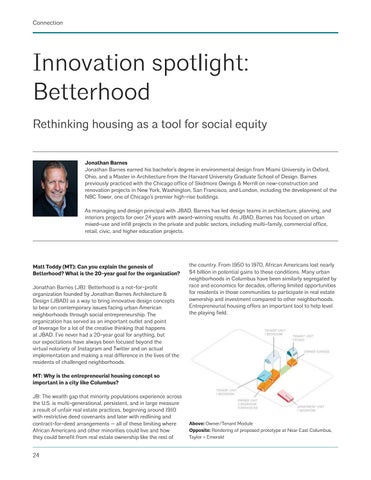
Above: Owner/Tenant Module Opposite: Rendering of proposed prototype at Near East Columbus, Taylor + Emerald
Vol. 18, Issue 02 2020
25
Connection
MT: What are the benefits of an owner-based residency model for an economically challenged neighborhood? JB: Entrepreneurial housing was created as a paradigm shift in affordable housing and social/financial entrepreneurship. This concept targets the problems of low rates of housing ownership and of absentee landlords and substandard housing in economically challenged neighborhoods with an inside-out solution by creating resident landlords with a vested interest in their communities rather than by policing the offenders. This is achieved through real estate ownership opportunities, a landlord education program and new, high-quality rental housing. This new way of thinking replaces traditional largescale neighborhood gentrification with a scalable infill approach that gives residents a profit and equity position in their communities and their futures. MT: What challenges have you encountered in the development process and deploying this model in the City’s neighborhoods? Like any new, innovative idea, the entrepreneurial housing concept was initially met with both acclaim and skepticism, mostly focused on the potential for people to embrace the business and social prospects of the model. With more opportunities to share the thinking behind the idea, communities, businesses, residents, and the city administration have become strong supporters. Developing the prototype project has had its share of challenges. The process of site selection revealed an inherent requirement of the project to operate in transitional neighborhoods where the project’s value could maintain a realistic level. The hybrid for-purchase/rental nature of the project presented challenges to lenders, which were overcome with some creative financing structures.
26
Vol. 18, Issue 02 2020
AERIAL
MT: This model challenges the traditional developerarchitect-contractor-consumer model of economic development. What would you recommend to other architects looking to engage innovative models of practice, t block also follows urban convention as a process, and development? story structure positioned at the street with
NORTHWEST Above: Northwest aerial. Far left: The design produces an iconic image of the detached single family house, in the context of a dense, urban infill development.
betterhoodusa.or
n space to the rear.
Yes, in this case, the project partnering team was created by and is led by the architect through Betterhood. In this way, the connections between both project initiationimplementation and architect-consumer are short-circuited, allowing a more effective application of the concept and a more direct dialogue between architect and end user. In order to seriously pursue alternative forms of practice, process, and development, architects must be able to see the connections between architecture, society, culture, and economics and school themselves in the motivations, the language, and the operations of those realms.
“In order to seriously pursue alternative forms of practice, process, and development, architects must be able to see the connections between architecture, society, culture, and economics and school themselves in the motivations, the language, and the operations of those realms.”
For more information on Betterhood and to stay up to date on the latest developments, visit Betterhoodusa.org. Plans, diagrams, and renderings illustrate the Taylor + Emerald Prototype project proposed for Columbus’s Near East neighborhood.
Matt Toddy, AIA, NCARB Opposite: Prototypical Elevation, Site and Floor Plans for proposed prototype at Near East Columbus, Taylor + Emerald. Above: Rendering of proposed prototype at Near East Columbus, Taylor + Emerald
Toddy is a graduate of The Ohio State University and architect at Columbus, Ohio’s Design Collective. He is the 2020-21 Strategic Vision Director for AIA National’s Young Architects Forum.
27
Connection
GrowHub A case study on community-based urban agriculture
Albertus Wang Wang is a professor at the University of Florida Graduate School of Architecture. He holds a bachelor’s of architecture from the University of Florida and a master’s in architecture from Harvard University’s Graduate School of Design. Wang has a long and distinguished international (academic and practice) career in the fields of architecture, urban design/planning, interior architecture, and performing arts in Asia and the United States.
Located in East Gainesville, GrowHub is a community for cultivating, empowering, and assisting adults with disabilities for sustainable living through education, training, and employment. Established in 2016, GrowHub provides a wide range of opportunities to work — a harvest of urban business to meet a critical need faced by local students of varying abilities, who complete their schooling at age 22 and have limited options for meaningful employment, and veterans, who face barriers re-entering the traditional workplace. GrowHub’s mission is to create new collaborations with supplementary businesses aligning their targets with GrowHub’s goals to provide opportunities to employ aspiring human resources. It also collaborates with humanitarian organizations and individuals looking to make a real difference locally and support self-sufficiency through food, resource, and job security. Social service agencies such as Vocational Rehabilitation and the Center for Independent Living and Veterans Affairs also work with GrowHub. In this interview, Albertus Wang, one of two lead designers of GrowHub’s master plan project, answers questions on the concepts and strategies used in its preliminary proposal. He was invited by Ruth Ron to collaborate on this exciting design opportunity. Wang has worked on a wide range of architecture, urban design, and interior design projects in the United States and Asia and has been recognized through awards from the American Institute of Architects and the Foshan International Urban Design Competition in Guangdong, China. His projects have been published in several books, magazines, and journals in the United States and abroad. He has served as the director and co-director of the University of Florida’s
28
School of Architecture East-Asia Program (2010-2015) and as a co-coordinator and professor of the school’s Hong Kong/ China Program (2007-2008). He has taught at the Boston Architectural College, the University of Pelita Harapan and UF and has been invited for lectures and design reviews at numerous international universities. He is a co-founder and a co-director of the European Historic Architecture and Urban Planning Program, a collaboration with the Huazhong University of Science and Technology (2015-present). His design interests focus on the critical dialogue and intersection between historical context and modern design of various scales and on East-West cultural exchanges.
Arash Alborzi: GrowHub is a community for cultivating, empowering, and assisting adults with disabilities for sustainable living through education, training, and employment. How can civic architecture help GrowHub to pursue its strategies? Albertus Wang: My colleague Ruth Ron invited me to collaborate in developing a master plan for GrowHub. Since GrowHub is a community-based effort, maybe the term “civic” architecture can be toned down to something that is more related to its main purpose — “community-based” architecture and garden. To make GrowHub sustainable, not only ecologically, but also socioeconomically, it needs a wellthought-out master plan with several supporting architecture components and series of productive gardens within it. We adopt seven programmatic components. Those are the seed studio, where seeds are being handled and then stored; the
Vol. 18, Issue 02 2020
seed bank; the seed library; the arts and medicine, which includes the training center, gallery, and art shop; the outdoor kitchen and dining; the greenhouses for certain plants that need some controlled environment to grow; and of course the garden itself. These programs partially exist on site and are loosely connected. We thought that they need to be tightened up and the programmatic hierarchy and relationship between components need to be simplified and refined. I am a firm believer that architecture needs to comprise of two aspects: the programmatic/functional aspects (the “ethical” aspects) and the spatial/spiritual experiences (and the experience of the senses) within it (the “poetic” aspects). What I mean by the ethical aspects are, for example: 1) The seed studio should have an indirect sunlight to allow healthy working space but also protect the seeds from direct sunlight; it also needs to have good workflow. 2) The seed bank should have an organized arrangement and safe to store the seeds for a long period of time. 3) The seed library allows users access to the materials systematically. 4) The arts and medicine is an existing room, and the new design can incorporate the existing but needs to have more dedicated spaces for teaching and studio workspace, a gallery, and an art shop to sell their arts. 5) The outdoor kitchen and dining expose GrowHub to the community at large and draw in additional patrons and participants. 6) The greenhouses need to be designed according to the set criteria. 7) The layout of the gardens needs to be based on the efficiency and effectiveness of the workflow because GrowHub is, in a way, a productive community-based entity. However, aside from those functions, spatial/spiritual experiences, and again the experience of the senses (touch, see, smell, hear, taste, and feel), are also very crucial. For instance: 1) In the seed workspace, how sunlight indirectly enters the space and how the choice of materials and colors of the ceiling and walls would allow the people who work in this space to be inspired. 2) and 3) Aside from the references and books, the sampling of the seeds themselves could be a part of the seed library collection for the purpose of education and training. In the seed bank, seed could be displayed attractively to inspire students, patrons, and visitors. 4) In the arts and medicine space, the roles of “arts” need to be apparent in its architecture and interior design aspects. Walls can be used for displaying arts for education, exhibition, and gallery shop. 5) As a component that could subsidize the GrowHub activities, the outdoor kitchen and dining need to be designed to stimulate patrons and visitors. They need to feel inspired by being in a beautiful garden enjoying the company and good healthy food, while doing it for a good cause. 6) The idea of having the dining room partially in the greenhouse, for instance, could allow educational experience while enjoying meals. I have seen this being done, for instance, at the Mediamatic in Amsterdam. 7) The garden has one unbeatable aspect: That is the plants, the flowers. I presume everyone loves to be surrounded by greens and colorful flowers. Being in a garden gives me a very beautiful feeling and recollection. In my culture, we refer
Figure 1: Aerial Image. GrowHub configuration of garden and supporting components grow organically. Source: © Google Earth. to this special experience as a spiritual longing for “Firdaus” [paradise]. In a garden, I immerse in its colors, fragrance, and reminiscence of this very special and beautiful place. Some garden areas can be more rationally organized; some can be more natural and wilder. The interplay between garden and architecture, allowing them to celebrate each other, spiritually can be very evoking. So, when working on the layout, a designer must understand the poetic potentials of a garden. In short, with a well-thought-out, community-based master plan and innovative architecture/garden design, GrowHub has the opportunity and potential to make itself an effective community hub, connected to other urban/suburban hubs within Alachua-Duval counties. AA: Urban farming has the pivotal role in relation to the development and success of GrowHub. How does your design advance the role of urban farming in GrowHub? Would you please explain and elaborate your concepts for this project? AW: Currently, GrowHub is operating more as an urban garden, focusing on continuing education and employment for people with physical and intellectual barriers and collecting/storing native seeds. However, it has a potential to incorporate broader urban farming. To reach that level, GrowHub has to work on its infrastructure, which include organizational, technological (information technology and operational technology), and finally the design and master planning that I mentioned in my answer to your question above. The organizational infrastructure can meaningfully increase efficiency and effectiveness on its daily operation, allowing the community to participate in it even more. The technological infrastructure could allow GrowHub to access necessary resources, as well as allowing people in the community and beyond to access the seed inventory at GrowHub. Finally, as I mentioned in point the first response, design allows both ethical and poetical impacts. In Figure 1, GrowHub configuration of garden and supporting
29
Connection
1 1
Legend 1. Pavement/pathway 2. Entry plaza 3. Inner courtyard 4. Open kitchen 5. Wooden planters 6. Entry planters (w/ GrowHub logo) 7. Life fence
30
1 6
1
2 6
3 7
4
5
Vol. 18, Issue 02 2020 components grow organically. In Figure 2, we want our preliminary design to be more realistic and inexpensive, trying to utilize and optimize existing components as much as possible. Refer to master plan and legends for elements and their descriptions below: 1. Pavement/Pathway: We thought the most important aspect is to identify the paths as organizational components and as the way to experience the area. We utilize and connect existing paths with some inexpensive, natural, and beautiful paving techniques I learned while I lived in Indonesia, casting interesting leaves on wet cement pavement. (See Figures 3 and 4.) 2. Entry Plaza: A sense of community arrival is a very important and powerful tool to begin experiencing this place. This plaza will be almost like an Italian piazza, a void that has either no function or all functions. It is a multi-purpose space that will be used for different functions in different times. In order to make this void, we need to activate the surroundings or, in other words, to create activated programmatic architectural or garden components that contain this plaza. 3. Inner Plaza: This is a spatial echo of the entry plaza, but it is more intimate and embedded more within the garden. This inner plaza has more specific functions, which operate within the idea of communal space, enjoyment, and appreciation of good, healthy, comestible products that are locally grown and experience GrowHub as a community garden and farm. 4. Open kitchen and dining will be located adjacent to the inner plaza, using the backdrop of Florida landscape. 5. Wooden planters are used as a boundary to prevent wildlife from destroying the garden. 6. Entry planters are used to accentuate the entry gate. 7. Life fence is also created around the property to prevent wildlife, such as deer, from entering into the property and consuming the plants in the garden. 8. Other functions (or architects like to call them “programs”) are absorbed and framed within the pathway so that they operate within clear organizational quadrants; they now are both structured as well as organic.
AA: Social-based urban farming is a promoted trend in urban agriculture. In your opinion, how can you extend the concepts of GrowHub through Gainesville or other cities? Basically, which advantages and disadvantages do you expect in such projects? AW: I think urban gardening, urban farming, and communitybased activities need to be evaluated in case-by-case scenarios and unique to each place. So, let me try to answer only on how GrowHub can be the catalyst to create urban linkages of productive urban farming and gardening, which connect existing components within Duval and Alachua counties. So, I think by activating GrowHub and making it as an initiator to connect already existing urban initiatives to experiencing locality, in terms of urban farming, gardening, and other community efforts, is not only interesting, but also crucial. Now that we experience the global impact of an event, COVID-19, all of a sudden, we are awakened by the reality that local initiatives are the only way to guarantee not only survival, but also sustainable livelihood, but without abandoning the reality and profound understanding that we are all in this together as a nation and as a human race; that we are all connected and must rebuild our local and global environment together.
We hope this master plan approach could optimize the existing GrowHub’s programmatic components without designing from tabula rasa (blank slate), which is unrealistic, unaffordable, wasteful, and less interesting. On the architectural design, a similar adapt-and-reuse (or in another term — repurposing) approach is adopted.
Top left: Figure 2 - Master plan sketch. Bottom left: Figure 3 - Pathway pattern and master plan composite image. Top right: Figure 4 - Pavement pattern
Arash Alborzi Alborzi is a doctoral candidate at the University of Florida School of Architecture in Gainesville. His dissertation focuses on feasibility of urban agriculture in existing cities. He has over 10 years of engagement in design, teaching, and research.
31
Connection
AIA Pittsburgh facade improvement program Alaina Bernstein, Assoc. AIA Bernstein earned her Master of Design in Interior Studies and Adaptive Reuse from the Rhode Island School of Design. She is a Senior Architectural Designer at Michael Baker International. Bernstein is a reliable designer known for her consistent and productive work ethic. She is a native Pittsburgher who enjoys hiking, running, and spending time with family and friends.
Friendly, attractive, and human-scaled storefronts build neighborhood character and add to the compositions of convivial urban environments. They help to encourage pedestrian activity, driving economic development and vitality. Seeking to revitalize streetscapes and encourage neighborhood investment, Pittsburgh’s Urban Redevelopment Authority and the Pittsburgh Foundation for Architecture founded the Facade Improvement Program in 2019. Alaina Bernstein, Assoc. AIA, has worked with three business owners through the program and took time to share more about her experience.
John Clark (JC): How did the Pittsburgh Foundation for Architecture discover the need for the Facade Improvement Program? Alaina Bernstein (AB): The Urban Redevelopment Authority of Pittsburgh (URA) is Pittsburgh’s economic development agency. One of their main goals is to expand neighborhood and Main Street revitalization efforts. During the summer of
32
2019, the URA reached out to the Pittsburgh Foundation for Architecture to discuss the need to revitalize business facades in the Homewood neighborhood of Pittsburgh. Together with Neighborhood Allies, a community development organization in Pittsburgh, the groups created the Facade Improvement Program. JC: Why was participating in this program important to you? AB: I have always had a passion for adaptive reuse. While studying for my master’s degree at the Rhode Island School of Design, I got to focus my thesis on Pittsburgh’s Carrie Furnace. Through this experience, I was able to examine how to turn one of the last remaining blast furnaces in the city into a modern museum highlighting the deep history of Pittsburgh, steel, and its impact on the world. More recently, I was able to participate in a charette at the Peter and Paul Church in the East Liberty neighborhood of
Vol. 18, Issue 02 2020
Pittsburgh. During this charette, I got to see firsthand the challenges with implementing adaptive-reuse projects in the city. I hate to see significant structures torn down only to be replaced by typical designs. Being involved with the Facade Improvement Program is a great opportunity for me to channel my passion for adaptive reuse into helping revitalize some of Pittsburgh’s neighborhoods. JC: Describe the design and charette process. What information and perspectives are gathered that inform the final design? AB: Neighborhood Allies and the Urban Redevelopment Authority bring prospective projects to the Facade Improvement Program team. Once a business is selected, the Pittsburgh Foundation for Architecture organizes the charette that includes businesses and neighborhood partners, as well as the URA. Alongside the volunteer designers and architects, the team sets off to develop drawings of the new facade. The designers and architects often visit the site before the charette and come prepared with trace paper, PowerPoints, Post-its, and sometimes even models! Each member of the charette brings a specific element to the team. The business owners and neighborhood partners describe their wants and needs for the building. The volunteers work to combine their initial ideas with the business’s needs to come up with a final rendering of the facade. The URA helps to facilitate the grant process and answer any questions that may arise.
Above: Proposed facade renovation for Baker’s Dairy in Pittsburgh. Courtesy, Paul J. Levine, Architect.
After the initial meeting, the volunteer architects and designers take on a variety of tasks ranging from finalizing renderings,
33
Connection
New Windows on second floor
Decorative screens w/ LED backlights
Conceptual Design for D&C Sandwich Express & Galaxy Lounge Homewood, Pgh. 12/17/19
Collapsing glazed wall over outdoor coffee counter
contacting suppliers, to potentially serving as the project architect. JC: What steps are needed to take the design through approvals, funding, and construction to a final product? AB: After the charette, the Foundation for Architecture lets the URA take the lead. The URA, along with their neighborhood partners, works to gain approval for the drawings, secure funding, and help with construction of the new facade. JC: What have you learned about the community design process from working with individual business owners and communities? AB: I have really appreciated the power of the community in championing these projects. To date, the Facade Improvement Program has worked with three businesses in Homewood: a corner market, a doctor’s office, and a neighborhood staple restaurant and gathering place. A common theme among the owners was that while they had a vision for how they wanted their business to look, they were very open-minded and took advantage of the architects’ experience in eventually coming to a final design. The neighborhood’s needs were balanced with the feasibility of the designs. Bringing people together from government, business, and architecture provided an opportunity for complex problems to get resolved quickly with a multifunction team at the table during the charette. Above and right: Conceptual design for D&C Sandwich Express and Galaxy Lounge in Homewood, Pittsburgh.
34
JC: How can young architects apply this process to their own communities? Why do you feel it is important for architects to give back in similar ways? AB: There are a variety of ways young architects can apply this process to their own communities. First, and most simply, get involved with volunteer organizations that let architects donate their time to develop ideas for local communities. If that doesn’t exist in your city, work with your local redevelopment authority to get partnered with businesses in need. Be sure to listen to the needs of the business owner; they have the best sense for their neighborhood and what would help to improve the feel of their street and the success of their shop. I feel it is important for architects to give back in similar ways because we so often work on new structures that replace existing buildings. I believe there is beauty in these aged buildings, and we can rebuild dilapidated structures with a little creativity instead of always constructing from scratch. By donating time to help neighborhoods in need, architects can become more connected with their communities and help to revitalize areas of their city.
John J. Clark, AIA, NCARB
Clark is an architect with RMKM Architecture in Albuquerque, N.Mex. Clark is a graduate of the University of New Mexico and is the 201920 Communications Director for the AIA National’s Young Architects Forum.
Vol. 18, Issue 02 2020
Paint Faรงade w/ updated color scheme
Conceptual Design for D&C Sandwich Express & Galaxy Lounge Homewood, Pgh. 12/17/19
New Windows on second floor
Decorative screens w/ LED backlights
Relocate existing sconces above new sign
Metal planters
New entrance door and transom & new backlit signage
Collapsing glazed wall over outdoor coffee counter
Notes: 1. Eliminating the front door being replaced w/ collapsible glazed wall may require providing a secondary means of exit. A code analysis based on occupancy counts must be performed to confirm. 2. A building permit and submission to Pittsburgh Zoning Dept. for review and approval is required
Paint Faรงade w/ updated color scheme
Screens to match faรงade treatment
Conceptual Design for D&C Sandwich Express & Galaxy Lounge Homewood, Pgh. 12/17/19
Fiber cement planks in various sizes and colors
New backlit signage
Metal planters Painted wood column wraps w/ metal accents Screen to match faรงade treatment to conceal exhaust
Notes: 1. A building permit and submission to Pittsburgh Zoning Dept. for review and approval is required
35
Connection
How to empower neighbors and transform communities An interview with a 2020 Young Architect Award recipient Wayne A. Mortensen, AIA, NASW Mortensen recently accepted the role of CEO at NeighborWorks Lincoln, an affordable housing developer in Lincoln, Nebraska. Previously, he worked on behalf of urban neighborhoods as the Director of Design and Development for Cleveland Neighborhood Progress, a not-for-profit community development organization. With graduate degrees in architecture, urban design, and social work, the Nebraska native is a licensed architect in Ohio and has lectured broadly on the creation of equitable housing and just communities. He is a community activist and was elected to serve as the 2021 President of the Cleveland chapter of the American Institute of Architects. Editors Note: At the time of the interview, Mortensen was employed by Cleveland Neighborhood Progress. He has since accepted the role of CEO at NeighborWorks Lincoln, and is expected to start in mid-July.
Clarice Sollog (CS): Congratulations on being a 2020 recipient of the AIA Young Architects Award! Your career to date seems to be centered around community-based design and civic engagement. Can you explain what influenced you to head down this path? Wayne Mortensen (WM): I decided that I was going to be an architect in the sixth grade, but it was my modern history seminar at Nebraska that nearly disillusioned me with architectural practice altogether. I enrolled in architecture school to help uplift communities and bring people together. That ethos seemed wholly absent in modern practitioners in both concept — Plan Voisin (Corbusier), Broadacre City (Wright) — and execution — Pruitt-Igoe (Yamasaki), CabriniGreen (various), and the many regrettable enactments of Robert Moses. The latter were real projects that actively harmed people by reinforcing the most insidious aspects of American society (segregation, racism, classism, et. al.) and bred skepticism about the ability of design to solve problems. A year away from school spent with the AIAS, in Washington, D.C., as president allowed me to recharge and focus. The next fall, I would enroll at Washington University and seven semesters later become the first student (though not the last) to wrap up graduate degrees in architecture, urban design, and social work. It was exactly what I needed to become the professional I am today and move into a sector of work that few architects are able to break into.
36
CS: What has been the most transformational experience, leadership position, or project for your career — something that set something in motion or maybe forced you to reframe your career goals or focus? WM: After graduate school, I joined a planning consultancy named H3 Studio and worked as a project manager and outreach coordinator in marginalized communities across the Midwest and South. We worked in disaffected rural and urban communities and teamed with three other firms to pull off the Unified New Orleans Plan — a project that led to several subsequent follow-up efforts. It was fulfilling in every sense, save the repeated trauma of having to abandon the relationships you spend months creating with the completion of each contract. It helped me understand that the for-profit model was not structured to help advance communities, longterm. My selection as a Rose Fellow in 2010 changed all of that by opening a door to the community development industry and providing a network of like-minded professionals for support, knowledge sharing, and collective impact — all of whom are smarter and more talented than me! Without the innovative structure of that fellowship, I don’t know that I could have broken into this world and found roles that allow such direct and sustained service to a singular community. I was fortunate that one of those wicked smarties, Jess Zimbabwe, was an acquaintance through AIA, or I may never have become
Vol. 18, Issue 02 2020
familiar with the fellowship, and I would likely still be trying to figure out why I wasn’t happy in consulting. CS: Can you share a little about the work that Cleveland Neighborhood Progress does, and what your role with them is? WM: We are essentially a “super CDC” (community development corporation) that works as an intermediary between Cleveland philanthropy and myriad community partners working to improve their neighborhoods. We are a convener, facilitator, and collaborator of work that advances city-wide improvement, and we try to attract resources and develop capacity across the community so that the voices and ideas of residents can be elevated and carried out. When I first showed up in Cleveland as the hot-shot fellow nobody had heard of, I hilariously thought it was my ideas that were going to slowly (See? Both humble and realistic.) reverse decades of disinvestment and save the day. Within months, I realized that my technical capacity, creative energy, and professional values far outweighed any presumptive salvation plans. The ideas and initiatives were already largely authored by the real community experts that have been doing the living and dying and laughing and crying in their Cleveland community for decades — they just needed me to ask, “How high”?
skills developed in my past life to facilitate public planning efforts or help organizations through strategic planning conversations. What makes my role a little more unique is that it wouldn’t have traditionally been filled by an architect, had it not been for the Rose Fellowship. It is worth pointing out that architects can bring a lot to the myriad conversations that occur within the community development field — even with the residual scars of design studio and Heidegger. CS: Tell me about the one aspect or accomplishment of your career, so far, that you’re most proud of and what about it makes it top the list? WM: The project that I was cleaning the bathrooms of was a six-year, $63 million adaptive-reuse project called Saint Luke’s Hospital in Cleveland. It was a hopelessly idealistic M.Arch
My formal title is “Director of Design and Development,” which positions me as a staff leader in our “placemaking” portfolio and charges me with conceptual feasibility of the development projects (typically adaptive reuse or urban infill) we are considering. If we decide to pursue the project, I slide into my unofficial role of “director of whatever it takes” to move the project forward — owner’s representative, architectural collaborator, public meeting facilitator, PowerPoint designer — whatever it takes. (I have been known to clean bathrooms on the eve of ribbon cuttings.) From time to time, I will also utilize
37
Connection
thesis come to life. We bought a derelict medical campus for $1 and got a refund of $900,000 in order to do the environmental abatement and raze the (non-historic) additions — and that was the easiest part of the project. What followed was a transformation of a 384,000-square-foot historic hospital into a mixed-use transit-oriented development in one of Cleveland’s most depressed communities (at the time). The project became 137 units of affordable senior housing (two market rate), two not-for-profit headquarters, a Boys & Girls Club, a preschool, and a K-8 charter school that utilized senior mentors in their pedagogical model. (Cue the groans from the thesis adviser.)
Above: Before and after exterior view of the Saint Luke’s Hospital adaptive reuse. Opposite Left: Interior images from the charter school classrooms at Saint Luke’s Hospital adaptive reuse. Oppositve Right Shaker Square (Cleveland, Ohio). Courtesy: Cleveland Neighborhood Progress
38
The project was beautifully designed (Wallace Roberts & Todd, DLR Group), but it was the financial structure of the deal that was truly innovative. To fund the rehab, we utilized state and federal historic tax credits, new-market tax credits, low-income-housing tax credits, and an $8 million capital campaign. We had such incredible buy-in that the contractor (Mistick Construction) fronted $4.5 million worth of work prior to the [financial] closing of the third phase (which was 10 days before the first day of school)! That is just not something that happens. In order to secure the anchor tenant (The Intergenerational School), we turned over $4.5 million of the capital campaign so that they could be an equity investor and get the rent rates they needed. And the cherry on top? That it was the residents — in a community planning process eight years prior — that hatched the idea by circling the derelict hospital on a neighborhood map in red sharpie. Needless to say, the bathrooms were spotless for the ribbon cutting, and sharpie-circled “Saint Luke’s” will always remain the best project many of us will ever work on.
Vol. 18, Issue 02 2020
CS: How do you define success in the realm of communitybased design? What are some of the challenges that are faced and how can they be overcome? WM: If people will talk to you after a project is over. Seriously. If some go out of their way to shake your hand or give you a hug in public, well, then you’ve done very, very well. That said, community problems are problems for usually insidious reasons, be it economic exclusion, structural oppression and racism, exploitation, etc. You are trying to effect change over a period of a few years against forces decades in the making, and a rendering is never going to get you there. Balancing the needs of the community against the economic realities of development and plan implementation will always be the hardest part of public facilitation. Maintaining relationships with different factions of stakeholders whose concerns and needs are often in conflict with one another is a skill I … hope to eventually develop. In the meantime, you need to get comfortable with simultaneously being the target of loud ridicule while having the quiet respect of those you admire.
charmed than it is today. I was the first architecture student to be selected to the Homecoming Court at Nebraska in 20 years! (This is an area where more economical state undergraduate programs thrive, by the way.) If my self-worth was wrapped up in what my design critics thought of my work, I would have left the profession years ago a very broken person. CS: What’s the best piece of advice you’ve received? Can you share some advice to other up-and-coming young architects that may be looking expand their careers to have more impact in their communities? WM: “If you say you’re going to do something, you better f--ing do it.” Brad Buchanan, FAIA Brad created a program in Denver, Colo., named Freedom by Design. When I was at AIAS, we collaborated to make “FBD” the national service initiative of the organization. He dispensed this advice at the inaugural captain orientation on the topic of pro bono designers working with medically and economically fragile clients. A simple concept that is broadly applicable.
CS: Is there a component of architectural education — that often talked about concept of “design thinking” — that you believe is key to developing emerging professionals as participants in community-based design? Or did your diversity in education — with additional graduate degrees in urban planning and social work more adequately provide you with the tools to succeed in your chosen path? WM: Extracurricular activities. I don’t think I’m a model professional by any means, but without leadership opportunities available through AIAS (or Mortar Board or Panhellenic or Young Democrats or any of the countless other organizations available on a college campus) my life is far less
Clarice Sollog, AIA, NCARB Sollog is a Project Architect at CDM Smith in Orlando. She was awarded the AIA Orlando Young Architects Award in 2014 and is the Young Architect Regional Director for the Florida Caribbean Region.
39
Connection
Young architect spotlight Meet community-focused architect Lisa Sauvé
Lisa Sauvé, AIA, NCARB, IIDA Sauvé is the Principal and Co-Founder of Synecdoche Design Studio in Ann Arbor, Mich. Looking back at her 11 years in the field, it is clear that Sauvé has always been focused on community design and betterment. She sits on the Ordinance Revisions Committee of the Ann Arbor Planning Commission and is a Business Ambassador for the Detroit Regional Chamber. She’s also a member of the Ann Arbor Arts District Committee, chairs the Building Design Committee of the Ann Arbor Art Center, and is an Advisory Board member for Engage Affect, an organization that strives to engage municipal members and foster a stronger connection to their community. This passion is further illustrated by Synecdoche’s core values and Sauvé’s involvement in the AIA’s Small Project Design community..
Lisa Sauvé is a Michigan gal, born and raised. While receiving an undergraduate degree from Lawrence Technology University, Sauvé and her partner, Adam Smith, formed Synecdoche. They actually skipped graduation to work on their first project! While juggling the demands of her studio, Sauvé earned an M.Arch degree from the University of Michigan in 2011. Around that same time, Synecdoche competed in the 10up Atlanta design competition. Their temporary outdoor pavilion design, titled “Edge Condition” won first place. As if that wasn’t enough, Sauvé went back to the University of Michigan to earn a second master’s degree in conservation in 2014.
space is just as important as the design of your business. It can support your ideas and act as the first glimpse into what your new business is all about. Many entrepreneurs and smallbusiness owners do not have the capital to hire an architect or design studio to help them shape their vision. Recently,
Synecdoche’s projects range in scale from custombuilt furniture to new spaces for small businesses and entrepreneurs. Through innovative design, a unique business model, and strong drive to enact change, Sauvé and Synecdoche are able to help Ann Arbor grow and thrive as a tech and design hub. When zoning restrictions were making it almost impossible for her clients to renovate or expand their small businesses, Sauvé became a member of the planning board. These zoning laws were put in place for the betterment of the area and should work to do just that. This position allows her to push forchanges to these laws that will foster adaptive reuse projects and maintain the architectural integrity of the downtown area. Being a small-business owner herself, Sauvé knows how difficult it can be to start your own firm. The design of your
40
Above: Edge Condition. Courtesy: Lisa Sauvé.
Vol. 18, Issue 02 2020
“Architecture is reactionary — hired when others believe there is a need. It needs to be more proactive in our initiation of work and how we see needs in our community and environment. Responding to RFPs and being set up as a service industry limits our scope and I believe also limits the abilities of those in the profession. ”
41
Connection
Synecdoche has started entering into equity partnerships with some of their small-business clientele in lieu of design fees. This symbiotic partnership gives small-business owners the opportunity to create a space for their work that speaks to their core values and gives Synecdoche the chance to promote businesses they would like to see in their area. Sauvé loves the reward of seeing a business she helped design thrive. It boosts morale in the studio and makes the team feel like they are really making positive changes happen. Sauvé is also using her connections with small-business owners to create the “Inaugural Mural Festival” in Ann Arbor. The original goal was to have artists throughout the area design and create murals to showcase their talents at a week-long arts festival. The murals would be painted on buildings throughout the city. Given the ongoing situation with COVID-19, Lisa has had to change gears and reinvent the festival. Instead of cancelling or postponing, she is working to find safe ways for the muralists to create their work. By partnering with local businesses and organizations, the festival will go on and provide a living wage for these muralists. These murals aim to provide joy to those walking their dogs or taking a stroll to get some fresh air and to help the local economy. It was clear to me that Sauvé embodies Synecdoche’s core value of “Do Good Work.” She does what it takes to move the profession, design, and her community into the future. All the work she does is for the good of the community. She is willing to put in the time and effort it takes to enact the positive changes she wants to see. I don’t know about you, but Sauvé is definitely one of my role models now! The following questions and answers give greater insight into Sauvé’s expertise, passions, and aspirations.
Caitlin Osepchuk (CO): Did you take a non-traditional path to become an architect or since you became a licensed architect? If so, please describe that journey.design methodology was critical to the success of our cross-border collaboration, again allowing for an efficient feedback loop
42
and rapid iterative process and creating a bridge between the design, fabrication, and construction processes. Lisa Sauvé (LS): I’m not sure many, if any, architecture students who graduated in 2009 or around the recession have a traditional path, including myself. Without a job prospect, my partner, Adam Smith, and I found a small project on Craigslist for a graphic design office interior design project. We skipped graduation to fabricate the pieces and formed the LLC when we needed a bank account to cash the check for materials. CO: What inspired you to become an architect? LS: It wasn’t until recently that I made the connection that my amazement with the ability to imagine a creative built world probably came from a poster I used to stare at in my dad’s office by Matt Groening of “Bongo’s Dream Dorm.” I was fortunate to have great drafting teachers in middle and high school that also supported me with a scholarship to a summer engineering and CAD program and helped me find my way to architecture school. My idea of an architect at that age was much different than when I finally finished graduate school in 2011. So a poster and some strong mentorship. CO: Why did you decide to get licensed, and what year did you receive your initial license? LS: I got my license in 2018, nine years after starting Synecdoche. We worked previously in collaboration with Architects of Record. Our popularity locally got the attention of a couple local firms that did not like our format even though it is a legitimate way to design. To diminish the pressure and disruption they were causing to our projects and team, I finished the tests and became licensed. While it is a helpful step, I think it’s also important for emerging professionals to know that having the license isn’t a requirement to do something independently. There are ways to collaborate or work on projects that don’t require a stamp that still contribute to the designed and built environment. I proved
Vol. 18, Issue 02 2020
that with Synecdoche and our portfolio of projects prior to becoming an architecture office. CO: Describe something memorable about your experience as a young architect so far. LS: It’s strange to think about only the past two years of being a young architect compared to my entire career. The things that happened in this past year that are memorable did not require me to be licensed. I became a partner in a salon we designed, I’m starting a business for creatives sharing studio and venue space with a friend, and have invested in a development we’re a part of. I’m also part of the Ann Arbor Planning Commission, where I have a direct impact and contribution to the way we build and vision our city. I’m also leading a committee with our local art center for an inaugural mural festival to reinvent a portion of our downtown as a creative district. None of these things directly required licensure, but all of them are incredibly rewarding and possible because of my role in the community and as a founder of a design studio. CO: What unique perspective do you bring to your job or the architecture profession as a young architect? LS: Architecture is core to the creation of community. I approach architecture as fostering new projects rather than being hired to design buildings. Through partnerships on projects and with businesses, introducing potential clients and spaces, and self-initiated custom-built work and development feasibility, there are so many ways to impact what projects happen and how. Design in the built world is so much broader than buildings, and I’m excited to work on several aspects of that. CO: If you could change one thing about the profession, what would it be? LS: Architecture is reactionary — hired when others believe there is a need. It needs to be more proactive in our initiation of work and how we see needs in our community and environment. Responding to RFPs and being set up as a service industry limits our scope and I believe also limits the abilities of those in the profession. We are losing diverse representation to other industries because of roadblocks within our own profession. Being a broader contributor and initiator would enable more to contribute with their unique perspectives and talents. This helps foster a more diverse representation growing into leadership roles — which is incredibly important to the sustainability of the profession. CO: Is there any advice you have for other young architects or other words of wisdom you’d like to share? LS: First, I often said, “Do good work, and people will notice,” which has evolved into our studio core values of “Do Good
43
Above: WYLD project. Courtesy: Lisa Sauvé. Top left: Thrive project. Courtesy: Lisa Sauvé. Work.” It basically boils down to doing the work you believe adds value at a high level will attract the attention and respect of others and motivate everyone to elevate their work, but it takes action and hard work and a lot of intention. Second, invest in people. It’s unmeasurable to have connections both inside and outside of the architecture profession. Getting out there and talking to people builds your network and helps you find allies. The next person you meet could bring you your next project or your next opportunity to give back to your community.
Caitlin Osepchuk, AIA
Osepchuk is an Architect at HMFH Architects in Cambridge, Mass. She received her M.Arch and BS in Architecture from Roger Williams University and is the AIA New England Young Architect Regional Director.
43
Connection
Young architect spotlight Meet justice architect Christine V. Smith Christine V. Smith, AIA, NCARB, LEED AP BD+C Smith is an Architect at Arrington Watkins Architects LLC in Phoenix. After an alternative path due to the state of the economy in which she worked and volunteered for various police dispatch units, Smith reentered the architecture realm when the chance came. She brought with her a wealth of knowledge and passion for justice architecture and is eager to keep that passion ignited for generations to come.
Christine Smith, originally from Wisconsin and now in Phoenix, graduated from Iowa State University, found her dream job, and then was hit by the 2008 recession. Smith did not let this hurdle deter her passion. While staying active with small architectural competitions, teaching herself programs like Revit, and learning from her dispatch jobs, Christine always had public architecture in the back of her mind. When a colleague from a former internship called, Smith had nothing to lose and everything to gain. Her experience being a part of the communities she wanted to design spaces for has only helped her become a more holistic thinker and problemsolver. She believes wholeheartedly that architects do not just deliver a building, but also an experience. The experiences we hope to create can be helped by alternative paths that may be inevitable during economic downturns. The current and future generations of architects should keep seeking out opportunities, never give up hope, and use their knowledge and interests to bolster the immense capabilities of the architectural profession. Learn more about Christine’s path below.
Ashley Hartshorn (AH): Did you take a non-traditional path to become an architect or since you became a licensed architect? If so, please describe that journey. Christine Smith (CS): I graduated from college in the midst of the Great Recession. I was laid off in 2008, just four months after landing what I thought was my dream job. I would send
44
hundreds of résumés out and rarely even heard back. I took a job as a police dispatcher and ended up working for multiple police agencies across the country for over five years. When my husband and I moved to Phoenix, I switched paths into the insurance industry and ended up writing property and casualty insurance for years. The overlap of experience that I gained in both the police department role and the insurance underwriter role provided a broad viewpoint for my current role as an architect that I never would have expected. Having written insurance policies, I understand contracts, coverage, the liability of what we do on a daily basis, in addition to my technical architecture education. The knowledge that I gained in those roles has provided me with a unique perspective and understanding of my clients and my professional responsibility to them. AH: What inspired you to become an architect? CS: When I was young, my mom and I would tour the Parade of Homes every summer in my hometown. I was drawn to the unique feelings that could be invoked by different spaces and materials. I gravitated toward the public safety and justice industry very early, being drawn to the endless “Law & Order” marathons. When I was in college, I worked as a police dispatcher. The department I worked at was small, and I had in-depth interactions with the detectives, chief, and officers on a daily basis. I was always impressed with their ability to adapt to their environment — not just in their job on the street, but within their facilities. I am inspired daily by the work of our law enforcement agencies, and I am truly passionate about using my talents to create work spaces that they deserve.
Vol. 18, Issue 02 2020 Proposal for California Highway Patrol Replacement Facility. Courtesy: Christine Smith.
AH: Why did you decide to get licensed, and what year did you receive your initial license? What has your architectural license helped you achieve?
working on a project that has a full dispatch center, and it feels incredibly rewarding to be able to create an environment that improves the daily life of these men and women.
CS: After getting laid off, it took me over eight years to find a job again in the architecture field. When I finally got that job offer, I ordered all my study material and got to studying. Getting licensed was a goal of mine since my first day of college, and knowing the industry would always deal with economic uncertainty, I wanted to be diligent about building my résumé. I received my first license in 2017. My architectural license has allowed me to step into leadership roles on projects and be valuable to my company. It has also signaled the beginning of my mentoring the next generation of architects. I enjoy being able to guide and help shape the future of the profession.
AH: What words of wisdom would you like to share?
AH: What unique perspective do you bring to this Knowledge Community as a young architect? CS: When I was in college, our studios shared a space with the police department, which happened to have jobs open for students. My schedule was packed with classes, so I found being a dispatcher for the police department to be the perfect job — I was able to work nights and study and do studio work when things were slow. After I graduated and subsequently was laid off, I needed something to pay the bills. I applied for a full-time dispatching position where I lived. I learned so much about the justice system from spending five years immersed in it. I’m currently
CS: I had a professor in college who would not allow us to work in the studio on Friday or Saturday nights. He would come through the studio and kick everyone out. He told us that you cannot design for a world that you are not a part of. To this day, I truly believe this. We have to understand our clients and the world around us. If we get too isolated in our own bubbles, we become disconnected and narrow-minded. Being focused on public safety and justice architecture, I have made an effort to connect with police departments by completing ride-alongs, touring facilities, and taking part in citizens police academies. These all offer an inside look of how various departments operate.
Ashley Hartshorn, AIA, NCARB
Hartshorn is a Project Manager at Archis Design in Albuquerque. She received her M.Arch from Northeastern University and is the AIA Western Mountain Region Young Architect Regional Director.
45
Connection
The philosophical shift in justice architecture Meet justice architect Andre Voss
Andre Voss, AIA, NCARB, LEED AP Voss is an Associate at CGL Companies, a comprehensive criminal justice consulting firm specializing in justice facility planning, design, maintenance, and operations. In 2013, Voss started working for CGL and expanded his experience with institutional, medical, and interior projects. He contributes to all phases of design, from planning through concept design to construction management. Outside of CGL, Voss is involved with national and local AIA Knowledge Communities including the Academy of Architecture for Justice (AAJ). He also serves as president of the NYC Revit Users Group and teaches as an adjunct professor at the New York Institute of Technology.
Within the first few minutes of our conversation, I was struck by Voss’s passion for his work with justice architecture. While this specific professional niche was not always his plan, Voss has a profoundly deep understanding of the philosophical perspectives of the different people impacted by the design of courthouses and detention centers, and he is using this knowledge to help facilitate change in what many perceive to be a broken system. The following questions and answers give greater insight into Voss’s expertise, passions, and aspirations. Jessica O’Donnell, AIA (JO): Did you take a non-traditional path to become an architect or since you became a licensed architect? Andre Voss (AV): I was born, raised, and educated in Germany, so it took me a while longer to be able to sit for the ARE. By the time my U.S. permanent residency (green card) was approved, I had been in New York City for about 10 years, and my career demanded a lot of time. When I finally found the motivation and made the time, NCARB had trouble accepting my degree from Germany. I took the ARE in New York state based on time I had worked in architecture offices and had to wait until I passed the 12-year mark to receive my license. The
46
one advantage of that delay was that the content of the ARE was less a matter of studying and largely a matter of applying the knowledge I had acquired in practice.” JO: What inspired you to become an architect? AV: Initially, my intention was to become a structural engineer. Before college, I completed an apprenticeship as a draftsman and realized that the scope of the architect is much more holistic and interesting. The idea of masterminding the building for all trades appealed to me. JO: What drew you to justice architecture? AV: I was drawn to CGL by the fact that these were two guys who had carved out their niche and made their name in this business. I knew what I could learn from them would be unlike what I could learn from yet another residential mid-rise building. Over the years, I have come to appreciate the fact that in the detention center design, we are the voice of those who do not get to have a voice within the building; we are advocating for those who cannot advocate for themselves anymore — for those who have been turned over to the care of the state,
Vol. 18, Issue 02 2020
Multnomah Courtroom rendering. Courtesy: Andre Voss either on the adult or on the juvenile side. We are building for a user group that is not sitting at the table, and we are their advocates. When designing detention centers for adults, I personally tend to think of the homeless veteran who did his job, came back with PTSD, is having a hard time coping with life in this world, and ends up being homeless. What happens to this person when they commit a crime of convenience and ends up in jail for a couple of nights? How do we want to treat that person? What is our level of humanity as a society? Is that a full, blown-out maximum-security setting that this person needs to go into, or is that a more “We are the voice of those humane therapeutic who do not get to have a setting? Depending voice within the building; on what setting we are putting we are advocating people in, what for those who cannot is their reaction? Environment cues advocate for themselves behavior.
anymore.”
We know that. A mentor of mine used to say, “A good building will not turn a bad person into a good person, but a bad building will make any of us worse.” I have learned that in my previous offices, and I see that to be truer in justice architecture than anywhere else. We also think about the correction officers (COs) who work in these facilitates. A catchphrase from one of my mentors is, “The correctional officers are the lifers.” They typically spend a 25-year career, eight-hour days with overtime, in these
buildings. These officers are at risk for PTSD because of the daily anxiety of being under threat. There was a study done that showed COs typically die five to eight years younger than the national average. When I heard that, I doubled back, and it made me pause. Their mental stress is real, and compartmentalizing is hard. If COs consistently walk into an environment where they are afraid someone will attack them, how will they perceive a given situation? What can we as designers do to help mitigate the anxiety of all parties in these facilities? On the courthouse design side, we are advocating for the public in a similar way. There are many stakeholders at the table, including judges, operations staff, vendors, sheriffs, but the actual public is rarely represented at the table. When it comes to designing courthouses, I personally think of the single mother in a custody battle who is walking into the courthouse with a stroller and two toddlers. What is her experience with justice? You have to go through the same security you would have to go through in any airport just to get into the courthouse, but what does this look like for someone who is there full of anxiety, thinking, “I’m going to have to see the judge, is my ex here (if this is a custody battle), am I losing my kids?” Or maybe she’s just there to pay a parking ticket or wants to contest the parking ticket. That experience is currently intimidating. The level of anxiety from the security to waiting in lines to see the judge — that whole experience. What can we do on the design side to help alleviate the anxiety, to make the experience more humane, to make sure justice is served better and that the system works better?
47
Connection
JO: What unique perspective do you think justice architects bring to the profession? AV: The understanding of human behavior needed for justice architecture is unlike what is required for any other part of the architectural industry. All of those aspects are being considered by all staff members in CGL’s 360 Justice approach.
“The understanding of human behavior needed for justice architecture is unlike what is required for any other part of the architectural industry.”
Not every design solution in a detention facility is what it seems at first blush. Think of the considerations that go into whether a bedroom should have a toilet, which some may consider to be a luxury item. We must first decide if it is a human right. Then we must consider the financing costs of the added fixtures and infrastructure. On top of that, we need to consider both the residents and staff. When discussing this topic with one CO, he said if every bedroom had a toilet, that would reduce the violent incidents in his facility by about 80 percent because the resident would have agency over this part of his life and would not have to ask someone else to go to the bathroom. That means this toilet is not a luxury item; it is an operational solution resulting in less PTSD for both the COs and the residents under their care. This is a small glimpse into the type of thinking and analysis that goes into every aspect of justice architecture design. Our job is to advocate for those who cannot advocate for themselves. You can say that for other industries, too. In hospitality design, the hotel guests are not sitting in the room for the design of the hotel; the shopper is not there when you are designing the new Prada store. Justice architecture is different still because the Constitution comes into play here. Our client is the taxpayer, and neither the taxpayer nor the people involved in the justice system are at the design table, but access to justice is a constitutional right, and we need to be cognizant of that. JO: Describe something memorable about your experience in the niche of justice architecture. AV: Last year, I had the chance to work on a prototype/model youth justice facility for the Juvenile Justice Commission of New Jersey. Following a shift in operational philosophy, the state decided to close the central Training School for Boys and some other outdated facilities and replace them with three small, treatment-centric and youth-focused facilities located
48
closer to the families and communities they serve. These new regional centers for male and female youth will be located in north, central and southern New Jersey. It was a highlight of my career to develop this prototype of a secure school for committed (sentenced) youth with a team of highly dedicated professionals on all sides: State officials, Justice Commission members, and designers and planners all shared a common goal of improving the lives of those for whom this facility is design and who cannot advocate for themselves. JO: Describe the philosophical change that you have seen in the design of detention facilities? AV: New Jersey, among other states, has instituted a philosophical change for juvenile detention facilities to move to a therapeutic model that promotes healing by giving hope and re-establishing the kids’ outlook on life. This is being accomplished through multiple means. In New York state and others, the Raise the Age initiative is preventing 16- to 18-yearold youth to be housed with adults. Another decision is to move from single central facilities to smaller facilities embedded throughout multiple communities, allowing family and community to remain involved in their lives. Kids in juvenile facilities are put under the care of the state. They do not face life sentences, so they will not be in these facilities forever. We, as a society, have a choice: We can lock them up and throw away the key and after two to five years of negligence expect them to walk out and fit back into society, or while they are in the facilities, we can help these kids cope with their learning disabilities, cope with their trauma, show them what a different life can be and how to be a productive member of society. In some states, the term “youth” is a little more flexible. Depending on the charge, the judge can decide whether the offender goes to a youth facility or an adult facility up to the age of 25. In some states, it is 18; in other states, the age threshold is 21. Research shows that the judgment center in our brain is developing until age 25 — that is the same for everyone regardless of who they are, what their upbringing is, or where they come from. We all know the phrase “I made that mistake when I was young and dumb.” We have to acknowledge that phrase is not the same for everyone. For the vast majority of people of color, this statement typically leads to an over-harsh sentence, which starts them on a track to a cycle where they do not learn the typical life skills one should acquire at that age to be a productive member of society. They only learn skills from their peers who are also committed. By implementing this new philosophy, we are trying to break this cycle. There is a lot of research, psychology, statistics that are behind that. At CGL, we are one of the few firms, if not the only, who employ
Vol. 18, Issue 02 2020
New Jersey Juvenile Campus rendering. Courtesy: Andre Voss a criminologist. She is on our planning team and works with the architectural team daily. For us, it is mission critical to have that “foot” in research into the psychology and sociology of the people who visit, live, and work in the facilities we design. In the healing approach, it all starts with phrasing. We are not talking about “inmates,” we are talking about juveniles and residents. We are not talking about cells, we are talking about bedrooms. We don’t say officers, we say youth workers — it starts there, “In the healing approach, and we are very it all starts with phrasing.” conscientious about it. When designing for this new approach, we tend to think of a bedroom, and four bedrooms make a neighborhood. Four neighborhoods make a village (one building, 16 bedrooms). A village makes up a community that interacts with one another on a daily basis for meals and programming. JO: What advice do you have for other young architects? AV: Find your dream boss not your dream firm. There are many excellent practitioners in small firms where you will have a better life/work/learning experience than in some of the more prestigious companies. You will have to do “bread and butter” work everywhere, but a great boss will enable you to grow even through that.
Resources: AIA Knowledge Community: Academy of Architecture for Justice (AAJ) NYC Architecture for Justice Committee www.aiany.org/committees/architecture-for-justice/ NYC Emerging New York Architects (ENYA) www.aiany.org/committees/emerging-new-yorkarchitects/ NYC Architecture for Education www.aiany.org/committees/architecture-for-education/ AIA NY Technology www.aiany.org/committees/technology/
Connect on Social Media: #360justice and #CGLCompanies Linkedin: www.linkedin.com/company/cgl-companies/ Twitter: @CGLcompanies Facebook: CGL Companies Instagram: @cglcompanies
Jessica O’Donnell, AIA, NCARB O’Donnell is a project architect at Kitchen & Associates in Collingswood, NJ. She received her B.Arch from Oklahoma State University in 2011 and serves the Young Architects Forum Advisory Committee as Knowledge Director.
49
Connection
Vol. 17, Issue 04 2019 Top: Miami-Dade Gelber and Gladstone Children’s Courthouse. Courtesy: HOK (Photo credit: Moris Moreno) Bottom left: Exterior of Tarrant County Tom Vandergriff Civil Courts Building. Courtesy: HOK (Photo credit: Joe Aker) Bottom right: Typical courtroom of Tarrant County Tom Vandergriff Civil Courts Building. Courtesy: HOK (Photo credit: Joe Aker)
Young architect spotlight Meet justice architect Tommy Sinclair Tommy Sinclair, AIA, LEED AP BD+C Sinclair is an architect and project designer at HOK’s Tampa office. Originally from Florida, his 14 years of experience in justice architecture brought him from Tampa to Dallas, to Los Angeles, and back to Tampa. Sinclair’s passion for justice architecture is reflected in his involvement with the AIA’s Academy of Architecture for Justice (AAJ).
Born and raised in Florida, Tommy Sinclair graduated in 2006 with an M.Arch from the University of South Florida School of Architecture and Community Design in Tampa. While in school, he was fortunate to receive an award sponsored by HOK. Little did he know that this connection would lead to his first job in the architecture profession and a fulfilling career focus in architecture for justice . A proud family man, Sinclair stands out as a community and civic-driven leader. During my interview with Sinclair, three things were very clear: He truly loves what he does. His work is making a genuine difference. And he has opened my eyes to what justice architecture really is and what it can be. The following questions and answers give greater insight into Sinclair’s expertise, passions, and aspirations.
50
Jason Takeuchi (JT): Did you take a non-traditional path to become an architect or since you became a licensed architect? If so, please describe that journey. Tommy Sinclair (TS): I think it was a fairly traditional path to becoming an architect, but probably not so traditional in regards to the project type that I’ve focused on since graduating. Justice projects (courthouses, corrections, public safety) are not typically studied in architecture school, so starting out the gate working on courthouses was really new and exciting to me. At the time I started at HOK’s Tampa office after graduating in 2006, the office was fortunate to have quite a few courthouse projects on the boards and in construction, not just in Florida, but in New York and New Jersey as well. I gained valuable experience that led me to justice architecture, a specialty that I’m very proud of.
50
Vol. 18, Issue 02 2020
51
Connection
I worked in the HOK Tampa office for eight years, mostly on courthouse design, planning, and space programming. My favorite project there was the East Hillsborough County Courthouse in Plant City, Fla. After eight years in Tampa, I transferred to the HOK Dallas office, where the regional offices started a hub of justice expertise to deliver justice projects around the Gulf Coast area. In Dallas, I worked on many master planning and programming efforts for county facilities across Texas in eight different counties. One of my favorite experiences was planning and designing the Hays County Public Safety Building in San Marcos, Texas, which has sheriff’s office space, evidence storage and processing, an EOC, and 911 dispatch center. After 4½ years in Dallas, I transferred to the L.A. office. While in Los Angeles, I gained experience in mental health projects for the local community, as well as a 50 bed mental health crisis facility for patients that are a part of the state’s correctional system. And now my journey has come full circle and I am back to practice in Florida. To say I’m excited to be back is an understatement! JT: What are some misconceptions about justice architecture? TS: Justice facilities are more than just courthouses and jails. They are mental health treatment facilities, 911 dispatch centers, police stations, forensic labs, correctional facilities. These projects are important for communities but oftentimes misunderstood by the public since they are not allowed inside the secure portions of these projects. Good justice architecture projects have interior environments that strive to incorporate natural daylight, color, and areas of respite, rather than be bunkers. In justice architecture, there is a tricky balance of being welcoming to public and staff and being secure, while designing to represent the community it serves. All of these projects have clients that are municipal, county, state, or federal entities, so they are inherently based in civic and local community work. JT: Why did you decide to get licensed, and what year did you receive your initial license? What has your architectural license helped you achieve?
TS: Getting licensed was always a major milestone for me because that meant it was official! I received my initial license in 2015. I am currently registered in Florida and Texas. Since getting my license in 2015, it’s really helped with my exposure to more client-centric and business development aspects of the profession. Firmwide, justice leaders began placing my résumé and profile into project proposals for new work across the country. They’ve asked me to participate in interviews, leading programming/planning meetings and workshops with the clients, etc. Getting my license also helped diversify and round out my experience. JT: Is there any advice you have for other young architects or other words of wisdom you’d like to share? TS: I think that finding a mentor early in my career really helped to set the stage for my professional growth. My advice to young architects is, when you find a colleague you look up to and respect, someone you connect with, don’t be shy in asking a lot of questions. In my experience, the mentors that I have worked with understand the value of knowledge transfer and mentorship to the next generation of leaders in the profession. In addition to seeking mentorship, become a mentor yourself as you gain experience and are placed in leadership positions or opportunities. Pay it forward. JT: If you could change one thing about the profession, what would it be? TS: Something I would encourage more is the crosspollination of architecture specialists within the profession to share lessons learned and experience. I think the role of the architect has been evolving to be more multi-disciplinary. Justice architects will be gaining more experience in healthcare aspects from projects that have mental health treatment programs. And with health care architects working on more community-based projects for county and local government, you will begin to see increased security needs and more local entities like public defenders having office and interview space within a treatment facility. These community-based types of projects can help serve the most vulnerable populations, which include those struggling with mental illness or substance use disorders and homelessness and those who have been involved in the criminal justice system.
Jason Takeuchi, AIA, NCARB
Takeuchi is an architect at Ferraro Choi And Associates in Honolulu, HI, and the Young Architect Regional Director for the AIA Northwest and Pacific Region. He is a 2018 Associates Award Recipient.
52
Vol. 18, Issue 02 2020
Multifaceted leadership An interview with Michael Ayles, FAIA F. Michael Ayles, FAIA, NCARB Ayles is Principal of Business Development at Antinozzi Associates in Bridgeport, Conn. For almost two decades, Ayles served as a national leader with the AIA, chairing the Young Architects Forum (2004) and the Center for Civic Leadership (2008, 2012). Locally, he is serving a three-year term on the AIA Connecticut Board of Directors. Since 2007, Ayles has served as an elected official in his hometown of Guilford, Conn., on its Board of Finance and was appointed Chairman in 2017.
Michael Ayles, FAIA, is a multifaceted leader, holding distinguished positions within his firm, the American Institute of Architects, and his community. He is the principal of a Connecticut-based firm, responsible for its business development strategies and human resources efforts. Through volunteer roles, he has been an advocate for the profession, a mentor to high school students and those on their path to licensure, and a leader at the local, regional, and national levels. Shortly after earning his Bachelor’s of Science in Architecture degree from Roger Williams University, he was appointed to his town’s building committee. From there, his roles have continued to expand, and he is now the chairman of the Guilford, Conn., Board of Finance. As a young architect and fellow AIA Connecticut member, I had an opportunity to interview Ayles about his career progression and how he balances his roles as a community and civic leader. What makes him the most successful in these roles? His ability to think big picture.
Katelyn Chapin (KC): Describe your background as both an architect and a community/civic leader. Michael Ayles (MA): I started out my career in a drafting role with a large firm working on hospital/health care facilities. After a reduction in the firm’s healthcare work, I left to work for a mid-sized, 15-person firm to work on K-12 school projects. Once I became licensed, I started managing the design/ construction of new and renovated branch facilities for a major retail bank client, as well as several corporate office projects. After eight years working in this capacity, I became more
interested in the business aspects of the firm and profession. I directed firm operations for a couple of years before shifting into business development in 2006, yet still stayed involved in some aspects of operations such as the recruitment/retention side of human resources. Several years after graduating, I became increasingly interested in getting more involved in my town, the same as I had been raised in. With young children in the school system and specific expertise as an architect, I asked to get involved and was quickly appointed to the town building committee. I subsequently and simultaneously served on the historic district commission and planning committees for both the town and school district. For the last 13 years, I have served in an elected position on the town’s Finance Board — the last two and a half years as chairman. KC: How did you become involved in your current role? MA: In late 2006, I was having a drink with a member of the finance board, who also happened to serve on the town building committee before my time. We spoke about next steps in our respective roles, and he indicated he was stepping down from his finance board position to focus on his new business. We began talking about what that role entailed. I thought about how much I could learn from being in this position in my professional life, as well as the need for architects to be more involved in the decision-making process of their local community. Upon indicating my interest, though hesitant in my knowledge of municipal finances, the Finance Board chairman supported my appointment to complete the term to
53
Connection
be vacated — as long as I ran for election in 2007. I did, and in 2019, I was elected to my fourth term on the Finance Board. I became chairman of the board when the chairman of 23 years was elected to be First Selectman of the town in 2017, and I was unanimously appointed to take over as chair based on my diverse experience, demeanor, and the leadership I had demonstrated for 20 years in town. KC: What’s it like balancing being a community/civic leader and an architect? MA: It definitely has its challenges, especially when working in a city 45 minutes away from where I live. Trying to schedule meetings in both locations takes a lot of coordination to be efficient with time. You can’t do both without being committed to both. Nights and weekends can certainly be taken up with numerous work deadlines and issues, as well as community concerns and responsibilities that over 22,400 residents depend upon. Many times, I have to be fluid to address the competing needs, and that may mean working from home during the week to attend meetings, going into the office on weekends to address my “paying job,” and then there’s having a semblance of personal life. The best way to balance architect and community leader is to: 1. Schedule every waking moment as best as possible. 2. Make sure that your “inner circle” knows that schedule. 3. When the schedule changes (because it will), don’t get frustrated as people are depending on you. KC: How does your role as a community/civic leader impact your career as an architect, and how does your career as an architect impact your role as a community/civic leader?
54
MA: My community leadership role impacts my career largely when it comes to thinking about project financing, municipal funding, and a client’s need to compromise. Since my firm focuses on many municipal project types (community buildings, schools, libraries), I have a great deal more empathy on what the client, committee, board, or community leaders are feeling, thinking, and what keeps them up at night. My career as an architect impacts my community leadership role since, by nature and training, I can understand the intricacies of the town’s capital needs, collaborating on issues as a team, and being able to focus on the big picture, long term, as opposed to micromanaging issues in the short term. Leaders need to be big-picture, long-term thinkers. KC: How does the AIA bring value to your community/civic role? MA: From the time I joined the AIA as an associate member out of college, I have been involved in local, regional, and national efforts with AIA. I have always said that the opportunities that one can create for themselves by simply getting involved in an organization (like AIA) and becoming active in a topic or subject matter you are passionate in is all it takes to fuel the inner fire. Organizational involvement and volunteerism is incredibly important to our society, especially architecture, and there are so many opportunities to insert yourself in — and then take what you learned over time as a leader and bring it to your local, or even regional, community. My involvement as an Associate Director with AIA Connecticut, with the Young Architects Forum, and several national AIA committees promoting leadership training and advocacy as an architect has molded me to become a civic and community leader. Only being recently elevated to the College of Fellows, I expect my leadership abilities to continue to develop.
Connection
KC: What is the role of the community in your community/ civic leadership role? MA: As Finance Board chairman, I need to be aware of the needs and wants of a diverse set of residents, business owners, visitors (both recreationally and professionally), community volunteers, elected officials, and many others. Their role is of utmost importance in order to provide regular input on how our town can best provide the resources needed and wanted, in a financial sense, to live, work, learn, and play in our community. Without that input, my role is blind to their reality, and I cannot be the community/civic leader they, or I, want me to be. KC: How is the COVID-19 pandemic impacting projects in your community? MA: Our biggest issue revolves around the approval of a town and school budget for fiscal year 2020-2021. As a town where residents and property owners come out to vote on the town and school budgets every year, the governor mandated this year that budgets must be approved without a public vote, and that the local governing body of a municipality must assign the responsibility of setting a budget and mill rate to the highest financial governing body. That would be the Finance Board. This is a responsibility that I and my colleagues are taking very seriously, and we need to weigh the challenges all of our residents are facing with this pandemic (loss of jobs, reduction of income, maintaining expenses) and the needs of the town (public safety, education, community services). It is a bit daunting of a task, but we have instituted a process of community input that we are confident will help us make the correct decision.
55
Vol. 18, Issue 02 2020
Above: Community parade, Courtesy: Steven McGuire Left: Board of Finance meeting, Courtesy: Ayles.
Michael’s advice for young architects looking to get involved in their community: 1.
Find a passion, whether it is design-oriented (historic structures) or technical-oriented (codes). Find how it can be, or is, implemented in your community, and get involved. There are plenty of opportunities. 2. The higher the leadership role you attain in a civic/community effort, the less people you will make happy. It’s OK — you can never make 100 percent happy. Listen to the minority and have compassion, but focus on the majority. Otherwise, you will drive yourself crazy. 3. Find a mentor who has been in a similar role you want to take on or are in. You will be that person one day and will look back fondly on that mentor, just as they are doing now with you. 4. We need the problem-solving, collaborative ability of architects to become civic leaders! Don’t be shy, there are hundreds of us out there to guide you!
Katelyn Chapin, AIA, Chapin is a Project Architect at Svigals + Partners in New Haven, Conn. She was awarded the AIA Connecticut Emerging Architect of the Year Award in 2014 and is the 2020-2021 Community Director of AIA National’s Young Architects Forum.
55
Connection
The YES! House Rural advocacy and the power of creative people The YES! House is a radically welcoming creative community gathering space that utilizes an artist-led community design-build process to engage residents in each step of the renovation process. — Ashley Hanson Located in Granite Falls, Minn., in the southwestern region of the state, the project began in fall 2018 with initial community engagement and outreach phases. Construction began in late May 2020. When finished, the basement and first floors will serve the community as a multi-use space that accommodates co-working, pop-up business activity, public events such as theatrical performances, and other arts and cultural initiatives. The second floor is residentially programmed and will host the town’s first artist in residence, an annually appointed artist who will collaborate with the city on civic-related initiatives. The YES! House project was built from an interdisciplinary team of artists, designers, and architects with the goal of addressing the lack of creative programming and amenities locally available to rural southwestern Minnesota residents. Using the design-build project delivery method, it accommodates the creative flexibility of an artist-led team and includes community members in each phase. Ultimately, the project was designed to be an adaptable model that small towns can utilize to integrate arts and culture initiatives in community and economic development. Getting Her Start The YES! House project was born out of years of advocacy work for and with rural communities in mind. While I started out as a designer on the project in May of 2019, owner Ashley Hanson began the work that led to this project years ago. With an educational background in social change and performance art, she started her career in the public art sector before deciding to shift her focus to rural arts initiatives. In 2011, Patrick Moore, a community organizer, contacted her to create and perform a place-based play in Granite Falls (population 2,734). This was her first break as a rural
56
Vol. 18, Issue 02 2020
Opposite top: Granite Falls community meeting for the YES! House project. Courtesy: Ashley Hanson Opposite bottom: Twin buildings, showing the YES! House project site on the left and Granite Falls State Bank building on the right, which was recently renovated. Courtesy: Miranda Moen.
Above: Design Shareback presentation drawings showing the schematic-design floor plan for the YES! House project. Courtesy: Miranda Moen
57
Connection community-based theater artist and would eventually lead to the co-founding of her theater company, PlaceBase Productions. She collaborated with playwright Andrew Gaylord to create “Granite Falls: A Meandering River Walk,” which spanned 11,000 years of history in just 45 minutes. Because of its success and the unique angle of the play, Hanson was promptly called back to create another for Granite Falls. From there, her work only expanded in its mission and outreach. Following the 2016 presidential election, she began noticing the rift between urban and rural communities. Growing up in small-town Minnesota herself, she felt the need to become a cultural translator between the two, a role she had become familiar with throughout her career. In 2018, she founded a nonprofit cleverly titled Department of Public Transformation, an artist-led organization that emphasizes local partnerships and rural creativity in addressing community challenges. She then embarked on a 6,200-mile trek across 20 states to 24 towns with fewer than 10,000 people to connect with rural artists across the nation. In large part because of this work, she was one of 20 people selected in 2018 to become an inaugural Obama Fellow, pledging to further amplify rural voices. At that time, the Department of Public Transformation’s mission expanded to connect rural artists by creating one of only a few artist-in-residence programs hosted by small-town governments. Of course, this started in Granite Falls. In her own words, “Granite Falls was the first town to say yes,” so she chose to give back when the opportunity arose to renovate a vacant downtown building that would serve as a creative hub and host the residency program. Later that year, a Granite Falls resident donated the building on Main Street that became the site for the YES! House project, and work commenced. The YES! House: Innovation in Partnerships and Funding The YES! House project has embraced unique, interdisciplinary teams since day one. The project was developed in collaboration with the Southwest Minnesota Housing Partnership (SWMHP), a nonprofit community development corporation serving 30 counties in the southwestern and south-central parts of the state. Funding for the project originated from the Partnership Art initiative, which sought to develop strong relationships and projects with the art and culture sector to better serve communities in southwestern Minnesota. In 2015, the SWMHP was one of six organizations nationally that received funding through ArtPlace America to participate in the Community Development Investments (CDI) program for three years. This program provided funding and “technical assistance on conceiving, executing, and financing creative placemaking projects aimed at achieving their missions more effectively.” Ultimately, this provided the SWMHP the ability to distribute funding to the YES! House project with the goal of discovering what artist-led, community-oriented building looks like in practice. Architect James Arentson of the SWMHP provided
58
architectural and general project management services alongside Hanson to integrate the partners’ work into future phases of the project. While his primary work with the SWMHP centers on affordable housing and community development, Arentson’s role as the architect for “The Granite Falls City the YES! House Artist in Residence project also program embeds artists in included community the civic realm to engage engagement and funding components.
more residents in city processes and initiatives. CAIR and YES! are designed and evaluated as models for future small towns to adapt.”
Outside of these programs, Hanson has played the lead in overall fundraising efforts for the YES! House project. She launched a capital campaign in 2019 to find additional support for construction costs and used the training and resources she was given through the Obama Fellowship to assist in this endeavor. The Process: Pre-Design, Community Research and Engagement Strategies As owner of the building and founder of the project idea, Hanson works hard to thoughtfully engage the Granite Falls community. One way she does this is by spreading news and upcoming events hosted by the YES! House through social media to keep up the project’s momentum and the community’s morale. She is quick to point out, however, that many other people were instrumental in its development — a key source of her creative process and the project’s innovation. To begin community engagement and outreach work, the multidisciplinary collective of artists and designers known as Homeboat was hired to facilitate and develop creative programming in collaboration with the Department of Public Transformation. Homeboat’s engagement process, known as Creative Community Design Build, a term coined by Homeboat, was deeply important to creating long-lasting relationships
Vol. 18, Issue 02 2020 and trust within the Granite Falls community. This process began with an event known as Sundae Sunday in August 2018. Homeboat members met with residents to come up with strategies to re-activate the building as a community space. Other engagement events included Winter Warming House, which took place over the winter and piloted a series of events such as a casserole potluck, bingo night, wood workshops, game days, and drop-in social hours. In March 2018, following an intensive one-week construction phase, Homeboat renovated the front space of the YES! House building. The following week, they offered a full calendar of day-and-night community programming. It was important that Hanson and other project partners could engage with residents in the actual space that would be transformed. This allowed community members to form a relationship with the building and its staff in advance of its official opening in addition to being a crucial step for future construction workshop engagement. As part of the one-week renovation blitz, Homeboat developed a full-scale interior design of the space, including the project’s color palette, which was derived from the historic tile floor they uncovered during the renovation. They also built lightweight furniture and added place-inspired artistic touches such as an abstract mural depicting granite rock formations that give the town its name. Homeboat’s implementation and the outcome of the CCDB process were documented by in-depth research reports which allowed stakeholders to understand the impact of an artist-led process. The report issued midway through their work detailed existing building parameters and offered programming and engagement strategies aligning with the YES! House’s mission. It also offered important precedents, ideas for generating income, and clearly stated desired outcomes and next steps. Their final report analyzed learning moments, summarized community feedback, and transparently shared project costs. Utilizing this work, the design team was then able to establish a focused project scope and quickly identify design strategies for the next phase. Without this research and outreach, I do not believe we would have had as much success gathering community support. Design and Demo Phases: Architect, Artist, and Community Collaboration After the initial community engagement events wrapped up in May 2019, I was brought onto the team to work alongside Arentson, the architect, to help develop a design concept and renovation approach for the building. After thorough as-built documentation, we utilized Homeboat’s community engagement reports to quickly develop initial design schemes and programming solutions for the project’s scope and the amenities it sought to provide. This work resulted in presentation drawings and a 3D-model video walkthrough showcasing early design concepts and programming ideas for the YES! House. These were unveiled to the Granite Falls
community at the Design Shareback event hosted at the YES! House in November 2019. We hosted another event to meet with regional contractors and tradespeople to get to know local professionals we could work with and bring onto the project during construction. We learned it was deeply important to meet with contractors in person and establish relationships early on to build trust with local stakeholders. Architects and designers who are not locally based are almost always perceived as outsiders, and the stereotype of the “starchitect” often prevails if not dispelled Left: The YES! House building on Prentice Street in Granite Falls during the “Sundae Sunday” ice cream social, part of its on-site outreach and research phase. Courtesy: Homeboat Upper Right: The YES! House front space interior renovation by Homeboat to allow for community engagement events. Courtesy: Homeboat Lower Right: Existing historic tile floor. Credit: Miranda Moen
59
Connection
early on. When working in rural communities, it is incredibly important to show that you, as a designer or architect, are committed to serving the community’s specific needs and providing a design solution that is not simply a cut-and-paste from an urban community — a common mistake when firms transition to rural work. People want place-based work, as a symbol that you hear their concerns and care about their needs. In late February 2020, Hanson organized a demolition workshop led by the general contractor that invited community members to take part in the process and learn basic demo skills. Free lunch was provided, and almost all of the demolition required to move forward was completed in four hours. COVID-19 halted some of our progress as we headed into March, but our team forged ahead with design while taking precautions and shifting project deadlines as required. We are now fully engaged in the design-build construction process, with plans to reschedule our planned framing and drywall workshop offered to community members later in the year. In addition, our fundraising period was disrupted by the pandemic, so our construction timeline has been expanded, and our focus is now primarily on preparing the second floor to be livable spaces by October, the move-in time planned for our city artist in residence. Despite the natural belief that a community-sourced and -fundraised project would be shattered in light of the pandemic, the YES! House continues forward. This is in large part because so many people are involved and believe in its mission. At this point, community members, council members, Granite Falls administrators, and even the mayor have been involved for years. We have garnered the attention of community members and plan to buy as local as possible, in addition to employing local tradespeople. Without this support and the belief in the goal of having a community space that enhances local amenities and drives economic growth, the project probably would have sunk by now. This shows the power of creative people and the value of investing in art and design for all project scales.
60
Conclusion As a young designer, it has been a dream to work on a project that seeks to revitalize small towns alongside artists through the celebration of rural culture, people, and places. Rural artists understand so well the struggle of rural architects and designers. I have found such a great community by intertwining my practice with artists who focus on rural spaces and community development. We are often practitioners with very limited resources — financial and otherwise. It’s hard to find camaraderie within an industry that does not often showcase meaningful work being done in rural areas. We (rural designers and artists) are small pockets within vast landscapes and between metropolitan areas. Spreading the word about our work is often challenging, with few organizations that champion rural voices and concerns. We must therefore engage in this work in ways that differ from what we have been taught by traditional education and conventional practices. I’m glad arts-based collaboration is being used more and more, but on the whole, we in the architecture and community development sectors need to do better. It is my intent to share this project as just one case study that brings together stakeholders in multidisciplinary collaboration, working toward the common goal of serving the underrepresented and underserved. We, as creatives, have the power to take on meaningful projects that extend far beyond just one client. All it takes is a little dreaming and the support of a village — luckily, there are many to go around.
Top left: Design Shareback event rendering of first floor front entrance space, co-working and gathering space, and performance venue. Credit: Miranda Moen Top right: Community meetings at the YES! House in early design and community engagement phases. Credit: Ashley Hanson.
Miranda Moen Moen is passionate about rural design and cultural heritage research, working with rural artists, economic development leaders, and private clients in Southern Minnesota and Northern Iowa.
Vol. 18, Issue 02 2020
The challenge is the opportunity There is no singular community voice If you remember only one thing from your professional practice class in college, it’s probably the professional responsibility of the architect: protecting the health, safety, and welfare of the public. We know this translates into more than just designing buildings to meet local codes. This includes designing spaces that respect the environments they’re in and respond to the communities they serve. Though we aim to balance all these needs in our practices, it’s not uncommon for the community voice to take a backseat to budgets, schedules, and politics. In the 1950s, community design centers were formed by architects and planners to elevate the community voice in the design and planning processes, and they still operate today across the country. Some operate out of universities, and some were formed by practitioners working in their communities. In 2018, I and four other designers started the River East Design Center (REDC) to provide low-cost design services and educational opportunities to the communities in southeast Washington, D.C. Throughout this process, we’ve encountered complex challenges and promising opportunities that will inform how we continue our work in these neighborhoods. Histories are complex and past events may have eroded relationships and trust. Establishing trust is an essential first step in doing any type of community work. This can be complicated in communities with complex histories and strained relationships with decisionmakers and governmental or quasi-governmental entities. But for community design centers to do the work they aim to do, relationships must be built, and trust must be established. We have to acknowledge the past not as an act of political correctness, but to learn from it and make better decisions in the future. We have an opportunity to learn more about our community’s history and needs and unveil the sometimes obscure processes that shape our built environment.
there’s no panacea that will solve all the problems a community faces. It’s been important for the REDC to be clear about the work we can do and the issues we can address, though it can be difficult to “stay in our lane.” Our mission is rooted in equity, and it’s difficult to have a conversation about equity without talking about housing cost, education, fresh food access, and jobs, just to name a few. We quickly learned that building relationships with other organizations that do address these other issues would be key to fulfilling our mission as a designbased organization. For some of the general public, there is confusion about what architects actually do. We know how influential the built environment is on our health and well-being. We’ve learned to measure the benefits of natural light, clean air, and other tangible elements of building design. Additionally, we are skilled in the more subtle aspects of design that aren’t so easily measured or monetized (like the importance of entry, procession, and wayfinding). We sometimes take these skills for granted. When introducing the design center, I often get asked whether we provide services like basement renovations or home additions. We know architects can handle these things and much more. We know this, but we haven’t done the greatest job at explaining the full breadth of our talents to the public. As I share the mission and vision of the River East Design Center, this challenge has presented an opportunity for us to introduce the profession to individuals who may have never worked with an architect. Giving voice and agency to communities throughout the design and development process has been the goal of community design centers since their inception in the 1950s. This is not without hard work, but the challenges are followed closely by opportunities to empower communities and strengthen our profession.
Communities are diverse and face many challenges that work together to create the physical, social, and economic environment. If you ask 10 people how to solve a problem, you may get 11 answers. There is no singular community voice. If these varying and sometimes conflicting views aren’t acknowledged and handled delicately, it could cause difficulty on a project or strain a partnership. In addition to diverse opinions, there are also diverse needs. Just as there’s no singular community voice,
Anna McCorvey, RA, LEED AP BD+C Anna is a licensed architect in Washington, DC. She is the Executive Director of the River East Design Center and is a project architect at Cox Graae & Spack Architects.
61
Connection
Practicing architecture in small town America You may love Brooklyn, but Brooklyn doesn’t need your ass. Go somewhere that does. — Ryan Terry I live in Ripley, W.Va., population 3,200. I grew up in Evans, W.Va., population 1,710. But my life between Evans and Ripley took me to several major out-of-state cities. These cities were bustling and vibrant, and I never could’ve eaten at all the restaurants I wanted to try. These cities had professional sports teams, the economy was robust, and, in my eyes, the air was filled with a hope and intrigue for the future. Retail centers, office buildings, and housing developments were being built faster than you could say “EIFS.” I enjoyed my time in these cities. I enjoyed the people I got to know there. But I left and moved back home. I told myself it was for several reasons. I wanted to watch my niece and nephew grow up, and I wanted my son to grow up near his extended family. The enticement of accessible babysitting, in the form of nearby grandparents, definitely played a role. All these reasons were true, but I couldn’t put my finger on the main reason until I heard Ryan Terry’s quote above — those cities didn’t need me. So now I live 10 miles from my childhood home, and I relish every second of it. I loved participating in a program that resulted in grant writing and design for new wayfinding signage around town. I’m thrilled when a new business owner wants my opinion on renovating a space on the courthouse square. I enjoy helping a nonprofit achieve its vision of a children’s museum. These projects make me feel like I’m making a difference in my community and staying connected to the lives of my fellow citizens. And I’m not the only one who feels this way. In Deloitte’s 2015 Millennial Survey, 60 percent of millennials said “a sense of
62
purpose” is part of the reason they chose to work for their companies. Millennials are also volunteering on average almost twice as much as their baby boomer counterparts. And why should we care what millennials think? Because millennials and their younger colleagues in Generation Z together make up 40 percent of the U.S. population. Within the AIA, approximately 30 percent are emerging professionals, a group including students, recent graduates, and architects who have been registered less than 10 years. And these emerging professionals want to make a difference. I have many friends who have moved away from West Virginia and are thriving in their jobs out of state, and I’m genuinely happy for them. I see the experiences their cities offer, and sometimes I want those, too. But I know those friends are sometimes envious of my slower-paced life, far away from the everyday grind and rat race they’ve become accustomed to. The Survey on Community and Society released by the American Enterprise Institute in February 2019 explores how Americans feel about their communities and examines factors that might increase or impede community engagement. According to this survey, residents in a small town or rural area are more satisfied with their communities than those living in large cities, and they are also more willing to help their neighbors. I know what you’re thinking — you don’t want to design insignificant office spaces for small businesses for the rest of your life. But living in a small town and working with local communities does not diminish my creativity or suffocate my opportunities to work on larger-scale projects. Because, be honest, we all want that, too. And even large projects need to be rooted in some sort of human connection — and a connection to the town in which they’re located. “I cannot begin to imagine a lifestyle or career that doesn’t involve a profound human connectivity at whatever contextual scale
Vol. 18, Issue 02 2020 The author’s hometown of Ripley, WV.
A historic rehabilitation project located in downtown Huntington, WV owned and designed by Phoebe Randolph, AIA.
63
Connection
Above: A health clinic located in Sissonville, WV designed by Silling Architects. that is presented,” said Jeremy Jones, AIA, an architect at Charleston, W.Va.-based Silling Architects. Jones’s diverse portfolio includes small, local renovation projects and large, complex governmental facilities. “This has provided me an opportunity to reflect in ongoing dialogues with owners about incredibly important and engaging construction both in and away from my intrinsic roots. Many people only build once in an entire lifetime; and there is no greater responsibility or prideful
64
endeavor that an architect can participate in than assisting in turning their visions into an occupiable reality, no matter the size of the project.” I’m sure small communities all around our country are eager to open their doors to young professionals and would love nothing more than to have these folks contribute their fresh ideas and a new perspective. Phoebe Randolph, AIA, a principal at
Vol. 18, Issue 02 2020
Edward Tucker Architects in Huntington, W.Va., stays involved in her community and can’t imagine doing it in any other place than her hometown. “Huntington had experienced a major loss of population and industry, and many of the people who remained were beaten down and discouraged. The ability to come in fresh out of architecture school and apply my training as an architect to the complex problems facing our city was incredibly rewarding. I was invited to sit at tables that I would never have had access to in larger cities, or in larger firms. And I found that the firm I worked for was committed to acting as a resource for the community, applying our unique skills as architects to solving problems and completing projects.” Jones agrees that his decision to return to small-town America after graduation was the right one. “I had a choice after college, and I chose to come back home to the foothills of the Appalachian mind-set. Many of my peers and academic associates questioned this decision, and I definitely did contemplate my choice in my early career as I detailed residential stairs and managed small commercial work with very little artistic grain. However, I gained so much experience in doing so. I now recognize that many younger professionals benefit as well from that localized network that is nearly family — and not vegetating in an office environment where they don’t see real construction, don’t get knee-deep in their communities, and don’t get the fine roast of cost-associated decision-making.” West Virginia has only 100 AIA members in our component, which spans the entire state. This makes us one of the smallest components in the country, but 90 percent of architects in West Virginia are AIA members, which is one of the highest percentages in the country. This means we have architects who are involved and committed, and we appreciate what the AIA does for our profession. And I don’t think we’re the minority. Rural components across the country are just as involved as we are, and the AIA needs our input and ideas. I encourage anyone in a rural area to get involved in their region, apply for those open positions, and speak out about issues we’re facing day to day.
pursue a career in architecture, not just because it is home,” Randolph said, “but because there is such a sense of being needed, being useful, and making a real impact on people’s lives with the work that we do.” No two architects are alike; we know that. Our goals, visions, and values are just as unique as our choice of eyeglasses. But I do think one thing we can agree on is that we want to better the communities in which we live. Maybe you can do that in Brooklyn — and I’m glad some architects want to do that because I love visiting Brooklyn. But I also enjoy walking down the street in my small hometown knowing that I can make a direct impact in improving the quality of life of its residents. Do you want to make an impact in the community where you live? Live somewhere that needs you. As Jones accurately stated, “All paths in the design community are extremely valuable and impactful … be real, be you, and contribute wherever you may be.”
“But living in a small town and working with local communities does not diminish my creativity or suffocate my opportunities to work on larger-scale projects. And even large projects need to be rooted in some sort of human connection — and a connection to the town in which they’re located.”
A common misconception is that there are no jobs in these smaller areas. Our latest AIA West Virginia newsletter showed several openings for emerging professionals. Please, come and make a difference, and while you’re at it, enjoy our state’s immense natural beauty and cheaper cost of living. “West Virginia has been an amazing place to raise our family and Marie McCauley, AIA McCauley is a Project Architect for Silling Architects in Charleston, W.Va. McCauley is a former Young Architect Regional Director for the Virginias Region and a Director for AIA West Virginia. She holds a B.Arch from the University of Tennessee.
65
Connection
Where can I serve? The winding path to becoming a citizen architect My relationship with the concept of the “Citizen Architect” started as a high school senior in Austin, Texas, while viewing a documentary. Having known since I was 10 years old that I wanted to be an architect, I thought I knew everything there was to know on the topic. Through my Internet searches on “How to be an architect,” I believed the profession to be about art history, science, math, and maybe even a digital graphics class but had never considered buildings to be about people. As a high school senior watching “Citizen Architect: Samuel Mockbee and the Spirit of the Rural Studio,” I was shocked that this topic I believed to be so full of history, culture, and legacy was ultimately hollow without the people and communities these buildings served. All of a sudden, I was lit on fire by this idea and knew I had to work solving problems for real people — and above all, design for dignity. This documentary and the legacy of Samuel Mockbee drove me to attend Auburn University, the home of the renowned Rural Studio, that next fall. By my third year, I finally got the chance to attend. Along with 13 other classmates, we designed and built a home for Rose Lee and her son Jason in Footwash, Ala. I had been “snake-bit” as they say at the Rural Studio, by the opportunity to make a difference in a community. I loved working with my classmates to synthesize problems and stories into a solution. Upon leaving that spring, the concern of how I would turn
66
this passion into a career was haunting me. Were there still opportunities to make a difference in the world outside of rural Alabama? I continued with a hunger to make a difference and began to look around at my immediate community — my architecture school. I was inspired by my studio friends’ work, effort, and dedication and decided to work to make their lives better. I began planning events, programs, and opportunities for students, which led me to involvement with my chapter of the American Institute of Architecture Students. The more I dug into the advocacy of students, the more I saw a need to stand up for our rights, our voice, and ultimately our dignity. Dignity for living and working conditions and opportunities should reflect a place of health, safety, and happiness. My involvement with the AIAS culminated in serving as the 2016-2017 AIAS National President, which then opened up doors to a series of service positions. Although relatively early in my career, building this service career parallel to a career in design has been incredibly rewarding, and a habit of saying yes to all service opportunities can lead to some great experiences. As co-Chair of the AIA Center for Leadership (formally Center for Civic Leadership), I had the chance to design and moderate a discussion between two incredible role models on the future of architecture and inclusion in the profession.
Vol. 18, Issue 02 2020
Locally, opportunities like the AIA|DC Christopher Kelley Leadership Development Program empowered my class of emerging professionals to develop leadership skills needed for influence in our careers and communities. During our session on community engagement, speakers from iSTUDIO Architects talked with us about the two types of communities — “community of place” and “community of interest.” This was another revelation in being a citizen architect, which had always been so ingrained as place-based for me. Even on a winding path, my pursuit of becoming a citizen architect continues to be a meaningful calling full of opportunity. Pairing this service career with a penchant for hospitality interior design, I think I’m out for a very “custom” interpretation of citizen architect that will continue to unfold. I think we are all on different paths, which is what makes becoming a citizen architect such a worthwhile and achievable goal. Being a citizen architect doesn’t mean working in a certain market sector or having any formal role in your community — it just means picking up the mantle of social responsibility and looking for the need. As an architect, I don’t think every problem in the world can be solved by more natural lighting, an open floor plan, or even a new town hall, but I do think architects have a voice that can make a difference in our communities of place and communities of interest. We just have to be listening for the opportunities.
Left: Citizen Architect: Samuel Mockbee and the Spirit of the Rural Studio released in 2010 Top right: Auburn University Rural Studio: Fall of 2013 Class Middle right: AIA Leadership Institute 2018: Act 3 - What’s at Stake. Speakers: Gabrielle Bullock and John Cary Lower right: CKLDP Class of 2019: Session 4 -Community Engagement; Speaker: Mayor Jacob Day
Sarah Wahlgren Wingo, AIA As a committed volunteer and leadership development enthusiast, Wahlgren Wingo served as the 2016-2017 AIAS National President and stays involved with many community and industry organizations. She is a licensed architect in Washington, D.C.
67
Connection
Teaching architecture through community engagement Strategies for service learning in architectural education Service learning is a structured learning experience that combines community service with preparation, reflection, and demonstration1. Many academic fields, especially related to social sciences and health, are accustomed to this approach, yet it is not well established in design fields like architecture2. Service learning (SL) can be summarized as a structured educational experience that tries to bring community service (engagement) and education together3. It is important to not confuse SL with similar traditional approaches like the “charity model.” In the charity model, activities are co-curricular; the focus is mostly on the number of hours, focusing on students’ personal growth and providing a service to the community4. In contrast, in the SL model, the pedagogical strategies emphasize the application of knowledge and using reflections to comprehend experiences in a way that is dialectical and mindful5. Moreover, as a reciprocal and collaborative approach, the partnership between students and the community will benefit the recipient and the learners6.
students8. A common misconception about SL is that the community partners need aid from students. In many cases, educators and the community must come up with a plan to involve the student in the process and create an opportunity that might not be a need9. Additionally, this experience improves students’ skill sets by exposing them to real-world problems, giving them profound knowledge, dissipating stereotypes, reinforcing their sense of civic responsibility, and increasing awareness of career options. However, the nature 8. Verjee, “Service-Learning.” 9. Kaye, The Complete Guide to Service Learning, 7–10.
This relationship is based on symbiotic learning between the community and students7. Although communities or organizations might benefit from SL, the service that they are receiving is not the main focus of these engagements. The community or the organization is seen as a co-educator, creating a learning environment and opportunities for
1. Cathryn Berger Kaye, The Complete Guide to Service Learning: Proven, Practical Ways to Engage Students in Civic Responsibility, Academic Curriculum, & Social Action (Free Spirit Publishing, 2004), 7. 2. Stephanie Watson Zollinger et al., “Deconstructing Service-Learning: A Framework for Interior Design,” Journal of Interior Design 34, no. 3 (May 2009): 31–45. 3. Kaye, The Complete Guide to Service Learning, 7–10. 4. Begum Verjee, “Service-Learning: Charity-Based or Transformative? Begum Verjee, Adler School of Professional Psychology Author’s Contact Information,” 2010. 5. Chia-Ling Wang, “Learning from and for One Another: An Inquiry on Symbiotic Learning,” Educational Philosophy and Theory 51, no. 11 (September 19, 2019): 1164–72. 6. Kaye, The Complete Guide to Service Learning, 8–9. 7. Wang, “Learning from and for One Another.”
68
Above: The students’ collaborative design process during the Studio ecoMOD 5; spring 2016 at School of Architecture and Panning, University of New Mexico, in partnership with Habitat for Humanity.
Vol. 18, Issue 02 2020
Sectional model of the University of New Mexico’s ecoMOD 5 Shift House.
“This experience improves students’ skill sets by exposing them to real-world problems, giving them profound knowledge, dissipating stereotypes, reinforcing their sense of civic responsibility, and increasing awareness of career options.”
of this approach can be challenging for students, instructors, and communities. Some of the challenges are related to the short period of the semester and its schedule. Likewise, weather or unexpected circumstances such as the pandemic can affect this teaching process. Moreover, inter-communication between stakeholders complicates SL because, in comparison to the traditional syllabus and established teacher-student relations, there are other players who should be considered. The instructor needs to build trust among all stakeholders, plan for the duration of the engagement, and prepare all sides before it starts10. Commitment is another issue that can be challenging: The instructor needs to put a system in place that ensures students and the community are obligated to the terms in the short and long run. Finally, considering the diversity of people we are involving in the process is a key factor for success. 10. Kaye, The Complete Guide to Service Learning.
Besides those general challenges, other issues should be taken into consideration when it comes to the architecture curriculum. Considering the long tradition of architecture education, from the Beaux-Arts and Bauhaus schools in Europe to the NAAB-accredited schools in the United States, one of the challenges is introducing SL as an alternative method to this well-established system11. The concept of SL is not difficult for classes and studios to adopt, but bringing faculties onboard can be a struggle12. Also, it is complicated to find projects, organizations, and communities that are willing to engage with the school for the long term. This is particularly hard for architecture projects because most of them are costly, with tight schedules and several phases13. A successful SL process includes five stages: investigation, preparation, action, reflection, and demonstration14, presenting a beneficial framework for the curriculum as the core of this model. Although every stage is referenced individually, they are interconnected and may be experienced simultaneously. The role of the instructor is to ensure that students meet the class learning objectives within this framework. Courses in 11. Mary C. Hardin, From the Studio to the Streets: Service-Learning in Planning and Architecture (Stylus Publishing, LLC., 2006), 3–4. 12. Hardin, 5–14. 13. Alexis Gregory and April Heiselt, “Reflecting On Service-Learning In Architecture: Increasing the Academic Relevance of Public Interest Design Projects,” Globalizing Architecture: Flows and Disruptions, 2014. 14. Kaye, The Complete Guide to Service Learning.
69
Connection
architecture need to improve imaginative and creative-thinking skills, as well as the ability to analyze and critically assess problems, communicate and work in a team, and see the big picture while giving attention to the smallest detail. They also must impart a general knowledge of history and cultural and environmental concerns. SL not only helps with many hard skills that are crucial for architecture students, but it also enhances many soft skills, like communication and leadership, that would be difficult to address in a usual studio setting. More important, this approach increases the awareness of social responsibility among students and in some cases leads to a better understanding of cultural diversity, which is necessary for having truly sustainable and resilient architecture. The first stage is investigating students’ level of curiosity and exposing them to the true needs and problems in the field. The second stage is preparing students by providing the knowledge they will need to fulfill course objectives. The third stage is taking action, based on the inquiry that has been done at the first stage, by implementing them in the four different types of service: direct, indirect, research-based, and advocacy15. Reflection, as the fourth stage, is a crucial part of service learning and asks students to look back critically on what they have done in this process. This includes analyzing the situation, understanding the development process, planning, and even 15. Ceola Baber, Paula Faulkner, and Dana Lyles, “Relationships Between Cognitive Engagement and Self-Efficacy for High School Students Who Participate in Service-Learning,” Journal of Research Initiatives 5, no. 1 (December 12, 2019)
70
improving self-awareness. The last stage is demonstration, which can be translated as a presentation.. The students will practice sharing their insights and achievements during each stage to varied audiences (inside and outside of the school). These five stages make sure that students gain experience with a dependable and flexible structure that they can employ with confidence in similar situations. Accordingly, four action plans for architecture education curricula are discussed in the following, with some course suggestions. Direct service requires students to serve others in person and have face-to-face interaction with community members. This direct interaction helps students learn to communicate effectively with different stakeholders, have a better understanding of society’s diversity, and gain profound knowledge about context. Direct service can be used for small adaptive-reuse and interior design projects, individually or in teams. Also, this can be a feasible method for updating traditional “community design centers” at design schools that work as professional firms and serve clients16. This type of service involves students more in the programming phase, letting them analyze the community and the context, employ knowledge gained in other theory classes, reflect on their personal experiences, and eventually present the result to the community. The author had a similar experience as a student in spring 2016 during ecoMOD studio at the School of Architecture and Planning at the University of New Mexico, in 16. Gregory and Heiselt, “Reflecting On Service-Learning In Architecture: Increasing the Academic Relevance of Public Interest Design Projects.”
Vol. 18, Issue 02 2020 which several student teams and faculty, under the supervision of John Quale (the architecture program’s chair and professor), worked on design-build projects for Habitat for Humanity17. The only thing that makes this studio incomplete as an SL experience is the lack of a reflection component. Indirect service requires students to assist an organization to fulfill a need but not interact with community members18. Many schools facilitate professional engagement through internships, but most focus only on general exposure to the field, without having specific educational objectives and following the five stages of SL. Design schools can partner with organizations and architecture firms to assign goal-oriented tasks to students during internships, ask for reflection and demonstrated outcomes, and eventually evaluate students. In courses like systems integration, which teach the practical aspect of design, or courses related to sustainability and historic preservation that have a specific procedure, students can highly benefit from being mentored by professionals in those fields while learning different software. Research-based action encourages students to conduct research on a problem and report their findings to an organization or the public19. This method teaches students to analyze and assess problems critically and enhance their presentation skills. This can be easily implemented in many design-leadership, programming, and history/theory courses. In the SL method, students should find a way to present the outcomes to a community or organization that might be interested. A similar approach is common in historical preservation courses, but it should be reevaluated in the SL framework. In this approach, the investigation stage is important because students are going to discover a problem in a context, such as a building that doesn’t meet ADA codes or has a high carbon footprint, analyze the situation, and choose the right methods to present the findings. Advocacy is an interesting type of action, requiring students to inform others about the importance of an issue and suggest ways to improve the situation20. This approach is mostly missing in architecture schools, but it is getting more important as we move toward healthier and more sustainable communities. To raise awareness, students need to know the subject well to be convincing and accurate. This can be applied to courses that deal with code and regulation, social justice, programming, sustainability, and public health issues, especially at the graduate level. This process will highly improve students’ critical-thinking and leadership skills. The nature of architecture education gives it great potential for incorporating the SL framework to enrich the experience of students in many ways. By creating this reciprocal relationship with communities, organizations, architecture professionals, and universities, we can create an effective framework for 17. ecoMOD,” ecoMOD, accessed May 11, 2020, http://ecomod.unm.edu. 18. University of Central Arkansas, “Types of Service-Learning,” accessed May 11, 2020, https://uca.edu/servicelearning/types/. 19. University of Central Arkansas. 20. University of Central Arkansas.
Left and above: The students’ collaborative design process during the Studio ecoMOD 5; spring 2016 at School of Architecture and Panning, University of New Mexico, in partnership with Habitat for Humanity.
teaching, research, and community engagement in architecture education . In the SL method, like any other, students are evaluated at the end, so it is important to set defined progress measurements in the syllabus that can also reflect the insights of the community or organization. Finally, as the architecture design paradigm shifts toward sustainability and social justice, there is a growing interest in and need for community engagement and practice-based learning methods like service learning, and we need to optimize this method in architecture education.
Hirbod Norouzianpour Hirbod is a part-time faculty, teacherassistant, and a fellow of the Engaged Pedagogy Graduate Fellowship program at University of New Mexico.
71
Connection
Starting your own firm: A young architect perspective What to know before starting your own firm (and more importantly, tips on how to sustain it)
These are trying times. A time of great change in our communities and our global society. It is easy to focus only on the here and now that is affecting us all today, but by doing so, we neglect tomorrow. We, as a people, are in a period of transition. It can also be a time for your own transition, though. Perhaps you are still working, but under a cloud of uncertainty for the future. Perhaps you have been furloughed or even laid off and are now considering what to do next. This can be an opportunity, an There is no right or wrong opportunity to finally start your way to begin your firm. own firm.
The most important and hardest step is just that first one.
While there have been many books and podcasts about the subject, this article focuses on interviews with younger entrepreneurs, ones who took the leap many of us are afraid to take early in their careers. It is true, if we are honest with ourselves, that it is fear that usually keeps us from beginning our own firm. Many of us want everything to be perfect beforehand. We want to have a road map laid out that brings us directly to our destination of a successful practice. In the interviews that follow, though, you will see that there is no right or wrong way to begin your firm. The most important and hardest step is just that first one.
72
Vin Minkler (VM): How important was your professional network in starting your firm? Matthew Clapper: In starting it, it wasn’t important at all. However, in learning and growing, it has been hugely important. I am the exception to that standard, as my start was more unique than most. When I started my firm, I was in a brand-new city and barely had a professional network there at all, so there wasn’t anyone to lean on during that time. Marissa Iamello: Very Important. I worked in NYC for seven years and had tons of contacts and then returned to my hometown in New Jersey and suddenly knew hardly anyone professionally. I felt that I needed time to build up a local network in New Jersey since I left the majority of my contacts behind in NYC. Takeaway: Having a large network isn’t necessary to begin your firm, but it can be critical for it to be successful.
VM: How do you stay tied to your community? Do you hold a position within your community? Katie Kangas: I have a church community and volunteer with a multidisciplinary group of professionals who serves my target market.
Vol. 18, Issue 02 2020
Meet The Entrepreneurs Matthew Clapper, LEED AP Clapper is a licensed architect in Wisconsin and Illinois and a LEED Accredited Professional. He holds a Master of Architecture from the University of Kansas, a Master of Science in Architecture and Urban Design from Columbia University, and an Advanced Professional Certificate in Real Estate Development from New York University. He is the founder and principal of MAD (Modern Architecture & Development), an architecture and real estate development firm based in Chicago and Milwaukee that focuses mainly on small- to medium-scale residential and specialty commercial work. MAD has been in business for five years and is a sole-practitioner firm, meaning all work is performed by Clapper without additional employees. He is 2021 Chair of the AIA Small Firm Exchange.
Katie Kangas, AIA Kangas is the founder of Pasque Architecture, which provides storycentered architecture and design. Like a pasque flower, architecture belongs to the place in which it is created. It needs to be resilient in harsh weather, but simple, functional design can also be beautiful and inspire. Kangas, AIA, founded this Minnesota firm in the spirit of discovery in March. She is building a process-centered practice to serve small communities and rural towns. As the Young Architects Regional Director for the North Central States Region, she works to connect emerging architects with the resources they need to thrive in the profession and beyond.
Marissa Iamello, AIA Iamello Architectural Studio is a fatherdaughter firm started in 2015, with over 50 years’ of combined experience in a variety of project types, including singlefamily and multi-family residences, assisted-living facilities, and pre-K-12 and higher education facilities. Iamello graduated from Cornell University and has large- and small-firm experience. She is the 2020 president of AIA Jersey Shore.
James Silvestro Silvestro Design Operations was founded by James Silvestro in 2016. Practicing primarily in Chicago and occasionally in New York, SDO employs a researchand design-based approach to a variety of project types while incorporating decades of construction management experience. An office of two, SDO recently hired Rex Hughes to help expand the scope of work. SDO also coproduces and edits the journal Corridor, a biennial publication about small cities connected by rail in the northeastern United States.
Marissa Dionne Mead Mead is a Principal and co-founder of Atelier Cue, a studio specializing in placemaking, branding, and the creation of site-specific works of art. She is a licensed architect with a background in sculpture, furniture making, and the creation of architectural ornaments. She has designed and directed artwork installations for public art and architecture projects nationwide including the award-winning New Britain Beehive Bridge, Slover Memorial Library, and New Haven Botanical Garden of Healing.
73
Connection
and the third was the same. The majority of my clients have been referrals from personal connections and/or previous clients. Marissa Iamello: My first client was a friend of a contractor I had done numerous projects with at another firm. My second and third projects were home-renovation projects for friends of mine. Takeaway: Personal connections are the key to successful referrals. Having a network is a good starting point, but it is only the first step in creating the personal connections that lead to referrals. When you own a business, every relationship should be seen as a potential lead generator.
Clapper - Country View Subdivision. Grafton, WI Matthew Clapper: One of the first things I did to remedy that lack of a professional network was to embed myself in the community as much as possible. I became a board member of both AIA Chicago’s Small Practitioners Group and their Regional and Urban Design Knowledge Community. I also examined the specific town I was living in at the time and proposed a pro bono project and competition for an abandoned Chrysler plant that had been torn down. Marissa Dionne Mead: We try to keep a community-centric approach in our projects whenever possible. This includes many meetings and outreach events, which tie us into the communities where our projects are built. We regularly volunteer at community events — helping to set up for a holiday event or setting up a project table at the New Haven night market. And for the past two years, we have participated in the Yale Day of Service “The Architect is In” event to provide pro bono design assistance to projects in need. My partner, Ioana Barac, holds a position with a zoning work group and is an appointed member of the Design Review Board in Meriden. I am an active member of the Women in Architecture committee through AIA. Takeaway: Having a diverse network will likely serve you better than a focused network, though networking with your target clientele can be the most effective approach.
VM: How did you land your first, second, and third clients? James Silvestro: My first client came while I was at my old firm. They were a young marketing company looking for an architect. I was introduced to them by a local business owner that I knew well. Mysecond client was a referral from a friend,
74
VM: What was the driving factor behind starting your own firm? Marissa Iamello: Several driving factors for me: I wanted more flexibility — I knew I wanted to be able to start a family and spend time with my family. Also, I wanted to make more money. Finally, the local firms I worked at had little growth potential. Katie Kangas: I’m seeking alignment between my passions, the projects I do, and how I spend my time. I don’t want to slowly climb a large firm ladder before I have enough control to shape how things are done and who the clients are. I haven’t found a firm that does exactly what I want to try. Starting my own will help me test different financial models of reimbursement. Seek out a broader clientele (small towns throughout the state). And maybe do my dream projects (community projects like museums, cultural centers, monuments, recreational, parks buildings, etc.) Takeaway: There are many benefits that come with starting your own firm with only one large drawback, the potential for it to fail. One thing that isn’t mentioned much, though, is that even if your business was to fail and you had to look elsewhere for work, having run your own business listed on your résumé really sets you apart from others and immediately shows a potential employer that you have experience that many others don’t. There can be tremendous value in failure.
VM: Were you still working somewhere else when you began your firm? James Silvestro: I had left my previous position, traveled for several months, then started freelancing, doing a mix of construction management consulting and small design projects. Eventually, I landed a decent-size residential project and decided to create my own office.
Vol. 18, Issue 02 2020
Katie Kangas: No, moonlighting was explicitly prohibited in my employee contract. For about 15 months, I worked on a business plan (including a six-month hiatus while too busy with projects), attended sessions at conferences about starting a firm (national AIA and WLS), read books, made connections, and networked with sole proprietors and small-firm owners. Marissa Iamello: I had established my firm, but for three years, I worked full-time for other architectural firms while moonlighting for myself. When I had my first child, I decided it was time to go full-time for myself. Marissa Dionne Mead: Ioana and I both held positions in architecture offices when we launched Atelier Cue. I continue to work outside of our studio as a primary source of income. Ioana has taken a leave of absence from her architecture position this year to focus on advancing the studio, while teaching part-time at University of Hartford. Takeaway: Based on the varying answers, you can see that any time or circumstance can be the right time to start your firm.
VM: Did you hire an outside company to help you create your firm, or did you file the paperwork yourself? Matthew Clapper: I filed everything myself. It is undoubtedly more time consuming, but it is also far more cost effective. I’m also more of the Renaissance-man-type mentality, that if you can do it yourself, then more often than not, you should. Knowing the ins and outs of the government paperwork and requirements, etc., has also been very helpful going forward in helping others know what to do and expand my network, and when any issues arise, I’m well versed to handle them. Knowledge is never a waste in my view. James Silvestro: I hired an accountant quickly because I don’t have a good grasp on taxes and filing this type of paperwork. Takeaway: Filing the proper paperwork to make sure your company is legally created is an important step. Your own comfort level should dictate how you proceed with this. Familiarizing yourself with how it is done can be useful to your own business and potentially others.
VM: Did you take out any type of loan to get your business off the ground? Matthew Clapper: So far, I have not. I have just bootstrapped everything with the little savings I had and reinvested everything I’ve ever made back into the company. Graduating into the Great Recession and seeing what it, and existing loans, did to my parents during that time, I am very careful when it
Silvestro - Open Air Moment - A temporary installation as part of the 2019 Architectural Biennial at Overton Elementary School. Team credits: Ke’Shon Newman, Sarah Walter, Mike Beavers. Photo credit: Ally Almore, courtesy of Borderless Studio comes to loans and try to avoid them as much as possible. I believe there is a time and place for them, but they are very specific and few. This mentality probably slows my immediate growth, but also creates far less risk and therefore hopefully more longevity than others who have taken out loans. I still don’t consider my firm successful, I just consider it still alive, but as probably anyone else who as ever started a firm can affirm, that’s a huge success in itself! Katie Kangas: No, my husband and I have saved well, and we are taking this “risk” to see if I can be profitable. We will have some lifestyle changes, but we have about a two-year buffer. However, I will be assessing viability at six months and one year. Takeaway: While each person will handle their finances differently, the key to this advice is to keep your costs low to start.
VM: When did you pursue professional liability insurance? Health insurance? Marissa Iamello: Professional liability insurance was immediate. For health insurance, I rely on my spouse (and the same for my business partner). Matthew Clapper: Health insurance was pursued right away, as I didn’t want to have the worst happen, so I made sure to have myself covered there. General liability came when I
75
Connection
finally had some physical space that I would be responsible for. Since I don’t have an office space, that came when I started having my own booth at those expos. Professional liability insurance came the first time I ever had to stamp a project. Not all projects we could work on would necessarily require an architect’s stamp, so you can get away without it for a while. This also varies state by state, and in some states, just being a licensed architect makes you liable, even if you don’t stamp the drawings you prepared, so make sure to watch out for those types of things. Another perk of filing your own paperwork and looking into all of those details! Takeaway: Insurance is always important to have, whether it is health insurance or professional liability insurance. These costs are typically tax deductible.
VM: What software did you find the most helpful to have? James Silvestro: Having AutoCAD LT upfront was key. Revit LT has become more integral to the practice now that I have a recently graduated part-timer working for me. I signed on to QuickBooks after the second year, and that is most helpful (tracking invoices, payments, payroll, etc.). Marissa Iamello: AutoCAD. Excel (to track things). Dropbox andGoogle Drive to share files. Bluebeam for marking up PDFs, which is especially helpful during CA. Illustrator/Photoshop for graphic content.
Mead - Recent projects have led us to study the possibilities of creating sculptural work with light and paper. The ‘Les Feuilles’ series - named after the french word which translates to both “pages” and “leaves” - is an exploration in scale, fold, rhythm, and form.
Takeaway: Utilizing software that you are familiar with at the start of your company can be enticing to maximize your productivity. Adopting newer software that follows the direction of the industry, though, can set your company on a more longterm path with potential employees being more familiar with it when you hire them. It is easier to create and adapt to new software at the start of your company than to change software once you are established.
VM: Do you have an office space? James Silvestro: I own my home and have an office within it. I also helped another firm out with a contract project when I was freelancing, and they allow me to use a desk there for free as much as I want, so I sometimes go there when I feel like some camaraderie. I have recently set up a second desk in my office for my part-timer. I’m pretty happy with it all. Katie Kangas: I’ve created a space in my own home. I think a budget of about $5,000 would get my perfect setup. I’m only partway there. I have a sit/stand desk, large work surfaces for drawing board/watercolor, bookshelf for products/old projects/books, filing cabinet for projects, one 4K monitor.
76
Vol. 18, Issue 02 2020
I have yet to add a laptop (ideally Intel core i7 vPRO eighth generation) and a second monitor. Takeaway: Even prior to the pandemic’s forcing many people to work from home, home offices were becoming more and more common. It is a natural place to begin your own firm if you want to keep your overhead low. You can always grow into a larger space outside of the home if needed. The key to having a successful home office, though, is for it to be a space that allows you to be separated from your home life.
VM: How do you market your company? Matthew Clapper: I have firm social accounts on basically every platform, I have a booth that I take to expos, and I keep up with my local network of architects. However, this is the million-dollar question because no matter what you’re doing, it’s almost never enough still. Hanging out with other architects also isn’t always that great of a business strategy either cause they’re in the same boat and are more often looking for work like you than they are able to share work with you, but you don’t want to miss out on those opportunities. James Silvestro: I just try to meet as many people as I can and stay open to opportunities. I put a few ads in the South Side Weekly (local advertising magazine) last year, but I don’t think that garnered much work, though I was happy to support them. I am a reluctant user of social media. Most of my work has come from word of mouth and (I think) because past clients have enjoyed my process and dedication to the work. Marissa Dionne Mead: We try to stay active and visible through a combination of community work, community events, and social media posts, as well by exhibiting our fine art work together and individually. We were invited to give a presentation to the AIA Connecticut last year (and a webinar this year?) and may look for additional opportunities to present our work at industry events. We also send out periodic email updates to our network via MailChimp. We have applied for a couple artist opportunities/grants and plan to pursue more of those types of opportunities in the coming year. Takeaway: No matter what you do to advertise, you can always do more. Social media and websites are both passive and active forms of marketing. Make sure your content conveys the right message to the clients you want to attract. Never be afraid to reach out to contractors and other industries that you can form a mutually beneficial relationship with. Most will be excited to expand their own networks as well.
Silvestro - Residential Renovation in Bucktown - Renovation of an existing single family home. Wall installation designed by SDO. Fabricated by Fricano Construction Company. Photo credit: Rise Up Shots
Kangas - A garage addition to a midcentury modern home
77
Connection
VM: What do you wish you knew before starting? Katie Kangas: How to land a client. This seems to be a wellkept secret of leadership. It shouldn’t be that hard. It’s about meeting people at the right time, with the right problem that I can solve. Matthew Clapper: How long it would take and recognizing smaller wins. You’re so gung-ho when you start out that you think you’re gonna be successful in no time, but that’s just never the case. This is a very slow process and can be discouraging when it is taking so long, but you have to remember to look back and realize everything that you have achieved along the way, even if they are smaller wins than you had imagined when you started. Marissa Dionne Mead: That starting a business would be harder than I imagined, but also well worth it. Knowing more about the laws and regulations upfront could have helped a bit as well.
VM: Where do you want to take the firm? James Silvestro: I would like to partner with someone someday to share the burden and joy of the work. I don’t necessarily want too many employees because I like doing the work more than I do managing it, but two or three full-timers would be a nice number. Working on projects that matter is also crucial to the success of my firm. Katie Kangas: My BHAG (Big, Hairy, Audacious Goal) is a network of small firms located within the downtowns of small communities. The building would get a conscientious owner and have a secondary service to the community (either a gallery, work co-op, event center, etc.). The secondary use would provide a secondary income for the business. I’d like to create passive income opportunities to help spread my brand and create revenue to help with growth. I’m most scared of the complications and legal ramifications of hiring employees. Marissa Dionne Mead: We hope the studio can become a primary source of income in the next couple of years, and we hope to become a recognized name in design and creative production in our area. We also hope to have a significant portfolio of large-scale, beautiful works cherished by the community — and a long list of happy references. Takeaway: This is a very personal question that only you can answer. Knowing what your overall goal is, though, will help you steer your business in that direction from the start. This goal will probably change over time, so it’s equally important to reassess where you hope to take your firm as time goes on.
78
VM: What has been the hardest aspect of starting your own firm? Katie Kangas: Seeing myself as capable. Once I started hearing new advice that I already knew, I felt like it was time to just go for it. James Silvestro: Not always having a sounding board. Being the only one making decisions can become daunting because I often ask myself whether I really have any idea what I’m doing. Matthew Clapper: I think the marketing and finding work has by far been the hardest. You think that just by existing and having social media, everyone will be able to see how awesome you are and want to work with you, but that’s just not the case. You’ve got to figure out how to go above and beyond and get in front of the right people. Marissa Iamello: Always staying on top of finding the next project. Constantly maintaining and updating social media. Marissa Dionne Mead: Administrative stuff can be overwhelming. I think I imagined owning a small business as being a bit more glamorous than it actually is — there are bills and taxes and bookkeeping, which are not fun and feel like they are taking away from the real work. And there is a lot of unpaid effort — especially in the beginning. Figuring out the roles in a partnership is an added complexity as well. Understanding the business documents and filings for registration, licensing, taxation, as well as insurance is complex — we opted to tackle these aspects without having to rely on the services of an attorney. Fitting our business within a very limited set of categories has been particularly tricky for our work, which straddles several fields. Takeaway: It was important to show everyone’s responses to this question because they all hit on great points. You are generally the only hurdle between working for someone else or working for yourself. If you don’t see yourself as capable, you can never expect your clients to see you that way. Having your own firm can be isolating, especially at first. Making sure your firm continues to be successful takes more time than actually doing the architectural work you receive in most cases. While most people start their own firms to have more flexibility, they will quickly find that the cost of that flexibility will be that you are always actually working to keep your firm running in some capacity.
Vin Minkler, AIA
Minkler is the founder of Minkler Architecture & Design, LLC and has over 20 years of experience in single-family residential design. Minkler is also the Young Architects Regional Director for the New Jersey region of the AIA.
Vol. 18, Issue 02 2020
Young architect checklist for starting your own firm 1
Become a business
□□ Business Name, issue with your secretary of state or department of commerce □□ Incorporate, choose between an LLC, S-CORP, C-CORP, Sole Proprietor, or other with your state revenue department □□ State Tax ID for applicable service and payroll taxes □□ EIN, Employer Identification Number through the National Internal Revenue Service (IRS), also called FEIN
Network & get work
4
□□ Treat EVERY job like it will lead to 10 more □□ Tell everyone you know that you are starting a business and what you do □□ Call contractors who do the type of work you want to do. Most clients reach out to them first. □□ Join local groups that have the clientele you wish to practice for
5 Create business systems
□□ Register your business and yourself to practice Architecture with your state licensure board or Secretary of State
□□ Write a business plan to consolidate your ideas, strategy, brand, and mission (Optional)
2
□□ Plan a monthly routine for invoicing, seeking work, tracking taxes and payroll
Build professional references
□□ Accountant for questions on payroll, taxes, and bookkeeping or hire them to outsource these tasks so you have more time □□ Insurance Provider or Broker for professional liability insurance and managing risk from the very start of your firm
□□ Create templates or purchase from EntreArchitect or 30x40 Workshop (See list below)
6 Run the business □□ Get stuff done □□ Do it well
□□ Lawyer for questions or hire for incorporating your business or reviewing contracts, even with AIA contracts a lawyer can help
Business forms:
□□ Create a Bank Account to separate your business from your personal financial assets (Optional)
Marketing
Business plan
Templates •
Reports
□□ Financial Advisor for money management and planning for the future (Optional)
•
Proposals
•
Document Sets
•
Project Intake Form
•
Quality Control Checklists
3 Set up shop
•
Contracts (AIA Supplied)
•
Specifications
•
Project Manuals
•
BIM Models
□□ Create a Website (Squarespace, WIX, HostGator, Wordpress/Wordpress.org) □□ Infrastructure, keep it simple (desk, computer, chair, printer, drafting board, etc.) □□ Software (Email, Drafting, 3D Modeling, Rendering, Word Processing, etc.) □□ Research Savings, like the Autodesk Software donation for start-ups
Accounting •
Timesheet
•
Invoicing
Questions? Start a discussion at: network.aia.org/yaf
Graphic by: Katie Kangas
79
Young Architects Forum an AIA member group