You gave a TEDx talk in New York where you put forth the idea that resilience is about people, not buildings. Can you give us some insight on how you arrived at that conclusion?
Your TEDx talk began with the mantra of “We are not alone.” How important are mantras like that when people are facing the kinds of events that would cause them to become refugees?
There a couple of factors that have led me to feel this way. Buildings can be replaced, but people can’t. Being well connected with a network will enable one to know what’s coming and also know that one can rely on others for help. During Hurricane Sandy, there were people who could not get out of their houses due to a disability and neighbors came to their aid and helped with their evacuation. We also saw groups of neighbors organize the evacuation of multi-story buildings where the elevators couldn’t be employed. This leadership model emerged from communities that knew one another. These types of examples are embedded in the culture in places like the Philippines and the Marianas Islands where I visited. Groups of families that had knowledge and skill in construction would step up and rebuild neighbors’ houses. During this process, they would sleep on each other’s floors and then move on to the next one. That kind of community resilience is essential to coping with shock and stresses.
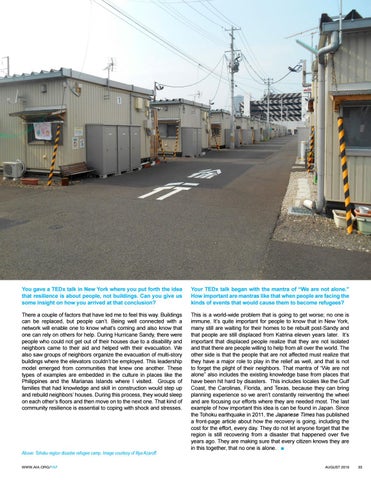
This is a world-wide problem that is going to get worse; no one is immune. It’s quite important for people to know that in New York, many still are waiting for their homes to be rebuilt post-Sandy and that people are still displaced from Katrina eleven years later. It’s important that displaced people realize that they are not isolated and that there are people willing to help from all over the world. The other side is that the people that are not affected must realize that they have a major role to play in the relief as well, and that is not to forget the plight of their neighbors. That mantra of “We are not alone” also includes the existing knowledge base from places that have been hit hard by disasters. This includes locales like the Gulf Coast, the Carolinas, Florida, and Texas, because they can bring planning experience so we aren’t constantly reinventing the wheel and are focusing our efforts where they are needed most. The last example of how important this idea is can be found in Japan. Since the Tohoku earthquake in 2011, the Japanese Times has published a front-page article about how the recovery is going, including the cost for the effort, every day. They do not let anyone forget that the region is still recovering from a disaster that happened over five years ago. They are making sure that every citizen knows they are in this together, that no one is alone. ■
Above: Tohoku region disaster refugee camp. Image courtesy of Illya Azaroff. WWW.AIA.ORG/YAF
AUGUST 2016
33