DESIGN EMERGENT PRACTICE
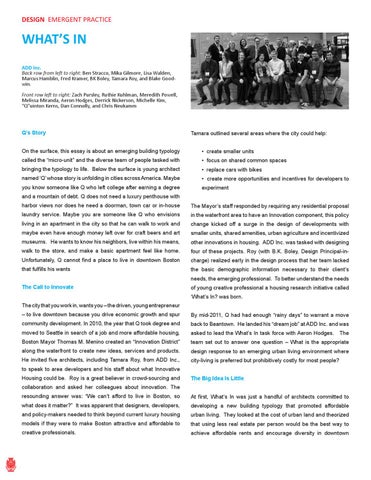
WHAT’S IN ADD Inc. Back row from left to right: Ben Stracco, Mika Gilmore, Lisa Walden, Marcus Hamblin, Fred Kramer, BK Boley, Tamara Roy, and Blake Goodwin. Front row left to right: Zach Pursley, Ruthie Kuhlman, Meredith Powell, Melissa Miranda, Aeron Hodges, Derrick Nickerson, Michelle Kim, “Q”uinton Kerns, Dan Connolly, and Chris Neukamm
Q’s Story
Tamara outlined several areas where the city could help:
On the surface, this essay is about an emerging building typology
• create smaller units
called the “micro-unit” and the diverse team of people tasked with
• focus on shared common spaces
bringing the typology to life. Below the surface is young architect
• replace cars with bikes
named ‘Q’ whose story is unfolding in cities across America. Maybe
• create more opportunities and incentives for developers to
you know someone like Q who left college after earning a degree
experiment
and a mountain of debt. Q does not need a luxury penthouse with harbor views nor does he need a doorman, town car or in-house
The Mayor’s staff responded by requiring any residential proposal
laundry service. Maybe you are someone like Q who envisions
in the waterfront area to have an Innovation component, this policy
living in an apartment in the city so that he can walk to work and
change kicked off a surge in the design of developments with
maybe even have enough money left over for craft beers and art
smaller units, shared amenities, urban agriculture and incentivized
museums. He wants to know his neighbors, live within his means,
other innovations in housing. ADD Inc. was tasked with designing
walk to the store, and make a basic apartment feel like home.
four of these projects. Roy (with B.K. Boley, Design Principal-in-
Unfortunately, Q cannot find a place to live in downtown Boston
charge) realized early in the design process that her team lacked
that fulfills his wants
the basic demographic information necessary to their client’s needs, the emerging professional. To better understand the needs
The Call to Innovate
of young creative professional a housing research initiative called ‘What’s In? was born.
The city that you work in, wants you – the driven, young entrepreneur – to live downtown because you drive economic growth and spur
By mid-2011, Q had had enough “rainy days” to warrant a move
community development. In 2010, the year that Q took degree and
back to Beantown. He landed his “dream job” at ADD Inc. and was
moved to Seattle in search of a job and more affordable housing,
asked to lead the What’s In task force with Aeron Hodges.
Boston Mayor Thomas M. Menino created an “Innovation District”
team set out to answer one question – What is the appropriate
along the waterfront to create new ideas, services and products.
design response to an emerging urban living environment where
He invited five architects, including Tamara Roy, from ADD Inc.,
city-living is preferred but prohibitively costly for most people?
The
to speak to area developers and his staff about what Innovative Housing could be. Roy is a great believer in crowd-sourcing and
The Big Idea Is Little
collaboration and asked her colleagues about innovation. The resounding answer was: “We can’t afford to live in Boston, so
At first, What’s In was just a handful of architects committed to
what does it matter?” It was apparent that designers, developers,
developing a new building typology that promoted affordable
and policy-makers needed to think beyond current luxury housing
urban living. They looked at the cost of urban land and theorized
models if they were to make Boston attractive and affordable to
that using less real estate per person would be the best way to
creative professionals.
achieve affordable rents and encourage diversity in downtown