ways of teaching that incorporate the OSEU concepts—such as examples or activities, to reinforce the message that Native voices are valuable. After developing the materials, TIE spent a year showing teachers at one particular reservation school how to implement them. At the end of the year, the teachers who had been most reluctant had become the biggest supporters. Another problem TIE is working to overcome is the high turnover rate for teachers in the state—especially in reservation schools. Simpson says that at some reservation schools, they have seen 100 percent turnover in 12 months. Many times, the school year starts and there are still teaching positions vacant. Even in non-reservation schools, there is a problem with teacher retention in rural areas in South Dakota. Giving new teachers a way into the local culture and helping them identify resources in the community has been an important part of Simpson’s work with TIE. They developed a mentorship program for new teachers called the WoLakota Project that incorporates the OSEU. In the three years that they’ve offered the program, they have successfully retained more participating teachers.
While there is not much data yet to prove the success of these programs, there is strong anecdotal evidence to show that they are working. The State of South Dakota is now implementing the OSEU in public schools across the state. TIE’s WoLakota Project is expanding their work to Native populations in Wyoming and North Dakota. The National Board of Teacher Certification and the Bureau of Indian Education are partnering with TIE to scale up the program into the HEART Initiative (Helping Educators Achieve, Reflect, and Teach) in Mississippi,
Hawaii and New Mexico—three other states with large Native populations. They are also investigating how this culturally responsive model could be used in other communities. Could they interview black, Hispanic or immigrant community elders to determine a set of core beliefs that legitimizes those cultures in particular classrooms? “The core of this system is allowing our educational practice to be deeply influenced by the elders of the community,” said Simpson. n
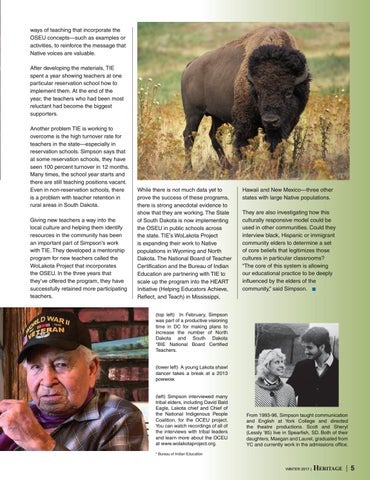
(top left) In February, Simpson was part of a productive visioning time in DC for making plans to increase the number of North Dakota and South Dakota *BIE National Board Certified Teachers. (lower left) A young Lakota shawl dancer takes a break at a 2013 powwow. (left) Simpson interviewed many tribal elders, including David Bald Eagle, Lakota chief and Chief of the National Indigenous People Coalition, for the OCEU project. You can watch recordings of all of the interviews with tribal leaders and learn more about the OCEU at www.wolakotaproject.org.
From 1993-96, Simpson taught communication and English at York College and directed the theatre productions. Scott and Sheryl (Lessly '85) live in Spearfish, SD. Both of their daughters, Maegan and Laurel, graduated from YC and currently work in the admissions office.
* Bureau of Indian Education
WINTER 2017 2013 |
Heritage | 5