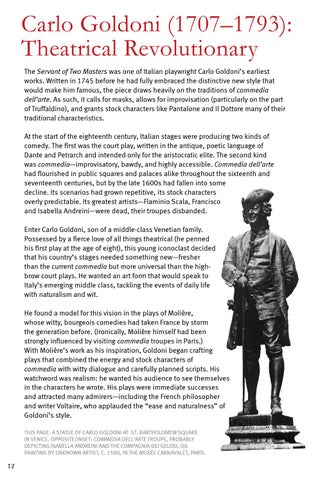
Carlo Goldoni (1707–1793): Theatrical Revolutionary The Servant of Two Masters was one of Italian playwright Carlo Goldoni’s earliest works. Written in 1745 before he had fully embraced the distinctive new style that would make him famous, the piece draws heavily on the traditions of commedia dell’arte. As such, it calls for masks, allows for improvisation (particularly on the part of Truffaldino), and grants stock characters like Pantalone and Il Dottore many of their traditional characteristics. At the start of the eighteenth century, Italian stages were producing two kinds of comedy. The first was the court play, written in the antique, poetic language of Dante and Petrarch and intended only for the aristocratic elite. The second kind was commedia—improvisatory, bawdy, and highly accessible. Commedia dell’arte had flourished in public squares and palaces alike throughout the sixteenth and seventeenth centuries, but by the late 1600s had fallen into some decline. Its scenarios had grown repetitive, its stock characters overly predictable. Its greatest artists—Flaminio Scala, Francisco and Isabella Andreini—were dead, their troupes disbanded. Enter Carlo Goldoni, son of a middle-class Venetian family. Possessed by a fierce love of all things theatrical (he penned his first play at the age of eight), this young iconoclast decided that his country’s stages needed something new—fresher than the current commedia but more universal than the highbrow court plays. He wanted an art form that would speak to Italy’s emerging middle class, tackling the events of daily life with naturalism and wit. He found a model for this vision in the plays of Molière, whose witty, bourgeois comedies had taken France by storm the generation before. (Ironically, Molière himself had been strongly influenced by visiting commedia troupes in Paris.) With Molière’s work as his inspiration, Goldoni began crafting plays that combined the energy and stock characters of commedia with witty dialogue and carefully planned scripts. His watchword was realism: he wanted his audience to see themselves in the characters he wrote. His plays were immediate successes and attracted many admirers—including the French philosopher and writer Voltaire, who applauded the “ease and naturalness” of Goldoni’s style. This page: a statue of carlo goldoni at st. bartholomew square in venice. opposite/inset: Commedia dell’arte troupe, probably depicting Isabella Andreini and the Compagnia dei Gelosi, oil painting by unknown artist, c. 1580, in the Musée Carnavalet, Paris.
12