XCITY / Features
Q&A with
Hugh Pym
From interviewing patients to filming in PPE, the BBC health editor speaks to Victoria Miller
What has been the most challenging aspect of reporting the pandemic? Interviewing some of the families of those who have lost loved ones, especially those who never got a chance to see them. Understandably, families want to mark and celebrate their loved ones’ lives and it is a privilege to talk to them. It can hit home as I realise just how traumatic the experience was for the person and their family. Interviewing patients in the wards has been challenging but a very important part of the coverage. The patients are brave; they are struggling but they want to speak to us. The team has to make sure that the patient isn’t under too much strain because their breathing can be laboured. You have to gauge when to continue and when to stop. I also take my hat off to the camera crew and wider team who do an amazing job of filming in PPE in intensive care. Hospitals are very busy and crowded places. The team has to have the right kit and sanitise everything before and after filming. Everything has to be worked out; there are no second chances.
88
|
How do you think this pandemic has changed or will change the way health is reported? It is hard to tell what health reporting in the future will look like, but what I do think is that health and science journalists are, and quite rightly, being recognised for their expertise. The pandemic will dominate news for months to come and such expertise will be needed, even as the pandemic starts to slow down. By then, I imagine the news will focus on reflections from the pandemic. Questions such as: what the government did right; what it did wrong; was lockdown too harsh? Health and science journalists will be required to present the data and facts of just how much strain the NHS was under, and how some hospitals were very close to being overwhelmed.
“The patients are brave; they are struggling but they want to speak to us”
Image: BBC
H
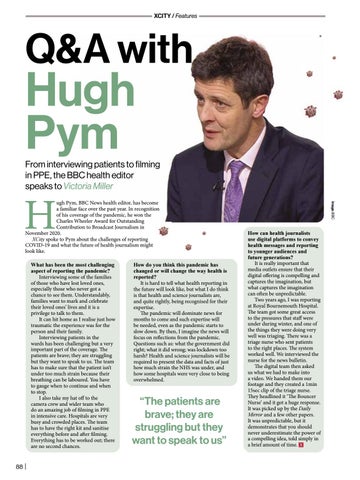
ugh Pym, BBC News health editor, has become a familiar face over the past year. In recognition of his coverage of the pandemic, he won the Charles Wheeler Award for Outstanding Contribution to Broadcast Journalism in November 2020. XCity spoke to Pym about the challenges of reporting COVID-19 and what the future of health journalism might look like.
How can health journalists use digital platforms to convey health messages and reporting to younger audiences and future generations? It is really important that media outlets ensure that their digital offering is compelling and captures the imagination, but what captures the imagination can often be unpredictable. Two years ago, I was reporting at Royal Bournemouth Hospital. The team got some great access to the pressures that staff were under during winter, and one of the things they were doing very well was triaging. There was a triage nurse who sent patients to the right places. The system worked well. We interviewed the nurse for the news bulletin. The digital team then asked us what we had to make into a video. We handed them our footage and they created a 1min 15sec clip of the triage nurse. They headlined it ‘The Bouncer Nurse’ and it got a huge response. It was picked up by the Daily Mirror and a few other papers. It was unpredictable, but it demonstrates that you should never underestimate the power of a compelling idea, told simply in a brief amount of time. 🆇