Features 53
The New(s) Frontier Meet the content creators adopting journalistic skills to reach massive audiences. How is TikTok shaking up traditional news?
By Caitlin Barr and Yasmin Vince
T
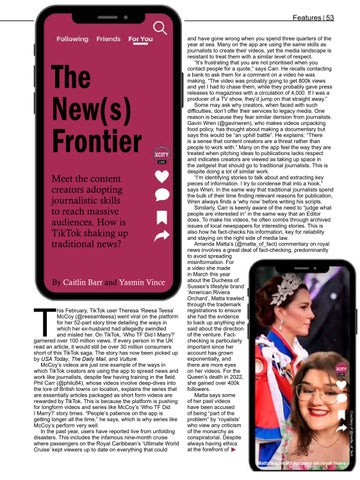
Matta’s content focuses on royal news
Courtesy of @matta_of_fact
his February, TikTok user Theresa ‘Reesa Teesa’ McCoy (@reesamteesa) went viral on the platform for her 52-part story time detailing the ways in which her ex-husband had allegedly swindled and misled her. On TikTok, ‘Who TF Did I Marry?’ garnered over 100 million views. If every person in the UK read an article, it would still be over 30 million consumers short of this TikTok saga. The story has now been picked up by USA Today, The Daily Mail, and Vulture. McCoy’s videos are just one example of the ways in which TikTok creators are using the app to spread news and work like journalists, despite few having training in the field. Phil Carr (@philc84), whose videos involve deep-dives into the lore of British towns on location, explains the series that are essentially articles packaged as short form videos are rewarded by TikTok. This is because the platform is pushing for longform videos and series like McCoy’s ‘Who TF Did I Marry?’ story times. “People’s patience on the app is getting longer all the time,” he says, which is why series like McCoy’s perform very well. In the past year, users have reported live from unfolding disasters. This includes the infamous nine-month cruise where passengers on the Royal Caribbean’s ‘Ultimate World Cruise’ kept viewers up to date on everything that could
and have gone wrong when you spend three quarters of the year at sea. Many on the app are using the same skills as journalists to create their videos, yet the media landscape is resistant to treat them with a similar level of respect. “It’s frustrating that you are not prioritised when you contact people for a quote,” says Carr. He recalls contacting a bank to ask them for a comment on a video he was making. “The video was probably going to get 800k views and yet I had to chase them, while they probably gave press releases to magazines with a circulation of 4,000. If I was a producer of a TV show, they’d jump on that straight away.” Some may ask why creators, when faced with such difficulties, don’t offer their services to legacy media. One reason is because they fear similar derision from journalists. Gavin Wren (@gavinwren), who makes videos unpacking food policy, has thought about making a documentary but says this would be “an uphill battle”. He explains: “There is a sense that content creators are a threat rather than people to work with.” Many on the app feel the way they are treated when pitching ideas to publications lacks respect and indicates creators are viewed as taking up space in the zeitgeist that should go to traditional journalists. This is despite doing a lot of similar work. “I’m identifying stories to talk about and extracting key pieces of information. I try to condense that into a hook,” says Wren. In the same way that traditional journalists spend the bulk of their time finding relevant reasons for publication, Wren always finds a ‘why now’ before writing his scripts. Similarly, Carr is keenly aware of the need to “judge what people are interested in” in the same way that an Editor does. To make his videos, he often combs through archived issues of local newspapers for interesting stories. This is also how he fact-checks his information, key for reliability and staying on the right side of media law. Amanda Matta’s (@matta_of_fact) commentary on royal news involves a great deal of fact-checking, predominantly to avoid spreading misinformation. For a video she made in March this year about the Duchess of Sussex’s lifestyle brand ‘American Riviera Orchard’, Matta trawled through the trademark registrations to ensure she had the evidence to back up anything she said about the direction of the venture. Factchecking is particularly important since her account has grown exponentially, and there are more eyes on her videos. For the Queen’s death in 2022, she gained over 400k followers. Matta says some of her past videos have been accused of being “part of the problem” by ‘royalists’ who view any criticism of the monarchy as conspiratorial. Despite always having ethics at the forefront of