The impact of internal marketing on service quality (Case study: African Community Credit – West Also, by communicating a clearer vision to their employees through internal marketing, they come to know what organizations expect from them and are therefore likely to offer better service to their customers (Liao and Chuang, 2004). In the same vein, Reynoso and Moores (1996) state that organizations by communicating their vision to their employees draw their attention to the effectiveness of a quality service. The physical environment refers to all that is necessary for the production of the service: the immediate environment in contact with the customer (or the physical space in which the service takes place), the material elements necessary for the provision of the service and the equipment of the staff in contact (Flipo, 1986). Bitner (1990) argues that the visible elements of the environment can affect customers' impressions of the quality of service. Environmental design and design can significantly influence customer expectations for service quality (Shostack, 1977). The management of the space, the decor, the working atmosphere and the working environment contribute to facilitate the realization of the service, to transform it into a successful experience for the customers. In view of the above, the contribution of internal marketing to the provision of a quality service is no longer to be denied. Moreover, the concept of the internal marketing has been found to be a problem of high quality (Panigyrakis and Theodoridis, 2009). Therefore, each organization should develop marketing program for its external markets in order to continually provide high quality services to its clientele (Berry and Parasuraman, 1991).
III.
Research Methodology
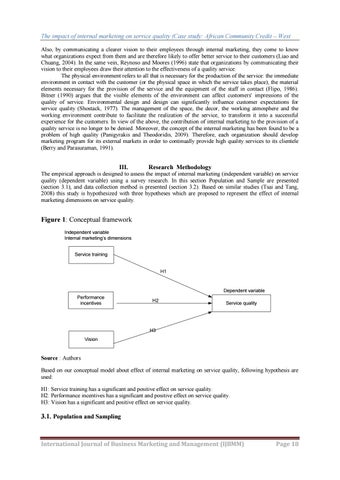
The empirical approach is designed to assess the impact of internal marketing (independent variable) on service quality (dependent variable) using a survey research. In this section Population and Sample are presented (section 3.1), and data collection method is presented (section 3.2). Based on similar studies (Tsai and Tang, 2008) this study is hypothesized with three hypotheses which are proposed to represent the effect of internal marketing dimensions on service quality.
Figure 1: Conceptual framework Independent variable Internal marketing’s dimensions Service training
H1
Dependent variable Performance incentives
H2
Service quality
H3 Vision
Source : Authors Based on our conceptual model about effect of internal marketing on service quality, following hypothesis are used: H1: Service training has a significant and positive effect on service quality. H2: Performance incentives has a significant and positive effect on service quality. H3: Vision has a significant and positive effect on service quality.
3.1. Population and Sampling
International Journal of Business Marketing and Management (IJBMM)
Page 18