Biomimetics is a rapidly growing, interdisciplinary field that involves studying the structure and function of biological systems and using them as inspiration and models for the design and engineering of materials and devices, explained Robin Hissam.
In a project with drug delivery applications, Hissam is working with a temperature-sensitive biopolymer to create drug delivery vehicles that will travel to certain higher-temperature areas of the body. “This will limit the effects of the drug on healthy tissues, providing a more targeted effect. Also, by changing the chemical composition of the material, we can manipulate its shape and size, increasing its potential usefulness.”
Biomimetics: the Convergence of
Another project Hissam is working on involves biomineralization, the process through which living organisms produce minerals, often to harden or stiffen tissues.
Biology and Engineering “Biological materials are excellent at organizing themselves into intricate and well-defined structures, and scientists are attempting to mimic this behavior with synthetic and biological polymers,” she said. “Biological materials offer a starting point to modify and mimic natural processes and design new structures for wider applicability.” Hissam, an assistant professor in the Department of Chemical Engineering, is currently working on three separate but related research projects focused on creating and optimizing biomimetic systems with many potential applications.
In biology, biomineralization takes such forms as sea creatures’ shells or the bones of mammals and birds. Researchers are attempting to mimic the ways that living organisms produce minerals to produce useful materials with various applications. Hissam’s work in biomineralization is aimed at the development of a material with antimicrobial properties that may be effective in wound healing. A mix of biological understanding and engineering skill is critical to the field of biomimetics, said Hissam.
In one project, Hissam is collaborating with Charter Stinespring, associate professor of chemical engineering, and Edward Sabolsky, assistant professor of mechanical and aerospace engineering, to develop a new generation of high-speed, high-sensitivity chemical and photo biosensors to meet the needs of the defense, intelligence, and medical communities. The project involves the use of graphene—a substance made of carbon, but in a one-atom-thick sheet—and certain polymers.
“The need to draw from physical and life sciences, as well as health sciences, for the development of biologically based engineering projects is essential,” she said. “The fundamentals of biology and chemistry drive our manipulation of systems to create more complex or more applicable materials. For example, the structural behavior of proteins drives our drug delivery project, which is derived from biochemistry.
“Because of its unique characteristics, graphene has the potential to revolutionize the field of solid-state electronics and sensors,” said Hissam. “Using biological systems for inspiration, we hope to develop a sensor platform that is highly sensitive but also highly selective in detecting certain target molecules.”
“Biology has created optimum, complex systems,” she added, “and the field of biomimetics is allowing researchers to create systems that—in the future— will approach this level of perfection.”
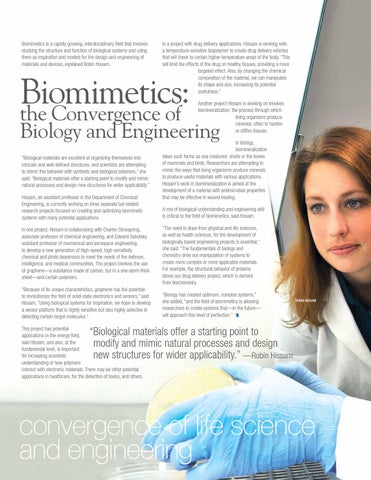
ROBIN HISSAM
“Biological materials offer a starting point to modify and mimic natural processes and design new structures for wider applicability.” —Robin Hissam
This project has potential applications in the energy field, said Hissam, and also, at the fundamental level, is important for increasing scientists’ understanding of how polymers interact with electronic materials. There may be other potential applications in healthcare, for the detection of toxins, and others.
convergence of life science and engineering