February 16, 2017
Page A3
Self-care recommended during winter to prevent sickness During temp changes, nurse says hygiene, sleep essential By BRANDON WILLIAMS For the Yellow Jacket
For most Americans, one of the first things they do upon waking up is check the weather. Whether this is via Twitter, the morning news or
HIGH TEMPERATURES DURING THE LAST TWO WEEKS (PITTSBURGH) (F°)
60 50 40 30 (FEB)
1
2
3
4
listening on the radio, one’s decisions for the day including clothing and activities are based on the weather conditions. As of late, in south-
5
6
7
8
9
10
western Pennsylvania, the weather has fluctuated on a daily basis. From Jan. 31 to Feb. 9 the lowest temperature was 28 degrees Fahrenheit. The highest
11
12
13
14
temperature, recorded in the same span, was 66 degrees, according to U.S Climate Data. With all the weather change also comes change
in the way our bodies feel as well. “Studies find that changes in the barometric pressure can causes headaches, arthritic joint pain and joint sensitivity,” said Jennifer Shiring, nurse director of Student Health Services at Waynesburg University. To stay healthy during this time, Shiring offered advice to students on how to handle such dramatic weather fluctuations. “Students can keep their
immune systems healthy by getting sleep, eating a healthy, balanced diet and frequent hand washing,” said Shiring. This is key to students making it through the semester staying out of bed and in the classroom. As Shiring attests, it can be easy for students to lose track of their health and fall into the trap of getting sick when the weather changes so often. CHANGES >> A4
Alcohol: Houses held Bonner: WU a leader in service learning in 90s to different standards Continued from A1
Continued from A1
Humiston. Humiston said inspections and access of the on-campus houses fall under the same policy in the Code of Conduct as the dorms, as well. “The university reserves the right of Resident Directors, Maintenance and Public Safety staff, and other authorized representatives to enter the room premises at any time for the purpose of supervising conditions regarding maintenance, repair, damage, health, safety, compliance with university policies, or federal, state and borough laws,” states the Code of Conduct. “Additionally, the university reserves the right to inspect all residence halls rooms to insure compliance of rules, regulations and laws, whether or not the occupants are present at the time of inspection. All rooms will be inspected at Thanksgiving, Christmas, and Spring breaks.” DoPS officers conduct walkthroughs of the dorms on campus once or twice a shift, Humiston said, but monitoring the on-campus houses pose a different challenge due to having 14 of them and the locations of them being all over the outskirts of the college. This leads to the on-campus houses being checked much less than the dorms on campus.
Humiston said the decision for Public Safety officers to inspect on-campus houses is “more random” than planned and relates to information provided to Public Safety. “Security will act on an investigation, a lot of times it’s by an anonymous call or maybe it’s a Res Life member who has heard it or seen it, so they notify security who will investigate,” Humiston said. “Most of the information we get is credible, so we hold that [accused] person or those persons accountable for a violation of our alcohol policy.” Humiston said initially each member of the house will be responsible for the alcohol in the house, but “typically what happens in a multi-living setting, someone takes ownership of it,” Humiston said. One reason, Hardie said, the on-campus houses are inspected less is due to “trust” between Residence Life and the students in the houses. “You go through a pretty lengthy process to apply for that house and you go through a committee, an impartial committee that looks at GPA, discipline, credits earned, those types of things,” Hardie said. “The trust level is really high for those kinds of students. We wouldn’t put you in there if we didn’t trust you. We don’t feel like there needs to be mandatory walkthroughs.”
acampus. When Stover Campus Center was built in 1998, Thyreen intentionally placed the Center for Service Leadership right next to the first floor entrance. “I wanted students to know that service to others was a very important part of a Waynesburg education,” said Thyreen. At some point during the early years of Thyreen’s presidency, a consultant came to Waynesburg University and told Thyreen that if he could accomplish what he aimed to do in terms of his vision for the institution, it would influence all of higher education. “It really did do that,” said Thyreen. According to Thyreen, ‘service learning’ wasn’t politically c or re c t t o talk about in the 1990s. Other universities questioned Wa y n e s burg’s policy of giving academic credit f o r service learning classes, and questioned the value of the Bonner program. But Thyreen continued to give speeches at various
venues about Bonner and Waynesburg’s service learning initiatives, and soon, other colleges were calling the university, asking about the Bonner Program. Thyreen wasn’t worried about other schools “copying” Waynesburg’s service model. In fact, he hoped they would, so that service learning would become important across higher education. “I want schools to be excited about service learning,” he said. “That will change the language of higher education and students will be looking for it.” Today, service learning has taken off at colleges around the country, and it continues to be embedded in the mission and operations of Waynesburg University. “The Bonner Program continues to play a very integral and vibrant role in how this university moves forward, because it helps us to stay identified with one of the touchstones of our mission,” s ai d c u r re nt President Douglas Lee. Lee has had the opportunity to interact with many Bonner Scholars during his years as a trustee and since the beginning of his presidency.
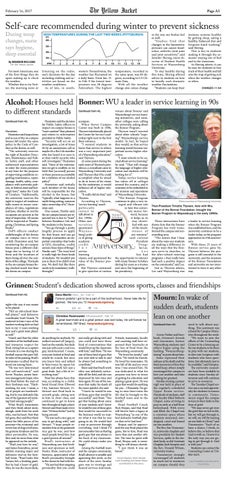
Photo courtesy of Waynesburg University
Then-President Timothy Thyreen, here with Mrs. Bonner of the Bonner Foundation, brought the Bonner Program to Waynesburg in the early 1990s. Those interactions have shown him that the Bonner Program has truly transformed the campus and surrounding area. “The stories that I hear about the ways our students are making a difference in all the ways that the Bonners serve in churches, in the after-school tutoring programs – they really have had such a positive impact on the community,” said Lee. Just as Thyreen attests, Lee said Waynesburg was
a leader in service learning when the Bonner Program was established here, and the university continues to be a leader today, as the program approaches its 25th anniversary. With those 25 years of Bonner service gone by, Thyreen believes the program is still essential to the university, and the missions of the Bonner Foundation and university are too intertwined to have it any other way.
Grinnen: Student's dedication showed across sports, classes and friendships Mourn: In wake of sudden death, students lean on one another
Continued from A1
right—the way it was meant to be played. “He’s an old-school football player,” said defensive coordinator Scott Venick. “It mattered to him—one of the hardest-working kids we had here in my 11 years working here and a great team player as well.” Venick said that the other members of the football team had immense respect for Brad, voting him as a captain 10 weeks in a row during the football season this past Fall. In wake of his passing, Brad's teammates recalled that he stood out among them. “He was very determined and self-motivated,” said Kevin Thacker, junior business management major, who met Brad before the start of their freshman year. “Hardworking, for sure. I mean, a lot of people are hardworking, but he was definitely like one of the [greatest at] working hard among people.” What Brad’s teammates said they think about most, though, aside from his work ethic, was his heart. Now that he’s gone, they said they think about the little pieces of his persona—his irrational and severe fear of dogs of all sizes, his genuine kindness and his jokey personality. He was, they said, far more than what he appeared on the outside. “That’s just how he was,” said James Roundtree, junior athletic training major and defensive end on the football team. “Brad looks like Tarzan; he’s a freaking giant. But he had a heart of gold. Man, he was the nicest dude,
Continued from A1
do anything for anybody. He walked around all [angry], hard on the outside, but dude was just soft—just a real nice guy, kind-hearted. I mean, everyone looked at Brad and would be scared, but once you knew him and talked to him—once he opens his mouth and stuff, he’s just a great dude. Just a life of everything man.” Brad has always been this way, according to a childhood friend from Ellwood City, Jamison Stewart, 21. Stewart met Brad back in seventh grade, sitting next to him in choir class, and continued to get to know him throughout high school. Stewart said Brad made every class “10 times better” just by being around. “He was such a nice guy, so easy to get along with,” said Stewart. “I hope people remember him as the genuinely nice guy he was, and how much people loved him. Just a good person all around.” Brad’s instructors at Waynesburg saw that liveliness and openness as well. Neeley Shaw, instructor of business, appreciated what Brad’s personality brought to the classes he had with her. “He just had that outgoing personality that you could
just really get along with and you could just have those kind of conversations that would liven up the classroom with him,” said Shaw. “He was one of those kind of guys that you were able to talk to and he always had something to contribute.” Shaw said that Brad’s work ethic was definitely noticeable off the field, and she was impressed by him time and time again. It’s one of the reasons that make his death all the more painful, she said. “I knew he would be one of those guys that would be successful,” said Shaw. “You get that feeling about some of your students and I knew he would be one of those guys that would be successful in the business world no matter what it was that he was going to do. He would find a way to persevere through everything. And I think I’ll just remember him as that big goofy guy that was always in the back of my classroom. He could always make you laugh.” Among the football team and the campus community, Brad’s absence is notable and agonizing this week, as the shock of the news Sunday gave way to viewings and funeral services mid-week.
Friends, teammates, faculty and coaching staff have expressed their heartache at the loss of Brad from the Waynesburg community. “He loved his family,” said Falvo. “He loved his friends. He loved his teammates. He was full of life and joy every time I was around him. He was dedicated to what his purpose was here in terms of getting his education and playing a great sport. He was a guy that would do anything for you…Ultimately, I’m going to miss him—miss the life that he brought to the football team and to the family.” Head Football Coach Rick Shepas, said that Brad will forever have a legacy at Waynesburg “as one of the best defensive football players that we’ve had here.” Shepas said he appreciated the way Brad played the game, but to him, Brad was more than just another athlete. The time he spent with Brad, Shepas said, is something he will always cherish. “I just think it was an honor.” Kimmi Baston, Shon Meade, Luke Goodling and Jacob Meyer contributed to this story.
Across Twitter and Facebook, Grinnen’s friends and classmates, former Waynesburg students and others began using the hashtag “#waynesburgstrong” in posts about him. Some expressed their sadness at his death and the fond memories of him they would keep; others simply encouraged the campus to love one another and take nothing for granted. Sunday evening, a prayer vigil was held in place of the regularly scheduled Upper Room ser vice. Hundreds of students, staff and faculty filled Roberts Chapel, some arriving to pray as early as a half hour beforehand. With every seat filled, the Chapel was a common space where students mourned, worshipped, cried and leaned on one another. The Rev. Jim Tinnemeyer, university chaplain and vice president for Student Services, spoke to the student body, as did Assistant Chaplain Josh Sumpter and the Rev. Donald Wilson, university trustee. Tinnemeyer strongly encouraged all students to reach out to resources on campus should they
need to talk about anything. This sentiment was echoed by Campus Ministries throughout the week. “We want to join the efforts of the Counseling Center to be a listening ear for our students, to be there to pray with our students, to dive into Scripture with students who have questions, but ultimately just to be available,” said Sumpter. The university counselors have been available to students since Sunday afternoon and will continue to serve as resources. The Tuesday Chapel service was a second opportunity for students to mourn in community. Tinnemeyer urged the campus to turn to their faith in this time of grief. “We may never get over the grief that we feel in life, but we will get through it, we will, we will by leaning on our faith in Christ,” said Tinnemeyer. “Each of us have a choice, I think, to believe this, to believe that God is with us. I know it is the only way you are going to get through it. God is with you.” Students can contact the Counseling Center at 724852-3225. Luke Goodling contributed to this article.