HERE’S WHAT WE SEE
Why the Medical Device Handbook matters Medical device suppliers are way beyond the times when they merely filled orders to spec for medtech OEMs. From incorporating steerability into catheters to getting validation and testing done right, the companies serving the medical device industry have become specialized experts. Through our annual Medical Device Handbook, we seek to harness this expertise for the medical device industry. We requested articles from medical device designers, outsourcers and consultants that avoided marketing pitches and instead provided useful information for our community. Whether medical device developers are new to, say, catheters, electronic components or rapid manufacturing, the nearly 50 articles in this issue should hopefully help them dip their toes into these areas. Here are just a few examples of the expertise to be had in this year’s Medical Device Handbook:
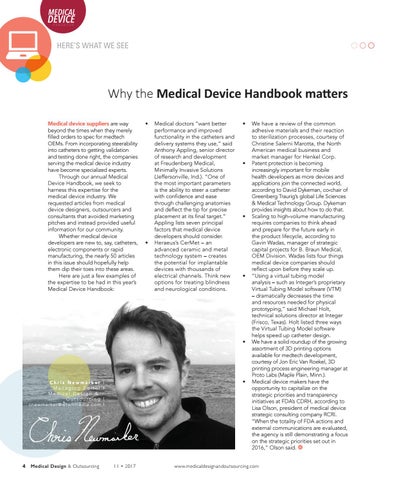
Chris Newmarker Managing Editor Medical Design & Outsourcing c newmark er@wtwhmedia.com
4
Medical Design & Outsourcing
Editorial Nov 2017_Vs1.indd 4
| | | |
11 • 2017
• Medical doctors “want better performance and improved functionality in the catheters and delivery systems they use,” said Anthony Appling, senior director of research and development at Freudenberg Medical, Minimally Invasive Solutions (Jeffersonville, Ind.). “One of the most important parameters is the ability to steer a catheter with confidence and ease through challenging anatomies and deflect the tip for precise placement at its final target.” Appling lists seven principal factors that medical device developers should consider. • Heraeus’s CerMet – an advanced ceramic and metal technology system – creates the potential for implantable devices with thousands of electrical channels. Think new options for treating blindness and neurological conditions.
• We have a review of the common adhesive materials and their reaction to sterilization processes, courtesy of Christine Salerni Marotta, the North American medical business and market manager for Henkel Corp. • Patent protection is becoming increasingly important for mobile health developers as more devices and applications join the connected world, according to David Dykeman, co-chair of Greenberg Traurig’s global Life Sciences & Medical Technology Group. Dykeman provides insights about how to do that. • Scaling to high-volume manufacturing requires companies to think ahead and prepare for the future early in the product lifecycle, according to Gavin Wadas, manager of strategic capital projects for B. Braun Medical, OEM Division. Wadas lists four things medical device companies should reflect upon before they scale up. • “Using a virtual tubing model analysis – such as Integer’s proprietary Virtual Tubing Model software (VTM) – dramatically decreases the time and resources needed for physical prototyping,” said Michael Holt, technical solutions director at Integer (Frisco, Texas). Holt listed three ways the Virtual Tubing Model software helps speed up catheter design. • We have a solid roundup of the growing assortment of 3D printing options available for medtech development, courtesy of Jon Eric Van Roekel, 3D printing process engineering manager at Proto Labs (Maple Plain, Minn.). • Medical device makers have the opportunity to capitalize on the strategic priorities and transparency initiatives at FDA’s CDRH, according to Lisa Olson, president of medical device strategic consulting company RCRI. “When the totality of FDA actions and external communications are evaluated, the agency is still demonstrating a focus on the strategic priorities set out in 2016,” Olson said. M
www.medicaldesignandoutsourcing.com
11/3/17 11:09 AM