MOTION SYSTEMS HANDBOOK
Motors–DC
DC MOTORS:
brushed and brushless
A
direct current (dc) motor is an electric machine that converts electrical energy to mechanical energy. All dc motors generate a magnetic field, either with electromagnetic windings or permanent magnets. An armature, which is often a coil of wires, is placed between the north and south poles of a magnet. When current flows through the armature, the field produced by the armature interacts with the magnetic field from the magnets and eventually generates a torque and thereby motion. According to common industry naming conventions, the most common dc motor types are basic brushed dc motors and brushless dc motors. Brushed dc motors Some engineers call brushed dc motors wound-field motors because they have wound and lacquered coils of copper wire that make the electromagnetic field. No matter the term, there are permanent magnet (PM), shunt, series and compound-wound brushed motors. In a brushed dc motor, the magnet acts as the stator. The armature is integrated onto the rotor and a commutator switches the current flow. Brushed dc motors use commutators and brushes to pass current to the rotating rotor’s copper-wire windings. Designers can control speed by changing rotor voltage (and current with it) or by changing the magnetic flux between rotor and stator through adjustments of the field-winding current. In fact, the way dc brush motors let designers control field and rotor windings means they’re suitable for applications that need simple and cost-effective torque and speed control. That said, increased functionality from electronics for PM motors means that this advantage is less pronounced than it once was. Brushed dc motors have the advantage of generally low initial cost and simple control of the motor speed. However, there are some drawbacks. At certain periods during the dc motor rotation, the commutator must
120
DESIGN WORLD
Motors_DC_MB_Vs5.indd 120
8 • 2015
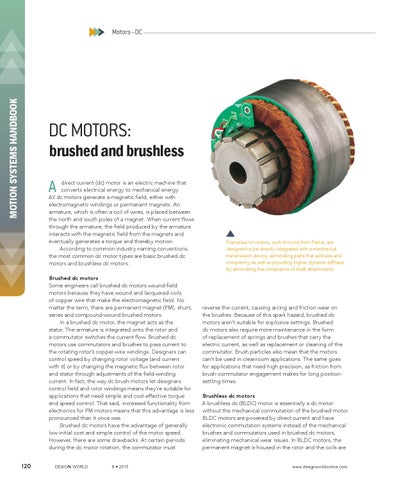
Frameless kit motors, such this one from Parker, are designed to be directly integrated with a mechanical transmission device, eliminating parts that add size and complexity, as well as providing higher dynamic stiffness by eliminating the compliance of shaft attachments.
reverse the current, causing arcing and friction wear on the brushes. Because of this spark hazard, brushed dc motors aren’t suitable for explosive settings. Brushed dc motors also require more maintenance in the form of replacement of springs and brushes that carry the electric current, as well as replacement or cleaning of the commutator. Brush particles also mean that the motors can’t be used in cleanroom applications. The same goes for applications that need high precision, as friction from brush-commutator engagement makes for long positionsettling times. Brushless dc motors A brushless dc (BLDC) motor is essentially a dc motor without the mechanical commutation of the brushed motor. BLDC motors are powered by direct current and have electronic commutation systems instead of the mechanical brushes and commutators used in brushed dc motors, eliminating mechanical wear issues. In BLDC motors, the permanent magnet is housed in the rotor and the coils are www.designworldonline.com
8/17/15 2:51 PM