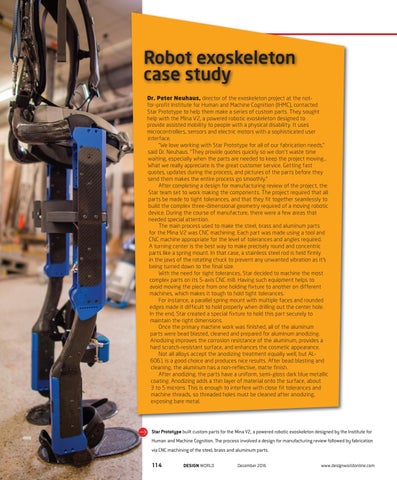
Robot exoskeleton case study Dr. Peter Neuhaus, director of the exoskeleton project at the notfor-profit Institute for Human and Machine Cognition (IHMC), contacted Star Prototype to help them make a series of custom parts. They sought help with the Mina V2, a powered robotic exoskeleton designed to provide assisted mobility to people with a physical disability. It uses microcontrollers, sensors and electric motors with a sophisticated user interface. “We love working with Star Prototype for all of our fabrication needs,” said Dr. Neuhaus. “They provide quotes quickly so we don’t waste time waiting, especially when the parts are needed to keep the project moving… What we really appreciate is the great customer service. Getting fast quotes, updates during the process, and pictures of the parts before they send them makes the entire process go smoothly.” After completing a design for manufacturing review of the project, the Star team set to work making the components. The project required that all parts be made to tight tolerances, and that they fit together seamlessly to build the complex three-dimensional geometry required of a moving robotic device. During the course of manufacture, there were a few areas that needed special attention. The main process used to make the steel, brass and aluminum parts for the Mina V2 was CNC machining. Each part was made using a tool and CNC machine appropriate for the level of tolerances and angles required. A turning center is the best way to make precisely round and concentric parts like a spring mount. In that case, a stainless steel rod is held firmly in the jaws of the rotating chuck to prevent any unwanted vibration as it’s being turned down to the final size. With the need for tight tolerances, Star decided to machine the most complex parts on its 5-axis CNC mill. Having such equipment helps to avoid moving the piece from one holding fixture to another on different machines, which makes it tough to hold tight tolerances. For instance, a parallel spring mount with multiple faces and rounded edges made it difficult to hold properly when drilling out the center hole. In the end, Star created a special fixture to hold this part securely to maintain the right dimensions. Once the primary machine work was finished, all of the aluminum parts were bead blasted, cleaned and prepared for aluminum anodizing. Anodizing improves the corrosion resistance of the aluminum, provides a hard scratch-resistant surface, and enhances the cosmetic appearance. Not all alloys accept the anodizing treatment equally well, but AL6061 is a good choice and produces nice results. After bead blasting and cleaning, the aluminum has a non-reflective, matte finish. After anodizing, the parts have a uniform, semi-gloss dark blue metallic coating. Anodizing adds a thin layer of material onto the surface, about 3 to 5 microns. This is enough to interfere with close fit tolerances and machine threads, so threaded holes must be cleaned after anodizing, exposing bare metal.
Star Prototype built custom parts for the Mina V2, a powered robotic exoskeleton designed by the Institute for Human and Machine Cognition. The process involved a design for manufacturing review followed by fabrication via CNC machining of the steel, brass and aluminum parts. 114
Test and Measurement 12-16_Vs2.indd 114
DESIGN WORLD
December 2016
www.designworldonline.com
12/1/16 4:23 PM