PANDEMIC POSTCARDS CHAPBOOK
F O E L TAB NTS E T N O C Winners FULL TANK
by Rachelle Pinnow
3
Wild Child
by Laura Manuel
4
City of Cats
by Bruce Cinnamon
5
Honourable Mentions Time Warp
6
by Janice Kenyon
Birthday Cake
7
by Kim Mannix
Letter to My school Teacher
by Sharmila
8
Pokharel
Hypothermia
A moment in the pandemic Hello from the bunker Could This
by Josephine LoRe
by Suzanne Johnston
by Michelle Spencer
Noticing Noticing Season of Loss Little Gifts
9
by Bret Crowle
by Mary Vlooswyk
by Joan Crate
by Silvia Pikal
10 11 12 13 14 15
Thank you to the Rozsa Foundation for making this possible!
! R E E N N N N I W W
FULL TANK One day, we’ll travel again. We’ll travel like we used to back in a simpler time, before children, before careers, before Covid-19, when we could circle some random town on a map and just go there. I remember one Friday, at four o’clock in the afternoon, we decided to take a road trip to Jasper. By five o’clock, your Volkswagen was idling in the alley behind my apartment while I tried, frantically, to pack a
JUDGE'S REMARKS:
This story wonderfully evokes many of the
single suitcase. You were like Kerouac with a full tank of gas. All you could say was, Let’s go, let’s go! Being a Victorian at
pre-COVID pleasures that we took for
heart, it was impossible for me to travel light. I felt my picnic
granted, paying exquisite tribute to the
basket was essential, with its blue china plates and my
tactile nature of roaming to new places, of
grandmother’s silverware. Yet we didn’t pack any masks or
meeting new people. The author renders in
anti-bacterial wipes, no hand sanitizer or rubber gloves.
clear, vibrant language a nostalgia, not only towards the past, but also for the future, however uncertain, of a return to what is impossible in the present circumstances:
Instead, we bought sticky snacks and Big Gulps when filling up in highway towns, and paid with grimy dollar bills. I remember how easily we met new people, shared food with them, sang together around campfires, swigged from the
those campfire nights, passing food and drink
same bottle. We listened to the radio, and the hot, July wind between friends, a time when “essential” could just as easily have alluded to the pull of sentiment rather than a fight for survival. Full Tank is a beautiful snapshot of longing that
pushed through the car windows until static made us turn the dial, scanning for the next station. When it was my turn to drive, the sun had long dropped behind the mountains, black
radiates with beauty, fragility, and the ever-
jags outlined in summer orange. With hundreds of kilometers
present need to connect with others, for that
behind us, you fell asleep with your warm hand on my bare
simple reassurance of “your warm hand on my
knee.
bare knee.”
By:
Rachelle Pinnow
WILD CHILD My daughter is now feral. Rebecca arrives at the doorstep looking for food, smelling of loam from an overturned spruce. Matted, blonde tangles crown ruddy cheeks. Dark earth is compressed under sharp fingernails. Her bare, sun-warmed
W WII N NN NE ER R!!
legs are etched by pine needles and coloured with bruises. While others insulate, Rebecca unwraps. In a different time, the before time, she folded limbs into square spaces. Now she passes empty classrooms as her legs strain toward yawning puddles and coiled roots. Rebecca follows the siren call of the North Saskatchewan River. And she
JUDGE'S REMARKS:
sympathizes - breaking clay embankments with a stick to soothe swelling currents. Standing on the threshold, blood seeps from her palm. Flesh shines red.
With well-crafted sentences and sharp imagery, Wild Child offers
In explanation, Rebecca wordlessly reaches into her pocket for the Swiss Army knife. Previously, the multitasking gadget
an unexpected and fresh approach to the global pandemic. In a short
rested quietly on a shelf. Contained. Clean. Compact. In her small palm, the tool’s hinges are now stiff with mud. The largest blade no longer smoothly clicks back into place.
space, the author gives us a strong sense of the young character who
Scratched polish leaves grooves for her small fingers to grasp.
has carved an envious and wondrous
“Now I know to carve away from myself,” Rebecca says.
space in our locked down world. Wild
I wrap her hand as she pauses on the stairs, gazing at blue
Child beautifully captures a child
gaps above the straight street. She accepts a cool sip of
navigating the world on her own
water and a sandwich. Half now, half for later. She will eat it terms, unfettered by the
while sitting on a stump, dropping crumbs for ants. constraints now imposed on us.
By:
Laura Manuel
!! R E E N N N IIN W W
CITY OF CATS He comes to visit me every day, a Norwegian Forest Cat with a fiery mane and malachite eyes. The little ginger lion smirks at me, giving me cat kisses until I open my patio door and scratch under his chin. He struts inside like nobody’s done in months, tail in the air, king of the castle. I feed him some skin and broth from a tin of salmon. He bathes himself after his meal, then curls up in my lap and purrs as I read. And then he leaves, out of
JUDGE'S REMARKS:
my small world and into his big one. He makes his way through the quiet city, striding boldly down
The author of City of Cats surprises
the centre of empty streets. He rides atop the streetcar across
and delights from the opening with an
the bridge, sees a Turkish Van trying to catch koi in the
expectation of magic. The Norwegian
Legislature fountain. He strolls through the marble halls of the
Forest Cat becomes the wise traveller
grand building, sits on the Speaker’s Throne as a Russian Blue
purring and cuddling by day, but by
and an orange tabby hiss at each other from across the aisle.
night! Oh, he’s is not confined by any
He wanders around downtown, watches a Ragdoll sliding merrily
pandemic! He becomes a wanderer and
across the ice at the arena, observes two Persians playfighting
an adventurer in the strange, dream-lit,
in the Hotel Macdonald’s ornate ballroom.
surreal night filled magical realism and
As the sun begins its slow descent, all the cats of the city
joy. Defying all rules of human
return home. They find their humans lounging in sunbeams,
engagement with the city, the cat
taking naps. They let the humans feed them, pet them, play with
makes us want for that kind of freedom,
them. And, as the moon dawns, they go to the window and look
that kind of returning to home after a
out on their sparkling city, eager for another day of adventure.
good time away. City of Cats wakes us up to the uninterrupted world of the urban animal.
By:
Bruce Cinnamon
TIME WARP Dave Williams, astronaut on his spacewalk on the Canadarm2 looked into “the vastness of space, a seemingly infinite void” and saw stars 4.3 light years from Earth in the Milky Way. He wondered if he was “looking back through time.” I walked in the country where migrating snow geese flew what felt like inches over my head and time stood still. When was that cherished moment? Yesterday? What kind of time? The same as Williams’ when he was suspended in space? Was that cosmic time? What time was I in when I felt the beating of wings in the space where I walked? Was it two days ago, or last week, or yesterday? Maybe I imagined the feel, the sound, the sight of black-tipped wings on a snow-white body? Could I see, feel, hear them maybe tomorrow? Confirmation there’s a kind of time warp in my head? A wish to encounter the snow geese come true? If you put me to the test and ask what happened in my isolation three days ago – or ten days before that – I can’t answer. Not for sure because isolation is a time warp. Everyone knows it, hears it, tastes it. Different for each of us, but feelings of losing track, being un-grounded, fear of slipping into afternoons and misty nights for another tomorrow to go nowhere persists. We have to encourage each other that we will get somewhere. Eventually. I’m convinced the snow geese were real. I just don’t know when.
By:
Janice Kenyon
H HO ON NO OU UR RA A M ME B B EN L L NT E E TIIO ON N
BIRTHDAY CAKE I hang up the phone and look out the window, trying not to cry because I know Kelsey is about to come into the kitchen. I stare at the leaves on the neighbour’s elm tree, noticing the way they collect the morning light. I count the radish tops polka-dotting the garden soil with green. I’ve probably planted them too close. Always thoughts about distance. Two inches between seedlings. Six feet between strangers. Five hundred kilometers to Dad’s place, if only we could go.
E E L L B B A A R R U U N N O O O I I N N T T O N N HO H E E M M
“Hi mama,” Kelsey says, pressing her head into my chest as she
squeezes me. I squeeze back. Her hair smells like a mix of berry shampoo and stale pillows. She pulls back and looks up at me, eyes narrowing as she examines
my face. “Why are you sad?” “I just miss your Grandpa,” I tell her. “Today was supposed to be his
birthday party.” I leave out the diagnosis. For now. Leave out that today, tomorrow,
probably for weeks, he’ll be in hospital. That this will be the best-case scenario. I want to be honest. But we make decisions about what and when to tell our kids. Second guess the effect of every inclusion and omission. She opens the pantry door. Sets flour, sugar, and cocoa powder on the counter. Grabs milk and eggs from the fridge. “What are you doing?” I ask. “Making cake. For breakfast. For Grandpa.” She gives me a crooked grin. “That’s ok, right?” “Yes,” I smile back. “It’s perfect.”
By:
Kim Mannix
A LETTER TO MY SCHOOL TEACHER Dear Sambhu sir, I saw your missed call on Messenger. The unattended call brought back my entire childhood. In your Facebook profile picture, you look old and pale. I heard about your older son’s death in a motorcycle accident. Today, I sit in the shadow of a tree in front of my house.
Few
people walk on the sidewalk, maintaining safe distance during this pandemic. I feel nostalgic about my school life, as if I am still a fourteen-year-old girl, sitting in the classroom. Daydreaming was a part of my existence. Wind rustles with a gentle touch. Light clouds are moving, spreading a sense of calmness. A sunny day, smooth blow of air, bright sky and marigolds always remind me of Rupnagar. These flowers were the symbol of upcoming festivals. Almost all households' front yards were full of marigolds. Monsoon was my favourite season. In Rupnagar, schools would close for three weeks for summer. When raindrops fell, I stayed on the verandah and watched until one of my family members interrupted me. But thunderstorm and lightning were frightening, especially in our house. Hail falling from the sky onto the CGI sheet roof made a huge noise. Sometimes, monsoon showered the rooftop days and nights. Our life was simple, without technology, electricity and the Internet. The only place I knew was Rupnagar, a village of beauty. Now, I know Rupnagar is just a tiny, invisible part of this universe. As my knowledge expanded, my happiness shrunk. Regards
Sharmila Pokharel
H HO ON NO OU UR M RA ME A EN B B NT L LE TIIO E ON N
HYPOTHERMIA Two days before the malls shut down, mom slams her finger in the car door in the Safeway parking lot. Fingernail’s bed darkens immediately, and a ripple of light blue shoots up from the knuckle downward. It looks like the frost frozen on the fish tank dad left on the deck. Yellow, orange, and blue bodies crystalize in various positions; tail fins spread wide, others closed, eyes always open. He didn’t take his medication last week, we ran out of fish food, and he didn’t want them to starve. Instead, he put them outside. Hypothermia just puts things to sleep; he says. It makes them freeze; he says. The day after my birthday, mom is laid off at work, and dad hasn’t left the house in a week, but I find him lying in a snowbank; nose nipped by the cold and fingertips a shade darker than mom’s mangled mess. When I lay down next to him, I ask what he’s doing. Frostbitten skin faces me, frost settles on his eyelashes, and he’s silent for a moment. Both hands lift to frame either side of his face, gills, while cheeks suck inwards. The actions make his face contort into one of the beta fish, the blue one with shiny gills that always swam a little too close to the glass and looked like he was smiling. I know dad just wants to sleep, too.
By:
Bret Crowle
HO N OU M EN RA TI BL ON E
A MOMENT IN PANDEMIC The reverence of observation, stillness. All else dissipates. Time curls up on my lap.
H HO ON NO OU UR RA AB BL LE E M ME EN NT TIIO ON N
The unpredictability of this plague. Perhaps this will save us – chickadee in spruce
I raise a gloved hand and wave regally
old snow retracting at the speed of glacier.
to motorists. Some wave back.
A hundred mountain mornings ago, I sat on summit, chill of first light. Elk-call resounding
Tonight I read a bedtime tale to my nephew in Toronto.
through the valley. The sound echoing
He laughed and laughed at The Fierce Bad Rabbit and The Man
echoing through my chest. I felt
with the Gun. I put my lips
truly alive.
to the glass, kissed him goodnight four thousand kilometers away.
I seek beauty in the everyday. A clutch
His hair still damp from the bath.
of hens & chicks pinkening on lawn, sky reflected in a sheet of ice.
Does anyone else miss Deerfoot traffic?
I prepare lessons and see students
You could have cake for breakfast, be drunk
in boxes on the screen.
before noon, walk the block in pyjamas.
My daughter asked me
Eat ice-cream from the tub,
Is it today or tomorrow?
in the tub.
These constructs—
Oh, and the civil disobedience—
what do they mean?
I cross on the red, do 40 in a school zone. Dream of kissing strangers
Fewer pedestrians. Many averted
full on the lips. Of riding a horse
as if COVID could transmit
through the dead center of town.
through the vulnerability of the eyes.
By:
Josephine LoRe
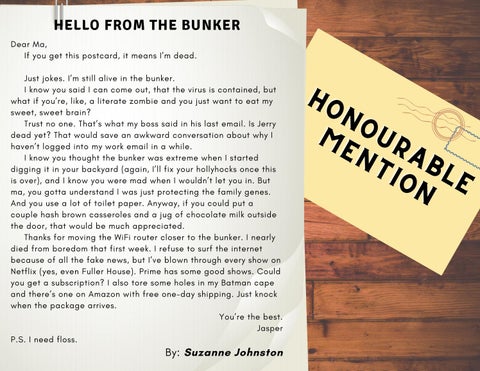
HELLO FROM THE BUNKER Dear Ma, If you get this postcard, it means I’m dead.
Just jokes. I’m still alive in the bunker. I know you said I can come out, that the virus is contained, but what if you’re, like, a literate zombie and you just want to eat my sweet, sweet brain? Trust no one. That’s what my boss said in his last email. Is Jerry dead yet? That would save an awkward conversation about why I haven’t logged into my work email in a while. I know you thought the bunker was extreme when I started digging it in your backyard (again, I’ll fix your hollyhocks once this is over), and I know you were mad when I wouldn’t let you in. But ma, you gotta understand I was just protecting the family genes. And you use a lot of toilet paper. Anyway, if you could put a couple hash brown casseroles and a jug of chocolate milk outside the door, that would be much appreciated. Thanks for moving the WiFi router closer to the bunker. I nearly died from boredom that first week. I refuse to surf the internet because of all the fake news, but I’ve blown through every show on Netflix (yes, even Fuller House). Prime has some good shows. Could you get a subscription? I also tore some holes in my Batman cape and there’s one on Amazon with free one-day shipping. Just knock when the package arrives. You’re the best. Jasper P.S. I need floss.
By:
Suzanne Johnston
HO N OU M EN RA TI BL ON E
COULD THIS The tomatillo plant surprised me today, Bruce. It made a papery lantern baby. The girl at the greenhouse had told me I’d need two plants so they
E E L L B B A A R R N N U U O I I O O T T N N N N O O E E H M M
could pollinate. Success had seemed unlikely but I’d acquiesced, a COVID experiment born. I noticed it during my early morning tour of the garden. Not much has changed here. Our acreage is still a happy kind of scruffy. Coffee in hand, I sat with the tomatillo for a long while. I peered into the translucent lime green house to work out husk from budding fruit. I touched the cheek of it — whispered hello. These dialed in moments pile up under isolation. It’s one of the perks. I wonder how you would’ve coped with it all: the shifting rules, the stillness, and fears? I think the slowing down part would’ve suited you. Tending to your anxiety had looked so lonely, the work of an outlier. But now, seemingly overnight, there is tenderness for the quickened heartbeats and clammy hands of the nation. Would this openness have comforted you? Could this have saved you? The horror of how you left us rubs up against springtime. Normally, we wait for the dissonance to abate—for the smear of vibrant green to wither away, free our grief from spring’s obnoxious assault. But, mercifully, spring returned to us this year. Charlotte was born March 11th. Pandemic. Day One. We finally got to meet her. She’s pink and blue-eyed, a tiny surprise—a new life to love, unreservedly.
By:
Michelle Spencer
NOTICING NOTICING Dearest Morag, How I miss time with you since we have been in this pandemic
E E L L B B A A R R U U N N O O O O I I N N T T O O N N H H E E M M
lockdown. A hawk perches on the skeleton of my favourite poplar not yet in leaf, dark against the evening sky. His red tail flies west as I walk east. I thought the juniper in our front yard was dead, but I found green needles near its center. When I asked my husband to buy avocadoes for lunch so I could prepare your toast recipe, he came home with kiwi. My son shared the story of his last relapse. I didn’t collapse or wither away. As details spilt into the backyard my heart caught his cry for understanding. I clutched at the emptiness beside him — held the unknowable very still. Words piled up, gathered on one another, tumbled from the nothing in his center. I pray this is a beginning, a transformation like creating tiny flutes from the hollow bones of songbirds. Lavender from our flowerbed wraps around me when I can’t sleep at 3:00 am. I’ve ordered new black patent shoes even though I don’t have anywhere to go. We must plan to celebrate – when this is over. Someone left a painted stone at the end of our driveway. It’s tiny and could easily be missed. The message fills me with a warm glow. It says, Have Faith.
By:
Mary Vlooswyk
SEASON OF LOSS It snowed every other day in February. Now it’s officially Spring, but still snowing. No visits, of course, but my friends and I have virtual meetings which, in our nests of isolation, turn into therapy sessions. The husband of one walked out just last week, the husband of another, 3 months ago. Each left a hole, a void larger than their wives could have imagined. It fills with shadows, 10 degrees colder than any other part of their houses. Storms gather inside, howls of rage, whimpers of lethargy. The wives walk around the chill, but feel ice stab their thoughts, snow-mold creeping shoulder to fingers. This morning when I awoke, it was snowing. I felt your pulse, got up, put on the coffee, mixing mine with Kalua. I poured a bath and in clouds of steam, my mind wandered from the Spanish novel you ordered last week, to your black-eyed stare, to the dirty laundry. I soaked my flesh warm, dried, and went to our bedroom. You—who not half an hour before were just steps past slumber —had gone. Left was a statue commissioned to look like you, cold as marble. Winter settled through the house, more bitter than the outside weather. I checked if windows or doors were open, but everything was shut tight, furnace blasting. Outside it was snowing. Inside, I was freezing. And you had frozen. Now it’s summer but some of us are left behind, locked in a season of losing. We shiver.
By:
Joan Crate
H HO ON NO OU UR RA M A ME B BL EN L NT E E TIIO ON N
LITTLE GIFTS We bought a 3D model online and bent and twisted the
E L L B B A A R R U U N N O O O O I I N N T T O N N HO H E E M M
steel until it took the shape of the Arc de Triomphe. I’ll never forget climbing to the top of the world’s tallest arch, and gazing at the Paris skyline, the sun a brilliant fire. A pack of us were shoulder to shoulder, unafraid, in awe of the Eiffel Tower in the distance. Paris really is everything they say it is. Now I sit by the window and feel the same sun, busy my hands with models and puzzles. When we can’t sleep, we bake chocolate chip banana bread, sourdough (I know, I know, you must be sick of hearing about it) and apple pie with a lattice top. We froze crabapples last year. When we want something sweet, we heat them on the stove, sprinkle them with cinnamon. All our anxious hearts want to do is create something we can leave on the front porch of our neighbours, to thank them for the tomato plant they passed over the fence. We water it and wait for the fruit to arrive. A coyote leaves a deer jawbone on our front lawn, picked clean. My parents drop off muffins filled with raspberries from their garden. We swap books in our mailbox with friends. A stranger repots chives, places them in front of the little free library, where there’s sometimes a line. And we cross the street, every time, but we wave.
By:
Silvia Pikal
"Ran out of toilet paper and started using lettuce leaves. Today was just the tip of the iceberg, tomorrow romaines to be seen."