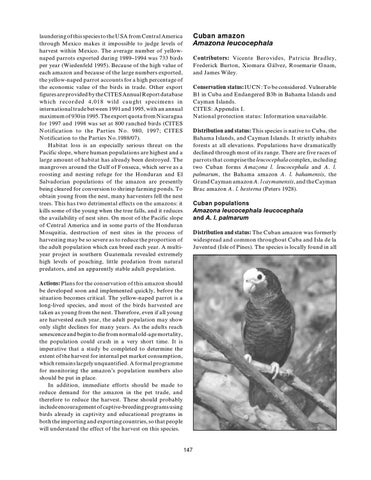
Cuban amazon Amazona leucocephala
laundering of this species to the USA from Central America through Mexico makes it impossible to judge levels of harvest within Mexico. The average number of yellownaped parrots exported during 1989–1994 was 733 birds per year (Wiedenfeld 1995). Because of the high value of each amazon and because of the large numbers exported, the yellow-naped parrot accounts for a high percentage of the economic value of the birds in trade. Other export figures are provided by the CITES Annual Report database which recorded 4,018 wild caught specimens in international trade between 1991 and 1995, with an annual maximum of 930 in 1995. The export quota from Nicaragua for 1997 and 1998 was set at 800 ranched birds (CITES Notification to the Parties No. 980, 1997; CITES Notification to the Parties No.1988/07). Habitat loss is an especially serious threat on the Pacific slope, where human populations are highest and a large amount of habitat has already been destroyed. The mangroves around the Gulf of Fonseca, which serve as a roosting and nesting refuge for the Honduran and El Salvadorian populations of the amazon are presently being cleared for conversion to shrimp farming ponds. To obtain young from the nest, many harvesters fell the nest trees. This has two detrimental effects on the amazons: it kills some of the young when the tree falls, and it reduces the availability of nest sites. On most of the Pacific slope of Central America and in some parts of the Honduran Mosquitia, destruction of nest sites in the process of harvesting may be so severe as to reduce the proportion of the adult population which can breed each year. A multiyear project in southern Guatemala revealed extremely high levels of poaching, little predation from natural predators, and an apparently stable adult population.
Contributors: Vicente Berovides, Patricia Bradley, Frederick Burton, Xiomara GĂĄlvez, Rosemarie Gnam, and James Wiley. Conservation status: IUCN: To be considered. Vulnerable B1 in Cuba and Endangered B3b in Bahama Islands and Cayman Islands. CITES: Appendix I. National protection status: Information unavailable. Distribution and status: This species is native to Cuba, the Bahama Islands, and Cayman Islands. It strictly inhabits forests at all elevations. Populations have dramatically declined through most of its range. There are five races of parrots that comprise the leucocephala complex, including two Cuban forms Amazona l. leucocephala and A. l. palmarum, the Bahama amazon A. l. bahamensis, the Grand Cayman amazon A. l caymanensis, and the Cayman Brac amazon A. l. hesterna (Peters 1928). Cuban populations Amazona leucocephala leucocephala and A. l. palmarum Distribution and status: The Cuban amazon was formerly widespread and common throughout Cuba and Isla de la Juventud (Isle of Pines). The species is locally found in all
Actions: Plans for the conservation of this amazon should be developed soon and implemented quickly, before the situation becomes critical. The yellow-naped parrot is a long-lived species, and most of the birds harvested are taken as young from the nest. Therefore, even if all young are harvested each year, the adult population may show only slight declines for many years. As the adults reach senescence and begin to die from normal old-age mortality, the population could crash in a very short time. It is imperative that a study be completed to determine the extent of the harvest for internal pet market consumption, which remains largely unquantified. A formal programme for monitoring the amazon’s population numbers also should be put in place. In addition, immediate efforts should be made to reduce demand for the amazon in the pet trade, and therefore to reduce the harvest. These should probably include encouragement of captive-breeding programs using birds already in captivity and educational programs in both the importing and exporting countries, so that people will understand the effect of the harvest on this species.
147