Photo: Roberto Ure
areas. Sixty-four feeding flocks where located in patches of natural vegetation, six were found in pastures, and only two were located close to crops in an irrigated area (see also PsittaScene Vol 17 No 4: 10-11). Although most of the feeding flocks were small, supporting an earlier observation that the Burrowing Parrots disperse in small flocks to feed in patches of natural vegetation, we also observed several large feeding flocks up to 100 individuals. The nature and distribution of their food resources undoubtedly influences the daily movements of the parrots. Species exploiting ephemeral or widely dispersed food resources may be forced to travel long distances to find suitable feeding locations.
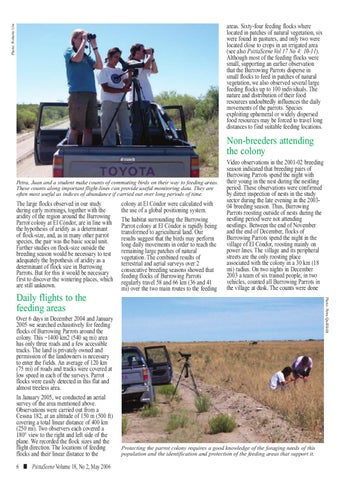
Non-breeders attending the colony Petra, Juan and a student make counts of commuting birds on their way to feeding areas. These counts along important flight-lines can provide useful monitoring data. They are often most useful as indices of abundance if carried out over long periods of time.
The large flocks observed in our study during early mornings, together with the aridity of the region around the Burrowing Parrot colony at El Cóndor, are in line with the hypothesis of aridity as a determinant of flock-size, and, as in many other parrot species, the pair was the basic social unit. Further studies on flock-size outside the breeding season would be necessary to test adequately the hypothesis of aridity as a determinant of flock size in Burrowing Parrots. But for this it would be necessary first to discover the wintering places, which are still unknown.
colony at El Cóndor were calculated with the use of a global positioning system. The habitat surrounding the Burrowing Parrot colony at El Cóndor is rapidly being transformed to agricultural land. Our results suggest that the birds may perform long daily movements in order to reach the remaining large patches of natural vegetation. The combined results of terrestrial and aerial surveys over 2 consecutive breeding seasons showed that feeding flocks of Burrowing Parrots regularly travel 58 and 66 km (36 and 41 mi) over the two main routes to the feeding
Video observations in the 2001-02 breeding season indicated that breeding pairs of Burrowing Parrots spend the night with their young in the nest during the nestling period. These observations were confirmed by direct inspection of nests in the study sector during the late evening in the 200304 breeding season. Thus, Burrowing Parrots roosting outside of nests during the nestling period were not attending nestlings. Between the end of November and the end of December, flocks of Burrowing Parrots spend the night in the village of El Cóndor, roosting mainly on power lines. The village and its peripheral streets are the only roosting place associated with the colony in a 30 km (18 mi) radius. On two nights in December 2003 a team of six trained people, in two vehicles, counted all Burrowing Parrots in the village at dusk. The counts were done
Over 6 days in December 2004 and January 2005 we searched exhaustively for feeding flocks of Burrowing Parrots around the colony. This ~1400 km2 (540 sq mi) area has only three roads and a few accessible tracks. The land is privately owned and permission of the landowners is necessary to enter the fields. An average of 120 km (75 mi) of roads and tracks were covered at low speed in each of the surveys. Parrot flocks were easily detected in this flat and almost treeless area. In January 2005, we conducted an aerial survey of the area mentioned above. Observations were carried out from a Cessna 182, at an altitude of 150 m (500 ft) covering a total linear distance of 400 km (250 mi). Two observers each covered a 180° view to the right and left side of the plane. We recorded the flock sizes and the flight direction. The locations of feeding flocks and their linear distance to the 6 ■ PsittaScene Volume 18, No 2, May 2006
Photo: Petra Quillfeldt
Daily flights to the feeding areas
Protecting the parrot colony requires a good knowledge of the foraging needs of this population and the identification and protection of the feeding areas that support it.