Gold fingers
Surge in gold as central banks hedge against uncertainty
Casino economy
Trump’s crypto reforms ignite boom, raising fears of instability
Laundered legacy
The EU fights back against illicit flow of billions by forming AMLA


Surge in gold as central banks hedge against uncertainty
Casino economy
Trump’s crypto reforms ignite boom, raising fears of instability
The EU fights back against illicit flow of billions by forming AMLA



Sam Altman, OpenAI’s powerful CEO, dominates the booming AI industry with ChatGPT’s global success and trillion-dollar deals, but growing concerns over profits, ethics and a potential AI bubble threaten his legacy

Meet the world’s most advanced business jets.






Request your private consultation



















Gatherings at Kiawah Island Golf Resort offer a new view of success. It’s where mindful moments transcend tasks on a calendar and achievement is measured by the depth of experiences. It’s an environment where discussions inspire innovations. Where collaboration is shaped by island adventures, and taking time to reflect is the ultimate path to progress. Here, a meeting is not only business, it’s a breath of fresh air.








Our presence in Miami, New York, and Madrid reflects more than growth, it represents our strategic vision to accompany our clients globally.
At Banreservas, we believe in building lasting relationships and creating value beyond borders.
We grow to serve you better.



Winter 2025-26






Sam Altman’s leadership at OpenAI has driven unprecedented AI growth, with record investments, global influence, and ethical challenges shaping the technology’s future, raising both opportunity and risks
Gold’s surge past $4,000 an ounce reflects geopolitical and economic uncertainty, dollar weakening, and central banks diversifying reserves, marking a structural shift in global capital flows
DESIGNER:
Sam Millard
REPROGRAPHER: Robin Sloan
PRODUCTION MANAGER: Richard Willcox
WEB AND MOBILE DEVELOPMENT:
Scott Rouse
VIDEO PRODUCER:
Paul Richardson
EDITORIAL:
Laura French
Courtney Goldsmith
Neil Hodge
Jemima Hunter
Graham Jarvis
Alex Katsomitros
Claire Millins
John Muchira
David Orrell
Selwyn Parker
Rachel Richards
Khatia Shamanauri
David Worsfold
The EU’s new AMLA agency aims to harmonise anti-money laundering rules and supervise high-risk institutions, but limited resources and fragmented oversight create persistent enforcement challenges
The Trump administration’s GENIUS Act promotes dollar-backed stablecoins to sustain US dominance, but risks include regulatory gaps, illicit use, geopolitical tensions and potential systemic instability
CONTRIBUTORS:
Amanda Akien
Vikki Davies
Antonia Di Lorenzo
Ilan Goldfajn
Sergei Guriev
Nick Hodgson
Emma Holmqvist
Ruth Kibble
Anne Krueger
Indrabati Lahiri
Guillermo Ortiz
Maryam Shahvaiz
Hannah Smith

ACCOUNTS:
Gemma Willoughby
ILLUSTRATORS:
Richard Beacham
Jim Howells
BUSINESS DEVELOPMENT:
Bryan Charles
Tom Crosse
Michael Harris
Terry Johnson
James Watson
Monika Wojcik
Greece’s fiscal mismanagement triggered a decade-long eurozone crisis. Three bailouts and years of austerity and reforms later, and there are signs of economic recovery, but it has come at the cost of deep social hardship
At 80, the UN faces funding shortfalls, geopolitical gridlock, and rising conflicts. Reform initiatives aim to boost efficiency, but political will and Security Council constraints challenge its peacekeeping role
The information contained within this publication has been obtained from sources the proprietors believe to be correct. However, no legal liability can be accepted for any errors. No part of this publication may be reproduced without the prior consent of the Publisher.
World News Media Ltd, 2025–26 Printed in the UK - ISSN 1755–2915
Editorial on pages 34–41, 114, 126–127 & 152–153 © Project Syndicate, 2025
Web: www.WorldFinance.com
Email: enquiries@wnmedia.com
28 Financial History
We look at the evolution of robots, from early automatons, to more recent developments in AI research
30 Profile
In 15 years, Revolut CEO Nikolay Storonsky has journeyed from derivatives trading to being head of a global finance powerhouse
34 Comment
Anne Krueger on Trump’s private sector meddling, Sergei Guriev on Putin’s polycrisis, Ilan Goldfajn on reducing poverty and Guillermo Ortiz on Mexico’s economy
170 The Econoclast
Exploring the discipline-spanning problem posed by the replication crisis: the power of authority over evidence
98 Commodities
In a post-oil economy, copper and cocoa could become the ‘new oil,’ shifting global power towards the Global South
100 Infrastructure
MPC Capital is investing in niche European energy infrastructure for stable, long-term institutional returns
106 Artificial Intelligence
Exploring how AI must evolve to understand human emotion, not just language
108 Future of AI
Two paths to AGI have emerged: large language models and whole brain emulation, and their success may depend on one another
110 Trading
A look at how education, advanced tools and low-latency execution can empower traders
114 Technology
TikTok’s US transfer increases American control but leaves China influential via algorithm licensing
48 Africa
Nigeria’s economic renewal is being driven by domestic capital to fund infrastructure and support inclusive growth
52 Finance
The dollar remains dominant but faces gradual decline amid rising multipolarity
56 Mexico
Banorte is driving inclusive growth through innovation, trust and social commitment
58 Dominican Republic
Banco Popular Dominicano leads sustainable banking in the Caribbean, combining profitability with social impact
62 Digital
Hybrid banking blends technology, trust and permanence to empower millions financially
66 Qatar
Qatar is preparing for a future-ready economy by merging technology, green finance and innovation
122 Sustainability
ANAVRIN feed reduces livestock methane, boosts productivity, and generates carbon credit revenue for farmers
132 Pensions
AFP Capital is leading Chilean pensions with innovation, digital advice, strong returns and client-focused service
134 Armenia
Armenia is leveraging tech investment and diaspora support to reduce Russian dependence and boost innovation hub status
137 Ukraine
Ukraine’s financial sector remains resilient through digitisation, reforms, international support and war-time adaptations
74 Inheritance
As $124 trillion shifts generations, women emerge as the new stewards of global wealth
76 Private Banking
Italy’s wealth management sector is evolving fast � driven by generational change, innovation and rising HNWI wealth
78 Exchange-traded Funds
Despite volatility, ETFs are booming � driven by record assets and global demand
80 Investment
Modern investing replaced intuition with data � ushering in efficient markets and a legacy now challenged by AI’s rise
82 Insurance
Geneva Insurance is blending innovation, digital trust and governance excellence to keep pace with regulation
90 Taxation
Former trader turned activist Gary Stevenson is redefining influencer economics
146 Residency
Portugal is attracting millionaires with IFICI tax incentives, lifestyle appeal, EU access and targeted professional benefits
148 Economics
Modern capitalism is in need of a reset, as long-term societal, ethical and economic value takes a back seat to short-term gains
152 Politics
Reinvention is needed to help reproduce Germany’s postwar ‘economic miracle’
154 Leadership
Fintech success depends on founders’ integrity, self-awareness, cognitive agility, and balanced, ethical leadership
160 Cybersecurity
Africa’s digital growth faces escalating cybercrime, threatening economic stability
162 Lifestyle
Kiawah Island offers secluded luxury and elite accommodations along pristine South Carolina shores



India’s Prime Minister Narendra Modi inspects a guard of honour during the celebrations to mark the country’s Independence Day in New Delhi. The Indian government has allocated approximately $78bn to the Ministry of Defence for 2025 26, a nominal increase of about 9.5 percent over the previous year.


Many aspects of global national outlook and economics have been turned on their heads. The idea of free-flowing trades and open markets that came into action post-war has since faded, replaced by the rise of economic nationalism. Governments are again prioritising their own interests, protecting jobs and industries, even if it bruises relationships abroad. Until recently, Donald Trump used economic protectionism as a coercive mechanism in the form of tariff s in the US. The World Trade Organisation warned that new US tariff s and retaliations could cut global merchandise trade volumes by one percent in 2025; a big change after years of expansion. China struck back by implementing export controls on rare earth minerals. Now, in a brief pause to months of tension, both countries have agreed on a framework to ease trade tensions. The deal takes the pressure off the 100 percent tariff s on Chinese imports and delays China’s planned export restrictions on minerals. For now, the US and China have entered a period of cooling after what appeared to be an escalating trade war, but how long it will last is a whole other question. Japan’s newly elected Prime Minister, Sanae Takaichi, made it her promise to “make the economy stronger and remake Japan into a country capable of fulfilling its responsibilities to future generations.” Japan seems determined to put its interests first, and it seems other nations are catching on. Across Europe, right-wing parties are progressing with voters who want to tighten borders and reinforce their sense of national identity. Essentially, it is about protecting national self-interest – an understandable sentiment in itself, but one that risks unintended consequences. If countries start closing off trade, supply chains could become increasingly impermeable, resulting in escalating costs, punishing their very own consumers with higher prices and less choice. Manufacturers have increased safety stock and are holding more inventory than usual; a costly hedge against these tariff shocks. For investors, challenges are growing as the tariff rate in the US is the highest it has been since the 1930s. As US companies struggle with higher input costs and delays on shipments, markets have become particularly sensitive to every policy threat or trade retaliation.
TO READ MORE FROM WORLD FINANCE COLUMNISTS, VISIT: www.worldfinance.com/contributors
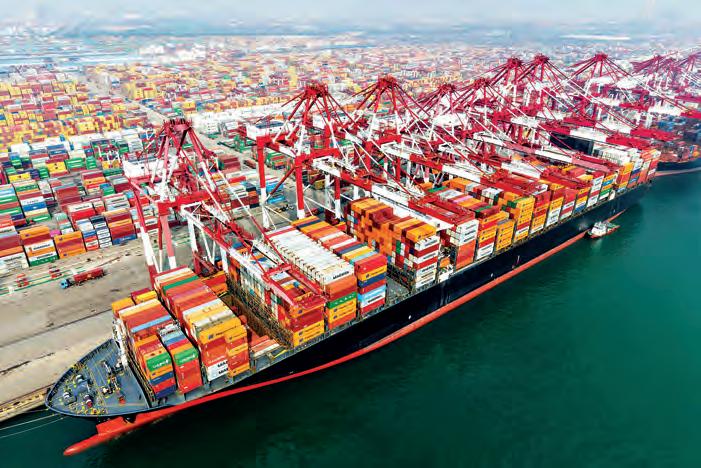
China’s export growth exceeded expectations towards the end of 2025, but uncertainty in the market continues to weigh on the world’s second-largest economy’s growth prospects. Recent customs data showed that China’s outbound shipments rebounded in September, rising 8.3 percent compared with 4.4 percent in August, notching the fastest rate of growth in six months after the country worked to diversify its export markets to protect itself from US President Donald Trump’s tariffs. The US now accounts for less than 10 percent of China’s exports. While exports to the US fell by 27 percent in the latest data, exports to the EU, Southeast Asia and Africa all grew by double digits (see Fig 1)
The International Monetary Fund still expects China’s economy to slow to 4.8 percent in 2025 from five percent in 2024, before dropping to just 4.2 percent in 2026, the group confirmed in its latest World Economic Outlook report. China’s slowdown has been driven by a reduction in net exports, which have
Since Donald Trump returned to the US Presidency, tensions have been high with trading partners, especially China. While so far China has proved to be more resilient than many feared in the wake of Trump’s sweeping tariff s, the constant threat of a trade
been at least partly offset by growing domestic demand fuelled by policy stimulus, the IMF said. The IMF also noted that while Asia sits at the centre of “the global trade-policy reset,” it will remain the biggest driver of growth, contributing about 60 percent this year and next.
war reigniting ensures a large level of uncertainty for investors. While many analysts expect the latest tensions to cool, with neither side really wanting another escalation in tariffs, it is no surprise to see China insulating itself by moving its export-reliant economy further away from the US.

CEO Johannesburg Stock Exchange
Valdene Reddy was named the CEO of the Johannesburg Stock Exchange, effective April 1, 2026, following the early retirement of outgoing chief executive Leila Fourie. Having spent more than a decade at the bourse, Africa’s largest, Reddy most recently headed up the capital markets division. There, she focused on listings and secondary market trade activity across all asset classes. “I am confident that Valdene’s deep industry expertise, strategic acumen and stakeholder relationships will position the JSE for continued success in a rapidly evolving financial landscape,” chair Phuthuma Nhleko said.
Philipp Navratil CEO Nestlé
Miels CEO GSK
Miels has long been considered next in line to lead the pharma giant. While Walmsley oversaw a step-change in GSK’s performance, she faced criticism for her consumer-focused background. With his strong pharma focus, Miels will be tasked with reaching the board’s goals of hitting £40bn in sales and launching 15 blockbuster medicines by 2031. appointments
VOICE OF THE MARKET
Fourie led the charge on a turnaround in the JSE’s earnings while diversifying the group’s revenue profile and modernising its core technology and regulatory frameworks. Reddy is well placed to be just as influential, focusing on accelerating innovation and enhancing competitiveness by continuing to drive earnings growth through diversified revenue streams.
Having spent more than two decades at Nestlé, Philipp Navratil was named the next CEO of the Swiss multinational food and drink maker. It followed his appointment to the board at the start of 2025 following a run of successes in his management of the firm’s coffee and beverage business. He played a pivotal role in strengthening the Nescafé brand in Mexico before being appointed to Nestlé’s Coffee Strategic Business Unit, where he shaped the global strategy for Nescafé and Starbucks coffee brands. “It is a privilege to take on the responsibility of leading Nestlé into the future,” Navratil said.
VOICE OF THE MARKET
Navratil’s appointment comes following the departure of Laurent Freixe, who was dismissed after an undisclosed romantic relationship came to light. Chair Paul Bulcke said the change in leadership did not equate to changes in the company’s growth plans. “We are not changing course on strategy and we will not lose pace on performance.”
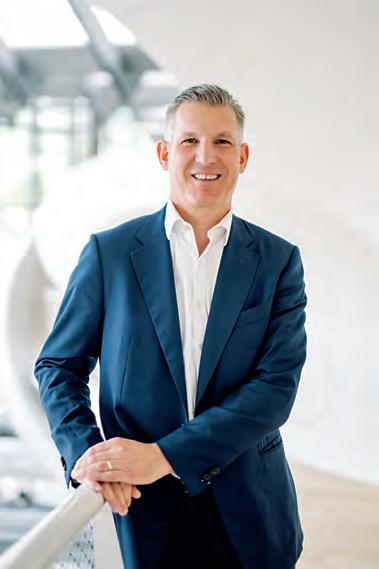
Emma Walmsley will step down as CEO of global pharmaceutical giant GSK, effective January 1, 2026, and will be succeeded by Luke Miels, who held responsibility for GSK’s global medicines and vaccines as chief commercial officer. Miels first joined the firm in 2017 and has played an instrumental role in building GSK’s speciality medicines portfolio. Having worked at AstraZeneca, Roche and Sanofi-Aventis prior to GSK, he has wideranging and considerable experience. “He is extremely well placed to lead, deliver and surpass the ambitions we have set for GSK,” said Jonathan Symonds, chair of GSK.
VOICE OF THE MARKET



Growing scrutiny from boards and shareholders has resulted in chief executives being removed at the fastest pace in two decades in the US, data shows. Think back over the year, and many significant CEO departures will likely spring to mind. At Nestlé, the board pushed out Mark Schneider after becoming increasingly concerned about weak growth and slowing product development following stock highs in 2022. Unilever lost its CEO, Hein Schumacher, when the board ousted him after around 18 months in the role to reignite the consumer goods firm’s turnaround plans. And drinks giant Diageo’s CEO Debra Crew departed after just two years after missteps sent earnings expectations down. As of July 2025, nearly as many CEO exits had occurred at S&P 500 companies than over the whole of 2024 – 41 compared with 49, according to data from the Conference Board, a nonprofit executive research group, and ESGAUGE, a data analytics company. It comes as activist investors benefit from an environment where underperformance is seen as a fireable offence. In fact, 42 percent of the S&P 500 companies that changed CEOs last year were trailing their competitors for total shareholder returns, lagging in the 25th percentile. At the same time, in the post-#MeToo era, companies are taking decisive action on any reputational risks. In Europe, CEO tenures are growing shorter, too, as boards get more involved in strategy and shareholder activism increases, Oliver Wyman Forum’s the CEO Agenda 2025 found.
European chief executives are spending nearly half their planning time on horizons of less than one year, the research found. With stocks hitting records, even amid wobbly economic growth and global uncertainty, investors have high expectations. And what’s more, no one wants to be the next international news story after a ‘Coldplay kiss cam’ scenario. So what is a chief exec to do? Aside from the obvious of avoiding unethical behaviour, it is worth remembering that your fiscal plans command more loyalty than your personality.
“If activist investors have bought into a company's five-year plan then they want someone to exercise it,” Jason Schloetzer, an expert in corporate governance, told Reuters. “And if the guy at the top can't do it, they will find the next one.”
TO READ MORE FROM WORLD FINANCE COLUMNISTS, VISIT: www.worldfinance.com/contributors


If once war-torn Rwanda needs a symbol of probably the biggest economic comeback in the history of sub-Saharan Africa, the sprawling brand-new international airport in the capital of Kigali will suffice. The numbers are inarguable. Thirty years after being a basket-case, the economy grew at a rate of nearly eight percent in the second quarter of 2025, roughly the same as in 2024. International reserves are robust and inflation is in control. Over the past two decades Rwanda has achieved remarkable progress.
In quality of life Rwanda has made giant strides too. There are mobile phones in most households and electricity in half of them, primary education is universal, medical services are much improved and clean drinking water becomes more available by the month. Most importantly, average life expectancy in this overcrowded, land-locked nation of 14.6 million people is 20 years longer than it was 30 years ago.
Compared with the quality of life in the western world, these gains may not look like much but it is a lot when you consider where the country was. “Rwanda in 1995 was a society shattered by violence, trauma and loss,” explains the World Bank. To get where it is today, the country had to overcome a genocidal immediate past, lingering internal violence, a massive refugee crisis, a collapsed justice system, a subsistence farming-based economy and high levels of poverty.
How did the comeback happen in a country famous only for its gorilla population? According to the IMF, the government of President Paul Kagame put together a plan that worked its dollars to the limit. “The recovery came from relatively modest increases in investment, education and health spending from $150 to $420 per person.” Instead of splurging on trophy projects, the focus was on value for money.
“The key is to make every penny of taxpayer resources count,” says the IMF, citing astonishing improvements of up to 11 percent in developing nations and four percent in developed ones if they follow the same discipline. And President Kagame isn’t planning on stopping here. He wants Rwanda to become an upper middle-income nation by 2035 and a high-income one by 2050. Ambitious, but look what has happened so far.
TO READ MORE FROM WORLD FINANCE COLUMNISTS, VISIT: www.worldfinance.com/contributors
Banking giant HSBC is paying $13.6bn to take over its Hong Kong-based subsidiary, Hang Seng Bank. The deal, believed to be the biggest bank buyout in Hong Kong in more than a decade, is designed to allow HSBC to capitalise on Hong Kong’s role as a ‘super-connector’ between China and global markets, as the lender redoubles its efforts on its Asian business. “Hong Kong is one of HSBC’s home markets and HSBC benefits from the proud heritage and brand strength of both HSBC Asia-Pacific and Hang Seng,” the bank said in a statement. Chief executive Georges Elhedery said the deal was “an exciting opportunity to grow both Hang Seng and HSBC,” adding that the Hang Seng “brand, heritage, distinct customer proposition and branch network” would be preserved while new strengths in products, services and technology would be unlocked. He continued, “Our offer also represents a significant investment into Hong Kong’s economy, underscoring our confidence in this market and commitment to its future as a leading global fi nancial centre, and as a super-connector between international markets and mainland China.” Elhedery, who was
M&A

appointed CEO in 2024, has announced a raft of measures shaking up HSBC, including cost cuts. Investors were spooked immediately after the announcement, with HSBC’s share price dropping six percent. Analysts speculate that this was more down to the bank’s plans to pause share buybacks for the next three financial quarters to fund the deal than a negative view of Hang Seng. In fact, Citigroup’s analysts had expected the bank to spend about $8bn on buybacks over the next three quarters. Hang Seng does come with some baggage, however, with significant exposure to Hong Kong and mainland China’s property sector, which has experienced a lengthy downturn.
M&A
Gaming giant Electronic Arts (EA) will be sold in a $55bn deal led by Saudi Arabia’s Public Investment Fund. The deal, which also includes buyers such as private equity firm Silver Lake and Donald Trump’s sonin-law Jared Kushner’s Affinity Partners, is said to be the largest leveraged buyout in history. It also slaps a 25 percent premium on EA’s market value, giving it a valuation of $210 per share. As one of the largest gaming companies in the world, EA is known as the name behind best-selling games like EA FC, the football game previously known as Fifa, The Sims and Mass Effect. While the deal has understandably raised eyebrows, it is only the second-most-valuable gaming purchase in history, after Microsoft’s huge $69bn deal to buy Activision Blizzard, a gaming empire known for making Call of Duty.
Goldman Sachs is shelling out $665m in cash and equity for ‘pioneering’ venture capital firm Industry Ventures. The deal includes an additional $300m based on the firm’s performance through 2030. The 25-year-old business has $7bn in assets under management and will boost Goldman Sachs’ $540bn alternatives investment platform. “Industry Ventures’ trusted relationships and venture capital expertise complement our existing investing franchises and expand opportunities for clients to access the fastest growing companies and sectors in the world,” Goldman CEO David Solomon said. “We are uniquely positioned to serve the increasingly complex needs of entrepreneurs, private technology companies, limited partners, and venture fund managers,” Hans Swildens, founder and CEO of Industry Ventures, added.


A general view of Coima’s ‘Bosco Verticale,’ two residential towers designed by Italian architect Stefano Boeri (currently under investigation) in Milan. Amid a corruption probe into Milan’s urbanplanning sector, real-estate investments in Italy surged 52 percent in H1 2025 to €5.3bn, with Milan accounting for roughly 30 percent.













“Everybody likes moving markets, but I think some of the stuff that we saw, particularly in April and May, was very, very extreme.” World Finance invited David Barrett, CEO of EBC Financial Group (UK), into our studio to discuss the first half of 2025 in trading, and he had one word to describe it.
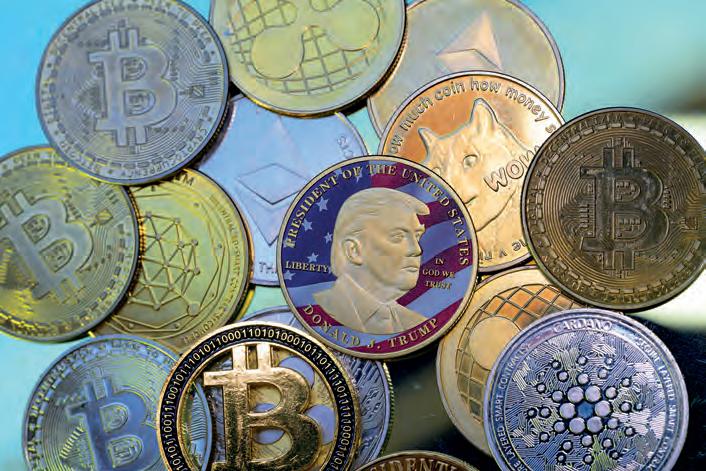
While cryptocurrency bulls are fighting to shed Bitcoin’s reputation for dramatic jumps and dives, the digital currency still has volatility issues that can leave traders in shock. In October, the cryptocurrency sector suffered its largest liquidation in history. Bitcoin, which plummeted from near a record high to a low of around $103,000, lost more than $200bn in value in a short-lived but significant flash crash (see Fig 1). It came as US President Donald Trump threatened to revive his trade war with China. He posted on his social media platform, Truth Social, that a raft of new tariffs of 100 percent on Chinese imports would
take effect in mere weeks. Investors dumped cryptocurrencies like Bitcoin for safe haven assets like gold – which conversely flew to a record high of more than $4,000 an ounce. The sell-off was heightened by investors’ highly leveraged positions. Data from CoinGlass revealed the crash saw $19bn in liquidated positions. While Bitcoin saw a significant loss, speculative ‘meme coins’ were hit even harder. Trump’s $TRUMP coin tumbled 63 percent, even more than the 50 percent drop for Dogecoin. While Trump may have labelled himself the ‘crypto president,’ in the long run he may do more favours for gold.
“Chaos!” he said. “The volatility that we have seen this year, even just the first six months, has been extraordinary... There will be a lot of young retail traders that wouldn’t have seen this. And hopefully it has been a good education and a lesson for them, but I do suspect that some of them have kind of had a baptism of fire. April in particular was pretty nasty.” VIX, the index that tracks expected volatility in the S&P 500, leapt to a five-year high of 52.33 in April 2025, as traders responded to the opening salvos of Trump’s trade war – a jump exceeded only by those recorded during the global financial crisis in October 2008, and the Covid-19 lockdowns in March 2020. And, while markets have settled in the months following, ongoing geopolitical tensions, supply chain disruptions and monetary policy changes have kept volatility high.
“Our advice to clients has been: take it back a bit, smaller positions, less leverage and take your time,” Barrett said. “Because if you look at the volatility, you look at the extreme moves we have had, it has created a huge amount of opportunity to enter and exit positions at levels and at timing that you never would have thought would be there in ordinary markets.
“The opportunities given by the volatility mean that you can take your time, take a step back, and do it in a more methodical manner than just jumping in with both feet,” he said. EBC Financial Group offers trading solutions to a huge breadth of customers: from professional and eligible clients in the UK, to retail clients in Asia and Latin America – some of whom may just be starting their trading career. Supporting them with education and market advice is very important, Barrett believes. “Best clients are clients that stay,” he said. “Clients that stay are clients that make money. So it is important for us to help them.”
TO FIND OUT MORE: www.worldfinance.com/videos

The Mediterranean island of Malta announced changes to its permanent residency programme in July 2025, making the popular path to European residence more accessible, flexible, and financially competitive. “We always try to adapt, to take into consideration new realities, geopolitical shifts and industry trends,” said Jonathan Cardona, CEO of Residency Malta Agency, in a video interview with World Finance. “We now have a more competitive financial outlay, more flexibility with property subleasing and rentals, and importantly an introduction of a one-year temporary residence permit provided at the very start of the applications.” Following the European Court of Justice ruling that recipients of EU citizenship must demonstrate a ‘genuine link’ with their adoptive member state – not simply show receipts of a financial transaction – Europe’s direct citizenship-by-investment schemes were all outlawed. Residency-by-investment schemes still remain, allowing non-EU nationals residence in the programme’s country, freedom of movement in the Schengen area, and in some cases a path to citizenship – although it is expected schemes offering the latter will come under closer scrutiny from the European Commission in due course.
“I think the Malta Permanent Residency Programme (MPRP) is an important tool to help the government and its revenues. Because at the end of the day it was implemented to better our economy, and attract talent,” said Cardona. “We have had people who have come through this programme, who have established businesses here, who have helped in employing people, who have helped in increasing our economy – which at the end of the day are all important for the betterment of our quality of life,” he said. While the changes to the MPRP have reduced the total contribution required from applicants, Cardona was keen to stress that the programme is still rigorous in ensuring that the people welcomed to Malta’s shores will not jeopardise its reputation as a stable jurisdiction and a safe place to live. “What definitely has not changed is our quality of service, and the levels of due diligence, which continue to be at the heart of what we do.”
TO FIND OUT MORE: www.worldfinance.com/videos

Over the last two years, France’s President Emmanuel Macron has appointed five different prime ministers to tackle the country’s runaway deficit, which is nearly double the European Union’s three percent limit. The euro zone’s second-largest economy’s public finances are in chaos. Not only is France’s deficit the widest in the euro zone, but its debt-to-GDP ratio is nearly 118 percent as of October 2025, the third highest in the EU, after Greece and Italy. Macron, who, before winning France’s presidential election in 2017 worked as economy minister for three years, was known for his strong approach to state finances. Looking to spur growth, he cut taxes and spending and even lifted the retirement age from 62 to 64. Since then, government spending on business subsidies ballooned in the wake of the pandemic and an energy crisis sparked by Russia’s invasion of Ukraine. With interest rates also heading higher, France’s
France already has the highest tax burden in the European Union, at nearly 44 percent of GDP, but spending is also high, with a whopping 15 percent of the country’s economic output going towards pensions alone. Investors are beginning to lose confidence in the nation’s ability to manage its finances. In fact, the
deficit has swelled. Sebastien Lecornu, the prime minister at the time of writing, who was reappointed by Macron after standing down, presented a new budget to parliament that sets out to reduce the deficit to between 4.7 percent and 5.0 percent of GDP, down from the rate of 5.4 percent recorded in 2025. The plan presents a mix of cuts to corporate tax breaks, tighter rules on social welfare contributions and a raft of new tax measures. However, an independent fiscal watchdog warned that they are based on overly optimistic economic assumptions.
“Overall, the public balance forecast for 2026 submitted to the Haut Conseil des Finances Publiques is weakened by an optimistic economic scenario and, more importantly, by the risk that the projected revenue and savings measures may be under-delivered – or may simply not materialise at all,” the watchdog said.
International Monetary Fund (IMF) predicts that French public debt will hit 130 percent of GDP by 2030. There is a possibility, if financial markets are too spooked, that the European Central Bank could step in to buy French bonds. However, analysts expect that any genuine financial crisis is unlikely – at least for now.




*Based on assets under management and market share of USD fund categories from AIMC as of the end of September 2025

































Warning : Investors should understand the characteristics, conditions, returns and risks of products before making investment decisions. Investing in mutual funds is not the same as depositing money and returns cannot be guaranteed. Past performance/comparison of performances of related capital market products are not a guarantee of future performance. For more information, please contact UOB Asset Management (Thailand) Co., Ltd. at 0-2786-2222 or www.uobam.co.th


Warning : Investors should understand the characteristics, conditions, returns and risks of products before making investment decisions. Investing in mutual funds is not the same as depositing money and returns cannot be guaranteed. Past performance/comparison of performances of related capital market products are not a guarantee of future performance.



Lot 23, a stainless-steel Patek Philippe Ref. 1518, believed to be the first ever made, sold at Phillips’ Geneva Watch Auction on November 8, for $17.6m, becoming the most expensive vintage Patek Philippe ever auctioned just shy of the record held by a Rolex ‘Paul Newman’ Daytona, which sold for $17.8m in March 2024.

Global fintech revenues hit $378bn last year, with challenger banks and digital payment platforms taking the largest slice of the pie. From global revenue growth to the number of fintech start-ups worldwide, we look at the stats behind this booming industry.
Number of fintech start-ups GLOBALLY 2019 2024
By REGION 2019 2024

$378bn
Global fintech revenues in 2024
$1.1trn
Projected value of the global fintech market by 2034
Projected growth of fintech revenue by segment COMPOUND ANNUAL GROWTH RATE
$126bn Of 2024 fintech revenues came from payment firms
21%
Growth witnessed in fintech revenues in 2024







$28bn
Global fintech funding in 2024
Fintech’s
Approximate number of fintech firms worldwide in 2024 3%
Projected growth of the global fintech market USD BILLION
30,000
24 Number of profitable
Scaled fintech revenues by region 2024
3x
The pace at which fintech firms outgrew incumbent banks in 2024
8.34bn
Number of projected digital payment users globally by 2030
Customer satisfaction by digital banks in the UK PERCENTAGE

































































The building materials industry today is in conflict. On one hand: how to satisfy the rising demand for housing and infrastructure? Europe, for example, currently needs 9.6 million extra homes, with that shortage likely to get worse before it – slowly – gets better. On the other: how to tackle its carbon footprint, and reduce greenhouse gas emissions (36 percent of Europe’s total) by 55 percent in the next five years, and become completely carbon neutral by 2050? For international construction materials manufacturer TITAN Group, offering innovative, sustainable products and solutions is a key pillar in its growth strategy, CEO Marcel Cobuz explained in a video interview with World Finance “2024 was our fourth year of top-line growth with record sales and an over-proportional EBITDA growth,” he said. “It was full of milestones, like building capabilities in attracting new talent in areas like low carbon products, decarbonisation of our processes, but also the New York Stock Exchange listing of our US business, TITAN America: a bold move which strengthens our growth platform and unlocks more growth potential.” 2024 also saw the launch of its TITAN Edge range of “innovative, high-performance, low-carbon cementitious products,” Cobuz said. “In Greece for instance, we have launched a new innovative product, VELTER, which demonstrates how we are advancing performance in superior low-carbon products and construction.”
VELTER promises up to 30 percent less CO2 emissions than standard concretes in the Greek market, while still offering the same durability and resistance to carbonation, chloride intrusion, and sulphate attack – making it suitable for urban and coastal use. It is currently being deployed in Greece’s Ellinikon project: the largest urban regeneration project in Europe, transforming the grounds of a disused airport into a smart and sustainable ‘15-minute’ city.
“Sustainability was at the core of our strategy for a long time,” Cobuz said. “We have committed to reduce emissions across the value chain, and achieve net-zero by 2050.”
TO FIND OUT MORE: www.worldfinance.com/videos
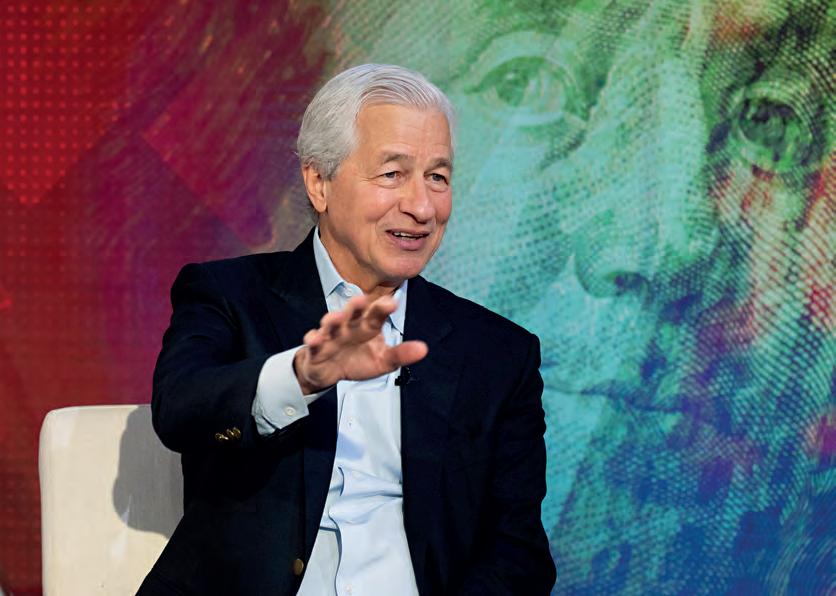
banks reported quarterly earnings, many of which beat analysts’ expectations. Despite fears of an unsettled economy, JPMorgan reported a 12 percent increase in profit in the three months to September compared with the same quarter last year. Profits swelled to $14.4bn on revenues of $46.4bn. “There continues to be a heightened degree of uncertainty stemming from complex geopolitical conditions, tariffs and trade uncertainty, elevated asset prices and the risk of sticky inflation,” Dimon continued in a statement.
Rival Goldman Sachs, meanwhile, reported a profit of $4.1bn in the quarter, a 37 percent year-on-year uplift, thanks to a boom in deals. It also boasted its highest-ever revenue for the third quarter of $15.2bn. Citi Bank also beat analysts’ forecasts with profit of $3.8bn, up 16 percent on the same quarter the previous
JPMorgan’s decades-long investment plan includes up to $10bn in direct stakes in select companies focusing on four key industries: supply chain and advanced manufacturing, defence and aerospace, energy independence and resilience and frontier and strategic technologies. These are then broken down into
year, on revenues of $22.1bn, up nine percent. Over at Wells Fargo, profits jumped nine percent to $5.6bn on revenues of $21.4bn. The bank’s chief financial officer Mike Santomassimo noted that credit and debit card spending increased both among high-earning and lower-income customers. “While some economic uncertainty remains, the US economy has been resilient and the financial health of our clients and customers remains strong,” Charlie Scharf, Wells Fargo’s CEO, said in a statement. With America’s banks looking surprisingly healthy, it is perhaps no surprise that at least one is taking the opportunity to make a large investment in boosting the country’s prospects – and leading the charge on US President Donald Trump’s ‘America first’ ethos. JPMorgan announced $1.5trn in financing and investments over the next 10 years, focusing on industries “critical to national economic security and resiliency” in the US.
27 sub-industries. “It has become painfully clear that the US has allowed itself to become too reliant on unreliable sources of critical minerals, products and manufacturing,” Dimon said in a statement. The move had an immediate impact on US-based rare earth producers, whose shares jumped as much as 32 percent for one company.
Peace continues to deteriorate worldwide, according to the 2025 Global Peace Index. While Iceland, Ireland and New Zealand retain top spots, sharp declines in Russia, Ukraine and Sudan underline the economic and political costs of conflict, with only parts of South America bucking the trend
1 Iceland (Rank 1)
Iceland once again tops the Global Peace Index, a position it has held since 2008. Its strength lies in consistently high scores across all domains: societal safety and security, ongoing conflict and militarisation. With virtually no internal or external conflict and minimal military capacity, Iceland exemplifies how stability can become self-reinforcing. Public trust in institutions remains high, violent crime is low and political risks are negligible. While global peace has deteriorated overall, Iceland shows remarkable insulation from these pressures. For investors, its resilience underlines the value of stable governance and social cohesion as a foundation for long-term security.
2 Russia (Rank 163)
Russia ranks as the least peaceful country in the world in 2025. The war with Ukraine has driven severe declines across the ongoing conflict domain, with high internal conflict deaths, displacement and cross-border hostilities. While Russia registered a minor improvement in militarisation � mainly from reduced arms exports � this is overshadowed by escalating battlefield intensity and political instability. The costs are multidimensional: human, economic and reputational. Russia’s collapse in peacefulness illustrates how sustained external aggression and militarisation create a downward spiral that erodes security and longterm economic prospects.
3
Ukraine ranks second to last, reflecting the severe toll of its war with Russia. The ongoing conflict domain shows sharp deterioration, with high battle deaths, displacement and spill-over effects across society. Safety and security indicators have weakened as civil unrest and crime rise amid war fatigue. Militarisation remains elevated as Ukraine mobilises to defend itself, but this does little to offset the human and institutional costs of prolonged conflict. Ukraine illustrates how external aggression corrodes social trust, governance and economic stability. The war’s impact is a reminder of the far-reaching consequences of unresolved conflict on peace and development.
4 Ireland (Rank 2)
Ireland retains second place in the GPI, supported by strong societal safety and small improvements in crime perceptions, homicide rates and political terror scale. While Ireland hasn’t dramatically advanced its positive peace indicators, the country has maintained a steady path of resilience in a turbulent global environment. Ireland’s low militarisation is particularly striking against the backdrop of rising European defence spending. Ireland’s stability bolsters its reputation as a lowrisk hub for finance, technology and services. Its peacefulness offers a competitive edge at a time when geopolitical shocks are reshaping investor confidence.
5
New Zealand climbs to third, reflecting gains in societal safety and reductions in ongoing conflict. Improvements in terrorism impact, violent demonstrations and public perceptions of crime underpin its strong showing. However, the country has edged higher on militarisation metrics, notably through rising defence spending and increased weapons imports � echoing a global trend toward strategic preparedness. This mix of improved social peace and heightened security posture illustrates how even highly stable nations are responding to increased global uncertainty. Its trajectory shows that even peace leaders must adapt to shifting regional dynamics during these times.
Bangladesh records one of the steepest declines among populous nations in 2025. Its fall stems from growing political repression, curbed civil liberties and rising militarisation. Indicators such as political terror, external conflict and military expenditure have worsened, pointing to an increasingly securitised state response to internal pressures. While some measures of societal safety remain stable, the overall trajectory is negative. Bangladesh’s slide reflects a broader pattern � when governments tighten control rather than fostering inclusion, the erosion of peace can trigger economic volatility alongside social unrest.
Peru stands out as a rare bright spot in the 2025 index, with peacefulness improving by nearly three percent. Gains were strongest in safety and security, where reductions in violent demonstrations, homicide rates and political terror scale offset regional volatility. The ongoing conflict domain remains a drag, but the overall direction is positive. For South America � uniquely the only region to improve in 2025 � Peru exemplifies how democratic stability and incremental reforms can yield peace dividends. Improved peacefulness not only reduces domestic risk but also enhances Peru’s appeal for investment, tourism and regional partnerships.
Sudan remains near the bottom of the rankings as civil war between the Sudanese Armed Forces and the Rapid Support Forces grinds on. The conflict has produced soaring internal conflict deaths, widespread displacement and humanitarian crises. Indicators in safety and security have worsened sharply, with violent crime, political instability and limited humanitarian access undermining any prospects for stability. Militarisation remains high, with significant shares of GDP directed toward warfare. For the global community, Sudan’s plight is a sobering reminder of how weak institutions and armed rivalries can dismantle social and economic foundations.
Humans have long been fascinated by the idea of automation, and the past century has seen breakthrough after breakthrough, turning sci-fi visions of AI into an eerie reality. Here we trace its evolution across the decades – from the dawn of robots in the 1920s to Alan Turing’s work on machine intelligence in the 1950s, AI-powered NASA rovers in the early 2000s to the explosion of generative AI in the 2020s.
1920 s

Records from 400BC refer to ‘automatons’ that could move without assistance, but it was only in 1920 that the term ‘robot’ was first coined, in a play by Czech playright Karel Čapek. In the play, the robots revolt, destroying humanity. In 1928, the basic robot vision became reality when Professor Makoto Nishimura built Gakutensoku, a humanoid robot that used an air pressure mechanism to move.



In 1950, Alan Turing published ‘Computing Machinery and Intelligence,’ introducing the idea of the ‘imitation game’, now known as the Turing Test, to measure machines’ intelligence. In 1955, the term ‘artificial intelligence’ was officially coined, ahead of a workshop focusing on the field. The first trainable artificial neural network, the Perceptron, was meanwhile developed in 1957 by psychologist Frank Rosenblatt.
2000 s
Unimate, the world’s first industrial robot, began working on a General Motors assembly line in New Jersey in 1961, transporting car parts. In 1966, the world’s first chatbot, ELIZA, arrived, using natural language processing. Around the same time, Shakey the Robot was also created at the Stanford Research Institute, using sensors and a camera to perceive, reason and solve basic problems about its surroundings.

the end of the human era as we know it in his essay ‘The Coming Technological Singularity.’ In 1997, IBM’s chess-playing programme Deep Blue beat world chess champion Garry Kasparov. The same year, Dragon Systems released the first voice recognition software, paving the way for the likes of Siri and Alexa, and putting the spotlight on AI once again.
NASA sent two AI-equipped Rovers to Mars in 2003 to search for evidence of past water and life. Apple integrated virtual assistant Siri into its iPhone 4 in 2011, and Amazon launched its first Alexa device in 2014. Meanwhile, platforms such as Facebook, Twitter and Netflix started deploying AI to tailor recommendations and advertising.

Interest in AI waned during the 70s but was revived in the 1980s, with several key developments. The Association for the Advancement of Artificial Intelligence (AAAI) was founded in 1979 to encourage progress, while Japan launched its Fifth Generation Computer Project in 1982, investing around $850m in AI projects. The first self-driving vehicle was meanwhile developed in Germany in 1986.

In 2016, Hanson Robotics created Sophia, considered the world’s first ‘robot citizen’ thanks to her ability to mimic emotion. Facial recognition also progressed, with Apple introducing Face ID in 2017. The same year, two chatbots were trained to speak with each other at Facebook’s AI Research lab; they began communicating in their own shorthand language without human intervention, and the experiment was stopped.

In 2021, DeepMind’s AlphaFold2 accurately predicted protein structures from their amino acid sequences displaying the substantial potential for AI in healthcare research. 2022 saw the arrival of OpenAI’s advanced conversational chatbot ChatGPT, later launching video generation model Sora in 2024. These highlight the huge opportunities of AI as it continues to take on an ever-greater role in our lives.





















is a new address for luxury hospitality in Italy: a 5-star hotel in the capital of business, fashion and design, that stands out for its style and welcome.




NEMI offers a refined experience , rich in new , just a short walk from the heart of Milan. a in a vibrant, trendy and well-connected area restaurants, historic shops, art galleries and showrooms Milan.









Nikolay Storonsky CEO AND CO-FOUNDER, REVOLUT
Words by: Courtney Goldsmith
As the founder of Europe’s most valuable fintech, Nikolay Storonsky is at the helm of a digital-first bank pushing back against the traditional grain. But as Revolut’s valuation soars, can he walk the line between agile start-up and global banking powerhouse?
In the mid-2010s, Europe’s fintech sector was booming. A novel band of financial technology companies were rewriting the script on everything consumers thought they knew about banking. Buzzy names with swelling valuations stole the spotlight from traditional lenders – in fact, in the second half of the 2010s, fintechs raised record capital. Venture capital funding grew from $19.4bn in 2015 to $33.3bn in 2020, according to a report by McKinsey & Company.
In recent years, the feverish rush to fintech has cooled slightly. But one company that remains as ambitious today as it was in its exhilarating early years is Revolut, the app-based bank and current holder of the title of Europe’s most valuable fintech. Revolut has successfully made the leap from start-up to unicorn to profit-turning institution. In 2024, its profits more than doubled to £1bn, and more recently customer numbers have surged to 65 million. It is clear that Revolut CEO and co-founder Nikolay Storonsky is doing something right.
Founded in 2015, Revolut started its days as a pre-paid card with free currency exchange. After years of experimentation in new verticals, alongside steady growth of the bank’s main operations, Revolut now offers everything from cryptocurrency trading to in-app eSIMs for travellers. Indeed, Storonsky
has stated he wants to create the “Amazon of banking.” While Revolut has taken a ‘jack of all trades’ approach, the caveat is that Storonsky expects to be master of all.
While Revolut’s success so far is undeniable, global banking domination is not a given. Banking licences have not been easy to come by, and, as with many ambitious, fast-growing tech companies, ex-employees have complained of an excessively demanding workplace culture. What’s more, after a secondary share sale bumped the firm’s valuation up to $75bn over the summer from $45bn the year before, some critics are calling Revolut’s price tag into question.
Yet Storonsky continues to set his sights high, targeting continued innovation in new verticals and plans for geographic expansion, too. Does he have what it takes to build the world’s leading financial services provider?
The collapse of Lehman Brothers in 2008 sent shockwaves across the global financial services sector. For Storonsky, it had a significant, personal impact. Born in Russia, Storonsky moved to the UK in 2004 with a degree in general and applied physics from the Moscow Institute of Physics and Technology and a degree in applied economics and finance from Moscow’s New Economic School. There, he
soon began working for the lender as a derivatives trader. When Lehman Brothers filed for bankruptcy, Storonsky was stunned. “It was a big and powerful investment bank, so the announcement came as a shock,” he told CNBC. “We were told without much warning, and it seemed to happen quite quickly.”
Storonsky told the Financial Times in an interview that the crisis not only cost him around half a million pounds, but it also taught him the value of backing every decision with data and logic. After moving to Credit Suisse, where he worked from 2008 to 2013, Storonsky began to hatch an idea to simplify financial services through an easy-to-use app that would reduce fees when spending in different currencies. In 2015, he co-founded Revolut with British-Ukrainian Vladyslav Yatsenko, a software developer who cut his teeth at UBS and Deutsche Bank, and who remains the company’s chief technology officer today.
Outside of Revolut HQ, similar innovations in financial technology were unfolding. The global financial crisis shook consumers’ confidence in the biggest banks, leading to an upswell in support for a new generation of tech-forward digital banks – not only Revolut, but also Germany’s N26 and Fidor, Brazil’s Nubank and America’s Chime. These firms promised convenience, improved user
“Banking has historically avoided disruptions by technology, but that is all about to change on a big scale”
Nikolay Storonsky

CURRICULUM VITAE
Born in Dolgoprudny, Russia, Storonsky made the move to the UK in 2004 after having studied in Moscow. He would later gain citizenship for himself in the UK.
Storonsky was working at Lehman Brothers when the investment banking giant filed for bankruptcy, which was a pivotal moment in the global financial crisis.
experience and the agility needed to chop and change their services as required. Many of them were founded by the very employees who were left high and dry after the collapse of Lehman Brothers – and who, like Storonsky, dreamt of something better. As he told CNBC, “A number of successful entrepreneurs rose from the ashes who were pretty disillusioned with the financial system.”
Following its launch, Revolut experienced rapid growth. In 2018, Storonsky announced a cash injection of $250m that propelled the fintech’s valuation to more than $1bn, making it Britain’s first digital bank unicorn – and one of the fastest tech companies in Europe to reach unicorn status.
After a stint at Credit Suisse from 2008 to 2013, Storonsky cofounded Revolut with CTO Vladyslav Yatsenko with a dream of simplifying financial services.
Revolut achieved unicorn status following a $250 million funding round, becoming one of the fastest companies in Europe to grow to a valuation of more than $1bn.
Even then, he hinted that Revolut was nowhere near finished. “Our focus, since we launched, has been to do everything completely opposite to traditional banks,” he said in a statement at the time. “We build worldclass tech that puts people back in control of their finances, we speak to our customers like humans and we’re never afraid to challenge old thinking in order to innovate.
“Banking has historically avoided disruptions by technology, but that is all about to change on a big scale,” Storonsky said, taking aim at the banking establishment. His vision for an alternative global banking system – one where, “Anyone in the world can just download the Revolut app and set up a local bank account to access any services they need,” as he told Business Insider in 2017 – is grounded in
Storonsky started up a venture capital and growth equity firm called QuantumLight, which uses an AI model to fund fintech and related start-ups.
When a secondary share sale propelled Revolut’s valuation to $75bn, Storonsky’s personal wealth shot up to over $18bn, making him one of the richest people in the UK.
an approach that ensures the company never stands still. This is most evident in Revolut’s engine for growth in new verticals: its ‘new bets’ division.
‘Move fast and break things’ is the Mark Zuckerberg-coined ethos that tech companies have long lived and breathed, and Revolut is no different. The lender is known for its ability to quickly launch into new revenue streams –everything from mobile phone plans to an air mile points offering.
These have the potential to become quick moneymakers for the business, with cryptocurrency trading being a case in point. The division helped to boost Revolut to its first annual profit in 2021 as retail traders jumped at the chance to join in the crypto boom. “Nikolay Storonsky’s leadership of Revolut highlights
how speed and adaptability can really define success in fintech,” Ed Gibbins, co-founder and CEO of ChaseLabs, an AI sales development system, told World Finance. “His approach reflects a deep understanding of tech disruption: launch quickly, scale globally, and then refine using real user feedback. This ability to treat global markets as testing grounds means Revolut can adapt features faster than rivals and align its offerings closely with consumer demand.”
Each ‘new bet’ at Revolut begins with a small team of around 10 people led by an employee with a strong entrepreneurial background, as reported by Sifted earlier this year. With a budget of around £2m to £3m, they work to build experimental products on tight timelines of just 18 months, though many have been launched even more quickly.
By moving faster than traditional banks, and even many challengers, Revolut has built a reputation for agility that resonates with tech-savvy consumers, Gibbins explains. “The strategy of rapid feature deployment and constant iteration allows the company to test ideas across markets and double down on what works. This cycle of innovation and responsiveness has enabled Revolut to outpace competitors and strengthen its position as a leading player in global fintech,” Gibbins said.
If a new bet makes money, it’s scaled up; if it doesn’t, it is either tweaked, scaled down or ditched. To date, 45 ‘new bets’ have been approved, with some of these still in the development pipeline, a Revolut spokesperson told Sifted. They described the unit as operating “on a venture capital-inspired model.” Storonsky is no stranger to VC. In 2022, he started up his own VC firm, QuantumLight, which uses an AI model to fund fintech and related start-ups.
Revolut’s agility and its comprehensive offering are key selling points among customers. “Revolut’s rise has been driven by a clear focus on tech-savvy consumers who expect more than traditional banking can deliver,” Michael Foote, founder of Quote Goat, an insurance comparison tool, told World Finance. “By combining everyday money management with trading and payments inside one app, the company positions itself as a lifestyle tool rather than a conventional bank. This multifunctional approach has given it strong appeal among younger customers who value speed, convenience, and variety without juggling multiple providers.”
As of September 2025, Revolut said it had surpassed 65 million customers worldwide. Its success has driven financial winnings for Storonsky, too, who is thought to own around a 25 percent stake in Revolut. According to Forbes, he has a net worth of $7.9bn.
While Revolut can boast growing customer numbers and profits, the firm’s financial success may disguise challenges that have dented its reputation. For example, Revolut’s aggressive corporate culture has come under intense scrutiny in recent years, with some former employees claiming they were set unachievable targets, forced to do unpaid work and put under enormous pressure.
For many years, the company’s tough culture was an open secret. “We are not about long hours – we are about getting shit done,” Storonsky explained to Business Insider in 2017. “If people have this mentality, they work long hours because they want it.”
The company has thousands of reviews on Glassdoor, an employer review site. Even with an overall rating of 4.0, as of October 2025, reviewers frequently mention a lack of work-life balance and management’s prioritisation of targets above all else. However, many reviewers appear to recognise that while the environment at Revolut is not for everyone, some thrive in its high-pressure conditions.
“No one is sitting there telling them they have to work long hours,” Storonsky continued telling Business Insider. “They are really motivated, really sharing the vision of where we want to go and as a result, they work long hours – they work at least 12 or 13 hours a day. All the key people, all the core team. A lot of people also work on weekends.”
Since that interview, Storonsky has claimed that changes have been made. “We are a different company than we were two to three years ago,” he said in a 2019 interview with Reuters. “We have learned lessons.” But in 2023, still seeking to address the feedback, the firm assembled an internal team to track whether its employees were being ‘inclusive,’ ‘approachable’ and ‘respectful,’ the Guardian reported, encouraging a more ‘human’ approach.
Francesca Cassidy, editor of Raconteur, a business news website, questioned whether change would really be effective if it wasn’t happening from the top. “Storonsky wants Revolut to be the ‘Amazon of banking.’ In pursuing this objective, he works tirelessly and expects much the same from his colleagues. With such a dedicated, driven character at the helm, it is little wonder that Revolut’s culture has developed as it has,” she wrote in an opinion piece.
Yet the company’s plans to revamp performance reviews and launch a recognition and reward programme, “do little to address the high-performance culture that seems to be the source of much of the negative feedback,” Cassidy wrote. “How can employees be expected to pour their energy into being

pleasant, collaborative colleagues if they are overworked, under stress and burnt out?”
In addition to a thorny working culture, Revolut has for years battled with a slow approval of its full UK banking licence. In 2018, the company gained its EU banking licence through Lithuania, but after a three-year application process that finally resulted in approval in July 2024, Revolut’s full UK banking licence was still being held up by regulators’ concerns at the time of publishing. The Bank of England has highlighted concerns over the start-up’s ability to maintain its risk management controls in line with its rapid international expansion, the Financial Times revealed.
Storonsky has admitted that not prioritising securing a full UK banking licence in Revolut’s early stages, and instead going all-in on growth, was a rare misstep for the business. A full UK banking licence will allow Revolut to offer a broader range of financial products and services. For example, it will finally be able to enter the UK lending market, allowing it to compete more directly with traditional banks in areas like mortgages and savings accounts.
Equally as importantly, the approval could open the door to further licences in countries including the US, Australia and Japan. It could also be seen as a stepping stone to the company’s stock market flotation, which is likely to be in London or New York.
While Storonsky has global ambitions for Revolut, his focus isn’t narrowed to the digital bank alone. QuantumLight, his venture capital firm, this year announced the close of its inaugural $250m fund. Created with an aim of backing ‘exceptional’ founders across AI, web3, fintech, software as a service (SaaS) and healthtech, QuantumLight is further evidence of Storonsky’s obsession with data. The VC is described as, “on a mission to bring scientific precision to venture capital.”
“Our ambition is to build the world’s best systematic venture capital and growth equity firm,” Storonsky said in a statement. QuantumLight is also a handy promotional vehicle for Revolut. The business releases public ‘playbooks’ that promote Revolut’s expertise in order to help founders replicate its successes.
Its most recent launch was Hiring Top Talent. Co-authored by Storonsky, the playbook is designed to share the operating principles Revolut developed to ‘systematically scale world-class teams.’ It promises to offer a ‘blueprint’ for implementing the structured recruitment approach behind Revolut’s ‘hiring engine’ that helped the company scale to more than 10,000 employees in just 10 years.
“Our goal is to make the invisible operating systems behind iconic companies like Revolut visible and replicable,” said Ilya Kondrashov,
$75bn
Revolut’s valuation in 2025
£1bn
Profit achieved in 2024
2018
Year Revolut achieved unicorn status
65 million
Customer numbers as of 2025
This year, he set out his aim to hit 100 million retail customers globally by mid-2027 and to enter more than 30 new markets by 2030, becoming “the world’s leading financial services provider.”
“Our mission has always been to simplify money for our customers, and our vision to become the world’s first truly global bank is the ultimate expression of that,” Storonsky said. Alongside the announcement, Revolut noted that it had earmarked $500m to accelerate its operations in the US. The company’s US CEO confirmed reports that it is looking into whether to apply for its own banking licence in the US or acquire a US bank, which would allow it to expand more quickly.
CEO of QuantumLight. “Founders shouldn’t have to reinvent the wheel when it comes to building high-performing teams. By sharing these tools and frameworks, we’re helping scale-ups move faster from day one.”
Beyond venture capital, Storonsky has also shown a penchant for the finer things with Utopia Design, a luxury travel company that Forbes revealed he had quietly set up in 2023. Building on a personal passion for kite surfing, the project includes high-end luxury villas in destinations including the Dominican Republic, Brazil and Barcelona.
While these passion projects have the potential to line Storonsky’s pockets, his main moneymaker continues to be Revolut. In fact, he is said to have set up a multibillion-dollar payout if he can catapult the fintech’s valuation to $150bn, the Financial Times revealed. The deal, similar to one approved by Tesla’s board for Elon Musk, would offer Storonsky shares in Revolut, paid out in stages, that could be equal to a further 10 percent stake.
Back in 2019, Storonsky said Revolut’s success would hinge on whether it could gain enough customers. “The whole idea was we provide the product for free, then we cross-sell other services. So we just need to have large customer numbers,” he said in an interview with CNBC.
Overall, Revolut is investing $13bn over the next five years in its global expansion – which continues apace. The firm’s launch in Mexico is expected in early 2026, and an opening in India is also on the cards in the not-distant future. A new global tech hub in the Philippines was set up to support operations in Australia and New Zealand, where Revolut is seeking to obtain banking licences. The company is also beginning to make its first push into Africa, with South Africa in its sights, and it has received an in-principle licence in the UAE to facilitate an expansion into the Middle East. Reports have even surfaced that Revolut is mulling a move into China.
Meanwhile, Revolut’s ‘new bets’ unit is likely to continue cooking up new financial products to explore, but what those will be, exactly, is less clear. In September 2025, a company announcement revealed that the main areas of focus would include AI and private banking. However, if Storonsky’s plans to continue opening in new markets is successful, these new verticals may need to be tailored to the countries in which they are launched, as regulatory requirements could vary region to region. While this could create opportunities for unique products, it also has the potential to take the wind out of the division’s sails as more red tape arises.
“Nikolay Storonsky’s strategy has centred on rapid global expansion and aggressive feature rollout,” Foote said. “The combination of constant innovation and international reach has set the business apart, showing how fintechs can compete with traditional banks by being faster to market and more responsive to customer demand.”
Despite Revolut’s boundless appetite for growth and its achievement of profitability, there are still worries in some corners that the company’s $75bn price tag is too high. However, if Storonsky can pull off his ambitious plans for global expansion and continue to bring to market exciting new products, there is no doubt he will silence the critics. n



Anne Krueger FORMER WORLD BANK CHIEF ECONOMIST


For more than a century, the US economy thrived on private enterprise and limited government interference. But Donald Trump’s latest interventions – from steel and chipmakers to media and research – suggest that America’s market model is being reshaped by politics, not productivity
For at least the last 150 years, state intervention in picking individual industries and firms to support has been shown to undermine productivity and weaken economic performance. When political considerations outweigh sound commercial judgment, companies may be compelled to keep unprofitable factories open, maintain loss-making activities, favour government-owned suppliers over private vendors, or appoint unqualified but politically connected individuals to leadership positions.
By contrast, when private companies are inefficient or producing goods people do not want, they exit the market, and more productive companies enter. The profit motive drives businesses to recruit capable employees, produce quality goods that meet demand, innovate, and embrace cutting-edge technologies. When subject to political influence or control, companies generally have weaker incentives to pursue these goals precisely because government ownership shields them from competition. In the US, as in most advanced economies, the private sector has long been
the primary driver of GDP growth. With governments playing a relatively limited role – establishing regulatory frameworks, supporting basic research and innovation, and curbing monopolies – competition has flourished, delivering decades of economic prosperity.
A break from tradition
But under President Trump, the US – once an avatar of free-market capitalism – has broken with this tradition. Since the start of his second term, Trump has repeatedly meddled in private-sector decision-making. His administration has targeted law firms, universities, think tanks, semiconductor and battery manufacturers, media companies, research, and more.
And, taking a page from the playbook of state-controlled communist economies, his administration has gone even further, moving from intimidation to direct government ownership of private firms. In June, for example, Japan’s Nippon Steel was permitted to acquire US Steel but had to grant the federal government a ‘golden share,’ giving American
policymakers veto power over the company’s business plans. Even before Trump’s intervention, Nippon Steel had pledged to make major investments in US Steel, retain all employees, and honour newly negotiated contracts with union-represented workers. The Trump administration’s added demands thus send a mixed message: while it courts foreign investment, it erects unnecessary barriers.
Trump’s deal with chipmakers Nvidia and AMD illustrates this contradiction. In April, the administration halted the sale of advanced semiconductors to China on national-security grounds. Yet by July, Nvidia and AMD were permitted to resume sales, provided they hand the US government 15 percent of the revenues.
The administration’s deal with Intel is even more brazen. In August, Trump announced that the US government had acquired a 10 percent stake in the company, paid for with $5.7bn Intel had already been promised under the CHIPS and Science Act and another $3.2bn from the Secure Enclave programme.
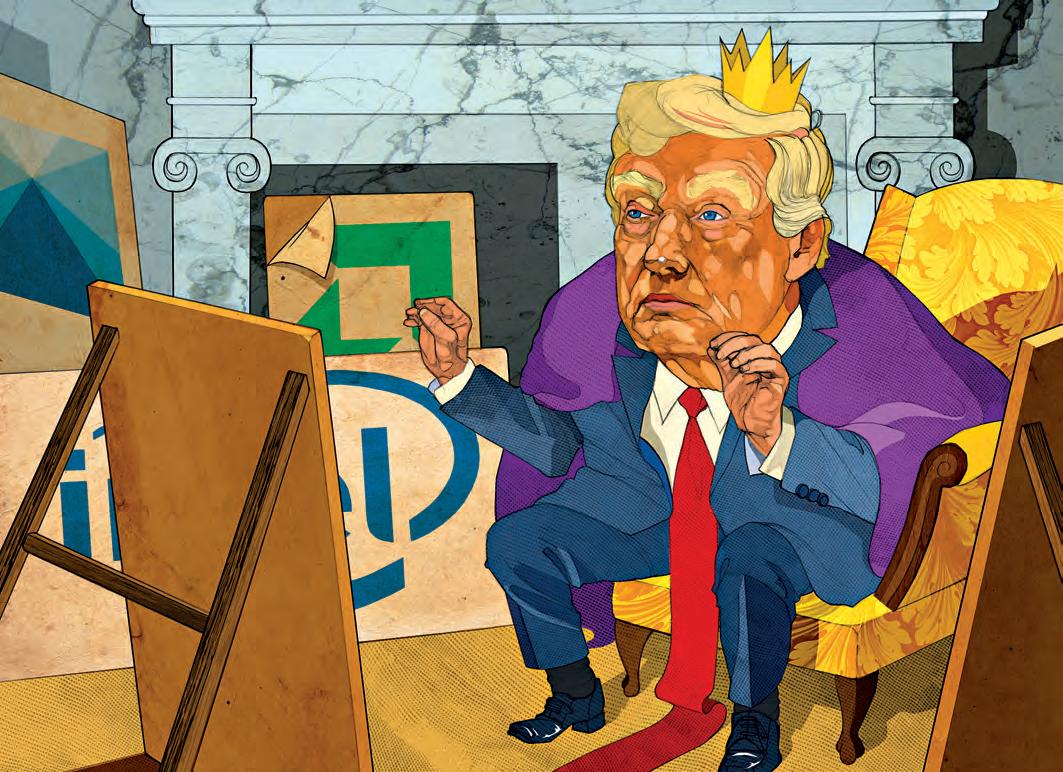
The agreement also effectively shackles Intel to its loss-making foundry while giving the government the option to buy an additional five percent if the foundry is ever sold. Notably, by converting anticipated CHIPS grants into equity, the agreement does not provide Intel with new government funds. Meanwhile, private shareholders bear the cost of dilution: the US government purchased its stake at $20.47 per share – well below the $24.80 closing price on the eve of Trump’s announcement.
Although the government will hold no seats on Intel’s board, even without formal representation, the administration’s shadow
will loom over the company’s decision-making. Policymakers could lean on Nvidia, AMD, and other firms to buy semiconductors from Intel, pressure the company to build new factories in unprofitable locations, or force it to hire workers chosen for political loyalty rather than competence.
Intel’s prolonged decline underscores the poor economics driving Trump’s investment. In the 1990s, the company was the leading semiconductor manufacturer; in 2000, it even briefly became the world’s second most valuable company.
Against this backdrop, Trump’s Intel deal looks especially misguided. What the company truly needs is new financing to service its existing obligations, swollen by years of heavy losses, and fund the turnaround plan developed by its new CEO, Lip-Bu Tan. SoftBank, the Japanese investment conglomerate, recently announced a $2bn investment in Intel, though whether that move reflects genuine confidence in Intel’s future or an effort to curry favour during tense tariff negotiations between the US and Japan remains an open question. Industrial policy is often said to be about ‘picking winners.’
“Trump’s brand of state capitalism does little to strengthen either industry or the broader US economy”
Today, however, it doesn’t even crack the top 15 chipmakers by market capitalisation. Intel has also been the single largest beneficiary of the CHIPS Act, using federal funds to develop new production facilities in Arizona. But construction faced repeated delays, with executives blaming a shortage of skilled labour. Similarly, an Ohio plant already under construction has had its completion date pushed back from 2025 to 2030.
But given Intel’s recent performance, the Trump administration seems intent on picking losers. While few dispute the importance of steel production, or that semiconductors will drive future growth, Trump’s brand of state capitalism does little to strengthen either industry or the broader US economy. Instead, it exposes the dangers of government meddling in markets: wasted taxpayer money, distorted incentives, weakened competition, and less dynamism and innovation. n


Sergei Guriev



DEAN AND PROFESSOR OF ECONOMICS
Economic strain, demographic decline and sanctions are eroding Russia’s wartime resilience. Still, Vladimir Putin sees continued fighting as his best investment – a gamble the West must now counter with sharper economic pressure
As the war in Ukraine drags on, the economicpolicy debate in Russia has shifted from celebrating war-driven growth to arguing over whether the economy is stagnating or has entered a recession. In the first quarter of 2025, GDP declined by 0.6 percent compared to the previous quarter, and then grew by only 0.4 percent in the second quarter.
Even the most optimistic forecasts expect Russia’s growth to be around one percent in 2025, down sharply from 4.3 percent in 2024 and 4.1 percent in 2023. Despite this deceleration, inflation remains a challenge. As a result, the Russian Central Bank recently lowered its policy rate by 100 basis points – a smallerthan-expected cut – to 17 percent. Russian consumers are already feeling the pinch. Car sales, for example, are forecast to fall by 24 percent this year.
President Putin is also facing a fiscal challenge. Russia’s budget deficit in the first eight months of 2025 hit 1.9 percent of annual GDP and is projected to grow to 2.6 percent of GDP by the end of the year – low by American or European standards, but problematic for a
country that has been cut off from international borrowing as a punishment for invading Ukraine. Over the same period, oil and gas tax revenues fell by about 20 percent year on year, thus draining the sovereign wealth fund. The liquid part of this fund now stands at $50bn, or 1.9 percent of GDP.
Understanding that under the current economic model he will run out of cash in less than a year, Putin just announced a budget for 2026–28 that includes substantial tax hikes. This will depress the economy further and could trigger a public backlash.
In addition to mounting economic pressures, Russia faces a deepening demographic crisis. Around one million troops have been killed or wounded in the war, and roughly the same number of people have fled the country, many of them men avoiding conscription. It is telling that this year Russia has stopped publishing demographic data. Moreover, the West’s sanctions regime has limited Russia’s access to crucial technologies, undermining invest-
ment in the economy and modernisation efforts. Given these conditions, it is no surprise that a substantial majority of Russians have grown tired of the war. In a recent poll, 66 percent of respondents were in favour of starting negotiations rather than continuing military actions in Ukraine.
Despite these multiple challenges, Putin seems undeterred. That is because the situation is not yet catastrophic. After all, the Russian economy may be stagnating, but it is not collapsing. And with a labour force of more than 72 million, Putin can still recruit about 30,000 soldiers per month by paying men from Russia’s poorest regions 10 or 20 times their average wage. These factors, coupled with his apparatus of repression, have likely convinced Putin that he has the means to keep his war economy running and suppress domestic discontent for as long as necessary.
Perhaps more importantly, Russian forces continue to advance on the battlefield – a critical element of Putin’s strategy. To be sure, the process is slow and costly in terms of lives and money. But so long as Putin continues to seize

“Under the current economic model Putin will run out of cash in less than a year”
more Ukrainian land, he has no incentive to negotiate, regardless of what the US government offers him. That is not to say that Western sanctions have failed. Putin has limited access to cutting-edge military technology and must rely on China, North Korea and Iran for spare parts and other supplies.
He has less cash to recruit soldiers, and he may need to spend even more to quell civil unrest. In the new fiscal plan for 2026, he has to budget the same amount for military and security spending in nominal rubles – thus de facto reducing this expenditure adjusted for inflation.
Looking ahead, Russia’s demographic troubles imply that the Kremlin will need to offer ever higher bonuses for recruits and spend more on wages for workers in defence industries, while enduring a further slowdown in civilian sectors.
Meanwhile, a recession would undermine fiscal equilibrium and mire the country in a doom loop, as the higher taxes needed to fi-
nance the war dampen economic growth and depress revenues further. In Putin’s view, these are concerns for another day. In the near term, he has sufficient resources to maintain order at home and pay for his army’s slow advance in Ukraine.
Yes, it comes at the expense of spending on education, health care, innovation and infrastructure. But for Putin, making progress on the battlefield is a better investment in Russia’s future: it means that he will have a stronger hand when it comes time to make a settlement.
If Putin cares about territorial gains above all else, the question becomes how to stop Russian troops from advancing in Ukraine. That will require the West to press as hard as possible on Putin’s pain points. Only by strengthening technological, economic and financial sanctions against the Kremlin, providing advanced weapons to Ukraine, and incentivising the Russian brain drain can Western policymakers accelerate the demise of Putin’s war machine, freeze the frontline, and save Ukrainian lives. n

Ilan Goldfajn PRESIDENT OF THE INTER-AMERICAN DEVELOPMENT BANK GROUP
As fiscal pressures mount, many developing countries are tempted to cut anti-poverty programmes. Yet doing so would be a costly mistake: reducing poverty is not only a moral goal, but also an economic necessity that drives growth, stability and development
Faced with a slowing global economy and rising debts, many developing-country governments may be tempted to scale back antipoverty programmes. That would be a grave mistake. Combating poverty is not just a moral imperative; it is also crucial for economic stability, conflict prevention, and long-term development. Recent research supports the economic case for reducing poverty, showing that a 10-percentage-point decrease in poverty rates can raise per capita growth by up to 1.2 percent annually. For countries like the Democratic Republic of the Congo (DRC) and Paraguay, that would mean an increase of 25 percent or more in annual per capita growth.
Moreover, the experience of countries across Africa, Latin America and the Caribbean demonstrates that meaningful poverty reduction can be achieved even under severe budget constraints. To this end, governments must focus on three key areas.
The first is energy. Expanding access to affordable electricity is essential for manufacturing and agriculture, and thus for the sustainable growth required to reduce poverty.
A major step forward in this regard is Mission 300, a groundbreaking initiative led by the World Bank and the African Development Bank (AfDB) that aims to provide electricity to 300 million Africans by 2030.
The second priority is investing in human capital. Studies have consistently shown that investments in early childhood programmes, quality education, and accessible health care generate high returns. In Jamaica, for example, early interventions increased mid-career incomes by 37 percent, according to a 2021 study. Similarly, a 2024 World Food Programme study found that school nutrition programmes can produce up to $9 in crosssector benefits for every dollar of investment. Notably, Kenya’s Home-Grown School Feeding Programme, which links education, nutrition, and local agriculture, has boosted school attendance, improved health outcomes, and enhanced students’ long-term earnings potential.
Lastly, investing in large-scale cross-border infrastructure can accelerate economic integration, create job opportunities, and
sharply reduce poverty. The $15.6bn AbidjanLagos Super-Corridor, which connects five West African countries with a combined population of 330 million, will cover 75 percent of the volume of West Africa by 2030. Similar projects include a proposed $531m corridor linking the DRC, the Central African Republic and Chad, and the $576m AfDB-funded Nacala Road Corridor, which is already benefiting more than two million people in Zambia, Malawi and Mozambique.
While these strategies are cost-effective, scaling them up requires increased financing at a time when public budgets around the world are under growing strain. A hybrid capital instrument based on the International Monetary Fund’s Special Drawing Rights (SDRs, the IMF’s reserve asset), developed by the AfDB and the Inter-American Development Bank (IDB), offers a promising solution.
A helping hand
In 2024, the IMF allowed countries to use this innovative financial tool to reallocate their existing SDRs voluntarily to develop-

ing countries through the AfDB and the IDB, whose triple-A credit ratings and proven track records uniquely enable them to maximise the impact of these additional resources. The impact can be transformative, because each dollar equivalent of SDRs the AfDB and the IDB receives counts as quasi-equity, enabling them to multiply its value by three to eight times, according to our estimates.
So, by leveraging SDRs, we could deploy low-interest loans, guarantees, and blendedfinance instruments that attract private investment in infrastructure, greentech and agriculture. In Latin America, the IDB estimates that channeling $1bn in SDRs could unlock between $7bn and $8bn in development funds – enough to provide school meals to 10 million children, healthcare services to 1.3 million women and children, and direct cash transfers to four million households for a year – advancing efforts to eliminate extreme poverty by 2030. In line with this approach, the IDB has already joined the Global Alliance Against Hunger and Poverty, committing up to $25bn to support policies and government-
led anti-poverty and food-security initiatives that leverage innovative tools such as reallocated SDRs. Even modest SDR reallocations could deliver outsize returns, especially in Africa. Redirecting just $1.5bn in SDRs to the AfDB could generate $10bn in development financing. If invested in agriculture, these resources could double the productivity of 16 million farmers, increase food production by 40 million tons, and lift 80 million people out of poverty by 2030, according to AfDB estimates.
An additional $4.5bn could be directed toward regional infrastructure, including the 1,300-kilometre (807-mile) Lobito Corridor.
This EU-backed project to modernise the railway linking Angola to landlocked, mineralrich regions in Zambia and the DRC will cut shipping times between the Atlantic and Asia by at least 10 days, unlocking billions of dollars in copper and cobalt exports and supporting infrastructure investment.
With sufficient political will and international cooperation, SDRs could become a powerful tool for multilateral development banks to expand development finance. By lending just a fraction of their SDRs through the innovative model pioneered by the AfDB and the IDB, countries can facilitate transformative investments while preserving the value of their international reserves and enabling participating central banks to deliver higher returns.
“Meaningful poverty reduction can be achieved even under severe budget constraints”
The fight against poverty must remain a high global priority. Through well-designed investments and innovative financing, developing countries can weather economic slowdowns, raise living standards, and lay the foundation for a more stable and prosperous future for all. n



Guillermo Ortiz FORMER FINANCE MINISTER OF MEXICO AND GOVERNOR OF BANCO DE MEXICO
Mexico’s narrowing deficit has reassured markets, but beneath the surface lie familiar vulnerabilities – low tax collection, heavy social spending, and a vast informal economy. Modernising digital payments may prove as vital to fiscal stability as any budget reform
As President Claudia Sheinbaum marks one year in office, Mexico’s finance ministry has released its year-end public finance estimates, along with preliminary projections for the 2026 budget. Encouragingly, the country’s fiscal deficit – which election-related spending had pushed to six percent of GDP in 2024 – declined to 4.3 percent in 2025.
The deficit is set to shrink marginally next year, easing fears of a credit-rating downgrade. While economic growth is expected to remain sluggish, the debt-to-GDP ratio is projected to hold steady at 52 percent. Consequently, S&P affirmed Mexico’s investmentgrade BBB rating with a stable outlook.
But Sheinbaum should be aware that deeper structural challenges remain, particularly low revenues and widespread tax evasion. The government has decided to delay a comprehensive fiscal reform – a sensible move given the uncertainty surrounding the future of the US-Mexico-Canada Agreement and the fallout from US tariff hikes, though the delay will have significant implications for public finances in 2026 and beyond.
Official figures illustrate the extent of the problem. Social transfers have tripled over the past six years, and social spending now accounts for nearly half of public expenditures – with about one-quarter tied to programmes introduced under Sheinbaum’s predecessor, Andrés Manuel López Obrador (AMLO) –while public investment is at a multi-year low. At the same time, tax evasion is estimated to cost the government 20 percent of potential tax revenue. With evasion so prevalent, Mexico’s tax revenues are among the lowest in Latin America, underscoring the need for the fiscal overhaul that authorities have now postponed. Still, reforming the payment system could help address some of the country’s most persistent challenges by improving tax collection, curbing money laundering and promoting financial inclusion.
In 2024, only 63 percent of adults had a savings account, and just 33 percent used digitalpayment platforms. Roughly 85 percent of adults relied on cash as their primary means
of paying for small, in-person purchases. Cash in circulation amounted to about 10 percent of GDP – more than double its 2014 level and the highest in the region. This reliance on cash reflects Mexico’s large informal economy, which provides fertile ground for tax evasion, corruption and organised crime. Unsurprisingly, studies show that the extraordinary rise in cash use, particularly high-denomination banknotes, stems from money laundering, fuelled by the rapid growth of organised crime during AMLO’s presidency. The proliferation of organised crime has, in turn, prompted Sheinbaum’s government to strengthen cooperation with US President Donald Trump’s administration on migration control and drug enforcement. As a result, illegal crossings at the US-Mexico border have fallen by 94 percent since their 2023 peak, while a new security agreement has led Mexico to extradite dozens of convicted gang members to the US. Banco de México has long sought to modernise the payments system. In 2004, it launched SPEI, a pioneering wholesale electronic payments platform – one of the first of

its kind in the developing world – which was soon expanded to real-time retail transactions. Seeking to broaden access, Banco de México introduced two additional retailpayment platforms: CoDi in 2019 and DiMo in 2023. Both, however, have struggled to achieve widespread adoption.
Even so, these systems have delivered tangible benefits. Interbank transfers rose from about 1.5 million in the first quarter of 2004 to more than 416 million in the first quarter of 2025. Yet, despite this nearly 28,000 percent growth, instant payments remain underused and could be leveraged more effectively to address Mexico’s structural challenges.
Other emerging markets offer helpful models. In 2020, Brazil’s central bank launched Pix, a national instant-payment scheme that enables seamless money transfers between individuals, businesses and government entities. Rather than requiring users to download a dedicated app, financial institutions have integrated Pix directly into their platforms.
Transfers are routed via Pix ‘keys’ – mobile number, email address, taxpayer ID, or a random code – eliminating the need to enter an account number and making the system widely accessible. End-to-end encryption, real-time fraud monitoring, and multi-factor authentication protect users’ privacy and security. By offering a fast, safe, and simple way to make everyday payments – from retail purchases to rent – Pix has become an integral part of daily life. With virtually all financial institutions required by law to participate, more than 150 million people – almost all of Brazil’s adult population – regularly use it.
The impact on financial inclusion has been striking. By 2023, more than 87 percent of Brazilians had an account with a financial institution, up from 77 percent in 2019. Over the same period, cash usage declined sharply, from 76.6 percent to 40.5 percent, while Pix surged in popularity. It now accounts for 43 percent of all cashless transactions.
Another example is India Stack. This initiative, which links the Aadhaar biometric identification system, the government’s Jan
Dhan financial-inclusion programme, and the UPI instant-payment platform, enables people to open accounts within minutes and pay by phone or QR code. The numbers speak for themselves: account ownership rose from about 35 percent to nearly 90 percent in a decade, onboarding costs fell dramatically, and UPI now processes tens of billions of payments each month – even in rural areas.
There is also evidence that tax compliance has improved both in Brazil and India. To achieve similar results, Mexico must upgrade its SPEI and DiMo systems by adapting the most effective elements of Pix and other emerging-market platforms to local realities. A phased programme offering a simple and reliable way to make everyday transactions – supported by common identifiers such as phone numbers or emails, robust security protocols, and clear dispute-resolution mechanisms – could gradually reduce cash dependence, expand access to formal finance, and improve enforcement, thereby strengthening public finances and helping to ensure fiscal stability. n

RECORD AMOUNTS OF CASH ARE FLOWING INTO THE AI INDUSTRY, WITH TECH GIANTS RACING TO SCALE UP THEIR DATA CENTRES AND KEEP PACE WITH DEMAND. AMID THIS INVESTMENT BOOM, INDUSTRY LEADERS WIELD IMMENSE POWER TO DEFINE THE FUTURE OF AI – WITH LASTING CONSEQUENCES FOR SOCIETY AT LARGE »
Words by: Rachel Richards
am Altman might just be the most influential person in the most influential industry in the world today – and that gives him an awful lot of influence. As CEO of the artificial intelligence (AI) powerhouse, OpenAI, the American entrepreneur stands at the very forefront of a technological revolution, with almost unprecedented power to shape the future of AI. Already, Altman can be credited for helping to bring AI to the mainstream. In November 2022, Altman’s company launched ChatGPT, a transformative tool that has taken the world by storm. At this point, the OpenAI chatbot needs little introduction, such is its popularity. Boasting 800 million weekly users (see Fig 1) and 1.8 billion daily user queries, ChatGPT dominates the AI market, and has ushered in a new era of technological transformation. Once confined to the realm of science fiction, AI tools are now ubiquitous in everyday life, upending the way we work, study and interact.
With these new technologies becoming ever more engrained in our daily routines, investors have been betting big on AI. Over the last few years, huge amounts of money have flowed into tech stocks, sending start-up valuations soaring and propelling stock markets to record highs. But amid this flurry of investor activity, a growing number of industry experts are warning that the AI boom may really be a bubble – and it could be about to burst. Recent analysis has suggested that the AI bubble may be 17 times the size of the dotcom frenzy of the 1990s, and four times the size of the mid-2000s subprime bubble, and the International Monetary Fund and the Bank of England have both issued warnings about overinflated stock market valuations. To add further fuel to the fire, a recent Massachusetts Institute of Technology report revealed that 95 percent of companies investing in generative AI are yet to see any form of financial returns, unsettling some investors. As concerns mount over a future bubble bursting, Altman’s leadership of the world’s most valuable startup may soon be put to the test.
In just a few short years, the company has gone from relative obscurity to an industry titan, credited with driving a surge in AI adoption across the globe. The company’s rapid rise has propelled CEO Sam Altman to a position of immense power and influence. In recent months, the tech tycoon has been busy rubbing shoulders with world leaders and signing deals that will give his company unprecedented reach. Along with securing a $200m military contract with the US Department of War, Altman has also received White House backing for a $500bn data centre mega plan, which will ramp up AI infrastructure in Texas, New Mexico and Ohio.
THE AI BOOM MAY REALLY BE A BUBBLE – AND IT COULD BE ABOUT TO BURST
In October this year, OpenAI was valued at an eye-watering $500bn (see Fig 2). A blockbuster share sale saw the start-up leapfrog Elon Musk’s SpaceX to become the world’s most valuable private company, demonstrating just how dominant OpenAI has become.
Mingling with prime ministers and making speeches at large-scale tech events, Altman seems comfortable acting as the public face of AI. But his position at the very top of the industry hasn’t always been so certain. In early November 2023, just 12 months after the record-breaking launch of ChatGPT, Altman was fired from the OpenAI board for failing to be ‘consistently candid in his communications.’ The dramatic firing sent shockwaves around Silicon Valley, with investors and OpenAI employees immediately calling for his reinstatement. In typical tech CEO fashion, Altman took to social media to document the fallout, posting a picture of himself holding a guest pass inside OpenAI’s San Francisco headquarters as discussions with the board rumbled on. Over the course of three dramatic days, OpenAI cycled through three CEOs, prompting staff discontent to reach fever pitch. The majority of OpenAI’s 770 employees signed a letter addressed to the board, threatening to resign en masse unless Altman returned. With mounting staff pressure and the very public turmoil threatening the company’s reputation, the board buckled and brought Altman back into the fold. Since his return as CEO, the OpenAI board has had a significant revamp, with Altman’s leadership seemingly strengthened by the crisis. Putting his brief ousting behind him, Altman has had further troubles to contend with in his race to dominate Silicon Valley. Former OpenAI co-founder Elon Musk has sued the company numerous times, alleging that the start-up has abandoned its original, non-profit mission to develop AI for the public good. According to Musk, the company has become focused on maximising profits and dominating the AI sector, which he sees as a violation of its founding principles.

800 million
ChatGPT’s weekly users
1.8 billion
ChatGPT’s daily user queries
FIG 1. CHATGPT WEEKLY ACTIVE USERS
In what has escalated into a very public feud, OpenAI has filed a counterclaim against Musk, accusing him of using ‘bad-faith tactics’ against the company, in an effort to slow down its business and gain the upper hand in the competitive AI market. As the two Silicon Valley heavyweights gear up for a high-stakes legal battle, both sides are claiming that they are acting in the best interests of the public. But is this bitter billionaire spat simply serving as a distraction from some of the more difficult questions surrounding the unstoppable rise of AI?
There is little doubt that AI is the defining technology of our time. Already, AI is reshaping the way that we work and live – and it is still thought to be in its early stages of development. Leading companies such as OpenAI are actively working on artificial general intelligence (AGI), a theoretical form of AI with human-like intelligence and an ability to selfteach. If achieved, AGI may be able to perform tasks beyond human capabilities, potentially redefining how we perceive intelligence and cognition. By OpenAI’s own admission, AGI could “come with serious risk of misuse, drastic accidents and societal disruption.”
Even as some industry experts sound the alarm bells on the potential consequences of unchecked superintelligence, the race towards the next AI frontier is hotting up. Tech giants in the US and China are ramping up AI research and development, and record amounts of investment are flowing into the sector. There are now just shy of 500 AI ‘unicorns,’ or private AI companies with valuations of over $1bn. In the US, AI-related enterprises have driven an estimated 75 percent of stock market gains in 2025, while global spending on AI is expected to reach $1.5trn before the end of the year. And as investor frenzy continues to mount, OpenAI’s position as industry leader has never looked more certain.
Over the past few months, OpenAI has announced a string of gargantuan deals with fellow tech giants including Nvidia, Oracle and AMD – thought to be worth more than $1trn in total. In September, it confirmed that it would pay IT behemoth Oracle $300bn for a five-year cloud computing contract, as part of the wider $500bn Stargate data centre buildout project. That same month, chipmaker Nvidia announced that it would be investing up to $100bn in OpenAI to support
the delivery of new AI megacentres. Once operational, the data-intensive sites may require as much energy as 10 nuclear reactors.
Hot on the heels of these blockbuster announcements came the news that OpenAI had officially entered into partnership with Broadcom to co-design custom chips and AI accelerators, to ‘meet the surging global demand for AI.’ As Altman continues to forge new alliances, this recent flurry of dealmaking is beginning to raise some eyebrows. With money changing hands within a small group of big-name players, some industry experts are concerned by the seemingly circular nature of the deals. If the same funds are circulating between just a handful of companies, this can create the appearance of endless growth, even if profits aren’t matching up. Even more concerning are the parallels being drawn with ‘vendor financing,’ where a company lends money to their customers so that they can keep spending money with them. This risky practice helped to fuel the dotcom bubble of the late 1990s – a pattern that market watchers are loath to see repeated. We may still be a long way off the heady heights of the dotcom boom, but this tangled web of deals has left some investors feeling spooked. If the AI boom is really more of a bubble, where does that leave the global economy?
For some time now, there have been whisperings of a growing AI bubble. Altman has himself admitted that the sector feels “kind of bubbly right now” and that some company values are “insane.” But ‘bubble’ is a loaded term in economics, describing a situation where the price of an asset is much higher than what it is really worth. This overinflation is then followed by a panic and a sudden crash as investor confidence evaporates. Bubbles are both hard to identify and hard to time, only becoming clear once they have ‘popped.’ It is true that technology stocks have made remarkable gains over the last three years, but this rally appears to have been built on some fairly firm foundations. Demand for AI is surging, with new tools and technologies becoming increasingly embedded in everyday life. A recent Stanford University report found that 78 percent of businesses were using AI in 2024, with adoption happening at pace across a range of sectors, from healthcare and finance through to agriculture and mining. According to some estimates, AI could con-


















tribute up to $15.7trn to the global economy by 2030 – more than the current output of China and India combined. But does this enormous economic potential justify the current investor frenzy surrounding AI?
Some high-profile figures are unconvinced. The Bank of England and the International Monetary Fund are the latest to voice their concerns that the sector may be heading towards a ‘correction,’ with potentially devastating impacts for the wider economy. Huge amounts of funding have been poured into AI infrastructure projects that are yet to show returns. The ‘big four’ tech giants Alphabet, Amazon, Meta and Microsoft are expected to spend £325bn on AI infrastructure this year alone, scaling up their data centres and cloud computing potential at a remarkable pace. This hefty infrastructure spending is a big bet on continued customer demand for AI –one that they hope will pay off in the long run. Similarly, the soaring valuations of leading and emerging AI firms is starting to spook some analysts. OpenAI was valued at $157bn last October, and is now worth a record $500bn.While its revenue is growing steadily, its immense operational costs mean that it has never turned a profit. But OpenAI isn’t alone in that regard. In the last 12 months, 10 lossmaking AI firms have seen their combined valuations reach almost $1trn, as investors continue to gamble on AI. The anticipation of future profits has proved hard to resist for
many deep-pocketed backers, but a return on investment is never guaranteed.
Perhaps even more worrying is the level of concentration on the stock markets. Currently, the so-called ‘Magnificent Seven’ – Alphabet, Amazon, Apple, Meta, Microsoft, Nvidia and Tesla – make up more than a third of the whole S&P 500 index, closely tying the health of the US economy to the fate of these highperforming companies. If the bubble does burst, it could slam the brakes on US growth, with far-reaching implications for the global economy as a result.
It can be tempting to draw parallels between the current AI frenzy and the late 1990s internet stock bubble. The similarities are striking – both eras brought the promise of a new, transformative technology that would change how we live our lives. Both eras have also pushed stock valuations to new heights, with investors racing to back young, ambitious companies that are yet to turn a profit. And yet, even after the dotcom bubble burst, a handful of companies managed to rise from the ashes. For those investors who kept faith in the sector, the rewards have been huge. The internet has radically reshaped the way we live and work since the early 2000s, delivering real economic gains that would have been hard to predict
AI
in the wake of the dotcom bubble implosion. Similarly, we can expect AI to remain a fi xture in our lives, even if there is a ‘bubble burst’ moment. As the cream rises to the top, a handful of the strongest, most innovative companies will be able to withstand any stock market stumbles. And in a winner-takes-all scenario, it isn’t hard to imagine that OpenAI might just come out on top. Every tech cycle has a small number of dominant players, but OpenAI is in a league of its own. Three years ago, the company cracked the AI industry wide open with the launch of ChatGPT, reaching 100 million users in just two months. The chatbot’s unprecedented popularity soon made it the fastest-growing consumer internet app ever released, outpacing social media giants such as TikTok, Instagram and Facebook. Now, with Altman securing a number of new strategic partnerships, the company is strengthening its position as industry leader. “We have decided that it is time to go make a very aggressive infrastructure bet,” Altman recently revealed on a podcast. “To make the bet at this scale, we kind of need the whole industry, or a big chunk of the industry to support it,” he said. Altman’s dealmaking is helping to give OpenAI greater control over every part of the value chain – from research to end-user product – in a way that few competitors can match. The company is spending money at a historic

$500bn
OpenAI’s valuation


75% Of stock market gains in 2025 driven by AIrelated enterprises


$1.5trn
Global spending on AI expected before the end of the year





pace to build a full in-house AI ecosystem, much like Microsoft did for PCs and Apple did for smartphones. And if its current user numbers are anything to go by, then OpenAI may be well on its way to making ChatGPT as trusted and ubiquitous as the iPhone. Its rivals seem simply unable to match this pace, speed and scale – and Altman might only be getting started.
As we move towards an era of omnipresent AI, we need to ask ourselves who is shaping this new dawn. As the architect behind the rise of ChatGPT, Altman has an enormous amount of influence over the future of AI – and by extension, our very lives. So, what is Altman’s vision for this generation-defining technology?
As a self-professed ‘techno-optimist,’ Altman appears to be motivated by a genuine belief that AI can impact lives for the better. “The future can be vastly better than the present,” he wrote in a recent blog post. “Scientific progress is the biggest driver of overall progress; it is hugely exciting to think about how much more we could have.”
Indeed, OpenAI was founded as a nonprofit organisation to ensure that AI ‘benefits all of humanity.’ Altman himself has advocated for aligning AI with human values, and has stated that this is one of his company’s top priorities. He is also highly cognisant of the inherent risks involved in developing super-
human intelligence, acknowledging that the worst-case scenarios could cause significant harm to the wider world. Perhaps we can feel reassured that some of the sector’s top minds are thinking about minimising risk and preserving humanity while building superintelligence. But as OpenAI has grown, its morals have started to feel slightly more murky.
Last year, the company came under fire when it released a chatbot with an ‘eerily similar’ voice to Hollywood actress Scarlett Johansson. Having rejected an initial offer from Altman to voice the app, Johannson said she was “shocked, angered and in disbelief” at the chatbot’s likeless, accusing the company of deliberately seeking to copy her voice. Altman added further fuel to the fire by posting the word ‘her’ on X during a demo of the chatbot – seemingly a knowing reference to the 2013 fi lm where Johansson voices an AI operating system. The dispute reignited heated debates in the creative world on how AI firms are using people’s likeness without their consent. The US actor’s union Sag-Aftra has been campaigning for creatives to receive fair compensation when their work has been used to train AI models, and stronger laws to protect performers’ faces, voices and likeness.
OPENAI’S POSITION AS INDUSTRY LEADER HAS NEVER LOOKED MORE CERTAIN
readily available, the privacy and autonomy of ordinary people is increasingly at risk. In the weeks following the launch of Sora 2, OpenAI’s new AI video app, a proliferation of problematic videos started flooding social media feeds, forcing the fi rm to beef up its safeguards. The company is now working to ‘improve its guardrails’ after ‘disrespectful’ depictions of Martin Luther King Jr and other deceased public figures and celebrities started to circulate on the app. As debates over ethics and privacy heat up, the US Congress is currently considering the ‘NO FAKES Act,’ which would ban the production and distribution of AI-generated content of any individual without their consent. While OpenAI has been publicly supportive of the Act, its struggles to contain offensive and misleading videos on the Sora app suggest that the genie is already out of the bottle.
Even with alarm bells loudly ringing on deepfakes and falsified media, companies continue to rush towards superintelligence. But what happens now will have lasting consequences for all of us.
But the concerns over ‘deepfakes’ is not just limited to Hollywood. As text-to-video apps become ever more sophisticated and
For better or worse, AI is clearly here to stay, and the choices made by the industry leaders today will have a profound impact on the world of tomorrow. We will have to hope that there is still a place for human values in the fast-unfolding future of AI. n
As Nigeria marks 65 years of independence, Coronation Merchant Bank is helping drive the country’s economic renewal –mobilising domestic capital to finance infrastructure and power sustainable growth
Taiwo Olatunji, CFA





On October 1, Nigeria celebrated 65 years of independence. President Bola Ahmed Tinubu, who has presided over a period of remarkable economic recovery anchored on fundamental reforms in recent times, acknowledged the country is making progress in the right direction. Though out of the woods, Nigeria is “racing against time” in guaranteeing longterm economic transformation, the President observed. He went on to cite the need to invest in roads, rail, energy, schools, hospitals and other critical infrastructures for sustainable development.
Tinubu’s clarion call echoes the very existence of Coronation Merchant Bank (Coronation MB). In operation for more than three decades, Coronation MB is driven by a vision of wanting to see a continent transformed and a mission of providing transformational solutions for Africa’s challenges. In pursuit of these goals, the bank has grown to become one of Nigeria’s leading financial institutions offering services across investment banking, corporate finance and wealth management, among others.
In 2024, Coronation MB’s shareholder funds stood at ₦45bn ($30.6m) with gross earnings of ₦70bn ($47.5m) and ₦12.2bn ($8.2m) in profit after tax. With assets in excess of ₦558.6bn ($380.2m), the bank’s growth has come by owing to strong governance, disciplined risk management, unlocking value for clients, deepening stakeholder trust and delivering sustainable returns. Besides, Coronation MB is one of the most highly rated financial institutions in Nigeria. This includes a ‘BBB’ rating from Agusto & Co and a Fitch
rating of B- with a ‘stable outlook,’ all of which reflect the bank’s consistent asset quality and strong capitalisation.
Banking’s
For Coronation MB, the investment banking division is the heartbeat of the bank’s central role in Nigeria’s socio-economic development journey. This it does through its full suite of services cutting across capital raising, mergers & acquisitions, advisory to project and structured finance. The services, coupled with strong principles of strategic transformation, governance and professionalism, and a culture that blends innovation with execution discipline, have catapulted the bank to becoming a trusted partner for both private and public sector clients.
Granted, Nigeria is witnessing an economic renaissance. In the second quarter of this year, the country recorded an impressive 4.2 percent gross domestic product (GDP) growth rate, the highest in four years. Inflation is on a downward trajectory, declining to 18 percent in September from over 30 percent in 2024. Foreign reserves are booming, surpassing $42bn, while the public debt is projected to decline from 42.9 percent in 2024 to 39.8 percent this year.

Development Bank data show the country’s infrastructure stock currently stands at only about 35 percent of GDP compared to an international benchmark of 70 percent. The gap cuts across energy, transport, housing, utilities and social infrastructure.
One primary cause of the huge gap is the fact that public funding alone cannot meet the scale of the investments required. Also, reliance on short-term, foreign-currency denominated loans from commercial banks as well as multilateral partners have proved to be largely unsustainable, often due to pains that come with maturity and exchange-rate mismatches. For this reason, mobilising longterm domestic capital becomes the ideal strategy for financing infrastructure projects.
NIGERIA PRIDES ITSELF ON BEING ONE OF THE MOST VIBRANT AND LIQUID CAPITAL MARKETS IN AFRICA
The improving macroeconomic fundamentals are giving Nigeria ample headroom to be creative and innovative on strategies that will see one of Africa’s biggest economies realise its infrastructure sovereignty through domestic capital mobilisation. This is critical. Nigeria’s infrastructure deficit, estimated at over $100bn annually, remains one of the biggest constraints to economic growth and competitiveness. National Integrated Infrastructure Master Plan and African
Evidently, resources are available domestically. Currently, capital markets and institutional investors such as pension funds, insurance companies, high-net-worth investors and the Nigeria Sovereign Investment Authority collectively manage over ₦42trn ($28bn) in long-term assets. This, in essence, is a significant financial pool, which, if properly harnessed, can easily finance infrastructure needs sustainably.
For this to happen, developing transparent, well-structured instruments like infrastructure debt funds, project bonds and unit trust structures among others is critical. To make them attractive, the instruments must not only be long-term but should also be local currency denominated.
At the forefront
Coronation MB is at the forefront of mobilising domestic capital for infrastructure financing through the structuring of innovative equity and debt instruments. One such instrument is the Coronation Infrastructure Fund (Coronation IF) that is specifically designed to address one of Nigeria’s most critical challenges – lack of long-tenor, local currency financing for infrastructure. Through the ₦200bn ($133.3m) close-ended, nairadenominated fund, the bank, through its affiliate, Coronation Asset Management, is facilitating the channelling of domestic savings into viable infrastructure projects in sectors such as telecoms, real estate, utilities, social, transport, and energy. Notably, the focus is on projects that provide essential services including power generation and distribution, housing, waste management, data centres, and social amenities such as hospitals and education facilities.
Going by the success of the fund, there is no doubt investors covet instruments that generate predictable returns. Under Series I, the fund issued about 88 million units at ₦100 per unit, successfully raising ₦8.8bn ($5.9m). This was the largest amount ever raised for a maiden infrastructure fund in Nigeria. Coronation MB intends to ensure the fund continues to be a catalyst for economic growth by improving investor confidence and creating a consistent pipeline of bankable infrastructure projects.
4.2%
Nigeria’s GDP growth in Q2 2025
$380m
In assets held by Coronation MB
Coronation IF is among the many solutions the bank has provided in the infrastructure financing space. Others include hedging arrangements, financial modelling, trade finance, private markets, public private partnerships (PPPs), and many more. Boasting a rich basket of clients cutting across governments (both federal and states), corporate, financial institutions and ultra-high net worth individuals, the bank has been involved in a growing list of landmark infrastructure financing deals.
In one such deal over the past 12 months, Coronation MB was the joint issuing house and bookrunner on the ₦32.5bn ($21.6m) 20-year Craneburg EKSG Motorway infrastructure bond. Backed by InfraCredit’s AAA guarantee, the transaction was initiated for financing the construction of a 17.84-kilometre phase of the Ado-Ekiti toll road. The bank was also involved in the ₦35bn ($23.8m) seven-year fixed rate bond for Cross River State the proceeds of which are earmarked for the acquisition of aircrafts and the dualisation of highways in the state. In both transactions, Coronation MB showcased its expertise in mobilising domestic capital for financing infrastructure projects that are critical for economic development.
While Coronation MB has become a powerhouse in bond issuances, the bank is also actively involved in PPPs. With governments being under pressure due to squeezed resources, PPPs are powerful mechanisms that are unlocking private investments for public good. By deploying its financial advisory expertise, structuring capabilities, capital markets access and private market, Coronation MB can bridge the gap between governments, project sponsors and institutional investors, thus making PPPs bankable and investable. In one facet, the bank seeks to collaborate with development finance institutions and specialised financial institutions to provide credit enhancements and blended finance solutions for PPP transactions. The strategy makes transactions more attractive to private capital, thereby enabling projects to achieve investment-grade status.
Nigeria understands that having many tributaries makes it possible to mobilise domestic resources to close the infrastructure financing gap. Islamic finance is another stream, one that is particularly popular for the federal government. In recent years, the federal
government has cumulatively raised ₦1.3trn ($928m) through eight Sukuk issuances. The most recent was in May when the government raised ₦300bn ($200m). The proceeds have financed over 4,000 kilometres of roads and bridges across the country, directly linking Islamic finance to tangible national development.
Coronation MB considers Islamic finance an increasingly vital pillar of Nigeria’s capital market and infrastructure financing ecosystem. In this space, the bank played a pioneering role as the first arranger of TrustBanc’s NICP programme under FMDQ’s revised wakalah framework, enabling corporates to issue Shariah-compliant short-term instruments. The innovation underscored the bank’s commitment to supporting both public and private sector entities in accessing noninterest capital. The ultimate goal is not only supporting the country’s sustainable economic development but also deepening the capital markets and expanding financial inclusion. Nigeria prides itself on being one of the most vibrant and liquid capital markets in Africa. However, the market is still developing with a focus on increasing depth, structure, and the range of instruments available for long-term infrastructure financing.
As a leading investment bank, sustainability is at the core of Coronation MB’s operations. The bank is cognisant of the fact that long-term projects have deep environmental and social footprints. For that reason, environmental, social and governance (ESG) integration is not just a compliance requirement for the bank. Rather, ESG is a strategic imperative for delivering lasting value to clients, investors, and the communities. This understanding has ensured that sustainability is embedded throughout its advisory and arrangement processes for infrastructure financing, including environmental feasibility studies for projects.
Coronation MB is also a leading house in facilitating the issuance of green bonds and other sustainability-linked instruments for its clients. One such transaction was the Craneburg EKSG Motorway infrastructure bond in which the bank acted as joint issuing house. The ₦32.5bn ($22m) bond is a classic indication of the bank’s strong commitment to ESG integration in infrastructure financing. Apart from environmental studies, the project promoted local content participation, job creation, and community engagement throughout its execution. n
In a rapidly evolving financial ecosystem, iib shares with World Finance its vision for the next era of banking by building a futureready, inclusive bank that bridges developed and emerging markets through value-driven finance
INTERVIEW WITH
Sohail Sultan CHAIRMAN, IIBGROUP HOLDINGS



noise, yet conscious of context. At iib, we operate with the understanding that neutrality is not silence. We take principled positions: we stand for financial dignity, transparency, and long-term vision and growth. These are not political stances, they are human ones.



You have led iib through a significant global expansion. How do you define the institution’s core identity in today’s banking landscape?
iib isn’t just another commercial bank – we see ourselves as an intermediator between financial flows from developed markets to developing markets and frontier markets. We saw higher regulation and operating costs for western fi nancial institutions post 9/11 and this accelerated post the Global Financial Crisis (GFC). We observed a mass exodus of western institutions facilitating banking in the emerging markets space. We look to fill that gap.
Our mission is to unlock the potential of regions often overlooked by mainstream banking. We believe in a value-led fi nancial infrastructure: one that drives responsible growth, fosters inclusion and respects local dynamics. We are not just intermediating capital flows; we are reallocating confidence to the economies that would otherwise remain underserved.
You have expanded into regions like Cape Verde and are reportedly exploring further opportunities in Africa and the Caribbean. What is the logic behind that strategy?
We enter markets with patience, not as extractive institutions. We seek to build deep, permanent relationships. That is why we localise leadership, invest in financial education, and support ESG initiatives on the ground. For us, success isn’t just about financial return – it is about social and systemic return.
With rising digitisation in banking, how does iib position itself in terms of innovation and fintech integration?
Digital transformation is core to our strategy. For us as a bank that intermediates capital flows, transactionality and functionality are
Some may see small international banks as too niche or fragmented to compete. What makes iib different?
Scale matters, as does clarity of vision. We may not be the largest bank in terms of balance sheet; however, our international reach allows us to do what we do in intermediating capital flows whether in commercial banking, transactional banking or trade finance, better than our peer group. Our structure allows us to be agile without compromising governance. We are backed by serious leadership, a prudent risk culture, and a long-term strategy that does not change with market winds.
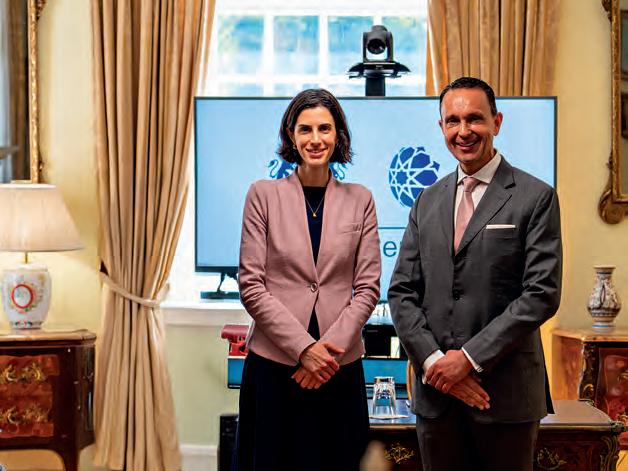
The strategy is not Cape Verde, Djibouti, Bahrain, Dubai, or the Bahamas per se. What these specific geographies allow us is to build regional franchises. Economic and political stability, rule of law, and forcibility of contract and stable financial currencies allow us to rebuild a regulated banking footprint on a regional basis. Cape Verde allows us to build a regional banking franchise in Lusophone Africa, Djibouti allows us in turn to build a franchise to facilitate Ethiopian and regional trade and transaction flows, Bahrain and Dubai allow us to support clients regionally in the GCC and South Asia. The smaller markets where we have invested regulated capital allow us to build and leverage larger regional markets.
costs, increase access to capital, and improve transparency.
In many of our markets, traditional banks impose friction: high fees, rigid processes and limited reach. Our digital products, whether through mobile platforms or cross-border settlement tools, are designed to democratise finance. But we never automate empathy. We blend technology with human insight.
What is your perspective on the geopolitical role of banks today? Can banks remain neutral?
Banks are no longer neutral vessels. We live in a world where capital flows are political, data is currency, and trust is a geopolitical asset. Our role is to ensure that financial infrastructure remains resilient and independent of
WE ARE REALLOCATING CONFIDENCE TO THE ECONOMIES THAT WOULD OTHERWISE REMAIN UNDERSERVED
Where others see complexity and risk in emerging markets, we have the ability to navigate the local operating environment, build banking infrastructure and systems and provide services and solutions at a cost at which others may struggle.
What is next for iib in the coming decade?
Our next chapter is about resilience and responsibility. We are investing in green financing, sustainable trade corridors, and building a decentralised ecosystem that empowers local institutions.
We are also exploring how AI and digital identity can reshape credit models for the underserved. But the compass remains the same: inclusion, transparency and trust. Our ambition is to further enhance our position as a respected cross-regional bank operating with a relentless focus on customer relationships, financial inclusion and tailored solutions to shape the communities we serve. n














































In an exclusive interview with World Finance’s Alex Katsomitros, the Harvard University academic explains how the era of unchallenged dollar dominance is fading in a multipolar world
INTERVIEW WITH
Prof.
Kenneth Rogoff
ECONOMIST & AUTHOR



Few economists can claim a résumé as eclectic as Kenneth Rogoff ’s. Before he was advising governments and lecturing at Harvard as the Thomas D. Cabot Professor of Public Policy and Professor of Economics, he was outthinking opponents as an internationally ranked chess player, even achieving the title of grandmaster. His career includes serving as Chief Economist at the International Monetary Fund (IMF), where he played a pivotal role in navigating economic challenges of the early 2000s. Rogoff has now turned his analytical mind to the future of the US dollar. In his latest book, Our Dollar, Your Problem, he explores how America’s currency shapes – and sometimes destabilises – the world economy in an era of shifting global power. Blending economic insight with a strategist’s instinct, Rogoff unpacks the risks and realities of a financial system still ruled by the greenback, but increasingly undermined by rivals such as the renminbi and stablecoins, as well as political polarisation in the US.
Is the dollar still an exorbitant privilege or an exorbitant burden for the US?
There are some burdens, the biggest one being that you need to remain a dominant military power. The cost is far in excess of most other numbers we are talking about. The idea that the big problem is that demand for the dollar makes it overvalued and hollows out our manufacturing might have a grain of truth, but it is a small issue. The dollar is strong because we are good at technology, engineering, services and intellectual property. Manufacturing jobs have been hollowed out mostly due to automation. In fact, manufacturing as a share of GDP has risen. So there is some truth to it, but it is one of a dozen factors. Saying that it is the dominant one is polemical nonsense.
What is the biggest threat to the dollar’s dominance?
My book envisions a slow decline of the dollar’s share. It will still be fi rst, but in a more multipolar system where the euro expands its footprint and the renminbi becomes a regional currency in Asia and maybe parts of Africa and Latin America. Not long ago, the dollar’s share was smaller. It grew because of the euro crisis and because China made its economy dollar-centric. In 2015, the dollar reached a level higher than it had ever been at, but it has been in decline since then. If you look at countries’ exchange rate systems, the share of reserves, the dollar has been gradually losing market share, going back to the pre-eurocrisis equilibrium. Also, the promiscuous use of sanctions has made countries wary of being over-reliant on the dollar. The US is the world’s back office, which allows us to spy on everyone. So it is not just the Chinese, but also Arabs, North Koreans, Russians, Europeans, even Latin Americans, who are looking for ways to diversify their back office so they are not reliant on dollar plumbing.
Is there a point beyond which rising US public debt will make foreign investors lose confidence in the dollar and Treasuries?
I don’t think so. Gradually the interest rate will rise, and that puts pressure on the government to find other means to free resources to pay for spending in the case of Democrats, for Republican tax cuts, for military expenditure in the case of both parties. For a large country that issues and borrows in its own currency, debt crises don’t have the suddenness they have for countries that borrow in other currencies. But that doesn’t mean that it is not a problem.
Carmen Reinhart and I wrote a paper in 2010 where we divided countries into buckets and found that countries with high debt tend to grow more slowly. It was claimed that there were myriad errors and it was completely wrong. There was one error that didn’t affect
things that much. We have a 2012 paper that has no errors and gets the same results. More than a decade later, many other people found this. High debt slows growth. You have less money to spend on infrastructure, to react to financial crises. But there is no known upper limit on debt that leads to a crisis. Japan has a 240 percent debt-to-GDP ratio. It hasn’t had a crisis, but it has grown spectacularly slowly. Japan was the second richest country 35 years ago. Now it has an income per capita similar to the poorest US state, Mississippi.
Could the renminbi threaten the dollar’s status as the global reserve currency?
In 100 years, sure. In the near term, the renminbi is likely to become a regional currency in Asia. As China breaks free from its dollar peg, it will hold fewer dollars. Its Asian partners, who will be stabilising their currencies against both the renminbi and the dollar, will be holding fewer dollars. We are not going to be using the renminbi in New York, not unless the US badly loses a war to China! But will the renminbi become used in Indonesia, even India? Of course it will. It is not necessarily going to replace the dollar, but its footprint will grow significantly in a multipolar system.
Is the digital yuan part of China’s strategy to undermine the dollar?
Yes. Both the EU’s and China’s central bank digital currencies (CBDCs) are directed at undermining dollar dominance. This is part of building a back office, replacing the plumbing. It also makes it more convenient to hold. Now a large share of settlements are done in dollars. China has already built alternative systems; even Brazil and Europe have. New digital technologies allow ways for them to compete more effectively. The US has launched stablecoins to counterattack, but that will not stop the rise of CBDCs. They help facilitate the move away from dollar dominance.
Why do you think that the US under Trump has embraced stablecoins and banned a digital dollar?
There are two ways to look at it. One is that the US is far ahead on stablecoins and behind on CBDC, so it is leaning into its strengths.
“The US is the world’s back office – which allows us to spy on everyone”
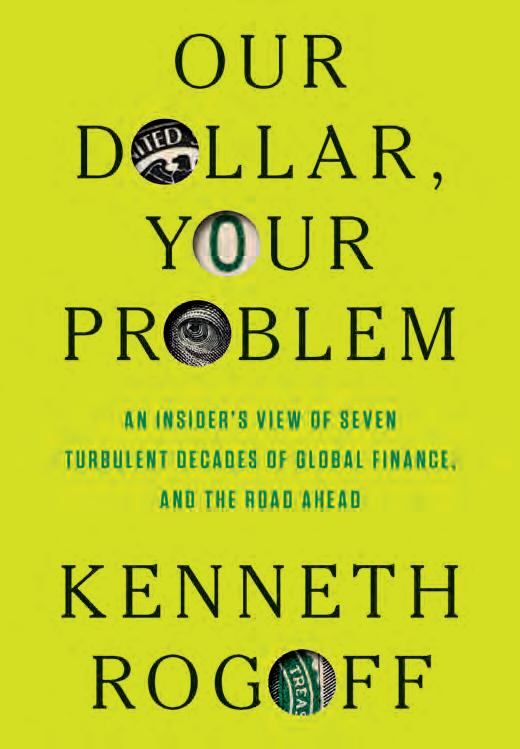
Alternatively, this is an example of extreme corruption. The crypto industry made a quarter to half the donations to both parties in the last election, and it is being paid off. The financial industry had a similar profile in the 2008 election, and we saw what happened. Some positive things were done in trying to define crypto regulation, but the government allowed the industry to write everything without any discussion from outside. We will get an underregulated crypto industry that competes with dollars. That undermines the ability of the Treasury to take in tax revenues and makes it easier to evade regulations and engage in criminal activity. When all is said and done, this will be viewed as a colossal over-reach.
Can the Fed withstand political pressures and how will they affect the dollar?
Both sides want to undermine Fed independence. If Harris had prevailed, we also would have had an assault on central bank independence with different goals, but similar effects. We will end up with more bouts of high and volatile inflation and higher and volatile longterm interest rates. All the benefits of central bank independence will be weakened. Not
overnight; it will take years. To say that this is a mistake by Trump isn’t accurate, because in the short term, he could benefit. Often, populist policies work for a while. He may succeed in holding interest rates lower for a while, but in the long run, we will get higher inflation, especially if there is another big shock. That undermines the dollar. Europe faces the same problem. More volatile and higher average inflation makes safe assets less safe, and weakens demand for them, not just the dollar.
It is often argued that one advantage the dollar has is the rule of law. Given the current political climate, is that still true?
Trump’s assault on the rule of law undermines the US’s competitive position. If you were a foreign investor, you could depend on a non-political court system. The US was exceptional. You didn’t have to worry about what the President thought about some court case involving, say, default in Argentina. Now the President takes an outsized role over Congress and the courts. One thing Republicans are short-sighted about is that they won’t always be in power. In the future, it could be OcasioCortez or Gavin Newsom who assumes these same powers. So it will weaken the appetite
for US assets. The subtle change, which many investors overlook, is the US tariff wall. Many countries are retaliating, which weakens demand for US assets. If you make tariffs high enough, it collapses demand for US assets. You can’t easily get your money in and out. Some argue that geopolitical fracturing and the rise of AI will inevitably require a more autocratic government, and Trump sees ahead the need for that. If that is true, fine, but it is also going to lead to a more fractured system where the dollar is no longer quite as dominant, but king of a smaller hill.
If Europe invested in its defence, would that help the euro compete with the dollar?
One reason the euro can’t fully compete with the dollar is Europe’s lack of geopolitical heft. If it became a military power, that would benefit the euro. It allows you to have a security umbrella over friendly countries that might be more inclined to hold the euro. But it also helps you in international negotiations. Not just Trump, but also Nixon, Reagan and Johnson used military power to get their way in financial negotiations. The shape of the IMF, SWIFT’s design, the way clearing houses are set up. All that has roots in US military power, not just dollar dominance and the US’s economic size. So if the US forces Europe to become a military power, it may find to its chagrin that the euro will become more important.
Is a world currency possible?
It is not possible in the foreseeable future, unless we have a world government. Look at the trouble the eurozone has coordinating countries that share similar values and income levels, and compare that to differences between African countries and Norway. It is simply not possible, unless you are willing to massively redistribute income. I favour that, but a world currency will not gain traction. Take the IMF’s Special Drawing Rights; there are people like Joe Stiglitz and Janet Yellen who believe that it is free money we can give out. It is not free money; it is just like any other loan. For the foreseeable future, we will not have a world currency until we have a dominant country globally. n

Remittances are no longer simply transfers of cash. They are investments in education, small businesses and resilience – offering developing nations both opportunities and risks in a shifting global economy
WORDS BY Maryam Shahvaiz
FEATURES WRITER


Anti-migrant movements in different developed countries like the US, UK and parts of Europe are taking a new shift. Many individuals who oppose globalisation argue that migration policies have created unfair labour conditions, widened global inequalities and contributed to political instability in underdeveloped countries. Yet the other side of the story is equally strong. Migration has indeed enabled millions of households to survive, build resilience and even prosper.
Remittances, the money migrants send back to their home countries, are now considered one of the most important sources of external financing for developing economies. In fact, in many countries, remittances have surpassed foreign direct investment (FDI). As per the World Bank’s Global Remittance Report, there remains a large data gap between officially recorded flows and actual remittances, as migrants often rely on both formal and informal transfer systems.
The World Development Report 2023 notes that around 184 million people migrated globally in 2023 due to economic, domestic and political reasons. At least 77 countries now rely on remittances for more than three percent of their GDP, and in about 30 countries, remittances account for over 10 percent of GDP. For low- and middle-income countries (LMICs), remittance inflows exceeded
$650bn in 2023, a figure higher than FDI for many economies. By 2026, the global remittance market is predicted to exceed $800bn, underscoring its critical role in economic development. Migration patterns, fintech innovation and geopolitics are shaping this huge market, making it more dynamic than ever before.
From consumer brands to tech giants like Procter & Gamble, Apple, Amazon, Alibaba, Google and Microsoft, outsourcing and hiring across borders is now part of business models. Developed economies with high GDP are also confronting structural challenges like aging populations, low birth rates and persistent labour shortages. Countries like Japan, Germany, Italy and the UK increasingly rely on foreign workers to sustain their industries. At the same time, poor infrastructure and low wages in home countries continue to push individuals to migrate in search of better opportunities.
While anti-migrant campaigns and rising nationalism seek to limit immigration, the global demand for labour shows no sign of slowing down in 2026. This continued demand sustains the flow of migrant workers and, with it, the flow of remittances. Another dimension is climate change, which is becoming a central driver of migration. By 2050, millions of people are projected to be displaced due to extreme weather conditions, global warming and disruptions to agriculture. By 2026, these factors are already accelerating migration patterns.
The World Meteorological Organisation highlights that there is a 48 percent chance that global temperatures will exceed 1.4°C above pre-industrial levels in the next five years. Regions like Southwest America and Southern Europe are expected to be drier, while parts of Africa, Brazil and Australia will face heavier rainfall and flooding.
These weather disruptions are reshaping mobility. Skilled workers in Alaska or Canada, facing harsh winters, may seek opportunities elsewhere. Likewise, extreme heat in Brazil is likely to push workers toward countries offering both better pay and more favourable climates. Regardless of the economic necessity, political instability, or climate disruption, migrants consistently send funds back home. These cross-border cash flows not only secure the livelihoods of families but also stimulate local economies. The use of remittances is also evolving. Traditionally, funds were directed toward household consumption such as food, rent or education. Migrants are leveraging their earnings for investment opportunities in their home countries, financing small businesses, purchasing property or supporting community projects.
This shift means remittances are no longer simply tools of survival but also drivers of entrepreneurship and economic diversification. Both sending and receiving countries benefit from this where migrants strengthen their financial security abroad while simultaneously stimulating economic growth back home.
Before the technological boom, sending and receiving money across borders was costly, slow and often inaccessible. According to the World Bank’s 2020 data, the global average cost of sending $200 was between six and seven percent, far higher than the UN
184 million
People migrated in 2023 for economic, domestic and political reasons
$1.5trn
Projected value of the digital remittance market by 2033
Although still in their early stages, CBDCs could become a secure and low-cost remittance channel within a few years. Security is another frontier where fintech has made advances. Digital wallets now incorporate biometrics, facial recognition and multi-factor authentication, reducing the risk of fraud. Moreover, by moving migrants into the formal financial system, these innovations allow governments to collect data, improve transparency and even broaden their tax base. The result? By 2026, digital transformation will have made remittances not only cheaper and faster but also more integrated into everyday financial life.
The geopolitical cut
Sustainable Development Goal (SDG) target of three percent. In Africa, costs often exceeded 10 percent, making remittances especially burdensome for low-income migrants. The fintech revolution has transformed this landscape. Instant money transfers are now possible thanks to digital platforms that complete transactions in seconds rather than days. Migrants no longer need to stand in long queues at remittance centres; with the tap of a mobile app, they can send funds home almost instantly. This convenience has redefined the experience of sending and receiving money across borders. Equally transformative has been the rise of mobile money services. Platforms such as M-Pesa in Kenya, Easypaisa in Pakistan, and bKash in Bangladesh have given millions of people access to financial services for the first time. By allowing recipients to receive funds directly on their mobile phones, these systems eliminate the need for bank accounts, which remain inaccessible for many in rural or underserved areas.
The dominance of mobile money is set to expand further. By 2026, analysts predict that mobile money applications will become the primary channel for remittances in many developing countries. In regions where traditional banking infrastructure is limited, these digital platforms are emerging as the backbone of financial inclusion, ensuring that remittances reach families quickly, securely and at a fraction of the previous cost.
Cryptocurrencies and stablecoins have added a new dimension to remittances. Stablecoins, backed by assets like the US dollar, offer a less volatile way to transfer funds. While cryptocurrencies remain riskier, they are increasingly popular in regions with weak financial systems. At the same time, central banks are experimenting with Central Bank Digital Currencies (CBDCs).
Remittance channels are deeply influenced by geopolitics. Changing alliances, sanctions and rivalries will shape how money moves across borders in 2026. Countries under heavy sanctions often experience reduced remittance flows, as migrants resort to informal networks such as hawala or unregulated crypto transfers. These alternatives undermine transparency and weaken oversight. At the same time, shifts in global financial power are producing new dynamics. For example, Russia and China are working to develop regional payment systems to reduce dependence on western platforms, potentially redrawing the global remittance map. Governments are also seeking to better track remittances and encourage the use of formal systems. India, for instance, has introduced diaspora bonds, enabling its large migrant population to invest directly in infrastructure projects. Other countries are introducing policies to incentivise banking channels over illegal transfers. By 2026, the emphasis will be on making remittances not just transparent and secure, but also strategically aligned with national development goals.
Is the $800bn milestone enough to understand the future of remittances? The answer is more complex. In countries such as India, Bangladesh, the Philippines, and across Latin America and throughout Sub-Saharan Africa, remittance inflows are expanding at double-digit rates. These regions rely heavily on migrant earnings, and the steady increase highlights the resilience of remittances even in times of global uncertainty.
The digital remittance market has already surpassed $800bn as of 2024, and projections suggest it will continue to grow rapidly. With a compound annual growth rate of around 8.5 percent forecast from 2026 to 2033, the sector could reach as much as $1.5trn by 2033. This scale not only reflects rising migration but also the speed at which digital platforms are transforming the industry. Yet challenges persist. Economies with weak digital infrastructure
risk falling behind in this transformation. In several parts of Sub-Saharan Africa, limited internet connectivity, inadequate regulation and gaps in financial literacy hinder the widespread adoption of digital channels. Without targeted investment and policy support, these countries may not fully capture the benefits of the digital remittance boom. While digital channels are quickly dominating, traditional money transfer operators remain relevant in certain regions. Countries like Nigeria and some parts of Latin America continue to rely on conventional platforms due to low digital penetration. Yet, experts estimate that within a few years, more than 50 percent of global remittances will be digitalised. Remittances carry both opportunities and risks. On the opportunity side, they improve household welfare, finance education, and stimulate entrepreneurship. Governments can channel these funds into development initiatives such as infrastructure, healthcare and small and medium enterprise (SME) support. The rapid rise of fintech offers another opportunity: digital channels bring millions of previously unbanked people into the financial system. By 2026, fintech platforms could provide consistent economic growth and the financial security that developing economies urgently require. Yet risks remain. Heavy dependence on remittances can make economies vulnerable to downturns in host countries. If a host economy faces recession or imposes restrictive policies, remittance flows could decline sharply. Furthermore, strict regulations or heavy taxation may drive migrants back toward informal transfer systems, undermining transparency. Geopolitical conflicts and sanctions also remain a constant threat to the smooth flow of funds. The future of remittances is promising, but it is not without pitfalls. The key lies in making them affordable, transparent and resilient.
Remittances are far more than financial transfers. They are lifelines for families, catalysts for fintech innovation, and drivers of economic growth in both host and home countries. By 2026, the global remittance market will not just be a story of money moving across borders but of resilience, opportunity, and transformation. Predictions from global analysts suggest steady growth well into the next decade. Yet, the key question remains: can governments, financial institutions and fintechs keep remittances affordable, transparent and impactful? If they can, remittances will evolve from survival tools into engines of prosperity; a bridge not just between countries, but between present needs and future opportunities. n

For over a century, Banorte has stood by the people of Mexico –helping them dream, build and thrive. Guided by passion, purpose and pride, it continues to transform banking into something closer and more personal: a force for progress and national pride
WORDS BY Carlos Hank González CHAIRMAN OF THE BOARD, GRUPO FINANCIERO BANORTE


Banorte has dedicated 125 years supporting families and backing Mexican businesses, convinced of the immense potential of our country and demonstrating that the ordinary can be made extraordinary when done with passion and purpose. Few institutions in the world can say they have walked alongside their country and its people for so long. Banorte did it, and continues to do so with pride, as a bank that was born in Mexico, grew with Mexico, and still firmly believes in Mexico.
Making the ordinary extraordinary
When World Finance announced that Banorte was recognised as Best Retail Bank and Best Corporate Governance in Mexico, it confirmed that we are on the right path, because we are precisely focused on being the best bank for our customers and upholding the best corporate governance practices.
Just over 10 years ago, when Marcos Ramírez and I took on the responsibility of leading Banorte, we embarked on a radical transformation alongside our employees, customers and investors, aiming to become the best financial group in Mexico and a leader in the digital world. We reinvented and innovated, while keeping our essence intact: always putting the customer at the centre.
Today, Banorte continues to focus on being the best bank for our customers. We are convinced that trust is built through daily actions; that is why we have focused on making the ordinary extraordinary for them. Being the best means having a deep understanding of each
customer to anticipate their specific needs and offer them tailored experiences, which at Banorte we call ‘hyper-personalisation.’ Our goal is to provide the best experience in the market, with the highest customer satisfaction metrics and the most efficient operations to offer ‘a bank in minutes’ to those who trust us. This translates into making every customer feel unique through our service and valuing their time so they can get what they need easily and instantly.
We share the vision of the Mexico Plan launched by the Government of Mexico, which seeks to promote shared prosperity and national development through collaboration between public and private investment.
As part of this plan, Banorte launched an initiative to support SMEs, especially those led by women, offering better credit conditions to foster their growth and, in doing so, continue contributing to Mexico’s progress.
We are the only major Mexican bank that has witnessed 125 years of transformations, crises and changing eras, standing strong and loyal to its people. We are a bank that beats with the same heart as Mexico. We are proud to be the Strong Bank of Mexico! and this is not a slogan; it is a reality experienced in every office, branch, and decision we make. From the north of the country, where we were born, to every corner of our geography, we support dreams, projects and aspirations.
The pride of being Mexican is the driving force behind us, because we believe our country deserves the best. That was the reason that led us to join the transformation of a national symbol: the new Banorte Stadium, the venue for the opening of the 2026 FIFA World Cup. We are thrilled to be part of the evolution of this stadium, a legend in Mexico, as it ushers in a new era by leading the way in modernity and sustainability.
20 years of the Banorte Foundation
WE ARE CONVINCED THAT TRUST IS BUILT THROUGH DAILY ACTIONS
In a world of rapid changes, trust is the most valuable asset. At Banorte, we are convinced that trust is built through strong, transparent, and responsible corporate governance. That is why we uphold the best international practices in this area. Banorte’s governance has been strengthened to address the current market needs in sustainability, transparency and accountability, which are key to our strategy. This strength enables growth across every metric, portfolio, and region. Banorte’s results position us as one of the most profitable banks in Mexico, demonstrating our ability to generate sustainable value for all stakeholders.
Being with our people is more than a phrase; it is a real commitment. We are very happy to celebrate 20 years of the Banorte Foundation – two decades of building strong families, bringing hope, support and opportunities to thousands of families in need. We want a country where poverty is not destiny, by supporting families with housing, health, nutrition, education and the empowerment of women. To celebrate this incredibly special anniversary, we are sharing stories from families we have supported with all of Mexico.
Today, we can proudly say that we are a Mexican bank, customer-focused, a leader in technological and digital transformation, with world-class corporate governance and an unwavering social commitment. No result or achievement would be possible without the effort of the thousands of colleagues who are part of the Banorte family.
We know that Mexico deserves a strong, solid, and committed bank that always grows alongside its people. That is why, at Banorte, we passionately turn the ordinary into the extraordinary. n
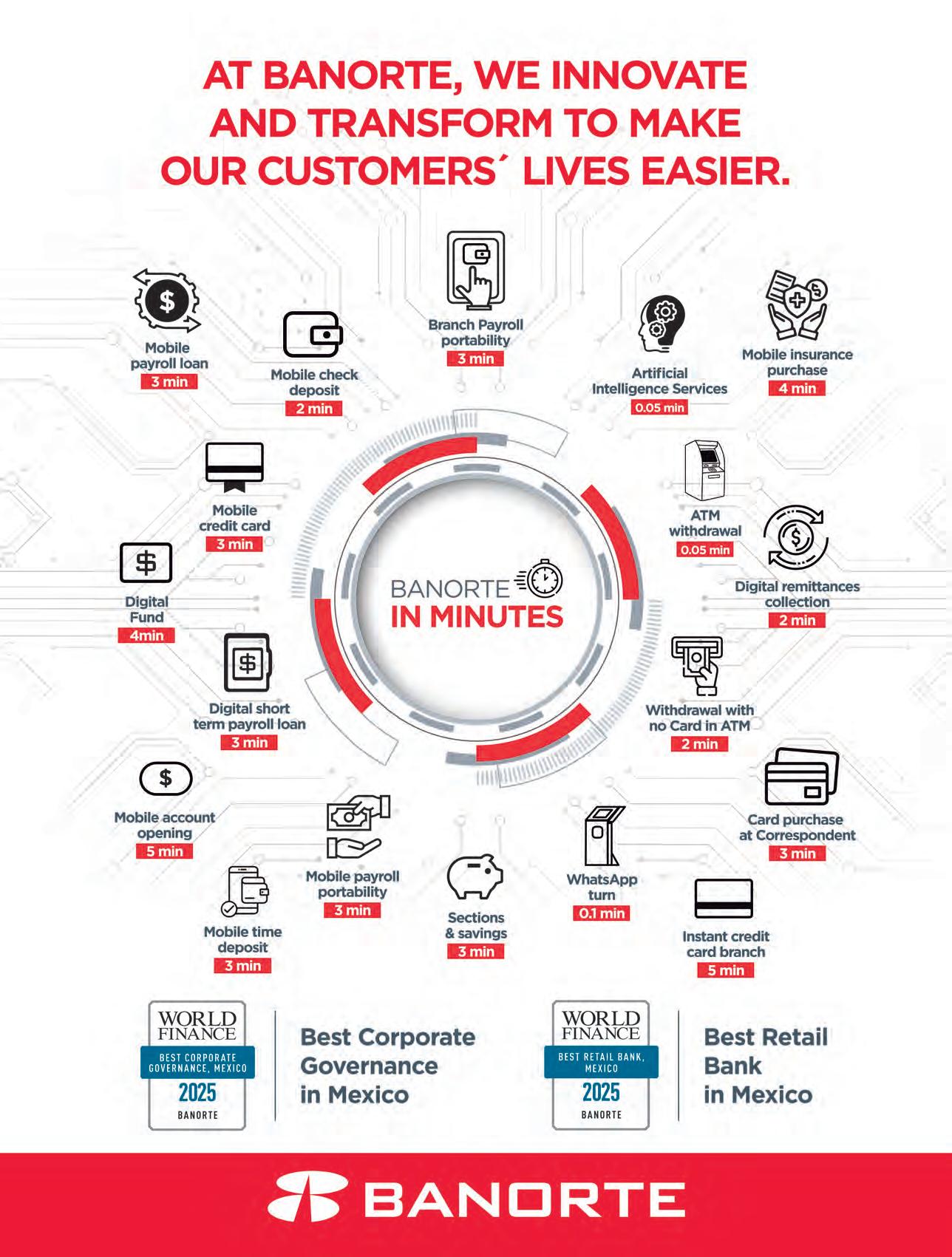
Banco Popular Dominicano is charting a new course for the financial sector – one where responsible banking drives innovation, inclusion and impact. Its sustainability strategy demonstrates that financial strength and social value can grow from the same foundation of trust
WORDS BY Christopher Paniagua CHIEF EXECUTIVE OFFICER, BANCO POPULAR DOMINICANO





In today’s world, where social, environmental and economic challenges are increasingly complex, sustainability has moved from being a trend to an urgent necessity. Within this context, Banco Popular Dominicano has assumed a leading role in promoting a business model grounded in sustainability, integrating this vision across all levels of its institutional structure. This article explores in depth the strategic management behind the bank’s sustainable vision, highlighting its pillars, achievements, challenges, and the key role of corporate communication.
Since its opening in 1964, Banco Popular has been guided by a philosophy centred on the economic, social and environmental development of the Dominican Republic. Over time, this philosophy has evolved into a comprehensive approach called ‘Responsible Banking.’ Under the leadership of Don Alejandro Grullón E., followed by Don Manuel A. Grullón and myself, the bank has consolidated an organisational culture that aligns with its founding principles, now focused on sustainable development. The shift in mindset towards sustainability came from the understanding that economic growth cannot come at the expense of collective wellbeing or environmental preservation. Sustainability is not just a strategy – it is a conviction that guides business decisions to ensure progress does not compromise future generations.
Banco Popular has developed an institutional action model based on eight fundamental elements that collectively build its sustainable vision. The first is addressing societal expectations and demands. By actively listening to society, the bank delivers inclusive and equitable solutions. Second, its management philosophy is based on ethical principles, transparency, and responsibility, guided by a long-term vision.
The third element is alignment with the Sustainable Development Goals (SDGs), which serve as a decision-making framework. Fourth is the adherence to the 2019 Principles for Responsible Banking, committing the bank to finance sustainable development, reduce social and environmental risks and promote inclusion.
The fifth element considers business needs, recognising that sustainability enhances competitiveness, efficiency and the creation of shared value. Sixth is the diversity of initiatives that include actions in energy efficiency, financial inclusion, community development and socially impactful products.
The seventh element is institutional positioning, which strengthens the bank’s leadership in sustainability as a differentiating factor in the market.
Finally, the eighth element is leadership in the transformation agenda, with Banco Popular taking a leading role in transitioning to a more just and low-carbon economy. The sustainability model at Banco Popular is strengthened by the Sustainability and Reputation Committee, which ensures that all actions align with stakeholder interests and are measured by impact indicators.

Corporate communication is key to building Banco Popular’s credibility and reputation. It goes beyond informing – it creates meaning, mobilises allies and fosters internal education. Transparent communication strengthens institutional reputation, reduces risks, helps all stakeholders understand the purpose behind sustainable decisions, facilitates and promotes strategic partnerships with NGOs, government and businesses, fosters a culture aligned with sustainable values and ensures the organisation’s social legitimacy – an essential element for operating with societal support. In this way, communication becomes a tool for transformation and leadership.
Banco Popular was the first bank in the insular Caribbean to adhere to the UNEPFI Principles for Responsible Banking. This involves concrete commitments such as aligning with the SDGs and the Paris Agreement, maximising positive impacts, working
responsibly with clients, collaborating with stakeholders, implementing effective governance with measurable goals and ensuring transparency and accountability. These principles strengthen reputation, improve risk management, attract international financing and foster innovation.
Banco Popular has proven that it is possible to generate economic profitability while promoting social and environmental development. Investments in renewable energy, financial education, and green products have not only strengthened client relationships but also opened up new business opportunities.
In the field of renewable energy, the bank has approved over $525m in projects with 780MW of installed capacity. Its portfolio of green products has disbursed more than RD$3,000 million ($47m), benefiting over 800 individuals.
Through its Environmental and Social Risk Management System (SARAS), the bank identifies and mitigates risks in financed operations, aligning with international frameworks. Since 2019, Banco Popular has published annual sustainability reports following
1964
The year Banco Popular began operations
$525m Value of renewable energy

Global Reporting Initiative (GRI) standards. Since 2022, these reports have been indepen dently verified by KPMG, ensuring transpar ency and traceability.
EFFECTIVE COMMUNICATION FOSTERS A CULTURE ALIGNED WITH SUSTAINABLE VALUES
Initiatives such as ‘Emprende Mujer,’ ‘Finanzas con Propósito,’ and ‘Excelencia Popular’ promote education, entrepreneurship and women’s inclusion. In 2024, more than 1,200 women were impacted and 650 scholarships were awarded. Over 75,000 small and mediumsized enterprises have received financial support, boosting local development.
Since 2014, Fundación Popular has led health, education, and environmental projects such as the Yuna Centre, watershed reforestation, and community aqueduct construction. It has also supported postgraduate programmes in CSR and sustainability, benefiting more than 500 professionals.
More than 3,000 Banco Popular volunteers participate in initiatives spanning health, the environment, education, and community development.
Leading the shift toward sustainability with in a large financial institution has involved overcoming resistance, promoting ongoing education, and exercising empathetic leadership. Sustainability has moved beyond being the task of one department – it is now a shared responsibility across the organisation.
The next generation
The future of sustainability needs ethical, creative, and committed communicators –individuals capable of creating meaning, mobilising people, and driving real transformation through both words and actions. Banco Popular has demonstrated that sustainability can be the central pillar of a corporate strategy without compromising profitability. With a clear vision, solid governance, high-impact projects, and effective communication, it positions itself as a leader in sustainable banking in the Caribbean. For future generations – especially women – there is both the challenge and an opportunity to lead with ethics, purpose, and the conviction that every action matters. n
Under newly appointed CEO Leonardo Aguilera, PhD, Banreservas aims to consolidate its leading role in the Dominican economy, with further advances in digitalisation and a stronger push for financial inclusion
INTERVIEW WITH
Dr. Leonardo
CEO, BANRESERVAS
Aguilera





Leonardo Aguilera assumed the executive presidency of Banreservas, the largest financial institution in the Dominican Republic, in August 2025. He holds a PhD in economics, has more than 20 years of university teaching experience, and is the founder of the Cibao Economic Centre. Between 2020 and 2025, he headed the Dominican Petroleum Refinery (Refidomsa). Following his appointment, Dr. Aguilera spoke with World Finance about Banreservas’ fundamental role in the Dominican economy and the bank’s priorities for the future.
Banreservas reported a rapid increase in lending in recent years compared with prior periods. How has this benefited the national economy?
Greater access to credit has enabled both large corporations and SMEs to diversify their offerings, improve operational efficiency, and ultimately boost job creation and incomes. In addition, the availability of bank financing – delivered by executives with deep expertise in tailoring structures to each project – helps attract foreign investment. In tourism, a key pillar of the economy, financing has been essential to developing core infrastructure: hotels and resorts, airlines, cruise ports, transport networks and attractions. Credit has also broadened and strengthened supply chains. By financing suppliers and service providers that support tourism – local food producers, artisans, and transport services – banks reinforce the overall ecosystem.
Meanwhile, consumer lending has played, and will continue to play, a central role in stimulating domestic tourism by giving people access to affordable financing for travel and leisure.
The ripple effects are positive for retail, hospitality and agriculture. We currently hold the number one position in the credit card market. To date, Banreservas has issued 1.44 million credit cards and 3.77 million debit cards, a combined year-over-year increase of 24.5 percent. We also lead the payment platform for social assistance programmes, serving roughly 855,000 beneficiaries, and we support merchants with a range of annual promotions.
What role is Banreservas playing today in advancing financial inclusion, for example through education?

1.44 million
Credit cards issued
3.77 million
Debit cards issued
One of our most significant initiatives is the PUEDO programme – our first large-scale effort, in partnership with the Ministry of Education, to deliver financial education in public schools. Through PUEDO, we have reached 4,300 students in 17 public schools across several provinces, focusing on those in the final years of primary and secondary school. We are now scaling to thousands more institutions, extending financial education to more than 7,800 schools nationwide as well as to teachers. We recently convened with more than 1,000 students from the southern region – mostly in early grades – and were encouraged by their enthusiasm for learning about money management and the importance of saving for emergencies and future needs.
Meanwhile, through our ‘Banking is the Nation’ programme, we have brought more than 900,000 Dominicans – many from vulnerable communities – into the formal financial system by combining digital accounts, government payrolls, and social subsidies. This effort is supported by more than 4,000 financial literacy workshops.
Banreservas is implementing an internationalisation strategy to expand access to financial services for Dominicans living abroad. What has been achieved so far?
We continue to take important steps to connect the Dominican diaspora with the national fi nancial system. Our compatriots in the US and Europe – more than 2.5 million people – send over $10bn in remittances annually, a vital source of support for our economy. The establishment of three representative offices – Madrid, New York and Miami – fulfills a commitment made by President Luis Abinader and makes Banreservas the first Dominican bank with a presence in both Spain and the US. These offices have already served more than 60,000 clients, processed more than 25,000 savings account openings, and handled mortgage applications totalling over RD$3bn.
WE CURRENTLY HOLD THE NUMBER ONE POSITION IN THE CREDIT CARD MARKET
In the near term, our focus is to strengthen this presence and offer Dominicans abroad more options for dynamic engagement, allowing them to benefit from Banreservas’ footprint in these markets and remain closely connected to their homeland. Through international real-estate fairs held in New York, Lawrence and Madrid in 2024 and 2025, we have showcased a broad range of residential projects
to Dominican com munities abroad.
WE WILL CONTINUE DEVELOPING PRODUCTS THAT HELP MICRO AND SMALL BUSINESSES GROW
Working with leading developers and real-estate agents in the Dominican market, we provide personalised advice, preferential financing, and the assurance that comes with Banreservas being present in their community.
Rather than viewing Dominicans abroad simply as remittance senders, we see them as active partners in national growth. Looking ahead, we are developing even more innovative digital solutions that will allow them to manage their entire financial lives remotely, quickly, and securely. These efforts also align with the President’s commitments to Dominican communities abroad – commitments Banreservas embraces as the bank with the strongest ties to our diaspora.
What are Banreservas’ main priorities and objectives through 2030?
We have three priorities. First, deepen our digital transformation. We will continue to expand our digital capabilities to deliver faster, more secure, and more personalised solutions for corporate and retail clients. That includes optimising payment platforms, cashmanagement, and financing services with a strong focus on user experience and regional interoperability.
Second, optimise capital to fund innovation and expansion. Following the capital increase authorised by Law 13-24, Banreservas now has a significantly stronger capital position. We will leverage this to accelerate technological innovation, expand banking infrastructure, and enhance our suite of transactional products – investing in cybersecurity, process automation, new digital channels, and expansion into key regional markets.
Third, expand financial inclusion. We will drive initiatives in underserved communities by integrating accessible digital solutions and strategic partnerships to broaden the reach of our transactional services. We will continue developing products that help micro and small businesses grow – facilitating access to credit, modern payment methods, and financial tools that improve sustainability and competitiveness.
In September 2025, the bank announced RD$7bn to finance national productive sectors at preferential rates. Which sectors will benefit?
These funds are targeted at the country’s main productive sectors: construction, commerce, manufacturing, exports, health and agriculture.
Banreservas recently reported that its CREE programme – which supports entrepreneurs and innovative projects – has channelled more than RD$72m in equity investments since 2015. What role will this programme play going forward? CREE will remain Banreservas’ flagship initiative for backing innovation. By combining equity investment with specialised mentorship, it contributes to national socioeconomic development. We expect CREE to broaden its reach, supporting more founders at the early and growth stages while strengthening business models.
The vision is to cement CREE as an engine of innovation – turning ideas into high-impact projects that address social and economic challenges and help build a more prosperous future for all Dominicans.
What else is the bank doing to support entrepreneurs and SMEs?
Fomenta Pymes offers flexible financing, technical advice, and specialised support to strengthen management and competitiveness among SMEs. The programme facilitates access to credit, provides training tools, and connects entrepreneurs with support networks – helping businesses grow sustainably, create jobs, and boost local economies.
How is the digitalisation of banking services progressing, and what are the key objectives in this area for the next five years?
With the launch of the TuBanco Personas platform, we have modernised online banking for individuals, delivering a faster, more intuitive, and more secure experience. Our AI-powered virtual assistant, Alma, has become a key self-service channel. We have also redesigned the Personas app to give customers greater autonomy in managing products such as accounts, time deposits, cards and loans. The Banreservas MIO Digital Account has expanded access for traditionally underserved segments, while digital onboarding allows new customers to join without in-person visits. In addition, Banreservas Wallet complements Apple Pay and Google Pay, offering additional contactless options.
For business clients, we have implemented solutions that optimise cash-management and digital transactions, including Automated Deposit Vaults and a direct interconnection platform with corporate ERP systems that enables automatic reconciliation of large transaction volumes. We also offer a Digital Token for businesses to modernise authentication across digital channels – replacing physical devices with a more secure, efficient solution aligned with international cybersecurity standards. Together, these solutions reinforce Banreservas’ leadership in the sector.
Over the next five years, our digitalisation strategy centres on four pillars.
1) 100 percent digital onboarding and services: ensuring that both individuals and businesses can open, manage, and close products through digital channels, supported by advanced biometrics and security controls.
2) A I-powered hyper-personalisation: leveraging AI and data analytics to deliver more contextual, proactive financial solutions.
3) Cloud scalability and resilience: consolidating migration to cloud platforms for greater agility in responding to regulatory change, demand spikes, and new product launches.
4) E xpansion into digital ecosystems and BaaS: deepening partnerships with fintechs, companies, and government entities through Banking-as-a-Service models that expand innovation and self-service. With this roadmap, Banreservas seeks not only to modernise its digital channels but also to redefine how customers interact with financial services – placing innovation, accessibility and inclusion at the centre of the bank’s strategy. n

True innovation in banking is not defined by technology alone, but by building systems – digital and human – that enable millions to participate in the financial mainstream. This is the Banco Azteca model
WORDS BY Alejandro Valenzuela CHAIRMAN, BANCO AZTECA AND AZTECA SERVICIOS FINANCIEROS


In global finance, the word ‘innovation’ often evokes digital platforms, premium services or algorithmic models. Yet the most transformative advances in banking are not technological in isolation. They are structural: designing products, processes and systems that expand access, resilience and trust.
This has been Banco Azteca’s mission from the start. In Mexico, financial exclusion was once treated as inevitable. By embedding inclusion into its very architecture, the bank has built a model that is both commercially robust and socially relevant. The recognition by World Finance as the ‘Most Innovative Company in the Banking Industry 2025’ reflects not a single app or feature, but a system-wide commitment to innovation as infrastructure.
Banco Azteca’s inclusive product design demonstrates that innovation can extend far beyond technology. Guardadito, the bank’s foundational savings account, remains the first formal financial tool for millions of Mexicans, with more than 24 million active accounts. SOMOS, created by women for women, integrates savings with access to legal, medical and psychological support, now serving over 680,000 women. Guardadito Amigo and Sin Fronteras, tailored for migrants, refugees and their families, have grown to more than 150,000 accounts by mid-2025.
These products are not pilots. They are regulated, permanent and available in every branch nationwide. Their impact shows that innovation also means permanence: turning exclusion into participation by making inclusion part of the core banking system.
Digital at scale, but not alone Technology plays a critical role, but it is part of a wider ecosystem. Banco Azteca’s app has become one of the largest digital banking platforms in the country, with more than 23 million users. Two-thirds of all transactions and more than half of savings account openings now happen digitally.
than half of repayments are made directly in the app. By simplifying processes, embedding real-time tracking and allowing repayment without cost or travel, the bank has redefined access to credit for millions of households. Here again, innovation is not just technological; it is behavioural, designed around how people actually live and work.
Trust as institutional innovation
BANCO AZTECA’S APP HAS BECOME ONE OF THE LARGEST DIGITAL BANKING PLATFORMS IN THE COUNTRY
The app was designed from the ground up for first-time users: intuitive, hybrid and linked to 2,000 branches that remain open 365 days a year. This hybrid approach means clients can move seamlessly between digital and physical channels. For many, the app is their first interaction with a formal financial institution, yet they know they can still rely on face-to-face support if needed. What makes this digital model innovative is not technology in isolation, but how it complements human-centred infrastructure to scale trust.
Innovation also extends to how credit is originated and serviced. The Unified Loan Origination Process, launched in the past year, has standardised applications across physical and digital channels. Weekly loan applications have grown 231 percent, with digital origination up 75 percent, and today 68 percent of all loans originate digitally. More
Banco Azteca’s Apoyar Nos Toca programme illustrates that innovation is not limited to products or technology. It can also mean rethinking how a bank builds legitimacy and social resonance. By supporting merit-based causes such as Mexico’s Physics Olympiad delegation, rural students in Oaxaca, and outstanding artists, the initiative generated over 50 million organic impacts in 2025. What distinguishes it is not philanthropy, but a new model of reputational strategy, one that transforms selective sponsorships into scalable trust-building infrastructure, linking institutional purpose with national pride.
Banco Azteca’s model suggests a broader lesson for global finance. Innovation is not only defined by apps, nor by short-lived pilots. It is about permanence, replicability and resilience. At Banco Azteca, inclusion is designed as infrastructure: products that last, processes that scale, digital channels that connect, and programmes that build trust.
In an era where technology is reshaping financial services at unprecedented speed, the challenge is to ensure that it empowers rather than excludes. Banco Azteca’s experience shows that innovation is strongest when it combines digital transformation with inclusive product design, resilient processes and trust-building initiatives.
Purpose makes technology meaningful, turning innovation into infrastructure for equity. The most significant innovation in banking, therefore, is not measured by features alone, but by the scale of lives it brings into the financial system. n

As Frankfurt’s finance hub reflects shifting market moods, data shows cooling growth and cautious investment across the eurozone. The heart of Europe’s financial system and home to the European Central Bank (ECB), Frankfurt is again under the spotlight as markets assess the region’s slowing growth
trajectory. Traders and analysts alike are grappling with mixed signals: inflation is easing, but corporate lending and investment remain subdued. Germany – long the engine of European growth –faces industrial contraction and weak export demand, especially from China.
Financial institutions are now cutting forecasts for 2026, anticipating continued volatility and only modest recovery. Economists warn that Europe may be entering a ‘soft stagnation’ phase – avoiding recession, but with minimal growth and tightening consumer confidence.
‘Bankenviertel,’ the banking district in Frankfurt, Germany, is seen mirrored by a puddle during October
56% of European fund managers surveyed by the ECB expect ‘below-trend growth’ in 2026
68% of eurozone economists believe inflation will remain above the ECB’s 2% target through mid-2026
4 in 10 manufacturers in Germany report reduced export orders, largely due to weaker Chinese demand
61% of European banks say corporate loan demand has fallen in Q3 2025 – the sharpest drop since 2020
52% of retail investors in plan to increase gold or bond holdings in 2026 as a hedge against volatility
The combination of technology and traditional banking will drive a more modern, efficient and accessible future
WORDS BY Petia Dimitrova CEO, POSTBANK & CHAIRPERSON AT THE ASSOCIATION OF BANKS IN BULGARIA





Digital innovations are on the rise globally, and the banking sector plays a significant role in this transformation. The accelerated adoption of high-tech solutions enhances the overall customer experience. In this way, banks provide their clients with higherquality, faster and more efficient financial services, because the essence of banking lies in the relationship between the customer and the financial institution. Digital cards, virtual wallets, QR-code payments – all of these are part of the new portfolio of services that banks are developing and offering.
Digital transformation in banking is no longer merely a matter of convenience – it is a necessary condition for sustainability, growth and long-term competitiveness in an era of accelerated technological evolution and shifting customer expectations. The Bulgarian banking sector demonstrates stability and maturity but also ambition to be an active participant in this transformation. Many banks are already working towards Banking-as-aService platforms, investing in Open Finance solutions, digital wallets, cloud infrastructure and artificial intelligence – tools that enhance not only operational efficiency but also the overall customer experience.
We are witnessing deeper integration between traditional banking services and fintech solutions, as well as increased agility in responding to changing customer needs. This is a clear sign that the sector is not only adapting global trends but also actively fostering innovation born here – in Bulgaria. The digitalisation of banking services is already at an advanced stage – over 76 percent of bank transfers are initiated via digital channels, providing fast, easy and convenient banking through mobile devices at an accessible cost.
The past few years, marked by various challenges, have undoubtedly acted as a catalyst and accelerated digitalisation across all sectors, with banking being no exception. The dynamic development of financial and technological innovations is focused entirely on customer satisfaction and seamless access to banking.
Technology is reshaping the very architecture of banking – from back-office operations to front-end solutions for end users. Yet the key question remains: how do we combine innovation with trust – the core currency of our sector? The answer lies in proactive regulation, responsible business practices and open dialogue with all stakeholders – from government to consumers. Only in this way can we ensure that technological progress does not come at the expense of security, transparency or accessibility. That is why the sector supports initiatives to improve financial literacy, raise awareness of digital risks and protect personal data. We believe that sustainable banking in the digital age must place the customer at the heart of every innovation. True transformation requires, above all, a new mindset and new skills – both for banking teams and for customers. For clients, it is a cultural shift: embracing the idea that familiar services will now be accessed through digital channels and devices.
apps, digital branches and self-service zones, all while enjoying consistently high service quality. Our advanced customer segmentation enables us to run hyper-personalised campaigns – targeted, timely and tailored to each client’s preferences and current needs. This is yet another reason why digital channels are gaining traction.
Our clients increasingly value the convenience, security and added benefits that digital channels offer. The sustained growth in these segments reflects our ongoing efforts to enhance the customer experience. In recent years, our focus has been on upgrading existing digital channels and introducing new ones that transform how we serve clients and manage operations.
We have created and are actively executing the Go-Beyond programme – a strategic plan that will transform Postbank and allow us to set new standards for service delivery, offering better and faster services, greater operational efficiency and flexibility in today’s dynamic environment. Our mission and priority remain to deliver exceptional customer experiences and high-quality financial services and digital innovative solutions through continu-

Digitalisation is not just about offering online services – it includes transforming the entire business model through automation, hyper-personalised financial solutions and proactive service based on real-time data analysis. As an institution with a longstanding commitment to digitalising financial services, we understand that technological progress only makes sense when it is accessible and easy to understand. For us, digital financial literacy is not just CSR – it is part of responsible modern banking.
Postbank is among the pioneers in creating an omnichannel customer strategy – building a connected digital experience where clients can seamlessly transition between mobile
ous process improvement and cutting-edge technology – ensuring security, convenience and efficiency in every interaction.
To meet these challenges, Postbank has invested heavily in mobile banking development, enhancements to our online platform, the OneWallet digital wallet and new analytical tools to better understand our customers’ needs. I believe that the combination of technological advancement and classical institutions will be the driving force behind a more modern, efficient and accessible banking future. Undoubtedly, the winners will be those who successfully integrate open banking models and platforms – combining speed, technological expertise and the ability to build more genuine, accessible and personalised relationships with people. n

New technologies and environmentally friendly initiatives are transforming Qatar’s banking sector, further enhancing the Nation’s investment appeal, writes Commercial Bank
At Commercial Bank, we have long been champions of digital innovation and technological progress. New technologies have radically reshaped the banking industry over the last two decades, but the current pace of change is simply unprecedented. Artificial Intelligence (AI) has opened the door to a host of new opportunities, allowing forwardthinking banks to enhance their customer experience offer, increase efficiencies and boost their global competitiveness.
Commercial Bank is proud to be an early adopter of advanced AI technologies, and our company-wide deployment of AI tools is helping us to positively transform our banking operations and customer engagement.
In 2019, Qatar launched its National AI Strategy, setting out a bold and comprehensive plan for unlocking the many opportunities that AI presents. The demand for AIpowered services has been growing rapidly in recent years – both in the banking industry and across the wider economy – fuelling strategic investments in Research and Development (R&D), upskilling and digital infrastructure.
By 2031, the Nation’s overall AI market is predicted to grow by 29 percent, reaching a value of $2.2bn. With strategic investments
helping to support a thriving AI sector, Qatar is fast becoming a regional pioneer in digital innovation, with exciting real-world impacts for the banking world and beyond.
Across the globe, AI is transforming industries, economies and societies, bringing countless opportunities to boost productivity, reduce costs, and drive innovative thinking.
The appetite for AI adoption appears to be particularly strong in Qatar. According to PwC, 90 percent of Qatar-based CEOs have reported integrating GenAI into their businesses over the last year, compared to 83 percent globally.
At Commercial Bank, we share this enthusiasm for harnessing the opportunities that new technologies can bring. Digital innovation is at the heart of everything we do – it defines how we design our products, deliver our services and enhance every customer interaction.
With Qatar’s AI strategy advancing at a rapid pace, the Nation’s investment appeal also continues to grow. New technologies play a key role in creating Qatar’s dynamic and

welcoming business environment, with the widespread adoption of AI tools helping to boost productivity and enhance the customer experience for investors with an interest in the region. Last year, Foreign Direct Investment (FDI) in Qatar surged by 110 percent to $2.7bn, reaffirming the Nation’s ability to attract high-quality investments into its key growth sectors.
At Commercial Bank, we know that experienced, well-established businesses are key to building an attractive business environment for investors. We recognise that clients will have different needs and preferences, and have a diverse range of offerings to help our customers to bring their ideas into reality.
We will aim to work with both local and international stakeholders, offering expertise, connectivity and financial solutions that help to transform potential into tangible progress, ultimately contributing to investor success and to Qatar’s wider journey towards a more diversified and resilient economy.
Launched in 2008, the National Vision 2030 aims for Qatar to be an advanced state, capable of achieving sustainable development. In the years since its publication, Qatar has made significant strides in diversifying its economy away from natural gas, attract-
ing new strategic investment and positioning itself as a world-class business hub. Its progressive business environment – supported by leading financial institutions like Commercial Bank – creates a fertile ground for investors seeking stability, innovation and meaningful partnership.
With investors increasingly looking to Qatar, FDI inflows are helping to fuel activity in the Nation’s high-growth sectors, including banking, AI, biotechnology and R&D. Aiming to build on this positive momentum, in May the Qatari government introduced a $1bn investment incentive programme, which aims to boost FDI investments into its priority sectors – demonstrating continued commitment to its diversification ambitions. By combining financial strength with seamless customer experiences, Commercial Bank is playing its part in establishing Qatar as a dynamic destination for doing business.
Along with enjoying growth in FDI, the Qatari economy is also reaping the benefits of a thriving and resilient financial services sector. Across the country, financial institutions such as Commercial Bank are financing transformative projects and supporting entrepreneurship, enabling the private sector to thrive.
Today, the banking sector’s contribution extends beyond traditional finance to areas that shape Qatar’s global identity, such as sports. As Qatar strengthens its position as a world-class sports destination and now pitches to host the Olympic Games, the banking sector provides strategic and financial backing to initiatives that enhance the Nation’s international standing and stimulate economic activity across multiple industries.
Commercial Bank is proud to be playing a role in supporting Qatar’s transition to a sustainable and diversified economy. In a clear statement of ambition, the Nation recently launched a $2.5bn sovereign green bond, which will fund environmentally friendly projects such as renewable energy and lowcarbon infrastructure. The move marks a significant step in bringing the environmental commitments of the National Vision 2030 to life, positioning Qatar as a regional leader in sustainable finance. Commercial Bank is actively supporting this transition and is setting a new standard for sustainability in the regional financial services sector.
Our Sustainable Finance Framework is enabling Commercial Bank to support pro -
COMMERCIAL
jects that assist the transition to a low-carbon and climate-resilient economy, while also generating positive societal impact. Along with issuing green bonds, Commercial Bank is also proud to offer green home loan financing, and has partnered with MasterCard to give our customers access to the company’s Carbon Calculator – a tool that can estimate the carbon emissions generated by different purchases and spending habits. We have made a number of energy-efficient upgrades across the company that have significantly reduced our greenhouse gas emissions.
These changes have allowed Commercial Bank to successfully integrate environmental responsibility, social impact and strong governance into every facet of its business. We are pleased to say that these efforts have since been recognised with a number of prestigious awards, including the ‘Best Green Financing Initiative’ and ‘Sustainable and Green Bank of the Year in Qatar in 2024’ from the Asian Banker. By combining environmental responsibility with cutting-edge technologies and a customer-centric approach, Commercial Bank has positioned itself as a leader in the regional financial services sector, while also contributing to a resilient, diversified Qatari economy. n

Gold’s surge to $4,000 an ounce marks more than a price record – it signals a retreat from the US dollar and a new era of risk aversion as nations seek political and financial insulation. Graham Jarvis reports »





old prices continue to break new price records. During the second week of October 2025, gold had surged to $4,000 a troy ounce, and the Financial Times reports that prices have doubled in less than two years because central banks are stockpiling bullion and investors are pouring into gold funds. This is despite central banks’ investments in gold slowing in July 2025.
Central banks’ interest in gold is possibly driven by geopolitical risks. They are subsequently turning away from the US dollar to this particular commodity. Reports also suggest that another factor could be that the bond markets have also had a bumpy ride this year. However, in stark contrast, the FT also reports that Goldman Sachs predicts that gold could hit nearly $5,000 – particularly if US President Donald Trump undermines the Federal Reserve, as critics of his White House policymaking suggest.
Regardless, there is a global ease about budgets and central banks’ ability and willingness to keep inflation under control in the medium term. For example, during a press conference in September 2025, Christine Lagarde, President of the European Central Bank, and Luis de Guindos, Vice-President of the ECB, claimed that higher tariffs, a stronger euro and increased global competition are holding back growth; “However, the effect of these headwinds on growth should fade next year. While recent trade agreements have reduced uncertainty somewhat, the overall impact of the change in the global policy environment will only become clear over time.”
The ECB hopes that it will be able to stabilise inflation at its two percent target in the medium term.
Ugo Yatsliach, Founder of Gold Policy Advisor and a professor of economics at Bridgewater State University and of finance at Bunker Hill Community College, claims: “Central banks aren’t just worried about inflation –they are worried about a world where dollar assets can be sanctioned, seized or devalued.
“This is why central banks are paying a premium for gold, as it creates a politically neutral, seizure-resistant reserve portfolio. Dollar dependence is the underlying vulnerability. Treasuries and US funding still anchor reserves, but demand is falling, as competing blocs, parallel payment systems, and supplychain realignment are eroding FIAT reserves and complicating monetary policy.”
With geopolitical and economic uncertainty being prevalent in their minds, gold is seen as a viable hedge – a strategic bet against geopolitical risk and central bank demand, marking what industry commentators suggest is a structural shift in global capital flows.
The Official Monetary and Financial Institutions Forum (OMFIF) suggests that geopolitical events have laid a solid foundation for gold “to become prominent once again in the reserve portfolios of central banks, and as a way to settle payments for some countries.”
“ WHEN CAPITAL STOPS CHASING YIELD, IT RUNS TO PERMANENCE – AND PERMANENCE IS GOLD”




Earlier in the year, AInvest reported that central banks added “410 tonnes of gold in H1 2025 (24 percent above the five-year average), with emerging markets leading diversification from dollar reserves.” It says investors have therefore been advised to allocate between five and 10 percent to gold via bullion or ETFs “as geopolitical risks persist, though dollar strength and policy shifts pose short-term volatility risks.”
A spokesperson for the European Central Bank told World Finance, “The ECB holds gold as part of its foreign reserves, and we recognise its historical and strategic significance in reserve management.” Beyond this, he said the ECB – just like the Bank of England – could not comment any further as they are unable to remark on specific market forecasts or on other central banks’ policies.
Nevertheless, Hugh Morris, Senior Research Partner at Z/Yen Group, finds the current level of interest in gold quite interesting. He claims that there is a “definite reversal of an historic trend because up until recently central banks have been net sellers rather than net buyers of gold.” However, President Trump has shaken them up a bit, accelerating and sparking concerns that there is too much dependence on the US dollar – making central banks and investors think they shouldn’t be overly dependent on it, even though concerns about this currency predate Trump.
Another driver is the fact that the world has become more insecure with more conflicts and more crises, such as the war between Russia and Ukraine, and in Gaza between Israel and Palestine. So, as gold has always been











“EMERGING MARKET CENTRAL BANKS HAVE BEEN THE LARGEST BUYERS OF GOLD”
a hedge on economic and volatility impacts, he emphasises that gold, unlike other asset classes, remains a very certain asset.
He adds: “The last driver is groupthink. I see other central banks being busy buying gold, so that if they are asked by politicians or other central banks; ‘why are you not buying gold?’ They can respond that they have already been buying it. They want to be part of the in-crowd.”
Michael Bolliger, Chief Investment Officer Emerging Markets UBS Global Wealth Management, finds that gold is especially attractive to central banks in developing countries as they are trying to diversify their holdings while also hedging against economic, geopolitical and policy uncertainties.
“In recent years, emerging market central banks have been the largest buyers of gold, seeking assets that are less correlated with the US dollar and less sensitive to fluctuations in interest rates,” he explains before adding that this ongoing accumulation is expected to persist. This may be because these institutions are less price sensitive; they view gold as a stable store of value.
Bolliger suggests that there are also several reasons that have driven the gold price highs since July 2025. The first driver is the anticipation of further Federal Reserve interest rate
Top 10 countries with the largest gold reserves TONNES





cuts and persistent inflation. Together they have driven real interest rates lower in the US, making gold more attractive compared to interest-bearing assets. The US dollar has also weakened because the Fed is expected to ease policy, which he says enhances gold’s appeal for non-dollar investors.
To cap this, there is a robust investor demand, which is “evidenced by rising exchange-traded funds (ETF) holdings and strong central bank purchases.” This continues to support prices, and so while there was a very brief slowdown in the summer, “these underlying drivers, along with elevated geopolitical risks and policy uncertainty, have propelled gold to new highs,” he says.
Morris adds: “While Samuel Pepys may have buried some cheese during the Great Fire of London, most people buried gold. It is the go-to asset in times of uncertainty. There is one more interesting side effect of prolonged institutional buying of gold; it has broken the long-term inverse relationship between gold prices and interest rates. When interest rates were higher, traditionally, gold prices were lower. We are currently seeing relatively high interest rates and high prices of gold.”
Despite this, Eric Strand, Portfolio Manager of the AuAg Funds at AIFM, and their founder, claims that the Bank of England and the European Central Bank have been the least active in buying gold. “China has been a big buyer of gold, as well as other central banks in Asia, and now some European central banks have begun to do so – such as Poland,” he notes.
He claims that while Poland’s central bank sees the troubles in the system and acts accordingly, the Bank of England has historically often sold at the wrong time. In contrast, China and Russia are big gold producers and so they keep all their gold to add to their reserves. He adds: “We thought the US would count the gold they have, but this has still not materialised in the way that Trump wanted. At the same time there are questions about how much gold there is in Fort Knox.
“It is a bit strange because the US had 16,000 tonnes of gold after the Second World War, and now they have about 8,133 tonnes of gold. They started to print a lot of money to finance wars. The deal was that the dollar was as good as gold, allowing for other countries to get paid in gold. The US had to ship half of their gold to Europe, leaving them with today’s unaccounted tonnes of gold. This led to a disconnection with gold in 1971 under President Nixon. That is the timeline for our new world order. Since then, all currencies are connected to the dollar, which has lost 98 percent of its value as measured in gold.”
The problem is that all FIAT currencies have been losing value since then. While central banks can print money to double its volume, such as for quantitative easing (QE), the very act of doing so can halve every unit of any given currency – whether it is the pound sterling or the US dollar. Then there is the need to service Sovereign debt. For example, Strand says the US is running up a seven percent deficit and so it is running on debt all the time. “The cost of servicing debt – including for defence – is the highest of all costs for the US and so this will force us back to much lower
$4,000
Per troy ounce, gold’s recordbreaking price in October 2025 $5,000
Forecast price from Goldman Sachs if US policy instability grows 410 tonnes
Of gold added by central banks in H1 2025, 24% above five-year average 98%
Of value FIAT currencies have lost versus gold since 1971




» rates and probably all the way down to zero,” he argues. He thinks that Trump needs to get interest rates down and as for the Federal Reserve, he suggests it is normally the first to act before claiming that it is currently behind the curve. Other central banks are ahead when it comes to interest rates. Meanwhile, Switzerland’s central bank is already down to zero percent. He therefore predicts that all central banks will be heading in the same direction. This is because it is the only way for countries to service their debt.
The trouble is that the Fed may return to QE control to get down the long rates, but Strand says this prospect makes the markets nervous as it is another way to print money. To him, that is a strong reason to own gold as QE only works in the short term. He believes that QE is the medicine that could be worse than the cure.
As to why there is a shift in global capital flows, Nicky Shiels, MKS PAMP’s Head of Research and Metals Strategy, stresses that confidence in historically safe assets, such as fixed income assets, has diminished considerably given the “extraordinary debt levels across most Western countries.” She says this has forced investors to reconsider their options or to re-think the traditional 60:40 portfolio, and to turn to assets such as gold, crypto or real estate. However, she warns that the pool of safe haven assets is shrinking.
Morris argues that the primary catalyst for the shift in capital flows is that the perception of risk is greater than the perception of








opportunities in the market. He explains why he thinks this situation has arisen: “Companies that looked for high growth, high value investment opportunities – such as Third World manufacturing companies – are now being impacted by US tariffs.
“Investors are having to re-think where opportunity and risk may lie. The important driver of Trumponomics is that Trump’s view of economics is based on a zero-sum outlook, which is driven by a fundamental belief that the pie of opportunity is limited, and if I have a bigger bit, you have a smaller bit, and vice versa.” This is in contrast with the view of classic economics, which implies that there is no need to worry about the size of your slice of the pie, because it is important to worry more about the size of the pie you are taking your share from. This is because a smaller slice of a larger pie may, he explains, deliver a better outcome compared to a larger slice of a smaller pie. “Trump’s philosophy is based on a win-lose outcome, essentially: if you win, I lose, or I win, you lose, and he does not see a world where we can both win. That world view drives his policymaking,” he adds.
This might be the case, but not everyone sees it as being about Trump’s policymaking. While he says he is not advocating for or against President Trump, Lobo Tiggre, CEO of Louis James, believes the biggest reason why central banks are turning to gold is the weaponisation of the US dollar by former US President Joe Biden in response to Russia’s second invasion of Ukraine in 2022. He claims












this, and the sanctions that followed, were a shot heard around the world – not just by the rivals of the US.
He explains: “Even before Trump 2.0, allies understood that they were at risk entrusting their financial lifeblood to the US. This was a very big deal – the beginning of the end of the Bretton Woods accord. And now that Trump is waging trade wars against friend and foe alike, it has only added to the incentive for central banks around the world to diversify out of the USD and US treasuries.”
Yatsliach says capital is migrating from “yield at any cost” to “resilience at all costs.” He adds: “Falling demand for US Treasuries, dollar devaluation, and geopolitical tensions are making paper assets riskier investments, driving financial institutions to gold for protection.” He finds that gold’s appeal rises when the store-of-value function outranks the means-of-payment function: “Gold is liquid outside any single sovereign, and now a larger, steadier share of official demand than a decade ago. When capital stops chasing yield, it runs to permanence – and permanence is gold.”
As for China, the world’s second-largest US Treasuries holder, he says it has “decreased Treasuries holdings from $1.3trn to $765bn,
“CAPITAL IS MIGRATING FROM YIELD AT ANY COST TO RESILIENCE AT ANY COST”
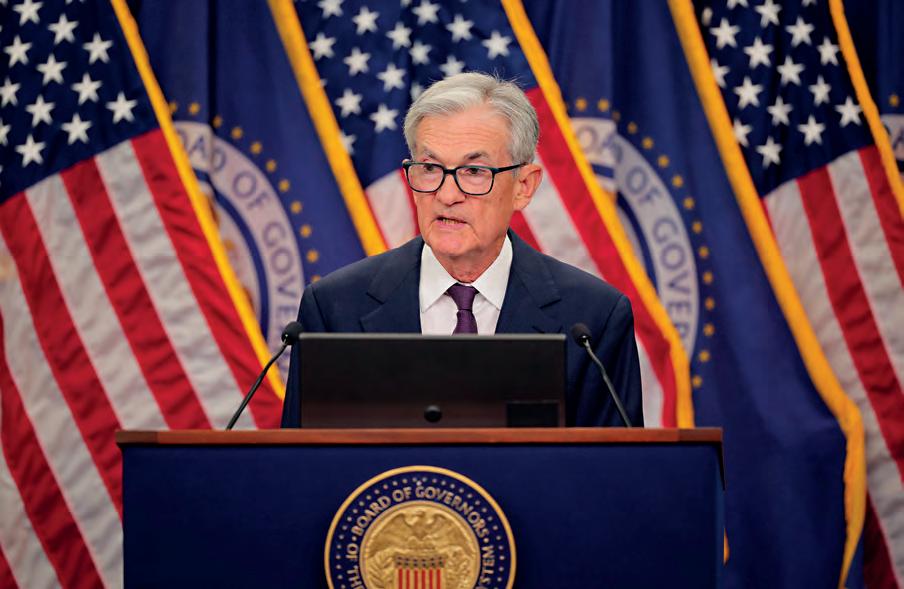
while simultaneously strengthening their gold reserves” since 2011. The purpose behind this action was to diversify the country’s reserve holdings and to mitigate the risks of the US dollar’s weaponisation.
As for the US Federal Reserve, he remarks: “Fast forward to today, the global community sees the executive branch of the US government is seeking more influence over the Fed. This increases the perception of the dollar being used as a political tool, hence, the flight from dollars to gold – which is politically neutral. Politics is a catalyst, not the cause: it accelerates a diversification already in motion.”
The Trumpian shake-up
Morris agrees that President Trump is trying to change and shake up the current financial and economic system – in the US and globally. He says Trump is doing this by maintaining persistent pressure on the Fed to reduce interest rates to stimulate economic activity. He claims that other central banks are worried about these Trumpian tactics: “If the Fed does cut interest rates, there is already ample evidence that inflationary pressures are building in the US economy, and cutting interest rates aggressively would simply pour petrol on the flames.”
“Social media isn’t wrong, US policy is shifting,” comments Yatsliach. To him what matters is how US moves transmit globally through the US dollar, treasuries, and fund markets. “Any executive attempt by the US government to influence Fed governance and policy (appointments, high-profile clashes, unprecedented bids to remove a sitting Gov-
ernor) generates uncertainty in the global markets,” he explains. The fear is that the president will have absolute power over the dollar, which is the anchor of the global reserve system. This is because it would become political rather than market driven.
He adds: “What most don’t know is that the Gold Reserve Act of 1934 transferred ownership of all gold from the Fed to the US Treasury and created the Exchange Stabilisation Fund (ESF) – a fund designed to control the value of the dollar internationally. Section 10(a-c) gives the President and the Secretary of the Treasury discretionary power to deal in gold and foreign exchange, as well as the operation of a $2bn Exchange Stabilisation Fund (Gold Reserve Act of 1934, Pub. L. No. 73-87, § 10(a)-(c), 48 Stat. 337 (1934).
“The act also states that the President’s and Treasury Secretary’s actions are final and not subject to review by any other officer of the US. So, if a President succeeds in removing the sitting Governor of the Fed, and appoints someone under executive influence, the global monetary system would be subject to unprecedented executive influence from the US.”
Ultimately, this would decrease the independence of the Fed as it would become susceptible to the political agenda of the Trump administration. Consequently, this would raise the premium foreign central banks place on self-insurance. While central banks, he argues, don’t fear presidents, they fear the politicisation of the dollar as more political dollar funding can become more volatile. This is a critical concern for non-US banks such as the Bank of England and the ECB that borrow in
“GOLD CAN CONTINUE TO OUTPERFORM SAFEHAVEN ASSETS SUCH AS THE US DOLLAR AND US TREASURY BONDS”
dollars. They rely on the Fed’s swap lines, he explains, to backstop their stress.
“If the US loosens oversight and then hits turbulence, contagion can travel via derivatives, repo, and clearing networks into Europe,” he warns before adding: “For the ECB especially, volatility in core rates and the dollar can complicate monetary transmission and re-ignite fragmentation risks inside the euro area. Tariffs can move yields, the dollar, and risk premia, directly affecting the value of other central banks’ dollar reserves. When the anchor currency looks political, every central bank’s insurance policy is gold.”
Can gold ride out the geopolitical and economic risks better than the US dollar and treasury bonds? Morris argues that they are completely disconnected. That is because gold is an asset in times of uncertainty. Nevertheless, he predicts that bonds and other interestlinked instruments will continue to command premium returns because of the levels of uncertainty and risk in the world. “Currently we are seeing high interest rates and a high price for gold; both driven by the levels of risk and uncertainty in the world, but independently of each other,” he expounds.
Bolliger responds by highlighting that in recent years gold has outperformed many other asset classes, including the US dollar and US Treasury bonds, “and as long as investors remain preoccupied with geopolitical concerns as well as political and policy risks, we think gold can continue to outperform safe haven assets such as the US dollar and US Treasury bonds.” He adds that UBS wishes to stress that gold price can also see fluctuations during “risk-off events as investors liquidate assets and hide them in (US dollar) cash.”
As for the Goldman Sachs prediction that gold could soon hit nearly $5,000, Strand suggests that anything below $4,300 is cheap with regards to the deficit and Sovereign debt situation. While he thinks that $5,000 sounds high, although it’s only 25 percent from $4,000, gold will continue to rise. He is sure that the Fed will need to lower interest rates, allowing gold to fly. He therefore agrees that the Goldman Sachs scenario is realistic. Much depends on how fast the central banks print money or perform QE. Whatever happens, while there is uncertainty, people will continue to invest in gold. n
Over the next 20 years, $124trn will shift hands in the largest wealth transfer in history. More than numbers, this moment marks a cultural turning point – placing women at the centre as primary inheritors and financial decision-makers wealth management Inheritance
WORDS BY Antonia Di Lorenzo FEATURES WRITER


Over the next two decades, the largest intergenerational wealth transfer in history will take place. Baby Boomers and the Silent Generation are expected to pass down roughly $124trn by 2048, a tidal wave of capital that will reshape families, philanthropy and the financial services industry. The numbers alone are enough to grab headlines. But behind the dollars lies a deeper story about who will inherit this wealth and what they will do with it. For the first time in history, women are positioned not as ‘plus ones’ in financial planning, but as primary inheritors and decisionmakers.
Statistically, women live longer than men, meaning they are more likely to control assets for longer stretches of time. That reality shifts the centre of financial gravity. “With women holding more wealth for longer periods of time, their decisions have the potential to shape our economy more than ever before,” says Megan Wiley, CFP of Badgley Phelps Wealth Managers. This historic handoff is more than just a matter of economics. It is a social and cultural inflection point that is already reshaping the way families talk about money, how advisors work with clients, and how women see themselves as stewards of wealth.
A recent Harris Poll report, The Great Wealth Transfer, sheds light on the attitudes shaping this moment. According to the findings of this American market research and analytics firm, older Americans – those 55 and up – see wealth primarily as a source of security (42 percent) and lifestyle or enjoyment (35 percent). By contrast, younger heirs emphasise legacy-building (22 percent) and personal fulfillment (18 percent), alongside far greater interest in ESG and impact investing.
This generational divide signals a profound change in how capital will be deployed. Millennials and Gen Z are less content with
simply holding and growing wealth; they want their money to work in service of values and social change.
Confidence, however, tells a different story. Sixty-four percent of older Americans say they trust their heirs to manage wealth responsibly, while 83 percent of heirs say they feel confident themselves. But beneath the surface optimism lies unease. Younger inheritors cite concerns about taxes, legal complexities and the possibility of mismanaging assets. They also carry an emotional load: guilt, grief and anxiety that older generations often underestimate. These cross-currents will have a direct impact on financial firms. Nearly half of heirs – 43 percent – say they plan to switch providers after receiving their inheritance, citing mismatched values and a lack of personal connection. For wealth managers, the message is clear: retaining the next generation of clients will require more than investment performance. It will demand trust, transparency and alignment with values.
One of the biggest hurdles women face in this transition isn’t financial – it is cultural. For decades, daughters were often excluded from wealth conversations. Many grew up hearing, ‘Dad handles the finances,’ a phrase that subtly reinforced the belief that money was not their domain.
“All too often, heirs are looped in at the 11th hour, when the will has been written or after someone’s death,” says Michelle Taylor, a financial advisor at GFG Solutions. “The fear of making a wrong move with family money can paralyse them into inaction.”
Nancy Butler, a financial planner with 40 years of experience, has seen how silence perpetuates unpreparedness. “If your greatgrandparents didn’t teach sound financial habits to your grandparents, and your grandparents didn’t pass them down, then your parents may not have been equipped to teach you,” she explains. “Without this chain of knowledge, each generation finds itself repeating the same mistakes.” By contrast, families that talk openly about money tend to raise more confident heirs. “Families that talk about wealth transfer create heirs who thrive, not heirs who guess,” says Allison Alexander of Savant Wealth Management.

Today’s young women may be more financially literate than any generation before them, but that doesn’t mean they are prepared to inherit. “You can have all the content in the world, but unless you understand it and implement it, the confidence gap will still be present,” says Taylor. Srbuhi Avetisian, Research and Analytics Lead at Owner.One, argues that the real gap is inheritance literacy. “Only seven percent of heirs in our global survey knew they typically have a three-to-six-month window to act before assets freeze,” she explains. “That window determines whether heirs – often daughters – retain access to their families’ lifestyle or lose it.”
Joyce Jiao, CEO of Herekind, a digital estate administration platform, points to another overlooked challenge: the administrative burden. “Financial literacy teaches you how to manage money, but it doesn’t teach you how to navigate the nightmare of probate, bank negotiations, funeral costs and dependent care – all while grieving,” she says. “Most often, the eldest daughter is the executor. Even highly educated women can feel overwhelmed and unprepared.” Money is never just money, especially when it arrives through loss. Inheritances often come tethered to grief, guilt, or a sense of unworthiness. “An inheritance can carry grief as well as opportunity,” says Alexander. Without support, those emotions can drive poor financial choices.
For many women, the emotional undercurrents run deep. “Impostor syndrome is huge. Survivor’s guilt is common. And wealth, for many women, still feels dangerous – like it
comes with a cost and can be taken away,” says transformational wealth coach Halle Eavelyn.
Jiao sees the same dynamic in her work with executors: “They are the emotional bridge – grieving, paying estate costs out-ofpocket, and making financial decisions that affect the entire family – all before they can even access their inheritance.”
The advisory industry is beginning to take note. Where once women were treated as secondary clients, they are increasingly recognised as the lead decision-makers. “Women are happy to know the desired result will be achieved and give that more weight than the return they will achieve in a particular strategy,” says Taylor. Wiley sees a similar trend: “Clients want to see a holistic plan before making portfolio changes, allowing them to align investments with broader goals such as charitable giving.” That shift toward holistic, life-centric planning is critical. Advisors who focus only on products and return risk alienating a generation that values impact, caregiving and legacy alongside financial growth.
Technology is also reshaping the landscape. Interactive dashboards, inheritance simulations, and women-focused peer networks are creating safe spaces to learn and practise decision-making before the windfall arrives. “Institutions that run inheritance simulations – showing heirs what the first 90 days after a death look like – will build more confidence than any investment seminar,” says Avetisian. As women inherit unprecedented amounts of wealth, they are also
1
$50trn
$40trn
$30trn
$20trn
$10trn
ESTIMATED WEALTH TO BE INHERITED THROUGH 2048, BY GENERATION:
rewriting its purpose. Unlike earlier generations, they are far more likely to view money not as an end in itself but as a means to community impact, sustainability, and family legacy. “When women control the purse strings, priorities change,” says Eavelyn. “Leadership gets more nuanced. Entrepreneurship gets more inclusive. Philanthropy shows up more. This isn’t just a transfer of wealth – it’s a paradigm change.”
Kristin Hull, Founder and CIO of Nia Impact Capital, an Oakland-based impact investing firm that builds public equity portfolios with a focus on companies advancing sustainability, social justice, and gender diversity in leadership, argues that the $124trn wealth transfer is positioning women as key decisionmakers who want transparency, purpose and investments aligned with their values.
She notes that while younger women are digitally fluent and eager for tools and peer networks, gaps remain in inheritance literacy and emotional readiness. Her most urgent call: to make gender-lens investing (GLI) the default, embedding equity and impact metrics into portfolio construction, estate planning and wealth transfer frameworks.
This shift is not confined to the US. In Asia, women are on track to control nearly a third of investable assets by 2030, while in Africa and the Middle East, rising female entrepreneurship is accelerating wealth ownership. Yet cultural and legal barriers remain: in some regions, inheritance laws still favour male heirs, and in others, daughters face resistance in assuming financial leadership. For global financial institutions, the implication is clear
– this transfer is both an opportunity and a stress test, demanding new frameworks that respect regional differences while empowering women as primary decision-makers.
The overlooked opportunity Across the experts, one theme recurs: timing. Too often, women are brought into wealth planning too late – after a death, when grief and confusion collide with financial responsibility. “The most overlooked opportunity is recognising that women need not just a wealth plan but a wealth identity,” says Eavelyn. “Until a woman sees herself as someone who is worthy of holding, growing and enjoying her money, she stays stuck in fear and silence.”
Practical steps can shift this trajectory. Inviting heirs to annual family meetings, creating mentorship spaces, offering just-in-time educational tools, and reframing conversations around values instead of just numbers all help prepare women for stewardship. These early interventions turn inheritance from a disruptive windfall into a natural extension of life planning.
The $124trn wealth transfer is more than a reallocation of assets – it is a cultural and economic turning point. Women, poised to inherit and manage more wealth than ever, face both challenges and opportunities. For financial institutions, the path forward is clear: survival in this new era requires transparency, education, and treating women as the lead decision-makers they are. Whether this transfer becomes a burden or a breakthrough will depend on how well families, advisors, and institutions rise to the moment. n
Italy’s wealth management market is transforming as rising HNWI and UHNWI wealth, generational shifts and AI reshape client expectations and drive banks towards more integrated, personalised advisory models
WORDS BY
Luca Bonansea HEAD OF PRIVATE BANKING & WEALTH MANAGEMENT, BNL BNP PARIBAS




The Italian wealth management market is undergoing a profound transformation, driven by the rapid expansion of the High Net Worth Individual (HNWI) and Ultra High Net Worth Individual (UHNWI) segments, and by the increasing sophistication of entrepreneurial families’ financial needs. In this evolving landscape, banks must reshape their advisory models towards services that are integrated, innovative, and highly personalised – built on specialised wealth management platforms capable of addressing complex and global needs. At the same time, the rise of artificial intelligence is enabling a hybrid model in which human expertise is increasingly enhanced by advanced technological capabilities.
In recent years, the investable financial wealth of Italian households has shown steady growth, with a sharp acceleration among HNWIs and UHNWIs – a segment that continues to outperform the market average, demonstrating both a stronger ability to generate wealth and a greater appetite for sophisticated investment strategies. The annual growth rate of financial wealth allocated to investments, around three percent in recent years, is expected to remain stable through 2025–2026, supported by positive inflows and resilient market conditions.
Private banking remains a structural growth engine within the Italian financial in-
dustry, with assets projected to rise by around six percent by 2026 – well above the national average. The sector’s assets under management (AuM) are expected to exceed €1.4trn in 2026, thanks to the ability to provide an increasingly diversified range of solutions for sophisticated clients, especially UHNWIs.
Italy is now approaching a fundamental turning point in what many call the ‘great wealth transfer’ – the inter-generational handover of hundreds of billions of euros in assets. Today, nearly 75 percent of total wealth is held by individuals over the age of 55. By 2033, it is estimated that approximately €300bn will be passed on to younger generations.
This demographic and financial shift, mirrored across Europe, places longevity and generational planning at the very centre of the wealth management agenda. It marks a pivotal moment for how families manage both their personal and their business wealth. Here, the value of global advisory becomes crucial – the ability to transform the complexity of wealth transmission into a strategic opportunity for business growth and long-term value creation.
Managing the wealth of Italian families will increasingly require strategic partners capable of creating value throughout every stage of the client’s life journey – developing together a structured plan of objectives for the individual, the family and the enterprise. Equally essential will be a well-defined family

governance structure to ensure the smooth transition of wealth and the continuity of the family business when ownership changes hands. In the coming years, the industry’s key challenge will be to offer goal-based, personalised, and flexible solutions through a truly global wealth management platform that can address the sophisticated and multidimensional needs of its clientele.
The transformation of wealth management for HNWI and UHNWI clients requires an integrated and specialised approach that goes far beyond traditional financial management. It demands a holistic and goal-based vision of wealth. At BNL BNP Paribas Private Banking & Wealth Management, the strength of our strategic advisory model lies in our ability to provide HNWIs and UHNWIs with highly skilled professionals who deliver tailored, timely support. Within our advisory model, relationship managers work alongside a team of specialists covering key areas such as global markets, wealth planning, trust services and corporate finance.
Our bankers, together with wealth planners and experts from our fiduciary company Servizio Italia, work closely with entrepreneurs to design succession plans that actively
involve the next generation. Including younger family members in the design and implementation of succession strategies has been instrumental in ensuring business continuity and in strengthening the long-term vision of many family-owned enterprises.
Advisory during this delicate phase is a cornerstone of our way of doing private banking.Through our ‘One Bank’ model, we leverage on the expertise of all BNP Paribas Group business lines – combining the specialised knowledge of wealth management with the vertical capabilities of corporate and investment banking. This allows us to provide truly 360-degree advisory services, supporting entrepreneurs and their family businesses in both extraordinary transactions (such as M&A and ownership transitions) and the daily management of assets – including real estate and global markets advisory.
Wealth Management developed in partnership with the Bocconi University School of Management in Milan. The programme offers specialised, certified training paths for bankers and advisors, ensuring that our professionals remain at the forefront of industry best practices and HNWI and UHNWI client expectations.
WE INVEST HEAVILY AND CONTINUOUSLY IN THE ADVANCED TRAINING OF OUR PROFESSIONALS
To consistently maintain the highest standards, we invest heavily and continuously in the advanced training of our professionals. A key initiative, in this regard, is the Excellence Academy of BNL BNP Paribas Private Banking &
Looking ahead, our vision is to build an integrated, international and innovation-driven service model – positioning ourselves as the strategic advisor of reference for clients managing wealth over the medium and long term. Innovation and the ability to anticipate shifts in global markets are becoming essential assets for anyone operating in private banking. Collaboration across business lines within the BNP Paribas Group, combined with our agility in developing bespoke solutions, enables us to respond effectively to the challenges posed by market volatility and evolving regulation.
Integration with international platforms is a defining feature of our model, allowing us to serve HNWIs and UHNWIs who are increasingly exposed to cross-border dynamics and global investment opportunities. Our company provides multi-asset, multi-currency solutions and advanced reporting services,
ensuring a seamless client experience across all touchpoints.
Our cross-country architecture and specialised service verticals enrich a value proposition that is both comprehensive and personalised. The growing demand for diversification and capital protection is driving interest in sophisticated products such as alternative investments, private assets, and tailor-made financing solutions. Advanced analytics are further enhancing personalisation – allowing us to profile clients in greater depth and anticipate their needs through predictive data models.
Artificial intelligence is rapidly emerging as a transformative force across the industry. By leveraging AI, we can deepen client insight, automate processes, and deliver personalised, omnichannel experiences. Predictive analytics and insight-driven advisory tools will enable a shift from conventional to truly proactive and customised advisory. The challenge for the next decade will be to effectively integrate the human and the technological – creating a hybrid service model powered by Human+AI resources that preserves the relational value of human interaction while fully harnessing the potential of advanced technology.
Today, the industry faces an unprecedented opportunity: to combine the legacy of relationship excellence and local expertise with the new frontiers of internationalisation and innovation. Investing in global platforms, empowering our teams, and embedding AI within advisory processes will allow us to deliver a truly distinctive service – one that meets the expectations of a sophisticated, demanding, and global clientele.
This evolution calls for a new kind of leadership – one capable of orchestrating human and technological capabilities, combining the irreplaceable value of people with the extraordinary potential of AI. It is an intellectually stimulating challenge for the next generation of professionals in our industry – and one in which we intend to play a leading role. n
Exchange-Traded Funds
Despite market volatility, exchange-traded funds continue to soar. With record assets, expanding fixed-income offerings, and rising global adoption, ETFs are evolving from niche products into powerful tools reshaping modern investment strategies worldwide
WORDS BY
Graham Jarvis
FEATURES WRITER





Exchange-traded funds (ETFs) have new heights to reach. That is the view of Blackrock’s Dhruv Nagrath – director of the firm’s iShares Fixed Income Strategy team – who said in August 2025 that the ETF market is both large and still in its early stages of growth. While there have been ups and downs over the last five years, $200bn a year has been invested in the fi xed income industry despite the market volatility that has existed since the year 2000, and even though 2024 was a record year ($280bn).
In fact, Investment News reported that Nagrath revealed they had reached a record $12.5trn Assets Under Management (AUM) and declared that this was only scratching the surface to the extent that 2025 was expected to be yet another headline year. Miguel Ramos Fuentenebro, Co-founder of Fair Oaks Capital, also declared that from its own perspective growth is far from over.
Fuentenebro said, “In Collateralised Loan Obligations (CLOs), for example, ETF adoption is only at the very beginning in Europe: US CLO ETFs already represent over three percent of their market, whereas in Europe ETFs and UCITS funds together account for barely 0.2 percent of a €311bn CLO market.
“Investors are looking for floating-rate income and robust underlying assets and CLOs match that criteria. By providing those exposures in ETF format, we have democratised access into an asset class previously accessible only to the largest credit buyers,” Fuentenebro continued. The rate cut by the US Federal Reserve in September 2025 and the impact of market volatility caused by tariffs have nevertheless stirred up ETFs.
Subsequently, there has been an increase in trading volumes, and a shift from passive to active ETFs. This is because investors, with an eye on containing risk, are now drawn to diversified and fi xed income solutions.
To encourage market growth, Vanguard has also slashed its fees on six equity ETFs that are domiciled in Europe by three and five basis points to counter fee pressure within core market segments. A fee drop may also be to respond to the fact that Blackrock leads the ETF haul, reports DL News, to the value of $3.5bn, while Vanguard currently sits in second place with $2.4bn. This may also be because Vanguard’s SPLG is 20 years old, while Blackrock’s IBIT started in January 2024.
As for Blackrock’s BINC – its iShares Flexible Income Active ETF – Seeking Alpha reports that it is seeing, “astounding growth in a decreasing rates environment.” The conclusion to that article by Binary Tree Analytics says: “The fund has seen a massive growth in AUM, with the assets now reaching an astounding $13bn figure. We like the riskreward proposition here and the active management, and are of the opinion that BINC is a good choice for a macro environment where much lower Fed Funds are priced in.”
Speaking about ETFs, Hugh Morris, Senior Research Partner, Z/Yen remarks that ETFs are quite trendy at the moment. His company is seeing significant investor interest in ETFs and fixed-income ETFs. He therefore comments: “One strongly suspects that this has a fair way to go yet because there are a number of factors at play. I would say that, first, there has been interest from retail investors as ETFs are relatively simple to understand, and that combined with institutions’ desire for liquidity management and tactical asset allocation have produced a surge in demand.” He suggests this is against a background of

tion. On top of this, there are more trading platforms out there, and “the regulatory landscape has changed to make it easier to manage and launch ETFs and ETF markets also have greater transparency than previously,” Morris continued.
There are also niche ETFs targeting sectors in particular, such as green bonds and cryptocurrencies, Morris says before adding: “Combine all these trends together with a rise in actively managed fi xed-income ETFs, then investors have more options than before.”
As for the future, there is growing interest in fixed-income ETFs that focus on emerging market debt. Alongside this, he reports that there is huge growth in the corporate bond market for ETF offerings as ETFs can be used as a hedge against inflation. They can also function as a hedge against volatile interest rates too. As for CLO ETFs, Fuentenebro says they began in the US. Despite this, the same forces are at work globally. His company launched the first AAA CLO ETF in Europe 12 months ago. “The reception shows there is clear global demand – we have seen interest from European investors but also from investors in Latin America, the Middle East and Asia, often into the USD-hedged share class.” So, while he finds that the US is ahead in scale,
Morris adds: “ETFs have lower management fees compared with mutual funds, and the structure of ETFs allows for tax-efficient trading. Looking into the future, there are lots of untapped segments – such as the corporate bond world and emerging markets debt.”
“You name it, you can do an ETF in it. While ETFs have been US and Western markets focused; there is increasing traction in Asia. It is for the same reasons – people have suddenly discovered them as they are easy to put together and launch,” Morris noted.
He therefore agrees that fixed-income ETFs are only just scratching the surface because they have shown, in his opinion, “great resilience.” This robustness is attracting investors’ interest. Fluctuating interest rates and concerns about inflation, he stresses, are making fixed-income ETFs attractive because they deliver yield. This trend is also driven by the levels of economic uncertainty. However, ETFs are also tax efficient, subject to favourable regulation, cost-efficiency and lower management fees, and they are easily and increasingly accessible via digital trading platforms.
So, what made 2024 a record year? Morris responds: “All of the things we have talked about really kicked in during 2024; a story that is still driving in 2025 and even into next year. It is all about ETF products becoming
$12.5trn
Global ETF assets under management in 2025
$200bn
Average annual investment into fixed income ETFs
responds from a AAA CLO ETFs perspective, declaring that the answer lies in the floating nature of the asset class. He claims these securities are far less exposed to the “sharp swings in government bond yields we saw around Liberation Day.” He adds that this ‘insulation,’ combined with the structural strength of AAA CLOs, has meant CLO ETFs offered investors differentiated exposure to fixed income.
THE ETF MARKET IS BOTH LARGE AND STILL IN ITS EARLY STAGES OF GROWTH
easier to buy and more regulated (allowing funds that couldn’t buy ETFs now being able to do so as a result of the changes in regulations), which means that institutions can use them for tactical asset allocation and liquidity management purposes.
“Part of investors’ portfolio management is the search for yield, which you get from fixed-income ETFs. They are going to continue to grow. It is slightly unusual to get retail and institutional interest combining to provide additive demand for an asset class, and that is a major factor affecting ETFs that I believe will continue into next year,” Morris added.
As for rate hike shocks, and perhaps even reductions, he claims there are often immediate market reactions, which lead to market volatility. The impact is often short-term, and he finds that investors are getting used to them. However, there are two types of investors to consider. Morris says that they are the ones that “believe in the longer-term potential of ETFs who see the short-term shocks as being part of life’s rich pattern, and so short-term volatility doesn’t deter them from holding ETFs.” Then there are arbitrageurs for whom volatility is an opportunity; they will seek to take advantage of short-term movements.
So why has $200bn a year been invested in the fixed-income ETF industry, despite market volatility since 2020? Fuentenebro
Morris underlines that fixed-income ETFs provide risk mitigation. This is because they are a more stable investment option than bonds. “They provide diversification benefits, helping to manage exposure to bond markets, and when interest rates fall, they provide a source of income – our famous yield,” he explains. As they are liquid, they are easy to trade – coming with a lower cost of ownership in terms of management fees compared to mutual funds.
He adds: “There are new offerings out there, as well as active management ETF options now available. They don’t just affect young investors because older investors are looking for risk management and they are looking for income generation as they approach retirement. ETFs appeal to younger investors as they look exciting, and to older investors for the factors of risk management, income generation and lower fees.”
Fuentenebro says tax efficiency is not the main draw in Europe. Other factors include transparency, daily liquidity, and UCITS governance. However, he also comments: “It is also worth noting that, for European investors, US-domiciled ETFs are often less efficient due to both tax leakage and access constraints. By contrast, a UCITS ETF such as ours provides the right regulatory format, efficiency, and accessibility for European and global allocators.”
As for iBonds, Morris thinks they are an interesting concept – adding another dimension to the market. He therefore concludes that they will play their part in the ETF landscape, and so he’s “absolutely optimistic about fixed-income ETFs reaching new heights.”
In his view they will become a broader and deeper market, and he believes iBonds will be one of the instruments that will help ETFs provide an inflation hedge and predictable cashflows. While he won’t predict what will happen over the next five years, he assumes that volatility and economic uncertainty will remain, and so ETFs – particularly fixedincome ETFs – have a bright future ahead. n
Half a century ago, a small group of University of Chicago economists redefined how we think about markets. Tune Out the Noise traces how their radical ideas became the foundation of global finance
WORDS BY
Alex Katsomitros






What does it take for an idea to change an industry forever? In finance, a handful of academics daring to think differently and make some money by putting their ideas into practice, a university willing to nurture unorthodox ideas, a new technology – and a good dose of luck. That argument lies at the heart of Tune Out the Noise, Errol Morris’s latest documentary, which premiered in New York last March. The film revisits the birth of modern investing at the University of Chicago in the 1960s and early 1970s, when a group of researchers didn’t just develop another theory – they changed the very fabric of financial markets. Their ideas reshaped how ordinary Americans thought about their future, while revolutionising the global investment industry.
Efficient markets
It is difficult to imagine in an era when algorithms make split-second trading decisions, but more than half a century ago the markets ran on intuition. Investing was more of an art than a science, dominated by professionals trying to outsmart the market by spotting opportunities others had missed. As Eugene Fama – one of several Nobel Prize winners featured in the documentary – recalls in the film, the conventional wisdom at the time was to trust a person with special stock-picking skills who could “beat the market.” That mindset began to crumble with the rise of the efficient-market hypothesis (EMH), a theory Fama helped pioneer. The idea upended conventional investing. What if asset prices already reflect all available information, and everything else is just noise? If markets are efficient, then consistently beating them is impossible – prices move only when new information emerges. The logical conclusion was that success depends not on instinct, but on diversification and disciplined risk management.
The timing was perfect. The 1960s brought a computational revolution that gave investors access to stock prices and company data. Markets could finally be analysed with scientific precision. Out went hunches; in came data-driven strategies that laid the groundwork for passive investing. As Fama says in the film, “Markets work; prices are right.” In other words, you can’t beat the averages, but you can outperform the professionals by embracing the market itself. If that was the case half a century ago, it is even more true today, says Aaron Brask, a Wall Street veteran who teaches finance at the University of Florida. “Markets were not that efficient when Eugene Fama wrote his dissertation on the topic in the 1960s. If they were, it would imply that Warren Buffett, Charlie Munger, Walter Schloss, Philip Fisher and Seth Klarman were all lucky. Fast forward 60 years, and we now have an incredible amount of money, brains and computing power devoted to sniffing out investment opportunities. This makes it significantly more challenging to beat the market. There is less dumb money, and markets are more efficient.”
Fama’s ideas sparked a financial revolution, making passive investment the go-to option for millions of investors. Thus the index fund was born, powered by data and algorithms rather than intuition and luck. Wells Fargo launched the fi rst index fund in 1971, while John Bogle, the legendary financier whose name would become synonymous with low-cost investing, created the first index mutual fund available to individual investors in 1976. Although the case against active investing remains strong for most investors, there are some, albeit fewer, active managers who can still beat the market, says Brask: “Buffett and other active value investors come up with an idea of how much a stock should be worth based on its fundamentals. This figure is often referred to as a stock’s intrinsic value. Then they compare that value to its market price. In the end, their value investing equates to buying stocks for significantly less than they think they are worth. In some cases, higher quality or growing fundamentals might warrant higher valuations.”
~$800bn
Value of assets managed by Dimensional Fund Advisors
THE
One of the theory’s most enduring insights was the importance of diversification. Where old-school investors sought a single big win, Chicago’s researchers promoted the opposite: spread your bets. They found that mixing the stocks of established firms with smaller, high-potential firms, could reduce volatility without sacrificing returns. This gave rise to modern portfolio theory, now a bedrock of contemporary finance. Among its early advocates were David Booth and Rex Sinquefield who went on to found Dimensional Fund Advisors, the Austin-based investment firm that turned the EMH into a money-making machine.

Booth features prominently in the documentary, which at times borders on a promotional piece for Dimensional, one of its backers. Yet Errol Morris, an Oscar-winning filmmaker, handles the material with his trademark subtlety. His conversational style – punctuated by deceptively simple questions like “Why did you get sick of French?, Why would you do that?, You failed in airconditioning?” – allows the story to unfold naturally. The result is a thoughtful exploration of how finance evolved from intuition to evidence. “The fi lm emphasised the human element. The academics interviewed were
in their own words,” says Matthew Garrott, Director of Investment Research at Fairway Wealth Management, a US wealth manage ment firm.
One of the film’s most striking messages is the importance of chance. Financial markets are chaotic systems shaped by randomness rather than rational decisions. Sheer luck also brought together the brilliant minds who pio neered passive investment at the University of Chicago, although its reputation for rigorous economics likely helped. The creation of the Centre for Research in Security Prices by the economist James Lorie in 1960 was a turning point that brought together two revolutions, a financial and a technological one, offering investors a trove of long-term stock and bond data.

Luck shaped the individuals too. Eugene Fama almost missed his chance to go to the University of Chicago, receiving a last-minute scholarship that changed his life. Myron Scholes, another Chicago veteran, Nobel laureate and early champion of computerised trading, stumbled into the art of deciphering financial data by accident: in 1963 he took a
hypothesis has been so successful that too much passive investing has undermined market efficiency, leaving a shrinking minority of investors to feed new information into prices.
For its proponents though, the theory still holds water. “Many smart traders exist, and behavioural biases are not more or less than in the past. Hence, the impact of irrational traders on efficiency is unchanged.
It can also be shown that bubbles are consistent with an efficient market,” says Robert Jarrow, advisor at the data and AI provider SAS and Professor of Investment Management at Cornell University. “There is a continuum of less efficient to more efficient. Markets with more pricing events like US large cap stocks are more efficient. The market for selling your house is much less efficient. The US stock market is not perfectly efficient, but it is efficient enough that active managers are at a significant disadvantage,” says Garrott from
Even the equations used to justify investment strategies have faced fierce criticism. Take the Black-Scholes model, Scholes’s great contribution to financial economics, with its recipe for sophisticated risk management and portfolio diversification. A mathematical triumph in theory, it also became the justification for an explosion in speculative trading in derivatives. Designed to hedge risk, derivatives have turned into highly leveraged bets stacked upon other bets. The financial alchemy enriched traders but also destabilised markets, culminating in the credit crunch and the near collapse of global banking in 2008. As one commentator would put it at the time, the model became “an ingredient in a rich stew of financial irresponsibility, political ineptitude, perverse incentives, and lax regulation.”
Tune Out the Noise is not just about finance. The film presents a vision of America and its ability to question itself that is fading away. Passive investing, after all, means accepting average returns – a notion that, as Sinquefield wryly notes in the film, was not regarded at the time as “the American way,” but eventually came to be. David Booth’s own story underscores that tension. A former shoe salesman, he recalls in the film: “When I went home at night, I wanted to feel good about myself.” His words evoke an older America, one that prized diligence, honesty and modest success, now eclipsed by the speculative frenzy of crypto trading and
At its core, the film is also about information: the flood of data, the promise of efficiency, and the human struggle to separate signal from noise. The EMH rests on the belief that data doesn’t lie. Yet in an age of algorithmic trading, that certainty feels less solid. Markets move at machine speed, and active management faces extinction as AI systems take over. Tune Out the Noise leaves viewers with a quiet unease – that even the most rational systems are built on human assumptions, and that the next investment revolution may be about rediscovering human judgment. n

Intentional progress, disciplined innovation and enduring trust – 2025 saw Geneva International Insurance strengthen its foundations for the future, ensuring every evolution aligns with the principles that define the Geneva Standard
WORDS BY Nikita Gibson MANAGING DIRECTOR – INSURANCE OPERATIONS, GENEVA INTERNATIONAL
match opportunity with oversight, ensuring that as exposure to private markets expands, so too does our commitment to transparency, diversification, and client protection. We see this evolution not as a trend, but as a trajectory; one that aligns perfectly with our philosophy of long-term value creation through disciplined flexibility.
The broader regulatory landscape this year has underscored themes that have always been central to Geneva’s DNA: solvency discipline, client-centric governance, and responsible innovation. The 2025 Deloitte and PwC outlooks on the global insurance sector both emphasised the growing intersection between technology, transparency and trust, an alignment we have long anticipated.



For Geneva International Insurance, 2025 was a year of intentional progress, not a sprint for change, but a deliberate strengthening of the foundations that sustain long-term trust. In an environment marked by regulatory tightening, shifting asset allocations, and accelerating digital transformation, our focus remained clear: to evolve with purpose, and to ensure that every advancement aligns with our core commitments to governance, solvency and client confidence.
Our digital transformation agenda took centre stage this year, built on a simple premise: to make it easier for the right people to do the right things. We expanded digital tools that empower introducers (agents) with seamless access to client data and portfolio information, enabling quicker decision-making and transparent communication.
This wasn’t just about technology; it was about creating an ecosystem of efficiency. The new portals and data-sharing frameworks introduced in 2025 reduced friction between policy administration, compliance and relationship management, all while reinforcing data integrity and security. For Geneva, digitisation is not an operational convenience but a strategic enabler, turning information into insight and partnerships into progress.
Regulation continues to evolve, and so must we. Over the past year, Geneva strengthened its internal frameworks designed to identify, interpret and integrate regulatory changes before they arrive. This proactive stance ensures that compliance remains a culture, not a checkbox. As the global investment landscape grows more complex, Geneva has placed even greater emphasis on valuation governance and documentation. Our ongoing enhancements in this area ensure that the information supporting private and alternative asset positions is both comprehensive and regulator ready. It is an extension of our philosophy: that structures built with clarity today will withstand scrutiny tomorrow.
The global insurance landscape in 2025 revealed a clear trend, a strategic pivot toward private markets. According to S&P’s 2025 Insurance Investments Report, insurers across jurisdictions increased allocations to private credit, infrastructure and other alternative assets in search of diversification and yield. For PPLI structures, this shift makes the asset side of the equation more compelling than ever. The ability to access and manage bespoke portfolios within compliant insurance wrappers remains one of PPLI’s greatest strengths, and Geneva has positioned itself to meet that moment. Our investment governance frameworks have been enhanced to
While some view regulation as an external pressure, we see it as an internal compass. It guides how we design products, manage risk and communicate with clients. Each new standard, whether in data management, solvency reporting, or consumer protection represents an opportunity to refine how we operate. At Geneva, governance is not a compliance function; it is a value proposition.
As we look toward 2026, our focus remains on building relevance through resilience. We will continue expanding our access to privatemarket opportunities, including digital and alternative asset classes, in ways that preserve the integrity of our policy structures and meet the sophisticated needs of our clients.
Digitally, the next phase of transformation will go beyond portals and dashboards, integrating intelligent analytics, policy-performance monitoring, and tailored client insights into every aspect of our service delivery. Our goal is to give both introducers and policyholders the visibility they need, supported by the governance they trust. Product and policy innovation will also remain a strategic priority. Whether through new policy design, enhanced liquidity features, or improved integration of alternative investments, our objective is constant: to ensure Geneva’s offerings remain as dynamic as the markets in which we operate.
If 2025 was the year of refinement, 2026 will be the year of resonance, where every initiative connects back to what defines us. In every shift, there is signal and there is noise. Our focus remains on the signal: disciplined innovation, regulatory foresight, and the quiet confidence that comes from getting the fundamentals right. At Geneva, we continue to evolve, not for the sake of keeping up, but for the sake of keeping true. That is, and will always be, the Geneva Standard. n












In 2024, the Philippine non-life insurance industry again proved its resilience, growing premiums and bottom lines despite climate-driven catastrophes, rising reinsurance costs, and inflationary pressures – underscoring both its adaptability and the mounting challenges shaping its future trajectory
WORDS BY Leticia C. Tendero DIRECTOR OF INVESTOR RELATIONS, STANDARD INSURANCE


The non-life insurance industry has consistently demonstrated resilience in the face of natural catastrophes over the past years, and 2024 was no exception. Riding on the growth of the economy, the non-life insurance industry posted growth in premiums and bottom lines. It is optimistic that the industry will continue to grow in the coming years, anchored on the strong prospects of the economy. Be that as it may, said optimism is not without evolving challenges, both natural and manmade, market-induced, or the dynamics of strong competition among the players.
Climate change and catastrophic natural disasters have wreaked havoc on the global environment, negatively impacting the global reinsurance market. The effects have shown an increasing severity and frequency of devastating natural events, which have widened the protection gap (the difference between the insured and uninsured losses). This protection gap dictates the financial resiliency of global economies from these events.
With the increasing risk exposures to catastrophic events or calamities in recent years, on the back of climate change, among others, the Philippine non-life insurance industry is experiencing a surge in reinsurance costs with more stringent terms and conditions. Reports have it that this rising cost of reinsurance is making non-life products more costly and is
placing additional pressure on local insurers.
The severe effects of climate change have been a major challenge in recent years and will continue to be so in the years ahead. Around 20 typhoons enter the Philippine Area of Responsibility from the Pacific Ocean annually, with around eight or nine crossing through the Philippines. Typically, typhoon season runs from July to October, but climate change has shifted it to more random months, doubling catastrophic challenges with noticeable changes in trends of catastrophic events.
These market realities are proving to be extremely challenging in addition to increasing claims and indemnity costs as a result of inflationary pressures in recent years, particularly spare parts and labour costs for motor car insurance and replacement costs for property insurance.
We are a trailblazing team, working together as market movers and innovators, achieving our goals steadily and sustainably. The company’s ecosystem is composed of dynamic and innovative groups that closely collaborate, always practising our corporate ethos – working as a team towards the same goals, embracing our culture of passion for excellence, underpinned by our massive transformational purpose, ‘Peace of Mind for all Mankind.’
Proactively prepared for any kind of calamity, the company has an innate capability to update its systems and enhance risk management capabilities, systematically and effectively, meeting the demands of an evolving market and weather unpredictability, at any time.

After a relatively benign year of catastrophic events in 2023, the year 2024 ushered in myriad challenges, including Super Typhoon Carina (internationally known as Typhoon Gaemi) in July, and a record-breaking six consecutive storms clustered within barely a month, three of which were classified as super typhoons, from late October to mid-November 2024. This record-breaking typhoon season was said to be ‘supercharged’ by climate change.
With 66 years of experience competently weathering calamities, the company is programmed to immediately mobilise and respond to these catastrophic events effectively. Financially, the company, supported by a dependable and financially strong reinsurance facility, remains protected amid the onslaught of catastrophic events.
Moreover, all claims platforms are powered by internally developed technological systems, aided by artificial intelligence, allowing the company to facilitate prompt and appropriate handling and monitoring of claims; aggregate limits are meticulously monitored, with the extent or highest level of the unit reached by flood indicated in the AON
questionnaire, allowing us to immediately gauge aggregate losses per area, nationwide; but more importantly, digitalised procedural processes allow the effective and efficient handling and payment of claims.
Despite the loss experience, our clients felt supported by us, giving them peace of mind amid the chaos of the moment. For our claims team, who are experts in their respective roles, it has always been ‘just another day’ of service to our clients.
Throughout these years and amid a challenging business environment, Standard Insurance steadfastly continues to focus on proper underwriting, intelligent pricing across all lines, fast and accurate claims turnaround and sustainability.
As a leading motorcar insurer, the company utilises its wealth of data to understand the particular risks and characteristics related to the different vehicle types and markets, the peculiarities of motorcar losses, vis-à-vis recoveries, among others. The resulting motorcar analytics underpin our informed and intelligent motorcar strategies – better pric-
ing and underwriting analysis and decisions, as well as improved churn rates.
The lessons from the CAT events in 2024 taught us to be comfortable with the uncomfortable, never ceasing to challenge what is comfortable and pivot to the uncomfortable. With the destructive effects of CAT events, claims frequency and severity have become more extreme, and reinsurance costs have become more restrictive and expensive. Inflation and disruptions in supply chains have likewise pushed up claim costs, with minimal or sometimes no increase in premiums on the back of a very competitive market. Who then covers the gap or the rising burning cost?
The company implemented game-changing underwriting policies, never before tried within the industry, but perceived to be a response to the evolving hard realities of the non-life industry, especially in the motorcar insurance business.
Equally important, non-motorcar risks follow clear and defined underwriting guidelines and discipline. Standard Insurance remains consistently vigilant in protecting our balance sheet, vis-à-vis, the underlying risk portfolio. We conduct selective and
The severe effects of climate change have been a major challenge in recent years”
stringent underwriting, focusing on maintaining and developing a risk spread that is consistent with the company’s directives for sustained profitable growth. We continue to strictly follow our preferred and ideal risks, cross-selling with the deliberate intention of portfolio diversification. The strict adherence to the NatCat Underwriting Guidelines via CRMS resulted in well-managed Property CAT claims in 2024.
All these have led to our ultimate validation from a global perspective. The Global Credit Rating (GCR) has recently upgraded Standard Insurance’s national scale financial strength rating to AA-(PH) from A+(PH). At the same time, GCR has upgraded Standard Insurance’s international scale financial strength rating to BB+ from BB, a notch lower than the Philippine sovereign rating. Both ratings were placed on Stable Outlook. GCR is wholly owned by Moody’s Corporation (NYSE:MCO).
Equally important, the company’s recent SGS audit reaffirmed our commitment to excellence, thus maintaining our ISO 9001:2018 certification. By conforming to standards, adhering to disciplined processes, delivering consistent quality service and fostering a culture of accountability, we continue to raise the bar for serving our clients and partners. These global awards reflect the passion for excellence that transcends our DNA and culture.
Recently, Toyota Motor Philippines Corporation (TMP), the leading motorcar dealer in the market, officially endorsed Standard Insurance as its second model end-of-life vehicle (ELV) dismantling facility in the Philip-

pines, and included in the ‘Toyota Global 100 Dismantlers Project’. Standard Insurance’s Technical and Training Centre (TTC) is the fifth dismantling facility in Asia and the 19th worldwide. This global project aims to establish proper ELV dismantling operations, addressing key environmental challenges.
This partnership further enhanced its existing partnership with TMP under the Toyota Insure Programme, where Standard Insurance is already part of its panel of accredited insurers. Toyota remains the leading brand in the country.
Born out of a need to accommodate the huge volume of inundated motorcar units after a devastating typhoon in Metro Manila, which the dealers could no longer handle due to the sheer volume, our TTC was established in 2014 and since then has been a major part of the company’s ecosystem. TTC is located in Naic, Cavite, spanning close to seven hectares, with five buildings housing our restoration facilities, as well as our dismantling and recycling or ELV facilities.
The TTC complex is a one-of-a-kind motorcar and motorcycle restoration, dismantling, and recycling facility in the industry, supporting an innovative loss-mitigating mechanism. It provides a circular economy, where the proceeds from the sale of these restored units and parts revert to savings, thus mitigating our losses. TTC has always recognised the importance of sustainable practices and aims to lead the industry in promoting environmental stewardship. It took a trans-
formative step, championing technical excellence and environmental responsibility, ushering in a circular future, turning discarded vehicles into valuable resources and fuelling jobs, innovation, and sustainability.
To better equip its role in motorcar dismantling, the company sent its engineers and mechanics to train in car recycling operations with the biggest Japanese recycler, Kaiho Sangyo, located in Kanazawa, Japan.
The company intensified investments in its state-of-the-art restoration and dismantling infrastructure. TTC is the only one with a motorcycle frame straightening bench that allows for the precise repair of motorcycles with bent frames. Moreover, to enhance its ELV dismantling operations, acquisitions of specialised equipment were completed, such as an excavator fitted with a hydraulic shear that has scissor-like jaws used to dismantle an end-of-life vehicle; a metal baler or baling press that is used to compress scrapped metals from dismantled body panels, ready for recycling; and a shredder that is used to reduce
the size of waste materials such as scrapped metals and other materials, including tyre shredding.
Trained technicians, following globally accepted practices for depollution, ensure the safe removal and disposal of fluids and hazardous materials from these end-of-life vehicles, minimising ecological impact during the dismantling process. Chemicals drained from ELVs are sold to a treater hauler accredited by the DENR. Scrap metals are sold to local metal scrappers.
TTC is a shared mission with Toyota, DENR, TESDA, LGUs, and other community partners. In fact, Standard Insurance has been recognised by the DENR for its exemplary environmental programmes in pursuit of a circular economy. Moreover, a certificate of recognition was awarded to our Group Chairman, Ernesto T. Echauz, our Pollution Control Officer and a chemical engineer, for his unwavering commitment in partnership with EMB CALABARZON Region in pursuit of a healthy and clean environment.
With increasing frequencies of unpredictable weather disturbances and calamities, resulting in increasing motorcar claims, our investments in advanced recycling infrastructure, implementing responsible dismantling practices and training, maximising material recovery and resources, and collaborating with recycling partners are more than worth it. Standard Insurance is indeed leading the way towards a greener automotive industry. n “The company implemented gamechanging underwriting policies”

Fubon

Backed by record results and multiple national and international awards, Fubon Life Insurance explains how it is setting new standards for responsible insurance in Taiwan
Fubon Life upholds the core value of ‘be positive, enrich life,’ and effectively leverages its insurance protection capabilities while fulfilling its commitment to sustainability. The company has made significant strides in sustainable operations, fair treatment of customers and social responsibility. It has been recognised 14 times by World Finance as the ‘Best Life Insurance Company in Taiwan’ and has received the ‘National Sustainable Development Awards’ from the Taiwan National Sustainable Development Council of the Executive Yuan. Additionally, it has been honoured by the Taiwan Financial Supervisory Commission for its outstanding performance in the ‘Sustainable Finance Assessment’ and the ‘Assessment of the Implementation of Treating Customers Fairly Principles.’ In terms of operations, Fubon Life’s net income of NT$102.66bn for 2024 reflects an impressive operational performance and has won the support of policyholders representing approximately a quarter of Taiwan’s total population.
To enhance sustainable operations, Fubon Life is focusing on four key areas: board governance, integrity in business practices, compliance with regulations, and risk management. The company has also established a performance evaluation mechanism for its Sustainable Development Committee. In addition, a new ‘Sustainable ESG’ section has been launched on the official website to improve information transparency and inclusivity, helping stakeholders understand the company’s specific actions in environmental, social and corporate governance. In product development, the company is responding to Taiwan’s societal changes by introducing trend-aligned insurance products, including a new generation of national policies, the ‘Participating Policy’ that offers both protection and the potential for dividends, as well as the industry’s first policy that covers the actual expenses incurred for outpatient and inpatient cancer treatment.
Fubon
Fubon Life is dedicated to the fair treatment of its customers and focuses on fraud prevention while delivering friendly service. The company has pioneered the use of the commercial short code ‘68999’ within the life insurance sector to help mitigate the risk of the public encountering fraudulent text messages. Furthermore, Fubon Life has incorporated fraud detection into its operational processes to enhance its financial fraud prevention strategies. The success of its counter staff in preventing fraud has been acknowledged by the Taipei City Government, Chiayi City Government and Kaohsiung Police Department
To advance its fair treatment philosophy, Fubon Life has introduced the ‘Fubon Life Good IDEA’ programme, which features inclusion, diversity, equity and action. This programme aims to embed the principles of fair treatment throughout its services, fostering a diverse and inclusive service environment. Initiatives include a dedicated ‘Financial Friendly Service Section’ and a ‘Fair Treatment of Customers’ Principles Section’ on its website, along with the promotion of microinsurance services to provide coverage for vulnerable groups.
Fubon Life’s net income for 2024
Fubon Life harnesses the power of insurance to stabilise society and is fully committed to corporate social responsibility. The initiatives include: collaborating with the Society of Wilderness on a quick screening survey of river waste to reduce river waste accumulation and prevent it from entering the ocean through public and private sector cooperation, implementing operational strategies focused on energy conservation, carbon reduction and renewable energy generation, with a goal of using 100 percent green energy by 2040.
Fubon is also promoting the ‘Barrier-Free Medical Access for Seniors in Rural Areas’ project, which assists over 2,500 cancer patients with transportation subsidies for medical visits, advancing insurance education to help students of all ages enhance their financial risk resilience, and sponsoring Taiwan major sporting events such as the Kaohsiung Fubon Marathon and the University Basketball Association (UBA) to promote sports equity. n

Once a high-flying financial trader, Gary Stevenson now leverages his platform and personal experience to advocate for targeted wealth tax on fortunes over £10m. This article explores his mission to shift public debate away from polarisation and toward social justice
WORDS BY Ruth Kibble
FEATURES WRITER


Gary Stevenson is agitated. Leaning forward in his chair, the self-styled social economist gesticulates animatedly and says to his counterpart, serial entrepreneur Daniel Priestley, “I don’t need to be here. I am a multimillionaire just like you. Sometimes we have to do things not because they are easy, but because they are hard; that is what makes a rich country rich.” Stevenson and Priestley are guests on a two-and-a-half-hour special edition of the number one Diary of a CEO podcast. We are almost an hour into the conversation and both guests are presenting passionate, wellresearched points offering different views on the solution to increasingly severe inequality in the west and what Stevenson sees as the imminent collapse of the UK economy.
What is striking about the debate is not only that both men make excellent arguments for how to approach the undeniably urgent problem, but that the nature of the discussion, although heated and frustrating to listen to at times, remains curious, understandable, and crucially, respectful throughout. Against the current political backdrop, that is impressive. There are no easy answers and, refreshingly, neither guest is pretending otherwise.
It is almost impossible to consume any mainstream or social media in 2025 without being sucked into highly adrenalised, even dangerously oversimplified arguments. DOAC and other online broadcasts deliberately play into this, using ‘urgent’ graphics and inflammatory language. But stick with this episode and the nuances are allowed to unfold – one
of the benefits of longform podcasting, albeit one that does warrant some scrutiny as many of host Steven Bartlett’s guests (and some controversial viewpoints) do go largely unchallenged.
The algorithms and clickbaity nature of social media has shaped public discourse to the point of entertainment and agitates people into commenting, following, and pouring fuel on the fire. Not only that, but the issues of the day – increasing poverty, environmental disasters, geopolitical emergencies – naturally lead people to seek simple solutions; someone to blame. You have only to look at recent political events in France, the US, the UK, and elsewhere to sense that political and social polarisation is posing a genuine threat to democracy.
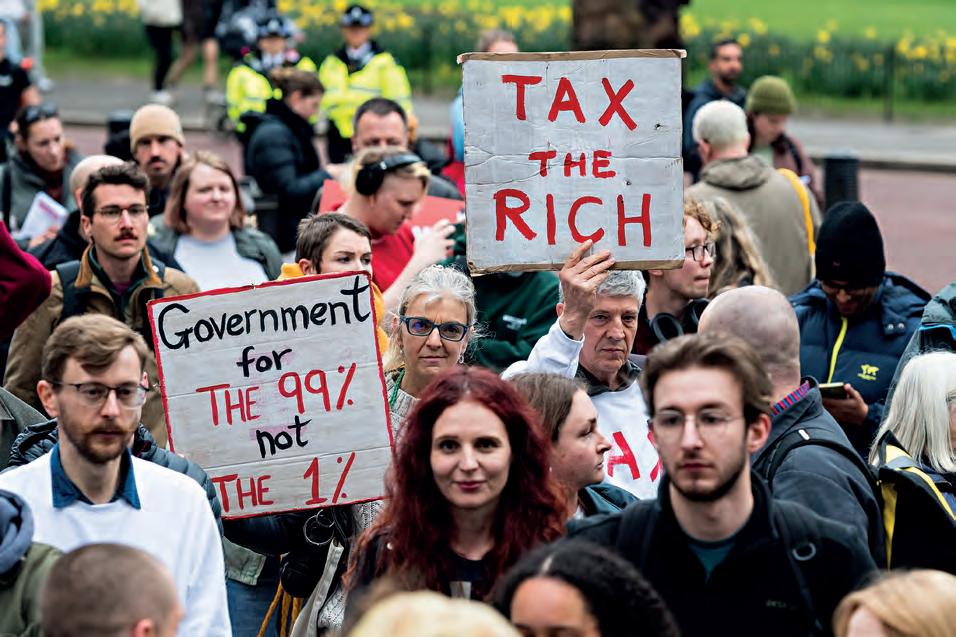
been put on the shelf.” In other words, a media controlled by what Stevenson calls ‘wealthy elites’ will naturally attempt to shift public debate away from itself and onto an ‘easy’ answer: immigrants. It is a tale as old as time.
A MEDIA CONTROLLED BY ‘WEALTHY ELITES’ WILL NATURALLY ATTEMPT TO SHIFT PUBLIC DEBATE AWAY FROM ITSELF
A recent episode of Stevenson’s ‘Gary’s Economics’ videos helpfully explains this phenomenon: he goes into 25 minutes of detail outlining how to control a media narrative by using techniques such as salience and storytelling. All of this to address the question of why the working class and the media have been swept into overwhelming public debate about migrant hotels, protests and counterprotests, flag flying and so-called ‘illegals.’ Stevenson believes it was deliberate. “At the end of June, the economy and inequality and taxation of the rich were being discussed every single day on every single news show; we had massive salience. And now if you look at the TV, what you see is immigration and asylum seekers and refugee rights. Refugee protests outside hotels are being spoken about much, much more, and the issues of inequality, taxation, distribution have kind of
If you are engaged in business and economics in 2025, you will be aware of the many disruptors who have emerged across industries, but Stevenson’s disruption, rather than getting rich, cashing out, and retiring somewhere tropical, is to take aim at the very structures and systems that enable people to do that without paying their fair share.
Stevenson’s path is an inspiring one: he is a ‘working-class boy done good’ who studied hard, got into LSE and literally won his way into an investment banking job. He became fantastically successful at trading, which almost broke him, and has now written a book about his experiences and vlogs about economics ‘for normal people.’ And it is this new outlet where things swiftly get political. With a quick mind, a sharp tongue, and a penchant for winding himself up, Stevenson is compulsively fascinating to watch – he has created a YouTube channel with 1.49 million subscribers featuring nothing more than him chatting at his kitchen table with the occasional scribbled line graph on a pad of paper. A member of the lobby group Patriotic Millionaires, which campaigns for governments to tax them and others like them, Stevenson uses his growing platform to talk to the working class that he came from, but he is taking aim at his new peers: “I come in here because I come from a
poor background and it is ordinary people like my family, like the kids I grew up with, whose kids are gonna be in poverty. Tackling wealth inequality is difficult, but it is necessary.”
Why a wealth tax?
So, to the core argument. Having made his millions betting on the economy never recovering after the 2008 crash, Stevenson believes that the solution is to implement a one to two percent wealth tax on wealth above £10m. Crucially, he is not interested in raising income tax in basically any scenario but focuses solely on curbing the compounding of existing wealth at levels far beyond even the highest salaries for everyday corporate work.
One counterargument to this is that such a tax would lead to an exodus of the super-rich, and the number of millionaires leaving the UK is often used to back this up. Stevenson believes that millionaire entrepreneurs are leaving the UK because its spending power is so weak – middle- and working-class families are struggling and so spending less money. A wealth tax would stop the super-rich being able to simply stockpile assets and squeeze out the poor and middle classes, opening up opportunities to buy homes, have a family, and become more economically active.
It is also the case that ultra-high net worth individuals (UHNWIs) are essentially globally mobile, as are the businesses that they run. One of the joys of the technology age is the ability to start an online business from anywhere, but this makes it difficult to trace
Suggested tax on wealth above £10m

and track profits and wealth, especially when it is so easy to shift where these are held to tax havens. This begs the question of traction – it almost feels as though for this to work, it is not enough for one country to implement it, it would need to happen the world over. In a time when places like Dubai are cutting taxes there is something systemic and far-reaching here that may very well be beyond the scope of one economic influencer. What is interesting though, is that this ‘millionaire exodus’ is already happening to some degree, without the UK implementing any wealth tax of the type Stevenson supports. And truly, he does seem to care about the 99 percent of the population that aren’t millionaires, so when challenged with this, he remains committed to the cause he knows he is likely to lose.
In a striking shift toward progressive economic reform, the Green Party’s newly elected leader Zack Polanski is also calling for a wealth tax. Not dissimilar in attitude, Polanski himself made well over 100 media appearances and interviews in the first week after his leadership announcement in September, and among the first guests on his new podcast was one Gary Stevenson. Since then, the Green Party has increasingly echoed the call for a comprehensive wealth tax, calling for a two percent tax on wealth above £10m.
It is too reductive to say that influencer politics have shaped the Green Party’s approach to wealth taxation, but in a summer of identity politics overtaking almost all nuance of complex issues, they have surely been emboldened by it.
With the next election approaching, Stevenson is keen for other voices to take up the message and spread the idea of wealth taxation, particularly among the working classes. The challenge will be to keep enough salience
enough of the narrative, and present ideas accessible enough that people understand them and are prepared to vote for them over identity. Thanks largely to social media amplifying increasingly extreme viewpoints, both the right and left in the UK have never felt so stark, and the traditional parties of Labour and Conservative have scarcely been more similar. Stevenson’s influence not only appears to be shaping grassroots politics, but if the next UK election really does become a choice of either Reform or the Greens to oust Labour, the question becomes which way the country ultimately swings. Both sides of the debate will need to capture the hearts and minds of the working class; it is a question of exactly which issue will capture the public imagination more. No doubt, Stevenson has his work cut out.
This article was written over a period of several weeks. As I started it, Stevenson’s DOAC debate had just aired. During its development time, Polanski announced his wealth tax plan in an almost perfect echo of Stevenson, and the two men were backing and complimenting one another online. By the time it was finished, Gary’s Economics had a new video out titled ‘Goodbye and Good Luck.’ Not an announcement of Stevenson quitting, but of taking an extended break, essentially because he has recognised that he is exhausted and fighting a very difficult battle. A marathon, not a sprint, for the ideals he champions. No doubt those who are against him will hope that the idea dies down, but this doesn’t feel likely. In the show notes for the video, Stevenson lists several individuals and organisations his followers can support in the meantime. The first on the list: Patriotic Millionaires. The second: Zack Polanski. n


The EU’s new anti-money laundering agency aims to harmonise oversight and close long-standing gaps across the single market. But with a modest budget and an evolving financial landscape, AMLA faces a formidable challenge in turning ambition into enforcement. Neil Hodge reports »
urope has big plans to combat money laundering, but its history of tackling the illicit flow of dirty cash through its financial system is decidedly checkered. Estimates vary wildly about how much money is cleared through the European Union’s (EU) banking and financial services industry every year: figures range from as low as €117bn while others go as far as suggesting closer to €750bn. Whatever the true amount, the fact that the EU is one of the world’s biggest financial markets means it stands to reason that it will be one of the biggest conduits for criminal funds.
Evidence suggests that some 70 percent of criminal networks based within the bloc use the single market’s financial system to launder dirty money, and around 80 percent use legal business structures to freely move cash. That means not only is Europe’s financial services system failing to identify, prevent or report suspected money laundering, but other professions such as accountants, tax advisers and law firms are also taking little preventative action. At the same time, crime agencies’ efforts to clampdown on money laundering are floundering: in fact, according to the EU’s Agency for Criminal Justice Cooperation (EUROJUST), on average only two percent of the assets from organised crime are confiscated by law enforcement annually, despite a 15 percent surge in cases.

Stemming the flow
The EU wants to turn the situation around and in July this year AMLA, the bloc’s Authority for Anti-Money Laundering and Countering the Financing of Terrorism, formally came into being. Though it will not begin direct supervision until January 1, 2028, the agency’s role is to co-ordinate the efforts of EU member states by ensuring they implement EU anti-money laundering (AML) rules properly, as well as take active steps to improve cooperation between the 27 countries’ financial intelligence units (FIUs).
As part of its remit, AMLA will directly supervise the EU’s highest-risk financial institutions with significant cross-border exposure and will exercise indirect supervision across both the financial and non-financial sectors. So far, AMLA has entered into memorandums of understanding with the EU’s other main supervisory bodies, the European Banking Authority (EBA), the European Securities and Markets Authority (ESMA), and the European Insurance and Occupational Pensions Authority (EIOPA), as well as with the European Central Bank (ECB).
Hopes are high for the EU’s new agency, especially as it could finally give the EU a strong, unifying voice in a system that has been plagued by fragmented national oversight and that has allowed several high-profile – and highly damaging – money laundering scandals to go undetected. But AMLA is not without its problems. While its remit is wide-ranging, its budget is not. It currently has funding of €119m set to last from 2024 until the end of 2027. When it is operational, 70 percent of its funding will come from fees (estimated at €65m for 2028) with a further €27m coming from the EU, providing an annual budget of €92m. By then, AMLA is set to have 430 staff. Additionally, the fact that it will not be fully operational for over two years means a lot of dirty cash is still set to flow through the EU’s financial system between now and then. And even when the agency does take effect in 2028, the existing executive board will only be in post for a year, which creates concerns over leadership and continuity.
While AMLA’s creation may be a bold step towards a unified European approach to financial crime, its effectiveness will hinge on
AMLA’S CREATION MAY BE A BOLD STEP TOWARDS A UNIFIED EUROPEAN APPROACH TO FINANCIAL CRIME
$750bn
In illicit funds estimated to have flowed through the EU in 2023
execution. While the agency’s priorities of harmonising rules, strengthening cooperation, supervising high-risk cross-border institutions, and tackling emerging threats like crypto address the fragmentation and intelligence gaps that criminals have exploited for years, its objectives face key challenges, and problems are likely to persist.
For instance, non-financial sectors remain largely outside of AMLA’s direct remit, while geopolitical risks like sanctions evasion add complexity. Additionally, harmonising rules across 27 member-states (where differing national approaches are likely to be entrenched), coupled with directly supervising key entities, coordinating the efforts of multiple FIUs, and the buildout of IT and data systems is complex, resource-intensive, and requires skills, manpower and budgets that the agency does not yet have.
Many believe one of AMLA’s biggest challenges is that the agency faces fierce competition for experienced talent in an industry that is already fighting for experienced professionals, while there are also fears that AMLA’s operational start date of 2028 simply gives criminal gangs enough time to shift channelling dirty money through Europe’s financial services system to less-supervised sectors such as real estate, which remain outside the
agency’s direct purview. There are also concerns that AMLA’s powers are defined less by laws and more by the level of political will in Brussels.
“AMLA is a powerful deterrent on paper, but its true test will come when it investigates a national champion bank,” says Willem Wellingoff, chief compliance officer at payments platform Ecommpay. “Will member states provide their full support or will national interests lead them to shield their own institutions?”
The EU has a mixed reputation regarding its efforts to curb money laundering. Over 34 years, the bloc has implemented six directives to combat money laundering and terrorist financing risks – the last three of which were agreed in the past 10 years as a succession of scandals were uncovered in several of the EU’s biggest financial institutions around 2017 and 2018 (Danske Bank; Latvia’s ABLV Bank; Versobank in Estonia; ABN Amro; and Commerzbank, among others.)
Last year the EU finalised its so-called ‘AML Package’ of new rules to counter ML/CTF risks. The package consists of the Regulation on Money Transfer Information, which covers information accompanying transfers of funds and certain cryptocurrencies; the AML Regulation and latest (sixth) AML Directive, which will both apply from July 2027 (the regulation will be an EU-wide rule, while the directive needs to be implemented into member states’ national frameworks); and legislation enabling the establishment of the EU’s Authority for Anti-Money Laundering and Countering the Financing of Terrorism (AMLA), which began operations this July.
Despite its willingness to beef up rules, the EU can’t seem to get a proper handle on the problem. An estimated $750bn in illicit funds flowed through the EU’s financial system in 2023 alone, according to a study released this March by financial crime tech software firm Nasdaq Verafin. The figure amounts to a quarter of the global total and is equivalent to 2.3 percent of Europe’s GDP.
Projected annual budget of AMLA once it is fully operational
Ultimately, preventing money laundering in the financial sector is dependent on how capable –or willing – financial services firms are to combat the problem (as opposed to fulfilling box-tick compliance with current rules). According to Wellingoff, present delays in reporting and the separation of fraud and AML functions within financial services firms “still give criminals an advantage.”
These concerns are likely to be exacerbated as the fintech, regtech, and crypto sectors continue to grow in an environment where innovation outpaces governance. Europe’s main banking regulator, the European Banking Authority (EBA), fears that money laundering and terrorist financing risks may be going unchecked because of current weak controls and compliance among these new entrants. These fears are not helped by the fact that the riskbased approaches financial regulators take across the EU to police these firms are often inconsistent, lack clarity, and are ‘uneven’ in terms of their effectiveness.
The EBA has been issuing opinions on money laundering and terrorist financing risk (ML/TF) every two years since 2017. In its latest opinion in July, the EBA said the sector’s drive for innovation and growth may be outpacing its ability to manage them. It added that the ‘unthinking’ use of regtech solutions meant to improve anti-money laundering (AML) compliance – combined with the ‘spill-over risks’ from the increased interconnectedness between traditional financial services providers and the influx of emerging, innovative players such as crypto firms – are also a ‘particular concern.’ The EBA found that while fintech products and services are becoming more popular and mainstream, providers are prioritising growth over compliance. According to Alex Clements, global head of AML, CFT and sanctions at payments
The UK has struggled to shed its reputation as one of the world’s biggest conduits for dirty money –despite having appropriate anti-money laundering legislation and a range of sanctions in place to punish corporate and individual offenders. Around 40 percent of the world’s total of dirty cash flows through the UK’s financial system, but experts believe progress to tackle the problem is hampered by the UK’s dependence on a multitude of poorly resourced, ill-equipped regulators and enforcement bodies. AML monitoring is in the hands of 25 different bodies and is co-ordinated by the Office for Professional Body AntiMoney Laundering Supervision (OPBAS), a division within the Financial Conduct Authority (FCA). But since OPBAS’ creation in 2018, the patchwork system of AML oversight and enforcement has been questioned for its ineffectiveness. “If you were designing a system of AML supervision from scratch, you would be unlikely to come up with the current regime,” says Colette Best, director of anti-money laundering in the legal services regulatory team at law firm Kingsley Napley. In September 2024 OPBAS found ‘weaknesses’ in how the 25 supervisors use enforcement powers to supervise members, and that – worryingly – none were ‘fully effective in all areas’ of anti-money laundering measures.
firm TransferMate, many fintech, regtech, and crypto firms prioritise fast onboarding at the expense of robust ‘know your customer’ (KYC) controls, leaving gaps that criminals can exploit. “Once inside the system, criminals leverage digital wallets, virtual IBANs, and instant cross-border payment schemes to layer and move funds in ways that make tracing illicit funds increasingly complex,” says Clements. “At the same time, the rise of privacy coins and decentralised finance platforms make verifying the source of funds even more difficult by providing anonymity that can shield illegal flows of funds,” he adds.
The number of staff meant to oversee ML/TF risks is often insufficient and those staff lack appropriate training. In addition, over half (52 percent) of regulators surveyed believe fintech institutions lack proper understanding of the level of such risks associated with their products and services. The EBA also highlighted as key areas of concern the sector’s over-reliance on third parties; their increased exposure to cybercrime; ineffective customer due diligence; and the high level of risk associated with cross-border transactions. The opinion found other worrying trends. One example is so-called ‘white-labelling’ – where fintechs provide the infrastructure for financial services firms to market the products under their own brand.
The report also found the number and value of fines issued had declined on the previous year, and that proactive information and intelligence sharing with regulators and law enforcement was ‘inconsistent.’ Following a two-year consultation to reform AML supervision the government announced in October 2025 that it will create a single professional services supervisor (SPSS), which will see the FCA assume responsibility for ensuring accountancy and legal firms comply with anti-money laundering rules rather than their professional bodies. However, the timescale for the changes – and how they will work in practice – are not clear. Prosecuting AML cases has also historically been chronically slow: in the decade up to December 2021 the FCA opened only 23 criminal cases against individuals and corporates for failing to report suspicious money laundering-related activity. Part of the problem stifling the UK’s efforts to prevent money laundering is that its strategy encourages huge numbers of reports, including lots of false positives. Most of these reports, approx. 900,000 are generated each year, cannot be meaningfully investigated due to resource constraints. AML compliance is also hugely expensive, which pushes larger institutions to rely on automated systems that do not always work as well as they are meant to.
EXPERTS BELIEVE FINTECH FIRMS’ AML COMPLIANCE IS HAMPERED BY A LACK OF SKILLED STAFF
That’s an area that may lack proper oversight as regulators have assessed the risk as being low, but without realising how widespread the practice may actually be, the EBA warned. In terms of regtech, the EBA said while the technology “offers significant benefits in the fight against financial crime,” money laundering risks had increased because the solutions were not being adequately tested, nor used or implemented properly (partly due to a lack of in-house expertise.) The EBA also warned that financial institutions have become heavily reliant on a small number of regtech solutions, meaning that if vulnerabilities arise in one of the products, a significant number of firms could be at risk.
Meanwhile, money laundering and terrorist financing risks remain high in the crypto sector, fuelled in part by a surge in transaction volumes and a 2.5-fold increase in the number of authorised crypto assets service providers in the EU between 2022 and 2024.
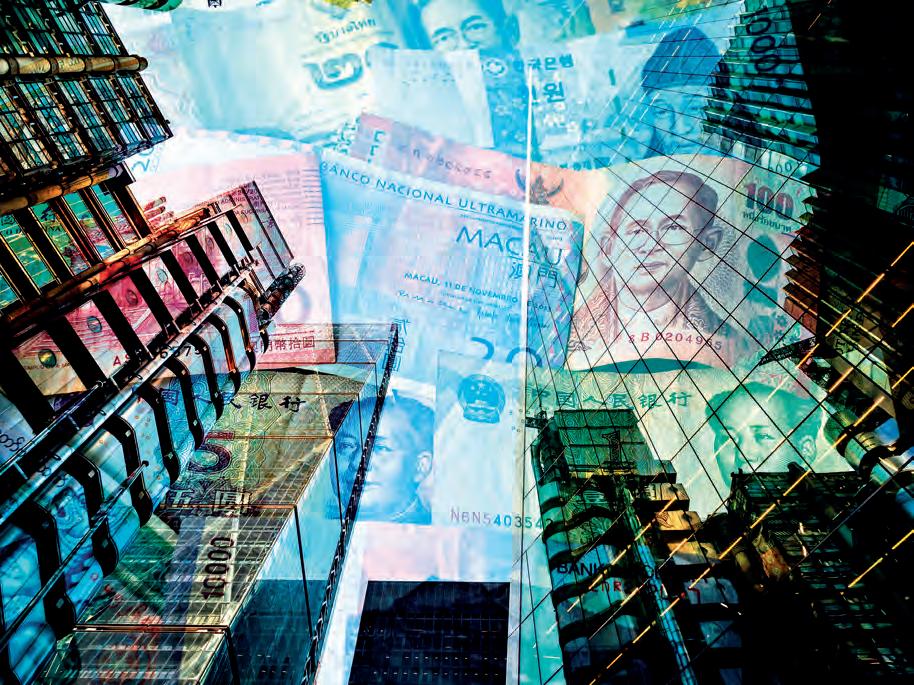
But it’s also because crypto firms continue to act in much the same way as they always have – namely, that senior management fails to take compliance seriously; internal controls and governance arrangements are not fit for purpose; and firms deliberately try to bypass processes because they think the rules that apply to traditional providers do not/should not apply to themselves.
Marit Rødevand, CEO of AML tech company Strise, says that the sector’s failure to address these problems is “partly cultural, partly structural. Growth and speed to market are of greater priority to developers, leaving compliance as an afterthought.
“In crypto, there is an added reluctance to move until regulators force the issues. The result is a cycle of under-resourced compliance, insufficient controls, and firms playing catch-up rather than leading from the front,” Rødevand adds. Such views are backed up by research from UK professional accounting body ACCA. It found that fintech and regtech firms admit that internal mechanisms often fail to translate into meaningful action, which creates a ‘persistent misalignment’ between written policies and actual practices – a situation that is ripe for fraudsters to exploit.
AI is also exacerbating cybercrime, fraud and ML risks. According to a 2024 report by security tech firm Signicat, a staggering
42.5% Of fraud attempts in financial services are now AI-driven
42.5 percent of fraud attempts in financial services are now AIdriven. The report said criminals use AI for money laundering to automate financial schemes, conceal fund sources, and make high-risk transactions harder to detect. In addition, the technology can be used to generate fake documents, simulate legitimate operations and evade customer due diligence measures through deep-fakes.
The recent history of several new entrants, crypto and fintech firms is doing little to alleviate fears that financial crime will continue to grow as regulators across Europe step up monitoring and enforcement efforts. In 2023 Lithuania revoked the licence of banking platform Railsr’s European payments unit, PayRNet, for ‘gross, systematic and multiple violations’ of ML and terrorist financing laws. In May 2024 Germany’s financial regulator BaFin fined online bank N26 €9.2m over its late filing of suspected money laundering reports, and in July 2024 the UK Financial Conduct Authority (FCA) hit CB Payments – part of crypto-asset trading platform Coinbase –with a £3.5m fine for onboarding and/or providing e-money services to 13,416 high-risk customers. The previous year the firm had agreed to a $100m settlement with New York’s
Danske Bank: In 2017 Denmark’s biggest lender found itself at the centre of allegations that have since given the organisation the dubious honour of being responsible for the world’s largest moneylaundering scandal. Over the course of eight years, between 2007 and 2015, around €800bn of suspicious transactions flowed through the bank’s Estonian network, with little attempt to stop it. In December 2022 Danske Bank pled guilty and agreed to a $2bn fine with the US Department of Justice. Further fines worth billions of dollars are expected from other financial regulators.
ABN Amro: In April 2021 the Dutch bank reached a €480m settlement with the Netherlands Public Prosecution Service (NPPS) to resolve money laundering charges, two years after the agency said the bank was the subject of a criminal investigation relating to potential violations of the Dutch Anti-Money Laundering and Counter Terrorism Financing Act (AML/CTF Act).
Nordea Bank: In August 2024 the Finnish bank agreed to pay $35m to resolve an investigation by the New York Department of Financial Services (NYDFS) into ‘significant compliance failures’ in its anti-money laundering and Bank Secrecy Act (AML/BSA) programme. Nordea was discovered to be facilitating the creation of off-shore tax havens in the 2016 Panama Papers investigation. A subsequent NYDFS investigation found the bank was engaging in high-risk transactions through its international bank branch in Denmark. Nordea also formed relationships with high-risk correspondent banking partners without conducting adequate due diligence on them, the regulator said.
Department of Financial Services (DFS) over AML failings. In April 2025 Lithuania’s central bank fined British fintech firm Revolut €3.5m for AML failures.
According to Nick Henderson-Mayo, head of compliance at VinciWorks, a compliance eLearning and software provider, AML compliance is “butting against” the AI-enabled tech revolution. “Fintechs compress onboarding into minutes, regtech tools often operate as ‘checkbox tech’ rather than embedded risk management, and crypto still enables anonymous, borderless value transfer.” He added that nearly 40 percent of illicit crypto transactions are from sanctioned jurisdictions and entities. “Oligarchs use their speed, liquidity and borderless nature to slip past traditional compliance checkpoints. It is like watching a river of money disappear underground. When it resurfaces, you can never be certain whose hands it passed through.”
Experts believe fintech firms’ AML compliance is hampered by a lack of skilled staff, coupled with a lack of specific requirements by regulators of what skills individuals in AML roles should have. Other factors may also make AML monitoring ineffective. For example, many firms are not fully licensed (instead, a licensed entity has agents and/or
AROUND 40 PERCENT OF THE WORLD’S TOTAL OF DIRTY CASH FLOWS THROUGH THE UK’S FINANCIAL SYSTEM
distributors who are able to conclude contracts and board clients without having a sufficiently skilled money laundering reporting officer) and criminals simply appoint nominees (known as ‘money mules’) to make transactions on their behalf to evade checks. Additionally, while AML detection technologies are useful, they require heavy integration to get sufficient data into the systems and are often outdated by the time they are embedded. While the EU may have identified the problem areas in its drive to curb money laundering, it is another matter whether the steps it is putting in place to tackle the issue will pay off: a lot of different factors need to come together. In the absence of better, more effective and more closely joined-up approaches from regulators to monitor activity, putting a stop to the flow of dirty money comes down to how willing and prepared industry players are to shoulder the costs of compliance rather than pursue clients and new opportunities. So far, taking the money has been a bigger inducement than spending it. n
A surge in copper along with record cocoa prices are seeing the global economic map being redrawn. In the post-oil world, the path to power runs through mines and plantations, not pipelines
Indrabati Lahiri FEATURES WRITER






As climate change and the green transition gather momentum in 2025, unlikely commodities such as copper and cocoa are now reshaping global economic stability the way oil once did. Copper prices have surged more than 20 percent so far this year, driven by supply crunches, green infrastructure and data centre demand. Similarly, cocoa has seen extreme price volatility, due to African climate shocks, hitting record highs in early 2025, before plummeting almost 50 percent.
Together, they highlight a broader geopolitical shift away from fossil fuels towards essential commodities and natural resources. With copper driving the energy transition and cocoa shaping food supply chains and ethical trade, they have become the dual bellwethers of a changing world order.
They also represent how resource power and strategic assets are increasingly concentrated in the Global South, in West Africa’s cocoa heartlands and Latin America’s copper belt. In many ways, copper and cocoa are now the ‘new oil’ – strategic, scarce and representative of both innovation and global inequality.
Underpinning the climate transition
Copper is essential to electrification, being used in electric vehicles, solar panels, wind turbines, hydropower plants, grid upgrades and more. Demand for copper from data centres, where it is used in cooling systems, internal connectivity and power systems, has increased exponentially, supported by the surge in artificial intelligence.
According to the International Energy Agency (IEA), copper demand could hit 31.3 million tonnes by 2030, a considerable increase from 2021’s approximately 24.9 million tonnes. “China’s massive grid expansion and urban development have been the single largest recent driver of copper demand. Continued Chinese industrial stimulus and
infrastructure spending are therefore key factors underpinning copper prices,” António Alvarenga, Professor of Strategy and Entrepreneurship at Nova School of Business and Economics, explained. He added: “However, copper mine output has grown only about one to two percent annually, despite rising demand, and new projects take around 15–17 years to develop.”
Copper production is highly concentrated in Zambia and Democratic Republic of Congo, along with Latin America’s copper belt, including Chile and Peru. “This concentration of resources is quietly reshaping global alliances, as countries compete to secure longterm access, much like the oil geopolitics of the 20th century,” Sunil Kansal, head of Consulting and Valuation Services at Shasat Consulting, said.
As such, any mine accidents in these key countries can have a profound impact on copper production and drive prices up. Chile’s El Teniente mine had a deadly accident back in July this year, which led to a major production halt and drop in output. This was also seen at the Komoa-Kakula copper mine in DRC in April due to a flooding event and roof collapse. Older mines and chronic underinvestment have boosted copper prices and caused supply chain bottlenecks too lately.
“Many of the world’s major copper mines are aging, and the average copper content (ore grade) is declining, meaning that more rock must be processed to extract the same amount of copper,” Franck Bekaert, senior emerging markets analyst at Gimme Credit, highlighted. “Additionally, permit delays and ecological constraints are hindering the launch of new projects, which is driving up costs. To meet the growing demand for copper, significant investments will be required,” Bekaert added.
Political instability in major producing countries, such as worker strikes and environmental protests, as well as governance issues such as rising corruption have also contributed to supply woes. At present, copper inventories are at record lows, according to Benchmark Intelligence, even as green infrastructure demand from the US and EU soars.

As the world races to electrify, copper’s scarcity is fast becoming a structural risk to global growth, much like oil shocks once were.
“When the Ivory Coast and Ghana sneeze, global chocolate catches a cold. Cocoa just had its ‘oil moment’: a near 500,000-ton global deficit in 2023–24 pushed inventories to multi-decade lows and sent futures above $10,000/ton at the peak in January 2025,” Francisco Martin-Rayo, co-founder and CEO at Helios AI, said. One of the biggest reasons for this was the El Niño weather pattern in the 2023–24 season. This caused volatile weather patterns, such as unusually heavy rain, followed by hotter and drier weather across key cocoa-producing countries such as Ghana and the Ivory Coast. Cocoa is very sensitive to weather changes as it grows only in limited areas of warm, humid equatorial conditions, with 70 percent of the crop coming from West Africa (see Fig 1). These temperature extremes caused decreased cocoa yields and a rise in crop diseases such as swollen shoot virus and brown rot. The diseases also meant that the remaining yield was of lower quality, further escalating prices. Aging West African cocoa trees are another factor contributing to higher prices. These can severely dampen yield capacity because of decreased soil fertility. Older trees can also be more vulnerable to diseases and pests and become weaker with time.
Farmers then need to invest large amounts in replanting and farm rehabilitation. However, consistently low farmer incomes make such investments difficult to maintain, creating a vicious cycle of aging trees, low productivity and low incomes.
“Cocoa demand has grown steadily. Western holiday consumption and an expanding middle class in Asia/Africa support baseline demand. However, extremely high prices can dampen consumption: in 2025 European and Asian cocoa grindings fell as manufacturers faced higher costs,” Alvarenga said. The factors affecting cocoa go beyond just determining chocolate and related product prices – they represent a systemic crisis in agricultural supply chains today, defined by
climate volatility, worsening soil degradation and widespread farmer poverty. With much of the crop still tied to smallholder farmers, cocoa is a social commodity, intimately linked to human issues such as food insecurity, forced migration and income loss and inequality, sitting at the heart of debates about ethical sourcing and fair trade. Even as prices pull back slightly now, the structural issues driving cocoa price volatility remain.
Much like oil in past decades, both copper and cocoa supply has been highly concentrated in a few regions. This has significantly shaped new geopolitical alignments and trade tensions. One of the biggest ways this has materialised is through consumers now actively seeking to diversify suppliers, to reduce supply chain and security risks. Copper, as a strategic metal and asset, is now crucial to countries’ decarbonisation plans. As AI and other cutting-edge technologies gather pace and require more electricity, copper’s status as the ‘new oil’ is likely to keep growing. As such, major copper consumers including the US and EU are now trying to find more suppliers to spread supply risks.
“The US launched a section 232 national security investigation into copper and China has pivoted away from Chile by sourcing more from DRC, Russia and Zambia. These moves have created new alignments – such as China deepening ties with African producers, Western nations seeking alternative mines or stockpiles,” Alvarenga highlighted. This geopolitical strategising and positioning mimics past resource wars over oil, creating new alliances between industrial powers and resource-rich countries. “As with oil, these relationships can lead to trade frictions, resource nationalism, and competition for influence. For investors, this concentration magnifies geopolitical risk but also signals long-term strategic value,” Edward Nikulin, weather model expert at Mind Money, said.
For cocoa, Ghana and Ivory Coast’s governments wield considerable supply influence through export regulations and price-setting, acting as a kind of producer bloc, similar to OPEC. “We are seeing the emergence of coordinated action by Ghana and the Ivory Coast to demand fairer terms, echoing the resource diplomacy once seen in oil markets,” Kansal said. This is through the ‘Living Income Differential,’ which raises export prices to ensure that more cocoa income reaches farmers directly to improve living standards and reduce child labour, poverty and deforestation.
“The joint $400/ton ‘Living Income Differential’ set a de-facto floor under farmgate economics, while EU deforestation rules (EUDR) are forcing farm-level traceability (GPS coordinates, plot IDs) and reshaping trade flows toward compliant suppliers,” Martin-Rayo explained. “Expect more local processing in Abidjan and San-Pédro and more origin diversification to Ecuador/Brazil � a classic resource-security realignment.”
Cocoa farming is increasingly using more tech such as satellite imagery, robotic pollination, ground sensors and drones. These monitor pests, growth rates and soil moisture in large plantations in real time, helping yields to become more stable, which can boost cocoa’s economic and strategic importance. Similarly, more major copper companies are focusing on responsible copper production practices, addressing sustainability and labour concerns that are key to attracting the next generation of investors. “Over the past five years, copper and copper miners have significantly outpaced the S&P 500 and broad commodity indices. Dedicated copper ETFs and mining stocks have been popular. Upside for investors comes from expected supply deficits: pent-up demand from EVs/renewables could lift prices if new mine output lags,” Alvarenga said.
However, he emphasised that policy intervention risks like stockpiling and tariffs remain, which could suddenly decrease copper flows. Although cocoa is more volatile and speculative than copper, Martin-Rayo calls its oil-like status a regime shift. “Think of cocoa as smaller than oil, but newly ‘systemic’ for food manufacturers and retailers.”
The road ahead
2025 highlights the start of a ‘post-oil’ resource era – one where sustainable and ethical commodities hold power. The ‘new oil’ may be mined, grown or digitally verifiable, instead of liquid. Both copper and cocoa mark a shift to the commodities of the future, scarce and economically resilient in an increasingly fragmented world, with investors demanding balance between transparency, accountability and growth. n
As the world races to rebuild its energy foundations, MPC Capital is finding strength in specialisation – investing in the overlooked niches of Europe’s decentralised infrastructure market to unlock stable, long-term value for institutional clients
INTERVIEW WITH
Christian Schwenkenbecher CHIEF CLIENT OFFICER, MPC CAPITAL


One of the fears of pension fund investment managers as they strive to deliver the UK government’s targets for investment into infrastructure and other large-scale private assets is that quality assets will quickly be snapped up. Exploring niches offers a solution to that challenge.
Energy infrastructure provides one such opportunity, says Christian Schwenkenbecher, chief client officer of MPC Capital, which works with institutional investors to access structural growth opportunities in the maritime and energy infrastructure markets. With the growing importance of energy security within a more de-centralised energy infrastructure, especially in Europe, there are some exciting prospects.
“Our approach to energy infrastructure investments focuses on generation assets such as onshore wind, solar PV as well as storage. We focus on structuring and securing longterm cash flows primarily through corporate off take structures, allowing us to take an active role as a vertically integrated investor, ensuring we remain close to the underlying asset. Going forward we will be looking for additional niches across the entire value chain of energy infrastructure.”
This effectively gives the client a ringside seat, reassuringly close to the decisionmaking centre of the firms they are investing in, a point underlined by Schwenkenbecher. “We look for majority ownership in assets to fully exploit our active management approach. However, we also see value in partnering when skillsets are complementary, and return and performance expectations are aligned. This means we have built a track record of working successfully for and alongside institutional investment partners but also industrial partners. Combining the two is a key ingredient for performance.”
The focus on Europe is driven by the quality of assets, reliable political and regulatory systems and the substantial investment backlog building a new, more flexible and decentralised energy infrastructure system. Schwenkenbecher continued; “The industrial sector in particular will increasingly depend on private capital to drive economically feasible decarbonisation. This is a compelling investment thesis for institutional investors, including private equity firms, such as KKR, Apollo and EQT, which have stepped up their investment activity, particularly in Germany, Europe’s largest economy.”
The current waves of geo-political unrest sweeping around the world also create a neat intersection for MPC Capital’s core expertise in maritime and energy assets. With European governments – especially those within the NATO alliance – now committed to increasing defence spending to five percent of GDP in the next decade, he sees some of that funding major port expansions, all of which will need a robust energy infrastructure.
WE WILL BE LOOKING FOR ADDITIONAL NICHES ACROSS THE ENTIRE VALUE CHAIN OF ENERGY INFRASTRUCTURE
Schwenkenbecher explained that while MPC Capital’s target markets will remain unchanged, there seems to be a growing overseas interest from the US and the Middle East to invest in Europe. While this seems sensible considering recent political events, he sees ample investment opportunities in Europe both in the short and medium to long term, across the entire value chain, from generation to grid infrastructure to energy services.
“Energy will likely be the key bottleneck for new, rising technologies such as AI and will continue to facilitate overall GDP growth and domestic competitiveness. Ahead of these mega-trends and structural growth drivers it seems sensible to be invested along those structural trends,” Schwenkenbecher said.
While governments are looking to an expansion of nuclear power to play an important part in their longer-term plans to create national greater energy security and capacity, it does not figure prominently in MPC Capital’s strategy. “We are agnostic to overall energy sources, but our focus on renewable production capacity is mostly due to its cost competitiveness and shorter time to market compared to nuclear power,” Schwenkenbecher continued.
“Increased spending on port infrastructure and other maritime assets validates the importance of both sectors, and the focus on attractive niches is rather geared towards the intersection of maritime and energy infrastructure.” These wider macro-economic, geo-political and regulatory issues are constantly on our radar screens, says Schwenkenbecher; “We have to be sensitive to the impact of interest rate developments on transaction as well as fundraising activity. This leads us to adopt a selective approach to overall transaction activity in a still high-interest-rate environment. We will be very cautious as central banks start to ease interest rates. If continued, this trend should act as a tailwind for our transaction activities.”
He emphasised the importance of balancing transactional and management revenues, and that recurring service revenues have been a key reason for MPC Capital’s resilient business model. It has enabled the company to remain disciplined and focused on those investment strategies while ensuring high visibility of earnings growth.
Regulatory structures and policies are also a key influence when it comes to deciding which projects to commit capital to. The jolt to the world’s energy markets following the Russian invasion of Ukraine put national energy security firmly on government agendas. So far, the response in terms of impactful regulatory change has been mixed.
“The importance of sensible regulation to drive investment to accelerate the build-out of energy infrastructure cannot be underestimated. In particular, the regulatory approaches in the UK and US have been very encouraging,” Schwenkenbecher said, while also expressing a desire for similar regulations to be enacted in Germany to attract more capital to the infrastructure sector. “Private capital will play a key role, with governments likely to provide frameworks to attract capital.” n
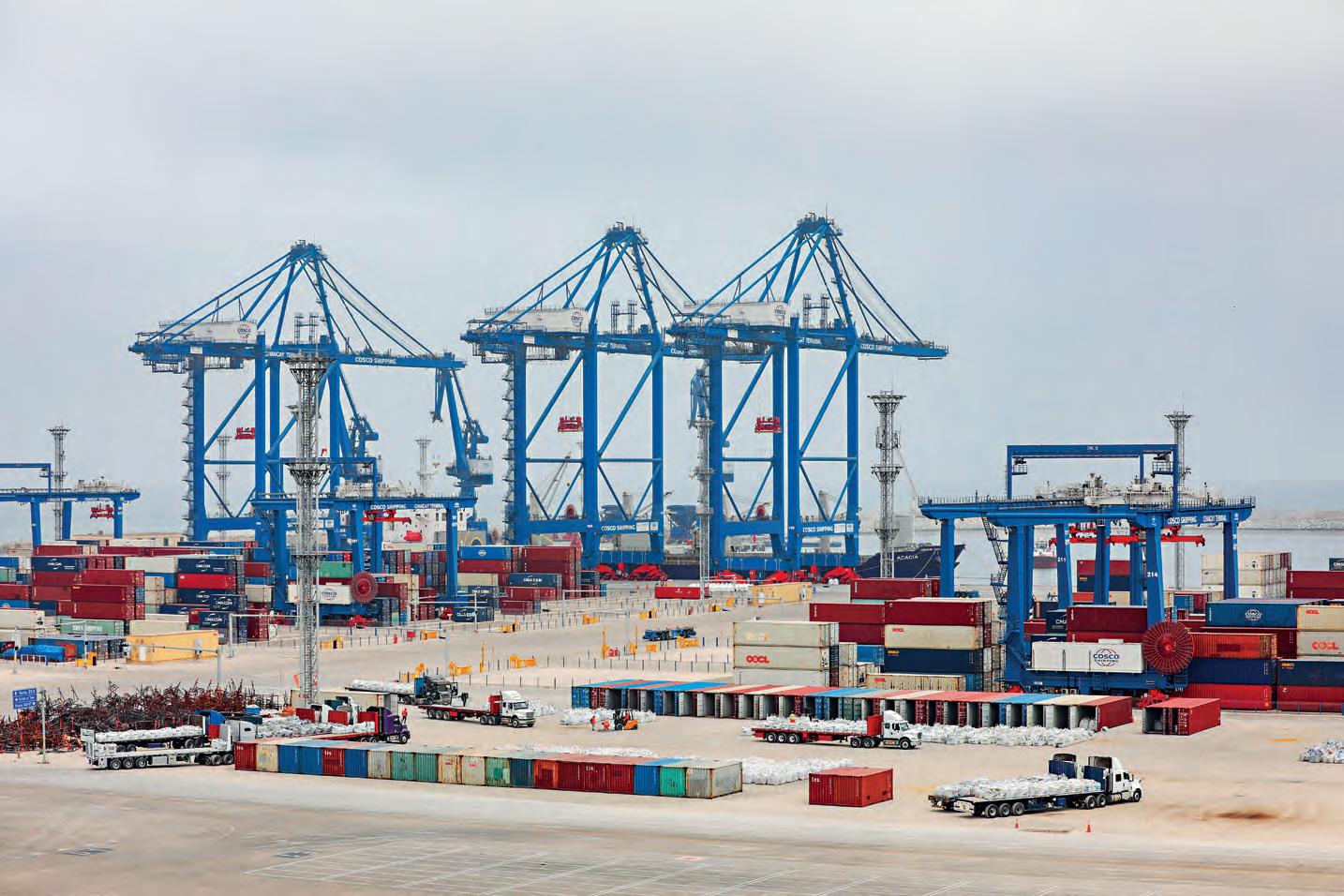
Beijing’s billion-dollar Belt and Road investments are redrawing Latin America’s economic map – and raising fears that the region is trading sovereignty for infrastructure
WORDS BY
Selwyn Parker FEATURES WRITER





When Peru opened a new $3.6bn mega-port in late 2024, it was the latest of the giant projects that China has built and funded in Latin America under its global, trillion-dollar Belt and Road programme. And it was typical of many other B&R projects.
First, China gets much more out of it than Peru because the port, named Chancay, slashes shipping time between Latin America and Asia by two whole weeks. This means Chinese state-owned container vessels are shifting electric vehicles and many other manufactured goods into the region much faster than before and shifting raw materials back home to feed China’s enormous factories.
Second, the fi nancial arrangements cost
Peru a lot more than they do China. For a relatively small investment of about $1.6bn of the total $3.6bn, state-owned port giant Cosco has booked a 60 percent stake.
Third, courtesy of the Peru government, which rewrote the rules of foreign ownership, Cosco gets exclusive use of the deep-water port for up to 60 years. Overall, the deal is so beneficial for China in the long term that President Xi, who formally opened the port, promised in early 2025 at least another $9bn in credit for B&R-type projects in Latin America. “We ride the tide of progress together to pursue win-win cooperation,” he told Latin American dignitaries in Beijing. Although the Chinese economy has weakened in the last two years, there is still money on the table for the right B&R projects. Typically, the funds come from what a UN report described as “a complex web of policy banks, commercial banks, state-owned enterprises, sovereign funds and public–private partnerships.”
Until recent years, B&R-funded projects were mainly to build conventional infrastructure such as new roads, railways, airports, dams and ports. For instance, the Chancay port is one of at least a dozen wholly or partly owned or run by China. Now though, China’s stateowned and controlled giants are moving in new directions. Currently, according to recent studies, PowerChina has invested in no fewer than 11 Latin American countries including, once again, in Peru, where it acquired two electricity suppliers for some $3bn in a deal that gave China virtual control over the nation’s electricity distribution. In other energy coups, Chinese companies are running Latin America’s largest solar plant in Jujuy, Argentina and a wind farm in Coquimbo, Chile.
Huawei is one high-tech Chinese company that has established a strong foothold in new infrastructure such as artificial intelligence, smart cities and 5G technology. By 2020, in Curitiba, Brazil, Huawei was running over half of internet connections. Although not officially under the B&R umbrella, Brazil has quietly become Beijing’s biggest trading partner in the region. “Even though Brazil
Value of trade in 2024 between China and Latin America and the Caribbean
WHILE CHINA HAS BEEN ASSIDUOUSLY CULTIVATING LATIN AMERICA, THE US HAS NEGLECTED IT LATELY
is not formally part of the Belt and Road, we are in many ways very much aligned with its spirit,” Tulio Cariello, director of content and research at the Brazil-China Business Council, told Dialogue Earth, a non-profit environmental media outlet. “We have been receiving investments in infrastructure for quite some time now – especially in the energy sector –but also in ports, storage, logistics and more.”
In a region hungry for foreign investment, Brazil is one of 20 other countries to sign deals with China, the most recent being Colombia. Of these nations Brazil, Argentina, Peru, Chile, Ecuador and, most controversially, Venezuela have gone in the deep end – to the regret of numerous activist organisations that argue Beijing has too much control over their countries’ future.
For instance, China is also heavily invested in Peru’s mines, hydropower, transmission and copper projects. On top of existing projects, Brazil is discussing with Beijing a transcontinental rail link that would run from the Amazon (where China already has significant interests) to the Pacific, thus bypassing the Panama Canal.
Argentina, which was only too pleased to grab an $18bn currency swap lifeline from Chinese banks to tide it over a debt crisis, is also home to B&R-financed hydropower dams
and space-tracking facilities, the latter of great concern to the US. Billions of Venezuela’s debt to China is paid in oil exports, much to the detriment of the domestic economy.
The main attraction for China remains Latin America’s critical minerals, notably the ‘lithium triangle’ that links Chile, Argentina and Bolivia. This has aroused fierce domestic criticism over the wholesale export of raw and rare materials that could be exploited much more profitably at home.
In the first years of B&R in Latin America, it was Chinese officials who opened the door, preferring to work with dictatorships – or at least authoritarian governments – rather than with democratic, market-led nations. Talking to Dialogue Earth, Colombia-based expert on China, Parsifal D’Sola, puts it diplomatically by saying that Beijing has tended “to favour state-to-state relations, which facilitates the entry of projects and financing in countries where decision-making is concentrated in a small group and the market plays a secondary role.”
Others put it more bluntly. China’s role in such countries is that of “an incubator of populism,” argues Evan Ellis, professor of Latin American Studies at the US Army War College Strategic Studies Institute. “It’s not that China’s trying to produce anti-democratic regimes, but that anti-democratic regimes find a willing partner in the Chinese.” Until President Xi’s promise of $9bn or more of extra credit for Latin America, China had held the purse strings tighter in the last two or three years, at least for big-ticket projects, as Beijing waits for the original investments to pay off. And they are paying off handsomely.
In 2024, total trade between China and Latin America and the Caribbean (the LAC region) hit $518bn, according to official Chinese figures. China imports agricultural produce to feed its 1.4 billion people, and metals and minerals to supply its high-tech industries such as BYD, the world’s largest manufacturer of electric vehicles that, incidentally, has taken over a former Ford-owned plant in the Bahia region of Brazil.
In short, Latin America sells to China vast quantities of low-value products such as soy, copper, lithium, iron ore and oil while buying high-value machinery, electronics, electric vehicles, turbines and other cleverly massproduced technologies. Economists would say that Latin America is on the wrong end of the supply chain. Yet China is widely applauded for its consistent, long-term implementation of an economic strategy while Latin America’s nearest neighbour and natural economic
partner – the US – sat on its hands. For instance, in the last few years few American companies even bothered to bid for the many infrastructure projects that B&R was able to snap up under Uncle Sam’s nose.
Peru’s Chancay Port provides a good example. It is an investment that capital-rich America could have made to its enormous benefit. Yet Peru, a nation of 38 million, has a substantially bigger trade with China than it does with the US – and it can only get bigger.
While China has been assiduously cultivating Latin America, the US has neglected it lately, even though the US is still the region’s biggest trading partner. Former President Joe Biden visited South America just twice while Donald Trump made just one visit to the region in his first term. Trump has gone out of his way to put the region offside rather than cultivate it, for instance by imposing punitive tariffs on Brazil and by threatening to seize the Panama Canal.
Although it is far too late, senior US military are increasingly concerned about Beijing’s leverage in Latin America. General Laura Richardson of the US Southern Command has warned that “China is on the 20-yard line, to our home land,” citing Chancay Port’s potential to be used for military vessels spying on American naval and commercial ships.
Strategic think tanks like the Atlantic Council has warned: “If a conflict were to break out in, for example, Taiwan or the South China Sea, this global network of 38 Coscooperated ports could pose a serious logistical challenge for foreign militaries looking to move ships or supplies to the Indo-Pacific.”
Some B&R projects go wrong. New research shows that up to a third globally aren’t completed or run into trouble – a dam in Ecuador is mired in dispute over structural defects, and recipient nations all too often end up with unsustainable debt burdens against which China extracts payment in kind; for instance, Venezuela’s oil exports. Complaints about severe ecological damage at Chancay were quickly shut down.
Yet only one nation has signed itself out of B&R. Although he told Trump that “our canal’s sovereignty is not negotiable,” Panama’s president Jose Raul Mulino kicked China out of planned projects there. Others are nervous of Beijing involvement and, like Mexico, prefer to remain outside the fence.
In the meantime, China’s trading boom looks unstoppable. In 2021 trade with Latin America was worth over $450bn. Three years later it was worth $518bn for an increase of over 40 times since the turn of the century. And there are plenty of experts who predict $700bn within another decade. n
Afreximbank champions Africa’s long-term growth and prosperity.
For 30 years, the Bank has been deploying innovative structures to deliver financing solutions that support the transformation of the structure of Africa’s trade, accelerating industrialisation and intra-regional trade, thereby boosting economic expansion in Africa.
Subsidiaries:
Specialized Initiatives:




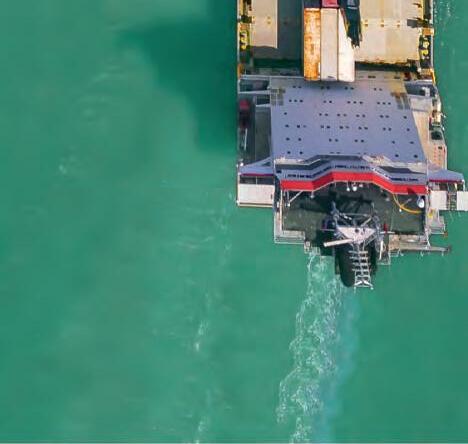




On September 3, 2025, a Peruvian appeals court ordered the release of former President Martín Vizcarra, who had been detained on corruption charges. His abrupt release has reignited debates over judicial independence and the country’s chronic political instability.
KEY STATS:
Over the past two decades, six former Peruvian presidents have faced criminal investigations or imprisonment. This revolving door of corruption has weakened public trust and deterred foreign investment, even as Peru remains rich in copper, gold, and lithium.
Markets reacted with a minor selloff as investors weighed renewed instability risks. Analysts warn that recurring corruption scandals are eroding confidence in governance � pressuring Lima to rebuild institutional credibility amid economic headwinds.
Police officers and a dog guard the prison in Lima, Peru, after former President Vizcarra was recently freed
Peru’s sovereign bonds dipped 1.7% following the court order
Currency then weakened 0.8% against the US dollar in a slight decrease
Approval rating of judiciary fell to 27% according to national polls
Corruption perception index rank: 101 of 180 (Transparency Int’l, 2025)
Mining exports in the country are down 5% year-on-year

As the world debates whether AI will replace us, the more profound question is whether it can truly understand us. The next frontier of artificial intelligence isn’t automation but empathy: technology that unlocks global understanding, thus augmenting human connection rather than eroding it
WORDS BY Marco Trombetti CEO, TRANSLATED
man workforce, the next phase of progress will be towards better understanding us. In this respect, Translated is leading a pioneering project: DVPS (Diversibus Viis Plurima Solvo), backed by a €29m European seed investment across 20 partners in nine countries, precisely to tackle this challenge. DVPS is about moving beyond language models that digest text and images collected in the past, and into models that sense vision, audio, and sensor input, models that engage in real time with the physical world and have a greater contextual awareness.



As the list of companies citing AI efficiencies as the rationale for staff restructuring grows, many have rushed to speculate about the future of work and to surmise that the next logical step for AI is towards replacing humans in the workforce. But, from where I sit, at the intersection of translation and AI sectors, the more compelling transformation is not simply what AI replaces, but how AI is learning, or failing, to understand the human dimension – eventually the human touch – behind every action or task.
As a true believer that language is the most important factor for human evolution, I founded Translated in 1999 to help people translate their words, and indeed cultures, all over the world, by allowing everyone to understand and be understood in their own language. Since AI is powering the possibility for increased connection, I believe that our industry is the perfect vantage point from which to consider the wider world.
Firstly, because it was with the combination of language and AI that saw the first mass adoption of use: in large language models that answer our questions in full sentences and tailor their responses based on our preferences.
Decades of research on machine translation – and indeed language – have enabled this. AI is in turn enabling the translation of language. However, despite its increasing speed and accuracy, one thing remains abundantly clear to experts: it does not replace the need for human sensitivity. Instead, it can perform the repetitive and monotonous tasks that occupy the time of skilled experts and allow them to focus on more complex elements of their roles, most notably those parts of translations that are most steeped in emotion and in ‘humanness.’
For many businesses, the discussion around AI still revolves around productivity gains and potential labour displacement: ‘Which jobs will go?’ and ‘How many will remain?’ These questions we see posed over and over and are, of course, important to provide answers to, not only for those fearing replacement but for future generations questioning what the world of work will look like for them. Perhaps though, the more important questions are ‘What do humans do best?’ and ‘How can AI enable us to do more of this?’
THE QUESTION IS NO LONGER WHICH TASKS AI CAN PERFORM, BUT HOW IT CAN ELEVATE HUMAN POTENTIAL
Undoubtedly, for AI to work in partnership with a hu-
Equally, this progress must be assessed and managed appropriately, and global conversations are necessary to achieve this. I was recently invited to participate in the World Meeting on Human Fraternity in Rome. The discussion saw top AI scientists, including Nobel Laureate Geoffrey Hinton, the most cited AI scientist Yoshua Bengio, and professor and leading author Stuart Russell, come together to share their insight with Pope Leo XIV on the social, cultural and ethical dimensions of AI. The message was clear: AI must serve humanity, not erode its dignity, and must be anchored in dialogue and care. It is with no surprise that this group agreed that the two most significant positive impacts AI can have are ‘scientific discovery’ and ‘global human understanding.’
Leading in the age of understanding
For leaders and organisations, the path forwards demands a shift in perspective. The question is no longer which tasks AI can perform, but how it can elevate human potential. The most successful companies will be those that invest in understanding and context rather than just efficiency. True leadership in the age of AI means embedding empathy and ethics at the core of innovation, ensuring that technology amplifies what is most human about us: our ability to care, to interpret and to connect.
The next decade of AI will not be defined by fewer jobs and faster machines. It will be defined by machines that understand contexts, emotions, and human values, and by humans who leverage that understanding to do what only humans can do: build relationships, innovate culture, and lead with meaning.
When machines fi nally grasp that a sentence is not just a sentence, but an expression of human intent, when they discern not just words but tone, gesture, and cultural context, then we will emerge from automation into augmentation. That is the moment when AI truly becomes a partner in human progress. The real progress of AI will not be measured by how many jobs disappear, but by how many new forms of human value emerge. n




Your trust is the greatest prize for us. With over 1 trillion TRY* in assets under management, we are the largest privately owned asset manager in Turkiye, offering unique opportunities and the widest range of solutions for our clients.
akportfoy.com.tr/en
*As of July 2025 by Capital Markets Board of Turkiye, the regulatory authority of the securities market in Turkiye.
From large language models to whole brain emulation, two rival visions are shaping the next era of artificial intelligence. But as investment in ‘thinking machines’ accelerates into the billions, questions remain over what – or who – will emerge first

BY
WORDS
Scott Rouse
FEATURES WRITER


Over 20 years ago, I sat in a lecture hall while a professor talked excitedly about artificial neural networks (ANNs) and their potential to transform computing as we knew it. If we think of a neuron as a basic processing unit, then creating an artificial network of them would be akin to multiplying processing power by several factors and replacing the traditional view of each computer having one central processing unit, or CPU.
I found the concept of modeling the neurons of the human brain compelling, but frustratingly inaccessible. For one thing: how?
How exactly do we translate the firing of neurons, a complex electro-chemical event that is not yet fully understood, and apply it to computing? This is before we even get into neural communication, the coordinated activity of neural networks and the even more complex questions surrounding consciousness. How exactly do we get computers to ‘think’ in the same way that we do? Back then, I had a laptop that was an inch thick and capable of a relatively limited number of tasks. It seemed
almost unfathomable to think that these ideas could be put into practice alongside the current incarnation of silicon-based chips.
It would take 10 years before a research paper from Google changed everything. In 2017, a team of researchers at Google published a paper with an unassuming title: Attention Is All You Need. Few could have predicted that this work would mark the beginning of a new epoch in artificial intelligence. The paper introduced the ‘transformer’ architecture – a design that allowed machines to learn patterns in language with unprecedented efficiency and scale. Within a few years, this idea would evolve into large language models (LLMs), the type of which was popularised by OpenAI’s ChatGPT. It was the foundation of systems capable of reasoning, translating, coding and conversing with near-human fluency. But this was not the first step.
era of generative AI. Today, these models underpin nearly every frontier of AI research. Yet their emergence has also brought about a deeper question: could systems like these, or others inspired by the human brain, lead us to artificial general intelligence (AGI) – machines that learn and reason across domains as flexibly as we do?
There are now two distinct paths of research for AGI. The first are LLMs – trained on huge amounts of text through self-supervised learning, they display strikingly broad competence in several key areas: reasoning, coding, translation and creative writing. The suggestion here – and a giant leap from lecture hall discussions about ANNs – is that generality can emerge from scale and architecture.
THE COST OF DEVELOPING AI IS, BY ANY MEASURE, EXTRAORDINARY
A year earlier, Google’s Exploring the Limits of Language Modeling had shown that scaling artificial neural networks – in data, parameters and computation – yielded a predictable, steady rise in performance. Together, these two insights –scale and architecture – set the stage for the
Yet the intelligence of LLMs remains disembodied. They lack grounding in the physical world, persistent memory, and selfdirected goals. And this is one of the central philosophical arguments that hampers the legitimacy of this path for AGI. Our ability to learn is arguably grounded in experience, our ability to perceive the world we live in and actively learn from it. If AGI ever arises from this lineage, it may not be through language models alone, but through systems that combine their linguistic fluency with perception, embodiment, and continual learning.
The other path
$15bn
Google’s investment in India for AI infrastructure
$14.3bn
Meta’s investment push for AGI
A year before the project started, in what is often referred to as the ‘Big Bang’ of AI, the development of an image recognition neural network called AlexNet rewrote the book on deep learning. Leveraging a large image dataset and the parallel processing power of GPUs was what enabled researchers at the University of Toronto to train AlexNet to identify objects from images.
As the 10-year assessment report for the HBP concludes, researchers realised that “deep learning techniques in artificial neural networks could be systematically developed, but they often involve elements that do not mirror biological processes. In the last phase, HBP researchers worked towards bridging this gap.” It is this, the mirroring of biological processes, which the patternist philosophy wrestles with. It is the idea that things such as consciousness and identity are ‘substrate independent,’ and are held in patterns that could successfully be emulated by a computer.
SPENDING ON TRAINING
If LLMs represent the abstraction of intelligence, whole brain emulation (WBE) is its reconstruction. The concept – articulated most clearly by Anders Sandberg and Nick Bostrom in their 2008 paper Whole Brain Emulation, A roadmap – envisions creating a one-to-one computational model of the human brain. The paper describes WBE as “the logical endpoint of computational neuroscience’s attempts to accurately model neurons and brain systems.” The process, in theory, would involve three stages: scanning the brain at nanometre resolution, converting its structure into a neural simulation, and running that model on a powerful computer.
If successful, the result would not merely be artificial intelligence – it would be a continuation of a person, perhaps with all their memories, preferences, and identity intact. WBE, in this sense, aims not to imitate the brain but to instantiate it.
Running from 2013 to 2023, a large-scale European research initiative called the Human Brain Project (HBP) aimed to further our understanding of the brain through computational neuroscience. AI was not part of the initial proposal for the project, but early successes with neural net deep learning inarguably contributed to its inclusion.
As Sandberg and Bostrom noted, “if electrophysiological models are enough, full human brain emulations should be possible before midcentury.” Whether realistic or not, this remains one of the few truly bottom-up approaches to AGI – one that attempts to build not a model of the mind, but a mind itself.
It is perhaps no surprise that LLMs have taken off when WBE still seems to be in the realm of science fiction. It is undoubtedly a harder sell for investors, no matter how alluring to egocentric billionaire types the idea of being able to copy yourself may be.
The cost of developing AI is, by any measure, extraordinary. The Wall Street Journal recently reported that Google will invest $15bn in India for AI infrastructure over the next five years. The Associated Press indicated that Meta has struck a deal with AI company Scale and will invest $14.3bn to satisfy CEO Mark Zuckerberg’s “increasing focus on the abstract idea of ‘superintelligence’” – in other words, a direct pivot towards AGI.
These are big numbers, especially considering that the EU awarded Henry Markram, co-director of the HBP, just €1bn to run his 10year mission to build a working model of the human brain. Beyond corporate announcements, research institute Epoch AI reports that “spending on training large-scale ML (machine learning) models is growing at a rate of 2.4x per year” and research by market
data platform Pitchbook shows that in 2024 investment in generative AI leapt up 92 percent year-on-year, to $56bn.
For investors, the risk profile of AGI research is, to put it mildly, aggressive. The potential ROI depends not only on breakthroughs in model efficiency, but also on entirely new paradigms – memory architectures, neuromorphic chips and multimodal learning systems that bring context and continuity to AI.
Large language models and whole brain emulation represent two very different roads towards the same destination: general intelligence. To my mind, it seems that neither one can do it alone. LLMs take a top-down path, abstracting cognition from the patterns of language and behaviour, discovering intelligence through scale and statistical structure. WBE, by contrast, is bottom-up. It seeks to replicate the biological mechanisms from which consciousness arises. One treats intelligence as an emergent property of computation; the other, as a physical process to be copied in full fidelity.
Yet these approaches may ultimately converge, as advances in neuroscience inform machine learning architectures, and synthetic models of reasoning inspire new ways to decode the living brain. The quest for AGI may thus end where both paths meet: in the unification of engineered and embodied mind.
In attempting to answer what makes a mind work, we find that the pursuit of AGI is, at its heart, a form of introspection. If the patternists are right and the mind is substrateindependent, a reproducible pattern rather than a biological phenomenon, then its replication in silicon will profoundly alter how we view the ‘self’ if we ever do replicate the mind in a machine. That said, if the endpoint of humanity is being digitally inserted into a Teslabot to serve out eternity fetching a Diet Coke for the likes of Elon Musk, then it might be more prudent to advise restraint.
Jensen Huang, CEO of Nvidia believes that “artificial intelligence will be the most transformative technology of the 21st century. It will affect every industry and aspect of our lives.” Of course, as the man leading the world’s foremost supplier of AI compute chips, he has a vested interest in making such statements.
Perhaps it is best then, to temper such optimism and leave you with the late Stephen Hawking’s warning: “success in creating AI would be the biggest event in human history. Unfortunately, it might also be the last, unless we learn how to avoid the risks.” n
The next era of trading belongs to those who understand before they act. EBC Financial Group blends financial education with professional-level execution, giving modern investors the clarity and confidence to navigate volatility and turn analysis into advantage
WORDS
BY David Barrett CEO, EBC FINANCIAL GROUP (UK)


At EBC Financial Group, we live by our brand mission to be every trader’s North Star by providing a trusted trading platform to our clients across the world. This includes the next generation of traders and investors who demand substance over spectacle. Their biggest need is building real market understanding. It is not just about executing trades, but combining financial literacy with understanding of the broader economic relationships to make informed decisions in a very volatile market. In contrast, many platforms focus on gamification and social features that can amplify behavioural biases.
At EBC Financial Group (UK) and the Group as a whole, we find young investors seeking genuine financial education combined with professional-grade tools which they can use to apply their knowledge. Thus, we invest heavily on both fronts while positioning ourselves as every trader’s North Star. Advancing financial literacy is an ongoing effort. EBC Financial Group does its best to meet investors and traders at different points of their investing and trading journey. We do this through structured educational programmes, starting with market fundamentals and risk management principles, delivered via the EBC Trading Academy. Our multi-format approach includes over 1,000 webinars in the last quarter in various languages catering to our growing global audience. Clients and nonclients alike can tune in to our ‘Pulse 360°’ podcast on Spotify, which features experts from different disciplines covering trading insights and market outlook.
Experiential learning is as important as the theoretical learning. Therefore, our users have access to hands-on trading tools where they can apply what they have learnt. For qualified clients on the EBC Financial Group platform, Smart Copy Trading provides an-
other learning dimension: observing experienced traders’ decisions in real-time before developing independent strategies. We found contextual learning works best – education paired with practical tools rather than theoretical content in isolation.
As digital natives expect institutionalquality execution, we offer advanced charting and analytics complementing our educational foundation. With experience and education, our clients will be able to interpret and understand what this technical information means and adjust their trades accordingly. The goal is to create informed traders, not just active ones. Technology is also a tool that we use to strengthen trust. The pace of change is extraordinary with the complex, volatile market, but the focus across our multijurisdictional regulated entities has always been on infrastructure that delivers stability, security, and fairness for clients. We are continually upgrading our execution systems and deepening liquidity relationships. Innovation for us is less about chasing trends and more about ensuring clients trade in reliable, transparent environments resilient to shocks with nearzero downtime.
Our goal across the global EBC Financial Group is to expand access to institutionalquality instruments for qualified traders and investors. Clients have access to multi-asset classes including over 200 CFDs spanning multiple asset classes including FX, commodities, indices, stocks, ETFs and Bitcoin CFD. This includes over 100 US-listed ETF CFDs from major issuers including Vanguard, BlackRock and State Street Global Advisors, giving eligible clients real-time exposure to global themes such as clean energy, tech, and emerging markets, with competitive fee structures.
We are not just keeping up with technological evolution, we are building infrastructures that anticipate where trading technology needs to go. For instance, low execution latency is critical to client success during the

execution infrastructure for our professional clients, a benefit that extends to our clients across the world.
With speed and precision being the cornerstone of our technology infrastructure, EBC Financial Group’s platforms feature smart liquidity routing that connects to multiple toptier liquidity providers, constantly scanning markets in real time. When spreads widen or liquidity fragments during volatility spikes, the system automatically sources optimal pricing across multiple venues. Our proprietary Trading Black Box becomes essential during market stress. This system manages trade flow automatically, providing eligible clients with enhanced control over pricing and execution timing. These capabilities help manage slippage and execution risk precisely when traditional systems often struggle.
We also engineer our infrastructure to cope with the capacity surges during volatile periods. While many platforms experience slowdowns or rejections during high-volume events, our systems are designed to maintain sub-20 millisecond average execution speed while processing over 1,000 orders per second, with 98.75 percent platform uptime. This combination of speed, capacity, and reliability ensures consistent performance even when market conditions are challenging.
The key differentiator is intelligent routing that anticipates rather than reacts to volatile conditions. Algorithms monitor market depth and liquidity patterns in real-time, pre-positioning for optimal execution pathways before volatility peaks impact other systems. This proactive approach, combined with our infrastructure capacity, means clients can trust
their orders will be executed efficiently when market movements create time-sensitive opportunities.
Volatility is part of the market’s DNA, but resilience comes from preparation through analytical frameworks and risk management discipline rather than short-term positioning. We help clients understand how major policy shifts (central bank decisions, trade tensions, geopolitical events, inflation trends, and supply chain disruptions) create interconnected effects across global markets and different asset classes, while emphasising diversification across assets, geographies, and timeframes.
Investors cannot know what will happen in markets, but understanding the factors driving them is key. We provide advanced market insights and analytical tools to support our clients, with resources to help them track developments and assess the implications for their portfolio based on their specific risk profile. Scenario-based education and adaptive strategies designed to perform across a range of market conditions are also important tools in our client’s toolbox that helps them rule the markets.
Market movements create opportunities. Capitalising on them requires sound understanding of market dynamics and economic cycles. As part of our mission to advance financial literacy, we educate clients about how tradable conditions arise from market volatility: price dislocations, momentum patterns, and timing considerations across different asset classes.
Each asset class behaves differently to market developments. Understanding how different instruments behave during volatile periods and developing the discipline to act on analysis rather than impulse is essential.
Practical learning through our platform’s analytical tools allows our clients to read market conditions in real time and make data-backed decisions for their next move.
Far from being prescriptive, we provide the educational framework and analytical capabilities so clients can develop their own approach. They learn to identify volatility patterns and construct strategies suited to their individual financial goals, risk tolerance, and trading style. Volatility becomes advantageous through calculated, informed preparation and disciplined execution, not through speculation. That is where genuine education and financial literacy make the difference.
Where technology meets the human Technology enables scale, but trust is built through people. Technology and human expertise must work in concert. Our professional clients benefit from direct access to relationship managers who understand both regulatory requirements and market dynamics. Clients also receive 24/7 multilingual customer service, so people receive knowledgeable assistance, not just technical support.
Clients often tell us that knowing they can reach an experienced professional during market movements is as valuable as the technology itself. During volatile periods or when navigating complex strategies, human insight becomes essential alongside automated systems.
These positive experiences have contributed towards EBC Financial Group receiving numerous accolades, including World Finance ’s World’s Best Broker and Best Trading Platform in three consecutive years following prior wins in the Best CFD Broker, Best FX Trading Platform and Best Trade Execution categories. I have explained how we approach education for our user base, but we also encourage people to form communities based around our educational initiatives. Here clients can learn from experts and each other, share experiences and build relationships that extend beyond our platform.
It is our belief that sophisticated technology actually enables more meaningful human interaction, rather than creating distance. When routine processes are automated
efficiently, our teams focus on what matters most: providing strategic guidance and building the trusted connections that keep clients confident in dynamic markets.
The democratisation of finance has fundamentally altered both client behaviour and market structure. Technology has unbundled financial services, making complex trading accessible to broader, less experienced audiences – creating both opportunities and responsibilities. Enhanced market participation now extends beyond traditional highnet-worth individuals. We are seeing digital platforms attract wider, younger demographics entering markets for the first time, although ease of access doesn’t automatically translate to genuine financial literacy.
Gamification and social features engage users while amplifying behavioural biases and promote short-term speculation. The negative consequences of allowing uninformed trading impacts lives and livelihoods. Trading and investment should be done responsibly and sustainably. Clients will be able to focus on key signals and decide on the trades within their risk appetite when they have been equipped with the knowledge, skills, and awareness needed. This is why EBC Financial Group’s education-first approach matters. Across our entities, we prioritise developing informed decision-makers over simply enabling transactions.
Structurally, markets are fragmenting, with liquidity dispersed across regions and platforms. This unbundling has created specialised players offering targeted solutions, intensifying competition and forcing industrywide innovation. Regulatory frameworks are adapting at different speeds across jurisdictions. Our subsidiaries operate under supervision from top-tier authorities including the UK’s FCA, Australia’s ASIC, the Cayman Islands’ CIMA, and Mauritius’ FSC, with more regulatory licences in the pipeline. This multijurisdictional oversight ensures we maintain the highest standards of transparency and client protection across all the markets we serve. Our approach is to adopt the highest standard and best practices and apply them throughout the group. Ultimately, these regulations exist to protect investors based on their experience and risk appetite. This strict compliance also leads to continued trust in our platform.
We strongly believe that the future will belong to platforms that combine institutionalquality technology with comprehensive education: empowering the next generation of traders to rule the markets through informed decision-making. n

A masterclass in adaptability, Libertex Group explains how it continues to evolve and better serve its global clientele with a well-balanced portfolio of finely tuned online trading platforms and state-of-the-art technologies
With a history dating back to 1997, the Libertex Group has established itself as a leading international fintech powerhouse. As one of the most trusted names in global online trading, it operates both the multi-award-winning Libertex broker and the newly launched LBX broker, which collectively provide traders and investors access to a broad range of financial worldwide markets. Its comprehensive CFD offering spans commodities, stocks, Forex, ETFs and cryptocurrencies, while clients also have the option to invest directly in real stocks – further enhancing the versatility and appeal of its platforms.
But it is not just about quantity; what truly sets the Libertex Group apart is the quality, security and depth of its services – a set of characteristics that keep existing clients satisfied while attracting new ones daily. In addition to world-class account security and the peace of mind that CySec and FSC Mauritius regulation brings (depending on the jurisdiction), the Libertex Group’s clients get access to advanced, industry-standard trading tools like MT4 and MT5, as well as the company’s own award-winning proprietary platform, Libertex. This won the 2025 gong ‘Best Online Trading Platform’ at the ninth annual Fintech Breakthrough Awards, while – on account of its overall offering – the broker was also named ‘Best Global Broker’ at the Ultimate Fintech Awards this year.
Multiple awards aside, it is the emphasis on stable, responsive, and reliable technology that has won the Libertex Group the trust of millions worldwide. In a changing world, the broker is constantly upgrading its security protocols and the speed of its infrastructure in order to stay ahead of the curve in this
fast-evolving space. Meanwhile, the Libertex platform’s in-depth and in-built live analytics, charts and technical analysis tools give more experienced traders a wealth of actionable information and insights right at their fingertips, making it ideal for tech-savvy and well-informed market initiates.
For the Libertex Group, it isn’t merely a matter of providing a reliable, trustworthy and interactive service to its millions of clients; there is a clear obligation to go beyond the bare minimum to ensure that clients have the resources to educate themselves through initiatives such as the Libertex Academy. This educational tool offers a range of courses and training exercises to help new entrants put their best foot forward. Both LBX and Libertex offer free demo accounts with a virtual balance of up to $100,000 to enable less experienced users to put their newly acquired knowledge into practice risk-free, before trading for real.
only a socially responsible one, it also works to overcome hesitancy in traditionally more conservative savers and is often a deciding factor for traders to choose one of the Libertex Group’s brokers over less welcoming competitors.
The rise of LBX
Always evolving, it was the desire to reach new clients and previously untapped markets that led the Libertex Group to create LBX – a new online trading broker with a focus on highgrowth, emerging markets. As an extension of the Libertex Group brand, it retains all the experience, regulatory oversight, and global credibility that the group has amassed over its 28-year history, while adding unique local market knowledge and a refreshed approach tailored to the modern age.
SUCCESS IS NOT ONLY MEASURED IN TRADING RESULTS, BUT ALSO IN LIVES CHANGED FOR THE BETTER
This has been of particular significance in light of the continued low-interest-rate environment in which investing has become the new saving. People who had never even heard of ETFs or index funds are diving into the world of investment in a bid to prevent the erosion of their wealth by sub-inflation savings yields. In order to succeed, they need a broker like Libertex or LBX that is willing to help them get to grips with this complicated landscape. This approach is not
LBX is built around the broker’s ‘Trade ON’ philosophy, empowering traders to act with resilience, clarity, and decisiveness when milliseconds matter. Despite its relatively short story so far, LBX was recently recognised as the ‘Best CFD Broker in LATAM’ for 2025 by Global Forex Awards. For added credibility, it is regulated by the Financial Services Commission of Mauritius, whose stringent requirements are internationally recognised as a gold standard, with more regulatory approvals to be announced soon.
LBX’s key advantages include zero commissions, a minimum investment amount of just $20, a $100,000 demo/training account, copy trading capabilities, a wide range of local payment methods, and instant withdrawals. However, the jewel in LBX’s crown is its IB Programme, which has already been awarded with World Finance magazine’s ‘Best IB Pro-
NEVER ONE TO REST ON ITS LAURELS, THE LIBERTEX GROUP IS DETERMINED TO CONTINUE TO EVOLVE
gramme of 2025.’ LBX’s IB Programme brings exceptional benefits like high rebates, attractive commission structures with transparent tracking, long-term sustainable partner growth supported by dedicated teams, and daily payouts. In addition to this they offer official F1 merchandise and VIP F1 experiences.
Strength through partnerships
As strong as the Libertex Group is as a largescale organisation in its own right, it has gone about bolstering its brand recognition and reaching new clients by pairing its brokers with likeminded partners in the world of sport – which shares more similarities than one might think with the fast-paced, high-stakes world of trading and investing. The Libertex Group is a firm believer in the power of sport to inspire, empower and push for success. Hence, it has built a strong legacy of sponsor ing high-profile, internationally renowned
teams. Over the last few years, Libertex has enjoyed successful multi-year partnerships with elite sports teams including Bayern Munich, Tottenham Hotspur and Getafe, to mention but a few. Today, both Libertex and LBX are proud to be official online trading partners of the KICK Sauber F1 Team, thus aligning with a sport built on precision, speed and resilience – a reflection on some of the necessary skills required to be a successful trader today.
But the Libertex Group does not only find its preferred partners within the bright lights and glamour of top-level sports. The ability to bring real change and improve the lives of others is equally important. As part of Libertex Group’s CSR efforts, partnerships with numerous charitable and educational organisations have been established, demonstrating genuine care for the wider community beyond the financial markets and the pursuit of profit.
Two of the main charities that Libertex Group has consistently contributed to over the years are: Hope for Children, which advocates for children’s rights in line with UN and EU standards, and Change One Life, which helps children in orphanages and child-care institutions find families and live fulfilling lives. This ongoing effort to alleviate suffering and share some of its good fortune with the wider world stems from the Group’s firm belief that success is not only measured in trading results, but also in lives changed for the better.
highly secure and feature-rich systems that make Libertex Group brokers, Libertex and LBX, stand out from the crowd; the sales and marketing professionals who bring the knowledge of the brand to millions of users around the world, and a superb customer support team. In short, the Libertex Group has built a family of diverse profiles working together to bring value to its varied customers.
Bearing responsibility for all of this is the company’s senior management, which has a wide range of complementary experience from different markets and contexts, constantly drawn upon to improve the group’s brands and services. Originally joining back in 2011 as Chief Financial Officer, current Libertex Group CEO Michael Geiger leveraged his knowledge of sound financial responsibility and strategic management to reorient the Libertex Group towards future-proof, highvolume assets like cryptocurrencies and new, fast-growing markets in the developing world.
Libertex Group CMO Marios Chailis, meanwhile, has over 25 years of leadership experience in the marketing arena, distinguished by a sharp focus on the financial services industry. He is widely recognised for driving growth at scale, bringing deep expertise in omnichannel marketing, global brand strategy and high-performance acquisition campaigns. From securing headline sponsorships, such as the current KICK Sauber F1 Team sponsorship, to engineering viral moments – like landing a McLaren Solus GT on a superyacht at the 2025 Monaco Grand Prix – Chailis redefines what it means to market at the intersection of finance, technology and culture – and his input has certainly boosted

Never one to rest on its laurels, the Libertex Group is determined to continue to evolve with the times, as it has done so adeptly for the past three decades, and drive on to new heights in the years to come. With LBX and the group’s deeper expansion into new regions, there are many exciting milestones yet to come. The leadership team’s expectation of continued growth seems more than reasonable in the current context of rising adoption of CFD instruments such as crypto and the general trend towards higher-reward invest-
Building on its already extensive reach to traders worldwide, the Libertex Group is now further expanding its global presence, and doing so with remarkable success. The future of the entire Libertex Group is surely bright, and we look forward to seeing it taking shape over
After years of legal wrangling, geopolitical tension and four deadline extensions, TikTok is finally being transferred to US ownership. Yet beneath the fanfare, China still holds the upper hand – keeping control of the algorithms that made TikTok a global cultural force
WORDS BY Angela Huyue Zhang PROFESSOR OF LAW, UNIVERSITY OF SOUTHERN CALIFORNIA





After four extensions of the statutory deadline to ban TikTok or force its Chinese owners to divest, US President Donald Trump has now signed an executive order transferring the app to US ownership. The announcement follows years of diplomatic sparring, bureaucratic manoeuvring, repeated efforts by federal and state governments to curtail the platform and even a ruling from the US Supreme Court. Has the fate of America’s most viral social media app finally been decided?
Those expecting closure will be disappointed. This latest ‘framework consensus’ still leaves China with significant leverage over TikTok. What looks like a victory for the US may well be Chinese President Xi Jinping’s biggest strategic triumph yet.
On the surface, the agreement does look like a grand bargain for America. Oracle and a consortium of US investors would control 80 percent of a newly created American entity that would run TikTok’s operations in the US. All US user data would remain on Oracle’s servers in Texas, and the new company would license TikTok’s prized recommendation algorithms and retrain them on American data. Six of the entity’s seven board seats will be held by Americans. In other words, Americans’ data and TikTok’s servers and algorithms would all appear to be firmly under US control. And the deal even carries financial rewards for the Trump administration, in the form of a multibillion-dollar payment from investors (effectively a fee for brokering the settlement with the Chinese).
Look more closely, however, and the picture is less reassuring. After all, global investors already own roughly 60 percent of ByteDance, TikTok’s parent company, while the company’s founders own another 20 percent and its employees the remaining 20 percent. Thus, the deal merely raises US ownership of the American operation to 80 percent, leaving ByteDance with just under 20 percent –
but still the single largest shareholder. More tellingly, the intellectual property behind TikTok’s algorithms remains firmly in ByteDance’s hands. Far from acquiring the recommendation engine outright, Oracle and other US investors are only receiving a licensed copy. Algorithms are not static assets. Unlike a car or a house, they cannot be transferred once and for all. They are dynamic, data-driven systems that demand constant retraining, fine-tuning, and significant engineering support to remain effective. Oracle may be able to inspect the code, copy it in full, and retrain the licensed version on US data. But the new American TikTok will still depend on China for periodic updates. This raises difficult ques-
approval. The Chinese authorities therefore can make TikTok a diplomatic tool. Should tensions rise over Taiwan, tariffs, Ukraine, or restrictions on Nvidia chip exports, China could delay or withhold licensing approvals, using TikTok as yet another bargaining chip. In this way, the platform has been transformed into a powerful instrument of Chinese statecraft.
Faced with a licensing arrangement that is governed less by legal terms than by shifting geopolitical winds, US investors in the new TikTok should brace themselves for heightened uncertainty. Rather than shifting TikTok from Chinese to American control, this deal merely replaces one form of dependence with another.
Yes, ByteDance will no longer oversee daily content recommendations; Oracle will, easing the US government’s most immediate security concerns. But China will retain residual control over TikTok’s algorithms. It has the
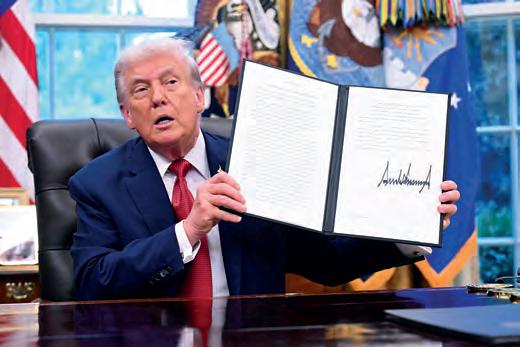
tions: will Oracle even receive those updates; and, if so, can it meaningfully monitor and audit them?
To be sure, what makes an algorithm powerful is not only its architecture but also the data on which it is trained. Yet because the US version will rely solely on American user data, Oracle will lack access to the vast global dataset that makes ByteDance’s cutting-edge models so powerful.
China, meanwhile, will hold the legal levers to restrict or impose conditions on any transfer of ByteDance’s technology. Since 2020, China has classified personalised recommendation algorithms as sensitive technology under its export-control regime. That means every export of updates or improvements to TikTok’s algorithm is subject to Chinese government
“This deal merely replaces one form of dependence with another”
freedom to set the scope of the licence, determine the frequency of updates, and decide whether the US version can keep pace with the global one. Far from diminishing China’s influence, the deal risks entrenching it.
With this agreement, the fear of Chinese access to Americans’ data or direct manipulation of algorithms may fade. But it will be replaced by a subtler and more enduring risk: technological dependence on China, which holds a chokehold over TikTok’s powerful recommendation engine. The Trump administration has simply traded one vulnerability for another. That said, a less competitive US version of TikTok might not be bad for America. Some may even see it as a blessing in disguise. A less competitive TikTok would be a less addictive TikTok. That would ultimately benefit American teenagers – whether or not they realise it. n































The Trump administration is staking everything on stablecoins to sustain dollar dominance and demand for Treasurys, but dangers loom ahead. Alex Katsomitros reports »












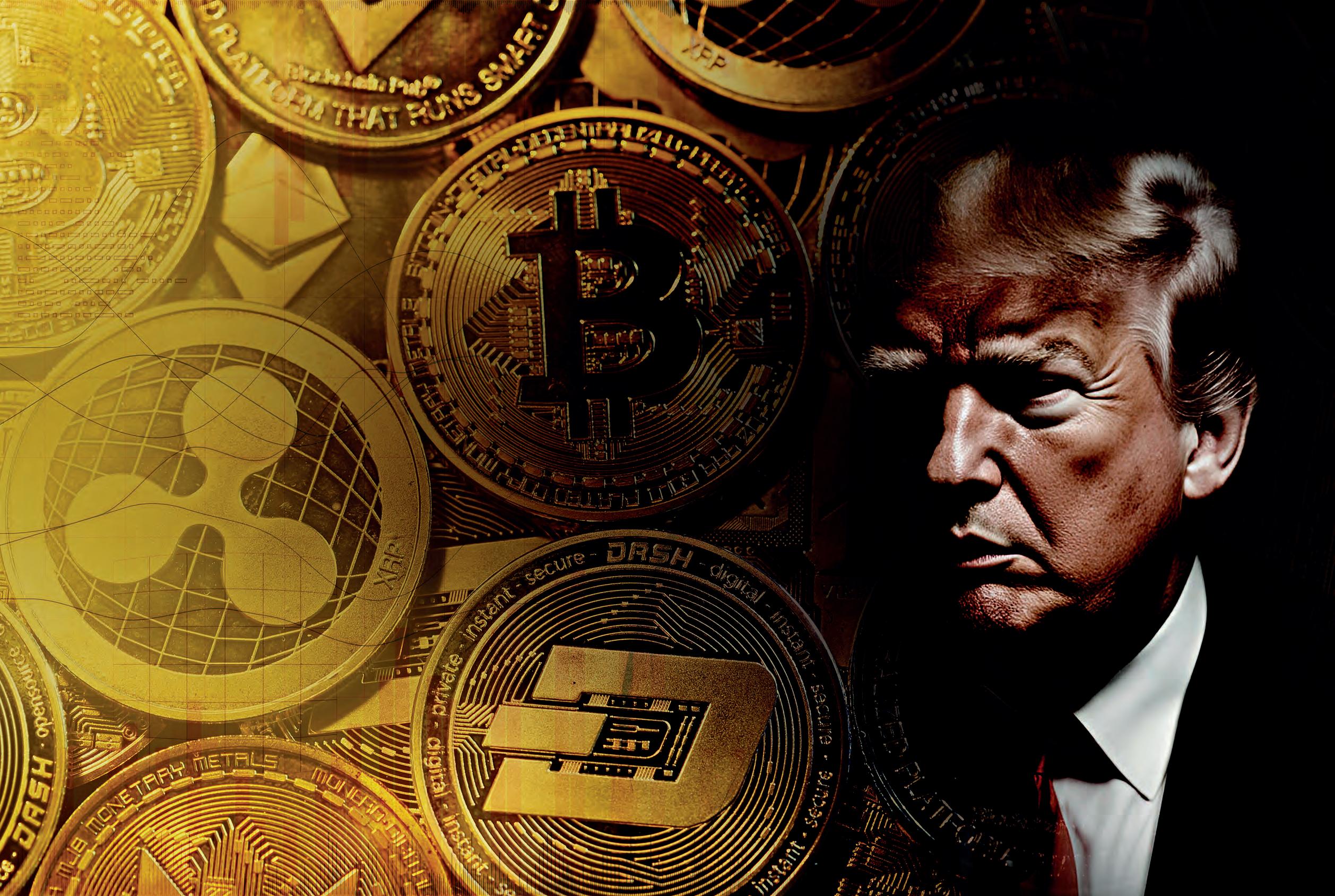
n election night in November 2024, the US crypto industry enjoyed a rare moment of euphoria, with investors celebrating the arrival of the first truly crypto-friendly administration in American history. Bitcoin climbed to a record high of over $75,000. Crypto-linked equities rallied sharply. Donald Trump was hailed as the first American leader who wholeheartedly believed in digital money – and with reason. “If crypto is going to define the future, I want it to be mined, minted and made in the USA,” he had declared on the campaign trail.
Only a few months later, President Trump would deliver on that promise, taking the crypto community to the promised land. Last July, he signed the ‘Guiding and Establishing National Innovation for US Stablecoins Act’ – dubbed the GENIUS Act – which ushered in the first comprehensive federal framework for stablecoins: dollar-pegged digital tokens that underpin the crypto economy. It was a landmark moment for digital money, signalling both opportunity and risk.
The Act lays down strict rules for issuers of dollarbacked digital tokens, requiring full, verifiable reserves held in cash or short-term government bonds (Treasurys), monthly attestations of these holdings, clear redemption obligations, and compliance with anti-moneylaundering and consumer-protection rules. Crucially, it treats stablecoins as payment instruments rather than securities, putting an end to regulatory strife and removing litigation risk for issuers. “We are witnessing a shift of stablecoins from simply being ‘crypto’ or ‘digital currency’ to being core payments infrastructure,” says Mike Hudack, co-founder of Sling Money, a cryptoenabled money transfer app that leverages stablecoins.
Underneath the exuberance lies a deeper strategic calculation: a nod to innovation, but also a deliberate alternative to a central bank digital currency (CBDC). One of Trump’s first actions in his second term was banning US authorities from issuing a digital dollar. By rejecting a government-run digital dollar, a project largely seen as a legacy of the Biden administration, Washington effectively outsourced digital money to the private sector – a move that blends ideology, market pragmatism and politics in equal measure. White House officials have argued that a digital dollar would have placed the government too close to citizens’ wallets, risking accusations of financial surveillance. By contrast, stablecoins offer a market-driven model for digital payments while maintaining the global dominance of the dollar and preserving US financial hegemony in a fast-digitising world. Roughly 99 percent of stablecoins are currently denominated in dollars, meaning that every transaction in them reinforces the greenback’s global reach.
The choice also reflects the administration’s ideological aversion to expanding federal control over money – an issue that galvanised both libertarians and the business community during the campaign. “A CBDC would concentrate financial power within the government, something this administration was never likely to endorse,” says Maghnus Mareneck, co-CEO of Cosmos
Labs, a US blockchain firm behind a blockchain interoperability protocol used by banks. “The administration recognises that stablecoins can modernise the dollar without replacing it.” The legislation was greeted with enthusiasm by crypto firms, long frustrated by years of regulatory ambiguity. Many argued that the Securities and Exchange Commission (SEC) had crippled the industry with regulatory overreach. During his campaign, Trump had pledged to fire Gary Gensler, the Biden-appointed SEC chairman who had pioneered crypto regulation. Gensler stepped down in January, despite his term being scheduled to end in 2026, paving the way for a shift in the agency’s regulatory mindset. In the months following the Act’s passage, the stablecoin market exploded. Once a niche market, total stablecoin capitalisation surpassed $300bn last October, expanding twice faster than the crypto sector, while Citi analysts estimate that it will reach $4trn by 2030. Tether, the dominant dollar-based stablecoin issuer, is seeking up to $20bn of new capital in its latest funding round, which would bring its valuation close to the $500bn threshold. Critics, however, have focused on the act’s lenient treatment of the risky aspects of stablecoins. “What the Act does is vastly expand the network effects that make it easier to launder money and operate in the underground economy. It is important for the government to be able to monitor and audit transactions, and the bill is very light on that,” says Professor Kenneth Rogoff, who teaches international economics at Harvard University and has served as Chief Economist of the IMF. “It does not guarantee timely redemption or provide federal insurance, and it lacks clear rules for dispute resolution, unauthorised transfers, or fraud recovery. Oversight is fragmented across state and federal channels, creating space for inconsistent enforcement and charter shopping,” says David Hoppe, founder of the US law firm Gamma Law, which specialises in cases involving digital assets.
Central bankers warn that a widespread shift to stablecoins could reduce their control over money creation
For the banking sector, the rise of state-approved stablecoins poses both opportunity and existential risk, notably through disintermediation. Few stablecoins currently pay interest, yet if issuers begin offering yield and businesses adopt them for payrolls, trade and settlements, deposits could drain from banks, weakening their traditional model of deposit-funded lending and threatening credit creation. Their balance sheets, already squeezed by digital payment platforms, could shrink further. Up to $6.6trn in deposits could leave bank coffers if crypto exchanges are allowed to offer interest payments or similar financial incentives, estimates a recent US Treasury report, a prospect US banks are urging policymakers to prevent.
Legacy lenders are taking a cautious approach, recognising they still retain certain advantages. “If banks issue their own stablecoins directly, they would be safer, because they have direct access to central bank
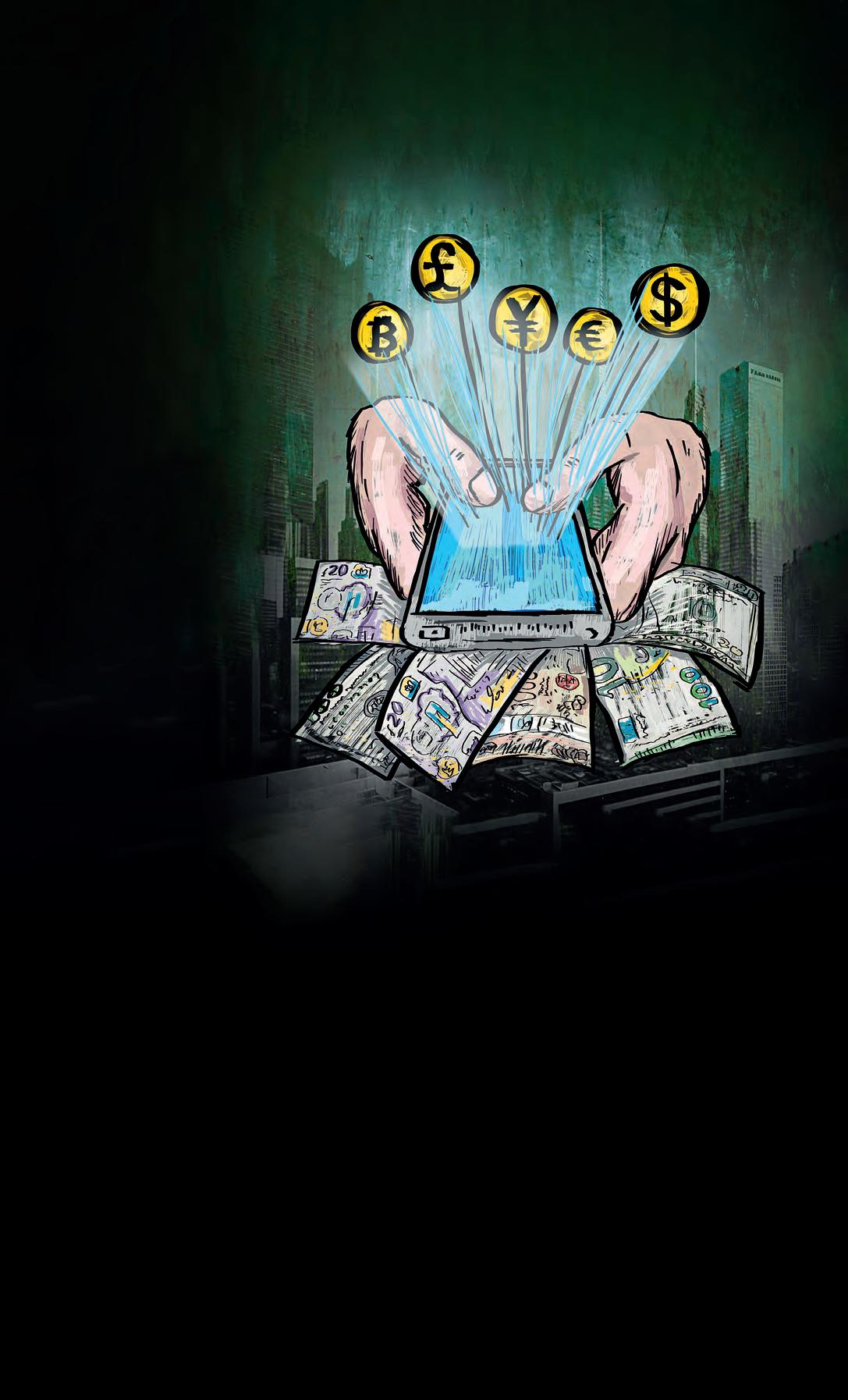
reserves,” says Lucrezia Reichlin, an economist at the London Business School. JPMorgan Chase and Citi are exploring issuance of their own dollar-pegged payment tokens, while nine European financial institutions, including UniCredit and ING, have a euro-denominated stablecoin in the pipeline. “Banks may look to position themselves as the infrastructure and control layer for stablecoin custody, settlement, and on-chain treasury, providing KYC, segregation, and policy controls, so they can capture fee revenue as liquidity and payments migrate on-chain,” says Susana Esteban, Managing Director of the Blockchain and Digital Assets practice at FTI Consulting, a US business consultancy firm. Their end game, she adds, could be tokenised deposits while offering the same ‘24/7, programmable experience’ that stablecoins offer.
Banks may look to position themselves as the infrastructure and control layer for stablecoin custody
At stake is not merely efficiency but sovereignty. The growing role of privately issued dollars could diminish the influence of most central banks, transforming the architecture of international finance. “Stablecoins do not create base currency, so they don’t directly erode the Federal Reserve’s ability to set short-term rates or influence market liquidity,” says Jonathan Church from TransferMate, a fintech payments infrastructure firm. Yet central bankers warn that a widespread shift to stablecoins could reduce their control over money creation and interest-rate transmission, forcing monetary policy to operate through less predictable channels. As more money circulates outside the regulated banking system, interest-rate adjustments might take longer to filter through the economy. The governor of the Bank of England, Andrew Bailey, has recently warned that stablecoins could “separate money from credit provision,” as non-banks assume a greater role in financial intermediation.
International payments group Swift is also racing to adapt, building a shared blockchain ledger with Bank of America, Citi and NatWest to facilitate transactions, notably settlement of tokenised assets, including stablecoins. The rise of stablecoins threatens Swift’s traditional role by allowing instantaneous transfers that bypass intermediaries. Transactions that once took several days and required multiple compliance checks can now occur within seconds, disrupting decades of financial infrastructure building. Swift’s fight for survival serves as a metaphor for the whole financial system. In a world of programmable, borderless money, legacy institutions must evolve or risk irrelevance.
As with much of the Trump presidency, the boundary between public policy and private interest is blurred. Members of the President’s family have launched crypto ventures, including World Liberty Financial, issuer of the USD1 stablecoin, and American Bitcoin, a mining company co-founded by Donald Trump Jr and Eric Trump. A meme-token, $TRUMP, is named after the President himself. Such interweaving of political and commercial interests is hardly new for the Trump
administration, but the stakes are higher in this case. Stablecoins, unlike hotels or golf courses, touch the foundations of the financial system.
For supporters, the symbolism is potent: the selfstyled deal-maker who once built skyscrapers now aims to anchor American influence in digital money. Critics argue that this alignment of public policy with private profit risks eroding confidence in the neutral ity of US financial regulation. Lawmakers and ethics experts have called for clearer safeguards, including restrictions on digital-asset ownership by politicians and senior officials and stronger blind-trust require ments. “The president directs agencies responsible for implementing the Act, while his family benefits from a company whose success depends on those same regula tions,” says Gamma Law’s Hoppe. “Even if lawful, such circumstances create the perception that private gain could influence public policy, which risks undermining confidence in fair enforcement and market integrity.”
Yet for now, the administration appears unfazed. In Washington’s calculus, the digital future of money must be denominated in dollars – even if those are minted by private actors. In that sense, the GENIUS Act is a geo political statement. Both officials and Trump family members frame the policy as a response to de-dollari sation efforts led by China. “Crypto is actually going to be the thing that preserves dollar hegemony around the world,” said Donald Trump Jr at a crypto conference in Singapore, adding: “As stablecoins start becoming the markets and treasuries, that’s going to replace China and Japan and some of these places that say, ‘You know what? We don’t want America to have that power anymore.’”
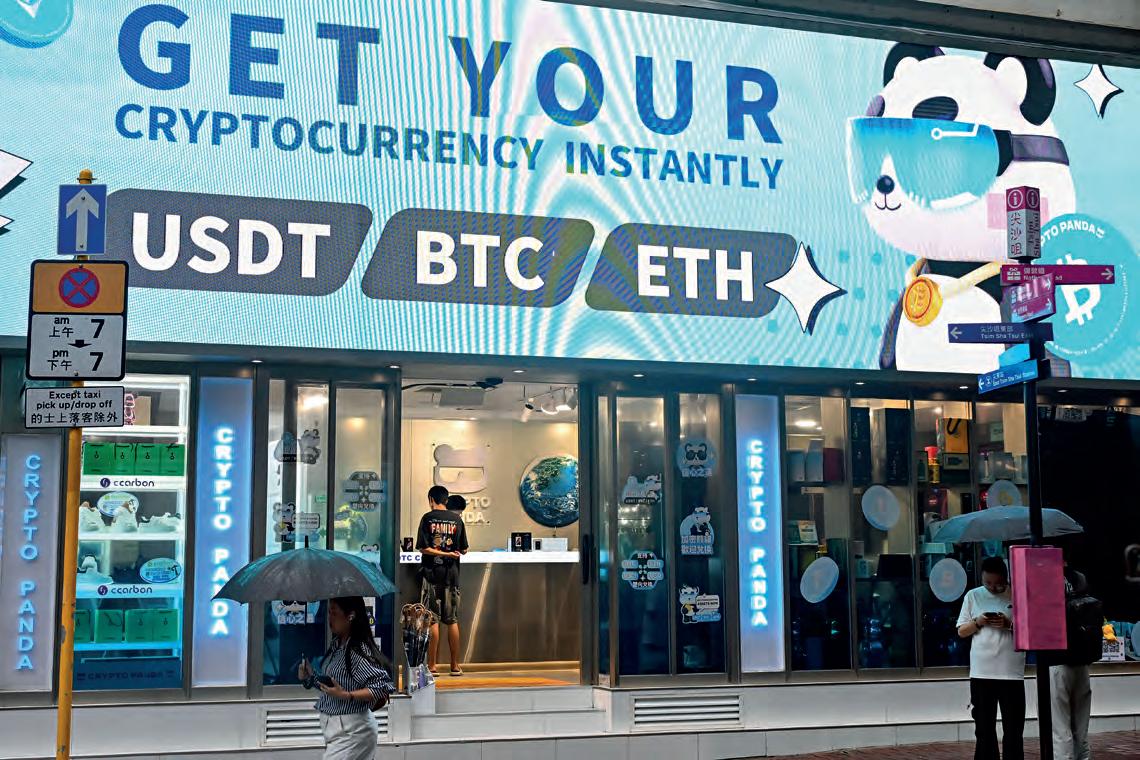
$300bn
STABLECOIN CAPITALISATION IN OCTOBER 2025
One way China is seeking to undermine the dollar is by rolling out its CBDC, an effort intensified after sanctions against Russia targeted Chinese banks accused of helping Russia secure weapons parts. Beijing has also encouraged the use of its cross-border payments system, Cips, while overseas lending in renminbi has also increased dramatically, with outbound renminbi loans, deposits and bond investments by Chinese banks quadrupling since 2020. China is also a main driver behind m-CBDC Bridge, a multi-CBDC platform that facilitates cross-border payments, controlled by the central banks of China, Hong Kong, Thailand, Saudi Arabia and the UAE. “China’s ambition is not to replace the dollar or make the yuan an alternative to it. They know that it would be unrealistic,” says Reichlin, the economist from London Business School. “But they want to defend the payment system in their financial ecosystem and one way to do it is to control the rails for cross-border payments via digital solutions.”
China approaches stablecoins with much more caution. Last summer, the Hong Kong Monetary Authority started accepting applications for stablecoin issuers, a move interpreted as China’s response to the US GENIUS Act. Chinese officials argued that China should respond to US promotion of stablecoins with a renminbi-pegged stablecoin that would boost the yuan’s use abroad. Since then, several Chinese regula-
$4trn
ESTIMATED CAPITALISATION OF STABLECOIN BY 2030
tors, including the country’s central bank, have poured cold water on yuan-based stablecoins, citing concerns that private stablecoins could undermine the CBDC. The regulatory crackdown forced Chinese tech giants such as Ant Group and ecommerce group JD.com, expected to participate in Hong Kong’s pilot programme, to pause their stablecoin issuance plans. “Beijing wants every digital yuan transaction, whether it is domestic or international, to move through systems it can oversee. Stablecoins inherently create alternative payment networks that the state cannot easily legislate, and that introduces risk and potential fragmentation of issuance for this government,” says Mareneck of Cosmos Labs, an expert on Asian stablecoins.
In a world of programmable, borderless money, legacy institutions must evolve or risk irrelevance
The US drive for stablecoin supremacy has also unsettled European policymakers and the European Central Bank (ECB), which is pressing ahead with the introduction of the digital euro. Despite being the first major economic power to establish a comprehensive stablecoin regulatory framework with its Markets in Crypto Assets regulation (MiCA), the bloc does not currently prioritise stablecoins. Experts warn that Europe risks repeating past mistakes by over-regulating a nascent market, allowing American platforms to capture it. “MiCa has a number of restrictions and many in Europe appear to be focused on protecting banks rather than embracing technological innovation. Stablecoins enable easy access to US short-term government bonds from all parts of the world, which also diverts capital flows from the EU and the UK to the US,” says Gilles Chemla, who teaches finance at the Imperial Business School and is co-director of the university’s Centre for Financial Technology. Concerns over sovereignty are driving the EU’s CBDC programme, as it seeks to reduce reliance on US payment companies such as Visa and Mastercard.
Many in Europe appear to be focused on protecting banks rather than embracing technological innovation
However, experts question whether this goal is achievable if dollar-denominated stablecoins are widely used in Europe, and whether a digital euro is the most effective tool to address the issue. “The digital euro in its current design is narrowly focused on the euro area as a means of payment only for private households and with holdings limited to €3,000, while stablecoins offer an international payment scheme that can be used by global companies,” says Peter Bofinger, an economist at Würzburg University and former member of the influential German Council of Economic Experts. A better option for the EU, Bofinger adds, would be integration of its existing national payment systems.
If dollar-backed stablecoins are adopted by the public in the Eurozone, the ECB will be faced with stark choices. “There is a risk of dollarisation. Dollar-backed stablecoins could become what the eurodollar market is now: a big offshore dollar-based market,” says Reichlin from the London Business School, a former ECB director general of research, adding: “If Europe doesn’t develop euro-pegged stablecoins, the old payment system could be dollarised, especially large cross-border payments. Europe is complacent about this risk.” Others, however, consider warnings about dollarisation to be exaggerated. “The ECB is raising the risk of dollarisation to justify the need for a digital euro,” says Bofinger. “There’s no such risk, because currencies are like languages: to switch from a domestic currency to a foreign one, the domestic currency has to be in a terrible state, like in some Latin American countries.”
Another concern for the ECB is that dollar-backed stablecoins could erode the euro’s global role, while their widespread adoption in Europe might weaken the ECB’s control over monetary policy. “Every tokenised dollar transaction strengthens the dollar’s global position, even beyond US borders. A euro CBDC cannot match that momentum, and will likely be slower, more limited, and less compatible with global blockchain systems,” says Mareneck of Cosmos Labs. “It was a mistake of the ECB to think of CBDCs as an alternative to private stablecoins. These are two different things,” Reichlin adds. “CBDC is similar and complementary to cash, whereas stablecoin is complementary to deposits. There is no reason why CBDCs and stablecoins could not coexist.”
Almost two decades after the 2008 credit crunch, policymakers are still haunted by its effects. Stablecoins are expected to be backed with safe, liquid assets and users will be able to redeem their stablecoins at par. “Because stablecoins are not lent out the way bank deposits are, you can argue that in some respects they are likely to be at lower risk than bank deposits, though governments are more likely to bail out banks than stablecoin companies,” says Paul Brody, a blockchain expert at professional services firm Ernst & Young. Yet economists warn that stablecoin issuers effectively function as shadow banks, but without the same capital requirements, access to central bank liquidity or oversight from regulators. Should confidence in their reserves falter, the unwinding could spill into bond markets and cause
liquidity crises, echoing panic seen in 2008 and 2020, and once again forcing governments into politically unpopular bailouts. “If a major stablecoin issuer is unable to meet redemptions or discloses reserve weaknesses, trust could unravel quickly, prompting mass withdrawals. The impact would extend beyond digital assets, affecting wider financial markets that rely on tokenised instruments for settlement and liquidity,” says Krishna Subramanyan, CEO of Bruc Bond, a cross-border banking and payments provider.
One major concern is that speculation could once again outweigh regulatory caution. Although the GENIUS Act prohibits issuance of interest-bearing stablecoins, it does not explicitly ban third parties from offering interest-bearing financial products that involve stablecoins. Experts warn that the creation of such reward-based products could create a parallel deposit market that competes on yield with only a flimsy guarantee of one-to-one convertibility, making monetary control more difficult. “Because stablecoins are vulnerable to runs, a fire sale of their reserve assets – such as bank deposits and government debt – could spill over into bank deposit markets, government bond markets, and repo markets,” the IMF warned in a recent financial stability report. “A practical safeguard is integration rather than prohibition: preserve monetary control by including stablecoin flows in the liquidity toolkit using facilities such as the Standing Repo Facility and Reverse Repo Facility to absorb shocks while supervisors treat major issuers as systemically important payment institutions subject to stress testing and live disclosure,” says Susana Esteban from FTI Consulting.
Security remains a critical factor. Some experts warn that, like other forms of crypto, several stablecoins could be used for illegal activities such as money laundering and are also vulnerable to cyberattacks and technical glitches. Stablecoin issuers will need insurance to reimburse holders in the event of cyberattacks and to cover operational risks, which would add to their costs. Political uncertainty may also fuel volatility, as a future Democratic administration could impose stricter regulation on stablecoins. “Expect a revisit of the CBDC ban, stricter consumer protections, and tighter perimeter rules for issuers regarding resolution, interoperability and wallet safeguards,” says Maja Vujinovic, CEO of Digital Assets at FG Nexus, a digital assets holding firm. By the next presidential election, however, America’s financial experiment with stablecoins may be too big to fail. The wager is bold: that the profit motive of dollar-denominated token issuers will align neatly with national interest. In this sense, the GENIUS Act represents a paradox: it enhances dollar supremacy while simultaneously weakening Washington’s control over money creation. Can this hybrid model of monetary sovereignty – one where Wall Street and Silicon Valley pull the strings of global finance, rather than the Federal Reserve – live up to the expectations of crypto enthusiasts, including the Trump administration, or will it sow the seeds of the next financial crisis?
The answer depends on the same forces that have long defined finance: confidence, liquidity, and the belief that the system, whatever its flaws, will hold. n
Sustainability
ANAVRIN, an innovative livestock complementary feed, reduces methane emissions while enhancing productivity. By advancing climate goals and unlocking carbon credit opportunities, it fosters sustainable growth throughout the global agricultural sector
WORDS BY
Gianluigi Sgarbi PARTNER COO/CFO, VETOS EUROPE
bination of climate benefits and productivity improvements sets ANAVRIN apart, aligning environmental goals with agricultural sustainability.*




Every 10 seconds, human activity emits over 4,000 metric tonnes of greenhouse gases (GHGs) into the atmosphere. While carbon dioxide (CO₂) remains the most abundant of these gases, methane (CH₄) is far more dangerous in the short term. Despite accounting for only about 20 percent of total GHG emissions, methane is over 80 times more potent than CO₂ over 20 years when it comes to trapping heat in the atmosphere.
Methane’s short atmospheric lifetime – approximately 12 years compared to CO₂’s centuries – means that cutting methane now can deliver significant near-term climate benefits. According to the Intergovernmental Panel on Climate Change (IPCC), methane mitigation is one of the most powerful levers we have to slow global warming over the next two decades. Among methane sources, agriculture is one of the most significant contributors globally, and within agriculture, livestock –especially ruminants like cattle – are primarily responsible. Methane is emitted mainly from the digestive processes of ruminants, a phenomenon known as enteric fermentation. In cattle, this methane is released mostly through belching and accounts for a significant proportion of agricultural emissions.
As the global population continues to rise and demand for meat and dairy products increases, this problem is expected to intensify. The world’s cattle population currently stands at around 1.5 billion and is expected to grow significantly by 2050, especially in developing regions with rising incomes and food consumption. Without effective mitigation, livestock methane could jeopardise global climate goals, including those set by the Paris Agreement.
While various technologies have been proposed to reduce methane emissions from livestock, demonstrating both a measurable
impact and scalability in real-world conditions remains a challenge. The need for a solution that is effective, scalable, economically viable, environmentally friendly and scientifically sound has never been more urgent. This is the problem our solution was built to solve.
We have developed ANAVRIN, a blend of essential oils, tannins and bioflavonoids carefully selected to support and improve ruminal functions while counteracting methane production. Essential oils play a crucial role in the growth kinetics of certain bacteria. Tannins have positive effects on protein metabolism and possess anti-inflammatory properties, while bioflavonoids act as powerful antioxidants.
By maintaining a stable ruminal environment, enhancing the functionality of beneficial bacteria while controlling the growth of methanogenic ones, ANAVRIN helps improve ruminants’ zootechnical performance and simultaneously reduces methane emissions. ANAVRIN not only cuts emissions but also enhances animal productivity, creating a powerful incentive for adoption and enabling rapid, global-scale impact. This unique com-
OUR MISSION IS NOT ONLY TO REDUCE EMISSIONS BUT TO EMPOWER FARMERS AS KEY CONTRIBUTORS TO CLIMATE SOLUTIONS
Our technology is grounded in rigorous scientific validation. Over the past several years, we have partnered with leading research institutions and universities to conduct a series of in vivo and in vitro studies across diverse regions and cattle breeds. The findings, published in peer-reviewed scientific journals, consistently confirm that ANAVRIN reduces methane emissions from enteric fermentation by an average of 10–16 percent in terms of methane production grams per head per day (g/ head/d). It also improves milk production in dairy cattle and weight gain in beef cattle, with milk yields increasing by 3.2–3.8 percent in energyand protein-corrected milk, and average daily weight gain rising by 5.5–6 percent (kg/head/ day). Furthermore, it improves feed conversion ratio efficiency in both beef and dairy cattle by 6–8 percent, meaning animals require less feed to achieve the same or better growth or milk output. Importantly, studies show no adverse effects on animal welfare or product quality, with some reporting improvements. These results have been consistently repli-

cated in various climates, production systems, and animal types, demonstrating that ANAVRIN is ready for global deployment.
Recognising the broader potential of our technology, we initiated a comprehensive decarbonisation project in 2020, beginning in Uruguay, a country renowned for its progressive approach to sustainable agriculture. In collaboration with Verra, the world’s leading standard for carbon credit certification, we launched the first carbon credit project in the livestock sector in South America, specifically targeting methane reduction.
The project’s objectives are to quantify and verify methane reductions in real farm settings using ANAVRIN, translate these emission reductions into verified carbon credits under an internationally recognised framework, and establish a standardised implementation model that includes a regulatory
approval pathway, farmer training protocols, methane measurement procedures, and a carbon credit certification process.
The Uruguay project, which has already received initial approval from an independent verification body approved by Verra, has paved the way for global expansion. This model has since been implemented in Italy and Spain, with preparations underway for launches in Brazil, Costa Rica, Argentina, Chile and Australia. This growing momentum reflects the increasing interest from farmers, governments, and sustainability leaders who seek practical solutions for reducing methane emissions.
We are also working closely with two globally recognised climate and carbon advisory organisations whose expertise is guiding us toward global Verra protocol validation for our method. Climit, an experienced consulting firm with a track record in developing and implementing carbon projects worldwide,
coordinates initiatives in South America. Rete Clima, a specialist in helping companies develop mitigation strategies to reduce their greenhouse gas footprint and achieve a longterm competitive advantage, serves as the focal point for the project in Europe.
One of the most innovative aspects of our project is the ability to monetise methane reductions through carbon credits. Under the Verified Carbon Standard (VCS) from Verra, emission reductions generated by farmers using ANAVRIN can be converted into tradeable carbon credits. This opens an entirely new revenue stream for livestock producers, one that is independent of market prices for meat or milk and instead tied to the global demand for emissions reductions. Farmers become part of a new class of environmental stewards, compensated for their role in helping the planet. This approach can be especially transformative for small and medium-sized farms, which often operate with narrow profit margins and face increasing pressure to adopt sustainable practices without sufficient financial support. Our mission is not only to reduce emissions but to empower farmers as key contributors to climate solutions.
The path forward involves scaling our technology and carbon credit framework across regions and livestock production systems. Over the next five years, we aim to secure global Verra protocol validation for methane reduction via ANAVRIN, expand our carbon credit projects to at least 10 more countries, collaborate with governments, cooperatives, and NGOs to encourage adoption, invest in farmer training and support services, and build robust measurement, reporting and verification (MRV) infrastructure.
We are committed to maintaining scientific integrity, transparency and inclusivity throughout this process. Farmers, researchers, policymakers, and sustainability leaders all play a crucial role, and we welcome collaboration at every level. Our work has already been recognised with the award for ‘Best Innovation in Livestock Decarbonisation,’ a testament to the technology’s potential and the measurable impact it is delivering. This recognition is more than a milestone – it is a driving force behind our continued growth, innovation and expansion into new regions and projects. We are only at the beginning and remain committed to bringing our proven solution to a global scale. n
*Results may vary based on farm conditions. ANAVRIN’s regulatory status varies by jurisdiction. Carbon credits are subject to final Verra protocol validation.
Sustainability

As fossil fuels continue to dominate global energy use, market mechanisms are quietly driving change. Environmental commodity markets are pricing carbon, mobilising investment, and accelerating the energy transition – turning climate ambition into a bankable, scalable reality
WORDS BY Marijn Van Diessen CHIEF EXECUTIVE, STX GROUP


Despite strong global momentum to accelerate decarbonisation, fossil fuels still have a strong hold of the energy use across most sectors. The IEA reports that industrial energy consumption is still dominated by fossil fuels, in particular coal; and transportation relies on oil products for nearly 91 percent of its energy. As of the first half of 2025 however, the global energy supply shows a more positive picture as renewable energy overtook coal as the leading source of energy for the first time in history. But that was no miracle; that is market logic in action. The environmental commodity markets have played the role of scaffolding by providing the framework and support on which the energy transition can be built.
To explain the concept of environmental commodity with a simple analogy: If a homeowner wants to lower his or her carbon footprint, they might install some solar panels. But presuming they live in a block of flats, they might ask a friend to put solar panels on their roof instead. The flat owner helps the friend to fi nance that and in return can claim that they have neutralised the carbon output of their flat. What those homeowners are doing is creating a marketplace for decarbonisation opportunities, which is exactly what is happening at a macro-level between energy producers, corporates and major industry. It allows people who want to make moves to decarbonise, but who might be constrained. It allows them to invest in the move to decarbonise elsewhere. Similarly, it also enables people who have the opportunity, but not the finance, to get their projects off the ground.
The levers of transition
Emissions Trading Systems (ETS) that put a price on emissions were first launched in 2005. In addition, renewable energy certificates (GOs, IRECs, RECs) that link clean energy generation with consumer demand and fuel mandates (LCFS, REDIII) that reward low-carbon alternatives have gained their importance as tools to put a price on emissions and address environmental impact. These markets exist not to virtue-signal but to account for the cost of emissions and make decarbonisation bankable. Just as in other markets, traders, like us at STX Group, come in to facilitate pricing structures and climate solutions that simplify sales and manage risk for both the buyer and the producer. This market mechanism brings more investment to the market and is therefore an essential part of the commodities markets.
these regulations put more pressure on European refineries to ramp up their production of clean energy products. These regulations and increased renewable energy also translate into growing demand for certificates, and that demand makes the transition investable. The future growth of the ‘sustainable economy’ is driven largely by the widening net of regulatory compliance but also has become a lifeline for energy companies operating on markets rapidly shifting towards renewables.
While the pace of change to decarbonise the global economy is arguably still slow, we cannot ignore the emissions that have been capped and addressed because of market schemes like the ETS and a large variety of environmental commodities. To give a sense of the scale, the global EAC market has grown to over 2,400 TWh annually since its formalisation in the early 2000s, representing a size equal to more than 60 percent of the total electricity demand of the European Union. It now covers approximately 40 percent of the EU’s total GHG emissions and generates €38bn in revenues in 2024.
By my latest count, more than 70 countries now operate carbon pricing systems. Clean fuel mandates and schemes are spreading across North America and Asia. In Europe, numerous clean energy policies and regulations are making carbon a balance-sheet cost for major heavy industries including aviation, shipping and manufacturing. There are plenty more schemes similar to the existing regulation that we expect to see make a big impact in the coming years, such as sustainable aviation fuel certificates (SAFc), white certificates to drive energy efficiency and biofuel mandates. One thing is clear: emissions now carry a price, and that price is rising.
Revenue generated by environmental commodity markets in 2024
The energy transition is ultimately executed through three levers: efficiency, switching towards renewable fuels and feedstocks, and carbon capture. But these levers only move at scale when markets make them investable; for example, when carbon emissions have been properly priced. The good news is, carbon is being appropriately priced and, as a result, environmental commodity markets have been growing rapidly over the last 20 years. New regulations are also taking effect, especially in Europe, across multiple industries. In shipping, FuelEU Maritime is reshaping fuel demand. In aviation, ReFuelEU mandates are driving uptake of sustainable fuels. RED III is pushing EU member states to increase renewables in power and heat. CBAM is levelling the playing field between domestic and foreign producers in the EU. All
I strongly believe that market mechanisms are the most efficient way to align political ambition, corporate obligation and consumer demand to decarbonise, at an affordable cost. Without them, the transition risks becoming slower, costlier and more divisive. n







As trade tensions and tariffs test global supply chains, fashion and consumer-goods companies are learning that true resilience lies not in cost-cutting, but in cultivating transparent, trust-based supplier relationships rooted in responsibility and sustainability
WORDS BY
Joleen Ong
SENIOR DIRECTOR OF BRAND AND RETAILER MEMBERSHIP, CASCALE




Recent geopolitical developments have underscored the fragility of global supply chains, reminding businesses in constantly evolving sectors such as consumer goods and fashion that the strength of supplier relationships is one of the few persistent sources of resilience. Maintaining such relationships through responsible purchasing (based on environmental and social considerations, not just cost and quality) is not only ethical, but strategically necessary. The fashion industry is one of many that is feeling the weight of tariffs
– disruptions that come at a time when it is struggling to make progress toward previously stated climate and sustainability goals. According to a 2025 benchmarking survey by the US Fashion Industry Association, 100 percent of 25 leading apparel brands and retailers identified the current administration’s protectionist stance and volatile trade relationships as a top challenge, and more than half flagged policy uncertainty, especially retaliatory tariffs, as their primary concern. Rather than responding with short-term cost-cutting, though, major consumer-goods companies are making strategic investments to build resilience. For example, retailers such as Walmart and Target have front-loaded inventory to absorb tariff shocks ahead of the holiday season; and Apple chartered cargo flights to transport 1.5 million iPhones from
India, an option made possible by increasing production with a key supplier. These are not just logistical moves; they are evidence of why trust-based, responsive supply-chain relationships matter. Responsible purchasing practices are the glue that holds supply chains together in uncertain times. Gartner reports that nearly half of large enterprises have renegotiated supplier contracts or shifted sourcing strategies to manage risks associated with the tariffs. Tools like supply-chain finance are increasingly being used not just for liquidity, but as buffers against volatility. Such trends reflect a growing consensus: resilient, transparent, and values-aligned supply chains are key to avoiding major disruptions and maintaining competitiveness.
Catwalk conundrum
Unfortunately, the fashion sector is a laggard in this regard, scoring just 66 out of 100 in Cascale’s Better Buying 2025 Garment Industry Scorecard, with year-on-year declines in key areas of responsible purchasing, including cost negotiation, payment terms, and product
$3trn
development (see Fig 1). This is concerning, given that upstream effects can spread when tariffs or other external shocks hit. Production costs often need to be renegotiated, and without strong supplier relationships, shifts in production can increase delays, labour risks, and reputational exposure. The trend is also concerning for its climate implications. The fashion industry, with its complex
global supply chains, is particularly vulnerable to such ripple effects. The US tariffs that went into effect on August 7th directly affect sourcing hubs with an outsize influence on the industry’s carbon footprint. Cascale finds that just 1,800 factories in nine countries account for over 80 percent of measured carbon emissions from the apparel, textile, and footwear industries (see Fig 2). Of these, six countries – China, Bangladesh, Vietnam, India, Turkey and Pakistan – have been directly affected by the new tariffs.
Shifting sourcing away from these hubs might avoid short-term tariff costs. But it could also disrupt ongoing efforts to reduce emissions from these major sources. We saw this in 2018, when tariffs against China drove a production surge in Vietnam. Since it typically takes an average of 14 months for brands to add new suppliers, such rapid shifts cause a ripple effect: labour violations, longer lead times, and quality issues. Without coordinated planning, they risk undermining climate goals and working conditions alike.
Though fashion is a $3trn industry, it is expected to have only a minimal formal presence at this year’s United Nations Climate Change Conference (COP30). As in previous years, travel budgets are being cut, and many teams are being downsized, as the industry slims down in the face of market volatility. Unlike climate-focused gatherings like Climate Week NYC or London Climate Action Week, COP30 will focus more on adaptation finance, carbon pricing, and nature-based strategies than on redrawing trade or sourcing lines.
Nonetheless, those in the industry should pay close attention to get a sense of the global appetite for sustainable finance and investment. Brazil is using its COP30 presidency to promote major initiatives such as the $125bn Tropical Forests Forever Facility, a blended-
finance tool designed to help close the $1.3trn annual climate-finance gap by 2035. Moreover, the discussions about carbon pricing could have a greater impact on international trade and value chains than any industryspecific trade reform.
In short, COP30 will not offer any direct relief on tariffs, but it could shape the longterm rules of the game, linking sustainability targets, sourcing practices, and competitiveness factors through policy levers that lie beyond the fashion industry’s immediate control.
As trade-related costs persist, industry leaders must shift their mindset. Their businesses’ resilience will not come from diplomacy or a presidential handshake, but from trust-based relationships, fair purchasing practices, and innovations to drive sustainability. Brands and retailers should view tariffs not only as cost burdens but as stress tests for their supplier partnerships. Companies that default to price-driven strategies risk eroding their ability to deliver quality, speed, and innovation to today’s conscientious consumer.
By contrast, companies that lean into transparency and collaboration – sharing forecasts to ensure continuity, smoothing demand through level loading, and offering fairer payment terms – are more likely to avoid spikes in labour violations and preserve the market signals needed to sustain decarbonisation investments.
At a time when tariffs and climate-related shifts can alter sourcing strategies overnight, resilient partnerships are more than operational tools. They are strategic differentiators, signalling accountability, stability, and ethical leadership to a growing list of stakeholders who are thinking about the long term. n

The digital banking landscape has undergone another transformative year, as technology, regulation, and consumer behaviour continue to reshape the way financial services are delivered. From the rise of embedded finance and open banking to advances in AIpowered personalisation and cybersecurity, 2025 has been about deepening digital trust and enhancing customer experience. Banks and fintechs alike are finding new ways to blend innovation with reliability – delivering platforms that are smarter, safer, and more intuitive than ever. 2025’s World Finance Digital Banking award winners have stood out for their ability to harness technology in meaningful ways, driving financial inclusion and redefining digital excellence. We celebrate their achievements and the pioneering spirit that continues to elevate digital banking across the global financial ecosystem.
BEST DIGITAL BANKS
REGION
Africa
Asia
Europe
Latin America
BANK
Ecobank
DBS Bank
Revolut
Banco Popular Dominicano
Middle East Commercial Bank
North America
BEST CONSUMER DIGITAL BANKS
BEST MOBILE BANKING APPS
COUNTRY
BANK/APP
Bulgaria m-Postbank
Colombia
Costa Rica
Dominican Republic
Ally Financial
COUNTRY BANK
Bulgaria Postbank
China Fubon
Colombia Bancolombia
Costa Rica
Dominican Republic
France
Ghana
Bancolombia App
BAC Credomatic App
Banco Popular Dominicano
France Revolut App
Ghana
Hong Kong
Indonesia
Kuwait
Malaysia
Mexico
BAC Credomatic
Banco Popular Dominicano
Revolut
Ecobank Ghana
Greece Eurobank
Hong Kong
Indonesia
Kuwait
Ecobank Ghana Mobile App
Standard Chartered Mobile App
BNI Mobile Banking App
NBK Mobile Banking App
Maybank2u App
Banorte Movil
Nigeria Access Bank Nigeria App
Pakistan
Saudi Arabia
Singapore
Taiwan
Turkey
Standard Chartered
Bank Negara Indonesia
National Bank of Kuwait
Malaysia Maybank
Mexico
Nigeria
Pakistan
HBL Mobile App
Al Rajhi Bank App
DBS Digibank App
Taipei Fubon
Garanti BBVA
UAE ADCB
US
Banorte
Access Bank
Habib Bank
Portugal Santander
Saudi Arabia
Ally Mobile App
BEST BANK FOR AI INTEGRATION & DIGITAL TRANSFORMATION
REGION BANK
Africa Discovery Bank
Asia
Al Rajhi Bank
Singapore DBS Bank Singapore
Turkey Garanti BBVA
UAE
US
Mashreq Bank
Ally Financial
DBS Bank
Europe Unicredit
Middle East Commercial Bank
BEST USE OF SOCIAL MEDIA
COUNTRY BANK
Kuwait Gulf Bank

Resilience has once again been the defining quality of the insurance industry. In 2025, firms have contended with everything from the lingering effects of climate-related claims to the growing need for cyber coverage and digital underwriting. At the same time, the sector has made impressive progress in embracing technology – from AI-driven risk assessment to seamless customer experience platforms – all while strengthening its regulatory and sustainability frameworks. The winners of 2025’s World Finance Insurance awards embody this balance between innovation and reliability. They are the organisations that continue to earn policyholder confidence, deliver operational excellence, and redefine what responsible insurance looks like in a digital age.
COUNTRY Best General Insurance Companies Best Life Insurance Companies
Argentina Sancor Seguros Magnal Life
Australia Insurance Australia Group Acenda
Austria Helvetia Austria Helvetia
Bahrain Qatar Insurance Company Al Hilal Life
Belgium AXA NN
Brazil Zurich Sulamerica Cia Saude
Bulgaria Uniqa Uniqa
Cambodia Infinity General Insurance Forte Life Assurance
Canada Intact Group Sun Life
Caribbean RBC
Sagicor
Chile ACE Seguros de Vida SURA
China Ping An P&C Insurance China Pacific Insurance
Colombia Liberty Seguros Seguros Bolívar
Costa Rica ASSA Compañía de Seguros Pan American Life Insurance
Cyprus Genikes Insurance Eurolife
Czech Republic KB Pojistovna KB Pojistovna
Denmark Tryg Nordea Life & Pensions
Egypt AL Mohandes Insurance Company Allianz Egypt
Finland Fennia Mutual Insurance Localitapiola
France Groupama CNP Assurances
Georgia Unison Imedi L
Germany Allianz The Talanx Group
Greece Interamerican NN Hellas
Honduras Ficohsa Seguros Pan-American Life
Hong Kong Liberty Insurance
China Life Insurance (Overseas)
Hungary Groupama Biztosító Magyar Posta Eletbizosito
India ICICI Lombard
Max Life Insurance
Indonesia Asuransi Astra Buana Great Eastern Life
Italy UnipolSai Poste Vita
Japan Mitsui Sumitomo Insurance
Jordan GIG
Kazakhstan Eurasia Insurance
Nippon Life Insurance Company
Arab Orient Insurance Company
Freedom Life
Kenya CIC Insurance Group Britam
Kuwait Qatar Insurance Company GIC

COUNTRY Best General Insurance Companies Best Life Insurance Companies
Lebanon AXA Middle East Bancassurance
Luxembourg AXA Luxembourg Swiss Life
Malaysia Etiqa Zurich Malaysia
Malta GasanMamo Insurance HSBC Life Assurance Malta
Mexico GNP New York Life
Myanmar AYA SOMPO Insurance Prudential Myanmar
Netherlands Unive Aegon the Netherlands
New Zealand Tower Insurance Asteron Life
Nigeria Zenith Insurance Sanlam Life Insurance
Norway Tryg If Skadeforsikring
Oman Qatar Insurance Company Qatar Insurance Company
Pakistan Adamjee Insurance State Life Insurance Corporation
Peru Rimac Seguros Pacifico Seguros
Philippines Standard Insurance BPI AIA
Poland Warta Warta
Portugal Generali Tranquilidad Fidelidade
Qatar Qatar Insurance Company QLM Life & Medical Insurance
Romania Omniasig VIG Metropolitan Life
Saudi Arabia Tawuniya Tawuniya
Serbia Generali Osiguranje Generali Osiguranje
Singapore Great Eastern Great Eastern
South Korea Hanwha General Insurance Kyobo Life
Spain SegurCaixa Adeslas VidaCaixa
Sri Lanka Continental Insurance Ceylinco Life Insurance
Sweden Hedvid Folksam
Switzerland Helvetia Swiss Life
Taiwan Cathay Century Insurance Fubon Life Insurance
Thailand Thaiviat Thai Life Insurance
Turkey Zurich Sigorta Zurich Sigorta
UAE Qatar Insurance Company Oman Insurance
UK AXA UK Aviva
US State Farm MassMutual
Uzbekistan Apex New Life Insurance
Vietnam BaoViet Insurance Prudential

For investment managers, 2025 has been a year that demanded both agility and conviction. With markets influenced by macroeconomic uncertainty, interest rate recalibrations, and renewed focus on ESG integration, firms have been tested on their ability to generate sustainable value in a shifting global economy. Across both traditional and alternative asset classes, top performers have embraced technology to sharpen their analysis, enhance transparency, and deliver meaningful outcomes for clients. The World Finance Investment Management award winners for 2025 represent the very best of that evolution. They have shown vision in navigating risk, creativity in portfolio construction, and leadership in advancing responsible investment practices. We congratulate all of them for not only achieving strong results but also helping define the standards of excellence that will guide the industry into the next chapter.
BEST
COUNTRY COMPANY
Austria Kepler Fonds
Bahrain SICO
Belgium KBC Asset Management
Brazil BTG Pactual Asset Management
Bulgaria DSK Asset Management
Canada Stonebridge Financial
Chile Patria Investimentos
Colombia Sura Asset Management
Denmark Nordea Asset Management
France BNP Paribas Asset Management
Germany Metzler
Ghana InvestCorp
Greece Eurobank Asset Management
Hong Kong
HSBC Asset Management
Jordan Al Arabi Investment Group
Kuwait Kamco Invest
Luxembourg Genève Invest
Malaysia Maybank Asset Management
Mexico BBVA
Monaco Monaco Asset Management
Morocco Wafa Gestion
Netherlands Van Lanschot Kempen Investment
Nigeria FBNQuest
Pakistan Al Meezan Investments
Romania
BT Asset Management SAI
Saudi Arabia Alistithmar Capital
Singapore UOB Asset Management
South Africa Sanlam Investment
Switzerland Vontobel
Thailand UOB Asset Management
Turkey Ak Asset Management
UAE Emirates NBD
Vietnam Dragon Capital

The global transition toward a low-carbon economy has gathered extraordinary momentum over the past year, as governments, investors, and corporations alike accelerate their commitments to net zero. Amid tightening disclosure standards, evolving carbon markets, and growing scrutiny around greenwashing, 2025 has underscored the importance of credible, data-driven sustainability strategies. The winners of 2025’s World Finance Carbon awards have not only demonstrated measurable impact but also shown leadership in integrating climate responsibility into the core of financial and operational decision-making. Their achievements reflect the industry’s broader shift from ambition to action – proving that sustainability and performance are no longer competing priorities but mutually reinforcing goals. We congratulate all our winners for their pioneering work in driving carbon accountability and helping chart a more sustainable path for the global economy.
BEST TECHNOLOGY PROVIDERS FOR CARBON REDUCTION
INDUSTRY COMPANY
Blockchain Solution for Carbon Market Liquidity KlimaDAO
Building Products Supplier Earth4Earth
Carbon Issuance in GreenTech SME Rainbow
Decarbonisation in Aviation LanzaJet
Decarbonisation in the Beef Industry
Vetos Europe
ERW Technology UNDO Carbon
Farming Technology Farmonaut Technologies
Large Enterprise and Financial Carbon Accounting Persefoni
Payment Technology Ecommpay
SMEs Carbon Accounting Plan A
BEST COMPANIES FOR CARBON REDUCTION
INDUSTRY COMPANY
Airports Aeroporti di Roma
Chemicals INEOS Styrolution
Data Centres
Quality Technology Services
Flag Carrier Airlines Turkish Airlines
Footwear CCC
Glass BA Glass
Oil & Gas Harbour Energy
Semiconductors GlobalFoundries
Steel Nucor Corporation
Travel Amex GBT Egencia
Wine Products Corticeira Amorim
BEST RAILWAY TRANSPORTATION FOR CARBON REDUCTION
REGION COMPANY
Africa Lobito Atlantic Railway
Asia Central Japan Railway
Europe Go-Ahead Group
GCC Etihad Rail
North America CPKC
South America Rumo Logística
BEST CARBON MARKETS PROJECTS
PROJECT COMPANY
High-Integrity Carbon Project Developer South Pole
North American Environmental Markets Broker Anew Climate
Swine Livestock Farming SinGEI Project


Innovation has always been the engine of progress in financial services – and in 2025, that engine is running at full speed.
From fintech disruptors to established institutions reinventing themselves through partnerships, data analytics, and generative AI, this year has demonstrated how creative thinking can translate into real-world impact. Whether through smarter payments infrastructure, next-generation wealth platforms, or inclusive financial access initiatives, innovation is no longer a buzzword – it’s the foundation of growth. World Finance ’s Innovation award winners for 2025 exemplify the courage to challenge convention and the ability to turn visionary ideas into measurable results. They remind us that the future of finance belongs to those who not only adapt but also imagine new possibilities. Congratulations to all the trailblazers driving the industry forward.
MOST INNOVATIVE COMPANIES
CATEGORY

The past year has seen the wealth management industry navigate an environment defined by market volatility, shifting client expectations and accelerating digitalisation. As inflationary pressures and geopolitical uncertainty shaped investor sentiment, advisers and firms have been challenged to deliver consistent performance while preserving trust and transparency. At the same time, the rise of holistic financial planning, sustainable investment options, and AI-driven client engagement tools has continued to redefine what excellence in wealth management looks like. The World Finance Wealth Management awards winners of 2025 exemplify the adaptability and insight required to meet these evolving demands. They have demonstrated not only strong performance, but also a commitment to long-term client wellbeing, innovation and ethical stewardship.
BEST WEALTH MANAGEMENT PROVIDERS
COUNTRY COMPANY
Argentina Santander Wealth Management
Armenia Wilco
Australia Westpac
Austria Kathrein PrivatBank
Bahamas Scotia Wealth Management
Bahrain Ahli United Bank
Belgium
COMPANY
AI-Powered Green Fintech for Sustainable Financing CTBC Bank Automotive Interior Design Antolin
Banking Banco Azteca
Chemical INEOS Styrolution
Cybersecurity & Digital Identity Solutions Kapital Bank
Decentralised Climate Finance
Degroof Petercam
Bermuda Butterfield Bank
Brazil BTG Pactual
Bulgaria Compass Invest
Canada RBC Wealth Management
Chile BTG Pactual
China
KlimaDAO
Digital Asset Payments for Emerging Markets Tether
Digital Platforms
ByteDance
Fintech RedCompass Labs
Fuel-Free Power Hybrid Power Solutions Partners
High-Yield Asset-Backed Digital Currency Solutions Kinesis Money
LatAm Digital-First Neobank Banco W
MENA Real-Time Payments
RAKBANK
Midwest and Southwest Financial Services BOK Financial
Open Banking & Hyper-Personalisation Solution Zenus Bank
Payment Technology
Regtech, Risk & Compliance Solutions
Search Engine
Sustainability Accounting Fintech
ICBC Private Banking
Colombia BTG Pactual
Denmark Nykredit
Estonia Raison Asset Management
Finland Nordea Private Banking
France BNP Paribas Banque Privée
Georgia Bank of Georgia
Germany Commerzbank
Greece
Hong Kong
Hungary
Ecommpay
REGnosys
Perplexity
Lele-HCM
Sustainable Infrastructure Finance Stonebridge Financial
Alpha Private Bank
DBS Private Bank
OPT Private Banking
Iceland Islandsbanki Asset Management
India Kotak Mahindra Bank
Indonesia Hana Bank
Italy BNL BNP Paribas
Japan UBS SuMi Trust Wealth Management
Kuwait NBK Wealth
COUNTRY
Liechtenstein
COMPANY
Kaiser Partner
Lithuania INVL
Luxembourg BNP Paribas Wealth Management
Malaysia Bank of Singapore Wealth Management
Mauritius Stewards Investment Capital
Mexico Santander Wealth Management
Monaco Banque Richelieu Monaco
Morocco BMCI Groupe BNP Paribas
Netherlands ING Private Banking
New Zealand Bank of New Zealand
Norway Nordea Asset & Wealth Management
Oman Bank Muscat
Philippines EastWest Bank
Poland PKO Bank Polski
Portugal Santander Wealth Management
Saudi Arabia NBK Wealth
Singapore DBS Private Bank
South Africa Investec Wealth and Investment
South Korea Woori Bank
Spain Santander Wealth Management
Sweden SEB
Switzerland Pictet
Taiwan CTBC Bank
Thailand Kasikornbank
Turkey Akbank Private Banking
UAE
Emirates NBD
UK Schroders
US Northern Trust
Vietnam Genesis Fund Management
As Chile undertakes its most ambitious pension reform in decades, AFP Capital has emerged as a benchmark for innovation, trust and performance. Find out how the company is shaping the future of retirement with technology, transparency and client focus
INTERVIEW WITH
Renzo Vercelli CEO, AFP CAPITAL
How does this recognition impact your relationship with members?
This award is not only a reflection of our internal work but also of the trust relationship we have built with our clients, who have chosen us to safeguard their future. It challenges us to keep improving, innovating, and responding to their needs with responsibility and empathy.


AFP Capital has been recognised by World Finance magazine for its leadership and excellence in Chile’s pension market. CEO Renzo Vercelli shares insights on what this honour represents, the company’s journey toward achieving it and how AFP Capital is navigating the most significant pension reform since Chile’s system began.
Can you describe what it means for AFP Capital to receive this international recognition?
For us, it is a source of great pride, and this recognition validates the effort and dedication of the entire AFP Capital team, who work tirelessly, with innovation and focus, to build a very comprehensive and unique value proposition in the market, enabling us to advise our more than 1.4 million clients in building their pensions.
Chile is currently undergoing a major shift in its pension system. How did you achieve this recognition amid such significant change?
Indeed, this year saw the launch of a major pension reform, which acknowledges the importance of individual capitalisation, adjusts a universal guaranteed pension from the State, rewards the effort of saving for retirement with benefits, and implements a generational fund regime. Private sector administrators like AFP Capital are working with the utmost diligence and excellence to support this process operationally. In this context, amid all the changes required by the regulator to implement the reforms, we have also continued to develop an innovative value proposition for our clients.
Could you describe the key elements of that value proposition and why it might be so competitive in the local pension market?
Our value proposition is based on advisory services, with simple and accessible information, personalised attention, and clear services that make it tangible for each client throughout their accumulation and decumulation stages, so they can make the best decisions. We have seen that it is a differentiated value proposition, recognised and currently valued by our clients; this is reflected in our NPS, service and brand indicators.
What other factors do you attribute to AFP Capital receiving this award?
It has been recognised for its unique and innovative Interactive Streaming system, which is open and reaches more than four million people, including members, retirees and the market. AFP Capital also stands out for its strong focus on digitalising its services, currently offering advisory services through innovations such as remote video calls from anywhere in the country, appointment scheduling for members and retirees, and a website that will become the most comprehensive branch in the future. Additionally, for the third consecutive year, we have achieved international ISO 9001 and ISO 10002 certifications, which recognise the quality of our customer service model and our ability to resolve complaints and enquiries effectively. This makes us the only pension fund administrator with this double recognition, evidencing our ongoing focus on strengthening service channels to offer a people-centred experience.
It is also relevant to mention our leadership in generating returns for our members’ pension funds, which have consistently outperformed the rest of the industry over the past 60 months, thanks to the management of a highly experienced and specialised team in the various assets of portfolio management.
What challenges lie ahead for AFP in Chile, and how does AFP Capital plan to address them?
In March of this year, the 2024 Population and Housing Census revealed data confirming an evident reality: Chile is ageing. The percentage of people over 65 years old grew from 6.6 percent in 1992 to 14 percent in 2024. In the same period, the percentage of people under 14 years old fell from 29.4 percent to 17.7 percent. These figures not only represent a change in age composition but also raise fundamental questions about how we organise ourselves as a society, for today and also for the future.
Pensions are perhaps the most visible face of this phenomenon. The reform may help address this challenge to some extent, but further adjustments are needed. The retirement age in our country, currently 65 for men and 60 for women, seems insufficient in this context of greater longevity. We are facing a complex issue, considered politically incorrect to discuss, but inevitable to address. We must continue to tackle the low density of contributions by promoting a strong culture of long-term savings and moving toward a more formal labour market.
What are AFP Capital’s projections following this recognition?
This recognition drives us to redouble our commitment to excellence. We will continue investing in technology, training and service quality. We are part of SURA Asset Management, the largest Latin American manager of pension funds with more than 23 million clients, and from Chile, we want to keep contributing to our shareholder’s leadership with innovation, closeness, and solid results in profitability.
We also believe that being highlighted by World Finance at a global level is an incentive to continue strengthening trust and excellence in the Chilean pension fund industry, building on what we have demonstrated we do well. n



















Long seen as Russia’s loyal partner in the South Caucasus, Armenia is undergoing a remarkable shift. As Western tech investment pours in, the country is betting on innovation to drive its future. Yet one question hangs over this transformation: can technology help Armenia break free from its deep dependence on Moscow?
WORDS BY
Khatia Shamanauri
FEATURES WRITER


Samvel Khachikyan’s career path may seem unusual, but in many ways, it is quite typical for Armenia – a small Caucasian country of fewer than three million people. His personal journey mirrors the challenges and achievements his homeland has experienced in recent years.
At 17, through hard work and determination, Khachikyan earned a place at the United World College on nearly a full scholarship. But just six months into his studies, he was forced to pause his education to complete mandatory military service. In 2020, he joined the army and served in Nagorno-Karabakh – known as Artsakh by Armenians, a mountainous region at the southern end of the Karabakh range within Azerbaijan.
That same year, after decades of sporadic clashes, Azerbaijan launched a large-scale military operation that became known as the Second Karabakh War. In just 44 days, it broke through Armenian defences and regained seven surrounding districts along with about a third of Nagorno-Karabakh itself. At least 6,500 lost their lives in the conflict.
Having witnessed one of the hardest chapters in his country’s recent history, Khachikyan completed his service with a renewed sense of purpose. “I was a guy with little experience, no knowledge, nothing in my background –just a big desire to do something and a strong hunger to learn,” he says.
Today, Khachikyan is the Director of Programs at SmartGate, a venture capital firm based in both California and Armenia that focuses on tech investments. The company connects Armenian founders with Silicon Valley and Los Angeles, helping them build networks with leading US companies and investors.
When Khachikyan was serving in the military, he recalls vividly that he never once encountered a Russian soldier – yet Russian forces have long maintained a strong presence in Armenia. The Russian 102nd Military Base in Gyumri, under the command of Moscow’s Southern Military District, stands as a visible symbol of the Kremlin’s enduring influence. For decades, Armenia has been regarded as Russia’s closest ally in the South Caucasus. Natalie Sabanadze, a Senior Research Fellow with the Russia and Eurasia Programme at Chatham House, says the relationship was “historically determined – shaped by security and geopolitical priorities.”
She explains, “You choose an ally to balance threats and reduce risks. Historically, the greatest threat to Armenia in the region came from Turkey. Later, as a result of the Karabakh conflict, Azerbaijan also became a threat. To minimise the risks, Armenia chose to maintain its alliance with Russia after the collapse of the Soviet Union.”

“Compared to previous years, Pashinyan is actively trying to shift from a balancing policy to one focused on moving out of Russia’s sphere of influence,” says Natia Seskuria, an Associate Fellow at the Royal United Services Institute (RUSI). “It is not easy to make Armenia a compelling case for investment – especially given the ongoing geopolitical turbulence.”
Armenia’s bet on technology
ARMENIA APPEARS TO BE TURNING ITS BACK ON ITS LONGTIME POLITICAL AND ECONOMIC PARTNER
As a result, two geopolitical axes emerged in the Caucasus: one reinforcing Russia’s dominance – Russia, Armenia and Iran – and the other, comprising Turkey, Georgia and Azerbaijan, aligning more closely with the West. Now, however, Armenia appears to be turning its back on its long-time political and economic partner. In a historic moment, the Armenian president stood at the White House alongside his Azerbaijani counterpart to sign a peace deal brokered by US President Donald Trump. The move signals a bold realignment – and leaves Prime Minister Nikol Pashinyan with a daunting challenge: convincing Western partners that Armenia is ready for closer cooperation.
Technology has emerged as Armenia’s niche – a route to greater political and economic independence. The country’s quiet digital transformation is now drawing the attention of global players. Among the most ambitious projects is an AI data centre by US tech giant Nvidia, slated to open in 2026 – a development few could have imagined just a decade ago.
According to Minister of High-Tech Industry Mkhitar Hayrapetyan, the initiative will be the region’s largest technological undertaking: a $500m investment, the deployment of thousands of Nvidia Blackwell GPUs, and the construction of infrastructure with more than 100 megawatts of capacity.
The country aims to strengthen its technology sector and position itself as a regional hub. But this is not purely a technological ambition – it is also a strategic one. Technological progress could play a crucial role in helping Armenia grow into a more independent and influential state on the global political and economic stage.
Seskuria believes the strategy is logical, given Armenia’s lack of natural resources and limited geostrategic importance. “The niche it is trying to occupy can make Armenia attractive not only to European but also to Asian countries,” she says. “This has an economic dimension first and foremost, but also a political one, since the two are interconnected.”
Armenia’s goals are considered largely realistic, given other successful examples in the wider region. Soon after gaining independence from the Soviet Union in 1991, Estonia decided that building a digital economy and investing heavily in technological innovation would be the best path forward for a small nation with few natural resources. Substantial investments in computer networking and digital infrastructure followed – and today, this former Soviet republic stands as one of the most technologically advanced countries in the world. Perhaps it is a path Armenia is determined to follow.
Khachikyan believes that the driving force behind Armenia’s recent technological pivot is its people. “People started building tech start-ups without any support from inside the country,” he says. “They understood that this could become something important – something that could position Armenia as a regional hub.” According to him, both the Armenian government and the public are now paying unprecedented attention to the country’s tech
Value
TECHNOLOGICAL PROGRESS COULD PLAY A CRUCIAL ROLE IN HELPING ARMENIA GROW
ecosystem – largely because Armenia has the intellectual capacity to compete globally.
There are already companies proving that Armenians have the ability to achieve ambitious goals in technology. ServiceTitan – an Armenian-founded, cloud-based tradesperson software company – became the first Armenian tech firm to list its shares on the Nasdaq stock exchange when it went public last December and was valued at over $10bn. The company was founded in 2012 in California, by Armenian entrepreneurs Ara Mahdessian and Vahe Kuzoyan. Over the past 12 years, it has grown into a leading developer of software to help HVAC businesses solve the challenges they face.
Khachikyan’s SmartGate VC is another example of an Armenian tech company that has found success abroad. The firm has been investing in artificial intelligence, brain–computer interfaces, cybersecurity and other emerging technologies. Khachikyan notes that their work began long before the current AI boom. “We were investing back in 2018, when AI wasn’t a hype,” he says. “We are not just investing in start-ups that use ChatGPT – we are investing in the fundamentals of AI.”
SmartGate also supports early-stage founders through community initiatives. “We are organising lots of events and programmes for start-ups,” Khachikyan explains. “One of those initiatives is the Armenia Start-up Academy, which we launched in 2018 with one simple goal – to help Armenian founders
understand what a start-up really is and give them the resources to build one.”
Collaboration and mutual support have long been essential drivers across Armenia’s different sectors. According to official data, around seven million Armenians live in more than 100 countries worldwide. The diaspora – diverse, far-reaching and active across 24 time zones – plays a vital role in connecting Armenia with the rest of the world and amplifying its influence. “Armenia has always maintained strong connections with both the West and the East, largely thanks to its diaspora. The diaspora factor is very significant, as Armenia has a highly influential global community that closely follows developments in the country,” says Sabanadze.
Armenia’s
As Armenia aims to become a hub for innovation and investment, being a neighbour of Russia presents significant challenges – especially given Moscow’s long-standing role as a close ally in economic, political and military matters. The central question now is whether Russia will step aside and allow Armenia to successfully attract Western investments and establish itself as a technology hub in the region. The answer is far from straightforward, particularly in light of the Kremlin’s aggressive actions in both recent and more distant history. While many believe that Russia lacks the capacity to block Armenia’s Western path, Seskuria holds a different view.
“Militarily, Russia’s resources are quite limited due to the enormous expenditures in Ukraine,” she says. “However, if we look at other hybrid warfare methods in the region –not just in Armenia – Russia has become more active since the war in Ukraine began.”
Seskuria warns that Armenia’s upcoming elections warrant close attention. “Elections are a politically vulnerable moment,” she explains. “Russia often sees them as an opportunity to intervene and influence the outcome using its resources.”
Despite these risks, Khachikyan remains optimistic. He believes that growing international interest and investment signal a bright future for Armenia’s technology sector. Nvidia’s forthcoming project, along with other major initiatives, will provide local researchers and engineers with access to advanced technologies and greater computing power. Yet, he emphasises that one factor will determine whether Armenia’s ambitions can truly take root: peace. “If people feel safer –free from wars and conflicts – growth will be stronger,” Khachikyan says. “Because the most fundamental requirement for developing any economy, or any field, is security.” n






Despite relentless attacks and deep economic disruption, Ukraine’s financial system remains stable — a feat of resilience built on rapid reforms, digital innovation, and international partnerships that are quietly reshaping the country’s postwar future.

WORDS BY David Worsfold
FEATURES WRITER



There are the obvious operational challenges of running banks, insurers and financial advisors when the bombs are falling: staff safety and availability is a constant challenge and Russian attacks on infrastructure mean blackouts, energy supply uncertainty, communications disruption and physical damage to premises are frequent occurrences. Many firms have also been subject to Russian cyberattacks and, as a result, have some of the most robust systems in the world for dealing with those. The success of Ukraine in maintaining a stable financial system was highlighted in a recent report from the Organisation for Economic Co-operation and Development (OECD): “Three years into Russia’s war of aggression, Ukraine continues to show strong resilience. Despite the ongoing hostilities, policy makers and regulators are continuing to work hard to ensure the stability and resilience of the financial system, and to support households and businesses. At the same time, they are progressing reforms to increase
transparency, accountability, and efficiency in the regulatory framework for financial markets and corporate governance, in line with international standards and in partnership with multilateral organisations and partner countries.” Behind this there is an impressive story of innovation in redesigning operational models, especially moving customer contact and service online. This a matter of great pride to Ukrainians.
Keeping the lights on
Olena Sotnyk, Managing Director Rasmussen Global Ukraine, policy adviser to Ukraine’s deputy prime minister for European integration and a former member of Ukraine’s national parliament, told a recent event in London that the war accelerated the pace of digitisation of much of Ukrainian society and business, something that was happening already as the country invested in modernisation to shake off the legacy of the Sovietera bureaucracy.
THE WAR ACCELERATED THE PACE OF DIGITISATION OF MUCH OF UKRAINIAN SOCIETY AND BUSINESS
“I can see, because I work in this area, how even very old style institutions are ready to change
quickly. They are ready to sacrifice their business-as-usual [models] and that has created momentum for Ukraine to switch from the heritage of Soviet Union legacy to a really western model.
“We already have something which even the European Union doesn’t have with digitalisation as that has helped to digitalise the whole country, because when you can’t physically get services or when you can’t physically get documents, approvals etc, you look for more efficient ways in how to do that. Digitalisation is one of the answers we have.” This is not to underestimate the dislocation to business life that occurred when the bombs started falling in February 2022, as Alina Golubieva, CEO, Co-founder at Karpatia Benefits, a financial advisor and insurance firm based in Kyiv, described: “We had a few clients in Kharkiv, we had clients in Kherson and in Mykolaiv, which wasn’t invaded, but still badly affected. And we had a lot of clients with employees in Mariupol as well. So basically, they relocated to either other parts, or we just saw the numbers there drop drastically.
“So, for example, one of our clients, they had about 600 people in Kharkiv. Now it is only 50 people and 200 people are in other parts of Ukraine. Some of the people are relo-
cated outside of Ukraine, but the war affected business immensely.” Golubieva says they had no idea what impact the war was going to have on their business: “We were expecting to lose about 80 percent of our portfolio, but we lost only 30 percent because we haven’t stopped working and we are a digital business. Every day we were online and we were answering clients’ questions.
“It was an amazing team effort. On Febru ary 24, 2022 we regrouped quickly. Some of our people relocated to safer areas of Ukraine if they were able to. We didn’t store any paperbased agreements or anything like that. So we closed the office for two months and it didn’t affect our work at all.
“A lot of our clients relocated their teams outside of Ukraine as well. Because mainly we focused on the IT sector, there were compa nies that could afford to create hubs outside of Ukraine, from Poland to Spain or Germany,” Golubieva explained. None of this would have been possible if major adjustments hadn’t been made to the way firms were regulated and the flow of capital maintained: in short, a rapid re-shaping of the whole financial eco system.
The National Bank of Ukraine (NBU) im mediately put the banking system on a war footing, implementing a range of controls on capital flows, as well as foreign exchange out flows. The NBU also relaxed some regulations around loan forbearance and grace periods, encouraging restructuring of loans where ap propriate. This was against a background of rapid transformation of the country’s bank ing sector as the nation slowly emerged from the trauma of the Revolution of Dignity, also known as the Maidan Revolution, in early 2014. The banking sector was very fragmented, with many smaller banks that were not well capitalised. By the outbreak of the war there were still 71 banks operating in Ukraine. Five of the largest of these were Russian controlled with one, Alfa Bank, which had a 3.2 percent market share, attempting to rebrand itself as Sense Bank. This failed to satisfy the NBU, which nationalised it in July 2023 as it was still deemed to have too strong ownership ties to Russia.
The insurance sector was also impacted by the withdrawal of firms identified as being controlled from Russia. Providna, one of the largest insurance companies in Ukraine, couldn’t provide the proof of beneficiaries to the regulator and had its licence cancelled by
would reduce the value of any (collateralised) state assets. While there is no legal restriction on financial restructuring by state banks, in practice the perception is that any loan restructuring that entails a (partial) write-off may be challenged by law enforcement agencies and considered as misappropriation or damage to state property.”

atically important banks in Ukraine. We areies and villages. These branches are expected to function as one network. We are developing operational solutions to support this network, even under blackout conditions, with backup electricity, connectivity, and cash. Nothing -

This was supplemented with a drive to rid banks of dependence on software and systems developed by Russian or Belarussian companies, part of the building of greater resilience against the anticipated cyber-attacks. Financing investment by Ukraine’s already welldeveloped IT sector was deemed a priority to facilitate this process.
WE ARE SENDING A CLEAR SIGNAL: UKRAINE IS ACTIVELY LOOKING FOR WAYS TO REDUCE RISKS FOR BUSINESS
The NBU also moved quickly to ensure access to banking services was maintained through an initiative called Power Banking, launched by the NBU Governor Andriy Pyshnyy, who described the initiative in a report to the International Monetary Fund: “This includes the crea -
The Power Banking initiative is now being developed into a longer-term programme, looking beyond the war, which the NBU has labelled ‘financially inclusive banks.’ There are still regions near the frontline and reoccupied regions where the branches of most banks do not operate fully.
The NBU therefore intends to enable large retail and postal service companies that have branch networks near the frontline to create a bank with a limited banking licence that will
be able to use the infrastructure available to a group, ensuring access to financial services for local residents and small businesses.
The world steps in
In the first year of the war the World Bank mobilised $38bn in emergency financing, commitments, and pledges, including grants, guarantees, and linked parallel financing from the US, UK, Canada, European countries and Japan. Much of this was used to ensure that state pensions and state employees were paid on time, with the target of 98.5 percent of pension payments easily met.
Meanwhile, the mainstream banks have continued to build greater resilience into their businesses. Loans as a share of bank assets dropped from 36 percent in December 2021 to 23.6 percent in 2024. Liquid instruments, such as cash, and deposits at NBU rose from 27.1 percent to 43 percent over the same period. This suggests caution and contingency planning are still the order of the day.
In August 2025, the Ukraine Ministry of Finance published a revised national financial sector development strategy that explicitly includes upgrading capital markets infrastructure and consolidation of accounting and trading infrastructure with a core aim of at-
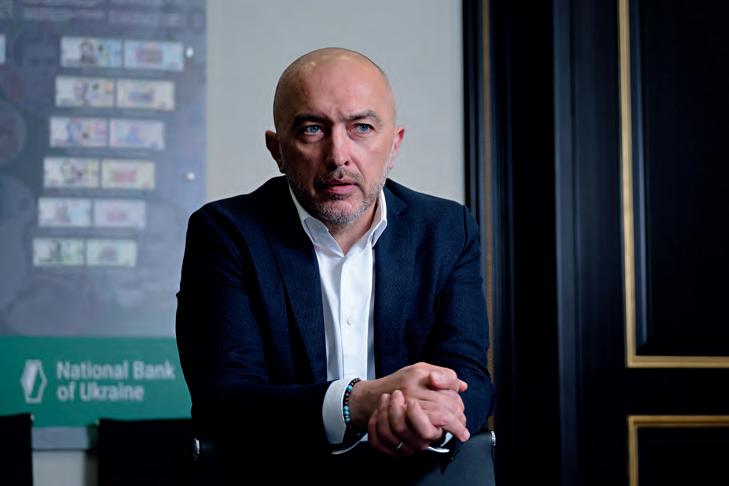
Amount that the World Bank mobilised in emer-
$486bn
Estimated cost for recovery and reconstruction over a
tracting foreign investors. It also commits the NBU to align regulation with the European Union and continue to improve transparency and eliminate any remaining pockets of corruption, a legacy of Russian influence according to the Ministry.
Alongside Western governments and institutions, western financial institutions have also stepped in to provide vital support.
Local insurers were struggling to access the international reinsurance market, so US insurance broker giant Aon and the European Bank of Reconstruction and Development put a scheme together to facilitate this for three local insurers: Ingo, Colonnade and Uniqa. Similarly, a marine insurance package to facilitate the grain shipments from Odesa was created, and new ways of raising capital through the wholesale banking sector global investment funds are being developed.
In March 2025, global (re)insurer MS Amlin set up a reinsurance scheme that can provide €1bn in war risk cover annually to Ukrainian SMEs insured by local Ukrainian insurers. This scheme aims to stimulate business activity with a view to a postwar Ukraine’s reconstruction. This was followed in August by a memorandum of understanding signed in Rome by the Ukrainian govern-
ment and representatives of several leading insurance companies, with the aim of developing the country’s insurance market. Signatories included Marsh McLennan, Aon, MS Amlin, Fairfax insurance group and the National Association of Insurers of Ukraine.
First deputy prime minister and minister of economy for the Ukraine, Yulia Svyrydenko, who launched the memorandum, said, “We are sending a clear signal: Ukraine is actively looking for ways to reduce risks for business. This memorandum demonstrates our common intention to form a modern insurance market with flexible products that will provide comfort to investors.”
This is one of several measures seen as essential pre-conditions to attracting the international finance that will be needed to rebuild Ukraine after the war, however that may end.
‘Victory’ in sight
The expected recovery and reconstruction needs over a decade are estimated at $486bn, nearly three times Ukraine’s nominal GDP in 2023. As the war drags on and Russian attacks on Ukrainian infrastructure intensify, these financing needs will continue to grow. Well-functioning capital markets and financial institutions will be essential to attract much-needed foreign investment and grow domestic finance.
So will the determination of its people to rebuild their country. While there is the inevitable weariness from three long, brutal years of war, their belief in its future seems unshakeable. When Golubieva decided to reestablish a physical presence in Kyiv, she selected a co-working office in the centre of the city. In a typical show of Ukrainian defiance, the office complex is symbolically named Nepemora (Peremoha), which means ‘Victory’ in Ukrainian. n

In the wake of the 2008 financial meltdown, Greece became the epicentre of Europe’s most perilous economic drama – a decade-long struggle that tested the limits of the euro, shattered economies and reshaped the continent’s financial order, Selwyn Parker reports »
Of all the crisis meetings around the world in the wake of the collapse of Lehman Brothers in the US and the onset of the Great Financial Crisis of 2008, the one in Athens was the most significant. And it was a meeting that would go on, in various forms, for a decade. The attendance in Athens in late 2009 comprised European banks that were on the hook for billions in euro loans to Greece that were on the verge of default, experts from the European Central Bank and International Monetary Fund, European politicians who feared the collapse of the euro, and members of an abject Greek government whose profligacy had landed the parties in this precarious position.
There was one main burning issue on the table: the survival of the euro, the 10-year-old currency that had, uniquely, been designed by committee instead of emerging organically like sterling or the dollar. But some even feared the crisis could lead to the collapse of the entire European experiment.
As the main players got around the table, the situation was desperate. Greece was on the brink of bankruptcy and currency traders were mercilessly attacking its sovereign debt while also doing their level best to undermine other highly indebted nations, notably Ireland and Portugal.
The stakes could hardly have been higher. Under the Stability and Growth Pact agreed in the 1990s, member countries had formally agreed to pursue mutually responsible economic policies – fiscal discipline, in short. No country was allowed to print money without reference to Brussels, borrowing was to be tightly controlled and inflation closely managed. Most EU members had more or less followed the rules, but not Greece.
As the Peterson Institute for International Economics explains: “Despite the pact, the Greek government racked up years of deficits and excessive borrowing after adopting the euro in 2001.” That is, two years after its official launch. However, Greece was flagrantly breaking the rules and concealing it, a deceit helped by prevailing and unusually low interest rates on its sovereign bonds. This was contrary to the normal behaviour of government debt when a country runs persistent and large deficits and it assisted Greece in pulling the wool over Brussels’ eyes.
“ its finances before it even joined the eurozone

As the Council on Foreign Relations would explain years later in a timeline of the drawnout crisis, Greece had misrepresented its finances before it even joined the eurozone. “Its budget deficit was well over three percent and its debt level about 100 percent of GDP,” the council pointed out, also citing Goldman Sachs’ role in helping Greece conceal part of the debt through complex credit swap transactions. Greece wasn’t the only EU country to misbehave, economically speaking, but it was certainly the most irresponsible. As the IMF would explain in a paper years later: “Pensions and social transfers increased by a whopping seven percent of GDP from the time of euro adoption to the eve of the crisis, while the public wage bill rose by three percent of GDP. This drove the overall fiscal deficit from four percent in 2000 to more than 15 percent of GDP in 2009 – a staggering five times the Maastricht [official] limit.
And so Greece’s private lenders, most of them French and German, blithely continued to throw money at the country. The standard explanation for their failure to spot the danger was a general misunderstanding of the rules of the eurozone. As the Peterson Institute surmises: “Financing institutions may have assumed that any country with a
and other social spending. Its borrowing was hidden by budget subterfuge. Warnings about its condition went largely unheeded.”
Some began to worry though when Greece hosted the 2004 summer Olympics at a cost of €9bn and when more public borrowing sent the deficit to over six percent and the ratio of debt to GDP to 110 percent. “Greece’s unsustainable finances prompted the European Commission to place the country under fiscal monitoring in 2005,” recalls the council.
It was the general election of 2009 that opened the Pandora’s Box of Greece’s profligacy and triggered a descent into economic chaos. A new socialist government under George Papandreou revealed that the budget deficit was heading for over 12 percent of GDP, nearly double the original estimates. But even that was too low – soon it would be revised to 15.4 percent. At that point credit rating agencies abruptly downgraded Greece’s sovereign debt to junk status.
By 2011 the money markets were thoroughly rattled. “Bond markets started to lose confidence in Greece’s economy,” explains the Peterson Institute, in something of an understatement. This loss of confidence turned into despair when private lenders in France and
its debts because the banks refused further loans for fear of good money following bad. Hence the EU’s most economically recalcitrant member could not plug the gaps in its budget shortfalls. The alarm bells ringing all over Europe, the IMF and ECB had to hurriedly step in along with the EU’s economic trouble-shooters in what became known as ‘the troika.’ None of these institutions had faced a crisis of this magnitude.
The immediate and looming threat was the risk of contagion in a European banking system already in trouble in the wake of the 2008 bank collapses that precipitated the Great Financial Crisis. Many institutions bore heavy losses and they had no appetite for shovelling further debt to Greece. Having mistakenly assumed all debt to member countries was riskfree, they had compounded their error by also assuming that Greece’s central bank had sufficient capital to absorb a Greek default.
Suddenly the banks, the troika and everybody else on the sidelines of these increasingly fraught negotiations were deeply aware of a long-held principle among central bankers. Namely, moral hazard. In simple terms this meant that, if profligate nations were bailed out, other economically delinquent govern-
€110bn
Value of the first bailout deal in 2010
€130bn
Value of the second bailout deal in 2012
€86bn
Value of the third bailout deal in 2015
ments would expect the same favours. “All banks in Europe feared that Greek debt relief would set a precedent,” notes the Peterson Institute. “Bonds issued by other European governments suddenly became risky.”
In consequence the cost of debt began to rise for other EU members. The Peterson Institute: “Almost overnight this made it more expensive for these governments to borrow. Loss of investor confidence was infecting the entire European financial system.” Contagion really was setting in.
The economic lines were drawn. On one side experts feared that the Greek economy would be strangled if the politicians imposed excessively punitive measures. On the other most EU politicians and, it seems, the troika were determined to send a message: “Germans and others in Europe felt that Greece had to suffer the consequences of its alleged misbehaviour.” Stuck in the middle were hapless Greek citizens. As the economy foundered and punitive measures were indeed enforced, they rightly blamed their government for misleading them. All too soon Greece’s economic woes spilled into the streets as rioters in Athens rallied against hefty budget cuts
“
Financing institutions assumed that any country with a borrowing crisis would be bailed out”
and tax increases that were triggering high unemployment, shrunken living standards and slashed social services. Simultaneously, populist politicians over much of the EU were attacking the EU, which, they argued, was suppressing their national identities.
The immediate source of Greek citizens’ anger was the Athens deal, a three-year bailout scheme agreed in mid-2010. In this the IMF and EU threw Greece a €110bn lifeline repayable over three years. The price was austerity measures including €30bn in spending cuts and tax increases. This was an all-out assault on the deficit put together by the IMF and other, mostly reluctant, EU nations that already had quite enough financial troubles of their own. Spain for instance was just about overwhelmed by a real-estate crisis while Portugal was suffering from its own economic mismanagement. The ECB also stepped in by buying up heavily discounted Greek bonds on the secondary market in what it called the Securities Market Programme. This was an unprecedented move, but ECB president Mario Draghi promised the bank “would do whatever it takes.”
The programme allowed Europe’s top central bank to absorb the government bonds of other struggling sovereigns. “This was to boost market confidence and prevent further sovereign debt contagion throughout the eurozone,” explains the Council. In fact the contagion was spreading so fast that EU finance ministers also agreed rescue measures worth nearly $1trn to hard-hit eurozone countries. But austerity didn’t work for Greece. After a brief rally when the deficit sank to five percent of GDP, an encouraging improvement, the inevitable occurred. The Greek economy was stripped so bare that it fell into decline and there were not the funds to meet the loans that still hung over the country like a sword of Damocles.
Two years after the Athens deal, the situation was once again so dire that the risk of a Greek default was back on the table. German chancellor Angela Merkel and French president Nicolas Sarkozy led a new programme that became known as the Deauville Deal. “If the euro fails, Europe will fail,” declared Merkel.
» This time the banks – ‘irresponsible lenders,’ according to the parties involved in the deal – were told to accept their share of the punishment in the form of discounting the value of their loans. In short, they had to take a haircut. But as the Peterson Institute acknowledges: “The Deauville announcement rattled bond markets further. Banks feared having to take haircuts on the value of their loans. Bond yields spiked, making the prospect of a timely return of Greece to market borrowing even more remote.” The banks were strong-armed into submission. Facing complete write-offs or haircuts, most of the private lenders opted for the latter rather than be party to a complete default.
This second bailout handed Greece €130bn, but the country’s private lenders took a beating – a 53.5 percent write-down. Greece’s side of the bargain was to slash its debt to GDP ratio from 160 percent to just over 120 percent by 2020. It was the largest restructuring of its type in history. Simultaneously, all but two EU members – Britain and the Czech Republic – signed the Fiscal Compact Treaty designed to keep their economic behaviour in line. The crisis had now dragged on for four years – and then it got worse.
Although, in 2013, Greece finally posted a surplus, it was a technical one described as a “small primary fiscal surplus, the fiscal balance excluding interest payments.” Just when the authorities were ready to applaud, the economy plummeted to an even lower level, with economic output down by 25 percent compared with 2010, which had been bad enough. Unemployment hit 27 percent. And debt to GDP ratio shot up from the 130 percent of 2009 to 180 percent by the end of 2015.
The patient was even sicker. About 25,000 public servants from an admittedly bloated bureaucracy were laid off and the labour unions, whose members had taken a beating, called a general strike. As more rational economists had argued years before, if the purpose of the rescue measures was to help Greece repay its debts, as it surely was, it had demonstrably failed. Clearly, only a healthy economy could produce the revenues that enabled it to climb out of trouble.
The composition of Greece’s debt was now unrecognisable from before the rescue attempts. Nearly all of it lay in the hands of a variety of European and international institutions such as the European Financial Stability Facility and the ECB, which was on the hook for long-term debt of up to 30 years.
Behind the scenes the ECB was deeply involved. It had issued more than $1.2trn in quantitative easing – effectively the printing of credit – to boost a moribund European economy.

Then in 2015, to the horror of Brussels, angry and disillusioned Greek voters installed a left-wing government under the Syriza party and another crisis promptly ensued. Of all the crisis years, this would be the most fraught and raise the probability of ‘Grexit,’ Greece’s departure from the eurozone. As many now said, it should never have been allowed to join in the first place.
New prime minister Alexis Tsipras had the backing of unions and he promptly attacked the troika over austerity measures, demanded relief from the mountain of debt and an end to austerity. An aghast Brussels flatly refused, insisting that Greece work through the original arrangements before coming back to the table. When the Tsipras government missed a €1.6bn repayment to the IMF, negotiations between Greece and its official creditors deteriorated rapidly. To stem the flight of capital from the country, Tsipras had already limited bank withdrawals to just €60. Eventu-
“Austerity didn’t work for Greece – the economy was stripped so bare that it fell into decline”
ally though, the prime minister had to bow to Greece’s obligations to creditors and, despite a referendum that overwhelmingly rejected austerity measures, he signed a third bailout deal with up to €86bn after a tense weekend of negotiations in August 2015 in which Greece was nearly kicked out of the eurozone.
The price this time was wholesale economic reform whereby the government agreed to introduce tax reforms, cut public spending even further, privatise state assets and deregulate the labour market. Just to keep an increasingly divided government on track, the €86bn was to be spread over three years.
Interestingly, the ECB sat in on the negotiations but refused further loans. Obviously, the central bank thought it had done enough.
Turn of the tide
€290bn
Greece’s total debt to the EU and IMF by 2018 25%
Fall in economic output between 2010 and 2015 15.4%
Budget deficit in 2009, five times the EU’s Maastricht limit
Two things now began to turn the tide – the less draconian terms of the latest rescue package and long overdue economic reforms. In 2016, Greece provided a pleasant surprise by posting a large budget surplus of almost four percent. Almost miraculously, unemployment began to decline, albeit slowly. Then in 2017, the economy started to grow for the first time in eight years.
Yet the recovery was too slow for Greeks, who voted the socialists out. Although the tide was turning, the accumulation of rescue debt had reached proportions that horrified most economists. By 2018, Greece owed the EU and IMF alone about €290bn. Like a dark cloud over the country’s future, successive governments were expected to run budget surpluses for the next 42 years! The size of the Greek economy had crashed by nearly a quarter and faced a long uphill recovery.
This was much worse than had been thought at the outset of the crisis exactly a decade earlier. The IMF’s Poul Thomsen, director of the European department, painted a dark picture to an audience at the London School of Economics in 2019: “We had assumed that it would take Greece eight years to return to pre-crisis level. This was as bad as in the United States Great Depression in the 1930s, and considerably worse than the four years that it took countries affected by the Asian crisis.
“The outcome was much worse. Today, almost 10 years later, GDP per capita is still 22 percent below the pre-crisis level. We forecast that it will take another 15 years, until 2034, to return to pre-crisis levels. Under the Commission’s forecast it will take until 2031.” So where had the rescue missions gone wrong?

In the rationally argued view of Poul Thomsen, the enforced measures had reduced the economy so severely that it could not pay its way out of trouble. Basic public services could not be provided and capital spending was so low that any prospect of growth was rendered just about impossible. As tax increases were piled on already high rates, tax collections had slumped from 65 percent in 2010 to about 41 percent in 2017 while – the opposite of what was needed – well over half of all wage-earners and pensioners were exempt from paying any personal income tax at all. And somehow much-needed reforms of one of the EU’s most generous pension schemes had been abandoned along the way.
For most Greeks, the troika and the IMF in particular had become the whipping boy. Yet contrary to the populist rhetoric, the IMF had not insisted on more austerity. Instead the organisation had argued that Greece should not be asked to deliver unreasonably high surpluses but should be required to fix its problems with pensions and taxes so that the economy could recover more quickly. In short, go for growth.
The IMF’s overall explanation for Greece’s painfully drawn-out crisis was political. “Contrary to other crisis-hit countries, there was no broad political support for the programme from the outset,” concludes Thomsen, citing various parties’ failure to unite behind the measures. In Portugal, which faced similar problems, there was broad political support for the rescue on both sides of the aisle.
“It was the largest restructuring of its type
in history”
But the IMF does not absolve itself of blame. The architects of the various rescue missions simply expected too much too soon from an economy with so much self-inflicted damage. But lessons had been learned and salvation was at hand.
To the relief of Greece’s 10.4 million people, by early 2025 GDP was growing faster than the eurozone average and had been for four straight years. Moreover, it was expected to do so until at least 2027. The volume of public debt was down. Unemployment had fallen to historically low levels of just under 10 percent, albeit high by European standards, but half a million new jobs had been created in six years. The all-important primary surplus had hit 4.8 percent, more than twice as high as predicted. And the days of junk status for bonds were over – in 2023, Greece’s sovereign debt was restored to investment grade in a red-letter day for the country’s beleaguered central bank.
There is work still to be done, according to a late 2024 survey by the OECD that cited low productivity and reluctant business investment still scarred by the Great Financial Crisis. But the worst is definitely over. In an event that nobody would have predicted in the dark days of 2009, in May 2025 Prime Minister Kyriakos Mitsotakis accepted an award at an economic conference in Berlin for what most economists were calling a remarkable recovery.
No longer Europe’s problem child on the brink of “crashing out of the eurozone,” as he put it, “Greece is being recognised for its determination, its discipline, its resilience and its ability to implement difficult reforms.” Still, it was a close-run thing. n
Portugal is emerging as Europe’s leading magnet for high-net-worth individuals, thanks to its new tax regime for innovation and research, lifestyle appeal and strategic access to the EU
WORDS BY Shelley Wren HEAD OF BUSINESS DEVELOPMENT, SOVEREIGN


Authority (AT) and the relevant government agencies responsible for receiving and verifying registration applications. Applicants will also require accreditation by their respective employers or those contracting their services.



A record-breaking 142,000 millionaires are projected to relocate internationally this year, with the UK expected to see the largest net outflow of high-net-worth individuals (HNWIs) by any country since global wealth intelligence firm New World Wealth began tracking millionaire migration 10 years ago.
In Europe, Portugal is one of the key beneficiaries of this trend. It is set to attract a net gain of more than 1,400 HNWIs, driven by its favourable tax regime, lifestyle appeal and active investment migration programmes. The ongoing appeal of Portugal includes its lifestyle and climate, security and safety, easy access to the European Union and the Schengen area, and its vibrant cities and coastal areas. Key locations attracting millionaires include Lisbon, Cascais and the Algarve, with the latter two particularly known for their desirable luxury properties.
Portugal’s new IFICI regime – ‘Tax Incentive for Scientific Research and Innovation’ –was launched in December 2024 and is a new, targeted residence regime for highly qualified professionals. It delivers significant tax benefits and generous tax exemptions, especially for overseas income, to eligible new tax residents in Portugal.
The IFICI replaces the well-known NonHabitual Resident (NHR) special tax regime, which was closed to new entrants at the end of 2023, and is commonly known as ‘NHR 2.0’. Like the previous NHR regime, it provides the following key tax benefits, which are available for 10 calendar years from the time the applicant becomes tax resident in Portugal.
A special Personal Income Tax (IRS) flat tax rate of 20 percent applies to employment and professional income obtained in Portuguese territory. Non-Portuguese income in most categories – dependent work, professional activities, capital income, rental income and capital gains – is exempt from IRS provided that the income is being taxed abroad under a double tax agreement (DTA),
or if it is otherwise taxed in the source country and not classified as Portugal-source, or if it is taxable under OECD treaty principles.
Unlike the previous NHR regime, which taxed foreign pension income at a flat tax rate of 10 percent, foreign pension income is fully taxable in Portugal under the IFICI. Additionally, any income earned in countries listed by the Portuguese Finance Department as ‘preferential tax regimes’ – the so-called ‘blacklist’ – will not qualify for exemption.
Only individuals who move to Portugal for eligible roles related to science, research, or innovation are eligible. But the professional
It is important to note that IFICI is designed to attract talent and foster the growth of Portuguese companies, so eligible businesses must have economic substance in Portugal. Industrial and service companies must also export at least 50 percent of their turnover.
While IFICI unlocks powerful benefits, the route to qualification and maintaining ongoing compliance is not straightforward. Each case requires careful structuring, eligibility validation and continuous record-keeping. A professional advisory approach is strongly recommended for every step, particularly for high-value cross-border tax planning.

scope is broad, from CEOs to technicians, and the range of eligible activities is wide –extractive industries, manufacturing industries, utilities, construction, hospitality, ICT, financial, scientific and technical, education, administration, health and cultural or natural interest.
Individuals can either establish tax residency in Portugal voluntarily by securing a residence permit and establishing a permanent address, or by residing in Portugal for more than 183 days within any 12-month period or by establishing a habitual residence. Applicants must not have been a tax resident in Portugal in the previous five years or have previously benefited under the NHR regime.
The granting of the IFICI is dependent on prior registration with the Portuguese Tax
1,400
Projected number of HNWIs relocating to Portugal this year
Sovereign Portugal specialises in concierge IFICI onboarding and residency planning, smoothing the path for new residents and their companies to enjoy the regime’s benefits.
As part of the global Sovereign Group, we are also well placed to provide the tailored global tax advice and compliant structuring that is often required. We will provide clear, tailored pathways for applicants and entrepreneurs, as well as their families, to successfully establish their lives and ventures in Portugal. Our deep knowledge of Portuguese tax regimes, visa requirements and corporate structuring enables us to offer clients confident, seamless integration strategies that deliver financial efficiency as well as meeting their personal and professional goals.
Sovereign Portugal can be contacted by telephone: +351 282 340480 and email: serviceinfo@sovereigngroup.com n
























Once a system celebrating productivity and enterprise, capitalism in 2025 is increasingly defined by share buybacks and financial engineering. This shift from long-term value creation to short-term gains has reshaped markets, corporate behaviour, society and challenged the moral core envisioned by Adam Smith
WORDS BY Claire Millins
FEATURES WRITER


When did capitalism become a dirty word?
Despite what we are led to believe, it is not a political construct; it has absolutely nothing to do with politics. Adam Smith, the so-called ‘Father of Capitalist Thinking’ believed that free markets were not engines of extraction, but instruments of moral order, arguing that “humans were self-serving by nature but that as long as every individual were to seek the fulfilment of his or her own self-interest, the material needs of the whole society would be met.” In fact, he never even coined the term capitalism.
However, Smith’s simple explanation of markets has since been hijacked as we see business capital flow towards ‘engineering’ balance sheets rather than building factories, towards stock price rather than workers, and extraction instead of invention. This is more than a market distortion, it is an identity crisis, and with capitalism stripped of its moral core it risks becoming an economy of scraping value from value, rather than creating it.
Enterprise as moral progress
Smith didn’t see commerce as a cold machine, and believed, rightly or wrongly, that selfinterest and sympathy could align to generate productivity and shared prosperity. In his ‘Theory of Moral Sentiments and Essays on Philosophical Subjects’ (1759), he argued that when individuals pursue their own gain within a moral framework, their labours often produce benefits beyond themselves, because we have in-built instincts that make us care about others’ well-being.
And this concept forms the basis of his ‘Invisible Hand Theory’ in his seminal work The Wealth of Nations about the unseen market forces that drive a free economy through selfinterest and voluntary trades. The industrial revolutions that followed seemed to vindicate
this ethos, and early capitalism wasn’t just about factories or markets, it was about harnessing innovation, trade, and employment to lift living standards and entire societies. Prosperity meant producing more, such as steel, textiles and railways, and the ‘real economy’ was capitalism’s moral anchor: enterprise equalled progress.
And for over 200 years, capitalism worked, on the whole, as Smith intended, with capital flowing into factories, infrastructure, and innovation, to create real wealth and shared prosperity. However, new financial tools, the rise of shareholder primacy, and a wave of financial deregulation in the 1980s redefined corporate priorities. Driven by financial investors who criticised managers for not focusing on shareholder interests during the economic challenges of the 1970s, this ‘shareholder value revolution’ shifted focus from building productive businesses and long-term growth to maximising short-term returns for shareholders, often at the expense of investment in workers, research, and tangible assets.
$110bn
Value of Apple’s 2024 repurchase plan, while maintaining significant cash reserves

Along with advancements in information technology, these developments facilitated the rise of financial markets and the prioritisation of shareholder value over traditional industrial growth, to fundamentally alter the landscape of capitalism.
BUYBACKS
ONLY
PROVIDE SHORT-TERM STABILITY. THEY MASK ANY UNDERLYING ISSUES
A pivotal moment in this transformation occurred in 1982 with the US Securities and Exchange Commission’s adoption of Rule 10b-18, which provided companies with a ‘safe harbour’ allowing them to buy back their own stock without risking accusations of market manipulation, provided they follow clear limits on timing, amount and price. Meanwhile the Depository Institutions Deregulation and Monetary Control Act of 1980 phased out interest rate ceilings on deposits and broadened the range of activities banks could engage in. In the UK, deregulation occurred through a series of legislative acts and market-driven changes, most notably the Big Bang in 1986, which freed London’s stock market by allowing foreign ownership of brokers, removing fixed commissions and automating price quotes.
The use of stock buybacks has transformed from being a niche financial tool in the 1980s to a core mechanism for companies to return capital to shareholders. And while this can signal confidence in a company’s future, this diversion of funds from research and development (R&D), employee wages and business expansion has raised concerns about buybacks being used to boost earnings per share (EPS) and inflate stock prices. Unfortunately, this trend has been reinforced by executive pay, which often links CEO pay to short-term stock results. For example, in 2018, S&P 500 firms allocated a staggering 81 percent of extra cash from tax cuts to buybacks and dividends, but only 4.6 percent was spent on R&D.
In the technology sector, Apple announced a $110bn repurchase plan in 2024, while maintaining significant cash reserves, which raises questions about the allocation of resources between shareholder returns and investments in innovation. Similarly, Delta Air Lines repurchased $5bn of its stock in 2018, money, some would say, that would have been better spent on improving infrastructure or
investment in sustainable energy initiatives or projects that address environmental concerns. All of which illustrate the broader trend of financial engineering over investments to drive long-term growth and societal benefits.
For capitalism in the 21st century, this surge in stock buybacks has introduced a paradox. While companies may appear more profitable in the short term, the long-term health of both markets and society is increasingly at risk.
On the surface, by reducing share supply, potentially boosting EPS and making companies more attractive to investors, buybacks can stabilise stock prices. The 2021 US Chamber of Commerce report by Craig Lewis and Joshua White, ‘Corporate Liquidity Provision and Share Repurchase Programmes,’ which studied a large sample of more than 10,000 US companies over 17 years found six key benefits associated with buybacks: greater liquidity, reduced volatility, economic benefit for retail investors, proactive repurchase activity to stabilise stock price, responding to uncertainty by strengthening buyback activities, and using stock buyback as a strategic liquidity supplier.
But buybacks only provide short-term stability. They mask any underlying issues. With buybacks, companies risk diminishing their
STAGNATED, WHICH HAS ONLY HELPED TO WIDEN THE WEALTH GAP
ital investment away from R&D, infrastructure and workforce investment. This can lead to a decline in productivity and increased vulnerability during economic downturns, as firms may lack the necessary investments to adapt and innovate.
The societal impact is equally concerning.
Prioritising shareholder returns over capital investment means that for many workers wage growth has stagnated, which has only helped to widen the wealth gap. And with companies allocating more funds to buybacks rather than paying income tax, according to a report by Americans for Tax Fairness, it raises questions as to their true commitment to societal welfare. As profits flow towards mostly shareholders and executives, workers are left behind, eroding trust in companies and challenging capitalism’s fairness and moral legitimacy.
As we move into the second quarter of the 21st century, capitalism, or rather what it has morphed into, is in desperate need of a makeover. But with the whole world seemingly in a financial mess, how can we realign economic incentives with long-term societal well-being?
Allocation of extra cash from tax cuts to buybacks and dividends by S&P 500 firms
In terms of policy reforms, one suggestion is to restrict excessive stock buybacks either through increasing the tax on repurchases or treating buybacks similarly to dividends and taxing accordingly. One other crucial measure to implement is realigning executive pay from short-term results to long-term performance.
However, policy tweaks alone won’t restore faith in capitalism. There is a growing push to rethink how companies invest, grow, and define success through a combination of stakeholder capitalism and patient capital. Valuing workers, customers, and communities, instead of shareholder returns, and investing money for the long term rather than a quick win, will, invariably, give businesses room to innovate and grow. Additionally, by implementing green industrial policies, governments can steer investment into clean energy, new technologies, and infrastructure to speed the shift towards a low-carbon economy.
Was Adam Smith right? Is self-interest only justifiable when it serves society? If recent social commentary is anything to go by, economic systems without this alignment risk inefficiency and moral erosion. And, like Mr Darcy’s good opinion, trust in the system, once lost, is hard to get back, while markets based purely on extraction instead of creation are unstable.
Capitalism with a moral core provides more than ethical reassurance; it encourages people to act responsibly and predictably, creating stability in how businesses and markets operate. And companies that embed social purpose into strategy often foster loyalty, spark innovation, and encourage responsible risk-taking, with studies showing that those committed to ESG often outperform others, proving that profit and purpose can coexist.
Building businesses and creating wealth is not, as social media would have you believe, inherently evil. But without an ethical anchor, rewarding short-term gain at the expense of collective welfare is what has given capitalism its bad name.
With that moral anchor, people can see economic success as serving society, and it is a win-win all round; companies become stronger and more resilient, communities trust those companies to reinvest, workers feel valued, and investors gain confidence that profits are sustainable in the long term. n
Driven by technology, consumer values and circular thinking, the global resale boom is creating powerful new opportunities for brands, investors and marketplaces – and challenging traditional ideas of consumption
WORDS BY Vikki Davies
FEATURES WRITER





Second-hand shopping has come a long way. What was once the preserve of charity shops and car boot sales has evolved into one of the fastest-growing sectors in global retail. Today’s resale market is a vibrant, tech-driven space powered by savvy shoppers who care about both value and sustainability. It is the circular economy in action, where products are designed, used and reused to give them a longer life.
From fashion to electronics, buying preowned has become a mainstream habit that is changing the way people, and brands, think about ownership and waste. For marketplaces and investors, this shift opens up huge opportunities, but it also brings new challenges as they navigate a fast-moving and increasingly sophisticated resale landscape.
A recent report, Second-Hand, First Choice: The Psychology of Recommerce by Retail Economics and MPB, values the global recommerce market (excluding cars) at around $220bn – and it is expected to grow by almost 80 percent by 2028 across the US, UK, France and Germany.
Rising living costs have made value a key concern for shoppers, but this boom isn’t just about saving money. It reflects a deeper cultural and generational shift. Younger consumers, especially Millennials and Gen Z, are turning away from fast fashion and throwaway tech in favour of items that reflect personality and ethics. Buying second-hand has become a lifestyle statement, a way to shop with purpose and express individuality.
Resale also delivers real environmental impact. Every pre-owned purchase helps extend the life of an existing product, reducing the need for new manufacturing and cutting
carbon emissions. For consumers who want to live more consciously, resale offers a simple, rewarding way to support a more responsible and less wasteful economy.
The professionalisation of resale Today’s marketplaces are polished and techenabled, combining convenience with trust. Depop, for example, has redefined fashion resale by blending social media-style discovery with commerce, while Vestiaire Collective has built a reputation for authenticated luxury fashion. Vinted, ThredUp and eBay have all expanded certified pre-owned programmes, further embedding resale into the mainstream retail ecosystem.
At the heart of this transformation is technology, but it is the way it is used that really makes the difference. AI now helps shoppers find exactly what they are looking for, suggesting items, setting fair prices and curating personalised experiences. Smarter logistics make buying and selling seamless, with integrated systems that handle shipping, returns and reverse supply chains efficiently. Many platforms also use expert authentication teams or even blockchain-based certificates to verify the provenance of high-value items. Together, these innovations have removed much of the friction and doubt that once surrounded second-hand shopping, giving the resale market the same polish and professionalism as traditional retail.
For investors, the rise of the resale and circular economy is a clear market opportunity with long-term value potential. The appeal lies in the combination of growth and strong ESG credentials. Venture capital and private equity firms are increasingly backing businesses that extend product lifespans through refurbishment and repair models that generate healthy returns while supporting sustainability goals. The investment logic is straightforward: as resources become scarcer and regulation around waste and emissions tight-

economic downturns, driven by consumer demand for value, adds another layer of stability, making resale and refurbishment a rare mix of defensive and growth investment.
Funds are now focusing on scalable, technology-led platforms that make circularity efficient across industries such as fashion, electronics and furniture. For investors, supporting these companies is a way to futureproof portfolios against changing consumer expectations and regulatory pressure. The circular economy is proving that profitability and responsibility can go hand in hand, and that is an equation the finance world is increasingly keen to back.
For established retailers, the resale revolution is proving both a challenge and an opportunity. Traditional linear business models – sell, discard, repeat – are increasingly at odds with consumer expectations and ESG commitments. In response, many brands are integrating resale and repair directly into their operations. Patagonia’s Worn Wear programme, IKEA’s buy-back initiatives and Gucci and Burberry’s certified pre-owned collections all signal a shift towards more circular retail practices. These initiatives extend product life and tap into new revenue streams. By facilitating resale within their own ecosystems, brands can control quality and capture residual value that once leaked
progress against sustainability goals, some thing investors and consumers increasingly demand.
For all its growth, the resale sector’s success ultimately hinges on trust. The risk of counterfeit goods and misrepresentation remains a persistent challenge, particularly in luxury and electronics categories. The platforms that will endure are those investing heavily in authentication and verification.
AI algorithms capable of spotting anomalies in photos, blockchain-based provenance records, and specialist teams that inspect and certify goods before listing are fast becoming industry standards. These measures not only protect consumers but also preserve the reputations of brands entering the pre-owned space. Insurance integration complements this framework by offering financial protection against misrepresentation or faults.
Consumers want confidence that their purchases, whether refurbished electronics, luxury handbags, or vintage furniture, are protected. Insurers are responding with products tailored to these needs, covering risks such as counterfeiting, misrepresentation, or faults.
Companies like Bolttech, Cover Genius and Embri are working with marketplaces and retailers to offer embedded insurance, making coverage easy to access at the point of sale. Platforms like Oyster integrate protection plans directly into online checkouts,
Value of the global recommerce market
80%
Expected growth across US, UK, France and Germany by 2028
Yet sustainability in resale is not automatic. The rise of ‘fast resale,’ quick turnover of second-hand goods driven by trends and social media, can encourage overconsumption rather than replace new purchases. In such cases, environmental benefits may be diluted. True sustainability depends on quality refurbishment and systems that prioritise reuse over replacement. The most responsible players are taking this seriously, investing in transparent supply chains and low-carbon logistics. Their challenge now is to ensure that the circular economy remains genuinely circular, rather than just a new form of fast consumption with greener branding.
ensuring that buyers receive reassurance without extra hassle. By providing this safety net, insurers help legitimise the resale sector, encouraging customers to buy higher-value items with confidence. For marketplaces, offering embedded insurance has become a key way to build trust and stand out, providing peace of mind for their users.
In the UK, Back Market covers refurbished mobile devices against damage. Its General Manager, Katy Medlock, explains: “While the refurbished tech movement is growing in the UK, many people still consider pre-loved gadgets a risk. Our insurance is part of an ongoing commitment and we hope this will give more customers peace of mind that their refurbished device is covered and the confidence to swap something ‘new’ for something that’s ‘like new’.”
The environmental benefits of resale are undeniable. Extending the life of products reduces the need for new manufacturing, conserving raw materials and cutting carbon emissions. The impact is particularly profound in industries with heavy resource footprints: fashion, which accounts for around 10 percent of global emissions, and electronics, where production involves significant energy use and mineral extraction. Buying a refurbished smartphone or laptop, for instance, avoids the carbon cost of producing a new one, an advantage that resonates with climateconscious consumers.
As resale becomes a major global industry, regulatory scrutiny is inevitable. Variations in warranty rules and return policies across markets can create confusion and limit crossborder trade. A move towards greater standardisation would benefit both consumers and platforms, simplifying compliance and fostering trust. Another challenge lies in logistics. Managing returns and restocking adds cost and complexity. Efficient reverse supply chains, capable of collecting and redistributing products at scale, are critical to maintaining profitability. The winners in this space will be those who master operational efficiency as well as consumer engagement.
The trajectory of the resale market points to continued acceleration. Consumer awareness and technological sophistication are converging to make second-hand desirable. For marketplaces, the opportunity lies in scaling responsibly: combining convenience with credibility and profit with purpose. For retailers, the challenge is to embed circularity as a structural component of their business models.
Those who succeed will redefine the meaning of ownership, turning products from disposable commodities into long-term assets with multiple lives. The future of consumption will not be defined by constant replacement but by continuous renewal. The rise of the resale market shows that extending the life of products is economically advantageous.
With $197bn in clothing resale sales last year and projections of $350bn by 2028, along with multi-billion-dollar valuations for refurbished tech platforms, the numbers speak for themselves. Beyond the figures lies something more profound: a reimagining of the consumer economy that prizes longevity over disposability and purpose alongside profit. Companies that recognise and adapt to this transformation will define the next wave of retail. n
For 70 years, Germany embodied postwar recovery – prosperous, stable and admired. Now, as exports falter, populism grows and trust in politics erodes, the nation that once rose from ruin faces a quieter reckoning: can it reinvent itself without another catastrophe?
BY
WORDS
Barry Eichengreen


PROFESSOR OF ECONOMICS AND AUTHOR

known, was signed into law on April 3, 1948, by US President Harry Truman. Disbursements began immediately, with initial aid shipments reaching Germany in early July.

Postwar Germany has appeared to the world as a model democracy and economy for fully seven decades. From the first postwar chancellor, Konrad Adenauer, through Willy Brandt, Helmut Schmidt, Helmut Kohl, and the 16 years of Angela Merkel’s leadership, Germany’s postwar political and economic stability appeared rock-solid, so much so that the Federal Republic could readily absorb the decrepit communist economy of East Germany within a year of the fall of the Berlin Wall. No doubt, there were bumps along the way in the decades following the Second World War, from the Red Army Faction/BaaderMeinhof terrorism of the 1970s to the inflation and stagflation that followed the oil price shocks of that same decade. For the most part, however, Germany’s economy grew steadily and inclusively, led by world-beating manufacturing exports. But now Germany is firmly in the grip of a malaise. The country’s exportled economic model has been unable to cope with its loss of competitiveness to China, and resentment of immigration has reached its highest level in the postwar years following Merkel’s decision in 2015 to open the country’s borders to over a million migrants. Germany, like much of the West, is experiencing a rising far-right populist tide, with Alternative für Deutschland questioning the fundamental assumptions and norms of political behaviour that have governed Germany since the Federal Republic’s founding in 1949.
The miracle workers
To understand how we got here, it helps to go back to the beginning. Conventional accounts of the Wirtschaftswunder – West Germany’s miraculous economic ascent after the Second World War – locate its origins in the Ludwig Erhard-engineered currency reform and the George Marshall-inspired European Recovery Programme, both introduced in 1948. The Marshall Plan, as the ERP was informally
In exchange for receiving Marshall Plan aid, the German authorities were required to balance the budget, contain inflation, dismantle rationing, remove wage and price controls, encourage private enterprise and liberalise trade. In effect, they were asked to implement what came to be known a half-century later as the ‘Washington Consensus.’
A key element was Erhard’s currency reform, inaugurated midway between Truman’s signing of the ERP and the arrival of the first aid shipments. On June 20, 1948, the Deutsche Mark replaced the Reichsmark as legal tender in the Bizone, the western zone of occupation administered jointly by US and British forces. The monetary overhang that fuelled inflation on the black market and created shortages in the controlled economy was removed by converting Reichsmarks into Deutsche Marks at a rate of roughly 10 to one.
Erhard, as the highest German economic official working under the occupation authorities, administered the introduction of the Deutsche Mark. One day later, acting on his own authority, he unilaterally abolished most price controls and rationing.
Eliminating the monetary overhang, together with fiscal retrenchment and the removal of price controls, led to the miraculous reappearance of goods on previously barren store shelves. Farmers now had real money with which to buy equipment and fertiliser, much of which was provided by the US through the Marshall Plan. The prospect of real revenues encouraged them to bring produce to market, alleviating food shortages. Exchange-rate stabilisation enabled firms to export while also selling at home, leading them to hire, invest and ramp up production.
The rest is history, or so say triumphal accounts of the Wirtschaftswunder. Over the subsequent quarter-century, West Germany grew by an unprecedented six percent per year. By 1973 the Federal Republic of Germany had become the world’s third-largest economy.
LUDWIG ERHARD WAS CHAMELEON-LIKE, ABLE TO SUCCESSFULLY BEND HIS POLICY POSTURE TO THE PREVAILING WINDS
Two new books by Carl-Ludwig Holtfrerich, a former professor of economics at the Free University of Berlin, and Tobias Straumann, a professor of economics at the University of Zurich, push back against this conventional account. Holtfrerich insists that Erhard actually played no role in designing the currency reform, despite having claimed credit for it for the remainder of his political career.

Straumann, for his part, argues that German economic recovery was far from secure following the reforms of 1948. West Germany’s economic miracle would not have endured without the 1953 London Debt Agreement, which eliminated all possibility that the country would be saddled with massive reparation obligations to its wartime enemies, as happened after the First World War.
The London Debt Agreement was the culmination of several years of negotiations between a German delegation headed by Hermann Josef Abs, a senior Deutsche Bank official, and 20 creditor countries, of which the US, the UK and France carried the most weight. In explaining the outcome and why it was so different from debt and reparations negotiations after the First World War, Straumann posits a straightforward ‘lessons of history’ hypothesis. Negotiators on all sides drew a straight line from the economically crushing and politically humiliating reparations burden imposed on Germany in 1921 to the downfall of the Weimar Republic and the rise of Adolf Hitler and the Nazi Party. After the Second World War, they understandably sought, at all costs, to avoid a similar sequence of events.
the full story is more complex, as Straumann eventually acknowledges. The influence of the Cold War was critically important in the 1950s and created an imperative for economic recovery that was absent among the victors in the aftermath of the First World War. With the Soviet Union threatening Western Europe, it was urgent to get the West German economy, Europe’s most important source of capital goods, running on all cylinders. This meant not overburdening Germany with reparations, but it also presupposed normalising the Federal Republic’s financial relations with the rest of the world, so that German firms could borrow abroad and export without fear that their goods would be garnished.
Under the London Debt Agreement, the new West German government committed to service and repay Reich and Weimar-era foreign borrowings and post-Second World War loans from Western governments, but not Nazi-era war debts and occupation costs. All reparations obligations were put off until that far-distant day when the two Germanys might be reunified. Another important difference from the aftermath of the First World War, not unrelated to the first, was European integration. Proceeding in parallel with debt negotiations, the French government, with leadership from Foreign Minister Robert Schuman, launched a scheme for joint control of French and German heavy industry; what became the European Coal and Steel Community. The Soviet threat highlighted the need to return the operation of Western Europe’s heavy indus-
try, and specifically German heavy industry, to full capacity. But this required assurance that Germany’s industrial might would not again be used to threaten France and other neighbours. The Coal and Steel Community served this purpose. It is hard to imagine that the Community could have been successfully launched absent progress on the debt front. In an aside, Straumann describes how the French plan was sprung on UK Foreign Minister Ernest Bevin and other British officials, whose startled reaction was strongly negative, presaging an enduring ambivalence about what became the European Community and then the European Union.
Finally, the London Debt Agreement enabled the new German government to begin normalising relations with Israel, despite the horrors of the Holocaust. Without it, the Federal Republic would not have had the resources and political will to send DM3bn worth of German goods to the Jewish State, or to pay for Israel’s desperately needed imports from Britain’s oil companies.
Deutsche Mark’s real father
Whereas Straumann’s book is a political narrative, Holtfrerich’s is a biography, the subject of which, Edward Tenenbaum, was the real author of the currency reform. Holtfrerich’s account starts with the immigration of Tenenbaum’s Jewish parents from Polish Galicia, his childhood in New York, and his education at the International School of Geneva and Yale. An interesting parallel, not drawn by the author, is with Harry Dexter White, architect of the Bretton Woods system, another
component of the monetary system that supported the Wirtschaftswunder.
Tenenbaum served as an intelligence officer in the Twelfth Army Group during the Second World War, and in the Office of Military Government, United States (OMGUS), which administered the American occupation zone. After being discharged in 1946, he continued to work as a civilian adviser to OMGUS, and it was in this capacity that he designed the currency reform. In Army Intelligence and then at OMGUS, Tenenbaum worked closely with a more senior economic expert, Charles Kindleberger, subsequently an accomplished professor of international economics and economic history at MIT. Kindleberger’s appearance in the book is more than incidental. Holtfrerich describes how, during an academic sabbatical in Cambridge, Massachusetts, in 1975–76 – that is, fully a half-century ago – he learned from Kindleberger of Tenenbaum’s role in the currency reform, thereby planting the seeds for the present book. He reveals how Kindleberger withheld, presumably out of kindness, the fact that he had for a time been in charge of selecting targets for America’s wartime strategic bombing campaign, as a result of which Holtfrerich’s father lost his life in 1944.
As for why Erhard rather than Tenenbaum received – and continues to receive – popular credit for the currency reform, Holtfrerich offers three explanations. First, Tenenbaum was remarkably self-effacing, for reasons that elude even his biographer. When confronted with the fact that Erhard was stealing his thunder, Tenenbaum is said to have casually replied, “Who cares who gets the credit?”
Second, Erhard, in contrast to Tenenbaum, was unrelenting in his self-promotion. Such is the difference between economists and politicians, it is tempting (if self-serving) to say. Erhard was also chameleon-like, able to successfully bend his policy posture to the prevailing winds. Before and during the war, he had been an advocate of strong state direction of the economy. With the advent of the Marshall Plan, he became a champion of sound money, private enterprise, and competition.
Third, postwar West Germany was desperately in need of a positive self-image, given the Third Reich’s horrific actions and the guilt bequeathed by acknowledgment of that history. It was desperately in need of leaders, even heroes. The idea of a home-grown currency reform led by a German fit the bill. Today’s Germany reflects the legacy of the postwar Wirtschaftswunder: rich, democratic and firmly anchored in Europe. But nothing is guaranteed forever. To preserve the gains made over the postwar decades, Germany once again needs an economic overhaul and political leaders who are equal to the task. n
As fintech competition intensifies, leadership psychology has become a strategic differentiator. Understanding how founders think – and where their strengths turn into risks – can help investors, boards and entrepreneurs build companies that thrive under pressure
WORDS BY
Dr. Ryne Sherman CHIEF SCIENCE OFFICER, HOGAN ASSESSMENTS
ament often determines whether ventures grow sustainably or collapse under volatility. In our work at Hogan, we see that founders who manage risk by building governance into their culture, maintaining transparency and surrounding themselves with trusted advisors, are far likelier to succeed.




The financial industry is evolving at unprecedented speed. Traditional banking and investment models are being challenged by nimble fintech start-ups, and with them comes a new breed of entrepreneur: visionary, ambitious, and willing to take risks in markets historically dominated by established institutions. In the UK alone, the fintech ecosystem comprises over 3,300 fintech firms as of late 2024. Moreover, UK fintech investment reached $7.2bn in the first half of 2025, underscoring both growth and the intensity of competition. But what drives these individuals? What personality qualities distinguish the fintech founder who succeeds from the one whose venture falters?
At Hogan Assessments, we have spent decades studying how personality influences career trajectories and leadership effectiveness. Our research shows that entrepreneurs in the financial sector often display a combination of high ambition, strong cognitive ability, and a willingness to challenge the status quo. These traits can be powerful catalysts for innovation, but they also carry potential pitfalls.
Ambition fuels growth, attracts investment, and motivates teams. In fintech, where speedto-market can define success or failure, ambitious leaders can move quickly, inspire followers, and secure funding. However, unchecked ambition can lead to overconfidence, excessive risk-taking, and ethical lapses. Ambition may get you the job, I often tell founders, but self-awareness helps you keep it.
In recent years, high-profile failures have underscored how ambition, when divorced from feedback and humility, can harm organisations. The lesson for investors and boards is clear: ambition is essential, but it must be balanced with integrity, self-awareness and humility. Entrepreneurs who recognise their
limitations, solicit feedback, and maintain perspective tend to create ventures that are resilient, sustainable, and trusted by clients and partners alike.
Fintech founders face an environment of constant change; shifting regulations, emerging technologies and rapidly evolving consumer expectations. Cognitive agility, or the ability to process complex information and pivot strategies effectively, is therefore critical. Entrepreneurs who combine creativity with disciplined decision-making are better equipped to navigate uncertainty without jeopardising their organisations. In the UK context specifically, with the regulatory framework evolving and market pressures mounting, this quality becomes even more important. The best founders I have worked with don’t merely tol-
Ultimately, the most effective fintech entrepreneurs are not those who are fearless or flawless, but those who balance ambition with ethics, decisiveness with reflection, and innovation with governance. Boards, investors, and partners benefit from understanding these traits: they inform leadership development, succession planning and risk management. In a sector defined by rapid disruption, personality matters. Recognising the strengths and potential derailers of financial entrepreneurs can help stakeholders support ventures that not only grow quickly but endure. As fintech continues to reshape global finance, a nuanced understanding of the people behind the innovation will be as important as the technologies they create.
In the UK specifically, this insight is essential. The nation remains Europe’s leading fintech hub, even as capital markets and investor sentiment recalibrate. With over 11 of the UK’s most profitable fi ntechs posting combined $3.3bn in profits before tax in

erate change, they anticipate it, restructure accordingly, and embed learning loops within their teams. Adaptability isn’t a soft skill: it is a strategic differentiator.
Start-ups, by nature, involve risk. Successful financial entrepreneurs tend to tolerate uncertainty and remain composed under pressure. However, extreme risk-seeking behaviour, especially when coupled with low conscientiousness or high narcissism, can threaten both the company and its stakeholders. For boards and investors, evaluating risk tolerance and decision-making patterns is as important as assessing technical skills or market insights. In the UK fintech ecosystem, where investment valuations and exit timing are under pressure, founders’ risk-temper-
AMBITION IS ESSENTIAL, BUT IT MUST BE BALANCED WITH INTEGRITY, SELF-AWARENESS AND HUMILITY
2024 and employing more than 26,000 people, the foundation is strong. Yet leadership risk abounds. In such a vibrant environment, boards and investors must look beyond business models and ask: Who is behind this venture? How do they respond when the spotlight dims? The technology may drive disruption, but personality determines whether that disruption is sustainable.
If there is one truth to take away, it is this: the ideal fi ntech founder is not the one who never falters, it is the one who recognises when to pause, learns from their mistakes, seeks counsel, and leads with integrity. In an industry defi ned by change, such human qualities are not the soft option; they are the hard requirement of longevity. n



Thank you for honoring us as Europe’s Best Airline for the 10th time and awarding us in 8 categories at the Skytrax World Airline Awards.










From gatekeeper to change-maker: today’s CFO rewrites corporate leadership, steers digital transformation, and drives long-term strategy

WORDS BY Amanda Akien FEATURES WRITER





Once guardians of budgets and balance sheets, CFOs are now architects of strategy and transformation. The Super CFO, a global CFO survey, finds that ‘super CFOs’ are emerging to combat challenges. Finance leaders have moved from reporting performance to designing it. Enter the Chief Value Officer (CVO), reflecting finance’s role in total value creation. Value is no longer defined by profit but by the Integrated Reporting Framework’s six capitals.
The CFO role has transformed over the last two decades, moving beyond traditional accounting and control functions. Historically, CFOs focused on financial stewardship, including financial reporting and recording transactions. A reactive role has transformed into a strategic partner to the CEO, acting as a ‘co-pilot,’ identifying future opportunities. This double act is critical in managing modern economic unpredictability: the CEO focuses on market opportunities while the CFO steers the organisation through financial stresstesting and scenario planning.
The CFO role is strategic leadership that delivers long-term value to stakeholders. Businesses face more demands from boards, investors and regulators. “Over the past 10 years, the role of CFO has changed from one
of financial management and compliance to a strategic leadership tasked with driving change,” says Dan Benson, managing director at executive search fi rm Morgan Philips Group. This strategic leadership shift has expanded the CFO’s mandate to include greater internal collaboration and external focus.
Deana Murfitt, COO and Executive Coach at Breakfast People, concurs: “The modern CFO is market-facing, having moved away from the confi nes of the traditional fi nance function. CFOs are now true business leaders: analysing market trends, pitching to Venture Capital (VC) and representing the corporate voice.”
An unforgiving business landscape fuels this transformation: supply shocks, inflation spikes, and investor scrutiny. CFOs have swapped the back office of spreadsheets for the unpredictability of boardroom strategy. While changes happened before Covid-19, the pandemic accelerated the CFO role. CFOs became catalysts for change across their businesses. AI, data analytics, technology and non-financial metrics have shaped this.
Benson notes that CFOs are now at the centre of growth initiatives. “Amid a changing and challenging business landscape, CFOs are increasingly focused on driving growth, leading on M&A and raising capital or by driving organisational change to ensure businesses evolve at the pace required to compete,” he says. One CFO who has witnessed the changing role is Rafał Zborowski, founder and managing partner of advisory firm, Braincapital.pl.
He explains, “My career started with a strong focus on financial control and performance management in large organisations like Polkomtel (a mobile operator in Poland), where the priority was cost optimisation and operational efficiency.” Zborowski has seen this first-hand. “Over time, the CFO role has shifted dramatically, and so has mine. At Empik’s Learning Systems Group, I was not only responsible for finance but also for all other supportive functions like IT, HR and legal, which allowed me to lead major transformation programmes, including ERP implementation and process automation,” he says.
The Super CFO study by Egon Zehnder finds 82 percent of finance leaders report a broadening of responsibilities, including direct ownership of ESG alongside M&A and corporate strategy. These figures highlight the shift from operational control to value creation. Earlier generations of CFOs managed performance; today’s CFOs engineer it.
As CFOs extend their reach, their risk remit has expanded too. They now oversee operational, financial, reputational, and environmental risks. “CFOs today are value protectors and value creators, shaping the future by aligning capital, risk management, and strategic ambition,” says Zborowski.
This responsibility intensified postpandemic, when CFOs led the response to unprecedented volatility. In an article for FM Magazine, Zborowski described re-engi-
of finance teams now use AI, more than double the rate a year earlier. Once reserved for CTOs, CFOs are taking ownership of digital transformation projects. The finance function provides the discipline, governance, and data rigour to make digital investment deliver measurable results. Benson observes that this shift is also changing how company value is perceived. “The digital revolution of the past 10 years is a significant driver in this change, with investment in tech-related businesses dramatically up. For a CFO, this means the value of a company is linked with their tech stack and capability, meaning many strategic CFOs are the drivers of digital transformation within an organisation.
riers, followed by knowledge gaps. Current and future CFOs must develop skills through learning and organisational exposure.
BDO/ACCA advises on skills needed for the pipeline: the next generation must develop experience beyond the core finance function, including involvement in strategic change programmes like IT delivery or M&A integration. This prepares them for a C-suite partnership. Ultimately, organisations must support this development. Boards are seeking diversity of thought.
neering the business model of a global education group within days of lockdowns. These lessons have become standard practice. From liquidity stress-testing to scenario planning for geopolitical shocks, CFOs now anticipate disruption rather than reacting to it. ESG has expanded the scope: over half of respondents integrate environmental and social risk into financial decision-making.
The CFO challenge is integrating systemic risks into financial models:
• Cyber risk: No longer an IT problem; a financial liability. CFOs must stress-test the balance sheet against the cost of breaches, including regulatory fines, legal liabilities and brand damage.
• Geopolitical and supply chain risk: CFOs map financial assets and supply costs against political instability.
• ESG integration and carbon pricing: CFOs guide investment toward green technology by implementing an internal carbon price on capital expenditure. Measuring new costs relies on technology.
The digital imperative
Finance blurs as automation and analytics reshape decision-making. AI automates reporting, aids forecasting and improves risk analytics. “Today, the CFO is no longer reporting the numbers but using digital tools and insights to guide innovation and long-term value creation using all available tools, including AI,” explains Zborowski. Protiviti’s Global Finance Trends 2025 study finds 72 percent
“The CFO’s role is not only to secure financing and monitor performance, but to challenge existing business processes and create the atmosphere for transformation,” Zborowski adds. AI’s impact goes beyond automation. CFOs use models including hyper-accurate forecasting, autonomous compliance using NLP to track global regulations and real-time risk analytics, auditing transactions for anomalies. Once optional for finance leaders, digital literacy is a core component of financial literacy. Successful CFOs will be those who can harness AI and digital transformation for insight.
60 percent of CFOs aspire to be CEOs and 35 percent already co-lead with the CEO, per the Egon Zehnder report. Today’s CFO acts as a de facto deputy CEO, balancing capital allocation with leadership. Benson explains, “While in the past the CFO may have been an ‘ultimate destination’ role, it is increasingly viewed as a stepping stone to CEO and, latterly, NED opportunities.”
The CFO position gives a 360-degree view of the business. Zborowski’s accumulated experience, which includes comprehensive knowledge of financial control, IT systems, HR, and legal, enabled the ultimate pivot to CEO. “Later, as CEO of a private equitybacked company, I applied these skills to redesign the business model and drive growth,” the CFO-turned-CEO explains.
Yet not every CFO aspires to be CEO. Due to the demands of their jobs, 64 percent of European CFOs and 50 percent of North American CFOs are considering early retirement, according to Egon Zehnder. The larger the company, the higher the likelihood that a CFO considers early retirement.
To make that leap, technical excellence alone is no longer enough. While 60 percent of CFOs aspire to the top post, 46 percent cite networking and visibility as the biggest bar-
Benson believes that boards now prioritise agility, resilience, and communication. “Beyond strategy definition and driving change, CFOs must demonstrate workplace agility and lead through challenging times with resilience, flexibility and clarity.” The skillset is no longer confined to financial analysis; it is about executive leadership. Firstly change management: to lead large-scale digital transformation projects, managing stakeholder impact. Secondly, communication: the skill to be a ‘financial storyteller,’ translating data into clear narratives for stakeholders, including investors, regulators and media. Thirdly, digital fluency: not only using technology, but understanding AI and cloud computing.
The road ahead
Few titles will face greater pressure or opportunity than the CFO. Technological progress, regulatory scrutiny, and a volatile global economy demand sharper insights. “The CFO role will continue to broaden as we face a world of greater uncertainty and faster change,” says Zborowski. “Challenges such as ESG integration, cybersecurity and geopolitical volatility will increasingly define their agendas. Advances in AI and digital transformation present an enormous opportunity to enhance decision-making and reinvent business models.” That balance between caution and innovation will determine which finance leaders succeed. As AI and automation take on transactional tasks, the CFO’s comparative advantage will lie in human judgement; connecting data with vision and performance with purpose.
Zborowski concludes with a clear view of the opportunity ahead: “Having worked as both CFO and CEO, the opportunity lies in stepping fully into the role of transformation leader. Those CFOs who can combine strategic vision and execute complex change will be the ones who drive sustainable longterm growth and position their companies to thrive.”
The finance function has come a long way from counting the numbers. The CFO of the future will not just measure value; they will define it. n
A look at how one CEO’s journey from iGaming technology to broad industry recognition reveals the strategies any tech leader can use to transcend their vertical
Alex Feshchenko CEO, GR8 TECH



When Alex Feshchenko, CEO of the iGaming provider GR8 Tech, was named 2025’s CEO of the year in the technology industry by European CEO, it marked more than personal achievement. It signalled how boundaries between niche and mainstream tech are dissolving, and how visionary leaders are building companies that compete far beyond their original markets. Unlike peers recognised only within iGaming, Feshchenko’s award reflects that today’s most successful companies aren’t defined by verticals but by their ability to solve complex problems with scalable, elegant solutions. Here are five lessons from GR8 Tech’s journey for tech leaders aiming to expand beyond traditional boundaries.
Lesson 1) Master the B2B2C chain: While GR8 Tech operates in B2B, its strength lies in mastering the full B2B2C value chain. iGaming operators compete with each other and fight for people’s attention against streaming, social media and mobile entertainment. “Our clients need to captivate users in a world of infinite choices,” says Feshchenko. “To compete with giants, we must offer a stack that matches and beats them.”
That mindset drove GR8 Tech to adopt AI early, enabling real-time personalisation at scale. Competing with recommendation engines like Netflix required sophisticated user segmentation and personalised tools, now key to delivering better player experiences and stronger operator profitability.
Lesson 2) Borrow and contribute across industries: GR8 Tech believes innovation shouldn’t stay confined to one industry. Engaging with other fields brings fresh perspectives and sparks new solutions. This two-way exchange prevents tunnel vision: GR8 Tech adapts outside ideas to strengthen its products, while its own real-time iGaming technologies often find applications in other sectors. Such cross-pollination is a key advantage in the fast-moving tech industry.
Lesson 3) Build cross-industry partnerships: GR8 Tech’s partnership with Ready to Fight – the platform co-created by undisputed heavyweight champion Oleksandr Usyk – shows how tech can transcend industry boundaries by blending boxing, technology and community. Both brands embody resilience and excellence. Ready to Fight integrates Web3, crypto services and community tools – areas where specialised tech often leads mainstream adoption. From this collaboration came GR8 Tech’s Heavyweight Club, an exclusive community for operators who want to lead inspired by Usyk’s discipline.
The Heavyweight Club demonstrates how cross-industry partnerships can create new business opportunities. Operators who join aren’t seeking invitations; they are embracing a mindset that demands heavyweight performance and delivers heavyweight results.
Lesson 4) Maintain relentless ambition: “What keeps me motivated is the discomfort of knowing how much more we could still achieve,” Feshchenko says. The most dangerous place for any organisation, the CEO argues, is satisfaction with current success. “The toughest competitor you can face is yourself.”

This ambition keeps GR8 Tech pushing past milestones, onboarding 60�plus new clients and building tech that rivals any industry. The company treats each success as a foundation for the next. Intending to become the number one sports book provider by 2028, GR8 Tech shows how ambitious targets fuel innovation, prevent complacency and prove specialised tech can achieve mainstream recognition.
Lesson 5) Build technology that delivers results under pressure: Impact comes from tech that performs under business pressure. GR8 Tech focuses on heavyweight performance – scalability, speed, profitability – with geo adaptations. The results prove it: operators often reach breakeven in under 12 months (versus the three-to-four-year average), and one client hit $1m in gross gaming revenue within four months.
Real-world outcomes drive GR8 Tech’s expansion beyond a single industry. “Heavyweight ambitions deserve heavyweight solutions,” the company maintains – and proves this stance with technology that translates directly into business results. GR8 Tech understands that its clients’ success determines its own.
The broader application
Champions aren’t born in comfort zones –they are forged through the relentless pursuit of excellence and the courage to compete beyond traditional boundaries. As tech democratises, the winners will be those who pair deep expertise with broad vision. GR8 Tech’s recognition in the general technology category proves this balance is both possible and essential. For leaders, the champion’s playbook is clear: redefine competition, master value chains, build bold partnerships, stay relentlessly ambitious, and deliver tech that performs under pressure.
For iGaming operators aiming for the heavyweight division, the path is proven. GR8 Tech’s recognition and results come from refusing to settle for less than championship performance. Champions recognise champions. The question isn’t whether you can compete at this level – it is whether you are ready to step into the ring. n

As autumn arrives in southern China, tea leaves once again drive the rhythm of village life across Hezhou’s terraced hills. Farmers in Zhaoping County are busy hand-picking tender shoots destined for domestic markets and international export alike.
China’s tea sector – blending deep-rooted tradition with modern branding and sustainable cultivation – continues to thrive despite economic slowdowns elsewhere. The 2025 harvest season is expected to bring even higher yields, driven by improved
irrigation and wider organic certification. Analysts note that the push towards sustainability could lift export values even further, as global consumers seek traceable and eco-friendly products from China’s renowned tea regions.
Farmers pick leaves at a tea plantation in Zhaoping County, China, during harvest season in October
270,000 tons of tea produced annually, among China’s top 10 regions
Tea exports rose 12.4% year-on-year in 2025
Over 70% of households in Zhaoping County depend on tea-farming income
The average price of premium green tea increased 6.3% this season
There are 18,000 hectares of organic-certified plantations in the County
As Africa emerges as a global leader in mobile money and digital innovation, a wave of cyberattacks is threatening to derail its progress. Experts warn that without stronger, homegrown cybersecurity systems, the continent’s digital future could be at risk
WORDS BY
John Muchira FEATURES WRITER



At the turn of the millennium, Africa was a metaphorical desert in terms of internet access and broadband connectivity. A quarter of a century later, the continent has recorded tangible successes in opening up the digital space. Granted, only 38 percent of Africans are connected to the internet compared to a global average of 68 percent. However, it is indisputable that the continent is home to a burgeoning digital ecosystem that is anchoring economic development and job creation for its young population, 70 percent of whom are under the age of 30. The push towards financial inclusion exemplifies the transformative impacts of digitalisation.
Today, Africa is the bastion of mobile money, with 1.1 billion registered accounts in subSaharan Africa. This is more than half of the 2.1 billion global accounts. More fundamentally, the continent accounts for 74 percent of all mobile money transactions globally, with over 81 billion transactions handling a staggering $1.1trn in value in 2024.
Unfortunately for Africa, the unprecedented digital transformation is coming under serious threat from cybercriminals. The continent has become a fertile ground for attacks, which come in all forms from phishing, malware, ransomware, identity theft, hacking, business email compromise, social media fraud, to large-scale breaches and even digital sextortion. Once a technology problem, cyberattacks have morphed into real threats not just for businesses, but the stability of the socio-economic order.
“Cybersecurity is not merely a technical issue; it has become a fundamental pillar of stability, peace, and sustainable development in Africa,” said Jalel Chelba, Afripol
acting Executive Director. He added that the menace is a major threat to the digital sovereignty of states, the resilience of institutions, citizen trust and the proper functioning of economies.
From government agencies, financial institutions, telecoms and betting companies, to critical infrastructures and all spheres of life, the question is no longer whether cybercriminals will strike, and when. Rather, it is a matter of how often. A survey by audit firm PwC in East Africa confirms this fact. In the region, 74 percent of businesses reckon cyber risks are the topmost concern. Macroeconomic volatility and geopolitical risks rank way below, at 51 percent and 12 percent respectively.

In recent years, companies like Eneo in Cameroon, South Africa Airways, Kenya Urban Roads Authority, Telecom Namibia, Morocco’s National Social Security Fund and even Bank of Uganda (BoU) have fallen victim to attacks. BoU offers a glimpse of just how determined hackers are. In November last year, a breach of IT systems by a group calling itself ‘Waste’ saw the bank lose $16.8m from its coffers.
$4bn
Annual cost of cybercrime in Africa
38%
Of Africans are connected to the internet
68% Is the global average for internet connectivity
Across the continent, the rising challenge of cybercrime is bringing about massive losses, with scammers siphoning away in excess of a whopping $4bn annually. The amount is equivalent to 10 percent of GDP. Kenya, Nigeria, South Africa, Egypt, Morocco, Uganda, Ghana and even war-ravaged and poverty-stricken South Sudan are among the countries bearing the brunt of
compared to a global average of 85 percent. Tragically, experts reckon that although the challenge of cyberattacks in Africa borders on a crisis that risks wiping out gains in digitalisation, measures to tackle the problem do not inspire confidence. The continent is largely deploying fragmented policies and interventions to fight cybercrime. More worrying is that Africa continues to depend on the global community not only for direction and support, but also for funding operations designed to cripple cybercriminal networks.
“The complexity and fluidity of cyberattacks means that Africa requires urgent and coordinated actions to deal with the problem,” says Ewan Sutherland, Visiting Adjunct Professor at LINK Centre, University of the Witwatersrand (Wits) in South Africa. He adds that the continent cannot fully exploit the benefits of deepening connectivity and digitalisation without watertight mechanisms and systems to deal with cybercrimes.
Interpol, in its 2025 Africa Cyberthreat Assessment Report, paints a picture of Africa as a ‘landscape in flux’ as far as cybercrime is concerned. The report contends that a growing share of reported crimes in the continent
Interpol is taking leadership in helping Africa deal with the problem. In August, a mission dubbed Operation Serengeti 2.0 managed to dismantle cybercrime and fraud networks across 18 countries. The operation led to the recovery of $100m, the dismantling of 11,400 malicious infrastructures and the arrest of 1,210 cybercriminals who had targeted nearly 88,000 victims. A similar operation last year in 19 countries led to the arrest of over 1,000 suspects and the dismantling of 134,000 infrastructures linked to $193m in financial crimes that had targeted 35,000 victims. Notably, Interpol’s operations continue to be foreign funded, specifically by the UK and Germany governments as well as the Council of Europe.
Realisation that a booming digital revolution is fast becoming a source of increased vulnerability and economic loss is forcing Africa into action, albeit with each country carving its own path on how to deal with the problem. This emanates from the fact that continental ambitions under the African Union Convention on Cybersecurity and Personal Data Protection, popularly known as the Malabo Convention, have not amounted to any concrete actions. Despite being adopted in 2014 and coming into effect in 2023, the convention is seen as archaic in a fast-changing environment characterised by new technologies like artificial intelligence, cloud computing, in-
1.1 billion
Mobile money accounts are registered in Africa
81 billion
Mobile money transactions in Africa in 2024
$1.1trn
Value of those transactions African transactions
ternet of things and blockchain, among others. Using AI, for instance, criminals are building more sophisticated tools like WormGPT, FraudGPT, and DarkBERT that facilitate targeted, effective and harderto-detect attacks.
Besides, the fact that only 15 countries have ratified the convention undermines any efforts towards regional or cross-border cooperation in combating cyberattacks, whose masterminds transcend borders. Chinese nationals, in particular, remain as key architects in instigating attacks in the continent. In the Interpol-led operation for instance, authorities in Angola dismantled 25 cryptocurrency mining centres where 60 Chinese nationals were found to be illegally validating blockchain transactions to generate cryptocurrency.
“African countries are enacting the necessary laws and building homegrown capacity to deal with cybercrimes,” states Mugambi Laibuta, a Kenyan-based privacy and data protection specialist. He adds the fact that 46 countries have data protection laws that mandate reporting of attacks within 72 hours shows the continent is waking up to the seriousness of the problem.
Kenya is a case in point. Data by the Communications Authority shows the country recorded 2.5 billion cyberthreat incidents in the first quarter of 2025, representing a 201.7 percent increase from the previous quarter. GDP losses in the country due to cyberattacks is estimated at 3.6 percent. Being a pioneer in the mobile money space, digital lending and fintech innovations, the country has become a playing field for hackers and scammers. Recently, the Central Bank of Kenya established a cybersecurity operations centre as part of measures to fight the menace. The centre is equipped to provide critical services such as cyber threat intelligence, incident response, digital forensics and investigations.
“Governments in Africa must realise that cybercrime has the potential to cripple the digital revolution success story,” observes Ali Hussein, a Kenya-based digital transformation consultant. He adds that for this reason, the continent needs sustainable approaches to digital security.
One critical approach that is bearing fruit, albeit on a small scale, is collaboration with international partners. The fact that Interpol in collaboration with Afripol and partners like Cybercrime Atlas, Fortinet and Kaspersky can execute operations to dismantle cybercrime ecosystems gives the continent a solid foundation on which to build on. Experts contend that by plugging in more public and private sector institutions, Africa might not eradicate cybercrime, but has the potential to stem the tide.
“Africa must realise that depending on the international community is a stopgap intervention. In the long term, governments must take the lead in disrupting cybercrime networks,” notes Sutherland.
On this, a growing number of governments are demonstrating some steps in the right direction, particularly in the area of enacting laws and regulations and crafting national cybersecurity strategies that clearly outline the guiding principles for dealing with the menace. These cut across technology transfer, capacity building and information sharing, among others.
Critically, Africa understands that it cannot win the war on cybercrime through fancy strategies and policies on paper. For that reason, governments and private companies are increasing cybersecurity budgets to invest in robust systems, which are not cheap. Global consulting firm Kearney gives context in terms of funding. To address investment gaps and secure a sustained commitment to cybersecurity, countries must spend a staggering $22bn between 2022 and 2026.
In Kenya, banks are already budgeting as much as $4.6m annually towards cybersecurity.
“Any organisation that is not embedding cybersecurity in its strategy is walking blind,” observes Laibuta. He adds the fact that a majority of companies are directing resources in hiring qualified personnel and talent training is an indication that most take the risks of cybersecurity seriously.
For Africa, the reality is that digital evolution is intricately entangled with cyberattacks, which continue to be a moving target. While separating the two is bound to be elusive, the trick in sustaining the digital economy boom lies in building an insurmountable gap and a rock-hard wall when it comes to vulnerabilities. n


Away from the bustle of city life, an oasis of beauty and opportunity awaits at this private East Coast southern enclave, writes Kiawah Island Golf Resort
Along a 10-mile stretch of pristine shoreline, South Carolina’s cradle of Forbes Five-Star luxury lies veiled within the gated tranquility of unspoiled island surroundings. Long favoured by presidents, celebrities and the global elite for nearly five decades, Kiawah Island Golf Resort is where discerning travellers find the sense of prestige, personal space and privacy they quietly seek.
In addition to unfiltered natural beauty, guests are greeted with genuine Southern hospitality and five championship golf courses, including the famed Ocean Course – a fixture on every golfer’s must-play list. Close to Charleston International Airport (CHS) and Charleston Executive Airport (JZI), the resort offers seamless access for both private aviation and commercial travel, making it as convenient as it is unforgettable.
Upon landing, the exclusive journey begins with a leisurely drive – less than an hour to the coast – down winding roads shaded by sweeping arches of live oaks delicately draped in Spanish moss. Continuing under this canopy leads to quaint bridges surrounded by picturesque Lowcountry marshland. It is here, just inside the main entry gate, that guests get a first glimpse of the property’s crown jewel, a haven aptly named The Sanctuary.
Elegant, yet welcoming with traditional Southern style intertwined with distinguished sophistication, the four-storey, 255room hotel is impressive on every level. The Sanctuary is the only destination in the state to garner a Triple Forbes Five-Star rating for
accommodations, spa and dining. It is a rare accolade currently bestowed to just a handful of properties worldwide.
Inside the spacious hotel, guests slip into a world of top-tier amenities, epicurean masterpieces and custom furnishings. Floor-toceiling windows frame sweeping views of vast beach and rolling surf, filling each space with light and a sense of ease, setting the tone for the stay. All guestrooms and suites feature expansive balconies and breathtaking island vistas. The Spa at The Sanctuary is an awardwinning paradise of pure renewal. Trickling fountains and essential oils soothe the senses, while elevated treatments restore balance, leaving body and spirit refreshed. Choose from options ranging from body fusions and detoxifying mineral-based massages to holistic facials, and a beautifully appointed Couple’s Suite with two treatment tables.
Close by, Resort Villas offer a curated selection of one- to three-bedroom residences, and the standout Private Homes Collection showcases an elite portfolio of multi-milliondollar estates available for luxury vacation rentals. Featuring every imaginable amenity from private pools to state-of-the-art interiors, the properties are surrounded by trees, water and other natural landscapes for a secluded, peaceful escape.
At The Sanctuary, meeting settings range from light-filled chandeliered ballrooms and manicured terraces to formal boardrooms and grand lawns overlooking the Atlantic Ocean. Legendary golf clubhouses and distinguished pubs at the resort offer additional ways to network and collaborate. Also inside the main entry gate is the stately West Beach Conference Center. With 23,000 square feet
“Guests slip into a world of top-tier amenities, epicurean masterpieces and custom furnishings”
of customisable indoor and outdoor space, it is ideal for every group, from confidential meetings to gatherings of 800 attendees. All within earshot of the Atlantic Ocean.
A second gate on the island reveals the outermost tip of the property – one of the most exclusive enclaves on the East Coast. The striking and serene peninsula is home to the PGA-famed Ocean Course, the renowned clubhouse and the Cottages at the Ocean Course. These four discreet cottages, embracing both the course and the sea, represent golf at its most immaculate for players seeking an experiential golf outing, undisturbed meeting, or retreat.
Fine dining spans the resort, featuring thoughtfully prepared dishes, superior wine selections, hand-crafted cocktails and farreaching island views. Inspired chef-driven cuisine ranges from the Ocean Room, the property’s premier steakhouse – the only Five-Star dining experience in South Carolina – to fresh-catch seafood delicacies and authentic flavours of Italy.
For golfers, refined pub fare and cocktails served in distinguished clubhouses are perfect for celebrating a game well played. The property’s longest-standing tradition, the authentic Lowcountry Oyster Roast and BBQ, is both lively and inviting, unfolding along the salt marshes of Kiawah River at Mingo Point. In all, the Kiawah Dining Collection offers 15 exceptional culinary experiences to suit every palate. All guests of the resort can enjoy 10 miles of beautiful beaches, golf rounds on all five championship courses and preferred tee times. Refreshing pool complexes, private boat charters, guided nature tours, an acclaimed tennis centre, padel, pickleball, kayaking and paddleboarding add to the ways to connect. Quiet times are equally rewarding, like basking in the glow of a southern sunrise. In the splendour of your very own private sanctuary, of course. n

AS THE UNITED NATIONS TURNS 80, THE ORGANISATION IS COMING UNDER PRESSURE TO REFORM IN ORDER TO STAY RELEVANT. BUT CAN THE UN ADAPT TO THE FINANCIAL AND POLITICAL CHALLENGES OF TODAY’S WORLD, WHILE STAYING TRUE TO ITS FOUNDING MANDATE? RACHEL RICHARDS REPORTS »
n the summer of 1945, leaders from 50 nations gathered in San Francisco to sign the United Nations Charter, pledging to “save succeeding generations from the scourge of war.” This powerful promise, written as the world was reeling from the horrors of the Second World War, would serve as the guiding principle for the new United Nations – an intergovernmental body established to promote peace and cooperation in the fragile post-war period.
Now, 80 years on from its ratification, the foundational pledge of the UN is coming under increasing strain. This year, devastating conflicts in Gaza, Ukraine and Sudan have made it seem that global peace is moving ever further out of reach. The world is now experiencing its highest level of conflict since the Second World War, with 59 active conflicts and an estimated 233,000 associated deaths in 2024. Each ongoing conflict brings with it untold suffering, while the economic impact of this violence now stands at $19.97trn, representing 11.6 percent of global GDP. According to the Global Peace Index, nations spent $15trn on military and internal security costs – a figure that dwarfs the $47bn spent on peacekeeping and peacebuilding.
With so much at stake, the UN is coming under increasing pressure to deliver on its foundational pledge and reaffirm its position as a powerful peacekeeper. As the organisation marks a landmark anniversary, can it find a way to reassert itself on the fragmented global stage?
Since its creation, the United Nations has demonstrated its ability to deliver on its peacekeeping pledge and has played a vital humanitarian role in some of the world’s most dangerous and devastating conflicts. Over the last 80 years, the UN has helped to end conflicts and support mediation efforts in dozens of countries, from the Middle East to Central America. In 1988, the United Nations Peacekeeping Forces were awarded the Nobel Peace Prize for ‘preventing armed clashes and creating conditions for negotiations,’ highlighting the UN’s central role in fostering collaboration and lasting peace.
When accepting the award, the then Secretary-General, Javier Pérez de Cuéllar, told the Oslo audience that the essence of peacekeeping “uses soldiers as the servants of peace, rather than the instruments of war.”
By providing basic security guarantees in crisis situations, the UN’s peacekeeping forces have been able to stabilise fragile regions and support peaceful political transitions in regions blighted by conflict. In Mozambique, the organisation played a significant role in facilitating the transition from civil war to peace after a devastating 16-year conflict. After the signing of the 1992 Rome General Peace Accords, the UN deployed the United Nations Operation in Mozambique (ONUMOZ), to monitor the ceasefire, oversee the demobilisation of troops and support peaceful postconflict elections. Backed by some 6,500 UN troops and military observers, the ONUMOZ operation helped to transition Mozambique to a multi-party democracy and establish the vital foundations for long-lasting peace. Similarly, the United Nations Transition Assistance Group (UNTAG) played a crucial role in supporting Namibia’s transition to independence in 1989 and 1990. Namibia, then known as South West Africa, had been illegally administered by South Africa for decades, with years of armed insurgency displacing thousands of civilians and causing widespread violence. After establishing a ceasefire between warring parties, the UN began to deploy peacemakers to the region, to monitor the withdrawal of South African forces and ensure that safe and fair elections could be held. Despite the complexities of the mission, UNTAG was able to successfully establish a peace plan that emphasised local ownership of the nation’s transition to independence. Today, the operation is regarded as one of the most successful peacekeeping missions in UN history and serves to illustrate how the organisation can positively change the trajectory of a nation – when it is operating at its best.
The UN’s historic peacekeeping missions show that when properly resourced, adequately funded and politically supported, the organisation can achieve real success in regions blighted by conflict. This success, however, is by no means guaranteed. Without sufficient powers or legitimacy, peacekeeping missions
can falter, leaving civilians vulnerable to a resumption of violence. In the 1990s, atrocities in Rwanda and Bosnia illustrated the limits of international interventions.
The United Nations Assistance Mission for Rwanda (UNAMIR) entered Rwanda in 1993, with a mandate to enforce the Arusha Accords peace agreement, which was meant to bring an end to the nation’s bitter civil war. With just 2,500 troops and a limited budget, the mission was hampered from the very outset. Despite a growing awareness of the violent intentions of armed militia groups in the country, the UN Department of Peacekeeping operations did not permit mission troops to disarm or demilitarise these groups, with peacekeepers unable to act proactively to prevent the mass killings that followed.
With many UN member states unwilling to commit to a larger, more robust intervention in the region, the ill-equipped and outnumbered UNAMIR troops were insufficient to address the unfolding humanitarian crisis. Between April and July 1994, militia groups are estimated to have killed between 800,000 and one million people, marking one of the darkest moments in the history of international peacekeeping. A little over a year later, Dutch peacekeeping troops were unable to stop the massacre of 8,000 Muslim men in Srebrenica, a town that was supposed to be a UN-protected ‘safe area’ for Bosnian civilians. The lightly armed Dutch unit were easily overrun by Bosnian Serb forces, in what was the largest massacre on European soil since the UN’s founding. In the years since, the organisation has recognised “the failure of the United Nations and the international community to prevent this tragedy.” Thirty years on from these atrocities, the UN says that important lessons have been learned from the failures of the 1990s. Adequate resources are essential to any peacebuilding mission, as is effective leadership and a clear, robust mandate. Heeding early warnings and acting preventatively is vital to addressing violence before it escalates. And for peacekeeping to be more than immediate crisis response, missions should be locally grounded, with local leaders taking ownership of the long-term peace process. These are lessons learned at a painful price. But despite the UN’s vows to avoid the mistakes of the past, its current paralysis in the face of widespread violence and war is once more prompting concern over its ability to fulfil its peacekeeping mandate.
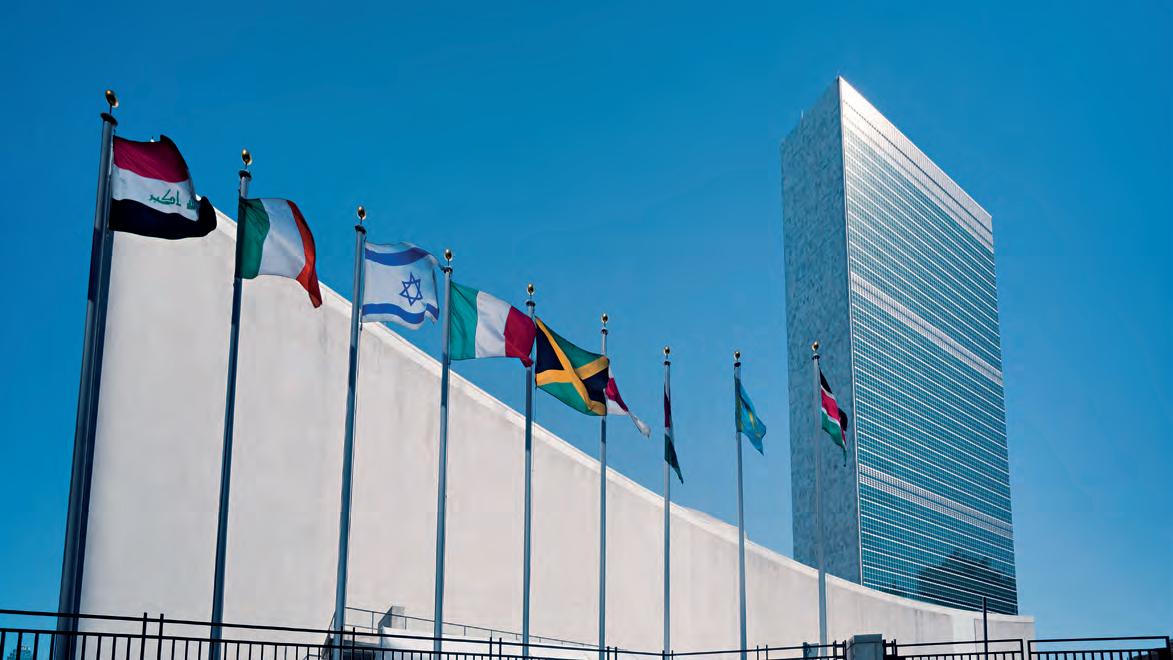
59 ACTIVE CONFLICTS IN 2024
233,000 DEATHS IN THOSE CONFLICTS
$19.97trn
$47bn SPENT ON PEACEKEEPING
$500m BUDGET CUTS THE UN FACES IN 2026
$1.5bn
WITHOUT STRONG POLITICAL SUPPORT, THE UN’S ROLE ON THE GLOBAL STAGE WILL BE INEVITABLY DIMINISHED
SOURCE: United Nations
Fit for purpose?
As conflicts rage around the world, the need for peacekeeping and peacebuilding is high. Despite providing vital humanitarian support in crisis-ridden regions, the UN has been seemingly powerless to intervene in some of the world’s bloodiest conflicts. The veto powers of the Security Council’s five permanent members – China, France, Russia, the UK and the US – have stymied the organisation’s ability to respond to major crises, including the Russian invasion of Ukraine and Israel’s war in Gaza.
Since launching its full-scale invasion of Ukraine in February 2022, Russia has continued to use its veto power to block action by the Security Council, stirring debate about the body’s effectiveness and ability to defend international peace. These discussions have been further amplified by the repeated US vetoes on resolutions on Gaza. Amid a worsening humanitarian crisis in the Gaza strip, the US voted against ceasefire resolutions on six separate occasions, leaving UN peacekeeping at a standstill in the war-torn region. Sidestepping any UN-led efforts, President Trump has instead forged ahead with his own 20-point plan for peace in Gaza, undermining the organisation’s long-running endeavour to secure collective agreement on conflict resolution in the region. With the UN seemingly unable to intervene in high-stakes scenarios, many are now questioning whether the Security Council may be ripe for reform.
The body – which is primarily responsible for maintaining international peace through resolutions, peacekeeping missions and sanctions – has remained largely unchanged since its founding in 1946. Increasingly, its make-up is thought to be unrepresentative of the international community and the evolving geopolitical environment. Since its formation, the council’s elected membership has grown modestly from six elected members to 10, while its permanent membership remains the same as in 1946. Regional powers and member states from the developing world have been calling for a stronger voice at the council, with some seeking to secure permanent seats of their own. Greater representation may well give the body enhanced legitimacy in the eyes of the international community, with the council better able to reflect the current geopolitical landscape, rather than the post-Second World War political order.
Critics also argue that the increasing use of veto powers is limiting the council’s functionality. While France and the UK have not used their veto since 1989, China, Russia and

more frequently in recent years. Since the outbreak of the Syrian civil war in 2011, Russia – often joined by China – has used its veto power close to 20 times to block resolutions that would protect Syrian civilians suffering under the Bashar al-Assad regime. Since the 1970s, the US has used the veto far more than any other permanent member of the council, with the majority of its most recent vetoes relating to resolutions on Israel’s war in Gaza. The recent uptick in vetoes by the permanent five is reflective of the fractured times we are living through.
With members increasingly at odds with each other, last year the Security Council passed just 41 resolutions – the lowest number since 1991. As differences and disagreements hold the UN back, how can the organisation make good on its basic principles of peace, security and cooperation?
As the UN celebrates its 80th anniversary, it feels right to reflect on its role on the global stage. The world of today is very different to that of 1945, and the UN needs to ensure that it can adapt to an era of rising political tensions and budgetary pressures.
“This is a good time to take a look at ourselves and see how fit for purpose we are in a set of circumstances which, let’s be honest, are quite challenging for multilateralism and the UN,” said Guy Ryder, Under-SecretaryGeneral for Policy for the UN, at the launch of the ambitious UN80 Initiative.
seeks to modernise the UN and improve its efficiency across the board, enabling the organisation to remain effective, cost-efficient and responsive to today’s global challenges. Taking a three-pronged approach to reform, the initiative will look at improving internal efficiencies by cutting red tape, as well as reviewing the organisation’s 40,000 mandate documents to see what can be prioritised and deprioritised. The last and arguably most ambitious workstream looks at whether “structural and programme realignment are needed across the UN system,” in order to simplify operations going forward. “Eventually, we might want to look at the architecture of the United Nations system, which has become quite elaborate and complicated,” said Ryder.
This bold, far-reaching initiative is a clear statement of intent for the UN, signaling its aspirations to transform itself into the peacekeeping power that the world needs today. Shrinking budgets and growing geopolitical divides are placing ever-increasing strain on the organisation, and the UN will need to adapt to these pressures if it is to stay relevant in today’s fragmented world.
Long-standing criticisms of the organisation’s structure – including its limited Security Council
membership – may need to be addressed if the reform process is to be fully inclusive and transparent. These are not simple changes for an organisation as complex as the United Nations to make, but the need to revitalise and reinvigorate the UN is more pressing than ever before. As the organisation is increasingly sidelined in primary peacemaking, and faces repeated attacks on its legitimacy from US President Donald Trump, the UN must strengthen its resolve and reaffirm its commitments to its core values, while responding to the demands of today.
“We will come out of this with a stronger, fit-for-purpose UN, ready for the challenges the future will undoubtedly bring us,” Ryder said of the initiative.
Of the many challenges facing the UN, its funding shortfalls may be the most acute. The organisation will need to cut an estimated $500m from its 2026 budget and lose up to 20 percent of its staff as it looks to cope with a huge reduction in funding from the Trump administration. Against this worrisome backdrop, it is hard not to conclude that the UN80 Initiative may be driven by a need to dramatically cut costs.
The UN’s liquidity issues primarily stem from member states failing to fulfil their financial obligations, leaving a substantial budget shortfall and cash deficit. While the US is the largest debtor, owing approximately $1.5bn in withheld funds, it is far from the only member state to miss its regular payments.
Last year, 152 nations out of 193 member states paid their full UN contributions by the deadline of December 31, while in 2023, that number was just 142. Delayed and missed payments to the UN regular budget – which covers core administrative and operational costs – are placing ever-increasing strain on the organisation, while many countries are also slashing their foreign aid budgets, with devastating effects on humanitarian and peacekeeping operations.
The impact of funding cuts on important, life-saving programmes is already becoming apparent.
IS UNDER FIRE PRECISELY WHEN WE NEED IT MOST
The UN Refugee Agency (UNHCR) has warned that it may need to cut or suspend essential services in crisis-afflicted regions such as the Democratic Republic of the Congo and Bangladesh, putting the health of 13 million displaced people at risk. The UNHCR health budget has been cut by 87 percent compared to 2024, with devastating consequences for some of the world’s most vulnerable people. The UN’s Nobel Prize-winning World Food Programme (WFP) may also be forced to scale back or halt its life-saving operations, even as hunger crises around the world deepen. With its budget falling 34 percent in 2025, the WFP has said that it will be forced to reduce emergency food assistance, affecting up to 16.7 million people facing food insecurity and famine. Yemen faces the most severe cuts to its food aid system, with 4.8 million people at risk of losing life-saving support. In Cameroon, WFP resources are already at critically low levels, placing half a million refugees at risk of hunger and malnutrition. Elsewhere, HIV and AIDs support programmes in Tajikistan are suffering from shrinking support, as are protections for women and girls in crisis zones across Africa and the Middle East.
“Budgets at the United Nations are not just numbers on a balance sheet – they are a matter of life and death for millions around the world,” UN Secretary-General António Guterres told reporters at the UN80 Initiative launch. While the proposed structural changes of the UN80 Initiative will not ease the pain of budget cuts on the UN’s life-saving humanitarian work, they may well help the organisation to make some valuable savings through increasing effectiveness and efficiency. In this new era of dramatically reduced foreign aid funding, every penny counts.
There is no doubt that international diplomacy is in a very difficult place. Decades-long relations are fraying, as major powers are increasingly pursuing their own interests. If the old order of Pax Americana is truly dead, then President Trump’s speech at the 80th United Nations General Assembly might have been the final nail in its coffin. The theme for the 80th session was ‘better together,’ but Trump’s speech spoke of a deeply divided world. Over the course of an hour, the US president took aim at his opponents, saving his most scathing criticisms for his hosts. Repeating his much-disputed claim that he has personally ended seven wars in the last seven months, Trump accused the UN of inaction and “empty words.”
“What is the purpose of the United Nations?” he asked in his wide-ranging speech. “It has such tremendous potential but it is not even coming close to living up to that.”
By its own admission, the UN could indeed stand to strengthen its position and improve its ability to respond to today’s challenges. But what Trump’s speech failed to acknowledge was how repeated attacks on the UN are contributing to a wider erosion of trust in global institutions. For decades, multilateral bodies such as the UN have been able to bring parties around the table to work out collective solutions to the most complex global problems. Even in the most testing times, the organisation has served as a platform for dialogue, collaboration and collective action, encouraging unity over isolationism.
In today’s fragmented and militarised global landscape, trust in the multilateral system is faltering. The UN’s legitimacy and effectiveness is under ever-increasing scrutiny – and this scrutiny is curtailing the UN’s ability to act. Without strong political support from its member states, the UN’s role on the global stage will be inevitably diminished.
“Multilateralism is under fire precisely when we need it most,” said Guterres in his first year as UN Secretary-General. “We need stronger commitment to a rules-based order, with the United Nations at its centre.”
Simply put, the world needs more collaboration, not less. History has taught us that isolationism often leads to insecurity and instability, with civilians left to pay the price of these political decisions. For all its flaws, the United Nations remains the most important forum for collective action on the complex challenges facing the world today. As it celebrates its 80th birthday, renewed political will may be the greatest gift the UN can ask for. n


David Orrell AUTHOR AND ECONOMIST
Scientific progress depends on results that can be repeated – yet across disciplines, too many experiments fail that test. From medicine to economics, the replication crisis reveals not just flawed data, but a deeper problem: the power of authority over evidence
The replication crisis in science refers to the experimental finding that many or most experimental fi ndings don’t hold up when scientists try to repeat them. Unlike those other scientific results, it seems that this one has legs – the issue started to become very visible in areas such as medicine, psychology and biology in the mid-2000s, but other fields including economics are not immune.
Since verification is a key step in the scientific method, this calls the whole scientific project into question. Blame for it is often put down to the ‘publish or perish’ ethos, where academics are under pressure to come up with novel findings that will make interesting papers, but another factor is a (rather unscientific) respect for authority. As Jay Bhattacharya, Director of the US National Institutes of Health, told the New York Times, “You have, in field after field after field, a kind of set of dogmatic ideas held by the people who are at the top of the field. And if you don’t share those ideas, you have no chance of advancing within those fields.”
In other words, the problem is not just that experiments do not replicate. It is that theories endorsed by leaders in the field replicate without end.
Respect my authority
An early example of the phenomenon occurred in 1923 when an eminent scientist called Theophilus Painter published a paper that announced that, according to his microscopic observations, human cells contained 24 pairs of human chromosomes. Other scientists repeated his observations and came up with the same number.
However, in the 1950s new methods were developed in which cells were placed onto microscope slides, giving a better view, and it soon became obvious that there were in fact only 23 pairs. Still, Painter’s influence was such that many scientists preferred to stay with his count. Indeed, textbooks from the
time showed photographs of chromosomes, in which there were clearly 23, and yet the caption said there were 24. A variation on this occurs when new results are simply ignored because they don’t agree with current theories.
A cornerstone of modern economics is the random walk hypothesis, which states that price changes in the stock market are due to random fluctuations. In their 1999 book A Non-Random Walk Down Wall Street, Andrew Lo and Craig MacKinlay recounted that “when we first presented our rejection of the random walk hypothesis at an academic conference in 1986, our discussant – a distinguished economist and senior member of the profession – asserted with great confidence that we had made a programming error, for if our results were correct, this would imply
NEW RESULTS ARE SIMPLY IGNORED BECAUSE THEY DON’T AGREE WITH CURRENT THEORIES
tremendous profit opportunities in the stock market. Being too timid (and too junior) at the time, we responded weakly that our programming was quite solid thank you, and the ensuing debate quickly degenerated thereafter. Fortunately, others were able to replicate our findings exactly.” The random walk hypothesis was thus falsified and never spoken of again (not).
Don’t blame the butterfly
I had first-hand experience of something similar while doing my doctorate on model error in weather forecasting. The general view at the time (around 2000) was that forecast error was primarily due to chaos, aka the ‘butterfly effect,’ rather than the model itself. It followed that by making multiple model runs starting from slightly altered initial conditions, it should still be possible to make probabilistic
forecasts: a technique known as ensemble forecasting. My thesis though showed there was a simple test: if forecast errors grew exponentially in time (line curves up), they were probably due to chaos, but if they grew with the square-root of time (line curves down), then they were due to the model. During a talk at a main European weather centre, when I showed a plot of forecast errors growing almost perfectly with the square-root of time, I was interrupted by the institution’s research head who said confidently that the plot must be wrong, since error growth has positive curvature, not negative.
After the talk, we agreed that someone should replicate my results. When that was done, they were identical to the ones I had shown – however, it made absolutely no difference. The consensus remained that the errors were primarily due to chaos, so the expensive ensemble forecasting systems were not at risk (though not everyone was convinced, including New Scientist magazine which ran with the cover article ‘Don’t blame the butterfly’).
Of course, you might think that replication should be less of a problem in finance, if only because of the amounts of money that are often at stake. You can’t just make up a wacky theory about the stock market with made-up data and hope that no one will notice. Or say that a line curves up when it obviously curves down. However, in another sense it may be that the opposite is true.
Biology has progressed remarkably since the textbooks of the 1950s. Not only can biologists correctly count chromosomes, they can also engineer what goes on inside them. Economics and finance in contrast seem stuck (the random walk hypothesis dates back to 1900, and people are still arguing about it). Instead of replicating tired ideas, maybe it is time to look at data in a new way. But that is a topic for another column. n