94 The Future of Water in African Cities
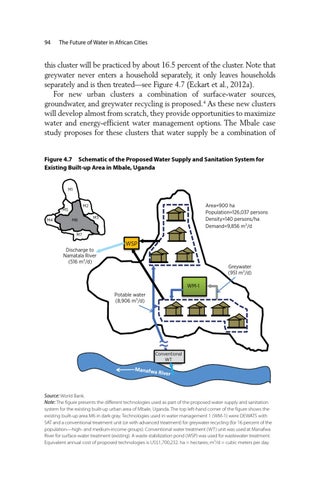
this cluster will be practiced by about 16.5 percent of the cluster. Note that greywater never enters a household separately, it only leaves households separately and is then treated—see Figure 4.7 (Eckart et al., 2012a). For new urban clusters a combination of surface-water sources, groundwater, and greywater recycling is proposed.4 As these new clusters will develop almost from scratch, they provide opportunities to maximize water and energy-efficient water management options. The Mbale case study proposes for these clusters that water supply be a combination of
Figure 4.7 Schematic of the Proposed Water Supply and Sanitation System for Existing Built-up Area in Mbale, Uganda M1
M4
Area=900 ha Population=126,037 persons Density=140 persons/ha Demand=9,856 m3/d
M2
M5 M6
M3
M7
Discharge to Namatala River (516 m3/d)
WSP
Greywater (951 m3/d) WM-1 Potable water (8,906 m3/d)
≈
Conventional WT
Source: World Bank. Note: The figure presents the different technologies used as part of the proposed water supply and sanitation system for the existing built-up urban area of Mbale, Uganda. The top left-hand corner of the figure shows the existing built-up area M6 in dark gray. Technologies used in water management 1 (WM-1) were DEWATS with SAT and a conventional treatment unit (or with advanced treatment) for greywater recycling (for 16 percent of the population—high- and medium-income groups). Conventional water treatment (WT) unit was used at Manafwa River for surface-water treatment (existing). A waste stabilization pond (WSP) was used for wastewater treatment. Equivalent annual cost of proposed technologies is US$1,700,232. ha = hectares; m3/d = cubic meters per day.