Rural Water Supply Corruption in Ethiopia
147
through different financing modalities remains opaque; however, most of the private drilling companies questioned were sanguine on this matter, highlighting the sheer volume of work that all parties must carry out to meet the UAP target. Box 4.4 provides a more comprehensive summary of the drilling companies’ views.
Box 4.4
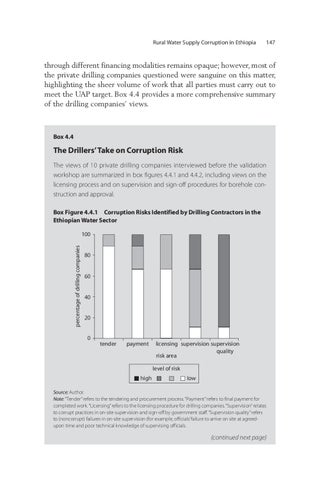
The Drillers’ Take on Corruption Risk The views of 10 private drilling companies interviewed before the validation workshop are summarized in box figures 4.4.1 and 4.4.2, including views on the licensing process and on supervision and sign-off procedures for borehole construction and approval. Box Figure 4.4.1 Corruption Risks Identified by Drilling Contractors in the Ethiopian Water Sector
percentage of drilling companies
100 80
60 40 20 0
tender
payment
licensing supervision supervision quality risk area level of risk
high
low
Source: Author. Note: “Tender” refers to the tendering and procurement process. “Payment” refers to final payment for completed work. “Licensing” refers to the licensing procedure for drilling companies. “Supervision” relates to corrupt practices in on-site supervision and sign-off by government staff. “Supervision quality” refers to (noncorrupt) failures in on-site supervision (for example, officials’ failure to arrive on site at agreedupon time and poor technical knowledge of supervising officials.
(continued next page)