access WORCESTER ART MUSEUM spring / summer 2021
© Estate of Tanaka Shinsui
4
From the director
6
What the Nazis Stole from Richard Neumann (and the search to get it back)
contents
8
The Iconic Jersey: Baseball x Fashion
12
Chiso’s Worcester Wedding Kimono
14
Higgins Armory Collection updates
16
Getting arms and armor ready for the road
18
Visual Thinking Strategies
19
Find yourself at WAM
20
Ongoing/upcoming exhibitions
22
Tours and programs
24
Seen at WAM!
25
Membership and giving22 Seen at WAM!
Cover: G. Yamazawa wearing the Heart Mountain Jersey. Photographed by Jillian Clark. On view in The Iconic Jersey: Baseball x Fashion exhibition, June 12 through September 12, 2021. Left: Utagawa Kunisada, 1786-1865, The Kabuki Actor Ichimura Uzaemon XIII, 1860, color woodblock print with graduated colors (bokashi) and blindprinting (karazuri), Mrs. Kingsmill Marrs Collection, 1925.1001. On view in The Kimono in Print: 300 Years of Japanese Design. access magazine is a publication of the Worcester Art Museum and funded in large part by the Herron-Dresser Publications Fund. All rights reserved. Information subject to change. Editor: Julieane Frost Editorial Assistant: Cynthia Allegrezza Design: Kim Noonan Photography: Stephen Briggs, Erb/Dufault Photography, Kim Noonan, Troy B. Thompson Photography Contributing Writers: Cynthia Allegrezza, Sarah Leveille
Connect with us E D S Q
3
From the director
As I write this, we have just closed an uplifting four days of Flora in Winter. We are grateful to the Worcester Garden Club and all the arrangers, who—in addition to giving their time and talent—showed adaptability and a willingness to embrace new ways to bring Flora to those at home. For those who could visit in-person, the gorgeous flower arrangements and springtime scents in the galleries were especially welcome—after nearly a full year of pandemic-related restrictions. Hope for brighter days ahead is emerging as the COVID-19 vaccine rollout continues. While we at WAM have done our best to keep you connected (first digitally only and then also by safely reopening with timed tickets), our work for a post-pandemic future continues. Progress on the new Lancaster Plaza continued through the winter, and we are on track to open our reimagined main entrance (pictured on the opposite page) in late May. When this project—including new stairs and an elevator— is completed, the Museum will be fully accessible, an achievement made possible in part by a transformative 2019 gift from the C. Jean and Myles McDonough Foundation. Have you seen the stunning kimonos in our first-ever online exhibition, Kimono Couture: the Beauty of Chiso? Although digital can never replace direct experiences, the virtual presentation allows us to see details closely, as well as to read more in-depth information. The Worcester Wedding Kimono—which you can see at the Museum in The Kimonos in Print: 300 Years of Japanese Design—was created by a family-owned fashion house in its 466th year of operation. Among the first—if not the very first—kimono commissions by a Western art museum, this stunning masterpiece helps continue ancestral Japanese fabric design techniques—some nearly extinct—and maintain a venerable tradition. This spring, we look forward to celebrating opening day for the Worcester Red Sox when they play their first game at brand-new Polar Park. Congratulations to the WooSox and the City of Worcester for reaching this exciting milestone—no small feat given the past year. In celebration, WAM has developed a special exhibition, The Iconic Jersey: Baseball x Fashion, sure to appeal to both baseball lovers and fashionistas. The response by those who have seen a sneak peek and those willing to provide support to the exhibition has been extraordinary. We are especially grateful to Lisa McDonough, Donna Cohen, Larry Lucchino, and Dr. Charles Steinberg at the WooSox for their enthusiasm for the exhibition and assistance in garnering support for this project. (See Curator Erin Corrales-Diaz’s personal reflection about the project on page 10.) In other good news, Jeffrey Forgeng, The Higgins Curator of Arms & Armor and Medieval Art, has developed an exhibition of highlights from the Higgins Collection that will travel throughout the United States. Two locations are already booked. This tour makes the collection available to a broad audience while raising revenue for the arms and armory gallery at WAM. That gallery, which we all look forward to, is currently in the advanced planning phase. (Read Jeffrey’s update on page 15.) Last but not least, I thank all of you, from the bottom of my heart and on behalf of the entire staff, for allowing us to continue our mission to connect people, communities and cultures via the experience of art. That you supported us so generously at a time when your own lives were in upheaval means that we matter to you—and that means a lot to us. You kept us going and made it possible for us to celebrate brighter days—with many more to look forward to. Thank you again!
Matthias Waschek Jean and Myles McDonough Director
The Worcester Art Museum's mission is to connect people, communities, and cultures through the experience of art.
WORCESTER ART MUSEUM
Board of Trustees 2021 Dorothy Chen-Courtin, President Mark W. Fuller, Vice President Douglas S. Brown, Vice President Sarah G. Berry, Treasurer Susan M. Bassick, Clerk Karin I. Branscombe James C. Donnelly, Jr. Antonella Doucette Lisa Kirby Gibbs Jennifer C. Glowik-Adams Karen M. Keane Sohail Masood Lisa H. McDonough Margaret McEvoy-Ball Thomas P. McGregor Philip R. Morgan Malcolm A. Rogers John Savickas Clifford J. Schorer Jonathan R. Sigel Anne-Marie Soullière Cynthia L. Strauss George W. Tetler III Christina Villena Valerie Zolezzi-Wyndham Ex Officio Matthias Waschek, Jean and Myles McDonough Director
Image right: Artist rendering of the new Lancaster stairs and elevator. Courtesy of wHY Architecture.
4
Learn more at worcesterart.org
Connect with us E D S Q
5
6
Learn more at worcesterart.org
Exhibitions
What the Nazis Stole from Richard Neumann (and the search to get it back) April 10, 2021 – January 16, 2022 What the Nazis Stole from Richard Neumann (and the search to get it back) presents the story of Viennese industrialist Dr. Richard Neumann (1879 – 1959) and the decades-long effort to recover his art collection—taken from him after Nazi Germany’s annexation of Austria in 1938. He escaped first to France and later to Cuba, and as early as 1950, began filing law suits against the Austrian government to reassemble the collection that was rightfully his. However, progress in this effort did not happen until a half century later when his grandson, Tom Selldorff, began working with the Vienna-based art historian, Sophie Lillie. Lillie was an advisor for this exhibition of the 14 restituted works to date—a small percentage of Richard Neumann’s original collection. Claire Whitner, James A. Welu Curator of European Art, interviewed Lillie about her work. CW: How did you first begin researching Nazi-era provenance? SL: In 1995, just after finishing my master’s degree in art history at Columbia University, Vienna’s Jewish Community needed a oneweek intern for their Mauerbach Benefit Sale. It was the first time I witnessed an appraisals process and saw the markings and inscriptions on the physical objects themselves, chronicling ownership and dispossession. I resolved to decipher them. The 1996 Mauerbach Benefit Sale sparked public interest in the subject of Nazi art looting, coinciding with the discovery of dormant bank accounts and unpaid Holocaust-era insurance policies in Switzerland. A subpoena was issued in 1997 for two paintings by Egon Schiele then on loan to the Museum of Modern Art in New York from Vienna’s Leopold Museum. The media outcry prompted the introduction of Austria’s 1998 Art Restitution Act to govern the return of Nazi-era art from federal museums and public collections. That law—together with the declassification of archival records—marked the onset of provenance research as we now know it. The 1998 Washington Conference on the Holocaust-era was critically important in bringing about this change. CW: How did you come to help the Selldorff family? SL: Tom and I met about twenty years ago, when I was conducting research for my first book, Was einmal war (What Once Was). The book features 150 Viennese art collections looted by the Nazis—including that of Tom’s grandparents, Dr. Richard Neumann and Alice Neumann. Through
Tom I learned more about Dr. Neumann, who built an important collection of Italian Baroque art, reflecting the taste and aspirations of Vienna’s pre-war haute bourgeoisie. CW: How did you approach this undertaking? SL: My starting point was a Neumann collection inventory, compiled by the Nazis in the summer of 1938 and submitted in an export license application for works Richard Neumann hoped to take with him on his flight from Vienna. It also documents the ruthless expropriation to come; the Nazis confiscated many of the best works and allocated them to local museums. The works cleared for export were later seized during the Nazi occupation of France. Some paintings were destined for the Führermuseum Hitler planned to build in Linz, Austria. Over many years, I built upon that first inventory, adding information I found in other sources, such as exhibition and sale catalogues, newspaper articles, art historical literature, and Tom’s family papers. My goal was to catalogue each work as fully as possible—adding measurements, medium, a date or other identifying mark, ideally a photograph—in order to establish its current whereabouts. CW: What has been most challenging? SL: Provenance research relies on identifying source materials, interpreting those records, understanding how public offices work, and dissecting the mechanisms of Nazi dispossession. Records are typically kept where private and public life intersects. A marriage record may include provisions relating to property. A probate file may give a detailed appraisal of property.
Thomas Selldorff and Sophie Lillie, who helped him identify the paintings, pose for the media during a ceremony at the Ministry of Culture in Paris in 2013 to return paintings taken from their Jewish owners during World War II. © Michel Euler/AP
The Nazis’ notorious recordkeeping—much of which has been preserved—plus Naziera tax records, customs, and export records are key to retracing the misappropriation of art. Ultimately, restitution relies on paralegal work, on compiling key documents to build a persuasive argument—and a great deal of attention to detail, perseverance, and patience. CW: What has been most rewarding? SL: Over many years, we recovered a number of Neumann objects from public collections—two from the Weinstadtmuseum in Krems, an Austrian town, six from Vienna’s Kunsthistorisches Museum, and six from French museums, including the Louvre in Paris. Two paintings, which resurfaced on the art market in recent years, were recovered from private collectors. My greatest joy has been working with Tom, who has pursued the quest for his family’s art with enthusiasm, dedication, and great courage. Tom speaks of these artworks as a way of passing on his grandfather’s love for art to his children and grandchildren, which is a lovely metaphor to describe what art restitution is all about. It is a great privilege for me to have been a part of his journey. Generous support for this exhibition is provided by the Jewish Federation of Central Massachusetts and anonymous donors. Additional support is provided by The Strassler Center for Holocaust and Genocide Studies at Clark University, PEACE Fund GWCF, Marlene and David Persky, Carol and Michael Sleeper, Dr. and Mrs. Herbert Dean, Dr. Shirley S. Siff, Johanna D. Drooz Yoffie and Alan S. Yoffie, and Carol Seager. Sponsored by
Opposite: Giovanni Battista Pittoni the younger, Hannibal Swearing Revenge Against the Romans, detail, The Selldorff Family in memory of Richard Neumann.
Connect with us E D S Q
7
Exhibitions
The Iconic Jersey: Baseball x Fashion June 12 – September 12, 2021 Models wearing the Ghana Baseball Jersey, designed by MIZIZI International, LLC. Photographed by Kwesi Yanful (@kwesithethird) with creative direction by Temi Thomas (@temithomas).
J
ust over a mile from the Worcester Art Museum, Polar Park—home of the newly minted Worcester Red Sox—is slated to open this spring. Bringing the Triple-A affiliate of the Boston Red Sox to Worcester and building a new professional ball park here is part of what many are calling the city’s “Renaissance.” Eager to participate in this monumental occasion and celebrate Worcester’s growing cultural and economic vitality, WAM has developed an exhibition that fans of baseball—and fashion—will love. The Iconic Jersey: Baseball x Fashion, puts the spotlight on the most visual, symbolic, and for many, the most cherished aspect of the sport. Today, the jersey is not only found on the diamond or in the stands, but also on the street and the runway. From the covers of music albums to the crowds at Fashion Week, the baseball jersey has come to represent more than a team or an individual player. It has also come to reflect a larger commentary about culture, identity, and status. In addition, it can recall forgotten narratives, promote social change, and subvert the status quo. The jersey unifies and divides, and at the same time has sparked a lasting stylistic shift in how and why Americans engage with sportswear in the everyday. Accessible and recognizable, yet often overlooked for its familiarity, the baseball jersey captures the imagination—from Little Leaguers to couture designers. To don a baseball jersey is to engage in more than 170 years of baseball fashion and design history. How did the baseball jersey, a garment intended as a sporting uniform, transform into a fashion statement and platform to express creativity and social commentary? The Iconic Jersey explores
8
Learn more at worcesterart.org
this question and many more by unraveling the historical threads of the baseball shirt and examining the interwoven aesthetic stories of technological innovation, societal change, and the lure of nostalgia. Featuring more than 35 historic and contemporary jerseys and baseball-inspired fashion, the show traces the development, experimentation, and dissemination of the iconic American-style baseball shirt in the sport, on the runway, and in everyday life. The exhibition is divided into three sections that allow for aesthetic rumination and intellectual curiosity. Most of us have encountered the distinct shape and style of today’s baseball jersey: a short-sleeved, collarless button-down shirt with the player’s name and number on the back. “The Modern Jersey” traces the graphic time line of artistic choices in the garment. Often perceived as timeless, the baseball jersey underwent several transformations before settling on the recognizable design we associate with the sport today. Far from static, baseball jerseys move through cycles of nostalgia and fashion-forward modernity. But even as the jersey evolves, it holds tight to certain customs of dress and design, instilling a belief in the traditional form of the American-style baseball jersey, although contemporary sportswear designers are looking for a change. “Experimental Design” examines tailoring decisions that deviate from the traditional jersey shape. From practical modifications to the superfluous, these jersey alterations illustrate fashion trends and potential future evolutions. In a sport where tradition reigns supreme, change is generally perceived negatively. But fashion is ever-changing, even in baseball, and what was once the subject of sartorial tirades now garners respect and popularity.
The final section, “Off the Field,” looks at how the baseball jersey became the ultimate symbol of fandom and its emergence in luxury design and streetwear. When baseball fans donned their favorite replica jerseys to games or sports bars, they normalized sportswear in the everyday. Without fan fashion, the baseball jersey would not carry the same pop culture status that is so appealing to designers as inspiration for off-the-field clothing ranging from streetwear to haute couture. Displayed alongside fabric swatch books, logo designs, and historic photographs, these garments demonstrate creativity, craftsmanship, and culture that operate inside and out of the ballpark—and tell a fascinating story about the long-standing collaborative intersection of baseball and fashion. We hope The Iconic Jersey adds to the excitement surrounding the opening of Polar Park and gives WooSox fans another reason to cheer this summer. —Erin Corrales-Diaz, Ph.D., Assistant Curator of American Art The Iconic Jersey: Baseball x Fashion is made possible through the generous support from the Fletcher Foundation. Additional support is provided by the Arthur M. and Martha R. Pappas Foundation, Bill and Joan Alfond Foundation, Lunder FoundationPeter and Paula Lunder family, Murray Family Charitable Foundation, Larry and Stacey Lucchino, Cynthia L. Strauss and Harry A. Sherr, and an anonymous donor. This project is also funded in part by the Don and Mary Melville Contemporary Art Fund, Ruth and John Adam, Jr. Exhibition Fund, Hall and Kate Peterson Fund, Heald Curatorial Fund, and Michie Family Curatorial Fund. Sponsored by:
Media Partner: Opposite: Wright & Ditson (American, founded 1871), Boston Red Sox Uniform Shirt, worn by Jesse Tannehill, 1908, wool flannel, National Baseball Hall of Fame and Museum, B-176-61
Don and Mary Melville Contemporary Art Fund
Erin Corrales-Diaz wearing WAM’s Worcester WooSox Jersey, which is for sale in the Museum Shop.
A baseball journey When the idea was tossed around the curatorial department of creating an exhibition to celebrate Polar Park, Worcester’s brand-new baseball stadium, I saw a wonderful opportunity to rethink the intersection between art and sports. Not because I am a die-hard baseball fan (Full disclosure: fair-weather Seattle Mariners fan here!), but because I saw it as a creative and novel way to celebrate our city. Rather than revisit the subject of baseball in fine art, I pitched a different approach—fashion and design. Clothing is a profoundly personal art form, accessible to all and intrinsic to our daily lives, and my background in visual and material culture gave me the frameworks to broach this topic. Plus, my own personal fascination with fashion and textiles added to my enthusiasm for this approach—the first ever for an art museum. So, from sports graphic designers to hip-hop photographers, I delved into the extraordinary world of baseball jerseys. My WAM colleagues and I knew we had an appealing exhibition idea, but we didn’t anticipate the overwhelming community response we’ve had. Driven by WAM Board member Lisa McDonough’s contagious passion and commitment for the project, we garnered record-breaking support—from the WooSox and Boston Red Sox to the City of Worcester to many generous donors and sponsors. We are profoundly grateful to Lisa McDonough, Donna Cohen, Larry Lucchino, and Dr. Charles Steinberg and his staff at the WooSox for their enthusiasm, inspiration, and support throughout the development of this exhibition. I am thrilled that my project has garnered such interest from so many diverse communities, all through a simple, but remarkable garment—the baseball jersey. —Erin Corrales-Diaz, Ph.D. Assistant Curator of American Art
Don and Mary Melville met in London and together ventured to New York and Boston, finally landing in Worcester when Don joined Norton Company in 1967. Over the next 30 years, Don’s career culminated with him becoming CEO and Chairman of Norton. At the same time, he and Mary actively supported area nonprofits and educational institutions, particularly the arts, sciences, environment, and women’s issues.
Don and Mary Melville
The Worcester Art Museum was fortunate to have the Melville's generous and passionate support. While Mary had several artist friends, Don immersed himself at the Museum volunteering on various committees: Collections, Development, Diversity, Exhibitions, Finance, Investments, Marketing, Planning, Nominating, and the Board of Trustees, on which he served as President in the early 1990s. For his commitment to WAM, Don received the Salisbury Award, the Museum’s highest honor, in 1996. Don explained his philosophy about the importance of art when he stated that “cultural activities help people to enjoy their lives and I think enjoyment of life is what we’re on the planet for. Also, it is part of the civilizing influence that helps to make us all more tolerant of our neighbors. And that’s a very healthy thing.” Their daughters confirm this. Jennifer Melville says that art always had a strong presence in their home, while daughter Wendy Mains says that her father was most proud of his family and his contribution to the arts. Along the way and perhaps through Mary’s friendships, they began to collect and admire contemporary art. In 1997, they established the Donald and Mary Melville Contemporary Art Fund to support contemporary arts programming. One might wonder why someone would set up a fund such as this. In a letter to Director Emeritus Jim Welu in 2008, Don wrote of his own art experience saying “that it was at WAM that I got my Ph.D. in art appreciation—I got to like so many different manifestations of art from so many civilizations and centuries. Because I like change, I am enamored of contemporary art, but, of course, all art was contemporary once.” We are honored that Don and Mary chose to commit to their belief in the uniting influence of art by endowing a fund at the Worcester Art Museum. This year their endowment will support programming for The Iconic Jersey: Baseball x Fashion, bringing new audiences to the Museum. Because of the Melvilles’ generosity, future generations of diverse people and communities will enjoy the transformative and unifying power of contemporary art. If you would like to establish an endowed fund in your name or in honor of a loved one, please contact the Development Office at 508.793.4325.
Philanthropy Salisbury Award 2021: Judith Stoddard King At the virtual Salisbury Society Evening on January 29, the Museum was honored to present Judith Stoddard King with the Salisbury Award, the Museum’s highest distinction. First bestowed in 1992 to Judy’s mother, Helen E. Stoddard, the award commemorates outstanding contributions of leadership and support to the Worcester Art Museum. Judy is just the twelfth recipient of our most prestigious recognition. The award was last given to Mary and Warner Fletcher in 2012. Judy has been a treasured and lifelong friend of the Worcester Art Museum. A trustee emerita, she served on the Board of Trustees from 1997 to 2006. Her involvement continues today as a Corporator and valued member of the Collections Committee. Through her service on the latter and her philanthropy to the Museum, she has helped steward and broaden WAM’s collection, with the goal of expanding the visitor experience through the intrinsic value of art.
“The Worcester Art Museum is here for everyone.” The Stoddard and King families have been lead supporters of the Museum for decades. The Stoddard Acquisition Fund, created in 1979 and one of the most generous and meaningful gifts in the Museum’s history, has allowed WAM to grow its extraordinary collection. On a personal level, Judy and her late husband, B.A. “Tony” King, have been dedicated philanthropists, supporting the Museum and the concept of art for all—views they imparted to their four children. While Tony was an accomplished photographer (whose works were showcased in a 2018 WAM exhibition, which Judy helped organize after his passing), art has always been at the center of her life. Today, her colorful, meticulously created collages are inspired by daily observations, and encourage viewers to be aware of the beauty of our surroundings. Judy’s works have been shown at the Fletcher/Priest Gallery, the Neal Rosenblum Goldsmith Gallery, and the Mast Cove Gallery in Maine. Her collages are currently on view at the Pucker Gallery in Boston.
Judith Stoddard King
alisbury
ward
in recognition of OU TSTA NDING SERVICE & PHIL ANT HROP Y
2021
udith Stoddard ing
Judy is admired for her quiet, discreet leadership style; her warm and welcoming nature; and her deep love of art and art expression. Always generous with her time and resources, she is a committed advocate for many cultural organizations in the Worcester community. WAM is fortunate to have Judy as one of our most cherished and devoted friends. Her steady support has helped ensure that the Worcester Art Museum remains a vibrant institution that enriches the lives of our community and visitors with the beauty and transcendence of art.
2012
When accepting her award, Judy said, “The Worcester Art Museum is here for us—for everyone—a beautiful place in which to find solace, self-expression, as well as trigger and inspire our own ... I have been blessed ... I thank you!”
1995
ean and
1994
hapin
1993
arbara Allen ooth
1992
elen . toddard
We are so grateful for Judy’s many years of outstanding service and philanthropy and are delighted to bestow the Museum’s highest honor to her.
2011
arner and ohn and
2008 2003
ohn M. mes
1996
arianne eppson
ancy Murray
2001 1999
ary letcher
.
organ
elson ald 2nd
obert and
viva reelander
onald R. yles
cDonough
iley
Connect with us E D S Q
11
Exhibitions The Worcester Wedding Kimono
A
fter a long wait, the Worcester Wedding Kimono is finally on exhibit at WAM! This exquisite garment—designed and crafted by Chiso, the 466-year-old, Kyoto-based kimono house—is the centerpiece of The Kimono in Print: 300 Years of Japanese Design, on view through May 2, 2021. Inspired by Worcester’s iconic seven hills and the maple leaf—a shared symbol of nature in New England and Japan—the kimono design encompasses seven decorative techniques. Some of the techniques are endangered, practiced today by only a handful of artisans, making the kimono—the first commissioned as a work of art by an American art museum—a time capsule of Chiso craftsmanship.
Surrounded by 70 woodblock prints and illustrations exploring the kimono as a major source of inspiration and experimentation in Japanese print culture from the 17th to 20th centuries, the Worcester Wedding Kimono offers a unique opportunity to compare the print images with an actual kimono. The open display on a mannequin allows a close-up look at the kimono’s stunning details and vibrant colors. The Worcester Wedding Kimono was originally commissioned for an in-house exhibition, Kimono Couture: The Beauty of Chiso. With travel restrictions due to the pandemic, the show could not be held as planned, so it was reimagined as a virtual, multi-media, and interactive experience. The transition from in-house to virtual exhibition was managed by Rachel Parikh, Ph.D., Assistant Curator of Asian and Middle Eastern Art. access: How did you approach creating this virtual exhibition? RP: I first met with Vivian Li and Christine Starkman, the co-curators of the original exhibition, to discuss what concepts, ideas, and visual elements they wanted to bring to life in a virtual format. We wanted to emphasize the enduring and innovative artistry in creating a kimono at Chiso and decided it would be best to tell this story through a variety of themes, from the materials used to decorate the kimono to the collaborative process in its production (Chiso employs nearly 600 artisans!). I then teamed up with web engineer, Amanda Cheung, and designer, Ian Dickens, to create the exhibition. Through their thoughtful and striking designs, layouts, and animations, Amanda and Ian were able to convey Chiso’s core value: bi hitosuji, which translates to “nothing but beauty”.
Screenshot from the virtual exhibition, Kimono Couture: The Beauty of Chiso, kimonocouture.worcesterart.org
12
Learn more at worcesterart.org
access: How was this experience different from curating a physical exhibition? RP: In an in-house exhibition, wall labels usually supplement what you are seeing and experiencing, but in a virtual format, you have to lean into storytelling. Thus, we made the virtual exhibition both interactive and animated to not only guide the visitor through an experience that made sense, but to also give them an engaging way to understand and appreciate the subject matter. access: What was the biggest challenge you faced? RP: This was an unprecedented venture for WAM, so we had to work through the learning curve. That involved making sure everyone was on the same page. Realizing early on that we can’t replace it or replicate an in-person experience, we shifted our thinking and approach in order for it to be successful on a virtual platform. An example is readapting elements, like the flow and content. We learned from the experience and created something beautiful, insightful, and inviting.
access: What was the thinking behind releasing the exhibition over ten weeks? RP: We wanted the exhibition to be immersive for the visitor to get the most out of their experience and to get to know Chiso. We thought staggering the show over ten weeks was a great way to achieve this. Each week, the visitor encountered a new theme through a different Chiso kimono. These bite-sized moments allowed for really understanding the material and content. We liked the idea of creating a full story over time, in a sense mimicking the long and storied history of Chiso. The ten weeks also was a countdown to the in-house exhibition, The Kimono in Print: 300 Years of Japanese Design. The two exhibitions dovetail beautifully, as the specially commissioned Worcester Wedding Kimono is featured in both. access: How will this experience change how WAM engages with audiences in the future? RP: This is a major milestone for us with regard to audiences and accessibility. We can bring WAM to everyone, and everyone can be part of the WAM community. It’s exciting to think of people halfway around the world engaging with our exhibitions. It also really changes what a “visitor” means to us. We now have the opportunity to provide WAM as an experience in any size, shape, or form—and that just opens up so many exciting possibilities for us and for our growing community. The Kimono in Print: 300 Years of Japanese Design is generously supported by the E. Rhodes and Leona B. Carpenter Foundation. Early research for this project was made possible by the Japan Foundation and the Institute of Museum and Library Services. Media partner is WGBH. Research for Kimono Couture: The Beauty of Chiso was made possible by the Japan-United States Friendship Commission and the Northeast Asia Council of the Association for Asian Studies. The exhibition presentation and kimono commission are supported by the Fletcher Foundation and Michie Family Curatorial Fund. Additional support is provided by Sandy Hubbard and Thomas J. Logan and Emily and James Holdstein. Corporate sponsors are Cornerstone Bank and Imperial Distributors.
Opposite: CHISO, Ltd., Worcester Wedding Kimono, 2018, various dyeing methods with gold leaf and embroidery on woven silk, Stoddard Acquisition Fund, 2021.1
The development of The John
Woodman Higgins Arms & Armor Collection at the WORCESTER ART MUSEUM over time
2013
Higgins Armory Museum closes on December 31.
2014
WAM begins accessioning objects from the Higgins Armory Collection in January. Knights! exhibition opens on March 29. Jeffrey L. Forgeng, Ph.D., begins as The Higgins Curator of Arms & Armor and Medieval Art.
2015
Samurai! exhibition runs from April 18 – September 6.
2016
On November 6, Knights! closes after 18 months. Reinstalled Medieval Galleries open on December 17.
2017
Installation of arms and armor throughout the Museum galleries begins. In total, more than 100 objects are on display. WAM receives a $40,000 planning grant from the NEH.
2018
WAM receives a $250,000 grant from the Institute for Museum and Library Services (IMLS) to begin developing the permanent Arms and Armor Gallery.
2019
In the fall, Natasha Mao, Ph.D., is hired as Interpretive Fellow, with particular responsibility for visitor data gathering, digital and social media development, and project management.
2020
The Higgins team at WAM launches a social media program on Facebook, Instagram, and YouTube. The Museum receives another $250,000 grant from IMLS to continue developing the permanent gallery. The traveling exhibition, The Age of Armor—Treasures from the Higgins Armory Collection at the Worcester Art Museum is created and the first two venues booked.
2021
The Age of Armor—Treasures from the Higgins Armory Collection at the Worcester Art Museum travels to its first venue, the Toledo Museum of Art, November 2021 – February 2022.
2022
The Age of Armor—Treasures from the Higgins Armory Collection at the Worcester Art Museum will be on view at Cummer Museum of Art and Gardens from October 2022 – January 2023.
Collection
Higgins Armory Collection updates
S
ince the Worcester Art Museum acquired John Woodman Higgins’s beloved collection of arms and armor in 2014, we have found numerous ways to bring it to new life for WAM visitors. From the Knights! and Samurai! exhibitions to the reinstallation of the Medieval Galleries and armor displays around the Museum, the Collection—familiar to so many—has been interpreted in fresh ways. Now, while continuing the work of planning a permanent arms and armor gallery, we are taking the Higgins Armory Collection to the world— literally and virtually—through a new traveling exhibition and social media.
In the short term, this digital content has helped WAM connect to its public during the pandemic. Ultimately, it will provide the basis for content in the permanent arms and armor gallery. In fact, the mini-videos have already been integrated into a new interactive recently created to inform visitors about the arms and armor in our Medieval Gallery. The need to suspend all hands-on activities at the Museum during the pandemic, gave us an opportunity to adapt this interactive for mobile devices, so that visitors can learn about the objects on display via their smartphones. (Look for the QR code next to the arms and armor display.)
This outreach, along with progress toward completing the arms and armor gallery, got a big boost in the fall of 2019 with the hiring of Natasha Mao as Interpretive Fellow, thanks to funding from an Institute for Museum and Library Services (IMLS) grant. Since then, Natasha, who earned her Ph.D. in Art History from Rice University, has worked closely with me and the rest of the Higgins team to gather audience data— through educator roundtables, accessibility audits, visitor interviews, and focus groups—that will help us design a highly accessible and visitor-friendly gallery.
We formally launched the design process for the permanent arms and armor gallery in 2020. A National Endowment for the Humanities (NEH) grant allowed us to work with wHY Architecture, the architect of WAM’s Campus Master Plan, to develop a preliminary concept design. Then, we engaged IKD, a design firm based in Boston and San Francisco, as the gallery designer. Currently, IKD is completing an analysis of the Collection that will scale the dimensions of more than 1,000 objects to determine how they will fit into the future gallery space.
Natasha also has taken the lead in developing the Higgins Armory Collection social media presence, assisted by a cadre of creative and dynamic interns. When WAM closed in March 2020 due to COVID-19, this initiative took on new importance as people couldn’t come to the Museum to see the objects in person. In June the team launched a revived and rebranded Higgins Armory Facebook page, as well as a new Instagram page. By the end of the year, the team posted content six days a week. We also started producing mini-videos on the Collection, with more than two dozen now available on the Higgins Armory playlist on WAM’s YouTube channel.
Amidst all of these initiatives, the Higgins team also created a touring exhibition of the arms and armor collection, The Age of Armor—Treasures from the Higgins Armory Collection at the Worcester Art Museum. Since most of the Collection is currently in storage, the traveling exhibition offers a rare opportunity to share highlights with a national and international audience, while also generating revenue to help support the expense of the future gallery. The exhibition will travel to Ohio’s Toledo Museum of Art in 2021 and Florida’s Cummer Museum of Art and Gardens in 2022, with additional venues in negotiation.
Jeffrey L Forgeng (left) and Natasha Mao (right) stand behind the Stechzeug armor in the Medieval Galleries.
This touring exhibition also helps us experiment with new ways of displaying and interpreting the Collection. One important development has been a new generation of mannequins for displaying suits of armor. WAM inherited a number of mannequins from the Higgins Armory Museum, but most are antiquated and ready to be retired from service. We are working with local craftsmen to create custom mannequins that will be sturdy, posable, and economic to reproduce. (See related article on page 16.) The team wrapped up the NEH grant in early summer of 2020 and the first IMLS grant in the fall. During this time, we also received another two-year IMLS grant to support the next phase of designing and developing the arms and armor gallery. These federal grants cover only a fraction of the millions of dollars required to complete the project, but lend considerable weight to future fundraising efforts, particularly with the assistance of wHY’s concept design and the project’s highly visible profile on social media. Keep an eye out on Facebook and Instagram to watch this exciting project unfold in real time and stay tuned for more updates! —Jeffrey L. Forgeng, Ph. D., The Higgins Curator of Arms & Armor and Medieval Art
Connect with us E D S Q
15
Conservation
Getting arms and armor ready for the road
T
he Higgins Armory Collection has long been a hidden treasure of the City of Worcester. Originally assembled by John Woodman Higgins in the early 20th century, for display in a museum attached to his factory, this collection now comprises more than 1,500 armor and weaponry objects from around the world. It is the second largest collection of such in the United States (after the Metropolitan Museum in New York). Generations of children and adults alike were enthralled by arms and armor at the former Higgins Armory Museum, brought to life by creative displays, engaging tours, and demonstrations conducted by dedicated educators. When the collection moved to the Worcester Art Museum in 2014, we committed ourselves to recreating that magic. That goal is closer than ever, thanks to the efforts of Higgins Curator of Arms & Armor and Medieval Art Jeffrey Forgeng and Project Conservator of Objects, Higgins Collection Bill MacMillan (both formerly of the Higgins Armory Museum). But first, museum-goers in other parts of the country will have an opportunity to experience the Higgins Collection for themselves through the new traveling exhibition, The Age of Armor—Treasures from the Higgins Armory Collection.
Of course, the entire Collection cannot go on the road. “We assess every piece before deciding what can go,” says Bill. “Is it safe to travel? Can it handle being set up and taken down? Each one gets a full exam to make sure it’s road-worthy. If it doesn’t do well, we don’t send it out.”
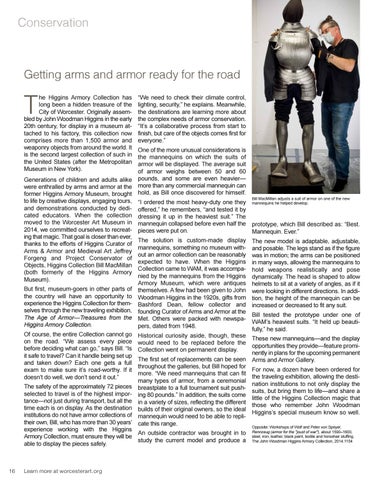
“We need to check their climate control, lighting, security,” he explains. Meanwhile, the destinations are learning more about the complex needs of armor conservation. “It’s a collaborative process from start to finish, but care of the objects comes first for everyone.” One of the more unusual considerations is the mannequins on which the suits of armor will be displayed. The average suit of armor weighs between 50 and 60 pounds, and some are even heavier— more than any commercial mannequin can hold, as Bill once discovered for himself. “I ordered the most heavy-duty one they offered,” he remembers, “and tested it by dressing it up in the heaviest suit.” The mannequin collapsed before even half the pieces were put on. The solution is custom-made display mannequins, something no museum without an armor collection can be reasonably expected to have. When the Higgins Collection came to WAM, it was accompanied by the mannequins from the Higgins Armory Museum, which were antiques themselves. A few had been given to John Woodman Higgins in the 1920s, gifts from Bashford Dean, fellow collector and founding Curator of Arms and Armor at the Met. Others were packed with newspapers, dated from 1948. Historical curiosity aside, though, these would need to be replaced before the Collection went on permanent display.
The first set of replacements can be seen throughout the galleries, but Bill hoped for more. “We need mannequins that can fit many types of armor, from a ceremonial The safety of the approximately 72 pieces breastplate to a full tournament suit pushselected to travel is of the highest impor- ing 80 pounds.” In addition, the suits come tance—not just during transport, but all the in a variety of sizes, reflecting the different time each is on display. As the destination builds of their original owners, so the ideal institutions do not have armor collections of mannequin would need to be able to replitheir own, Bill, who has more than 30 years’ cate this range. experience working with the Higgins An outside contractor was brought in to Armory Collection, must ensure they will be study the current model and produce a able to display the pieces safely.
16
Learn more at worcesterart.org
Bill MacMillan adjusts a suit of armor on one of the new mannequins he helped develop.
prototype, which Bill described as: “Best. Mannequin. Ever.” The new model is adaptable, adjustable, and posable. The legs stand as if the figure was in motion; the arms can be positioned in many ways, allowing the mannequins to hold weapons realistically and pose dynamically. The head is shaped to allow helmets to sit at a variety of angles, as if it were looking in different directions. In addition, the height of the mannequin can be increased or decreased to fit any suit. Bill tested the prototype under one of WAM’s heaviest suits. “It held up beautifully,” he said. These new mannequins—and the display opportunities they provide—feature prominently in plans for the upcoming permanent Arms and Armor Gallery. For now, a dozen have been ordered for the traveling exhibition, allowing the destination institutions to not only display the suits, but bring them to life—and share a little of the Higgins Collection magic that those who remember John Woodman Higgins’s special museum know so well. Opposite: Workshops of Wolf and Peter von Speyer, Rennzeug (armor for the "joust of war"), about 1590–1600, steel, iron, leather, black paint, textile and horsehair stuffing, The John Woodman Higgins Armory Collection, 2014.1154
Education
What’s going on in this picture? Visual Thinking Strategies offer valuable lessons on art interpretation
I
magine learning how to look at art by talking about it. That’s exactly what Worcester Public School fourth-graders did during their field trips to WAM before the COVID-19 pandemic. As part of The Culture LEAP (Learning Through Arts Partnerships) initiative, Museum docents helped the students look at art and discuss what they saw using the innovative Visual Thinking Strategies (VTS) method. Introduced to WAM docents several years ago, the VTS approach believes that thoughtful, facilitated discussion of art activates transformational learning accessible to all. It works well for both children and adults. According to Aileen Novick, manager of public and educations programs, VTS is a discovery process that uses art to teach critical thinking, communications skills, and visual literacy. “At its core are three key questions to answer: What's going on in this picture? What do you see that makes you say that? What more can we find?” she says. WAM docent Deb Wallace has used VTS since 2018, primarily with the fourth-grade LEAP tours. “These students are eager to learn, explore, and discover, and VTS supports that learning style,” she says, “I see Museum guests become more engaged in viewing art, more receptive to the introduction of new vocabulary, and listening carefully to others’ observations.” WAM’s Education staff worked with Timmary Leary, WPS Visual Arts Curriculum Liaison, to create a virtual LEAP program for fourth graders scheduled to launch this winter, according to Aileen. “Our Studio Art faculty will use VTS with Head Start students as we work with them virtually
18
Learn more at worcesterart.org
Docents use Visual Thinking Strategies in both school and adult tours.
this winter,” she adds. ““Thanks to generous funding from the Hanover Group Insurance Foundation 25 docents were trained on VTS in a virtual program last fall. Eventually, VTS will be used with all fourth-grade WPS field trips to the Museum.” “Our experience with the VTS training of WAM docents helps us put students in charge of their own meaning making,” says Aileen. “Teachers use this strategy to access the student narrative as part of the discussion. This classroom preparation will deepen their meaning making at WAM during their fourth-grade LEAP trip. VTS discussions led by docents strengthen the connections made by our students to the works in the Museum and their appreciation for cultural institutions. Recognizing oneself in the Museum honors their diverse cultures, memories, and complex identities,” she emphasizes. Docent Brad Barker uses VTS for both school and adult tours (offered virtually during the pandemic). “This learning approach not only benefits Museum guests, but also enhances my own enjoyment because my tours became more interactive, engaging, and energetic,” he says. “I like that VTS teaches children that art is interpretive and it’s acceptable that children can have different interpretations.” When docents use VTS, they provide little information about the artwork, if anything at all, according to Brad. “VTS coaxes out observational and critical explanations and encourages each guest to think for themselves as opposed to what the docent is saying,” he says. “This makes the artwork more personal and promotes the concept that art is, by its very nature, interpretative.”
It is this personal analysis of the art that leads to a conversation and presents individual ideas to the entire tour group. This sharing allows Museum visitors to realize that others see the art differently and may have unique interpretations. “This is a benefit that cannot be obtained through the traditional tour practices,” Brad says. “Studies have proven that guests actually learn, and retain, a great deal more using VTS as opposed to a lecture-style touring format.” “I enjoy seeing Museum visitors actually looking at the work, and their excitement to contribute their reflections,” adds Deb Wallace. “VTS is an observer-driven learning experience, initiated by those three questions that are followed by observations and the paraphrasing of those remarks in an accepting community.” And according to Aileen, participating in a VTS tour improves the visitor experience. “Many people will typically spend less than three seconds really looking directly at a work of art. More attention is often given to the label associated with the work,” says Aileen. “Moreover, people are frequently discouraged from creating and sharing their own ideas about art. With VTS, students and adults can be shown that their experience with a work of art is valuable, and this often encourages them to take more time to really look at a painting or an object.” Culture LEAP is a partnership among the Worcester Public Schools, cultural institutions, the Working Education Subcommittee of the Worcester Cultural Coalition, and the Worcester Educational Development Foundation, Inc. The program receives generous support from the George I. Alden Trust and the Stoddard Charitable Trust. Visual Thinking Strategies (VTS) is an educational non-profit that trains educators in schools, museums, and institutions of higher education to use a student-centered facilitation method to create inclusive discussions. VTS training at WAM is generously supported by the Hanover Group Insurance Foundation, Inc.
Find yourself at WAM
Works of art speak to us in different ways; sometimes we find ourselves returning to the same piece over and over. Members of the WAM community tell us about their favorite works in the Museum’s collection.
Andrew Hem’s Uzumaki Clan mural in the Lancaster Lobby When I moved to Worcester over a decade ago, I felt detached. I questioned whether a first generation Filipino American from the Bronx would make any meaningful connections. Culturally, I’ve been raised to be an introvert, but stepped outside my comfort zone and took an Asian Brush Painting class at WAM. Over the years, I enrolled in this class multiple times. That class has opened new opportunities and friendships that I will cherish forever. I’d look forward to our trips to the Asian Art collections, where we’d immerse ourselves in the work and get inspired to create our own spin on the art. In 2015, I was delighted to see the progress of the Samurai! murals each week as they transformed from outlines on blank walls to striking images that graced the Lancaster Welcome Center for a few years.
A detail from Andrew Hem’s mural, Uzumaki Clan, 2015
“You can feel her determination coming out of the painting.”
My favorite mural was the one by Andrew Hem. The work drew me in because I feel that I can relate to the main character, a samurai widow who dons her late husband’s armor. She seems to be branching off from the traditional way of life, empowered to be in the forefront, to “do her thing.” I loved how the other characters in the background seemed so flat and angular, whereas the woman was bold, facing forward with heart and spirit. You can feel her determination coming out of the painting. This work reflected WAM’s core mission of connecting people, communities, and cultures through the experience of art. It celebrated immigrants and the empowerment of women. I found this painting special because it is so welcoming and encourages even the most timid of spectators to come in, explore, and make their own path. Romina Sarreal Ford of Worcester has been a Worcester Art Museum Corporator since 2019.
Flying Panel Metate from Costa Rica Growing up in Ecuador, my beautiful abuela (grandmother) used to tell me “The only things you take to the next place with you is what you ate and what you learned.” Whenever I visit the Worcester Art Museum, I like to make a purposeful stop at the Pre-Columbian Art Wing to connect with those words through one of the pieces that holds deep meaning to me, the Costa Rican Flying Panel Metate. Although it is described as a ceremonial piece, I think of both the simplicity and the deep complexity of this piece as it blends two of the most important things for me in my life, food and art. As an everyday object, it received the touch of expert and knowledgeable hands (probably wonderfully worn like my abuela's hands) who brought sustenance to families. As a piece of art, it makes me wonder about the artist’s process as it evokes many stories involving human, animal, and divine dimensions. And as a ceremonial element, it brings its simplicity to an eternal realm as it was designed to accompany someone to the next place, so they can continue their journey with taking what they ate and learned with them.
Flying Panel Metate, Costa Rica, Atlantic Watershed Region, 1 CE–500 CE, stone, Museum Purchase, 1965.3
“Growing up in Ecuador, my abuela (grandmother) used to tell me ‘The only things you take to the next place with you is what you ate and what you learned.’”
The Metate grounds my experience at the WAM and helps me connect to the rest of the place as somewhere I also belong. Germán Chiriboga is a new Worcester Art Museum Corporator. Originally from Ecuador, Germán moved to Worcester 20 years ago. Connect with us E D S Q
19
Ongoing/upcoming Central Massachusetts Artist Initiative (CMAI) Sidney and Rosalie Rose Gallery
Hank von Hellion, Vanda Saints
Hank von Hellion May 26 – November 28, 2021
Leslie Graff (top) On Her Mind, 2020, acrylic on canvas, (bottom) On His Mind, 2020, acrylic on canvas, Courtesy of the Artist
Leslie Graff Through May 16, 2021 Sutton, MA-based artist Leslie Graff examines the fundamental human experience in her acrylic and mixed-media paintings. Her portrait-based series explore individual identity as it is defined by relationships, especially within family settings.
Hank von Hellion, of Worcester, works with street art, graffiti, illustration, installation, and photography and has painted several outdoor murals in the city. For this project, he will create a site-specific installation at WAM, responding to museums as places of contradiction—both empowering and at times elitist—in light of his own experiences as a developing artist. Von Hellion's work is informed by growing up in the punk subculture, and reconciling his understanding of his art and identity in light of this. In addition to his work as a freelance artist and muralist, he is Managing Director of the Worcester PopUp at the Jean McDonough Arts Center (JMAC), workshop instructor, and creative consultant and independent curator for businesses and nonprofit organizations.
Women of WAM: Depictions of Femininity in Early Modern Europe Self-guided Exhibition, early European Galleries Through June 2021 The Worcester Art Museum's collection of European art contains many paintings and sculptures depicting female saints, mythological subjects, and members of elite society. This self-guided exhibition explores how these works both embodied and reinforced the idealized notions of femininity in Early Modern Europe. Women of WAM was a collaboration between Clark University and WAM. Clark University students chose the theme, selected the works, and wrote the special labels and brochure. Funding was provided in part by the Art History program, Visual & Performing Arts, Clark University, and seeded by the Andrew W. Mellon Foundation. Details, top row, left to right: School of Fontainebleau, Woman at Her Toilette, 1550–1570, Museum purchase, 1932.23; Giulio Cesare Proccacini, Saint Catherine, early 1600s, Charlotte E.W. Buffington Fund, 1971.113; Master of the Magdalen Legend, Mater Dolorosa, late 1400s–early 1500s, Theodore T. and Mary G. Ellis Collection, 1940.43; bottom row, left to right: Nicolaes Maes, An Old Woman Praying, about 1655, Museum purchase, 1924.14; Paolo Veronese, Venus Disarming Cupid, 1550–55, Gift of Hester Diamond, 2013.50; Jan Gossaert, Portrait of Queen Eleanor of Austria, about 1516, anonymous loan, 83.84.1
20
Learn more at worcesterart.org
Shinsui Tanaka, Women Divers of Hokuetsu, 1940, painting mounted as four-panel folding screen; ink and colors on paper, Stoddard Acquisition Fund, 2017.18. © Estate of TANAKA Shinsui
Japanese Case Rotation Through May 4, 2021 To coincide with The Kimono in Print: 300 Years of Japanese Design, the Japanese gallery will feature an installation of a four-panel folding screen—measuring over seven feet in height—that depicts a group of female free-divers on Japan’s northwestern coast. Their striped garments are a nod to an enduring pattern introduced by the Portuguese in the 16th century that has been popular in kimono designs since then. The artist, Shinsui Tanaka, also pays homage to a 2,000-year-old Japanese tradition, ama (diving), carried out mostly by women, who famously plunge great depths for pearls, and, in some cases, seafood. Tanaka captures the four women’s strong and independent spirit as they lie or stand on a rocky cliffside, watching the crashing waves.
Love Stories from the National Portrait Gallery London November 13, 2021 – March 13, 2022 WAM will be the first venue, and the only one in North America, for this traveling exhibition of masterpieces from the collection of the National Portrait Gallery, London, exploring the role of love in the creation of some of the greatest masterpieces of Western art. At the heart of the exhibition are a series of real-life love stories, from Van Dyck to the present. The stories shed light on a different aspect of romantic love and the role of portraits within it. From notions of romantic love as a dangerous illness at the beginning the modern era, to today’s celebration of romance as a means of finding fulfilment in life, Love Stories ultimately reveals love as a constant and defining element of human experience. Featured artists include Sir Anthony Van Dyck, Sir Joshua Reynolds, Angelica Kauffman, G. F. Watts, Vanessa Bell, Man Ray, Cecil Beaton, Leigh Miller, and Annie Leibowitz. Featured sitters include Emma Hamilton, John Keats, Robert and Elizabeth Barrett Browning, Oscar Wilde, Sylvia Plath and Ted Hughes, John Lennon and Yoko Ono, and Prince Harry and Meghan, Duchess of Sussex.
George Frederic Watts, Ellen Terry ('Choosing'), oil on strawboard mounted on Gatorfoam, 1864, Accepted in lieu of tax by H.M. Government and allocated to the Gallery, 1975, Primary Collection, NPG 5048
Connect with us E D S Q
21
Tours and programs
Admission to the Museum is by timed ticket only. Visit worcesterart.org to purchase or reserve.
Tours Zip Zoom tours* Our virtual, docent-led art discussions focus on select works in the collection. These 30minute spotlights include time for audience comments and questions. Free. • March 10 Explore “Still Life” as a genre in works ranging from Severin Roesen’s 1849 Still Life to Roger Fry’s 1919 The Blue Bowl. • March 24 Join this in-depth examination of Reginald Gammon’s moving work, Holy Family, a recent WAM acquisition. • April 7 Learn about the story, themes, and design process behind the Worcester Wedding Kimono, created by Chiso, the 466-year-old Kyoto-based kimono house.
Severin Roesen, Still Life, 1849, oil on canvas, Charlotte E.W. Buffington Fund, 1981.343
Programs
• April 21 Discover sacred representations of women through time and place in WAM’s collection, beginning in the ancient world.
in conjunction with The Kimono in Print: 300 Years of Japanese Design
• May 5 Explore works from the 1920s and 1930s of German artist, Käthe Kollwitz.
All programs will be held via Zoom and Facebook Live.*
• May 19 Learn about Edward Augustus Brackett’s sculpture, Shipwrecked Mother and Child, currently undergoing conservation work in the Jeppson Idea Lab.
Sunday, March 7, 1pm Japanese storytelling, “Kamishibai Man.” Kamishibai was a form of Japanese street theater, popular from the 1930s through the post-war period. Stories were told by a kamishibaiya ("kamishibai narrator"), who travelled to street corners with illustrated boards that were placed in a stage-like creation. Pictures accompanied the stories, as with manga and anime. Kamishibai Man, Shunsuke Yamaguchi, tells two stories and then answers your questions.
Group Tours Due to the COVID-19 pandemic, onsite group tours are temporarily suspended through Spring 2021. To schedule a group adult or youth/student tour or to arrange a guided virtual tour for summer or fall 2021, email AileenNovick@worcesterart.org.
Programs for all ages Virtual Live Arms and Armor presentations Alternating Saturdays at 11:30am March 6, 20; April 3, 17; May 1, 15, 29; June 12, 26; July 17, 31; August 14, 28 WAM's Facebook page (Facebook Live) Learn all about different kinds of arms and armor, including those used by Roman soldiers, Medieval knights, and more! Free. Schedule subject to change. Please check our calendar for updates.
Tuesday, March 30, 6pm “The Art of Sushi,” talk with Chef Wilson Wang of Baba Sushi. Sushi, a traditional Japanese dish of fermented rice, is believed to have been introduced in Japan in the 9th century and is now enjoyed by foodies around the world. The award-winning chef of the Baba Sushi restaurants in Worcester, Sturbridge, and Bristol, RI, talks about this Japanese delicacy and shares methods he uses to create beautiful and delicious sushi.
*For virtual programs, visit our online calendar at worcesterart.org for details and links to programs.
22
Learn more at worcesterart.org
Thursday, April 22, 6pm “Traditional Japanese Dance.” Michiko Kurata, dancer and choreographer, performs two traditional dances and explains the stories behind them. In honor of the Worcester Wedding Kimono she will also perform a celebratory wedding dance.
Festa Roma Welcome spring, Roman-style, in our series of virtual programs throughout the month of April. All programs will be held via Zoom and Facebook Live.*
Saturday, April 10, 10am Storytime, with WAM Librarian Rebecca Morin. After hearing Young Zeus by G. Brian Karas, learn how to create your own paper plate laurel wreath at home. Wednesday, April 21, 12:30pm “From Ancient Goddesses to Christian Saints.” Explore sacred representations of women through time and place in WAM’s collection, beginning in the ancient world. Saturday, April 24, 11am “Daily life in Roman Times.” Historical re-enactor Andy Volpe introduces us to everyday items that would have been used in Ancient Rome, such as wax writing tablets, historic attire, and foodstuff!
Studio art classes Classes, workshops, and lectures cover a variety of subjects and media. Online classes are live classes taught through Zoom—all classes are encrypted and secure. In-person classes will abide by social distancing requirements and pay the utmost attention to the health and safety of our students, visitors, and staff while striving to maintain our high-quality art education standards. To view the course offerings and to register, visit portal.worcesterart.org/classes. Adult classes Our spring lineup of online classes runs from Monday, April 26, 2021 through Wednesday, June 30, 2021, offering studio classes, art history lectures, workshops, and other engaging programs. A varied schedule allows students to sign up for onetime workshops and multi-week classes. Topics and media are designed to meet the needs for beginners to advanced students. For the full schedule of Adult Classes, visit portal.worcesterart.org/classes. Youth and teen classes Starting in late April 2021, classes for students ages 3-17 will be offered in a variety of subjects, mediums, and themes. For the full schedule of Youth and Teen Classes, visit portal.worcesterart.org/classes. WAM Teen Council Do you know a teen that would like to be involved in developing Museum programming? We’d love to meet them! As part of grant funding from the National Endowment of the Arts, we will be developing online teen programs over the course of the spring—which will be spearheaded in part by Worcester’s own teens! Reach out to us at teens@worcesterart.org to get involved in such programs such as teen docents, paid internships, teen nights, and more!
Class Scholarships Thanks to generous funders, scholarships are available for youth, teen, and adult online and in-person classes. Scholarships granted cover 100% of tuition. Individuals with financial need who would like to apply for a scholarship can find more information at: https://portal.worcesterart.org/classes/schol arship or may contact us at 508.793.4339.
MASTER SERIES 2020-2021 The Worcester Art Museum’s Master Series includes a Third Thursday art talk presented by a scholar in the field. This year, the series covers a range of topics from the new Lancaster Street entrance to baseball and fashion. The virtual talks are free for Members, $10 for nonmembers ($8 for seniors, $5 for students). Visit our online calendar at worcesterart.org for details and links to programs. Hosted by the WAM Members Council, the Master Series is presented with support from the Bernard G. and Louise B. Palitz Fund and the Amelia and Robert H. Haley Memorial Lecture Fund. Sponsored by
Thursday, March 18, 6pm
Speaker: Seth Wiseman, co-founder & managing partner of ConForm Lab, a Boston design research company. Art Talk: “Lancaster Plaza: Vision, Process + Future,” reimagining the Lancaster Street entrance and the guest experience at WAM. Thursday, April 15, 6pm Speaker: Monika Bincsik, Ph.D., Diane and Arthur Abbey Assistant Curator for Japanese Decorative Arts, The Metropolitan Museum of Art. Art Talk: “Kimono Fashion in Kyoto,” in conjunction with The Kimono in Print: 300 Years of Japanese Design. Thursday, May 20, 6pm Speakers: Laura Weinstein, Ananda Coomaraswamy Curator of South Asian and Islamic Art, Museum of Fine Arts, Boston; and Karina Corrigan, Associate Director of Collections and the H.A. Crosby Forbes Curator of Asian Export Art, Peabody Essex Museum. Art Talk: “Multiple Voices on Asian Art Collection Reinstallation Display in the 21st Century” Thursday, June 17, 6pm Speaker: Todd Radom, author of Winning Ugly: A Visual History of the Most Bizarre Baseball Uniforms Ever Worn, published in May 2018. Art Talk: “Baseball by Design: Looking at the Rich Visual History of our National Pastime,” an exploration of graphic design for professional sports, the aesthetics of baseball, and the dynamics of brand loyalty between consumers and professional sports franchises.
Connect with us E D S Q
23
Seen at WAM!
24
Learn more at worcesterart.org
After being closed for nearly seven months, the Museum reopened to Members on October 1, and to the general public on October 7, 2020. Members Council, Board members, and Corporators joined docents and staff—including Neal the Knight—to give visitors a warm welcome.
Philanthropy Chapin Riley Fund Although his uncle, Aldus Higgins, was one of Worcester’s great collectors and President of the Worcester Art Museum in the late 1940s, Chapin Riley’s interest in art was formed later in life. He grew up in Worcester and attended Worcester Academy and Yale University. Along with his first wife, Mary Alexander, he attended the 1933-34 World’s Fair in Chicago and visited the Century of Progress exhibition, which had been organized by Daniel Catton Rich (Worcester Art Museum Director from 19581970). From that exhibition, Chapin began his love affair with art, first purchasing works by regionalist artists Thomas Hart Benton, Grant Wood, Charles Burchfield, then European masters, including Renoir, Modigliani, Matisse, Van Gogh, and Signac. Elected a Corporator of the Museum in 1949, Chapin joined the Collections Committee and then the Members Council in 1952, serving as its Chair in 1956. He was elected to the Board of Trustees in 1957. In the 1960s, Chapin became more active in contemporary art, and when he moved to California after the death of Mary and upon marrying Mildred Jarrow, he and
Mildred helped start the Los Angeles Museum of Contemporary Art. He had the unique pleasure of meeting many contemporary artists, such as Giacometti, Jean Miro, and David Hockney. In his later years, Chapin donated many works by all the above-mentioned artists to the Worcester Art Museum. He also established the Chapin Riley Fund at the Greater Worcester Community Foundation to benefit Worcester Academy and the Museum, for the express purpose of purchasing new works, especially contemporary art. Some of the many works purchased with the Chapin Riley Fund include 15 photographs from LaToya Ruby Frazier’s groundbreaking series The Notion of Family (2013.10-24) and John O'Reilly's, Self-Portrait, 1965, (2015.70). For his donations of art, his philanthropy and service to the Worcester Art Museum, Chapin was given in 1994 the Salisbury Award, the Museum’s highest honor. We are forever grateful that Chapin never forgot his Worcester roots and left a legacy to WAM, which ensures that others can share the excitement and joy of discovering art—something he experienced through much of his life.
John O’Reilly, Self-Portrait, 1965, black paper, various printed matter, gelatin silver print, and casein montage on masonite, Chapin Riley Fund, 2015.70. © John O’Reilly
Legacy Society The Legacy Society was formed to recognize those individuals who have included the Worcester Art Museum in their will or estate plans. These generous and visionary members ensure that the Museum is a vibrant institution that will deliver transformative experiences for future generations. We are grateful to the following who have either left a legacy gift to WAM or have included the Museum in their estate plans, thereby making WAM a priority during their lifetime and beyond: Mrs. Margery A. Adams Mr.* and Mrs. William C. Arthur. Jr. Ms. Ann Baumann* Elaine W. Beals* Sarah and Allen Berry Mr. and Mrs. Howard M. Booth* Philip H. Brewer Karl and Dorothy Briel* Dr. Elaine and Mr. Robert Bukowiecki Elizabeth Burguet* Douglas P. Butler* Estate of Dr. and Mrs. William T. Carleton William R. Carrick* Alexandra Cleworth and Gary Staab Paula H. Connolly Susan C. Courtemanche Mrs. Fairman C. Cowan* Jeanne Y. Curtis* Mary S. Cushman* Janet B. Daniels* Dix and Sarah Davis Brenda Verduin Dean
Robert A. DeLuca Patricia and Richard Desplaines, Jr. Henry B. and Jane K. Dewey Maria and John Dirlam Andrea N. Driscoll Estate of Shirley Look Dunbar Mr. and Mrs. I. R. Freelander* Esther and Howard Freeman* Estate of Judith S. Gerrish Lisa Kirby Gibbs and Peter Gibbs Daniel Grim and Irene Browne-Grim Robert D. Harrington, Jr.* Mrs. Milton P. Higgins* Dr. James and Mrs. Kathleen Hogan Prof. Louis J. Iandoli Frances and Howard Jacobson Peter Jefts John and Marianne Jeppson* Joan Peterson Klimann Sarah Bramson Kupchik* Marcia Lagerwey and Loren Hoekzema Claude M. Lee III
Irving and Marie Lepore* Dr. Paul J. Mahon Patricia F. Mallard* Carl A. Mangano* Jodie and David Martinson Mr.* and Mrs. Robert K. Massey Myles* and Jean McDonough Ellen E. McGrail* Dr. and Mrs. Glenn A. Meltzer Don and Mary Melville* Estate of Jean H. Miles Mrs. David J. Milliken* Mrs. Anne (Nancy) Morgan* Ileana Muniz Linda and John* Nelson Viola M. Niemi* Douglas Cox and Edward Osowski Fund for Photography Mrs. Mae I. Palmgren* Richard Prouty* Sarah and Joe Ribeiro Mr.* and Mrs. Chapin Riley Estate of Blake Robinson
Mrs. Elijah B. Romanoff* Mr. and Mrs. Henry B. Rose Mr.* and Mrs. Sidney Rose Estate of Edith Safford The Estate of Leonard B. Safford Mr. Norman L. Sharfman* Dr. Shirley S. Siff and Robert M. Siff* Mary Skousgaard Ivan and Virginia Spear* Helen M. and Thomas B. Stinson* Helen E. Stoddard* Estate of Madeline Tear Richard S. Teitz* Mr. and Ms. Jack Tobin* Grace Van Tassel* Hester N. Wetherell* Margaret Ray Whitney* Irving N. Wolfson, M.D.* Mrs. Ledlie L. Woolsey* Elton Yasuna* * Deceased
If you are interested in naming the Worcester Art Museum in your will or estate plans, please contact the Development Office by calling 508.793.4404 or emailing us at marillynearley@worcesterart.org. Connect with us E D S Q
25
Membership Member spotlight: William O. Pettit III Bill Pettit grew up in Worcester and after graduating from Middlebury College, took a job at Norton Company. He was transferred to the Norton plant near Albany, NY, where he has lived for almost 40 years, but never cut his Worcester roots. He has been a WAM Benefactor and Corporator for years, as well as a member of the American Antiquarian Society. He founded Pettit Design Studio, where he specialized in graphic design and creating websites in the heyday of the ‘90s. But landscape painting has been a passion of his since an early age. In his studio, framed on a wall, is his first landscape—a finger painting he did in kindergarten when he was at Bancroft School on Sever Street! Campaign Associate Alex Krasowski interviewed him for access magazine. AK: Can you tell us about your history with the Worcester Art Museum? WP: My earliest memories of WAM are school field trips and being mesmerized by the antiquities. From then on, every chance I got, I would wander the galleries. That first memory was from the 1950s. The work I do germinated at WAM when I was in grade school—it’s where my love of art and creating stated. Additionally, while I took art classes at Middlebury in my undergraduate years, it was the classes I took after college at WAM in the mid-1970s that led me to understand my abilities. AK: What benefits of Membership do you appreciate the most and why? WP: Being able to view a superb collection anytime. As a landscape painter, I value being able to spend time up close and personal with other people’s work. WAM is unique in that one can step right up to a painting and see the artist’s brushwork closely. And WAM’s collection allows just that, and covers much of art history. If I want to research medieval painting techniques, there is something there to study. The reciprocal membership program is awesome too—I travel all over the east coast and I always take my WAM card because I visit every local museum. It is a great way to see the Guggenheim, for example. AK: Do you have a favorite WAM memory? WP: My favorite WAM memory was the Members’ Council Fun Day in 1976 when I spent the day in the Higgins Education Wing courtyard cooking hot dogs and hamburgers for the families that came to have fun, play games, and see art. I was in my mid-20s—slinging hamburgers could not have been any more fun! Hope Spear led the event day and pressed me into action… fun times! AK: Can you tell me about this photo of you? WP: Here I am with one of my latest paintings, which I donated to the Albany Institute of History and Art’s major fundraiser and gala last November. 26
Learn more at worcesterart.org
WA M
MEMBER
Bill Pettit, Worcester Art Museum Benefactor Member and Corporator
Be part of all that happens at WAM. Become a Member! • • • •
RECEIVE Free admission all year! GAIN Member Admission to Flora in Winter DEMONSTRATE Your Support of a Valuable Organization ENJOY Special hours, talks, reading groups, virtual presentations, and sneak-peeks, just for members • EARN Discounts in the Museum Shop and on tuition for studio classes. Join or renew online at www.worcesterart.org/join, email membership@worcesterart.org, call 508.793.4300, or stop by one of the Guest Services desks.
Thank you to our Institutional Members Anna Maria College Assumption College Bancroft School Becker College Clark University College of the Holy Cross Eagle Hill School Fay School
MCPHS University New Member! Quinsigamond Community College Saint John’s High School The T.E.C. Schools Worcester Academy Worcester Polytechnic Institute Worcester State University
To learn more about Institutional Membership, contact Marleen Kilcoyne at 508.793.4323 or MarleenKilcoyne@worcesterart.org.
Would you like free admission at 43 museums? Did you know that if you donate $250 or more to the Museum, in any given year, you qualify for a Benefactor membership? You can enjoy special benefits while supporting your museum. $250 – $349 FRIEND MEMBERSHIP • Unlimited free admission for 4 adults (children 17 and under are free) • Reciprocal membership for 4 at 43 other museums through the Museum Alliance Reciprocal Membership Program, including ICA/Boston, Currier Museum of Art, Portland Museum of Art, Guggenheim Museum • 2 single use guest admission passes • Invitation to annual Benefactor and Salisbury Evening with an artist or art scholar
►
$350 – $649 SPONSOR MEMBERSHIP All benefits from Friend Membership plus: • Reciprocal membership for 4 at over 400 museums through Reciprocal Organization of Associated Museums (ROAM), including Harvard Art Museums, Boston Athenaeum, Clark Art Institute, DeCordova Sculpture Park and Museum, Danforth Museum, Frick Collection • 2 additional single use guest admission passes for a total of 4
To join or upgrade to the Benefactor level with a gift of $250 or more, donate online at worcesterart.org/join or call 508.793.4325.
$650 – $1,499 FELLOW MEMBERSHIP All benefits from Friend and Sponsor Membership plus: • Reciprocal membership for 4 at over 1,000 museums through North American Reciprocal Museum (NARM) program, including Wadsworth Atheneum Museum of Art, Museum of Russian Icons, Fruitlands Museum, Norman Rockwell Museum, Peabody Essex Museum • 2 additional single use guest admission passes for a total of 6 • Complimentary Double membership to give as a gift in December
Did you know? Every exhibition and program at WAM is only possible through the generosity of people who care about the Museum and the topic being presented. Individual donors are vital, along with foundations and corporations. If you would like to learn more or offer your personal support for one of WAM’s extraordinary exhibitions or programs, please contact Karmen Bogdesic at KarmenBogdesic@worcesterart.org or 508.793.4326.
Flora in Winter 2021
Connect with us E D S Q
27
Salisbury Society members enjoy exclusive benefits and programming because of their philanthropy and commitment to the Museum. Since April 2020, Society members have been treated to monthly virtual Salisbury Art Series talks and presentations. Programs in 2021 have so far included a talk by Shrewsbury artist Susan Swinand about her exhibition Nature Imagined; a very special Salisbury Society Evening honoring Judith Stoddard King with the Salisbury Award and included a presentation on How Modern Art Embraced the Riotous Delight of Collage and Why Artists Still Love the Medium Today by Claire Whitner, Ph.D., Director of Curatorial Affairs and James A. Welu Curator of European Art; and a special Flora in Winter program, Painted Poppies, Carved Carnations: Flora in Mughal Art by Rachel Parikh, Ph.D., Assistant Curator of Asian and Middle Eastern Art. Upcoming programs include: March
The Age of Armor: Touring the Higgins Collection by Jeffrey Forgeng, Ph.D., the Higgins Curator of Arms & Armor and Medieval Art (Benefactor members are also invited)
April
What the Nazis Stole from Richard Neumann (and the search to get it back) with Claire Whitner, Ph.D., Director of Curatorial Affairs and James A. Welu Curator of European Art; Tom Selldorff, grandson of Richard Neumann; and Sophie Lillie of Vienna, independent scholar and historian
May
Reckoning: Contemporary Visual Approaches to Race and Ethnicity with Nancy Burns, Stoddard Associate Curator of Prints, Drawings, and Photographs, and Toby Sisson, M.F.A., Associate Professor of Studio Art, Clark University
June
The Iconic Jersey: Baseball x Fashion Opening and Salisbury Benefit
July
Corporator and Salisbury Summer Social and The Iconic Jersey: Baseball x Fashion presentation with Erin R. Corrales-Diaz, Ph.D., Assistant Curator of American Art and Larry Lucchino, Chairman of the Worcester Red Sox
August Intricacies of Paper Conservation with Eliza Spaulding, Paper Conservator Benefits for Salisbury Members include: • Free admission and member benefits at over 1,400 museums • Unique access to Curators and the Director through virtual and in-person Salisbury Art Series presentations, including sneak previews • Salisbury Art Travel program to other museums • Salisbury Society Evening with a renowned speaker For questions or more information about joining the Salisbury Society, email NancyJeppson@worcesterart.org or call 508.793.4325.
28
Learn more at worcesterart.org
Salisbury Spotlight: Elena Hutchinson I grew up with myths and fairy tales at bedtime, and as I’ve gotten older, those images of flashing swords and shining armors have never lost their romance to me. These days I run my own clothing line where armor inspires my designs. Though I live near Washington, D.C., I am ever eager to study extant pieces wherever I can find them in the US—and so I found WAM, the home of the former Higgins Armory Collection. I visited the Museum in 2018 when I was in the Boston area, and was delighted by the pieces on display. I look forward to seeing more of the arms and armor collection as it expands into its own galleries in the future, and I am more than happy to support that vision in any way I can so that others may learn the beauty of steel.
Opposite: A detail from "The Portrait Palace" a tape art installation in the McDonough Court created in February 2021 by talented students from across Massachusetts as part of Art AllState, a year-long arts mentoring program for high school juniors. Mural artists: Michael Townsend and Leah Smith of Tape Art; Art All-State artists: (work pictured) Katherine Zuis, Jenny Yu, Lily Barsam-Thompson, Kaitlyn Lindquist, Evan Mickey, Katie Clifford
Thank You
Business Partners! Together we make a difference for our community SPONSORS $10,000+ AbbVie Cole Contracting, Inc. Cornerstone Bank Country Bank Fallon Health FLEXcon Gilbane Building Company The Hanover Insurance Group Foundation Interstate Specialty Products, Inc. Saint-Gobain Samuel Adams Skinner Auctioneers UMass Memorial Health Care UniBank Unum WinnCompanies $5,000+ Berkshire Bank The BHR Life Companies Bowditch and Dewey, LLP Fidelity Bank Imperial Distributors, Inc. Rand-Whitney Container Reliant Medical Group Webster Five Worcester Business Journal DONORS $2,500+ J.J. Bafaro, Inc. Herbert E. Berg Florist, Inc. The Boston Globe CCR Wealth Management, LLC Christie's Commerce Bank Country Bank Fletcher Tilton PC Foley Incorporated Harvard Pilgrim Health Care iHeart Radio, 961 SRS & WTAG Lamoureux Pagano Associates | Architects Mirick O’Connell Spectrum Health Systems, Inc. TD Bank WBUR MEMBERS $1,000+ AAFCPAs Avidia Bank Bartholomew & Company, Inc. Bay State Savings Bank The Berry Group Blue Cross Blue Shield of Massachusetts Central One Federal Credit Union Columbia Tech Cutler Capital Management, LLC Data Source, Inc. Davis Publications, Inc. Fiduciary Investment Advisors, LLC Gatorade Green Leaf Construction Greenberg, Rosenblatt, Kull & Bitsoli, P.C. Greenwood Industries
InThink Agency Kelleher and Sadowsky Associates, Inc. Leadership Transitions, LLC L.E.I. Corporation Lock 50 / Russo Mercier Electric Co., Inc. Merrill Lynch / The O'Brien Group Miles Press, Inc. Morgan Stanley, Mark Cote, Financial Advisor Russell Morin Catering and Events J.S. Mortimer, Inc. New England Disposal Technologies, Inc. Niche Hospitality Group Nitsch Engineering Penta Communications, Inc. Peppers Artful Events Perfect Focus Eyecare / Goswick Eye Phoenix Communications Polar Beverages Portland Group / Spritzo Provo Wealth Management Group Quaker Special Risk Risk Strategies Company Rollstone Bank and Trust Carol Seager Associates Seder and Chandler, LLP Sentinel Benefits & Financial Group Seven Hills Foundation Southgate at Shrewsbury St. Mary's Credit Union Sullivan Benefits Sunshine Sign Company, Inc. Table Talk Pies Stephen F. Wentzell, CPA The Wetzel Group at Morgan Stanley Thomas J. Woods Insurance Agency, Inc. Wings Over Worcester FRIENDS $500+ Akuity Technologies Applied Interactive Burr Insurance Agency, Inc. Callahan Fay Caswell Funeral Home Coghlin Electrical Contractors, Inc. ConForm Lab Cryogenic Institute of New England, Inc. Erland Construction Erskine & Erskine LLC Franklin Realty Advisors, Inc. F.W. Madigan Company, Inc. George's Coney Island Grimes & Company Integrated Financial Partners JM Coull, Inc. Longden Company Marsh & McLennan Agency, LLC MSW Financial Partners NAI Glickman, Kovago & Jacobs Nypro, Inc. Joffrey Smith Financial Group Sotheby's Struck Catering Sullivan, Garrity & Donnelly Insurance Agency, Inc. The Willows at Worcester Tufts Health Plan As of January 31, 2021
Left: Martin van Heemskerck, Altar Wing with Donors, detail, 1500s, oil on panel, The Selldorff Family in memory of Richard Neumann.
The art of business We’re proud to be celebrating 100+ Business Partners! These companies know that supporting the arts means good business. We thank them for their support.
WA M Busin pA R t n E s s ERs
“Gilbane Building Company is proud to partner with the Worcester Art Museum and support Worcester’s rich history with the arts. This worldclass institution’s mission is to connect people, communities, and cultures through the experience of art. At Gilbane, we are committed to improving and connecting with the communities where we live, work, and play.
“Beer is a beautiful mix of art and science. As a leading independent, American craft brewer based right here in Massachusetts, we at Samuel Adams are just as proud of where we started as how far we’ve come leading the craft beer revolution. Worcester County is home to some of the best and brightest craft breweries and together we’re painting a promising future for our industry and those who enjoy the fruits of our labor. Samuel Adams is honored to support the Worcester Art Museum and the highly anticipated exhibition, The Iconic Jersey: Baseball x Fashion. A welcomed sign of spring, we know from experience that the perfect pairing for baseball is beer. We raise a toast to America’s greatest pastime and the wonderful community the Museum has fostered.” —Jim Koch Founder & Brewer Samuel Adams
Whether building a state-of-the-art sporting venue or enhancing a local university campus, our teams are dedicated to making communities stronger and more connected. We’re proud to partner with the City of Worcester and the Worcester Red Sox to bring Polar Park to life this spring! Looking forward to bringing everyone together on Opening Day!” —Michael O’Brien Vice President Gilbane Building Company
Join us!
BECOME A BUSINESS PARTNER portal.worcesterart.org/join
For information about how your company can co-brand with WAM through a Business Partnership or Sponsorship, contact Marleen Kilcoyne, Corporate Relations Manager, at 508.793.4323 or MarleenKilcoyne@worcesterart.org.
Connect with us E D S Q
31
SALUTE TO FOUNDATIONS
The Worcester Art Museum gratefully acknowledges the following foundations and government agencies for their support during a particularly challenging period marked by a global pandemic (gifts as of 1/31/21).
We are grateful to the many local and national foundations that make our work possible and sustain the Museum’s innovative exhibitions, public programs, and educational and community endeavors, as well as maintain and improve our exceptional facilities. To learn more about WAM’s institutional priorities and ways that foundations and government agencies might assist, please contact Christine Proffitt, Senior Manager of Institutional Giving, at ChristineProffitt@worcesterart.org. George I. Alden Trust Bill and Joan Alfond Foundation Barr Foundation Patrick and Aimee Butler Family Foundation E. Rhodes and Leona B. Carpenter Foundation The Crawford Foundation Fred Harris Daniels Foundation Dirlam Charitable Trust East Bay Community Foundation Ruth H. and Warren A. Ellsworth Foundation J. Irving England & Jane L. England
Charitable Trust Fidelity Charitable Gift Fund Fidelity Foundation Fletcher Foundation George F. and Sybil H. Fuller Foundation Greater Worcester Community Foundation Hanover Insurance Group Foundation, Inc. Bradley C. Higgins Foundation Highland Street Foundation Hoche-Scofield Foundation Institute of Museum and Library Services The Kirby Foundation The Klarman Family Foundation
Carl Lesnor Family Foundation Henry Luce Foundation Lunder Foundation The Manton Foundation Mass Cultural Council – Cultural Districts Initiative Mass Cultural Council – Cultural Investment Portfolio Massachusetts Cultural Facilities Fund Mass Humanities C. Jean and Myles McDonough Charitable Foundation Mildred H. McEvoy Foundation National Endowment for the Arts
National Endowment for the Humanities Paine Charitable Trust Arthur M. and Martha R. Pappas Foundation Amelia Peabody Charitable Fund The Schwartz Charitable Foundation Stoddard Charitable Trust Terra Foundation for American Art TIAA Charitable Gift Fund Worcester Educational Development Foundation, Inc. Wyman-Gordon Foundation
TRIBUTE TO ENDOWMENTS Worcester Art Museum was founded on a passion for art and community made possible through philanthropy. For nearly 125 years, the Worcester Art Museum has relied on the generosity of donors who believed in the value of the Museum. We honor and recognize the following families who have supported the Museum by creating endowed funds. The income produced by these funds is used to support the purposes communicated by the donor. These funds provide important financial support to WAM and its programs. The Museum is grateful for this enduring legacy of support provided by the following endowed funds: Ruth and John Adam, Jr. Exhibition Fund George I. Alden Trust Assistant Director of Education Fund George I. Alden Trust Docent Education Fund Harriet B. Bancroft Fund S.N. Behrman Library Fund Sally Riley Bishop Fund Barbara A. Booth Flower Fund Karl L. and Dorothy M. Briel Library Fund Alexander H. Bullock Fund Burrow Movie Fund Isabel Baker Carleton Memorial Fund Abbie S. and Mildred L. Cather Fund Dorothy Frances Cruikshank Education Fund Charles E. Culpeper Conservation Laboratory Fund Dwight A. Davis Fund Alexander and Caroline Murdock DeWitt Fund Docent Education Fund Ruth and Loring Holmes Dodd Fund Frank F. Dresser Fund Theodore T. and Mary G. Ellis Fund J. Irving England & Jane L. England Charitable Trust David Freelander Memorial Education Fund David J. Freelander Scholarship Fund
George F. and Sybil H. Fuller Conservation Higgins Armory General Endowment Fund Romanoff Education and Library Fund Marion Olch Ruhman Education Fund The Higgins Curator of Arms and Armor Fund William S. Sargent Fund and Medieval Art Endowment Fund Thomas Hovey Gage Memorial Fund Norman and Dorothy Sharfman Education Hoche-Scofield Foundation Austin S. Garver Fund Fund Christian A. Johnson Discovery Fund Sarah C. Garver Fund Helen Sagoff Slosberg Fund Christian A. Johnson Exhibition Fund Edward F. Goggin Fund The Christian A. Johnson Resource Center Ethel M. Smith Education Fund Nehemias Gorin Foundation Fund Spear Fund for Public Programs Fund Greater Worcester Community Foundation Stoddard Acquisition Fund Frances A. Kinnicutt Fund Booth Family Fund for Education and Stoddard Associate Curator of Prints, Philip Klausmeyer Conservation Fund Outreach Drawings, and Photographs Endowment Joseph and Shirley Krosoczka Memorial Martha A. Cowan Fund Fund Youth Scholarship Fund Jeppson Memorial Fund Stoddard Charitable Trust Directors Fund Macomber Conservation Fund Louise R. and John F. Reynders Fund Stoddard Discovery Fund Jean and Myles McDonough Director Marvin Richmond Fund St. Wulstan Society Fund Endowment Fund Chapin Riley Fund (see page 25) Sudbury Foundation Scholarship Fund Andrew W. Mellon Foundation Helen M. and Thomas B. Stinson Fund Alice Eliza Waite Memorial Fund Conservation Fund Nathan and Barbara Greenberg Discovery Miriam Washburn Trust Fund Don and Mary Melville Contemporary Art Fund Karl B. A. Wass/Lundquist Family Fund (see page 10) Nathan and Barbara Greenberg Education Scholarship Fund Michie Family Curatorial Fund Fund James A. Welu Curator of European Art John M. Nelson Fund Amelia and Robert H. Haley Memorial Fund Paine Charitable Trust Lecture Fund Jerome A. Wheelock Fund Eliza S. Paine Fund Charles A. Hamilton Fund Mary Louise Wilding-White Fund Bernard G. and Louise B. Palitz Fund Richard A. Heald Curatorial Fund TheFund Worcester Art Kate Museum is grateful sponsorsArt for Society understanding Hall and Peterson Fund to our corporateWorcester Edith Florence Hendricks Scholarship Mary E. and L. Piper exhibitions, Scholarship Fund Herron-Dresser Publications Fund the value of making theIrene Museum’s projects, and programs possible. If you are interested in establishing a fund, Susan Ella Reed-Lawton Fund Chester D. Heywood Scholarship Fund please call 508.793.4325. Arthur J. Remillard, Jr. Youth Education Hiatt FAME Fund Fund Jacob Hiatt Scholarship Fund
SALUTE TO SPONSORS
For more information about how your company can co-brand with WAM through a Business Partnership or Sponsorship, contact Marleen Kilcoyne at 508.793.4323 or MarleenKilcoyne@worcesterart.org. 32
Learn more at worcesterart.org
Building More Than Buildings™
Building Communities Building more than buildings means a commitment to improving and connecting with the communities where we live, work and play. We’re proud to partner with both the City of Worcester and the Worcester Art Museum as they help weave the intersection of baseball and fashion into the fabric of the city. We’re excited to bring Polar Park to life this spring and look for o ward to seeing everyone on Opening p g Dayy!
w w w.gilbaneco.com
the museum
shop
Featuring items inspired by art in the Museum’s collection and exhibitions.
worcesterart.org
1 8 , 7 0 < 0 7 2 ($06 & 2 : 7
+*)(*'&**%'$#"! ' !$$"# % '"!#' " !% * ' % *' ' % '%" ' *)#*' % ' ' !$$"# ' "' " #' # ) *% *#' * ' '"%*'" ' *' ' "!% % ' # %*# '" ' *'+"" " ' *' #*'* *# ' "!% % ' " %' "' $*% % ' %' ## % '"%'"!#' " *% ' "'+"# * *# ' *) '&*' (* ' "# % ' ' *'+"" " ' " '&! %* * ' % ' * #* *#' " !% ' "' "% %!*' " *# % ' "!#' " *' * ' $ # ' % ' % ' #*' " %
! #
"
All ages & levels!
G/CLASSES
WORCEST ERART.OR
WORCESTER ART MUSEUM fifty-five salisbury street worcester, massachusetts 01609 WORCESTERART. ORG
Admission is by timed-ticket only. Visit worcesterart.org to reserve. Information subject to change. Wednesday, 10am-noon (Members only) Wednesday, noon-4pm Thursday – Sunday, 10am-4pm 3rd Thursday, 10am-8pm Closed Mondays, Tuesdays, and holidays THE MUSEUM CAFÉ Check worcesterart.org for reopening date. ADMISSION Members: Free Adults: $18 Seniors and Students: $14 Youth 0-17: Free First Sundays 10am-4pm: Free (The first Sunday of each month.) EBT, WIC, ConnectorCare cardholders: Free Sponsored in part by Saint-Gobain with support from Sandy Hubbard and Thomas J. Logan.
THE MUSEUM SHOP Open during Museum hours. For curbside pickup or mail delivery, call 508.793.4355 or email shopsales@worcesterart.org
BUSINESS PARTNERS / SPONSORSHIPS INSTITUTIONAL MEMBERS / ACCESS ADS 508.793.4323 MarleenKilcoyne@worcesterart.org
LIBRARY 508.793.4382 library@worcesterart.org Closed until further notice.
GUEST SERVICES 508.793.4362 guestservices@worcesterart.org
CLASSES Higgins Education Wing classes@worcesterart.org Registration: 508.793.4333 GROUP TOURS 508.793.4338 EducationPrograms@worcesterart.org MEMBERSHIP 508.793.4300 membership@worcesterart.org SALISBURY SOCIETY & BENEFACTOR MEMBERSHIP / ANNUAL FUND 508.793.4325 NancyJeppson@worcesterart.org
Unless otherwise stated, all images © Worcester Art Museum, all rights reserved.
ACCESSIBILITY All visitors are asked to enter the Museum through the Salisbury Street entrance, which is barrier-free. Designated parking spaces for visitors with disabilities are available in the Salisbury Street lot. Wheelchairs and walkers are available on a first-come, first-serve basis for loan. Please request upon arrival.
EDSQM
m 508.799.4406
General operating support is provided by the Mass Cultural Council, Patrick and Aimee Butler Family Foundation, Carl Lesnor Family Foundation, Paine Charitable Trust, Jeppson Memorial Fund, and J. Irving England and Jane L. England Charitable Trust.