Milestones
Washington and Lee Traveller
A Mediterranean Odyssey Aug. 23–Sept. 5, 2015
F
Upcoming 2016 Trips
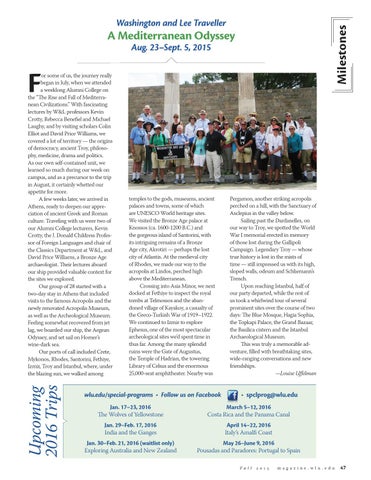
or some of us, the journey really began in July, when we attended a weeklong Alumni College on the “The Rise and Fall of Mediterranean Civilizations.” With fascinating lectures by W&L professors Kevin Crotty, Rebecca Benefiel and Michael Laughy, and by visiting scholars Colin Elliot and David Price Williams, we covered a lot of territory — the origins of democracy, ancient Troy, philosophy, medicine, drama and politics. As our own self-contained unit, we learned so much during our week on campus, and as a precursor to the trip in August, it certainly whetted our appetite for more. A few weeks later, we arrived in Athens, ready to deepen our appreciation of ancient Greek and Roman culture. Traveling with us were two of our Alumni College lecturers, Kevin Crotty, the J. Donald Childress Professor of Foreign Languages and chair of the Classics Department at W&L, and David Price Williams, a Bronze Age archaeologist. Their lectures aboard our ship provided valuable context for the sites we explored. Our group of 28 started with a two-day stay in Athens that included visits to the famous Acropolis and the newly renovated Acropolis Museum, as well as the Archeological Museum. Feeling somewhat recovered from jet lag, we boarded our ship, the Aegean Odyssey, and set sail on Homer’s wine-dark sea. Our ports of call included Crete, Mykonos, Rhodes, Santorini, Fethiye, Izmir, Troy and Istanbul, where, under the blazing sun, we walked among
temples to the gods, museums, ancient palaces and towns, some of which are UNESCO World heritage sites. We visited the Bronze Age palace at Knossos (ca. 1600-1200 B.C.) and the gorgeous island of Santorini, with its intriguing remains of a Bronze Age city, Akrotiri — perhaps the lost city of Atlantis. At the medieval city of Rhodes, we made our way to the acropolis at Lindos, perched high above the Mediterranean. Crossing into Asia Minor, we next docked at Fethiye to inspect the royal tombs at Telmossos and the abandoned village of Kayakoy, a casualty of the Greco-Turkish War of 1919–1922. We continued to Izmir to explore Ephesus, one of the most spectacular archeological sites we’d spent time in thus far. Among the many splendid ruins were the Gate of Augustus, the Temple of Hadrian, the towering Library of Celsus and the enormous 25,000-seat amphitheater. Nearby was
Pergamon, another striking acropolis perched on a hill, with the Sanctuary of Asclepius in the valley below. Sailing past the Dardanelles, on our way to Troy, we spotted the World War I memorial erected in memory of those lost during the Gallipoli Campaign. Legendary Troy — whose true history is lost in the mists of time — still impressed us with its high, sloped walls, odeum and Schliemann’s Trench. Upon reaching Istanbul, half of our party departed, while the rest of us took a whirlwind tour of several prominent sites over the course of two days: The Blue Mosque, Hagia Sophia, the Topkapi Palace, the Grand Bazaar, the Basilica cistern and the Istanbul Archaeological Museum. This was truly a memorable adventure, filled with breathtaking sites, wide-ranging conversations and new friendships. —Louise Uffelman
wlu.edu/special-programs • Follow us on Facebook • spclprog@wlu.edu April 18–26 July 31–Aug. Jan. 17–23, 2016 March 5–12, 20167 Flavors of of Provence The Wolves Yellowstone
May 22–June Jan. 29–Feb. 17, 32016 TheIndia Danube by River Ship and the Ganges
June Jan. 30–Feb. 21,13–21 2016 (waitlist only) Leonardo’s Milan and the and Villas of Lake Como Exploring Australia New Zealand
Southeast of Alaska Costa Rica andIslands the Panama Canal
Aug.14–22, 23–Sept. April 2016 5 A Mediterranean Odyssey Italy’s Amalfi Coast
Sept. 7–15 May 26–June 9, 2016 Shakespeare’s Englandto Spain Pousadas and Paradores: Portugal
Fall
2015 mag a z ine.wlu.e du
47