Princeton magazine
summer 2013
summer 2013
ben bernanke Obama’s Brain Mapping project SaMuel Yellin: IrOnman Summer SaturdayS on the Delaware rIver brIck Farm market: it StartS With the Soil mIstral restaurant Q&a with shIrley tIlghman diScovering rumsOn/reD bank
$4.95 princetonmagazine.com
Welcome to our new Pediatric
THE DOROTHY B. HERSH PEDIATRIC EMERGENCY DEPARTMENT The minute you walk into The Dorothy B. Hersh Pediatric Emergency Department at The Children’s Hospital at Saint Peter’s University Hospital, you’ll know we’re dedicated to kids. From our specially trained doctors, nurses and staff, to our soothing surroundings, we’ve worked hard to make a child’s visit to the Emergency Department (ED) a lot less scary — for both of you. With 11 private rooms, a Fast Track treatment area, a rapid asthma treatment area and more, it’s one of the largest pediatric ED facilities in the region. Our new Emergency Department features: ■ Board-Certified Pediatric Emergency Medicine Physicians and Board-Certified Pediatricians with extensive ED experience, 24/7 ■ Skilled Pediatric Emergency Nurses ■ A full-time Child Life Specialist to help children and parents deal with the stress of an ED visit ■ A dedicated Emergency Department Pharmacist who works hand-in-hand with our staff to review and prepare medication orders ■ Physician Scribes who document your child’s stay so our physicians can focus on your child’s care ■ Bedside Triage to get your child to the point of care faster ■ A fast, simple, hands-free wireless communication system that allows our staff to use voice commands to instantly connect with each other
For more details on our new Pediatric Emergency Department, call 732.745.8600 or visit saintpetershcs.com/pediatric-emergency-medicine
Emergency Department.
DESIGNED FOR KIDS — FROM TOP TO BOTTOM
254 EASTON AVENUE, NEW BRUNSWICK, NJ 08901 Catholic hospital sponsored by the Diocese of Metuchen Regional medical campus of Drexel University College of Medicine
■ �
�
732.745.8600
■
www.saintpetershcs.com
State-designated children’s hospital and regional perinatal center Affiliate of The Children’s Hospital of Philadelphia
| IN STYLE
www.steppinbirkenstock.com
New American Cuisine with bistro influences
Friends & Family 20% Off 609.730.1010 emilyscafeandcatering.com
12 Chambers Street 609-921-8411 Expires 7/31/13
• Serving Lunch & Dinner Daily • Private Dining For Any Occasion • Monday Night Cooking Classes • New Farm-To-Table Menu Additions • Over 27 Years of Fine Catering 2667 Main Street Lawrenceville 609-896-5995 | www.chamberswalk.com
Cranbury Design Center Holistic Financial Services & Tax Planning Wealth Management 54 Route 31 N, Pennington, NJ 08534 (609) 750-0002 phone • (609) 750-0034 fax www.scafafinancial.com
Come see our new kitchen, office and furniture displays featuring Waypoint and Levant cabinetry, as well as our classic Plain & Fancy cabinetry displays. See our new appliances including cook-tops, steam and wall ovens. The latest in countertop choices, including granite, quartz and wood will also be on display. We have the know-how, to surpasses the expectations of our clients — all done with the flexibility and custom solutions needed by each individual client.
ROBIN H EPBURN
GOLDSMITH
Custom Kitchens, Baths and Renovations 145 West Ward Street, Hightstown, NJ 08520 609-448-5600 | fax 609-448-6838 cranburydesigncenter.com
609 737 7235 7 Rt. 31 North, Pennington, NJ 08534 orionjewelrystudio.com
IFC-005_Ads IFC-005_Ads 7/29/08 7/29/08 1:46 1:46 PM PM Page Page IFC2 IFC2
adult orthodontics
Daytime Daytime Sleepiness? Sleepiness?
http://www.6monthsmiles.com/assets/downloads/controlpanelfiles/Photos%20Patient%20Marketing/2%20Before.JPG
http://www.6monthsmiles.com/assets/downloads/controlpanelfiles/Photos%20Patient%20Marketing/2%20After.JPG
Let Let the beauty Letthe thebeauty beauty of your smile blossom of your smile blossom of your smile blossom in a short six months You You could could be be suffering suffering from from obstructive obstructive sleep sleep apnea apnea Have you everDental dreamed changing your smile didn’t want to drill down your teeth Advanced Artsof would like to introduce Mini Denture Stabilization System! IfIfyou loved experiences excessive daytime sleepiness, you are at risk for vehicle and youororaaImagine lovedone one experiences excessive daytime sleepiness, youbut arethe atan anincreased increased risk formotor motor vehicle andwork-related work-related http://www.6monthsmiles.com/assets/downloads/contro...elfiles/Photos%20Patient%20Marketing/2%20Before.JPG [5/12/2011 http://www.6monthsmiles.com/assets/downloads/controlpanelfiles/Photos%20Patient%20Marketing/2%20After.JPG 3:54:23 PM] braces for two years or longer? [5/12/2011 3:52:44 PM] for costly crowns and veneers or wear metal accidents. accidents. Left Leftuntreated, untreated,obstructive obstructivesleep sleepapnea apneacan canlead leadto, to,ororworsen, worsen,cardiovascular cardiovasculardisorders, disorders,diabetes diabetesand andstroke. stroke. Is your loose denture causing you to:
The atat Imagine Dental Arts recommend specific treatment options including Thedoctors doctors Imagine Advanced Dental Artsacan can recommend specific treatment options including Imagine Advanced Dental Arts is introducing revolutionary orthodontic system that provides a fast •M iss out Advanced on life’s simple pleasures? • M iss eating your favorite foods? An array of options are available from Imagine Advanced Dental Arts to give you the smile you have always An array ofof options are available from Imagine Advanced Dental Arts togive give you thesmile smileyou youhave havealways always An array options are available from Imagine Advanced Dental Arts to you the An array of options are available from Imagine Advanced Dental Arts to give you the smile you have always • Be afraid to laugh, smile or speak in public? replacing your cumbersome CPAP device with a comfortable oral appliance. replacing your cumbersome CPAP device with a comfortable oral appliance. and whitening, economical way for porcelain adults to begin smiling with confidence in as little as six months. desired. Teeth life-like veneers, and natural, tooth-colored restorations are just a few desired. Teeth whitening, life-like porcelain veneers, and natural, tooth-colored restorations are just afew few desired. desired.Teeth Teethwhitening, whitening,life-like life-likeporcelain porcelainveneers, veneers,and andnatural, natural,tooth-colored tooth-coloredrestorations restorationsare arejust justaafew Call us for a complimentary consultation Call us for a complimentary consultation Mini Dental Implants were developed in order provide greater denture stability for those patients who of the choices you have today thanks to advancements in modern cosmetic dentistry. ofof the choices you have today thanks to advancements in modern cosmetic dentistry. have in cosmetic ofthe thechoices choices you have todaythanks thanksto toadvancements advancements inmodern modern cosmeticdentistry. dentistry. Callyou us for a today complimentary Six Month Smiles consultation cannot withstand the rigors of conventional implant surgery. Visit our office in the morning, have the Call complimentary consultation. Call us for your complimentary smileyour consultation. Call us for your complimentary consultation. Call usfor for your complimentary consultation. mini implants placed inus less thatyour two hours, then go out and smile enjoy favorite lunch, eat comfortably and talk with confidence, knowing your denture is secure....all of this at an extremely affordable price!
ADVANCED DENTAL ADVANCEDDENTAL DENTAL ARTS ARTS ADVANCED DENTAL
David Schor, D.D.S. David Schor,D.D.S. D.D.S. David I.I.I.I.Schor, David Schor, D.D.S.
Maria Rhode, D.M.D. MariaRhode, Rhode,D.M.D. D.M.D. Maria Maria Rhode, D.M.D.
Vivien Vivien Mesina, D.M.D. Vivien Mesina, D.M.D. VivienMesina, Mesina,D.M.D. D.M.D.
3100 Princeton Pike -Bldg. Bldg. 22---Lawrenceville, Lawrenceville, NJ 08648 609.896.0589 3100 Princeton Pike -Bldg. Bldg. -Lawrenceville, Lawrenceville,NJ NJ08648 08648----609.896.0589 609.896.0589----www.ImagineDentalArts.com www.ImagineDentalArts.com 3100 Princeton Pike --Dental 22Arts 3100 Princeton Pike NJ 08648 609.896.0589 www.ImagineDentalArts.com Imagine Advanced would like to introduce the Mini Denturewww.ImagineDentalArts.com Stabilization system! ® Member of Member of of the theAmerican AmericanAcademy Academy of Dental Dental Sleep Sleep Medicine Medicine
® American Academy of to: Cosmetic Dentistry -Cpleasures? Committed toExc Excellence inoofoods? Cosmetic Dentistry Is your loose denture causing you ! Miss out on life’s®®®simple ! Miss eating your favorite Am eeri Ac em sm De nntBe ttitiisissafraid C m m eeetetititciciccDe nnntntitistististrstry. Am nAc Ac emm fCCoCoososm smm De - C mm miiiittor eedddd ttttooooinExc De AAm em cri aadadaededm yyyyooofoffC eeetettiticiciccDe n!n tsttrtrryryyy to---laugh, Exc nnCC CCosossm m De eriri cacancananAc De Coooom m m tttttteespeak Exceeeellllleleeennnnccceceeeiiinin sm m De try. ry.y. smile public?
Mini Dental Implants were developed in order to provide greater denture stability for those patients who cannot
2013 BMW 128i
$249
per month for 36 months
*See dealer for details.
3630 Quakerbridge Road | Hamilton, NJ 08619 | (P) 866.259.8720
PrincetonBMW.com
|
CONTENTS
62
76
48
20
SUMMER 2013
54
40
30
Wrought Iron Base with Marble Bowl 1919, by Samuel Yellin.
..... HERE & THERE .....
..... FEATURES .....
BOOK SCENE
LEARNING FROM THE GREAT DEPRESSION WITH BEN BERNANKE
Walking, as a fine art 12
MARK YOUR CALENDAR
BY LINDA ARNTZENIUS
They say he can move markets with a single word 20
16
SOCIAL SCENE SAVE; Palmer Square’s Girls Night Out 46
SUMMER SATURDAYS ON THE DELAWARE RIVER BY WENDY PLUMP
A day of wandering 30
ART SCENE Collectors share their passions 48
SHOPPING River Fun 36
Red, White and Bows 52
BRICK FARM MARKET: IT STARTS WITH THE SOIL BY ILENE DUBE
The latest addition to Hopewell’s food scene 40
SAMUEL YELLIN: IRONMAN BY ANNE LEVIN
The master of ornamental ironwork 54
THE TASTES: MISTRAL BY LESLIE MITCHNER
Look what the wind has blown into Princeton 66
PRESIDENT OBAMA’S BRAIN MAPPING PROJECT BY ELLEN GILBERT
Making sense of the human brain 62
VINTAGE PRINCETON John Witherspoon
..... LAST WORD .....
74
INTERVIEW WITH SHIRLEY TILGHMAN BY ELLEN GILBERT
Princeton University’s retiring president recalls some highlights of her presidency 76
ON THE COVER: Ben Bernanke photographed by Tom Grimes.
Mt. Everest? Is it time to consider a knee replacement? At Capital Health Hopewell, the region’s progressive new hospital, we have 50 highly experienced orthopedic surgeons ready when you are. With a dedicated orthopedics unit, specialized nursing care, on-floor rehab, and an advanced approach to pain management, we get you up, moving and back to your life faster than you ever thought possible. For more information, visit capitalhealth.org/ortho. You’ll wonder why you waited so long.
capitalhealth.org/ortho
Your
one - source solution to managing Your milestones . As your trusted advisors, we work with you to navigate lifetime planning. At Mercadien, we understand the importance of living for today and planning for tomorrow. Individual Services Include: Milestone Planning Tax Compliance & Planning Fiduciary Services Estate Planning
Celebrating 50 Years leading bY example
of
www.MerCadien.CoM Call Marguerite Mount at 609-689-2303 or email mmount@mercadien.com
Certified PubliC ACCountAnts • ConsultAnts Technology • WealTh ManageMenT
SUMMER 2013 PUBLISHER J. Robert Hillier, FAIA EDITOR-IN-CHIEF Lynn Adams Smith CREATIVE DIRECTOR Jorge Naranjo ART DIRECTOR Jeffrey Edward Tryon GRAPHIC DESIGNER Matthew DiFalco CONTRIBUTING EDITORS Stuart Mitchner Linda Arntzenius Ellen Gilbert Anne Levin Ilene Dube Wendy Plump Leslie Mitchner Gina Hookey Jordan Hillier ADVERTISING DIRECTOR Robin Broomer SENIOR ACCOUNT MANAGER Jennifer McLaughlin ACCOUNT MANAGER Sophia Kokkinos ADVERTISING ASSISTANT Jennifer Covill OPERATIONS MANAGER Melissa Bilyeu PHOTO EDITOR Andrew Wilkinson PHOTOGRAPHERS Tom Grimes Benoit Cortet Andrew Wilkinson PRINCETON MAGAZINE Witherspoon Media Group 305 Witherspoon Street Princeton, NJ 08542 P: 609.924.5400 F: 609.924.8818 www.princetonmagazine.com Advertising opportunities: 609.924.5400 Media Kit available on www.princetonmagazine.com Subscription information: 609.924.5400 ext. 30 subscriptions@witherspoonmediagroup.com Editorial suggestions: editor@witherspoonmediagroup.com
eastridge design
Interior Design for Homes
Princeton, New Jersey (609) 921-2827 eastridgedesign.com
8
|
PRINCETON MAGAZINE SUMMER 2013
Princeton Magazine is published 7 times a year with a circulation of 35,000. All rights reserved. Nothing herein may be reproduced in whole or in part without written permission of the publisher. To purchase PDF files or reprints, please call 609.924.5400 or e-mail melissa.bilyeu@witherspoonmediagroup.com.
Audrey Gould, Managing Director - Investments and her two daughters, Financial Advisors Georgeanne Gould Moss and Ellen Gould Baber, operate the Gould Group, a wealth management practice at Wells Fargo Advisors.
THE GOULD GROUP: Doing it D
The Gould Group of Wells Fargo Advisors 138 Nassau Street Princeton, NJ 08540 609-688-0949
all.
uring the past year, Princeton University academics, alumni and students have attracted national attention with viewpoints about women, their roles as wives, mothers and professionals, and how sometimes, perhaps often, those roles conflict. But, long-time Princetonian Audrey Gould – dedicated wife, mother of two, grandmother to four, and 40-plus-year veteran of the investment industry – does believe that women can have it all. “However,” she says, “it takes a lot of organizational skills to successfully balance these areas of your life.” In their office across the street from Princeton University, Audrey and her two daughters, Georgeanne and Ellen, operate the Gould Group, a wealth management practice at Wells Fargo Advisors, LLC. Established in 1982, the Gould Group provides in-
vestment counsel and comprehensive wealth management services to a variety of individuals, small businesses, pension plans and corporate clients located across the country and around the world. Audrey attended the University of Pennsylvania and received a degree in orthoptics (a specialized health-care field that diagnoses and corrects defective vision) from the University of Iowa. Audrey’s initial interest in the investment field was ignited by her family’s ownership of two seats on the New York Stock Exchange. From a very young age, Audrey was exposed to frequent family discussions about the financial markets and investments. Audrey was undaunted by those who dissuaded her from entering the investment world, which many deemed an “unladylike” career. Audrey was determined to enter wealth
management where the presence of women in senior positions was rare. Thirty years later – and strengthened by the addition of two daughters with backgrounds in law and finance – the Gould Group, now under Wells Fargo Advisors, serves its many clients with commitment and dedication. In fact, the team’s success has led to a number of awards from both the industry and Wells Fargo Advisors. They have also been appointed to numerous community and national boards in recognition of their leadership skills and professionalism. “We’re about strong client relationships and understanding our clients’ needs and objectives,” says Ellen Gould Baber. “We realize that our clients look to us for prudent and intelligent guidance for themselves and their families,” adds Georgeanne Gould Moss. -- Teresa Dougherty
Investment and Insurance Products: uNOT FDIC Insured uNO Bank Guarantee uMAY Lose Value
Wells Fargo Advisors, LLC, Member SIPC, is a registered broker-dealer and a separate non-bank affiliate of Wells Fargo & Company. ©2013 Wells Fargo Advisors, LLC 0513-05342 5/13
| FROM THE PUBLISHER
In our last issue of your magazine my business partner and Editor-in-Chief, Lynn Adams Smith acknowledged the fifth anniversary of our purchase and makeover of Princeton Magazine. With this issue I mark the beginning of our second half-decade with our remarkable cover story on Ben Bernanke, Chairman of the Federal Reserve and a leader of national and international prominence. This cover furthers the quality of the individuals we have been honored to feature with each issue of the magazine. The covers over the last five years have focused on residents of Princeton whose reach and influence goes far beyond this central Jersey region. Our number of issues have also grown from five per year to the present seven plus Princeton Magazine Healthy Living. This has been due to your enthusiastic response to the magazine and the accompanying demand of advertisers to be included. The town of Princeton is known for its dedication to sustainability as evidenced by the demands put on each new development with LEED as a measurement. One aspect of the LEED program is the requirement that the construction materials be as locally produced as possible. As we can see with the explosion of Farmers Markets, a similar sustainability attitude of “grown locally” now pervades our food purchasing. Our story on Robin and Jon McConaughy presents how one couple have taken that food sustainability a step further in establishing a new Double Brook Farm on lands along Carter Road to supply their new Brick Farm Food Market on Broad Street in Hopewell. This amazing new store with fresh produce and home grown meats will soon be followed by a new creamery with home made cheeses and ice cream. Robin’s grandfather, Peter Cook, was an accomplished painter, best known for his portraiture, including that of Hobey Baker, the legendary Princeton hockey player. On the topic of food, make it a point to digest our story on the new restaurant Mistral at the corner of Witherspoon and Hulfish Streets. Scott Anderson, who is also the Executive Chef of the restaurant elements, gives you a gourmet tour of this newest Princeton menu. In a different art form, I hope you enjoy the beautiful iron work from hinges to tapestry-like gate ways by the Samuel Yellin Metal Works. In its third generation of management, this is the company that did the 1927 gates for the Federal Reserve Bank in New York and is still providing period pieces of ironwork to Princeton University. If historical iron isn’t your passion, let’s go to one step short of science fiction with our story on President Obama’s Brain Mapping Project. We take you to this new frontier through lively discussions with Professor Stephen Hanson, the director of The Rutgers Brain Imaging Center and Princeton Professors Lynn Enquist and Sabine Kastner, who are just moving into their new Neuroscience and Psychology Center on Washington Road.
10
|
PRINCETON MAGAZINE suMMER 2013
Photography by Andrew Wilkinson
Dear Readers,
That new center is just one of the great new science facilities that have been created during the awesome, twelve year tenure of retiring President Shirley Tilghman who is appropriately featured on our “Last Word.” Shirley Tilghman has put the University and therefore our town of Princeton on the map as one of the great intellectual and research centers of the world. My Princeton class made her an honorary member because we think so much of her and all that she has done to advance the University. Shirley, we wish you well and thank you! This has been a terrific issue to put together. Lynn and I hope you enjoy it. Respectfully yours,
J. Robert Hillier, FAIA Publisher
| BOOK SCENE FOOTLOOSE — WALKING AS A FINE ART By Stuart Mitchner
A
fter claiming that William Wordsworth’s legs were “condemned by all female connoisseurs in legs,” Thomas DeQuincey admits that there was “no absolute deformity about them,” given the fact that in the course of his life the poet had traversed “a distance of 175,000 to 180,000 English miles.” Perhaps to compensate for his unkind remarks about the poet’s legs, DeQuincey claims that all that walking was responsible for Wordsworth’s “life of unclouded happiness” and “much of what is most excellent in his writings.” The Opium Eater was no slouch himself when it came to long walks, reportedly having covered the 40 miles between Bridgewater and Bristol in an intellectual fever after his first meeting with Samuel Taylor Coleridge, who took 20-mile hikes as a matter of course. One wonders what the preferred 19thcentury footwear was for those marathon perambulations.
There’s a passing reference to DeQuincey’s claims for Wordsworth in Robert Macfarlane’s The Old Ways: A Journey on Foot (Viking $27.95), where he estimates having “walked perhaps 7,000 or 8,000 miles” so far in his own life (he’s 36). You don’t need to read far in The Old Ways to appreciate how much Macfarlane’s walking has contributed to “what is most excellent in his writings.” His second chapter, “Paths,” collects testimonials from poets, walkers, and various cultures, Apache to Tibetan, in support of the idea “that walking might be thinking or that feet might know.” Read on and there’s no “might” about it — walking can be anything a writer as gifted
12
|
PRINCETON MAGAZINE SUMMER 2013
as Macfarlane wants it to be. In Cheryl Strayed’s Wild: From Lost to Found on the Pacific Crest Trail (Knopf 2012, just reprinted in Vintage paperback, $15.95), an up-closeand-personal American female response to the subject (and a vivid contrast to Macfarlane’s discursive and learned British male’s point of view), walking has less to do with thinking than with feeling in the most acute, intensely painful sense of the word. While Strayed may not share Macfarlane’s fondness for the walking-writing trope, she’s taken a writers’ perogative by choosing a metaphorical identity. Looking beyond the divorce precipitated after she “strayed,” she wanted a new last name to put on the divorce papers and found that the dictionary’s “layered definitions” of “strayed” spoke directly to her life: “to wander from the proper path, to deviate from the direct course, to be lost, to become wild.” [author’s italics]. At the same time, she makes sure to point out that the name isn’t meant to define “negative aspects” of her life “because even in my darkest days — those very days in which I was naming myself — I saw the power of the darkness. Saw that, in fact, I had strayed and that I was a stray and that from the wild places my straying had brought me, I knew things I couldn’t have known before” — including, of course, what she learned during an eleven-hundred mile solo trek from the Mojave Desert through California and Oregon to The Bridge of the Gods. Strayed’s effectiveness as a writer is in the way she’s able to frame her adventure around those darkest days (“power of the darkness” is practically a brand name in American literature), most memorably in confronting her mother’s death at 45, along with childhood traumas, a scattered family, her marriage, her heroin use and the affair associated with it, and her sexuality. You also know from the books she’s brought with her (As I Lay Dying, Flannery O’Connor’s Complete Stories, Lolita, Dubliners, among them) that she’s a serious reader, though as she progresses, she feeds the pages she’s finished to the fire, and makes no effort to use the content of those books to complement or broaden her experience the way Macfarlane does, except for a poignant admission of regret for once patronizing her mother on the subject of James Michener’s Texas (“You know, that’s not a real book”).
There’s no doubt that The Old Ways is a more accomplished piece of work; every page has sentences or phrases or passages you can savor. Comparing Macfarlane to Strayed, you might even make the “real writer” distinction, but dense prose makes for slower reading. I’m still not finished with The Old Ways even though I began it weeks before Wild, which I read in a matter of days. Simply put, Macfarlane is interested in what his feet and the feet of various life forms do to the earth while Strayed is obsessively concerned with what the earth does to her feet as she hikes up and down rugged grades and around the occasional rattlesnake. Macfarlane sees the snow “densely printed with the tracks of birds and animals — archives of the hundreds of journeys made since the snow had stopped.” In the same paragraph, he describes how the moonlight “deepened the dark in the nearer tracks so they appeared full as inkwells.” To begin the next paragraph he dips his pen into the imaginary inkwell and writes, “The snow was overwhelmingly legible. Each print-trail seemed like a plot that could be read backwards in time.” Strayed leaves little to the imagination when it comes to the lamentable condition of her feet, which she shows to us at intervals throughout the narrative; the cover design features the image of a hiking boot like one of the pair that was
doing damage to her “swollen and battered,” “clawed up,” “tortured” feet, “toenails entirely blackened,” “the nails ... near dead, the pinky toes ... rubbed so raw I wondered if they’d eventually wear clean away,” “blisters covered the backs of my heels all the way up to my ankles,” “my tortured big toes...I could literally see them throbbing—the blood beneath my flesh pulsating in a regular rhythm that flushed my nails white then pink ...They were so swollen that it looked as if the nails were simply going to pop off.” She ends up tugging off the nails and feels instant relief. Before she’s done, she’s lost five toenails. She makes it a contest, her feet against the trail, keeping score, with a final result of 5-5. The devotion of so much detail to intimate examination of Strayed’s body has a curious effect on the reader, perhaps more so if the reader is a male. As she describes the damage done, not only to her legs and feet, but to her hips, back, and shoulders from the weight of the huge pack she calls Monster, she’s exposing herself to us, drawing attention to her nakedness even as she insults it. The trail is writing the story of the walk on her flesh; again, a reversal of what Macfarlane is doing, though he does at one point admit his feet “were puffy as rising dough.” He has no wish for us to look at him. His focus is on the paths
and the ways. Look at the jacket photo of Strayed, and you see a comely blue-eyed blond who appears to be in her thirties (she’s actually 44 now); she was 26 when she took to the trail, so it’s likely that the men she met along the way would be turned on by her. She’s also been appealingly forthright about her own desires; she likes men, she gets horny, and she likes sex; thus the breakup of her marriage. She admits to having “a fat roll of condoms” in the immense backpack she can barely lift. Before her trek is over, she’s made use of the lone condom she salvaged when the rest were stolen. So take your pick: Wild, which is as much about feeling and healing as it is about walking, or The Old Ways, which is as much about writing as it is about walking. My choice, my way of ending this column, would be to return to “a real book” of the highest order, a meditation with images that creates its own genre, W.G. Sebald’s The Rings of Saturn, which is about a walk along the Suffolk coast that leads through time, space, thought, history, life and death, and just about everything under the sun.
Shop Online at blueraccoon.com
Useful Lamps / Cozy Rugs / Unique Finds / Comfortable Couches
INTERIOR DESIgN SERvICE
visit www.blueraccoon.com/interior-design for details
BLue Raccoon BR_193 Princeton Mag Ad.indd 1
6 Coryell Street, Lambertville, NJ 609.397.5500 blueraccoon.com 6/10/13 2:03 PM SUMMER 2013 PRINCETON MAGAZINE
| 13
Summer Concert Series Thursdays, 6–8 pm June 20–August 22 Located a few blocks from
Princeton’s Central Business
District, Princeton Shopping Center provides a unique
selection of shopping, dining
and services.
301 North Harrison Street Princeton, NJ 08540 www.princetonshoppingcenter.com
THE HUN SCHOOL OF PRINCETON CONGRATULATES THE CLASS OF 2013 Shane Michael Adams Sang Il Ahn Olivia Kathleen Albanese Saeed Ahmed Saeed Mulla Husain Alrahma Khalid Saud Al-Saleh Lauren Hansen Apuzzi Kylan Terrelle Baker Jacqueline Noelle Baptiste Danielle Nicole Beal Zachary Tanner Bicho Devan James Birch Benjamin Winders Brougham Janine Louise Cadet Connor Edward Cahill Yilin Cai Caroline Theresa Campbell Christopher James Cardinali Cansu Cebeci Heston Ismael Charres Ethan Bao Chee Minghui Chen Marlen Yassiel Chirú Yoonha Cho Hee Eun Choi Brandon Richard Coleman Simone Gabrielle Cotton Gianna Maria Crivelli Joey Anne Crivelli JonCarlo Steven DeFazio Gordon Kousuke DeGeorge Scott Joseph DelPrato Ferguson Carter Duke Brett Duggan Ender Mehrtash Ferdows Gregory Elias Flood James Andrew Frazier Nicholas Joseph Freda Yuheng Fu Jordan Lyn Fusco Christian Julius Galkowski Steven Luke Godich Austin Tyler Goeke Gregory Alexander Golden Jared Clark Golestani Ángela Verónica González Muentes Jordan Joseph Greces Alexander Davis Griese Nicholas Phillip Guns
Sang A Han John Welcome Sayles Hartman Taylor Kennedy Havard Hunter Sutherland Lantz Hecker Robert William Hedberg Quashaé Tyree Murphy Hendryx Daniel Hernandez Michael Hernandez Samantha Morgan Heyrich Jack Peter Horton Wei -Jou Huang Keeauna DeToiya Jacobs Ming Ming Jiang SuJung Jo Kyria Sade Johnson Christina Sime Kilgariff Dong-Ho Kim Hunter William Knighton Ye Mo Koo Lauren Rebecca Kotler Cheng Kou Amor Gita Kriek Eliza Sharma Lavine Max Richard Leone Xinyi Li Yi-San Liu Grant Ronald Mackay Abdul-Malik Majeed Kerri Alison Mandelbaum Michael Albert Manfredi Anthony Joseph Marino III Juan Carlos Martínez González Allison Nicole Maziarz Gilles Caryl Merckx Robert Andrew Frederick Merfield Carey Leigh Million Hashim Najja Akil Moore John Charles Moritz Peter Kahl Nawn Jake Hunter Newman Ian Patrick Oakes Rebecca Angela Pankove Edward William Paparella Kwan Yong Park Patrick James Anderton Prendergast Alina Vasilevna Prokudina Bríghid Quinn-Gordon Michael William Ray Lily Razavi
James Leonard Recine Ayana Moné Reed Samuel Jordan Remis Nicholas Caesar Revano Matthew Carl Riello Zachary Arthur Roberson Frances Margaret Roden Ryan Cole Ross Angie Ernestina Ruiz-Mitchell Anton Salienko Jenna Leigh Sands Edward Carl Scanlan Madeleine Ann Schade Camille Thomasina Schrier Matthew Raymond Schweitzer Blake Steven Searfoss William Danielson Sharples Sang Ki Shin Alexandra Sylvia Sitepu Paola Emanuela Stanton Bevilacqua Brent Christian Steinhause Peter Joseph Stoddard Saheedat Olatoyosi Sulaimon Chenzuo Suo Eric William Szeker Angelica Maria Tabares Tomoko Maria Takeuchi Jonathan Joseph Tattoni Christian Joseph Toto Catherine Yi An Tsao Alexander Davis Vukasin Jordan Yang Wang Deanna Rebecca Washington Matthew Crawford Waxman Sarah Gibson Weck Kaitlyn Jane Weeks Victoria Elizabeth Weeks Yixuan Wei Steven David Wells Jr Isaiah Robert West Harrison Robert David Whelan Rakiyah Ateamah White Marien Alexandra Wilkinson Kaley Nicole Wills Zachary Davis Winterstein Hyunjae Woo Andrew Jay Zhou
CELEBRATING OUR 99th COMMENCEMENT 14
|
PRINCETON MAGAZINE
SUMMER 2013
Sunset Creations, Inc. d f l &o l s esigners of
ine
andscapes
uTdoor
iving
paces
Terraces • Walls • landscapes • lighTing • sTamped concreTe
Sunset Creations, Creations, Inc. Inc. Sunset
SunsetRoad, Road,Skillman, Skillman, NJ 284284 Sunset NJ08558 08558 908-281-6600 • Fax: 908-281-9672 908-281-6600 • Fax: 908-281-9672 www.sunsetcreationsinc.com www.sunsetcreationsinc.com NJNLANJNLA • CNLP •MEMBER ICPI • TECHO PRO ICPI Certified Installer NJNCA • BBB ACCREDITED Contractor #13VH04270900
| CULTURAL EVENTS
JULY 20
JULY 3
M A R K YO U R
CALENDAR
M U S I C | B O O K S | T H E AT R E | L E C T U R E S | S P O R T S
AUG. 1
MONDAY, JULY 1 7:30PM Pop sensations Bruno Mars and Ellie Goulding perform at the Prudential Center in Newark.
TUESDAY, JULY 2 8PM Actor, singer, and pianist Harry Connick Jr. performs songs from his latest album, Every Man Should Know at the Count Basie Theatre in Red Bank.
8PM Singer-songwriter Jackson Browne performs at the State Theatre of NJ in New Brunswick.
WEDNESDAY, JULY 3 8PM The Shakespeare Theatre of NJ in Madison presents Noel Coward’s play Fallen Angels (July 3-28).
9PM Independence Day fireworks at Princeton University Stadium. For the best viewing, head to the sports fields adjacent to the Stadium. Fields open at 7PM for picnicking and fireworks begin at dusk. Sponsored by the Spirit of Princeton.
THURSDAY, JULY 4 12-3PM Join Morven Museum & Garden
SATURDAY, JULY 6 Bash; 330 Cold Soil Road (also, on Sunday, July 7).
3-3PM Join Princeton Public Library for an in-depth tour of the many gargoyles located on the Princeton University campus.
THURSDAY, JULY 11 6-8PM Alborada Spanish Dance Theatre
8-10PM Members of the Berklee Global Jazz
7:30PM Lyle Lovett and His Acoustic Group
THURSDAY, JULY 25
perform a special concert at Longwood Gardens in Kennett Square, Pa.
WEDNESDAY, JULY 17 8-10PM The Philadelphia Orchestra performs at Richardson Auditorium as part of the Scheide Concert Series.
THURSDAY, JULY 18 7PM Trenton Thunder Baseball vs. New
Theatre presents a re-imagining of Young Frankenstein, based on the classic movie by Mel Brooks (July 19-28; August 1-4).
PRINCETON MAGAZINE SUMMER 2013
Barrel Trail Weekend at wineries and vineyards across N.J. (visit www. newjerseywines.com for updated listings). Institute perform at Richardson Auditorium.
9PM Philadelphia’s Firework Celebration
|
SATURDAY, JULY 20
performs at the Princeton Shopping Center.
Hampshire Fisher Cats at Trenton Thunder Stadium.
16
JULY 18
TUESDAY, JULY 9
for an Independence Day Jubilee at the home (turned museum) of Richard Stockton. This free event will include historical demonstrations, live music, drinks and barbecue. at Penn’s Landing on the Delaware River Waterfront.
AUG. 12
10AM-5PM Terhune Orchards’ Blueberry
FRIDAY, JULY 19 7:30PM Washington Crossing Open Air
Atlantic City Food and Wine Festival (runs through Sunday, July 28).
7PM Beyonce performs at the Wells Fargo Center in Philadelphia as part of her Mrs. Carter Show World Tour.
FRIDAY, JULY 26 5PM Start of the 3-day WXPN Summer Music Festival on the Camden Waterfront. This year’s line-up includes well-known artists like Bob Dylan, Ryan Bingham, and Wilco (check www.xpn.org for exact listings).
7PM Country singer Miranda Lambert performs at the Susquehanna Bank Center in Camden for her Locked & Re-loaded Tour.
JULY 11
AUG. 22
JULY 6
JULY 26
AUG. 7
AUG. 10-11
FRIDAY, AUGUST 16 SATURDAY, AUGUST 10 THURSDAY, AUGUST 1 6-8PM Avi Wisnia performs at the Princeton Shopping Center.
8PM Princeton Summer Theater performs
The New Hope Automobile Show, a showplace for classic automobiles, all competing for the grand prize. Hundreds of vehicles will be featured each day; New Hope-Solebury High School, 182 West Bridge Street, New Hope (also on Sunday, August 11).
2013 Rock and Blues Fest at the Bergen Performing Arts Center in Englewood, N.J. Musical groups include Edgar Winter, Canned Heat, Rick Derringer, Pat Travers, and more.
SATURDAY, AUGUST 17 5PM Washington Crossing 15K at Washington Crossing Park sponsored by the Run Bucks Race Series.
Pulitzer-Prize winning playwright Donald Marguiles’ Time Stands Still (August 1-4 and 8-11).
7-8:30PM Cajun rock group, The VooDudes perform at the Nassau Park Pavilion.
SUNDAY, AUGUST 4
MONDAY, AUGUST 12
3:30PM The Montreal Boys Choir performs a “Choral Evensong” at Miller Chapel on the campus of the Princeton Theological Seminary.
7:30AM 2013 American Idol contestants and
The Barclays’ PGA Tour returns to New Jersey’s Liberty National Golf Course in Jersey City (runs through August 25).
winners perform live at the Sun National Bank Center in Trenton.
SATURDAY, SEPTEMBER 7
WEDNESDAY, AUGUST 7 7:30PM Maroon 5 performs at the Susquehanna Bank Center in Camden.
TUESDAY, AUGUST 13 8PM Legends of the Summer Tour featuring Justin Timberlake and Jay-Z arrives at the Citizens Bank Park in Philadelphia.
THURSDAY, AUGUST 22
10AM-5PM Twenty-Second Annual Doylestown Arts Festival in historic downtown Doylestown, Pa. Features live entertainment, original arts and crafts, and unique cuisine (also on Sunday, September 8).
SUMMER 2013 PRINCETON MAGAZINE
| 17
Learn About Literary Legends Pearl S. Buck and Publisher Richard Walsh Tour their National Historic Bucks County Homestead the Pearl S. Buck House Visit Ivy League Grad and Publisher Richard Walsh’s Office · View Pearl S. Buck’s Private Library and Literary Office · Take Home Treasures from the Gift Shop www.pearlsbuck.org/house for tour schedule 520 Dublin Road, Perkasie, Bucks County 15 minutes from Doylestown
Offering the Personal Attention You Deserve and the Legal Expertise You Can Count On. Amy C. Goldstein, Esq. offers a full range of litigation and non-litigation services relating to divorce, complex financial issues, cohabitation, civil unions, custody, mediation review and all other family law matters. Amy C. Goldstein, Esq. Family Law Chair
Thomas D. Begley, III, Esq. is a Certified Elder Law Attorney who helps preserve the legacy you have spent a lifetime building from taxation, long term care costs, divorce, creditors and unnecessary litigation. Thomas D. Begley, III, Esq. Estate Planning Chair Trenton, NJ Holmdel, NJ Mt. Laurel, NJ Philadelphia, PA Elmira, NY New York, NY Wilmington, DE To learn more about our comprehensive legal services, please call 856.234.6800 or visit www.capehart.com
18
|
PRINCETON MAGAZINE
SUMMER 2013
Art by renowned illustrator Julianna Brion.
Renowned DEDICATION we understand your drive and determination, because we share it. You should expect nothing less from the firm handling your wealth planning. For access to the highest caliber wealth management team in the business, call Fernando Garip at 201-580-4600, email fernando.garip@wilmingtontrust.com, or visit wilmingtontrust.com.
FIdUCIARY SeRVICeS
|
Š2013 Wilmington Trust Corporation.
w e A LT H P L A n n I n G
|
InVeSTMenT MAnAGeMenT
|
P R I VAT e B A n K I n G
16 | | PRINCETON 20 PRINCETONMAGAZINE MAGAZINE juNE/july suMMER 2013 2013
Learning from
The Great Depression with Ben Bernanke
by Linda Arntzenius | photography by Tom Grimes Ben S. Bernanke. They say he can move markets with a single word. He’s been called “the most powerful man in U.S. finance.” To some, he’s the helmsman who steered the country through “the worst financial crisis since the Great Depression.” To others…Well, let’s just say his critics have not lacked vitriol. summer 2013 PrINCeTON mAGAZINe
| 21
P
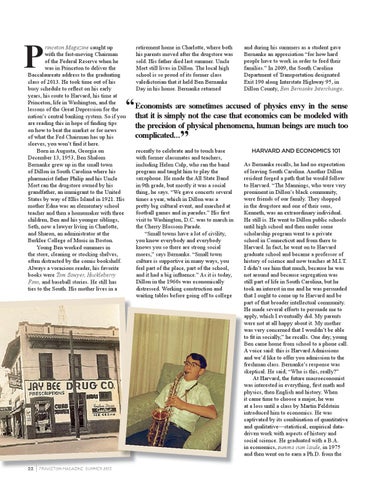
rinceton Magazine caught up with the fast-moving Chairman of the Federal Reserve when he was in Princeton to deliver the Baccalaureate address to the graduating class of 2013. He took time out of his busy schedule to reflect on his early years, his route to Harvard, his time at Princeton, life in Washington, and the lessons of the Great Depression for the nation’s central banking system. So if you are reading this in hope of finding tips on how to beat the market or for news of what the Fed Chairman has up his sleeves, you won’t find it here. Born in Augusta, Georgia on December 13, 1953, Ben Shalom Bernanke grew up in the small town of Dillon in South Carolina where his pharmacist father Philip and his Uncle Mort ran the drugstore owned by his grandfather, an immigrant to the United States by way of Ellis Island in 1921. His mother Edna was an elementary school teacher and then a homemaker with three children, Ben and his younger siblings, Seth, now a lawyer living in Charlotte, and Sharon, an administrator at the Berklee College of Music in Boston. Young Ben worked summers in the store, cleaning or stocking shelves, often distracted by the comic bookshelf. Always a voracious reader, his favorite books were Tom Sawyer, Huckleberry Finn, and baseball stories. He still has ties to the South. His mother lives in a
22
|
PRINCETON MAGAZINE SUMMER 2013
retirement home in Charlotte, where both his parents moved after the drugstore was sold. His father died last summer. Uncle Mort still lives in Dillon. The local high school is so proud of its former class valedictorian that it held Ben Bernanke Day in his honor. Bernanke returned
and during his summers as a student gave Bernanke an appreciation “for how hard people have to work in order to feed their families.” In 2009, the South Carolina Department of Transportation designated Exit 190 along Interstate Highway 95, in Dillon County, Ben Bernanke Interchange.
are sometimes accused of physics envy in the sense “Economists that it is simply not the case that economics can be modeled with the precision of physical phenomena, human beings are much too complicated...
”
recently to celebrate and to touch base with former classmates and teachers, including Helen Culp, who ran the band program and taught him to play the saxophone. He made the All State Band in 9th grade, but mostly it was a social thing, he says. “We gave concerts several times a year, which in Dillon was a pretty big cultural event, and marched at football games and in parades.” His first visit to Washington, D.C. was to march in the Cherry Blossom Parade. “Small towns have a lot of civility, you know everybody and everybody knows you so there are strong social mores,” says Bernanke. “Small town culture is supportive in many ways, you feel part of the place, part of the school, and it had a big influence.” As it is today, Dillon in the 1960s was economically distressed. Working construction and waiting tables before going off to college
HARVARD AND ECONOMICS 101 As Bernanke recalls, he had no expectation of leaving South Carolina. Another Dillon resident forged a path that he would follow to Harvard. “The Mannings, who were very prominent in Dillon’s black community, were friends of our family. They shopped in the drugstore and one of their sons, Kenneth, was an extraordinary individual. He still is. He went to Dillon public schools until high school and then under some scholarship program went to a private school in Connecticut and from there to Harvard. In fact, he went on to Harvard graduate school and became a professor of history of science and now teaches at M.I.T. I didn’t see him that much, because he was not around and because segregation was still part of life in South Carolina, but he took an interest in me and he was persuaded that I ought to come up to Harvard and be part of that broader intellectual community. He made several efforts to persuade me to apply, which I eventually did. My parents were not at all happy about it. My mother was very concerned that I wouldn’t be able to fit in socially,” he recalls. One day, young Ben came home from school to a phone call. A voice said: this is Harvard Admissions and we’d like to offer you admission to the freshman class. Bernanke’s response was skeptical. He said; “Who is this, really?” At Harvard, the future macroeconomist was interested in everything, first math and physics, then English and history. When it came time to choose a major, he was at a loss until a class by Martin Feldstein introduced him to economics. He was captivated by its combination of quantitative and qualitative—statistical, empirical datadriven work with aspects of history and social science. He graduated with a B.A. in economics, summa cum laude, in 1975 and then went on to earn a Ph.D. from the
Photo: Princeton University, Office of Communications, Denise Applewhite (2013)
(OPPOSITE) The drug store in Dillon, S.C. that was founded by Ben Bernanke’s grandfather. Bernanke and his saxophone. He no longer plays. (ABOVE) Bernanke addresses members of Princeton’s Class of 2013 during the University’s 266th Baccalaureate service on Sunday, June 2, in the University Chapel. (RIGHT) Bernanke with Anna, his wife of 35 years. They met on a blind date.
Massachusetts Institute of Technology in 1979. “Economists are sometimes accused of physics envy in the sense that it is simply not the case that economics can be modeled with the precision of physical phenomena, human beings are much too complicated,” he says. “But I think a good deal of knowledge has been accumulated. What I find interesting is that this knowledge comes from a variety of epistemological sources, from formal modeling, from empirical work, from reading history, from policy experience and all those combined to provide a multi-dimensional view of human behavior.” In the 60s and 70s, the dominant approach was Keynesian, after the British economist John Maynard Keynes (1883-1946). Economists used monetary fiscal policy to stabilize the economy. But the failure to predict the inflation of the 70s challenged this framework and prompted a new approach and the idea of rational expectations, i.e.: that people form expectations of the future using a lot of information, and a lot of knowledge about the economy. “It turns out that under some circumstances, the ability of monetary policy to affect the economy is much less than the Keynesians would argue,” says Bernanke. “When I was in
graduate school there was a big battle between the Keynesians represented by Harvard, M.I.T., Berkeley, and Princeton, and supporters of Rational Expectation in Chicago and Minnesota.” Since then there’s been a synthesis of the two in which Bernanke played an important part. BLIND DATE While at M.I.T., Bernanke met his future wife Anna on a blind date in October 1977 when Anna was a student at Wellesley College. It was a whirlwind romance. They married shortly after Anna graduated in May 1978 and have been together for 35 years. Their son Joel recently graduated from Cornell Medical School and is starting his residency at Columbia Medical School in child psychiatry; daughter Alyssa has just been accepted into medical school. After teaching for a time at New York University and Stanford University Business School, Bernanke came to Princeton University in 1985 as a professor of economics and public affairs. “People don’t appreciate that New Jersey is a beautiful state and this part is very pretty,” he says. “Princeton has many of the features of a small town so we got
to know a lot of people; the University is friendly, it’s a safe environment. Our kids loved growing up here and still have many friends here.” Ann Bernanke taught Spanish at Princeton Day School and the Bernanke children attended schools in Montgomery Township, where their father was elected to serve two terms on the school board at a time of expansion and much debate. “The two things people care most about are their children and their taxes, and in this case you had a conflict between the two, people who were pushing for the best possible schooling facilities and others who were concerned that their taxes were going up.” Bernanke claims he learned a great deal about working with committees from the experience, which also provided some relief from the consuming work of academic research. SUMMER 2013 PRINCETON MAGAZINE
| 23
(BELOW) Crowd gathering at the intersection of Wall Street and Broad Street after the 1929 crash; Crowd at New York’s American Union Bank during a bank run early in the Great Depression. The Bank opened in 1917 and went out of business on June 30, 1931. Images courtesy of Wikipedia.
THE GREAT DEPRESSION A CAUTIONARY TALE At Princeton, much of Bernanke’s research focused on the Great Depression of the 1930s. The period serves as a sort of laboratory experiment providing data no theoretical model could. Bernanke cites two main lessons from the period that proved useful in the recent economic crisis. One was that the Fed was very conservative with respect to monetary policy in the thirties, allowing deflation, falling prices, and was reluctant to take aggressive action to help restore economic activity. “That continued until Franklin D. Roosevelt took the U.S. off the Gold Standard,” says Bernanke. “So in the more recent episode, the Federal Reserve was quite aggressive. Even though interest rates were down to zero, we took additional actions to try to support economic recovery.” The second lesson, says Bernanke, stems from United States and other countries allowing their financial systems to collapse. The ensuing global crisis “had tremendously destructive consequences for confidence, for credit flows, and for stability.” During the crisis of 2008, therefore, the Federal Reserve along with other central banks and governments worked very aggressively to try to stabilize the financial system. Another takeaway from this time, says Bernanke, is that sometimes, in extreme situations, orthodoxy may have to be abandoned. “Roosevelt did this; he took
24
|
PRINCETON MAGAZINE SUMMER 2013
a variety of novel steps, some of which worked, some of which didn’t, to try to break the hold of the Depression.” As for a return to the Gold Standard, the 14th Chairman of the Federal Reserve believes that it proved to be counterproductive during the twenties and thirties and is not really appropriate for modern economies. Asked whether he finds it annoying that people want to take the temperature of the economy whenever there’s a change in gas prices, he says “People are obviously interested in what happens in the economy. It’s important for everyone’s opportunities, their jobs, what they pay at the gas pump, so it’s natural. In some sense, what matters is the long run, which is what determines the living standards. The U.S. over long periods of time has shown its ability to keep growing and to provide increasingly better living standards for its population.” THE FEDERAL RESERVE AT 100 According to Bernanke, the founding of the Federal Reserve in 1913 was probably the primary domestic accomplishment of Woodrow Wilson’s first term. Besides a board of governors in Washington, the Fed has 12 reserve banks around the country which gives it “a very regional and main street kind of feel,” an innovation that made it different from central banks in other countries. The U.S. was one of the last industrial countries to have a central bank and its founding was, in part, a response to the financial crises of 1907
and the late 19th century. Bernanke moved from Princeton to Washington in 2002 to become a member of the Federal Reserve Board of Governors. In 2005, President George W. Bush appointed Bernanke to be his chief economic adviser. Bernanke then replaced Alan Greenspan as Fed Chairman in February of 2006. So when the economy took a deep downturn, he was in charge. He backed the rescues of Bear Stearns and the American International Group, Inc. (AIG) and, as banks struggled with home-loan delinquencies, he attempted to keep credit flowing with lending programs for corporations and small businesses. In October 2009, a month after President Obama announced Bernanke’s reappointment saying that his “background, temperament, courage and creativity helped to prevent another Great Depression in 2008,” unemployment reached 10 percent. In spite of the President’s confidence in the Fed Chairman, many criticized Bernanke for failing to foresee the financial crisis and for the Wall Street bail-outs. His actions to stimulate the economy—keeping interest rates near zero and tripling the size of the Fed’s balance sheet—drew criticism from Republicans Mitt Romney, Newt Gingrich, Ron Paul and Rick Perry, especially during the most recent Republican presidential primary (rather ironic since Bernanke is also a Republican). Presidential candidate Paul called for an end to the Federal Reserve and a return
(BELOW) Bernanke in a reflective mood in Princeton last month.
to the Gold Standard. He was derided by Texas Governor Rick Perry. Mitt Romney and Newt Gingrich both spoke of firing him. More recently, critics like Paul Singer have gone as far as to describe Bernanke as “destroying the very fabric of society.” He’s even been lampooned in The Onion. BB, as he is known, rarely dignifies such invective with a response, although he has commented that the job of the Federal Reserve “is to do the right thing for the economy irrespective of politics.” His former Princeton University colleague Paul Krugman has, however, risen to his defense. For example, in a May 9 Op-Ed column, The New York Times columnist and Nobel Laureate, wrote: “For whatever reason, many people in the financial industry have developed a deep hatred for Ben Bernanke, the Fed Chairman, and everything he does; they want his easy-money policies ended, and they also want to see those policies fail in some spectacular fashion. As it turns out, however, dislike for bearded Princeton professors is not a good basis for investment strategy.” Both Krugman and Bernanke sport beards. Krugman describes the ire against Bernanke as irrational. In 2009, TIME magazine named Bernanke Person of the Year, calling him “the most powerful nerd on the planet,” to which he responded “I am very proud of my nerd-dom. The world needs more nerds. Nerds create jobs, advance science and, I hope, make good economic policy.” More recently Forbes magazine listed him as number six (up from number 8 in 2011) in its list of the top ten most powerful individuals, behind Barack Obama, Angela Merkel, Vladimir Putin, Bill Gates, and Pope Benedict VI.
I try to give myself a sense of perspective and keep myself thinking broadly about the world and not simply about the narrow issues that confront the Federal Reserve. I’m a great baseball fan and I go to the Washington Nationals games when I can.” Both books and baseball featured in Bernanke’s speech to graduating seniors at Princeton University, for which he adopted a fatherly mode, presenting, “The Ten Suggestions,” and demonstrating the wry humor for which he is known. “These notes have nothing whatsoever to do with interest rates. All of what follows has been road-tested in real-life situations, but past performance is no guarantee of future results,” he quipped. He spoke on the role that chance plays in determining one’s future and quoted the Apostle Luke, Robert Burns, Forrest Gump and Lily Tomlin. Echoes of his Dillon, S.C., upbringing surfaced when he described those worthy of admiration: “I think most of us would agree that people who have, say, little formal schooling but labor honestly and diligently to
help feed, clothe, and educate their families are deserving of greater respect—and help, if necessary—than many people who are superficially more successful. They’re more fun to have a beer with, too.” He described economics as “a highly sophisticated field of thought that is superb at explaining to policymakers precisely why the choices they made in the past were wrong. About the future, not so much.” Baseball figured too: “Nobody likes to fail but failure is an essential part of life and of learning. If your uniform isn’t dirty, you haven’t been in the game.” He also paid tribute to his wife, Anna. “Speaking as somebody who has been happily married for 35 years, I can’t imagine any choice more consequential for a lifelong journey than the choice of a traveling companion.” As the end of Bernanke’s second four-year term as Chairman of the Board of Governors of the Federal Reserve System approaches on January 31, 2014, is he nostalgic for his days at Princeton? As with the economy Bernanke declines to speculate. We shall just have to wait and see what the future brings.
Washington In Washington, the Bernankes enjoy the Kennedy Center, the National Symphony, the National Opera, and the city’s theater scene. “We go to a lot of theater and dance and to independent movies but we are both so busy that we are less engaged in the social scene,” he admits. To unwind, Bernanke still turns to his favorite pursuits: reading and baseball. “I read lots of books almost none of them on economics: novels, mysteries and thrillers as well as more literary work, lots of nonfiction; I enjoy history, math and science. summer 2013 PrINCeTON mAGAZINe
| 25
Kitchen Kapers Lace Silhouettes Lingerie Lacrosse Unlimited lululemon athletica Luxaby Baby & Child Origins Palm Place,
nOW Open!
A British clothing brand with collegiate ladies and gentlemen in mind.
1 shopping Aerosoles Ann Taylor Ann Taylor Petites Au Courant Opticians Berlitz Language Center Bluemercury Botari Brooks Brothers Bucks County Dry Goods Cranbury Station Gallery Dandelion Design Within Reach the farmhouse store Indigo, by Shannon Connor Interiors
J.Crew jaZams kate spade new york
A Lilly Pulitzer Signature Store
The Papery of Princeton PNC Bank Ralph Lauren Salon Pure Silver Shop Talbots Urban Grace Urban Outfitters Zoë
2
specialty food & drink The Bent Spoon Carter & Cavero Old World Olive Oil Co. Halo Pub / Halo Fete Lindt Olsson’s Fine Foods Princeton Corkscrew Wine Shop Thomas Sweet Chocolate
3 Download our neW MObile App for exclusive deals & more.
dining
Opening July 2013
A small batch artisan coffee roaster and cafe.
the palmer square list Come visit our 40+ stores and restaurants in the heart of downtown Princeton. For our event calendar, promotions and parking information please visit palmersquare.com.
Chez Alice Gourmet Café & Bakery Mediterra Princeton Soup and Sandwich Co. Teresa Caffe Winberie’s Restaurant & Bar Yankee Doodle Tap Room
Congratulations to the Class of 2013!
Babson College (2) Barnard College Berklee College of Music (2) Boston College (3) Boston University (3) Bowdoin College (2) Brown University Bucknell University Chapman University Claremont McKenna College College of Charleston Colorado College Columbia University Cornell University
Drexel University Duke University Elon University Emory University Fairfield University Fordham University Franklin and Marshall College Gettysburg College Hamilton College (2) Harvard University Harvey Mudd College Haverford College Hobart and William Smith Colleges Ithaca College
Skidmore College Johns Hopkins University (3) St. Lawrence University Kenyon College The George Washington University Lafayette College The Ohio State University Lehigh University (2) The University of Georgia Massachusetts Institute of Technology (3) Trinity College Middlebury College Tufts University Muhlenberg College (4) United States Naval Academy New York University (2) University of California at Los Angeles Northwestern University University of Maryland, College Park Princeton University (3) University of Massachusetts, Amherst Purchase College State University of Miami University of New York Rider University University of Michigan Rollins College University of Missouri, Kansas City
PRINCETON DAY SCHOOL 26
|
PRINCETON MAGAZINE
SUMMER 2013
University of Notre Dame University of Pennsylvania (2) University of Pittsburgh University of Southern California (3) University of Vermont (3) University of Virginia Vanderbilt University (2) Virginia Military Institute Wake Forest University (3) Washington University in St. Louis (2) Wellesley College Wesleyan University (2) Yale University (2)
| RUMSON - REDBANK
We invite you to visit us at 19 Broad Street, Red Bank.
HiDEF is one of New Jersey’s leading custom audio/ video installers of home theaters. We’re the one source you need to design, create and manage your home electronic systems - indoors and out - including audio, video, home automation networking, lighting and even surveillance. We also offer computer networking and system maintenance with a dedicated team of experts.
Hamilton’s Arabesque Collection. 18k yellow gold round earrings with diamonds, $2,295.
With Experience Comes Unique and Unlimited Possibilities! With Experience Comes ENGLEWOOD | REDBANK | RIDGEWOOD | SHORT HILLS 47 Broad Street, Red Bank, NJ Red Bank: 97 Broad Street (free parking in rearand of store) Unique Unlimited Possibilities! 866.678.6464 • Shop online at EDOUBLETAKE.COM Phone: 732-530-5511 • www.hidefnj.com
PRINCETON RED BANK PALM BEACH PALM BEACH GARDENS SHOP ONLINE AT HAMILTONJEWELERS.COM
With Experience Comes Unique and Unlimited Possibilities!
With Experience With Comes Experience ComesComes “Fit-to-be-tied” Design: With Experience
The ties hold the comforter and Unique cover together to prevent shifting and to create the lofty look.
Just In Time For Summer.
Unique and Unlimited Possibilities! Unique and Unlimited Possibilities! WithUnlimited Experience Comes and Possibilities! Unique and Unlimited Possibilities!
Fabulous Waterfront In Rumson, NJ
WATERFRONT
4 Water Way, Rumson
866-215-4265 Pauline Call us today for an appointment. Poyner Our niche is the unique window and door. 866-215-4265 866-215-4265 We can match your new wood Plantation Shutter with any color or stain to match your trim. Free in-home consultation 866-215-4265 Free in-home consultation 866-215-4265
Free in-home consultation Free in-home consultation Call for an appointment. Call us today forus antoday appointment.
Our nichewindow is the unique window and door. Our niche is the unique and door. We can new wood Plantation Shutter with anytocolor or your staintrim. to match your trim. We can match your newmatch woodyour Plantation Shutter with any color or stain match Weline offer full line of Hunter Douglas products — Shutters - Shades - Blinds. We offer the full of the Hunter Douglas products — Shutters - Shades - Blinds. Previews Property Specialist NOW PROVIDING — window window tinting. Free in-home consultation NOW PROVIDING Home/Office tinting. We the—ideas full line ofHome/Office Hunter Douglas products — Shutters - Shades - Blinds. Call offer us today forand an appointment. Freevisit in-home consultation Forand design customer testimonials, visit our website. For design ideas customer testimonials, our website. Free in-home consultation
866-215-4265
866-215-4265
Call us today for an appointment. NOW PROVIDING Home/Office window tinting.Direct 732-933-5527 ProudlyOur Offering Products Proudly Offering Products us and today an appointment. niche is the uniqueCall window door.for — Our niche is theIn unique window and door. Call us today for an appointment. www.MBShutters.com In The USA! www.MBShutters.com Crafted The USA!Crafted We can match your new wood Plantation Shutter with any Cell 732-766-3330 Forordesign ideasyour andtrim. customer testimonials, visit our website. We can match your new wood Plantation Shutter with any color stain to match Our niche isorthe unique window and door. Our niche is the unique window and door. color stain to match your trim. Email rightdec@aol.com We offer the full line of Hunter Douglas products — Shutters Shades Blinds. Proudly Offering Products Our niche is the unique window and door. We can match your new withDouglas any color or stain to match your trim. Wewood offer Plantation full lineShutter Hunter products We can match your new woodNOW Plantation ShutterHome/Office with anythe color or- of stain toBlinds. match your trim. Crafted In Thecan USA! PROVIDING window tinting. Webto match paulinepoyner.com Shutters Shades -www.MBShutters.com We offer the—full line of Hunter Douglas products — Shutters - Shades - Blinds. We match your new wood Plantation Shutter with any color or stain your trim. ForHunter design ideas and customer testimonials, visit— website. We offer the full line of Douglas products — Shutters Shades Blinds. NOW PROVIDING —our Home/Office window tinting. NOW PROVIDING Home/Office window tinting. We offer the full line of Hunter Douglas Committed products — Shutters - ShadesYour - Blinds. For design ideas and customer testimonials, visit our website. Proudly Offering Products To Exceeding Expectations. For design ideas and customer testimonials, visit our website. NOW PROVIDING — Home/Office window tinting. www.MBShutters.com Crafted In The USA! NOW PROVIDING — Home/Office window tinting. 2 Bridge Ave - the Galleria Proudly Offering Products Office 732-842-3200 • 1 West River Rd, Rumson, NJ 07760 For design ideas and customer testimonials, visit our website. For design ideas and customer testimonials, visit our website. www.MBShutters.com Crafted In The USA! Red Bank, NJ Proudly Offering Products
Proudly Offering Products
800-822-2135 Crafted • www.downtobasics.com Crafted In The USA! www.MBShutters.com In The USA!
©2013 Coldwell Banker Real Estate LLC. Coldwell Banker® is a registered trademark
licensed to Coldwell Banker Real Estate LLC. An Equal Opportunity Company. Equal www.MBShutters.com Housing Opportunity. Owned & operated by NRT LLC.
David Lerner • Mandalay • Black Halo • Alexis •Minnie Rose • Flavio Castellani • Diane Von Furstenberg • Equipment • Torn • Rachel Zoe • Kimberly Ovitz
CoCo Parì red bank, nj u deal, nj
www.cocopari.com
“Experience Coco Pari – a true fashion icon that’s worth traveling hours to visit.” – Industry Magazine
Valet parking available on Broad Street every night 5pm - 12am
It's summertime in Red Bank again. Get ready for another season of great shopping, great dining and fun, in the town that New York Post Page Six declared: “... is the crown jewel of the Jersey Shore.” Stores and restaurants are alive with people every Friday and Saturday night, you'll think you flew to Miami for the weekend. Visit “A Cool Little Town” in an authentic downtown and see for yourself why Smithsonian Magazine voted Red Bank as the third best small town in America!
Experience Char Steakhouse, Red Bank’s hottest new restaurant and lounge.
RED BANK
OPEN SUNDAYS 12 – 6PM!
17 Broad Street • Red Bank, NJ • 732-212-8111 Mon.-Thurs. 10am-9pm • Fri. & Sat. 10am-10pm • Sun. Noon-6pm Exit 109 off G.S.P (40 minutes from Bergen County) DEAL 270 Norwood Avenue (Route # 71) • Deal, NJ • 732-517-1227
• Stella McCartney • Balmain • Roberto Cavalli • ISSA • Victoria Beckham • Catherine Malandrino • Cavalli Class • Plein Sud • Missoni • IRO • Haute Hippe
• Jimmy Choo • Christian Louboutin • Nicholas Kirkwood • Saint Laurent • Giuseppe Zanotti • Charlotte Olympia • Valentino
• Brian Atwood • Alice & Olivia • Halston • J Brand •Alexander McQueen • Hervé Léger • Autumn Cashmere • Amen •
by Wendy Plump
SUMMER D
on’t start in New Hope. Everyone does that. New Hope is crowded. Its parking spaces are extinct. And its single street light takes eight years to clear, by which point you will have exhausted your family and turned back for home. Start across the bridge, in Lambertville. Lambertville is less trammeled and more crunchy, which these days is synonymous with all things bright and beautiful. It is a better point of departure for a Saturday of exploring the Delaware River—the actual river— beyond the antique shops and quirky stores that line these streets. You can visit those stores some other time. This Saturday, it’s all about the water. Hancock, New York lays claim to
30
|
PRINCETON MAGAZINE SUMMER 2013
the title, “Gateway to the Delaware River,” but it is simply where the upland East and West branches curve around a miniature mountain and join hands on the other side. From Hancock, the Delaware is 330 miles long, coursing through New York, Pennsylvania, New Jersey and Delaware before emptying into Delaware Bay and the Atlantic Ocean. For optimum summer Saturdays, take just a small slice of it, from Lambertville to Frenchtown, crossing back and forth between Pennsylvania and New Jersey as the river sights warrant. One early spring morning I try a test-run of this circuit to see how it might play out. I start quite early at the far end of North Union Street in Lambertville, in a little haven of hipness called Rojo's
Roastery (row-hoes). It is part café, part coffee roastery. Their coffee beans have been prepped in a vintage gas-fired Probat UG-15 roaster. Whatever that is, it works brilliantly, producing such a rich, strong brew that I won’t need coffee again until Christmas. I head out to my car, my first destination the historic Goat Hill Overlook outside of town, which I visit every time I need a commanding view of the area I call home. I access the overlook off of George Washington Road, up Goat Hill Road. Leaving my car in the parking lot, which looks like it has been savaged by beavers, I walk for seven minutes up a tree-framed trail to the top. I could turn right toward the grassy, open expanse once used by General George Washington to appraise
IMAGES COURTESY OF SHUTTERSTOCK.COM
on the
RIVER
the situation before a certain Christmas Eve offensive. Instead, I turn left onto the dirt path that bends through the forest. When I emerge through the trees, the river is quite suddenly there in all its blue and wind-whipped glory, many hundreds of feet below. I sit on the massive rock at the end of the trail, taking in the view of the wing dam and the river pouring through it. This is one of the best places to actually see the Delaware—how it lays in its valley, how it snakes along, and how big it is. It is a gorgeous view.
PAUSE FOR FOOD
Back in my car I drive up to Stockton, ostensibly to cross the bridge to Pennsylvania but in reality to stop in at Stockton Market and gawk at the baked
goods, fresh-mixed juices and farm-stand produce. With morning rolls from Crossroads Bakery stuffed into my knapsack, I drive over the river into Pennsylvania and the little town of Center Bridge. I turn right at Dilly’s Corner, and head 1.2 miles up Rte. 32 to the Virginia Forest Recreation Area. It is one of the prettiest places to walk along the Delaware Canal State Park, with a nice-sized parking lot and bathrooms to make things easier for visitors. The trail to the north has been hammered by storms and flooding. So I walk south, back toward Center Bridge. On my right the canal is well-shaded, shallow and clear, and invites a quick dunk. On the left, the riverbanks plunge steeply down to the Delaware. I come up
on the back of Burgess Lea, a huge private estate, whose acreage languishes in dewy beauty like some wine chateau in the French countryside. I walk down to “town,” energized by the wash of primary colors—blue river, red barn, yellow meadow. While quite crowded on weekends, Dilly’s Corner restaurant is the perfect reward for the walk. The Dilly Dog comes on a toasted torpedo roll, which is the only way to eat a hot dog on a Saturday afternoon. Along with a peanut butter milkshake to wash it down. Lots of calories, yes, but what do you care? You can walk it all off through the afternoon. One of the joys of driving up the Delaware River is the sight of the hobbit-like houses that line River Road. SUMMER 2013 PRINCETON MAGAZINE
| 31
Stockton, NJ
t– Stockton Marke
Dilly’s Corner–N
ew Hope, PA
Two Buttons–Frenchtown NJ
Paddle Creek Kayak Frenchtown, NJ
IMAGES COURTESY OF SHUTTERSTOCK.COM
Lumberville Footbridge Lumberville , PA All stone and shutter, they hang above the road as if they have been slotted into the hillside behind them. I want to live in all of them. In the village of Lumberville there is a General Store, and the famous Black Bass Hotel. It still has one of the best bars in the area for indoor sipping, and its dining room has a sublime view of the river out of its full-length windows. But I’m here to walk the footbridge, which leads over the river to the Bull’s Island Recreation Area. There, you can picnic or walk along the river on a small network of trails. I stand in the middle of the pedestrian bridge looking upriver, and squint out the traces of human habitation so that the river looks the way it must have looked 200 years ago. This can still be done up and down the river here, and it’s a mercy. Back on Rte. 32, I pass that place on the Delaware where the homes of the river
hippies on the Jersey side come almost down to the water. There were docks and landings and canoes here before Hurricane Sandy thrashed them all to pieces, and one looks for their return. The river broadens and the trees thin along the road, so there is a wide view of the river. River Country is here, as well, where the hordes descend on weekends to go tubing down the Delaware. This seems like a sodden way to spend the day, and there are other activities ahead. So I drive past, but more quickly.
PALISADES AND CANALS
I am on my way now through Tinicum and Erwinna, I pass the palisades far off to my left, rising like a black spine out of the flat fields. Just past the Erwin Stover House, I turn left into Tinicum Park, which seems to me the very ideal of public park space: Green, crowned with
fragrant pines and soaring hardwoods, bang up against the canal and the palisades rising behind it. It is peaceful and beautiful, and perfect for a long walk or a bike ride. Back on Rte. 32, the next bridge over the river leads to Frenchtown, New Jersey. Frenchtown is small and unprepossessing, but it is crammed with charming stores and small cafes. Locals have their lunch at the Lovin’ Oven, down Rte. 29 (River Road) a few hundred yards. The author Elizabeth Gilbert, who wrote Eat, Pray, Love, has her Two Buttons store here, too. Both places go a long way towards defining the laid-back gestalt of these river towns. One of the best ways to see the Delaware, of course, is to get out on it. Paddle Creek Kayak in Frenchtown provides single- or guided-paddle trips on kayaks and canoes. I once paddled a Stand Up SUMMER 2013 PRINCETON MAGAZINE
| 33
34
|
PRINCETON MAGAZINE SUMMER 2013
Tinicum Park Tinicum, PA
Rojo’s Roastery Lambertville, NJ
IMAGES COURTESY OF SHUTTERSTOCK.COM
Lovin’ Oven–Frenchtown NJ Paddleboard the 12-mile distance from Frenchtown to Lambertville. It took about three hours and two eagle sightings to accomplish. But since going over several flights of rapids without a helmet and a guide is ill-advised, I think Paddle Creek is the safest way to go, particularly for families. (The outfitter’s Friday Night Fireworks trips take you several miles downstream to watch the summer fireworks over New Hope.) As if the whole day hasn’t been exhausting enough, there is one more river activity to cram in. I drive back down Rte. 29 on the Jersey side—it’s quicker—ending up back in Lambertville, where my friend Arounkone Sananikone runs Pure Energy Cycling & Java House at the intersection of South Main and Mt. Hope.
Arounkone’s shop sponsors a women’s professional cycling team that is kicking glutes all over the country, which gives him a great deal of street cred. But for the purposes of a summer Saturday, what you want is a bike rental. For $10 an hour, rent one of the hybrids and take it out to the canal path. The path is cindered on the Jersey side and is therefore a much easier ride than it would be over in New Hope. It’s a seven-mile trip down to the Washington Crossing State Park, past fields and the canal and the river sparkling off on your right. Do this late in the afternoon, and you will have the pleasant sensation of watching the day draw to its close along the Delaware. Dinner is its own reward, of course. There are lots of places to eat. But the day has been spent in a kind of localized
mentality, so the best way to continue that mindset is to have dinner at Rick’s. A small, B.Y.O.B. off of South Main, Rick’s offers great Italian dishes but with a casual flare. The tables are small and crammed in, and it’s boisterous on a Saturday night. OK? But it’s local and it has great food. And anyway, you’re too tired after a day up and down the Delaware to put on dressy clothing. Enjoy a plate of duck gnocchi, and call it a day. If you must go to New Hope, now is the time. Cross the bridge during your after-dinner stroll, and browse the fine collection of books (remember those?) at Farley’s Bookshop, one of the region’s best Indies. Booksellers Jen, Julian and Buffy will not steer you wrong as you pick out a title for a relaxed summer night—the perfect counterpart to a day of wandering. SUMMER 2013 PRINCETON MAGAZINE
| 35
| PRINCETON SHOPS
River Fun BY GINA HOOKEY AND SOPHIA KOKKINOS
1)
2)
1) Athleta Zanzibar cutback rashguard, $54; Rittenhouse Square Philadelphia, 215.732.1983 2) GoPro HERO3 waterproof camera, $399.99; Dick’s Sporting Goods Princeton, 609.419.1661 3) A Paddler’s Guide to the Delaware River by Gary Letcher, $17.06; amazon.com 4) Mad River Adventure 16s canoe, $795; brms.com 5) Astral Ronny PFD, $89.99; Blue Ridge Mountain Sports Princeton, 609.921.6078 6) NRS sasquatch paddling shoes, $44.99; Blue Ridge Mountain Sports Princeton, 609.921.6078 7) Aquapac Whanganui dry case, $29.99; Blue Ridge Mountain Sports Princeton, 609.921.6078
3)
4)
7)
36 | PRINCETON MAGAZINE
6)
SUMMER 2013
5)
Saturdays on the Delaware Chestnut Hill on the Delaware
Anton’s At the swAn Locally Inspired Cuisine, Impeccable Service in a Sophisticated Romantic Setting.
908-996-4889
One of New York magazine’s “30 Best Getaways,” and awarded BEST FOR SPECIAL OCCASIONS by The Best of www.bedandbreakfast.com, Chestnut Hill offers serene views from its rooms, verandas, and terraced gardens above the lower Delaware, a nationally recognized Wild and Scenic River.
Chestnut Hill Bed and Breakfast Milford, New Jersey 888-333-2242
Expert independent exotic car service, customization, repair and concours restoration since 1979. Ferrari, Lamborghini, Maserati, Porsche and Aston Martin specialists.
636 Frenchtown Road, Milford, NJ 08848 www.exoticars-usa.com
43 South Main St LaMbertviLLe, nJ 08530 (609) 397-1960
908-996-4889
Enjoy Patio Dining Outdoors
lillysgourmet.com
Restaurants & Catering
Lilly’s Meals - Stockton 609.397.8033 Lilly’s on the Canal - Lambertville 609.397.6242 Lilly’s Gourmet - Doylestown 215.230.7883 Lilly’s Cafe America - Doylestown 215.348.7838
90
Fine & Casual Dining • Tavern & Bar • River Deck • Luxury Suites The perfect setting for a relaxed dining experience, a romantic getaway, cocktails or dessert after work, an event with friends and family... all with a breathtaking view of the Delaware River. An experience unlike any other – right across the bridge in Lumberville.
3774 River Road, Lumberville, PA • 215-297-9260 • BlackBassHotel.com Open 7 Days • Breakfast • Lunch • Dinner • Champagne Sunday Brunch • Locals Night (Mon. - Wed.)
The 2013 New Hope Automobile Show August 10 & 11 | New Hope-Solebury High School | New Hope, PA
250 different cars each day. See our website for listings. 9am – 4pm each day. Admission: $5; $3 Seniors
Sponsored by the New-Hope Solebury Community Association
We mark the 150th anniversary of the birth of Henry Ford. July 30, 1863
This 1958 Ford Skyliner will be on view each day. Funding student scholarships since 1957.
38
|
PRINCETON MAGAZINE
SUMMER 2013
[215] 862 5665
| www.newhopeautoshow.com
the bespoke luxury of a palmer square address
the bespoke luxury of a palmer square address
never before, never again. new limited edition townhomes and flats in the heart of princeton.
never before, never again.
townhome residences priced from $1,775,000 new limited edition townhomes and flats flats priced $1,230,000 in the heartfrom of princeton. townhome residences priced from $1,775,000 flats priced from $1,230,000
53 Hulfish Street, Princeton, NJ 53 v Hulfish 609Street, 924 Princeton, 3884 v NJ v
609 924 3884
v
PalmerSquareResidences.com PalmerSquareResidences.com
The complete offering terms in are a Public Offering Statement from Sponsor. Sponsor: Square Residences The complete offering are terms in a Public Offering Statement available available from thethe Sponsor. Sponsor: Palmer Palmer Square Residences This advertisement is for information purposesonly onlyand and is not solicitation of an of offer, or reservation. I, LLC. ThisI, LLC. advertisement is for information purposes notananoffering, offering, solicitation ancontract offer, contract or reservation.
It Starts With The Soil By Ilene Dube • Photography by Benoit Cortet
With Brick Farm Market, Double Brook Farm and a restaurant and creamery to come, Jon and Robin McConaughy are growing an agrarian hamlet in Hopewell.
SUMMER 2013 PRINCETON MAGAZINE
| 41
pring has been an especially hectic time in the already busy lives of Jon and Robin McConaughy. In addition to preparing for the birthing of lambs, pigs and calves, they opened the doors to Brick Farm Market. And while the gestation period for a cow is nine months, and a pig roughly half that, it took a full two years to give birth to the market—designing the space, getting the infrastructure in place, and hiring bakers and butchers and cheese makers. Brick Farm Market is the latest addition to Hopewell’s burgeoning food scene. Nestled in the Sourland Mountains with Victorian architecture and antique shops, the borough has always had its charms. In recent years, the historic district has been revitalized with brick pavers, benches and planters, and Broad Street has become a dining mecca, with lines to get in to Brothers Moon, Blue Bottle Café, Nomad Pizza, Bell & Whistle, the Peasant Grill, Antimo’s, and Da’s Kitchen. The Boro Bean is a major daytime gathering spot, and further down Broad Street, Brick Farm Market is on its way to becoming one.
The building itself, a former Chevrolet dealership established in the 1930s, is made of red brick with diamond shaped patterns on front. Now it is adorned with a large chrome rooster. Walk in and pick up a fair trade shopping basket with pigs stenciled on by General Manager Deeann Lemmerling and Robin McConaughy. McConaughy’s grandfather was artist Peter Cook, and she has inherited his eye for design. There are tables made from reclaimed wood beams from the Chevy dealership office, and the legs are made from radiators and heating pipes. The shelves behind the counters are also made from wood reclaimed from the building, as well as a tree that fell on the estate of Charles Lindbergh during Hurricane Irene. At the center is a bounty of greens, beets, onions, radishes and herbs grown at Double Brook Farm, and a display table is made from butcher block from the former Village Market (site of present day Brothers Moon). Produce will be offered all year, thanks to greenhouses at Double Brook Farm designed by Eliot Coleman of Maine.
Carrots and kale grown at Double Brook Farm are used at Brick Farm Market's juice bar.
42
|
PRINCETON MAGAZINE SUMMER 2013
At the bar, you can get triple-filtered Hopewell water, sparkling or flat. Brick Farm Market sells its own blend of Small World Coffee, juices at a juice bar, and ice cream, gelato and frozen yogurt made from the creamery. The bakery entices with breads, pastries and tarts. Karen Child, who formerly ran the Village Bakery in Lawrence Township, went to the French Culinary Institute for special training in artisanal bread making. The staff of 40 includes local artisanal food legends. Lemmerling was formerly manager at Bon Appetit in the Princeton Shopping Center, co-owned with her brother-in-law, Michel Lemmerling, until 2008. At the far wall, large letters adorned with light bulbs spell out T-A-S-T-E over the prepared foods counter, with a rotisserie, vegetables, salads, soups and paninis. At the helm is Chase Gerstenbacher, who trained and worked under Jose Garces in Philadelphia. To the left below the mezzanine level are walk-in chillers for the public to see the meat and charcuterie aging, as well as the cheese. Michel Lemmerling is the
Triple-filtered Hopewell water is enlivened with strawberries and other fruits; fresh herbs from the farm.
Fromager, or cheese sommelier. Until the McConaughys’ own creamery is up and running, cheeses come from Valley Shepherd, Cherry Grove and other East Coast farms within a 200-mile radius. And then there’s the charcuterie, with prosciutto, lomo (cured pork loin), guanciale (jowl), sopressata (Italian dry salami) and other salumi Italian cured meat products. Bacon and hams are now smoked at Springfield Smokehouse, but the owners hope to smoke their own meats and offer their own pâtés.
CONNECTING TO THE LAND
The story of the McConaughys’ life as local and humane food entrepreneurs begins in 2002. Having read an excerpt in the New York Times Magazine from Michael Pollan’s The Omnivore’s Dilemma, they embarked on “a quest to understand where our food was coming from and how it was raised,” says Robin. “It seemed like a good idea at the time to aspire to have a ‘gentleman’s farm’ and raise our own animals on a few dozen manageable acres. This way, our children could grow up with a connection to the land.” The McConaughys met at Princeton
Day School—Jon was friends with Robin’s older brother, Jack—but they didn’t begin dating until 1993. An English lit and Italian language and lit major at Trinity College in Hartford, CT, Robin was working as an executive recruiter in Philadelphia placing research and marketing professionals in biotech and pharmaceutical firms. Jon—he majored in skiing, jokes Robin (it was actually finance at the University of Colorado at Boulder) – embarked on a two-year trip around the world after college. “I had planned it as the best way to a liberal arts education,” he says of his travels to Africa, India and Southeast Asia, ultimately ending with the Trans-Siberian Railway to Russia. When his money ran out (he had worked as a mason in high school and college to save for the trip), he came home and two months later found himself on the floor of the Chicago Options Exchange. After two years as a stock options trader in Chicago with Susquehanna Investment Group, he moved to work at the Philadelphia headquarters. He and Robin married in 1998, and in 2001 they moved to New York where Jon headed up
arbitrage strategies for Credit Suisse. Robin owned a sports entertainment and apparel business. In 2011, Jon committed full time to his vision for Double Brook Farm and Brick Market. “I had to give one year’s notice to get early retirement,” he says. Jon, too, has art in his blood—his father was an artist and his parents ran a watercolor business, painting scenes of bucolic towns just like Hopewell. And if farming isn’t in their genes, it’s part of their history. Jon’s grandfather had been a sharecropper in Mississippi, and Robin’s grandfather, Peter Cook, operated a farm in Kingston, raising poussin and turkeys for restaurants such as the 21 Club in New York. Robin’s father plucked chickens in his youth, but she doesn’t think there was any genetic imprinting. “To develop our approach to farming, we’ve really worked to educate ourselves on many approaches to farming and what we did and did not want in our own operation,” she says. “When I read Pollan’s account of the life of a steer, the hormones it was given, and the 18 months of its life until
SUMMER 2013 PRINCETON MAGAZINE
| 43
The staff of 40 includes local artisanal food legends. Karen Child, formerly of Village Bakery, creates breads, pastries and tarts, and Michel Lemmerling, who once owned Bon Appetit, is the Fromager, or cheese sommelier.
slaughter, the whole idea of commodity meat sickened me,” she continues. In 2003, when the McConaughys moved to their 60-acre lot in Hopewell, they had only a few chickens and an orphaned cow. They eventually added more animals for their personal consumption. Soon friends started asking to purchase meat and eggs.
FARMING BY THE BOOK
To learn how to raise animals, the McConaughys read everything they could get their hands on about soils, humane animal treatment and rotational grazing. Temple Grandin, Greg Judy and Joel Salatin were their models. They also attended lectures, visited farms and networked in the local farming community. Soon, they hatched a business plan: “Our research of local farming revealed a trend. Local farmers all seemed to share the same problem; marketing and distribution. The more time they spent on that, the more the quality of their product suffered,” the couple writes on the Double Brook Farm website. They discovered that chefs, restaurants and retailers had the opposite problem; they could not achieve quality and consistency.
44
|
PRINCETON MAGAZINE SUMMER 2013
To sustain the mission of delivering the best tasting local food to the community at fair prices, they had to look at ways to cut out the middlemen. Their idea was to have a “vertical” model: farm, slaughter capabilities, retail market, and restaurant with nearly everything produced on a single farm. Unsold food will return to the farm as feed or fertilizer. “The ultimate goal is a farm that uses energy from the sun or the earth, has zero outside inputs, no external animal feed, no external fertilizers and a very limited carbon footprint.” The McConaughys’ commitment to sustainability extends from the home they built to the cars they drive: a Tesla, a Prius and a diesel SUV, for which they make fuel using oil from a local restaurant. The house features solar PV panels for energy solar evacuated tubes providing domestic hot water, radiant floor heat, geothermal HVAC, a concrete frame (for higher r-rating), and recycled wood for flooring, beams and cabinets. Robin serves as a trustee for D&R Greenway Land Trust. At St. Michaels Preserve in Hopewell, the McConaughys graze cattle along public walkways, where visitors can
view the livestock. The McConaughys believe it is just as important for people to see that their food is raised ethically and without pesticides as it is to rely on the government stamp of organic. “If you don’t know where your food comes from, then the USDA organic certification is a nice fallback. We are working toward certification, but we want people to walk the land and see the process,” says Jon.
FARM TO TABLE
After building a hand-hewn home of local materials, Robin and Jon purchased an adjacent farmhouse from Deeann and Luc Lemmerling. The 1810 structure, Brick House Farm, is the site at which they plan to operate Brick Farm Tavern, a 125-seat restaurant. (The Lemmerlings moved to a smaller property up the road, and Deeann commutes to Brick Farm Market on a Vespa.) About 80 percent of what is served at the restaurant will come from the farm and the other 20 percent will be sourced locally or in an environmentally sustainable way, says Jon. “We’ll allow the chef to zero in on the best tasting product.” The Devon cattle and Katahdin
sheep are grass-fed and the heritagebreed pigs, chickens and turkeys are pasture raised and fed a grain supplement grown locally. “We never use hormones and will only use antibiotics on a sick animal, for which we will, in turn, find another outlet,” says Robin. The McConaughys own a total of 500 acres, and farm 800 acres, including 200 at St. Michaels Farm Preserve. “All are within 10 miles of Hopewell,” says Jon. They have 400 sheep, 500 pigs, 1,000 egg-laying chickens, and go through about 140 meat chickens a week. Poultry processing is done on the farm with a mobile unit from Pennsylvania. In the old days evoked by the market, it took a village: the farmers, the bakers, the butchers, the dairy workers. In the McConaughys’ farm-to-table business, there are just as many moving pieces: from animal to vegetable farm, processing facility, butcher facility, bakery, creamery and land leased from seven landowners, as well as six tenant farmer houses to manage, in addition to the full-service market and restaurant. It is a complicated arrangement of employee ownership involving real estate, leases, and proprietary elements to the profit sharing arrangement in order to incentivize employees to treat the business as their own, says Robin. While they seek an environmentally
sustainable model, is it economically viable? “In our opinion, if it’s not economically viable, it’s not sustainable. That is the goal, to have a profitable business that supports our mission.” says Jon. “This operation has been capital-intensive to start up, creating a major barrier to entry for someone who would like to replicate it. And right now, farming is not seen as a good investment. Through a profitable, successful business, we are hoping banks and venture capitalists will see the opportunity in a local, closed-loop operation such as ours and will invest in supporting others trying to do the same thing.” Additionally, “we want to share what we’ve learned with other farmers. If others hadn’t helped us it would have taken us longer. The more farmers the better.”
RE-INVENTING THE PAST
For a full two years, the McConaughys hoped to open the market imminently, but there were continuous setbacks. “When dealing with adaptive reuse, you never know what you’re going to find,” says Jon. There were lighting fixtures that took three times longer than expected to be delivered, water geysers from drilling geothermal wells that closed down all construction for days, cheese storage code approval delays, window contractors who disappeared, the sudden need to rebuild a
back building... “Every part of this business is unique, from the cheese aging rooms to our solar and geothermal hook-ups to our hundreds of yards of radiant floor heating, and you can’t go to someone and ask them to build it,” says Robin. “We didn’t want to be in the construction business—we’re farmers, not developers.” “Finding balance between our business and personal life is a constantly moving and sometimes overwhelming, target,” continues Robin, who spends a good portion of her day shuttling kids and at the computer managing human resources, maintaining the website, updating the farm blog, connecting with Lemmerling about market needs and with farmers about scheduling and administrative items. “The key for us has been finding the right people to manage individual business units who can take responsibility and run with it.” Ice cream, yogurt, butter and cheese will soon be manufactured at Brick Farm Creamery in the former Sunoco station on Broad Street. Before all this started, Robin planned to have an art studio in the barn but the space was co-opted by carpenters five years ago and has been that way ever since. She’s learning to say no to more new ideas.
Having read an excerpt from Michael Pollan’s The Omnivore’s Dilemma, Robin and Jon McConaughy embarked on a quest to understand where their food was coming from and how it was raised. SUMMER 2013 PRINCETON MAGAZINE
| 45
| social scene
1. Dennis and Meg Helms, Steve Semple, Julia Helms 2. Janet Haring, Ruth Sayer 3. Adam and Piper Burrows 4. John and Dudley Sayer 5. Grant Somerville, Judy Munn
S AV E , A F r i E n d t o H o m E l E S S A n i m A l S THIRTEENTH ANNUAL GALA BENEFIT On Saturday, May 5, SAVE, A Friend to Homeless Animals, hosted its Thirteenth Annual Gala Benefit at the Princeton Airport for over 250 guests. The Great Catsby theme set the tone for a festive Roaring Twenties evening which included cocktails, dinner and dancing, a special tribute to SAVE Trustee, John D. Sayer, a live and silent auction, and a 50/50 raffle. A total of $100,000 was raised for the shelter’s programs and services. SAVE is a private shelter and animal welfare organization dedicated to protecting the health and well being of companion animals in the greater Princeton area. Through six core programs of Rescue, Shelter, Health and Welfare, Spay/Neuter, Adoption and Humane Education, SAVE strives to substantially reduce animal overpopulation and the corresponding euthanasia of adoptable and treatable animals. For more information about SAVE, please call 609.921.6122 or visit the SAVE website at www.savehomelessanimals.org.
2
3
1
4
5
PA l m E r S Q U A r E G I R L S N I G H T O U T On Thursday, May 16, Palmer Square hosted their 7th Annual Girls Night Out. Over 800 attendees enjoyed the evening which featured exclusive promotions, sales, and discounts from over 35 stores and restaurants around the Square. In addition, all pre-registrants were treated to food samples in the Taste of the Square tent, a Shopping & Dining Passport and complimentary parking. Ticket sales for The GNO Lounge, which was located in PNC Bank, generated a $2,200 donation to Dress for SuccessÂŽ Mercer County.
46
|
PRINCETON MAGAZINE suMMER 2013
Say IN goodbye STYLE | SUMMER
to stubborn fat.
toSay stubborn fat. goodbye to stubborn fat.
it's cool
DR. SHAWN YUNAYEV PRESENTS... Cutting edge laser technology and non-invasive medical aesthetics to treat:
Say goodbye to stubborn fat.
• Vericose, spider and facial veins
• Unwanted hair on face and body
• Wrinkles and other skin texture issues
when it's hot!
r e w o t k c o l C Cabana
• Red, brown and age spots • Excess weight
Reference this ad and receive a FREE consultation
Sculpt your body without diet, exercise or surgery.
BEFORE
®
FIRST TREATMENT FIRST TREATMENT
FIRST TREATMENT
812 STATE RD. | PRINCETON, NJ 08540 ® 1.888.983.2649 | 609.955.1370 ® eminencema.com facebook.com/eminencema
FIRST TREATMENT CoolSculpting is the revolutionary body contouring treatment that freezes and naturally eliminates fat from your body. There are no needles, no special diets, no exercise programs and best of all – no downtime. Developed by Harvard scientists to eliminate fat, CoolSculpting is FDA-cleared, safe and clinically proven. ®
12 wEEkS AFTER
SECOND TREATMENT
Procedure by Flor A. Mayoral, MD
patio Thomas A. Leach, M.D. bar
SECOND TREATMENT
Procedure by Flor A. Mayoral, MD SECOND TREATMENT Procedure by Flor A. Mayoral, MD BEFORE 12 wEEkS AFTER
FIRST TREATMENT
Shore
CoolSculpting is the revolutionary body Sculpt your your body body without without BEFORE 12 wEEkS AFTER 12 wEEkS AFTER Sculpt BEFORE 12 wEEkS AFTER wEEkS AFTER contouring treatment that 12 freezes and naturally diet, exercise or surgery. Sculpt your body diet, exercise or surgery. eliminates fat without from your body. There are no diet, exercise or surgery. Sculpt your body without BEFORE 12 wEEkS AFTER wEEkS AFTER needles, no special diets, no12exercise programs CoolSculpting is the revolutionary body CoolSculpting is the revolutionary body diet, treatment exercise surgery. contouring thator freezes and naturally and best of all – no downtime. Developed by Thomas A. Leach, M.D. Thomas A. Leach, M.D.
LOCATED @ Princeton Day Spa
12 wEEkS AFTER
12 wEEkS AFTER
932 State Road Princeton,it's NJ 08540 a (609) 921-7161
SECOND TREATMENT
Procedure by Flor A. Mayoral, MD
SECOND TREATMENT
Procedure by Flor A. Mayoral, MD
contouring treatment that freezes and naturally Thomas A. Leach, M.D. 932 State Road eliminates fat from your body. There are no Harvard scientists to eliminate fat, CoolSculpting CoolSculpting thebody. revolutionary body eliminates fat from is your There are no 932 State Road Princeton, NJ 08540 932safe State Road (609) 921-7161 needles, no special diets, that no exercise programs is FDA-cleared, and clinically proven. contouring treatment freezes and naturally www.princetonsurgery.com needles, no special diets, no exercise programs Thomas A.NJ Leach, M.D. Princeton, 08540 www.princetonsurgery.com Princeton, NJ 08540 and best of all fat – no downtime. Developed by from your body. There are no and eliminates best of all – no downtime. Developed by (609) 932 921-7161 State Road Harvard scientists to eliminate fat, CoolSculpting Call 609-921-7161 today!(609) 921-7161 needles, no special diets, no exercise programs Main Street Bistro Courtyard Call 609-921-7161 today! Harvard scientists to eliminate fat, CoolSculpting Princeton Center for Plastic Surgery Princeton, NJ 08540 is FDA-cleared, safe and clinically proven. and best of all – no downtime. Developed by www.princetonsurgery.com is FDA-cleared, safe and clinically proven. 301 n harrison st • 609-921-2779 Princeton Center Plastic Surgery www.princetonsurgery.com (609)for 921-7161 Harvard scientists to eliminate fat, CoolSculpting www.clocktowercabana.com FDA-cleared, safe and clinically proven. Call is609-921-7161 today! www.princetonsurgery.com Call 609-921-7161 today! Princeton Center for Plastic Surgery Results and patient experience may vary. Ask your physician if CoolSculpting is right for you. Princeton Center for Plastic Surgery CoolSculpting for non-invasive fat reduction is cleared for the flank and abdomen. CoolSculpting is a registered trademark and the CoolSculpting logo Call 609-921-7161 today! and the Snowflake design are trademarks of ZELTIQ Aesthetics, Inc. © 2012. All rights reserved. IC0352-B Princeton Center for Plastic Surgery ®
Results and patient experience may vary. Ask your physician if CoolSculpting is right for you.
CoolSculpting for non-invasive fat reduction is cleared for the flank and abdomen. CoolSculpting is a registered trademark and the CoolSculpting logo and the Snowflake design are trademarks of ZELTIQ Aesthetics, Inc. © 2012. All rights reserved. IC0352-B
thing...
Results and patient experience may vary. Ask your physician if CoolSculpting is right for you.
Results and patient experience may vary. Askfor your physician if CoolSculpting is right for you.trademark and the CoolSculpting logo CoolSculpting for non-invasive fat reduction is cleared the flank and abdomen. CoolSculpting is a registered CoolSculpting for non-invasive fat reduction cleared for the flank abdomen. CoolSculpting is a registered trademark and the CoolSculpting logo and the Snowflake design are trademarks of is ZELTIQ Aesthetics, Inc.and © 2012. All rights reserved. IC0352-B and the Snowflake design are trademarks of ZELTIQ Aesthetics, Inc. © 2012. All rights reserved. IC0352-B Results and patient experience may vary. Ask your physician if CoolSculpting is right for you.
CoolSculpting for non-invasive fat reduction is cleared for the flank and abdomen. CoolSculpting is a registered trademark and the CoolSculpting logo and the Snowflake design are trademarks of ZELTIQ Aesthetics, Inc. © 2012. All rights reserved. IC0352-B
• User Friendly Month-to-Month Memberships • Programming Guided by Medical Advisory Panel
User Friendly Month-to-Month Memberships • User • Friendly Month-to-Month Memberships
• EVERY 6-8 WEEKS: Evaluation with Personal Trainer • User Friendly Month-to-Month Memberships • Programming Guided by Medical • Programming Guided byAdvisory MedicalPanel Advisory Panel • EVERY 90 DAYS: Evaluation with Nurse
• EVERY 6-8 WEEKS: Evaluation withPanel Personal EVERY 6-8 WEEKS: Evaluation withTrainer Personal Trainer • Programming Guided by••Functional Medical Advisory Movement Screening • Pilates Reformers
• EVERY 6-8 WEEKS:
• EVERY 90 DAYS: with Nursewith Nurse • EVERY 90Evaluation DAYS: Evaluation
••Over 120 Group FitnessScreening Classes aReformers Week Evaluation with Personal Trainer • Functional Movement Screening • Pilates Functional Movement • Pilates Reformers Large Variety of Strength CardioaEquipment • Over••120 Group Classes Week Over 120Fitness Group Fitnessa& Classes Week
• EVERY 90 DAYS: Evaluation with Nurse • Large Variety of Strength & Cardio Equipment
TAKE ADVANTAGE OF
GRAND OPENING TAKE ADVANTAGE OF TAKE ADVANTAGE OF
TAKE ADVANTAGE * GRAND OPENING GRAND OPENING
OF
$AVING$! GRAND OPENING $AVING$! $AVING$! 609.799.7777 * 7 Plainsboro Rd, Plainsboro, NJ 08536 princetonfitnessplainsboro.com
*
$AVING$! *OFFER EXPIRES 5/31/13 609.799.7777 609.799.7777 7 Plainsboro Rd, Plainsboro, NJ 08536 princetonfitnessplainsboro.com
7 Plainsboro Rd, Plainsboro, NJ 08536 princetonfitnessplainsboro.com
*OFFER EXPIRES 5/31/13 *OFFER EXPIRES 5/31/13 *OFFER EXPIRES: 8/31/13 LOCATED ON HOSPITAL CAMPUS!
Large Variety ofAquatic Strength & Cardio ••Comprehensive Center withEquipment Salt-Water Filtered Pools LOCATED ON HOSPITAL CAMPUS! LOCATED ON HOSPITAL CAMPUS!
• Comprehensive Aquatic with Salt-Water Filtered Pools Comprehensive Aquatic Center with Filtered • Functional Movement Screening • Pilates Reformers ••Large Selection ofCenter Aquatic Classes for Salt-Water Every Age & FitnessPools Level
• Large•Selection of Aquatic Classes Every Age & Fitness Level Large Selection Aquaticfor Classes for Every Age & Fitness Level • Phase III Cardiac of Rehabilitation • Phase• III Cardiac Rehabilitation Phase III Cardiac Rehabilitation
• Over 120 Group Fitness Classes a Week
• Locker Rooms Featuring Sauna, Steam Rooms & Towel Service
• Large Variety of Strength & Cardio Equipment
• Locker Rooms Featuring Sauna, Steam Rooms & Towel Service • Locker Rooms Featuring Sauna, Steam Rooms & Towel Service Free On-Site Child Care&• Aquatic Land &Physical AquaticTherapy Physical Therapy • Free•• On-Site Child Care • Land Free On-Site Child Care • Land & Aquatic Physical Therapy
• Comprehensive Aquatic Center with Salt-Water Filtered Pools
7 Plainsboro Rd, Plainsboro, NJ 0853 princetonfitnessplainsboro.com
*OFFER EXPIRES 5/31/13
LOCATED ON HOSPITAL CAMPU
• Large Selection of Aquatic Classes for Every Age & Fitness Level 609.799.7777 609.799.7777 609.799.7777 • Phase III Cardiac Rehabilitation
7 PLAINSBORO RD • PLAINSBORO, NJ 08536 77PLAINSBORO RD NJ PLAINSBORO RD ••PLAINSBORO, PLAINSBORO, NJ08536 08536 WWW.PRINCETONFITNESSPLAINSBORO.COM WWW.PRINCETONFITNESSPLAINSBORO.COM WWW.PRINCETONFITNESSPLAINSBORO.COM
1225 STATE ROAD •ROAD PRINCETON, NJ 08540 •NJ 609.683.7888 1225STATE STATEROAD • PRINCETON, 08540 • 609.683.7888 CHECK OUR OTHER LOCATION: 1225 NJ 08540 • CHECK OUT OUR OTHER LOCATION: W W W. P RW IN CE NC F IETTN• EPRINCETON, S SFAI T NN DE WSESLA LN S .E CL OL609.683.7888 M CHECKOUT OUT OUR OTHER LOCATION: W W. PT RO IN O N NEDSW NESS.COM
• Locker Rooms Featuring Sauna, Steam Towel W W W. P R I N CRooms E T O N F I T& NE S S A N DService WELLNESS.COM • Free On-Site Child Care • Land & Aquatic Physical Therapy
609.799.7777
| ART SCENE ColleCtors shAre their PAssions at Morven Museum & Garden and D&R Greenway Land Trust by Linda Arntzenius
IN
addition to world class galleries at Princeton University and Rutgers, not to mention easy access to those in Philadelphia and Manhattan, the Princeton area offers a variety of places where art can be enjoyed. Local cafés and small businesses, and an increasing number of non-profits are presenting art in harmony with their missions. The area is also fortunate in the number of collectors with a desire to share enthusiasms. Two local non-profits that have become established art venues, Morven Museum & Garden and the D&R Greenway Land Trust, have exhibitions that draw upon the interests of individual collectors. What better way to express the preservationist philosophy of The D&R Greenway Land Trust than through art exhibitions in the circa-1900 restored barn that is the Johnson Educational Center, where the non-profit’s CEO and President Linda Mead believes that art serves a practical purpose in drawing people to the conservation ethic.
Fine Art Wood CArvings When local philanthropist Jay Vawter was looking for a home for his extensive collection of first class decoy-inspired wood carvings, he found the D&R Greenway on his doorstop. Decoys, art? If in doubt, visit and see for yourself. Decoy artists have elevated what was once a craft with the purpose of luring wildfowl into range of a hunter’s gun into a bona fide art form. Although inspired by hunting decoys, none of these birds is ever likely to be exposed to water. In Europe, live birds were traditionally used to draw down birds for hunters, a practice that was banned in
48
|
PRINCETON MAGAZINE suMMER 2013
this country in 1912, spurring a craft that has a rich history in New Jersey. Vawter’s interest began some 40 years ago when he bought a miniature duck from fisherman turned carver Cap’n Jess Urie of Rock Hall, Maryland. In 2001, after discovering Ron Kobli’s Decoys and Wildlife Gallery on Bridge Street in Frenchtown, Vawter began commissioning works from leading carvers. His first was a pair of Wood Ducks by carver Ben Heinemann. The D&R Greenway collection includes the work of brothers Lemuel and Stephen Ward, famed Chesapeake Bay masters who moved from making traditional gunning decoys to carving finer and more realistic birds. The Wards were known for their close observation, allowing ducks and geese to alight and swim among their decoys, to the astonishment of hunters. Vawter originally thought of donating his collection to the Ward Museum of Waterfowl Art in Maryland, which has a vast stock of decorative decoys. Fearing that his collection, or parts of it, might be sold, he is now delighted that the birds remain in Princeton as part of the D&R Greenway’s educational mission. “The gunning decoys that you shoot birds over are rather plain in comparison to these works of art,” says Vawter, who has collected between 80 and 90, including many top award-winners. The D&R Greenway received the bulk of his collection, some 80 pieces. The birds are displayed in cases specially built for the purpose, and because only a fraction can be shown at one time, the content changes periodically, offering opportunities to explore many different themes: historic,
natural, preservationist and artistic. The current exhibition Color!—From White Swan to Black Duck focuses on fine art woodcarvings that reveal the exquisite intricacies of feather and color.
PAinters oF the neW Jersey shore The current exhibition at Morven is also tapping into the resource of local private collections. Recently the museum gave us a privileged look at some unique New Jerseyana, prints, paintings, drawings, and ephemera gathered by the prominent Princeton book dealer Joe Felcone in Portrait of Place: Paintings, Drawings, and Prints of New Jersey (1761-1898). No sooner was that down than museum curators launched a celebration of the Pine Barrens with the work of Princeton photographer Richard Speedy. Later in the year, the Museum will present New Jersey in the Age of Sail, featuring the collection of maritime objects belonging to Dick Updike. Now there is Jersey Shore Impressionists: The Fascination of Sun and Shore, 1880-1940. Morven’s focus on New Jersey culture, history, and art is a perfect match for this historic 18th century house. The current show is timed to coincide with the publication of the book, Jersey Shore Impressionists: The Fascination of Sun and Sea, 1880-1940 by Lambertville gallery owner and art dealer Roy Pedersen, who argues that the artists of the New Jersey Shore deserve to stand alongside better-known artist colonies of the East Coast. This exhibition makes his case with ease. The New Jersey shore was home to artist colonies whose output rivaled those of Old Lyme and Cos Cob, Connecticut and Bucks County, Pennsylvania. Pedersen is the leading collector and historian of these New Jersey artists. His book
(opposite) Puffin from the Jay Vawter Collection at the D&R Greenway, photographed by tasha o’Neill. Pintail from the Jay Vawter Collection at the D&R Greenway, photographed by Mary Leck. (this paGe) Jersey Shore Impressionists: The Fascination of Sun and Sea, 1880-1940 by Roy pedersen. (beLow) Home of Clara Stroud, oil, 1925 by ida well stroud.
took more than a decade to write. Already having a wide knowledge of the New Hope and Bucks County artists, he was prompted to seek out New Jersey painters and spread the word about the Shore Impressionists, who were “extremely accomplished and important in American art, but historically overlooked.” Works by Edward Boulton, Wyatt Eaton, Albert Reinhart, Julius Golz, Charles Freeman, John F. Peto, Thomas Anshutz, Hugh
Campbell, and Carrie Sanborn are among those featured in both book and exhibition. The exhibition recognizes the artists in communities along the Manasquan River area and in places like Toms River, Island Heights, Long Beach Island, Atlantic City and Cape May. Arranged in five upstairs galleries at Morven, the exhibition looks at two generations of artists, one group, from 1880 to 1915, which settled in Brielle and Point Pleasant Beach after studying art abroad, and a second group, from 1915 to 1940, many of whom studied in the United States at schools like the Pennsylvania Academy of the Fine Arts. Among the second group are mother and daughter Impressionists Ida Wells Stroud and Clara Stroud whose joint exhibitions and classes in the Barn Studio in Brick Township in the 1920s evolved into the Manasquan River Group, still in existence today.
Co-curators Elizabeth Allan and Roy Pedersen have arranged the works to demonstrate the various connections between these artists drawn to the light and water of New Jersey from the comparatively small American art community of the 19th and early 20th centuries. Edward Boulton studied under Thomas Eakins at the Pennsylvania Academy and then became his neighbor in Point Pleasant, along the Manasquan River. Wyatt Eaton, who frequently visited his friend Carrie Sanborn in Point Pleasant Beach, had studied for years with James Whistler, Jean-Léon Gérôme, and Jean-François Millet. Eaton’s closest friend, Will Hickok Low, also studied under Gérôme and spent summers in Barbizon. These were artists used to showing their work at the Pennsylvania Academy of the Fine Arts, the Paris Exposition, and the Art Institute of Chicago. In addition to items from Mr. Pedersen and a number of other private collectors, the exhibition includes contributions from the Phoenix Art Museum, Hunter Museum of American Art, and the Saint-Gaudens National Historic Site. A recent short segment about the exhibition aired on public television and you can see it online at: http://watch.njtvonline.org/ video/2365014147/ Coastal Impressions: Painters of the Jersey Shore, 1880-1940 continues through September 29 at the National Historic Landmark Morven Museum & Garden on Stockton Street, Wednesday to Friday, 11AM to 3PM, Saturday and Sunday, noon to 4PM. For more information, call or visit: www.morven.org. Color!–From White Swan to Black Duck, with representations from America’s finest carvers, is at the D&R Greenway, One Preservation Place, off Rosedale Road, until late October. For more information, call 609.924.4646 or visit: www.drgreenway.org.
OTHER AREA EXHIBITS Princeton University Art Museum. Shared Vision: The Sondra Gilman and Celso Gonzalez-Falla Collection of Photography, through September 15, features more than 130 iconic images from the past 100 years of photography. For information and hours, call 609.258.3788 or visit: www.artmuseum.princeton.edu. Jane Voorhees Zimmerli Art Museum. Works by French artist Henri-Gabriel Ibels (1867-1936) through September 8; Leningrad’s Perestroika: Crosscurrents in Photography, Video, and Music through October 13. For admission and hours, call 732.932.7237, ext. 610 or visit: www.zimmerlimuseum.rutgers.edu. James A. Michener Art Museum. Nelson Shanks: A Brush with Reality through September 8; Harry Bertoia: Structures & Sounds from July 20 through October 13. For admission and hours, call 215.340.9800 or visit www.michenerartmuseum.org.
summer 2013 PrINCeTON mAGAZINe
| 49
Shared
ViSion The Sondra Gilman and Celso Gonzalez-Falla
ColleCtion of PhotograPhy through september 15
Create
always free and open to the public artmuseum.princeton.edu top: Loretta Lux, The Drummer, 2004. © 2013 Artists Rights Society (ARS), New York / VG Bild-Kunst, Bonn / bottom: Harold Edgerton, Milk Drop Coronet, 1957. Courtesy MIT Museum. Both works from The Sondra Gilman and Celso Gonzalez-Falla Collection of Photography.
Outdoor Living Spaces PM_060513_SV_final.indd 1
5/29/13 12:23 PM
Wednesday, July 17, 2013 8:00pm at Richardson Auditorium in Alexander Hall Princeton University, Princeton, New Jersey
Our Services: Patios, walkways, walls, pools And poolscapes, outdoor cooking stations & fireplaces, paver driveways landscape design and installation, low voltage landscape lighting. Specializing in bluestone, brownstone & travertine in dry or mortar laid applications. Masonry block, porches and natural stone veneers. visit us on the web: www.greenviewdesigns.com email us at: daveebusch@yahoo.com
Prokofiev Weber Brahms Schumann
Symphony No. 1 (“Classical”) Overture to Oberon Variations on a Theme of Haydn Symphony No. 1 (“Spring”)
Judith & William Scheide Present The Sixth Annual Midsummer Celebration Mark Laycock Conductor
University Ticketing 609.258.9220 www.philorch.org www.ScheideConcerts.com 50
|
PRINCETON MAGAZINE
SUMMER 2013
It all adds up to a great value!
Ask About Our New Entry Level Palmer Membership • Specially Priced Value Memberships! No Initiation Fee. No Deposit. No Assessments. • Enjoy 3 Courses For The Price Of One! Full memberships include access to 54 holes of award-winning golf including the legendary Banks Course, the Palmer Course and the A.W. Tillinghast designed course at Shackamaxon Country Club. • Palmer Membership Entry level membership includes access to Palmer Course and full clubhouse and dining privileges. Experience the pride and privilege of membership, incredible golf, fine and casual dining, year-round family and adult events, tennis, swimming and fitness. This is a limited time offer, so act now! For details contact Membership Sales Manager Henry DeBianchi at 732-656-8933 or Hdebianchi@forsgatecc.com
Bonus Offer!
New members receive a complimentary Titleist Performance Institute assessment and 6 week golf-specific exercise program. A $399 value!
F ORSGATE D RIVE
AT
E XIT 8A, NJ T PK . • M ONROE T WP., NJ •
3750
As little as
$
WWW.F ORSGATECC . COM
| PRINCETON SHOPS
Red, White and Bows BY GINA HOOKEY AND SOPHIA KOKKINOS
1)
2) 7)
6)
1) Ted Baker logo bow flip flops, $60; Bloomingdale’s Bridgewater Commons, 908.762.2400 2) Salvatore Ferragamo ‘Glory’ slide sandal, $375; Nordstrom Menlo Park, 732.603.5000 3) Valentino ‘Garavani’ PVC flip flop, $295; valentino. com 4) L.K. Bennett ‘Bondi’ brogued bow toe sandal, $195; Bloomingdale’s Bridgewater Commons, 908.762.2400 5) Prada patent leather logo bow slide sandal, $350; Neiman Marcus Short Hills, 973.912.0080 6) Salvatore Ferragamo ‘Bali’ jelly flip flop, $165; Bloomingdale’s Bridgewater Commons, 908.762.2400 7) Tory Burch ‘Kailey’ flat sandal, $265; toryburch.com
3) 5)
4) 52 | PRINCETON MAGAZINE
SUMMER 2013
fall 2013 now enrolling
The Official School of American Repertory Ballet
Call today: (609) 921-7758
Princeton Cranbury New Brunswick
ART by IRMS
ART by IRMS
© Caroline Pallat, George Jones
Live music All ages and levels Top faculty & facilities Distinguished alumni Performance opportunities
arballet.org/PBS
At the Institute for Reproductive Medicine and Science,
Luggage
Assisted Reproductive Technology is more than just cold science,
Duffels Laptop Bags
and patients are seen as much more than numbers-driven results.
Briefcases Backpacks
ART is dynamic science brought literally to life in the hands of a dedicated
Vera Bradley
ART by IRMS
Luggage
team of doctors. Doctors who skillfully blend innovation with their Medicine and Science, At technical the Institute for Reproductive
Duffels Laptop Bags
Technology own creativity, compassion and knowledge,Assisted to designReproductive distinct treatment plans is more than just cold science, and patients areAt theseen asReproductive muchMedicine more than Institute for and Science, for each individual patient – thus providingnumbers-driven unparalleled careresults. to couplesAssisted Reproductive Technology is more than just cold science,
Briefcases Backpacks Vera Bradley
and patients are seen as much more than numbers-driven results.
A.R.T. is dynamic science brought to tolife inhands of a dedicated hoping to build the families of their dreams. ART is dynamicliterally science brought literally life in the GET BEHIND YOUR team of doctors. Doctors who skillfully blend technical innovation with their the hands of a dedicated team of doctors. Doctors who own creativity, compassion and knowledge, to design distinct treatment plans skillfully blend technical innovation with own care to couples for each individual patient – thustheir providing unparalleled hoping to build the families of their dreams. creativity, compassion and knowledge, to design distinct GET BEHIND YOUR treatment plans forIUI each• IVF individual – thus • PGD patient • Egg Freezing Allcare majorto insurance accepted providing unparalleled couplesplans hoping to build the families of their dreams. Now
WHEELER. IUI • IVF • 4PGD • Egg Freezing All major insurance plans accepted 4 WHEELER.
Open in
East Now Windsor FOR MORE INFORMATION Open in OR AN APPOINTMENT text IVF to 313131* or scan IUI • IVF • PGD • ThirdEast Party Reproduction All major insurance plans accepted Windsor
www.sbivf.com
www.sbivf.com
*Standard text and data rates may apply. Check with your carrier for details.
Livingston 973.322.8286609
Hoboken 201.963.7640
FOR MORE INFORMATION OR AN APPOINTMENT text IVF to 313131* or scan
908.788.4810
908.788.4810
www.luggagefactory.com
www.luggagefactory.com
Clark 732.943.7169
Westfield 973.322.8286
East Windsor 609-448-4300
76 Rt. 202/31N
76 Rt. 202/31N Flemington, NJ 08551 Flemington, NJ 08551
Tel: 609.448.4300 Visit us at: www.sbivf.com
Livingston • Hoboken • Clark • Westfield • East Windsor 5_Doctors_NJ_Interior_Card_2013.indd 1
*Standard text and data rates may apply. Check with your carrier for details.
Hoboken
Clark
Westfield
East Windsor |
SUMMER 2013 PRINCETON MAGAZINE
53
5/14/13 10
Ironman Samuel Yellin grew up in Poland. But by the time he died in his adopted city of Philadelphia at the age of 55, his inuence had spread to cities, towns, and college campuses all over the United States. BY ANNE LEVIN IMAGES COURTESY OF SAMUEL YELLIN METALWORKERS CO.
(OPPOSITE) Samuel Yellin. (BELOW) Sketch of grille for the Federal Reserve Bank of New York 1925. Sketch of the McKinlock Gate, Chicago 1927.
troll the streets of almost any major American city, and you are bound to come across an example of Yellin’s work. This master of ornamental ironwork crafted gates, doorways, window grates, lamps, fences, and interior décor for banks, museums, office buildings, universities, and private homes. He collaborated with famous architects of his day – Ralph Adams Cram, Cass Gilbert, Horace Trumbauer among them – who sought him out because of his reputation for excellence. “Yellin was the premier American ironsmith of the 20th century,” said David Rago, a specialist in American and European 20th-century decorative arts and the founder of the Rago Arts and Auction Center in Lambertville. “It’s amazing how much of his work is spread across America, and the quality and consistency is remarkable.” “He was a genius,” said Peter Renzetti, a blacksmith whose shop in Dilworthtown, Pa. did all of the Yellin company’s work from 1993 to 2007. “He was a consummate craftsman as well as a designer. He knew how to design in two dimensions but work in three dimensions.” The sheer number and scope of Yellin
projects is staggering. He used traditional methods of heating and manipulating iron and steel, creating massive gates for sites including Philadelphia’s Packard Building and Yale University’s Harkness Tower. The Frick residence, the Cloisters, and the Federal Reserve building in Manhattan; the Seattle Art Museum, the Sarasota Court House in Florida, and the Aetna Life Insurance Company building in Hartford, Connecticut, are just a few of the buildings that boast Yellin ironwork. So do many educational institutions, including Princeton University, which used Yellin for hardware on the doors of the University Chapel. At the height of his career in the 1920s, Yellin employed more than 250 artisans at his shop in Philadelphia. While the business continues today, it is on a significantly smaller scale. Yellin’s granddaughter Clare runs a small version of the shop with a few select employees, producing light fixtures, gates, hardware, and decorative metal objects for mostly residential clients. Clare never knew her grandfather. “Sam died in 1940, and I was born in 1949,” she said during a telephone conversation from her home in Haverford, Pa. “My grandmother took over the company after he died, and she ran it for a few years. “My father (Harvey Yellin) was a senior at the University of
Pennsylvania in it’s architecture program at the time. He graduated in 1941, and was immediately drafted. After World War II when he got out of the service, he took over and ran the company until he died in 1985.” After Harvey Yellin’s death, his widow took over the business for a few years. “In the meantime, I got involved,” said Clare, who calls herself “a jack of all trades.” “I was a liberal arts graduate in the sixties, so I have a B.A.—not in architecture or engineering or blacksmithing, but I do a little bit of everything.” The Yellin aesthetic began to take shape in the early part of the 20th century, when Samuel Yellin decided to pursue a career in art and apprentice himself to an ornamental metalworker. After wandering around Europe for a few years, he came to Philadelphia in 1907 and enrolled in the Philadelphia Museum School of Industrial Art. Within a year, he was teaching there. He held the post for several years. In the meantime, Yellin had opened his own shop. A large portion of his business came from the architectural firm Mellor, Meigs and Howe, who designed a studio for him in 1915 in West Philadelphia. It wasn’t long before Yellin’s reputation was established, and other architects across the country began turning to his shop for ornamental ironwork. Metalsmith Peter Renzetti never met the master, but his father knew Yellin SUMMER 2013 PRINCETON MAGAZINE
| 55
(Left) Hardware for the Princeton Chapel in Princeton, NJ, 1928. Wrought Iron Hardware for the Princeton Chapel in Princeton, NJ, 1928. from the collections of the Seeley G. Mudd Manuscript Library, Princeton, NJ.
(BeLoW) forge, Arch Street Studio, Circa 1920; Cresting Detail, federal Reserve Bank of New York 1923; Drafting Room Arch Street Studio, Philadelphia, Pa. Circa 1922. (oPPoSIte) Wrought Iron Gates and Sconces (Packard Building), Philadelphia 1924.
56
|
PRINCETON MAGAZINE suMMER 2013
summer 2013 PrINCeTON mAGAZINe
| 57
58
|
PRINCETON MAGAZINE suMMER 2013
(OPPOSITE) Samuel Yellin (right) with striker, circa 1920s; (TOP) Wrought Iron Fragment Circa 1920s (Grotesque); Wrought Iron Floral Fragment Circa 1920s; Copper Candlestick Circa 1910. (BELOW RIGHT) Clare Yellin.
when both men taught at the Museum School. Renzetti is one of the founders of ABANA (the Artists Blacksmiths Association of North America). His knowledge of Yellin’s life and work is extensive. “He studied in Europe, and a lot of his training was from the classic shops that had a lot of European influence,” Renzetti said. “If you take that into account, the spectrum of his work was profound. He was a unique individual. He spoke seven languages. At the time he came to Philadelphia, there were a lot of immigrants coming into the shipyards. He would go down there and look for people that had skills in metalworking, woodworking, and other skills that would go with the ideas he had.” Yellin was obsessed with metalwork. “I think he was blessed and cursed,” Renzetti said. “He had an endless amount of energy. Ideas came to him constantly. He kept a pad next to his bed and he would come up with ideas at all times, and write them down. He could converse with just about anyone on any level. And his enthusiasm was contagious, because he was able to secure clients who were careful about what they spent their money on. “He had an ability to manage people and he knew how to run a business, which is rare for a craftsman. But he had all
of those things working for him. I also think what gave him a heads up and an advantage was that he took care of the people he hired. He really honored the craftsmen with praise, though he was a strict man in the shop.” Yellin valued tradition as well as creativity. “I am a staunch advocate of tradition in the matter of design,” he said in a frequently quoted 1926 lecture to the Architectural Club of Chicago. “I think that we should follow the lead of the past masters and seek our inspiration from their wonderful work. They saw the poetry and the rhythm of iron. Out of it they made masterpieces not for a day or an hour but for the ages. We should go back to them for our ideas in craftsmanship, to their simplicity and truthfulness.” Around her grandfather’s metalwork her whole life, Clare Yellin has a deep appreciation for the art form. “I learned to love what forged work is,” she said. “When you look at a (forged) flower, each one from a distance looks similar. But when you get up close, you see the differences. It’s just like nature. When I look at the metalwork I see not only the strength, but the refinement. You’re making something while it’s hot. You’re only tongs away, kind of like Edward Scissorhands. You have these implements, but it also has to be engineered properly.
I look at that with such amazement.” Yellin’s work “is so fluid,” she added. “It’s strong. It’s bold. It makes a statement. I feel that when you go to a place like the National Cathedral in Washington, and you see the Gothic architecture and the stonework, it blows your mind. And then you look at the metalwork, 75 percent of which was my grandfather’s. You say, ‘Oh my God, did someone really do that? Look at how all of this is put together.’” Renzetti said the Children’s Chapel at the National Cathedral was Yellin’s alltime favorite job. “It’s a magnificent, very profound amount of work,” he said. “All of the animals, the figures, the decorative ornaments, are just breathtaking.” Yellin didn’t live to see the decline in the use of ornamental metalwork that began in the 1950’s through the 1970’s. “At that time, decorative work was not really done on buildings,” said Clare. “You might have spun aluminum instead of forged iron light fixtures. There’s nothing wrong with that, but it’s just a different animal. The artistic skill of creating something with a fire is not there.” The Philadelphia location of the Yellin shop was closed in 1992. Renzetti’s shop turned out the products until 2007, when he retired. Clare reorganized in 2008. The recession hit the company hard. “For artisans and people like myself, it was more like a crash,” she said. “But within the past two years, the economy has really changed and I’m getting calls right and left from people, which is really nice. Not all of them become a job, but there are certainly more than there were back in 2008 and 2009. “For what I can’t handle or don’t want to,” she continued, “I recommend other people and try to spread the wealth. If this were more like 10 or 15 years ago, I might have looked to hire more people, but not now. I don’t want to grow. I’ve been there, done that. As I get older, I’m putting it to bed, because beyond me, it’s not going to continue. Nothing lasts forever.”
SUMMER 2013 PRINCETON MAGAZINE
| 59
OPEN HOUSE Thursday, August 1, 7:00 – 8:00 pm
Princeton Montessori School
Infant - 8th grade
Teaching Children the Way They Learn Best
Upper School Students: Emily, Tessa, Dominic, Matt and Chris
Tours Thursdays 9:00 am or by appointment
..
www.princetonmontessori.org 487 Cherry Valley Rd, Princeton • 609-924-4594
OPEN HOUSE:
Accredited by: American Montessori Society (AMS)
Saturday, July 13 at 10:00 a.m.
Middle States Association (MSA) National Council for Private School Accreditation MeMber: (NAIS) National Association of Independent Schools
53 Bayard Lane 609 609--924 924--8120 lewisschool.org
Incredible Me Picture Perfect for your Incredible Baby. Apparel • Footwear • Accessories • Gifts
& BACK-TO-SCHOOL ITEMS!
A
U
ni
ns
Layette Wear • Blankets • Novelty gifts
qu
eB out
s i q ue f o r K i d
&
e Te
609-683-8907 Monday - Saturday 10-6 & Thursday 10-8
60
|
PRINCETON MAGAZINE
SUMMER 2013
High-Quality Orthopaedic Care When you need it, Where you need it. Princeton Bone & Joint specializes in arthritis and joint replacement, sports injuries and arthroscopy, and fracture care. Led by Harvey Smires, MD, a board-certified orthopaedic surgeon who has practiced in the area since 1988, Princeton Bone & Joint is conveniently located on the campus of the new University Medical Center of Princeton at Plainsboro. • Same-day and walk-in appointments • The latest surgical procedures and techniques • Efficient office visits and respect for your time • Onsite physical therapy with Redcord® for core strengthening • Advanced hospital services just steps away • In-office digital X-ray technology • Onsite massage therapy • 1st floor location and fREE valet parking Harvey Smires, MD
5 Plainsboro Road | Medical Arts Pavilion Suite 100 | Plainsboro, NJ 08536 (connected to the new hospital)
www.pbnj.com • 609.750.1600
NEUROSCIENTISTS STUDY
P
resident Obama’s April 2 announcement of the Brain Research Through Advancing Innovative Neurotechnologies Initiative (BRAIN) to “unlock the mystery of the three pounds of matter that sits between our ears,” was greeted with considerable enthusiasm. BRAIN research will focus on how the brain works and how it responds to injury and disease. It may ultimately lead to advanced forms of treatment for
of HGP data. While 2014 marks the first year of the President’s initiative, work on brain imaging has been going on for some time. Which is not to say that the new flurry of attention to the field is unwelcome. “It is fortuitous when announcements like that just happen to describe your research,” said Stephen José Hanson, director of the Rutgers University Brain Imaging Center (RUBIC), an expansive MRI facility on the Newark campus that opened in May
over,” suggests Princeton University Psychology Professor and Neuroscience Institute member Sabine Kastner. Using schizophrenia as a model, Kastner who received a M.D. and a Ph.D. in Germany, hopes to identify how different nodes in the brain communicate with each other, and why the “chemicals somehow got mixed up,” confusing communication. Of particular interest to Kastner is the interaction between vision and how we pay (or don’t pay) attention to the sensory
“...there’s this enormous mystery waiting to be unlocked, and the BRAIN Initiative will change that by giving scientists the tools they need to get a dynamic picture of the brain in action...” —President Barack Obama
conditions like Alzheimer’s, Parkinson’s, autism, and schizophrenia. Unlike the multi-billion-dollar Human Genome Project (HGP) to which it is sometimes being compared, the initial proposal for Congress to fund year one of BRAIN research comes in at a relatively modest one-hundred-million dollars. It is a near certainty, however, that studies contributing to the advancement of BRAIN research will continue long beyond HGP’s 13-year start-to-finish dates—even with the continued analysis
62
|
PRINCETON MAGAZINE SUMMER 2013
2011. RUBIC is available for use by institutions and businesses in the New Jersey area and beyond, though Rutgers researchers have priority. The coming merger of Rutgers and the University of Medicine and Dentistry of New Jersey promises to add complexity to the mix, says Hanson, alluding to not only an increased capacity for research but the mountain of red tape the move will entail. Cross- disciplinary collaborations are the order of the day in brain research. “The age of the big, single scientist is
information available in the environment around us. A whopping one-third of the primate brain is dedicated to enabling us to see, and this preeminence makes vision a well-studied starting point for neuroscientists. Kastner is enthusiastic about participating in neuroscience research interactions at Princeton, where collaborations among Applied Math, Chemistry, Engineering, Molecular Biology, Physics, Philosophy and Psychology are becoming more and more
BY
ELLEN GILBERT
THE BRAIN’S CIRCUITRY frequent. Kastner’s office is currently in Green Hall, longtime home to the school’s Psychology Department, located at the corner of Washington Road and Nassau Street. The department will eventually be moving to a new two-building complex that will bring the Princeton Neuroscience Institute and the Psychology Department into closer proximity. Although the buildings will provide separate facilities for each discipline, shared scientific research facilities will be included for use by faculty members from various departments as well as outside scholars. National and international collaborations are equally important. Kastner reports that combining the clinical strengths of departments at schools like Yale and Berkeley (where she holds a visiting appointment) with the basic research being conducted elsewhere is of key importance. So are shared values, though historically, Kastner says, the NIH (National Institute of Health) “has not been good at providing support” for work that crosses disciplines. Francis Collins, the NIH director who was present at President Obama’s BRAIN announcement, and who was recently awarded an Honorary Doctor of Science degree by Princeton University,
likened making sense of the human brain, which contains almost 100 billion neurons that make trillions of connections, to listening only to the string section in order to figure out what a whole orchestra sounds like. Lynn Enquist, Princeton’s Henry L. Hillman Professor in Molecular Biology and Neuroscience Institute member, uses another simile, a car battery, as he talks about the work that he and his colleagues are doing using genetically engineered viruses in mice as “explorers” that travel throughout the nervous system, tracing the connections between neurons and reporting on their activity along the way. One technique involves tracing the path of a virus as it hops from one cell to other connected cells. The other, aptly named Brainbow, involves marking individual brain cells with distinct, randomly generated colors. “The Brainbow virus will let us label all of the wires in the car that connect to the battery,” while isolating “those that connect to the radio in a different color,” Enquist explains. Mental health professionals who must often (and sometimes reluctantly) use the DSM (Diagnostic and Statistical Manual) to name a condition, are likely to embrace the ability to physically pinpoint a
misfiring part of the brain to help explain what is going on in a troubled individual. Hanson uses another musical simile, “playing a piano chord, as opposed to a single key,” as he describes the imaging process. “A chord, as it’s modulated, represents different things in the memory,” and brain reading “can be done with high reliability,” though not yet in real time. RUBIC can play host to about 22 independent investigators at a time, with “internal spaces that allow people to camp out for several hours while collecting data, or doing a de-briefing with students,” reports Hanson. The presence of the Center of Alcohol Studies at Rutgers’s New Brunswick campus, along with a strong genetics group in New Brunswick and a strong neuroscience group in Newark, Hanson says, promise more neurogenetic work in the future. By mapping a gene array in two different populations and measuring and comparing the subjects’ performance over several trials, Hanson hopes to “map functional activities” and identify phenotypes (sets of observable characteristics) that occur among people suffering from diseases like schizophrenia, or to identify the potential for at-risk behavior. SUMMER 2013 PRINCETON MAGAZINE
| 63
President Barack Obama is introduced by Dr. Francis Collins, Director, National Institutes of Health, at the BRAIN Initiative event in the East Room of the White House, April 2, 2013. (OFFICIAL WHITE HOUSE PHOTO BY CHUCK KENNEDY); Brainbow images.
ETHICS Funding agencies like NIH, the National Institute on Drug Abuse (NIDA), the National Eye Institute, and the James S. McDonnell Foundation have strict guidelines for researchers to follow in their quest for grants. Kastner’s research involves the use of non-human primates, and she is eager to respond to animal rights activists’ claims that lab animals are poorly treated. “I think we are held to the very highest standards in this country (U.S.A.),” she says. “We do everything according to protocol.” The stringency of recentlyadopted protocols, as a matter of fact, may have had a negative effect: Kastner speaks wistfully of the “very social” atmosphere in less regulated labs, where animals “became our pets and sat on our shoulders.” The good news is that the current use of non-invasive imaging means that animals do not have to be sacrificed for the sake of science. At around the age of 12, they are sent to a “retirement home” in Texas, where they may live for another
64
|
PRINCETON MAGAZINE SUMMER 2013
dozen years, which, it turns out, is considerably longer than their counterparts in the wild. At Rutgers, Hanson took on questions about the validity of the work he and his colleagues were doing by coediting a book with Rutgers Philosophy Professor Martin Bunzl, Foundational Issues in Human Brain Mapping (MIT Press, 2010). The word “foundational” is key, says Hanson. The book was written in response to critics who sometimes use the word “blobology” to describe brain imaging, and suggest that the work he and his colleagues are doing does not really relate to neuroscience. Contributors to the book clarify what brain mapping is; the new questions it has generated; the new methodologies being developed to address those questions; and the rigor with which the work is being carried out. Hanson’s next book is called Brain Reading: Multivariate Pattern Analysis, Prediction, and Visualization of Brain Imaging Data. The fact is, though, that possible outcomes of current neuroscience research are not always certain, and some of the tools for achieving them have yet to be
invented. “You have to have much more multi-parallel methods of being able to sample activities at a level of precision that we just don’t currently possess,” acknowledged President Obama in announcing BRAIN. Neuroscientists and their collaborators are an optimistic bunch, though. Enquist’s 30 year career experience has spanned research work in government laboratories at the NIH, heading research at Molecular Genetics, Inc. (one of the first biotechnology companies), designing novel applications of viruses for DuPont corporate research, and managing an antiviral drug discovery team for DuPont Merck Pharmaceuticals. “I don’t think mental diseases will be cured in my lifetime. Perhaps by the end of the century” says Kastner. In the meantime, she says that she is happy to be working with colleagues at Princeton and beyond, discovering links between brain structure and behavior, and to be teaching the next generation of researchers. “All research in this vein is incremental,” observes Hanson. “You are basically trying to take small steps that bring larger things together.”
LASIK B R I N G S T H E
TRUE 20/20 E X P E R I E N C E
Thousands of happy people have changed their view with LASIK from Wills Laser Vision at Princeton. We are the area’s only practice offering the newest generation state-of-the-art 100% Blade Free LASIK, the safest most reliable method of vision correction. That’s right, no cutting and a success rate beyond those of conventional LASIK – often better than 20/20. At Wills Laser Vision at Princeton you get the doctors you know and trust from Princeton Eye Group, the premier ophthalmology practice in Central Jersey. For a complimentary LASIK consult call us at 609-924-9200. Safe & Reliable | More Accurate | Area’s Most Skilled Surgeons | Better Vision
Wills Laser Vision at Princeton Princeton Eye Group
Princeton Healthcare Center, 419 No. Harrison St., Princeton, NJ 08540
609.924.9200 • willslaservision.com Stephen M. Felton, M.D., Ph.D. | Michael Y. Wong, M.D. | Richard H. Wong, M.D. | R. David Reynolds, M.D. Anita I. Miedziak, M.D. | Samuel M. Liu, M.D., Ph.D. | John A. Epstein, M.D. | Suzanne K. Jadico, M.D.
Small PlateS, Big taSteS Mistral in Princeton by LesLie Mitchner photography by Andrew wiLkinson food photography by ZAch sMith
16
|
PRINCETON MAGAZINE juNE/july 2013
(opposite) Mistral dining room; pork belly salad: watercress, szechuan pepper, peanut, jicama; (below) Chef scott Anderson; Marinated olives; Rendering of Mistral exterior and outdoor dining room, courtesy of schmitt Anderson Architects.
W
hat has the wind blown into Princeton? For months we have been held in suspense, gathering clues online, picking up snippets of information from a variety of print publications, while watching the ongoing construction behind the parking lot on Hulfish Street next to the UPS store. We have witnessed the equivalent of a horse race as two ambitious downtown restaurants, barely a block apart and running neck and neck, tantalized us for months with announcements that they were just about to open. We wondered how two such high-end projects could differentiate themselves from one another and both survive, let alone thrive. In the end Agricola won by a nose, but Mistral has finished strong. It might be said that neither has reached the finish line because both are refining and perfecting what they do, and it is to be hoped that they will continue to do that as the seasons change and the years pass. The accident of timing, with corresponding prolonged delays in opening, have led food writers to pair the two restaurants. In each case a talented executive chef is in partnership with a wealthy backer; the philosophy of fresh-food-in-innovative-combinations
is at the heart of the enterprise; and the decor highlights hints of the old in a contemporary setting. That is where the similarities end, however. The close relationship of Elements and Mistral, both owned by Stephen Distler and Scott Anderson, more precisely pinpoints the new restaurant’s ambitions, and surprisingly, given its name and the French doors that line the front and side, it is not to be French, Mediterranean, or Provençal. Think instead of fusion tapas. Think small plates and bento boxes. Think of Mistral as Elements’ cousin. The restaurant’s logo is a clue. That turquoise tree bent in the wind has a certain Japanese feel to it, an abstract and spare quality reflected in the furnishings of both Anderson-Distler establishments. There are no old world pretensions here, no mimicry of a French bistro or rustic country inn, even if rough wood beams crisscross the ceiling. Great care has gone into selecting the bare light color wood tables with their textured knotty tops. The open kitchen’s vast stainless steel hood is totally modern, and even if the reclaimed barn wood floors, tiles, and lighting hint at centuries-old heritage, they have been freshly reinvented in the same way that the food has been. When the patio seating is replaced with an addition partly covered
in stone and featuring a gas or wood fireplace on the far end, it is likely that the same twist on old and new will be in evidence. The addition will allow Mistral to continue to seat about 40 people inside and 40 outside nearly year round. The realization of the vision will be complete. Scott Anderson was a 2013 semifinalist in the best mid-Atlantic chef category for a James Beard Foundation award. Elements was named by New Jersey Monthly as one of the top 25 restaurants in the state. And Opinionated About Dining ranked the restaurant number 23 in the United States. Those impressive credentials and talents have been brought to Mistral where similarly inventive combinations of meat, grains, pastas, and vegetables are on the menu but at more affordable prices. In contrast to Elements, the selections will not constantly change, although seasonal ingredients will be brought into the mix that executive chef/partner Anderson has created. He is dividing his time between the restaurants for now, working with Ben Nerenhausen, who will be chef de cuisine at Mistral. Nerenhausen was sous chef at Napa Valley’s The Restaurant (winner of three Michelin stars and recently nominated for two James Beard awards) for the last few years. The two of them summer 2013 PrINCeTON mAGAZINe
| 67
(BELOW) Kimchi pancake: housemade kimchi, tamari, scallions. (OPPOSITE) Chef’s table; Chef Anderson prepares for guests at the chef’s table.
will be working with the line cooks to perfect the dishes currently offered and to ensure consistency of preparation. The trick, of course, is to grant each ingredient its due and to allow the complementary flavors and textures to equal more than the sum of their parts. The menu is divided into three general sections—From the Fields, From the Land, and From the Water, as well as Desserts and House-made Drinks. The night a friend and I ate there we sampled two dishes from the Fields, the Onsen Egg with fregola (also called Sardinian couscous but really a very small pasta), asparagus, shaved-aged gouda, and roast maitake (a mushroom native to the northeastern mountains of Japan) and the semolina gnocchi with spinach, morels, spring onions, green garlic, parsley, and breadcrumbs. It is hard to imagine either being improved upon. From the Land, we tried Korean Short Rib with soy, ginger, ramp kimchi, and shishito peppers and Chicken “Yakitori” with scallion, orange, sesame, and nori (a seaweed). The short rib, which had been cooked sous vide, once again demonstrated the art of combining traditional Asian
flavors with modern cooking techniques. The chicken yakitori (a Japanese way of grilling skewered meat, in this case dark and light chicken pressed into a block) was less successful in that the soy flavor drowned out everything else. This imperfection was a reminder of just how difficult it is to get it right, which I have no doubt Anderson and Nerenhausen will do. The Grilled Calamari, with artichoke barigoule (at last a traditional Provençal dish) and crispy artichoke, as well as the Housemade Buccatini with softshell crab, scallion, and chipotle From the Water similarly failed to achieve the height of perfection that is Anderson’s hallmark. Both suffered from uneven preparation of the key ingredient and ranged from chewy to tender. When we told our server, Eric which preparations were not quite “there” yet, he cheerfully told us not to worry. After all, this was a “soft opening” and that was the point, we were the taste testers, there to ensure that all high goals would be achieved. The desserts we chose were the Hay and Vanilla Panna Cotta with biscuit and Asian pear (too much gelatin but Eric promised this would be corrected) and
the Rhubarb with sorrel and buttermilk (delicious). Derek Brosseau, who is the manager of both restaurants and an essential part of the enterprising team, welcomed all the diners, gathered their comments and basked in their praise, assured that another success story was in the making—a combination of people, architecture, and food that adds up to far more collectively than you could ever imagine.
Mistral is located at 66 Witherspoon Street, with parking available on the street or in several nearby garages. The restaurant is open 7 days a week, Sunday through Thursday from 11AM-9PM and Friday and Saturday from 11AM-11PM. Visit the website at www.mistralprinceton.com. Online ordering, according to that site, will be available soon. The phone number is 609.688.8808. Reservations can be made only for parties of six or more, and the restaurant is BYO.
68
|
PRINCETON MAGAZINE SUMMER 2013
summer 2013 PrINCeTON mAGAZINe
| 69
Belle Mead Animal Hospital
Best Bistro in Massachusetts! Best Bistro in Best Bistro in Massachusetts!
– Editor’s Choice, New England Travel 2011
Massachusetts!
– Editor’s Choice, New England Travel 2011 – Editor’s Choice, New England Travel 2011
“It’s worth a trip to the Cape just to eat here.” – Zagat
NatioNal recognition. loCal OBSESSION.
free onsite parking 163 bayard lane (rte. 206) • princeton www.elementsprinceton.com • 609.924.1108
Wellness Exams & Vaccinations Daytime Sick & Emergency Care House Calls & Farm Calls Boarding & Grooming After Hours Phone Service Digital Radiology Ultrasonography Dental, Soft Tissue, & Orthopedic Surgery Behavior Consult & Training Exotics (pocket pet experts) Laser Acupuncture & Laser Therapy Weekly Puppy Social
Voted Best Vet in 2012
Chef Scott Anderson and his crew are fixated on local ingredients as the elements of your meal. So, menus change constantly to reflect what is freshest and best on each day of each season. Surprise your taste buds! Lunch, dinner and Sunday brunch all make eating with friends and family into a truly pleasurable, memorable experience. “If [elements’ Chef Scott] Anderson had merely given Princeton its one great eatery, he’d be a hero, but he is in fact in the vanguard of modern global-American cuisine.” John Mariani, Esquire Magazine
We Treat Your Pets As If They Were Our Own
508.539.7907 508.539.7907 10 Market Street, Mashpee Commons 508.539.7907 10 10 Market Street, Commons ww.bleurestaurant.com Market Street, Mashpee Mashpee Commons ww.bleurestaurant.com ww.bleurestaurant.com Open daily for Lunch 11:30am-4pm Open daily 11:30am-4pm Open dailyfor forLunch Lunch 11:30am-4pm and Dinner 5-10pm
872 Route 206 S, Hillsborough, NJ 08844
908.874.4447 www.bmvet.com
andDinner Dinner 5-10pm 5-10pm and
ELE187 Princeton mag_v2.indd 1
1/14/13 4:45 PM
7+ PRIVATE ACRES
Solebury Township, Pennsylvania: Far off the road on 7+ acres, this custom home in Solebury Township, Bucks County, makes a much more dramatic statement than one expects. Its 5,500SF opens with a traditional center hall plan with beautiful millwork and formal rooms on each side. It then leads to a grand a two-story great room and chef’s kitchen overlooking a heated pool to the rear. 4BR., 5.2 baths, including a guest/ au pair suite. Very private. Phone Beth Danese: 215.208.6549. Kurfiss.com/6173146 Offered at $1,575,000
HISTORICAL RESIDENCE
Stockton, New Jersey: Just steps from the center of this quaint river town, this charming residence offers hardwood floors, a custom renovated kitchen, fresh paint, new carpets and a cozy dining area with a wood stove for winter nights. Behind the main house is a two-story in-law/office/flex space with full bath, deck and workshop, and with commercial/residential zoning, possibilities abound! Walk to the farmer’s market, restaurants and more. Phone Beth Danese: 215.208.6549. Kurfiss.com/6227414 Offered at $444,900
BROWSE MORE OF OUR FINE LISTINGS AT KURFISS.COM New Hope, Pennsylvania 215.794.3227 70
|
PRINCETON MAGAZINE
SUMMER 2013
modern, friendly, convenient it’s happening!
downsize to a new community and a unique lifestyle in princeton • 1 53
luxuRy ReNtAl APARtmeNtS & eNcloSed PARkiNg • f ull-time oN-Site coNcieRge SeRviceS PRovided • B eAutiful WoodS iN tHe 200-AcRe PRiNcetoN Ridge PReSeRve
• 1/2
mile fRom PRiNcetoN SHoPPiNg ceNteR • AmeNitieS iNclude cAfe/liBRARy/ louNge, lectuRe/meetiNg Room, HeAltH cluB, dog PARk
Now leasiNg
609•924•0333
A Project By J. Robert Hillier | 190 Witherspoon Street | Princeton, New Jersey 08542
Lawrenceville. The stone-built Samuel Hunt House stands as one of Lawrenceville’s finest examples of 18th century architecture. Cherry paneled doors, wide plank floors and a cooking fireplace are irreplaceable features that remain thankfully unchanged. A sunny stone terrace savors a landscape of flowering trees, perennials, proud sycamores, and a red barn turned garage. Six bedrooms with lots of storage space and 4 sensibly placed bathrooms. An in-law suite adds valuable Priced at $1,295,000 versatility.
Barbara Blackwell Broker Associate Callaway Henderson Sotheby’s International Realty (609) 915-5000 bblackwell@callawayhenderson.com
For more information about properties, the market in general, or your home in particular, please give me a call.
Meet the new you at Princeton Windrows. Ready to enjoy retirement but not ready to give up control? Own a luxurious, maintenance-free townhouse, villa or condominium and maintain control of your assets and healthcare choices. Live an independent life with likeminded neighbors and varied amenities. On-site restaurants. An extensive library featuring resident authors. And a Health and Wellness Center complete with indoor pool.
So many reasons to retire in luxury and stay in control. To schedule a personal tour and lunch call us at 609-520-3700 today. P RI NCE TON W I ND ROW S 2000 Windrow Dr., Princeton, NJ 08540 www.princetonwindrows.com
72
|
PRINCETON MAGAZINE
SUMMER 2013
| vintage princeton John Witherspoon: the Man Who shaped the Men Who shaped aMerica
John Witherspoon Statue, Princeton. Wikipedia.
by Jordan Hillier
74
|
PRINCETON MAGAZINE suMMER 2013
W
hile recognized nationally as a signatory to the Declaration of Independence—the only clergyman to do so—John Witherspoon left his mark on Princeton University and the town of Princeton as well. Regarded as the most influential teacher in the history of American education, Witherspoon brought aspects of the Scottish Enlightenment to American thought and culture through his teaching and preaching. Born in Scotland in 1723, he received his Masters of Arts from the University of Edinburgh and a Doctorate in Divinity from St. Andrews University. As a minister, he gained international recognition as an advocate for the populist fundamentalist wing of the Scottish Presbyterian church with his first significant work: Ecclesiastical Characteristics (1753). In 1768, he was invited to America to become president of The College of New Jersey, now Princeton University. When Witherspoon immigrated to Colonial America, he brought his wife, Elizabeth, five children, and an extensive library. The family made its way to the home of Richard Stockton, who had helped recruit Witherspoon to the college. While Witherspoon was impressed by the graciousness and welcoming nature of the students and teachers, he was less impressed by the state of college finances and thought its students ill-prepared for higher education. He responded to the college’s problems, including plummeting enrollment, with ambitious plans. In addition to teaching, he presented weekly sermons at the church on campus. But while he was himself an impressive academic, he needed faculty to teach mathematics and astronomy, and hired another professor in 1771 to add these subjects to the curriculum which then comprised: philosophy, history, divinity, chronology, language, and rhetoric, a subject Witherspoon was the first to introduce. Very much a Calvinist in the tradition of Scotland’s John Knox, Witherspoon was nicknamed “Scotch Granite” by his students. He was a staunch supporter of American Independence and his sermons influenced the Revolutionary cause. He exposed his students to controversial and challenging ideas, even those with which he disagreed, as many of the books he added to the college library attest. His priority was always education. From among the 478 students who matriculated at Princeton during his tenure emerged future President James Madison, Vice President, Aaron Burr, 77 members of Congress and three Supreme Court justices. Witherspoon joined Congress in 1774, all the while working tirelessly to keep the college thriving. Having lost a son to the war, he resigned from Congress in 1782. Elizabeth Witherspoon passed away in 1789. Her husband died in 1794 on his Princeton farm, Tusculum. He is buried in the Princeton cemetery. Witherspoon’s place in American history is assured by those he influenced. Princeton’s Witherspoon Street is named for him, as is John Witherspoon Middle School. In 1908, a statue of this “man of moderation,” by the Scottish sculptor Alexander Stoddart, was unveiled on the Princeton University campus with the inscription: “the man who shaped the men who shaped America.” The Princeton Room at the Princeton Public Library has several books on John Witherspoon including selected writings edited by Thomas Miller and biographies by his student Ashbel Green and more recently by Martha Lou Lemmon Stohlman: John Witherspoon: Parson, Politician, Patriot.
BACK TO SCHOOL AUGUST 2013
MASON,GRIFFIN&PIERSON
A Professional Corporation Counsellors at Law l Since 1955
Business & Banking Employment Law Estates & Trusts Litigation Local Government Law Real Estate & Land Use
Don’t miss this great advertising opportunity!
609.924.5400 Or viSiT www.prinCeTOnmAgAzine.COm
101 Poor Farm Road Princeton, NJ 08540 609.921.6543 www.mgplaw.com
w w w.w i t h e r s p o o n m e d i a g r o u p .c o m
Merwick is different
For Skilled Nursing and Rehabilitation, How Does Merwick Compare?
98%
Overall Satisfaction
Our Numbers Speak for Themselves.
Cleanliness: Rehab Therapy: Quality of Medical Care: Admissions Process: Choices/Preferences:
99th Percentile 98th Percentile 98th Percentile 97th Percentile 97th Percentile
✔ ✔ ✔ ✔ ✔ ✔ ✔ ✔
Full Time On-Site Medical Director/Physician Registered Nurses 24/7 Private Rooms Rehabilitation by Kessler In-Wall O2 Spacious and Airy Rehab Gym Outdoor Therapy Garden Whole-Building Complimentary Wi-Fi Access
Schedule a Merwick tour today and enjoy a complimentary lunch in our Garden Bistro.
See for yourself why Merwick is New Jersey’s preferred destination for Skilled Nursing and Post-Hospital Rehabilitation. windsorhealthcare.org/merwick 609-759-6000 Located on the Princeton Health Campus *National Research Corporation survey data of NJ Skilled Nursing Facilities 11.2012-2.2013
SUMMER 2013 PRINCETON MAGAZINE
| 75
| the last word Shirley Tilghman Interview by Ellen Gilbert
T
What do you consider your greatest achievement as president of Princeton University? That question is like asking Sophie to choose among her children. There is no single achievement that stands out above the others, so perhaps the simplest answer is to say that my greatest achievement is to leave the University stronger and more vibrant than I found it. What will you miss the most? I will miss the intensity of my interactions with the campus community. The joy of my position has been getting to know so many students, faculty, staff and alumni from whom I have learned so much. How did you juggle the demands of heading a world-class university with responding to “town/gown” issues? I have never seen town/gown issues in conflict with University priorities. Just the opposite. The University critically depends upon the quality of life in Princeton to attract the very best faculty, students and staff. Part of our recruitment strategy is to extoll the virtues of living in this wonderful community. So the University’s interests are aligned with the community. You and Keith Wailoo, the Townsend Martin Professor of History and Public Affairs, recently collaborated on a course called
76 | PRINCETON MAGAZINE
suMMER 2013
courtEsy of PrIncEton unIvErsIty, offIcE of communIcatIons, DEnIsE aPPlEwhItE
he end of the 2012-2013 academic year has particular significance for Shirley M. Tilghman, who is stepping down as president of Princeton University. When the Canadian-born 66-year-old molecular biologist succeeded Harold Shapiro as the University’s 19th president in 2001, she was the second woman to lead an Ivy League university. She is turning the reins over to constitutional scholar Christopher L. Eisgruber after a 12-year tenure that has included noteworthy challenges and successes. The disposition of the Dinky station may have been a cause celebre as the University set out to create a new Arts and Transportation district in downtown Princeton, but the Board of Trustee’s recent creation of Tilghman Walk, a major east-west campus walkway linking the Lewis Center for the Arts to the science buildings that house genomics, neuroscience and psychology—two major campus areas with close associations with Tilghman—saw no challengers. Tilghman recently spoke about some of the highlights of her presidency. “Modern Genetics and Public Policy.” What issues emerged from teaching this course for the first time, and will you continue to offer it? Professor Wailoo and I are eager to offer the course again in the fall of 2014, when I return from my leave. The course covered topics that were very current, and we often directed students to articles in the press that had just been discussed in class, such as patenting of genes; direct-to-consumer DNA analysis; the reliability of DNA as evidence in criminal cases; and the scientific meaning of race. We studied policy in real time as it is being developed in the U.S. The construction of Peretsman-Scully Hall, a two-building complex that will house the interdisciplinary Princeton Neuroscience Institute and the Department of Psychology, dovetails with President Obama’s recentlyannounced initiative to map the human brain [see related article in this issue]. What lies ahead in this area for you and the University? It is very exciting that our neuroscientists anticipated by several years the BRAIN initiative that was just announced by President Obama. They had identified as a “grand challenge” the determination of the entire wiring diagram of the human brain as we were planning the agenda for the Institute, and we are currently recruiting a new generation of
neuroscientists who will be key to realizing that ambitious goal. “Inevitably, when young women ask me for advice about balancing family and work, the first thing I say is to train yourself to be guiltfree,” you reported in a recent talk with Anne Marie Slaughter about her Atlantic cover story, “Why Women Still Can’t Have It All.” Talk about your own “training” to be “guilt-free.” I think my “training” grew out of selfawareness and stark necessity. I knew myself well enough to know that I would make a terrible stay-at-home mom, so that was never under consideration. I just loved being a mother, and I loved being a scientist and professor. So it was a matter of refusing to beat myself up by feeling guilty whenever I was not doing one of those things. My mantra was “there is only one of me; there are only 16 hours a day in which I am vertical. Being a scientist and being a mother are both important to me, and they will have to share my time”. Any plans for some well-deserved R&R? Do you ever return to Canada? I am planning on spending the summer visiting family in Canada and relaxing in London. Then I will happily return for the fall so that I can be the world’s best grandmother to my first grandchild, who will be born in September in New York. I hope to return to the U.K. for the spring semester.
Dishwash h h h h h h In America, no dishwasher is quieter than a Miele.
Our Quiet and Clean Guarantee means we‘re confident that not only will it be the quietest dishwasher you‘ve ever owned, but it will also give you the best cleaning results. While some brands claim they‘re the quietest, their sound levels doubled when testing was done with dirty dishes. Only Miele‘s sound levels remained unchanged whether running a clean or dirty load of dishes. That‘s indisputable proof we call SoundTruth™. To learn more about SoundTruth™ scan:
8mieleusa.com 9 Independence Way Princeton, NJ Monday-Friday, 8:30am-5pm Saturday, 10am-4pm