25/26 CLASSICAL SERIES
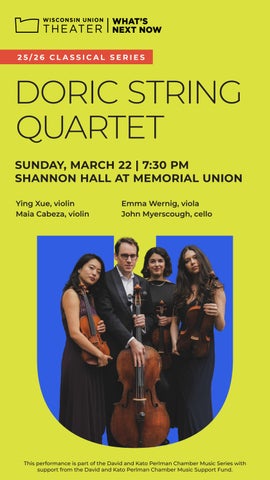
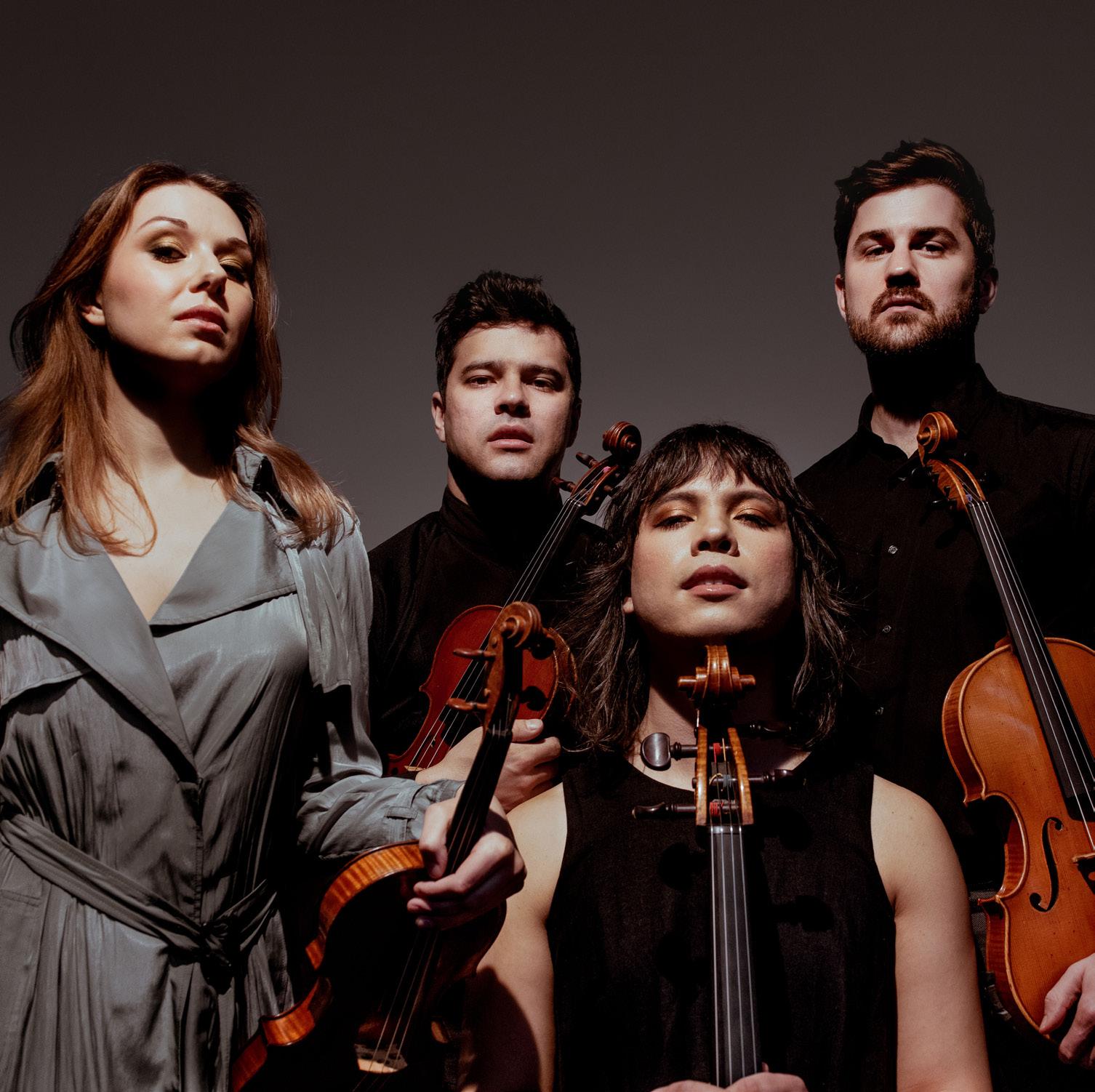
DORIC STRING QUARTET
SUNDAY, MARCH 22 | 7:30 PM
SHANNON HALL AT MEMORIAL UNION
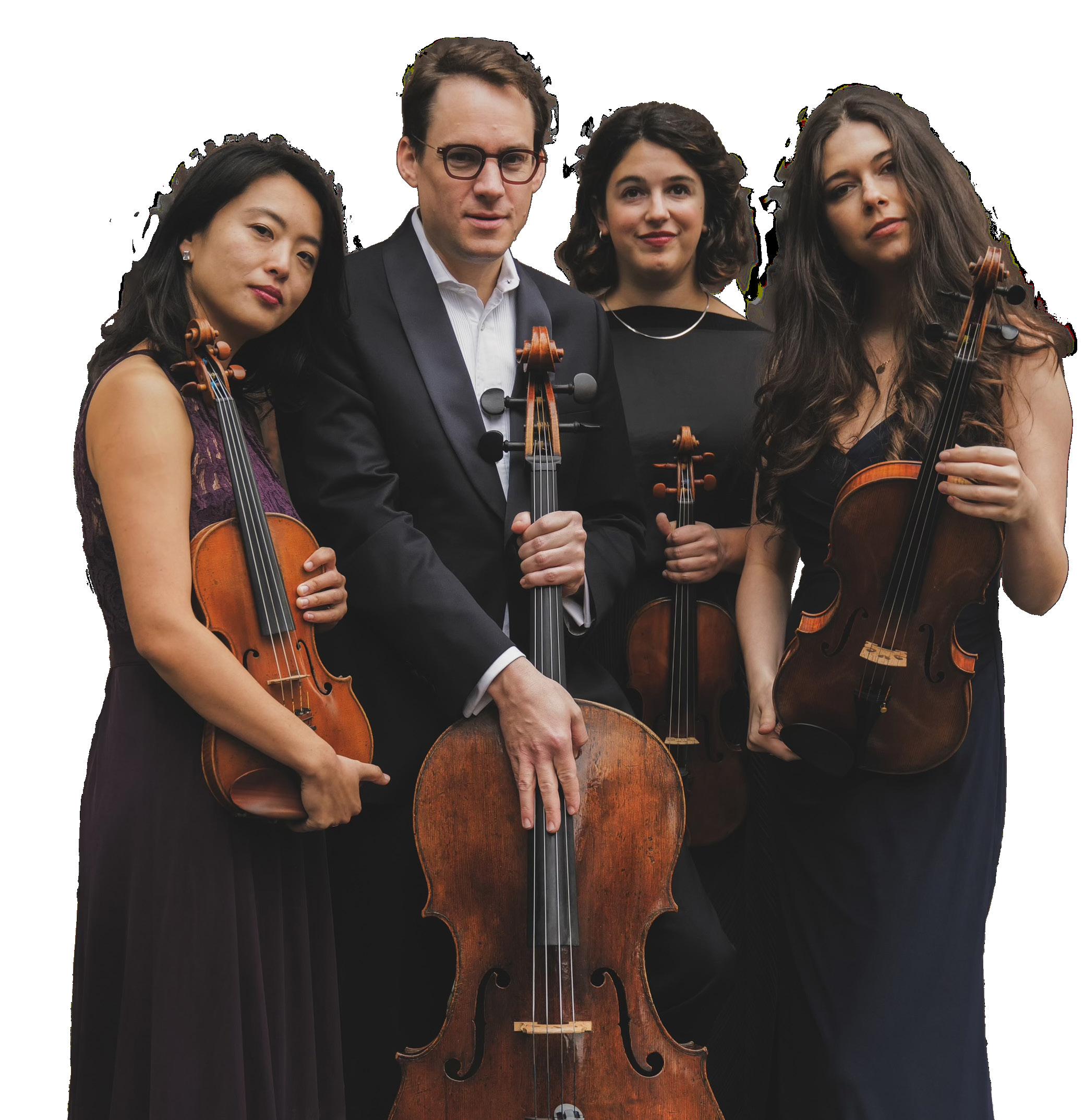
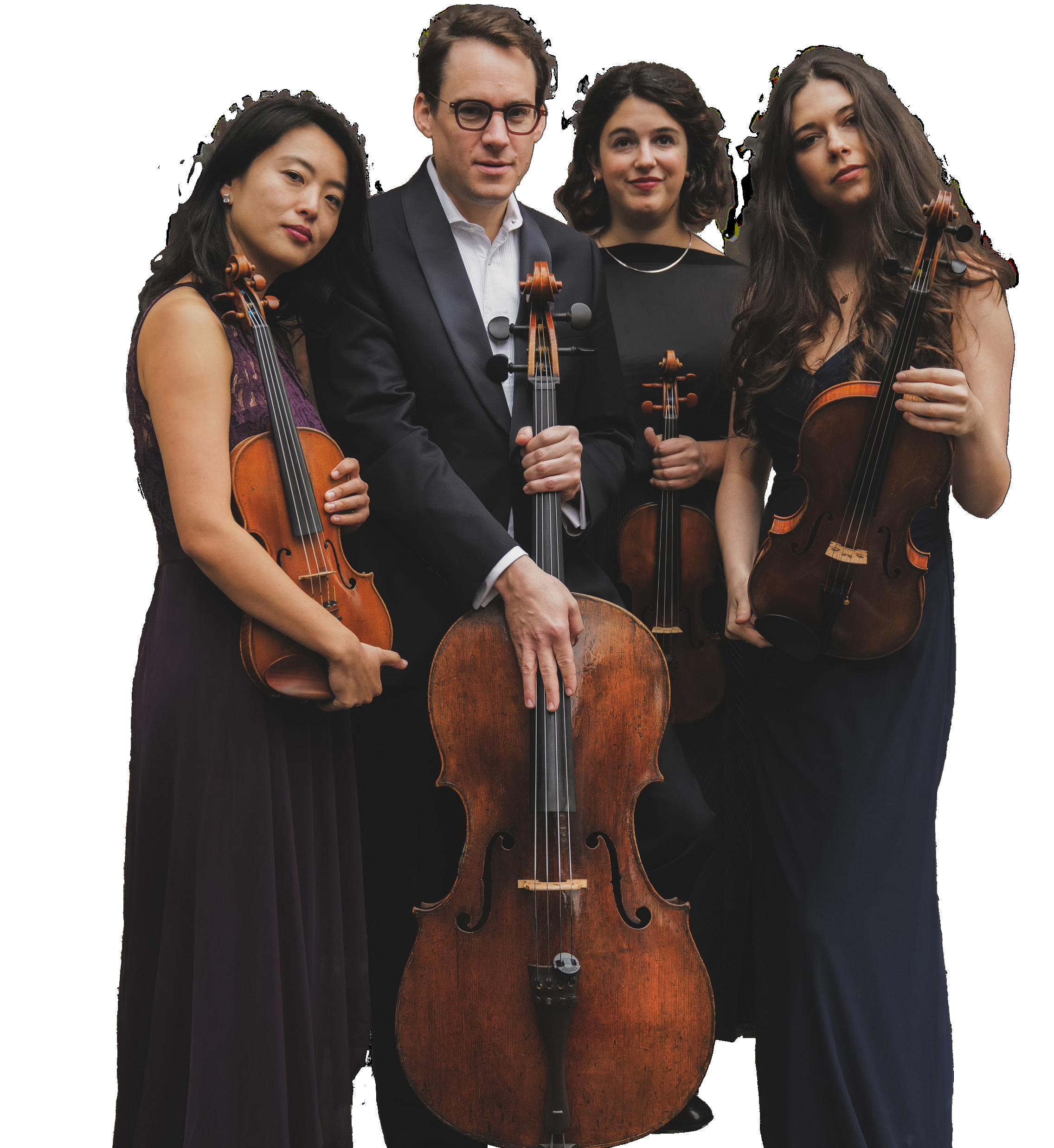
Ying Xue, violin
Maia Cabeza, violin
Emma Wernig, viola
John Myerscough, cello
Please silence all devices while viewing this program. We also invite you to reduce your screen brightness if you are able.
We appreciate your help in maintaining a quiet hall that is conducive to music-making and listening.
In an effort to increase our sustainability efforts, the Wisconsin Union Theater is now utilizing digital programs.
Printed PDFs of the program and large print copies are available upon request. Please ask an usher.
PROGRAMMED BY THE PERFORMING ARTS COMMITTEE
The Wisconsin Union Directorate Performing Arts Committee (WUD PAC) is a student-run organization that brings world-class artists to campus by programming the Wisconsin Union Theater’s annual season of events.
WUD PAC focuses on pushing range and diversity in its programming while connecting to students and the broader Madison community.
In addition to planning the Wisconsin Union Theater’s season, WUD PAC programs and produces studentcentered events that take place in the Wisconsin Union Theater’s Play Circle. WUD PAC makes it a priority to connect students to performing artists through educational engagement activities and more.
WUD PAC is part of the Wisconsin Union Directorate’s Leadership and Engagement Program and is central to the Wisconsin Union’s purpose of developing the leaders of tomorrow and creating community in a place where all belong.
PROGRAM
Johann Sebastian Bach (1685–1750)
Selections from The Art of Fugue, BWV 1080
Joseph Haydn (1732–1809)
String Quartet in F Minor, Op. 20, No. 5
Allegro moderato
Minuetto
Adagio
Finale: Fuga a due soggetti
INTERMISSION
Ludwig van Beethoven (1770–1827)
String Quartet in C Major, Op. 59, No. 3, “Razumovsky”
Andante con moto—Allegro vivace
Andante con moto quasi allegretto
Menuetto (Grazioso)
Allegro molto
PROGRAM NOTES
On this evening’s program, the Doric String Quartet performs works by three canonic composers from three different centuries whose acclaim and influence on instrumental music can hardly be overstated: Bach, Haydn, and Beethoven. As such, the program can provide an object lesson in distinct musical periods: Bach exemplifying the high Baroque, Haydn the Classical, and Beethoven the Romantic. Yet the Doric String Quartet also chose works that feature fugues: a genre with origins in the 14th century that has come to be understood as the acme of counterpoint. The fugues on this program show how all three composers participated in this longstanding tradition, but also the ways in which the concept of the fugue changed in context. After all, today we may view the fugue as proof positive of a composer’s mastery of counterpoint, but its social implications and meanings varied across the centuries.
BACH DEMONSTRATES THE ART OF FUGUE
Especially in the last decades of his life, Bach wrote largescale, thematically unified collections that have come to characterize him as an “encyclopedic” and “learned” composer. Most prominent are: the four books of the Clavier-Übung, which explore harpsichord genres and contain the monumental Goldberg Variations; The Musical Offering, a collection of canons, fugues, and a trio sonata all based on a theme provided by Frederick the Great; and The Art of Fugue, Bach’s supposed final work (most of it was written by 1740), posthumously published by his son Carl Philipp Emanuel. It contains 13 progressively more complex fugues, one incomplete fugue (a perennial source of intrigue for those who attempt to complete it), four canons, two arrangements, and a previously composed chorale to “complete” the publication (Emanuel, as he was called, claimed his father dictated it from his deathbed).
Cerebral in nature, these monumental collections are sometimes viewed as emblematic of the wider ideals of the Age of Enlightenment with its focus on rationalism and
science. Scholars today, however, have come to acknowledge that Bach’s conservative, faith-focused perspective was very much at odds with Enlightenment ideals. Moreover, unlike some of his more “enlightened” contemporaries like Telemann, he never had any university training, something he was likely keenly aware of during his nearly three decades in the university town of Leipzig. To square this circle, music historian David Schulenberg views Bach’s encyclopedic collections as representative of his lifelong role as a teacher, viewing the works as “demonstration” pieces with a pronounced educational dimension. (In fact, Bach’s earlier systematic publication, The Well-Tempered Clavier from 1722, was for young musicians “desirous of learning.”) Written for the keyboard, the works in The Art of Fugue are notated in open score—an educational feature where each “voice,” as they are called in counterpoint studies, is on a separate staff that also allows for easy transcription to other instruments. The Art of Fugue is not, however, a mere academic exercise. A practicing (and practical) musician, Bach aimed to perfect established forms with examples of real music.
The simplest fugue from The Art of Fugue is Contrapunctus 1 (another educational convention, Bach used the word contrapunctus, Latin for “counterpoint,” throughout). An exemplar, it has a clear exposition in which each voice presents the main theme (called the subject), followed by a middle section where subject statements alternate with episodes of free counterpoint, leading to a climax. After a grand pause, the final statement of the subject, with contrapuntal elaboration, puts a period at the end. Despite its austerity, Bach’s mastery of the expressive quality of the fugue comes to the fore. He uses syncopated suspensions to create expressive dissonances that pull for resolution and a repetitive sequence to modulate through keys creating harmonic excitement, both of which are Italianate (obliquely Corellian) features.
The last of his “simple” fugues, Bach wrote Contrapunctus 4 by presenting the main theme in inversion: Whereas the main theme (the subject of Contrapunctus 1) leaps upward by a fifth and descends by thirds, the subject of Contrapunctus 4 leaps downward by a fifth and ascends by thirds. Beyond his manipulation of the theme, Bach shows his power of invention in the episodes, an important Baroque
aesthetic (and a well-known feature of Vivaldi) that revels in the rapid succession of new ideas to build excitement.
After the simple fugues, Bach moves on to so-called stretto fugues. “Stretto” technically refers to a rapid pile-on of subjects such that at least two (but usually more) dovetail— but this is not the only advanced technique of Bach’s stretto fugues. Subjects may also appear sped up (called “diminution”) or slowed down (called “augmentation”) and in inversion. In Contrapunctus 6, Bach writes in the stylo francese (“French style”) by altering the main theme with dotted rhythms and including decorative ornamentation, like the stylish trills. Establishing the French style with the subject in the bass voice, Bach immediately creates a stretto by putting the subject in inversion and diminution in the soprano before the alto answers the bass with the subject also in diminution. Despite these dazzling techniques, the subject entrances are, by and large, obscured by the ornamentation, as if the French style is a disguise for distraction.
From the final section of The Art of Fugue, which has double and triple fugues (so named depending on the number of subjects), Contrapunctus 9 presents its two subjects in turn. The first features a large upward octave leap and fast runs. It appears in all four voices before the second subject—the main theme—sounds with a familiar, long-note melody that dramatically contrasts with the first subject. Bach wrote these two subjects as invertible counterpoint at the 12th (alla duodecima), which allows him to layer them simultaneously, regardless of which is on bottom or top. The overall effect is a virtuosic tour de force of fast, swirling runs that resolve at cogent moments of clarity when the main theme sings out.
THE FUGUES AND OTHER DIVERTIMENTOS OF HAYDN’S OP. 20
Haydn is almost singularly responsible for the standardization of the string quartet. For him, however, it started as a practical medium written for the needs of his position at the court of Prince Esterházy. As such, his early string quartets (from before 1790) were composed
in streaks with long pauses in between when other music took priority (most notably, time-consuming operas). The six quartets of Op. 20 (called “divertimentos” when published in 1774) marked a turning point in the genre and confirmed the string quartet as a significant medium for Haydn. The collection established the four-movement standard, as well as fast tempos for outer movements. The quartets are unique in that the dance movement (minuet) comes before the slow movement. They also display increasing independence for each instrument, even though the first violin remains dominant.
More than anything, the Op. 20 collection shows the kaleidoscopic potential of the string quartet. No. 3 in G Minor as well as No. 5 in F Minor exemplify the so-called Sturm und Drang (“storm and stress”) style of the 1760s and 1770s. For Haydn, these works illustrate the duality of his personality, embodying both subjective emotion and objective wit. Beyond exploration of the minor modes, the quartets of Op. 20 show a variety of approaches to sonata form, dance movements, and slow movements, and three (Nos. 2, 5, and 6) end with fugues. The fugue was, by the 1770s, quite archaic and deeply associated with sacred music. By concluding three “divertimentos” (a description that suggests “fun” music) with such an old-fashioned genre, Haydn may have been a touch ironic, as if to prove the string quartet is capable of everything, even fugues.
In the first movement of the String Quartet in F Minor, the minor key provides a somber mood more than a stormy one. Haydn uses a variety of textures toward expressive ends, but notably—and more in line with style of the time— the most contrapuntal moments, where each instrument has individual rhythms and melodies, create a sense of tense chaos in need of resolution. The second movement, a minuet, is dominated by the first violin playing as soloist. In the outer sections, it creates a stumbling effect by sporadically displacing the meter with leaps on beat 2, all in contrast with the stable trio section. For the slow movement, Hadyn writes a set of variations, one in which the theme is on constant repeat in different voices, but decorated with accompanying runs by the first violin or altered to evoke
different styles. The final movement, labeled fuga a due soggetti (“fugue with two subjects”), features a main theme with long notes and wide leaps against a countersubject distinguished by its three repeating notes. Unlike the double fugue of Bach’s Contrapunctus 9, the two subjects are not taken in turn; rather, the countersubject acts as a permanent fixture always accompanying the subject. Like Bach, Haydn does not write an academic exercise; after all, it had to be fun. Instead, the fugue builds gradually to a climactic pile-on before the conclusion.
BEETHOVEN REIMAGINES THE FUGUE
Commissioned by Count Andrey Razumovsky, a Russian ambassador in Vienna, the three string quartets of Op. 59 saw Beethoven taking an expansive approach to the string quartet with some disregard for the expectations of his audience or his patron. The works were meant to include Russian folk songs at the request of the Count, but Beethoven—never one to be told what to do—only integrated a thème russe in a single movement of Nos. 1 and 2 and then invented a Russian-style tune for No. 3. What he did deliver, however, were three quartets that pushed the limits of the genre. For audiences primed to hear a Classical string quartet, these works left many confused—one early reviewer called them “profoundly conceived and exquisitely composed, but not generally comprehensible.”
The Razumovsky String Quartets come from Beethoven’s “heroic” Middle Period, wherein he developed his “symphonic ideal.” He focused on large-scale musical development across movements and attempted to reconceptualize musical fundamentals to reach beyond their preconceived limits. In practical terms, this meant Beethoven’s works exploded in length, and his music began to narrate a sense of psychological development and organic continuity. He began to apply his “symphonic ideal” broadly to other genres. In Op. 59, No. 3, for example, the second and third movements both foreshadow the fugue finale with moments of staggered, fugal counterpoint.
Right off the bat, the first movement creates symphonic grandeur opening with an atmospheric minor-key slow introduction that is juxtaposed with a jubilant, at times
hyper, main theme in major. The accompaniment interjects with half steps throughout that signal conflict that the music ultimately resolves. In the slow second movement, Beethoven nods to a “Russian” style in the lyrical second theme, but the whole movement has a rustic quality with the bowed upper voices playing against the drone-like pizzicato of the cello that might also have been meant to signify folk music, Russian or otherwise. The third movement, labelled “Menuetto grazioso,” turns down the temperature, evoking the gentility of a formal dance in the outer sections. It ends by introducing staggered contrapuntal entrances leading without pause into the finale.
If for Bach the fugue was a learned tradition and for Haydn an ironic archaism, for Beethoven it represented something more cosmic—a procedure for integrating more and more independent ideas into a unified whole. Thus, in the fourth movement of Op. 59, No. 5, the recurrence of the frantic subject often acts as restart when things seem to grow out of control. These restarts, however, do not offer resolution, and in the final episode, Beethoven introduces a countersubject in half notes that grounds the subject for the first time. It leads to the conclusion, where the frenetic subject is subsumed into the long-note accompaniment for a calming, satisfactory conclusion.
ARTIST BIO
DORIC
STRING QUARTET
Ying Xue, violin
Maia Cabeza, violin
Emma Wernig, viola
John Myerscough, cello
Doric String Quartet brings an elegance and intimacy both to the Classical canon and new music, with the depth and integrity of their interpretations winning them fans across the world. Having performed cycles of Haydn, Mendelssohn, Britten, and Bartók at famous international venues, including Amsterdam’s Concertgebouw, Vienna’s Konzerthaus and Hamburg’s Elbphilharmonie, they now turn their attention to Beethoven. Continuing their recording project for Chandos, with the first installment released in 2023 and praised by The Times (London) as “a joy.” The series will culminate in 2026–27 with the 200th anniversary of the composer’s death.
Grounded in intellectual rigor, the quartet uses specially made original-style bows for performing Classical repertoire from Haydn to Mendelssohn—and while they are known for their refined performances of this repertoire, they are also committed to new music, performing works by composers such as Peter Maxwell Davies and Donnacha Dennehy. In 2019, they gave the world premiere of Brett Dean’s String Quartet No. 3, commissioned for the quartet by Musica Viva Australia, Carnegie Hall, Edinburgh Festival, Berlin Konzerthaus, Amsterdam String Quartet Biennale, and West Cork Chamber Music Festival.
Doric String Quartet’s curiosity and flexibility are represented by a discography of more than 20 recordings for Chandos, with whom they have recorded exclusively since 2010, ranging from Purcell to John Adams. They are regular visitors at Snape Maltings and London’s Wigmore Hall, where they were the first group to perform to a live audience after the venue’s
pandemic lockdown. They make an annual tour of the U.S. and visit Japan every other year at venues that include Suntory Hall.
The Doric often performs repertoire for string quartet and orchestra, including Elgar’s Introduction and Allegro, and were invited to give the Austrian premiere of John Adams’s Absolute Jest for string quartet and orchestra at the Vienna Konzerthaus, with Adams conducting. They also gave the Dutch premiere with the Netherlands Radio Philharmonic Orchestra at the Concertgebouw under Markus Stenz, and have performed the piece with the BBC Scottish Symphony and BBC Symphony orchestras. Their recording with the Royal Scottish National Orchestra and Peter Oundjian, released on Chandos in 2018, was named Recording of the Month in BBC Music Magazine and praised for its “sumptuous sweetness and laser-like clarity.”
As a group, they enjoy working with other musicians such as Elisabeth Leonskaja, Alina Ibragimova, Liza Ferschtman, and Alexander Melnikov. They recently toured the U.S. alongside Benjamin Grosvenor, worked with Tabea Zimmermann, and recorded Mendelssohn string quintets with Timothy Ridout. This season they are touring projects with Jonathan Biss and Cuarteto Quiroga.
Having benefitted from coaching by groups such as the Hagen, Alban Berg, Artemis, and LaSalle quartets, the group is keen to support young musicians. They have been Teaching Quartet in Association at the Royal Academy of Music in London since 2015, and artistic directors of the Mendelssohn on Mull Festival since 2018.
Ying Xue performs on a violin by Giovanni Gabrielli from 1754, Emma Wernig plays on a viola made by Jason Viseltear in 2019, and John Myerscough performs on a cello made by the Brothers Amati in 1587.
THANK YOU TO OUR GENEROUS DONORS
Anonymous
Margaret Alferi & Eugene Kim
Robin Axel & Jacob Axel
Mohamed Bacchus
Martin Baggott & Jennine Baggott
Robert Bell & Jeanne Bell
Bennett Berson & Rebecca Holmes
James Bigwood & Jay Cha
Diane Bless
Cassandra Book
Michael Brody & Elizabeth Ester
Daniel Burrell Jr & Jenice Burrell
James Carlson
Peggy Chane
Janet Cohen
Charles Cohen & Christine Schindler
Mary Crosby
George Cutlip
Heather Daniels & Alan Hiebert
Kelly Dehaven & David Cooper
André De Shields
Mark Dettmann & Cathleen Dettmann
Jaimie Dockray & Brian Dockray
Elizabeth Douma
Margaret Douma & Wallace Douma
James Doyle Jr & Jessica Doyle
Rae Erdahl
Deborah Fairchild
Hildy Feen
Marlene Fiske
Jeffrey Fritsche & Carol Fritsche
Deirdre Garton
Neil Geminder & Joan Geminder
Jean Gessl & Douglas Gessl
Michelle Gregoire & Tim Gregoire
Mark Guthier & Amy Guthier
Kristine Hallisy
Justin Hein & Paige Hein
Brent Helt
John Hirsh & Lynnette Tenorio
Seth Hoff
Matthew Huston
Carol Hyland
Arnold Jacobson
Kelly Kahl & Kimberly Kahl
Elisabeth Kasdorf
Kate Kingery
Daniel Koehn & Mark Koehn
Diane Kostecke & Nancy Ciezkia
Kathleen Kotnour
Iris Kurman & Seth Dailey
Sandra Lee & Jun Lee
Christopher Louderback
Douglas Mackaman & Margaret O'Hara
Edward Manuel & Marian Holton-Manuel
Shibani Munshi
Eric Nathan
Glenda Noel-Ney & William Ney
Mitchell Nussbaum & Eugenia Ogden
Ann Pehle
David and Kato Perlman
Lisa Pfaff
Nicholas Pjevach
M Thomas Record Jr & Voula Kodoyianni
Sharon Rouse
Ralph Russo & Lauren Cnare
Peter Ryan
Joshua Rybaski
Morgan Sachs
J Gail Meyst Sahney & Vinod Sahney
Steven Schaffer & Beth Schaffer
Carol Schroeder
Daniel Schultz & Patricia Schultz
Sarah Schutt & Donald Schutt Jr
Margaret Shields
Elizabeth Snodgrass
Polly Snodgrass
Monica St Angelo & Mark Levandoski
Mark Stanley & Krista Stanley
Lynn Stathas
Jonathan Stenger
Jason Stephens & Ana Stephens
Andrew Stevens & Erika Stevens
Millard Susman & Barbara Susman
Kimberly Svetin & Todd Svetin
Thompson Investment Management
Elizabeth Van Ness
Daniel Van Note
Rachel Waner
Glenn Watts & Jane Watts
Shane Wealti
Kathleen Williams
Janell Wise
James Wockenfuss & Lena Wockenfuss
Debbie Wong
Donors as of July 31, 2025


WISCONSIN UNION THEATER
Elizabeth Snodgrass, Director
Kate Schwartz, Artist Services Manager
George Hommowun, Assistant Director of Theater Event Operations
Zane Enloe, Production Manager
Jeff Macheel, Technical Director
Heather Macheel, Technical Director
Sean Danner, Assistant Director of Ticketing and Patron Services
Ted Harks, Arts Ticketing Website Systems Administrator
Eric Henkes, Lead House Manager
Ava Conrad, Rentals Assistant
Kelsey Fleckenstein, Special Projects Assistant
Mandy Descorbeth, External Relations Intern
Paige Verbsky, Bolz Center for Arts Administration Intern
WISCONSIN UNION DIRECTORATE
PERFORMING ARTS COMMITTEE
Jordan Waters, Director
Thomas Wieland, Programming Associate Director
Lucy Kenavan, Programming Associate Director
Sabrina Ortiz, Production Associate Director
Cosette Wildermuth, External Relations Associate Director
Kalia Gordon, Marketing Associate Director