Science matters
The initiative and efforts of Sophia Jex-Blake exemplify the striving of women in many cultural contexts to gain educational and other opportunities. In modern times they link to the courage and purpose of Nobel Prize-winner Malala Yousafzai, who continues to fight for female educational rights having survived a Taliban assassination attempt as a 15 year-old. limited, acknowledgement of her contribution. It is worth reflecting that November 2018 marked the anniversary of the admission of the Edinburgh seven into medical school (November 1869). Edinburgh University was the first in Britain to admit women, albeit reluctantly. Sophia Jex-Blake was the leading member of this group of seven pioneering women who broke new ground with their studies in Edinburgh. She was born in Hastings, England, educated privately, and developed an interest in medicine in the UK and through travels in the USA. She had in fact applied to study medicine at Harvard in 1865 but was refused entry because, as her rejection letter put it, ‘there is no
provision for the education of women in any department of this university’. Jex-Blake returned to the UK and went on to study in Edinburgh, where admission of the seven women medical students created sufficient controversy that the Surgeons’ Hall riot took place in protest in 1870. She had to move to London eventually to complete her studies, in the process playing a leading role in establishing the London School of Medicine for Women in 1874. Following this the Medical Act was passed by Parliament, allowing the medical licensing of any person, regardless of gender. Jex-Blake finally received her degree when she was awarded an MD in Berne, Switzerland. Taking advantage of new legislation, she returned to the British Isles and became one of Britain’s first female doctors. Eventually she returned to Edinburgh, becoming Scotland’s first practising female doctor and going on to establish the Edinburgh School of Medicine for Women, and the Edinburgh Hospital and Dispensary for Women and Children. The initiative and efforts of Sophia Jex-Blake exemplify the striving of women in many cultural contexts to gain educational and other opportunities. In modern times they link to the courage and purpose of Nobel Prize-winner Malala Yousafzai, who continues to fight for female educational rights having survived a Taliban assassination attempt as a 15 year-old. There is a need to emphasise the contribution of women to scientific progress and to increase still further the opportunities available to them. The scientific contribution of women is celebrated in the book ‘Nobel Prize Women in Science: Their Lives. Struggles and Momentous Discoveries’ (by S.B. McGrayne; ISBN 0-309-07270-0). Dr Richard Harwood is an education consultant (scientific and international education). Email: rickharwood@btinternet.com
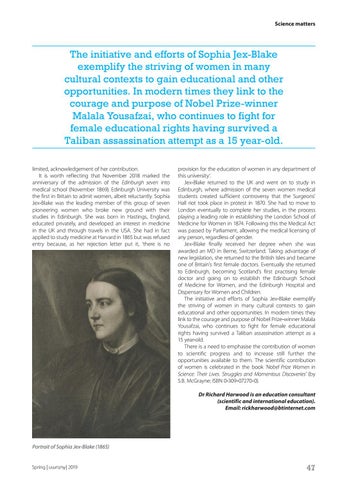
Portrait of Sophia Jex-Blake (1865)
Autumn
Spring |
| 2019
47