Faculty Perspective
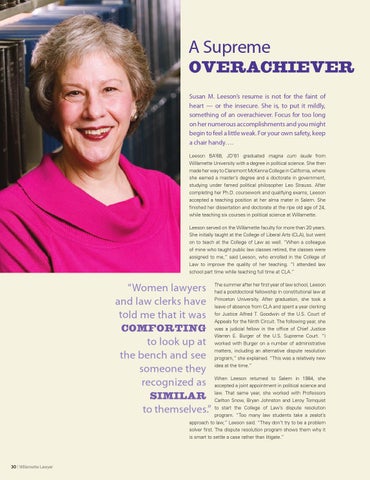
A Supreme Overachiever Susan M. Leeson’s resume is not for the faint of heart — or the insecure. She is, to put it mildly, something of an overachiever. Focus for too long on her numerous accomplishments and you might begin to feel a little weak. For your own safety, keep a chair handy…. Leeson BA’68, JD’81 graduated magna cum laude from Willamette University with a degree in political science. She then made her way to Claremont McKenna College in California, where she earned a master’s degree and a doctorate in government, studying under famed political philosopher Leo Strauss. After completing her Ph.D. coursework and qualifying exams, Leeson accepted a teaching position at her alma mater in Salem. She finished her dissertation and doctorate at the ripe old age of 24, while teaching six courses in political science at Willamette. Leeson served on the Willamette faculty for more than 20 years. She initially taught at the College of Liberal Arts (CLA), but went on to teach at the College of Law as well. “When a colleague of mine who taught public law classes retired, the classes were assigned to me,” said Leeson, who enrolled in the College of Law to improve the quality of her teaching. “I attended law school part time while teaching full time at CLA.”
summer after her first year of law school, Leeson “Women lawyers The had a postdoctoral fellowship in constitutional law at University. After graduation, she took a and law clerks have Princeton leave of absence from CLA and spent a year clerking Justice Alfred T. Goodwin of the U.S. Court of told me that it was for Appeals for the Ninth Circuit. The following year, she
COMFORTING
to look up at the bench and see someone they recognized as
When Leeson returned to Salem in 1984, she accepted a joint appointment in political science and law. That same year, she worked with Professors Carlton Snow, Bryan Johnston and Leroy Tornquist to start the College of Law’s dispute resolution program. “Too many law students take a zealot’s approach to law,” Leeson said. “They don’t try to be a problem solver first. The dispute resolution program shows them why it is smart to settle a case rather than litigate.”
SIMILAR
to themselves.”
30 | Willamette Lawyer
was a judicial fellow in the office of Chief Justice Warren E. Burger of the U.S. Supreme Court. “I worked with Burger on a number of administrative matters, including an alternative dispute resolution program,” she explained. “This was a relatively new idea at the time.”