Dr. Singh grew up on a small family farm in northern India and went on to complete an undergraduate degree in Agricultural Engineering, a master’s degree in Postharvest Engineering and a PhD in Biosystems Engineering. He was most recently an associate professor of Engineering at the University of Southern Australia, but it was during his five-year stint with OPIsystems, a grain management technology company based in Calgary, when he identified the potential for expanding postharvest research in Alberta. “Agriculture is so strong in this region, but no one is really taking on this particular issue,” says Dr. Singh. His short-term focus is on building research infrastructure, accessing funding and developing partnerships with growers and industry groups, including the Alberta Sugar Beet Growers (ASBG) and Potato Growers of Alberta (PGA). Both crops are important parts of southern Alberta’s agricultural sector. Alberta produces around 20 per cent of Canada’s spuds and southern Alberta is home to Canada’s only sugar beet processing plant, the Lantic Sugar operation in Taber. Each crop faces its own unique challenges when it comes to postharvest crop management. For example, sugar beets are one of the only crops to be stored outdoors, says Melody GarnerSkiba, ASBG’s executive director. “There are seven receiving stations that growers send their sugar beets to where they are stored in large piles before processing,” she says. “It doesn't make sense for our farmers to build storage bins because the return on the beets just isn't there to be able to afford to do that and still have a profitable business.” Garner-Skiba says this type of storage makes sugar beet crops vulnerable to temperature changes and moisture. Currently
crops are monitored weekly, but Garner-Skiba says the ASBG is hoping partnering with Dr. Singh and CARIE will lead to new solutions. “We're really going to be looking for [Dr. Singh’s] expertise to think outside the box and to give us suggestions for how can we try to mitigate nature as much as possible.” For potato farmers, the issue is maintaining quality over a long period between harvests. “It’s a once a year crop but the demand is year round,” says Thomas McDade, PGA’s agricultural director. “A potato harvest is a rest home, not a hospital, so storage is a critical concern.” McDade says potatoes are stored in bins that can hold as much as 3,000 tons. A bad batch can end up potentially spoiling hundreds of tons of product. “How we store potatoes has a significant impact on the profitability of our growers,” says McDade. “Supporting work like Dr. Singh’s is a way to get our membership to develop relationships and ultimately gain an understanding of the value of research.” Once underway, Dr. Singh’s research will rely heavily on technology, including remote sensing, automation, artificial intelligence, and mathematical modelling. “We can’t control Mother Nature, but if you have good infrastructure and are proactive, you can plan ahead and reduce the risks,” says Dr. Singh. “We can look at everything from the soil condition, weather condition, all of the inputs to the crop, when we harvest and at what conditions, where we store and process and we can use technology to come up with the best solutions or recommendation for the industry as well as for growers.” Story by Jeremy Franchuk | Photos by Rob Olson
“WE CAN’T CONTROL MOTHER NATURE, BUT IF YOU HAVE GOOD INFRASTRUCTURE AND ARE PROACTIVE, YOU CAN PLAN AHEAD AND REDUCE THE RISKS.” { Dr. Chandra Singh }
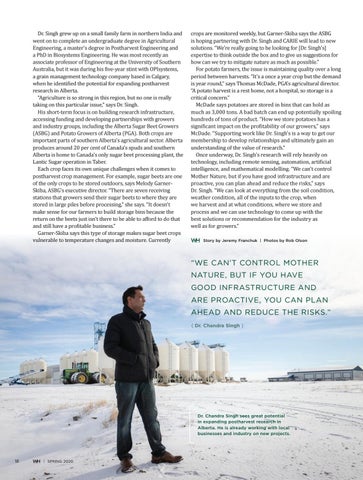
Dr. Chandra Singh sees great potential in expanding postharvest research in Alberta. He is already working with local businesses and industry on new projects.
18
| SPRING 2020