8A
WHITE BEAR PRESS
OCTOBER 19, 2016 www.presspubs.com
LOON WHISPERERS: DNR expert helps scout nesting sites on White Bear Lake
SUBMITTED
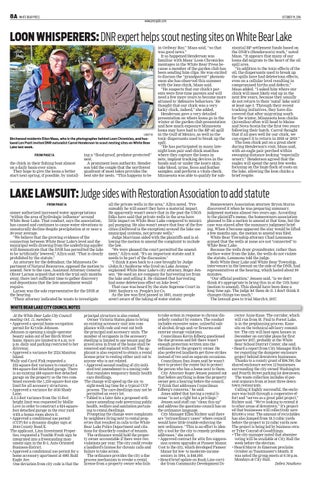
Birchwood residents Ellen Maas, who is the photographer behind Loon Chronicles, and husband Len Pratt invited DNR naturalist Carrol Henderson to scout nesting sites on White Bear Lake last week. FROM PAGE 1A
the chick in their fishing boat almost on a daily basis ever since. They hope to give the loons a better start next spring, if possible, by install-
ing a “flood-proof, predator-protected” nest. A prominent loon authority, Henderson told the couple that the northwest quadrant of most lakes provides the best site for nests. “This happens to be
in Ordway Bay,” Maas said, “so that was good news.” It so happened Henderson was familiar with Maas’ Loon Chronicles montages in the White Bear Press because a member of the garden club has been sending him clips. He was excited to discuss the “grandparent” phenomenon she has observed this summer with the lone chick, Maas said. “He suspects that our chick’s parents were first-time parents and will need a few more years to become more attuned to ‘defensive behaviors.’ He thought that our chick was a very lucky chick, indeed,” she added. Henderson gave a very detailed presentation on where loons go in the winter at the garden club presentation and how much exposure Minnesota loons may have had to the BP oil spill in the Gulf of Mexico, as well as the toxic dispersants used to break up the spill. “He has participated in many latenight loon pair and chick snatches where they capture the loons in nets; implant tracking devices in the bands and/or under the loon’s skin; take blood, urine, feces and feather samples; and perform a vitals check. Minnesota was able to qualify for sub-
stantial BP settlement funds based on the DNR’s (Henderson’s) work,” noted Maas. “It appears that many of our loons did migrate to the heart of the oil spill area. “In addition to the toxic effects of the oil, the dispersants used to break up the spills have had deleterious effects, even on a cellular level resulting in compromised births and defects,” Maas added. “I asked him where our chick will most likely end up in the next few years, because they usually do not return to their ‘natal’ lake until at least age 3. Through their recent tracking initiatives, they have discovered that after migrating south for the winter, Minnesota loon chicks (juveniles) often will head to Maine and Nova Scotia for the first two years following their hatch. Carrol thought that if all goes well for our chick, we can expect it to return in 2018 or 2019.” The loon chick put on a great show during Henderson’s visit, Maas said, with an eagle pair perched within swooping distance looking “especially ornery.” Henderson agreed that the eagles will spend the next few weeks focusing on the huge flock of coots on the lake, allowing the loon chicks a brief respite.
LAKE LAWSUIT: Judge sides with Restoration Association to add statute FROM PAGE 1A
sioner authorized increased water appropriations "within the area of hydrologic influence" around White Bear Lake. That conduct, says the association, has caused and continues to cause water elevations to unnaturally decline despite precipitation at or near a 30-year average. "We believe that the growing evidence of the connection between White Bear Lake’s level and the municipal wells drawing from the underlying aquifer will demonstrate that the DNR has permitted the lake to be 'artificially' lowered," Allyn said. "That is clearly prohibited by the statute." An attorney for the defendant, the Minnesota Department of Natural Resources, opposed the motion to amend. New to the case, Assistant Attorney General Oliver Larson argued that with the trial only months away, there isn't sufficient time to gather discovery and depositions that the late amendment would require. Larson was the sole representative for the DNR at the hearing. "Their attorney indicated he wants to investigate
all the private wells in the area," Allyn noted. "Presumably he will assert they have a material impact. He apparently wasn't aware that in the past the USGS folks have said that private wells in the area have little impact on White Bear Lake compared to municipal pumping. He also wasn't aware that four of the five cities (Dellwood is the exception) around the lake use municipal systems, not private wells." Judge Marrinan sided with the plaintiffs and is allowing the motion to amend the complaint to include the law. "We were pleased the court permitted the amendment," Allyn said. "It's an important statute and it needs to be part of the discussion." "I think it goes back to a case brought by Judge (John B.) Sanborne who lived on Lake Avenue," explained White Bear Lake’s city attorney, Roger Jensen. "He sued an ice company for harvesting ice from the lake and selling it. He claimed that harvesting had some deleterious effect on lake level." That case was heard by the state Supreme Court in 1900: Sanborn vs. People's Ice Co. As the law was first passed in 1881, many people aren't aware of the taking-of-water statute.
Homeowners Association attorney Bryon Starns discovered it when he was preparing summary judgment motions almost two years ago. According to the plaintiff's memo, the homeowners association planned to file a motion to amend at that time, but the case was stayed after the summary judgment briefing. When it became apparent the stay would be lifted a few months ago, the motion to amend was filed. White Bear Township attorney Chad Lemmons argued that the wells at issue are not "connected" to White Bear Lake. Because the wells draw groundwater, rather than surface water from the lake, the wells do not violate the statute, Lemmons told the judge. Both White Bear Lake and White Bear Township, intervenors in the lawsuit on the side of the DNR, had representatives at the hearing, which lasted about 90 minutes. "Our official position," Jensen said, "is we don't think it's appropriate to bring this in at the 11th hour (motion to amend). This should have been done a long time ago. The judge let them do it. I don't think it changes things too much." The lawsuit goes to trial March 6, 2017.
WHITE BEAR LAKE CITY COUNCIL NOTES At the White Bear Lake City Council meeting Oct. 11, members: • Approved a special home occupation permit for Krystle Johnson. Johnson is opening a single-operator beauty salon out of her Birch Street home. Hours are limited to 9 a.m. to 9 p.m. daily and parking restricted to her driveway. • Approved a variance for 2524 Manitou Island. Wally and Carol Fisk requested a 232-square-foot variance to construct a 994-square-foot detached garage. There is an existing 488-square-foot detached garage on the property so the two combined exceeds the 1,250-square-foot size limit for all accessory structures. • Approved a variance for 4616 Shady Lane. A 2.5-foot variance from the 15-foot height limit was requested by Mollie Love in order to construct a 624-squarefoot detached garage in the rear yard with a bonus room above it. • Approved a conditional use permit (CUP) for a dynamic display sign at 2044 County Road E. The applicant, Linn Investment Properties, requested a Tumble Fresh sign be integrated into a freestanding monument sign in the B-3, Auto Oriented Business district. • Approved a conditional use permit for a home accessory apartment at 4981 Bald Eagle Ave. One deviation from city code is that the
principal structure is also rented. Owner Victoria Staten plans to bring an existing accessory unit into compliance with code and rent out both the principal and accessory units. The number of occupants in the accessory dwelling is limited to one tenant and the gravel area in front of the home shall be removed and replaced with sod. The applicant is also required to obtain a rental license prior to renting either unit out to anyone who is not related. • Approved second reading of city-initiated text amendment to a zoning code that regulates temporary family health care dwellings. The change will speed up the six- to eight-week lag time for a typical CUP process. The care dwellings may not be permitted on every lot. • Tabled to a later date a proposed ordinance amending code governing public health, welfare and sanitation pertaining to rental dwellings. Prompting the change were complaints by neighbors living next to rental properties that resulted in calls to the White Bear Lake Police Department and citations for disorderly conduct of tenants. The ordinance would hold the property owner accountable if there were two violations per year. The city could revoke a landlord’s license for chronic calls and failure to take action. The ordinance provides the city a due process mechanism to revoke a rental license from a property owner who fails
to take action in response to chronic disorderly conduct by renters. The conduct includes excessive noise, unlawful sale of alcohol, drugs and/or firearms and exterior storage violations. Councilman Kevin Edberg questioned the due process and felt there wasn’t enough protection written into the ordinance for the property owner. He also preferred landlords get three strikes instead of two and on separate occasions. Councilman Dan Jones said he wasn’t here to protect the renter but to protect the person who has a home next to them. City Attorney Roger Jensen pointed out that before anything is done the property owner gets a hearing before the council. “I think that addresses Councilman Edberg’s concerns,” he said. Jones added that having a rental license “is not a right but a privilege.” Jensen said staff can “clean this up” and address the questions council has on the ordinance language. City Manager Ellen Richter said there are “extraordinary cases” where council would have little trouble enforcing the new ordinance. “This is an effort to identify a tool for the city to remedy problem addresses,” she noted. • Approved contract for attic fire suppression system upgrades at Pioneer Manor. Cost to the city, which developed Pioneer Manor for low- to moderate-income seniors in 1994, is $48,950. • Heard brief update on Rush Line corridor from Community Development Di-
rector Anne Kane. The corridor, which will run from St. Paul to Forest Lake, is in the preplanning process. Kane sits on the technical advisory committee. The city will host open houses in December on corridor plans for first quarter 2017, probably at the White Bear School District Center, she said. • Heard a report from City Manager Richter regarding the dumpster enclosure project behind downtown businesses. Thanks to a county grant of $96,700, the shared enclosure serves 12 businesses surrounding the city-owned Washington and Fourth Street parking lot downtown. The waste collection includes 45 percent organics from at least three downtown restaurants. Calling it highly successful, the enclosure was built through a cooperative effort and “serves as a great pilot project,” Richter said. “We’re looking to extend it to other areas of downtown.” It’s projected that businesses will collectively save $10,000 a year. The amount of recyclables has also jumped from 18.3 cubic yards before the project to 24 cubic yards now. The project is being led by business owner Tyler Conrad of Goodthings. • The city manager noted that absentee voting will be available at City Hall the week before the election. • Heard Mayor Jo Emerson proclaim October as Toastmaster’s Month. It was noted the group meets at 6:30 p.m. Mondays at City Hall. Debra Neutkens