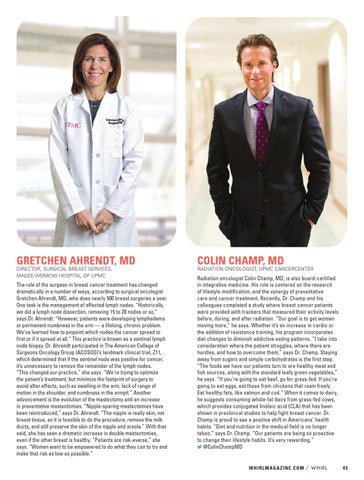
GRETCHEN AHRENDT, MD
COLIN CHAMP, MD
DIRECTOR, SURGICAL BREAST SERVICES, MAGEE-WOMENS HOSPITAL OF UPMC
RADIATION ONCOLOGIST, UPMC CANCERCENTER
The role of the surgeon in breast cancer treatment has changed dramatically in a number of ways, according to surgical oncologist Gretchen Ahrendt, MD, who does nearly 500 breast surgeries a year. One task is the management of affected lymph nodes. “Historically, we did a lymph node dissection, removing 15 to 20 nodes or so,” says Dr. Ahrendt. “However, patients were developing lymphedema or permanent numbness in the arm — a lifelong, chronic problem. We’ve learned how to pinpoint which nodes the cancer spread to first or if it spread at all.” This practice is known as a sentinel lymph node biopsy. Dr. Ahrendt participated in The American College of Surgeons Oncology Group (ACOSOG)’s landmark clinical trial, Z11, which determined that if the sentinel node was positive for cancer, it’s unnecessary to remove the remainder of the lymph nodes. “This changed our practice,” she says. “We’re trying to optimize the patient’s treatment, but minimize the footprint of surgery to avoid after effects, such as swelling in the arm, lack of range of motion in the shoulder, and numbness in the armpit.” Another advancement is the evolution of the mastectomy and an increase in preventative mastectomies. “Nipple-sparing mastectomies have been reintroduced,” says Dr. Ahrendt. “The nipple is really skin, not breast tissue, so it is feasible to do the procedure, remove the milk ducts, and still preserve the skin of the nipple and areola.” With that said, she has seen a dramatic increase in double mastectomies, even if the other breast is healthy. “Patients are risk-averse,” she says. “Women want to be empowered to do what they can to try and make that risk as low as possible.”
Radiation oncologist Colin Champ, MD, is also board-certified in integrative medicine. His role is centered on the research of lifestyle modification, and the synergy of preventative care and cancer treatment. Recently, Dr. Champ and his colleagues completed a study where breast cancer patients were provided with trackers that measured their activity levels before, during, and after radiation. “Our goal is to get women moving more,” he says. Whether it’s an increase in cardio or the addition of resistance training, his program incorporates diet changes to diminish addictive eating patterns. “I take into consideration where the patient struggles, where there are hurdles, and how to overcome them,” says Dr. Champ. Staying away from sugars and simple carbohydrates is the first step. “The foods we have our patients turn to are healthy meat and fish sources, along with the standard leafy green vegetables,” he says. “If you’re going to eat beef, go for grass-fed. If you’re going to eat eggs, eat those from chickens that roam freely. Eat healthy fats, like salmon and cod.” When it comes to dairy, he suggests consuming whole-fat dairy from grass-fed cows, which provides conjugated linoleic acid (CLA) that has been shown in preclinical studies to help fight breast cancer. Dr. Champ is proud to see a positive shift in Americans’ health habits. “Diet and nutrition in the medical field is no longer taboo,” says Dr. Champ. “Our patients are being so proactive to change their lifestyle habits. It’s very rewarding.” @ColinChampMD
WH I R LM A G A Z I N E .C OM / WH IRL
44-63.indd 45
45
4/13/16 5:02 PM