WHITE HOUSE COLLECTION
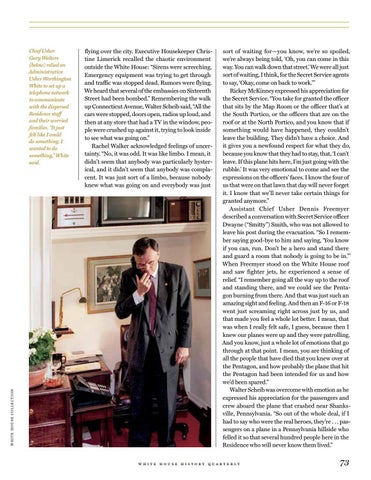
Chief Usher Gary Walters (below) relied on Administrative Usher Worthington White to set up a telephone network to communicate with the dispersed Residence staff and their worried families. “It just felt like I could do something. I wanted to do something,” White said.
flying over the city. Executive Housekeeper Christine Limerick recalled the chaotic environment outside the White House: “Sirens were screeching. Emergency equipment was trying to get through and traffic was stopped dead. Rumors were flying. We heard that several of the embassies on Sixteenth Street had been bombed.” Remembering the walk up Connecticut Avenue, Walter Scheib said, “All the cars were stopped, doors open, radios up loud, and then at any store that had a TV in the window, people were crushed up against it, trying to look inside to see what was going on.” Rachel Walker acknowledged feelings of uncertainty. “No, it was odd. It was like limbo. I mean, it didn’t seem that anybody was particularly hysterical, and it didn’t seem that anybody was complacent. It was just sort of a limbo, because nobody knew what was going on and everybody was just
sort of waiting for—you know, we’re so spoiled, we’re always being told, ‘Oh, you can come in this way. You can walk down that street.’ We were all just sort of waiting, I think, for the Secret Service agents to say, ‘Okay, come on back to work.’” Rickey McKinney expressed his appreciation for the Secret Service. “You take for granted the officer that sits by the Map Room or the officer that’s at the South Portico, or the officers that are on the roof or at the North Portico, and you know that if something would have happened, they couldn’t leave the building. They didn’t have a choice. And it gives you a newfound respect for what they do, because you know that they had to stay, that, ‘I can’t leave. If this plane hits here, I’m just going with the rubble.’ It was very emotional to come and see the expressions on the officers’ faces. I know the four of us that were on that lawn that day will never forget it. I know that we’ll never take certain things for granted anymore.” Assistant Chief Usher Dennis Freemyer described a conversation with Secret Service officer Dwayne (“Smitty”) Smith, who was not allowed to leave his post during the evacuation. “So I remember saying good-bye to him and saying, ‘You know if you can, run. Don’t be a hero and stand there and guard a room that nobody is going to be in.’” When Freemyer stood on the White House roof and saw fighter jets, he experienced a sense of relief. “I remember going all the way up to the roof and standing there, and we could see the Pentagon burning from there. And that was just such an amazing sight and feeling. And then an F-16 or F-18 went just screaming right across just by us, and that made you feel a whole lot better. I mean, that was when I really felt safe, I guess, because then I knew our planes were up and they were patrolling. And you know, just a whole lot of emotions that go through at that point. I mean, you are thinking of all the people that have died that you knew over at the Pentagon, and how probably the plane that hit the Pentagon had been intended for us and how we’d been spared.” Walter Scheib was overcome with emotion as he expressed his appreciation for the passengers and crew aboard the plane that crashed near Shanksville, Pennsylvania. “So out of the whole deal, if I had to say who were the real heroes, they’re . . . passengers on a plane in a Pennsylvania hillside who felled it so that several hundred people here in the Residence who will never know them lived.”
white house history quarterly
73