in the world.” Haines said, “Brad really liked that idea. That morning time slot stayed for eight years because of 9/11.” Additionally, “The world leaders started coming to show support and strategize. The NSC was super busy. We didn’t have time to feel, we just had to implement.” Josh Deckard was back in his West Wing office on September 12. “I remember 9/11 but also 9/14 being the most challenging days at the White House,” says Deckard. “On 9/14 Brian McCormack comes to get me and says, ‘There is a major threat and we [the vice president] are leaving for an undisclosed location and you need to sit in the VP’s outer office and man the phones. If you get a call and are told to leave, just go.’” Deckard remembers, “It was the second time I saw the CAT teams [Counter Assault Teams] and the first time I got emotional. . . . Melissa Bennett came by to see me, and I just felt better seeing her. I remember her saying to me, ‘It’s going to be okay.’” OMB Director Daniels recalls how “the days that followed were intensely busy with a long list of assignments that impacted every agency including supplemental appropriations for rebuilding New York City and indemnifying the airlines so that they can fly again. . . . The long sessions in Speaker [of the House Denny] Hastert’s office with House and Senate leadership was a period of bipartisanship we have not seen since.” The commitment to returning to work extended throughout the ranks. Mike Sanders, the director of the intern program, remembered many interns asking him, “Do we go back to the White House tomorrow?” When told they were cleared to return, “Every one of the interns came back.” Page Austin, a 22-year-old from New Orleans, returned the next day to the Political Affairs Office. She had evacuated with other interns and remembers: “We were scared and didn’t know what to do. Our phones didn’t work so we couldn’t get in touch with our families back home.” Her father wanted to bring her home to Louisiana, but she “insisted on staying.” She remembers “the first time I got to meet the president,” when he came to the OEOB cafeteria and was “standing at the door shaking hands and thanking his staff ” for coming back to work.55 Sara Taylor also remembers the sight of the president “coming into the cafeteria and thanking the staff and the custodians and cafeteria staff for coming back to work. He was trying to reassure
58
everyone and be strong for us.” “It was a human moment as a leader. It made a big impression on me to see that,” said Scott Stanzel. The president was concerned about the lack of evacuation plans for the White House staff. Ashley Estes remembers him asking her the next day, “Where did you go?” “What did you do?” “What was the warning?” He was “incredulous there was no preparation or plan,” says Linda Gambatesa. “He wanted that changed.” Estes and Walters had come from Texas with President Bush and were not surprised by his concern for the staff, but Estes remembers feeling “he had such weighty matters on him now and we didn’t want to be something he had to worry about in the face of all this.” That concern for the staff was also demonstrated by First Lady Laura Bush. Her scheduler Quincy Hicks Crawford remembers the first lady’s chief of staff, Andi Ball, calling the staff the night of September 11 “to check on us and to tell us to come to work the next day and that Mrs. Bush wanted to meet with us.” And on the morning of September 12, the first lady “put on a simple black shirt and gray slacks and went down to meet [her] staff.” “Nearly all had been told yesterday to run for their lives,” she wrote in her memoir. “Now they were being asked to come back to work in a building that everyone considered a target and for a presidency and a country that would be at war.” In meeting with her young staff, Mrs. Bush wrote, “I wanted to start by reassuring my staff. The night before, I asked Kathleene Card, a Methodist minister who is married to Andy Card, George’s Chief of Staff, to come in to speak. She tried to quiet their fears. But it was difficult. It was difficult to awaken in this new world. We were all still moving on adrenaline, but with an overlay of anxiety. Would today bring something worse?”56 Crawford recounts, “Mrs. Bush was super calm and comforting.” “What she did for us she did for the whole country. It was needed. We were looking to the president for one thing, and looking to her for another, and she provided it.” A few days after 9/11, Dr. Richard Tubb, the president’s physician, held a mental health information session for people who were struggling. According to Tubb, Joe Hagin, as deputy chief of staff for operations, was very involved in the continuity of government plans and operational changes for the White House. He had been a volunteer firefighter and “suggested setting up sessions for the
white house history quarterly
opposite
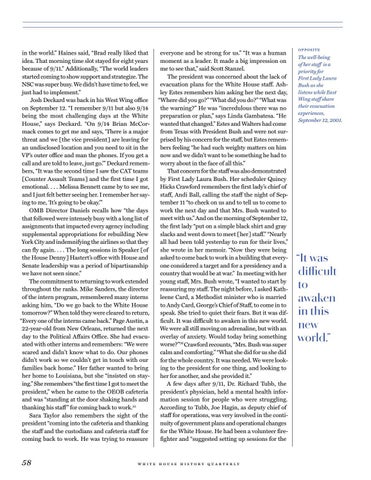
The well-being of her staff is a priority for First Lady Laura Bush as she listens while East Wing staff share their evacuation experiences, September 12, 2001.
“It was difficult to awaken in this new world.”