she helped to evacuate never returned to the office, however, and retired soon after the attacks. Ali Tulbah from Cabinet Affairs returned the next day and remembers the military presence and the sense of “total resolve that what we all would need to be doing was to support the president now.” “We had a big meeting about what all the agencies needed to do,” he recalls. “One of the presentations included a readout of the impact on the foreign exchange of the U.S. dollar and the value of the U.S. currency today. . . . It was the first time this hit us about how this was an attack on the American way of life, not just a physical attack.” Helen Mobley of the Scheduling Office returned to her office the next day and remembers “all the invitations that started coming into the White House for the president to attend the funerals of people who died on 9/11.” In addition to the written regrets that went out in a letter signed by Blakeman, Mobley “called every single family to convey the president’s regrets and express condolences.” Ruth Elliott and Mary Haines returned the
next day at the NSC. Elliott recounts, “I remember watching the president give his address that night and that brought me a lot of comfort and reassurance. If he can be there, I can be there. I’m going back and I’m helping to do whatever I can.” When she called the NSC Executive Secretariat late that night, the deputy who answered the phone said, “Come in early tomorrow morning and just be ready. Ready for anything.” Haines remembered, “I went back [to the NSC] the next day. We were so busy.” Among her many duties, Haines was responsible for scheduling proposals for world leader phone calls. “The whole world wanted to talk to President Bush,” she recalls, “and they were calling in and asking for an appointment.” It was a challenge to organize but, knowing the president was up very early every day, Haines thought there would be a better way to manage it. She met with Brad Blakeman, deputy assistant to the president for appointments and scheduling, and suggested that they block the schedule from 7:00 a.m. to 7:30 a.m. for world leader calls because it is a “humane time anywhere
GETTY IMAGES
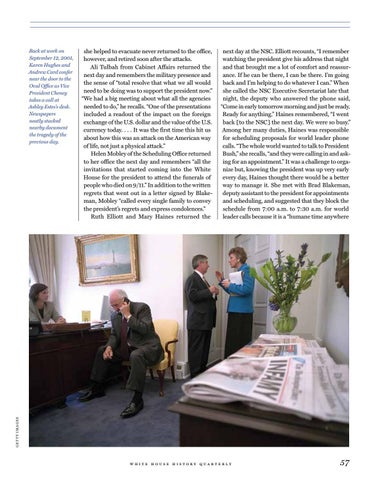
Back at work on September 12, 2001, Karen Hughes and Andrew Card confer near the door to the Oval Office as Vice President Cheney takes a call at Ashley Estes’s desk. Newspapers neatly stacked nearby document the tragedy of the previous day.
white house history quarterly
57