GETTY IMAGES
opposite and above
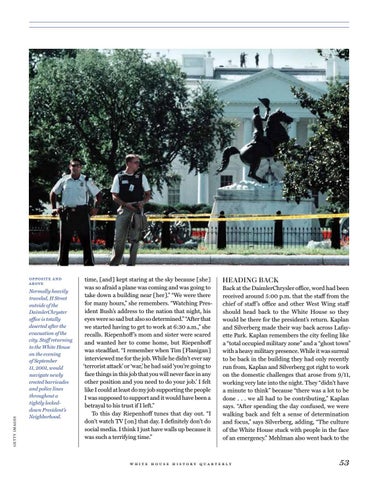
Normally heavily traveled, H Street outside of the DaimlerChryster office is totally deserted after the evacuation of the city. Staff returning to the White House on the evening of September 11, 2001, would navigate newly erected barricades and police lines throughout a tightly lockeddown President’s Neighborhood.
time, [and] kept staring at the sky because [she] was so afraid a plane was coming and was going to take down a building near [her].” “We were there for many hours,” she remembers. “Watching President Bush’s address to the nation that night, his eyes were so sad but also so determined.” “After that we started having to get to work at 6:30 a.m.,” she recalls. Riepenhoff ’s mom and sister were scared and wanted her to come home, but Riepenhoff was steadfast. “I remember when Tim [Flanigan] interviewed me for the job. While he didn’t ever say ‘terrorist attack’ or ‘war,’ he had said ‘you’re going to face things in this job that you will never face in any other position and you need to do your job.’ I felt like I could at least do my job supporting the people I was supposed to support and it would have been a betrayal to his trust if I left.” To this day Riepenhoff tunes that day out. “I don’t watch TV [on] that day. I definitely don’t do social media. I think I just have walls up because it was such a terrifying time.”
HEADING BACK Back at the DaimlerChrysler office, word had been received around 5:00 p.m. that the staff from the chief of staff ’s office and other West Wing staff should head back to the White House so they would be there for the president’s return. Kaplan and Silverberg made their way back across Lafayette Park. Kaplan remembers the city feeling like a “total occupied military zone” and a “ghost town” with a heavy military presence. While it was surreal to be back in the building they had only recently run from, Kaplan and Silverberg got right to work on the domestic challenges that arose from 9/11, working very late into the night. They “didn’t have a minute to think” because “there was a lot to be done . . . we all had to be contributing,” Kaplan says. “After spending the day confused, we were walking back and felt a sense of determination and focus,” says Silverberg, adding, “The culture of the White House stuck with people in the face of an emergency.” Mehlman also went back to the
white house history quarterly
53