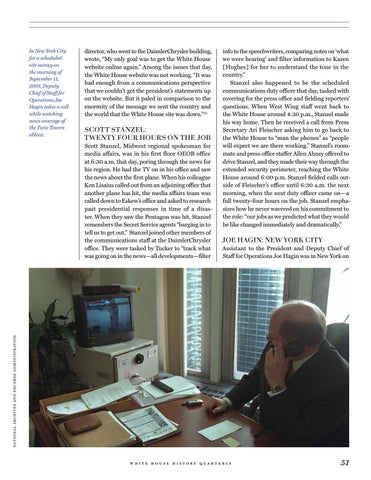
In New York City for a scheduled site survey on the morning of September 11, 2001, Deputy Chief of Staff for Operations Joe Hagin takes a call while watching news coverage of the Twin Towers ablaze.
director, who went to the DaimlerChrysler building, wrote, “My only goal was to get the White House website online again.” Among the issues that day, the White House website was not working. “It was bad enough from a communications perspective that we couldn’t get the president’s statements up on the website. But it paled in comparison to the enormity of the message we sent the country and the world that the White House site was down.”53
SCOTT STANZEL: TWENTY FOUR HOURS ON THE JOB
JOE HAGIN: NEW YORK CITY Assistant to the President and Deputy Chief of Staff for Operations Joe Hagin was in New York on
NATIONAL ARCHIV ES AND R EC OR DS ADMINISTRATION
Scott Stanzel, Midwest regional spokesman for media affairs, was in his first floor OEOB office at 6:30 a.m. that day, poring through the news for his region. He had the TV on in his office and saw the news about the first plane. When his colleague Ken Lisaius called out from an adjoining office that another plane has hit, the media affairs team was called down to Eskew’s office and asked to research past presidential responses in time of a disaster. When they saw the Pentagon was hit, Stanzel remembers the Secret Service agents “barging in to tell us to get out.” Stanzel joined other members of the communications staff at the DaimlerChrysler office. They were tasked by Tucker to “track what was going on in the news—all developments—filter
info to the speechwriters, comparing notes on ‘what we were hearing’ and filter information to Karen [Hughes] for her to understand the tone in the country.” Stanzel also happened to be the scheduled communications duty officer that day, tasked with covering for the press office and fielding reporters’ questions. When West Wing staff went back to the White House around 4:30 p.m., Stanzel made his way home. Then he received a call from Press Secretary Ari Fleischer asking him to go back to the White House to “man the phones” as “people will expect we are there working.” Stanzel’s roommate and press office staffer Allen Abney offered to drive Stanzel, and they made their way through the extended security perimeter, reaching the White House around 6:00 p.m. Stanzel fielded calls outside of Fleischer’s office until 6:30 a.m. the next morning, when the next duty officer came on—a full twenty-four hours on the job. Stanzel emphasizes how he never wavered on his commitment to the role: “our jobs as we predicted what they would be like changed immediately and dramatically.”
white house history quarterly
51