48
for most of the day.” He reports that they started making lists of what would need to happen for when the president returns. Silverberg “walked around the offices to stay informed on what was going on,” and Kaplan remembers “weighing in” with the speechwriters on the president’s remarks.
THE SPEECHWRITERS John McConnell and his fellow speechwriters, David Frum and Matthew Scully, had also arrived at DaimlerChrysler, and McConnell remembers being directed to an office where they could work together and get on the phone with the president’s chief speechwriter, Mike Gerson. Gerson had been driving to the White House on Interstate 395 and “saw a plane flying very low over the highway ahead, so low [he] could see the windows clearly.” What Gerson saw next was shocking: “The impact [at the Pentagon] was hidden by a bend in the highway, but I saw smoke begin to rise.”43 Gerson was stopped in traffic for more than hour and says he “began to sketch out some thoughts on a yellow pad for the inevitable speech.”44
white house history quarterly
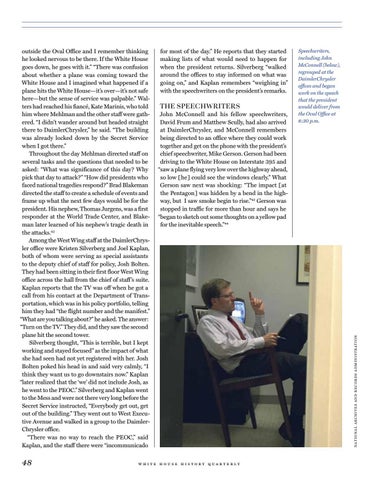
Speechwriters, including John McConnell (below), regrouped at the DaimlerChrysler offices and began work on the speech that the president would deliver from the Oval Office at 8:30 p.m.
NATIONAL ARCHIV ES AND R EC OR DS ADMINISTRATION
outside the Oval Office and I remember thinking he looked nervous to be there. If the White House goes down, he goes with it.” “There was confusion about whether a plane was coming toward the White House and I imagined what happened if a plane hits the White House—it’s over—it’s not safe here—but the sense of service was palpable.” Walters had reached his fiancé, Kate Marinis, who told him where Mehlman and the other staff were gathered. “I didn’t wander around but headed straight there to DaimlerChrysler,” he said. “The building was already locked down by the Secret Service when I got there.” Throughout the day Mehlman directed staff on several tasks and the questions that needed to be asked: “What was significance of this day? Why pick that day to attack?” “How did presidents who faced national tragedies respond?” Brad Blakeman directed the staff to create a schedule of events and frame up what the next few days would be for the president. His nephew, Thomas Jurgens, was a first responder at the World Trade Center, and Blakeman later learned of his nephew’s tragic death in the attacks.42 Among the West Wing staff at the DaimlerChrysler office were Kristen Silverberg and Joel Kaplan, both of whom were serving as special assistants to the deputy chief of staff for policy, Josh Bolten. They had been sitting in their first floor West Wing office across the hall from the chief of staff ’s suite. Kaplan reports that the TV was off when he got a call from his contact at the Department of Transportation, which was in his policy portfolio, telling him they had “the flight number and the manifest.” “What are you talking about?” he asked. The answer: “Turn on the TV.” They did, and they saw the second plane hit the second tower. Silverberg thought, “This is terrible, but I kept working and stayed focused” as the impact of what she had seen had not yet registered with her. Josh Bolten poked his head in and said very calmly, “I think they want us to go downstairs now.” Kaplan “later realized that the ‘we’ did not include Josh, as he went to the PEOC.” Silverberg and Kaplan went to the Mess and were not there very long before the Secret Service instructed, “Everybody get out, get out of the building.” They went out to West Executive Avenue and walked in a group to the DaimlerChrysler office. “There was no way to reach the PEOC,” said Kaplan, and the staff there were “incommunicado