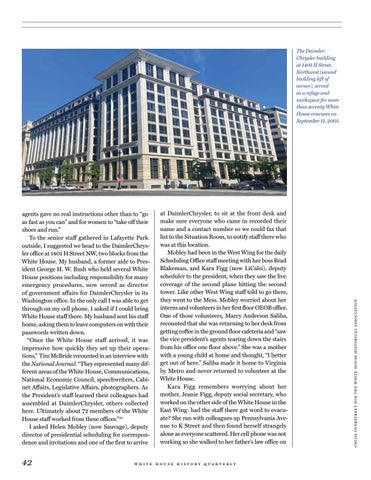
agents gave no real instructions other than to “go as fast as you can” and for women to “take off their shoes and run.” To the senior staff gathered in Lafayette Park outside, I suggested we head to the DaimlerChrysler office at 1401 H Street NW, two blocks from the White House. My husband, a former aide to President George H. W. Bush who held several White House positions including responsibility for many emergency procedures, now served as director of government affairs for DaimlerChrysler in its Washington office. In the only call I was able to get through on my cell phone, I asked if I could bring White House staff there. My husband sent his staff home, asking them to leave computers on with their passwords written down. “Once the White House staff arrived, it was impressive how quickly they set up their operations,” Tim McBride recounted in an interview with the National Journal. “They represented many different areas of the White House, Communications, National Economic Council, speechwriters, Cabinet Affairs, Legislative Affairs, photographers. As the President’s staff learned their colleagues had assembled at DaimlerChrysler, others collected here. Ultimately about 72 members of the White House staff worked from these offices.”35 I asked Helen Mobley (now Sauvage), deputy director of presidential scheduling for correspondence and invitations and one of the first to arrive
42
at DaimlerChrysler, to sit at the front desk and make sure everyone who came in recorded their name and a contact number so we could fax that list to the Situation Room, to notify staff there who was at this location. Mobley had been in the West Wing for the daily Scheduling Office staff meeting with her boss Brad Blakeman, and Kara Figg (now LiCalsi), deputy scheduler to the president, when they saw the live coverage of the second plane hitting the second tower. Like other West Wing staff told to go there, they went to the Mess. Mobley worried about her interns and volunteers in her first floor OEOB office. One of those volunteers, Marcy Anderson Saliba, recounted that she was returning to her desk from getting coffee in the ground floor cafeteria and “saw the vice president’s agents tearing down the stairs from his office one floor above.” She was a mother with a young child at home and thought, “I better get out of here.” Saliba made it home to Virginia by Metro and never returned to volunteer at the White House. Kara Figg remembers worrying about her mother, Jeanie Figg, deputy social secretary, who worked on the other side of the White House in the East Wing: had the staff there got word to evacuate? She ran with colleagues up Pennsylvania Avenue to K Street and then found herself strangely alone as everyone scattered. Her cell phone was not working so she walked to her father’s law office on
white house history quarterly
C H L O E O V E R S T R E E T F O R T H E W H I T E H O U S E H I S T O R I C A L A S S O C I AT I O N
The DaimlerChrysler building at 1401 H Street, Northwest (second building left of corner), served as a refuge and workspace for more than seventy White House evacuees on September 11, 2001.