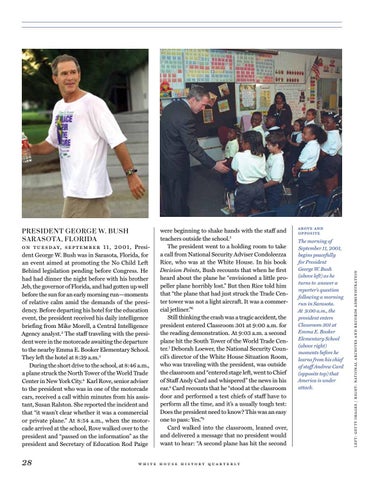
o n t u e s d ay, s e p t e m b e r 1 1 , 2 0 01 , President George W. Bush was in Sarasota, Florida, for an event aimed at promoting the No Child Left Behind legislation pending before Congress. He had had dinner the night before with his brother Jeb, the governor of Florida, and had gotten up well before the sun for an early morning run—moments of relative calm amid the demands of the presidency. Before departing his hotel for the education event, the president received his daily intelligence briefing from Mike Morell, a Central Intelligence Agency analyst.2 The staff traveling with the president were in the motorcade awaiting the departure to the nearby Emma E. Booker Elementary School. They left the hotel at 8:39 a.m.3 During the short drive to the school, at 8:46 a.m., a plane struck the North Tower of the World Trade Center in New York City.4 Karl Rove, senior adviser to the president who was in one of the motorcade cars, received a call within minutes from his assistant, Susan Ralston. She reported the incident and that “it wasn’t clear whether it was a commercial or private plane.” At 8:54 a.m., when the motorcade arrived at the school, Rove walked over to the president and “passed on the information” as the president and Secretary of Education Rod Paige
28
were beginning to shake hands with the staff and teachers outside the school.5 The president went to a holding room to take a call from National Security Adviser Condoleezza Rice, who was at the White House. In his book Decision Points, Bush recounts that when he first heard about the plane he “envisioned a little propeller plane horribly lost.” But then Rice told him that “the plane that had just struck the Trade Center tower was not a light aircraft. It was a commercial jetliner.”6 Still thinking the crash was a tragic accident, the president entered Classroom 301 at 9:00 a.m. for the reading demonstration. At 9:03 a.m. a second plane hit the South Tower of the World Trade Center.7 Deborah Loewer, the National Security Council’s director of the White House Situation Room, who was traveling with the president, was outside the classroom and “entered stage left, went to Chief of Staff Andy Card and whispered” the news in his ear.8 Card recounts that he “stood at the classroom door and performed a test chiefs of staff have to perform all the time, and it’s a usually tough test: Does the president need to know? This was an easy one to pass: Yes.”9 Card walked into the classroom, leaned over, and delivered a message that no president would want to hear: “A second plane has hit the second
white house history quarterly
above and opposite
The morning of September 11, 2001, begins peacefully for President George W. Bush (above left) as he turns to answer a reporter’s question following a morning run in Sarasota. At 9:00 a.m., the president enters Classroom 301 at Emma E. Booker Elementary School (above right) moments before he learns from his chief of staff Andrew Card (opposite top) that America is under attack.
L E F T : G E T T Y I M A G E S / R I G H T : N A T I O N A L A R C H I V E S A N D R E C O R D S A D M I N I S T R AT I O N
PRESIDENT GEORGE W. BUSH SARASOTA, FLORIDA