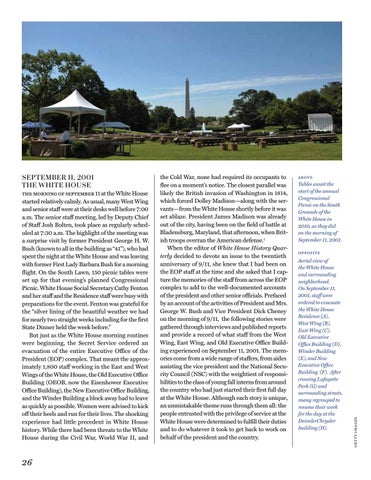
the morning of september 11 at the White House started relatively calmly. As usual, many West Wing and senior staff were at their desks well before 7:00 a.m. The senior staff meeting, led by Deputy Chief of Staff Josh Bolten, took place as regularly scheduled at 7:30 a.m. The highlight of the meeting was a surprise visit by former President George H. W. Bush (known to all in the building as “41”), who had spent the night at the White House and was leaving with former First Lady Barbara Bush for a morning flight. On the South Lawn, 150 picnic tables were set up for that evening’s planned Congressional Picnic. White House Social Secretary Cathy Fenton and her staff and the Residence staff were busy with preparations for the event. Fenton was grateful for the “silver lining of the beautiful weather we had for nearly two straight weeks including for the first State Dinner held the week before.” But just as the White House morning routines were beginning, the Secret Service ordered an evacuation of the entire Executive Office of the President (EOP) complex. That meant the approximately 1,800 staff working in the East and West Wings of the White House, the Old Executive Office Building (OEOB, now the Eisenhower Executive Office Building), the New Executive Office Building, and the Winder Building a block away had to leave as quickly as possible. Women were advised to kick off their heels and run for their lives. The shocking experience had little precedent in White House history. While there had been threats to the White House during the Civil War, World War II, and
26
the Cold War, none had required its occupants to flee on a moment’s notice. The closest parallel was likely the British invasion of Washington in 1814, which forced Dolley Madison—along with the servants—from the White House shortly before it was set ablaze. President James Madison was already out of the city, having been on the field of battle at Bladensburg, Maryland, that afternoon, when British troops overran the American defense.1 When the editor of White House History Quarterly decided to devote an issue to the twentieth anniversary of 9/11, she knew that I had been on the EOP staff at the time and she asked that I capture the memories of the staff from across the EOP complex to add to the well-documented accounts of the president and other senior officials. Prefaced by an account of the activities of President and Mrs. George W. Bush and Vice President Dick Cheney on the morning of 9/11, the following stories were gathered through interviews and published reports and provide a record of what staff from the West Wing, East Wing, and Old Executive Office Building experienced on September 11, 2001. The memories come from a wide range of staffers, from aides assisting the vice president and the National Security Council (NSC) with the weightiest of responsibilities to the class of young fall interns from around the country who had just started their first full day at the White House. Although each story is unique, an unmistakable theme runs through them all: the people entrusted with the privilege of service at the White House were determined to fulfill their duties and to do whatever it took to get back to work on behalf of the president and the country.
above
Tables await the start of the annual Congressional Picnic on the South Grounds of the White House in 2010, as they did on the morning of September 11, 2001. opposite
Aerial view of the White House and surrounding neighborhood. On September 11, 2001, staff were ordered to evacuate the White House Residence (A), West Wing (B), East Wing (C), Old Executive Office Building (D), Winder Building (E), and New Executive Office Building (F). After crossing Lafayette Park (G) and surrounding streets, many regrouped to resume their work for the day at the DaimlerChrysler building (H).
GETTY IMAGES
SEPTEMBER 11, 2001 THE WHITE HOUSE