10:00 A.M. ET A FORMIDABLE DECISION
14
Nor did Morell know that at that very hour, the agency had the hijacked planes’ manifests. He later wrote, “I had no way of knowing analysts at the CIA Headquarters had already tied AlQaida to the attacks. . . . Three passengers [on American 77] had known, and definite, links to Al-Qaida.”
white house history quarterly
above and opposite
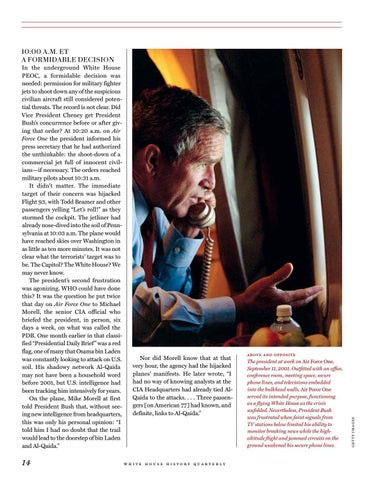
The president at work on Air Force One, September 11, 2001. Outfitted with an office, conference room, meeting space, secure phone lines, and televisions embedded into the bulkhead walls, Air Force One served its intended purpose, functioning as a flying White House as the crisis unfolded. Nevertheless, President Bush was frustrated when faint signals from TV stations below limited his ability to monitor breaking news while the highaltitude flight and jammed circuits on the ground weakened his secure phone lines.
GETTY IMAGES
In the underground White House PEOC, a formidable decision was needed: permission for military fighter jets to shoot down any of the suspicious civilian aircraft still considered potential threats. The record is not clear. Did Vice President Cheney get President Bush’s concurrence before or after giving that order? At 10:20 a.m. on Air Force One the president informed his press secretary that he had authorized the unthinkable: the shoot-down of a commercial jet full of innocent civilians—if necessary. The orders reached military pilots about 10:31 a.m. It didn’t matter. The immediate target of their concern was hijacked Flight 93, with Todd Beamer and other passengers yelling “Let’s roll!” as they stormed the cockpit. The jetliner had already nose-dived into the soil of Pennsylvania at 10:03 a.m. The plane would have reached skies over Washington in as little as ten more minutes. It was not clear what the terrorists’ target was to be. The Capitol? The White House? We may never know. The president’s second frustration was agonizing. WHO could have done this? It was the question he put twice that day on Air Force One to Michael Morell, the senior CIA official who briefed the president, in person, six days a week, on what was called the PDB. One month earlier in that classified “Presidential Daily Brief ” was a red flag, one of many that Osama bin Laden was constantly looking to attack on U.S. soil. His shadowy network Al-Qaida may not have been a household word before 2001, but U.S. intelligence had been tracking him intensively for years. On the plane, Mike Morell at first told President Bush that, without seeing new intelligence from headquarters, this was only his personal opinion: “I told him I had no doubt that the trail would lead to the doorstep of bin Laden and Al-Qaida.”