O P P O S I T E : G E T T Y I M A G E S / A B O V E : N A T I O N A L A R C H I V E S A N D R E C O R D S A D M I N I S T R AT I O N
above and opposite
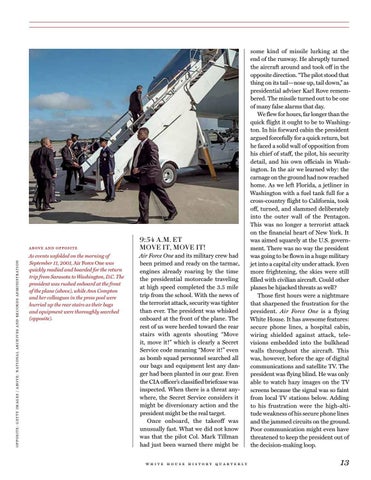
As events unfolded on the morning of September 11, 2001, Air Force One was quickly readied and boarded for the return trip from Sarasota to Washington, D.C. The president was rushed onboard at the front of the plane (above), while Ann Compton and her colleagues in the press pool were hurried up the rear stairs as their bags and equipment were thoroughly searched (opposite).
9:54 A.M. ET MOVE IT, MOVE IT!
Air Force One and its military crew had been primed and ready on the tarmac, engines already roaring by the time the presidential motorcade traveling at high speed completed the 3.5 mile trip from the school. With the news of the terrorist attack, security was tighter than ever. The president was whisked onboard at the front of the plane. The rest of us were herded toward the rear stairs with agents shouting “Move it, move it!” which is clearly a Secret Service code meaning “Move it!” even as bomb squad personnel searched all our bags and equipment lest any danger had been planted in our gear. Even the CIA officer’s classified briefcase was inspected. When there is a threat anywhere, the Secret Service considers it might be diversionary action and the president might be the real target. Once onboard, the takeoff was unusually fast. What we did not know was that the pilot Col. Mark Tillman had just been warned there might be white house history quarterly
some kind of missile lurking at the end of the runway. He abruptly turned the aircraft around and took off in the opposite direction. “The pilot stood that thing on its tail—nose up, tail down,” as presidential adviser Karl Rove remembered. The missile turned out to be one of many false alarms that day. We flew for hours, far longer than the quick flight it ought to be to Washington. In his forward cabin the president argued forcefully for a quick return, but he faced a solid wall of opposition from his chief of staff, the pilot, his security detail, and his own officials in Washington. In the air we learned why: the carnage on the ground had now reached home. As we left Florida, a jetliner in Washington with a fuel tank full for a cross-country flight to California, took off, turned, and slammed deliberately into the outer wall of the Pentagon. This was no longer a terrorist attack on the financial heart of New York. It was aimed squarely at the U.S. government. There was no way the president was going to be flown in a huge military jet into a capital city under attack. Even more frightening, the skies were still filled with civilian aircraft. Could other planes be hijacked threats as well? Those first hours were a nightmare that sharpened the frustration for the president. Air Force One is a flying White House. It has awesome features: secure phone lines, a hospital cabin, wiring shielded against attack, televisions embedded into the bulkhead walls throughout the aircraft. This was, however, before the age of digital communications and satellite TV. The president was flying blind. He was only able to watch hazy images on the TV screens because the signal was so faint from local TV stations below. Adding to his frustration were the high-altitude weakness of his secure phone lines and the jammed circuits on the ground. Poor communication might even have threatened to keep the president out of the decision-making loop.
13