T O P : A P I M A G E S / B O T T O M : N AT I O N A L A R C H I V E S A N D R E C O R D S A D M I N I S T R AT I O N
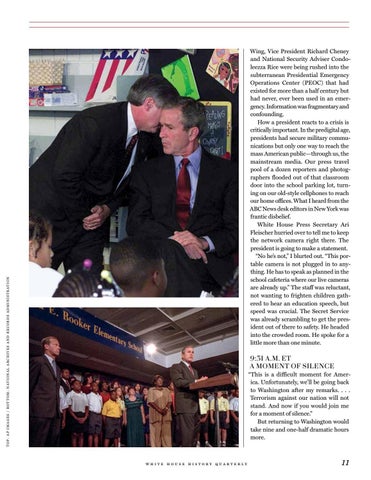
Wing, Vice President Richard Cheney and National Security Adviser Condoleezza Rice were being rushed into the subterranean Presidential Emergency Operations Center (PEOC) that had existed for more than a half century but had never, ever been used in an emergency. Information was fragmentary and confounding. How a president reacts to a crisis is critically important. In the predigital age, presidents had secure military communications but only one way to reach the mass American public—through us, the mainstream media. Our press travel pool of a dozen reporters and photographers flooded out of that classroom door into the school parking lot, turning on our old-style cellphones to reach our home offices. What I heard from the ABC News desk editors in New York was frantic disbelief. White House Press Secretary Ari Fleischer hurried over to tell me to keep the network camera right there. The president is going to make a statement. “No he’s not,” I blurted out. “This portable camera is not plugged in to anything. He has to speak as planned in the school cafeteria where our live cameras are already up.” The staff was reluctant, not wanting to frighten children gathered to hear an education speech, but speed was crucial. The Secret Service was already scrambling to get the president out of there to safety. He headed into the crowded room. He spoke for a little more than one minute.
9:31 A.M. ET A MOMENT OF SILENCE “This is a difficult moment for America. Unfortunately, we’ll be going back to Washington after my remarks. . . . Terrorism against our nation will not stand. And now if you would join me for a moment of silence.” But returning to Washington would take nine and one-half dramatic hours more.
white house history quarterly
11