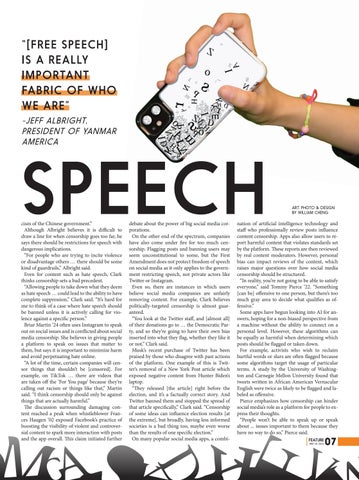
“ [FR E E SPE ECH] I S A R EALLY I M PORTANT FAB R IC OF WHO WE AR E” -J EFF ALBRIGHT, PRESI DENT OF YAN MAR AM ERICA
SPEECH cism of the Chinese government.” Although Albright believes it is difficult to draw a line for when censorship goes too far, he says there should be restrictions for speech with dangerous implications. “For people who are trying to incite violence or disadvantage others … there should be some kind of guardrails,” Albright said. Even for content such as hate speech, Clark thinks censorship sets a bad precedent. “Allowing people to take down what they deem as hate speech … could lead to the ability to have complete suppression,” Clark said. “It’s hard for me to think of a case where hate speech should be banned unless it is actively calling for violence against a specific person.” Briar Martin ’24 often uses Instagram to speak out on social issues and is conflicted about social media censorship. She believes in giving people a platform to speak on issues that matter to them, but says it is important to minimize harm and avoid perpetuating hate online. “A lot of the time, certain companies will censor things that shouldn’t be [censored]. For example, on TikTok … there are videos that are taken off the ‘For You page’ because they’re calling out racism or things like that,” Martin said. “I think censorship should only be against things that are actually harmful.” The discussion surrounding damaging content reached a peak when whistleblower Frances Haugen ’02 exposed Facebook’s practice of boosting the visibility of violent and controversial content to spark more interaction with posts and the app overall. This claim initiated further
debate about the power of big social media corporations. On the other end of the spectrum, companies have also come under fire for too much censorship. Flagging posts and banning users may seem unconstitutional to some, but the First Amendment does not protect freedom of speech on social media as it only applies to the government restricting speech, not private actors like Twitter or Instagram. Even so, there are instances in which users believe social media companies are unfairly removing content. For example, Clark believes politically-targeted censorship is almost guaranteed. “You look at the Twitter staff, and [almost all] of their donations go to … the Democratic Party, and so they’re going to have their own bias inserted into what they flag, whether they like it or not,” Clark said. Musk’s recent purchase of Twitter has been praised by those who disagree with past actions of the platform. One example of this is Twitter’s removal of a New York Post article which exposed negative content from Hunter Biden’s laptop. “They released [the article] right before the election, and it’s a factually correct story. And Twitter banned them and stopped the spread of that article specifically,” Clark said. “Censorship of some ideas can influence election results [at the extreme], but broadly, having less informed societies is a bad thing too, maybe even worse than the results of one specific election.” On many popular social media apps, a combi-
ART, PHOTO & DESIGN BY WILLIAM CHENG
nation of artificial intelligence technology and staff who professionally review posts influence content censorship. Apps also allow users to report harmful content that violates standards set by the platform. These reports are then reviewed by real content moderators. However, personal bias can impact reviews of the content, which raises major questions over how social media censorship should be structured. “In reality, you’re not going to be able to satisfy everyone,” said Tommy Pierce ’22. “Something [can be] offensive to one person, but there’s too much gray area to decide what qualifies as offensive.” Some apps have begun looking into AI for answers, hoping for a non-biased perspective from a machine without the ability to connect on a personal level. However, these algorithms can be equally as harmful when determining which posts should be flagged or taken down. For example, activists who wish to reclaim hurtful words or slurs are often flagged because some algorithms target the usage of particular terms. A study by the University of Washington and Carnegie Mellon University found that tweets written in African American Vernacular English were twice as likely to be flagged and labeled as offensive. Pierce emphasizes how censorship can hinder social media’s role as a platform for people to express their thoughts. “People won’t be able to speak up or speak about ... issues important to them because they have no way to do so,” Pierce said. FEATURE MAY 24, 2022
07