SECTIONING S T I G M A BY HEIDI DU & SOOMIN KOH PHOTOS BY SARA BARONCINI DESIGN BY XIAOYI ZHU
H
BREAKING DOWN DIVISIONS NCAA: National Collegiate Athletic Association DIVISION I: 32% of NCAA schools (350) Multiyear, cost-of-attendance athletics scholarships available DIVISION II: 28% of NCAA schools (310) Partial athletic scholarships DIVISION III: 40% of NCAA schools (438) - largest division in NCAA No athletic scholarships
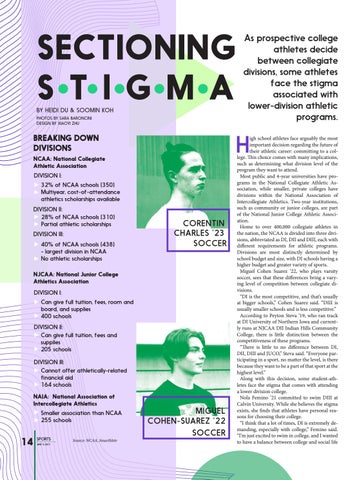
CORENTIN CHARLES ‘23 SOCCER
NJCAA: National Junior College Athletics Association DIVISION I: Can give full tuition, fees, room and board, and supplies 400 schools DIVISION II: Can give full tuition, fees and supplies 205 schools DIVISION III: Cannot offer athletically-related financial aid 164 schools NAIA: National Association of Intercollegiate Athletics Smaller association than NCAA 255 schools
14
SPORTS JUNE 3, 2021
Source: NCAA, Smarthlete
As prospective college athletes decide between collegiate divisions, some athletes face the stigma associated with lower-division athletic programs.
MIGUEL COHEN-SUAREZ ‘22 SOCCER
igh school athletes face arguably the most important decision regarding the future of their athletic career: committing to a college. This choice comes with many implications, such as determining what division level of the program they want to attend. Most public and 4-year universities have programs in the National Collegiate Athletic Association, while smaller, private colleges have divisions within the National Association of Intercollegiate Athletics. Two-year institutions, such as community or junior colleges, are part of the National Junior College Athletic Association. Home to over 400,000 collegiate athletes in the nation, the NCAA is divided into three divisions, abbreviated as DI, DII and DIII, each with different requirements for athletic programs. Divisions are most distinctly determined by school budget and size, with DI schools having a higher budget and greater variety of sports. Miguel Cohen Suarez ’22, who plays varsity soccer, sees that these differences bring a varying level of competition between collegiate divisions. “DI is the most competitive, and that’s usually at bigger schools,” Cohen Suarez said. “DIII is usually smaller schools and is less competitive.” According to Peyton Steva ’19, who ran track at DI University of Northern Iowa and currently runs at NJCAA DII Indian Hills Community College, there is little distinction between the competitiveness of these programs. “There is little to no difference between DI, DII, DIII and JUCO,” Steva said. “Everyone participating in a sport, no matter the level, is there because they want to be a part of that sport at the highest level.” Along with this decision, some student-athletes face the stigma that comes with attending a lower division college. Nola Femino ’21 committed to swim DIII at Calvin University. While she believes the stigma exists, she finds that athletes have personal reasons for choosing their college. “I think that a lot of times, DI is extremely demanding, especially with college,” Femino said. “I’m just excited to swim in college, and I wanted to have a balance between college and social life