CORD Abstracts Issue 2016 Qualitative Study of Medical Educators’ 3 APerspectives on Resident Remediation
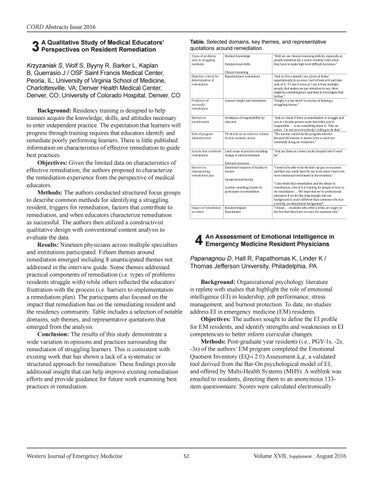
Table. Selected domains, key themes, and representative quotations around remediation.
Krzyzaniak S, Wolf S, Byyny R, Barker L, Kaplan B, Guerrasio J / OSF Saint Francis Medical Center, Peoria, IL; University of Virginia School of Medicine, Charlottesville, VA; Denver Health Medical Center, Denver, CO; University of Colorado Hospital, Denver, CO Background: Residency training is designed to help trainees acquire the knowledge, skills, and attitudes necessary to enter independent practice. The expectation that learners will progress through training requires that educators identify and remediate poorly performing learners. There is little published information on characteristics of effective remediation to guide best practices. Objectives: Given the limited data on characteristics of effective remediation, the authors proposed to characterize the remediation experience from the perspective of medical educators. Methods: The authors conducted structured focus groups to describe common methods for identifying a struggling resident, triggers for remediation, factors that contribute to remediation, and when educators characterize remediation as successful. The authors then utilized a constructivist qualitative design with conventional content analysis to evaluate the data. Results: Nineteen physicians across multiple specialties and institutions participated. Fifteen themes around remediation emerged including 8 unanticipated themes not addressed in the interview guide. Some themes addressed practical components of remediation (i.e. types of problems residents struggle with) while others reflected the educators’ frustration with the process (i.e. barriers to implementation a remediation plan). The participants also focused on the impact that remediation has on the remediating resident and the residency community. Table includes a selection of notable domains, sub themes, and representative quotations that emerged from the analysis. Conclusion: The results of this study demonstrate a wide variation in opinions and practices surrounding the remediation of struggling learners. This is consistent with existing work that has shown a lack of a systematic or structured approach for remediation. These findings provide additional insight that can help improve existing remediation efforts and provide guidance for future work examining best practices in remediation.
Western Journal of Emergency Medicine
Assessment of Emotional Intelligence in 4 An Emergency Medicine Resident Physicians Papanagnou D, Hall R, Papathomas K, Linder K / Thomas Jefferson University, Philadelphia, PA Background: Organizational psychology literature is replete with studies that highlight the role of emotional intelligence (EI) in leadership; job performance; stress management; and burnout protection. To date, no studies address EI in emergency medicine (EM) residents. Objectives: The authors sought to define the EI profile for EM residents, and identify strengths and weaknesses in EI competencies to better inform curricular changes. Methods: Post-graduate year residents (i.e., PGY-1s, -2s, -3s) of the authors’ EM program completed the Emotional Quotient Inventory (EQ-i 2.0) Assessment â„¢, a validated tool derived from the Bar-On psychological model of EI, and offered by Multi-Health Systems (MHS). A weblink was emailed to residents, directing them to an anonymous 133item questionnaire. Scores were calculated electronically
S2
Volume XVII, Supplement : August 2016