Merritt et al.
•
A Novel Curriculum to Optimize EM Residents’ Exposure to Pediatrics
EM residents to reinforce the skills critical to lifelong self-directed learning in EM. Assessed Need 5: While an understanding of inpatient pediatrics remains important to the educational development of EM residents, adult learners learn better via participating in a social and professional setting that more closely mirrors their future practice. This concept of situated learning9 was vital to the development of the PEMFU curriculum. PEMFU would need to allow EM residents to develop skill and expertise in pediatric care in the context of the practice of emergency medicine.
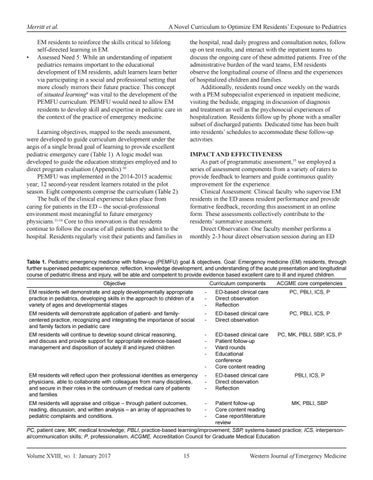
Learning objectives, mapped to the needs assessment, were developed to guide curriculum development under the aegis of a single broad goal of learning to provide excellent pediatric emergency care (Table 1). A logic model was developed to guide the education strategies employed and to direct program evaluation (Appendix).10 PEMFU was implemented in the 2014-2015 academic year; 12 second-year resident learners rotated in the pilot season. Eight components comprise the curriculum (Table 2). The bulk of the clinical experience takes place from caring for patients in the ED – the social-professional environment most meaningful to future emergency physicians.11-14 Core to this innovation is that residents continue to follow the course of all patients they admit to the hospital. Residents regularly visit their patients and families in
the hospital, read daily progress and consultation notes, follow up on test results, and interact with the inpatient teams to discuss the ongoing care of these admitted patients. Free of the administrative burden of the ward teams, EM residents observe the longitudinal course of illness and the experiences of hospitalized children and families. Additionally, residents round once weekly on the wards with a PEM subspecialist experienced in inpatient medicine, visiting the bedside, engaging in discussion of diagnosis and treatment as well as the psychosocial experiences of hospitalization. Residents follow up by phone with a smaller subset of discharged patients. Dedicated time has been built into residents’ schedules to accommodate these follow-up activities. IMPACT AND EFFECTIVENESS As part of programmatic assessment,15 we employed a series of assessment components from a variety of raters to provide feedback to learners and guide continuous quality improvement for the experience. Clinical Assessment: Clinical faculty who supervise EM residents in the ED assess resident performance and provide formative feedback, recording this assessment in an online form. These assessments collectively contribute to the residents’ summative assessment. Direct Observation: One faculty member performs a monthly 2-3 hour direct observation session during an ED
Table 1. Pediatric emergency medicine with follow-up (PEMFU) goal & objectives. Goal: Emergency medicine (EM) residents, through further supervised pediatric experience, reflection, knowledge development, and understanding of the acute presentation and longitudinal course of pediatric illness and injury, will be able and competent to provide evidence based excellent care to ill and injured children. Objective
Curriculum components
ACGME core competencies
EM residents will demonstrate and apply developmentally appropriate practice in pediatrics, developing skills in the approach to children of a variety of ages and developmental stages
- - -
ED-based clinical care Direct observation Reflection
PC, PBLI, ICS, P
EM residents will demonstrate application of patient- and familycentered practice, recognizing and integrating the importance of social and family factors in pediatric care
- -
ED-based clinical care Direct observation
PC, PBLI, ICS, P
EM residents will continue to develop sound clinical reasoning, and discuss and provide support for appropriate evidence-based management and disposition of acutely ill and injured children
- - - -
PC, MK, PBLI, SBP, ICS, P
-
ED-based clinical care Patient follow-up Ward rounds Educational conference Core content reading
EM residents will reflect upon their professional identities as emergency physicians, able to collaborate with colleagues from many disciplines, and secure in their roles in the continuum of medical care of patients and families
- - -
ED-based clinical care Direct observation Reflection
PBLI, ICS, P
EM residents will appraise and critique – through patient outcomes, reading, discussion, and written analysis – an array of approaches to pediatric complaints and conditions.
- - -
Patient follow-up MK, PBLI, SBP Core content reading Case report/literature review PC, patient care; MK, medical knowledge; PBLI, practice-based learning/improvement; SBP, systems-based practice; ICS, interpersonal/communication skills; P, professionalism, ACGME, Accreditation Council for Graduate Medical Education
Volume XVIII, no. 1: January 2017
15
Western Journal of Emergency Medicine