Western Journal of Emergency Medicine
Volume 22, Number 6, November 2021
West
Open Access at WestJEM.com
ISSN 1936-900X
Western Journal of Emergency Medicine: Integrating Emergency Care with Population Health Indexed in MEDLINE
VOLUME 22, NUMBER 6, November 2021
Emergency Department Operations 1211 Retrospective Analysis of Adult Patients Presenting to the Acute Care Setting Requesting Prescriptions L Shepherd, M Mucciaccio, K VanAarsen 1218
A Scoping Review of Emergency Department Discharge Risk Stratification TA Jaffe, D Wang, B Loveless, D Lai, M Loesche, B White, AS Raja, S He
1227 “Friction by Definition”: Conflict at Patient Handover Between Emergency and Internal Medicine Physicians at an Academic Medical Center Z Kanjee, CP Beltran, C Smith, J Lewis, MM Hall, CD Tibbles, AM Sullivan Endemic Infections 1240 Sources of Distress and Coping Strategies Among Emergency Physicians During COVID-19 E Dehon, KS Zachrison, J Peltzer-Jones, RR Tabatabai, E Clair, MA Puskarich, A Ondeyka, K Dixon- Gordon, LA Walter, EH Situ-Lacasse, ML Fix
1253
A Dispatch Screening Tool to Identify Patients at High Risk for COVID-19 in the Prehospital Setting A Albright, K Gross, M Hunter, L O’Connor
1257
Clinical Characteristics Associated with Return Visits to the Emergency Department after COVID-19 Diagnosis I Husain, J O’Neill, R Mudge, A Bishop, K Alexander Soltany, J Heinen, C Countryman, D Casey, D Cline
1262 Viral Coinfection is Associated with Improved Outcomes in Emergency Department Patients with SARS-CoV-2 EM Goldberg, K Hasegawa, A Lawrence, JA Kline, CA Camargo
PAGES 1211-1379
Behavioral Health 1270 Healthcare Use After Buprenorphine Prescription in a Community Emergency Department: A Cohort Study T Le, P Cordial, M Sankoe, C Purnode, A Parekh, T Baker, B Hiestand, WF Peacock, J Neuenschwander Contents continued on page iii
A Peer-Reviewed, International Professional Journal
ACOEP stands with all emergency physicians and providers on the front line. We thank you for your tireless work and effort.
www.acoep.org
Western Journal of Emergency Medicine: Integrating Emergency Care with Population Health
Indexed in MEDLINE, PubMed, and Clarivate Web of Science, Science Citation Index Expanded Andrew W. Phillips, MD, Associate Editor DHR Health-Edinburg, Texas
Mark I. Langdorf, MD, MHPE, Editor-in-Chief University of California, Irvine School of MedicineIrvine, California Edward Michelson, MD, Associate Editor Shahram Lotfipour, MD, MPH, Managing Editor Texas Tech University- El Paso, Texas University of California, Irvine School of MedicineDan Mayer, MD, Associate Editor Irvine, California Retired from Albany Medical College- Niskayuna, New York Michael Gottlieb, MD, Associate Editor Wendy Macias-Konstantopoulos, MD, MPH, Associate Editor Rush Medical Center-Chicago, Illinois Massachusetts General Hospital- Boston, Massachusetts Niels K. Rathlev, MD, Associate Editor Gayle Galletta, MD, Associate Editor Tufts University School of Medicine-Boston, Massachusetts University of Massachusetts Medical SchoolRick A. McPheeters, DO, Associate Editor Worcester, Massachusetts Kern Medical- Bakersfield, California Yanina Purim-Shem-Tov, MD, MS, Associate Editor Gavin Budhram, MD, Associate Editor Rush University Medical Center-Chicago, Illinois Tufts University- Medford, Massachusetts
Resident Editors
Shadi Lahham, MD, MS, Deputy Editor University of California, Irvine School of Medicine- Irvine, California Susan R. Wilcox, MD, Associate Editor Massachusetts General Hospital- Boston, Massachusetts Elizabeth Burner, MD, MPH, Associate Editor University of Southern California- Los Angeles, California Patrick Joseph Maher, MD, MS, Associate Editor Ichan School of Medicine at Mount Sinai- New York, New York Donna Mendez, MD, EdD, Associate Editor University of Texas-Houston/McGovern Medical School- Houston Texas Danya Khoujah, MBBS, Associate Editor University of Maryland School of Medicine- Baltimore, Maryland
Erik Melnychuk, MD Geisinger Health
Mandy J. Hill, DrPH, MPH UT Health McGovern Medical School
John J. Campo, MD Harbor-University of California, Los Angeles Medical Center
Quincy Tran, MD, PhD University of Maryland
K. Tom Xu, MD, PhD Texas Tech University Health Sciences Center
Tehreem Rehman, MD Advocate Christ Medical Center
Disaster Medicine
Christopher Kang, MD Madigan Army Medical Center
Infectious Disease
Gentry Wilkerson, MD University of Maryland
Ioannis Koutroulis, MD, MBA, PhD Drexel University College of Medicine
Education
Kevin Lunney, MD, MHS, PhD University of Maryland School of Medicine
AAEM/RSA
ACOEP
Justina Truong, DO Kingman Regional Medical Center
Section Editors Behavioral Emergencies
Danya Khoujah, MBBS University of Maryland School of Medicine
Erin Dehon, PhD University of Mississippi Medical Center
Jeffrey Druck, MD University of Colorado
Leslie Zun, MD, MBA Chicago Medical School
John Burkhardt, MD, MA University of Michigan Medical School
Marc L. Martel, MD Hennepin County Medical Center
Michael Epter, DO Maricopa Medical Center
Cardiac Care
ED Administration, Quality, Safety
Fred A. Severyn, MD University of Colorado School of Medicine
Gary Johnson, MD Upstate Medical University
Sam S. Torbati, MD Cedars-Sinai Medical Center
Brian J. Yun, MD, MBA, MPH Harvard Medical School
Clinical Practice
Laura Walker, MD Mayo Clinic
Casey Clements, MD, PhD Mayo Clinic Patrick Meloy, MD Emory University Nicholas Pettit, DO, PhD Indiana University
Injury Prevention
Mark Faul, PhD, MA Centers for Disease Control and Prevention Wirachin Hoonpongsimanont, MD, MSBATS Eisenhower Medical Center
International Medicine
William Fernandez, MD, MPH University of Texas Health-San Antonio Daniel Joseph, MD Yale University
David Thompson, MD University of California, San Francisco
Julian Mapp University of Texas, San Antonio
Kenneth S. Whitlow, DO Kaweah Delta Medical Center
Shira A. Schlesinger, MD, MPH Harbor-UCLA Medical Center
Critical Care
Geriatrics
Gabriel Wardi, MD University of California, San Diego
Stephen Meldon, MD Cleveland Clinic
Joseph Shiber, MD University of Florida-College of Medicine
Luna Ragsdale, MD, MPH Duke University
Matt Prekker MD, MPH Hennepin County Medical Center
Health Equity
Pediatric Emergency Medicine Paul Walsh, MD, MSc University of California, Davis
Muhammad Waseem, MD Lincoln Medical & Mental Health Center Deena Berkowitz, MD, MPH Children’s National Hospital Cristina M. Zeretzke-Bien, MD University of Florida
Public Health
Jeremy Hess, MD, MPH University of Washington Medical Center Jacob Manteuffel, MD Henry Ford Hospital John Ashurst, DO Lehigh Valley Health Network
Taylor Burkholder, MD, MPH Keck School of Medicine of USC
Trevor Mills, MD, MPH Northern California VA Health Care
Christopher Greene, MD, MPH University of Alabama
Erik S. Anderson, MD Alameda Health System-Highland Hospital
Chris Mills, MD, MPH Santa Clara Valley Medical Center
Technology in Emergency Medicine Nikhil Goyal, MD Henry Ford Hospital
Phillips Perera, MD Stanford University Medical Center
Melanie S. Heniff, MD, JD Indiana University School of Medicine Greg P. Moore, MD, JD Madigan Army Medical Center
Stormy M. Morales Monks, PhD, MPH Texas Tech Health Science University
James A. Meltzer, MD, MS Albert Einstein College of Medicine
Musculoskeletal
Juan F. Acosta DO, MS Pacific Northwest University
Pierre Borczuk, MD Massachusetts General Hospital/Havard Medical School Brandon Wills, DO, MS Virginia Commonwealth University
Shu B. Chan MD, MS Resurrection Medical Center
Soheil Saadat, MD, MPH, PhD University of California, Irvine
Trauma
Toxicology
Statistics and Methodology
Emily C. Manchanda, MD, MPH Boston University School of Medicine
William D. Whetstone, MD University of California, San Francisco
Tony Zitek, MD Kendall Regional Medical Center
Legal Medicine
Cameron Gettel, MD Yale School of Medicine
Antonio Siniscalchi, MD Annunziata Hospital Rick Lucarelli, MD Medical City Dallas Hospital
Heather A.. Brown, MD, MPH Prisma Health Richland
Shada Rouhani, MD Brigham and Women’s Hospital
Emergency Medical Services Joshua B. Gaither, MD University of Arizona, Tuscon
David Page, MD University of Alabama
Stephen Liang, MD, MPHS Washington University School of Medicine
León D. Sánchez, MD, MPH Beth Israel Deaconess Medical Center
Eric Snoey, MD Alameda County Medical Center
Christopher “Kit” Tainter, MD University of California, San Diego
Robert Derlet, MD Founding Editor, California Journal of Emergency Medicine University of California, Davis
David C. Lee, MD Northshore University Hospital
Michael C. Kurz, MD University of Alabama at Birmingham
Cortlyn W. Brown, MD Carolinas Medical Center
Elissa Schechter-Perkins, MD, MPH Boston University School of Medicine
Neurosciences
Jeffrey R. Suchard, MD University of California, Irvine
Ultrasound
J. Matthew Fields, MD Thomas Jefferson University Shane Summers, MD Brooke Army Medical Center Robert R. Ehrman Wayne State University Ryan C. Gibbons, MD Temple Health
Official Journal of the California Chapter of the American College of Emergency Physicians, the America College of Osteopathic Emergency Physicians, and the California Chapter of the American Academy of Emergency Medicine
Available in MEDLINE, PubMed, PubMed Central, CINAHL, SCOPUS, Google Scholar, eScholarship, Melvyl, DOAJ, EBSCO, EMBASE, Medscape, HINARI, and MDLinx Emergency Med. Members of OASPA. Editorial and Publishing Office: WestJEM/Depatment of Emergency Medicine, UC Irvine Health, 333 City Blvd, West, Rt 128-01, Orange, CA 92868, USA Office: 1-714-456-6389; Email: Editor@westjem.org
Volume 22, no. 6: November 2021
i
Western Journal of Emergency Medicine
Western Journal of Emergency Medicine: Integrating Emergency Care with Population Health
Indexed in MEDLINE, PubMed, and Clarivate Web of Science, Science Citation Index Expanded
Editorial Board Amin A. Kazzi, MD, MAAEM The American University of Beirut, Beirut, Lebanon Anwar Al-Awadhi, MD Mubarak Al-Kabeer Hospital, Jabriya, Kuwait Arif A. Cevik, MD United Arab Emirates University College of Medicine and Health Sciences, Al Ain, United Arab Emirates
Edward Michelson, MD Texas Tech University
Kenneth V. Iserson, MD, MBA University of Arizona, Tucson
Robert M. Rodriguez, MD University of California, San Francisco
Edward Panacek, MD, MPH University of South Alabama
Khrongwong Musikatavorn, MD King Chulalongkorn Memorial Hospital, Chulalongkorn University, Bangkok, Thailand
Robert Suter, DO, MHA UT Southwestern Medical Center
Francesco Della Corte, MD Azienda Ospedaliera Universitaria “Maggiore della Carità,” Novara, Italy Francis Counselman, MD Eastern Virginia Medical School
Abhinandan A.Desai, MD University of Bombay Grant Medical College, Bombay, India
Gayle Galleta, MD Sørlandet Sykehus HF, Akershus Universitetssykehus, Lorenskog, Norway
Bandr Mzahim, MD King Fahad Medical City, Riyadh, Saudi Arabia
Hjalti Björnsson, MD Icelandic Society of Emergency Medicine
Brent King, MD, MMM University of Texas, Houston
Jacob (Kobi) Peleg, PhD, MPH Tel-Aviv University, Tel-Aviv, Israel
Christopher E. San Miguel, MD Ohio State University Wexner Medical Center
Jaqueline Le, MD Desert Regional Medical Center
Daniel J. Dire, MD University of Texas Health Sciences Center San Antonio
Jeffrey Love, MD The George Washington University School of Medicine and Health Sciences
David F.M. Brown, MD Massachusetts General Hospital/ Harvard Medical School
Jonathan Olshaker, MD Boston University
Douglas Ander, MD Emory University
Leslie Zun, MD, MBA Chicago Medical School Linda S. Murphy, MLIS University of California, Irvine School of Medicine Librarian
Niels K. Rathlev, MD Tufts University School of Medicine Pablo Aguilera Fuenzalida, MD Pontificia Universidad Catolica de Chile, Región Metropolitana, Chile Peter A. Bell, DO, MBA Baptist Health Sciences University Peter Sokolove, MD University of California, San Francisco Rachel A. Lindor, MD, JD Mayo Clinic
Advisory Board
Amal Khalil, MBA UC Irvine Health School of Medicine Brian Potts, MD, MBA California Chapter Division of AAEM Alta Bates Summit Medical Center Elena Lopez-Gusman, JD California ACEP American College of Emergency Physicians Lori Winston, MD California ACEP American College of Emergency Physicians Kaweah Delta Healthcare District
Rosidah Ibrahim, MD Hospital Serdang, Selangor, Malaysia Samuel J. Stratton, MD, MPH Orange County, CA, EMS Agency Scott Rudkin, MD, MBA University of California, Irvine
Nadeem Qureshi, MD St. Louis University, USA Emirates Society of Emergency Medicine, United Arab Emirates
Katsuhiro Kanemaru, MD University of Miyazaki Hospital, Miyazaki, Japan
Robert W. Derlet, MD University of California, Davis
Scott Zeller, MD University of California, Riverside Steven H. Lim, MD Changi General Hospital, Simei, Singapore Terry Mulligan, DO, MPH, FIFEM ACEP Ambassador to the Netherlands Society of Emergency Physicians Vijay Gautam, MBBS University of London, London, England Wirachin Hoonpongsimanont, MD, MSBATS Siriraj Hospital, Mahidol University, Bangkok, Thailand
Editorial Staff
Robert Suter, DO, MHA American College of Osteopathic Emergency Physicians UT Southwestern Medical Center Shahram Lotfipour, MD, MPH UC Irvine Health School of Medicine Trevor Mills, MD, MPH California Chapter Division of AAEM Northern California VA Health Care
Isabelle Nepomuceno, BS Executive Editorial Director
Cassandra Saucedo, BS Executive Publishing Director
Shreya Gupta, BS WestJEM Editorial Director Associate Marketing Director
Nathan Do, BS WestJEM Publishing Director
Sohrab Kharabaf, BS CPC-EM Editorial Director Associate Marketing Director
Jorge Fernandez, MD UC San Diego Health School of Medicine
Stephanie Burmeister, MLIS WestJEM Staff Liaison
Trina Nguyen, BS CPC-EM Publishing Director Paul Abdo, BS WestJEM Associate Publishing Director Associate Marketing Director
June Casey, BA Copy Editor
Mark I. Langdorf, MD, MHPE UC Irvine Health School of Medicine Peter A. Bell, DO, MBA American College of Osteopathic Emergency Physicians
Official Journal of the California Chapter of the American College of Emergency Physicians, the America College of Osteopathic Emergency Physicians, and the California Chapter of the American Academy of Emergency Medicine
Available in MEDLINE, PubMed, PubMed Central, Europe PubMed Central, PubMed Central Canada, CINAHL, SCOPUS, Google Scholar, eScholarship, Melvyl, DOAJ, EBSCO, EMBASE, Medscape, HINARI, and MDLinx Emergency Med. Members of OASPA. Editorial and Publishing Office: WestJEM/Depatment of Emergency Medicine, UC Irvine Health, 333 City Blvd, West, Rt 128-01, Orange, CA 92866, USA Office: 1-714-456-6389; Email: Editor@westjem.org
Western Journal of Emergency Medicine
ii
Volume 22, no. 6: November 2021
Western Journal of Emergency Medicine: Integrating Emergency Care with Population Health
Indexed in MEDLINE, PubMed, and Clarivate Web of Science, Science Citation Index Expanded
JOURNAL FOCUS Emergency medicine is a specialty which closely reflects societal challenges and consequences of public policy decisions. The emergency department specifically deals with social injustice, health and economic disparities, violence, substance abuse, and disaster preparedness and response. This journal focuses on how emergency care affects the health of the community and population, and conversely, how these societal challenges affect the composition of the patient population who seek care in the emergency department. The development of better systems to provide emergency care, including technology solutions, is critical to enhancing population health.
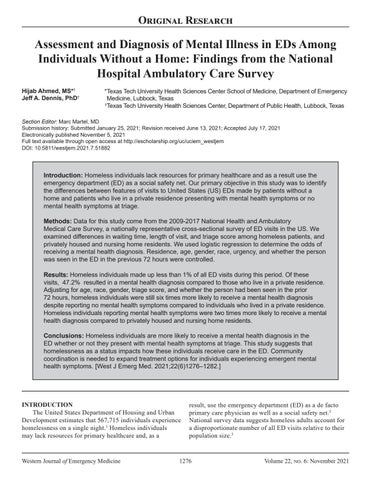
Table of Contents 1276
Assessment and Diagnosis of Mental Illness in EDs Among Individuals Without a Home: Findings From the National Hospital Ambulatory Care Survey H Ahmed, JA Dennis
Healthcare Utilization 1283 The Association of Demographic, Socioeconomic, and Geographic Factors with Potentially Preventable Emergency Department Utilization LC Carlson, KS Zachrison, BJ Yun, G Ciccolo, BA White, CA Camargo Jr, ME Samuels-Kalow 1291
Role of Creatine Kinase in the Troponin Era: A Systematic Review D Beamish, T Maniuk, M Mukarram, V Thiruganasambandamoorthy
Pediatrics 1295 Food Insecurity in a Pediatric Emergency Department and the Feasibility of Universal Screening JV Gonzalez, EA Hartford, J Moore, JC Brown 1301
Surgical Treatment of Pediatric Dog-bite Wounds: A 5-year Retrospective Review CJ Lee, E Tiourin, S Schuljak, J Phan, TW Heyming, J Schomberg, E Wallace, YS Guner, RM Vyas
Emergency Medical Services 1311 Centralized Ambulance Destination Determination: A Retrospective Data Analysis to Determine Impact on EMS System Distribution, Surge Events, and Diversion Status G Bains, A Breyre, R Seymour, JC Montoy, J Brown, M Mercer, C Colwell 1317
Estimated Cost Effectiveness of Influenza Vaccination for Emergency Medical Services Professionals MW Hubble, GK Renkiewicz
Clinical Practice 1326 A Retrospective Cohort Study of Acute Epiglottitis in Adults P Felton, L Lutfy-Clayton, LG Smith, P Visintainer, NK Rathlev 1335
Accuracy of Landmark-guided Glenohumeral Joint Injections as Assessed by Ultrasound in Anterior Shoulder Dislocations T Omer, M Perez, K Berona, CN Lam, D Sajed, C Brandon, J Falkenstein, T Kang, T Mailhot
Education 1341 A Positive Depression Screen is Associated with Emergency Medicine Resident Burnout and Is not Affected by the Implementation of a Wellness Curriculum K Williamson, PM Lank, A Olson, N Cheema, E Lovell
Policies for peer review, author instructions, conflicts of interest and human and animal subjects protections can be found online at www.westjem.com. Volume 22, no. 6: November 2021
iii
Western Journal of Emergency Medicine
Western Journal of Emergency Medicine: Integrating Emergency Care with Population Health
Indexed in MEDLINE, PubMed, and Clarivate Web of Science, Science Citation Index Expanded
Table of Contents continued Health Outcomes 1347 United States Emergency Department Use of Medications with Pharmacogenetic Recommendations AT Limkakeng, P Manandhar, A Erkanli, SA Eucker, A Root, D Voora Health Equity 1355 Gender-based Barriers in the Advancement of Women Leaders in Emergency Medicine: A Multi- institutional Qualitative Study EM Graham, M Ferrel, KM Wells, DJ Egan, CZ MacVane, MA Gisondi, BD Burns, TE Madsen, ML Fix Societal Impact on Emergency Care 1360 A Scoping Review of Current Social Emergency Medicine Research R Shah, AD Porta, S Leung, M Samuels-Kalow, EM Schoenfeld, LD Richardson, MP Lin Emergency Medicine Workforce 1369 Survey-based Evaluation of Resident and Attending Financial Literacy RM Huebinger, R Hussain, K Tupchong, S Walia, H Fairbrother, J Rogg International Medicine 1374 Epidemiology of Patients with Head Injury at a Tertiary Hospital in Rwanda N Karim, L Mumporeze, VJP Nsengimana, A Gray, A Kearney, AR Aluisio, Z Mutabazi, J Baird, CM Clancy, D Lubetkin, J Eric Uwitonze, J D’Arc Nyinawankusi, M Nkeshimana, J Claude Byiringiro, AC Levine Erratum 1379 The Effects of Implementing a “Waterfall” Emergency Physician Attending Schedule L Spiegelman, M Jen, D Matonis, R Gibney, S Saadat, S Sakaria, A Wray, S Toohey
Volume 22, no. 6: November 2021
iv
Western Journal of Emergency Medicine
Western Journal of Emergency Medicine: Integrating Emergency Care with Population Health
Indexed in MEDLINE, PubMed, and Clarivate Web of Science, Science Citation Index Expanded This open access publication would not be possible without the generous and continual financial support of our society sponsors, department and chapter subscribers.
Professional Society Sponsors American College of Osteopathic Emergency Physicians California ACEP
California Chapter Division of AmericanAcademy of Emergency Medicine
Academic Department of Emergency Medicine Subscriber Albany Medical College Albany, NY
INTEGRIS Health Oklahoma City, OK
Oregon Health and Science University Portland, OR
University of Illinois at Chicago Chicago, IL
Allegheny Health Network Pittsburgh, PA
Kaiser Permenante Medical Center San Diego, CA
Penn State Milton S. Hershey Medical Center Hershey, PA
University of Iowa Iowa City, IA
American University of Beirut Beirut, Lebanon
Kaweah Delta Health Care District Visalia, CA
University of Louisville Louisville, KY
AMITA Health Resurrection Medical Center Chicago, IL
Kennedy University Hospitals Turnersville, NJ
Regions Hospital Emergency Medicine Residency Program St. Paul, MN
Arrowhead Regional Medical Center Colton, CA
Kent Emergency Medical Residency Program Warwick, RI
Baystate Medical Center Springfield, MA
Kern Medical Bakersfield, CA
Bellevue Hospital Center New York, NY
Lakeland HealthCare St. Joseph, MI
Beth Israel Deaconess Medical Center Boston, MA
Lehigh Valley Hospital and Health Network Allentown, PA
Boston Medical Center Boston, MA
Loma Linda University Medical Center Loma Linda, CA
Brigham and Women’s Hospital Boston, MA
Louisiana State University Health Sciences Center New Orleans, LA
Brown University Providence, RI
Madigan Army Medical Center Tacoma, WA
Carl R. Darnall Army Medical Center Fort Hood, TX
Maimonides Medical Center Brooklyn, NY
Conemaugh Memorial Medical Center Johnstown, PA
Maine Medical Center Portland, ME
Crozer-Chester Medical Center Upland, PA
Massachusetts General Hospital Boston, MA
Desert Regional Medical Center Palm Springs, CA
Mayo Clinic College of Medicine Rochester, MN
Eastern Virginia Medical School Norfolk, VA
Mercy Health - Hackley Campus Muskegon, MI
Einstein Healthcare Network Philadelphia, PA
Merit Health Wesley Hattiesburg, MS
Eisenhower Medical Center Rancho Mirage, CA
Midwestern University Glendale, AZ
Emory University Atlanta, GA
New York University Langone Health New York, NY
Geisinger Medical Center Danville, PA
North Shore University Hospital Manhasset, NY
Grand State Medical Center Allendale, MI
Northwestern Medical Group Chicago, IL
Hennepin County Medical Center Minneapolis, MN
Ohio State University Medical Center Columbus, OH
Henry Ford Medical Center Detroit, MI
Ohio Valley Medical Center Wheeling, WV
State Chapter Subscriber
Arizona Chapter Division of the American Academy of Emergency Medicine California Chapter Division of the American Academy of Emergency Medicine Florida Chapter Division of the American Academy of Emergency Medicine
Rhode Island Hospital Providence, RI
University of Massachusetts Amherst, MA
Robert Wood Johnson University Hospital New Brunswick, NJ
University of Michigan Ann Arbor, MI
Rush University Medical Center Chicago, IL
University of Missouri, Columbia Columbia, MO
St. Luke’s University Health Network Bethlehem, PA
University of Nebraska Medical Center Omaha, NE
Spectrum Health Lakeland St. Joseph, MI
University of Nevada, Las Vegas Las Vegas, NV
Stanford Stanford, CA
University of Southern Alabama Mobile, AL
SUNY Upstate Medical University Syracuse, NY
University of Southern California Los Angeles, CA
Temple University Philadelphia, PA Texas Tech University Health Sciences Center El Paso, TX University of Alabama, Birmingham Birmingham, AL University of California, Davis Medical Center Sacramento, CA University of California, Irvine Orange, CA University of California, Los Angeles Los Angeles, CA University of California, San Diego La Jolla, CA University of California, San Francisco San Francisco, CA UCSF Fresno Center Fresno, CA University of Chicago Chicago, IL University of Florida Gainesville, FL University of Florida, Jacksonville Jacksonville, FL
Great Lakes Chapter Division of the AmericanAcademyofEmergencyMedicine Tennessee Chapter Division of the AmericanAcademyofEmergencyMedicine
University of Maryland Baltimore, MD
University of Tennessee, Memphis Memphis, TN University of Texas, Houston Houston, TX University of Washington Seattle, WA University of Wisconsin Hospitals and Clinics Madison, WI Virginia Commonwealth University Medical Center Richmond, VA Wake Forest University Winston-Salem, NC Wake Technical Community College Raleigh, NC Wayne State Detroit, MI Wright State University Dayton, OH York Hosptial York, ME
Uniformed Services Chapter Division of the American Academy of Emergency Medicine Virginia Chapter Division of the American Academy of Emergency Medicine
International Society Partners Emergency Medicine Association of Turkey Lebanese Academy of Emergency Medicine Mediterranean Academy of Emergency Medicine
Norwegian Society for Emergency Medicine Sociedad Argentina de Emergencias
Sociedad Chileno Medicina Urgencia Thai Association for Emergency Medicine
To become a WestJEM departmental sponsor, waive article processing fee, receive print and copies for all faculty and electronic for faculty/residents, and free CME and faculty/fellow position advertisement space, please go to http://westjem.com/subscribe or contact: Stephanie Burmeister WestJEM Staff Liaison Phone: 1-800-884-2236 Email: sales@westjem.org
Western Journal of Emergency Medicine
vii
Volume 22, no. 6: November 2021
Call for Section Editors • • • • •
Behavioral Emergencies • Trauma Care Emergency Cardiac Care • Ultrasound International Medicine Pediatric Emergencies Public Health
Send CV and letter of interest to Editor@WestJEM.org
NEW: HEALTH EQUITY SECTION Call for Reviewers and Manuscripts Send CV and letter of interest to Editor@WestJEM.org
Call for Reviewers!
Please send your CV and letter of interest to editor@westjem.org
Color Atlas of
EMERGENCY TRAUMA THIRD EDITION Edited by Demetrios Demetriades, Carl R. Chudnofsky, Elizabeth R. Benjamin
This full-color atlas presents over 1200 images from one of the largest and busiest trauma centers in North America.
cambridge.org/CAoET
Congratulations to WestJEM’ s and CPC-EM’s Decision Editor and Section Editors of the Year! WestJEM’s Section Editor
WestJEM’s Decision Editor
CPC-EM’s Section Editor
John Ashurst, DO Kingman Regional Health Network
Andrew Phillips, MD, MEd Washington Hospital, Fremont, CA
Austin Smith, MD Vanderbilt University
Congratulations to WestJEM’ s and CPC-EM’s Top Reviewers of the Year! Top 2 Reviewers Aaron Dora-Laskey, MD Ryan Misek, DO Michigan State University Midwestern University Top 20 Reviewers https://bit.ly/3woXV5C
Congratulations to ACEP President Elect, Dr. Christopher Kang! Christopher Kang, MD Madigan Army Medical Center WestJEM Disaster Medicine Section Editor
Congratulations to ACEP’s 2021 “25 Influencers Under 45 to Watch”! WestJEM Editorial Board Members Chadd Kraus, DO, PhD Michael Gottlieb, MD Abra Fant, MD, MS
Original Research
Retrospective Analysis of Adult Patients Presenting to the Acute Care Setting Requesting Prescriptions Lisa Shepherd, MD, MHPE* Meagan Mucciaccio, MD* Kristine VanAarsen, MSc†
*Schulich School of Medicine and Dentistry, Western University, Department of Medicine, Division of Emergency Medicine, London, Ontario † London Health Sciences Centre, Department of Emergency Medicine, London, Ontario
Section Editor: David Thompson, MD Submission history: Submitted February 5, 2021; Revision received June 25, 2021; Accepted June 24, 2021 Electronically published September 24, 2021 Full text available through open access at http://escholarship.org/uc/uciem_westjem DOI: 10.5811/westjem.2021.6.52060
Introduction: Patient visits to the emergency department (ED) or urgent care centre (UCC) for the sole purpose of requesting prescriptions are challenging for the patient, the physician, and the department. The primary objective of this study was to determine the characteristics of these patients, the nature of their requests, and the response to these requests. Our secondary objective was to determine the proportion of these medication requests that had street value. Methods: This was a retrospective, electronic chart review of all adult patients requesting a prescription from a two-site ED and/or an UCC in a medium-sized Canadian city between April 1, 2014–June 30, 2017. Recorded outcomes included patient demographic data and access to a family doctor, medication requested, whether or not a prescription was given, and ED length of stay. Medication street value was determined using a local police service listing. Results: A total of 2,265 prescriptions were requested by 1,495 patients. The patient median [interquartile range] age was 43 [32-54] years. A family doctor was documented by 55.4% (939/1,694) of patients. The two most commonly requested categories of medications were opioid analgesics 21.2% (481/2,265) and benzodiazepine anxiolytics 11.7% (266/2,265). Of patients requesting medication, 50.5% (755/1,495) requested medications without street value including some with potential to cause serious adverse health effects if discontinued. The requested prescription was received by 19.9% (298/1,495) of patients; 15.3% (173/1,134) returned for further prescription requests. The 90th percentile length of stay was 3.2 and 5.6 hours at the UCC and ED, respectively. Conclusion: Patients who presented to the ED or UCC sought medications with and without street value in almost equal measure. A more robust understanding of these patients and their requests illustrates why a ‘one-size-fits-all’ response to these requests is inappropriate and signals some fault lines within our local healthcare system. [West J Emerg Med. 2021;22(6)1211–1217.]
INTRODUCTION Although they make up a small proportion of the overall visits,1 patients presenting to the emergency department (ED) or urgent care centre (UCC) for the sole purpose of requesting a prescription pose many problems: 1) for the patient, who may experience a long wait and possibly a mismatch between what they want and what the acute care service is willing to provide; 2) for the physician, who is in the business of Volume 22, no. 6: November 2021
episodic not comprehensive care and is diligently trying to avoid the misdirection of medications; and 3) for the department, which strives to conserve time and specialized resources that arguably should be directed toward patients with more urgent needs. Lacking in the literature is a closer examination of these patients who request prescriptions (PRP), which is needed to explore how they can be better supported to manage their health conditions.
1211
Western Journal of Emergency Medicine
Retrospective Analysis of Adult Patients Requesting Prescriptions Research to date has offered some insight into two groups of vulnerable ED patients with a close relation to PRPs. The first group consists of heavy utilization patients who make multiple visits to the ED.2 These patients have been shown to have not only unmet access needs but also significant economic and social forces driving their choices.3 The second group is patients who exhibit behaviors associated with prescription drug misuse.4,5 This is a complicated group that also intersects patients with pain and addiction issues.6 Requesting a prescription refill is one behavior that has been identified with prescription drug misuse.4,5 Patients in the ED who request prescriptions, make multiple visits, and exhibit prescription misuse behaviors are all subgroups of the very heterogeneous ‘non-urgent’ patient group for which a more robust literature exists.7-9 However, use of the ED for any type of non-urgent care remains controversial. Whether or not these visits contribute to ED crowding, increased costs, and deprivation of continuity of care remains unresolved.10-12 Obtaining prescriptions and navigating medical appointments are part of self-management of health conditions, which does not occur in isolation but rather in the context of patients’ physical, social, and family environment.13 Yet, before being able to consider a larger social determinants of health approach to these patients, we need to first understand PRPs and their requests. With this understanding, we may be better positioned to serve these patients and to support physician decision-making surrounding their care. The primary objective of this study was to determine the characteristics of patients who present to the ED or UCC requesting a prescription, the nature of these requests, and the resulting action taken by the attending physician. The secondary objective was to determine the proportion of medication requests that have potential street value and the subsequent responses to these requests. METHODS Study design, setting and population We conducted a retrospective analysis of electronic health record data14 between April 1, 2014–June 30, 2017. To capture the maximum number of patients, we used both the presenting complaint and discharge diagnosis of ‘issue of repeat prescription.’ The presenting complaint code was searched using the Canadian Emergency Department Diagnosis Shortlist,15 and the discharge diagnosis code was searched using the International Classification of Disease, 10th Revision (ICD-10). We combined these lists to create our database. Any patient 18 years of age or older who attended either the ED or the UCC was included in the study. The study was approved by the Health Science Research and Ethics Board at Western University (no. 109752) and adhered to the STROBE (Strengthening the Reporting of Observational Studies in Epidemiology) guidelines for reporting observational studies.16 London Health Sciences Centre is a multisite, 1168bed, quaternary hospital that serves an urban population of Western Journal of Emergency Medicine
Shepherd et al. Population Health Research Capsule What do we already know about this issue? Patients presenting to acute care settings for a prescription request are an underexplored group that present challenges for themselves and emergency care providers. What was the research question? What are the characteristics of patients who present for prescription refill, their requests, and the response to these requests? What was the major finding of the study? Patients sought medications with and without street value in almost equal measure and received prescriptions 20% of the time. How does this improve population health? A ‘one-size-fits-all’ strategy, such as diversion, is insufficiently nuanced to be adequate. These patients expose fault lines within local healthcare systems.
approximately 400,000. The two adult EDs at this hospital have a combined annual census of 165,000. The UCC is located between the two EDs geographically and sees 48,000 patients annually; it is open 365 days per year but closes in the evenings. A common pool of emergency physicians staffs all departments. At the time of this study, both EDs and the UCC site used a hybrid health record model, with physician notes recorded on a paper chart and all other data recorded electronically. Only the electronic data was accessed and collected for this study. Outcomes Trained research personnel recorded baseline patient demographics including age, gender, and whether or not a family doctor was identified. Repeat visits were checked amongst all three sites. We logged the day of week of presentation, wait time, length of stay (LOS), and whether the patient left prior to being assessed by a physician. In keeping with provincial reporting metrics, ED wait times and LOS were calculated as 90th percentiles, which represent the maximum length of time in which 9 of 10 patients waited to be seen by a physician or completed their ED visit. We excluded patients who left prior to being assessed by a physician from wait time and LOS calculations. Specific medications requested were identified in the nursing triage note. Prescriptions issued at discharge
1212
Volume 22, no. 6: November 2021
Shepherd et al.
Retrospective Analysis of Adult Patients Requesting Prescriptions
were part of the electronic record and were documented and later categorized. The separation of analgesics into opioid and non-opioid was accomplished using the triage nurse record of patient request. If the patient requested a medication by name, then their request was coded as opioid or non-opioid analgesic, respectively. If the patient requested ‘pain meds,’ then these were recorded as non-opioid analgesic to avoid overestimating opioids. Whether or not a medication had value on the street was determined using the London Police Service 2017 Street Drug Index, a report maintained and updated by the local police department, which lists medications and their expected monetary value when sold on the street.
Table 1. Patient and response variables. All patients requesting prescriptions N(%)
Patients requesting at least one medication with street value N (%)
Age in years
n = 1,696
n = 740
18 - 30
390 (23.0)
163 (22.0)
31-50
741 (43.7)
355 (48.0)
> 50
565 (33.3)
222 (30.0)
Variable
Gender
n = 1,696
n = 740
Male
982 (57.9)
444 (60.0)
Female
708 (41.7)
292 (39.5)
Other
6 ( 0.4)
4 ( 0.5)
n = 1694
n = 738
Yes
939 (55.4)
417 (56.5)
No
755 (44.6)
321 (43.5)
Data Analysis Data were tested for normality and analyzed using descriptive statistics; they were summarized as mean (+-SD), median [IQR], or percentage as appropriate. Differences between groups were tested using MannWhitney U analysis. We defined P <0.05 as the level of statistical difference.
Family doctor documented*
RESULTS A total of 1,923 cases met the inclusion criteria over the 39-month study period. We removed cases (n = 227) if it was unclear whether a prescription had been requested, or a nonmedication prescription (ie, splint) or injection (ie, tetanus immunization) was requested (Figure 1).
Left without being seen
Site Visited
n = 1696
n = 740
655 (38.6)
293 (39.6)
1,041 (61.4)
447 (60.4)
n = 655 158 (24.1)
n = 293 58 (19.8)
n = 1,041 85 ( 8.1)
n = 447 39 ( 8.7)
n=173
n=124
ED only
38 (22.0)
27 (21.8)
UCC only
80 (46.2)
57 (46.0)
ED UCC ED UCC Patients with repeat visits by site
Both sites 55 (31.8) 40 (32.2) * Two patients with family Doctor field not completed in record. ED, emergency department; UCC, urgent care centre.
Figure 1. Patient health record selection process for the study.
The Patient The patient median age was 43 years [32-54] with 57.9% being male (Table 1). A family doctor was documented by 55.4% of patients. The EDs were chosen as the site of care by 38.6% (655/1,696) of patients while the UCC was chosen by 61.4% (1041/1,696). No significant difference was found for presentation by day of week. Some patients chose to leave before being seen by a physician, 24.1% (158/655) from Volume 22, no. 6: November 2021
the EDs and 8.1% (85/1,041) from the UCC. Of patients requesting a repeat prescription in the study time frame, 15.3% (173/1,134) had greater than one visit to either the EDs or UCC (range 1-26). Repeat presentations to the EDs only were seen in 22% (38/173), to the UCC only in 46.2% (80/173), and between the two facilities 31.8% (55/173). We compared demographic data for patients requesting at least one medication with street value to data for all patients. The Request An additional 201 patients were removed from the remaining analyses due to an unknown medication being requested. A total of 2,265 prescriptions were requested by 1,495 patients with the median number of medications requested during the visit being 1 [1-2] with a range of 1-8. The most commonly requested medications were opioid analgesics, benzodiazepine anxiolytics, non1213
Western Journal of Emergency Medicine
Retrospective Analysis of Adult Patients Requesting Prescriptions opioid analgesics, antidepressants, antipsychotics, and amphetamines (Table 2), with 39.1% (886/2,265) having street value. Of the patients presenting, 49.5% (740/1,495) made a request for at least one prescription of street value.
Shepherd et al.
Patients presenting with more than one visit had a similar profile of medication requests with 45.8% (362/791) having street value. Of these 173 multivisit patients, 57.8% (100/173) requested at least one prescription of street value.
Table 2. Prescriptions requested and written by category for all patients and patients with repeat visit. Prescriptions requested by all patients N (%)
Prescriptions written by physician N (%)
Prescriptions requested by patients with repeat visits N (%)
Analgesics-opioid**
481 (21.24)
61 ( 9.92)
154 (19.47)
Anxiolytics-benzodiazepine**
266 (11.74)
65 (10.57)
130 (16.43)
Analgesics-non opioid
248 (10.95)
50 ( 8.13)
91 (11.50)
Antidepressants
232 (10.24)
90 (14.63)
68 ( 8.60)
Antipsychotics
201 ( 8.87)
53 ( 8.62)
82 (10.37)
Central nervous system agents-amphetamines**
126 ( 5.56)
32 ( 5.20)
68 ( 8.60)
Cardiovascular agents
Prescription category
124 ( 5.47)
73 (11.87)
22 ( 2.78)
Respiratory tract agents
91 ( 4.02)
45 ( 7.32)
22 ( 2.78)
Antibacterials
70 ( 3.09)
2 ( 0.33)
12 ( 1.52)
Gastrointestinal agents
63 ( 2.78)
26 ( 4.23)
26 ( 3.29)
Anticonvulsants
56 ( 2.47)
17 ( 2.76)
20 ( 2.53)
Blood glucose regulators
46 ( 2.03)
19 ( 3.09)
10 ( 1.26)
Blood modifiers-anticoagulants
45 ( 1.99)
9 ( 1.46)
14 ( 1.77)
Sleep disorder agents
35 ( 1.55)
16 ( 2.60)
16 ( 2.02)
Immunological agents
30 ( 1.32)
4 ( 0.65)
8 ( 1.01)
Antivirals
22 ( 0.97)
6 ( 0.98)
0 ( 0.00)
Bipolar agents
18 ( 0.79)
7 ( 1.14)
9 ( 1.14)
Hormonal agents
16 ( 0.71)
6 ( 0.98)
5 ( 0.63)
Contraceptives
14 ( 0.62)
4 ( 0.65)
3 ( 0.38)
Skeletal muscle relaxants
14 ( 0.62)
7 ( 1.14)
6 ( 0.76)
Cannabinoids**
13 ( 0.57)
4 ( 0.65)
10 ( 1.26)
Antiparkinson agents
12 ( 0.53)
2 ( 0.33)
7 ( 0.88)
Antiemetics
8 ( 0.35)
1 ( 0.16)
3 ( 0.38)
Electrolytes/minerals/metals/ vitamins
8 ( 0.35)
1 ( 0.16)
4 ( 0.51)
Anti-addiction/substance abuse treatment agents
5 ( 0.22)
2 ( 0.33)
0 ( 0.00)
Ophthalmic agents
4 ( 0.18)
5 ( 0.81)
0 ( 0.00)
Genitourinary agents
4 ( 0.18)
2 ( 0.33)
0 ( 0.00)
Antimigraine agents
3 ( 0.13)
0 ( 0.00)
1 ( 0.13)
Sexual disorder agents
3 ( 0.13)
3 ( 0.49)
0 ( 0.00)
Antifungals
2 ( 0.09)
0 ( 0.00)
0 ( 0.00)
Antiparasitics
2 ( 0.09)
0 ( 0.00)
0 ( 0.00)
Metabolic bone disease agents
2 ( 0.09)
0 ( 0.00)
0 ( 0.00)
1 ( 0.04)
3 ( 0.49)
0 ( 0.00)
n = 2,265
n = 615
n = 791
Dermatological agents
Note: The requested prescriptions were categorized using the United States Pharmacopeial Convention Drug Classification System17 with the exception of cannabinoids, which was added to reflect the Canadian content. **Indicates categories with street value.
Western Journal of Emergency Medicine
1214
Volume 22, no. 6: November 2021
Retrospective Analysis of Adult Patients Requesting Prescriptions
Shepherd et al. The Response The 90th percentile wait time for seeing a physician was 2.8 and 4.9 hours at UCC and EDs, respectively. The 90th percentile LOS was 3.2 and 5.6 hours at UCC and Eds, respectively. The median time spent receiving care (ED LOS minus wait time) was 17 minutes [10-30] for patients who received their requested prescriptions and 20 minutes [11-36] for those who did not (P = 0.012). A total of 298 of 1,495 of patients (19.9%) received their requested prescription, with 7.9% (118/1,495) of patients receiving at least one prescription of street value. For all prescriptions requested, 27.2% (615/2,265) were written and 7.2% (162/2,265) had potential street value (shown in Table 2).
DISCUSSION To our knowledge, this is the first study to explore patients who present to acute care departments requesting prescriptions. Our study showed that approximately half of the patients presenting to an acute care department for the sole purpose of requesting a prescription asked for at least one medication that had value on the street. The other half requested a diverse array of medications without street value. Appreciation of this duality is important as we work to understand what drives these patients to seek care in acute care settings and subsequently strategize best care for these patients. This work adds to the body of literature by characterizing a previously poorly understood patient group; it adds to our local public health information by shining a light on some fault lines in the provision of healthcare within the community. The median age of patients in our study (43 years) aligns well with previous studies examining non-urgent visits to the ED.8,9,18 Patients experienced long waits to be seen by a physician at both the UCC (2.8 hours) and the ED (4.9 hours), which was longer than the 90th percentile for a wait time of 2.7 hours published for low-acuity patients who were discharged from Ontario EDs.19 Longer wait times at the EDs may also have contributed to the high rate of leaving prior to assessment (24.1%), which is strikingly higher than the provincial average of 3%,19 despite excluding all these patients from wait-time calculations. Although some consider the ED and UCC as an option of last resort,3,20 more than half of our patients reported having family doctors which suggests otherwise. Choice of the ED or UCC for refilling their prescriptions may instead be an ‘affirmative choice’21,22 driven by a failure to receive adequate help at other sources of care.9 Factors that lead patients to seek other sources of care outside of their family doctor include difficulty with accessing complicated appointment systems, English as an additional language, difficulty navigating the telephone, health literacy, and convenience.18,22,23 Our city has not been considered underserviced by family physicians. Of all participants, 15.3% had greater than one visit during the study timeframe with one patient presenting 26 times. It has been suggested Volume 22, no. 6: November 2021
that social and economic forces have strong impact on patients who are frequent utilizers of acute care resources for non-urgent problems.3 Emergency physicians practicing in this community have reason to be wary about misdirected prescriptions with 49.5% of patients requesting at least one prescription with street value. Relative to population size, it has been estimated that London has one of the largest populations of injection drug users in Canada.24 Access to patient drug profiles has become more readily available to emergency physicians, but it is unclear how this affects their prescribing patterns.5,25 It is important to pay equal attention to the other 50.5% of patients who requested medications without street value. Stopping many of these medications such as insulin, anticoagulants, and anticonvulsants could result in significant adverse health consequences. Psychiatric medications such as antidepressants, antipsychotics, and bipolar agents make up 20% of the total prescriptions requested in a city that has more psychiatrists per capita than the average in Ontario26 and no shortage of family physicians. With such a large number of requests for medications lacking street value, a shift in the accepted boundaries of emergency physician practice may need to be considered. The ‘just say no’ policy of the ED in this study directs physicians away from writing prescriptions for the purpose of continuing care but does allow for exceptions at the discretion of the physician. Intended to protect against medication misdirection, this policy may not be an appropriate response to requests for some of these medications. Our results confirmed that it takes significantly longer to say ‘no’ than to say ‘yes’ to a prescription request but physicians did say ‘no’ to almost 80% of patients. This time pressure adds yet another tension for physicians and their departments in the era of scorecards that track and reward throughput.6 The 90th percentile for LOS was 3.2 hours at the UCC and 5.6 hours at the EDs compared with a provincial report of 3.9 hours for low-acuity patients who were discharged.19 Prolonged LOS is of concern to healthcare administrators because of the perceived negative association with cost and crowding.27 Some argue that the true cost of serving non-urgent patients is lower than widely believed because of high, fixed operating costs and relatively low marginal costs.28,29 Our PRPs spent little time actively consuming department resources (medians of 17 and 20 minutes for UCC and ED), which is consistent with the literature.11 If these patients neither increase costs to the healthcare system nor contribute significantly to crowding, then the issue of their diversion to another place of care loses much of its relevance.8,11 Diversion also presumes that there is a primary care system ready and waiting to care for these patients, many of whom are vulnerable with challenging medical and social needs.7 A city with an adequate number of family physicians per capita does not necessarily translate into availability of care for all patients.
1215
Western Journal of Emergency Medicine
Retrospective Analysis of Adult Patients Requesting Prescriptions Many diversion plans and implementation solutions are based on the assumptions of healthcare planners, whose lives of privilege differ extraordinarily from the lives of those they serve.7 Another questionable assumption is that patients are rational consumers and will make ‘better’ and predictable choices if proper education, incentives, and disincentives are provided.3 Ultimately within the current Canadian healthcare system, the decision of where to receive care remains with the patient. Diversion may not be the only answer. Creative, holistic solutions have been described for ED patients that may be adaptable and beneficial for all involved in the care of PRPs. Malone proposed the implementation of an ED ‘slow track’ for high utilization patients where clinicians work alongside social workers to identify those at risk and address their social, economic, and structural barriers.3 This concept may slow throughput for a particular visit but may be beneficial for both the patient and the department in the future. A more recent study from Utah demonstrated the ability to systematically screen and refer for ED patients’ unmet social needs by using existing resources and to link screening results, service referral details, and health service data.13 Our study marks a first step in understanding the ‘who’, ‘what’ and ‘where’ of PRPs. Future research is needed to explore the important questions of ‘why’ raised by this study. Why did the patient choose an acute care setting v. their family doctor or another choice? Why did some patients continue to pay return visits: Were they successful in obtaining what they wanted or were they not? Why did physicians decide to offer or decline to write a prescription? Qualitative studies using more interpretative methodologies could delve deeper into these questions, adding important perspective needed to create care strategies. LIMITATIONS There are several limitations to our study. Our reporting of requests for opioid analgesia was falsely low. When a request for ‘pain meds’ was recorded in the triage note with no more specific descriptor, we counted this request as a non-opioid analgesic to avoid overestimating the narcotic request. Future studies collecting data prospectively could remove this limitation. For the period of this study, our electronic health record was a hybrid, with physician notes recorded on a paper chart and all other data recorded electronically. We did not review the paper charts, which may have led to some inaccuracies. We accepted the patient’s report of having a family physician as accurate. Yet there may have been multiple reasons for patient misrepresentation including a perceived improvement in their chances of obtaining a desired prescription. This was supported by the markedly inconsistent documentation of family physicians on review of patients seeking prescriptions on multiple occasions. This study was undertaken in a medium-sized urban community with a large opioid problem, adequately serviced by family physicians and psychiatrists. Our results signal some of the gaps in healthcare that existed locally at the time of this study, but generalizability to other sites and times may be limited. However, Western Journal of Emergency Medicine
Shepherd et al.
the information gathered should be easily retrievable from most electronic health records and could serve to highlight areas of concern within other communities. Finally, this study took place in Canada, where we have a publicly funded healthcare system, which may also affect generalizability. CONCLUSION Our study is a first step in understanding patients who present to acute care settings for the sole purpose of a prescription refill request. Patients who requested medications of street value and those who did not presented in equal numbers, which would suggest that any ‘one-size-fits-all’ care strategy is inadequate. The time may have arrived for EDs and urgent care centres to expand their approach and become more creative in meeting the needs of these patients. ACKNOWLEDGMENTS The authors wish to thank Trinh Ngyuen for her assistance in data collection.
Address for Correspondence: Lisa Shepherd, MD, MHPE, Schulich School of Medicine and Dentistry, Western University, Department of Medicine, Division of Emergency Medicine, E1-120 Westminster Tower 800 Commissioners Road East, London, Ontario N6A 5W9, Canada. Email: lshepher@uwo.ca. Conflicts of Interest: By the WestJEM article submission agreement, all authors are required to disclose all affiliations, funding sources and financial or management relationships that could be perceived as potential sources of bias. No author has professional or financial relationships with any companies that are relevant to this study. There are no conflicts of interest or sources of funding to declare. Copyright: © 2021 Shepherd et al. This is an open access article distributed in accordance with the terms of the Creative Commons Attribution (CC BY 4.0) License. See: http://creativecommons.org/ licenses/by/4.0/
REFERENCES 1. Derlet RW, Kinser D, Ray L, et al. Prospective identification and triage of nonemergency patients out of an emergency department: a 5-year study. Ann Emerg Med. 1995;25(2):215-23. 2. LaCalle E, Rabin E. Frequent users of emergency departments: the myths, the data, and the policy implications. Ann Emerg Med. 2010;56(1):42-8. 3. Malone RE. Whither the almshouse? Overutilization and the role of the emergency department. J Health Polit Policy Law. 1998;23(5):795-832. 4. Grover CA, Close RJ, Wiele ED, et al. Quantifying drug-seeking behavior: a case control study. J Emerg Med. 2012;42(1):15-21. 5. Weiner SG, Griggs CA, Mitchell PM, et al. Clinician impression versus
1216
prescription drug monitoring program criteria in the assessment of drug-seeking behavior in the emergency department. Ann Emerg
Volume 22, no. 6: November 2021
Retrospective Analysis of Adult Patients Requesting Prescriptions
Shepherd et al. Med. 2013;62(4):281-9.
Accessed February 27, 2020.
6. Browne AJ, Smye VL, Rodney P, et al. Access to primary care
18. Schumacher JR, Hall AG, Davis TC, et al. Potentially preventable
from the perspective of Aboriginal patients at an urban emergency
use of emergency services: the role of low health literacy. Med Care.
department. Qual Health Res. 2011;21(3):333-48.
2013;51(8):654-8.
7. Koziol-McLain J, Price DW, Weiss B, et al. Seeking care for
19. Ontario HQ. Under pressure: emergency department performance in
nonurgent medical conditions in the emergency department: through
Ontario: Toronto, Canada: Queen’s Printer for Ontario. 2016. Available
the eyes of the patient. J Emerg Nurs. 2000;26(6):554-63.
at: http://www.hqontario.ca/Portals/0/documents/system-performance/
8. Afilalo J, Marinovich A, Afilalo M, et al. Nonurgent emergency
under-pressure-report-en.pdf. Accessed February 27, 2020.
department patient characteristics and barriers to primary care. Acad
20. Iserson KV, Kastre TY. Are emergency departments really a “safety
Emerg Med. 2004;11(12):1302-10.
net” for the medically indigent? Am J Emerg Med. 1996;14(1):1-5.
9. Han A, Ospina MB, Blitz S, et al. Patients presenting to the
21. Bernstein SL. Frequent emergency department visitors: the end of
emergency department: the use of other health care services and
inappropriateness. Ann Emerg Med. 2006;48(1):18-20.
reasons for presentation. CJEM. 2007;9(6):428-34.
22. Ragin DF, Hwang U, Cydulka RK, et al. Reasons for using the
10. Gill JM, Mainous III AG, Nsereko M. The effect of continuity of care
emergency department: results of the EMPATH Study. Acad Emerg
on emergency department use. Arch Fam Med. 2000;9(4):333-8.
Med. 2005;12(12):1158-66.
11. Schull MJ, Kiss A, Szalai JP. The effect of low-complexity patients
23. MacKichan F, Brangan E, Wye L, et al. Why do patients
on emergency department waiting times. Ann Emerg Med.
seek primary medical care in emergency departments? An
2007;49(3):257-64.
ethnographic exploration of access to general practice. BMJ Open.
12. Lowe RA, Schull M. On easy solutions. Ann Emerg Med.
2017;7(4):e013816.
2011;3(58):235-8.
24. Middlesex-London Health Unit. Development and implementation of
13. Wallace AS. Implementing a social determinants screening and
a strategy to address HIV, hepatitis C, invasive group A streptococcal
referral infrastructure during routine emergency department visits,
disease and infective endocarditis in persons who inject drugs in
Utah, 2017–2018. Prev Chronic Dis. 2020;17:E45.
Middlesex-London, Ontario (Report No. 021-17), 2017.
14. Worster A, Bledsoe RD, Cleve P, et al. Reassessing the methods of
25. Grover CA, Garmel GM. How do emergency physicians interpret
medical record review studies in emergency medicine research. Ann
prescription narcotic history when assessing patients presenting to
Emerg Med. 2005;45(4):448-51.
the emergency department with pain? Perm J. 2012;16(4):32-6.
15. Canadian Institute for Health Information TCEDISC. The Canadian
26. Kurdyak P, Zaheer J, Cheng J, et al. Changes in characteristics and
Emergency Department Diagnosis Shortlist. 2015. Available
practice patterns of Ontario psychiatrists: implications for access to
at: https://caep.ca/wp-content/uploads/2016/03/ced-dxs_
psychiatrists. Can J Psychiatry. 2017;62(1):40-7.
tcdmu_2015_v_4_0_0.pdf. Accessed May 25, 2021.
27. Durand AC, Gentile S, Devictor B, et al. ED patients: how nonurgent
16. Elm E, Altman DG, Egger M, et al. The Strengthening the Reporting
are they? Systematic review of the emergency medicine literature.
of Observational Studies in Epidemiology (STROBE) Statement:
Am J Emerg Med. 2011;29(3):333-45.
guidelines for reporting observational studies. J Clin Epidemiol.
28. Williams RM. The costs of visits to emergency departments. N Eng J
2008;61(4):344-9.
Med. 1996;334(10):642-6.
17. Safety HQ. USP DC (Drug Classifications). 2020. Available at: https://
29. Richardson LD, Hwang U. Access to care a review of the emergency
www.usp.org/health-quality-safety/usp-drug-classification-system.
Volume 22, no. 6: November 2021
medicine literature. Acad Emerg Med. 2001;8(11):1030-6.
1217
Western Journal of Emergency Medicine
Original Research
A Scoping Review of Emergency Department Discharge Risk Stratification Todd A. Jaffe, MD* Daniel Wang, BS† Bosten Loveless, BS‡ Debbie Lai, BA§ Michael Loesche, MD, PhD* Benjamin White, MD¶|| Ali S. Raja, MD, MBA, MPH¶|| Shuhan He, MD¶||
*Massachusetts General Hospital and Brigham and Women’s Hospital, Harvard Affiliated Emergency Medicine Residency, Boston, Massachusetts † Kansas City University School of Medicine, Kansas City, Missouri ‡ Rocky Vista University College of Osteopathic Medicine, Ivins, Utah § University College of London, Division of Psychology and Language Sciences, London, England ¶ Massachusetts General Hospital, Department of Emergency Medicine, Boston, Massachusetts || Harvard Medical School, Department of Emergency Medicine, Boston, Massachusetts
Section Editor: Elizabeth Burner, MD, MPH Submission history: Submitted April 27, 2021; Revision received April 27, 2021; Accepted June 25, 2021 Electronically published September 23, 2021 Full text available through open access at http://escholarship.org/uc/uciem_westjem DOI: 10.5811/westjem.2021.6.52969
Introduction: Although emergency department (ED) discharge presents patient-safety challenges and opportunities, the ways in which EDs address discharge risk in the general ED population remains disparate and largely uncharacterized. In this study our goal was to conduct a review of how EDs identify and target patients at increased risk at time of discharge. Methods: We conducted a literature search to explore how EDs assess patient risk upon discharge, including a review of PubMed and gray literature. After independently screening articles for inclusion, we recorded study characteristics including outcome measures, patient risk factors, and tool descriptions. Based on this review and discussion among collaborators, major themes were identified. Results: PubMed search yielded 384 potentially eligible articles. After title and abstract review, we screened 235 for potential inclusion. After full text and reference review, supplemented by Google Scholar and gray literature reviews, we included 30 articles for full review. Three major themes were elucidated: 1) Multiple studies include retrospective risk assessment, whereas the use of pointof-care risk assessment tools appears limited; 2) of the point-of-care tools that exist, inputs and outcome measures varied, and few were applicable to the general ED population; and 3) while many studies describe initiatives to improve the discharge process, few describe assessment of postdischarge resource needs. Conclusion: Numerous studies describe factors associated with an increased risk of readmission and adverse events after ED discharge, but few describe point-of-care tools used by physicians for the general ED population. Future work is needed to investigate standardized tools that assess ED discharge risk and patients’ needs upon ED discharge. [West J Emerg Med. 2021;22(6)1218–1226.]
INTRODUCTION Emergency department (ED) discharge presents challenges and opportunities related to patient safety. Studies have demonstrated that gaps in ED discharge operations,
Western Journal of Emergency Medicine
including identification of high-risk patients and discharge processes, have led to multiple patient-safety concerns including poor comprehension of instructions, medication non-compliance, and lost to follow-up.1-4 Related work has
1218
Volume 22, no. 6: November 2021
Scoping Review of ED Discharge Risk Stratification
Jaffe et al. investigated how interventions for specific disease states can improve the discharge process and follow-up.5 In other processes of care, clinical decision tools are now used frequently in the ED, specifically with regard to stratifying illness severity on presentation and risk-stratifying patients in need of additional laboratory studies or imaging.6-9 In the inpatient setting, appropriate discharge planning remains a core element of care coordination, and numerous studies have demonstrated the benefit of robust discharge planning processes, such as decreased readmission rates and increased prescription drug adherence.10-13 In the ED, however, the development of diligent processes of care surrounding discharge is limited by time and resource constraints. Recent studies have found ED-based discharge planning initiatives to improve patient comprehension, yet the link to improvement in clinical outcomes has been less defined.14 As the ED remains the safety net for many at-risk populations, it could be argued that appropriate discharge planning is of even greater concern. In fact, studies have found that only a fraction of patients being discharged from the ED reliably attend follow-up visits.15,16 How EDs identify patients at increased risk at time of discharge remains largely uncharacterized. There may be numerous methods by which EDs risk-stratify patients at time of discharge, yet a comprehensive review of the literature is limited. A scoping review of the literature may aid in identifying point-of-care discharge risk-stratification tools. We aimed to explore the medical literature to assess how EDs identify and target patients at increased risk at time of discharge. We further aimed to conduct a review of how ED clinicians may use point-of-care tools to discover patients at increased risk and the clinical factors that inform these risk-stratification tools. METHODS We conducted a literature review and facilitated discussions with experts to determine how EDs assess patient risk upon discharge from the ED. Our prespecified search protocol was developed per collaboration among a medical research team consisting of attending and resident emergency physicians, research fellows, and medical students. We first searched the medical literature using PubMed for relevant articles published in the English language over the past 10 years, given the evolving landscape of emergency care. Initial inclusion criteria included articles that describe tools developed by emergency clinicians for discharge riskstratification or those specifically related to patient discharge from the ED. We excluded articles that describe primary care, office-based, or inpatient initiatives as our focus remained on emergency care discharge planning and assessment. Additional exclusion criteria included any articles regarding pediatric discharge and studies greater than 10 years old. Initially, if there were any question of relevance to our research question, we erred on the side of inclusion. The initial PubMed search yielded 384 articles with potential for inclusion. Two authors (DW and BL) screened Volume 22, no. 6: November 2021
Population Health Research Capsule What do we already know about this issue? Emergency department (ED) discharge presents challenges and opportunities related to patient safety, yet how ED clinicians perform discharge risk assessment is largely uncharacterized. What was the research question? How do ED clinicians identify and target patients at increased risk at the time of discharge? What was the major finding of the study? Many studies describe clinical risk factors but few describe point-of-care tools utilized by ED clinicians. How does this improve population health? By improving the understanding of ED discharge risk stratification tools, this study helps shed light on the lack of standardization of the process and potential harms that remain.
all titles and abstracts independently for potential relevance. Of these, we excluded 149 articles deemed out of scope based on preliminary title and abstract review, as well as duplicates and inaccessible articles. Of the articles that had potential for inclusion, the two authors conducted an independent, full-text review to determine eligibility and then met to resolve any disagreements. Of these articles, key data including title, author, description of study, and participants. A third author (TAJ) reviewed this consolidated list, and in collaboration with SH, DW and BL, filtered the articles according to whether they met our research aim. Figure 1 details the review process followed and outlines the exclusion criteria. We then conducted an additional full-text review and examined the references and related citations for all screened articles. We also searched Google Scholar and performed a Google search to identify high-quality, non-peer-reviewed (gray) literature related to our study. During full-text review, we extracted additional data from included articles including a comprehensive catalog of the patient and clinical factors included in discharge risk assessment. A more complete research protocol is included in the appendix. Based on this list, the primary author (TAJ) categorized the factors and reviewed categorization with additional members of the research team. We conducted two additional meetings with emergency physicians in ED operations leadership roles to review findings and identify themes. These experts included one clinical operations director and an executive vice chair at a large academic ED, each of whom has numerous publications
1219
Western Journal of Emergency Medicine
Scoping Review of ED Discharge Risk Stratification
Jaffe et al.
Figure 1. Flow diagram of review of discharge risk-stratification studies.
and national presentations on clinical operations, patientcentered communication, and discharge process improvement. Based on the literature review and expert meetings, major themes were cultivated and discussed for this review. RESULTS The PubMed search yielded 384 potentially eligible articles for title and abstract review. These were initially screened, with pertinent study data recorded for 235 articles for potential inclusion. After title and abstract review, 27 articles were included for full-text and reference review. Based on the review of references, and Google Scholar and gray literature review, we included three additional articles in our review. A summary of the reviewed studies is presented in the Supplemental Table.17-45 The subset of studies that in particular describe tools for ED discharge risk-stratification are included in Table 1. We identified key themes from this review, which are described below. Clinical and patient factors associated with discharge risk were also extracted and included. Theme 1: Over 60% of the included studies describe postdischarge risk assessment, whereas the use of point-of-care risk assessment tools appears limited. Our review found numerous examples of post-discharge risk assessment in the literature. Frequently, studies examined the safety of discharge via cohort studies of discharged patients from the ED and assessment of their post-discharge course. These studies were often specific to one disease-state or patient population. A few of these studies are highlighted below. Gabayan et al performed a case-control study to assess the factors associated with poor outcomes in the elderly discharged from the ED. They found that multiple factors present at discharge including systolic blood pressure less Western Journal of Emergency Medicine
than 120 millimeters mercury at discharge, heart rate greater than 90 beats per minute, and poorer score on a mini mental status exam all increased likelihood of intensive care unit (ICU) admission for patients greater than age 65.21 Noel et al performed a cohort study to delineate which clinical factors and patient characteristics were associated with increased seven-day mortality after ED discharge.41 They found that older age, male gender, and evidence of pre-existing conditions were all associated with increased risk of seven-day mortality among discharged ED patients. More commonly, studies assessed adverse events after discharge for one specific patient population or condition. For example, Chang et al examined how psychiatric illness may relate to early death after ED discharge.47 The authors found that the presence of a psychiatric diagnosis in patients discharged from the ED was independently associated with a greater likelihood of death compared with those without a psychiatric diagnosis. Atzema et al performed a study of patients with atrial fibrillation discharged from the ED and the factors associated with 90-day death for these patients.48 The authors concluded that lack of follow-up care had a correlation with increased risk of death at 90 days. Theme 2: Of the point-of-care tools that exist, inputs and outcome measures varied, and few were applicable to the general ED population. As our primary aim was to identify what risk-assessment tools are used by emergency clinicians at the time of discharge, we conducted a thorough review to identify studies describing the use of these tools. Few were elucidated in our primary literature review, yet our gray literature review highlighted the limited tools that have been used by emergency clinicians. Table 2 describes the risk assessment tools that were identified and the studies related to their use. Three of the risk-stratification tools are further described below. Gabayan et al conducted a retrospective cohort study leading to the development of a risk score to help predict short-term outcomes of patients following ED discharge.20 The authors examined patient and clinical factors associated with two clinical outcomes: inpatient admission and ICU admission/death. They then used these factors to develop a score to help predict each of the outcomes. Inputs were related to age, body mass index, systolic blood pressure, heart rate, comorbidities, length of stay, and evidence of recent inpatient admission. The authors retrospectively reviewed patient data to inform the development of the score; however, the ongoing use of the tool has not yet been described. Meldon et al examined the use of a five-question screening tool to predict return ED visits, admission, or nursing home placement among discharged patients from the ED.43 The authors found that patients deemed high risk based on this screening tool were more likely to have the composite outcome of repeat ED presentation, admission, or nursing home placement. The study specifically focused on the elderly
1220
Volume 22, no. 6: November 2021
Scoping Review of ED Discharge Risk Stratification
Jaffe et al.
Table 1. Select point-of-care emergency department discharge risk assessment tools. Study title
Author
Population
Description of tool
Outcome measure
Inputs
A risk score to predict short-term outcomes following emergency department discharge
Gabayan, G
All ED patients
Developed a score based on coefficient estimates of the model variables
General inpatient admission, ICU admission/Death within 7 days
Age, BMI, SBP, HR, CCI, ED LOS, inpatient admission in the previous week.
A brief risk-stratification tool to predict repeat emergency department visits and hospitalizations in older patients discharged from the ED
Meldon, S
Elderly
Five-question screening tool for elderly patients (Triage Risk Stratification Tool)
Composite endpoint of subsequent ED use, hospital admission, or nursing home admission at 30 and 120 days.
Cognitive impairment, Difficulty walking, >4 meds, ED use in previous 30 days, or hospitalization in previous 90, RN professional recommendation.
Identifying diverse concepts of discharge failure patients at emergency department in the US: a largescale, retrospective observational study
Schrader, C
All ED patients
Shout Score: Observational study to inform the development of a tool to assess and predict discharge failure
Return ED visits and/or lack of adherence to PCP or specialist follow-up
Gender, race, PCP assigned (y/n), homelessness, insurance status, means of arrival, vital signs, ESI, history of chronic conditions (y/n).
Return to the emergency department among elders: patterns and predictors.
McCusker, J
Elderly
Identification of Seniors at Risk (ISAR)
Return ED visit within 30 days and frequent ED visits, which include three or more within six months
Functional status, hospitalization within 6 months, visual impairment, mental impairment, multiple medications. ED, emergency department; BMI, body mass index; SBP, systolic blood pressure; HR, heart rate; CCI, chronic condition indicator; LOS, length of stay; RN, registered nurse; PCP, primary care provider; ESI, Emergency Severity Index.
population and included demographic and clinical questions. Schrader et al published an observational study in 2019 describing the inputs to and development of a tool to identify patients at risk of “discharge failure.” The authors defined discharge failure related to return ED visits and/or lack of adherence to primary care provider or specialist follow-up.44 The authors incorporated this information, as well as data from previous studies regarding other patient and clinical factors related to adverse events after ED discharge, to inform the development of their tool. These factors included patient gender, insurance status, Emergency Severity Index score, and vitals on discharge. The authors conducted simultaneous observational studies to train and test their tool and found that the tool may have application for predicting discharge failures. The ongoing use of the tool has yet to be studied. The aim of these risk-assessment tools varied. As indicated in Table 2, most were designed to assess risk of readmission, risk of poor compliance with follow-up, and/or risk of adverse events. Some tools incorporated the measurement of risk of ED re-presentation, whereas others assessed risk of readmission to the hospital and/or the ICU. One study also measured increased discharge risk as evidenced by frequent ED visits (>3) over the course of six months after ED discharge. Furthermore, the inputs included in the risk scores or clinical tools varied. Multiple studies targeted the elderly population, with whom Volume 22, no. 6: November 2021
the use of functional assessment questions was common. Vital signs were also commonly used as a proxy for discharge risk assessment, in addition to the occasional use of gender, insurance status, and whether or not the patient had a recent admission, among other inputs. Few, if any, of these studies described the risk-assessment tools as a means to assess needs at discharge, specifically what resources are needed and the urgency of follow-up. Secondary analysis aimed to characterize which factors were commonly used among reviewed risk assessment tools. Of the reviewed articles 60% (18/30) included risk assessment modalities, including those at point-of-care and post-discharge. After data retrieval of the factors included in the reviewed papers, we categorized the findings into the six most common groupings: vital signs; change in mental status; age; recent ED visit or admission; medical complexity; and social complexity (Table 2). Medical complexity includes references to specific diagnoses, the presence of chronic disease (most commonly pulmonary, cardiac, or renal impairment), higher acuity triage, and polypharmacy. Social complexity refers to housing instability, limited assistance at home, or Medicaid as insurance. Of these articles 83% (15/18) highlighted increased age as a risk factor, with 3/4 point-of-care tools including increased age as an input. Fifty percent (9/18) included medical complexity as a marker of increased discharge risk assessment, with vital signs
1221
Western Journal of Emergency Medicine
Scoping Review of ED Discharge Risk Stratification
Jaffe et al.
Table 2. Factors commonly included in discharge risk assessment. Paper title
First author
Vital signs
Are vital sign abnormalities associated with poor outcomes after emergency department discharge?
Chang CY
Qualitative factors in patients who die shortly after emergency department discharge
Gabayan G
A risk score to predict short-term outcomes following emergency department discharge
Gabayan G
x
Poor outcomes after emergency department Gabayan G discharge of the elderly: a case-control study
x
Change in mental status
Age
x
x
Medical complexity
Social complexity
x
x x
Effectiveness of a post-emergency Ong CEC department discharge multidisciplinary bundle in reducing acute hospital admissions for the elderly Emergency department discharge diagnosis and adverse health outcomes in older adults
Recent ED visit or admission
X
x x
Hastings SN
x
Tele-follow-up of older adult patients from the Morse L Geriatric Emergency Department Innovation (GEDI) program
x
Unscheduled return visits with and without admission post emergency department discharge
Hu KW
x
x
Value of information of a clinical prediction rule: informing the efficient use of healthcare and health research resources
Singh S
x
X
Unplanned early return to the emergency department by older patients: the Safe Elderly Emergency Department Discharge (SEED) project
Lowthian J
x
A multidisciplinary care coordination team improves emergency department discharge planning practice
Moss JE
x
Short-term outcomes of elderly patients discharged from an emergency department
Denman SJ
x
Factors associated with short-term bounce-back admissions after emergency department discharge
Gabayan GZ
Patterns and predictors of short-term death after emergency department discharge
x
x
x
x
x
Gabayan GZ
x
x
Predictors of admission after emergency department discharge in older adults
Gabayan GZ
x
x
A brief risk-stratification tool to predict repeat emergency department visits and hospitalizations in older patients discharged from the emergency department
Meldon, S
Identifying diverse concepts of discharge failure patients at emergency department in the USA: a large-scale retrospective observational study
Schrader, C
Return to the emergency department among elders: patterns and predictors.
McCusker, J
Total number of papers that include risk assessment factor
Western Journal of Emergency Medicine
x
x
x
4
1222
X
X
x
x
X
x
x
x
x
X
x
x
4
15
5
9
5
Volume 22, no. 6: November 2021
Scoping Review of ED Discharge Risk Stratification
Jaffe et al. (22%), change in mental status (22%), social complexity (28%), and recent ED visit or admission (28%) being less commonly referenced. Rarely, gender and physician or nursing concern were included as an input into increased discharge risk. Theme 3: Many studies describe initiatives to improve the discharge process, including improving comprehension and medication review. However, there remains a paucity of literature describing assessment of post-discharge resource needs. Numerous studies highlighted the importance of thorough discharge planning, including initiatives to improve patient comprehension. Other studies emphasized the importance of multidisciplinary involvement in the discharge process, whereas additional studies documented the importance of early discharge planning to decrease ED length of stay. Moss et al described the use of a multidisciplinary team to aid in the discharge planning process and care coordination of patients, with the goal of improving their post-acute care return to the community.31 The authors found that patients who underwent the intervention had a decreased rate of readmission to the hospital, and ED staff had a high rate of satisfaction with the program. Other studies explored the use of tools to facilitate close follow-up, often targeting specific patient populations that had historically been deemed higher risk. Biese et al conducted a study to assess the impact of a telephone follow-up for elderly patients by trained nurses after discharge from the ED.46 They found no significant improvement with the intervention as evidenced by a lack of change in readmission rate or adverse events when compared with the control group, yet responses to the study highlighted the limitation that the telephone follow-up may not have been appropriately intensive or did not target the correct population. Studies regarding initiatives aimed at improving the discharge process frequently described targeting a specific disease process or at-risk population. Although eight studies included in our review described initiatives to improve discharge comprehension, there was a notable lack of standardized tools to identify the patient’s post-discharge needs. DISCUSSION In our review of the use of discharge risk-assessment tools in the ED, we found multiple applications described in the literature. Many studies detailed post-discharge risk assessment tools for specific patient populations and medical conditions seen in the ED. Few studies described risk-assessment tools that could be used at the point of care, and the tools that do exist were often limited to the elderly population. Only one study in our review described a point-of-care risk-assessment tool for the broad ED population, and the use of that clinical tool remains in its nascency. Of the studies that included discharge risk assessment, a variety of patient and clinical factors were commonly referenced. In particular, studies frequently highlighted increased age as a risk factor, as well as medical complexity including chronic cardiac or renal impairment and Volume 22, no. 6: November 2021
taking multiple medications. Vital sign abnormalities, changes in mental status, social complexity, and recent ED visits or admission were also referenced, although less frequently. Previous studies have been limited to examining discharge risk assessments for specific patient populations or focusing on inpatient care. Lowthian et al conducted a systematic review of the discharge of elderly patients from the ED and found no significant benefit associated with the development of ED-based community transition strategies for the geriatric population.49 Moons et al conducted an analysis of four discharge risk-assessment tools specifically for the elderly population, and found one tool to be more accurate than others.50 Schwab et al expanded on this study and conducted a systematic review of the available elderly discharge risk-assessment tools and found two of these – Identification of Seniors at Risk and Triage Risk Stratification Tool – to be the best validated. Yet, these studies solely examined the elderly population and are not applicable to the broader ED population. Our study expands on this work by providing a thorough review of ED discharge risk assessment tools for the broader ED population. Furthermore, our study provides multiple takeaways regarding ED discharge which may merit further exploration. First, we found that a wide array of studies document patient risk factors when being discharged from the ED. These studies define and examine risk with a variety of endpoints including risk of readmission, adverse events, and mortality. This augments the previous literature as we have documented the lack of standardization among these assessments, both in how they define discharge risk and the patient populations they examine. Most notably, we found that there remains a paucity of available point-ofcare risk- assessment tools that are designed for the general ED population. Furthermore, how these tools are used by emergency clinicians, and how they can predict the resources needed for patients post-discharge, remains unknown. From our study, we were able to elicit some commonalities among the risk-assessment tools referenced in the literature. Specifically, we found that the elderly population is commonly included in risk-assessment modalities as well as targets for intervention from ED discharge. Other factors were also commonly cited including medical complexity and, less commonly, social concerns and other clinical factors. The tools that exist, however, often included a variety of these inputs and rarely targeted a general ED population. Furthermore, the outcomes they studied often varied. These outcomes included repeat ED visits, hospital admission, patient comprehension, and 30and 90-day mortality. We also considered which clinical factors, at a minimum, should be included in a discharge risk-assessment tool. Our study found that age was commonly associated with increased discharge risk, as well as the presence of complex medical illness, vital sign abnormalities, altered mental
1223
Western Journal of Emergency Medicine
Scoping Review of ED Discharge Risk Stratification
Jaffe et al.
status, recent admission, and social concerns. It is likely that at the very least these inputs are foundational for an accurate discharge risk-assessment tool; however, more research and discussion are likely needed to inform the development of a standardized tool. With the significant variability in both the factors included in discharge risk assessment as well as the measured outcomes, perhaps a first aim would be to develop consistency among the potential varying definitions of discharge risk. This may enable more standardization related to the testing of the clinical and patient factors included in the tools referenced above. Our study sheds light on the potential outcome measures and factors that may be included in these studies and provides a review of the disparate literature that currently exists. The importance of safe ED discharge warrants further exploration. Challenges and improvements with the ED discharge process have been associated with harm and better patient outcomes, respectively.1,2,15 Better understanding of the tools that exist to assess ED discharge risk helps shed light on the lack of standardization of the process and potential harms that remain. Our review suggests that the methodology for ED discharge risk assessment varies immensely, evidenced by the wide array of clinical factors used in the risk-assessment tools described. Although many studies documented risk factors for readmission and adverse events, few studies detailed the tools that may be used at the point of care, and even of these that exist, outcome measures varied. Of these point-of-care tools, there were some commonalities that likely contribute to their potential use at the point of care. Two of the pointof-care tools included screening questions used to predict discharge failure, whereas the other two tools included scores calculated from inputs of patient and clinical factors. Obtaining data that encompass these scores likely requires additional time at the point of care, such as reviewing mode of transportation, insurance status, and recent ED presentations. Validation related to the novel tools is also relatively limited as validation studies were only conducted at the study sites. Further research is indicated to externally validate the novel risk scores to further assess both their accuracy and application. It is also unclear from our study whether a single pointof-care tool would be able to capture both risk of readmission or adverse events as well as discharge needs. It may be that tools that identify patients at increased risk of readmission or adverse events may inform clinicians of those patients requiring more intensive discharge needs assessment. Additionally, as we have seen success with discharge process improvements targeting specific disease states, it may be challenging to develop a tool that applies to a broader patient population. Future studies may help to identify standardized tools for ED discharge risk assessment of all patients, as well as investigate which tools may help assess patient needs upon ED discharge. Western Journal of Emergency Medicine
LIMITATIONS Our study is not without limitations. First, although our aim was to identify how EDs identify and target patients at increased risk upon discharge, we found only four point-ofcare tools in our review. Furthermore, two of the point-of-care tools have been published in the last three years and thus have no long-term validation. Although our review was conducted using both published and gray literature, there may be other discharge risk-assessment tools being used by ED clinicians that have not yet been described. We attempted to mitigate this by discussion with clinicians with significant experience in ED operations; however, this limitation remains. The use of expert reviewers also presents limitations. Although they hold leadership positions in ED operations and have published on the topic, our expert reviewers may have limitations in their knowledge on the topic. Furthermore, their input may also introduce unintentional bias from expert opinion. Our use of a standardized data collection tool aimed to include only objective data for our reviewed studies, yet that limitation remains. Given our goal was to scope the literature related to ED discharge risk assessment, we purposely aimed to capture heterogeneous studies. As a result, the use of a meta-analysis was not appropriate for our study. We addressed this by keeping a broad scope and by including rigorous methods to capture pertinent studies. CONCLUSION In this clinical review of medical literature regarding ED discharge risk assessment, we found numerous studies describing patient risk factors associated with increased risk of readmission and adverse events after discharge from the ED, but few studies that describe point-of-care tools used by ED clinicians. Future work is needed to investigate standardized tools that assess ED discharge risk and patients’ needs upon ED discharge. Prospective studies on the use of these tools are needed to evaluate impact on patient outcomes.
Address for Correspondence: Todd A. Jaffe, MD, Massachusetts General Hospital and Brigham and Women’s Hospital, Harvard Affiliated Emergency Medicine Residency, 5 Emerson Place, Boston, MA 02114. Email: tjaffe@bwh.harvard.edu. Conflicts of Interest: By the WestJEM article submission agreement, all authors are required to disclose all affiliations, funding sources and financial or management relationships that could be perceived as potential sources of bias. No author has professional or financial relationships with any companies that are relevant to this study. There are no conflicts of interest or sources of funding to declare. Copyright: © 2021 Jaffe et al. This is an open access article distributed in accordance with the terms of the Creative Commons Attribution (CC BY 4.0) License. See: http://creativecommons.org/ licenses/by/4.0/
1224
Volume 22, no. 6: November 2021
Scoping Review of ED Discharge Risk Stratification
Jaffe et al. REFERENCES
from the ED to reduce avoidable hospital admissions. West J Emerg Med. 2017;18(5):870-7.
1. Hoek AE, Anker SCP, van Beeck EF, et al. Patient discharge
17. Chang CY, Abujaber S, Pany MJ, et al. Are vital sign abnormalities
instructions in the emergency department and their effects on
associated with poor outcomes after emergency department
comprehension and recall of discharge instructions: a systematic
discharge? Acute Med. 2019;18(2):88-95.
review and meta-analysis. Ann Emerg Med. 2020;75(3):435-44.
18. Samuels-Kalow M, Rhodes K, Uspal J, et al. Unmet needs at
2. Samuels-Kalow ME, Stack AM, Porter SC. Effective discharge
the time of emergency department discharge. Acad Emerg Med.
communication in the emergency department. Ann Emerg Med.
2016;23(3):279-87.
2012;60(2):152-9.
19. Gabayan GZ, Sun BC, Asch SM, et al. Qualitative factors in patients
3. Kripalani S, Jackson AT, Schnipper JL, et al. Promoting effective
who die shortly after emergency department discharge. Acad Emerg
transitions of care at hospital discharge: a review of key issues for
Med. 2013;20:778-85.
hospitalists. J Hosp Med. 2007;2(5):314-23. 4. Thomas EJ, Burstin HR, O’Neil AC, et al. Patient noncompliance with
20. Gabayan GZ, Gould MK, Weiss RE, et al. A risk score to predict
medical advice after the emergency department visit. Ann Emerg
short-term outcomes following emergency department discharge.
Med. 1996;27(1):49-55.
West J Emerg Med. 2018;19(5):842-8. 21. Gabayan GZ, Gould MK, Weiss RE, et al. Poor outcomes after
5. Blair RA, Palermo NE, Modzelewski KL, et al. Reduced impact of diabetes clinic referral on high-frequency emergency department
emergency department discharge of the elderly: a case-control study.
users. Endocr Pract. 2018;24(12):1043-50.
Ann Emerg Med. 2016;68(1):43-51e42. 22. Ong CEC, Asinas-Tan M, Quek LS, et al. Effectiveness of a post-
6. Silva JAD, Emi AS, Leao ER, et al. Emergency Severity Index:
emergency department discharge multidisciplinary bundle in
accuracy in risk classification. Einstein (Sao Paulo). 2017;15(4):421-7.
reducing acute hospital admissions for the elderly. Eur J Emerg Med.
7. Singer RF, Infante AA, Oppenheimer CC, et al. The use of and
2019;26(2):94-9.
satisfaction with the Emergency Severity Index. J Emerg Nurs.
23. Hastings SN, Whitson HE, Purser JL, et al. Emergency department
2012;38(2):120-6.
discharge diagnosis and adverse health outcomes in older adults. J
8. Deng Q, Tang B, Xue C, et al. Comparison of the ability to predict
Am Geriatr Soc. 2009;57(10):1856-61.
mortality between the Injury Severity Score and the new Injury
24. Morse L, Xiong L, Ramirez-Zohfeld V, et al. Tele-follow-up of older
Severity Score: a meta-analysis. Int J Environ Res Public Health.
adult patients from the Geriatric Emergency Department Innovation
2016;13(8):825.
(GEDI) program. Geriatrics (Basel). 2019;4(1):18.
9. Middleton PM. Practical use of the Glasgow Coma Scale; a
25. Sharma R, Mulcare MR, Graetz R, et al. Improving front-end flow
comprehensive narrative review of GCS methodology. Australas
in an urban academic medical center emergency department: the
Emerg Nurs J. 2012;15(3):170-83.
emergency department discharge facilitator team. J Urban Health.
10. Teasdale G, Jennett B. Assessment of coma and impaired
2013;90(3):406-11.
consciousness. A practical scale. Lancet. 1974;2(7872):81-4.
26. Hu KW, Lu YH, Lin HJ, et al. Unscheduled return visits with and
11. Braet A, Weltens C, Sermeus W. Effectiveness of discharge interventions from hospital to home on hospital readmissions: a
without admission post emergency department discharge. J Emerg
systematic review. JBI Database System Rev Implement Rep.
Med. 2012;43(6):1110-8. 27. Singh S, Nosyk B, Sun H, et al. Value of information of a clinical
2016;14(2):106-73.
prediction rule: informing the efficient use of healthcare and
12. Rogers AM, Ramanath VS, Grzybowski M, et al. The association
health research resources. Int J Technol Assess Health Care.
between guideline-based treatment instructions at the point of
2008;24(1):112-9.
discharge and lower 1-year mortality in Medicare patients after
28. Sabbatini AK, Gallahue F, Newson J, et al. Capturing emergency
acute myocardial infarction: the American College of Cardiology’s
department discharge quality with the care transitions measure: a
Guidelines Applied in Practice (GAP) initiative in Michigan. Am Heart
pilot study. Acad Emerg Med. 2019;26(6):605-9.
J. 2007;154(3):461-9. 13. Jack BW, Chetty VK, Anthony D, et al. A reengineered hospital
29. Lin MJ, Tirosh AG, Landry A. Examining patient comprehension
discharge program to decrease rehospitalization: a randomized trial.
of emergency department discharge instructions: Who says they
Ann Intern Med. 2009;150(3):178-87.
understand when they do not? Intern Emerg Med. 2015;10(8):993-1002.
14. Madge P, McColl J, Paton J. Impact of a nurse-led home
30. Lowthian J, Straney LD, Brand CA, et al. Unplanned early return
management training programme in children admitted to hospital
to the emergency department by older patients: the Safe Elderly
with acute asthma: a randomised controlled study. Thorax.
Emergency Department Discharge (SEED) project. Age Ageing. 2016;4(2):255-61.
1997;52(3):223-8. 15. Petersen DL, Murphy DE, Jaffe DM, et al. A tool to organize
31. Moss JE, Flower CL, Houghton LM, et al. A multidisciplinary care coordination team improves emergency department discharge
instructions at discharge after treatment of asthmatic children in an
planning practice. Med J Aust. 2002;177(8):435-9.
emergency department. J Asthma. 1999;36(7):597-603. 16. Carmel AS, Steel P, Tanouye R, et al. Rapid primary care follow-up
Volume 22, no. 6: November 2021
32. Denman SJ, Ettinger WH, Zarkin BA, et al. Short-term outcomes of
1225
Western Journal of Emergency Medicine
Scoping Review of ED Discharge Risk Stratification
Jaffe et al.
elderly patients discharged from an emergency department. J Am
42. Pearson SM, Tandon A, Fixen DR, et al. Pharmacist-led transition
Geriatr Soc. 1989;37(10):937-43.
of care pilot targeting older people after emergency department
33. Hastings SN, Barrett A, Weinberger M, et al. Older patients’
discharge. Sr Care Pharm. 2020;35(6):273-82.
understanding of emergency department discharge information and its
43. Meldon SW, Mion LC, Palmer RM, et al. A brief risk-stratification tool
relationship with adverse outcomes. J Patient Saf. 2011;7(1):19-25.
to predict repeat emergency department visits and hospitalizations
34. Logan PD, Schwab RA, Salomone JA, et al. Patient understanding
in older patients discharged from the emergency department. Acad
of emergency department discharge instructions. South Med J.
Emerg Med. 2003;10(3):224-32.
1996;89(8):770-4.
44. Schrader CD, Robinson RD, Blair S, et al. Identifying diverse
35. Driver BE, Scharber SK, Fagerstrom ET, et al. The effect of a
concepts of discharge failure patients at emergency department in
clinical decision support for pending laboratory results at emergency
the USA: a large-scale retrospective observational study. BMJ Open.
department discharge. J Emerg Med. 2019;56(1):109-13.
2019;9(6):e028051.
36. Shin H, Kim HJ, Kim S, et al. Should let them go? Study on the
45. McCusker J, Cardin S, Bellavance F, et al. Return to the emergency
emergency department discharge of patients who attempted suicide.
department among elders: patterns and predictors. Acad Emerg Med.
Psychiatry Investig. 2018;15(6):638-48.
2000;7(3):249-59.
37. Schrader CD, Robinson RD, Blair S, et al. Common step-wise
46. Hwang U, Hastings SN, Ramos K. Improving emergency department
interventions improved primary care clinic visits and reduced
discharge care with telephone follow-up. Does it connect? J Am
emergency department discharge failures: a large-scale retrospective
Geriatr Soc. 2018;66(3):436-8.
observational study. BMC Health Serv Res. 2019;19(1):451.
47. Chang BP, Pany MJ, Obermeyer Z. Early death after emergency
38. Wen LS, Kosowsky JM, Gurrola ER, et al. The provision of diagnosis
department discharge in patients with psychiatric illness. Am J Emerg
at emergency department discharge: a pilot study. Emerg Med J.
Med. 2017;35(5):784-6.
2013;30(10):801-3.
48. Atzema CL, Austin PC, Chong AS, et al. Factors associated with 90-
39. Gabayan GZ, Asch SM, Hsia RY, et al. Factors associated with
day death after emergency department discharge for atrial fibrillation.
short-term bounce-back admissions after emergency department
Ann Emerg Med. 2013;61(5):539-48e531.
discharge. Ann Emerg Med. 2013;62(2):136-44e131.
49. Lowthian JA, McGinnes RA, Brand CA, et al. Discharging older
40. Conesa A, Munoz R, Torre P, et al. [Emergency department
patients from the emergency department effectively: a systematic
discharge reports as a management tool of clinical information]. Med Clin (Barc). 2003;120:734-6.
review and meta-analysis. Age Ageing. 2015;44(5):761-70. 50. Moons P, De Ridder K, Geyskens K, et al. Screening for risk of
41. Gabayan GZ, Derose SF, Asch SM, et al. Patterns and predictors of
readmission of patients aged 65 years and above after discharge
short-term death after emergency department discharge. Ann Emerg
from the emergency department: predictive value of four instruments.
Med. 2011;58(6):551-8e552.
Eur J Emerg Med. 2007;14(6):315-23.
Western Journal of Emergency Medicine
1226
Volume 22, no. 6: November 2021
Original Research
“Friction by Definition”: Conflict at Patient Handover Between Emergency and Internal Medicine Physicians at an Academic Medical Center Zahir Kanjee, MD, MPH*† Christine P. Beltran, EdM‡ C. Christopher Smith, MD*†§ Jason Lewis, MD†¶ Matthew M. Hall, MD||# Carrie D. Tibbles, MD†‡**†† Amy M. Sullivan, EdD†‡
*Beth Israel Deaconess Medical Center, Hospital Medicine Program, Boston, Massachusetts † Harvard Medical School, Boston, Massachusetts ‡ Beth Israel Deaconess Medical Center, Carl J. Shapiro Institute for Education and Research, Boston, Massachusetts § Beth Israel Deaconess Medical Center, Internal Medicine Residency Program, Boston, Massachusetts ¶ Beth Israel Deaconess Medical Center, Department of Emergency Medicine, Boston, Massachusetts || Providence Regional Medical Center, Department of Emergency Medicine, Everett, Washington # Washington State University, Pullman, Washington **Beth Israel Deaconess Medical Center, Emergency Medicine Residency Program, Boston, Massachusetts †† Beth Israel Deaconess Medical Center, Office of Graduate Medical Education, Boston, Massachusetts
Section Editor: Gary Johnson, MD Submission history: Submitted April 12, 2021; Revision received July 26, 2021; Accepted July 23, 2021 Electronically published November 5, 2021 Full text available through open access at http://escholarship.org/uc/uciem_westjem DOI: 10.5811/westjem.2021.7.52762
Introduction: Patient handoffs from emergency physicians (EP) to internal medicine (IM) physicians may be complicated by conflict with the potential for adverse outcomes. The objective of this study was to identify the specific types of, and contributors to, conflict between EPs and IM physicians in this context. Methods: We performed a qualitative focus group study using a constructivist grounded theory approach involving emergency medicine (EM) and IM residents and faculty at a large academic medical center. Focus groups assessed perspectives and experiences of EP/IM physician interactions related to patient handoffs. We interpreted data with the matrix analytic method. Results: From May to December 2019, 24 residents (IM = 11, EM = 13) and 11 faculty (IM = 6, EM = 5) from the two departments participated in eight focus groups and two interviews. Two key themes emerged: 1) disagreements about disposition (ie, whether a patient needed to be admitted, should go to an intensive care unit, or required additional testing before transfer to the floor); and 2) contextual factors (ie, the request to discuss an admission being a primer for conflict; lack of knowledge of the other person and their workflow; high clinical workload and volume; and different interdepartmental perspectives on the benefits of a rapid emergency department workflow). Conclusions: Causes of conflict at patient handover between EPs and IM physicians are related primarily to disposition concerns and contextual factors. Using theoretical models of task, process, and relationship conflict, we suggest recommendations to improve the EM/IM interaction to potentially reduce conflict and advance patient care. [West J Emerg Med. 2021;22(6)1227–1239.]
Volume 22, no. 6: November 2021
1227
Western Journal of Emergency Medicine
Conflict at Patient Handover Between EM and IM Physicians INTRODUCTION Background Interactions between emergency physicians (EP) and internal medicine (IM) physicians are frequent and complex. The US Centers for Disease Control and Prevention reported 139 million visits to emergency departments (ED) in the US in 2017; 14.5 million of these resulted in admission, the majority of which were to medical services.1 Conflicts in priorities, opinions, and perspectives between these two departments are to be expected.2-4 The EP makes rapid diagnostic, management, and disposition decisions while simultaneously triaging a high volume of acutely ill pattients; IM physicians, on the other hand, must attend to more detailed workup, diagnosis, and treatment plans while managing bed and staffing resources on the hospital ward.5,6 Evidence across healthcare settings suggests that suboptimal interdepartmental interactions and inadequately managed conflicts can lead to adverse impacts on patient safety, healthcare systems workflow, physician wellbeing, and employee retention.7-11 For emergency medicine (EM)/ IM interactions specifically, unresolved conflicts and communication failures during patient handoffs between physicians are associated with higher risks of medical errors and adverse events.9,12-14 Understanding the nature of interactions between these groups and optimizing collaboration during patient admission is therefore a high priority for research and, ultimately, patient safety and care.6 Although the presence and nature of workplace conflict has been studied in various healthcare settings, rigorous research specifically aimed at elucidating the nature of conflict in the EM/IM interaction remains limited.15,16 Expert opinion and consensus have highlighted differences between departments in terms of work demands and culture, such as different levels of attention to detail and comfort with initial clinical ambiguity.6,17 Others have pointed out the pernicious impacts of a silo mentality between these two groups.18 A small survey of Australian EM and IM residents19 and an interview study at a US hospital16 each found that departments differed in their assessment of the adequacy of patient workup in the ED prior to admission, with IM physicians frequently desiring information beyond that which EPs normally provide. A survey study at a US academic medical center5 also found admitting medical services felt they received inadequate information from EPs, and that EPs frequently felt defensive in their interactions with their admitting medical colleagues. Focus group studies of Canadian EPs and IM and general surgery physicians have shown that familiarity and trust were important determinants of quality of communication between these departments,20 and that historical factors, attitudes and values, actions, external stressors, and trust could either produce or mitigate interdepartmental conflict.3 Goals of This Investigation We aimed to describe and explain the interactions Western Journal of Emergency Medicine
Kanjee et al. Population Health Research Capsule What do we already know about this issue? Emergency physicians (EP) and internal medicine (IM) physicians interact frequently. Suboptimal interdepartmental interactions can harm patients and physicians. What was the research question? What are major reasons for conflict between EPs and IM physicians at patient handoff? What was the major finding of the study? Contextual factors (eg, limited knowledge of the other/their workflow) and disposition disagreements (ie, if/when/where patients should be admitted) led to conflict. How does this improve population health? Understanding EP/IM physician conflict informs efforts to improve interactions, potentially enhancing outcomes for both patients and physicians.
and reasons for conflict between these two groups in the context of EM/IM handoffs. Our goal was to provide empirical evidence to inform interventions to enhance interdepartmental interactions and, ultimately, improve patient and physician outcomes. METHODS Study Design We used constructivist grounded theory,21 a primarily inductive approach to understand and describe social processes through systematic and rigorous analysis of participant interviews or focus groups. Because we wanted to understand shared perspectives and experiences among our study participants, we conducted focus groups to explore how EPs and IM physicians experienced the handoff process. We drew on the Consolidated Criteria for Reporting Qualitative Research22 to guide our analysis and reporting of findings. Study Setting This study was conducted at Beth Israel Deaconess Medical Center, a large, urban, tertiary care, academic medical center affiliated with Harvard Medical School. The hospital is a Level I trauma center with approximately 700 beds and 40,000 annual discharges. Each year the ED sees over 50,000 patient visits, resulting in over 19,000 admissions, approximately 80% of which are to IM general or subspecialty services. Patients are primarily seen in the ED by EM residents supervised by
1228
Volume 22, no. 6: November 2021
Kanjee et al. EM attendings who ultimately make disposition decisions. The IM services are staffed either by residents supervised by hospitalists/other medical subspecialists or by hospitalists without residents. The IM residents rotate in the ED, while EM and IM residents rotate together in the medical intensive care units (ICU) at both the academic hospital and a local community hospital. Otherwise, residents in the two departments do not routinely work side by side. This hospital has designed an electronic signout communication process (e-signout) between EPs and admitting physicians through an electronic ED dashboard system.23 (See Figure 1 for details on the process for admissions to the IM service.) By design, IM physicians rely primarily on the e-signout and do not routinely see admitted patients in the ED, instead meeting and examining them upon arrival to the
Conflict at Patient Handover Between EM and IM Physicians ward. Both EPs and IM physicians at this facility have reported greatly preferring this system to its verbal handoff predecessor.24 The system was designed with a mechanism for inpatient teams to request verbal clarification on signouts whereby a red box with the letters “MD” (known to EM staff as a “Red MD”) appears on the dashboard; in this case, EPs subsequently contact IM physicians for telephone discussion. Over time, this system has also become a way for inpatient teams to express concerns or requests to EPs. This dashboard is viewable by IM physicians and, for non-ICU admissions, is the only routine admission-related contact between physicians in the two departments. A Red MD discussion request occurred in 14.4% of inpatient medicine admissions during the previous year. In this study, having the dashboard system as the main source of communication between these two departments
Figure 1. Patient admission process from ED to IM floor. This hospital has designed an electronic signout communication process (e-signout) between EM physicians and admitting physicians through an electronic ED dashboard system. EM attendings decide on need for admission, notify admitting office. Admitting office assigns inpatient bed/team, notifies accepting IM physician via admission page. IM physician (either resident on teaching service, or hospitalist attending on non-teaching service) reviews e-signout and either accepts admission (86% of cases, in which case patient is transferred to IM service) or initiates discussion (14% of cases, in which case a “red MD” notification appears on dashboard and EM resident is notified of need for discussion). If “red MD” case, EM resident and IM resident/attending discuss concerns. If issue is resolved, patient is transferred to IM service. If not resolved, discussion rises to EM attending/IM attending telephone discussion (rare). Issue is either resolved and patient is transferred to IM service or disposition is changed. EM, emergency medicine; IM, internal medicine; MRN, medical record number; ED, emergency department.
Volume 22, no. 6: November 2021
1229
Western Journal of Emergency Medicine
Conflict at Patient Handover Between EM and IM Physicians offered a methodological opportunity, as it provides a unique lens into identifying and understanding sources of conflict between EPs and IM physicians. Participant Selection and Data Collection We conducted focus groups to assess various aspects of the EP/IM physician relationship, including venues for interactions, the nature of the interactions, and suggestions for improvement. Focus group guides (Appendix A) were based on a review of the relevant literature and informed by cognitive interviews25 with several faculty experienced in interdisciplinary research at our hospital. Focus group respondents were recruited using purposive sampling via email invitations from department heads and residency program directors and through invitation during departmental faculty meetings. Focus groups were held at times convenient for the participants. Participation was voluntary. Focus groups were conducted until data saturation was reached. To maximize participants’ sense of psychological safety in the focus groups and interviews, these sessions were conducted in a medical education research space away from clinical areas by two social scientists experienced in qualitative methods (AS and CB). Each focus group was department-specific (EM or IM) and consisted of physicians of the same level (resident or attending). Given the sensitive nature of the topic, we also informed participants that all focus groups were confidential and that the aim of the study was not to place blame on either department, but rather to understand and identify areas for improvement in EM/IM interactions. Sessions were recorded, with recordings sent to a secure human transcription service for deidentified transcription. All transcripts were subsequently reviewed with audio recordings by CB to ensure accuracy. In rare cases, a clinical author (ZK) corrected clinical terminology in the transcripts without listening to the audio recordings to maintain respondent anonymity. Additional observations about non-verbal cues or context were noted by either the focus group facilitator and/or a note-taker, if present, during each session. Data Analysis We analyzed focus group and interview transcripts using the framework approach,26 which begins with ongoing inductive content analysis to identify salient themes, followed by organizing themes into matrices.27 Matrix displays assist with analysis by visually mapping relationships between participant groups (horizontal axis) and thematic categories identified through content analysis (vertical axis). Specifically, we sought to identify associations between EM and IM respondents to gain a better understanding of how the two departments perceived common areas of conflict that impact their relationships with the other. Core analytic authors (ZK, AMS, CB) independently read through the transcripts and had ongoing meetings to discuss and identify important themes. Having a core interdisciplinary analytic team composed of a hospital medicine physician (ZK) Western Journal of Emergency Medicine
Kanjee et al. and social science researchers (AMS, CB) helped to ensure data were interpreted fully and from multiple perspectives. The core analytic team wrote and discussed analytic memos and/or detailed notes for each transcript to document personal reactions (“reflexivity”), identify potential biases and assumptions, and create an audit trail to track decisions and inferences made with these data. To minimize potential IM bias from the core team, several EM authors (JL, MH) read uncoded transcripts independently, generated potential codes, and participated in the analysis at larger team meetings with the core analytic authors to discuss and refine the codebook and data summaries, evaluate the credibility of results, and assess congruence with lived reality of the EM/IM relationship. After manually marking all transcripts and creating a codebook in Excel (Microsoft Corporation, Redmond, WA), core analytic authors created a matrix display in Word (Microsoft Corporation, Redmond, WA) for each transcript to reduce data into more manageable formats. We further reduced the data by listing areas/sources of interdepartmental conflict along the vertical axis, with participant and topic categories along the horizontal axes as follows: “IM physicians’ perspective of conflict area,” “Emergency physicians’ perspective of conflict area,” “IM physicians’ perspective of emergency physicians,” “Emergency physicians’ perspective of IM physicians,” and “Suggestions for improvement.” Important quotes and synthesized information were entered into overlapping or incongruent perspectives, as well as suggestions discussed by respondents to address each source of conflict. We used multiple strategies to address trustworthiness or qualitative validity (see Appendix B). Summary reports of the data were shared and discussed with co-authors who held leadership positions in each department (CS and CT). Findings were also presented to EM and IM departmental leaders not involved in the study. Ethical Approval This study received an exempt determination from the Beth Israel Deaconess Medical Center Committee on Clinical Investigations/Institutional Review Board. RESULTS Characteristics of Study Subjects See Table 1. From May–December 2019, 24 residents (IM = 11, EM = 13) and 11 faculty members (IM = 6, EM = 5) participated in focus groups. Focus groups with 3-6 participants lasted approximately one hour each (range 33-73 minutes). Due to availability and scheduling needs, two EM faculty members were interviewed one-on-one and one focus group consisted of one physician from each department. Emergency physicians and IM physicians confirmed that their primary means of interaction was through the e-signout and then, if necessary and requested by the admitting IM physician, subsequently by telephone. Overall, EPs and IM physicians described having effective and collaborative
1230
Volume 22, no. 6: November 2021
Conflict at Patient Handover Between EM and IM Physicians
Kanjee et al. Table 1. Characteristics of focus group participants (n = 35). Characteristic
Total n (% of total)
Department Internal Medicine (IM)
17 (48.6)
Emergency Medicine (EM)
18 (51.5)
Respondent group IM resident
11 (31.4)
EM resident
13 (37.1)
IM attending
6 (17.1)
EM attending
5 (14.3)
Resident Postgraduate Year (PGY) PGY 1
2 (5.71)
PGY 2
10 (28.6)
PGY 3
12 (34.3)
Attending number of years as faculty ≤ 5 years as faculty
6 (17.1)
> 5 years as faculty
5 (14.3)
Gender Male
20 (57.1)
Female
15 (42.9)
interdepartmental relationships; however, nearly all participants described multiple experiences of preventable conflict and frustration. Although the two departments described different perspectives and expectations of the handoff process, there was considerable agreement within each departmental group about the factors that consistently presented challenges or produced frustration. Main Results We identified two key themes related to the handover interaction: IM physician concerns about patient disposition (Table 2), ie, whether a patient needed to be admitted to the hospital, should go to an ICU, or required additional testing before transfer to the floor) and contextual factors (Table 3) at the level of the individual (the Red MD notification as a primer for conflict, knowledge of the other person and their workflow) and system (clinical workload and volume, the rapid workflow in the ED). We include representative comments as well as recommendations made by respondents. Patient Disposition Whether a patient requires admission at all Many IM physicians highlighted that they placed discussion requests when they felt that a patient may not need admission. Several agreed that such short-stay admissions necessitated a great deal of effort for limited medical benefit to the patient. One Volume 22, no. 6: November 2021
EP said they were “sympathetic” to IM physicians’ concerns and acknowledged that this would be “very frustrating” when IM physicians had “done a whole lot of work to admit a patient who no longer needs admission” (EM attending #2, Focus group F). On the other hand, EPs felt there were often other indications for admission beyond strictly medical reasons that might not be recognized by the accepting IM physician, such as the need for intense education for outpatient management, some of which EPs felt inadequately trained to do. Alternatively, EPs sometimes requested admission to the hospital because an otherwise clinically stable patient was not currently safe to go home. Sometimes EPs felt that finding “a label to attach” (ie, a diagnosis) to a patient, even if equivocal, made such requests easier. The IM physicians understood the occurrence of label attachment but wished the uncertainty of the label would be more clearly conveyed in the patient sign-out. Many IM physicians wished EPs could more regularly revisit admission decisions made earlier, especially if a patient improved significantly during a prolonged wait for an inpatient bed. Some IM physicians described a perception of futility in discussions to prevent what they thought were unnecessary admissions, which one resident characterized as a “big area of contention” (IM resident #3, Focus group C). However, IM physicians recognized that, due to high patient volume, EPs may not have the time to constantly re-evaluate the need for admission after a patient improves. Several EPs highlighted that prolonged ED patient boarding, and the resultant requirement to cover many patients whom they had not seen, made it especially challenging to overturn a previous EP’s admission request. Whether a patient should go to the ICU rather than the IM service Several IM physician respondents reported concerns when they felt patients who were admitted to the IM floor would be better served in the ICU. The IM physicians felt that their input on these questions was “undervalued” when they had more firsthand experience than EPs regarding the capabilities and limitations of care on the floor (IM resident #8, Focus group A). On the other hand, EPs felt frustrated that IM physicians were making requests for re-triage without having seen the patient. Whether additional testing is necessary before transfer to floor Many EPs were frustrated about requests from IM teams for additional testing before patient disposition to the floor. The EPs felt that some of these requests were reasonable (eg, if testing did not require the patient to remain in the ED while awaiting the result or if the doctor was not known to regularly request discussion), while others were perceived as less reasonable (eg, if testing was not going to change acute management or initial disposition) and caused unnecessary patient transfer delays or required significant human resources. One EP explained that some of the conflict around this point was due to “different perceptions of time” (EM attending #2, Focus group F) in the ED vs on the medicine floor, arising 1231
Western Journal of Emergency Medicine
Conflict at Patient Handover Between EM and IM Physicians
Kanjee et al.
Table 2. Internal medicine and emergency physician perspectives related to disposition decisions (whether patients require admission at all, whether patients should go to the ICU rather than the IM service, or whether additional testing is necessary before transfer to the floor).* Topic/perspectives
Representative IM quotes
Representative EM quotes
Our beds are full and our wards teams are doing their best to discharge everyone that they can safely, but when you get a patient who feels fine and wants to go home…it can just get frustrating for the patient, for you, for everyone. IM resident #1, FG C
We’re not admitting everything. We’re trying our best to filter out the [patients who don’t] need to stay in the hospital because it doesn’t make sense for [IM physicians] to do work that’s unnecessary.... I think sometimes people forget that. EM resident #3, FG G
...sometimes they’ll put a reason for admission because they’re trying to get the patient upstairs... and the real reason would’ve been more acceptable. They’ll put, “Admit for UTI”...but the real reason is the patient...[has] no social supports and they’re just not safe to discharge, which is kind of an okay reason to admit somebody… IM resident #6, FG A
You’ll often...call something a pneumonia... or call something a UTI that’s kind of borderline. If you can find a label to attach, then it’s easier. ...If we...could ...just say, “...I really don’t know what’s wrong with this patient, but I don’t think they can safely go home”...that would be much more productive. EM resident #3, FG D
There’s a decision...that the patient needs to be admitted...Then the patient sits [in the ED] for 10 hours [during which they become] stable and ready to go home. ….I desperately wish that...the new ...ED team...would be willing to re-evaluate the patient and discharge them... IM attending #1, FG E
We’re just too busy to re-litigate a decision that’s already been made by another resident and attending from our own department. EM resident #3, FG D
Perceived futility of IM arguing against need for admission Shared: Emergency physicians rarely reverse admission decisions based on IM physician opinion.
I don’t actually call anymore if I think the patient should be discharged...It’s always a lost cause... they’ve made the decision that the patient needs to be admitted to the hospital and so me...saying, “Have you considered not admitting this patient?” it’s just...a waste of everyone’s time. IM attending #2, FG B
I’ve never discharged someone...based on what an internal medicine resident is telling me...they always end up being admitted because we have admitting privileges... At the end of the day, the patient will be coming to them..., which I understand can make them feel [they] have less power…. EM resident #6, FG G
Personal expertise and perspective regarding ICU disposition IM: IM physicians have knowledge and experience with what is logistically possible on the floor.
[O]ur opinion on what [qualifies as] a safe patient for the floor is under-valued. I think that’s something that we have more experience than the [physicians in the] emergency room...We know what it’s like to get a patient from the emergency room on the medicine floor...trying to manage with the limited resources you have, and then trying to transfer that patient [to the ICU]. IM resident #8, FG A
[Regarding IM teams requesting re-triage to ICU] That can be sort of frustrating because that’s coming from somebody who has not seen or evaluated the patient at all in person yet, and so we feel like we have the better perspective on that matter. EM resident #1, FG D
Unnecessary admissions IM: It is frustrating to admit people unnecessarily. EM: Acknowledgement of this challenge for IM physicians, but emergency physicians do not get credit for the admissions they do prevent. Attaching a diagnosis to patients admitted for mostly non-medical reasons IM: Non-medical reasons for admission are sometimes appropriate but should be documented. EM: Attaching a diagnosis to a patient, even if equivocal, facilitates admission requests. Emergency physicians revisiting admission decisions IM: There are instances when revisiting admission decisions would make sense, especially if a patient recovers while waiting in the ED. Shared: ED volume and workflow, especially prolonged ED boarding, makes revisiting such admission decisions challenging for emergency physicians.
The other issue...is boarding…[Y]our colleague thought [someone] needed to be hospitalized, and you are now the 3rd or 4th resident... taking care of this patient...waiting for a bed for 18-plus hours. Then you get questions from the medicine team about “Do they really need to be hospitalized?”....We’re trying to justify certain things based on how they look now, and that’s just a tough spot to be in. EM resident #5, FG D
EM: Emergency physicians are the only ones who have seen the patient. *Bolded sections added for emphasis. IM, internal medicine; EM, emergency medicine; ED, emergency department; ICU, intensive care unit; FG, focus group.
Western Journal of Emergency Medicine
1232
Volume 22, no. 6: November 2021
Conflict at Patient Handover Between EM and IM Physicians
Kanjee et al. Table 2. Continued. Topic/perspectives
Representative IM quotes
Effects of transfer delays from IM requests for additional testing IM: Transfer delays are sometimes in the patient’s best interests.
They [emergency physicians] thought that [transfer] delay was a bad thing, but...if... we felt...there needed to be a delay, then that’s in the patient’s interest. IM resident #8, FG A
Representative EM quotes There are different perceptions of time...what is a long duration vs a short duration. To the emergency department...a [transfer] delay of 2-3 hours is considerable. It is something we strive to avoid. It’s...not acceptable. A delay of 2-3 hours on the floor isn’t perceptible….[IM physicians say,] “Oh, it’s just a few minutes, just do it.” EM attending #2, FG F
EM: Transfer delays are experienced differently by emergency and IM physicians. *Bolded sections added for emphasis. IM, internal medicine; EM, emergency medicine; ED, emergency department; ICU, intensive care unit; FG, focus group.
Table 3. Internal medicine and emergency medicine perspectives on contextual issues that drive interdepartmental conflict.* Topic/perspectives
Representative IM quotes
Representative EM quotes
Discussion request as priming for conflict Shared: The discussion request can cause defensiveness, especially for emergency physicians when notifications lack further details.
That’s the way the system is set up…. The discussions are only around conflict and never were they, “You did a great job. I’m so impressed with your workup”….It’s only around “Why can’t this patient go home? Are you sure you’ve thought things through?”... Sometimes I just have a small question, but then I’m like, “They’re gonna think that [I have] a criticism, when...I just actually have a question.” IM attending #2, FG B
That [discussion request] relays as contention...I know me, personally seeing the red MD [icon]...I have a little bit of a block and I go on the defensive.... EM resident #1, FG G
It takes a lot of energy on our part to raise that flag because often we know it’s going to be a conflict. You have to feel very strongly...once we already feel strongly, there’s already extra emotion in there. IM resident #7, FG A
The worst is when they say, “Just please call.”... They don’t give you any information about what their question is...I have no idea what to expect. I’m just going into this conversation blind...Yeah, you’re defensive, right off the bat. EM resident #4, FG D
Knowledge of the other person and their workflow Shared: Opportunities to get to know one another personally and their workflows can be helpful.
[W]e get that the emergency room’s super busy because we...rotate [there]....We know that it’s like a constant flow of patients and that you have five minutes to see a patient, but on the flip side, if they rotated with us [on IM services], they might see how much pressure there is to discharge patients and the complexities of managing [10-20] sick inpatients at once... IM residents #2, FG C
In terms of the actual decreasing animosity during these conversations....it’s, honestly, just knowing these people outside of work. I think that putting a face to a name, having been out to dinner or had a drink with somebody, I think it’s a lot easier to call them. EM attending # 1, FG H
Clinical workload/volume Shared: Patient volume makes requests/interactions harder.
….the issues that we have with the ED stem from that global issue of a large number of people trying to be squeezed through a tiny little entry point into a thing that has a limited number of beds...Our issues [with emergency physicians] can’t be fixed unless this is fixed… IM resident #7, FG A
[Y]ou’ll get to a point where there’s 25 in the waiting room, 10 in rooms waiting to be seen. At that point you just gotta hustle and get everything done as fast as you can….those are times where we feel the most pressured and those [discussion requests] and stuff start to paper cut you a little bit more. EM resident #3, FG G
We all think about the pressures on us, but everyone’s pressures...and the volume [keep] going up...everyone’s already frayed. Now these innocuous things like, “Hey, can I have more information about the patient?”...are all viewed in the context of, “They’re just making me do more and I don’t have any bandwidth for it.” IM attending #1, FG B *Bolded sections added for emphasis. IM, internal medicine; EM, emergency medicine; ED, emergency department; FG, focus group.
Volume 22, no. 6: November 2021
1233
Western Journal of Emergency Medicine
Conflict at Patient Handover Between EM and IM Physicians
Kanjee et al.
Table 3. Continued. Topic/perspectives
Representative IM quotes
Representative EM quotes
Release valves Shared: My department does not have a release valve, while my counterparts do.
It’s not that I’m trying to hold [emergency physicians] to an impossible standard, and not that I’m trying to get out of work. It’s that we’re seeing the other side where there is no release valve. Their release valve is us, and our release valve is nothing. IM resident #7, FG A
...If an ambulance is coming [to the ED], you have to make room. You have no ability to turn them away, ask them to go elsewhere. There is no release valve. EM attending #2, FG F
Their [emergency physicians’] metric is that they’re trying to get people up to the floor as fast as possible... and they don’t always take us seriously when we’re trying to explain the reason why we don’t think it’s safe for them to go. IM resident #7, FG A
I think there’s a perception [of emergency physicians] we’re always into “get ‘em [patients] out [of the ED]”...[I]t’s not appreciated on the medicine side that...a slow [emergency physician] is a dangerous [emergency physician], and that if you let the place get jammed up....then that patient who is in that waiting room with 20 [others] ...actually could be having an acute [myocardial infarction]….That is not an economic decision or an efficiency decision. It’s a patient safety decision. EM attending #2, FG F
Impact of rapid workflow in ED IM: Emergency physician rapidity can conflict with patient safety.
[In the ED,] it’s not like you can say, “I have to stop working because I have too many patients,” ...that generates a lot of friction and animosity when you get told [by IM physicians], “Well, I can’t take this patient right now because I’m too busy,” .... because nobody in the emergency department has that option...that generates a lot of friction. EM attending #1, FG I
EM: Emergency physician rapidity is based on patient safety decisions. *Bolded sections added for emphasis. IM, internal medicine; EM, emergency medicine; ED, emergency department; FG, focus group.
from differences in duration of visits in the ED and IM floors. Some EPs felt that requests for additional testing, especially when requested near the end of an IM physician’s shift, were a way to avoid work and pass it on to an oncoming physician. The IM physicians acknowledged these occurrences do happen, though only rarely, and that EPs’ assumptions of these IM physicians being lazy were unjustified. The IM physicians felt requests for additional testing were important and beneficial to patients. The IM physicians reported asking for more testing because there were resources in the ED to do this more rapidly, rather than having to wait a considerable time for these tests to be done on the ward. Contextual Issues Respondents also identified contextual aspects that contributed to or exacerbated conflict. These occurred on the interpersonal level, with different individual responses to the Red MD dashboard signal and gaps in understanding of the other department physicians’ perspective; and at the hospital systems level, where factors included the impact of high patient volume and the rapid workflow in the ED. Discussion request primes for conflict The request for additional discussion was often perceived by both EPs and IM physicians as a trigger for conflict because Western Journal of Emergency Medicine
it was used almost exclusively in the context of discussing problems. Internal medicine attendings felt that the interactions were likely perceived as an “implied criticism of [the EP’s] workup” which led to “a defensiveness, which is understandable” (IM attending #3, Focus group B). The EPs expressed similar sentiments and felt especially defensive when such notifications were accompanied by incomplete information in the page about the issue they were being called upon to discuss. Limited knowledge of the other person or their workflow The EPs and IM physicians expressed that learning about each other personally and their respective workflows could reduce conflict. Direct experience in the ED helped IM physicians appreciate EP perspectives, and social relationships were beneficial to decrease inter-departmental animosity. High clinical workload/volume Both EP and IM physician respondents cited high patient volume as a significant, or even predominant, stressor on the interdepartmental relationship and physician well-being. High patient volume made what might otherwise be reasonable requests or interactions from their counterparts especially challenging. Citing the heavy workload on both departments, an EM attending reported that the EM/IM “interface is going to be friction by definition, because every side is going to be looking for room [to offload work] from somewhere” (EM
1234
Volume 22, no. 6: November 2021
Conflict at Patient Handover Between EM and IM Physicians
Kanjee et al. attending #2, Focus group F). Both sides felt they did not have a “release valve” to alleviate excessive clinical work. Differing perceptions of the impact of rapid ED workflow Some IM physicians felt that EPs’ rapid management and disposition decisions could conflict with patient safety. On the other hand, EPs felt that patient safety was the basis for this prioritization of prompt disposition, as ED disposition delays could adversely impact patient outcomes. Respondent Recommendations Respondents provided several recommendations to improve the EM/IM relationship and handover process (Table 4). These included improvements to the signout process (in both documentation and communication), increased positive interdepartmental feedback, guidelines to assist in disposition decisions, and interdepartmental social events.
DISCUSSION We conducted a qualitative focus group study of EP and IM physician descriptions of interactions related to patient handoffs at a large academic medical center. In an overall context of positive interdepartmental relationships, we identified patient disposition as a primary point of conflict, specifically the following: 1) whether patients should be admitted at all; 2) whether patients should be admitted to the ICU rather than the medical service; and 3) whether admission should be made pending additional tests in the ED. Contextual factors contributing to conflict included individual and interpersonal issues (discussion request as priming for conflict and lack of knowledge of the other and their workflow) and hospital level factors (high patient volume, and differing perspectives on the impact of rapid ED workflow). In general, these conflicts were not high in intensity, but they did appear regularly in the data and merit attention from physicians in both departments.
Table 4. Problems and recommendations at individual and department/hospital level for reducing emergency/internal medicine physician conflict and enhancing collaboration. Individual level recommendation
Problem
Department/hospital level recommendation
Comment/rationale
Problems Related to Disposition Emergency and IM physicians do not have shared understanding of reason for admission (eg, need for intravenous medications, lack of social supports, diagnostic uncertainty), especially when patients were seen by an emergency physician who has since completed their shift (T)
Emergency physicians routinely Change e-signout template document specific reason for to include specific reason for admission. necessity of disposition decision (rather than alternatives such as home or ICU).
Prevents misunderstandings/ disagreements between emergency and IM physicians.
Disposition decisions around need for admission or ICU are sometimes debatable (T)
Emergency and IM physicians work together to create pathways and disposition rulesa.
Create pathways and disposition rulesa.
Allows input/expertise of each department in decisions, creates clarity, partially removes these decisions from contentious discussions, capitalizes on complementary inter-departmental knowledge bases.
Emergency and IM physicians approach each other with curiosity and open-mindedness rather than defensiveness.
Implement interdisciplinary teamwork, conflict negotiation and mitigation training.
Transforms discussion requests from potentially contentious disagreements to satisfying opportunities for interdisciplinary, patientcentered problem solving.
Problems Related to Context Disposition discussions approached with defensiveness (R)
Physicians do not know each other well personally (R)
Emergency and IM physicians Organize joint social eventsa Facilitates respectful attend joint social eventsa and and trainings. interactions and teamwork. engage in small talk when able. Superscript “a” denotes respondent recommendation. IM, internal medicine; EM, emergency medicine; T, task conflict; P, process conflict; R, relationship conflict.
Volume 22, no. 6: November 2021
1235
Western Journal of Emergency Medicine
Conflict at Patient Handover Between EM and IM Physicians
Kanjee et al.
Table 4. Continued. Individual level recommendation
Problem Physicians do not understand each other’s workflows and priorities well (P)
Department/hospital level recommendation
Emergency and IM physicians ask each other about their priorities and concerns when working together.
Inpatient demands and inpatient volume make interactions with emergency physicians harder for IM physicians (R)
Communication with IM physicians via page/phone is challenging for emergency physicians (P)
IM physicians always provide information on what they need in page for request for more information.
Prolonged ED boarding time strains EM/IM interactions (R)
Comment/rationale
Organize joint trainings,28,29 interdepartmental retreats or workgroups, trainee rotations, and leadership meetings.
Enhances each group’s appreciation of the downstream consequences of their own actions on their counterparts’ lives and work, allowing for emphasis of shared values.
Reduce strain of admitting and caring for inpatients, eg, through changes to call schedules and geographic admitting, pharmacist involvement in medication reconciliation, streamlined outside record acquisition processes, reduced clinical documentation requirements,30 or additional attendings and advanced practice providers.31
Reduces strain that challenges IM physicians’ relationships with emergency physicians.
Implement two-way text paginga.
Reduces disruption to emergency physician workflow.
Reduce ED overcrowding and boarding, eg, through strategies such as flexibility in nursing resources,32 dedicated hospitalist-led ED boarding teams,33 or creation of psychiatry observation units.34
Decreases emergency physician stress, makes revisiting admissions decisions easier, reduces likelihood of needing to revisit admission decision made by an offservice emergency physician colleague, and makes discussions with/fulfilling additional requests from IM physicians easier.
Notification of request for IM physicians use request Adjust e-signout system to Makes requests less triggering. information/discussion is for discussion/information include a way to easily provide perceived as primarily negative system also to pass on positive and encourage positive by emergency physicians and feedbacka. interdisciplinary feedback. so is “triggering” (P, R) Superscript “a” denotes respondent recommendation. IM, internal medicine; EM, emergency medicine; T, task conflict; P, process conflict; R, relationship conflict.
We discuss our findings in the context of current research and theory in organizational and interpersonal conflict, in which conflict has been categorized into subtypes of task, process, and relationship conflict.35,36 (See Figure 2 with EP perspectives in green boxes and IM physician perspectives denoted in blue.) Task conflicts include difficulties in achieving mutually satisfactory outcomes because of differences in viewpoints and goals related to the task at hand; these are seen, for example, in conflicts related to IM physician requests to EPs for additional testing (Figure 2, #3). IM physicians described these tests as more efficiently carried out in the ED and ultimately beneficial to the index patient; for EPs, these represented unnecessary transfer delays that would Western Journal of Emergency Medicine
not change patient management and negatively impacted other patients by slowing the ED workflow. Process conflicts are defined as differing perspectives regarding how tasks should be accomplished. These are exemplified in conflicts arising when IM physicians felt that a particular admission decision should be revisited, whereas EPs felt that their workflow and the safety of other patients would be negatively impacted if they had to continually re-arbitrate initial admission decisions (Figure 2, #1), especially given the detrimental effects of high numbers of ED boarding patients. A third subtype, relationship conflicts, are manifested as tension and frustration between individuals or groups. These can be either antecedent or consequent to task and process conflict.
1236
Volume 22, no. 6: November 2021
Conflict at Patient Handover Between EM and IM Physicians
Kanjee et al.
Figure 2. Differences in perspectives regarding disposition decisions result in task, process, relationship conflict between internal medicine physicians and emergency physicians at patient handover. Contextual factors contribute to or exacerbate conflict. ED, emergency department; EM, emergency medicine; ICU, intensive care unit; IM, internal medicine
In our study, given the overall positive regard between EPs and IM physicians, relationship conflicts appeared primarily to result from the various task and process conflicts. For example, both IM and EPs felt their expertise was not always being valued when IM physicians raised questions about whether patients should go to the ICU rather than the ward (Figure 2, #2). Understanding the types of conflict present is useful in determining the most appropriate conflict management strategy. Conflict in the workplace is not uniformly destructive; when managed well, it can also be constructive and enhance productivity and work quality.37 A moderate level of task conflict, for example, might improve outcomes by promoting discussion, stimulating critical thinking, and decreasing cognitive biases by incorporating and integrating a diversity of viewpoints. In a recent review of theories of conflict and conflict management,38 Tjosvold, Wong, and Chen identified open-minded discussion as a foundational contributor to constructive conflict management. They define open-minded discussion as occurring when “people work together to understand each other’s ideas and positions, impartially consider each other’s reasoning for these positions, and seek to integrate their ideas into mutually acceptable solutions.” This aligns with recommendations from our participants to create more opportunities for interdepartmental interactions and discussions, as well as other attempts showing beneficial effects of structured communication between EPs and IM Volume 22, no. 6: November 2021
physicians.39 The focus, therefore, does not always need to be on eliminating conflict but instead ensuring that all sides can work together productively, respectfully, and efficiently. Table 4 shows recommendations to reduce negative interprofessional conflict and enhance collaboration between EPs and IM physicians. These recommendations emerge from the respondents themselves (denoted with superscript “a” in the table) and our own inferences and assessments of the key issues. These potential solutions are directed at both individual physicians as well as departments and hospitals and may serve as a starting point for discussion between EPs and IM physicians at other facilities. Several solutions from this list are particularly actionable and generalizable. These include standardizing some disposition decisions via shared interdepartmental working groups who can develop mutually agreeable patient pathways; increasing each department’s understanding of the other and their challenges through interdisciplinary teamwork, conflict training, and social events; and facilitating easier clinical communication in real time, for instance through two-way paging or texting. LIMITATIONS Our study has several limitations. First, this was a singlecenter study at a large academic medical center, so findings may not be fully transferable to other facilities and settings, although we believe many of the themes we explored are
1237
Western Journal of Emergency Medicine
Conflict at Patient Handover Between EM and IM Physicians fairly universal. Next, although we made multiple attempts to include attending physicians in our focus groups, our final attending participant counts were relatively low, increasing the possibility that we did not capture the full breadth of views on this topic. Still, each group was represented by multiple physicians and our data reached thematic saturation, suggesting we obtained the key information from our study participants. Support for the validity of our findings is also demonstrated in the multiple and ongoing approaches we employed to maximize trustworthiness of our findings, as detailed in Appendix B. Findings may also be subject to sampling bias because study participation was voluntary and physicians with more or less experience with conflict may have been more likely to participate.
Kanjee et al. REFERENCES 1. Centers for Disease Control and Prevention. Emergency Department Visits. 2018. Available at: https://www.cdc.gov/nchs/fastats/emergency-department.htm. Accessed September 7, 2020. 2. Apker J, Mallak LA, Applegate EB, et al. Exploring emergency physician-hospitalist handoff interactions: development of the Handoff Communication Assessment. Ann Emerg Med. 2010;55(2):161-70. 3. Chan T, Bakewell F, Orlich D, et al. Conflict prevention, conflict mitigation, and manifestations of conflict during emergency department consultations. Acad Emerg Med. 2014;21(3):308-13. 4. The Hospitalist. Listen Now: emergency medicine and hospitalist collaboration. 2014. Available at: https://www.the-hospitalist.org/ hospitalist/article/122724/listen-now-emergency-medicine-andhospitalist-collaboration. Accessed July 22, 2020.
CONCLUSION Our focus group study of EP and IM physician interactions related to patient handoff to the medical ward provides a nuanced look at factors related to interdepartmental disagreements and conflicts. Respondents reported largely positive relationships between these groups, yet highlighted conflicts around disposition and contextual factors at both the individual and systems levels which, as one of our participants noted, amounted to “friction by definition.” While our study focused on a single site, the presence of conflict between EPs and IM physicians during patient handoffs is well known outside of our institution, both anecdotally17 and in a small number of quantitative studies.3,16 Our findings extend current research by identifying, in detail, systematic and potentially modifiable causes of conflict and by offering specific suggestions to address these areas of friction. Understanding the perspectives of these two groups of physicians is an important step toward developing effective conflict management strategies and improving collaboration, quality of work life and, ultimately, patient care.
5. Smith CJ, Britigan DH, Lyden E, et al. Interunit handoffs from emergency department to inpatient care: A cross-sectional survey of physicians at a university medical center. J Hosp Med. 2015;10(11):711-7. 6. Beach C, Cheung DS, Apker J, et al. Improving interunit transitions of care between emergency physicians and hospital medicine physicians: a conceptual approach. Acad Emerg Med. 2012;19(10):1188-95. 7. McIntosh N, Meterko M, Burgess JF, et al. Organizational predictors of coordination in inpatient medicine. Health Care Manage Rev. 2014;39(4):279-92. 8. Mohr DC, Burgess JF, Young GJ. The influence of teamwork culture on physician and nurse resignation rates in hospitals. Health Serv Manage Res. 2008;21(1):23-31. 9. Leape LL, Shore MF, Dienstag JL, et al. Perspective: A Culture of Respect, Part 1: the nature and causes of disrespectful behavior by physicians. Acad Med. 2012;87(7):845-52. 10. O’Leary KJ, Hanrahan K, Cyrus RM. Teamwork essentials for hospitalists. Med Clin North Am. 2020;104(4):727-37. 11. Weller J, Boyd M, Cumin D. Teams, tribes and patient safety: overcoming barriers to effective teamwork in healthcare. Postgrad Med J. 2014;90(1061):149-54.
Address for Correspondence: Zahir Kanjee, MD, MPH, Hospital Medicine Office, SPAN 2 Beth Israel Deaconess Medical Center, 330 Brookline Avenue, Boston, MA 02215. Email: zkanjee@bidmc.harvard.edu. Conflicts of Interest: By the WestJEM article submission agreement, all authors are required to disclose all affiliations, funding sources and financial or management relationships that could be perceived as potential sources of bias. Zahir Kanjee receives royalties from Wolters Kluwer for books he has edited, serves on a paid advisory board for Wolters Kluwer for medical education products, receives payment for CME delivered for Oakstone Publishing, and is an Assistant Series Editor for Annals of Internal Medicine. Copyright: © 2021 Kanjee et al. This is an open access article distributed in accordance with the terms of the Creative Commons Attribution (CC BY 4.0) License. See: http://creativecommons.org/ licenses/by/4.0/
Western Journal of Emergency Medicine
12. Horwitz LI, Meredith T, Schuur JD, et al. Dropping the baton: a qualitative analysis of failures during the transition from emergency department to inpatient care. Ann Emerg Med. 2009;53(6):701-10.e4. 13. Wheelan SA, Burchill CN, Tilin F. The link between teamwork and patients’ outcomes in intensive care units. Am J Crit Care. 2003;12(6):527-34. 14. Welp A, Meier LL, Manser T. The interplay between teamwork, clinicians’ emotional exhaustion, and clinician-rated patient safety: a longitudinal study. Crit Care. 2016;20(1):110. 15. Greer LL, Saygi O, Aaldering H, et al. Conflict in medical teams: opportunity or danger? Med Educ. 2012;46(10):935-42. 16. Apker J, Mallak LA, Gibson SC. Communicating in the “gray zone”: perceptions about emergency physician hospitalist handoffs and patient safety. Acad Emerg Med. 2007;14(10):884-94. 17. Watto M. #65: Scott Weingart of EMCrit on Emergency versus
1238
Internal Medicine: The Devil of the Gaps. 2017. Available at: https://
Volume 22, no. 6: November 2021
Conflict at Patient Handover Between EM and IM Physicians
Kanjee et al. thecurbsiders.com/internal-medicine-podcast/65-scott-weingart-
outlook toward colleagues in other disciplines. BMC Med Educ.
emcrit-emergency-versus-internal-medicine-devil-gaps. Accessed
2019;19(1):276.
July 22, 2020.
29. Stead W, O’Halloran TD, Bernier M, et al. Using interprofessional
18. Kanjee Z and Bilello L. Leadership & professional development:
education strategies to improve collaborative attitudes among
specialty silos in medicine. J Hosp Med. 2021;16(6):357.
infectious diseases and cardiology physician trainees. Med Teach.
19. Lawrence S, Sullivan C, Patel N, et al. Admission of medical patients from the emergency department: An assessment of the attitudes,
2012;34(7):594-5. 30. Christino MA, Matson AP, Fischer SA, et al. Paperwork versus
perspectives and practices of internal medicine and emergency
patient care: a nationwide survey of residents’ perceptions of clinical
medicine trainees. Emerg Med Australas. 2016;28(4):391-8.
documentation requirements and patient care. J Grad Med Educ.
20. Chan T, Sabir K, Sanhan S, et al. Understanding the impact of
2013;5(4):600-4.
residents’ interpersonal relationships during emergency department
31. Fang M, Linson E, Suneja M, et al. Impact of adding additional
referrals and consultations. J Grad Med Educ. 2013;5(4):576-81.
providers to resident workload and the resident experience on a
21. Charmaz K. (2006). An Invitation to Grounded Theory. Constructing
medical consultation rotation. BMC Med Educ. 2017;17(1):44.
Grounded Theory: A Practical Guide through Qualitative Analysis 1st
32. Haq N, Stewart-Corral R, Hamrock E, et al. Emergency department
ed. (p. 1-22). Thousand Oaks, CA: Sage Publications. 22. Tong A, Sainsbury P, Craig J. Consolidated criteria for reporting
throughput: an intervention. Intern Emerg Med. 2018;13(6):923-31. 33. Hrycko A, Tiwari V, Vemula M, et al. A hospitalist-led team to manage
qualitative research (COREQ): a 32-item checklist for interviews and
patient boarding in the emergency department: Impact on hospital
focus groups. Int J Qual Health Care. 2007;19(6):349-57. 23. Sanchez LD, Chiu DT, Nathanson L, et al. A model for electronic
length of stay and cost. South Med J. 2019;112(12):599-603. 34. Parwani V, Tinloy B, Ulrich A, et al. Opening of psychiatric
handoff between the emergency department and inpatient units. J
observation unit eases boarding crisis. Acad Emerg Med.
Emerg Med. 2017;53(1):142-50. 24. Gonzalo JD, Yang JJ, Stuckey HL, et al. Patient care transitions
2018;25(4):456-60. 35. Barki H and Hartwick J. Conceptualizing the construct of
from the emergency department to the medicine ward: evaluation
interpersonal conflict. Int J Confl Manag 2004;15(3):216-44.
of a standardized electronic signout tool. Int J Qual Health Care.
36. Jehn KA. A qualitative analysis of conflict types and dimensions in
2014;26(4):337-47. 25. Hofmeyer A, Sheingold BH, Taylor R. Do you understand what I
organizational groups. Adm Sci Q 1997;42(3):530-57. 37. Munduate L, Euwema M, Elgoibar P. Constructive Conflict
mean? How cognitive interviewing can strengthen valid, reliable
Management in Organizations: Taking Stock and Looking Forward.
study instruments and dissemination products. Journal of
In: Elgoibar P, Euwema M, Munduate L, eds. (2016). Building Trust
International Education Research. 2015;11(4):261-8.
and Constructive Conflict Management in Organizations. Industrial
26. Ritchie J, Lewis J, Nicholls CM, Ormston R, eds. (2013). Carrying
Relations & Conflict Management (p.213-30). New York City, NY:
out Qualitative Analysis. Qualitative Research Practice: A Guide for Social Science Students and Researchers 2nd ed (p. 220-62).
Springer International Publishing. 38. Tjosvold D, Wong ASH, Feng Chen NY. Constructively managing
Thousand Oaks, CA: SAGE Publications Ltd.
conflicts in organizations. Annu Rev Organ Psychol Organ Behav.
27. Averill JB. Matrix analysis as a complementary analytic strategy in
2014;1(1):545-68.
qualitative inquiry. Qual Health Res. 2002;12(6):855-66.
39. Smith CJ, Buzalko RJ, Anderson N, et al. Evaluation of a novel
28. Bullard MJ, Fox SM, Wares CM, et al. Simulation-based
handoff communication strategy for patients admitted from the
interdisciplinary education improves intern attitudes and
Volume 22, no. 6: November 2021
emergency department. West J Emerg Med. 2018;19(2):372-9.
1239
Western Journal of Emergency Medicine
Original Research
Sources of Distress and Coping Strategies Among Emergency Physicians During COVID-19 Erin Dehon, PhD* Kori S. Zachrison, MD, MSc† Jennifer Peltzer-Jones, PsyD, RN‡ Ramin R. Tabatabai, MD§ Elizabeth Clair, DO* Michael A. Puskarich, MD¶ Amy Ondeyka, MD|| Katherine Dixon-Gordon, PhD# Lauren A. Walter, MD** Elaine H. Situ-LaCasse, MD†† Megan L. Fix, MD‡‡
*University of Mississippi Medical Center, Department of Emergency Medicine, Jackson, Mississippi † Massachusetts General Hospital, Department of Emergency Medicine, Boston, Massachusetts ‡ Henry Ford Health System, Department of Emergency Medicine, Detroit, Michigan § Keck School of Medicine of USC, Department of Emergency Medicine, Los Angeles, California ¶ Hennepin Healthcare, Department of Emergency Medicine, Minneapolis, Minnesota || Inspira Health Network, Department of Emergency Medicine, Vineland, New Jersey # University of Massachusetts, Psychological and Brain Sciences, Amherst, Massachusetts **University of Alabama at Birmingham, Department of Emergency Medicine, Birmingham, Alabama †† Banner University Medical Center – Tucson, Department of Emergency Medicine, Tucson, Arizona ‡‡ University of Utah School of Medicine, Department of Emergency Medicine, Salt Lake City, Utah
Section Editor: Marc Martel, MD Submission history: Submitted May 27, 2021; Revision received August 20, 2021; Accepted September 10, 2021 Electronically published October 27, 2021 Full text available through open access at http://escholarship.org/uc/uciem_westjem DOI: 10.5811/westjem.2021.9.53406
Introduction: The coronavirus disease 2019 (COVID-19) pandemic has been shown to increase levels of psychological distress among healthcare workers. Little is known, however, about specific positive and negative individual and organizational factors that affect the mental health of emergency physicians (EP) during COVID-19. Our objective was to assess these factors in a broad geographic sample of EPs in the United States. Methods: We conducted an electronic, prospective, cross-sectional national survey of EPs from October 6–December 29, 2020. Measures assessed negative mental health outcomes (depression, anxiety, post-traumatic stress, and insomnia), positive work-related outcomes, and strategies used to cope with COVID-19. After preliminary analyses and internal reliability testing, we performed four separate three-stage hierarchical multiple regression analyses to examine individual and organizational predictive factors for psychological distress. Results: Response rate was 50%, with 517 EPs completing the survey from 11 different sites. Overall, 85% of respondents reported negative psychological effects due to COVID-19. Participants reported feeling more stressed (31%), lonelier (26%), more anxious (25%), more irritable (24%) and sadder (17.5%). Prevalence of mental health conditions was 17% for depression, 13% for anxiety, 7.5% for post-traumatic stress disorder (PTSD), and 18% for insomnia. Regular exercise decreased from 69% to 56%, while daily alcohol use increased from 8% to 15%. Coping strategies of behavioral disengagement, self-blame, and venting were significant predictors of psychological distress, while humor and positive reframing were negatively associated with psychological distress. Conclusion: Emergency physicians have experienced high levels of psychological distress during the COVID-19 pandemic. Those using avoidant coping strategies were most likely to experience depression, anxiety, insomnia, and PTSD, while humor and positive reframing were effective coping strategies. [West J Emerg Med. 2021;22(6)1240–1252.]
Western Journal of Emergency Medicine
1240
Volume 22, no. 6: November 2021
Coping Strategies Among EPs During COVID-19
Dehon et al. INTRODUCTION Prior to the coronavirus 2019 (COVID-19) pandemic, physicians struggled with heightened levels of burnout, job dissatisfaction, depression, post-traumatic stress symptoms (PTSS), and suicidal ideation.1,2 Over the past year, emergency physicians (EP) were positioned as frontline caregivers for COVID-19, which further escalated challenges and pressure on the healthcare system and its workers. Studies have shown that pandemics such as severe acute respiratory syndrome (SARS) 2003 and COVID-19 are associated with increased levels of healthcare worker psychological distress, including burnout, anxiety, depression, insomnia, and post-traumatic stress.3-10 During the early stages of COVID-19, distress was particularly high in healthcare workers without consistent access to personal protective equipment (PPE)11 and those exposed to COVID-19 patients.12 A systematic review of 59 internationally diverse studies revealed that psychological distress associated with COVID-19 is a global problem.13 Studies of EPs, in particular, show increased levels of psychological distress in response to COVID-19.10,14,15 One survey of over 400 EPs revealed increases in work stress, home anxiety, emotional exhaustion, and burnout.14 Given that physicians are experiencing negative effects from the COVID-19 pandemic, it is critical to identify factors influencing physician stress for appropriate interventions to be designed. To date, there is limited data on which interventions have yielded the most success. Of the few published qualitative studies that have investigated potential contributors to physician anxiety, organizational factors such as access to PPE, exposure to COVID-19 at work, uncertainty of organizational support and lack of access to testing, childcare access and up-to-date information and communication were noted as main drivers.16 Current EP-specific literature is limited. Most studies were performed outside the US or in limited geographical areas such as New York City. Additionally, many do not include measures of psychological distress with strong validity evidence. Furthermore, there is not, to our knowledge, any current data focusing on possible positive psychological reactions to COVID-19 or effective coping strategies. Finally, although some studies have looked at factors contributing to clinician stress, none have performed a comprehensive stepwise approach using an assessment of multiple contributory factors. Our aim in this study was to extend prior research by identifying both individual and organizational factors that place EPs at risk for psychological distress during COVID-19. Additionally, we sought to identify any positive effects related to COVID-19 and examine coping strategies used by EPs. METHODS Study Design This was a prospective cross-sectional survey of EPs Volume 22, no. 6: November 2021
Population Health Research Capsule What do we already know about this issue? Coronavirus disease 2019 (COVID-19) has led to increased distress among healthcare workers. What was the research question? What are the factors that place emergency physicians (EP) at risk for psychological distress during COVID-19? What was the major finding of the study? Coping strategies predicted which EPs experienced distress during COVID-19. How does this improve population health? Hospitals should support EPs through promoting adaptive coping strategies.
administered via email between October 6–December 29, 2020. Demographic and work-related data were collected from respondents. We assessed negative mental health outcomes, positive work-related outcomes, and strategies used to cope with COVID-19. All surveys were completed anonymously. This study was approved by the local institutional review board and is reported according to the Strengthening the Reporting of Observational Studies in Epidemiology (STROBE) guidelines (Appendix 1).17 Participants and Recruitment Participants consisted of attending physicians who worked in an emergency department (ED) in the US during the COVID-19 pandemic. To recruit participants, we used a combination of convenience and purposive sampling strategies. A purposive sampling strategy was used to obtain a sample of EPs working in various US regions. We sent directed emails to a convenience sample of known colleagues who work at the identified hospitals asking them to function as survey champions by distributing the survey to all known EPs at their site who had worked in the ED during COVID-19. All participants received a $40 gift card for completing the survey. Survey Measures Below is a brief list of the measures used in this study. For further detail on the measures, please visit Appendix 2. Demographic, Living Arrangements, and Time-of-survey Variables ● Demographics (eg, gender, age, marital status, living arrangements, geographic location)
1241
Western Journal of Emergency Medicine
Coping Strategies Among EPs During COVID-19
Dehon et al.
● Time of survey/day of survey completion was recorded ● Living arrangements COVID-related Variables Pandemic Factors ● Current surge: Was the hospital experiencing a surge at the time of the survey? ● Perceived stigma and interpersonal avoidance – using a measure from SARS 2003 with previously sufficient validity evidence18 ● Job stress – using a measure from SARS 2003 with previous sufficient validity evidence18 ● Adequacy of training, protection, and organizational support – using a measure from SARS 2003 with previous sufficient validity evidence18 ● Current and prior access to PPE Individual Factors ● Fear of COVID-19 infection – using a subscale from a SARS 2003 measure with previous sufficient validity evidence19 ● Obsession with COVID-19 Scale (OCS)20 ● Coping with COVID-19 – using the Brief Cope, which assesses both approach and avoidance coping responses21 Mental Health Outcomes ● Influence of COVID-19 on mental health and daily activities (eg, overall impact on mental health and changes in stress, anxiety, sadness, irritability, loneliness, burnout,22 motivation, substance use, social support, and exercise frequency) ● Positive work-related outcomes as a result of COVID-19 – using individual items based on posttraumatic growth and meaning at work measures23,24 (items were examined individually and not combined to yield a total score) ● Depression – using the Patient Health Questionnaire (PHQ-9)25 ● Anxiety – using the Generalized Anxiety Disorder-7 (GAD-7)26 ● Post-traumatic stress symptoms (PTSS) - using the post-traumatic stress disorder (PTSD) checklist for Diagnostic and Statistical Manual of Mental Disorders, 5th Edition DSM-5 (PCL-5)27 ● Insomnia – using the Insomnia Severity Index28 Data Analysis An a priori power analysis using G*Power29 software (University of Dusseldorf, Germany) indicated that the sample size needed to detect a medium effect was 194 based on an alpha of .05, power of .95, and 14 predictors. Preliminary analyses were conducted to test the assumptions for the regression analyses. We calculated response rate using American Association for Public Opinion Research (AAPOR) response rate 2 definition, which allows for the inclusion of both complete and partial surveys.30 Non-response bias was Western Journal of Emergency Medicine
evaluated by comparing the early and late participants’ scores on mental health outcomes.31 For all measures, we evaluated internal reliability using Cronbach’s alpha. Construct validity was established by examining correlations with other theoretically related, psychological-outcome measures. Basic descriptive statistics and established cutoff scores, and diagnostic algorithms were used to examine the prevalence of PTSD, insomnia, depression, and anxiety among EPs. We used Mann-Whitney U tests to compare psychological outcomes among EPs by demographic and epidemic-related factors. To balance Type I and Type II error across the eight analyses for each of the three outcomes, we applied a HolmBonferroni correction.32,33 We performed four separate three-stage hierarchical multiple regression analyses to examine whether individual and organizational COVID-19 challenges related to COVID (eg, fear of COVID-19, PPE access) were predictive of psychological distress after accounting for demographic variables and living arrangements. In the final step, the unique contribution of coping strategies in predicting psychological distress was examined. The dependent variables were depression, anxiety, PTSS, and insomnia. In each regression, the predictor variables gender, age (> or < than 40 years old) and whether they were living alone (yes/no), living with children (yes/no), living with elderly individuals (yes/no), and isolated from family at any point during COVID-19 (yes/ no), and time of survey were analyzed in the first step. For the second step analysis, we added the predictor variables job stress, stigma, obsession with COVID-19, fear of COVID-19, and perceived adequacy of training, protection, and support. In the final step, we analyzed coping styles (approach and avoidant coping). RESULTS Characteristics of Participants A total of 517 EPs representing 11 institutions across 11 different states were invited to complete the survey. Participating sites included the following: the University of Mississippi Medical Center (Jackson, MS); University of Utah (Salt Lake City, UT); Keck School of Medicine of University of Southern California (Los Angeles, CA); Inspira Health Network (Vineland, New Jersey); Tulane Medical Center (New Orleans, LA); University of Alabama at Birmingham (Birmingham, AL); Henry Ford Health System (Detroit, MI); University of Texas Health Science Center (Houston, TX); University of Arizona Health Sciences (Tucson, AZ); Hennepin Healthcare (Minneapolis, MN); and Massachusetts General Hospital (Boston, MA). Three of the 11 sites were experiencing a “surge” at the time of the survey. The overall response rate using the AAPOR response rate 2 definition was 50%. This included 251 complete surveys and eight partially completed surveys (30-90% complete). Surveys were completed between October–December 2020. Respondents were 63% male and 37% female. About half
1242
Volume 22, no. 6: November 2021
Coping Strategies Among EPs During COVID-19
Dehon et al. of the participants were aged 30-40. Ten participants (4%) had been infected with COVID-19-. The majority (95.5%) of participants reported having adequate PPE over the prior month. Additional characteristics of the study population are shown in Table 1.
Table 1. Continued. Mild
32.5% (83)
Moderate
9% (23)
Severe
4% (10)
Insomnia Severity; median (IQR) None
Table 1. Characteristics of the emergency physicians who participated in COVID-19 survey. Participant Characteristics
4 (1-7) 49% (123)
Subthreshold insomnia
36.45% (92)
Clinical insomnia (moderate)
13.5% (34)
Clinical insomnia (severe)
1% (3)
PTSD (specific to COVID-19)
% (n)*
No PTSD
Gender
92.5% (236)
PTSD criteria met
7.5% (19)
Male
63% (163)
Female
37% (96)
No problematic thinking related to COVID-19
87.5% (210)
30-40
52% (134)
12.5% (30)
41-50
30% (78)
Problematic thinking related to COVID-19
51-60
12% (32)
Obsession with COVID-19
Age Range
>60
PTSD, post-traumatic stress disorder.
6% (15)
Time of Survey Completion October 2020
44% (114)
November 2020
38% (99)
December 2020
18% (46)
Current Living Arrangements Alone With children With elderly people
11% (28) 65% (169) 5% (13)
US Region South
26% (65)
Northeast
15% (39)
Midwest
21% (53)
West
38% (96)
COVID-19’s Impact on Mental Health No negative impact
15% (39)
Small negative impact
41% (104)
Moderate negative impact
32% (81)
Large negative impact Depression Severity; median (IQR)
12.5% (32) 8 (4-12)
Minimal
50.5% (129)
Mild
36.5% (93)
Moderate
7% (18)
Moderate to severe
5% (13)
Severe
1% (2)
Anxiety Severity; median (IQR) Minimal
4 (2-8) 54.5% (139)
US, United States; COVID-19, coronavirus disease 2019; IQR, interquartile range.
Volume 22, no. 6: November 2021
Non-response Bias Analysis To assess for non-response bias we compared early respondents to initial non-respondents across all mental health outcomes, based on the assumption that late respondents were similar to non-respondents.31 When comparing early respondents and initial non-respondents, we found no significant differences in levels of depression, anxiety, PTSS, or insomnia. The characteristics of early respondents and initial non-respondents are presented in Appendix 3. Furthermore, the proportion of female respondents in this sample (37%) is consistent with the proportion of academic EPs nationwide who are female (37%).34 Construct Validity and Internal Consistency of Measures Supporting the validity of these measures, fear of COVID-19, obsession with COVID-19, perceived stigma, and job stress were linked to anxiety, depression, and insomnia in the expected directions. As predicted, obsession with COVID-19 and fear of COVID-19 showed slightly stronger associations with anxiety than with depression. A comprehensive correlation matrix can be found in Appendix 4. Internal consistency was acceptable across measures: job stress (α = .65); perceived stigma (α =.79); obsession with COVID-19 (α =.80); fear of COVID-19 (α = .87); and training, protection, and support (α =.87). Mental and Behavioral Health Outcomes Based on a single-item measure of the overall impact of the pandemic, 85% of participants reported that COVID-19 has had some negative impact on their mental health. The 1243
Western Journal of Emergency Medicine
Coping Strategies Among EPs During COVID-19
Dehon et al.
level of impact COVID-19 has had on EP mental health was described as large (12%); moderate (31%); and small (40%). Compared to how they felt pre-COVID-19, participants reported feeling more stressed (31%), lonelier (26%), more anxious (25%), more irritable (24%), and sadder (17.5%)
(Table 2). The majority (71%) reported that their fear and anxiety about COVID-19 has at least “somewhat decreased” compared to when the outbreak started. Results from the OCS scale show that obsessive/maladaptive thinking related to COVID-19 was found in 12.5% of the sample. Responses
Table 2. Mental and behavioral health before and during the pandemic. Compared with how you were doing before COVID-19, how much have you been bothered by the following:
No change
A lot more than usual
A little more than usual
A little less than usual
A lot less than usual
Feeling stressed
15.2% (39)
31.1% (80)
49.8% (128)
3.1% (8)
.8% (2)
Feeling nervous or anxious
24.5% (63)
24.9% (64)
45.9% (118)
4.3% (11)
.4% (1)
Not being able to stop worrying
45% (116)
14.4% (37)
35.8% (92)
4.3% (11)
.4% (1)
Feeling sad
43.2% (111)
17.5% (45)
35.4% (91)
3.5% (9)
.4% (1)
Feeling annoyed or irritable
24.6% (63)
24.2% (62)
48% (123)
3.1% (8)
0
37% (95)
18.7% (48)
39.3% (101)
3.5% (9)
1.6% (4)
33.9% (87)
26.1% (67)
35% (90)
3.9% (10)
1.2% (3)
Daily
3-4 days a week
1-2 days a week
1-3 days a month
Never
Experiencing lack of motivation Feeling lonely How often did you do the following in the 6 months before COVID-19…
28.1% (72)
41% (105)
20.3% (52)
8.2% (21)
2.3% (6)
Get together with friends
Exercise
0.8% (2)
11.8% (30)
44.5% (113)
39.4% (100)
3.5% (9)
Get together with family
11.3% (29)
4.3% (11)
28.1% (72)
46.5% (119)
9.8% (25)
Drink alcohol
7.8% (20)
16.8% (39)
34% (86)
28% (70)
15% (37)
Daily
3-4 days a week
1-2 days a week
1-3 days a month
Never
24.5% (62)
31.6% (80)
26.9% (68)
11.5% (29)
5.5% (14)
ND
1.6% (4)
18.1% (46)
54.3% (138)
26% (66)
How often did you do the following in the past month… Exercise Get together with friends in person Get together with friends virtually
4% (1)
1.6% (4)
15.3% (39)
45.5% (116)
37.3% (95)
Get together with family in person
9.8% (25)
4.7% (12)
8.6% (22)
52.9% (135)
23.9% (61)
3.6% (9)
7.1% (18)
20.6% (52)
40.9% (103)
27.8% (70)
14.5% (37)
19.9% (51)
23% (59)
23% (59)
19.5% (50)
The symptoms of burnout wouldn’t go away.
I felt completely burned out and often wondered if I could go on. I was at the point where I needed some changes or needed to seek some sort of help.
Get together with family virtually Drink alcohol
Burnout Burnout 6 months pre-COVID-19 Burnout past month COVID-19, coronavirus disease 2019.
Western Journal of Emergency Medicine
I enjoyed my work. I had no symptoms of burnout.
Occasionally I felt under stress, and I didn’t always have as much energy as I once did, but I didn’t feel burned out.
16% (41)
67.7% (174)
14% (36)
1.9% (5)
0.4% (1)
10.5% (27)
48.6% (125)
31.9% (82)
4.7% (12)
4.3% (11)
1244
I was definitely burning out and had one or more symptoms of burnout, such as physical and emotional exhaustion.
Volume 22, no. 6: November 2021
Coping Strategies Among EPs During COVID-19
Dehon et al. to the Fear of COVID Scale indicate that fear of COVID-19 was common. Participants reported experiencing fear of being infected with COVID-19 (70%), fear of infecting others (77%) and fear of family being infected (84%). Specific item responses to the OCS scale and Fear of COVID scale can be found in Appendix 5. Compared to the six months before COVID-19, participants who were exercising at least three days a week decreased slightly from 69% to 56%. The number of participants reporting daily alcohol use nearly doubled over the same period from 8% to 15%. Participants reporting some level of burnout increased from 16% to 41% (Table 2). Based on a single item, 14% of participants reported that their experiences working during COVID-19 had made them wish they had chosen a different specialty. Based on established cutoff scores and diagnostic algorithms, the prevalence of mental health conditions among the sample was 17% for depression, 13% for anxiety, 7.5% for PTSD, and 18% for insomnia. Measures of organizational variables showed that increases in work-related stress (66%) and workload (63%) were prevalent. While most participants felt they had adequate training to work in the ED during COVID-19, only half felt appreciated and supported by their employer. Feeling stigmatized because of their work was also common (56%) (Table 3).
Table 4 displays the association between pandemicrelated factors and psychological distress. Mann-Whitney U tests showed that EPs who reported isolating from family had significantly higher levels of depression (P < .001, effect size = .21); anxiety, (P = .003, effect size = .19); PTSS (P = .004, effect size = .18); and insomnia (P = .002, effect size = .19). Anxiety levels were higher among EPs who reported lacking access to PPE (P = .006, effect size = .17) and staffing shortages (P = .003, effect size = .19) (Table 3). Experiences of PTSS were higher among EPs who reported ventilator shortages (P = .001 effect size = .21). Gender, age, and geographical region were not associated with levels of anxiety, depression, PTSS, or insomnia. Positive effects of COVID-19 were also reported (Table 5). Overall, 84% were at least slightly satisfied (vs dissatisfied) with their current job. The majority of participants included feeling at least “a little” more appreciated by patients and society (65%), having a greater appreciation (74%) and enthusiasm (44%) for the job, and feeling an increased sense of togetherness among colleagues (87%). Predictors of Mental Health Concerns (Table 6) Next, we examined for characteristics independently associated with four mental health concerns. Models were
Table 3. Perceived stigma, organizational support, and job stress. Disagree
Neither
Agree
I believe I have had adequate training to deal confidently with the situations that I face in the ED.
15.6%
12.4%
72.1%
I am provided with the PPE that I need.
15.2%
8.0%
76.8%
I believe there was adequate training provided to me in terms of infection control procedures.
25.1%
13.1%
61.8%
I believe that changes in protocols and procedures are communicated clearly to me.
27.1%
10.0%
63%
12%
23.5%
64.5%
I feel appreciated by my employer.
37.4%
14.7%
47.8%
My hospital is supportive.
29.6%
17.1%
53.4%
Training protection and support
My work provides emotional support to those who need help.
Job stress I have had an increase in workload.
25.5%
11.6%
62.9%
I feel more stressed at work.
20.4%
13.9%
65.8%
There is more conflict among colleagues at work.
53.4%
20.7%
25.9%
People avoid me because of my profession.
30.4%
13.5%
56.2%
People avoid my family members because of my work.
50.2%
18.3%
31.5%
Perceived stigma
Note: For the purpose of this table, we combined responses of “strongly disagree” “disagree,” and “somewhat disagree” into one “Disagree” category. Responses of “strongly agree” “agree,” and “somewhat agree” were combined into one “Agree” category. The full scale was used to calculate total subscale scores. ED, emergency department; PPE, personal protective equipment.
Volume 22, no. 6: November 2021
1245
Western Journal of Emergency Medicine
Coping Strategies Among EPs During COVID-19
Dehon et al.
Table 4. Relationship between pandemic-related factors and psychological distress. Participant Characteristics
Depression % (n)
Median (IQR)
Yes
27.7% (70)
5 (2-9)
No
72.3% (183)
4 (2-8)
Yes
4% (10)
7 (212)
No
96% (241)
4 (2-8)
Yes
24.5% (63)
6 (39.5)
No
75.5% (194)
4 (1-7)
Yes
41.7% (108)
5 (3-9)
No
54.8% (142)
4 (1-7)
Yes
73.2% (183)
5 (2-8)
No
26.8% (67)
3 (16.5)
Yes
12% (30)
6 (4-9)
No
88% (219)
4 (2-8)
Yes
32.4% (81)
4 (1-7)
No
67.6% (169)
4 (2-8)
P
Anxiety Adj. alpha
Median (IQR)
P
PTSS Adj. alpha
Median (IQR)
Insomnia Adj. alpha
P
Median (IQR)
P
Adj. alpha
.12
.007
.36
.013
.002
.006
.63
.025
.41
.017
.28
.01
.13
.008
Surge during time of survey 4.5 (19.5) .19
.017
4 (1-6)
8 (1.515) 0.08
.017
5 (112)
10 (3.513.5) .09
.017
7 (4-11)
Infected with COVID-19 (any time) 5 (2-11) .37
.025
4 (1-6)
9 (029) 0.39
.025
6 (113)
10.5 (5-16) .46
.025
8 (412)
Isolated self from family at any point 6 (1-7)
<.001
.006
4 (1-6)
10 (2.521.5) .003
.006
5 (111)
7 (4-11)
.004
.007
10 (614)
Adequate PPE at work (throughout COVID-19) 5 (27.5) .03
.007
3 (1-6)
8 (215) .006
.008
4 (.510)
8 (4.512) .01
.008
8 (412)
Staffing shortages due to COVID-19 5 (2-7) .06
.01
2 (0-5)
7 (215) .003
.007
3 (18.5)
7 (4-11) .02
.01
8 (4.512)
Ventilator Shortage (throughout COVID-19) 5 (4-8) .05
.008
4 (1-6)
10 (518) .013
.01
5 (112)
9 (612) .001
.006
8 (412)
Access to COVID-19 testing (throughout) 3 (1-6) .16
.0125
4 (2-7)
3 (111) .02
.0125
6 (214)
8 (3-11) .04
.0125
8 (412)
Note: P values derived from Mann-Whitney U tests. Bolded P values denote statistical significance.
Western Journal of Emergency Medicine
1246
Volume 22, no. 6: November 2021
Coping Strategies Among EPs During COVID-19
Dehon et al. Table 4. Continued. Replacement of N95 masks At least after 1 day
57.6% (144)
5 (1.58)
> 1 day or never
42.4% (106)
4 (2-8)
4 (1-7) .62
.05
5 (114)
4 (1-6)
.79
.05
6.5 (112)
8 (412) .65
.05
7.5 (412)
.87
.05
PTSS, post-traumatic stress symptoms; IQR, interquartile range; Adj, adjusted; COVID-19, coronavirus disease 2019; PPE, personal protective equipment.
Table 5. Positive outcomes as a result of COVID-19. Rate how much you feel you have experienced change in the area described as a result of COVID-19
A great deal
A lot
Moderate amount
A little
None at all
4.3% (11)
7.4% (19)
22.9% (59)
38.4% (99)
27.1% (70)
Feel more appreciated by society
5% (13)
20.9% (54)
25.2% (65)
38.8% (100)
10.1% (26)
Have a greater sense of job satisfaction
1.6% (4)
8.9% (23)
20.5% (53)
33.7% (87)
35.3% (91)
Have become more enthusiastic about my job
1.6% (4)
5.4% (14)
12% (31)
24.8% (64)
56.2% (145)
Have a greater appreciation for the value of my job
6.2% (16)
16.7% (43)
22.5% (58)
28.7% (74)
26% (67)
Feel an increased sense of togetherness and cooperation among my colleagues
8.9% (23)
19% (49)
28.7% (74)
30.6% (79)
12.8% (33)
Feel more appreciated by my patients
COVID-19, coronavirus disease 2019.
examined in a series to identify variation in individuals’ mental health concerns that were attributable to basic individual factors (demographics, living arrangements), individual and organizational challenges related to COVID-19 (eg, fear of COVID, job stress, PPE access), and coping styles. Depression We found that 9% of variation in individuals’ likelihood of depression was explained by basic individual factors, with isolation from family and later time of survey completion significantly associated with likelihood of depression symptoms. After accounting for basic individual characteristics, an additional 18% of variance in depression symptoms was explained by challenges related to COVID-19, with isolation from family, later time of survey completion, living alone, job stress, and obsession with COVID-19 significantly associated with likelihood of depression symptoms. After accounting for both basic individual factors and challenges related to COVID-19, coping behaviors predicted an additional 19% of the variance. The complete model explained 46% of the variance in depression. In the final model, living alone, isolating from family, job stress, and avoidant coping were significant predictors. Anxiety We found that 11% of variation in individuals’ likelihood of anxiety was explained by basic individual factors, with Volume 22, no. 6: November 2021
female gender, living with children, later time of survey, and isolation from family significantly associated with anxiety symptoms. After accounting for basic individual characteristics, an additional 26% of variance in anxiety symptoms was explained by challenges related to COVID-19, with isolation from family, later time of survey completion, job stress, obsession with COVID-19, and fear of COVID-19 significantly predicting anxiety symptoms. After accounting for both basic individual factors and challenges related to COVID-19, coping behaviors predicted an additional 17% of the variance. The complete model explained 54% of the variance in depression. In the final model, female gender, living with children, later time of survey completion, job stress, and avoidant coping were significant predictors. Post-traumatic Stress Symptoms We found that 7% of the variance in PTSS was explained by basic individual factors, with those who isolated from family and who took the survey later in time reporting higher levels of PTSS. After accounting for basic individual characteristics, an additional 19% of variance in PTSS was explained by challenges related to COVID-19, with isolation from family, job stress, and obsession with COVID-19 significant predictors. After accounting for both basic individual factors and challenges related to COVID-19, the addition of coping behaviors predicted an additional 21% of the variance in PTSS. The overall regression model predicted 47% of the variance in
1247
Western Journal of Emergency Medicine
Coping Strategies Among EPs During COVID-19
Dehon et al.
Table 6. Three-step hierarchical multiple regression analyses for mental health outcomes. Outcome
PTSS
Anxiety
Depression
Step
1
2
3
1
2
3
Male
.07
.01
.05
.14*
.06
Over 40
.01
.07
.06
-.02
.06
Living alone
-.01
.03
.02
.02
Living with children
.05
.05
.10
.15*
Living with elderly
.03
.00
.03
Isolated from family
.20**
.12*
Time of survey
.14*
.09
Protection and support
-.04
Job stress Stigma Obsession with COVID-19
Insomnia
1
2
3
1
.10*
.07
.02
.07
.10
.05
.09
.05
-.01
.06
.05
.12
.18**
.17**
.05
.04
.12
.15*
.13*
.07
.09
.07
.15
.19**
.11
.11
.14*
.09
.08
.10
.05
.01
.03
.06
.02
.04
.05**
.03
.03
.14*
.22**
.12*
.13*
.21**
.13*
.14*
.23*
.17*
.17*
.06
.18**
.12*
.10*
.15*
.12*
.08
.12
.10
.08
-.03
-.02
-.01
-.08
-.05
-.04
-.01
.23**
.14*
.29**
.21**
.23**
.15**
.14*
.11
-.04
-.06
-.02
-.04
-.02
-.04
.07
.06
.29**
.04
.28**
.06
.24**
.00
.17*
.06
.04
.14*
.11
.08
.06
.04
Fear of COVID-19
.08
Approach coping
-.05
Avoidant coping
-.07
.58**
2
-.13
.52**
3
.04 -.14
.56**
.30**
R squared
.06
.26
.47
.11
.37
.54
.09
.27
.46
.09
.18
.24
R square change
.07*
.19**
.21**
.11**
.26**
.17**
.09**
.18**
.19**
.09*
.09**
.06**
Note: Standardized beta coefficients are reported for comparability. Male is coded as 1, other genders = 2. Over 40 is coded as 2 and less than 40 is 1. Living with and isolation variables are coded as 1 = yes or 2 = no, *P < .05, **P <.01. PTSS, post-traumatic stress symptoms; COVID-19, coronavirus disease 2019.
PTSS. In the final model, isolation from family, job stress, and avoidant coping were significant predictors. Insomnia We found that 9% of the variance in insomnia symptoms was explained by basic individual factors with isolation from family and living with an elderly individual significantly predicting insomnia scores. After accounting for basic individual characteristics, an additional 9% of variance in insomnia symptoms was explained by challenges related to COVID-19, with age over 40, isolation from family, and obsession with COVID-19 significantly predicting insomnia scores. After accounting for both basic individual factors and challenges related to COVID-19, the addition of coping behaviors predicted an additional 6%. The complete model explained 24% of the variance in insomnia. In the final model, age over 40, isolating from family, and avoidant coping were significant predictors. Supplemental Analysis of Coping Strategies The most commonly used coping strategies among participants were acceptance, use of emotional support, planning, and self-distraction. We conducted four additional multiple regression analyses to examine which of the 14 specific coping strategies were associated with depression, anxiety, PTSS, and insomnia. Overall, results suggest that Western Journal of Emergency Medicine
use of behavioral disengagement, self-blame, and venting were significant predictors of psychological distress. Humor and positive reframing were associated with lower levels of psychological distress. See Table 7. DISCUSSION Despite recent attention to COVID-19’s impact on the mental health of healthcare workers, this is the first nationally representative multisite study to examine its effect on US EPs. We found high levels of psychological distress due to the COVID-19 pandemic, but we also identified some positive effects from the pandemic. We also explored coping strategies that EPs used. Overall, 85% of our participants reported some negative impact on their mental health due to the pandemic. Compared to pre-pandemic levels, EPs were, on average, drinking alcohol more frequently, exercising less, spending less time with friends and family, and feeling more stressed, lonely, and anxious. This increase in negative effects is in line with many recent studies of healthcare workers in the time of COVID-19.3-10,12-14,35 Regarding specific outcomes, we found that a subset of individuals reported clinically elevated levels of insomnia (18%), depression (17%), anxiety (13%), and PTSD (7.5%). At first glance these prevalence rates may appear lower than rates of mental health concerns found in existing COVID19-related studies. Several COVID-19-related studies have
1248
Volume 22, no. 6: November 2021
Coping Strategies Among EPs During COVID-19
Dehon et al.
Table 7. Multiple regression analyses for coping variables predicting mental health outcomes. Depression
Anxiety
PTSS
Insomnia
Mean
SD
β
β
β
β
Denial
2.17
0.66
-0.08
-0.02
0.03
-0.09
Substance use
2.83
1.34
.04
0.10
0.05
0.01
Venting
3.49
1.30
0.14*
0.23**
0.20**
0.03
Behavioral disengagement
2.55
1.08
0.32**
0.27**
0.27**
0.34**
Self-distraction
4.09
1.32
0.05
0.03
-0.03
0.12
Self-blame
2.91
1.29
0.39**
0.28**
0.42**
0.12
Active coping
4.28
1.90
0.11
0.15**
0.06
0.09
Positive reframing
3.85
1.46
-0.14*
-0.17**
-0.04
-0.09
Planning
4.12
1.65
0.15*
0.17*
0.09
0.12
Acceptance
5.42
1.64
-0.09
-0.06
-0.06
-0.11
Use of emotional support
4.17
1.64
-0.12
-0.02
-0.002
-0.22*
Use of instrumental support
3.58
1.49
0.02
-0.01
-0.01
0.18*
3.89
1.64
-0.12*
-0.16**
-0.16**
-0.12
0.05
-0.09
Avoidant coping
Approach coping
Other Humor
Religion 3.47 1.79 0.05 -0.06 Note: Standardized beta coefficients are reported for comparability. *P < .05. **P < .01. SD, standard deviation; PTSS, post-traumatic stress symptoms.
applied much lower cutoff scores (eg, PHQ-9 cutoff of 5 vs 10) and brief screening tools,14,35-37 which can lead to overestimates of prevalence rates. Rather than focusing on a narrow range of factors, this study adds to the literature by taking a comprehensive look at the impact of numerous individual (eg, demographic, fear of/obsession with COVID-19, coping strategies) and organizational (eg, practice setting, PPE, communication from leadership) factors as they relate to psychological distress. Throughout this pandemic, EPs have demonstrated resilience and the ability to adapt to a rapidly changing medical environment. Nonetheless, existing studies tend to focus on pathologizing EPs rather than highlighting factors that contribute to their resilience. This is not to suggest that the subset of EPs who are experiencing mental health concerns should be ignored. Rather, attention should also be focused on the vast majority of EPs who are not reporting high levels of distress despite the repeated day-to-day exposure to numerous stressors. In fact, compared to a sample of the general US adult population, EPs in the current study were reporting two times lower levels of anxiety and depression than the general population.38 This was further echoed in the positive outcomes questions included in our survey in which 57% of respondents felt an increased sense of togetherness and cooperation among colleagues. Additionally, the majority of respondents reported feeling more appreciated by society. Volume 22, no. 6: November 2021
A little less than half of the respondents reported having a greater appreciation for the value of his/her job, while onethird reported having greater job satisfaction as well as feeling more appreciated by patients. In terms of individual variables, coping strategies were found to play a major role in predicting or protecting against negative impacts on mental health. Engaging in avoidance coping strategies, in particular, was found to be the strongest predictor of psychological distress across all of the individual, organizational, and pandemic-related factors examined. Avoidance coping strategies include denial, substance use, venting, behavioral disengagement, self-distraction, and selfblame. When looking at the coping strategies individually, behavioral disengagement emerged as a significant predictor of all four negative mental health outcomes. Venting and engaging in self-blame were also significant predictors of elevated depression, anxiety, and PTSS in our population. Of the “Approach’’ coping strategies, use of “planning” as a coping response was significantly related to both depression and anxiety. Considering the uncertainty of COVID-19, it is understandable that a typically adaptive coping strategy (planning) was rendered ineffective during the outbreak. Positive reframing was also significantly negatively correlated with depression and anxiety in our population which helps explain why so many physicians reported experiencing positive outcomes from COVID-19.
1249
Western Journal of Emergency Medicine
Coping Strategies Among EPs During COVID-19
Dehon et al.
Humor, which is not considered an approach or avoidance strategy, was significantly negatively correlated with three of four of the main dependent variables (depression, anxiety, PTSS). Finding ways to incorporate humor in wellness interventions, staff meetings, education sessions, and even during shifts, may be a critical strategy not receiving enough formal attention. As a whole, these findings underscore the importance of offering individual-level interventions designed to promote the use of adaptive coping strategies and identifying at-risk colleagues who may be using maladaptive coping strategies. Organizational factors also played a significant role in predicting physician distress. In prior studies addressing healthcare worker concerns during the COVID-19 pandemic, clinicians cited lack of PPE and isolation from family as major sources of anxiety.16,37 Our findings confirmed that both lack of access to PPE and isolation from family were positively correlated with increased levels of psychological distress including depression, anxiety, PTSS, and insomnia. Higher levels of psychological distress were more common among individuals who reported experiencing PPE, ventilator, and/or staffing shortages at any point in time over the course of the pandemic. In terms of PPE, current access to PPE was not an issue for the vast majority of the participants during the time period of this study (October-December 2020) with 95.5% of respondents reporting that they had access to adequate PPE. Nonetheless, 54.8% of physicians reported that they did not have adequate access to PPE prior to the survey, and staffing shortages were also extremely common with 73.2% of respondents reporting shortages. Both limited access to PPE (at any point during the pandemic) and staffing shortages were associated with higher levels of psychological distress. In addition, physicians who were isolated from their families experienced higher levels of anxiety, depression, PTSS, and insomnia. Our findings emphasize the need for organizational support for those separated from their families via resources such as housing and/ or childcare. Increases in workload and increased job stress also had positive associations with anxiety, depression, and PTSS. Taken together, these findings highlight the importance of organizations supporting their physicians by ensuring adequate resources, staffing, and support during times of crisis. LIMITATIONS Several limitations of this work deserve consideration. First, participants were a convenience sample of physicians from 11 hospitals who were identified based on known contacts at those sites; therefore, results may not be representative of the entire EP population. By limiting the number of participating programs (rather than distributing via listserves) we were able to maximize our response rate. Second, surveys were taken at a single point in time. Given the dynamic nature of the pandemic, physicians may have taken the survey before, during, or after a surge of patients. While we attempted to assess for this, these Western Journal of Emergency Medicine
differences could have affected results. Similarly, longitudinal data were not available to assess how physicians responded to dynamic changes. Third, the survey was targeted toward EPs at academic medical centers, and generalizability to community or rural sites is unknown. Fourth, while the hypotheses of the study were not explicit, a Hawthorne effect may have been present. Furthermore, despite the strength of the instruments used, it is possible other measures could have yielded different results. Finally, although many would consider our response rate acceptable and we found no evidence of non-response bias, there was still the potential for sampling bias. CONCLUSION Emergency physicians experienced high levels of psychological distress during the COVID-19 pandemic. Individuals reporting avoidant coping strategies were most likely to experience depression, anxiety, insomnia, and PTSD. In contrast, humor and positive reframing were effective coping strategies for physicians. Strategies focusing on positive work-related experiences during the pandemic such as increased feelings of societal value or appreciation and increased sense of camaraderie with colleagues may be of value. These findings highlight the importance of hospitals supporting physicians through offering interventions designed to promote the use of adaptive coping strategies. ACKNOWLEDGMENTS This study was funded by the National Foundation of Emergency Medicine.
Address for Correspondence: Erin Dehon, PhD, University of Mississippi Medical Center, Department of Emergency Medicine, 2500 N State Street, Jackson, MS 39216. Email: edehon@umc.edu. Conflicts of Interest: By the WestJEM article submission agreement, all authors are required to disclose all affiliations, funding sources and financial or management relationships that could be perceived as potential sources of bias. No author has professional or financial relationships with any companies that are relevant to this study. This study was funded by the National Foundation of Emergency Medicine. Copyright: © 2021 Dehon et al. This is an open access article distributed in accordance with the terms of the Creative Commons Attribution (CC BY 4.0) License. See: http://creativecommons.org/ licenses/by/4.0/
REFERENCES 1. National Academies of Sciences E, and Medicine, National Academy
1250
of Medicine, Committee on Systems Approaches to Improve Patient Care by Supporting Clinician Well-Being. (2019). Taking Action
Volume 22, no. 6: November 2021
Coping Strategies Among EPs During COVID-19
Dehon et al. Against Clinician Burnout: A Systems Approach to Professional Well-
17. von Elm E, Altman DG, Egger M, et al. Strengthening the
Being. Washington, DC: The National Academies Press:21-36
Reporting of Observational Studies In Epidemiology (STROBE)
2. The Lancet. Physician burnout: a global crisis. Lancet.
statement: guidelines for reporting observational studies. BMJ.
2019;394(10193):93.
2007;335(7624):806-8.
3. Wu P, Fang Y, Guan Z, et al. The psychological impact of the SARS
18. Maunder RG, Lancee WJ, Balderson KE, et al. Long-
epidemic on hospital employees in China: exposure, risk perception,
term psychological and occupational effects of providing
and altruistic acceptance of risk. Can J Psychiatry. 2009;54(5):302-11.
hospital healthcare during SARS outbreak. Emerg Infect Dis.
4. Pappa S, Ntella V, Giannakas T, et al. Prevalence of depression,
2006;12(12):1924-32.
anxiety, and insomnia among healthcare workers during the
19. Ho SM, Kwong-Lo RS, Mak CW, et al. Fear of severe acute
COVID-19 pandemic: a systematic review and meta-analysis. Brain
respiratory syndrome (SARS) among health care workers. J Consult
Behav Immun. 2020;88:901-7.
Clin Psychol. 2005;73(2):344-9.
5. Lai J, Ma S, Wang Y, et al. Factors associated with mental health
20. Lee SA. How much “thinking” about COVID-19 is clinically
outcomes among health care workers exposed to coronavirus
dysfunctional? Brain Behav Immun. 2020;87:97-8.
disease 2019. JAMA Netw Open. 2020;3(3):e203976.
21. Carver CS. You want to measure coping but your protocol’s too long:
6. Rossi R, Socci V, Pacitti F, et al. Mental health outcomes among
consider the brief COPE. Int J Behav Med. 1997;4(1):92-100.
healthcare workers and the general population during the COVID-19
22. Dolan ED, Mohr D, Lempa M, et al. Using a single item to measure
in Italy. Front Psychol. 2020;11:608986.
burnout in primary care staff: a psychometric evaluation. J Gen Intern
7. Şahin MK, Aker S, Şahin G, et al. Prevalence of depression,
Med. 2015;30(5):582-7.
anxiety, distress and insomnia and related factors in healthcare
23. Tedeschi RG, Calhoun LG. The Post-traumatic Growth Inventory:
workers during COVID-19 pandemic in Turkey. J Community Health.
measuring the positive legacy of trauma. J Trauma Stress.
2020;45(6):1168-77.
1996;9(3):455-71.
8. Guo J, Liao L, Wang B, et al. Psychological effects of COVID-19 on
24. Arnold KA, Turner N, Barling J, et al. Transformational leadership and
hospital staff: a national cross-sectional survey in mainland China.
psychological well-being: the mediating role of meaningful work. J
Original Article. Vasc Invest Ther. 2021;4(1):6-11.
Occup Health Psychol. 2007;12(3):193-203.
9. Du J, Dong L, Wang T, et al. Psychological symptoms among
25. Kroenke K, Spitzer RL, Williams JB. The PHQ-9: validity of a brief
frontline healthcare workers during COVID-19 outbreak in Wuhan.
depression severity measure. J Gen Intern Med. 2001;16(9):606-13.
Gen Hos Psychiatry. 2020;67:144-5.
26. Spitzer RL, Kroenke K, Williams JB, et al. A brief measure for
10. de Wit K, Mercuri M, Wallner C, et al. Canadian emergency physician
assessing generalized anxiety disorder: the GAD-7. Arch Intern Med.
psychological distress and burnout during the first 10 weeks of
2006;166(10):1092-7.
COVID-19: a mixed-methods study. J Am Coll Emerg Physicians
27. Blevins CA, Weathers FW, Davis MT, et al. The posttraumatic
Open. 2020;1(5):1030-8.
stress disorder checklist for DSM-5 (PCL-5): development and initial
11. Arnetz JE, Goetz CM, Sudan S, et al. Personal protective equipment and mental health symptoms among nurses during the COVID-19
psychometric evaluation. J Trauma Stress. 2015;28(6):489-98. 28. Bastien CH, Vallières A, Morin CM. Validation of the Insomnia
pandemic. J Occup Environ Med. 2020;62(11):892-7.
Severity Index as an outcome measure for insomnia research. Sleep
12. Kannampallil TG, Goss CW, Evanoff BA, et al. Exposure to
Med. 2001;2(4):297-307.
COVID-19 patients increases physician trainee stress and burnout.
29. Faul F, Erdfelder E, Buchner A, Lang AG. (2009). Statistical power
PloS One. 2020;15(8):e0237301.
analyses using G*Power 3.1: tests for correlation and regression
13. Muller AE, Hafstad EV, Himmels JPW, et al. The mental health
analyses. Behav Res Methods. 2009;41(4):1149-60.
impact of the Covid-19 pandemic on healthcare workers, and
30. American Association for Public Opinion Research (AAPOR).
interventions to help them: a rapid systematic review. Psychiatry Res.
Response Rates – An Overview – AAPOR. n.d Available at:
2020;293:113441.
https://www.aapor.org/Education-Resources/For-Researchers/
14. Rodriguez RM, Medak AJ, Baumann BM, et al. Academic Emergency
Poll-Survey-FAQ/Response-Rates-An-Overview.aspx. Accessed
medicine physicians’ anxiety levels, stressors, and potential stress mitigation measures during the acceleration phase of the COVID-19
August 13, 2021. 31. Phillips AW, Reddy S, Durning SJ. Improving response rates and
pandemic. Acad Emerg Med. 2020;27(8):700-7.
evaluating nonresponse bias in surveys: AMEE Guide No. 102. Med
15. Kelker H, Yoder K, Musey P, et al. Longitudinal prospective study of emergency medicine clinician wellness across ten academic
Teach. 2016;38(3):217–28. 32. Holm S. A simple sequential rejective multiple test procedure. Scand
and community hospitals during the initial surge of the COVID-19 pandemic. BMC Emerg Med. 2021;21(1):36.
J of Statist. 1979;6:65-70 33. Glen S. “Holm-Bonferroni method: step by step” from
16. Shanafelt T, Ripp J, Trockel M. Understanding and addressing
StatisticsHowTo.com: elementary statistics for the rest of us! 2016.
sources of anxiety among health care professionals during the
Available at: https://www.statisticshowto.com/holm-bonferroni-
COVID-19 pandemic. JAMA. 2020;323(21):2133-4.
method/. Accessed August 13, 2021.
Volume 22, no. 6: November 2021
1251
Western Journal of Emergency Medicine
Coping Strategies Among EPs During COVID-19
Dehon et al.
34. Association of American Medical Colleges. U.S. Medical School
pandemic. Clin Med Res. 2020;9(6):123-31.
Faculty by Sex, Rank, and Department, 2018. 2018. Available
37. Shechter A, Diaz F, Moise N, et al. Psychological distress, coping
at: https://www.aamc.org/system/files/2021-01/2018Table13.pdf.
behaviors, and preferences for support among New York healthcare
Accessed June 3, 2021.
workers during the COVID-19 pandemic. Gen Hosp Psychiatry.
35. Hassamal S, Dong F, Hassamal S, et al. The psychological impact of COVID-19 on hospital staff. West J Emerg Med. 2021;22(2):346-52.
2020;66:1-8. 38. Vahratian ABS, Terlizzi EP, Schiller JS. Symptoms of anxiety or
36. Sing MNK, Baig N, Malik S, et al. Prevalence and factors associated
depressive disorder and use of mental health care among adults
with depression and anxiety among health care personnel in
during the COVID-19 pandemic — United States, August 2020–
the United States during coronavirus disease 2019 (COVID-19)
February 2021. MMWR Morb Mortal Wkly Rep. 2021;70(13):490-4.
Western Journal of Emergency Medicine
1252
Volume 22, no. 6: November 2021
Brief Reseaerch Report
A Dispatch Screening Tool to Identify Patients at High Risk for COVID-19 in the Prehospital Setting Amy Albright, MD Karen Gross, EMT-P Michael Hunter, EMT-P Laurel O’Connor, MD
University of Massachusetts Medical School, Department of Emergency Medicine, Worcester, Massachusetts
Section Editor: Kevin Lunney, MD, PhD, MHS Submission history: Submitted March 23, 2021; Revision received June 21, 2021; Accepted August 27, 2021 Electronically published October 27, 2021 Full text available through open access at http://escholarship.org/uc/uciem_westjem DOI: 10.5811/westjem.2021.8.52563
Introduction: Emergency medical services (EMS) dispatchers have made efforts to determine whether patients are high risk for coronavirus disease 2019 (COVID-19) so that appropriate personal protective equipment (PPE) can be donned. A screening tool is valuable as the healthcare community balances protection of medical personnel and conservation of PPE. There is little existing literature on the efficacy of prehospital COVID-19 screening tools. The objective of this study was to determine the positive and negative predictive value of an emergency infectious disease surveillance tool for detecting COVID-19 patients and the impact of positive screening on PPE usage. Methods: This study was a retrospective chart review of prehospital care reports and hospital electronic health records. We abstracted records for all 911 calls to an urban EMS from March 1–July 31, 2020 that had a documented positive screen for COVID-19 and/or had a positive COVID-19 test. The dispatch screen solicited information regarding travel, sick contacts, and high-risk symptoms. We reviewed charts to determine dispatch-screening results, the outcome of patients’ COVID-19 testing, and documentation of crew fidelity to PPE guidelines. Results: The sample size was 263. The rate of positive COVID-19 tests for all-comers in the state of Massachusetts was 2.0%. The dispatch screen had a sensitivity of 74.9% (confidence interval [CI], 69.21-80.03) and a specificity of 67.7% (CI, 66.91-68.50). The positive predictive value was 4.5% (CI, 4.17-4.80), and the negative predictive value was 99.3% (CI, 99.09-99.40). The most common symptom that triggered a positive screen was shortness of breath (51.5% of calls). The most common high-risk population identified was skilled nursing facility patients (19.5%), but most positive tests did not belong to a high-risk population (58.1%). The EMS personnel were documented as wearing full PPE for the patient in 55.7% of encounters, not wearing PPE in 8.0% of encounters, and not documented in 27.9% of encounters. Conclusion: This dispatch-screening questionnaire has a high negative predictive value but moderate sensitivity and therefore should be used with some caution to guide EMS crews in their PPE usage. Clinical judgment is still essential and may supersede screening status. [West J Emerg Med. 2021;22(6)1253–1256.]
INTRODUCTION In the midst of the severe acute respiratory syndromecoronavirus disease 2019 (SARS-COVID-19) pandemic, there is an unprecedented need to screen for infectious Volume 22, no. 6: November 2021
disease in real time. Identification of patients at high risk for COVID-19 infection is essential in the setting of high infection rates, particularly to balance the need to conserve personal protective equipment (PPE) and ensure healthcare 1253
Western Journal of Emergency Medicine
Dispatch Screening Tool to Identify Patients at High Risk for COVID-19 provider safety. Emergency medical services (EMS) personnel are at particularly high risk for exposures. They have less information and fewer resources to screen and test patients than their hospital-based counterparts. Thus, for EMS personnel the importance of PPE is paramount. However, there are several challenges to ensuring adequate protection due to concern for the EMS workers’ PPE fidelity and PPE conservation. Development of a screening tool that allows for detection of those most at risk for COVID-19 infection will aid the delicate balance of safety and conservation. Literature is sparse on the efficacy of existing screening tools, and none evaluates the tools used by EMS dispatchers. Most dispatch-screening tools have not been studied for previous epidemic infectious diseases. Some screeners have been used to evaluate patients for COVID-19 infection in different clinical settings.1,2 Many of these published tools have shown utility but require findings such as imaging or laboratory testing, which are not available in the prehospital setting.3,4 Screeners in questionnaire format, including symptomatic surveillance and questions pertaining to high-risk exposures, have been used but not prospectively validated and are known to lead to high rates of false positives.5 To optimize safety in the EMS setting, a highly efficacious screening tool must have high sensitivity and a very high negative predictive value (NPV) to allow for high levels of confidence when deciding not to don full PPE. This tool should also be easy to administer, simple, and brief.6 The objective of this study was to determine the efficacy of an infectious disease surveillance tool for detecting patients who test positive for COVID-19 and the impact of positive screening on PPE utilization. Primary outcomes were the positive (PPV) and negative predictive values of the dispatch-screening tool. The secondary outcomes included PPE fidelity, PPE documentation, most common positive screening question, and the special populations most commonly positive for COVID-19. METHODS This study was a retrospective chart review of prehospital care reports (PCR) and hospital electronic health records (EHR). We collected data from 911 calls placed between March 8–July 31, 2020 to an urban ambulance service serving a large, tertiary care center. We abstracted data from all 911 utilizations where the emergency medical dispatcher (EMD) documented the administration of a standardized screening tool. The instrument of interest used in this study was the Emerging Infectious Disease Surveillance Tool from the International Academies of Emergency Dispatch.7 A positive dispatch screen includes a “yes” to any of the questions on the included questionnaire. If the screen could not be completed, it was documented as an assumed positive. The contents of the instrument are depicted in Figure 1. Metrics of interest included the question that triggered a positive screen, inclusion in a special population, and documentation of PPE use. The hospital EHR was reviewed for all patients who had a positive dispatch screen and their Western Journal of Emergency Medicine
Kilzer et al.
Figure 1. Dispatch screening questions.* *Yes to any question results in positive screen. Y, yes; N, no; COVID-19, coronavirus 2019.
clinical course, including the results of their COVID-19 testing, and was abstracted successfully for all transported patients. The assay used for COVID-19 at the receiving hospitals was the Roche Cobas 6800 SARS-CoV-2 test (Roche Diagnostics, Basel, Switzerland) a highly sensitive duel-target, high-output polymerase chain reaction assay.8 Additionally, we queried the PCR and EHR for patients who had a negative dispatcher screen but ultimately tested positive for COVID-19, and abstracted their data. The institutional review board at the sponsoring institution approved this study. RESULTS The ambulance service of interest transported 13,399 patients during the study period. A total of 4,329 patients had a positive COVID-19 EMD screen and 9,070 calls screened negative. In total, 263 patients had a positive COVID-19 test. Of those with a positive test, 197 had a positive EMD screen (74.9%, n = 197). Characteristics of the COVID-19 positive patients and fidelity of EMS personnel to PPE are described in Table 1. The prevalence of COVID-19 in the community of interest averaged 1.98% over the study period. The sensitivity of the EMD screen was 74.9% (confidence interval [CI], 69.21-80.03) and the specificity was 67.71% (CI, 66.91-68.50). The screen’s PPV was 4.48% (CI, 4.17-4.80) and its NPV was 99.26% (CI, 99.09-99.40). When the screener’s performance was analyzed after excluding all instances where it could not be performed or was incomplete, its sensitivity was 70.93% (CI, 64.55-76.74) and its specificity was 67.68% (CI, 66.88-68.47). In this analysis, the PPV was 8.62% (CI, 7.969.33) and its NPV was 98.19% (CI, 97.79-98.52). DISCUSSION This dispatch-screening questionnaire used by one institution’s EMS service is a useful initial tool to evaluate for patients at high risk of COVID-19 infection. It is short
1254
Volume 22, no. 6: November 2021
Kilzer et al.
Dispatch Screening Tool to Identify Patients at High Risk for COVID-19 screener performs a similar function as a risk-mitigation strategy if complete PPE for every encounter is not feasible for EMS services. Data on prior screening tools are scarce. One study, examining a questionnaire for travelers, found that screening tools missed up to half of infections.9 It is understandable that the questionnaire screening persons activating EMS has a lower rate of false negatives than a questionnaire for travelers, as participants seeking medical care are more likely to be symptomatic. The question that resulted in a positive screen was distributed across several responses and, therefore, it appears unlikely that any given question could be definitively eliminated. The most common special population was residents of nursing facility (19.5%, n = 48). Other special populations much less commonly had positive tests and thus had minimal effect on the study including STEMI, stroke or trauma patient (n = 8, 3.3%), or drug/alcohol-related calls (n = 22, 8.0%). These populations were included because it was difficult to perform an effective prehospital screen on these patients due to altered mental status or critical illness; however, these patients rarely had positive COVID-19 tests. When such patients were excluded, however, the overall sensitivity of the screener was slightly decreased. The use of PPE was not documented in 27.9% (n = 74) of PCRs for participants with positive screens. Without prospective study, however, it is difficult to analyze for PPE fidelity. This is an important shortcoming in documentation, as in the absence of documentation of PPE use in the PCR, follow-up from a patient’s positive COVID test becomes resource intensive. Without adequate documentation, time and resources may be spent contacting and quarantining personnel who actually may have been protected properly at the time of exposure.
Table 1. Characteristics of coronavirus-2019 positive patients (N = 263). Positive screen (n, %) Yes
197 (74.9)
No
66 (25.1)
COVID test used (n, %) Rapid
100 (41.0)
PCR
144 (59.0)
Positive question (n, %) Known COVID19 contact
62 (32.0)
Fever/chills
54 (27.8)
Cough
54 (27.8)
Shortness of breath
100 (51.5)
Recent travel
0 (0.0)
Healthcare worker
5 (2.6)
Other breathing problem
5 (2.6)
Special population (n, %) Homeless
25 (10.2)
Skilled nursing facility
48 (19.5)
Drug/alcohol use
22 (8.9)
Trauma/STEMI/stroke
8 (3.3)
None
143 (58.2)
EMS PPE worn (n, %) Yes, full (N95, gown, gloves) Partial
146 (55.7) 22 (8.4)
No
21 (8.0)
Not documented
74 (27.9)
COVID-19, coronavirus disease 2019; PCR, polymerase chain reaction assay; STEMI, ST-elevation myocardial infarction; EMS, emergency medical services; PPE, personal protective equipment.
and simple, and evaluates enough metrics to achieve a NPV of 99.27%. However, its utility is limited by its sensitivity; the screen failed to detect one in four COVID-19-positive patients. Therefore, it must be used with caution and EMS agencies must consider their local disease prevalence and PPE availability when determining an appropriate interpretation of the screener’s efficacy. Ultimately, it may be prudent to don full airborne PPE for all EMS responses during a highprevalence time such as a pandemic. Despite its limitations, the screener has some utility in alerting crews to their highest risk patients. In many clinical settings, only patients who screen positive for specific symptoms are immediately placed on airborne precautions and some COVID-19-positive patients go undetected until they receive a positive test. The screeners help decrease, but do not eliminate, the number of high-risk exposures. The prehospital Volume 22, no. 6: November 2021
LIMITATIONS This study was retrospective and relies on the documentation of dispatcher and EMS crews with regard to fidelity to the screener as well as PPE utilization. The prevalence of COVID-19 during the study period was low, which improved the NPV of the screener. The setting most likely facilitated relatively high sensitivity, as most participants were symptomatic and seeking emergency medical care. The language barriers faced by dispatchers responding to a highly diverse area may have also limited specificity of the screen; the screen was performed in English and a translator was used only when available. If a translator was not available then the screen was defaulted positive. CONCLUSION Further study should be aimed at identifying the highest value screening questions so as to shorten the screening tool and increase sensitivity. Ambulance dispatch data as an early warning system for public levels of influenza-like illnesses
1255
Western Journal of Emergency Medicine
Dispatch Screening Tool to Identify Patients at High Risk for COVID-19 and acute respiratory infections have been used as a public health tool in some cities, and data from this dispatch screener could potentially be used in a similar fashion.10-16 This study demonstrated that the described screening tool is a valuable instrument to evaluate for patients at high risk of being COVID-19 positive but should be used with caution to make decisions regarding use of personal protective equipment.
Kilzer et al.
5. Duijster JW, Doreleijers SDA, Pilot E, et al. Utility of emergency call centre, dispatch and ambulance data for syndromic surveillance of infectious diseases: a scoping review. Eur J Public Health. 2020;30(4):639-47. 6. Herman C. What makes a screening tool “good.” Virtual Mentor. 2008;8(1):34-7. 7. U.S. Department of Health and Human Services. Emerging infectious disease surveillance tool. 2020. Available at: https://
This project was presented as an oral presentation at the NAEMSP annual conference in January 2021 by authors from the University of Massachusetts.
asprtracie.hhs.gov/technical-resources/resource/7741/emnginfectious-disease-surveillance-tool-2019-novel-coronavirus. Accessed December 18, 2020. 8. Pujadas E, Ibeh N, Hernandez MM, et al. Comparison of SARSCoV-2 detection from nasopharyngeal swab samples by the Roche
Address for Correspondence: Laurel O’Connor, MD, University of Massachusetts Medical School, Department of Emergency Medicine, 55 Lake Avenue North, Worcester, MA 01655. Email: laurel.o’connor@umassmemorial.org.
cobas 6800 SARS-CoV-2 test and a laboratory-developed real-time RT-PCR test. J Med Virol. 2020;92(9):1695-8. 9. Gostic K, Gomez AC, Mummah RO, et al. Estimated effectiveness of symptom and risk screening to prevent the spread of COVID-19. Elife. 2020;9:e55570.
Conflicts of Interest: By the WestJEM article submission agreement, all authors are required to disclose all affiliations, funding sources and financial or management relationships that could be perceived as potential sources of bias. No author has professional or financial relationships with any companies that are relevant to this study. There are no conflicts of interest or sources of funding to declare.
10. Mostashari F, Fine A, Das D, et al. Use of ambulance dispatch data as an early warning system for community wide influenza like illness, New York City. J Urban Health. 2003;80(2 Suppl 1):i43-9. 11. Coory MD, Kelly H, Tippett V. Assessment of ambulance dispatch
Copyright: © 2021 Kilzer et al. This is an open access article distributed in accordance with the terms of the Creative Commons Attribution (CC BY 4.0) License. See: http://creativecommons.org/ licenses/by/4.0/
data for surveillance of influenza-like illness in Melbourne, Australia. Public Health. 2009;123(2):163-8. 12. Monge S, Duijster J, Kommer GJ, et al. Use of ambulance dispatch calls for surveillance of severe acute respiratory infections. Emerg Infect Dis. 2020;26(1):148-50. 13. Bork KH, Klein BM, Mølbak K, et al. Surveillance of ambulance dispatch data as a tool for early warning. Euro Surveill.
REFERENCES
2006;11(12):229-33.
1. Huybens EM, Bus MPA, Massaad RA, et al. What is the preferred
14. Heffernan R, Mostashari F, Das D, et al. New York City syndromic
screening tool for COVID-19 in asymptomatic patients undergoing a
surveillance systems. MMWR Suppl. 2004;53:23-7.
surgical or diagnostic procedure? World J Surg. 2020;44(10):3199-206.
15. Osemek P, Kocik J, Paśnik K. Nadzór syndromowy w sytuacji
2. Elkin E, Viele C, Schumacher K, et al. A COVID-19 screening tool for
zagrozenia atakiem bioterrorystycznym--istota, mozliwości
oncology telephone triage. Support Care Cancer. 2020. In press.
zastosowania oraz przewaga nad tradycyjnym nadzorem
3. Baig MA. The rapid COVID screening (RCS) tool. J Coll Physicians
epidemiologicznym [Syndromic surveillance in circumstances of
Surg Pak. 2020;30(6):56-8.
bioterrorism threat--the essence, application abilities and superiority
4. Sambataro G, Giuffrè M, Sambataro D, et al. The Model for Early
over a traditional epidemiological surveillance]. Pol Merkur Lekarski.
Covid-19 Recognition (MECOR) Score: a proof-of-concept for a
2009;27(162):535-40.
simple and low-cost tool to recognize a possible viral etiology in
16. Lall R, Abdelnabi J, Ngai S, et al. Advancing the use of emergency
community-acquired pneumonia patients during COVID-19 outbreak.
department syndromic surveillance data, New York City, 2012-2016.
Diagnostics. 2020;10(9):E619.
Public Health Rep. 2017;132(1_suppl):23S-30S.
Western Journal of Emergency Medicine
1256
Volume 22, no. 6: November 2021
Brief Research Report
Clinical Characteristics Associated with Return Visits to the Emergency Department after COVID-19 Diagnosis Iltifat Husain, MD James O’Neill, MD Rachel Mudge, MD Alicia Bishop, MD K. Alexander Soltany, BA Jesse Heinen, BS Chase Countryman, MD Dillon Casey, MD David Cline, MD
Wake Forest School of Medicine, Department of Emergency Medicine, Winston-Salem, North Carolina
Section Editor: Ioannis Koutroulis, MD, MBA, PhD Submission history: Submitted April 15, 2021; Revision received September 20, 2021; Accepted September 11, 2021 Electronically published November 5, 2021 Full text available through open access at http://escholarship.org/uc/uciem_westjem DOI: 10.5811/westjem.2021.9.52824
Introduction: Patients diagnosed with coronavirus disease 2019 (COVID-19) require significant healthcare resources. While published research has shown clinical characteristics associated with severe illness from COVID-19, there is limited data focused on the emergency department (ED) discharge population. Methods: We performed a retrospective chart review of all ED-discharged patients from Wake Forest Baptist Health and Wake Forest Baptist Health Davie Medical Center between April 25-August 9, 2020, who tested positive for severe acute respiratory syndrome-coronavirus-2 (SARS-CoV-2) from a nasopharyngeal swab using real-time reverse transcription polymerase chain reaction (rRT-PCR) tests. We compared the clinical characteristics of patients who were discharged and had return visits within 30 days to those patients who did not return to the ED within 30 days. Results: Our study included 235 adult patients who had an ED-performed SARS-CoV-2 rRT-PCR positive test and were subsequently discharged on their first ED visit. Of these patients, 57 (24.3%) had return visits to the ED within 30 days for symptoms related to COVID-19. Of these 57 patients, on return ED visits 27 were admitted to the hospital and 30 were not admitted. Of the 235 adult patients who were discharged, 11.5% (27) eventually required admission for COVID-19-related symptoms. With 24.3% patients having a return ED visit after a positive SARS-CoV-2 test and 11.5% requiring eventual admission, it is important to understand clinical characteristics associated with return ED visits. We performed multivariate logistic regression analysis of the clinical characteristics with independent association resulting in a return ED visit, which demonstrated the following: diabetes (odds ratio [OR] 2.990, 95% confidence interval [CI, 1.21-7.40, P = 0.0179); transaminitis (OR 8.973, 95% CI, 2.65-30.33, P = 0.004); increased pulse at triage (OR 1.04, 95% CI, 1.02-1.07, P = 0.0002); and myalgia (OR 4.43, 95% CI, 2.03-9.66, P = 0.0002). Conclusion: As EDs across the country continue to treat COVID-19 patients, it is important to understand the clinical factors associated with ED return visits related to SARS-CoV-2 infection. We identified key clinical characteristics associated with return ED visits for patients initially diagnosed with SARS-CoV-2 infection: diabetes mellitus; increased pulse at triage; transaminitis; and complaint of myalgias. [West J Emerg Med. 2021;22(6)1257–1261.]
Volume 22, no. 6: November 2021
1257
Western Journal of Emergency Medicine
Clinical Characteristics Associated with COVID-19 Return Visits to the ED INTRODUCTION In December 2019 a pathologic human coronavirus, severe acute respiratory syndrome coronavirus 2 (SARSCoV-2), emerged in Wuhan, China, causing coronavirus disease 2019 (COVID-19). In less than a year since its emergence, more than 730,368 deaths have been attributed to COVID-19 in the United States (US) with over 45,149,234 total cases reported.1 Patients diagnosed with COVID-19 present not only a diagnostic challenge for the emergency department (ED), but also require significant healthcare resources.2 One of the diagnostic challenges emergency physicians face is the prolonged clinical course of COVID-19. The median time from onset of illness to acute respiratory distress syndrome is 8-12 days, with the median time of onset of illness to intensive care unit admission 9.5-12 days. This variability in clinical course makes it difficult for emergency physicians to predict whether patients diagnosed with COVID-19 in the ED will have a return visit or admission. While published research has shown clinical characteristics associated with severe illness from COVID-19, there is limited data focusing on the ED discharge population.3,4 Significant hospital resources and operational changes are required to manage patients who present to the ED with symptoms concerning for COVID-19. These include use of personal protective equipment (PPE), negative pressure rooms, cohorting of patients, and more.5 In October–November 2020, a significant increase in COVID-19 was experienced in the ED setting. The US Centers for Disease Control and Prevention reported coronavirus-like illness (CLI) or a COVID-19 diagnostic code in the ED setting increasing from 2.7% of visits in early October to as high as 6.6% in late November 2020. In some states, such as New Mexico, CLI or COVID-19 diagnostic code visits have been as high as 16.5% of ED visits.6 This dramatic increase in COVID-19 diagnoses makes it critical to understand the clinical characteristics of these patients and how many may have return ED visits. Currently there are no published reports of the clinical characteristics of patients who are discharged from the ED with a SARS-CoV-2-positive test and return within 30 days. Understanding these clinical character-istics would allow EDs to better prepare for return visits and allocate resources to help these patients in the outpatient setting once they are discharged. With EDs and hospitals experiencing constrained capacity, these proactive measures could enable hospital systems to reduce return visits of patients with COVID-19 and improve operational planning for them. METHODS We conducted a retrospective chart review of all EDdischarged patients from the Wake Forest Baptist Health and Wake Forest Baptist Health Davie Medical Center who had an ED-positive laboratory SARS-CoV-2 real-time reverse transcription polymerase chain reaction (rRT-PCR) test resulting from a nasopharyngeal swab between April 25–August 9, 2020. Western Journal of Emergency Medicine
Husain et al.
We compared the clinical characteristics of patients who were discharged and had return visits within 30 days to those patients who did not return to the ED within 30 days. This study was approved by the Biomedical Institutional Review Board of Wake Forest School of Medicine. Of patients discharged from the ED with positive rRT-PCR testing, we included patients aged 18 and older. Patients’ health records underwent individual chart review to determine whether they had a return visit to the ED within 30 days for COVID-19related symptoms. Patients who did not have a return visit to the ED within 30 days for COVID-19 related symptoms comprised our control cohort of no return ED visits. We analyzed the data using SAS 9.4 (SAS Institute, Inc., Cary, NC). Chi-square test was used to compare frequencies of categorical variables between discharged ED patients with a positive ED rRT-PCR for SARS-CoV-2 who returned after their index ED visit and those patients who did not return. We used Student’s t-tests or Wilcoxon signed-rank tests to compare continuous variables between groups. Logistic regression was used for multivariate analysis of those variables that were independently associated with return to the ED. RESULTS Our study included 235 adult patients who had an EDperformed SARS-CoV-2 rRT-PCR positive test and were subsequently discharged on their first ED visit. Of these patients, 57 (24.3%) had return visits to the ED within 30 days for symptoms related to COVID-19. Of these 57 patients, on return ED visits 27 were admitted to the hospital and 30 were not admitted. Of the 235 adult patients who were discharged, 11.5% (27) eventually required admission for COVID-19 related symptoms. With 24.3% of patients having a return ED visit after a positive SARS-CoV-2 test and 11.5% requiring eventual admission, it is important to understand clinical characteristics associated with return ED visits. Table 1 lists clinical characteristics and their univariate association with return to the ED. The chronic conditions that we found significantly associated with return ED visits were diabetes (OR 3.06, 95% CI, 1.52-6.13, P = 0.002) and hypertension (OR 2.18, 95% CI, 1.17-4.05, P = 0.013). Patients between ages 50-69 were more likely to have a return ED visit (OR 1.89, 95% CI, 1.02-3.50, P = 0.042). While patients with return ED visits had a higher percentage of abnormal chest radiographs at their index ED visit than those who did not return (42.1% to 28.1%), this was not statistically significant. Lab abnormalities significantly associated with higher return visits were transaminitis (OR 3.99, 95% CI, 1.53-10.4, P < 0.001); thrombocytopenia (OR 3.0, 95% CI, 1.2-7.2, P = 0.012); and abnormal glomerular filtration rate (OR 4.1, 95% CI, 1.2-13.9, P = 0.025). Interestingly, diagnostic markers used for risk stratification, such as D-dimer and lymphopenia, were not significantly associated with higher return visits to the ED. Neither were health insurance status or race significantly associated
1258
Volume 22, no. 6: November 2021
Clinical Characteristics Associated with COVID-19 Return Visits to the ED
Husain et al.
Table 1. Univariate analysis: clinical characteristics of patients with return visits to the emergency department after being diagnosed with coronavirus 2019.
Total N = 235
No return ED visit N = 178 N (% cohort)
18-49
151
120 (67.4)
31(54.4)
0.58 (0.31-1.06)
0.31
0.076
50-69
77
52 (29.2)
25 (43.9)
1.89 (1.02-3.50)
0.31
0.042
>70
7
6 (3.3)
1 (1.8)
1.16 (0.39-3.28)
0.54
0.827
Asthma or COPD
30
24 (13.5)
6 (10.5)
0.76 (0.29-1.95)
0.48
0.561
Diabetes
44
25 (14.0)
19 (33.3)
3.06 (1.52-6.13)
0.35
0.002
Hypertension
72
47 (26.4)
25 (43.9)
2.18 (1.17-4.05)
0.32
0.013
HR < 89 (triage)
96
80 (44.9)
16 (28.1)
0.478 (0.24-0.91)
0.33
0.026
HR > 90 (triage)
139
98 (55.1)
41 (71.9)
2.09 (1.09-4.00)
0.33
0.026
HR < 89 (discharge)
168
138 (77.5)
30 (52.6)
0.322 (0.17-0.60)
0.32
0.001
HR > 90 (discharge)
67
40 (22.5)
27 (47.4)
3.11 (1.66-5.82)
0.32
0.001
Chest CXR normal
88
69 (38.8)
19 (33.3)
0.79 (0.41-1.47)
0.32
0.461
Chest CXR abnormal
74
50 (28.1)
24 (42.1)
1.86 (1.00-3.45)
0.32
0.047
Chest CXR not ordered
73
59 (33.1)
14 (24.6)
0.65 (0.33-1.29)
0.34
0.225
Transaminitis
19
9 (5.1)
10 (52.6)
3.99 (1.53-10.4
0.48
<0.0001
Thrombocytopenia
24
13 (7.3)
11 (19.3)
3.0 (1.2-7.2)
0.44
0.012
Lymphopenia
34
24 (13.5)
10 (17.5)
1.36 (0.6-3.6)
0.41
0.449
D-dimer positive
9
7 (3.9)
2 (3.5)
0.88 (0.17-4.4)
0.81
0.885
GFR abnormal
11
5 (2.8)
6 (10.5)
4.1 (1.2-13.9)
0.62
0.025
109
89 (50.0)
20 (35.1)
0.541 (0.29-1.00)
0.31
0.051
112
81 (45.5)
31 (54.4)
1.47 (0.80-2.67)
0.31
0.212
BMI < 25
59
49 (27.5)
10 (17.5)
0.56 (0.26-1.19)
0.39
0.134
Overweight (BMI 25 to 29.9)
52
38 (21.3)
14 (24.6)
1.2 (0.60-2.42)
0.36
0.611
Obesity (BMI > 30)
124
91 (51.1)
33 (57.9)
1.31 (0.72-2.40)
0.31
0.375
Asian, non-Hispanic
5
4 (2.2)
1 (1.8)
0.777 (0.08-7.10)
0.17
0.746
Black, non-Hispanic
50
37 (20.8)
13 (22.8)
1.13 (0.55-2.31)
0.37
0.746
Clinical characteristics (Initial ED visit)
Return ED visit N = 57 N (% cohort)
Odds ratio (95% CI)
Standard error
P-value
Age
Chronic conditions
Vital signs
Lab / imaging
Labs not ordered Health insurance (Y) Weight
Race / Ethnicity
Other race, non-Hispanic
5
3 (1.7)
2 (3.5)
2.21 (0.35-13.02)
0.93
0.417
White, non-Hispanic
61
46 (25.8)
15 (26.3)
1.03 (0.52-2.02)
0.35
0.943
Hispanic 114 88 (49.4) 26 (45.6) 0.858 (0.47-1.56) 0.31 0.615 ED, emergency department; CI, confidence interval; COPD, chronic obstructive pulmonary disease; HR, heart rate; CXR, chest radiograph; GFR, glomerular filtration rate; BMI, body mass index.
with higher return visits to the ED. We analyzed triage and discharge vital signs from patient index visits and found heart rate > 90 during triage and discharge was significantly associated with return ED visits. Volume 22, no. 6: November 2021
Table 2 lists those clinical characteristics that retained independent association with a return visit to the ED after the index visit to the ED due to COVID-19. These clinical characteristics included increased pulse at triage, (OR 1.043, 1259
Western Journal of Emergency Medicine
Clinical Characteristics Associated with COVID-19 Return Visits to the ED
Husain et al.
Table 2. Multivariate logistic regression: clinical characteristics independently associated with return to the emergency department after the initial visit for COVID-19 infection. Clinical characteristic Pulse at triage (increasing)*
Odds ratio
95% Confidence interval
1.04
1.02
P-value
1.07
0.0002
Myalgia
4.43
2.03
9.66
0.0002
History of diabetes mellitus
2.99
1.21
7.40
0.0179
Transaminitis
8.97
2.65
30.33
0.0004
*Continuous variable; as pulse increased, the odds ratio increased 1.043 per each beat per minute.
95% CI, 1.020-1.065, P = 0.0002; myalgia, (OR 4.427, 95% CI, 2.028-9.663, P = 0.0002; history of diabetes mellitus, (OR 2.990, 95% CI, 1.208-7.403, P = 0.0179; and transaminitis (OR 8.973, 95% CI, 2.654-30.333, P = 0.0004. Transaminitis was defined as any abnormal elevation in aspartate aminotrans-ferase or alanine aminotransferase above the laboratory-defined upper limit of normal. DISCUSSION Our study shows the key clinical characteristics associated with ED return visits for patients discharged with EDpositive SARS-CoV-2 testing. After controlling for other clinical characteristics, multivariate logistic regression found that history of diabetes mellitus, a complaint of myalgia, an increased pulse at triage, and transaminitis were independently associated with a return ED visit. As EDs across the country continue to treat COVID-19 patients, it is important to understand clinical factors associated with return visits to prevent unnecessary COVID-19 return visits. The clinical characteristics we found associated with ED return visits will need to be validated independently. This analysis is part of a forthcoming study encompassing multiple EDs and a larger patient population. We encourage hospital operational teams to focus on the ED-discharge patient populations we have identified in our study to proactively prepare and attempt to prevent unnecessary ED evaluations in a time when hospital capacity is limited. LIMITATIONS Limitations of our study include possible sample bias. Our study population was made up of 49.3% Hispanics, 21.6% Black/non-Hispanic, and 26.4% White/non-Hispanic. However, this high percentage of Hispanics and Black/non-Hispanic does correlate with known disproportionate rates of SARS-CoV-2 infection in the US by race.7 A second limitation is the study’s duration (106 days) and the number of total patients (235). CONCLUSION Our study identified key clinical characteristics associated with return ED visits for patients initially diagnosed with SARS-CoV-2 infection: diabetes mellitus; increased pulse at triage; transaminitis; and complaint of myalgias. Western Journal of Emergency Medicine
Address for Correspondence: Iltifat Husain, MD, Wake Forest University School of Medicine, Department of Emergency Medicine, Medical Center Blvd, Winston-Salem, NC 27157. Email: ihusain@wakehealth.edu. Conflicts of Interest: By the WestJEM article submission agreement, all authors are required to disclose all affiliations, funding sources and financial or management relationships that could be perceived as potential sources of bias. No author has professional or financial relationships with any companies that are relevant to this study. There are no conflicts of interest or sources of funding to declare. Copyright: © 2021 Husain et al. This is an open access article distributed in accordance with the terms of the Creative Commons Attribution (CC BY 4.0) License. See: http://creativecommons.org/ licenses/by/4.0/
REFERENCES 1. Centers for Disease Control and Prevention. CDC COVID Data Tracker. 2020. Available at: https://covid.cdc.gov/covid-data-tracker/. Accessed October 21, 2021. 2. Ferguson J, Rosser JI, Quintero O, et al. Characteristics and outcomes of coronavirus disease patients under nonsurge conditions, Northern California, USA, March-April 2020. Emerg Infect Dis. 2020;26(8):1679-85. 3. Lavery AM, Preston LE, Ko JY, et al. Characteristics of hospitalized COVID-19 patients discharged and experiencing same-hospital readmission — United States, March–August 2020. MMWR Morb Mortal Wkly Rep. 2020;69(45):1695–9. 4. Centers for Disease Control and Prevention. Interim clinical guidance for management of patients with confirmed 2019 novel coronavirus (2019-nCoV) Infection. 2020. Available at: https://stacks.cdc.gov/ view/cdc/89980. Accessed December 15, 2020. 5. Centers for Disease Control and Prevention. Interim infection prevention and control recommendations for healthcare personnel during the coronavirus disease 2019 (COVID-19) pandemic. 2021. Available at: https://asprtracie.hhs.gov/technical-resources/ resource/9684/interim-infection-prevention-and-controlrecommendations-for-healthcare-personnel-during-the-coronavirusdisease-2019-covid-19-pandemic. Accessed December 10, 2020. 6. Centers for Disease Control and Prevention. CDC COVID Data
1260
Volume 22, no. 6: November 2021
Husain et al.
Clinical Characteristics Associated with COVID-19 Return Visits to the ED
Tracker United States Trends in Emergency Department Visits. 2020.
hospitalization and death by race/ethnicity. 2020. Available at: https://
Available at: https://covid.cdc.gov/covid-data-tracker/#ed-visits.
www.cdc.gov/coronavirus/2019-ncov/covid-data/investigations-
Accessed December 1, 2020.
discovery/hospitalization-death-by-race-ethnicity.html. Accessed
7. Centers for Disease Control and Prevention. COVID-19
Volume 22, no. 6: November 2021
December 15, 2020.
1261
Western Journal of Emergency Medicine
Original Research
Viral Coinfection is Associated with Improved Outcomes in Emergency Department Patients with SARS-CoV-2 Elizabeth M. Goldberg, MD, ScM* Kohei Hasegawa MD, MPH† Alexis Lawrence, MD* Jeffrey A. Kline, MD‡ Carlos A. Camargo, Jr, MD, DrPH†
*Brown University, Department of Emergency Medicine, Providence, Rhode Island † Massachusetts General Hospital/Harvard Medical School, Department of Emergency Medicine, Boston, Massachusetts ‡ Wayne State University School of Medicine, Department of Emergency Medicine, Detroit, Michigan
Section Editor: Stephen Liang, MD Submission history: Submitted June 10, 2021; Revision received June 10, 2021; Accepted August 24, 2021 Electronically published October 26, 2021 Full text available through open access at http://escholarship.org/uc/uciem_westjem DOI: 10.5811/westjem.2021.8.53590
Introduction: Coinfection with severe acute respiratory syndrome-coronavirus 2 (SARS-CoV-2) and another virus may influence the clinical trajectory of emergency department (ED) patients. However, little empirical data exists on the clinical outcomes of coinfection with SARS-CoV-2 Methods: In this retrospective cohort analysis, we included adults presenting to the ED with confirmed, symptomatic coronavirus 2019 who also underwent testing for additional viral pathogens within 24 hours. To investigate the association between coinfection status with each of the outcomes, we performed logistic regression. Results: Of 6,913 ED patients, 5.7% had coinfection. Coinfected individuals were less likely to experience index visit or 30-day hospitalization (odds ratio [OR] 0.57; 95% confidence interval [CI], 0.36-0.90 and OR 0.39; 95% CI, 0.25–0.62, respectively). Conclusion: Coinfection is relatively uncommon in symptomatic ED patients with SARS-CoV-2 and the clinical short- and long-term outcomes are more favorable in coinfected individuals. [West J Emerg Med. 2021;22(6)1262–1269.]
INTRODUCTION According to the US Centers for Disease Control and Prevention, as of October 2021 the severe acute respiratory syndrome coronavirus 2 (SARS-CoV-2) virus has caused an estimated 684 hospitalizations per 100,000 population and 711,020 deaths in the United States.1 Emergency clinicians decide which patients with coronavirus 2019 (COVID-19) to admit to the hospital and these decisions typically take into account patient age, need for supplemental oxygen, and other clinical and laboratory metrics, as well as anticipated clinical trajectory.2,3 Coinfection with SARS-CoV-2 and another virus may influence the short- and long-term clinical outcomes, and thus co-infection status could inform clinical decision-making in the emergency department (ED). However, little empirical data exists on the clinical outcomes of coinfection with SARS-CoV-2. Western Journal of Emergency Medicine
With the introduction of reverse transcription real-time polymerase chain reaction assays the detection of viral coinfections has grown.4 However, interpretation of these test is challenging as studies with short- and long-term clinical outcomes are scant, particularly for SARS-CoV-2 coinfection. Some reports of viral coinfection preceding the COVID-19 pandemic suggest higher disease severity with coinfection,5 while others report no relationship between multiple (nonSARS-CoV-2) respiratory viral infections and disease severity.6 The rate of coinfection and its potential impact on clinical outcomes likely depends on the particular virus, the means of detection, the patient’s demographics, and location of the study.7 Therefore, an evaluation of coinfection rates and outcomes for SARS-CoV-2 is necessary and important. A cross-sectional study of 1206 patients with respiratory symptoms revealed that 20.7% were positive for SARS-
1262
Volume 22, no. 6: November 2021
Goldberg et al.
Viral Coinfection is Associated with Improved Outcomes in SARS-CoV-2
CoV-2 and at least one additional virus.8 The most common coinfections were rhinovirus/enterovirus (6.9% of 116 specimens), respiratory syncytial virus (RSV) (5.2%), and non-SARS-CoV-2 coronaviruses (4.3%), but results were limited to a three-week period in March 2020 in a single region. Likewise, a meta-analysis (total of 1800 subjects)9 reported a 11.7% coinfection rate; however, because serum antibody studies that indicate both recent and acute infection were included, this may have artificially increased the coinfection rate. Neither study addressed clinical outcomes in coinfected patients . Therefore, our objectives were to determine the frequency of SARS-CoV-2 and any additional respiratory virus (coinfection) among ED patients. Secondarily, we were interested in comparing encounters with and without coinfection in terms of the following: a) baseline characteristics; b) short-term outcomes (hospitaliza-tion at the index ED visit); and c) 30-day clinical outcomes (hospitalization within 30 days of index ED visit; severe COVID-19 within 30 days defined as intubation with mechanical ventilation and/or death). We hypothesized that patients with SARS-CoV-2 coinfection would be more likely to experience unfavorable short- and long-term outcomes.
Population Health Research Capsule What do we already know about this issue? Some reports of viral coinfection preceding the COVID-19 pandemic suggest higher disease severity with coinfection. What was the research question? What is the rate of SARS-CoV-2 coinfection among emergency department patients and its impact on clinical outcomes? What was the major finding of the study? Of 6,913 ED patients, 5.7% had coinfection. Coinfected individuals were less likely to experience index visit or 30-day hospitalization.
METHODS Data Source The national Registry of Suspected COVID-19 in Emergency Care (RECOVER) network recorded clinical data on 35,120 ED patient encounters for COVID-19 symptoms.10 Encounters occurred between the first week of February 2020 and the fifth week of October 2020. Of the sites contributing to the registry 60% were community hospitals without a residency program.10 Clinical characteristics and outcomes were extracted from electronic health records by automated download and then supplemented by medical record review by trained research personnel. Best practices in medical record review studies were adhered to,11 including the following: abstractor training; case selection criteria; variable definition; abstraction forms; performance monitoring; institutional review board approval; and data management plan. Study Design In this retrospective cohort analysis, we included RECOVER network encounters by adults ≥ 18 years from 86 hospitals in 27 states. Eligibility for enrollment required that a molecular diagnostic test to have been performed in the ED setting or within 24 hours for patients with possible SARS-CoV-2 infection. Registry guidance advised that patients without suspected infection but who had swab testing performed in the ED only to comply with a hospital screening policy for admissions or preoperative testing be excluded.12 In total, 204 defined questions were asked about encounters falling in seven domains: 1) visit information; 2) demo-graphics, symptoms and risk factors; 3) vital signs; 4) Volume 22, no. 6: November 2021
How does this improve population health? Adults with coinfection with SARS-CoV-2 do not have worse clinical outcomes, compared to those without coinfection. This suggests that the impact of extended viral panels on clinical management is limited.
past medical history; 5) current medications; 6) test results; and 7) outcomes. The registry collected 47 questions about test results including whether extended viral testing was performed and the results of that testing. No effort was made to standardize the type of viral testing performed for each person or by site; however, only patients with molecular testing for SARS-CoV-2 were eligible for inclusion. The criterion standard for SARS-CoV-2 diagnosis required a positive molecular test (as opposed to antigen testing) from a swabbed sample from the nasopharynx. Coinfections were detected by molecular testing of separate swabs taken simultaneously. The local hospital institutional review board (IRB) approved the study (IRB # 1586472-1), and informed consent was waived for this minimal risk study. Exposure The primary exposure was coinfection by any respiratory virus(es) (eg, adenovirus, endemic coronavirus, influenza virus) at the index ED visit.10 Thus, we excluded encounters that did not report results of other viral testing. Outcomes The outcomes of interest were hospitalization at the index ED visit, any hospitalization within 30 days of index
1263
Western Journal of Emergency Medicine
Viral Coinfection is Associated with Improved Outcomes in SARS-CoV-2 ED visit, and severe COVID-19. Severe COVID-19 was defined as intubation with mechanical ventilation and/or death within 30 days.10 Statistical Analyses We described the baseline characteristics and clinical presentation at the index ED visit as well as outcomes. To investigate the association between coinfection status with each of the outcomes, we then constructed unadjusted and adjusted logistic regression models. In the multivariable model, we adjusted for 10 potential confounders based on a priori knowledge: age; gender; race/ethnicity; hypertension; cardiovascular diseases; chronic obstructive pulmonary disease; other chronic lung diseases; obesity; diabetes; and cancer.13 We performed the analysis using R version 4.0.1 (R Foundation for Statistical Computing, Vienna, Austria). RESULTS After exclusion of records from seven sites that used different inclusion criteria (n = 9,364), incomplete records (n = 8,069), children (n = 426), and encounters without non-SARS-
Goldberg et al.
CoV-2 viral testing (n = 10,348), our analytic sample included 6913 patient encounters (Figure 1). Among these 6,913 encounters, the median age was 59 (interquartile range 46-71) years and 49% were female. Overall, 1,843 (27%) patients had SARS-CoV-2 of whom 1,726 (94%) had SARS-CoV-2 alone and 117 (6%) were coinfected with an additional virus (Table 1). Those with coinfection were younger and more likely to be non-Hispanic Black. Additionally, there were significant differences by coinfection status for heart rate and oxygen saturation on presentation, with patients with coinfection having higher heart rates and oxygen saturation on room air. The most common additional viruses were RSV (60/117, 51%), rhinovirus (20, 17%), and non-SARS-CoV-2 coronaviruses (15, 13%). Encounters in which patients were coinfected were significantly less likely to result in hospitalization at the index ED visit (51% vs 68%, P<0.001), and less likely to result in any hospitalization within 30 days (55% vs 76%, P<0.001), compared to encounters with patients testing positive for SARS-CoV-2 alone. In the multivariable model, compared
Figure 1. Inclusion flow diagram. Among 35,120 records, 27,051 were complete and 17,687 used the same inclusion criteria. Of these, 6,913 records contained data on non-SARS-CoV-2 virus testing. We used these records to determine the frequency of SARS-CoV-2 and any additional respiratory virus (coinfection) among ED patients (Aim 1). We then used all records remaining that had positive SARS-CoV-2 results for Aim 2, where we compared encounters with and without coinfection in terms of a) baseline characteristics; b) short-term outcomes (hospitalization at the index ED visit), and c) 30-day clinical outcomes (hospitalization within 30 days of index ED visit; severe COVID-19 within 30 days defined as intubation with mechanical ventilation and/or death). SARS-CoV-2, severe acute respiratory syndrome coronavirus 2; ED, emergency department.
Western Journal of Emergency Medicine
1264
Volume 22, no. 6: November 2021
Viral Coinfection is Associated with Improved Outcomes in SARS-CoV-2
Goldberg et al.
Table 1. Characteristics and clinical presentation of 1,843 adults with SARS-CoV-2 infection by coinfection status. Any coinfection N = 117 (6%)
No coinfection N = 1,726 (94%)
P-value
53 (41-66)
60 (46-71)
0.002
54 (46)
843 (49)
0.64
Non-Hispanic White
31 (26)
527 (31)
Non-Hispanic Black
60 (51)
656 (38)
Hispanic
14 (12)
263 (15)
Other
12 (10)
280 (16)
14 (12)
161 (9)
0.44
60 (51)
937 (54)
0.59
Variables Characteristics Age (yr), median, (IQR) Female gender Race/ethnicity
0.03
Smoking Major comorbidities Hypertension Ischemic heart disease
9 (8)
192 (11)
0.31
Heart failure
8 (7)
178 (10)
0.29
Asthma
22 (19)
211 (12)
0.054
COPD
12 (10)
174 (10)
0.99
4 (3)
44 (3)
0.79
Obesity
37 (33)
529 (31)
0.84
Diabetes
30 (26)
539 (31)
0.24
Hyperlipidemia
28 (24)
628 (37)
0.008
Cancer
13 (11)
189 (11)
0.99
HIV/AIDS
1 (1)
20 (1)
0.99
Organ transplantation
1 (1)
22 (1)
0.99
Other chronic lung diseases*
Alcohol abuse
3 (3)
104 (6)
0.18
15 (13)
56 (3)
<0.001
Heart rate (bpm), median (IQR)
98 (88-109)
95 (83-108)
0.03
Respiratory rate at presentation (per minute), median (IQR)
20 (18-21)
20 (18-22)
0.68
Oxygen saturation on room air (%), median (IQR)
97 (94-98)
95 (92-98)
<0.001
8 (7)
-
-
15 (13)
-
-
Human metapneumovirus
9 (8)
-
-
Influenza A
4 (4)
-
-
Influenza B
1 (1)
-
-
Influenza A & B
3 (3)
-
-
Parainfluenza viruses 1-4
6 (5)
-
-
RSV
60 (51)
-
-
Rhinovirus
20 (17)
-
-
Other viruses
14 (12)
-
-
Hospitalization at index ED visit
60 (51)
1,169 (68)
<0.001
High-flow oxygen
15 (13)
335 (19)
0.10
Other substance use† ED presentation
Respiratory virus testing Adenovirus Endemic coronavirus
Clinical outcomes
*Defined by pulmonary fibrosis, cystic fibrosis, bronchiectasis, or pulmonary hypertension † Include cocaine, injection drugs, marijuana, methamphetamine, or opioid use
Volume 22, no. 6: November 2021
1265
Western Journal of Emergency Medicine
Viral Coinfection is Associated with Improved Outcomes in SARS-CoV-2
Goldberg et al.
Table 1. Continued. NIPPV Intubation and mechanical ventilation ECMO ICU admission Any hospitalization within 30 days Severe COVID-19
‡
§
Death
3 (3)
85 (5)
0.35
24 (21)
406 (24)
0.53
1 (1)
55 (3)
0.25
28 (24)
499 (29)
0.28
64 (55)
1,319 (76)
<0.001
25 (21)
498 (29)
0.10
15 (13)
295 (17)
0.28
Hospitalization immediately after the index ED visit or within 30 days from the index ED visit Intubation with mechanical ventilation and/or death within 30 days from the index ED visit SARS-CoV-2, severe acute respiratory syndrome coronavirus 2; yr, year; IQR, interquartile range; COPD, chronic obstructive pulmonary disease; HIV/AIDS, human immunodeficiency virus/acquired immunodeficiency syndrome; BPM, beats per minute; COPD, chronic obstructive pulmonary disease; ECMO, extracorporeal membrane oxygenation; ED, emergency department; ICU, intensive care unit; NIPPV, non-invasive positive pressure ventilation; RSV, respiratory syncytial virus. ‡ §
with patients who had only SARS-CoV-2, those with SARSCoV-2 and at least one additional virus had lowered adjusted odds of hospitalization at the index ED visit (odds ratio [OR] 0.57; 95% confidence interval [CI], 0.36-0.90) and hospitalization within 30 days (OR 0.39; 95% CI, 0.25-0.62). Coinfected patients did not have an increased odds of severe COVID-19 (OR 0.76; 95% CI, 0.46-1.24). DISCUSSION In this retrospective cohort study, which included 86 EDs, we found that coinfection occurs infrequently (5.7%) among symptomatic ED patients, and coinfection was not associated with hospitalization or other unfavorable short- and long-term outcomes. To our knowledge this is the first study examining clinical outcomes of symptomatic ED patients with SARSCoV-2 based on coinfection status. There are several potential explanations for why coinfection appeared to have a “protective” effect. First, ED patients found to be coinfected could have had an asymptomatic SARS-CoV-2 infection and may have had presenting symptoms from their other virus. Another explanation could be that individuals with high rates of prior viral exposure – through their occupation or social behaviors – may have primed their immune system with other coronaviruses and respiratory pathogens and may, therefore, have experienced less severe COVID-19.14 Non SARS-CoV-2 (endemic) coronaviruses share sequence homology with SARS-CoV-2, and immune responses can cross-react with SARS-CoV-2 antigens, eg, through longlasting memory T cells.15,16 Finally, SARS-CoV-2 could have been attenuated by other viruses (viral interference), or other viruses could have been the primary infection and could have initiated a partially helpful immune response reducing the severity of SARS-CoV-2 illness.15 These potential explanations merit further study. Western Journal of Emergency Medicine
Compared to other published studies on coinfection, we found similar rates of other viruses, with RSV being most common.8,9,17 RSV, while most recognized as the causative agent of infant bronchiolitis, causes severe infection in older adults with a morbidity and mortality similar to influenza.18 Symptoms of RSV are similar to COVID-19, but nasal congestion and wheezing are typical.18 Age-related immune senescence, whereby older adults may have lower protective serum antibodies against viral pathogens, increases vulnerability of this population to respiratory infection. Rhinovirus is an important cause of illness in school-age children, causing sputum production, myalgias, and nasal congestion, but may be less serious in adults. Similarly, endemic coronaviruses typically cause mild nasal congestion, dyspnea, and sputum production,18 and rarely lead to hospitalization. While our study focused on viral coinfections, a recent study of 8649 inpatients in the United Kingdom examined bacterial coinfections in patients admitted to the hospital with COVID-19 and found that bacterial coinfections are rare, most are secondary (occurring more than two days after hospital admission), and are not associated with inpatient mortality. The UK study concluded that empirical antimicrobial prescribing should be restricted.19 Clinical and policy implications of our study include that viral coinfection status does not confer greater risk of clinical deterioration among ED patients. Based on our results adults with multiple viral pathogens (coinfection with SARSCoV-2) do not have worse clinical outcomes, compared to those without infection, which suggest that the impact of extended viral panels on clinical management is limited. A study by Burk et al20 found that coexisting viral and bacterial pathogens conferred greater mortality in community-acquired pneumonia (OR 2.1, 95% CI, 35.1-53.3%). However, our data shows this not to be true for coinfection with another virus in COVID-19. Extended respiratory panels are costly
1266
Volume 22, no. 6: November 2021
Goldberg et al.
Viral Coinfection is Associated with Improved Outcomes in SARS-CoV-2
at $3,45021 per specimen and may not be advised unless needed for inpatient cohorting (keeping patients with similar pathogens in the same room), antiviral treatment purposes (eg, oseltamivir in early influenza illness), public health surveillance, or for special populations. In observational studies, however, patients with positive influenza results receive fewer antibiotics, undergo fewer diagnostic tests, and are less likely to be hospitalized; thus, extended panels may have utility in patients requiring hospitalization.22 It should be noted that the “twin-demic” of influenza and COVID-19 did not occur this year, likely due to high vaccination rates against flu and protective measures such as distancing and mask wearing. Without these protective measures we may have seen greater coinfection rates in our sample. Multiple guideline groups have addressed the role of laboratory testing for viruses in different patient populations.7 Generally, testing may play a more important role in the management of severely ill patients and immunocompromised patients, but less so in relatively healthy adults and children. Guidelines suggest that hematology and oncology patients,23 transplant patients,24 intensive care unit patients,25 and pediatric patients with underlying disease26 are good candidates for extended viral pathogen testing. Additionally, testing is useful for public health investigations of emerging pathogens such as SARS-CoV-2, epidemiological investigations. and for infection control. A pragmatic approach should be taken in the ED where testing is considered when it may impact clinical decisions or support patient management. Clinical symptoms associated with different viruses causing respiratory illnesses overlap and are often indistinguishable from illness due to bacteria based on clinical symptoms alone. Clinicians should understand that multiple viruses can cause similar signs and symptoms and laboratorians should base testing algorithms on current circulating pathogens in their region and emerging infections in other regions of the world. Future directions include evaluating coinfection status among patients who are asymptomatic. Most studies published on this topic include only symptomatic patients, and coinfection rates may be higher in this population.27 Presence and timing of outbreaks, such as influenza, can influence the other viral pathogens that are detected on samples, and further studies during different seasons and for different outbreaks would be useful. However, with increasing global travel. circulation patterns of viruses and dominant types can change from year to year.28 LIMITATIONS One potential limitation of this work is that coinfection rates may be lower than true rates, given clinician and site variability in respiratory virus testing. Additionally, as this was a retrospective analysis site investigators did not change clinical care or practice patterns. Thus, it was at the discretion of the emergency clinician whether to order an extended viral panel or solely a COVID-19 test. The ordering of extended Volume 22, no. 6: November 2021
viral panels is likely clinician, patient, and site specific. We also could not account for important confounders, such as smoking, frailty, and socioeconomic factors. Another possible limitation is that respiratory viruses are seasonal, and our data includes encounters from February–October 2020 only. Sixty-seven percent of our included patients were admitted. This high rate of admission could suggest that extended viral panels were more often ordered on patients with higher disease severity. Thus, there is a potential issue of confounding by indication. Strengths of our study include its generalizability; our data represents ED encounters throughout the US. Although we have statistically significant inference with the sample size in our cohort, an external validation in a separate patient sample would further enhance generalizability of the inference. Patient presentations to the ED likely reflect those with clinically meaningful illness (vs serum antibody testing that was included in prior studies).9 Additionally, the RECOVER registry included a standardized data entry instrument and fidelity checks to enhance data quality.10 CONCLUSION We found that coinfection is relatively uncommon in patients with SARS-CoV-2 and the clinical short- and longterm outcomes for patients are more favorable in coinfected individuals. These findings provide insight into the clinical course of patients with coinfection and lend support to the theory that commonly encountered respiratory viruses could stimulate the immune response to protect individuals from SARS-CoV-2.15 ACKNOWLEDGMENTS We would like to acknowledge all the RECOVER sites and site principal investigators: Trustees of Indiana University (Indiana University School of Medicine), Jeffrey Kline; Medical College of Wisconsin, Tom Aufderheide; The University of Chicago, David Beiser; Stanford University, Chris Bennett; Intermountain Medical Center, Joseph Bledsoe; Lincoln Medical Center, Nicholas Caputo; Washington University in St. Louis, Christopher Carpenter; Thomas Jefferson University, Anna Marie Chang; Icahn School of Medicine at Mount Sinai, Makini Chisolm-Straker; UT Southwestern Medical Center, D Mark Courtney; Cook County Health, Mark Mycyk; The Board of Trustees of the University of Illinois, Marina Del Rios; Trustees of the University of Pennsylvania, M. Kit Delgado; John Peter Smith Health Network/Baylor Scott & White, James d’Etienne; University of Maryland, Zach Dezman; Rhode Island Hospital, Elizabeth Goldberg; University of Florida, Faheem Guirgis; Medical University of South Carolina, Gary Headden; University of Iowa, Hans House; University of Texas Health Science Center at Houston, Ryan Huebinger; Harbor-UCLA Medical Center, Timothy Jang; Massachusetts General Hospital, Christopher Kabrhel; University Medical Center New Orleans, Stephen Lim; Duke University, Alexander Limkakeng; University of Utah, Troy Madsen; Northwestern University, Danielle McCarthy; The George Washington University, Andrew Meltzer;
1267
Western Journal of Emergency Medicine
Viral Coinfection is Associated with Improved Outcomes in SARS-CoV-2 The Pennsylvania State University, Steven Moore; Oregon Health & Science University, Craig Newgard; University of Colorado Denver, Kristen Nordenholz; West Virginia University, Justine Pagenhardt; University of North Carolina at Chapel Hill (Unfunded internally), Timothy Platts-Mills; The Board of Regents of the University of Wisconsin System, Michael Pulia; Hennepin Healthcare Research Institute, Mike Puskarich; The Ohio State University, Lauren Southerland; Riverside Regional Medical Center, Scott Sparks; Rush University Medical Center, Henry Swoboda; Virginia Commonwealth University Health System, Lindsay Taylor; The Regents of the University of California, University of California San Diego, Christian Tomaszewski; William Beaumont Hospital Research Institute, Danielle Turner-Lawrence; University of Washington, Marie Vrablik; The Charlotte-Mecklenburg Hospital Authority d/b/a Atrium Health (Unfunded Internally), Anthony Weekes; Baystate Medical Center, Inc., Lauren Westafer; Erlanger Health System, Jessica Whittle; Wayne State University, John Wilburn.
Goldberg et al.
viral respiratory infections in children: disease and management cannot be related to a specific pathogen. BMC Infect Dis. 2017;17(1):62. 5. Mazur NI, Bont L, Cohen AL, et al. Severity of respiratory syncytial virus lower respiratory tract infection with viral coinfection in HIVuninfected children. Clin Infect Dis. 2017;64(4):443-50. 6. Torres JP, De la Maza V, Kors L, et al. Respiratory viral infections and coinfections in children with cancer, fever and neutropenia: clinical outcome of infections caused by different respiratory viruses. Pediatr Infect Dis J. 2016;35(9):949-54. 7. Charlton CL, Babady E, Ginocchio CC, et al. Practical guidance for clinical microbiology laboratories: viruses causing acute respiratory tract infections. Clin Microbiol Rev. 2019;32(1):e00042-18. 8. Kim D, Quinn J, Pinsky B, et al. Rates of co-infection between SARSCoV-2 and other respiratory pathogens. JAMA. 2020;323(20):2085-6. 9. Davis B, Rothrock AN, Swetland S, et al. Viral and atypical respiratory co-infections in COVID-19: a systematic review and metaanalysis. J Am Coll Emerg Physicians Open. 2020;1(4):533-48. 10. Kline JA, Pettit KL, Kabrhel C, et al. Multicenter registry of United States emergency department patients tested for SARS-CoV-2. J Am Coll Emerg Physicians Open. 2020;1(6):1341-8.
Address for Correspondence: Elizabeth M. Goldberg, MD, ScM, Brown University, Department of Emergency Medicine, 5 Claverick Street, 2nd Floor, Providence, RI 02903. Email: elizabeth_goldberg@brown.edu.
11. Worster A, Bledsoe RD, Cleve P, et al. Reassessing the methods of medical record review studies in emergency medicine research. Ann Emerg Med. 2005;45(4):448-51. 12. Kline JA, Camargo CA Jr, Courtney DM, et al. Clinical prediction rule
Conflicts of Interest: By the WestJEM article submission agreement, all authors are required to disclose all affiliations, funding sources and financial or management relationships that could be perceived as potential sources of bias. No author has professional or financial relationships with any companies that are relevant to this study. There are no conflicts of interest or sources of funding to declare.
for SARS-CoV-2 infection from 116 U.S. emergency departments 2-22-2021. PLoS One. 2021;16(3):e0248438. 13. Rod JE, Oviedo-Trespalacios O, Cortes-Ramirez J. A brief review of the risk factors for COVID-19 severity. Rev Saude Publica. 2020;54:60.
Copyright: © 2021 Goldberg et al. This is an open access article distributed in accordance with the terms of the Creative Commons Attribution (CC BY 4.0) License. See: http://creativecommons.org/ licenses/by/4.0/
14. Sagar M, Reifler K, Rossi M, et al. Recent endemic coronavirus infection is associated with less-severe COVID-19. J Clin Invest. 2021;131(1):e143380. 15. Wec AZ, Wrapp D, Herbert AS, et al. Broad neutralization of SARS-related viruses by human monoclonal antibodies. Science. 2020;369(6504):731-6. 16. Le Bert N, Tan AT, Kunasegaran K, et al. SARS-CoV-2-specific T cell
REFERENCES
immunity in cases of COVID-19 and SARS, and uninfected controls.
1. Centers for Disease Control and Prevention. Trends in Number
Nature. 2020;584(7821):457-62.
of COVID-19 Cases and Deaths in the US Reported to CDC, by
17. Leuzinger K, Roloff T, Gosert R, et al. Epidemiology of
State/Territory. 2021. Available at: https://covid.cdc.gov/covid-data-
severe acute respiratory syndrome coronavirus 2 emergence
tracker/#trends_dailytrendscases. Accessed June 7, 2021.
amidst community-acquired respiratory viruses. J Infect Dis.
2. Petrilli CM, Jones SA, Yang J, et al. Factors associated with hospital
2020;222(8):1270-9.
admission and critical illness among 5279 people with coronavirus
18. Kodama F, Nace DA, Jump RLP. Respiratory syncytial virus and
disease 2019 in New York City: prospective cohort study. BMJ.
other noninfluenza respiratory viruses in older adults. Infect Dis Clin
2020;369:m1966.
North Am. 2017;31(4):767-90.
3. Owusu D, Kim L, O’Halloran A, et al. Characteristics of adults
19. Russell CD, Fairfield CJ, Drake TM, et al. Co-infections, secondary
aged 18-49 years without underlying conditions hospitalized
infections, and antimicrobial use in patients hospitalised with
with laboratory-confirmed coronavirus disease 2019 in the
COVID-19 during the first pandemic wave from the ISARIC WHO
United States: COVID-NET-March-August 2020. Clin Infect Dis.
CCP-UK study: a multicentre, prospective cohort study. Lancet
2021;72(5):e162-e6.
Microbe. 2021;2(8):e354-e65.
4. Wishaupt JO, van der Ploeg T, de Groot R, et al. Single- and multiple
Western Journal of Emergency Medicine
20. Burk M, El-Kersh K, Saad M, et al. Viral infection in community-
1268
Volume 22, no. 6: November 2021
Goldberg et al.
Viral Coinfection is Associated with Improved Outcomes in SARS-CoV-2
acquired pneumonia: a systematic review and meta-analysis. Eur
surveillance study evaluating the clinical impact of community-
Respir Rev. 2016;25(140):178-88.
acquired respiratory viruses in lung transplant recipients. Transplantation. 2010;89(8):1028-33.
21. Barish P, Treasure M, Mourad M, et al. 2018. Costs related to potential overuse of respiratory viral panel PCRs in general medicine
25. Koch RM, Kox M, de Jonge MI, et al. Patterns in bacterial- and viralinduced immunosuppression and secondary infections in the ICU.
patients. Abstract published at Hospital Medicine. Available at: https://
Shock. 2017;47(1):5-12.
shmabstracts.org/abstract/costs-related-to-potential-overuse-of-
26. Rao S, Messacar K, Torok MR, et al. Enterovirus D68 in critically ill
respiratory-viral-panel-pcrs-in-general-medicine-patients/. Accessed
children: a comparison with pandemic H1N1 influenza. Pediatr Crit
June 7, 2021.
Care Med. 2016;17(11):1023-31.
22. Pinsky BA, Hayden RT. Cost-effective respiratory virus testing. J Clin
27. Davis B, Rothrock AN, Swetland S, et al. Viral and atypical
Microbiol. 2019;57(9):e00373-19.
respiratory co-infections in COVID-19: a systematic review and meta-
23. von Lilienfeld-Toal M, Berger A, Christopeit M, et al. Community
analysis. J Am Coll Emerg Physicians Open. 2020;1(4):533-48.
acquired respiratory virus infections in cancer patients-Guideline on diagnosis and management by the Infectious Diseases Working
28. Fathima S, Simmonds K, Invik J, et al. Use of laboratory and
Party of the German Society for Haematology and Medical Oncology.
administrative data to understand the potential impact of human
Eur J Cancer. 2016;67:200-12.
parainfluenza virus 4 on cases of bronchiolitis, croup, and pneumonia
24. Kumar D, Husain S, Chen MH, et al. A prospective molecular
Volume 22, no. 6: November 2021
in Alberta, Canada. BMC Infect Dis. 2016;16(1):402.
1269
Western Journal of Emergency Medicine
Original Research
Healthcare Use After Buprenorphine Prescription in a Community Emergency Department: A Cohort Study Tinh Le, BS* Parker Cordial, BS† Mackenzie Sankoe, BS‡ Charlotte Purnode, BS‡ Ankur Parekh, BS§ Thomas Baker, MD¶ Brian Hiestand, MD, MPH|| W.F. Peacock, MD# James Neuenschwander, MD†¶
*Case Western Reserve University School of Medicine, Cleveland, Ohio † The Ohio State University College of Medicine, Columbus, Ohio ‡ Ohio University Heritage College of Osteopathic Medicine, Athens, Ohio § The Ohio State University, Columbus, Ohio ¶ Genesis Healthcare System, Department of Emergency Medicine, Zanesville, Ohio || Wake Forest School of Medicine, Department of Emergency Medicine, WinstonSalem, North Carolina # Baylor College of Medicine, Department of Emergency Medicine, Houston, Texas
Section Editor: Patrick Meloy, MD Submission history: Submitted December 24, 2020; Revision received June 28, 2021; Accepted June 25, 2021 Electronically published September 24, 2021 Full text available through open access at http://escholarship.org/uc/uciem_westjem DOI: 10.5811/westjem.2021.6.51306
Introduction: Recent studies from urban academic centers have shown the promise of emergency physician-initiated buprenorphine for improving outcomes in opioid use disorder (OUD) patients. We investigated whether emergency physician-initiated buprenorphine in a rural, community setting decreases subsequent healthcare utilization for OUD patients. Methods: We performed a retrospective chart review of patients presenting to a community hospital emergency department (ED) who received a prescription for buprenorphine from June 15, 2018– June 15, 2019. Demographic and opioid-related International Classification of Diseases, 10th Revision, (ICD-10) codes were documented and used to create a case-matched control cohort of demographically matched patients who presented in a similar time frame with similar ICD-10 codes but did not receive buprenorphine. We recorded 12-month rates of ED visits, all-cause hospitalizations, and opioid overdoses. Differences in event occurrences between groups were assessed with Poisson regression. Results: Overall 117 patients were included in the study: 59 who received buprenorphine vs 58 controls. The groups were well matched, both roughly 90% White and 60% male, with an average age of 33.4 years for both groups. Controls had a median two ED visits (range 0-33), median 0.5 hospitalizations (range 0-8), and 0 overdoses (range 0-3), vs median one ED visit (range 0-8), median 0 hospitalizations (range 0-4), and median 0 overdoses (range 0-3) in the treatment group. The incidence rate ratio (IRR) for counts of ED visits was 0.61, 95% confidence interval (CI), 0.49, 0.75, favoring medication-assisted treatment (MAT). For hospitalizations, IRR was 0.34, 95% CI, 0.22, 0.52 favoring MAT, and for overdoses was 1.04, 95% CI, 0.53, 2.07. Conclusion: Initiation of buprenorphine by ED providers was associated with lower 12-month ED visit and all-cause hospitalization rates with comparable overdose rates compared to controls. These findings show the ED’s potential as an initiation point for medication-assisted treatment in OUD patients. [West J Emerg Med. 2021;22(6)1270–1275.]
Western Journal of Emergency Medicine
1270
Volume 22, no. 6: November 2021
Healthcare Use After Buprenorphine Prescription
Le et al. INTRODUCTION The opioid epidemic is a decades-long public health crisis that is estimated to have claimed the lives of over 350,000 Americans from 1999-2016; it has far-reaching impacts beyond mortality, such as decreased quality of life, neonatal abstinence syndrome, increased healthcare utilization, and lost productivity.1-4 Unfortunately, the crisis appears to continue to accelerate, with the US Centers for Disease Control and Prevention (CDC) estimating that more Americans died of drug overdose in 2019 than in 2018, and partial data from the first half of 2019 revealing that 81.5% of recorded overdose deaths involved opioids.5 Even more ominously, some sources predict that the coronavirus 2019 pandemic and its consequences could worsen the opioid epidemic.6 This prediction is already potentially being reflected by early data.7 Studies have shown that medication-assisted treatment (MAT) is an effective maintenance strategy for improving quality of life, decreasing mortality, and even maintaining abstinence in some patients with opioid use disorder (OUD).8 These medications decrease patients’ risk of contracting infectious diseases such as human immunodeficiency virus, decrease their risk of suffering an overdose, and decrease their overall healthcare utilization.4, 9-11 Drugs commonly used in MAT include methadone, a full μ-opioid receptor agonist; buprenorphine, a partial μ-opioid receptor agonist; and naltrexone, a μ-opioid receptor antagonist.12 Due to their differing pharmacodynamics, each of these drugs has strengths and weaknesses in terms of initiation and induction, the logistics of distribution, potential for abuse, and risk of overdose and withdrawal.12 Buprenorphine produces mild, typical opioid effects at a low dose, but studies have shown it has a “ceiling effect,” ie, the effect does not increase as the dose is increased. In terms of safety profile, buprenorphine causes less respiratory depression than full μ agonists with lower overdose risk and less risk of arrhythmia.13,14 Buprenorphine is available in three forms: buccal or sublingual tablets; extended-release formulations (implant or depot injection); and as a skin patch, which is used for pain management.15 Unlike naltrexone, buprenorphine does not require a supervised withdrawal period and can be safely induced either in the emergency department (ED), the primary care setting, or at home.16 Unlike methadone, buprenorphine can be prescribed by any physician or advanced practice provider after undergoing proper training, and multiple days’ doses can be dispensed at once.16 These attributes make buprenorphine a favorable form of MAT to be prescribed by emergency physicians, attributes that become more relevant given that the ED is a key point of contact with the healthcare system for many OUD patients.17 Multiple recent studies have assessed the effect of buprenorphine prescription or induction by emergency physicians on patient outcomes. Most of the studies, which were conducted at urban, academic medical centers using 30day enrollment in an MAT program as a primary endpoint, Volume 22, no. 6: November 2021
Population Health Research Capsule What do we already know about this issue? Buprenorphine initiation in the emergency department (ED) is associated with improved engagement with addiction treatment programs for patients with opioid use disorder (OUD). What was the research question? Does emergency physician-initiated buprenorphine treatment decrease healthcare utilization for OUD patients? What was the major finding of the study? Patients prescribed buprenorphine in the ED experienced significantly lower 12-month ED-visit and hospitalizations rates, but no change in overdose rate. How does this improve population health? Emergency physician-initiated buprenorphine therapy is potentially valuable both in terms of patient outcomes and overall healthcare utilization.
found that significant proportions of subjects attained the desired outcome.16,18-21 In this study we sought to determine whether buprenorphine prescription by emergency care providers in a community hospital decreased healthcare utilization in patients with OUD. We hypothesized that buprenorphine prescription by emergency care providers would safely decrease healthcare utilization for OUD patients compared to matched controls, resulting in decreased rates of ED-visit and hospitalization rates without an increase in opioid overdose rates. METHODS We performed a retrospective chart-review study, which was approved by the institutional review board. The study site was a community healthcare system in the Appalachian United States with an annual ED census of 71,354. The site is the largest healthcare provider in a six-county area and is the region’s only Level III trauma center. It is also the only hospital and ED in a roughly 30-mile radius. Emergency physicians and nurse practitioners in the hospital had undergone free 8- and 24-hour training courses, respectively, to obtain X waivers. These waivers, which can be obtained by physicians, physician assistants, nurse practitioners and other healthcare providers, allow providers to administer, dispense, and prescribe buprenorphine.
1271
Western Journal of Emergency Medicine
Healthcare Use After Buprenorphine Prescription
Le et al.
Emergency care providers at the study site began prescribing buprenorphine in June 2018. As this was a retrospective analysis of buprenorphine prescription in the regular course of care, there was no formal protocol mandated for prescribing the drug to patients; providers prescribed based on their personal judgment and experience. If the choice was made to prescribe buprenorphine-naloxone or buprenorphine alone, the patient received a dose in the ED and was provided with a referral to an MAT clinic and a bridge prescription of 1-3 days. We compiled a convenience sample of all patients prescribed buprenorphine in the ED for approximately one year from the point at which providers began to prescribe buprenorphine (June 15, 2018-June 15, 2019). Patients were not included in the study if they were <18 years old at index visit or if they were pregnant at any time within one year of the index visit. Additionally, we also excluded patients who did not have any other contact with the study site healthcare system within one year of the index visit, as many such patients were determined to be transient. We decided that including such patients in the study could erroneously skew results toward decreased healthcare utilization. Pregnant patients were excluded because it was determined that subsequent ED visits and hospitalizations were likely to skew results as well. We then reviewed the charts of all patients who formed the buprenorphine group. Data were double-entered onto an abstraction form with standardized coding by medical and undergraduate students who had undergone a general electronic health record (EHR) training session, followed by a study-specific training session provided by author JN.22 Abstractors were not blinded to the study hypothesis. We obtained demographic data (age, race, gender), as well as all opioid-related International Classification of Diseases, 10th Revision (ICD-10) codes (including F11.10: opiate abuse, F11.93/F11.23: opiate withdrawal and T40.2: opiate overdose) associated with the patients’ diagnoses during their index visit. No pieces of data were found to be missing once double entry was complete, and conflicting data were addressed by review by senior authors. Abstractors’ progress was assessed at onemonth intervals, and accuracy was assessed by comparing data reported by paired abstractors. No formal inter-interpreter reliability analysis was performed. Next, we specifically searched the EHR for all patients who presented to the site ED during the study period and were diagnosed based on at least one of the opioid-related ICD-10 codes found in the buprenorphine group during their visit. We screened this larger cohort of patients to ensure that they had not been prescribed buprenorphine. Potential controls were then sorted by demographic variables, and the most closely matched control was selected for each member of the buprenorphine group on the basis of gender, age and race. We attempted to select controls with the exact age and gender of buprenorphine patients, and to match by race whenever Western Journal of Emergency Medicine
possible, although the study site’s patient population was largely racially homogeneous and White. Outcome measures obtained for buprenorphine and control patients included the following: hospitalization rate in the 12 months following index visit; ED visit rate in the 12 months following index visit; and opioid overdose rate in the 12 months following index visit. Additionally, we classified each hospitalization and ED visit as either opioidor non-opioid related. An opioid-related hospitalization or ED visit was defined as either being the result of opioid use (ie, overdose, withdrawal) or a direct sequela of opioid use (ie, injection-site cellulitis, endocarditis). Classification disagreements between reviewers were adjudicated by the senior author (JN). Data were de-identified before analysis. We assessed intergroup differences in demographic variables using two-sided t-test and chi-square test, using an alpha of 0.05 to denote statistical significance. Differences in event occurrences between groups were assessed with Poisson regression. We used Stata version 15.1 (Statacorp, College Station, TX) for analysis. Given that the sample size was fixed because it was a convenience sample, formal power analysis was not performed. RESULTS A total of 83 patients were prescribed buprenorphine within the study time frame. Of those patients 24 were excluded due to transience or pregnancy. Ultimately 59 patients were included to form the buprenorphine group, with 58 matched controls (one match served for two of the buprenorphine group due to a lack of eligible subjects with similar demographics) for an overall total of 117 subjects. The groups were well-matched on age, race and gender, and did not differ significantly in any of these variables. See Table 1 for full demographic data. Patients in the buprenorphine group experienced a total of 137 ED visits, with a median one visit per patient (range 0-8). The group experienced 29 total hospitalizations, with a median 0 hospitalizations per patient (range 0-4). The group experienced 17 total opioid overdoses, with a median 0 overdoses per patient (range 0-3). Patients in the control group
Table 1. Demographics of the study cohort. Total cohort (n = 117)
Buprenorphine (n = 59)
Age (Mean [SD])
33.4 (8)
White (95% CI)
109 (93.2%, 53 (89.8%, 88.6%, 97.7%) 82.1%, 97.5%)
56 (96.6%, 91.9%, 100%)
Male 72 (61.5%, 37 (62.7%, (95% CI) 52.6%, 70.3%) 50.4%, 75.0%) SD, standard deviation; CI, confidence interval.
35 (60.3%, 47.8%, 72.8%)
1272
33.4 (8)
Control (n = 58) 33.4 (8)
Volume 22, no. 6: November 2021
Healthcare Use After Buprenorphine Prescription
Le et al. experienced a total of 222 ED visits, with a median two ED visits per patient (range 0-33). The group experienced a total of 84 hospitalizations, with a median 0.5 hospitalizations per patient (range 0-8). The group experienced 16 total overdoses, with a median 0 overdoses per patient (range 0-3). The buprenorphine group experienced a significantly lower 12-month ED visit rate (IRR = 0.61; 95% CI, 0.49, 0.75). The buprenorphine group also experienced a significantly lower 12-month hospitalization rate compared to the control group (IRR = 0.34; 95% CI, 0.22, 0.52). No significant difference between the groups was found for overdoses (IRR = 1.04; 95% CI, 0.53, 2.07)). See Table 2.
Table 2. Average healthcare utilization for experimental and control groups. Buprenorphine
Control
IRR
1-year Hospitalizations (total, median [range])
29, 0 (0-4)
84, 2 (0-33)
0.34 (95%CI 0.22, 0.52)
1-year ED visits (total, median [range])
139, 1 (0-8)
222, .5 (0-8) 0.61 (95%CI 0.49, 0.75)
1-year 17, 0 (0-3) 16, 0 (0-3) 1.04 (95%CI Overdoses (total, 0.53, 2.07) median [range]) IRR, incidence rate ratio; ED, emergency department.
When ED visits and hospitalizations were stratified to either opioid- or non-opioid-related, differences between the groups persisted. Patients in the buprenorphine group experienced lower rates of both opioid-related and non-opioidrelated hospitalizations (IRR = 0.34; 95% CI, 0.22, 0.52) and IRR = 0.08; (95% CI, 0.02, 0.35, respectively). Buprenorphine group patients also experienced significantly lower rates of non-opioid-related ED visits (IRR = 0.46; 95% CI, 0.32, 0.66)], but did not experience lower rates of opioid-related ED visits (IRR =1.10; 95% CI, 0.77, 0.58)]. DISCUSSION This is the first retrospective, matched cohort study to examine whether buprenorphine prescription by an emergency physician in a community ED decreased healthcare utilization in OUD patients. Our results suggest that training emergency care providers to prescribe buprenorphine decreases patient healthcare utilization and does not increase opioid overdose rates compared to controls. Subjects in the buprenorphine group experienced significantly lower rates of ED visits and hospitalizations in the 12 months following buprenorphine prescription by an emergency care provider. Additionally, the IRR for overdoses between the two groups was nearly 1 (1.04), suggesting that buprenorphine Volume 22, no. 6: November 2021
prescription by emergency care providers did not increase overdose rates. Much has been written recently regarding buprenorphine prescription by emergency care providers, reflecting its potential as a gateway to MAT for OUD patients. Multiple studies, such as those by Kaucher et al., Edwards et al., and Dunkley et al. found that buprenorphine induction by emergency physicians was effective in encouraging 30-day follow-up in MAT clinics, although success rates varied (49% [Kaucher] vs 63% [Edwards]).16, 18-19 Furthermore, D’Onofrio et al.’s randomized clinic trial found that, compared to brief intervention and referral to treatment, ED buprenorphine induction resulted in significantly higher 30-day MAT enrollment rates, as well as decreased self-reported opioid use and utilization of inpatient addiction treatment.21 Both Lowenstein et al. and Fox et al. described potential barriers to implementation of MAT prescription by emergency physicians.23, 24 Lowenstein et al. surveyed emergency physicians in two urban, academic EDs regarding physician preparedness to prescribe buprenorphine and perceived barriers to its administration. They found that some reported barriers, such as patient social barriers and lack of patient interest in treatment, were consistently reported by all providers. Reporting of other barriers, such as comfort initiating buprenorphine and perceived safety of buprenorphine, was significantly higher in physicians who had not undergone X-waiver training.23 Fox et al. reviewed the current status of ED buprenorphine prescription in the US as well as barriers to ED-initiated buprenorphine therapy. They found that healthcare provider stigma toward patients who use drugs presents a major barrier to MAT prescription, as well as misconceptions regarding X-waiver training.24 Our experience is in line with these findings. Anecdotally, our emergency care providers were unsure of their knowledge regarding opioid MAT before X-waiver training but felt more comfortable discussing MAT with patients and prescribing buprenorphine after training. Additionally, the experience of receiving X-waiver training and prescribing MAT motivated some providers to begin working in MAT clinics. Our study is unique in that it is one of the few to track healthcare utilization after buprenorphine prescription. Hu et al. tracked six-month ED visits and hospitalizations and found that study patients who remained enrolled in MAT experienced significantly decreased rates of six-month ED visits compared to patients who dropped out.20 Additionally, our study is one of the few to take place in a rural, community setting, and our case-matched control design allowed for effective intergroup comparison of healthcare utilization. LIMITATIONS This study had several limitations, most importantly its retrospective methodology, which prevents the assumption
1273
Western Journal of Emergency Medicine
Healthcare Use After Buprenorphine Prescription
Le et al.
of causality and limits our conclusions to hypothesis generating. It is also limited by its small sample size, although our primary findings achieved both statistical significance and clinical relevance. Furthermore, abstractors were not blinded to the study hypothesis, and no formal inter-abstractor reliability analysis was performed, although data was entered by two abstractors for each patient, and any discrepancies were adjudicated by a senior author. We were unable to track subjects’ progress in MAT as subjects referred to multiple MAT clinics, some of which were not affiliated with the study site. Neither were we able to obtain mortality data for the patient cohort for this unfunded study, given that our community site does not maintain a contract with the Social Security Administration Death Master File. While no patients in the cohort presented to the ED in arrest, or had a death noted in EHR queries, there is certainly a possibility of patients dying outside a healthcare facility without being brought to the ED or dying in a different healthcare system. Although both groups were similar in terms of demographics and ICD-10 diagnoses at index visit, no formal protocol was in place to screen patients for buprenorphine treatment. Therefore, it is possible that the buprenorphine and control groups differed in motivation levels, with some proportion of the buprenorphine group actively seeking help and effectively self-selecting. Our study is also limited by the possibility that patients experienced events or hospitalizations at outside healthcare systems, although the study site’s position as the major healthcare system in its six-county area is a potentially ameliorating factor. Lastly, patients in the control group were selected on the basis of opioid-related ICD-10 codes found in the buprenorphine group. Although the buprenorphine group was found to have been diagnosed with a variety of opioid-related ICD-10 codes (ranging from opioid abuse, to overdose, to withdrawal), it is possible that this mechanism introduced some measure of bias.
Conflicts of Interest: By the WestJEM article submission agreement, all authors are required to disclose all affiliations, funding sources and financial or management relationships that could be perceived as potential sources of bias. No author has professional or financial relationships with any companies that are relevant to this study. There are no conflicts of interest or sources of funding to declare. Copyright: © 2021 Le et al. This is an open access article distributed in accordance with the terms of the Creative Commons Attribution (CC BY 4.0) License. See: http://creativecommons.org/ licenses/by/4.0/
REFERENCES 1. Seth P, Scholl L, Rudd RA, et al. Overdose deaths involving opioids, cocaine and psychostimulants – United States, 2015-2016. MMWR Morb Mortal Wkly Rep. 2018;67:349-58. 2. Kocherlakota P. Neonatal abstinence syndrome. Pediatrics. 2014;134(2):e547-61. 3. Baser O, Chalk M, Fiellin DA, et al. Cost and utilization outcomes of opioid-dependence treatments. Am J Manag Care. 2011;17 Suppl 8:S235-48. 4. Hagemeier NE. Introduction to the opioid epidemic: the economic burden on the healthcare system and impact on quality of life. Am J Manag Care. 2018;24(10 Suppl):S200-S206. 5. O’Donnell J, Gladden RM, Mattson CL, et al. Vital signs: characteristics of drug overdose deaths involving opioids and stimulants — 24 states and the District of Columbia, January–June 2019. MMWR Morb Mortal Wkly Rep. 2020;69:1189–97. 6. Becker WC, Fiellin DA. When epidemics collide: coronavirus disease 2019 (COVID-19) and the opioid crisis. Ann Intern Med. 2020;173(1):59-60. 7. Friedman J, Beletsky L, Schriger DL. Overdose-related cardiac arrests observed by emergency medical services during the US
CONCLUSION In this retrospective study, we found that opioid use disorder patients prescribed buprenorphine in a rural, community ED had lower 12-month ED visit and hospitalization rates compared to matched controls, but no change in overdose rate. As the opioid crisis shows few signs of declining, our findings reinforce the potential of ED buprenorphine prescription as a means of combating the crisis. Further research is needed to ensure the safety and examine the long-term efficacy of this technique.
COVID-19 epidemic. JAMA Psychiatry. 2021;78(5):562–4. 8. Schuckit M. Treatment of opioid-use disorders. N Engl J Med. 2016;375(4):357-68. 9. Woody GE, Bruce D, Korthuis PT, et al. HIV risk reduction with buprenorphine-naloxone or methadone: findings from a randomized trial. J Acquir Immune Defic Syndr. 2014;66(3):288-93. 10. Gibson A, Degenhardt L, Mattick RP, et al. Exposure to opioid maintenance treatment reduces long-term mortality. Addiction. 2008;103(3):462-8. 11. Babu KM, Brent J, Juurlink DN. Prevention of opioid overdose. N
ACKNOWLEDGMENTS The authors would like to thank Jennifer Cornman, PhD, for assistance with statistical analysis. This research was supported by the Robbins Summer Research Fellowship at Case Western Reserve University School of Medicine. Western Journal of Emergency Medicine
Address for Correspondence: James Neuenschwander, MD, Genesis Healthcare System, Department of Emergency Medicine, 2951 Maple Avenue, Zanesville, Ohio 43701. Email: jneuen@genesishcs.org.
Engl J Med. 2019;380(23):2246-55. 12. Blanco C, Volkow ND. Management of opioid use disorder in the USA: present status and future directions. Lancet. 2019;393(10182):1760-72. 13. Walsh SL, Eissenberg T. The clinical pharmacology of buprenorphine:
1274
Volume 22, no. 6: November 2021
Healthcare Use After Buprenorphine Prescription
Le et al. extrapolating from the laboratory to the clinic. Drug Alcohol Depend.
19. Dunkley CA, Carpenter JE, Murray BP, et al. Retrospective review
2003;70(2 Suppl):S13-27.
of a novel approach to buprenorphine induction in the emergency
14. Krantz MJ, Lewkowiez L, Hays H, et al. Torsade de pointes associated with very high-dose methadone. Ann Intern Med.
department. J Emerg Med. 2019;57(2):181-6. 20. Hu T, Snider-Adler M, Nijmeh L, et al. Buprenorphine/naloxone
2002;137(6):501-4.
induction in a Canadian emergency department with rapid access to
15. Shulman M, Wai JM, Nunes EV. Buprenorphine treatment for opioid use disorder: an overview. CNS Drugs. 2019;33(6):567-80.
community-based addictions providers. CJEM. 2019;21(4):492-8. 21. D’Onofrio G, O’Connor PG, Pantalon MV, et al. Emergency
16. Edwards FJ, Wicelinski R, Gallagher N, et al. Treating opioid
department-initiated buprenorphine/naloxone treatment for opioid
withdrawal with buprenorphine in a community hospital emergency department: an outreach program. Ann Emerg Med.
dependence: a randomized clinical trial. JAMA. 2015;313(16):1636-44. 22. Kaji AH, Schriger D, Green S. Looking through the retrospectoscope:
2020;75(1):49-56.
reducing bias in emergency medicine chart review studies. Ann
17. Houry DE, Haegerich TM, Vivolo-Kantor A. Opportunities for prevention and intervention of opioid overdose in the emergency
Emerg Med. 2014;64(3):292-8. 23. Lowenstein M, Kilaru A, Perrone J, et al. Barriers and facilitators
department. Ann Emerg Med. 2018;71(6):688-90.
for emergency department initiation of buprenorphine: A physician
18. Kaucher KA, Caruso EH, Sungar G, et al. Evaluation of an emergency department buprenorphine induction and medication-
survey. Am J Emerg Med. 2019;37(9):1787-90. 24. Fox L, Nelson LS. Emergency department initiation of buprenorphine
assisted treatment referral program. Am J Emerg Med.
for opioid use disorder: current status, and future potential. CNS
2020;38(2):300-4.
Drugs. 2019;33(12):1147-54.
Volume 22, no. 6: November 2021
1275
Western Journal of Emergency Medicine
Original Research
Assessment and Diagnosis of Mental Illness in EDs Among Individuals Without a Home: Findings from the National Hospital Ambulatory Care Survey Hijab Ahmed, MS*† Jeff A. Dennis, PhD†
*Texas Tech University Health Sciences Center School of Medicine, Department of Emergency Medicine, Lubbock, Texas † Texas Tech University Health Sciences Center, Department of Public Health, Lubbock, Texas
Section Editor: Marc Martel, MD Submission history: Submitted January 25, 2021; Revision received June 13, 2021; Accepted July 17, 2021 Electronically published November 5, 2021 Full text available through open access at http://escholarship.org/uc/uciem_westjem DOI: 10.5811/westjem.2021.7.51882
Introduction: Homeless individuals lack resources for primary healthcare and as a result use the emergency department (ED) as a social safety net. Our primary objective in this study was to identify the differences between features of visits to United States (US) EDs made by patients without a home and patients who live in a private residence presenting with mental health symptoms or no mental health symptoms at triage. Methods: Data for this study come from the 2009-2017 National Health and Ambulatory Medical Care Survey, a nationally representative cross-sectional survey of ED visits in the US. We examined differences in waiting time, length of visit, and triage score among homeless patients, and privately housed and nursing home residents. We used logistic regression to determine the odds of receiving a mental health diagnosis. Residence, age, gender, race, urgency, and whether the person was seen in the ED in the previous 72 hours were controlled. Results: Homeless individuals made up less than 1% of all ED visits during this period. Of these visits, 47.2% resulted in a mental health diagnosis compared to those who live in a private residence. Adjusting for age, race, gender, triage score, and whether the person had been seen in the prior 72 hours, homeless individuals were still six times more likely to receive a mental health diagnosis despite reporting no mental health symptoms compared to individuals who lived in a private residence. Homeless individuals reporting mental health symptoms were two times more likely to receive a mental health diagnosis compared to privately housed and nursing home residents. Conclusions: Homeless individuals are more likely to receive a mental health diagnosis in the ED whether or not they present with mental health symptoms at triage. This study suggests that homelessness as a status impacts how these individuals receive care in the ED. Community coordination is needed to expand treatment options for individuals experiencing emergent mental health symptoms. [West J Emerg Med. 2021;22(6)1276–1282.]
INTRODUCTION The United States Department of Housing and Urban Development estimates that 567,715 individuals experience homelessness on a single night.1 Homeless individuals may lack resources for primary healthcare and, as a
Western Journal of Emergency Medicine
result, use the emergency department (ED) as a de facto primary care physician as well as a social safety net.2 National survey data suggests homeless adults account for a disproportionate number of all ED visits relative to their population size.3
1276
Volume 22, no. 6: November 2021
Ahmed et al.
Assessment and Diagnosis of Mental Illness in EDs Among Individuals Without a Home
Previous research on homeless adults provides a demographic profile of homeless adults using the ED as well as characteristics of those visits. Homeless individuals who visit the ED are older, male, usually arrive via ambulance, and have a longer ED visit.4-6 Further, visits to the ED by older homeless adults are more often related to alcohol use and hospital admission whereas visits by younger homeless adults are related to psychiatric conditions and alcohol use.2 Homeless individuals who visited the ED for injuries were also more likely to be diagnosed with psychiatric or substance use disorders compared to non-homeless patients.7 A national dataset of aggregated ED visits from 2005-2015 revealed 28.4% of visits made by a homeless adult resulted in a psychiatric diagnosis.3 Further, homeless individuals with mental illness have higher frequency of 30-day readmissions compared to non-homeless individuals.8 No studies to date have compared homeless patients and privately housed residents on the presence or absence of mental health reasons for visit. The intersection of homelessness and mental illness compounds the difficulties homeless individuals have in receiving healthcare. In this study we aimed to describe the prevalence of reported mental health symptoms and diagnosis by housing status in US ED visits. We asked two primary research questions: 1) Among those who report mental health symptoms at triage, do homeless individuals have different wait times, triage scores, or length of visit compared to the non-homeless; and 2) among individuals who report any or no mental health symptoms during ED triage, are homeless individuals more likely to receive a mental illness diagnosis upon discharge? We hypothesized that individuals without a home would be more likely to receive a psychiatric diagnosis irrespective of presenting reasons for visit. METHODS Study Design, Setting, and Study population We used retrospective, cross-sectional data from the 20092017 National Hospital Ambulatory Medical Care Survey (NHAMCS), a nationally representative sample of ED visits in the United States collected annually by the National Center for Health and Statistics.9 The NHAMCS uses a three-stage probability sampling design where emergency service areas are sampled within hospitals and all emergency service areas of primary sampling stages. Primary sample stage consists of a sample of geographically defined areas. Randomly assigned EDs report their data for four weeks. This data is digitally recorded onto a patient record form by Census interviewers. The NHAMCS survey obtains data on patient and visit characteristics, clinician’s diagnosis (1-3 being the most relevant to the current ED visit and remaining diagnoses related to ongoing medical problems patient may have) health-related services, and treatments such as medications prescribed. The physician’s diagnosis was classified according to the International Classification of Disease, 9th revision 9 (ICD-9) through 2015, and then shifted to ICD-10 in Volume 22, no. 6: November 2021
Population Health Research Capsule What do we already know about this issue? Emergency department (ED) visits by homeless adults are disproportionate to the size of the homeless population with almost a quarter of visits related to mental health. What was the research question? What is the difference in ED visits between homeless adults and those who live in private residences? What was the major finding of the study? Homeless adults who do not present with mental health symptoms were six times more likely to receive a psychiatric diagnosis compared to privately housed residents and nursing home residents. How does this improve population health? This study suggests the homeless population may experience emergent mental health symptoms or that homelessness as a status impacts care received in the ED.
2016.10,11 Patient and visit characteristics included age, gender, residence type, and race. Visit characteristics of interest included waiting time to see physicians and advanced practice providers (APP) in minutes; length of visit; and immediacy with which patient should be seen. We used data from 2009 forward because of a different NHAMCS coding scheme for triage score prior to 2009. Data used for the study were deidentified and publicly available and did not require review by the university’s institutional review board. Independent Variables Residence was coded into three categories: private residence, nursing home, and homeless. Homelessness was defined by NHAMCS as individuals who reported currently living in a homeless shelter or without a home. We excluded residences listed as “other,” “blank,” and “unknown.” Reason for visit was classified according to whether the patient reported any symptom related to mental health. Symptoms reported at triage were coded as mental health being a reason for visit for codes in the category “Symptoms Referable to Psychological and Mental Disorders” (codes 1100-1199), excluding code 1135 (disturbances of sleep) and “Mental Disorders” (codes 2300-2349).12 Further, we included intentional self-mutilation (5,818) and suicide attempt (5,820).12 Any mental health reason for visit included visits where at least one reported reason for visit was a mental health symptom. “Only mental health symptom” visits were defined as
1277
Western Journal of Emergency Medicine
Assessment and Diagnosis of Mental Illness in EDs Among Individuals Without a Home those visits where all reported reasons for visit were from one of the above codes. We included as control variables age, gender, race, and having used the ED in the prior 72 hours.
Ahmed et al.
age, gender, race, urgency, and whether the person was seen in the ED in the previous 72 hours.
Outcomes Waiting time to see physicians and APPs in minutes, length of visit, and immediacy with which patient should be seen represent the first outcomes of interest. These variables were later used as controls in the examination of diagnosis at discharge. The dependent variable was diagnoses at ED discharge. These were further classified as either mental health diagnosis or nonmental health diagnosis. Mental health diagnosis was classified as any discharge diagnosis listed as ICD-9 codes 290-319 (excluding 310 – non-psychotic mental disorder due to brain damage), V62.84 (suicidal ideation), V71.09 (observation for suspected mental condition, or ICD-10 codes F01-F99.10,11 Within this group, substance use-related diagnoses were identified for comparison purposes, using codes 291, 292, and 303-305 in ICD9 and codes F10-F19 in ICD-10.10,11 Analysis We performed statistical analysis using Stata 16.1 (StataCorp, LLC; College Station, TX) with population weighting to adjust for NHAMCS sampling design. Univariate analysis examines differences in triage score and wait time, and length of visit by place of residence using Wald tests to compare means. We used logistic regression to estimate odds of receiving a mental health diagnosis adjusting for residence,
RESULTS The analysis sample for the nine-year NHAMCS study period included 183,085 adult ED visits. Of this sample, 12,384 (6.0%, weighted) cases included a person reporting a reason for visit that included mental health, and 18,365 (9.3%, weighted) were discharged with a mental health diagnosis. Individuals listed as “other” or “blank” for place of residence were dropped from analysis (N = 2,825; 1.5% weighted). We retained individuals for analysis with no listed reason for visit (“blank”) or no diagnosis in an attempt to best estimate the prevalence of mental health reasons for visit and mental health diagnosis in the sample of visits. Homeless individuals represented slightly less than 1% of all ED visits during the time period but comprised a disproportionate number of visits for mental health reasons (Table 1). Over one-third of all homeless visits included some type of mental health reason for visit compared to about 5% of individuals who live in a private residence. Further, nearly half of all ED visits by homeless individuals resulted in a mental health diagnosis at discharge, compared to less than 10% of individuals who lived in a private residence. Homeless individuals who presented to the ED with only mental health symptoms received similar triage scores and had similar wait times compared to their counterparts who lived in a private residence (Table 2). However, the overall length of
Table 1. Sample characteristics by residence type. Private residence N (weighted %)
Nursing home N (weighted %)
Homeless N (weighted %)
Overall
167,669 (96.76)
4,215 (2.38)
2,198 (0.86)
Female
96,475 (58.06)
2,571 (60.80)
581 (27.37)
Male
71,194 (41.94)
1,644 (39.20)
1,617 (72.63)
NH White
102,775 (61.84)
3,252 (77.78)
1,145 (56.08)
NH Black
36,820 (22.53)
580 (13.47)
630 (24.40)
Hispanic
22,002 (12.76)
274 (6.64)
328 (14.67)
6,072 (2.87)
109 (2.11)
95 (4.85)
No
141,199 (95.56)
3,552 (95.93)
1,764 (89.97)
Yes
7,039 (4.44)
145 (4.07)
238 (10.03)
9,811 (5.35)
592 (13.61)
817 (34.40)
P value <0.001
Race/ethnicity
Other
<0.001
Seen in ED past 72 hours <0.001
Mental health symptoms at triage Any None
<0.001
157,858 (94.65)
3,623 (86.39)
1,381 (65.60)
Only mental health symptoms at triage
3,811 (1.92)
224 (5.45)
346 (12.78)
<0.001
Any MH diagnosis at discharge
15,308 (8.71)
498 (11.37)
1,111 (47.02)
<0.001
NH, non-Hispanic, ED, emergency department; MH, mental health.
Western Journal of Emergency Medicine
1278
Volume 22, no. 6: November 2021
Assessment and Diagnosis of Mental Illness in EDs Among Individuals Without a Home
Ahmed et al.
Table 2. Mean differences in age and emergency department characteristics by housing status. Private residence Mean (SD) Age
Homeless Mean (SD)
P value
Nursing home Mean (SD)
Homeless Mean (SD)
P value
45.3 (19.2)
43.8 (16.2)
<0.001
76.1 (16.0)
43.8 (16.2)
<0.001
Triage score
3.0 (0.9)
3.0 (1.1)
0.089
2.8 (0.8)
3.0 (1.1)
0.097
Wait time (mins)
35.3 (70.9)
52.7 (151.6)
0.013
35.5 (97.8)
52.7 (151.6)
0.042
Length of visit (mins)
315.0 (447.7)
492.8 (749.5)
<0.001
297.9 (329.0)
492.8 (749.5)
<0.001
Triage score
2.8 (0.9)
2.8 (1.1)
0.820
2.8 (0.8)
2.8 (1.1)
0.833
Wait time
36.1 (77.2)
63.2 (211.8)
0.087
24.7 (57.4)
63.2 (211.8)
0.018
Length of visit
334.4 (453.5)
507.6 (614.5)
<0.001
327.6 (306.3)
507.6 (614.5)
<0.001
Triage score
3.3 (0.8)
3.4 (1.0)
0.606
3.0 (0.8)
3.4 (1.0)
<0.001
Wait time
38.1 (70.0)
48.8 (106.3)
0.002
29.9 (61.9)
48.8 (106.3)
<0.001
<0.001
256.2 (249.9)
276.0 (403.2)
0.238
Any mental health symptoms
Only mental health symptoms
No mental health symptoms
Length of visit 204.2 (244.5) 276.0 (403.2) ED, emergency department; SD, standard deviation; mins, minutes.
visit for homeless persons presenting with only mental health symptoms was nearly three hours longer (173 minutes) than for individuals who lived in a private residence. The average length of ED stay for these homeless individuals was over eight hours. Table 3 shows the percentage of visits receiving a mental health diagnosis by type of residence and whether or not mental health symptoms were reported at admission. About three quarters of individuals living in a private residence who reported mental health symptoms at triage received a mental health diagnosis compared to about 7/8 of their homeless counterparts. Homeless individuals in this situation more often received a diagnosis related to substance use. Nearly 30% of homeless individuals who reported no mental health symptoms received a mental health diagnosis at discharge. Most of the mental health diagnoses among individuals reporting no mental health symptoms were related to substance use disorder. Adjusting for age, race, gender, triage score, and whether the person had been seen in the prior 72 hours, homeless individuals were six times more likely to receive a mental health diagnosis despite reporting no mental health symptoms compared to individuals who live in a private residence (Table 4). Additionally, homeless individuals reporting any mental health symptoms at triage had two times higher odds of receiving a mental health diagnosis at discharge compared to those living in a private residence. DISCUSSION The main purpose of this study was to determine how housing status is associated with triage score, wait time, and length of visit and whether individuals without a Volume 22, no. 6: November 2021
home were more likely to receive mental health diagnoses than individuals with a residence. We evaluated whether patients without a home were treated differently in terms of triage scores, wait times, and length of stay than those from private residences and nursing homes. Triage scores exhibited few differences by type of residence, for both mental health and non-mental health related symptoms. Patients without a home with any mental health symptoms waited longer to see a physician or APP compared to private residence patients. Given the similar triage scores, the long wait may be a result of the type of ED used, where individuals without a home visit public EDs with higher patient loads and longer wait time. However, NHAMCS stopped identifying the type of hospital in 2012 to preserve data security, so this explanation cannot be confirmed. Although NHAMCS does not provide insight into the reason for delay, the additional time where these patients are “boarded” in the ED may relate to limited options for inpatient beds, particularly among an uninsured or underinsured population.14 Future studies should explore how discharge disposition differs by place of residence among patients with mental health diagnosis. Although enacted after the data collection period, California Senate Bill 1152 mandates hospitals secure appropriate shelter or other resources for homeless individuals before discharge and, therefore, may further increase boarding time in the ED for this population.15 One of the main findings of this study was that individuals without a home who did not present with mental health reasons for visit were six times more likely to receive a mental health diagnosis than those living in a private residence. Our findings are in line with Lombardi et al who showed that
1279
Western Journal of Emergency Medicine
Assessment and Diagnosis of Mental Illness in EDs Among Individuals Without a Home
Ahmed et al.
Table 3. Percent receiving a mental health diagnosis at discharge by residence and reason for visit. Private residence N (weighted %)
Homeless N (weighted %)
P value
Nursing home N (weighted %)
Homeless N (weighted %)
P value
Received any MH diagnosis
3,018 (76.1)
302 (87.7)
<0.001
104 (38.4)
302 (87.7)
<0.001
Received any SUD diagnosis
957 (25.1)
151 (43.8)
<0.001
8 (5.3)
151 (43.8)
<0.001
2,061 (50.9)
151 (44.0)
0.104
96 (33.1)
151 (44.0)
0.114
Received any MH diagnosis
8,697 (5.7)
432 (29.2)
<0.001
271 (8.0)
432 (29.2)
<0.001
Received any SUD diagnosis
5,018 (3.4)
336 (24.2)
<0.001
18 (0.4)
336 (24.2)
<0.001
Received non-SUD MH diagnosis
3,679 (2.2)
96 (5.1)
0.009
253 (7.6)
96 (5.1)
0.058
Received any MH diagnosis
3,018 (76.1)
302 (87.7)
<0.001
104 (38.4)
302 (87.7)
<0.001
Received any SUD diagnosis
957 (25.1)
151 (43.8)
<0.001
8 (5.3)
151 (43.8)
<0.001
2,061 (50.9)
151 (44.0)
0.104
96 (33.1)
151 (44.0)
0.114
Received any MH diagnosis
8,697 (5.7)
432 (29.2)
<0.001
271 (8.0)
432 (29.2)
<0.001
Received any SUD diagnosis
5,018 (3.4)
336 (24.2)
<0.001
18 (0.4)
336 (24.2)
<0.001
96 (5.1)
0.009
253 (7.6)
96 (5.1)
0.058
Presenting with only MH symptoms
Received non-SUD MH diagnosis Presenting with no MH symptoms
Presenting with only MH symptoms
Received non-SUD MH diagnosis Presenting with no MH symptoms
Received non-SUD MH 3,679 (2.2) diagnosis MH, mental health; SUD, substance use disorder.
individuals without a home were seven times more likely to receive a mental health diagnosis than non-homeless individuals comprising “other,” “private residence,” and “nursing home” residents.3 Furthermore, we showed that individuals without a home who present with mental health reasons for visit are still two times more likely to receive a mental health diagnosis than those living in a nursing home or private residence. Whereas a high prevalence of mental health issues exists in the homeless population, stigma of homelessness may increase the likelihood of mental illness diagnosis, or physicians may be more hesitant to ascribe a diagnosis of mental illness in the ED for non-homeless patients as an avoidance of a stigmatizing label.13 Also, there is no variable accounting for past medical history; so it is possible that individuals without a mental health reason for visit have mental illness that is documented in the clinician’s diagnoses. Care in the ED is designed for stabilization of acute health episodes and is far from the ideal location for treatment of chronic mental illness in the population. Lack of community resources for acute mental health care, as well as long-term Western Journal of Emergency Medicine
management of mental illness, may contribute to overuse of the ED for mental health reasons.16 Community programs that create more comprehensive services, including continuity of care and non-ED crisis services, and law enforcement collaborations that reduce prevalence of persons with mental illness in both the ED and jail may alleviate the problem; however, such programs require meaningful collaboration across agencies.16 LIMITATIONS The NHAMCS is a cross-sectional dataset of ED visits and does not identify patients across multiple encounters. Therefore, the exact prevalence of homelessness or mental health symptoms in this community is unknown. Homeless individuals who are chronic consumers of ED services may be treated differently because they are known to most staff. Although we cannot adjust fully for this possibility, NHAMCS provides some context with the variable for “visit made within the past 72 hours.” In addition, there is no separate variable addressing past psychiatric history for each visit; therefore, it is possible that visits made by individuals without a home
1280
Volume 22, no. 6: November 2021
Assessment and Diagnosis of Mental Illness in EDs Among Individuals Without a Home
Ahmed et al.
Table 4. Logistic regression of receiving a mental health diagnosis at discharge based on presence or absence of mental health symptoms at triage (Source: NHAMCS 2009-2017). No MH symptoms at triage OR (95% CI)
MH symptoms at triage OR (95% CI)
Residence type Private
Reference
Nursing home
1.7 (1.3,2.3)
0.4 (0.2,0.6)
Homeless
6.7 (5.3,8.5)
2.2 (1.2,4.0)
Age
1.0 (1.0,1.0)
1.0 (1.0,1.0)
Male
1.3 (1.2,1.4)
0.9 (0.7,1.2)
Race/ethnicity NH White
(Reference)
NH Black
0.8 (0.7,0.9)
0.9 (0.6,1.3)
Hispanic
0.8 (0.6,0.9)
0.8 (0.5,1.3)
Other
1.0 (0.8,1.3)
0.5 (0.3,1.0)
0.8 (0.7,0.8)
1.2 (1.0,1.4)
Triage score
Seen in past 72 1.2 (1.0,1.4) 0.6 (0.4,1.0) hours Bolded values indicate P<0.05. MH, mental health; OR, odds ratio; CI, confidence interval; ref, reference; NH, non-Hispanic: NHAMCS, National Hospital Ambulatory Medical Care Survey.
Address for Correspondence: Jeff A. Dennis, PhD, Texas Tech University Health Sciences Center, Department of Public Health, 3601 4th Street, STOP 9403, Lubbock, Texas 79430. Email: jeff.dennis@ttuhsc.edu. Conflicts of Interest: By the WestJEM article submission agreement, all authors are required to disclose all affiliations, funding sources and financial or management relationships that could be perceived as potential sources of bias. No author has professional or financial relationships with any companies that are relevant to this study. There are no conflicts of interest or sources of funding to declare. Copyright: © 2021 Ahmed et al. This is an open access article distributed in accordance with the terms of the Creative Commons Attribution (CC BY 4.0) License. See: http://creativecommons.org/ licenses/by/4.0/
REFERENCES 1. HUD Exchange. HUD 2019 continuum of care homeless assistance programs homeless populations and subpopulations: full summary report (all states, territories, Puerto Rico and District of Columbia). 2019. Available at: https://files.hudexchange.info/reports/published/ CoC_PopSub_NatlTerrDC_2019.pdf. Accessed June 3, 2021. 2. Brown RB, Steinman MA. Characteristics of emergency department visits by older versus younger homeless adults in the United States. Am J Public Health. 2013;103(6):1046-51.
who do not present with a mental health reason for visit may receive a mental health diagnosis based on prior history. This was addressed by comparing individuals without a home who do present with mental health symptoms to individuals residing in a private residence or nursing home. From a clinical perspective, the NHAMCS data do not provide the context or nuanced information that emergency clinicians use daily in the management of patients with mental health symptoms. As a population-based study, the aggregation of individuals by mental health symptoms and diagnosis is intended only for broad characterization of how this population is managed on a national level and may not match up with the individual experience of some emergency physicians or APPs. CONCLUSION This study revealed that homeless individuals in the ED were more likely to receive a mental health diagnosis whether they reported mental health symptoms at triage or not. Further, homeless patients presenting with mental health symptoms experienced longer stays and wait times than patients living in a private residence who presented with mental health symptoms. The prevalence of mental health symptoms and diagnoses among homeless individuals in the ED demonstrates the need for ongoing efforts to improve healthcare access and continuity of care in this population. Volume 22, no. 6: November 2021
3. Lombardi K, Pines JM, Mazer-Amirshahi M, et al. Findings of a national dataset analysis on the visits of homeless patients to US emergency departments during 2005-2015. Public Health. 2020;178:82-9. 4. Tadros A, Layman SM, Panateleon M, et al. A 5-year comparison of ED visits by homeless and nonhomeless patients. Am J Emerg Med. 2016;34(5):805-8. 5. Coe AB, Moczygemba LR, Harpe SE, et al. Homeless patients’ use of urban emergency departments in the United States. J Ambul Care Manage. 2015;38(1):48-58. 6. Oates G, Tadros A, Davis SM. A comparison of national emergency department use by homeless versus non-homeless people in the United States. J Health Care Poor Underserved. 2009;20(3):840-5. 7. Hammig B, Jozkowski K, Jones C, et al. Injury-related visits and comorbid conditions among homeless persons presenting to emergency departments. Acad Emerg Med. 2014;21(4):449-55. 8. Moulin A. Evans EJ, Xing G, et al. Substance use, homelessness, mental illness, and Medicaid coverage: a set-up for high emergency department utilization. West J Emerg Med. 2018;19(6):902-6. 9. Centers for Disease Control and Prevention. National Hospital Ambulatory Medical Care Survey (NHAMCS) - questionnaires, datasets, and related documentation. 2017. Available at: https:// www.cdc.gov/nchs/ahcd/ahcd_questionnaires.htm. Accessed December 12, 2019. 10. ICD-9Data.com. The web’s free ICD-9-CM coding reference. Avail-
1281
Western Journal of Emergency Medicine
Assessment and Diagnosis of Mental Illness in EDs Among Individuals Without a Home able at: http://www.icd9data.com/2015/Volume1/default.htm. Ac-
13. Corrigan PW. How clinical diagnosis might exacerbate the stigma of
cessed June 11, 2021. 11. ICD-10Data.com. The Web’s Free 2021 ICD-10-CM/PCS Medical
mental illness. Soc Work. 2007;52(1):31-9. 14. Nordstrom K, Berlin JS, Nash SS, et al. Boarding of mentally ill
Coding Reference. Available at: https://www.icd10data.com/
patients in emergency departments: American psychiatric association
ICD10CM/Codes. Accessed June 11, 2021. 12. National Center for Health Statistics. NAMCS micro-data file
resource document. West J Emerg Med. 2019;20(5):690-5. 15. California State Legislature. Hospital Patient Discharge Process:
documentation 2012. 2012. Available from: ftp://ftp.cdc.gov/pub/ Health_Statistics/NCHS/Dataset_Documentation/NAMCS/doc2012.
Homeless Patients, SB-1152. 2018. 16. Alakeson V, Pande N, Ludwig M. A plan to reduce emergency room
pdf Accessed June 7, 2021.
Western Journal of Emergency Medicine
Ahmed et al.
‘boarding’ of psychiatric patients. Health Affairs. 2010;29(9):1637-42.
1282
Volume 22, no. 6: November 2021
Original Research
The Association of Demographic, Socioeconomic, and Geographic Factors with Potentially Preventable Emergency Department Utilization Lucas C. Carlson, MD, MPH*† Kori S. Zachrison, MD, MSc‡ Brian J. Yun, MD, MBA, MPH‡ Gia Ciccolo, MPH‡ Benjamin A. White, MD‡ Carlos A. Camargo Jr, MD, DrPH‡ Margaret E. Samuels-Kalow, MD, MPhil, MSHP‡
*Partners HealthCare, Population Health Management, Somerville, Massachusetts † Brigham and Women’s Hospital, Department of Emergency Medicine, Boston, Massachusetts ‡ Massachusetts General Hospital, Department of Emergency Medicine, Boston, Massachusetts
Section Editor: Tony Zitek, MD Submission history: Submitted October 12, 2020; Revision received May 1, 2021; Accepted May 6, 2021 Electronically published October 27, 2021 Full text available through open access at http://escholarship.org/uc/uciem_westjem DOI: 10.5811/westjem.2021.5.50233
Introduction: Prevention quality indicators (PQI) are a set of measures used to characterize healthcare utilization for conditions identified as being potentially preventable with high quality ambulatory care. These indicators have recently been adapted for emergency department (ED) patient presentations. In this study the authors sought to identify opportunities to potentially prevent emergency conditions and to strengthen systems of ambulatory care by analyzing patterns of ED utilization for PQI conditions. Methods: Using multivariable logistic regression, the authors analyzed the relationship of patient demographics and neighborhood-level socioeconomic indicators with ED utilization for PQI conditions based on ED visits at an urban, academic medical center in 2017. We also used multilevel modeling to assess the contribution of these variables to neighborhood-level variation in the likelihood of an ED visit for a PQI condition. Results: Of the included 98,522 visits, 17.5% were categorized as potentially preventable based on the ED PQI definition. On multivariate analysis, age < 18 years, Black race, and Medicare insurance had the strongest positive associations with PQI visits, with adjusted odds ratios (aOR) of 1.41 (95% confidence interval [CI], 1.29, 1.56), 1.40 (95% CI, 1.22, 1.61), and 1.40 (95% CI, 1.28, 1.54), respectively. All included neighborhood-level socioeconomic variables were significantly associated with PQI visit likelihood on univariable analysis; however; only level of education attainment and private car ownership remained significantly associated in the multivariable model, with aOR of 1.13 (95% CI, 1.10, 1.17) and 0.96 (95% CI, 0.93, 0.99) per quartile increase, respectively. This multilevel model demonstrated significant variation in PQI visit likelihood attributable to neighborhood, with interclass correlation decreasing from 5.92% (95% CI, 5.20, 6.73) in our unadjusted model to 4.12% (95% CI, 3.47, 4.87) in our fully adjusted model and median OR similarly decreasing from 1.54 to 1.43. Conclusion: Demographic and local socioeconomic factors were significantly associated with ED utilization for PQI conditions. Future public health efforts can bolster efforts to target underlying social drivers of health and support access to primary care for patients who are Black, Latino, pediatric, or Medicare-dependent to potentially prevent emergency conditions (and the need for emergency care). Further research is needed to explore other factors beyond demographics and socioeconomic characteristics driving spatial variation in ED PQI visit likelihood. [West J Emerg Med. 2021;22(6)1283–1290.]
Volume 22, no. 6: November 2021
1283
Western Journal of Emergency Medicine
Association of Factors with Preventable ED Utilization
Carlson et al.
INTRODUCTION Emergency conditions are defined by the manifestation of acute symptoms that may represent a threat to life, limb, or an individual’s future health, and accordingly require urgent evaluation and potential intervention.1 While a number of studies have attempted to retrospectively infer the need for emergency care, and which emergency visits were “unnecessary” or “avoidable,” based on diagnoses obtained after a patient’s evaluation in the emergency department (ED),2-4 increasingly evidence has suggested that the need for emergency care can only be reliably determined by the patient experiencing symptoms at the time of presentation.5,6 Still, like other health conditions some emergency conditions and the need for emergency care can be prevented, both through primary prevention efforts such as influenza vaccinations, as well as secondary prevention such as coronary artery disease maintenance in primary care.7,8 Correspondingly, acute outpatient visits and the use of alternative sites of care such as urgent care centers, when available, accessible, and appropriate, could also be seen as a kind of tertiary prevention.9 To advance our understanding of potentially preventable acute care utilization, recent efforts have sought to define, measure, and characterize utilization for acute conditions that could have been prevented with robust primary care.10 The Prevention Quality Indicators (PQI) are a set of measures defined by the Agency for Healthcare Research and Quality based on rates of hospitalization for a pre-specified list of conditions identified as ambulatory care sensitive conditions (ACSC), or conditions for which hospitalization could have been prevented with high quality ambulatory care. These measures have been used to identify opportunities to improve and strengthen primary and preventive care.11 The PQIs have recently been adapted to ED presentations using a similar list of ED diagnoses, termed the ED PQIs, which can also be used to identify areas or populations for which strengthened ambulatory care systems could potentially prevent the need for emergency care.12 The authors investigated ED PQIs to measure and characterize potentially preventable ED utilization at a large, urban, academic medical center. Specifically, he analyzed the relationship of demographics and neighborhood-level socioeconomic indicators with potentially preventable ED utilization. He also explored the degree to which an individual’s neighborhood characteristics contribute to preventable ED utilization. METHODS Data Sources In this study, the authors used clinical data from ED visits to a large, urban, academic medical center, which sees approximately 110,000 ED visits per year, to analyze the relationship of demographics, neighborhood-level socioeconomic indicators, and potentially preventable ED utilization. All patient visits to the ED during calendar year Western Journal of Emergency Medicine
Population Health Research Capsule What do we already know about this issue? Patterns of emergency department (ED) utilization can be used to identify opportunities to potentially prevent emergency conditions and to strengthen systems of ambulatory care. What was the research question? How do demographic, neighborhood, and socioeconomic indicators relate to ED utilization for preventable conditions? What was the major finding of the study? Race, age, socioeconomic variables, and neighborhood were significantly associated with ED use for preventable conditions. How does this improve population health? Future efforts can potentially prevent emergency conditions and the need for emergency care by targeting the underlying patient and socioeconomic factors driving ED use.
2017 were included in the analysis, including visits to the pediatric section of the ED. This study was reviewed and approved by the local institutional review board. The authors obtained demographic information (age, gender, race/ethnicity), home addresses, and clinical data (ED diagnosis codes, ED disposition) from the electronic health records for all included ED visits. As the primary outcome of interest, he used the ED PQIs defined by Davies et al,12 converted from the International Classification of Diseases, 9th Revision (ICD-9) to ICD-10 based on the National Bureau of Economic Research crosswalk,13 to classify ED visits as non-PQI visits or PQI visits (ie, those for which high quality ambulatory care could have potentially prevented the need for emergency care). The authors specifically used PQI numerator definitions to categorize PQI status of included visits. These include dental condition, chronic ACSC (eg, heart failure, chronic kidney disease), acute ACSC (eg, acute otitis media, cellulitis), asthma, and back pain – each with specific associated ICD codes, inclusion criteria, and exclusion criteria. Please see Appendix 1 for more information regarding ED PQI conditions (ED PQI ICD-10 codes available from authors upon request). The ED visits were then geocoded based on patient home address and imported to ArcGIS 10.1 (Environmental Systems Research Institute; Redlands, CA) for geospatial analysis. After projecting addresses in North American Datum 1983 (NAD83) Massachusetts (MA) state plane coordinate system,
1284
Volume 22, no. 6: November 2021
Association of Factors with Preventable ED Utilization
Carlson et al. the authors tagged ED visits to the patient’s respective Census Block Group (CBG) and calculated each address’ Euclidean (straight-line) distance to the hospital. The CBG was chosen as the unit of inclusion given that it is the smallest geographic unit available with the corresponding census data, which in general encompass a population of between 600–3000 people, and has been used for previous area-level health analyses.15 Prior healthcare utilization research has demonstrated Euclidean distance to closely correspond with travel times.14 Seven CBGlevel socioeconomic indicators were selected for inclusion in the analysis based on prior studies of healthcare utilization and socioeconomic disadvantage, specifically the following: percent of adults without a high school diploma; percent of households with a single parent; percent of households receiving public assistance; percent of households without a private car; percent of families with income under 100% of the federal poverty line (FPL); percent of families with income under 200% of the FPL; and unemployment rates.15 The CBG-level values were obtained for each variable from the 2013-2017 American Community Survey 5-year estimates.16 Data Analysis Geospatial, demographic, and corresponding clinical data were then imported to STATA 13.1 (Statacorp LP, College Station, TX) for further statistical analysis. One-way comparisons between PQI and non-PQI visits were performed for demographic and neighborhood-level variables using Student’s t-tests. The authors used multivariable logistic regression to calculate adjusted odds ratios (aOR) of the likelihood of the ED visit being for a PQI using demographic, visit, and CBG-level socioeconomic covariates, with error clustered at the CBG-level. These covariates were selected a priori based on prior research demonstrating the importance of these variables in predicting healthcare utilization.15 For the logistic regression, CBG-level socioeconomic variables were converted from percentages to CBG quartiles for ease of interpretability. Collinearity between the included CBGlevel socioeconomic variables were tested using tolerance and variance inflation factor, and there was no evidence of severe collinearity that may have significantly impacted the findings. The authors also used multilevel modeling to assess the contribution of these variables to the likelihood of a visit being for a PQI condition. A series of hierarchal logistic regression models were performed with patient-level and CBG-level variables. The auhor first developed an empty model (Model 0), adjusting for neighborhood-level variation with random intercepts. Model 1 added patient-level demographic and visit characteristics to the model 0. Model 2 added hospital distance to Model 1. The final, full model (Model 3) added neighborhood socioeconomic variables to Model 2. For each model, intraclass correlation coefficients (ICC) and median odds ratios (MOR) were calculated to characterize the degree to which each group of variables contributed to PQI visit likelihood.17 Volume 22, no. 6: November 2021
RESULTS A total of 108,872 ED visits during 2017 were available for inclusion in the study. Of these, 108,069 (99.3%) were successfully geocoded, and 98,522 (91.2%) were both located in MA and had complete CBG data available from the US Census data bank (Figure 1). According to the ED PQI definition, 17,204 (17.5%) of these 98,522 visits were for PQIs. The PQI and non-PQI visits differed significantly by age, gender, race/ethnicity, insurance status, hospital distance, and each of the tested CBG-level socioeconomic indicators (Table 1). In general, patients with PQI ED visits were older, less likely to have private insurance, and were from neighborhoods with somewhat higher measures of socioeconomic disadvantage. In the logistic regression analysis, patient age, race/ ethnicity, insurance status, season, percent of adults without a high school diploma and percent of households without a
Figure 1. Percent of emergency department visits for prevention quality indicator conditions by census tract. AMC, academic medical center; PQI, prevention quality indicator; N/A: census tract with <10 visits total.
1285
Western Journal of Emergency Medicine
Association of Factors with Preventable ED Utilization
Carlson et al.
Table 1. Comparison of demographic and neighborhood-level socioeconomic variables among Prevention Quality Indicators (PQI) and non-PQI visits. Variable
Non-PQI
PQI
p-value
Mean age (years)
43.2
56.2
<0.0001
Age <18 (%)
12.3
6.4
<0.0001
Age ≥65 (%)
20.0
40.9
<0.0001
Female (%)
47.3
48.5
0.003
White
63.1
65.9
<0.0001
Black
10.1
11.8
<0.0001
Latino
15.5
13.9
<0.0001
Asian
4.4
3.3
<0.0001
Other
10.3
8.2
<0.0001
Medicaid
15.5
13.0
<0.0001
Medicare
20.6
40.8
<0.0001
Private
59.4
43.4
<0.0001
Uninsured
4.5
2.7
<0.0001
9.9
9.1
<0.0001
People >25 years without HS diploma
12.7
14.1
<0.0001
Households with single parent
28.6
29.9
<0.0001
Race/ethnicity (%)
Primary insurance (%)
Hospital distance (miles) CBG characteristic (%)
Households receiving public assistance
3.0
3.1
0.002
Households without private car
22.6
22.9
0.04
Families with income <100% FPL
10.2
10.9
<0.0001
Families with income <200% FPL
29.1
30.2
<0.0001
Adults that are unemployed 6.5 6.7 PQI, Prevention Quality Indicator; CBG, Census Block Group; HS, high school; FPL, federal poverty line.
private car were significantly associated with likelihood that an ED visit was for a PQI condition (Table 2). Neighborhoodlevel rates of adults without a high school diploma, by quartile, had an aOR of 1.13 (95% confidence interval [CI], 1.10, 1.17). Percent of households without a private car, by neighborhood quartile, was negatively associated with PQI visit likelihood, with an aOR of 0.96 (95% CI, 0.93, 0.99). After adjusting for other included variables, other neighborhood factors (percent of households with a single parent; percent of households receiving public assistance; percent of families with income under 100% of the federal poverty line (FPL); percent of families with income under 200% of the FPL; and unemployment rates) were not significantly associated with likelihood of having visited the ED for a PQI condition. In our multilevel model, the intraclass correlation coefficient (ICC) for the unadjusted model was 5.92% (95% CI, 5.20, 6.73), indicating variation in PQI visit likelihood attributable to patient neighborhood (Table 3). The MOR in the unadjusted model was 1.54, also indicating that CBG Western Journal of Emergency Medicine
0.01
was associated with PQI visit likelihood relative to other tested variables.17 After adjusting for patient demographic factors, the ICC decreased to 4.97% (95% CI, 4.28, 5.80); and in the fully adjusted model, including neighborhoodlevel socioeconomic indicators, the ICC was lower than the unadjusted model, 4.12% (95% CI, 3.47, 4.87), and the MOR was lower as well: 1.43. These findings support that the included neighborhood-level socioeconomic variables explained some of the variation attributable to patient neighborhood, but that there was still significant residual spatial variation unexplained by these factors. DISCUSSION Using ED PQI definitions, the authors found that demographic and neighborhood factors are significantly associated with ED utilization for ACSCs. This study adds to the existing literature regarding ED utilization patterns and socioeconomic drivers of health by characterizing preventable ED utilization using the ED PQI definitions,
1286
Volume 22, no. 6: November 2021
Association of Factors with Preventable ED Utilization
Carlson et al.
Table 2. Multivariable logistic regression results of the likelihood of an ED visit being categorized as a Prevention Quality Indicator (PQI) vs non-PQI visit. Variable
Odds ratio (95% CI)
Age (increasing by decile)
1.02 (1.02 - 1.02)
Pediatric visit (age <18 years)
1.41 (1.29 - 1.56)
Female
1.01 (0.96 - 1.06)
Race/ethnicity (relative to Asian) White
1.05 (0.94 - 1.18)
Black
1.40 (1.22 - 1.61)
Latino
1.22 (1.08 - 1.38)
Other
1.00 (0.88 - 1.14)
Insurance (relative to Medicaid) Medicare
1.40 (1.28 - 1.54)
Private
0.94 (0.87 - 1.01)
Uninsured
0.79 (0.69 - 0.90)
Hospital distance (miles)
0.99 (0.99 - 1.00)
Season (relative to Fall) Spring
1.03 (0.98 - 1.08)
Summer
0.88 (0.84 - 0.93)
Winter
1.10 (1.05 - 1.16)
CBG characteristic (quartile) People >25 years without HS diploma
1.13 (1.10 - 1.17)
Households with single parent
1.03 (1.00 - 1.07)
Households receiving public assistance
1.00 (0.97 - 1.03)
Households without private car
0.96 (0.93 - 0.99)
Families with income <100% FPL
1.01 (0.97 - 1.05)
Families with income <200% FPL
1.01 (0.96 - 1.06)
Adults that are unemployed CI, confidence interval; CBG, Census Block Group; HS, high school; FPL, federal poverty line.
as well as applying the ED PQIs using updated ICD-10 definitions.12,15,18,19 Overall, patient age, race, and insurance had the strongest relationships with ED PQI visit likelihood. Patient age <18 years was associated with more than 40% higher odds of visiting the ED for an ED PQI condition. This is likely due to varying patterns of ED utilization between pediatric and non-pediatric patient populations or differing thresholds for parents/guardians to decide to visit an ED with a pediatric patient for conditions otherwise considered amenable to primary care. This may also be due in part to confounding by varying incidences of ED PQI conditions between pediatric and non-pediatric age groups as well as age specifications used within the ED PQI numerator definitions. Uninsured status was also strongly associated with decreased likelihood of using the ED for an ED PQI condition. This may suggest that patients without insurance and therefore unshielded from healthcare costs are less likely to use the ED for ED PQI conditions; however, this finding may also Volume 22, no. 6: November 2021
1.00 (0.98 - 1.03)
be due to confounding as individuals who are healthier and with fewer chronic conditions may be less likely to seek or obtain insurance.28 It is also unclear, however, whether this is generalizable outside of Massachusetts, where the uninsured rate is only 3% compared with >9% nationwide.29 Although each of the tested socioeconomic variables was associated with PQI visit likelihood on univariable analysis, after adjusting for demographic and other neighborhood-level socioeconomic indicators, only percent of adults without a high school diploma significantly predicted higher PQI visit likelihood, with every increase in quartile being associated with a 13% increase in the odds of the ED visit being for a PQI condition. The strong relationship between preventable utilization and level of educational attainment has been noted in other settings and is likely multifactorial.20 In regard to preventable emergency conditions, this finding may indicate that barriers to ambulatory primary care mirror barriers to
1287
Western Journal of Emergency Medicine
Association of Factors with Preventable ED Utilization
Carlson et al.
Table 3. Changes in neighborhood-attributable variation in Prevention Quality Indicator visit likelihood by Census Block Group according to multilevel model results. Model
ICC, % (95% CI)
Median OR
Model A: adjusted only for clustering by Census Block Group
5.92 (5.20, 6.73)
1.54
Model B: adjusted for patient characteristics and clustering by Census Block Group
4.97 (4.28, 5.80)
1.49
Model C: adjusted for patient characteristics, hospital distance, and clustering by Census Block Group
4.84 (4.16, 5.63)
1.48
Model D: adjusted for patient characteristics, hospital distance, Census Block Group -level socioeconomic indicators, and clustering by Census Block Group
4.11 (3.47, 4.87)
1.43
ICC, intraclass correlation coefficient; CI, confidence interval; OR, odds ratio.
other public services such as education. This relationship may also be tied to health literacy and numeracy, in that many aspects involved in coordinating an individual’s care rely on these proficiencies.21 Lastly, it may also be related to constraints around the particular types of jobs available to individuals who do not have a high school diploma, as certain jobs may be more flexible in allowing an individual to coordinate outpatient care during standard business hours, and accordingly be less reliant on after-hours emergency care. Further research will be necessary to better understand the factors underpinning this association. Interestingly, although PQI visits were greater for patients from areas with lower percentages of households without a private car, after adjusting for demographics and other socioeconomic variables, percent of households without a private car was negatively associated with likelihood of PQI visit.22 This finding is somewhat counterintuitive and contrary to prior studies of ED utilization,22 but it suggests that there are other factors related to higher vehicle ownership rates that, once disentangled from other socioeconomic factors, may lead to increases in preventable ED utilization. This may be related to the robust public transportation system available in Boston and to the fact that a large percentage of individuals living in Boston do not own private cars.23 However, this finding may also be a function of patients’ access to emergency care, underlying disproportionate burden of other health conditions in this population, or a different threshold to seek emergency care for those with ready access to private transportation. According to the authors’ analysis, PQI ED visits were more common among racial/ethnic minorities and patients from neighborhoods with higher levels of socioeconomic disadvantage. This presumably reflects existing inequity in access to primary care and greater overall risk likely related to socioeconomic drivers, thus indicating a need for strengthened systems of care for these populations.24 The authors also found that PQI visit rates were significantly higher among patients with Medicare. This finding suggests that there is substantial opportunity to improve ambulatory care and chronic disease management among the Medicare population in this setting, Western Journal of Emergency Medicine
and accordingly decrease their need for emergency care. In this analysis, the authors also found that there was no significant difference in PQI ED visit likelihood between Medicaid- and commercially insured patient populations, supporting prior research challenging assertions that patients with Medicaid more frequently use the ED for non-urgent or routine care.25 Although PQI visit likelihood was significantly associated with both patient demographic and neighborhood socioeconomic variables, there was still significant residual variation at the neighborhood-level unexplained by these factors. This finding could be related to the organization of public and private transportation systems, local hospital preferences and care-seeking patterns, or neighborhood-level variation in social risk unaccounted for by the included socioeconomic variables. These findings indicate that although socioeconomic factors are important drivers of preventable ED utilization, there are still other factors linked to place of residence that affect patterns of emergency care utilization. These may include neighborhood access to other providers of acute unscheduled care (eg, urgent care centers); local practices among primary care providers with regard to ED referral; and financial frameworks/incentives of area healthcare systems. These factors can be further explored in future geospatial analyses. However, regardless of the factors underlying this association, this study demonstrates the importance of place for patients’ health status and needs. The public health community can further use this knowledge to geographically target prevention efforts and programs aimed at supporting access to primary care and other interventions to address social determinants of health. In addition, the finding that patients from areas with higher measures of socioeconomic stress were more likely to visit the ED for conditions that may otherwise be considered preventable by robust, reliable primary care further supports the position of the ED as a critical element of the healthcare safety net.30,31 The fact that patients from disadvantaged areas are more likely to rely on the ED for routine care, or even at times preventative care, only further reinforces the need for robust emergency care systems as an essential part of the fabric of the public health system.
1288
Volume 22, no. 6: November 2021
Association of Factors with Preventable ED Utilization
Carlson et al. LIMITATIONS This study has several potential limitations. First, it is an analysis of the experience of a single ED, and therefore these findings may not necessarily be generalizable to other EDs and healthcare systems outside of this specific context. Similarly, Boston is in a unique healthcare market with broad engagement in accountable care organizations and low rates of uninsured patients, which may differ substantially from other settings.26,27 Next, the authors oincluded visits only by patients with home addresses that were able to be successfully geocoded, consequently excluding undomiciled patients from our analysis; thus, these results do not reflect the likely substantial impact of socioeconomic drivers on utilization among this population. Neither did the data include time of day or day of the week of the ED visit, therefore making it impossible to comment on how these factors may have affected ED utilization for PQI conditions. Also, although it has been shown to be reliable in previous health services research, Euclidean distance was relied upon for distance calculations.14 In addition, although the ED PQI definitions were developed in a robust fashion, the preventability of these conditions is not definitive but rather exists on a spectrum. For example, an older adult with an upper respiratory infection presenting as shortness of breath may require further evaluation to rule out congestive heart failure or pulmonary embolism based on their presentation, and therefore cannot be characterized as preventable. Future assessments of ED PQI definitions could aim to evaluate the correlation between chief complaints and ED PQI diagnoses to further explore this question. Furthermore, many of the ED visits that could have been prevented with ambulatory care are not necessarily categorized as ACSCs using the PQI definition. Lastly, PQIs are defined as measures based on rates of utilization for an area or populations, including specific denominators of utilization. In this analysis, however, as the authors was analyzing visit-level data, he used only the definitions for the PQI numerators. CONCLUSION This analysis provides new data and a more nuanced understanding of patterns of ED utilization for ambulatory care sensitive conditions and opportunities for the prevention of emergency conditions. According to these findings, demographic and socioeconomic variables both in part explain neighborhood-level variation in ED utilization for PQI conditions. Future efforts to prevent emergency conditions and the need for emergency care can aim to do so by targeting efforts to pediatric, Black, Latino, and Medicare patient populations, as well as targeting the underlying socioeconomic factors driving utilization. Further research is also needed to explore other potentially modifiable factors beyond patient demographics and socioeconomic characteristics driving spatial variation in ED Patient Quality Indicators visit likelihood. Volume 22, no. 6: November 2021
Address for Correspondence: Lucas C. Carlson, MD, MPH, Brigham and Women’s Hospital, Department of Emergency Medicine, 75 Francis Street, Boston, MA 02115. Email: lucascarlson1@gmail.com. Conflicts of Interest: By the WestJEM article submission agreement, all authors are required to disclose all affiliations, funding sources and financial or management relationships that could be perceived as potential sources of bias. No author has professional or financial relationships with any companies that are relevant to this study. There are no conflicts of interest or sources of funding to declare. Copyright: © 2021 Carlson et al. This is an open access article distributed in accordance with the terms of the Creative Commons Attribution (CC BY 4.0) License. See: http://creativecommons.org/ licenses/by/4.0/
REFERENCES 1. American College of Emergency Physicians. EMTALA Fact Sheet. Available at: https://www.acep.org/life-as-a-physician/ethics--legal/ emtala/emtala-fact-sheet/. Accessed February 22, 2020. 2. Ballard DW, Price M, Fung V, et al. Validation of an algorithm for categorizing the severity of hospital emergency department visits. Med Care. 2010;48(1):58-63. 3. Gandhi SO, Sabik L. Emergency department visit classification using the NYU algorithm. Am J Manag Care. 2014;20(4):315-20. 4. Behr JG, Diaz R. Emergency department frequent utilization for nonemergent presentments: results from a regional urban trauma center study. PLoS One. 2016;11(1):e0147116. 5. Raven MC, Lowe RA, Maselli J, et al. Comparison of presenting complaint vs discharge diagnosis for identifying “nonemergency” emergency department visits. JAMA. 2013;309(11):1145-53. 6. Paul JE, Zhu KY, Meckler GD, et al. Assessing appropriateness of pediatric emergency department visits: is it even possible? CJEM. 2020;22(5):1-4. 7. Wells RE, Garb J, Fitzgerald J, et al. Factors associated with emergency department visits in asthma exacerbation. South Med J. 2015;108(5):276-80. 8. Bowman BA, Gregg EW, Williams DE, et al. Translating the science of primary, secondary, and tertiary prevention to inform the public health response to diabetes. J Public Health Manag Pract. 2003;Suppl:S8-14. 9. Carlson LC, Raja AS, Dworkis DA, et al. Impact of urgent care openings on emergency department visits to two academic medical centers within an integrated health care system. Ann Emerg Med. 2020;75(3)382-91. 10. Agency for Healthcare Research and Quality. Prevention Quality Indicators Overview. Available at: https://www.qualityindicators.ahrq.gov/ Modules/pqi_resources.aspx#techspecs. Accessed February 22, 2020. 11. Gounder PP, Seeman SM, Holman RC, et al. Potentially preventable
1289
hospitalizations for acute and chronic conditions in Alaska, 20102012. Prev Med Rep. 2016;4:614-61.
Western Journal of Emergency Medicine
Association of Factors with Preventable ED Utilization
Carlson et al.
12. Davies S, Schultz E, Raven M, et al. Development and validation
patients with low acuity conditions: Factors associated with resource
of the Agency for Healthcare Research and Quality measures of
utilization. Am J Emerg Med. 2018;36(8):1327-31.
potentially preventable emergency department (ED) Visits: the ED
23. Maciag M. Vehicle Ownership in U.S. Cities Data and Map. 2014.
Prevention Quality Indicators for General Health Conditions. Health
Available at: https://www.governing.com/gov-data/car-ownership-
Serv Res. 2017;52(5):1667-84.
numbers-of-vehicles-by-city-map.html. Accessed May 17, 2020.
13. Columbo JA, Kang R, Trooboff SW, et al. Validating publicly available
24. Wielen LM, Gilchrist EC, Nowels MA, et al. Not near enough: racial
crosswalks for translating ICD-9 to ICD-10 diagnosis codes for
and ethnic disparities in access to nearby behavioral health care and
cardiovascular outcomes research. Circ Cardiovasc Qual Outcomes. 2018;11(10):e004782.
primary care. J Health Care Poor Underserved. 2015;26(3):1032-47. 25. Sommers AS, Boukus ER, Carrier E. Dispelling myths about
14. Boscoe FP, Henry KA, Zdeb MS. A nationwide comparison of
emergency department use: majority of Medicaid visits are for urgent
driving distance versus straight-line distance to hospitals. Prof
or more serious symptoms. Res Brief. 2012;(23):1-10.
Geogr. 2012;64(2):10.1080/00330124.2011.583586.
26. Massachusetts Health Policy Commission. ACO Policy Brief -
15. Ash AS, Mick EO, Ellis RP, et al. Social determinants of health in
Transforming care: an introduction to accountable care organizations
managed care payment formulas. JAMA Intern Med. 2017;177:1424-30.
in Massachusetts. 2018. Available at: https://www.mass.gov/files/
16. United States Census Bureau. American FactFinder. Available at:
documents/2019/01/17/ACO%20brief%20%231.pdf. Accessed
https://factfinder.census.gov/faces/nav/jsf/pages/searchresults.
February 22, 2020.
xhtml?refresh=t&keepList=f. Accessed February 22, 2020.
27. Keith K. Uninsured Rate Rose In 2018, Says Census Bureau
17. Merlo J, Chaix B, Ohlsson H, et al. A brief conceptual tutorial of
Report. 2019. Available at: https://www.healthaffairs.org/do/10.1377/
multilevel analysis in social epidemiology: using measures of
hblog20190911.805983/full/. Accessed February 22, 2020.
clustering in multilevel logistic regression to investigate contextual
28. Commonwealth Fund. Who Are the Remaining Uninsured, and
phenomena. J Epidemiol Community Health. 2006;60(4):290-7.
Why Do They Lack Coverage? 2019. Available at: https://www.
18. Hu J, Kind AJH, Nerenz D. Area deprivation index predicts
commonwealthfund.org/publications/issue-briefs/2019/aug/who-are-
readmission risk at an urban teaching hospital. Am J Med Qual.
remaining-uninsured-and-why-do-they-lack-coverage. Accessed
2018;33(5):493-501.
February 8, 2021.
19. Sapra KJ, Yang W, Walczak NB, et al. Identifying high-cost Medicare
29. Kaiser Family Foundation. Custom State Report: Massachusetts.
beneficiaries: impact of neighborhood socioeconomic disadvantage.
Available at: https://www.kff.org/statedata/custom-state-
Popul Health Manag. 2020;23(1):12-19.
report/?i=32234&g=us~ma&view=3. Accessed February 8, 2021.
20. Buja A, Fonzo M, Sperotto M, et al. Education level and
30. Carlson LC, Reynolds TA, Wallis LA, et al. Reconceptualizing the role
hospitalization for ambulatory care sensitive conditions: an education
of emergency care in the context of global healthcare delivery. Health
approach is required. Eur J Public Health. 2020;30(2):207-12.
Policy Plan. 2019;34(1):78-82.
21. Hersh L, Salzman B, Snyderman D. Health literacy in primary care
31. Bernstein E, Goldfrank LR, Kellerman AL, et al. A public health
practice. Am Fam Physician. 2015;92(2):118-24.
approach to emergency medicine: preparing for the twenty-first
22. Pearson C, Kim DS, Mika VH, et al. Emergency department visits in
Western Journal of Emergency Medicine
century. Acad Emerg Med. 1994;1(3):277-86.
1290
Volume 22, no. 6: November 2021
Brief Research Report
Role of Creatine Kinase in the Troponin Era: A Systematic Review Daniel Beamish, MBBS* Tetyana Maniuk, MD* Muhammad Mukarram, MBBS†‡ Venkatesh Thiruganasambandamoorthy, MBBS*†‡
*University of Ottawa, Department of Emergency Medicine, Ottawa, Ontario, Canada † The Ottawa Hospital, Ottawa Hospital Research Institute, Ottawa, Ontario, Canada ‡ University of Ottawa, School of Epidemiology and Public Health, Ottawa, Ontario, Canada
Section Editor: Michael Kurz, MD, MS-HEs Submission history: Submitted April 16, 2020; Revision received November 20, 2020; Accepted November 18, 2020 Electronically published October 27, 2021 Full text available through open access at http://escholarship.org/uc/uciem_westjem DOI: 10.5811/westjem.2020.11.47709
Introduction: The diagnosis of non-ST-elevated myocardial infarction (NSTEMI) depends on a combination of history, electrocardiogram, and cardiac biomarkers. The most sensitive and specific biomarkers for cardiac injury are the troponin assays. Many hospitals continue to automatically order less sensitive and less specific biomarkers such as creatine kinase (CK) alongside cardiac troponin (cTn) for workup of patients with chest pain. The objective of this systematic review was to identify whether CK testing is useful in the workup of patients with NSTEMI symptoms. Methods: We undertook a systematic review to ascertain whether CK ordered as part of the workup for NSTEMI was useful in screening patients with cardiac chest pain. The MEDLINE, Embase, and Cochrane databases were searched from January 1995–September 2020. Additional papers were added after consultation with experts. We screened a total of 2,865 papers, of which eight were included in the final analysis. These papers all compared CK and cTn for NSTEMI diagnosis. Results: In each of the eight papers included in the analysis, cTn showed a greater sensitivity and specificity than CK in the diagnosis of NSTEMI. Furthermore, none of the articles published reliable evidence that CK is useful in NSTEMI diagnosis when troponin was negative. Conclusion: There is no evidence to continue to use CK as part of the workup of NSTEMI acute coronary syndrome in undifferentiated chest pain patients. We conclude that CK should not be used to screen patients presenting to the emergency department with chest pain. [West J Emerg Med. 2021;22(6)1291–1294.]
INTRODUCTION Chest pain is a common emergency department (ED) presenting complaint.1 The objective of ED evaluation is to rule out acute coronary syndrome (ACS), which comprises ST-elevated myocardial infarction (STEMI), non-STelevated myocardial infarction (NSTEMI), and unstable angina. A clinical history and/or electrocardiogram (ECG) is used for diagnosis of STEMI and unstable angina. NonST-elevated myocardial infarction constitutes 70% of ACS
Volume 22, no. 6: November 2021
and is diagnosed using biomarkers.2-4 The biomarkers used to diagnose NSTEMI have evolved greatly over the last 50 years. They have changed from the relatively non-specific biomarkers such as aspartate aminotransferase, lactate dehydrogenase, myoglobin, and creatine kinase (CK) (and its cardiac isoform CK-MB) to the very sensitive and specific cardiac troponin assays (TnI, TnT).5-6 Despite the availability and use of sensitive and specific cardiac troponin (cTn) biomarker assays, many physicians continue to order CK for
1291
Western Journal of Emergency Medicine
Role of Creatine Kinase in the Troponin Era
Beamish et al.
ACS diagnosis as well, notwithstanding recommendations to the contrary.7,8 The objective of this systematic review was to identify whether CK testing is useful in the workup of patients with NSTEMI symptoms. METHODS Search Strategy and Study Selection We conducted a systematic search using the Cochrane Library, Embase (OVID) and Medline (OVID) databases from January 1, 1995–September 2020. We included prospective and retrospective studies that measured CK levels as part of chest pain evaluation and compared it to cTn levels for NSTEMI diagnosis (Appendix A). The diagnosis of NSTEMI was dependent upon the institution and included World Health Organization (WHO) classification (at that time), as well as the diagnosis made by consulting cardiologists or staff physicians. We restricted our review to English-language and human studies. We excluded articles that compared CK to CK-MB to novel biomarkers that are not cTn, studies that used CK to evaluate infarct size in the setting of STEMI rather than NSTEMI diagnosis, and studies that included post-intervention patients (stent insertion or lytic administration). We also excluded studies involving children, special populations (eg, marathon runners), case reports, letters to the editor, and narrative reviews, or if data abstraction was not possible. The grey literature of unpublished abstracts was not searched. Data Abstraction Article titles and abstracts were independently screened by two review authors (DB, TM). Both reviewers independently screened full texts of potentially relevant studies. Disagreements were discussed between the two reviewers, and decisions were reached by consensus and adjudicated by a third reviewer (VT). We reviewed the bibliography of included articles and consulted authors to identify potentially missed studies. If data were missing we contacted authors a minimum of two times, two weeks apart via email. We used Covidence systematic review software (Veritas Health Innovation Ltd, Melbourne, Australia) to track articles in the systematic review. Our outcome was NSTEMI diagnosis. We assessed the diagnostic characteristics of troponin and CK in NSTEMI diagnosis. Data Extraction and Quality Assessment We extracted data for calculation of diagnostic characteristics using 2 x 2 tables. We specifically aimed to identify patients with a final NSTEMI diagnosis who had a negative cTn and elevated CK on initial evaluation. Quality assessment of the included studies was done using the quality assessment of diagnostic accuracy studies tool17 (QUADAS-2, developed collaboratively by the Centre for Reviews and Dissemination, University of York, and the Academic Medical Centre at the University of Amsterdam). We adhered to the Preferred Western Journal of Emergency Medicine
Reporting Items for Systematic Reviews and Meta-Analyses statement for systematic reviews. Data Synthesis and Analysis Owing to the small number of total trials with complete extractable data and the heterogeneity, a pooled meta-analysis would not be statistically valid. We therefore opted for a descriptive analysis of the data. RESULTS We identified 2,862 studies by the initial search strategy, and an additional three articles were identified by an author who was contacted for data clarification, leading to a total of 2,865 studies (Appendix B). Of those, 2,664 studies did not meet inclusion criteria, leaving 201 articles for full-text review stage. Of the 201 papers included in full-text review 193 studies were excluded. We identified a total of eight articles that met our inclusion criteria for the review process (Table 1). Three included studies were NSTEMI databases,9-11 wherein patients with confirmed NSTEMI were analyzed and their biomarkers were studied retrospectively. The remaining five papers consisted of patient groups that either were admitted for suspected ACS or were being evaluated for ACS in the ED.12-15 All papers that compared CK and cTn found that cTn was more sensitive than CK, regardless of the timing of their measurement (Appendix C). Sensitivity of troponin ranged from 88–100% across all studies. Sensitivity of CK ranged from 47.5-83% across all studies. Specificity could not be calculated for the database studies as all the patients with NSTEMI were included. Two studies (Wiens et al,16 and Ben Dor et al10) ultimately had a patient group diagnosed as an NSTEMI with a normal troponin and elevated CK. The Wiens et al data included a singular patient with a tenuous diagnosis of NSTEMI. The data from Ben Dor et al were unpublished and acquired through direct communication with the authors. This group represented 10.6% of their patient population; a greater proportion of their patients were troponin positive and CK negative (38%). Furthermore, in this study a large number of patients (24.6%) were diagnosed with NSTEMI in the face of both biomarkers being negative. The authors confirmed that no formal angiography, outcome, or echocardiography data were available for this cohort. As we have moved to a biomarker definition of NSTEMI, it is unclear whether the data from Ben Dor et al that were completely biomarker negative were misclassified or represent local practice patterns in diagnosis at the time. Quality assessment showed that 12.5% and 25% of studies had high risk of bias and applicability concerns for patient selection (Appendix D). DISCUSSION In this systematic review we found that none of the published results report that CK is useful for NSTEMI diagnosis when the troponin assay is negative. Two studies
1292
Volume 22, no. 6: November 2021
Role of Creatine Kinase in the Troponin Era
Beamish et al. Table 1. Characteristics of included studies.
Author
Study period
Study design
Total number of patients in study and total with diagnosis of NSTEMI
Setting
Discordant data
Sensitivity of troponin (cTn) (peak)
Sensitivity of CK (peak)
Apple et al, 199711
1996-1996
Prospective
United States, Inpatient, NSTEMI database
48, 31 NSTEMI
No
100%
54%
Ben-Dor et al, 20069
2002
Prospective
Israel, Inpatient, NSTEMI database
629, 629 NSTEMI
Yes, 10.6% (+ CK,-cTn)
91.3%
47.5%
Ishihara et al, 201710
2012-2014
Retrospective
Japan, Inpatient, NSTEMI database
1,021, 1,021 NSTEMI
No
100%
55%
Ferguson et al. 200212
2002
Prospective
Scotland, 80, 13 NSTEMI Inpatient admitted from ED
No
100% (0.75-1.0)
69% (0.39-0.91)
Graven et al. 200113
1998-1999
Prospective
Norway, Inpatient admitted from ED
442, 130 NSTEMI
No
100% (0.97-1.0)
50% (0.44-.58)
Hindle et al, 200514
2001-2002
Retrospective
Canada, ED
235, 11 NSTEMI
No
90% (0.55-1.0)
83% (0.78-0.88)
Tucker et al, 199715
1997
Prospective
United States, 177, 27 NSTEMI Inpatient admitted from ED
No
89% (0.71-0.98)
81% (0.62-0.94)
Wiens et al, 201916
2017
Retrospective
Canada, ED
9,951, Total Yes, Data not Data not NSTEMI not 0.012% available available reported (+ CK,-cTn) CK, creatine kinase; ED, emergency department; NSTEMI, non-ST-elevated myocardial infarction; cTn, troponin I, troponin T.
had evidence for such discordance where CK was elevated and troponin was negative. In one study the data were unpublished and in another represented just one patient. Overall, our systematic review showed that troponin is a superior biomarker with greater sensitivity and specificity. The overall low number of studies with complete data and the heterogeneity of the studies precluded a formal pooled metaanalysis of the data. Nevertheless, the data are in keeping with previous analysis of CK and troponin in ACS evaluation.1 As the cost of healthcare continues to rise, eliminating unnecessary testing from hospital departments will allow for better resource utilization. Depending on the institution and number of tests run yearly, thousands of dollars can be redirected to other patient care initiatives.16 Although we did not explicitly look at time to treatment, CK and cTn testing are generally both resulted within similar timeframes; therefore, eliminating CK should not result in any delays to diagnosis or treatment of NSTEMI. LIMITATIONS The gold standard for NSTEMI diagnosis used in most papers was the WHO definition. This definition has evolved Volume 22, no. 6: November 2021
over the course of our study period and is the greatest limitation of our paper. The diagnosis of ACS (and NSTEMI) has evolved from requiring two of three of the following 1) clinical history of chest discomfort of >30 minutes duration, 2) evolution of typical ECG changes, and 3) rise and fall of serum enzymes (currently CK and its isoenzyme CK-MB),15 to our current diagnostic model of elevated biomarkers (cTn) with appropriate clinical context; ECG findings may be present but are not required.7 Many of the studies also used local criteria or the discharge diagnosis from their cardiology department as their reference standard for diagnosing NSTEMI. Finally, the diversity of the settings does not lend itself to a direct comparison or meta-analysis. Our review included chest pain patients on inpatient units, rural EDs, academic centers, and patients who were hospitalized for chest pain workup. CONCLUSION Troponin (cTn) has become the mainstay of biomarker testing in NSTEMI diagnosis. This systematic review was able to identify one patient in published data, and a subset of unpublished data from one study with discordant biomarkers
1293
Western Journal of Emergency Medicine
Role of Creatine Kinase in the Troponin Era
Beamish et al.
(CK positive when cTn was negative) for NSTEMI diagnosis. In the same studies the sensitivity of cTn surpassed CK. As expected, we found troponin far superior to creatine kinase with excellent sensitivity and specificity. The continued use of CK for NSTEMI diagnosis is no longer recommended.
5. Babuin L, Jaffe AS. Troponin: the biomarker of choice for the detection of cardiac injury. CMAJ. 2005;173(10):1191-202. 6. Alpert JS, Thygesen K, Antman E, et al. Myocardial infarction redefined--a consensus document of the Joint European Society of Cardiology/American College of Cardiology Committee for the redefinition of myocardial infarction. J Am Coll Cardiol.
ACKNOWLEDGMENTS The authors would like to acknowledge: Jordan Bernick, Statistical Analysis, University of Ottawa Heart Institute Lindsey Sikora, Search Strategy Development, University of Ottawa Library Bahareh Ghaedi, Clinical Research Coordinator, Ottawa Hospital Research Institute
2000;36(3):959-69. 7. Amsterdam EA, Wenger NK, Brindis RG, et al. 2014 AHA/ACC Guideline for the Management of Patients with Non-St-Elevation Acute Coronary Syndromes: a report of the American College of Cardiology/American Heart Association Task Force on Practice Guidelines. Circulation. 2014;130:e344–426. 8. Chia S, Senatore F, Raffel OC, et al. Utility of cardiac biomarkers in predicting infarct size, left ventricular function, and clinical outcome after primary percutaneous coronary intervention for ST-
Address for Correspondence: Venkatesh Thiruganasambandamoorthy, MBBS, The Ottawa Hospital Research Institute, Department of Emergency Medicine, 1053 Carling Avenue, Ottawa, Ontario K1Y 4E9 Canada. Email: vthirug@ohri.ca. Conflicts of Interest: By the WestJEM article submission agreement, all authors are required to disclose all affiliations, funding sources and financial or management relationships that could be perceived as potential sources of bias. No author has professional or financial relationships with any companies that are relevant to this study. There are no conflicts of interest or sources of funding to declare. Copyright: © 2021 Beamish et al. This is an open access article distributed in accordance with the terms of the Creative Commons Attribution (CC BY 4.0) License. See: http://creativecommons.org/ licenses/by/4.0/
segment elevation myocardial infarction. JACC Cardiovasc Interv. 2008;1(4):415-23. 9. Ben-Dor I, Hasdai D, Behar S, et al. Prognostic implications of increased cardiac biomarkers and ST segment depression in non-ST elevation acute coronary syndromes: lessons from the acute coronary syndrome Israeli survey (ACSIS) 2002. Heart. 2006;92(4):547-8. 10. Ishihara M, Nakao K, Ozaki Y, et al. Long-term outcomes of non-STelevation myocardial infarction without creatine kinase elevation―the J-MINUET study. Circ J. 2017;81(7):958-65. 11. Apple FS, Falahati A, Paulsen PR, et al. Improved detection of minor ischemic myocardial injury with measurement of serum cardiac troponin I. Clin Chem. 1997;2051:2047-51. 12. Ferguson JL, Beckett GJ, Stoddart M, et al. Myocardial infarction redefined: the new ACC/ESC definition, based on cardiac troponin, increases the apparent incidence of infarction. Heart. 2002;88(4):343-7.
REFERENCES
13. Graven T, Kruger O, Bronstad G. Epidemiological consequences
1. Balk EM, Ioannidis JPA, Salem D, et al. Accuracy of biomarkers to
of introducing new biochemical markers for detection of acute
diagnose acute cardiac ischemia in the emergency department: A meta-analysis. Ann Emerg Med. 2001;37(5):478-94.
myocardial infarction. Scand Cardiovasc J. 2001;35(4):233-7. 14. Hindle HR, Hindle SK. Qualitative troponin I estimation in the
2. Than M, Cullen L, Aldous S, et al. 2-hour accelerated diagnostic
diagnosis of acute coronary syndromes in three rural hospitals. Can J
protocol to assess patients with chest pain symptoms using contemporary troponins as the only biomarker: The ADAPT trial. J
Rural Med. 2005;10(4):225-30 15. Tucker JF, Collins RA, Anderson AJ, et al. Early diagnostic efficiency
Am Coll Cardiol. 2012;59(23):2091-8.
of cardiac troponin I and troponin T for acute myocardial infarction.
3. Newby LK, Jesse RL, Babb JD, et al. ACCF 2012 expert consensus document on practical clinical considerations in the interpretation of
Acad Emerg Med. 1997;4(1):13-21. 16. Wiens EJ, Arbour J, Thompson K, et al. Routine creatine kinase
troponin elevations: a report of the American College of Cardiology
testing does not provide clinical utility in the emergency department
Foundation Task Force on Clinical Expert Consensus Documents. J
for diagnosis of acute coronary syndromes. BMC Emerg Med.
Am Coll Cardiol. 2012;60(23):2427-63. 4. Karras DJ, Kane DL. Serum markers in the emergency department
2019;19(1):1-5. 17. Whiting PF, Rutjes AW, Westwood ME, et al. QUADAS-2: a revised
diagnosis of acute myocardial infarction. Emerg Med Clin North Am.
tool for the quality assessment of diagnostic accuracy studies. Ann
2001;19(2):321-37.
Intern Med. 2011;155(8):529-36.
Western Journal of Emergency Medicine
1294
Volume 22, no. 6: November 2021
Original Research
Food Insecurity in a Pediatric Emergency Department and the Feasibility of Universal Screening Jaqueline Valdez Gonzalez, BS* Emily A Hartford, MD, MPH† Jennifer Moore, MD‡ Julie C. Brown, MDCM, MPH†
*Seattle Children’s Research Institute, Emergency Department Research Team, Seattle, Washington † University of Washington, Department of Pediatrics, Division of Emergency Medicine, Seattle, Washington ‡ University of Washington, Department of Pediatrics, Seattle, Washington
Section Editor: Emily Cleveland Manchanda, MD, MPH Submission history: Submitted March 18, 2021; Revision received July 26, 2021; Accepted July 17, 2021 Electronically published October 27, 2021 Full text available through open access at http://escholarship.org/uc/uciem_westjem DOI: 10.5811/westjem.2021.7.52519
Introduction: Children with food insecurity (FI) experience adverse health outcomes due to inadequate quantity or quality of food. Food insecurity may be high among families seeking emergency care. The Hunger Vital Sign (HVS) is a two-question validated tool used to screen families for FI. Our goal in this study was to assess prevalence of FI among emergency department (ED) patients, patient-level risk factors for FI, and the feasibility of screening. Methods: This was a cross-sectional analysis of FI in the ED. Parents or guardians of ED patients and adult patients (18 years or older) were approached for screening using the HVS during screening periods spanning weekdays/weekends and days/evenings. All ED patients were eligible, excluding siblings, repeat visits, critically ill patients, minors without a guardian, and families that healthcare staff asked us not to disturb. Families answered the HVS questions verbally or in writing, based on preference. Families with positive screens received information about food resources. We summarized patient and visit characteristics and defined medical complexity using a published algorithm. Multivariable logistic regression was used to assess FI risk factors. Results: In July-August 2019, 527 patients presented during screening periods: 439 agreed to screening, 18 declined, 19 met exclusions, and 51 were missed. On average the screening tool required five minutes (range 3-10 minutes) to complete. Most families (328; 75%) preferred to answer in writing rather than verbally. Overall, 77 participants (17.5%) screened positive for FI. In regression analyses, FI was associated with self-reported race/ethnicity (combined variable) of African American or Black (odds ratio [OR] 5.21, 95% confidence interval [CI], 2.13-12.77), Hispanic (OR 3.47, 95% CI, 1.48-8.15), or mixed/other (OR 3.81, 95% CI, 1.54-9.39), compared to nonHispanic white. FI was also associated with public insurance type (OR 5.74, 95% CI, 2.52-13.07, reference: private insurance), and each year of increasing patient age (OR 1.05, 95% CI, 1.01-1.09). There were no associations between FI and medical complexity or preferred language. Conclusion: Food insecurity was common among our ED patients. Race and ethnicity, insurance status, and increasing patient age were associated with increased odds of FI. Efforts to include universal FI screening for ED patients with immediate connection to resources will enhance overall care quality and address important health needs. [West J Emerg Med. 2021;22(6)1295–1300.]
INTRODUCTION Food insecurity (FI) is the limited or uncertain availability of nutritionally adequate foods, or limited ability to acquire such foods in socially acceptable ways.1 Food insecurity is Volume 22, no. 6: November 2021
a critical determinant of child health and is associated with worse healthcare access and poor health outcomes.2-5 It has been linked to a variety of conditions including developmental delay, behavioral dysregulation, poor academic school
1295
Western Journal of Emergency Medicine
Food Insecurity in a Pediatric ED
Valdez Gonzalez et al.
performance, asthma, depression, and anxiety.6 Children living in homes with FI have more frequent viral infections, chronic medical conditions, and lower levels of psychosocial and physical functioning.2,7-9 In addition, stress produced by ongoing food insecurity may predispose children to other chronic diseases such as diabetes, hypertension and obesity, with effects that continue into adulthood.4,10 Food insecurity is increasingly common in the United States (US), involving approximately 13.6% of US households with children.4 It appears to be more prevalent in families presenting to the pediatric emergency department (ED) than the general population, with reported prevalence between 20-46%.11-14 Children in food-insecure households may use the ED more frequently; therefore, this clinical setting presents opportunities for identifying needs and making connections to food resources. The prevalence of and risk factors for FI among patients in the ED in our region have not been well established. The Hunger Vital Sign tool (HVS) is a validated, twoquestion screening instrument that is highly sensitive and specific for FI.15 The HVS identifies households as being at risk for FI if answers to either of the following statements are “sometimes true” or “often true”: 1) Within the past 12 months we worried whether our food would run out before we got money to buy more; or 2) Within the past 12 months the food we bought just didn’t last and we didn’t have money to get more.15 The HVS is recommended for use by the American Academy of Pediatrics for universal screening for FI during routine visits with children.16 Our aim in this study was to assess the prevalence of FI using the HVS among patients visiting our academic, freestanding pediatric ED, the feasibility of screening, and the demographic associations with FI in our population. METHODS This was a cross-sectional analysis of the baseline prevalence and risk factors for FI and an assessment of the operational feasibility of screening in our ED. We utilized the STROBE checklist for cross-sectional studies (Supplement). A convenience sample of families and adult patients presenting to the ED were approached during screening blocks across a range of weekday and weekend days. The screening blocks were 3-4 hours long, covering the range from 8 am to 10 pm and included coverage seven days per week. Approximately one quarter of screening blocks occurred on weekend days and the remainder throughout the week. Families were screened for FI using the HVS. All families arriving to the ED within screening hours were eligible to be approached for the study. We excluded siblings, repeat visits, critically ill patients, minor-age patients without a guardian, and families that clinicians asked us not to disturb. In most cases an adult caregiver for the patient was asked to answer the screening questions. If the patient was an adult (18 or older) and no adult caregiver was present, the patient was asked directly. The respondent answered Western Journal of Emergency Medicine
Population Health Research Capsule What do we already know about this issue? Children with food insecurity (FI) experience adverse health outcomes. The prevalence in the United States is approximately 13.6%. What was the research question? What is the prevalence of and risk factors for FI in our emergency department, and is universal screening feasible? What was the major finding of the study? In our emergency department (ED), FI was 18% with these risk factors: Black and Hispanic race/ethnicity; increasing age, and non-private insurance. Screening took 5 minutes to complete. How does this improve population health? Our findings provide urgency and insight to implement universal screening for food insecurity in pediatric EDs to address inequities in health outcomes for children.
two FI screening questions verbally or in writing, based on preference. The written screening questions were offered in Spanish and Somali in addition to English, as these are the three most spoken languages in our ED. All other languages comprise a small proportion (<3% each) of our patient population. For patients who expressed a preference for care in another language, questions were asked verbally using an interpreter. Those who screened positive received information about food-related resources in the community and resources specific to our hospital including an onsite food pantry. This information was provided through handouts that were available in English and Spanish. Families with a language of care that was not English or Spanish received information about the food-related resources using a telephone interpreter. Families were also offered a visit with an ED social worker to address any other needs they might have. Clinicians were informed if their patient screened positive for FI. We summarized patient characteristics using descriptive statistics. Continuous variables were assessed for normality and, if normally distributed means and standard deviations. If not normally distributed, medians and interquartile ranges were used. Categorical variables were summarized using frequencies and percentages. We reported race and ethnicity using a combined race/ethnicity variable using an approach that has been discussed
1296
Volume 22, no. 6: November 2021
Food Insecurity in a Pediatric ED
Valdez Gonzalez et al. in the literature.17 The patient’s race and ethnicity were selfreported separately; they were categorized as Hispanic if they identified as Hispanic ethnicity, including any race. For nonHispanic ethnicity, race categories were separately reported. We included patient complexity level using the patient medical complexity algorithm (PMCA), which uses billing and diagnosis data to stratify children based on presence of chronic and/or complex disease.18 The patient’s preferred language was determined based on parent report during registration of what language they would prefer for care during their visit. High- and low-volume hours were classified based on historical ED encounter data; ED visits between 2 pm -2 am were considered higher volume hours and between 2 am - 2 pm as lower volume. We used multivariable logistic regression to assess risk factors for FI. Results were reported as odds ratios (OR) and 95% confidence intervals (CI). A P-value of 0.05 was considered statistically significant. SAS 9.4 (SAS Institute Inc, Cary, NC) was used for all analyses. We based feasibility on the time required to screen and to provide real-time resources for patients who screened positive. This study was granted exempt status by the hospital’s institutional review board. RESULTS There were 527 pediatric ED patient encounters eligible within the screening hours. Of these, 457 patient caregivers or adult patients were approached and 439 (96%) agreed to participate in screening and were screened; 18 declined, 19 met exclusion criteria, and 51 were missed (Figure). On average, the FI questions using the screening tool required five minutes (3-10 minutes) to complete; the screening required closer to 10 minutes when an interpreter was used. The majority of participants (328; 75%) preferred to answer in writing rather than verbally. Overall, 77 participants (17.5%) screened positive for FI (Table 1).
Table 1. Characteristics of pediatric patients screened for food insecurity. All subjects (n=439)
Screened positive (n=77)
6.1 (2.2-11.8)
5.9 (2.1-11.8)
7.8 (2.9-14.2)
Male
240 (54.7) 40 (52.0)
200 (55.3)
Female
199 (45.3) 37 (48.0)
162 (44.8)
White
197 (46.5) 13 (46.5)
184 (52.7)
Hispanic
75 (17.7)
24 (32.0)
51 (14.6)
Asian
53 (12.5)
4 (5.3)
49 (14.0)
Black
51 (12.0)
20 (26.7)
31 (8.9)
Mixed or other
48 (11.3)
14 (18.7)
34 (9.7)
Age, years, (IQR)
Screened negative (n=362)
Gender N(%)
Race/Ethnicity N(%)
Preferred language N(%) English
374 (85.2) 54 (70.1)
320 (88.4)
Spanish
29 (6.6)
15 (19.5)
14 (3.9)
Somali
6 (1.4)
3 (3.9)
3 (0.8)
Other
30 (6.8)
5 (6.5)
25 (6.9)
Insurance N(%) Commercial
209 (47.6) 9 (11.7)
200 (55.3)
Medicaid
208 (47.4) 65 (84.4)
143 (39.5)
Uninsured
16 (3.6)
2 (2.6)
14 (3.9)
Military
6 (1.4)
1 (1.3)
5 (1.4)
Mental health N(%)
29 (6.6)
6 (7.9)
23 (6.4)
Length of visit, mean (SD)
3:51 (2:11)
3:51 (2:20)
3:51 (2:09)
Time of visit* N(%) Higher volume
277 (63.1) 43 (55.8)
234 (64.6)
Lower volume
162 (36.9) 34 (44.2)
128 (35.4)
Non-chronic
287 (65.4) 44 (57.1)
243 (67.1)
Non-CC
86 (19.6)
18 (23.45
68 (18.8)
Complex chronic
66 (15.0)
15 (19.5)
51 (14.1)
3.0 (2.0-3.0)
3.0 (3.0-4.0)
3.0 (2.0-3.0)
PMCA N(%)
ESI, Med (IQR) Disposition N(%) Discharged
347 (79.0) 63 (81.8)
234 (64.6)
Admitted 92 (21.0) 14 (18.2) 128 (35.4) *Higher volume: between 2 PM – 2 AM, Lower volume: between 2 AM – 2 PM. IQR, interquartile range; SD, standard deviation; PMCA, patient medical complexity algorithm; non-CC, non-complex, non-chronic; ESI med, Emergency Severity Index, median. Figure. Study flow chart of patients screened using the Hunger Vital Screening Tool for food insecurity. FI, food insecurity.
Volume 22, no. 6: November 2021
In our regression model, several patient factors were associated with higher odds of FI (Table 2). Patients and families were more likely to have food insecurity if they self1297
Western Journal of Emergency Medicine
Food Insecurity in a Pediatric ED
Valdez Gonzalez et al.
Table 2. Factors associated with positive food insecurity screening. OR 95% CI P-value Age, per year increase
1.05
1.01, 1.09
0.022
Male
Ref
Ref
Ref
Female
1.26
0.71, 2.26
0.432
Gender
Race/Ethnicity Non-Hispanic White
Ref
Ref
Ref
Asian
0.84
0.24, 2.92
0.784
Black
5.21
2.13, 12.77
<0.001
Hispanic
3.47
1.48, 8.15
0.004
Mixed or other
3.81
1.54, 9.39
0.004
Insurance Commercial
Ref
Ref
Ref
Medicaid
5.74
2.52, 13.07
<0.001
Military
2.84
0.25, 32.06
0.399
Uninsured
1.47
0.26, 8.36
0.664
PMCA Non-chronic
Ref
Ref
Ref
Complex chronic
1.23
0.56, 2.67
0.606
Non-complex chronic
1.53
0.76, 3.11
0.237
Ref
Ref
Ref
Language English
Non-English 1.21 0.59, 2.48 0.594 OR, odds ratio; CI, confidence interval; PMCA, patient medical complexity algorithm.
reported their race/ethnicity to be Black (OR 5.21, 95% CI, 2.13-12.77), Hispanic (OR 3.47, 95% CI, 1.48-8.15), or Mixed/ Other (OR 3.81, 95% CI, 1.54-9.93) when compared to nonHispanic white. Families with public insurance were more likely to report food insecurity than those with private insurance (OR 5.74, 95% CI, 2.52-13.07). Each year of increasing patient age was associated with a 5% increased odds of FI (OR 1.05, 95% CI, 1.01-1.09). There was no association between FI and presence of chronic conditions using the PMCA. There was also no statistically significant association with preferred language of English or non-English. Families that screened positive were provided with information about additional resources at Seattle Children’s and within the community. Providing this information required an additional 10-15 minutes depending on the family’s number of questions, need for interpretation, and interest in engaging in more conversation or requests for additional resources. Additional time was also needed to maintain accurate and updated resources for families, which were also translated into Spanish. DISCUSSION The prevalence of FI in this sampling of our ED population was 17.5%, exceeding what has been reported in Western Journal of Emergency Medicine
households with children nationally. It is slightly below what has been reported in EDs in other US cities, with variability by region.11-13 Our patient population is diverse and unique because our hospital both cares for patients from the nearby major urban center while also functioning as the main subspecialty referral center for a large region including five states. In Philadelphia, 20.6% of 1,818 participants screened positive for FI using the HVS.11 In Maryland, among patients under four years of age, 22.7% of 3800 participants screened positive for FI based on the 18-item Household Food Security Survey Module and 32.9% using the HVS.12 In Madison, Wisconsin, 45.6% of 309 caregivers screened positive using the HVS and non-White race/ethnicity was associated with higher FI (56.8% vs 27.4%, P <0.01).13 In our study, we also found there was a significantly higher risk of screening positive for FI among those who identify as Black or Hispanic. This finding is in line with a large body of literature on structural racism and its many ill effects on communities that have been historically marginalized.19, 20 Families who identify as Black or Hispanic are more likely to be experiencing FI when they arrive in our ED. Raising awareness of this tangible evidence of structural racism in our environment can help move us toward mitigation as we seek to provide resources for these families and improve equitable care.21 While there was no significant association between FI and preference for English or nonEnglish language in our population, we were unable to analyze further by language preference due to the small numbers of families in each language group. Patients and families screened in our study were more likely to have FI as the child’s age increased, which has not previously been reported. This could be due to age restrictions on many public food assistance programs, competing priorities and costs for older children, or the amount of food they need. Alternately, it could reflect differences in what brings patients to seek care in the ED at different ages. There was also a strong association with public insurance status and FI, which means many of the families identified with FI may also be eligible for food assistance programs. There was no difference in FI based on history of chronic disease. We had postulated that the presence of chronic or complex illness history in a child may present additional financial stressors, as this has been reported in other settings,22-24 but we did not see an association when stratifying by PMCA. This means there was no difference in FI in our sample between children with no past medical history, those with some type of chronic disease, or those with complex chronic disease. The overall prevalence of FI throughout the US and in ED settings is high. Our data were collected before the onset of the COVID-19 pandemic, but FI has been sharply increasing more recently with the rise of significant economic challenges. A recent analysis of the US Census Bureau Household Pulse Survey found that FI doubled in the general
1298
Volume 22, no. 6: November 2021
Food Insecurity in a Pediatric ED
Valdez Gonzalez et al. population and tripled in households with children as of June 2020.25 It appears that with this increase, regional variation and disparities by race and ethnicity persist.16 Given the high prevalence and the compounding effects of structural racism and poverty for different groups, we believe universal screening for FI with the provision of resources is crucial to providing high-quality care in the pediatric ED. With the sharp increase in economic vulnerability as a result of the COVID-19 pandemic, this need for universal screening in healthcare settings is even more crucial. The HVS is a validated tool that can be rapidly completed and is recommended for screening as a part of a toolkit to address FI released by the American Academy of Pediatrics.16 Although it is commonly integrated in general pediatrician outpatient clinic visits as part of preventive care, it is not routinely implemented in most pediatric EDs. In previous research, families were more likely to report FI when completing written questions vs verbal.26 In our study, most families also preferred to answer written screening questions rather than verbally. The screening took an average of five minutes using the validated HVS tool, which makes it amenable to include in the routine ED check in process, particularly if self-administered by most families. Ideally responses should be entered directly into the electronic health record (EHR), with an electronic flag for providers when families identify as food insecure. Despite the importance of FI screening and the availability of good screening tools, one challenging barrier to implementation is a process for connecting families with FI to food resources.27 In our study, our dedicated screener was also responsible for providing families who screened positive with food resources including local food banks, our hospital food pantry, and enrollment in nutritional assistance programs when eligible. The average time to present these resources to families was 10-15 minutes; the screener also spent time each week checking to make sure the resources were current. This more significant time investment requires planning by the ED team and consideration of who will be responsible for addressing families with FI when identified, and how this will integrate with other ED care. Given the critical role food plays in health, FI must be recognized as an important part of addressing the healthcare needs of the ED patient and should be achievable at some point during the ED visit. The research assistant for our study was neither a clinician or social worker. They became well-versed in available food resources and assisted and informed families of these. Thus, there are many creative personnel potential solutions for performing this role. Our next step is the implementation of universal screening in written format with integration into the Electronic Health Record. We also hope to provide written materials in multiple languages that list locally available food resources. More research is needed on the ideal way to provide information to families with FI, but a connection to available resources after a positive screen is crucial. Volume 22, no. 6: November 2021
LIMITATIONS This study has several limitations. There may have been a selection bias given our sampling method of convenience. We attempted to mitigate for this by ensuring screening was available and deployed during a representative variety of times of day and week. This study took place in a freestanding pediatric hospital, and we had a dedicated research assistant available to do the screening; this may limit generalizability to other centers. We only had written materials translated into Spanish and Somali. Families with another language preference did not have the option to answer questions in written format. Although we used video interpretation and did not exclude these families, the lack of translated materials may have limited the number of families we screened and/or limited the ability to provide resources for them. Finally, our numbers of families included who have differing language preferences was relatively low making it difficult to fully analyze the impact of language on risk for FI. CONCLUSION Food insecurity was common among ED patients in our academic, freestanding pediatric ED, adding to a body of literature on the relatively high prevalence of FI in pediatric EDs. We found an association between FI and Black race, Hispanic ethnicity, public insurance, and increasing patient age. There were no significant associations between language preference and patient complexity. Using the Hunger Vital Sign tool, screening was feasible, and most caregivers preferred to complete the questions in written format when asked. Connecting families to food resources can be done by a variety of differing staff roles and will require additional time. Universal screening for FI with provision of food resources is feasible and necessary in pediatric EDs to provide optimal care for patients at highest risk for inequities and poor health outcomes.
Address for Correspondence: Emily Hartford, MD, MPH, Seattle Children’s Hospital, Department of Pediatrics, MB 7.520 PO Box 5371, Seattle WA 98145. Email:emily.hartford@seattlechildrens.org. Conflicts of Interest: By the WestJEM article submission agreement, all authors are required to disclose all affiliations, funding sources and financial or management relationships that could be perceived as potential sources of bias. No author has professional or financial relationships with any companies that are relevant to this study. There are no conflicts of interest or sources of funding to declare. This research was presented at Pediatric Academic Societies meeting in April of 2021. Copyright: © 2021 Valdez Gonzalez et al. This is an open access article distributed in accordance with the terms of the Creative Commons Attribution (CC BY 4.0) License. See: http:// creativecommons.org/licenses/by/4.0/
1299
Western Journal of Emergency Medicine
Food Insecurity in a Pediatric ED
Valdez Gonzalez et al.
REFERENCES
2010;126(1):e26-32. 16. Food Research & Action Center and the American Academy of
1. USDA ERS. Food Security in the U.S. Updated 2021. Available at: https://www.ers.usda.gov/topics/food-nutrition-assistance/food-
Pediatrics. Screen and Intervene: A Toolkit for Pediatricians to
security-in-the-us/. Accessed January 27, 2021.
Address Food Insecurity. 2021. Available at: https://frac.org/wpcontent/uploads/FRAC_AAP_Toolkit_2021.pdf. Accessed March
2. Cook JT, Frank DA, Berkowitz C, et al. Food insecurity is associated
11, 2021.
with adverse health outcomes among human infants and toddlers. J
17. Flores G. Language barriers and hospitalized children: Are we
Nutr. 2004;134(6):1432-8.
overlooking the most important risk factor for adverse events? JAMA
3. Cook JT, Frank DA, Casey PH, et al. A brief indicator of household
Pediatr. 2020;174(12):e203238.
energy security: associations with food security, child health,
18. Simon TD, Cawthon ML, Stanford S, et al. Pediatric medical
and child development in US infants and toddlers. Pediatrics.
complexity algorithm: a new method to stratify children by medical
2008;122(4):e867-75.
complexity. Pediatrics. 2014;133(6):e1647-54.
4. Council on Community Pediatrics, Committee on Nutrition. Promoting
19. Bailey ZD, Krieger N, Agénor M, et al. Structural racism and
Food Security for all Children. Pediatrics. 2015;136(5):e1431-8.
health inequities in the USA: evidence and interventions. Lancet.
5. Gundersen C, Ziliak JP. Food insecurity and health outcomes. Health
2017;389(10077):1453-63.
Aff (Millwood). 2015;34(11):1830-9.
20. Johnson TJ. Intersection of Bias, Structural racism, and
6. Thomas MMC, Miller DP, Morrissey TW. Food insecurity and child
social determinants with health care inequities. Pediatrics.
health. Pediatrics. 2019;144(4):10.1542/peds.2019-0397.
2020;146(2):e2020003657.
7. Eicher-Miller HA, Mason AC, Weaver CM, et al. Food insecurity is
21. Ford CL, Airhihenbuwa CO. Critical race theory, race equity,
associated with iron deficiency anemia in US adolescents. Am J Clin
and public health: toward antiracism praxis. Am J Public Health.
Nutr. 2009;90(5):1358-71.
2010;100Suppl1(Suppl 1):S30-S35.
8. Portrait F, Teeuwiszen E, Deeg D. Early life undernutrition and
22. McDonald CM, Bowser EK, Farnham K, et al. Dietary macronutrient
chronic diseases at older ages: the effects of the Dutch famine on
distribution and nutrition outcomes in persons with cystic fibrosis:
cardiovascular diseases and diabetes. Soc Sci Med. 2011;73(5):711-8.
an evidence analysis center systematic review. J Acad Nutr Diet.
9. Rose-Jacobs R, Black MM, Casey PH, et al. Household food
2021;121(8):1574-90.
insecurity: associations with at-risk infant and toddler development.
23. Starr MC, Fisher K, Thompson K, et al. A pilot investigation of food
Pediatrics. 2008;121(1):65-72.
insecurity among children seen in an outpatient pediatric nephrology
10. Nagata JM, Seligman HK, Weiser SD. Perspective: the convergence
clinic. Prev Med Rep. 2018;10:113-116.
of coronavirus disease 2019 (COVID-19) and food insecurity in the
24. Starr MC, Wightman A, Munshi R, et al. Association of food insecurity
United States. Adv Nutr. 2021;12(2):287-290.
and acute health care utilization in children with end-stage kidney
11. Cullen D, Woodford A, Fein J. Food for thought: a randomized trial
disease. JAMA Pediatr. 2019;173(11):1097-9.
of food insecurity screening in the emergency department. Acad
25. Schanzenbach DW, Pitts A. How much has food insecurity risen?
Pediatr. 2019;19(6):646-51.
Evidence from the Census Household Pulse Survey. 2020.
12. Gattu RK, Paik G, Wang Y, et al. The Hunger Vital Sign identifies household food insecurity among children in emergency departments
Available at: https://www.ipr.northwestern.edu/documents/reports/
and primary care. Children (Basel). 2019;6(10):107.
ipr-rapid-research-reports-pulse-hh-data-10-june-2020.pdf. Accessed March 11, 2021.
13. Pabalan L, Dunn R, Gregori K, et al. Assessment of food insecurity
26. Palakshappa D, Goodpasture M, Albertini L, et al. Written versus
in Children’s Hospital of Wisconsin’s emergency department. WMJ.
verbal food insecurity screening in one primary care clinic. Acad
2015;114(4):148-51.
Pediatr. 2020;20(2):203-7.
14. Peltz A, Garg A. Food insecurity and health care use. Pediatrics.
27. Barnidge E, LaBarge G, Krupsky K, et al. Screening for food
2019;144(4):10.1542/peds.2019-0347. 15. Hager ER, Quigg AM, Black MM, et al. Development and validity of a 2-item screen to identify families at risk for food insecurity. Pediatrics.
Western Journal of Emergency Medicine
1300
insecurity in pediatric clinical settings: opportunities and barriers. J Community Health. 2017;42(1):51-7.
Volume 22, no. 6: November 2021
Original Research
Surgical Treatment of Pediatric Dog-bite Wounds: A 5-year Retrospective Review Christine J. Lee, MD*† Ekaterina Tiourin, BS* Sawyer Schuljak, BS‡ Jonathan Phan, BS‡ Theodore W. Heyming, MD¶# John Schomberg, PhD** Elizabeth Wallace, MPH†† Yigit S. Guner, MD, MS§|| Raj M. Vyas, MD*†
*University of California – Irvine School of Medicine, Department of Plastic Surgery, Orange, California † Children’s Hospital Orange County, Division of Plastic Surgery, Orange, California ‡ University of California - Riverside, School of Medicine, Riverside, California § University of California – Irvine Medical Center, Department of Surgery, Irvine, California ¶ Children’s Hospital Orange County, Department of Emergency Medicine, Orange, California || Children’s Hospital Orange County, Division of Pediatric Surgery, Orange, California # University of California – Irvine School of Medicine, Department of Emergency Medicine, Orange, California **Children’s Hospital Orange County, Department of Nursing, Orange, California †† Children’s Hospital Orange County, CHOC Research Institute, Orange, California
Section Editor: Pierre Borczuk, MD Submission history: Submitted February 22, 2021; Revision received September 17, 2021; Accepted September 14, 2021 Electronically published October 27, 2021 Full text available through open access at http://escholarship.org/uc/uciem_westjem DOI: 10.5811/westjem.2021.9.52235
Introduction: Dog bites are a significant health concern in the pediatric population. Few studies published to date have stratified the injuries caused by dog bites based on surgical severity to elucidate the contributing risk factors. Methods: We used an electronic hospital database to identify all patients ≤17 years of age treated for dog bites from 2013–2018. Data related to patient demographics, injury type, intervention, dog breed, and payer source were collected. We extracted socioeconomic data from the American Community Survey. Data related to dog breed was obtained from public records on dog licenses. We calculated descriptive statistics as well as relative risk of dog bite by breed. Results: Of 1,252 injuries identified in 967 pediatric patients, 17.1% required consultation with a surgical specialist for repair. Bites affecting the head/neck region were most common (61.7%) and most likely to require operating room intervention (P = 0.002). The relative risk of a patient being bitten in a low-income area was 2.24, compared with 0.46 in a high-income area. Among cases where the breed of dog responsible for the bite was known, the dog breed most commonly associated with severe bites was the pit bull (relative risk vs German shepherd 8.53, relative risk vs unknown, 3.28). Conclusion: The majority of injuries did not require repair and were sufficiently handled by an emergency physician. Repair by a surgical specialist was required <20% of the time, usually for bites affecting the head/neck region. Disparities in the frequency and characteristics of dog bites across socioeconomic levels and dog breeds suggest that public education efforts may decrease the incidence of pediatric dog bites. [West J Emerg Med. 2021;22(6)1301–1310.]
INTRODUCTION With over 4.5 million dog bite injuries reported each year in the United States, dog bites continue to be a significant
Volume 22, no. 6: November 2021
public health concern.1 Children are at high risk for dog bite injury, with many incidents reported at or near a victim’s home.2 The current global pandemic has necessitated virtual
1301
Western Journal of Emergency Medicine
Surgical Treatment of Pediatric Dog-bite Wounds: A 5-year Retrospective Review learning, and children are spending more time at home. The latest report from the US Centers for Disease Control and Prevention on the frequency of dog bites reported that 800,000 individuals sought medical attention for a dog-bite injury in 2001.3 These numbers are expected to surge due to stay-athome guidelines during the current pandemic. Many studies have identified trends in pediatric dog-bite injuries and interventions,4-15 but few studies have stratified injury severity based on the type of surgical treatment required. Significant damage to the face, which is the area most commonly affected in children who sustain dog bites, may require the specialized skills of a subspecialist who can reconstruct the complex functional and aesthetic components of the affected anatomy.16 In younger patients, delicate anatomy and limited compliance may require treatment in the operating room (OR), instead of a bedside procedure. The surgical approach is also determined by injury severity, which has previously been shown to be associated with socioeconomic factors in adults with dog bites.17 We sought to examine the interplay among these factors in pediatric patients who presented for treatment of dog-bite injuries at our institution. Orange County, CA, where our institution resides, is the sixth largest county by population in the US, with many low-income and affluent communities in close proximity to one another. Our academic pediatric trauma center is the only pediatric hospital serving this diverse population of over three million. This makes our institution an ideal setting for an investigation of the etiology and treatment of pediatric dog-bite injuries. In this study, we describe our five-year experience and aim to characterize the settings in which a surgeon is required for the treatment of pediatric dog-bite injury. We also collected information from public records and healthcare databases to evaluate external risk factors that may increase risk for dog bites, such as socioeconomic status and breed of dog. Delineating the injury patterns in this high-risk population may both streamline care and guide future prevention efforts. METHODS This was a retrospective cross-sectional study of all children aged 0 to 17 years treated for dog-bite injury during the period from 2013–2018 at our institution. The inclusion criteria were all pediatric patients presenting to the pediatric emergency department (ED) during the study period and identified in the electronic health record (EHR) as having an acute dog bite injury (International Classification of Diseases, Ninth Revision and Tenth Revision, Clinical Modification [ICD-9] E906.0 and ICD-10-CM W54.0). Exclusion criteria were bite wounds that had already received a procedure at another institution and transferred to our institution for delayed reconstruction, patients who presented > 24 hours after the injury, and any subsequent visits related to the same initial injury. Two unblinded abstractors were uniformly trained to use a pilot-tested, standardized, online data abstraction form with coding rules. Data abstraction was Western Journal of Emergency Medicine
Lee et al.
Population Health Research Capsule Dog bites are a significant health concern in children. Most dog bites occur from age 1–5, and affect the head and neck region. What was the research question? Do sociodemographic factors and dog breed impact pediatric dog-bite injuries and their severity? What was the major finding of the study? Lower socioeconomic status increased risk for dog bites. Larger dogs were associated with more severe injury. How does this improve population health? This study informs injury prevention efforts that may target communities at risk including those with lower socioeconomic status.
routinely monitored to ensure systematic data collection including refresher training and review of coding rules. We did not exclude records with missing data; missing values for categorical variables were documented as unknown. The descriptive features captured in this study included the following: sociodemographic information (age, race, gender, ethnicity, payer source, and median income associated with residence ZIP code); clinical variables (wound depth, wound diameter, level of intervention required, number of body sites wounded, and anatomical site of injury); and information on the dog (relationship to dog, breed of dog). Wound depth was categorized as superficial (partial thickness skin wounds, scratches, excoriations, dermabrasions), deep (full-thickness skin wounds without trauma to underlying tissue), and complex (full thickness wounds with trauma to underlying tissues such as tendons, nerves, vessels). Information on the dog breed, patient’s relationship to the dog, and location where the injury occurred were first abstracted from the provider notes in the EHR and then cross-referenced with information included in the Animal Bite Human Reporting Form sent to the county health department. Socioeconomic data such as median income was extracted from the American Community Survey (ACS).18 We obtained county records of city-level dog populations from the county animal shelter.19 The relative proportions of various dog breeds in the county were applied to city-level estimates of dog population to determine the relative risk of dog bite. We further stratified the data analyzed for each dog breed based on bite severity
1302
Volume 22, no. 6: November 2021
Lee et al.
Surgical Treatment of Pediatric Dog-bite Wounds: A 5-year Retrospective Review
and median income in the area where the dog bite occurred. A phylogenetic tree of dog breeds was constructed using data from the National Human Genome Research Institute Dog Genome project.21 We constructed the phylogenetic tree using a circular tree plot to visualize bite frequency across genetic groups. Statistical Analysis We calculated the relative risk of being bitten by a specific breed of dog, the relative risk of being bitten in a lower-income area, and the relative risk of sustaining a severe, rather than moderate or mild, dog-bite injury. The relative risk of being bitten by a specific breed of dog was calculated using dog population data collected by the animal shelters of our county, which collect data for all licensed dogs in the county. We ranked dog breeds according to relative risk of bite, compared to the risk of being bitten by any member of the dog population in the county. The relative risk of dog bite was mapped onto each breed in the phylogenetic tree. If no bite data was observed for a specific dog breed, the relative risk was set to one. We calculated P-values using the chi-square test for cell size >100 and Fisher’s exact test for cell size <100. In this study, the Fisher’s and chi-square P-values measured distribution of a given variable after stratification by another categorical variable, in comparison to the distribution of all other categories summed. For continuous measures such as bite diameter, a Wilcoxon ranksum test was used to measure the difference in distribution among continuous measures. We used the R programming language to conduct these analyses. Income and dog-bite frequency were mapped using the Choroplethr package (R Foundation for Statistical Computing, Vienna, Austria).20 RESULTS From 2013 to 2018, 967 pediatric patients at our children’s hospital were identified as victims of a dog bite. The mean and median ages of pediatric patients who sustained dog-bite injuries were six years and five years, respectively. The mode of the age variable in this study was three years. After stratification into age categories of 1–5 years, 6–10 years, and >10 years of age, the 1–5 age group was identified as the group of patients that made up the greatest proportion of those bitten (53.4%). The risk for dog-bite injury was inversely correlated with age, with a Pearson correlation coefficient of -0.76 (Figure 1). Regardless of age, children are bitten most frequently by a dog living in their own home (33.4%), followed by pets belonging to family and friends (22.4%) (Supplemental Table). Our analysis of the sociodemographic data collected revealed that the racial distribution of pediatric patients who sustained dog-bite injuries was similar to the racial make-up of the community, with 64.6% of patients in the study identifying as White/Caucasian. It should be noted that patient families identifying as Latino were disproportionately represented in this survey. The 2017 ACS reported that 34.2% of the residents in the county identified as Latino, while 55.2% of the patient population in this study identified as Latino (with only 1.16% Volume 22, no. 6: November 2021
Figure 1. Distribution of dog bite injuries by age.
of study participants refusing to answer this question). It should also be noted that a large proportion of the patient families included in this study were covered by Medicare (22.4%) or Medicaid (29.5%); 41.4% were covered by private insurance, and the remaining 6.6% were self-pay (Table 1). Level of Intervention Most injuries did not require specialist or OR services; 71.8% of bites did not require wound repair, while 17.1% of patients required specialist consultation for wound repair in the ED or the OR. The distribution of bite severity mirrored this pattern, with 70.5% of bites classified as “superficial” (partial thickness, scratches, excoriations, abrasions); 21.1% of bites classified as “deep” (full thickness without trauma to underlying structures); and 8.5% of bites classified as “complex” (full thickness with trauma to underlying structures such as tendons, nerves, and/or vessels). Analysis of the data to determine which anatomical area was most commonly affected revealed that 61.7% of bites were inflicted on the head or neck, 20.6% on the hands or arms, and 13.0% on the feet or legs (Table 2). When we investigated the relationship between anatomical site of injury (head, upper extremity, lower extremity, other) and type of intervention (no repair, emergency physician repair [EP], surgical specialist repair in ED, specialist repair in OR), we found that head and neck injuries were significantly more likely to require repair (P = <.0001). When stratifying injuries by different levels of repair (EP, surgical specialist in ED, and specialist repair in OR) there were statistically significant differences in the proportion of observed injuries across different anatomic sites. The largest difference in proportion was observed in head and neck
1303
Western Journal of Emergency Medicine
Surgical Treatment of Pediatric Dog-bite Wounds: A 5-year Retrospective Review Table 1. Characteristics of pediatric dog-bite victims who presented to the emergency department from 2013--2018. Characteristics
Frequency n (%)*
Number of patients
Characteristics
6.04
Median
5
Mode
3 408 (43.2%)
Male
535 (56.7%) 610 (64.6%)
Black
12 (1.3%)
Asian
55 (5.8%)
American Indian
2 (0.2%)
Hispanic
19 (2.0%)
Native Hawaiian
8 (0.8%)
Other Refused
521 (55.2%)
Refused
11 (1.2%) 212 (22.4%)
Medicaid
279 (29.5%)
Private
391 (41.4%)
Self-pay
40 (4.2%)
Other 21 (2.2%) *Frequencies reported are limited to all patients with clinical and demographic data.
injuries, which contributed to 41.2% of cases not requiring repair, and 86.2%, 69.6%, and 88.5% to cases requiring repair by EPs, surgical specialists in the ED, and repair performed by specialists in the OR, respectively. This association persisted even when “no repair” patients were removed from the dataset (P = 0.002). This data is presented in Table 3 and Figure 2. When we examined the association between requirement for surgical treatment and bite severity, the data showed that 82.3% of complex wounds (full thickness with trauma to underlying structures such as tendons, nerves, and/or vessels) were treated in the OR, 9.8% of complex wounds were treated by a specialist in the ED, and 1.9% of wounds were repaired by a general EP. This observed pattern contrasted with that observed for deep wounds (full thickness without trauma to underlying structures), for which the majority (79.4%) were Western Journal of Emergency Medicine
139 (11.1%)
Superficial
861 (70.5%)
Deep
258 (21.1%)
Complex
102 (8.3%)
Head/neck
774 (61.7%)
Upper extremity hand
153 (12.2%)
Upper extremity arm
105 (8.4%)
Lower extremity foot
18 (1.4%)
Lower extremity leg
145 (11.6%)
treated by an EP. The majority of superficial wounds (76.3%) required no repair.
Payer Medicare
23 (1.8%)
Other 57 (4.5%) The depth variable was incomplete; thus, the percentages represent the number of injuries within each depth category out of the total number of injuries with complete wound depth data (n = 1,221)
19 (2.0%)
Latino
413 (32.9%)
Anatomic site
Ethnicity 421 (44.6%)
Repair by EP
Depth*
215 (22.7%)
Not Latino
677 (54.0%)
Repair in OR
Race White
1,252
No repair Repair by specialist in ED
Gender Female
Frequency n (%)
Level of intervention
Age (year) Mean
Table 2. Characteristics of dog-bite injuries. Number of injuries
943
Lee et al.
Socioeconomic Status We used ZIP codes to map city-level reports of median income from the ACS. The ZIP code was used to approximate the economic status of a patient family to evaluate the association between economic status and the frequency of bites. According to the 2017 ACS, the median income in the county is $89,000. Analysis of the study data showed that 67.9% of patients lived in areas with median annual income greater than $42,000, and 32.1% of patients lived in areas with median income of $42,000 or less (Figure 3). Using population-based estimates of the total dog population for each area, the relative risk of a pediatric patient being bitten in a low-income area (median income ≤ $42,000) was 2.24-fold greater than the baseline risk of being bitten in the county. In contrast, the relative risk of a pediatric patient being bitten in a high-income area (median annual income > $42,000) was 0.46. The relative proportion of biting dogs in the general dog population was significantly greater in low- vs high-income areas (P <.0001). These differences are illustrated in Figure 4; there was a significant difference in the proportion of dogs inflicting bites in neighborhoods with median income <$42,000 compared to the proportion of dogs inflicting bites in neighborhoods with median income >$42,000. We performed an analysis of the distribution of bites across insurance payer and level of intervention, with insurance
1304
Volume 22, no. 6: November 2021
Surgical Treatment of Pediatric Dog-bite Wounds: A 5-year Retrospective Review
Lee et al.
Table 3. Level of intervention by injury location and payer source. No repair
Repair by EP
Repair by surgical specialist in ED
Repair by specialist in OR
677
413
23
139
Head/neck
279 (41.2%)
356 (86.2%)
16 (69.6%)
123 (88.5%)
Upper extremity arm
141 (20.8%)
12 (2.9%)
0(0%)
0 (0%)
Upper extremity hand
80 (11.8%)
18 (4.4%)
1 (4.4%)
6 (4.3%)
Characteristic Total Injury Location
Lower extremity leg
17 (2.5%)
0 (0%)
1 (4.3%)
0 (0%)
Lower extremity foot
118 (17.4%)
21 (5.1%)
3 (13.0%)
3 (2.2%)
42 (6.2%)
6 (1.5%)
2 (8.7%)
7 (5.0%)
109(26.4%)
8 (34.8%)
54 (38.8%)
Other P-value
<.0001
Payer source Medicare
114 (16.8%)
Medicaid
227 (33.5%)
71 (17.2%)
1 (4.3%)
24 (17.3%)
Private
288 (42.5%)
174 (42.1%)
11 (47.8%)
51 (36.7%)
Self-Pay
23 (3.4%)
26 (6.3%)
0 (0%)
6 (4.3%)
Other
17 (2.5%)
12 (2.9%)
0 (0%)
0 (0%)
657 (98.5%)
188 (47.5%)
9 (39.1%)
7 (51.4%)
Deep
4 (0.5%)
205 (51.8%)
4 (17.3%)
45 (33.0%)
Complex
6 (0.8%)
2 (0.5%)
10 (43.4%)
84 (61.7%)
P-value
<.0001
Wound severity Superficial
P-value 0.0001 EP, emergency physician; ED, emergency department; OR, operating room.
status used as a proxy for economic status. Patients who used private insurance to pay for hospital services were significantly more likely to receive treatment by a specialist or treatment
Figure 2. Level of intervention by anatomic site of injury.
Volume 22, no. 6: November 2021
in the OR than patients who used Medicaid or Medicare to pay for hospital services (P <.0001) (Table 3). Medicaid patients accounted for only 15% of those with injuries treated by specialists. Among those who received OR treatment for dog bites, 75% used Medicare or private insurance to pay for hospital services (Figure 5). Dog Breed In 61.4% of cases included in the study, the breed of the dog that had bitten a particular patient was unknown. Among the cases where the breed of the dog responsible for the injury was reported, representation was as follows: Chihuahua mix, 7%; pit bull mix, 7.6%; German shepherd mix, 3.3%; other or mixed breed, 20.4%. No significant relationship was found between dog breed and anatomical site of injury, or between dog breed and median income in the area where the dog bite occurred. There was, however, a significant association between breed and the requirement for surgical treatment by a specialist (Table 4). The likelihood that the patient had been bitten by a pit bull increased as the level of intervention increased from no repair (6.0%) to repair in the OR (25.8%) (Figure 6). Dog breed was a significant predictor of bite severity (P <.0001) and of bite diameter (P <.0001). Pit bull bites were found to be significantly larger, deeper, and/or more complex 1305
Western Journal of Emergency Medicine
Surgical Treatment of Pediatric Dog-bite Wounds: A 5-year Retrospective Review
Lee et al.
Figure 5. Level of intervention by insurance payer group.
Figure 3. Distribution of dog bite injuries by level of annual income.
Figure 4. Distribution of dog bite injuries based on zip code and median income quartile.
than the average dog bites included in this study (Figure 7). Patients included in this study were more than four times as likely to have been bitten by a pit bull than by a German shepherd, and more than twice as likely to have been bitten by a pit bull, when compared with a dog of unknown breed. Furthermore, the relative risk of a pit bull inflicting a complex (full thickness with trauma to underlying structures) or deep (full thickness without trauma to underlying structures) bite was 17 times that observed for non-pit bull dogs. The relative risk of a German shepherd inflicting a complex or deep bite was 2.66, and the relative risk that a dog of unknown breed would inflict a complex or deep bite was 0.23. The relative risk of being bitten by a pit bull did not differ greatly between Western Journal of Emergency Medicine
high-income cities and low-income cities, with relative risk of 8.06 and 8.17, respectively (Table 5). We constructed a phylogenetic tree of dog breeds to identify clades with an increased relative risk of bite, compared to the general dog population (Figure 8). This visualization revealed increased relative risk for dog bite in dog breeds designated as “working dogs” by the American Kennel Club. The breeds in this group associated with high relative risk for bite-related injury were bulldog, boxer, French bulldog, pit bull, mastiff, Great Dane, Rottweiler, and Doberman pinscher. Siberian husky, chow chow, and Akita breeds also had increased risk of dog bite compared to the general population of dogs in the county. This latter group of dogs is classified on the side of the canine phylogenetic tree most distant from dogs classified as “working dogs.” Among all dogs within the phylogenetic tree, husky, chow chow, and Akita breeds are most closely related to the common ancestor of all canines, the wolf. Although the husky is classified as a working dog, it is not closely related to the clade of working dogs listed above. The dogs with decreased relative risk of bite (basset hound, beagle, and dachshund) were clustered in a group of dogs classified by the American Kennel Club as hounds (relative risk, < 1.00). DISCUSSION Dog bite injuries continue to be prevalent in the pediatric population, especially among young children. Similar to previous studies,4,5,7-9 our analysis showed that the majority of dog bites in our study affected children 1–5 years of age, with risk for dog bite decreasing as age increased. Dogs may perceive the behavior of young children as threatening.22-24 Infants, toddlers, and preschool children are less cautious, tend to explore their environments with their hands and mouths, and exhibit unpredictable behaviors, such as suddenly kissing, biting, grabbing, and climbing upon a
1306
Volume 22, no. 6: November 2021
Surgical Treatment of Pediatric Dog-bite Wounds: A 5-year Retrospective Review
Lee et al.
Table 4. Dog-bite visits by breed of dog from 2013–2018. Characteristic
Pit Bull
Mixed Breed
German Shepherd
Other
Unknown
Chihuahua
Head/neck
60(57.6%)
20(74.0%)
34(70.8%)
172(66.6%)
449(60.8%)
37(49.3%)
Upper extremity (hand/arm)
22(21.1%)
2(7.4%)
9(18.7%)
54(20.9%)
150(20.3%)
20(26.6%)
Lower ectremity (leg/foot)
14(13.4%)
2(7.4%)
2(4.2%)
23(8.9%)
110(14.9%)
12(16.0%)
8(7.7%)
3(11.1%)
3(6.3%)
9(3.5%)
29(3.9%)
6(8%)
0.4
0.34
0.19
0.09
0.07
0.08
<$42,000/year
23(32.3%)
7(38.8%)
10(32.2%)
53(30.8%)
191(33.2%)
16(23.5%)
>$42,000/year
48(67.6%)
11(61.1%)
21(67.7%)
119(69.1%)
384(66.7%)
52(76.4%)
1
0.6
1
0.71
0.38
0.13
No repair
41(39.4%)
16(59.2%)
17(35.4%)
109(42.2%)
424(57.4%)
69(92.0%)
Repair by EP
23(22.1%)
10(37.0%)
23(47.9%)
104(40.3%)
247(33.4%)
5(6.6%)
4(3.8%)
0(0%)
0(0%)
15(5.8%)
4(0.5%)
0
26(34.6%)
1(3.7%)
8(3.7%)
30(11.6%)
63(8.5%)
1(1.3%)
Body region injured
Other P-value Median Income by city reported by ACS
P-value Level of intervention
Repair by surgical specialist in ED Repair by specialist in OR
P-value 0.001 0.69 0.01 <.0001 0.004 ACS, American Community Survey; EP, emergency physician; ED, emergency department; OR, operating room.
dog. Because of its proximity to the floor, the head and neck region of children is particularly susceptible to dog-bite injury; in adults, the extremities are most susceptible.17 Our analysis supports prior studies4,5,11,12 demonstrating that the majority of dog bites in children affect the head and neck region (61.7%), followed by the hand or arms (20.6%). A previous study by our group of dog-bite injuries in the county showed that 60% of dog bites in adult patients received
Figure 6. Level of intervention by breed of dog.
Volume 22, no. 6: November 2021
<.0001
no intervention.17 Because the facial region is frequently involved when a dog bites a child, the families of children with dogbite injuries are also more likely to seek medical attention than adults who have sustained dog bites.25 Pediatric patients may, therefore, be more likely to present to the ED with superficial dog-bite injuries,6 which may partially account for the increased incidence of reported dog bites in children compared to adults. Of the pediatric patients who presented to the ED at our institution during the study period, 71.9% required no intervention because their injuries were superficial. Of the pediatric patients in our study requiring intervention, the greatest proportion of dogbite injuries that necessitated repair in the OR affected the head and neck areas. Dog-bite injury to the facial region not only threatens function but may also have a lasting impact on physical appearance as the child grows into adulthood. The complex nature of head and neck physiology and anatomy, therefore, often merits consultation with a specialist and intervention in the OR.15,26 In our study, complex and deep injuries with larger diameters were likely to require specialist intervention. Our analysis goes further to reveal how socioeconomic factors influence the management of dog-bite injury. A median annual income below $42,000 conferred a 2.24 relative risk for pediatric dog-bite injury, compared to a 0.46 relative risk in regions with high median annual income. This trend is consistent with the findings of a study by Ruiz-Casares et al, which demonstrated that children in low-income families are the most vulnerable to unintentional injury.27 Parents in lowincome households may need to attend to work obligations and may, therefore, be unavailable to supervise young children and 1307
Western Journal of Emergency Medicine
Surgical Treatment of Pediatric Dog-bite Wounds: A 5-year Retrospective Review
Figure 7. Distribution of bite diameter by breed of dog.
without the means to pay for daycare services. Young children supervised by older siblings have increased risk for injury, compared to young children supervised by their parents.28,29 Because adults are generally able to protect themselves, the risk for dog bite and associated patterns of injury in adults does not seem to be impacted by annual income.17 Furthermore, dogs in low-income households are less likely to be supervised, less likely to be sufficiently trained, and less likely to be kept in an area enclosed by fencing or gates.30 Low-income households are also more likely to have large-breed dogs for protective purposes.30 This combination of inadequate resources for child supervision and large-breed dogs without robust training may account for the increased incidence of pediatric dog-bite injury in low-income households. In our analysis, insurance type was used as an index for socioeconomic status. Our study shows that children in families with Medicaid or self-pay status were more likely to experience a dog-bite injury, but less likely to have their injuries repaired by specialists in the OR. It is unclear whether the difference in service utilization between private insurance payers vs Medicaid or self-payers reflects systemic obstacles or, rather, a parental preference for ED intervention based on financial concerns. While Essig et al showed that the surgical management of pediatric facial dog-bite injuries by specialists in either the ED or OR had no significant effect on the risk for surgical-site infection or reoperation,31 it would be interesting to study the outcomes of dog-bite injuries treated by ED clinicians, compared with similar injuries that were treated by surgical specialists. The results of a comparative cohort study might reveal whether treatment by a specialist decreased the incidence of infection, scarring, or later return to the OR. A significant difference in the outcomes of pediatric dogbite injury with specialist vs non-specialist treatment might Western Journal of Emergency Medicine
Lee et al.
ultimately result in a change in treatment patterns and improved public health. Many studies have attempted to elucidate the role of dog breed in bite injuries. In the literature the dog breeds most commonly associated with pediatric dog-bite injuries include the pit bull, Rottweiler, German shepherd, terrier, and mixed.9,10,32 In our analysis, German shepherds were responsible for the highest number of pediatric dog-bite injuries, but pit bulls were responsible for the most severe injuries. In a related study conducted at a Level I pediatric trauma center, Alizadeh et al showed that 47.8% of pediatric dog bites that involved a pit bull required surgical intervention.33 Many studies have reported similar results of pit bull-related aggression, and this particular breed has been considered a public health risk; several countries and US cities have introduced breed-specific bans.34,35 It should be noted that aggressive canine behavior is multifactorial, with genetic as well as human interferencerelated contributing factors.36,37 However, breed-specific legislation has been criticized for being ineffective, difficult to implement, and harmful to the welfare of dogs. Breed-specific bans may also be based on incomplete data from health records or sensationalized media reports.8,38,39 We agree that rather than breed-specific laws, efforts to decrease the frequency of pediatric dog-bite injury should focus on identifying the precipitating factors. Clinicians should be educated to include as part of their history questions about whether the child presenting for care was supervised and whether the dog was partitioned from the child, in addition to questions about the age, gender, breed, and level of training of the dog. A more complete health record would increase the accuracy of the data related to dog-bite injury in pediatric patients. LIMITATIONS There were several limitations to our study. The socioeconomic data that we extracted from the ACS was not a true measure of family income, as these pooled data represent neighborhood-level rather than individualized patient information. The data presented in this analysis is specific to a high-volume, academic healthcare institution that serves a large and diverse community. The findings may, therefore, not be generalizable to all institutions and populations. We did not stratify the data used for analysis based on surgical subspecialty or type of dog-bite injury. Not all bites could be attributed to a specific breed or mixed breed of dog. As a result, the relative risk of bite in some breeds may have been under-reported. Additional bias may occur in breeds with small reported populations in the community; these breeds may have instability in the estimates of relative risk of bite due to small samples that are not representative of a given dog breed. Additional studies will be designed to elucidate whether plastic surgeons, otolaryngologists, or general surgeons are more frequently involved with certain types of pediatric dogbite injuries. Such an investigation would help to streamline
1308
Volume 22, no. 6: November 2021
Surgical Treatment of Pediatric Dog-bite Wounds: A 5-year Retrospective Review
Lee et al.
Table 5. Relative risk* of bite by dog breed using estimated dog population. Number of bite events attributed to breed
Proportion of bites in database attributed to breed
Estimated population of dog breed in county
Proportion of bite events with >1 body site bitten
Average bite diameter in cm
RR of breed biting compared to general dog population
RR of inflicting deep or complex wound
Pit bull
75
7.75%
34,464(2.90%)
German shepherd
32
3.30%
142,60(1.20%)
32.67%
2.9
8.53
17.07
8.17
8.06
16.00%
1.62
2.02
2.66
1.97
1.95
Chihuahua mix
68
7.03%
534,78(4.50%)
29.10%
0.99
3.35
0.51
2.46
3.78
Mixed breed
18
1.86%
118,841(10.0%)
44.40%
0.95
0.2
1.7
0.24
0.18
Cocker spaniel
7
0.72%
142,60(1.20%)
28.57%
1.21
0.53
0.74
1.66
0*
180
18.6%
818,817(68.9%)
36.20%
1.817
0.27
0.23
0.25
0.27
Unknown 593 61.3% 133,102(11.2%) 19.07% 1.63 breed *All relative risks in comparison to rate observed in general dog population. RR, relative risk; cm, centimeter.
3.28
2.5
3.3
5.39
Dog breed
Other breed
workflow and to increase the use of a multidisciplinary approach in pediatric EDs. With interest, we continue to monitor and study how trends in the etiology and management of pediatric dog-bite injuries may change as social distancing alters the way that children interact with their environments. CONCLUSION Our findings support previous reports that pediatric dog-bite injuries occur more frequently in children aged 1–5 years. Most dog-bite injuries in this study were caused by encounters
RR of bite RR of bite occurring occurring in a low in a high median median income city income city
with large dogs, and bites from pit bulls were associated with significantly more severe injury. The anatomical site affected most commonly was the head and neck region. The dog-bite injuries that most frequently require subspecialist surgical intervention are those affecting the head and neck region and those involving extensive soft tissue damage. Low socioeconomic status may increase the risk of dog-bite injury. Pediatric patients with private health insurance were more likely than others to receive surgical intervention for dog-bite injuries.
Address for Correspondence: Theodore Heyming, MD, Children’s Hospital of Orange County, Department of Emergency Medicine, 1310 W. Stewart Drive, Suite 212, Orange, California 92868. Email: theyming@hs.uci.edu. Conflicts of Interest: By the WestJEM article submission agreement, all authors are required to disclose all affiliations, funding sources and financial or management relationships that could be perceived as potential sources of bias. No author has professional or financial relationships with any companies that are relevant to this study. There are no conflicts of interest or sources of funding to declare. Copyright: © 2021 Lee et al. This is an open access article distributed in accordance with the terms of the Creative Commons Attribution (CC BY 4.0) License. See: http://creativecommons.org/ licenses/by/4.0/
REFERENCES 1. American Veterinary Medical Association Task Force on Canine Aggression and Human-Canine Interactions. A community approach
Figure 8. Phylogenetic tree of dog breeds associated with risk for dog bite within the county.
Volume 22, no. 6: November 2021
to dog bite prevention. J Am Vet Med Assoc. 2001;218(11):1732-49. 2. Ozanne-Smith J, Ashby K, Stathakis VZ. Dog bite and injury
1309
Western Journal of Emergency Medicine
Surgical Treatment of Pediatric Dog-bite Wounds: A 5-year Retrospective Review prevention: analysis, critical review, and research agenda. Inj Prev.
the Massachusetts General Hospital over a 20-year period. Oral Surg
2001;7(4):321-6.
Oral Med Oral Pathol Oral Radiol. 2020;130(2):136-143.
3. Centers for Disease Control and Prevention. Nonfatal dog bite-
23. Rezac P, Rezac K, Slama P. Human behavior preceding dog bites to
related injuries treated in hospital emergency departments--United
the face. Vet J. 2015;206(3):284-8.
States, 2001. MMWR Morb Mortal Wkly Rep. 2003;52(26):605-10.
24. Davis AL, Schwebel DC, Morrongiello BA, et al. Dog bite risk: an
4. Cook JA, Sasor SE, Soleimani T, et al. An epidemiological analysis of
assessment of child temperament and child-dog interactions. Int J
pediatric dog bite injuries over a decade. J Surg Res. 2020;246:231-5. 5. McLoughlin RJ, Cournoyer L, Hirsh MP, et al. Hospitalizations for
Environ Res Public Health. 2012;9(8):3002-13. 25. Quinlan KP, Sacks JJ. Hospitalizations for dog bite injuries. JAMA.
pediatric dog bite injuries in the United States. J Pediatr Surg.
1999;281(3):232-3.
2020;55(7):1228-33.
26. Vasconez HC, Buseman JL, Cunningham LL. Management of facial
6. McGuire C, Morzycki A, Simpson A, et al. Dog bites in children: a
soft tissue injuries in children. J Craniofac Surg. 2011;22(4):1320-6.
descriptive analysis. Plast Surg. 2018;26(4):256-62.
27. Ruiz-Casares M, Nazif-Muñoz J, Iwo R, et al. Nonadult supervision
7. Fein J, Bogumil D, Upperman JS, et al. Pediatric dog bites: a
of children in low- and middle-income countries: results from 61
population-based profile. Inj Prev. 2019;25(4):290-4.
national population-based surveys. Int J Environ Res Public Health.
8. Bykowski MR, Shakir S, Naran S, et al. Pediatric dog bite prevention: Are we barking up the wrong tree or just not barking loud enough?
2018;15(8):1564. 28. Morrongiello B, Schmidt S, Schell SL. Sibling supervision and young
Pediatr Emerg Care. 2019;35(9):618-23.
children’s risk of injury: a comparison of mothers’ and older siblings’
9. Chen HH, Neumeier AT, Davies BW, et al. Analysis of pediatric facial
reactions to risk taking by a younger child in the family. Soc Sci Med.
dog bites. Craniomaxillofac Trauma Reconstr. 2013;6(4):225-31.
2010;71(5):958-65.
10. Kaye AE, Belz JM, Kirschner RE. Pediatric dog bite injuries: a 5-year
29. Schnitzer PG, Dowd MD, Kruse RL, et al. Supervision and risk of
review of the experience at the Children’s Hospital of Philadelphia.
unintentional injury in young children. Inj Prev. 2015;21(e1):e63-70.
Plast Reconstr Surg. 2009;124(2):551-8.
30. Shuler CM, DeBess EE, Lapidus JA, et al. Canine and human factors
11. Schalamon J, Ainoedhofer H, Singer G, et al. Analysis of dog
related to dog bite injuries. J Am Vet Med Assoc. 2008;232(4):542-6.
bites in children who are younger than 17 years. Pediatrics.
31. Essig GF, Sheehan CC, Niermeyer WL, et al. Treatment of facial dog
2006;117(3):e374-e379..
bite injuries in the emergency department compared to the operating
12. Brogan TV, Bratton SL, Dowd MD, et al. Severe dog bites in children. Pediatrics. 1995;96(5 Pt 1):947-50.
room. OTO Open. 2019;3(3):2473974X1985832. 32. Horswell BB, Chahine CJ. Dog bites of the face, head and neck in
13. Daniels DM, Ritzi RB, O’Neil J, et al. Analysis of nonfatal dog bites in children. J Trauma. 2009;66(3 Suppl):S17-S22.
children. W V Med J. 2011;107(6):24-7. 33. Alizadeh K, Shayesteh A, Xu ML. An algorithmic approach to
14. Gilchrist J, Sacks JJ, White D, et al. Dog bites: still a problem? Inj
operative management of complex pediatric dog bites: 3-year review
Prev. 2008;14(5):296-301.
of a Level I regional referral pediatric trauma hospital. Plast Reconstr
15. Mitchell RB, Nañez G, Wagner JD, et al. Dog bites of the scalp, face, and neck in children. Laryngoscope. 2003;113(3):492-5.
Surg - Glob Open. 2017;5(10):e1431. 34. Collier S. Breed-specific legislation and the pit bull terrier: Are the
16. Ambro BT, Wright RJ, Heffelfinger RN. Management of bite wounds in the head and neck. Facial Plast Surg. 2010;26(6):456-63.
laws justified? J Vet Behav. 2006;1(1):17-22. 35. Position Statement on Breed-Specific Legislation. American Society
17. Lee CJ, Santos PJF, Vyas RM. Epidemiology, socioeconomic
for the Prevention of Cruelty to Animals. Available at: https://www.
analysis, and specialist involvement in dog bite wounds in adults. J
aspca.org/about-us/aspca-policy-and-position-statements/position-
Craniofac Surg. 2019;30(3):753-7. 18. United States Census Bureau. “Summary File.” 2012 – 2016
Lee et al.
statement-breed-specific-legislation. Accessed August 9, 2020. 36. Kogan LR, Schoenfeld-Tacher RM, Hellyer PW, et al. Small animal
American Community Survey. 2015. Available at: http://ftp2.census.
veterinarians’ perceptions, experiences, and views of common dog
gov/. Accessed December 1, 2019.
breeds, dog aggression, and breed-specific laws in the United States.
19. OC Animal Care. Orange County City Level Dog Populations: Public
Int J Environ Res Public Health. 2019;16(21):4081.
Data Request. 2020. Available at: https://www.ocpetinfo.com/.
37. Caffrey N, Rock M, Schmidtz O, et al. Insights about the
Accessed June 2020.
epidemiology of dog bites in a Canadian city using a dog aggression
20. Lamstein A. Choroplethr. Simplify the creation of choropleth maps in R. 2020. Available at: https://CRAN.R-project.org/
scale and administrative data. Animals (Basel). 2019;9(6):324. 38. Arluke A, Cleary D, Patronek G, et al. Defaming Rover: error-based
package=choroplethr. Accessed December 1, 2019.
latent rhetoric in the medical literature on dog bites. J Appl Anim Welf
21. Plassais J, Kim J, Davis BW, et al. Whole genome sequencing of canids reveals genomic regions under selection and variants
Sci. 2018;21(3):211-23. 39. Podberscek AL. Dog on a tightrope: The position of the dog in British
influencing morphology. Nat Commun. 2019;10(1):1489.
society as influenced by press reports on dog attacks (1988 to 1992).
22. Zhu N, Cruz Walma A, Troulis MJ, et al. Facial dog bites treated at
Western Journal of Emergency Medicine
Anthrozoös. 1994;7(4):232-41.
1310
Volume 22, no. 6: November 2021
Original Research
Centralized Ambulance Destination Determination: A Retrospective Data Analysis to Determine Impact on EMS System Distribution, Surge Events, and Diversion Status Gurvijay Bains, MD* Amelia Breyre, MD* Ryan Seymour, MD† Juan Carlos Montoy, MD* John Brown, MD* Mary Mercer, MD* Chris Colwell, MD*
*University of California, San Francisco, Department of Emergency Medicine, San Francisco, California †San Francisco Emergency Medical Services Agency, San Francisco, California
Section Editor: Joshua Gaither, MD Submission history: Submitted May 12, 2021; Revision received July 22, 2021; Accepted August 1, 2021 Electronically published October 26, 2021 Full text available through open access at http://escholarship.org/uc/uciem_westjem DOI: 10.5811/westjem.2021.8.53198
Introduction: Emergency medical services (EMS) systems can become impacted by sudden surges that can occur throughout the day, as well as by natural disasters and the current pandemic. Because of this, emergency department crowding and ambulance “bunching,” or surges in ambulance-transported patients at receiving hospitals, can have a detrimental effect on patient care and financial implications for an EMS system. The Centralized Ambulance Destination Determination (CAD-D) project was initially created as a pilot project to look at the impact of an active, online base hospital physician and paramedic supervisor to direct patient destination and distribution, as a way to improve ambulance distribution, decrease surges at hospitals, and decrease diversion status. Methods: The project was initiated March 17, 2020, with a six-week baseline period; it had three additional study phases where the CAD-D was recommended (Phase 1), mandatory (Phase 2), and modified (Phase 3), respectively. We used coefficients of variation (CV) statistical analysis to measure the relative variability between datasets (eg, CAD-D phases), with a lower variation showing better and more even distribution across the different hospitals. We used analysis of co-variability for the CV to determine whether level loading was improved systemwide across the three phases against the baseline period. The primary outcomes of this study were the following: to determine the impact of ambulance distribution across a geographical area by using the CV; to determine whether there was a decrease in surge rates at the busiest hospital in this area; and the effects on diversion. Results: We calculated the CV of all ratios and used them as a measure of EMS patient distribution among hospitals. Mean CV was lower in Phase 2 as compared to baseline (1.56 vs 0.80 P < 0.05), and to baseline and Phase 3 (1.56 vs. 0.93, P <0.05). A lower CV indicates better distribution across more hospitals, instead of the EMS transports bunching at a few hospitals. Furthermore, the proportion of surge events was shown to be lower between baseline and Phase 1 (1.43 vs 0.77, P <0.05), baseline and Phase 2 (1.43 vs. 0.33, P < 0.05), and baseline and Phase 3 (1.43 vs 0.42, P < 0.05). Diversion was shown to increase over the system as a whole, despite decreased diversion rates at the busiest hospital in the system. Conclusion: In this retrospective study, we found that ambulance distribution increased across the system with the implementation of CAD-D, leading to better level loading. The surge rates decreased at some of the most impacted hospitals, while the rates of hospitals going on diversion paradoxically increased overall. Specifically, the results of this study showed that there was an improvement when comparing the CAD-D implementation vs the baseline period for both the ambulance distribution across the system (level loading/CV), and for surge events at three of the busiest hospitals in the system. [West J Emerg Med. 2021;22(6)1311–1316.]
Volume 22, no. 6: November 2021
1311
Western Journal of Emergency Medicine
Centralized Ambulance Destination Determination
Bains et al.
INTRODUCTION Ambulance distribution has been shown to have an impact on prehospital treatment and transport times and emergency department (ED) wait times, resulting in potential delays to care for time-sensitive medical conditions.1 Ambulance diversion has been shown to contribute to longer prehospital treatment/transport times, financial loss to hospitals, and increased ED crowding, and may be amenable to systemdriven improvement. The Centralized Ambulance Destination Determination (CAD-D, or CADDie) program was designed to manage the distribution of EMS patients throughout local hospitals to improve timely patient care. The CAD-D pilot project implemented an online, base hospital emergency physician and a paramedic supervisor to direct patient destination and distribution for stable, code 2 transport patients rather than have the destination chosen by each individual transporting paramedic. The physicians and the paramedic supervisor, using real-time and daily system data, provided real-time direction to EMS crews in the field to make transport-destination decisions. In assessing the program, our preliminary outcomes focused on transport per day to ED bed ratio, emergency medical services (EMS) surge events, and ambulance diversion, to determine whether there was improved distribution, and decreased surge and diversion rates. The city chosen to test this pilot project– San Francisco, California – encompasses 46 square miles and has a population of about 850,000 people. The population demographics are as follows: 46% Caucasian; 34% Asian; and 8% other, with a homeless population of roughly 8000. METHODS As part of the CAD-D protocol, paramedics called the EMS transport hub for instructions on where to transport patients if a non-emergent patient condition had been identified after paramedic assessment. The city has 11 EDs in the system, with one Level I trauma center. A paramedic supervisor paired with a base hospital physician were on duty during the study period to provide active direction/ identification of destination for ambulances. Figure 1 shows the workflow for this pilot project, including details on when and how CAD-D was used. Physicians were paired with paramedic supervisors to help facilitate an understanding of bed ratios and surge events that affected the EDs. The CAD-D destination recommendation used patient location, patient preference (if given), hospital diversion status, transport per hour-to-bed ratios, and patient chief complaint to assist the CAD-D paramedic and physician partner with the best hospital choice for the ambulance crew. Critically ill patients were transported to the geographically closest hospital appropriate to their medical condition (eg, trauma, stroke, STelevation myocardial infarction) without CAD-D contact. The standard EMS system Ambulance Destination Policy directed stable patients to be taken to the destination of their choice, if not Western Journal of Emergency Medicine
Population Health Research Capsule What do we already know about this issue? Emergency medical serivce systems are impacted by sudden surges that can occur throughout the day, as well as by natural disasters and the current pandemic. What was the research question? Can the use of an online base hospital physician and paramedic supervisor to direct patient destination and distribution decrease surges at hospitals? What was the major finding of the study? We found that there was improved distribution of patient transports, and that the average daily surge events decreased, while diversion rates steadily increased. How does this improve population health? Implementation could help offload busier hospitals and allocate resources appropriately to assist the most patients and spread distribution across a hospital system.
Figure 1. Flow Diagram with instructions on how to contact CADDie and how to assist with destination determination. Pt, patient; PES, Psychiatric Emergency Services; CADDIe, centralized ambulance destination-determination; ED, emergency department; NSTEMI, non-ST-elevation myocardial infarction; EKG, electrocardiogram; VS, vital signs; UCSF, University of California San Francisco.
1312
Volume 22, no. 6: November 2021
Centralized Ambulance Destination Determination
Bains et al. on ambulance diversion or if the geographically closest facility was open to ambulance traffic. This project was launched on March 17, 2020, when overall EMS call volumes were lower than normal due to the local coronavirus 2019 (COVID-19) surge and public health response, representing the baseline period. There were three phases of the project. In Phase 1 (April 16–July 2, 2020) CAD-D ambulance destination was a recommendation, and in Phase 2 (July 3 –October 26, 2020) CAD-D ambulance destination was a mandate. Based on an interim assessment of the data including system volume, patient distribution, compliance rates, and feedback from hospitals, a modified approach was attached to the CAD-D destination determination in an attempt to improve outcomes, thus creating the third and final phase. Phase 3 (October 27–February 2, 2021) was a hybrid system with CAD-D from 7 am to 12 am, coupled with a return to CAD-D destination as a recommendation. The analysis also included a baseline period prior to CAD-D institution. We obtained data from existing datasets used for prehospital patient management: ReddiNet* ambulance diversion reports (a service of the Hospital Association of Southern California, Los Angeles, CA) and First Watch** (Carlsbad, CA) CAD-D data. ReddiNet is a web-based emergency medical communications system used to report hospital, patient, and emergency event status, and First Watch is a web-based service to improve operations, performance, clinical measures and provide early warning for crucial events. The baseline period was the 30 days between March 17–April 15, 2020, coinciding with the day the local shelterin-place order was issued until the start of the CAD-D program. Phase 1 had CAD-D operational 24 hours per day, and hospital direction to EMS crews was a recommendation. Phase 2 had CAD-D operational 24 hours per day, and hospital direction to EMS crews was mandatory. During Phase 3, CAD-D was operational between 7 am and midnight (hours during which six or more calls per hour are generated in the system), seven days per week, and hospital direction to EMS crews was a recommendation except for the busiest hospital in the system, where the destination determination (to or away from) remained mandatory. In analyzing the data we used the coefficient of variation (CV) to measure the dispersion of data points about the mean, specifically by representing the ratio of the standard deviation to the mean. The ratio enabled us to measure relative variability between different datasets (eg, CAD-D phases), even if their means were different. This is important because the goal of CAD-D is to reduce variability in EMS patient distribution, relative to each hospital’s ED bed count, regardless of the average transport-to-bed ratio. This study looked at a new measure to determine whether the mean transport-to-bed ratio was significantly different between CAD-D phases (eg, fluctuations in call volume, potentially COVID-related) and whether the measure of variability between these phases would still be comparable using CV. Volume 22, no. 6: November 2021
We used analysis of co-variability to compare mean CV across phases while controlling for total EMS volume, thereby helping us ensure that the differences seen in mean CV were not attributable to transport volume. We also made pairwise comparisons between phases, having controlled for total EMS transport and adjusted using Tukey’s methodology. Over the course of the study, we collected data regarding the impact of CAD-D on the transports per hour: bed ratio in the EDs; the analysis of surge events; and the impact of this pilot project on diversion. Specifically, 56,684 EMS transports resulted from 911 calls in the city of San Francisco during the time of this project. Of the total number of transports, 40,365 (71%) were routed through CAD-D. Of the total number of CAD-D calls, 32,152 (80%) were logged with a valid incident number (unique call identifier) and a non-blank “requested hospital” field. Both of these were necessary to determine whether CAD-D had an impact on the outcome of the transport. Valid entries in the log were joined with EMS transport data and categorized as follows: non-candidate, ie, the requested hospital from EMS matches the hospital recommendation from CAD-D; and candidate, ie, either CAD-D indicated in the “requested hospital” field that “no preference” was given, or the actual destination hospital did not match the requested hospital. In these cases, CAD-D may have influenced the destination of the patient. Of the total number of validated CAD-D calls, 6527 (20%) were CAD-D candidates. CAD-D candidate transports were classified as “positive impact” if the actual destination matched the recommended destination given by CAD-D. In other words, if EMS was directed to a hospital by CAD-D when they requested a different destination, or did not have a requested destination, CAD-D had an impact on the transport outcome. Of the validated CAD-D calls, 5559 (17%) transports were impacted by CAD-D. Outcomes There were three primary outcomes: the ratio of EMS transports per hour to ED beds, EMS surge values, and ambulance mean time on diversion per day. The EMS transport per day-to-bed ratio was defined as the number of EMS transports to a hospital in a single day, in relation to the total number of licensed beds in that hospital’s ED. The CADD’s targeted max ratio, both daily and average, is 1.0, (ie, one EMS patient transported per 24 hours per licensed bed.) A lower CV indicated less relative variation in EMS transports and more even patient distribution, or “level loading.” A surge event was defined as occurring when the number of ambulance arrivals to an ED in a given hour exceeded 30% of its licensed ED bed count or was ≥ 6. This was chosen because most hospitals in our system have a single ambulance-triage entry point that at maximum can process one stable EMS patient arrival per 10 minutes. “Hospital A” was chosen due to having the highest rate of surge events in
1313
Western Journal of Emergency Medicine
Centralized Ambulance Destination Determination
Bains et al.
the county (2020), and the highest rate of diversion among all hospital in that county (2020). Being the county’s only trauma center, Hospital A is also a specialty center for other types of critical patients (eg, stroke, STEMI); therefore, receiving a large number of Code 3 ambulances whose destination determination is unaffected by the CAD-D program. Hospital B and Hospital C were chosen as two of the other busiest hospitals in our system for comparison ,and their data are also shown below in Figure 2. They are also specialty centers and receive Code 3 ambulances from the EMS system. We also studied ambulance diversion to determine whether EMS transports affected rates of diversion as a system. Emergency departments went on diversion, meaning they would prefer EMS to transport their Code 2 transports to less impacted hospitals. In our data, the diversion rates for the system as a whole increased, which is discussed below.
RESULTS For each day, the CV of all ratios were calculated and used as a measure of EMS patient distribution among hospitals as seen in Figure 3, which presents the CV of all ratios. Mean CV was lower in Phase 2 as compared to baseline (1.56 vs 0.80, P = 0.002), and baseline and Phase 3 (1.56 vs 0.93, P = 0.007). This showed the optimal (smallest) variation occurred during the recommendation in phase 2, even over phases 1 and 3. A lower variation meant more appropriate level loading of the system. This may indicate that CAD-D as
Hospital A: Average Daily Surge Events
Figure 3. The coefficient of variation* among the baseline, Phase 1, Phase 2, and Phase 3 portions of the project. *Lower coefficient of variation in all phases compared to baseline showed improved level loading of the system with improved patient transport distribution. CV, coefficient of variation.
Hospital B: Average Daily Surge Events
Hospital C: Average Daily Surge Events
Figure 2. Comparing the average daily rate of surge events, in the different phases of the Centralized Ambulance Destination Diversion (CAD-D) project. Hospitals A, B and C showed decreased surge events in the CAD-D phases compared to baseline.
Western Journal of Emergency Medicine
a mandate improved distribution over the system as a whole. We used analysis of co-variability to compare mean CV across phases while controlling for total EMS volume, showing that the differences seen in mean CV were not attributable to transport volume. A global F-test was performed to determine whether at least two of the groups had underlying means that were significantly different after controlling for transport volume. There is significant evidence at the level that there was a difference in CV between at least two phases, after controlling for total EMS transport volume. Figure 2 shows the results of the average daily rate of surge events. The results showed that compared to baseline vs phases 1, 2, and 3, there was a statistically significant difference demonstrating that the CAD-D project had a positive impact on the surge events at three of the busiest hospitals in the system. The proportion of surge events was lower between baseline and Phase 1 (1.43 vs 0.77. P = 0.002), baseline and Phase 2 (1.43 vs. 0.33, P < 0.00001), and baseline and Phase 3 (1.43 vs 0.42, P < 0.00001). The percentage of hours in which a surge event occurred was
1314
Volume 22, no. 6: November 2021
Centralized Ambulance Destination Determination
Bains et al. 46.1% lower in Phase 1 vs baseline, 76.9% lower in Phase 2 vs baseline, and 70.9% lower in Phase 3 vs baseline. The average daily rate of surge events was also studied in two other highly impacted hospitals in the system, Hospital B, and Hospital C. Finally, CAD-D did not seem to decrease the ambulance diversion rates across the system as a whole in San Francisco County (Figure 4.) This could have been due to higher acuity of patients during the COVID-19 era, more inpatient admissions, more ED boarding, or other non-EMS-related conditions that contributed to less ability for hospitals to be able to handle EMS calls.
Figure 4. Daily system diversion totals from implementation of the study to January 2021. Total daily diversion on X-axis compared to total daily transports on y-axis. Total diversion time does not seem to correlate with daily transports.
DISCUSSION When EDs become crowded, incoming ambulances are diverted to other hospitals to help ease this crowding. In 2003, 45% of United States EDs reported being “on diversion” at some point of the year. Common problems associated with diversion include prolonged transport times, delays in care, increased mortality, and lower hospital revenue.12 A systematic review from 2013 showed that smoothing elective surgery scheduling, adding ED fast tracks for inpatient boarders, and implementing regional cooperative agreements among hospitals are promising avenues for reducing diversion.13 However, diversion continues to be an issue, prompting the creation of a potential solution. The CAD-D pilot program has shown that the implementation of a physician and paramedic supervisor joint destination center to monitor and divert ambulances to less impacted hospitals as a way to level load the system had mixed effects. In our urban EMS system, the large, tertiary care hospitals frequently became the most impacted. To better offload these few hospitals and better distribute the EMS transports across the 11 hospitals in this system, the CAD-D Volume 22, no. 6: November 2021
project helped with distributing EMS transports to other hospitals. The CV is a marker for this distribution, with a lower number indicating that there were more patients spread across the different hospitals instead of all going to the few heavily impacted hospitals. However, when looking at heavily impacted hospitals in the system prior to CAD-D, the average daily surge events seemed to have decreased at Hospital A with statistical significance. Finally, ambulance diversion steadily increased across the system as a whole throughout the different phases. This finding could mean that although daily surge events decreased across the busiest hospitals, this had no bearing on whether a hospital went on diversion. It could also show that EMS transports have no bearing on whether a hospital goes on ambulance diversion. This could be due to higher acuity of patients during the COVID-19 era, more inpatient admissions, more ED boarding, or other non-EMS-related conditions that contributed to less ability by hospitals to handle EMS calls. However, interpretation of this preliminary data is challenged by many unaccounted factors, most notably the effect of a COVID-19 surge on the EMS system. LIMITATIONS One of the limitations of this study is that it was approved for and implemented during the COVID-19 pandemic. Because of this, the overall patient volumes were lower during the baseline period and all three phases. The decrease in patient volumes during the pandemic was difficult to foresee, but the overall phases of this study had similar patient volumes, as all were during the lockdown of the city. This study was also limited by lack of full compliance of all ambulance services in the county. While two of the ambulance services more consistently contacted the paramedic and physician supervisors, this was not the case for all services involved. More research is needed to determine the exact percentages of non-compliance and effect on this pilot study. Furthermore, at times there was a discrepancy between which hospital the ambulance was recommended to attend to and where the patient was transported. Within the context of the COVID-19 pandemic, and decreased transport volumes, this pilot project may prove to be more beneficial when surge events become more prominent as patient volumes return to the EDs. CONCLUSION In this retrospective review of a novel ambulance distribution system, we found that there was improved distribution of patient transports, and that the average daily surge events decreased at three heavily impacted hospitals in San Francisco County. Interestingly, diversion rates steadily increased as a whole. Since the diversion rate seemed to steadily increase during all phases of CAD-D implementation including the baseline phase, along with overall increase in EMS call volume, it may be a consideration that EMS and prehospital patient arrival has no bearing on the use of ambulance diversion by hospitals.
1315
Western Journal of Emergency Medicine
Centralized Ambulance Destination Determination
Bains et al.
Address for Correspondence: Gurvijay Bains, MD, University of California, San Francisco, Department of Emergency Medicine, 505 Parnassus Avenue, San Francisco, California 94143. Email: gurvijayb123@gmail.com.
between neighboring hospital campuses. Preshosp Emerg Care. 2019;23(6):788-94. 5. Redelmeier DA, Blair PJ, Collins WE. No place to unload: a preliminary analysis of the prevalence, risk factors, and
Conflicts of Interest: By the WestJEM article submission agreement, all authors are required to disclose all affiliations, funding sources and financial or management relationships that could be perceived as potential sources of bias. No author has professional or financial relationships with any companies that are relevant to this study. There are no conflicts of interest or sources of funding to declare. Copyright: © 2021 Bains et al. This is an open access article distributed in accordance with the terms of the Creative Commons Attribution (CC BY 4.0) License. See: http://creativecommons.org/ licenses/by/4.0/
consequences of ambulance diversion. Ann Emerg Med. 1994;23(1):43-7. 6. McConnell KJ, Richards CF, Daya M, et al. Ambulance diversion and lost hospital revenues. Ann Emerg Med. 2006;48(6)702-10. 7. Fatovich DM, Nagree Y, Sprivulis P. Access block causes emergency department overcrowding and ambulance diversion in Perth, Western Australia. Emerg Med J. 2005;22(5):351-4. 8. Pham JC, Patel R, Millin MG, et al. The effects of ambulance diversion: a comprehensive review. Acad Emerg Med. 2006;13(11):1220-7. 9. Castillo EM, Vilke GM, Williams M, et al. Collaborative to decrease ambulance diversion: the California Emergency Department Diversion Project. J Emerg Med. 2011;40(3):300-7.
REFERENCES
10. Lagoe RJ, Kohlbrenner JC, Hall LD, et al. Reducing ambulance
1. Backer HD, D’Arcy NT, Davis AJ, et al. statewide method of
diversion: a multihospital approach. Prehosp Emerg Care.
measuring ambulance patient offload times. Prehosp Emerg Care.
2003;7(1):99-108.
2019;23(3):319-26.
11. Vilke GM, Castillo EM, Metz MA, et al. Community trial to decrease
2. Reeder TJ, Garrison HG. When the safety net is unsafe: real time
ambulance diversion hours: the San Diego County patient destination
assessment of the overcrowded emergency department. Acad Emerg Med. 2001;8(11):1070–4.
trial. Ann Emerg Med. 2004;44(4):295-303. 12. Trzeciak S, Rivers EP. Emergency department overcrowding in the
3. Hsia RY, Asch SM, Weiss RE, et al. California hospitals serving
United States: an emerging threat to patient safety and public health.
large minority populations were more likely than others to employ ambulance diversion. Health Aff (Millwood). 2012;31(8):1767–76.
Emerg Med J. 2003;20(5):402-5. 13. Delagado MK, Meng LJ, Mercer MP, et al. Reducing ambulance
4. Felice J, Coughlin RF, Burns K, et al. Effects of real-time EMS
diversion at hospital and regional levels: systemic review of insights
direction on optimizing EMS turnaround and load-balancing
Western Journal of Emergency Medicine
from simulation models. West J Emerg Med. 2013;14(5):489-98.
1316
Volume 22, no. 6: November 2021
Original Research
Estimated Cost Effectiveness of Influenza Vaccination for Emergency Medical Services Professionals Michael W. Hubble, PhD, MBA, NRP Ginny K. Renkiewicz, MHS, EMT-P
Wake Technical Community College, Department of Emergency Medical Science, Raleigh, North Carolina
Section Editor: Julian Mapp, MD, MBA, MPH Submission history: Submitted November 3, 2020; Revision received August 1, 2021; Accepted July 23, 2021 Electronically published October 26, 2021 Full text available through open access at http://escholarship.org/uc/uciem_westjem DOI: 10.5811/westjem.2021.7.50681
Introduction: Because of their frequent contact with compromised patients, vaccination against influenza is recommended for all healthcare workers. Recent studies suggest that vaccination decreases influenza transmission to patients and reduces worker illness and absenteeism. However, few emergency medical services (EMS) agencies provide annual vaccination, and the vaccination rate among EMS personnel remains low. Reticence among EMS agencies to provide influenza vaccination to their employees may be due in part to the unknown fiscal consequences of implementing a vaccination program. In this study, we sought to estimate the cost effectiveness of an employer-provided influenza vaccination program for EMS personnel. Methods: Using data from published reports on influenza vaccination, we developed a costeffectiveness model of vaccination for a hypothesized EMS system of 100 employees. Model inputs included vaccination costs, vaccination rate, infection rate, costs associated with absenteeism, lost productivity due to working while ill (presenteeism), and medical care for treating illness. To assess the robustness of the model we performed a series of sensitivity analyses on the input variables. Results: The proportion of employees contracting influenza or influenza-like illness (ILI) was estimated at 19% among vaccinated employees compared to 26% among non-vaccinated employees. The costs of the vaccine, consumables, and employee time for vaccination totaled $44.19 per vaccinated employee, with a total system cost of $4,419. Compared to no vaccination, a mandatory vaccination program would save $20,745 in lost productivity and medical costs, or $16,325 in net savings after accounting for vaccination costs. The savings were 3.7 times the cost of the vaccination program and were derived from avoided absenteeism ($7,988), avoided presenteeism productivity losses ($10,303), and avoided medical costs of treating employees with influenza/ILI ($2,454). Through sensitivity analyses the model was verified to be robust across a wide range of input variable assumptions. The net monetary benefits were positive across all ranges of input assumptions, but cost savings were most sensitive to the vaccination uptake rate, ILI rate, and presenteeism productivity losses. Conclusion: This cost-effectiveness analysis suggests that an employer-provided influenza vaccination program is a financially favorable strategy for reducing costs associated with influenza/ILI employee absenteeism, presenteeism, and medical care. [West J Emerg Med. 2021;22(6)1317–1325.]
INTRODUCTION Influenza is a significant disease in the United States that contributed to approximately 44.8 million illnesses, 808,129 hospitalizations, and 61,099 deaths during the 2017-2018 influenza season.1 Annual immunization is recommended for Volume 22, no. 6: November 2021
all persons over six months of age2 and is the best prevention against contracting influenza or experiencing severe illness if infected. Moreover, vaccination of healthcare workers (HCW) has been shown to decrease influenza transmission to patients, as well as reduce worker illness.3 For these reasons, 1317
Western Journal of Emergency Medicine
Estimated Cost Effectiveness of Flu Vaccination for EMS Professionals the Advisory Committee on Immunization Practices and the Healthcare Infection Control Practices Advisory Committee recommend that all US healthcare workers be vaccinated annually against influenza.2,4 There are approximately 248,000 emergency medical services (EMS) personnel in the US who are on the front lines of patient care and may play a significant role in the transmission of influenza to patients and co-workers.5,6 One estimate reports that during an influenza season, as many as 12% of all patients with influenza-like illness (ILI) treated in an emergency department arrived via EMS,7 which indicates a significant exposure risk for EMS personnel. Once infected, an employee can transmit the disease one day prior to the onset of symptoms,8 and as many as 40% of healthcare workers purposefully continue to work while they are ill—a phenomenon known as presenteeism.9,10,11 During presenteeism, clinicians may see an overall decrease in productivity, increased medical errors, and impaired clinical judgment.11 Additionally, EMS employees may unwittingly transmit influenza to high-risk patients as well as coworkers and members of their own families. There is scant literature regarding barriers to vaccination in EMS agencies, although vaccination cost and lack of availability in the workplace have been cited.6 While employer promotional efforts appear to have a direct correlation with vaccination rates, vaccination coverage remains lower than ideal in this population.7,12,13 EMS professionals are 27 times more likely to obtain the influenza vaccine when they believe the vaccine is safe and over three times more likely when a vaccination program is available through their employer.12 Unlike hospitals, where mandatory immunization programs are becoming more commonplace, such programs among EMS agencies are relatively uncommon.12 Little is known about the rationale that underlies the lack of mandated vaccination programs in EMS agencies, although one possibility is that the cost effectiveness of such programs is largely unknown. Reports of the cost effectiveness of influenza vaccination in EMS are lacking despite the presence of similar studies conducted among other healthcare settings. These evaluations of cost effectiveness were conducted from the employer’s perspective and focused on the prevention of absenteeism and medical care costs for treating illness as the primary benefits of immunization. Nonetheless, there was variability in methodology and worker population, including differences in the cost parameters used across the studies. To further inform EMS administrators who must develop programs or policies regarding influenza immunization, we sought to develop a deterministic cost-effectiveness model of a mandatory, employer-provided immunization program from the financial perspective of the EMS agency. METHODS This project received institutional review board approval from Wake Technical Community College, Department of Emergency Medical Science. Using estimates from the published Western Journal of Emergency Medicine
Hubble et al.
Population Health Research Capsule What do we already know about this issue? Vaccination decreases influenza transmission to patients and reduces worker illness and absenteeism. What was the research question? What is the cost effectiveness of an employerprovided influenza vaccination program for emergency medical service (EMS) personnel? What was the major finding of the study? Employer-provided influenza vaccination is a cost-effective means for reducing absenteeism, presenteeism, and medical care. How does this improve population health? Investments in an employer-provided influenza vaccination program can reduce absenteeism and promote response readiness of the implementing EMS agency.
literature on influenza vaccination and illness, we developed a deterministic cost-effectiveness model of an employer-provided vaccination program from the perspective of the EMS employer. We chose a deterministic model rather than a probabilistic or simulation model because the former can easily be replicated with local data by an EMS manager using only a spreadsheet, whereas the latter modeling techniques require knowledge of statistical methods and computer programming languages. We calculated the cost to vaccinate an individual and then extrapolated the cost to a hypothesized EMS system of 100 employees. Model inputs included vaccination costs, vaccine uptake rate, infection rate, and costs associated with absenteeism, lost productivity due to working while ill (presenteeism), and medical care for treating illness (e.g., medical office visits and prescription drugs). To assess the robustness of the model we performed a series of sensitivity analyses on the input variables. Estimation of Vaccination Costs The costs of implementing influenza vaccination include the vaccine itself and disposable supplies (e.g., needles, syringes, and gloves), which was modeled at $21.42 per employee.14 In addition, we assumed 15 minutes of time for each vaccine administration by an infection control nurse,15 as well as 20 minutes of lost work time for the vaccine recipient.16 Personnel costs were calculated using mean hourly wages plus 30% benefit costs for registered nurses and paramedics.17,18 Paramedic compensation was calculated at $26.53 per
1318
Volume 22, no. 6: November 2021
Hubble et al.
Estimated Cost Effectiveness of Flu Vaccination for EMS Professionals
hour, totaling $8.84 per vaccination, and registered nurse compensation was calculated at $55.71 per hour, totaling $13.93 per vaccination. Costs for each vaccination including vaccine, supplies, and employee compensation totaled $44.19 for each vaccinated employee. Estimation of Vaccine Uptake Rate The vaccine uptake rate describes the willingness of a target population to engage or participate in vaccination programs and is not extensively documented among EMS personnel. Among the few published reports, rates varied from a low of 21% as reported by Rueckmann et al.6 to a high of 100% as reported by Rebmann et al.3 Of particular interest is that the uptake rate of 100% was obtained as the result of an employer-mandated vaccination program. When not employer-mandated, vaccination participation rates ranged from 21% to 66.8% for EMS personnel.3,6,12 For our model, we assumed a mandatory vaccination policy for which the EMS employer would provide vaccinations for all employees and would bear all associated costs. Estimation of Vaccine Effectiveness We calculated an estimation of vaccine effectiveness as a weighted average of published case series across several influenza seasons and varying degrees of match between vaccine and circulating strains. To more accurately capture the exposure risk we limited the studies used in the calculation of vaccine effectiveness to those among healthcare workers rather than the general working adult population.19-26 From these studies, we modeled the ILI rate of vaccinated employees at 18.97% and 25.74% for unvaccinated employees. Estimation of Illness Costs The costs of influenza and ILI in the workplace are derived from several different factors, which include absenteeism, presenteeism, and necessary medical care for treating the illness. Our model for employer costs is based on the mean salary for the paramedic, including an additional 30% for benefits,18 and we assumed all work shifts to be 12 hours in length. We did not explicitly account for any additional costs associated with backfilling absentee shifts with full-time or parttime personnel, although these costs are acknowledged. Based upon published reports, we modeled the weighted-average days of lost work time for unvaccinated vs vaccinated healthcare and other workers at 2.87 and 2.57 days, respectively.19,21,22,27-29 Healthcare workers are more inclined to report to work while ill compared to other professional groups,10,11,30 and presenteeism is estimated to cost $2,000-$15,541 annually per healthcare employee.31 Among all workforce sectors, the cost of presenteeism to employers in the US is nearly $150 billion dollars per year.32 We incorporated this productivity loss in our model using published estimates of the mean days of presenteeism for vaccinated (3.93 days) and unvaccinated Volume 22, no. 6: November 2021
(5.63 days) healthcare workers,29 with employee productivity during presenteeism shifts estimated at 54% of normal.33 Using a weighted average from published reports, we estimated that 35.8% of vaccinated employees with ILI would seek medical treatment; however, that rate was 52.73% in unvaccinated employees.21,27,34 Medical costs for the treatment of influenza and ILI were estimated at $362 per person, not including the cost of over-the-counter medications. This estimate was based on actual costs reported by Soni and Hill,35 which were converted to 2019 dollars using the Medical Cost Inflator.36 Sensitivity Analysis To assess the robustness of our model we performed a series of univariate and bivariate sensitivity analyses by modifying input variables to assess the impact on cost effectiveness. These variables of interest were vaccination costs, employee infection rate, presenteeism, and absenteeism. The relevant ranges across which these variables were established used speculative ranges of 0-100% for variables of proportions (vaccine uptake rate and lost productivity of presenteeism) and ranges of ± 10% of the point estimate for all other variables. In our univariate sensitivity analyses, vaccination costs varied between $35.45 and $48.61, the vaccination uptake rate was varied from 0-100%, and the presenteeism lost productivity rate was varied between 0-100%. We performed two-way sensitivity analyses on the ILI rate, missed days of work, and presenteeism days. The rate of employees suffering from influenza or ILI was simultaneously varied between 23.17-28.31% for unvaccinated workers and between 17.07-20.87% for vaccinated workers. Lost workdays were simultaneously varied between 2.58 and 3.16, and between 2.31 and 2.83 days for unvaccinated and vaccinated workers, respectively. Similarly, presenteeism shifts were simultaneously varied between 5.07 and 6.19 shifts, and 3.54 and 4.32 shifts for unvaccinated and vaccinated workers, respectively. RESULTS Base-Case Scenario For the base-case scenario, we assumed that an influenza vaccination program was neither in place nor offered to the employees and that no employees had obtained vaccination of their own volition. We anticipated that all ILI-related treatment costs were ultimately borne directly by the employer. In our hypothesized agency of 100 unvaccinated employees, 26 were expected to be affected by influenza or ILI, which caused 2.86 missed shifts per employee, resulting in a total of 73.78 lost shifts for the agency overall. This absenteeism represents $23,490 in lost productivity, assuming that employees were compensated via sick-day benefits. Regarding the impact of presenteeism in this hypothesized population, reduced productivity persisted over 5.63 shifts per employee, resulting in a total of 146.38 shifts overall for the agency. Productivity during a presenteeism shift was estimated at just 54% of normal,33 resulting in a cost to the employer of $21,221. Ill
1319
Western Journal of Emergency Medicine
Estimated Cost Effectiveness of Flu Vaccination for EMS Professionals employees would have also amassed $4,912 in associated healthcare costs. The total cost of influenza for the hypothetical agency was estimated at $49,623 annually (Table 1).
Hubble et al.
Mandatory Vaccination Scenario Once a baseline was established, we repeated the scenario with the assumption that the hypothesized agency had
Table 1. Cost-effectiveness analysis regarding employer-paid influenza vaccinations for paramedics. Scenario Input variables
Base case no vaccination
Universal vaccination
Total number of personnel
100
100
Vaccine uptake rate
0%
100%
Length of shift
12
12
$26.53
$26.53
Cost of vaccine
$0
$18.42
Cost of supplies
$0
$3.00
Infection control nurse (15 minutes at $55.71/hour)
$0
$13.93
Paramedic employee (20 minutes at $26.53/hour)
$0
$8.84
Personnel variables
Paramedic hourly pay rate Vaccination variables
Cost of vaccine administration
Vaccination costs per employee
$0
$44.19
$0.00
$4,419.15
25.74%
18.97%
Vaccinated
0
19
Unvaccinated
26
0
Number of shifts missed due to illness per ill employee
2.87
2.57
Total number of shifts missed due to influenza-like illness
73.78
48.69
$23,490
$15,501
5.63
3.93
Total vaccination cost Vaccine effectiveness Proportion of employees with influenza-like illness Number of employees with influenza-like illness
Costs due to lost productivity Lost productivity due to absenteeism
Cost of missed shifts due to influenza-like illness Lost productivity due to presenteeism Number of days of presenteeism per employee Total number of days of presenteeism
145
75
Total number of shift hours of presenteeism
1739
895
Lost productivity rate due to presenteeism
46%
46%
Total hours of productivity lost to presenteeism
800
412
$21,221
$10,918
52.73%
35.80%
14
7
Total cost of lost productivity due to presenteeism Health care costs of treating influenza-like illness Proportion of employees seeking medical care Number of employees seeking medical care Medical treatment costs per employee Total medical care costs
$362
$362
$4,912
$2,458
Cost effectiveness Total costs of vaccination
$0
$4,419
Total costs of absenteeism, presenteeism, and medical care
$49,623
$28,878
Total employer costs
$49,623
$33,297
Net savings from vaccination
Western Journal of Emergency Medicine
$16,325
1320
Volume 22, no. 6: November 2021
Hubble et al.
Estimated Cost Effectiveness of Flu Vaccination for EMS Professionals
a 100% vaccination uptake rate through an employer-mandated vaccination program. In this scenario, absenteeism affected just 19 employees, which caused 2.57 missed shifts per vaccinated employee, and resulted in 48.69 missed shifts for the agency overall. In comparison to the unvaccinated workforce, this represents a reduction in the cost of lost workdays of $7,988. Presenteeism also declined for the vaccinated group with just 3.93 shifts per vaccinated employee, for a total of 74.67 shifts for the agency overall. Assuming the same degree of reduced productivity during a period of presenteeism (54% of normal), this intermediate stage of productivity would have a total cost of $10,918, yielding an annual savings of $10,303. Additionally, this scenario also produced a decrease in ILI-associated healthcare costs of $2,454 ($2,458 vs $4,912). Overall, the annual net savings from a mandatory vaccination program was $16,325, which is approximately 3.7 times the cost of the overall program. Sensitivity Analysis We performed univariate sensitivity analyses on the vaccination uptake rate, vaccination cost, and presenteeism productivity-loss variables. The net savings to the employer were sensitive to the vaccination uptake rate, which is unlikely to be 100% even under a mandatory vaccination program. Additionally, some employees may receive vaccinations outside of their employer-sponsored program. Consequently, when the uptake rate was varied between 0-100%, the net savings ranged from $0-$16,326 over the base-case scenario. Variation of the costs per vaccination from $35.35 to $48.61 (± 10% of the base case) resulted in net savings between $15,884 and $17,210, which indicated that the economic benefits of vaccination are comparatively insensitive to this cost driver. The presenteeism productivity loss had a substantial impact on net savings. As this variable was adjusted between 0-100%, the net savings ranged between $3,509 and $27,244. We performed two-way sensitivity analyses on the ILI rate and the number of absenteeism and presenteeism shifts per employee. For the sensitivity analysis of the proportion of employees anticipated to acquire ILI, the proportion for unvaccinated and vaccinated employees were varied simultaneously by ± 10% of the base case. The net savings were $8,481 for the worst-case scenario (23.17% and 20.87% ILI rates for unvaccinated and vaccinated employees, respectively), and $24,182 for the best-case scenario (28.31% and 17.07%, respectively), suggesting that the net savings are sensitive to the ILI rate difference between vaccinated and unvaccinated workers. The prevailing literature suggests that there is little difference between vaccinated and unvaccinated workers in the number of work shifts missed once they develop ILI. Predominate factors for absenteeism are low pay and available time off, whereas working ill is associated with endorsement of presenteeism in the workplace culture, reluctance to burden Volume 22, no. 6: November 2021
coworkers, and associating being at work with competence.11 Consequently, the net cost savings were only marginally sensitive to absenteeism. As this variable was simultaneously adjusted by ± 10% of the base case, the net savings spanned from $12,429 to $20,237 between the most favorable and unfavorable scenarios. Although the literature suggests that the difference in the number of presenteeism shifts for each ill employee are more striking than the number of absenteeism shifts between vaccinated and unvaccinated workers, the monetary consequence is somewhat moderated by the fact that the employees remain productive, albeit at reduced levels. As the number of presenteeism shifts were simultaneously modified by ± 10% of the base case, the net savings spanned from $13,112 to $19,540 between the most favorable and unfavorable scenarios. Sensitivity analysis results are summarized in Table 2. Table 2. Results of sensitivity analysis. Variable (base case) Vaccination uptake rate (0%) Vaccination costs ($44.19)
Range varied
Savings for the employer
0% - 100%
$0-$16,325
$35.35 - $48.61
$17,210-$15,884
Proportion of employees with influenza-like Illness Unvaccinated (26%)
23.17% - 28.31% $8,481 - $24,182
Vaccinated (19%)
17.07% - 20.87%
Absenteeism shifts per ill employee Unvaccinated (2.87)
2.58-3.16
Vaccinated (2.57)
2.31-2.83
$12,429- $20,237
Presenteeism shifts per ill employee Unvaccinated (5.63)
5.07-6.19
Vaccinated (3.93)
$13,112- $19,540
3.54-4.32
Presenteeism productivity loss (46%)
0% - 100%
$3,509-$27,244
DISCUSSION When not employer-mandated, vaccination participation rates among EMS professionals remain low,3,6,12 although vaccination is a proven means of disease prevention.37,38 Low immunization coverage among EMS professionals poses a risk to hospitalized and long-term care patients who are already vulnerable to nosocomial infection. In addition to the societal costs of influenza and ILI in terms of morbidity and mortality, illness among the EMS workforce creates an economic burden for the employer via absenteeism, presenteeism, and medical care costs, some of which may be mitigated by a mandatory,
1321
Western Journal of Emergency Medicine
Estimated Cost Effectiveness of Flu Vaccination for EMS Professionals employer-sponsored vaccination program. Although vaccine hesitancy continues to be an issue among some healthcare workers, most hospitals mandate influenza vaccination—a policy change that has resulted in immunization coverage rates in excess of 90% for clinicians.39-41 However, mandatory influenza vaccination is rare among EMS agencies despite the significant risk of disease transfer to vulnerable populations.12 One possible factor contributing to the lack of mandatory vaccination programs in EMS is the lack of proven cost-effectiveness for the EMS agencies employing these professionals. In the absence of a controlled influenza vaccination trial designed to demonstrate the cost effectiveness of reducing EMS employee illness and the consequences of that illness, the potential benefits can only be estimated indirectly using historical data. Based on published estimates of vaccination costs, ILI rates, treatment costs, and lost productivity among ill workers, our model suggests that the mandatory vaccination of EMS professionals is a cost-effective strategy for reducing financial losses associated with influenza and ILI in the EMS workforce. For a hypothetical EMS system of 100 employees, the total cost of vaccination including the vaccine, supplies, and employee compensation would equal $4,419 or $44.19 per vaccinated employee. In return, the net savings from reduced absenteeism, presenteeism, and avoided medical costs was $16,325—or $163 per vaccinated employee, a total that is nearly four times the cost of the overall program. Although our model was based on a hypothetical EMS system of 100 employees, the model was structured such that the input and output variables are linear and scalable. Consequently, the crude cost-effectiveness of universal vaccination can be easily estimated for an EMS system of any size by using the per vaccinated employee cost ($44) and net savings ($163) point estimates. While actual realized savings may vary, our estimates were verified across a series of sensitivity analyses and should serve as a reasonable approximation. Notably, even under the most pessimistic assumptions, there were still cost savings for the employer. Although we were unable to identify any previous reports of cost-effectiveness studies of influenza vaccination among EMS agencies, similar studies have been conducted among other healthcare settings. Ito et al. found that the cost of vaccination was lower than the cost of one day of absenteeism; however, only disposable supplies and the employee’s and nurse’s time for immunization were included, and the study did not account for the cost of the vaccine itself.22 In one of the more comprehensive analyses, Meijboom et al. included the cost of vaccine, employee and nurse time for vaccination, supplies, overhead for implementing the vaccination program, productivity losses, and medical costs resulting from adverse events of vaccination, as well as medical costs for treating in-hospital patients with hospitalacquired infection via an infected HCW.42 They found the Western Journal of Emergency Medicine
Hubble et al.
program to be cost effective despite assuming an HCW vaccine coverage rate of only 15.47%. In a literature review of worksite influenza immunization programs, Olsen et al. reviewed two randomized trials and four cost-benefit models based on non-HCWs.43 The authors concluded that such programs were generally cost effective, with the primary savings derived from avoided lost productivity rather than averted healthcare costs for those with influenza in the workplace. In an analysis more similar to ours in terms of methodology, Colombo et al. evaluated the cost effectiveness of an influenza vaccination program at an Italian public healthcare unit.19 As cost inputs, this study included the cost of vaccine, supplies, nurse and physician time for administration, and employee time for vaccine receipt. Vaccination program benefits included cost savings from reduced absenteeism but not from reduced presenteeism or avoided treatment costs of sick employees. A cost-benefit ratio of 4.2 was reported, which was similar to our ratio of 3.7 despite some differences in model assumptions. Although our results suggest that vaccination is cost effective, a mandatory vaccination program for EMS professionals holds potential for reducing nosocomial infection among EMS patients as well as other patients encountered by EMS in the hospitals and long-term care facilities they frequent. This secondary benefit may be of greater importance than the potential direct cost savings from avoided workforce illness, and vaccination of EMS professionals could be justified on this basis alone even if the vaccination program resulted in a net cost. Prior studies have demonstrated that up to 25% of HCWs are infected with influenza during the season of prime prevalence and those who are ill seldom stay away from work.26,44 Additionally, some infected employees are asymptomatic, yet shed influenza virus. Consequently, the working ill and subclinically infected workers can perpetuate influenza transmission within healthcare facilities. This is particularly true of EMS professionals given the tighter working quarters and the known transmission of influenza from respiratory particulates that can occur within a six-foot radius.8 Thus, a mandatory vaccination program for EMS professionals may convey monetary rewards that extend well beyond those directly benefiting the EMS employer. LIMITATIONS The purpose of this study was to estimate the cost effectiveness of a mandatory vaccination program while accounting for costs borne solely by the employer. This model does not attempt to address the costs to society. More importantly, this model did not account for the financial and human suffering costs associated with the unintended spread of influenza from EMS caregivers to others. The model did not attempt to quantify the value to vaccinated workers who contract influenza but have a milder manifestation of
1322
Volume 22, no. 6: November 2021
Hubble et al.
Estimated Cost Effectiveness of Flu Vaccination for EMS Professionals
disease—a limitation that may underemphasize the efficacy and merit of such programs. It also did not incorporate the indirect benefits of vaccination linked to herd immunity. Direct evaluation of the benefits of vaccination programs among EMS workers are lacking. Consequently, our calculations are largely theoretical and based, in part, upon previously published data. Future research should seek to address the explicit costs of vaccination programs implemented in EMS agencies. The accuracy of our cost-effectiveness estimates was limited by the precision of our input variables drawn from the literature. The analysis used infection rates of vaccinated workers over multiple years, varying from 1.6% up to nearly 63%, with the mean infection rate being 18.9%. As a result, our estimates are what should be expected for an “average” vaccine match but cannot account for other confounding variables, such as particularly virulent strains, individual susceptibility to infection, or other environmental factors that confer a higher predisposition for contraction of influenza. Consequently, our effectiveness estimates are generalizable to annual vaccination programs during periods of typical antigenic drift, but we caution against extrapolating these results to any season with a pandemic strain. We did not account for productivity losses or treatment costs associated with adverse effects related to vaccination. However, most adverse events are of minimal medical consequence and serious sequelae are rare. Thus, adverse events would be unlikely to substantially alter our conclusions.45-47 Additionally, because the purpose of this study was to provide a cost-effectiveness analysis for the employer, we did not assess the effects of such a program on minimizing transmission, morbidity, or mortality of the disease. Finally, we did not account for such measures as Quality-Adjusted Life Years or Disability-Adjusted Life Years that may be pertinent to illness contracted by EMS personnel. CONCLUSIONS This cost-effectiveness analysis suggests that an employerprovided influenza vaccination program is a cost-effective strategy for EMS agencies. Based upon our hypothetical model of an EMS system with 100 employees, the implementation of a mandatory vaccination program may produce savings of up to 34% in lost wages, 49% in reduced productivity, and a 50% reduction in associated healthcare costs. This model may be useful for EMS agency managers investigating the feasibility and cost effectiveness of implementing such a program, particularly in light of the COVID-19 pandemic. Additional research should focus on the direct measurement of cost effectiveness of vaccination as well as the attitudes and beliefs of EMS professionals related to vaccination for influenza and COVID-19 to create a holistic understanding of vaccination programs within the EMS workforce. Volume 22, no. 6: November 2021
Address for Correspondence: Michael W. Hubble, PhD, MBA, NRP, Wake Technical Community College, Department of Emergency Medical Science, 2901 Holston Lane, Raleigh, NC 27610. Email: mwhubble@waketech.edu. Conflicts of Interest: By the WestJEM article submission agreement, all authors are required to disclose all affiliations, funding sources and financial or management relationships that could be perceived as potential sources of bias. No author has professional or financial relationships with any companies that are relevant to this study. There are no conflicts of interest or sources of funding to declare. Copyright: © 2021 Hubble et al. This is an open access article distributed in accordance with the terms of the Creative Commons Attribution (CC BY 4.0) License. See: http://creativecommons.org/ licenses/by/4.0/
REFERENCES 1. Centers for Disease Control and Prevention National Center for Immunization and Respiratory Diseases. Estimated Influenza Illnesses, Medical visits, Hospitalizations, and Deaths in the United States — 2017–2018 influenza season. 2019. Available at: https://www.cdc.gov/flu/about/burden/2017-2018.htm. Accessed March 25, 2021. 2. Fiore AE, Shay DK, Broder K, et al. Prevention and control of influenza: recommendations of the Advisory Committee on Immunization Practices (ACIP), 2008. MMWR Recomm Rep. 2008;57(RR-7):1-60. 3. Rebmann T, Wright KS, Anthony J, et al. Seasonal and H1N1 influenza vaccine compliance and intent to be vaccinated among emergency medical services personnel. Am J Infect Control. 2012;40(7):632-6. 4. Pearson ML, Bridges CB, Harper SA. Healthcare Infection Control Practices Advisory C, Advisory Committee on Immunization P. Influenza vaccination of health-care personnel: recommendations of the Healthcare Infection Control Practices Advisory Committee (HICPAC) and the Advisory Committee on Immunization Practices (ACIP). MMWR Recomm Rep. 2006;55(RR-2):1-16. 5. Statistics BoL. Occupational Outlook Handbook. 2021. Available at: https://www.bls.gov/ooh/healthcare/emts-and-paramedics.htm. Accessed March 25, 2021. 6. Rueckmann E, Shah MN, Humiston SG. Influenza vaccination among emergency medical services and emergency department personnel. Prehosp Emerg Care. 2009;13(1):1-5. 7. Greenko J, Mostashari F, Fine A, et al. Clinical evaluation of the emergency medical services (EMS) ambulance dispatch-based syndromic surveillance system, New York City. J Urban Health. 2003;80(2 Suppl 1):i50-6. 8. Centers for Disease Control and Prevention National Center for Immunization and Respiratory Diseases. How Flu Spreads. 2018. Available at: https://www.cdc.gov/flu/about/disease/spread.htm. Accessed March 25, 2021. 9. Chiu S, Black CL, Yue X, et al. Working with influenza-like illness:
1323
Western Journal of Emergency Medicine
Estimated Cost Effectiveness of Flu Vaccination for EMS Professionals presenteeism among US health care personnel during the 2014-2015
and attitudes regarding influenza vaccine among house staff. Infect
influenza season. Am J Infect Control. 2017;45(11):1254-8. 10. Tan PC, Robinson G, Jayathissa S, et al. Coming to work
Hubble et al.
Control Hosp Epidemiol. 2003;24(11):839-44. 25. Mitchell R, Ogunremi T, Astrakianakis G, et al. Impact of the 2009
sick: a survey of hospital doctors in New Zealand. N Z Med J.
influenza A (H1N1) pandemic on Canadian health care workers: a
2014;127(1399):23-35.
survey on vaccination, illness, absenteeism, and personal protective
11. Gustafsson-Senden MLL, Schenck-Gustafsson K, Fridner A. What makes physicians go to work while sick: a comparative study of
equipment. Am J Infect Control. 2012;40(7):611-6. 26. Wilde JA, McMillan JA, Serwint J, et al. Effectiveness of influenza
sickness presenteeism in four European countries (HOUPE). Swiss
vaccine in health care professionals: a randomized trial. JAMA.
Med Wkly. 2013;143:w13840. 12. Hubble MW, Zontek TL, Richards ME. Predictors of influenza
1999;281(10):908-13. 27. Campbell DS, Rumley MH. Cost-effectiveness of the influenza
vaccination among emergency medical services personnel. Prehosp
vaccine in a healthy, working-age population. J Occup Environ Med.
Emerg Care. 2011;15(2):175-83.
1997;39(5):408-14.
13. Moser A, Mabire C, Hugli O, et al. Vaccination against seasonal
28. Chan SS. Does vaccinating ED health care workers against influenza
or pandemic influenza in emergency medical services. Prehosp
reduce sickness absenteeism? Am J Emerg Med. 2007;25(7):808-11.
Disaster Med. 2016;31(2):155-62.
29. Nichol KL, D’Heilly SJ, Greenberg ME, et al. Burden of influenza-like
14. Centers for Disease Control and Prevention National Center for
illness and effectiveness of influenza vaccination among working
Immunization and Respiratory Diseases. CDC Influenza Vaccine Price Guide. 2021. Available at: http://www.cdc.gov/vaccines/
adults aged 50-64 years. Clin Infect Dis. 2009;48(3):292-8. 30. Giaever F, Lohmann-Lafrenz S, Lovseth LT. Why hospital physicians
programs/vfc/awardees/vaccine-management/price-list/index.
attend work while ill? The spiralling effect of positive and negative
html#adult. Accessed March 25, 2021.
factors. BMC Health Serv Res. 2016;16(1):548.
15. Bridges CB, Thompson WW, Meltzer MI, et al. Effectiveness and
31. Lui JNM, Andres EB, Johnston JM. Presenteeism exposures and
cost-benefit of influenza vaccination of healthy working adults: A
outcomes amongst hospital doctors and nurses: a systematic review.
randomized controlled trial. JAMA. 2000;284(13):1655-63. 16. Parlevliet W, de Borgie C, Frijstein G, et al. Cost-benefit analysis
BMC Health Serv Res. 2018;18(1):985. 32. Hemp P. Presenteeism: at work - however, out of it. Harv Bus Rev.
of vaccination against influenza of employees from an academic medical centre. Disease Management & Health Outcomes.
2004;82(10):49-58. 33. Rantanen I, Tuominen R. Relative magnitude of presenteeism
2002;10(9):579-87.
and absenteeism and work-related factors affecting them among
17. Salary.com. Staff Nurse - RN - Infection Control Salary in the
health care professionals. Int Arch Occup Environ Health.
United States. 2021. Available at: https://www.salary.com/ research/salary/benchmark/staff-nurse-rn-infection-control-salary.
2011;84(2):225-30. 34. Nichol KL, Lind A, Margolis KL, et al. The effectiveness of vaccination
Accessed March 25, 2021.
against influenza in healthy, working adults. N Engl J Med.
18. Salary.com. Medical Paramedic Salary in the United States. 2021. Available at: https://www.salary.com/research/salary/alternate/
1995;333(14):889-93. 35. Soni A, Hill SC. Average annual health care use and expenses for
medical-paramedic-salary. Accessed March 25, 2021.
influenza, 2001-2003. 2006. Available at: https://meps.ahrq.gov/data_
19. Colombo GL, Ferro A, Vinci M, et al. Cost-benefit analysis of influenza vaccination in a public healthcare unit. Ther Clin Risk
files/publications/st116/stat116.shtml. Accessed March 25, 2021. 36. Foundation OD. Historical price inflation for medical care. 2021.
Manag. 2006;2(2):219-26.
Available at: http://www.in2013dollars.com/Medical-care/price-
20. Elder AG, O’Donnell B, McCruden EA, et al. Incidence and recall
inflation/2003-to-2019?amount=219. Accessed March 25, 2021.
of influenza in a cohort of Glasgow healthcare workers during the
37. Flannery B, Clippard J, Zimmerman RK, et al. Early estimates of
1993-4 epidemic: results of serum testing and questionnaire. BMJ.
seasonal influenza vaccine effectiveness - United States, January
1996;313(7067):1241-2. 21. Chan AL, Shie HJ, Lee YJ, et al. The evaluation of free influenza
2015. MMWR Morb Mortal Wkly Rep. 2015;64(1):10-5. 38. Ferdinands JM, Gaglani M, Martin ET, et al. Prevention of
vaccination in health care workers in a medical center in Taiwan.
influenza hospitalization among adults in the United States, 2015-
Pharm World Sci. 2008;30(1):39-43.
2016: Results From the US Hospitalized Adult Influenza Vaccine
22. Ito Y, Sumi H, Kato T. Evaluation of influenza vaccination in healthcare workers, using rapid antigen detection test. J Infect Chemother.
Effectiveness Network (HAIVEN). J Infect Dis. 2019;220(8):1265-75. 39. Black CL, Yue X, Ball SW, et al. Influenza vaccination coverage
2006;12(2):70-2.
among health care personnel - United States, 2017-18 Influenza
23. Kheok SW, Chong CY, McCarthy G, et al. The efficacy of influenza vaccination in healthcare workers in a tropical setting: a prospective
Season. MMWR Morb Mortal Wkly Rep. 2018;67(38):1050-4. 40. Black CL, Yue X, Ball SW, et al. Influenza vaccination coverage
investigator blinded observational study. Ann Acad Med Singap.
among health care personnel--United States, 2013-14 influenza
2008;37(6):465-9. 24. Lester RT, McGeer A, Tomlinson G, et al. Use of, effectiveness of,
Western Journal of Emergency Medicine
season. MMWR Morb Mortal Wkly Rep. 2014;63(37):805-11. 41. Lindley MC, Bridges CB, Strikas RA, et al. Influenza vaccination
1324
Volume 22, no. 6: November 2021
Hubble et al.
Estimated Cost Effectiveness of Flu Vaccination for EMS Professionals
performance measurement among acute care hospital-based health
in the elderly during an epidemic of A/H1N1 virus in 1988-1989:
care personnel--United States, 2013-14 influenza season. MMWR
clinical and serological data. Gerontology. 1993;39(2):109-16.
Morb Mortal Wkly Rep. 2014;63(37):812-5.
45. Park SW, Lee JH, Kim ES, et al. Adverse events associated with the
42. Meijboom MJ, Riphagen-Dalhuisen J, Hak E. The potential economic
2009 H1N1 influenza vaccination and the vaccination coverage rate
value of influenza vaccination for healthcare workers in The
in health care workers. Am J Infect Control. 2011;39(1):69-71.
Netherlands. Influenza Other Respir Viruses. 2018;12(4):457-64.
46. Naz H, Cevik F, Aykin N. Influenza vaccination in healthcare workers.
43. Olsen GW, Steinberg ME, Ley CA. Worksite influenza immunization
J Infect Dev Ctries. 2009;3(1):50-4.
programs. Insight into the implementation and cost-benefit. AAOHN
47. Couto CR, Pannuti CS, Paz JP Jr, et al. Fighting misconceptions to
J. 2005;53(3):105-10.
improve compliance with influenza vaccination among health care
44. Odelin MF, Pozzetto B, Aymard M, et al. Role of influenza vaccination
Volume 22, no. 6: November 2021
1325
workers: an educational project. PLoS One. 2012;7(2):e30670.
Western Journal of Emergency Medicine
Original Research
A Retrospective Cohort Study of Acute Epiglottitis in Adults Patrick Felton, MD* Lucienne Lutfy-Clayton, MD* Liza Gonen Smith, MD* Paul Visintainer, PhD† Niels K. Rathlev, MD*
*University of Massachusetts Medical School-Baystate, Department of Emergency Medicine, Springfield, Massachusetts † University of Massachusetts Medical School-Baystate, Department of Epidemiology and Biostatistics, Springfield, Massachusetts
Section Editor: Eric Snoey, MD Submission history: Submitted April 1, 2021; Revision received August 30, 2021; Accepted August 24, 2021 Electronically published November 5, 2021 Full text available through open access at http://escholarship.org/uc/uciem_westjem DOI: 10.5811/westjem.2021.8.52657
Introduction: Adult epiglottitis is a disease process distinct from pediatric epiglottitis in microbiology, presentation, and clinical course. While traditionally considered more indolent and benign than in children, adult epiglottitis remains a cause of acute airway compromise with a mortality rate from 1-20%. Our objective was to characterize the disease course and evaluate the rate and type of airway management in this population at a tertiary, academic referral center. Methods: We conducted a retrospective chart review of all adult patients (age ≥ 18) who were definitively diagnosed with infectious “epiglottitis,” “supraglottitis,” or “epiglottic abscess” by direct or indirect laryngoscopy during a nine-year period. Double data abstraction and a standardized data collection form were used to assess patient demographic characteristics, presenting features, and clinical course. The primary outcome was airway intervention by intubation, cricothyroidotomy, or tracheostomy, and the secondary outcome was mortality related to the disease. Results: Seventy patients met inclusion criteria. The mean age was 50.2 years (standard deviation ± 16.7), 60% of the patients were male, and 14.3% were diabetic. Fifty percent had symptoms that were present for ≥ 48 hours; 38.6% had voice changes, 13.1% had stridor, 12.9% had fever, 45.7% had odynophagia, and 47.1% had dysphagia noted in the ED. Twelve patients (17.1%) received an acute airway intervention including three who underwent emergent cricothyroidotomy, and one who had a tracheostomy. Two patients died and one suffered anoxic brain injury related to complications following difficult airway management. Conclusion: In this case series the majority of patients (82.9%) did not require airway intervention, but a third of those requiring intervention (5.7% of total) had a surgical airway performed with two deaths and one anoxic brain injury. Clinicians must remain vigilant to identify signs of impending airway compromise in acute adult epiglottitis and be familiar with difficult and failed airway algorithms to prevent morbidity and mortality in these patients. [West J Emerg Med. 2021;22(6)1326–1334.]
INTRODUCTION The incidence of epiglottitis in the pediatric population has fallen significantly since the widespread use of the Haemophilus influenzae type B (HIB) vaccine in the United States.1 Epiglottitis in the adult population remains a distinct process from pediatric disease with respect to microbiology, spectrum Western Journal of Emergency Medicine
of presenting symptoms, and an often benign clinical course.2 However, adult epiglottitis remains a recognized cause of acute airway compromise with an associated mortality rate reported from 1-20%.3,4 A growing body of literature has demonstrated that the incidence of epiglottitis in the adult population is increasing in the post-HIB vaccine era.1,5
1326
Volume 22, no. 6: November 2021
Retrospective Cohort Study of Acute Epiglottitis in Adults
Felton et al. Symptoms of adult epiglottitis can include sore throat, fever, dysphagia, dyspnea, stridor, drooling, and acute respiratory compromise. Differentiating acute epiglottitis from other, more benign, causes of sore throat can be difficult and can lead to delays in diagnosis and subsequent increase in airway-related mortality.6 There is general agreement that a “selective” approach to airway management is appropriate with adult epiglottitis. Selecting which patients will benefit from airway intervention, however, remains challenging. Most patients appear to do well with conservative management with antibiotics and airway monitoring. Unfortunately, there appears to be a subset of patients without prominent respiratory symptoms initially who have rapid disease progression and acute airway compromise.5 Three cases of adult epiglottitis who presented to our emergency department (ED) over a two-year period requiring emergent surgical airway intervention prompted our review. We performed a retrospective study to evaluate the clinical presentation of acute epiglottitis in adults at our institution and to characterize the clinical course and need for airway intervention. BRIEF CASE REPORT A 35-year-old male presented to the ED at 11 am with complaints of two days of sore throat accompanied by fevers and chills. He went to a clinic and was referred to the ED due to concern for peritonsillar abscess. Triage vital signs were as follows: temperature 102.7℉, pulse 110 beats per minute; 26 respirations per minute, oxygen saturation 98%, and blood pressure of 141/75 millimeters mercury. His body mass index was 46. The triage nurse commented that the patient was unable to speak due to pain but was in “no respiratory distress.” He was seen 30 minutes after arrival by a physician assistant who found the pharynx to be injected with exudates, but the posterior structures could not be assessed due to swelling and discomfort. No anterior neck swelling was noted, but this was also difficult to assess due to obesity. Intravenous clindamycin and steroids were administered. The attending physician attempted to spray atomized lidocaine into the oral cavity to facilitate visual exam. The patient quickly developed laryngospasm and respiratory distress. At this point, the emergency physician used a nasopharyngoscope to identify swollen and bloody epiglottic and supraglottic structures. Anesthesia and trauma surgery attendings were paged overhead. While awaiting the anesthesia and surgical attendings, the patient developed stridor and diaphoresis. The emergency physician proceeded with ketamine dissociation and video-orotracheal laryngoscopy with a GlideScope (Verathon Inc, Bothell, WA). The vocal cords were visualized, but the operator was unable to pass an endotracheal tube (ETT). Ventricular-fibrillation cardiac arrest followed. The emergency physician attempted a cricothyroidotomy, but he was unable to pass an ETT. A surgical resident unsuccessfully attempted a surgical airway. Anesthesiology Volume 22, no. 6: November 2021
Population Health Research Capsule What do we already know about this issue? Epiglottitis can lead to acute loss of airway patency in adults. What was the research question? Are there factors that can predict the need for advanced airway intervention in adults presenting with epiglottitis? What was the major finding of the study? Stridor, dyspnea, and voice changes predict need for advanced airway in adult epiglottitis. How does this improve population health? Avoiding intubation in patients without highrisk features can reduce healthcare costs and preserve ICU beds. Early recognition of epiglottitis can reduce mortality.
unsuccessfully simultaneously attempted oropharyngeal intubation. The trauma surgery attending had difficulty identifying anatomical landmarks but was able to perform a cricothyroidotomy and secure a 6-0 ETT in the trachea. The patient regained spontaneous circulation shortly after the surgical airway was secured following approximately 12 minutes of chest compressions and defibrillation. The patient remained in the intensive care unit for two days with some spontaneous movements and respirations, receiving antibiotics and supportive care. Magnetic resonance imaging on day 2 after the arrest revealed anoxic encephalopathy. The patient was made comfort measures only (CMO) and expired. METHODS Study Design Baystate Medical Center is a 716-bed tertiary academic referral and Level I trauma center and the Western regional campus of the University of Massachusetts Medical School. The ED has an annual census of over 90,000 adult patients. The electronic health records (EHR) of all adult patients (age 18 and older) treated in our adult ED between January 2009–December 2017 who met inclusion criteria underwent retrospective chart review. Approval was obtained from the Baystate Medical Center Investigational Review Board prior to the start of the retrospective chart review. Selection of Participants Patients were selected based on a diagnosis of “epiglottitis,” “epiglottic abscess,” or “supraglottitis” by International
1327
Western Journal of Emergency Medicine
Retrospective Cohort Study of Acute Epiglottitis in Adults
Felton et al.
Classification of Diseases, 9th Revision codes (464.5, 464.51, J04.30, 464.3, 464.31, J05.10). The diagnosis of epiglottitis was established in all cases by direct or indirect laryngoscopy findings. We excluded patients if they were less than 18 years, did not have a final diagnosis of “epiglottitis,” “epiglottic abscess,” or “supraglottitis,” or had chronic tracheostomies. We reviewed a total of 122 charts, and 52 were excluded due to either an obvious miscode, duplication related to interfacility transfer, or not meeting inclusion criteria. Intervention After review, 70 patients met the inclusion criteria and their ED and EHRs were retrospectively reviewed by three emergency medicine resident physicians using double data abstraction and a standardized data collection form (Appendix 1). We assessed patient demographics, presenting symptoms, physical and radiographic findings, laboratory data, treatment, clinical course, complications, and final outcome. All patient information was saved on a secure Research Electronic Date Capture (REDCap, Vanderbilt University, TN) software platform. Measurements Prior to the review of these charts the data abstraction form was reviewed by the investigators and chart reviewers to establish consensus on patient and clinically significant variables to be included. The three chart reviewers subsequently independently reviewed the EHRs and abstracted the data based on the agreed-upon variables. A fourth reviewer reviewed all cases, and inter-rater reliability was calculated between the first three reviewers in aggregate and the fourth. Outcomes Using retrospective chart review of the clinical presentation of adult epiglottitis and the clinical course, we calculated the number and percentage of patients requiring airway intervention, the primary outcome. Clinical predictors of the necessity for airway intervention were analyzed. Secondary outcomes included the methods used for instituting a definitive airway and incidence of anoxic brain injury and death. Analysis For descriptive statistics, means and standard deviations are presented for continuous measurements, and proportions are presented for categorical variables. For comparisons between patients classified by whether they received airway management, we used t-tests for continuous variables and Fisher’s exact test for categorical variables. Significance testing was conducted at a critical test level of 5%. RESULTS We identified 70 cases of adult epiglottitis that met inclusion criteria during the study period. Demographic data and significant comorbidities are listed in Table 1. There Western Journal of Emergency Medicine
Table 1. Demographic data and comorbidities. Demographic Data and Comorbidities
N (%) ie, Number of Cases and Percent of Total
Age Mean age
50.2
Age range
19-96
Gender Female
28
40.0%
Male
42
60.0%
Diabetes
10
14.3%
HIV
3
4.3%
Chronic inflammation
3
4.3%
Alcohol abuse
7
10.0%
White
44
62.9%
Black
4
5.7%
Asian
1
1.4%
Native American
1
1.4%
Other/Unknown
20
28.6%
22
31.9%
Comorbidities
Race
Ethnicity Hispanic HIV, human immunodeficiency virus.
were 28 females and 42 males. Patients ranged from 19–96 years of age, with a mean of 50.2 years. Ten (14.3%) patients had a documented history of diabetes, three (4.3%) had a documented history of human immunodeficiency virus, three (4.3%) had a history of chronic inflammatory disease requiring steroids (inflammatory bowel disease, inflammatory arthropathy), and seven patients (10%) had a history of alcohol abuse documented. A total of 44 (62.9%) patients had a recorded race of “White,” four (5.7%) patients were Black, one patient was Asian, and one was Native American. Race was not listed or could not be determined from the EHR for the remaining 20 (28.6%) patients. We abstracted clinical characteristics and initial interventions and summarized them in Table 2. The most common presenting symptoms were dysphagia and odynophagia, which were reported by 33 (47.1%) and 32 (45.7%) patients, respectively. Sore throat was reported by 36 patients (51.4%). Nine patients (12.9%) had a recorded fever on initial presentation to the ED, and 11 patients (15.9%) developed a fever later during their hospitalization. Two patients reported a symptom duration of less than 12 hours, 12 reported a symptom duration of between 13-24 hours, and 33 patients (50.0%) reported a symptom duration of
1328
Volume 22, no. 6: November 2021
Retrospective Cohort Study of Acute Epiglottitis in Adults
Felton et al.
Table 3. Diagnostic testing.
Table 2. Clinical characteristics and interventions. Clinical Characteristics and Interventions
N(%) i.e. Number of Cases and Percent of Total
Diagnostic Testing
Steroids Prednisone
3
4.3%
Dexamethasone
48
68.6%
Methylprednisolone
11
15.7%
Other
1
1.4%
ICU
23
32.9%
Intermediate
16
22.9%
Telemetry
1
1.4%
Floor
26
37.1
Home from ED
4
5.7%
Dyspnea
7
10.0%
Dysphagia
33
47.1%
Odynophagia
32
45.7%
Drooling
12
17.1%
Voice change
27
38.6%
Sore throat
27
51.4%
Stridor noted
8
13.1%
Trismus noted
5
9.1%
Fever on presentation
9
12.9%
Fever during hospitalization
11
15.9%
< 12 hours
2
3.0%
12-24 hours
12
18.2%
25-48 hours
19
28.8%
N(%) i.e. Number of Cases and Percent of Total
Rapid strep testing Positive
2
2.9%
Negative
25
35.7%
Not performed or not recorded
43
61.4%
CT findings suggestive of epiglottitis
41
59.4%
CT negative
3
4.3%
Unknown whether CT was performed
2
2.9%
No CT performed
23
33.3%
Radiology
Disposition
CT, computed tomography.
Symptoms
Signs
Time of onset
> 49 hours 33 ICU, intensive care unit; ED, emergency department.
50.0%
greater than 49 hours. Upon initial presentation, eight (13.1%) patients had stridor and five (9.1%) had trismus. Sixty-three patients (90.0%) received corticosteroids. Twenty-three patients (32.9%) were admitted to an intensive care unit bed; 16 patients (22.9%) were admitted to an intermediate care/ stepdown bed, and 26 patients (37.1%) were admitted to a medical floor bed. Results of diagnostic test are summarized in Table 3, Two patients had positive blood cultures documented in the EHR. Thirty patients had confirmed negative blood cultures, and the remainder did not have blood cultures performed or the results were unavailable. Rapid antigen test for Group A streptococcus was positive for two patients and negative for 25. Forty-one patients (59.4%) had a computed tomography Volume 22, no. 6: November 2021
(CT) of the neck suggestive of epiglottitis. Three patients had a CT that did not demonstrate epiglottitis. There were three deaths in the study population. Two patients died during the acute phase of their presentation. One patient was found to have hypoxic encephalopathy as a result of difficult airway management and was made CMO several days later. The remaining 67 patients were ultimately discharged neurologically intact. Eight patients (11.4%) underwent intubation without requiring a surgical airway. Three patients had an emergency cricothyroidotomy performed (4.3%). One patient underwent emergent tracheostomy (1.4%). Fifty-eight patients (82.9%) did not require advanced airway management. The eight patients who underwent intubation without requiring a surgical airway were intubated using a fiberoptic device. Seven of those fiberoptic intubations were performed by an anesthesiologist, and one was intubated by an otolaryngologist. The ETT sizes used are listed in Table 4. There were no patient demographic factors associated with need for advanced airway management. See Table 5 for airway management by patient characteristics. Historical factors associated with need for airway management include the presence of stridor, dyspnea, and voice alteration by univariate analysis (Table 6). Our inter-rater reliability was 91% for the question “Should this patient be included?” and 98.5% for the question “Did this patient have advanced airway management?” These were calculated as simple percentages: the number of findings in agreement over the total number of cases. DISCUSSION Epiglottitis has long been recognized as a severe disease with potential for airway catastrophe. Allen et al found that mortality from acute epiglottitis decreased after widespread adoption of HIB vaccination and that adults in the US are
1329
Western Journal of Emergency Medicine
Retrospective Cohort Study of Acute Epiglottitis in Adults Table 4. Airway interventions.
Airway Interventions
N(%) i.e. Number of Cases and Percent of Total
Airway type Nonsurgical intubation
8
11.4%
Cricothyroidotomy
3
4.3%
Tracheostomy
1
1.4%
No advanced airway
58
82.9%
Video
3
5.7%
Direct
4
7.5%
Fiberoptic nasopharyngoscopy
30
56.6%
Fiberoptic laryngoscopy
16
30.2%
Method of Visualization
Who performed direct visualization Emergency physician
3
5.7%
ENT physician
45
84.9%
Anesthesia
5
9.4%
6.0
2
4.3%
6.5
1
1.4%
7.0
4
5.7%
8.0
1
1.4%
6.0
2
4.3%
6.5
1
1.4%
7.0
1
1.4%
Endotracheal tube size (nonsurgical)
Endotracheal tube/tracheostomy size (surgical)
ENT, ear, nose, and throat.
now more likely than children to die of acute epiglottitis.7 Our series found statistically significant correlations between the presence of dyspnea, stridor, and voice changes, and the likelihood of airway intervention. While most patients with dyspnea and/or voice changes will have neither epiglottitis nor require intubation, the majority of patients experiencing stridor are at risk of acute airway compromise and in our cohort heralded both the need for airway intervention and for surgical airway management at a much higher incidence than those without stridor. Airway interventions were undertaken in 17% of the patients with epiglottitis within our cohort. This is slightly higher than the 10.9% rate found in a recent meta-analysis of predictors of airway intervention in adult epiglottitis.8 Our case series does highlight some important points to consider when assessing patients with epiglottitis. Timing of Airway Intervention When evaluating epiglottitis and the institutional Western Journal of Emergency Medicine
Felton et al. resources needed for close observation, it may be helpful to note that, in our case series, no patients required airway intervention after 12 hours of observation. While overall time course and the rate of change of symptoms should be considered, the varying time course of progression can make determining the appropriate length of observation difficult. Given that no patients in our cohort decompensated more than 12 hours after arrival, observation in the highest level of care available with an available surgeon for that period of time may be a reasonable approach. Location of airway intervention The location most appropriate for airway intervention in epiglottitis patients has traditionally been the operating room (OR). In this series 55% of the airway interventions took place in the ED, including one in a community affiliate ED, and 45% took place in the OR, including one in a community affiliate. Among these airways, only one resulted in an anoxic brain injury. In this case, the airway compromise immediately followed an attempt at visualizing the posterior pharynx with the aid of atomized lidocaine. This patient was referred to the ED due to concern for peritonsillar abscess, and the documented examination followed accepted practice with this presentation. One emergency medicine textbook suggests that use of atomized lidocaine is appropriate and recommends evaluation of the airway in suspected epiglottitis.9 Balancing prudence with resource utilization continues to be a nuanced element of emergency medicine practice. Method of airway intervention Non-surgical airways were successful in 72% of the patients requiring an airway intervention within our cohort. These airways were performed by anesthesiologists, otolaryngologists and emergency clinicians and included awake, rapid sequence intubation, nasotracheal and orotracheal approaches with video-assisted laryngoscopy, direct laryngoscopy, and fiberoptic devices. Surgical airways, including both emergent cricothyrotomies and tracheostomies, accounted for the remainder of the airways in our cohort and were ultimately successful. While the literature traditionally supported universal surgical intervention without attempt at orotracheal or nasotracheal intubation, this recommendation has been replaced with awake fiberoptic intubation approaches over the past 20 years.10, 11 In cases of presumed or known epiglottitis, early consultation with intensivists, anesthesiologists, otolaryngologists, and surgeons should be strongly considered to develop an airway plan that can be quickly implemented if decompensation occurs. In contrast to pediatric patients, adults with epiglottitis who are not in extremis may benefit from close monitoring, and antibiotics and steroids, although prophylactic intubation can also be considered. Additionally, in contrast to treatment of pediatric disease, this more conservative approach may be considered in adults given the larger diameter of the adult 1330
Volume 22, no. 6: November 2021
Retrospective Cohort Study of Acute Epiglottitis in Adults
Felton et al. Table 5. Airway management by patient characteristics.
No airway management (n = 58)
Advanced airway management (n = 12)
p-value
Age, mean (SD)
50.5 (17.9)
48.8 (10.1)
0.751
Male
35 (60.3%)
7 (58.3%)
1.000
White
35 (60.3%)
9 (75.0%)
Black
3 (5.2%)
1 (8.3%)
Asian
1 (1.7%)
0 (0.0%)
Native American
1 (1.7%)
0 (0.0%)
Other/unknown
18 (31.0%)
2 (16.7%)
11 (15.7%)
4 (23.5%)
0.678
Presence of HIV
2 (3.4%)
1 (8.3%)
0.44
Chronic inflammatory disease on steroids
3 (5.2%)
0 (0.0%)
1.000
History of alcohol abuse
4 (6.9%)
3 (25.0%)
0.092
Stridor noted in the ED?
1 (2.0%)
7 (70.0%)
<0.001
18 (31.0%)
8 (75.0%)
0.008
2 (3.4%)
5 (41.7%)
0.001
Dysphagia
28 (48.3%)
5 (41.7%)
0.758
Odynophagia
28 (48.3%)
4 (33.3%)
0.526
Drooling
10 (17.2%)
2 (16.7%)
1.000
Sore throat
31 (53.4%)
5 (41.7%)
0.535
Fever at presentation
8 (13.8%)
1 (8.3%)
1.000
3 (27.3%)
0.364
Characteristic
Race
0.642
Presence of diabetes
Voice alteration Dyspnea
Fever during hospitalization 8 (13.8%) SD, standard deviation; HIV, human immunodeficiency virus; ED, emergency department.
Table 6. Airway management by patient presentation. No airway management (n = 58)
Advanced airway management (n = 12)
Yes
20 (34.5%)
2 (16.7%)
No
3 (5.2%)
3 (25.0%)
Patient characteristics Were there findings of epiglottitis on radiograph?
Unknown
0.070
1 (1.7%)
1 (8.3%)
34 (58.6%)
6 (50.0%)
Yes
24 (61.4%)
6 (50.0%)
No
3 (5.3%)
0 (0.0%)
Imaging not done Radiographic findings of epiglottitis on CT?
Unknown
P-value
0.436
1 (1.8%)
1 (8.3%)
Imaging not done
18 (31.6%)
5 (41.7%)
Already on antibiotics?
16 (28.6%)
5 (45.5%)
< 12 hours
2 (3.6%)
0 (0.0%)
13-24 hours
10 (18.2%)
2 (18.2%)
25-48 hours
16 (28.1%)
3 (27.3%)
> 49 hours
27 (49.1%)
6 (54.5%)
Time since symptom onset (in hours)?
0.301 1.000
CT, computed tomography.
Volume 22, no. 6: November 2021
1331
Western Journal of Emergency Medicine
Retrospective Cohort Study of Acute Epiglottitis in Adults
Felton et al.
Table 6. Continued. Who provided direct visualization?
0.001
Emergency physician ENT physician
1 (2.3%)
2 (22.2%)
42 (95.5%)
3 (33.3%)
1 (2.3%)
4 (44.4%)
Anesthesiologist Location where visualization performed?
0.003
ED
21 (47.7%)
6 (66.7%)
OR
2 (4.5%)
3 (33.3%)
21 (47.7%)
0 (0.0%)
4 (8.5%)
1 (12.5%)
Inpatient care unit Trismus noted in the ED? Tool used for visualization
0.559 0.324
Direct laryngoscopy
2 (4.5%)
2 (22.2%)
Video-assisted laryngoscopy
3 (6.8%)
0 (0.0%)
Fiberoptic nasopharyngoscopy
25 (56.8%)
5 (55.6%)
Fiberoptic laryngoscopy
14 (31.8%)
2 (22.2%)
ENT, ear, nose, and throat; ED, emergency department; OR, operating room.
larynx.12 Intravenous fluids and humidified oxygen may help to limit the risk of sudden airway obstruction and should be considered by clinicians in the process of evaluating a patient with suspected epiglottitis.13 Administration of humidified oxygen was not documented in the cases we reviewed. Clinical judgment should always be paramount when considering location and method of airway intervention for adults with epiglottitis. Imaging vs Inspection Imaging for clinically stable patients with possible epiglottitis can be considered, although direct visualization of the epiglottis remains the gold standard for diagnosis. The overwhelming majority of our patients received a preliminary diagnosis of epiglottitis based on imaging with CT, which remains an appropriate modality for many reasons, including expediency, accuracy at diagnosing a wide variety of pathology, and widespread availability. A notable downside of the use of CT is the need for patients to be in the supine position. A trial of supine positioning in the stable patient should be performed in the department with the physician at bedside prior to CT. Lateral neck radiograph can performed with the patient upright with neck extended, and the emergency physician should be familiar with the appearance of pathognomonic “thumbprinting” (Figure 1). Other findings visible on radiography include thickening of the aryepiglottic folds, prevertebral soft tissue swelling, and expansion of the hypopharynx. Sensitivity and specificity of plain radiography varies from 38-98%,4, 14 and may be useful in institutions without access to CT or fiberoptic nasopharyngoscopy capability. Looking forward, point-of-care ultrasound may represent a safer alternative for identification Western Journal of Emergency Medicine
Figure 1. Note the pronounced swelling of the epiglottis, often referred to as “thumbprinting.”
of epiglottitis, as it can be performed at bedside in the patient’s position of comfort with limited aggravation.15 With all these modalities, care should be taken to perform them only on patients who are not in extremis. LIMITATIONS Our methodology involved chart abstraction of variables regarding time course, subjective symptoms, and specific physical exam findings. As with most retrospective chart
1332
Volume 22, no. 6: November 2021
Retrospective Cohort Study of Acute Epiglottitis in Adults
Felton et al. reviews, these variables were not universally present in the documentation. This variability is likely related to patient discomfort and the critical nature of these presentations, limiting history and real-time documentation in favor of marshaling resources. The paucity of data within charts, especially those that were handwritten, may cause significant associations to have been overlooked. Our results should be considered hypothesis-generating and require prospective analysis in a multicenter trial for confirmation Several patients who were initially included had complex head and neck cancers, supraglottic infections related to preexisting tracheostomies, and other pathology such as infectious mononucleosis and vasculitis. These cases were omitted after the research team decided that these patients were not in keeping with the objective of describing acute bacterial epiglottitis in patients with normal anatomy. As only 12 patients required an advanced airway, only univariate analysis was performed. Our attempts at logistic regression to adjust for confounding factors led to very wide confidence intervals that did not represent any meaningful data associations. Thus, our review is hypothesisgenerating rather than hypothesis-testing. In concert with the Gilbert and Lowenstein16 recommendations for chart reviews, we followed most of the principal strategies. Opportunities for better adherence include providing chart abstractors with “practice” medical records as part of training in the use of RedCAP database; while the abstraction form was standardized and uniform, multiple types of emergent surgical airways were not anticipated. Formal review of coding rules did not occur at reviewer meetings, and blinding reviewers to the research outcomes was not practical given the complexity of data being extracted from narrative reports. Lastly, the abstraction form failed to clearly define the history of tobacco use and “chronic medical conditions.” CONCLUSION Epiglottitis is a life-threatening diagnosis that, after HIB vaccination implementation, is now more deadly in adults at 0.015 per 100,000 than in pediatrics at 0.006 per 100,000.7 This case series found that the majority of adult patients diagnosed with epiglottitis in our system (82.9%) did not require airway intervention, but a third (5.7% of total) of those who did require intervention had a surgical airway and three deaths ultimately occurred. Clinicians must remain vigilant to identify signs of impending airway compromise in acute adult epiglottitis including dyspnea, voice change, and stridor. Emergency clinicians should be familiar with difficult and failed airway algorithms to prevent morbidity and mortality in these patients. Coordinating definitive airway management in conjunction with anesthesiologists, otolaryngologists, and surgeons is likely to offer the best chance for a successful outcome. For those patients presenting without clear indications for airway management, we suggest that clinicians consider close observation in the highest level of care for at least 12 hours to monitor for acute airway compromise. Volume 22, no. 6: November 2021
Address for Correspondence: Patrick Felton, MD, University of Massachusetts Medical School - Baystate, Department of Emergency Medicine, 759 Chestnut Street, Springfield, Massachusetts 01199. Email: patrick.felton@baystatehealth.org. Conflicts of Interest: By the WestJEM article submission agreement, all authors are required to disclose all affiliations, funding sources and financial or management relationships that could be perceived as potential sources of bias. No author has professional or financial relationships with any companies that are relevant to this study. There are no conflicts of interest or sources of funding to declare. Copyright: © 2021 Felton et al. This is an open access article distributed in accordance with the terms of the Creative Commons Attribution (CC BY 4.0) License. See: http://creativecommons.org/ licenses/by/4.0/
REFERENCES 1. Cheung CSK, Man S-Y, Graham CA, et al. Adult epiglottitis: 6 years experience in a university teaching hospital in Hong Kong. Eur J Emerg Med. 2009;16(4):221-6. 2. Fontanarosa PB, Polsky SS, Goldman GE. Adult epiglottitis. J Emerg Med. 1989;7(3):223-31. 3. Solomon P, Weisbrod M, Irish JC, et al. Adult epiglottitis: the Toronto hospital experience. J Otolaryngol. 1998; 27:332-6. 4. Al-Qudah M, Shetty S, Alqdah M. Acute adult supraglotttitis: current management and treatment. South Med J. 2010;103(8):800-4. 5. Berger G, Landau T, Berger S, et al. The rising incidence of adult acute epiglottitis and epiglottic abscess. Am J Otolaryngol. 2003;24(6):374-83. 6. Charles R, Fadden M, Brook J. Acute epiglottitis. BMJ. 2013;347:f5235. 7. Allen M, Meraj TS, Oska S, et al. Acute epiglottitis: analysis of U.S. mortality trends from 1979 to 2017. Am J Otolaryngol. 2021;42(2):102882. 8. Sideris A, Holmes TR, Cumming B, et al. A systematic review and meta-analysis of predictors of airway intervention in adult epiglottitis. Laryngoscope. 2020;130(2):465-73. 9. Marx JA & Rosen P. Rosen’s Emergency Medicine: Concepts and Clinical Practice. 8th ed. Philadelphia, PA: Elsevier/Saunders 2014;969-970. 10. Katori H, Tsukuda M. Acute epiglottitis: analysis of factors associated with airway intervention. J Laryngol Otol. 2005;119(12):967-72. 11. Manatpon P, Weyh AM, Gray C, et al. Airway management for an adult epiglottic abscess. Cureus. 2020;12(1):e6771. 12. Dowdy RAE and Cornelius BW. Medical management of epiglottitis. Anesth Prog. 2020;67(2):90-7. 13. Hartman ND. Neck and upper airway. In: Tintinalli JE, Stapczynski
1333
J, Ma O, Yealy DM, Meckler GD, Cline DM, editors. Tintinalli’s Emergency Medicine: A Comprehensive Study Guide 8th ed. New York, NY: McGraw-Hill; 2016.
Western Journal of Emergency Medicine
Retrospective Cohort Study of Acute Epiglottitis in Adults
Felton et al.
14. Wick F, Ballmer PE, Haller A. Acute epiglottitis in adults. Swiss Med Wkly. 2002;132(37-38):541–7.
Med. 2020;22(1):51-2. 16. Gilbert EH, Lowenstein SR, Koziol-McLain J, et al. Chart reviews in
15. Hori H, Fukuchi T, Sugawara H. Point-of-care ultrasound for prompt
emergency medicine research: Where are the methods? Ann Emerg
diagnosis and treatment monitoring of acute epiglottitis. J Gen Fam
Western Journal of Emergency Medicine
Med. 1996;27(3):305-8.
1334
Volume 22, no. 6: November 2021
Original Research
Accuracy of Landmark-guided Glenohumeral Joint Injections as Assessed by Ultrasound in Anterior Shoulder Dislocations Talib Omer, MD Michael Perez, MD Kristen Berona, MD Chun Nok Lam, PhD, MPH Dana Sajed, MD Caroline Brandon, MD Jeffrey Falkenstein, BS Tarina Kang, MD Thomas Mailhot, MD
Keck School of Medicine of the University of Southern California, Department of Emergency Medicine, Los Angeles, California
Section Editor: Mark I. Langdorf, MD, MHPE Submission history: Submitted October 14, 2020; Revision received March 7, 2021; Accepted March 8, 2021 Electronically published November 5, 2021 Full text available through open access at http://escholarship.org/uc/uciem_westjem DOI: 10.5811/westjem.2021.3.50266
Introduction: To determine the accuracy of landmark-guided shoulder joint injections (LGI) with point-of-care ultrasound for patients with anterior shoulder dislocations. Methods: Patients with anterior shoulder dislocations who underwent LGI were enrolled at our tertiarycare and trauma center. LGI attempts were recorded by an ultrasound fellowship-trained ED physician who determined if they were placed successfully. Pain and satisfaction scores were recorded. Results: A total of 34 patients with anterior shoulder dislocation and their treating ED physicians were enrolled. 41.1% of all LGI were determined to be misplaced (n=14). Patients with successful LGI had a greater decrease in mean pain scores post-LGI. Conclusions: LGI had a substantial failure rate in our study. Using ultrasound-guidance to assist intra-articular injections may increase its accuracy and thus reduce pain and the need for subsequent procedural sedation. [West J Emerg Med. 2021;22(6)1335–1340.]
INTRODUCTION Background The shoulder joint is the most commonly dislocated joint and accounts for more than 70,000 emergency department (ED) visits per year in the United States alone. Current evidence suggests that intra-articular injection of the shoulder with local anesthetic agents can provide adequate analgesia to facilitate reduction and obviate the need for more resourceintensive methods such as procedural sedation. However, studies have not determined the rate at which landmark-guided shoulder joint injections (LGI) truly deposit local anesthetic into the joint space. Failure to deliver anesthetic into the joint space may increase complications and the need for additional analgesia and sedation. In the current study, we used point-ofcare ultrasound to determine the accuracy of LGI. Volume 22, no. 6: November 2021
Importance Shoulder dislocations are the most common joint injury treated in the ED, with anterior glenohumeral dislocation accounting for 95-97% of dislocations.1 In most institutions, the preferred method for providing the necessary pain relief and muscle relaxation to facilitate reduction involves procedural sedation and analgesia (PSA), typically with a combination of opioids and benzodiazepines.2 Although often effective, PSA can be time and resource intensive, requiring close monitoring by medical personnel due to the risk for severe complications such as central nervous system and respiratory depression.3 In light of this, the current literature suggests that intra-articular injections of the shoulder with local anesthetic can be an effective alternative to PSA for providing analgesia during reduction,4–9 especially in patients
1335
Western Journal of Emergency Medicine
Accuracy of Landmark-guided Glenohumeral Intra-articular Injections who cannot tolerate sedation.5,10 However, the use of local anesthetics assumes that these injections can be given with great accuracy. Prior studies have relied on the palpation of anatomical landmarks to determine the point of entry for intra-articular injection.5,8,10 Since these studies did not use ultrasound or other imaging techniques to guide their injections, and dislocation results in significantly disrupted shoulder anatomy, it is unclear whether the local anesthetic was truly deposited intra-articularly. Several studies have reported limitations in assessing the overall effectiveness of intra-articular injections as an alternative to PSA due to the difficulty in determining the accuracy of LGI and the inconsistency of hematoma aspiration.5,11–13 Anecdotal experience suggests that aspiration of a hematoma from the shoulder joint prior to injection of local anesthetic is not a reliable determinant of correct intraarticular placement, with one study indicating the aspiration of blood even when the needle was in the wrong position.14 To date, none of the literature has evaluated the accuracy of LGI for treatment of acute anterior shoulder dislocation. Goals of this Investigation The purpose of our study was to assess the accuracy of LGI for the treatment of patients with anterior shoulder dislocations. Our hypothesis was that many LGIs are not intraarticular and are, therefore, ineffective. We also evaluated the overall effectiveness of intra-articular injections as an alternative to PSA and the application of using ultrasound in the treatment of shoulder dislocations. METHODS Study Design and Setting We conducted a prospective, observational study on a convenience sample of patients who presented to the LAC+USC ED, an urban tertiary care and trauma center. The study was approved by the USC Health Sciences Institutional Review Board. Selection of Participants Patients with anterior glenohumeral shoulder dislocation diagnosed by radiography were enrolled between November 2015–October 2018. Adult patients (age > 18 years) were eligible for enrollment if the treating emergency physician decided to perform a landmark-based, intra-articular shoulder injection as part of the patient’s treatment. We excluded patients who had a shoulder fracture, inferior glenohumeral dislocation, or posterior dislocation confirmed via radiograph. Patients who had a prior history of shoulder joint replacement or contraindication to the shoulder injection, such as overlying cellulitis or allergy to lidocaine, were also excluded. Patient comprehension of the study, the potential risks, and its difference from the standard medical care were verbally assessed. All patients provided informed written consent to participate in the study Western Journal of Emergency Medicine
Omer et al. Population Health Research Capsule What do we already know about this issue? No prior studies have evaluated the success rate of landmark-guided joint injections (LGI) for anterior shoulder dislocations What was the research question? Our goal was to assess the accuracy of landmark-guided shoulder joint injections in anterior shoulder dislocations using point-ofcare ultrasound. What was the major finding of the study? Over 40% of LGI were not successful, resulting in higher pain scores compared to the successful group. How does this improve population health? Using ultrasound-guidance to assist with intra-articular lidocaine injection in anterior shoulder dislocations may result in reduction of pain.
Injection Technique For each emergency physician (EP) performing LGI in this study, we recorded his or her prior experience with shoulder injections. Immediately prior to the LGI attempt, the treating EP was given the opportunity to review an illustration of the standard intra-articular injection technique for an anterior shoulder dislocation. Injections were performed using sterile technique with an 18- or 20-gauge spinal needle (total length = 8.75 centimeters), and an injection volume of 15 milliliters of 1% lidocaine without epinephrine. The EPs performing the injection were blinded to any ultrasound images obtained throughout the procedure and were not informed of the needle tip position prior to injection. After the procedure, the EPs were asked to indicate their level of comfort with the LGI attempt. Ultrasound Technique Placing a curvilinear transducer C60 (FUJIFILM SonoSite, Inc, Bothell, WA) in a posterior axial position on the shoulder, an ultrasound-trained EP observed the LGI needle entering the skin in real time and acquired video clips of the procedure from the time of needle entry until needle removal. The screen of the ultrasound machine was hidden from the clinicican’s view so that they were blinded to the ultrasound-determined location of the needle. The procedure was considered successful if the needle tip was visualized within the joint space at the time of lidocaine injection.
1336
Volume 22, no. 6: November 2021
Omer et al.
Accuracy of Landmark-guided Glenohumeral Intra-articular Injections
Patients were also blinded to the success or failure of the procedure. The patient could not learn about the success of the procedure from the sonographer who was behind a screen, and the patient was further instructed not to reveal anything to the clinician. Physicians The EP’s decision to perform an injection was based on their clinical decision-making and personal preference, as well as the “culture” of the department where this injection was routinely done for shoulder dislocations. None of the participating EPs had specialty training in ultrasound. Residents usually performed the injections; in a few cases an attending EP performed the procedure when no residents were in the department. Measurements Before and after the intra-articular injection, the patient’s pain scores were recorded and quantified via subjective pain scale. The patient had no indication of the success/failure of placement, which might have affected their pain score. We also recorded the number of procedural sedations, the patient’s length of stay and time to discharge, the amount of parenteral pain medication administrations, and patient satisfaction scores. Additionally, the EP’s past shoulder-injection experience and comfort level were recorded prior to administration of the LGI. Post treatment, we also recorded the clinician’s likelihood of using ultrasound for future shoulder injections. RESULTS We enrolled 34 patients with anterior shoulder dislocations and their treating EPs between November 2015–February 2018. The majority of patients in both the successful LGI placement and misplaced groups were male and had a history of prior dislocation in the same joint before the study encounter (Table 1). Of the 34 LGIs, 14 (41.1%) were visualized outside the joint space and determined to be misplaced. The EPs in both the successful and misplaced groups reported similar comfort levels with LGI on a five-point Likert-type scale (U = 0.5). However, there was a significant difference in the number of prior injections between the successfully placed and misplaced injection groups, with the misplaced group reporting a mean
number of 5.8 prior injections compared to 1.4 in the successful group (Table 1). Patients with successful and unsuccessful relocation were comparable in age (mean 49.6; 42.7) and first- time dislocation (mean 30.0; 35.7). However, patients with unsuccessful relocation were more likely to have a right-sided laterality compared to patients with successful relocation (64.3% vs 45%). Pain scores before the procedure were not significantly different in both groups (P = 0.2), nor were pain scores significantly different afterward (P = 0.4). However, the successful LGI group had a significantly greater decrease in pain score of 3.8 (95% confidence interval [CI], -5.1 to -2.5) compared to a decrease of 1.9 (95% CI, -3.4 to - 0.5) for the misplaced group (P = 0.05). Patients in both the successful and misplaced groups received similar rates of enteral, intramuscular, or intravascular analgesics prior to LGI (P = 0.7). Patient satisfaction scores (4.8 success [CI, 4.2-5.3] vs 4 misplaced [CI, 3.2-4.8]) were similar, regardless of success of the LGI (P = 0.09). Ultimately, 42.7% of the misplaced group required a procedural sedation for reduction (n = 6) while 45% of the successful group also required procedural sedation (n = 9, P = 0.9). However, three of the successful LGI cases that underwent procedural sedation required subsequent reduction attempts by orthopedic surgery due to technically challenging reductions, one of which ultimately required surgical intervention. Overall satisfaction with treatment was not significantly different between the LGI groups. Those who underwent a procedural sedation rated their satisfaction lower (3.9; CI, 3.0- 4.8) than those who did not (4.8; CI, 4.6- 5.1) (P = 0.02). DISCUSSION Our results confirm substantial rates of misplaced anesthesia with the landmark-based approach and less reduction in pain in anterior shoulder dislocations. Although the current literature suggests LGI is a viable alternative to the traditional PSA, these studies did not assess the accuracy of injection. Misplaced injections fail to deliver local anesthetic into the joint space and may lead to increased pain from damaging adjacent structures.15 Moreover, our results show
Table 1. Emergency physician measures on landmark-guided joint injections and patient measures on pain. Mean (95% CI) EP prior Injections EP comfort level with LGI (five-point Likert scale) Patient pain pre-injection
Success (n = 20)
Misplaced (n = 14)
P-value
U-value
1.4 (0.4 to 2.3)
5.8 (0.5 to 11.7)
0.08
.05
3 (2.4 to 3.6)
3 (2.3 to 3.7)
1.0
9.2 (8.6 to 9.9)
8.5 (7.3 to 9.7)
0.2
Patient pain score post-injection
5.6 (4.1 to 7.0)
6.6 (4.5 to 8.7)
0.4
Difference in patient pain score
-3.8 (-5.1 to -2.5)
-1.9 (-3.4 to - 0.5)
0.05
CI, confidence interval; EP, emergency physician; LGI, landmark-guided joint injections.
Volume 22, no. 6: November 2021
1337
Western Journal of Emergency Medicine
Accuracy of Landmark-guided Glenohumeral Intra-articular Injections that while accurately placed LGI result in a greater decrease in pain score when compared to misplaced injections, the pain score was not significantly lower. Other studies have examined the effectiveness of successfully placed glenohumeral joint injections. Despite successful injection, nearly half the patients in our study needed to undergo procedural sedation, which may have been a result of several outliers in the success group that ultimately required more than one procedural sedation to reduce the shoulder joint. Ultrasound guidance can be used to confirm that the needle is accurately positioned within the joint. Ultrasound also provides several advantages of being readily available, portable, and associated with few to no side effects.16 Conversely, intra-articular lidocaine injections (IAL) without ultrasound guidance have been associated with several potential complications that will be addressed. Existing studies have recommended the use of IAL as a safe, effective, time-efficient alternative to PSA for providing analgesia during reduction of shoulder dislocation.4–8 Both a 2012 Cochrane systematic review7 of five randomized controlled trials (RCT) and 211 patients and a 2008 review of six RCTs6 and 283 patients found that there was no significant difference in immediate shoulder reduction success rate or pain experienced between patients placed into IAL and PSA treatment groups. Additionally, several studies found IAL to be associated with lower complication rates compared to PSA, by directly targeting the source of pain and avoiding the systemic side effects of intravenous (IV) medications.7,17,18 Since IAL typically does not require monitoring of oxygen saturation, electrocardiography, or IV access, it has also been associated with a significantly shorter length of stay in the ED compared to PSA,7,10,19 with one study finding a mean ED hospitalization time of the PSA group to be nearly four times that of the IAL group (8.1 hours vs 2.2 hours).11 Additionally, several studies found lidocaine injections to be less costly than PSA per visit.11,10 Miller et al19 noted that the cost of IV sedation was $97.64 compared with only $0.52 for use of intra-articular lidocaine per patient, although costs can vary considerably between hospitals. Although uncommon, possible complications of using IAL include the risks for infection and chondrolysis.4,20,21 Despite this potential risk, none of the previously mentioned studies indicated any cases of joint infection after injection, with the rate of septic arthritis estimated to be as low as 1 in 10,000 or 1 in 50,000 injections.22–24 In 2011 Piper et al25 conducted a review of the use of local anesthetics and determined that long exposures, such as with the use of pain pumps, can lead to chondrolysis of human articular cartilage in vitro. However, several recent studies testing isolated human articular chondrocytes determined that 1% lidocaine delivered by pain pumps for periods of 24, 48, and 72 hours did not lead to any significant chondrolysis.26–28 Thus, the use of a single intra-articular 1% lidocaine injection is likely a safe alternative to PSA with a low risk of infection or chondrolysis. Western Journal of Emergency Medicine
Omer et al.
Image-guided injections have been associated with substantially greater accuracy than LGI in both cadavers and live patients. A 2014 study by Patel et al16 found that there was a significantly higher success rate for ultrasound-guided shoulder injections compared with LGI in cadavers (92.5% vs 72.5%, n = 80, P = 0.02). Additionally, a systematic review by Daley et al29 determined that imaging for injections in the glenohumeral joint of live patients via ultrasound, fluoroscopy, and magnetic resonance imaging, was associated with a success rate of 95% vs 79% of injections without imaging (n = 810, P < 0.001). However, these studies involved non-dislocated shoulders, making it difficult to assess the effectiveness of using imaging to guide IAL injections after shoulder dislocation. Ultrasound may be an effective application in the treatment of anterior shoulder dislocations due to its ability to provide both real-time guidance for injections and immediate diagnostic imaging.30 Using ultrasound guidance to assist with IAL injection may increase its accuracy, making it a more attractive alternative to PSA for providing adequate analgesia to facilitate shoulder reductions.4,31 Further studies are needed to compare clinical outcomes of patients receiving ultrasoundguided shoulder injections with those receiving LGI, ideally in a clinical RCT. LIMITATIONS There are limitations to this study. First, our sample size was relatively small. There were difficulties in recruiting patients due to the infrequency of encountering anterior shoulder dislocations that met the study’s specific inclusion and exclusion criteria. Additionally, an ultrasound fellowshiptrained EP had to be available during subject enrollment to sonographically record the injection. Additionally, this was a convenience sample of patients who were aware of the experiment, which may have biased their interpretation of pain to fulfill the expectations of the treating physicians. Furthermore, some of the patients received pain medications before treatment with LGI, which may have influenced their perception of pain before and after LGI. Our study population was a specific sample of patients from Los Angeles County, who likely have different characteristics including body mass index (BMI) compared to the general population, and limits the study’s applicability to other groups. Palpation of anatomical landmarks to determine the point of entry for LGI injection may be more difficult in patients with a higher BMI and may influence the accuracy of injection. The BMI data on study participants was not available to assess its impact on the accuracy of LGI injections. Several outcomes are difficult to explain with the available data. We suspect that procedural sedation patients were less satisfied due to length of stay; however, the available data does not include complete satisfaction data. We do know that patients requiring procedural sedation had longer lengths of stay (615.20 minutes; standard deviation [SD] 328.6)
1338
Volume 22, no. 6: November 2021
Omer et al.
Accuracy of Landmark-guided Glenohumeral Intra-articular Injections
compared to those who did not require sedation (211.92. minutes; 371.57 SD). On the other hand, patients with successful placements had comparable length of stay (452.31 minutes; SD 270.08) to patients with unsuccessful placements (465.06 minutes; SD 304.37). Although the EPs in this study may have a level of expertise with shoulder injections that is not representative of physicians from institutions elsewhere in the US, experience alone seems not to be sufficient to ensure a high rate of success without confirmation of accuracy of the injection. Lack of experience with shoulder injections has been cited as one of the reasons that most EPs currently prefer PSA over LGI for shoulder reduction.6 Since PSA is used more frequently for procedures in the ED, EPs are usually more proficient and comfortable with that method.13 The small sample size, coupled with the fact that all physicians participating in the study were under 45 years of age, allowed for little variation in physician age and years in practice to evaluate the impact on procedure quality. Physician overconfidence was not assessed as a factor that might explain worse performance. The focus on the study was to determine the failure rate, and we did not collect relevant information about the reason for the failure. Forty-one percent of patients had misplaced anesthesia with the LGI approach, but no systematic data was collected to explain this outcome. No previous literature has examined the outcomes of this procedure. Our study was also limited in its lack of data on patient obesity or factors affecting the surgery such as difficult shoulder landmark and inadequate needle length. We did observe a recurrent error in which the needle was either placed too far posterior to the joint or in some cases was not inserted deep enough. One attending physician in the experienced group (with more than 30 prior rejections) missed, which may have skewed results in favor of the less experienced providers. Finally, the study did not record time since dislocation or distinguish between acute traumatic, first-time anterior shoulder dislocations and recurrent dislocations. This may have influenced the treating EP’s decision to use LGI over PSA and the effectiveness of LGI as a treatment method. A patient’s prior experience with shoulder dislocations may increase or attenuate the impact of perceived pain for shoulder reduction when compared to someone with no history of prior dislocation.12 Anecdotal experience suggests recurrent dislocations should be easier to reduce. However, our sample size was not sufficiently powered for this subgroup analysis. CONCLUSION We found a substantial failure rate of landmark-guided shoulder joint injection. Using ultrasound guidance to assist intra-articular injections may increase its accuracy, thus reducing complications and the need for subsequent procedural sedation. Further research is needed to compare clinical outcomes in patients receiving ultrasound-guided shoulder joint injections with those receiving LGI. Additional Volume 22, no. 6: November 2021
areas to explore include whether successful joint injections can decrease length of stay and improve patient satisfaction.
Address for Correspondence: Talib Omer, MD, LAC+USC Medical Center, Department of Emergency Medicine, 1200 N State St, Los Angeles, CA 90033. Email: omer@usc.edu. Conflicts of Interest: By the WestJEM article submission agreement, all authors are required to disclose all affiliations, funding sources and financial or management relationships that could be perceived as potential sources of bias. No author has professional or financial relationships with any companies that are relevant to this study. There are no conflicts of interest or sources of funding to declare. Copyright: © 2021 Omer et al. This is an open access article distributed in accordance with the terms of the Creative Commons Attribution (CC BY 4.0) License. See: http://creativecommons.org/ licenses/by/4.0/
REFERENCES 1. Brady WJ, Knuth CJ, Pirrallo RG. Bilateral inferior glenohumeral dislocation: luxatio erecta, an unusual presentation of a rare disorder. J Emerg Med. 1995;13(1):37-42 2. Chong M, Karataglis D, Learmonth D. Survey of the management of acute traumatic first-time anterior shoulder dislocation among trauma clinicians in the UK. Ann R Coll Surg Engl. 2006;88(5):454-8. 3. Miller MA, Levy P, Patel MM. Procedural sedation and analgesia in the emergency department: What are the risks? Emerg Med Clin North Am. 2005;23(2):551-72. 4. Breslin K, Boniface K, Cohen J. Ultrasound-guided intra-articular lidocaine block for reduction of anterior shoulder dislocation in the pediatric emergency department. Pediatr Emerg Care. 2014;30(3):217-20. 5. Kosnik J, Shamsa F, Raphael E, et al. Comparison of intra-articular lidocaine and intravenous sedation for reduction of shoulder dislocations: a randomized, prospective study. J Orthop Trauma. 1995;23(12):2135-9. 6. Fitch RW, Kuhn JE. Intraarticular lidocaine versus intravenous procedural sedation with narcotics and benzodiazepines for reduction of the dislocated shoulder: a systematic review. Acad Emerg Med. 2008;15(8):703-8. 7. Wakai A, O’Sullivan R, McCabe A. Intra-articular lignocaine versus intravenous analgesia with or without sedation for manual reduction of acute anterior shoulder dislocation in adults. Cochrane Database Syst Rev. 2011;(4):CD004919. 8. Ng VK, Hames H, Millard WM. Use of intra-articular lidocaine as analgesia in anterior shoulder dislocation: a review and metaanalysis of the literature. Can J Rural Med. 2009;14(4):145-9. 9. Kashani P, Asayesh Zarchi F, Hatamabadi HR, et al. Intra-articular lidocaine versus intravenous sedative and analgesic for reduction of anterior shoulder dislocation. Turkish J Emerg Med. 2016;16(2):60-4.
1339
Western Journal of Emergency Medicine
Accuracy of Landmark-guided Glenohumeral Intra-articular Injections 10. Matthews DE, Roberts T. Intraarticular lidocaine versus intravenous
Omer et al.
Bone Joint Surg Am. 2010;92(3):599-608.
analgesic for reduction of acute anterior shoulder dislocations. A
21. Webb ST, Ghosh S. Intra-articular bupivacaine: potentially
prospective randomized study. Am J Sport Med. 1995;23(1):54-8.
chondrotoxic? Br J Anaesth. 2009;(102):439-41.
11. Cheok CY, Mohamad JA, Ahmad TS. Pain relief for reduction of
22. Peterson C, Hodler J. Adverse events from diagnostic and
acute anterior shoulder dislocations: a prospective randomized
therapeutic joint injections: a literature review. Skeletal Radiol.
study comparing intravenous sedation with intra-articular lidocaine. J
2011;40(1):5-12.
Orthop Trauma. 2011;25(1):5-10.
23. Hunter JA, Blyth TH. A risk-benefit assessment of intra-articular
12. Orlinsky M, Shon S, Chiang C, et al. Comparative study of intra-
corticosteroids in rheumatic disorders *Septic arthritis 1 in 10,000.
articular lidocaine and intravenous meperidine/diazepam for shoulder dislocations. J Emerg Med. 2002;22(3):241-5.
Drug Saf. 1999;21(5):353-65. 24. Hollander JL. Intrasynovial corticosteroid therapy in arthritis. Md Med
13. Hames H, McLeod S, Millard W. Intra-articular lidocaine versus
J. 1970;(19):62-6.
intravenous sedation for the reduction of anterior shoulder
25. Piper SL, Kramer JD, Kim HT, et al. Effects of local anesthetics on
dislocations in the emergency department. CJEM. 2011;13(6):378-83. 14. Trimmings NP. Haemarthrosis aspiration in treatment of anterior
articular cartilage. Am J Sports Med. 2011;39(10):2245-53. 26. Dragoo JL, Korotkova T, Kanwar R, et al. The effect of local
dislocation of the shoulder. J R Soc Med. 1985;78(12):1023-7.
anesthetics administered via pain pump on chondrocyte viability. Am
15. Henkus HE, Cobben LPJ, Coerkamp EG, et al. The accuracy
J Sports Med. 2008;36(8):1484-8.
of subacromial injections: a prospective randomized magnetic
27. Dragoo JL, Korotkova T, Kim HJ, et al. Chondrotoxicity of low pH,
resonance imaging study. Arthroscopy. 2006;22(3):277-82.
epinephrine, and preservatives found in local anesthetics containing
16. Patel DN, Nayyar S, Hasan S, et al. Comparison of ultrasound-
epinephrine. Am J Sports Med. 2010;38(6):1154-9.
guided versus blind glenohumeral injections: a cadaveric study. J
28. Grishko V, Xu M, Wilson G, et al. Apoptosis and mitochondrial
Shoulder Elb Surg. 2012;21(12):1664-8.
dysfunction in human chondrocytes following exposure to
17. Lippitt SB, Kennedy JP, Thompson TR. Intra-articular lidocaine
lidocaine, bupivacaine, and ropivacaine. J Bone Jt Surg - Am Vol.
versus intravenous analgesia in the reduction of dislocated
2010;92(3):609-18.
shoulders. Orthop Trans. 1991;(15):804.
29. Daley EL, Bajaj S, Bisson LJ, et al. Improving injection accuracy of the
18. Moharari RS, Khademhosseini P, Espandar R, et al. Intra-articular
elbow, knee, and shoulder: Does injection site and imaging make a
lidocaine versus intravenous meperidine/diazepam in anterior
difference? A systematic review. Am J Sports Med. 2011;39(3):656-62.
shoulder dislocation: a randomised clinical trial. Emerg Med J.
30. Chen L, Baker MD. Novel applications of ultrasound in pediatric
2008;25(5):262-4.
emergency medicine. Pediatr Emerg Care. 2007;23(2):115-23.
19. Miller SL, Cleeman E, Auerbach J, et al. Comparison of intra-
31. Stone MB, Sutijono D. Intraarticular injection and closed
articular lidocaine and intravenous sedation for reduction of shoulder
glenohumeral reduction with emergency ultrasound. Acad Emerg
dislocations: a randomized, prospective study. J Bone Jt Surg Am. 2002;(84-A):2135-9.
Med. 2009;(16):1384-5. 32. Suder PA, Mikkelsen JB, Hougaard K, et al. Reduction of traumatic
20. Chu CTCR, Coyle CH, Chu CTCR, et al. In vivo effects of single
secondary shoulder dislocations with lidocaine. Arch Orthop Trauma
intra-articular injection of 0.5% bupivacaine on articular cartilage. J
Western Journal of Emergency Medicine
Surg. 1995;114(4):233-6.
1340
Volume 22, no. 6: November 2021
Original Research
A Positive Depression Screen Is Associated with Emergency Medicine Resident Burnout and Is not Affected by the Implementation of a Wellness Curriculum Kelly Williamson, MD* Patrick M. Lank, MD* Adriana Olson, MD† Navneet Cheema, MD† Elise Lovell, MD‡
*Northwestern University, Feinberg School of Medicine, Department of Emergency Medicine, Chicago, Illinois † University of Chicago, Pritzker School of Medicine, Department of Emergency Medicine, Chicago, Illinois ‡ University of Illinois at Chicago, Advocate Christ Medical Center, Department of Emergency Medicine, Chicago, Illinois
Section Editor: John Burkhardt, MD, PhD Submission history: Submitted February 2, 2021; Revision received September 21, 2021; Accepted September 26, 2021 Electronically published October 26, 2021 Full text available through open access at http://escholarship.org/uc/uciem_westjem DOI: 10.5811/westjem.2021.9.52016
Introduction: While burnout is occupation-specific, depression affects individuals comprehensively. Research on interventions for depression in emergency medicine (EM) residents is limited. Objectives: We sought to obtain longitudinal data on positive depression screens in EM residents, assess their association with burnout, and determine whether implementation of a wellness curriculum affected the rate of positive screens. Methods: In February 2017, we administered the Maslach Burnout Inventory and the Primary Care Evaluation of Mental Disorders Patient Health Questionnaire two-question depression screen at 10 EM residencies. At five intervention sites, a year-long wellness curriculum was then introduced while five control sites agreed not to introduce new wellness initiatives during the study period. Study instruments were re-administered in August 2017 and February 2018. Results: Of 382 residents, 285 participated in February 2017; 40% screened positive for depression. In August 2017, 247/386 residents participated; 27.9% screened positive for depression. In February 2018, 228/386 residents participated; 36.2% screened positive. A positive depression screen was associated with higher burnout. There were similar rates of positive screens at the intervention and control sites. Conclusion: Rates of positive depression screens in EM residents ranged between 27.9% and 40%. Residents with a positive screen reported higher levels of burnout. Rates of a positive screen were unaffected by introduction of a wellness curriculum. [West J Emerg Med. 2021;22(6)1341–1346.]
INTRODUCTION Burnout and depression are important and challenging issues facing resident physicians today. When first identified, burnout was thought to result from negative work-life balance, mental and physical exhaustion, and job disengagement and dissatisfaction.1 Today burnout is defined as the triad of emotional exhaustion, depersonalization, and low personal Volume 22, no. 6: November 2021
achievement, thought to result from system pressures and an imbalance between overwhelming job demands and insufficient job resources and support.2 Physician burnout is recognized as a widespread phenomenon affecting over half of practicing physicians. Emergency physicians report burnout levels between 55-70%.3-6 Additionally, resident physicians and fellows have higher levels of burnout and are more likely
1341
Western Journal of Emergency Medicine
Positive Depression Screen Is Associated with EM Resident Burnout to screen positive for depression than population controls.7 Several studies have highlighted the association of burnout with mental health consequences, alcohol and substance abuse disorders, and suicidal ideation. A survey of anesthesiologists determined that there was an independent association between lower mental and physical composite health scores and greater burnout scores.8 Physicians across all specialties have rates of alcohol abuse and dependence higher than the general population and these are independently associated with burnout.9 In particular, emergency physicians and emergency medicine (EM) residents experience higher rates of substance abuse than other specialties, and an estimated 4.9-12.5% of EM residents consume alcohol on a daily basis.10,11 In a study of nearly 8,000 surgeons, 1 in 16 reported suicidal ideation in the prior year and each one point increase in burnout scores correlated with an increased likelihood of reporting suicidal ideation.12 These studies suggest that burnout is a complex syndrome that does not exist in isolation but rather is intimately connected to overall physician well-being. Given the prevalence of burnout and its established detrimental effects, the Accreditation Council for Graduate Medical Education (ACGME) introduced a new Common Program Requirement, effective in 2017, that mandates resident education on the identification of burnout, depression, and substance abuse, and the implementation of program efforts to encourage well-being.13 There are graduate medical education programs proactively addressing mental health issues and depression in residents. The Pediatric Integrative Medicine in Residency program introduced a 100-hour online educational curriculum into five pediatric residencies.14 At the Oregon Health and Science University, a resident and faculty wellness program that provides educational outreach, psychological counseling, and psychiatric evaluation was associated with high participant satisfaction and a 10-year growth in utilization of the offered services.15 At Cooper University, group meetings with an employee assistance program (EAP) counselor were scheduled for all interns within the first six months of their residency, with the objectives of destigmatizing use of the EAP and increasing familiarization with the services. The initial seven sessions were so well received that three additional sessions were added and utilization thereafter significantly increased.16 Yet studies on wellness interventions in EM residents have been limited. We therefore sought to determine the prevalence of positive depression screens in EM residents over one year, the association of positive depression screens with burnout, and whether the implementation of a wellness curriculum affected the rate of positive depression screens in EM residents. METHODS Study Design This study was part of a larger, multicenter prospective educational trial performed at 10 ACGME-accredited EM Western Journal of Emergency Medicine
Williamson et al. Population Health Research Capsule What do we already know about this issue? Burnout and depression are challenging issues facing emergency medicine residents, but research is sparse. What was the research question? What is the prevalence of positive depression screens in residents and their association with burnout? Do wellness curricula affect the rate of positive depression screens? What was the major finding of the study? Rates of positive depression screens were between 27.9-40%, were associated with higher rates of burnout, and these rates were unaffected by a wellness curriculum. How does this improve population health? In determining wellness best practices for residents, detecting depression and promoting mental health resources are critically important.
residencies in the United States.17 Members of the Emergency Medicine Education Research Alliance (EMERA) were core faculty at all sites at the time of study initiation. The study was reviewed by each institution’s institutional review board and received approval at each site prior to study initiation. Subjects Eligible subjects for this study were postgraduate year (PGY) 1-4 EM residents at the participating programs during the study period February 2017–February 2018. Surveys were administered to current residents at each program. Participation in the survey study was voluntary. Informed consent was obtained from all subjects. Study Protocol Survey Instrument The survey instrument was sent to eligible participants at all study sites at three different time points: February 2017; August 2017; and February 2018. The survey was administered either as a paper survey or via online, proprietary software SurveyMonkey (Momentive, Inc, San Mateo, CA) at the preference of the site study leader. Follow-up for nonresponders was program-specific, either in person or via email. The survey instrument was designed for completion in 15 minutes and consisted of a total of 34 questions. In
1342
Volume 22, no. 6: November 2021
Williamson et al.
Positive Depression Screen Is Associated with EM Resident Burnout
addition to questions related to demographic information, the instrument consisted of several tools established for use in physician wellness research. The Maslach Burnout Inventory (MBI) is considered the gold standard in the assessment of physician burnout, measuring the domains of emotional exhaustion, depersonalization, and personal accomplishment.18 The survey instrument also included the Primary Care Evaluation of Mental Disorders Patient Health Questionnaire two-question screen (PRIME-MD PHQ-2)19 and three additional published wellness instruments: a quality of life assessment; an appraisal of career satisfaction; and a work-life balance rating.20-22 The PRIME-MD PHQ-2 depression screen asks the following questions: “During the past month, have you often been bothered by feeling down, depressed, or hopeless?”; and “During the past month, have you often been bothered by little interest or pleasure in doing things?” A “yes” response to either question is considered a positive screen. In a validation study, the Prime-MD PHQ-2 performed similarly to longer survey tools, including the long and short forms of the Center for Epidemiologic Studies Depression Scale, the long and short forms of the Beck Depression Inventory, the Symptom-Driven Diagnostic System for Primary Care, the Medical Outcomes Study depression measure, and the Quick Diagnostic Interview Schedule. In addition, a positive response on the two-item instrument had a sensitivity of 96% and a specificity of 57% for detecting depression when compared with clinical interviews.19 Curriculum Intervention Prior to the first survey administration, each site selfselected into the control or intervention group based on available site resources to institute the wellness curriculum. A year-long. multifaceted wellness curriculum was introduced at the five intervention sites in March 2017, while the five control sites agreed not to introduce new wellness initiatives during the study period. Individual participation in all elements of the curriculum was highly encouraged but not mandated. No incentives were provided for participation in the curriculum. Complete details of the wellness curriculum, as well as resident participation and perceptions have been previously published.23,24 The comprehensive curriculum included standardized, structured didactics presented by the study investigator at each site every other month, individualized interactive instruction assignments, additional reading materials and resources, and internet-based opportunities.23 The curricular intervention was completed prior to administration of the February 2018 end-of-study survey. Analysis In addition to the MBI and the Prime-MD PHQ-2, we obtained basic demographic information that included respondent age, gender, ethnicity, and PGY classification. Results of the components of the MBI are presented as both continuous and Volume 22, no. 6: November 2021
dichotomous data. “Global burnout” was defined as having both an emotional exhaustion score >26 and a depersonalization score >12 at any single survey administration.18,25 Descriptive statistics are presented as total number (n) and percentages with 95% confidence intervals for categorical variables. Continuous variables are displayed as either means with standard deviation for normally distributed variables or as medians with interquartile ranges (IQR) for non-normally distributed variables. Univariate analyses were performed using chi-square or Student’s t-test, as appropriate, for continuous or categorical variables. We performed logistic regression to obtain adjusted odds ratios for burnout at each survey administration for intervention and control site respondents. Analysis was performed using a statistical package program R version 3.3.2 (R Foundation for Statistical Computing, Vienna, Austria). RESULTS A total of 285/382 (74.6%) residents participated in the February 2017 data collection; 40% screened positive for depression. In August 2017, 247/386 (64%) residents participated; 27.9% screened positive. In February 2018, 228/386 (59%) residents participated; 36.2% screened positive. There were no significant differences in age, gender, ethnicity, or PGY training year distribution between the control and the intervention sites (Table 1). There were no statistical differences in the rates of positive depression screens between the intervention and control sites at any of the three data collections or over time. In addition, there was no sustainable change in positive depression screens within the intervention group during the study period (Table 2). We assessed the three components of burnout as continuous variables and compared the means for each component score with the results of the depression screen.
Table 1. Demographics of emergency medicine residents who responded to survey. Variable
Control
Intervention
Age
29 (IQR: 28-32)
29 (IQR: 27-31)
Gender (% female)
35.3% (95% CI, 28.1-42.5%)
29.1% (95% CI, 22.4-35.7%)
Ethnicity (% underrepresented in medicine)
10.3% (95% CI, 5.4-15.3%)
6.4% (95% CI, 2.4-10.5%)
PGY 1
42
41
PGY 2
48
45
PGY 3
44
44
PGY 4
0
10
Postgraduate year
IQR, interquartile range; CI, confidence interval; PGY, postgraduate year.
1343
Western Journal of Emergency Medicine
Positive Depression Screen Is Associated with EM Resident Burnout Residents who screened positive for depression experienced higher emotional exhaustion (mean 26.8 in screen-positive population vs 18.0 in screen-negative population, P <0.0001), higher depersonalization (mean 15.2 in screen positive vs 11.3 in screen negative, P <0.0001), and lower personal accomplishment (mean 36.3 in screen positive vs 40.9 in screen negative, P <0.0001) (Table 3). Consistent with Maslach’s definition, global burnout was defined as having both an emotional exhaustion score > 26 and a depersonalization score > 12.18,25 Positive depression screens were significantly associated with global burnout in our study population. At each survey administration, residents who screened positive for depression were significantly more likely to meet criteria for burnout (all P <0.005) (Table 4). This association remained significant when controlling for the potential confounders of the wellness curriculum intervention and respondent demographics (age, gender, ethnicity, and PGY status). In addition, when controlling for age, gender, ethnicity, and PGY status using logistic analysis, those meeting criteria for burnout among respondents who screened positive for depression was significant at each survey administration (Table 5). DISCUSSION In this year-long national study of EM residents, the prevalence of positive depression screens as measured by the PRIME-MD PHQ-2 was 27.9-43%. A positive depression screen was significantly associated with both global burnout as well as the individual components of burnout. The rates of positive depression screens were unaffected by the introduction of a multifaceted wellness curriculum. This study represents the first EM multi-center educational intervention
trial to assess the effects of implementation of a formalized wellness curriculum on EM resident depression screens. The prevalence of a positive depression screen in our survey sample ranged from 27.9-43%, higher than the 12% prevalence previously reported in a single-center study of EM residents.26 A systematic review and meta-analysis determined a 28.8% pooled prevalence of depression or depressive symptoms in resident physicians.27 The higher rates of a positive depression screen in our study population may relate to different measurement methods, an increasing prevalence of depression symptoms in resident physicians, or a higher rate of depression symptoms in EM residents compared with residents of other specialties. There has recently been debate regarding the relationship between physician burnout and depression. The association between burnout and positive depression screens is well described.6,28,29 Physicians experiencing burnout are also more likely to suffer from major depression.30 Some proponents advocate for the classification of burnout as a depressive condition given its association with the depressive symptoms
Table 4. Global burnout and depression screens. Burnout Negative Burnout Positive Survey #1
Control
Intervention
P value
43%
36.9%
0.35
August 2017
32.2%
21.8%
0.09
February 2018
32.6%
41.4%
0.22
Table 3. Mean burnout scores and depression screen results. Depression Screen Positive
Depression Screen Negative
P value
Emotional Exhaustion
26.8
18
<0.0001
Depersonalization
15.2
11.3
<0.0001
Personal Accomplishment
36.3
40.9
<0.0001
Western Journal of Emergency Medicine
Depression Screen Negative
141 (53%)
20 (7%)
Depression Screen Positive
67 (25%)
39 (15%)
Depression Screen Negative
156 (64%)
19 (8%)
Depression Screen Positive
42 (17%)
27 (11%)
Depression Screen Negative
121 (54%)
22 (10%)
Depression Screen Positive
48 (21%)
33 (15%)
Survey #2
Table 2. Percentage positive depression screens. February 2017
Williamson et al.
Survey #3
Table 5. Adjusted odds of meeting criteria for burnout among respondents who screen positive for depression†. Adjusted OR
P value
Survey 1
5.4 (2.8-10.1)
<0.001
Survey 2
4.3 (1.9-10.5)
<0.001
Survey 3
3.4 (1.5-8.2)
<0.005
When controlling for age, gender, and ethnicity. OR, odds ratio. †
1344
Volume 22, no. 6: November 2021
Williamson et al.
Positive Depression Screen Is Associated with EM Resident Burnout
of dysphoria, anhedonia, and exhaustion, and posit that the components of burnout correlate more highly with depression than with each other.31 However, others support the concept that depression is a disease that has well-defined diagnostic criteria and is context-free, while burnout is a separate, job-related syndrome that is situation-specific.32 A recent systematic review also supports depression, anxiety. and burnout as being distinct and robust constructs.33 Several factors may have contributed to the lack of effect of the formalized wellness curricula on rates of positive depression screens. During the study period, there was an increased awareness and promotion of physician wellness on a national level. This includes the Council of Emergency Medicine Residency Directors (CORD)/American College of Emergency Physicians National Physician Suicide Awareness Day campaign, the Academic Life in Emergency Medicine Wellness Think Tank, and the CORD mini-fellowship in wellness leadership. While the control sites agreed not to introduce any new programmatic wellness initiatives during the study period, residents may have been exposed to burnout and mental health initiatives at an institutional and national level, thereby accessing broader wellness initiatives despite not engaging in the study curriculum at their program. In addition, within the curriculum, mental health was addressed in the physical and emotional sections, but this was not a specific mental health curriculum. Finally, while the curriculum was highly encouraged, participation was not mandatory and there was variable compliance.24 LIMITATIONS There are several important limitations to our study. We used a convenience sample of residents, which was not subject to power analysis. As the analysis compared the intervention sites with the control sites, we did not account for or follow which particular residents were involved in each survey analysis. It is possible that bias was introduced by having different respondents during the different survey administrations. There may also have been a selection bias with regard to depressive symptoms among the residents choosing to complete the surveys. Additionally, individual sites self-selected into the intervention and control groups based on available resources, which may have introduced selection bias. As the control sites did not have the resources to implement the multifaceted wellness curriculum, it is also possible that there was less programmatic support to promote a new wellness culture at the time or that the control sites may have been satisfied with the wellness interventions already in place at their programs. To that extent, while the control sites agreed not to introduce new wellness initiatives during the study period, they may have already had formal or informal wellness activities and mental health resources in place that affected the results of the study. In addition, residents within the control sites programs may still have independently accessed national wellness resources that were becoming increasingly prevalent during the study period. Volume 22, no. 6: November 2021
We chose not to use a hierarchical model to control for nesting by residency programs in each of the two groups but rather a priori to treat them as a larger group of control vs intervention sites. When we performed statistical analysis, using both logistic regression and mixed effects, participant site itself was not a confounding variable at any point in the study. There is also likely a seasonal variation with respect to wellness, which may be especially notable in certain geographic areas. Two of our data collections were conducted in February, close to the annual EM in-training examination and in the middle of winter, which may have negatively affected wellness and mental health during those two survey administrations. Also, while the PRIME-MD PHQ-2 is a sensitive screen for detecting depression, the specificity of 57% is quite low and may have led to an overestimate of prevalence. Finally, we did not account for residents’ rotations during the time of each survey administration. CONCLUSION In this one-year study, rates of positive depression screens in EM residents ranged between 27.9% and 40%. Emergency medicine residents with a positive depression screen also reported higher levels of burnout, and the rates of a positive screen were unaffected by the introduction of a wellness curriculum. As residencies seek to determine wellness best practices, attention to depression detection and independent promotion of mental health resources are critically important. ACKNOWLEDGMENTS The authors would like to acknowledge The Emergency Medicine Education Research Alliance.
Address for Correspondence: Kelly Williamson, MD, Northwestern University, Feinberg School of Medicine, Department of Emergency Medicine, 211 East Ontario Street, Suite 300, Chicago, IL 60611. Email: margaret.williamson@northwestern.edu. Conflicts of Interest: By the WestJEM article submission agreement, all authors are required to disclose all affiliations, funding sources and financial or management relationships that could be perceived as potential sources of bias. No author has professional or financial relationships with any companies that are relevant to this study. There are no conflicts of interest or sources of funding to declare. Copyright: © 2021 Williamson et al. This is an open access article distributed in accordance with the terms of the Creative Commons Attribution (CC BY 4.0) License. See: http://creativecommons.org/ licenses/by/4.0/
REFERENCES 1. Freudenberger H. Staff burnout. J Soc Issues. 1974;30(1):159-65. 2. National Academies of Sciences, Engineering, and Medicine.
1345
2019. Taking Action Against Clinician Burnout: A Systems
Western Journal of Emergency Medicine
Positive Depression Screen Is Associated with EM Resident Burnout
curriculum is not associated with changes in burnout. AEM Educ
Approach to Professional Well-Being. Washington, DC: The
Train. 2020;4(2):103-10.
National Academies Press. 3. Shanafelt TD, Boone S, Tan L, et al. Burnout and satisfaction with
18. Maslach C, Jackson S, Leiter M. (Eds.). 1996. Maslach Burnout Inventory Manual, 3rd Edition. Palo Alto: Consulting Psychologists Press.
work-life balance among US physicians relative to the general US population. Arch Intern Med. 2012;172(18):1377-85.
19. Whooley MA, Avins AL, Miranda J, et al. Case-finding instruments for depression. Two questions are as good as many. J Gen Intern Med.
4. Shanafelt TD, Hasan O, Dyrbye LN, et al. Changes in burnout and
1997;12(7):439-45.
satisfaction with work-life balance in physicians and the general US working population between 2011 and 2014. Mayo Clin Proc.
20. Shanafelt TD, Novotny P, Johnson ME, et al. The well-being and personal wellness promotion strategies of medical oncologists in the
2015;90(12):1600-13.
North Central Cancer Treatment Group. Oncology. 2005;68(1):23-32.
5. Kimo Takayesu J, Ramoska EA, Clark TR, et al. Factors associated with burnout during emergency medicine residency. Acad Emerg
21. Shanafelt TD, Balch CM, Bechamps GJ, et al. Burnout and career satisfaction among American surgeons. Ann Surg.
Med. 2014;21(9):1031-5.
2009;250(3):463-71.
6. Lu DW, Dresden S, McCloskey C, et al. Impact of burnout on selfreported patient care among emergency physicians. West J Emerg
22. Shanafelt TD, Boone S, Tan L, et al. Burnout and satisfaction with work-life balance among US physicians relative to the general US
Med. 2015;16(7):996-1001.
population. Arch Intern Med. 2012;172(18):1377-85.
7. Dyrbye L, West C, Satele D et al. Burnout among U.S. medical students, residents, and early career physicians relative to the
23. Williamson K, Lank PM, Lovell EO, et al. Development of an emergency medicine wellness curriculum. AEM Educ Train.
general U.S. population. Acad Med. 2014;89(3):443–51.
2017;2(1):20–5.
8. Hyman SA, Shotwell MS, Michaels DR, et al. A survey evaluating burnout, health status, depression, reported alcohol and substance
24. Williamson K, Lank PM, Lovell EO. Development of an emergency medicine wellness curriculum. AEM Educ Train. 2019;3(2):202.
use, and social support of anesthesiologists. Anesth Analg. 2017;126(6):2009-18.
25. Eckleberry-Hunt J, Kirkpatrick H, Barbera T. The problems with burnout research. Acad Med. 2018;93(3):367-70.
9. Oreskovich MR, Shanafelt T, Dyrbye LN, et al. The prevalence of substance use disorders in American physicians. Am J Addict.
26. Katz ED, Sharp L, Ferguson E. Depression among emergency medicine residents over an academic year. Acad Emerg Med.
2015;24(1):30-8.
2006;13(3):284-7.
10. Hughes PH, Storr CL, Brandenburg NA, et al. Physician substance use by medical specialty. J Addict Dis. 1999;18(2):23–37.
27. Mata DA, Ramos MA, Bansal N, et al. Prevalence of depression and depressive symptoms among resident physicians: a systematic
11. McBeth BD, Ankel FK, Ling LJ, et al. Substance use in emergency
review and meta-analysis. JAMA. 2015;314(22):2373-83.
medicine training programs. Acad Emerg Med. 2008;15(1):45-53. 12. Shanafelt TD, Balch CM, Dyrbye LN et al. Special report: suicidal
28. Sun H, Warner D, Macario A, et al. Repeated cross-sectional surveys of burnout, distress, and depression among
ideation among American surgeons. Arch Surg. 2011;146(1):54–62.
anesthesiology residents and first-year graduates. Anesthesiology.
13. Accreditation Council for Graduate Medical Education. Common
2019;131(3):668–77.
Program Requirements, Section VI, with Background and Intent. 2017. Available at: http://www.acgme.org/Portals/0/PFAssets/
Williamson et al.
29. Smeds M, Janko M, Allen S, et al. Burnout and its relationship with
ProgramRequirements/CPRs_Section%20VI_with-Background-and-
perceived stress, self-efficacy, depression, social support, and
Intent_2017-01.pdf. Accessed August 9, 2017.
programmatic factors in general surgery residents. Am J Surg. 2020;219(6):907-12.
14. McClafferty H, Dodds S, Brooks AJ, et al. Pediatric Integrative Medicine in Residency (PIMR): description of a new online
30. Wurm W, Vogel K, Holl A, et al. Depression-burnout overlap in physicians. PLoS One. 2016;11(3):e0149913.
educational curriculum. Children (Basel). 2015;2(1):98-107. 15. Ey S, Moffit M, Kinzie JM, et al. Feasibility of a comprehensive
31. Bianchi R, Schonfeld IS, Verkuilen J. A five-sample confirmatory factor analytic study of burnout-depression overlap. J Clin Psychol.
wellness and suicide prevention program: a decade of caring
2020;76(4):801-21.
for physicians in training and practice. J Grad Med Educ. 2016;8(5):747-53.
32. Melnick E, Powsnder S, Shanafelt T, et al. In Reply—Defining physician burnout and differentiating between burnout and
16. Graessle W, Matthews M, Staib E, et al. Utilizing employee
depression. Mayo Clin Proc. 2017;92(9):1456-58.
assistance programs for resident wellness. J Grad Med Educ. 2018;10(3):350-1.
33. Koutsimani P, Montgomery A, Georganta K. The relationship between burnout, depression, and anxiety: a systematic review and meta-
17. Williamson K, Lank PM, Hartman N, et al. The implementation of
analysis. Front Psychol. 2019;10:284.
a national multifaceted emergency medicine resident wellness
Western Journal of Emergency Medicine
1346
Volume 22, no. 6: November 2021
Original Research
United States Emergency Department Use of Medications with Pharmacogenetic Recommendations Alexander T. Limkakeng Jr, MD* Pratik Manandhar, MS† Alaatin Erkanli, PhD† Stephanie A. Eucker, MD, PhD*‡ Adam Root, PharmD§ Deepak Voora, MD¶
*Duke University School of Medicine, Division of Emergency Medicine, Durham, North Carolina † Duke University School of Medicine, Department of Biostatistics and Bioinformatics, Durham, North Carolina ‡ Duke University School of Medicine, Department of Orthopedics, Durham, North Carolina § Duke University Hospital, Department of Pharmacy, Durham, North Carolina ¶ Duke University School of Medicine, Division of Cardiology, Durham, North Carolina
Section Editor: Brandon Wills, DO, MS Submission history: Submitted December 18, 2020; Revision received December 18, 2020; Accepted May 17, 2021 Electronically published September 23, 2021 Full text available through open access at http://escholarship.org/uc/uciem_westjem DOI: 10.5811/westjem.2021.5.51248
Introduction: Emergency departments (ED) use many medications with a range of therapeutic efficacy and potential significant side effects, and many medications have dosage adjustment recommendations based on the patient’s specific genotype. How frequently medications with such pharmaco-genetic recommendations are used in United States (US) EDs has not been studied. Methods: We conducted a cross-sectional analysis of the 2010–2015 National Hospital Ambulatory Medical Care Survey (NHAMCS). We reported the proportion of ED visits in which at least one medication with Clinical Pharmacogenetics Implementation Consortium (CPIC) recommendation of Level A or B evidence was ordered. Secondary comparisons included distributions and 95% confidence intervals of age, gender, race/ethnicity, ED disposition, geographical region, immediacy, and insurance status between all ED visits and those involving a CPIC medication. Results: From 165,155 entries representing 805,726,000 US ED visits in the 2010–2015 NHAMCS, 148,243,000 ED visits (18.4%) led to orders of CPIC medications. The most common CPIC medication was tramadol (6.3%). Visits involving CPIC medications had higher proportions of patients who were female, had private insurance and self-pay, and were discharged from the ED. They also involved lower proportions of patients with Medicare and Medicaid. Conclusion: Almost one fifth of US ED visits involve a medication with a pharmacogenetic recommendation that may impact the efficacy and toxicity for individual patients. While direct application of genotyping is still in development, it is important for emergency care providers to understand and support this technology given its potential to improve individualized, patientcentered care. [West J Emerg Med. 2021;22(6)1347–1354.]
INTRODUCTION Drug side effects, toxicity, and limited efficacy are common reasons for treatment failure and non-adherence and can lead to suboptimal outcomes.1 This can be particularly problematic from the emergency department (ED) where a brief interaction prevents optimal tailoring and adjustments of a patient’s medication regimen. One area that holds
Volume 22, no. 6: November 2021
promise for potentially improving initial choice of treatment is pharmacogenetics. Pharmacogenetics refers to the way in which one or a number of genes influence drug effects. Collectively the study of these relationships comprises pharmacogenomics, the broader study of interactions between numerous genes across the whole genome and drug activity. These genetically determined interactions contribute
1347
Western Journal of Emergency Medicine
Use of Medications with Pharmacogenetic Recommendations to the observed variability in different patients’ responses to a given drug. The potential improvement in treatment efficacy and decrease in medication-related morbidity has led the United States Food and Drug Administration to endorse many pharmacogenetic recommendations, ie, altering the dose or choosing an alternate medication for a specific indication based on the patient’s genotype. For example, the CYP2D6 gene has numerous alleles with a wide range of function, which can lead to phenotypes ranging from poor to ultrarapid metabolizers of opioids.2 Up to 28% of patients in some regions of Africa were found to have the ultrarapid metabolizer phenotype for CYP2D6,3 for which it is recommended to reduce doses of common ED medications such as tramadol, ondansetron, or oxycodone to prevent serious side effects or toxicity. Excitingly, the ability to apply pharmacogenetic information in the ED may be just on the horizon. Many commercial products allow patients to have their entire genetic data sequenced and downloaded in portable formats, and insurance carriers frequently reimburse for specific genotype tests. This could enable any provider to review their data and provide pharmacogenetic-guided drug selection.4 Some healthcare systems are already screening and making available to their network providers relevant pharmacogenetic genotypes to help guide clinical care. Once a patient’s relevant genotype has been determined, this information can easily be stored in electronic health records (EHR) and used for actionable guidance in real time, similar to existing pop-up warnings for allergic drug reactions.5,6 The Clinical Pharmacogenetics Implementation Consortium (CPIC) guidelines7 catalog known pharmacogenetic recommendations into evidence-based recommendations for specific gene–drug pairs. The use of these guidelines can lead to increased efficacy or decreased toxicity from a number of commonly prescribed medications. Therefore, an important first step toward understanding the potential benefit for the application of these guidelines in the ED is to characterize the types and frequencies of medications with pharmacogenetic recommendations that are ordered in EDs in the US. This information could shed light on the potential impact of pharmacogenetic guidance on patient outcomes in the ED. The US Centers for Disease Control and Prevention National Hospital Ambulatory Medical Care Survey (NHAMCS) allows researchers to calculate nationalized estimates of US ED visit characteristics, including medications ordered and prescribed. We conducted a cross-sectional study using the NHAMCS to determine what proportion of US ED visits included orders for medications with pharmacogenetic recommendations. Secondarily, we sought to determine patient-level characteristics associated with these visits to determine whether there are high-yield subgroups that might benefit from pharmacogenetic genotyping. Western Journal of Emergency Medicine
Limkakeng Jr et al. Population Health Research Capsule What do we already know about this issue? Emergency departments (ED) use medications with different efficacy and side effect profiles. Many drugs have recommendations based on the patient’s specific genotype. What was the research question? How frequently are medications with pharmacogenetic recommendations used in United States’ (US) EDs? What was the major finding of the study? Over 18% of US ED visits involve a medication with a pharmacogenetic recommendation that may impact efficacy or toxicity. How does this improve population health? Systems to support pharmacogenetic recommendations hold promise for improving emergency care through more targeted therapies with better efficacy.
MATERIALS AND METHODS Study Design and Setting We analyzed the NHAMCS 2010–2015 datasets. The NHAMCS uses a multi-staged probability sample design to collect a nationally representative sample of all US ambulatory care visits, excluding federal and military hospitals. We restricted our analysis to ED visits only. This study was exempted from full board review by the Duke Health Institutional Review Board. Methods and Measurements The NHAMCS survey methods have been described in detail previously.8 Briefly, hospitals are selected for discrete visit sampling through 112 geographic primary sampling units, with approximately 480 hospitals being surveyed. The NHAMCS collects demographic data, hospital characteristics, medications ordered or prescribed for each visit, and the final ED disposition. Data Collection and Processing We downloaded NHAMCS data for 2010–2015 in November 2018. All data analysis was carried out using SAS 9.4 (SAS Institute, Cary, NC). We extracted the following variables from NHAMCS ED visits: age; race/ ethnicity; gender; insurance status of the patient; medications ordered; hospital characteristics (geographic location and
1348
Volume 22, no. 6: November 2021
Use of Medications with Pharmacogenetic Recommendations
Limkakeng Jr et al. metropolitan area); disposition from the ED (admission, discharge, transfer); and year of visit. The CPIC compiles a list of medications with pharmacogenetic recommendations and grades the level of evidence (with “A” indicating the highest level of evidence). In May 2019, the lead author reviewed CPIC’s list of medications with Level A or B evidence and removed those that are not commonly prescribed in EDs. We studied the remaining 21 medications and report those that were involved in at least 0.1% of ED visits nationally (Table S1). Outcome Measures Our primary outcome measure was percentage of ED visits in which a CPIC medication was ordered. Data Analysis: We calculated raw percentages for demographics, hospital characteristics, and medications. National-level estimates were derived using the weights assigned by the National Center for Health Statistics for each visit. Weights are included in the dataset for each survey visit to account for selection probabilities, nonresponse, population ratio adjustment, and weight smoothing. Patients were sorted into subgroups for analysis. Our first subanalysis divided patients by the number of CPIC medications they were prescribed during their ED visit. We then compared the distributions of age, gender, race/ethnicity, disposition, geographical region, immediacy, and insurance status between the overall ED population and those patients receiving a CPIC medication, using 95% confidence intervals. RESULTS During 2010–2015, there were 165,155 entries representing 805,726,000 US ED visits in the NHAMCS. Among these, there were 148,243,000 (18.4%) ED visits in which CPIC medications were ordered. The percentage of ED visits involving a CPIC medication increased from 15.7% in 2010 to 21.3% in 2015 (Figure).
Figure. Rates of CPIC medications prescribed by year.
Volume 22, no. 6: November 2021
The demographics of ED patients overall and those with visits involving CPIC medications are summarized in Table 1. Visits involving CPIC medications had significantly higher proportions of female patients and dispositions of discharge from the ED but significantly lower proportions of patients with Medicare and Medicaid. There were minimal differences between geographical areas or hospital-based characteristics. The percentage of ED visits involving a CPIC medication, along with the level of evidence, are presented in Table 2. The most common CPIC medication was tramadol (6.3%), followed by ondansetron (4.0%) and oxycodone (3.5%). Table 3 lists gene–drug pairings of commonly ordered or prescribed medications in the ED along with prevalence of affected genotypes and actionable recommendations with rationale. DISCUSSION Emergency departments in the US administer a wide range of medications, many of which have pharmaco-genetic recommendations to adjust the dose or choice of medication based on patients’ genotypes to improve treatment efficacy and reduce toxicity and side effects. In this study we identified a sizeable proportion of ED visits, from 15-20%, involving the ordering or prescribing of a medication with a CPIC pharmacogenetic recommendation based on a high level of evidence. Over the six-year period studied, the number of gene–drug pairs with a high level of evidence has grown and is expected to continue to grow with continued research in this field. Thus, pharmacogenetics is expected to become increasingly relevant to emergency medicine as the genotypes contributing to the clinically observed variation in medication response phenotypes become elucidated. The potential impact of pharmacogenetic-guided therapy in a variety of other healthcare settings has been described.9 A trial of CYP2D6-guided pain treatment suggested improved pain control from opioids for patients with chronic pain.10 Acute pain could similarly benefit from more targeted use of medications for more effective pain control in the ED and mitigation of opioid use disorder development.11,12 To our knowledge, ours is the first study focused on EDs, in which we found the top three most frequently prescribed CPIC medications are commonly used for treating pain and nausea. Poor pain control is still one of the most frequently cited reasons for lack of patient satisfaction with ED care, and a common reason for poor post-ED discharge outcomes.13 Medication side effects are an additional major patient complaint.12 Accordingly, patient-centered care in EDs would benefit from systems to support pharmacogenetically guided treatment to improve treatment efficacy, medication tolerability, and patientoriented outcomes. Although genotype testing is not currently readily available in a platform that can be performed during an
1349
Western Journal of Emergency Medicine
Use of Medications with Pharmacogenetic Recommendations
Limkakeng Jr et al.
Table 1. Demographics and comparison of visits with a CPIC medication. All ED Visits, 2010-2015
Variable
Weighted estimate (%) (95% CI)
Patient age in years
Weighted patient # (in 1000s)
Visits in which a CPIC medications was ordered (2010-2015) Weighted estimate (%) (95% CI)
805,726
Weighted patient # (in 1000s) 148,243
Median
33.8 (33.0, 34.6)
36.8 (36.0, 37.6)
Quartile 1
18.8 (18.0, 19.6)
24.1 (23.5, 24.6)
Quartile 3
53.9 (53.1, 54.6)
Race/ethnicity (RACER and ETHIM combined) Non-Hispanic White
59.2 (57.1, 61.3)
476,805
61.3 (58.9, 63.6)
90,805
Non-Hispanic Black
22.4 (20.2, 24.5)
180,130
21.6 (19.3, 23.9)
31,970
Hispanic
15.5 (13.9, 17.1)
124,909
14.5 (12.8, 16.3)
21,534
3.0 (2.5, 3.4)
23,882
2.7 (2.2, 3.1)
3,933
55.3 (54.8, 55.7)
445,253
57.5 (56.7, 58.4)
85,288
Private insurance
28.6 (27.5, 29.6)
230,145
31.9 (30.3, 33.4)
47,256
Medicare
18.2 (17.5, 18.9)
146,598
16.4 (15.4, 17.4)
24,308
Medicaid or CHIP
28.3 (27.0, 29.5)
227,873
24.1 (22.6, 25.5)
35,681
Self-pay
13.1 (12.3, 13.8)
105,473
15.7 (14.7, 16.7)
23,285
Unknown
6.1 (5.0, 7.1)
48,878
5.6 (4.5, 6.7)
8,300
Worker’s compensation
0.9 (0.8, 0.9)
6,857
1.0 (0.9, 1.2)
1,518
All sources of payment are blank
1.3 (0.9, 1.7)
10,470
1.3 (0.8, 1.7)
1,865
No charge/Charity
0.9 (0.6, 1.2)
7,113
1.2 (0.7, 1.6)
1,760
Other
2.8 (2.4, 3.2)
22,320
2.9 (2.4, 3.4)
4,270
Non-Hispanic Other Patient Sex Female Expected primary source of payment (based on hierarchy)
Immediacy with which patient should be seen Immediate
0.8 (0.6, 0.9)
6,369
0.7 (0.5, 0.8)
1,030
Emergent
8.3 (7.6, 8.9)
66,615
7.0 (6.3, 7.7)
10,385
Urgent
35.9 (34.2, 37.6)
289,416
39.1 (36.9, 41.3)
57,927
Semi-urgent
28.8 (27.4, 30.2)
231,851
28.1 (26.4, 29.8)
41,696
Nonurgent
5.7 (5.1, 6.4)
46,234
4.5 (3.7, 5.3)
6,666
Visit occurred in ED that does not conduct nursing triage
2.5 (1.7, 3.3)
20,131
2.2 (1.4, 2.9)
3,194
89.6 (88.9, 90.4)
722,120
91.6 (90.5, 92.7)
135,827
10.4 (9.6, 11.1)
83,607
8.4 (7.3, 9.5)
12,416
MSA (Metropolitan Statistical Area)
83.5 (77.9, 89.2)
563,706
82.5 (76.2, 88.8)
103,963
Non-MSA
16.5 (10.8, 22.1)
111,151
17.5 (11.2, 23.8)
22,033
Northeast
17.5 (14.7, 20.3)
140,858
16.1 (12.6, 19.7)
23,887
Midwest
23.2 (19.7, 26.7)
187,086
22.7 (18.7, 26.6)
33,617
South
38.5 (34.4, 42.6)
310,329
40.3 (35.3, 45.4)
59,792
Discharged from the ED Yes Admit to this hospital Yes Metropolitan statistical area status
Geographic region
West 20.8 (17.7, 23.9) 167,453 20.9 (16.8, 24.9) 30,946 ED, emergency department; CPIC, Clinical Pharmacogenetics Implementation Consortium; CI, confidence interval; MSA, Metropolitan Statistical Area; CHIP, Children’s Health Insurance Program.
Western Journal of Emergency Medicine
1350
Volume 22, no. 6: November 2021
Use of Medications with Pharmacogenetic Recommendations
Limkakeng Jr et al.
Table 2. Rates of visits by common emergency department CPIC medications. Overall
Medication (Gene)
2019 CPIC evidence level*
2020 CPIC evidence level*
Any CPIC Medications (Gene)
Weighted patient # (in 1000s)
Estimate (95% CI)
148,243
18.4% (17.6%, 19.2%)
Tramadol (CYPD2D6)
A
A
50,575
6.3% (5.9%, 6.6%)
Ondansetron (CYP2D6)
A
A
32,223
4.0% (3.6%, 4.4%)
Oxycodone (CYP2D6)
A
C
27,847
3.5% (3.0%, 3.9%)
Lidocaine (G6PD)
B
B/C
24,336
3.0% (2.8%, 3.2%)
Codeine (CYP2D6)
A
A
8,381
1.0% (0.9%, 1.1%)
Omeprazole (CYP2C19)
B
A
4,526
0.6% (0.5%, 0.6%)
Pantoprazole (CYP2C19)
B
A
4,241
0.5% (0.4%, 0.6%)
Ciprofloxacin(G6PD)
B
B
4,147
0.5% (0.4%, 0.6%)
Sulfamethoxazole/Trimethoprim (G6PD, NAT2)
B
B
2,650
0.3% (0.3%, 0.4%)
Erythromycin (G6PD)
B
(removed)
2,576
0.3% (0.3%, 0.4%)
Levofloxacin (G6PD)
B
(removed)
2,563
0.3% (0.3%, 0.4%)
Phenytoin (CYP2C9, HLA-B, SCN1A)
A
A, A, B
2,195
0.3% (0.2%, 0.3%)
Divalproex Sodium (POLG)
B
A/B
1,850
0.2% (0.2%, 0.3%)
Carbamazepine (HLA-A, HLA-B, SCN1A)
A
A, B
1,759
0.2% (0.2%, 0.3%)
Valproic Acid (POLG, ABL2, ASL, ASS1, CPS1, NAGS, OTC)
B
A/B, B
1,734
0.2% (0.2%, 0.3%)
Warfarin (CYP4F2, CYP2C9, VKORC1)
A
A
867
0.1% (0.1%, 0.1%)
Nitrofurantoin (G6PD)
B
B
809
0.1% (0.1%, 0.1%)
Clopidogrel (CYP2C19)
A
A
588
0.1% (0.0%, 0.1%)
Succinylcholine (RYR1, CACNA1S, BCHE)
A
A, B/C
584
0.1% (0.1%, 0.1%)
Moxifloxacin (G6PD)
B
B
449
0.1% (0.0%, 0.1%)
Dextromethorphan (CYP2D6) B B/C 226 0.0% (0.0%, 0.0%) *CPIC assigns CPIC levels to gene/drug pairs. The levels (A, B, C, and D) represent the strength of level of evidence. Only those that have had sufficient in-depth review of evidence to provide definitive CPIC level assignments are published. Note that only CPIC level A and B gene/drug pairs have sufficient evidence for at least one prescribing action to be recommended. (https://cpicpgx.org/genesdrugs/) Accessed 5/6/19 and 12/11/20. Listed drugs may have more than one drug-gene pairing, only pairings with CPIC level A and/or B evidence are listed. CPIC, Clinical Pharmacogenetics Implementation Consortium.
ED visit, completion of genetic or genomic testing by an outpatient provider prior to a patient’s ED visit could make it available for informing more acute medical care. For example, direct-to-consumer genetic testing companies offer 12 pharmacogenetic tests to their United Kingdom customers.14,15 There are also targeted laboratory blood test panels that can identify common genotypes associated with pharmacogenetic recommendations.16 Existing EHR technologies could enable uploading of this genotype data to the patient’s medical record, allowing access to this data and embedded decision-support tools to inform emergency care providers of the pharmacogenetic recommendations associated with the patient’s genotype. Given the rapid Volume 22, no. 6: November 2021
expansion of EHR systems including health information exchanges, it may soon be feasible for emergency physicians to access previously conducted genetic testing results in an actionable way. LIMITATIONS In the current study, we did not know the specific genotypes of the patients being studied and were not able to determine whether optimal therapies were given nor what the patient-level effects were. Furthermore, since we retrospectively analyzed this data, we were unable to determine whether other factors influenced drug selection, such as prior medication use or drug-drug interactions. 1351
Western Journal of Emergency Medicine
Use of Medications with Pharmacogenetic Recommendations
Limkakeng Jr et al.
Table 3. Actionable pharmacogenetic guidance examples. Medication
Gene pairing
Genotype prevalence* Poor metabolizers 6-10% in European Caucasians; Approximately 30% of Asians intermediate metabolizers. Ultrarapid metabolizer up to 28% of North Africans, Ethiopians, and Arabs.1
Rationale
Action
Tramadol, Ondansetron, Oxycodone, Dextromethorphan
CYP2D6
Lidocaine, Fluoroquinolones**, Sulfamethoxazole/ Trimethoprim, Erythromycin**, Nitrofurantoin
CYB5R1, CYB5R2, CYB5R3 and CYB5R4- G6PD
Omeprazole/ Pantoprazole
CYP2C19
Phenytoin
CYP2C9, HLA-B, HLA-B*15:02 is most SCN1A prevalent in Oceania and Asian populations, ranging from 1-10%. CYP2C9 poor intermediate metabolizers range from 25-75% prevalence.11
HLA-B*15:02 carrier associated Stevens Johnson Syndrome (SJS). Patients can be classified as ultrarapid, intermediate, or poor metabolizers depending on specific CYP2C9 genotype.
Do not use in HLA-B*15:02. Intermediate, poor metabolizers: reduce initial dose
Divalproex Sodium, Valproic Acid
POLG
Specific genotypes predict risk of Valproate Sodium hepatic toxicity.12
Avoid carbamazepine in these genotypes.13
Carbamazepine
HLA-A, B, SCN1A
See above
HLA-B*15:02 carrier associated SJS. HLA-A*31:01allele is associated with a wider range of carbamazepine hypersensitivity reactions, including MPE, DRESS, and SJS/TEN.
Avoid carbamazepine in these genotypes.13
Warfarin
CYP2C9 ; CYP4F2; VKORC1
Allele Frequency 18 alleles have been associated Algorithm-based dosing. ranges from 3.4-23.1.14 with decreased enzyme activity. The nonsynonymous variant CYP4F2*3 (c.1297G>A; p.Val433Met; rs2108622) was first shown to affect enzyme activity. A common variant upstream of VKORC1(c.1639G>A,rs9923231) is significantly associated with warfarin sensitivity
3% Caucasians and 15 to 20% of Asians have reduced or absent CYP2C19 enzyme activity.10
Patients can be classified as ultra-rapid, intermediate, or poor metabolizers depending on specific genotype. This applies to all CYP2D6 genedrug pairs.
Dose may need to be decreased (for ultrarapid) or increased (for intermediate). Alternative (nonCYP2D6-interacting) drug recommended for poor metabolizers.
Patients with G6PD deficiency and carriers more susceptible to drug-induced methemoglobinemia
Use with caution.
Patients can be classified as Ultrarapid: Increased ultra-rapid, intermediate, or dose may be needed. poor metabolizers depending on specific CYP2C19 genotype.
*Subpopulations cited in this column refer to people living in particular geographic areas or ancestries as reported by the cited references, not race/ethnicities. Race/ethnicity may not serve as proxies for genetic ancestry. **CPIC guidelines for Erythromycin and Levofloxacin have subsequently been removed in 2020 based on new evidence. G6PD, Glucose-6-Phosphate Dehydrogenase; MPE, maculopapular exanthema; DRESS, Drug reaction with eosinophilia and systemic symptoms; SJS, Stevens Johnson Syndrome; TEN, Toxic epidermal necrolysis.
Western Journal of Emergency Medicine
1352
Volume 22, no. 6: November 2021
Use of Medications with Pharmacogenetic Recommendations
Limkakeng Jr et al. Table 3. Continued. Medication Clopidogrel
Gene pairing CYP2C19
Genotype prevalence* See above
Rationale
Action
CYP2C19*2 heterozygotes and Intermediate, poor homozygotes have reduced metabolizers: Alternative active clopidogrel metabolites antiplatelet therapy and higher on-treatment platelet aggregation compared with *1 homozygotes.15
Succinylcholine
RYR1; Certain subtypes associated Use alternative agent. CACNA1S, with malignant hyperthermia BCHE *Subpopulations cited in this column refer to people living in particular geographic areas or ancestries as reported by the cited references, not race/ethnicities. Race/ethnicity may not serve as proxies for genetic ancestry.
Therefore, the degree of direct clinical benefit from pharmacogenetically guided therapy remains unknown, particularly in an acute setting. However, recent systematic reviews on the wide variability of patient response and large, side-effect profiles of common ED medications suggest that a large number of patients have relevant pharmacogenetics that remain to be elucidated and used for clinical benefit.12 Our conclusions are based on data from 2010–2015, and there have been efforts to decrease opioid medication prescriptions since that time. Therefore, estimates of ED visits including these medications may have changed. CONCLUSION A significant proportion of ED patients are prescribed medications for which there are pharmacogenetic recommendations. Systems to identify such patients and to support clinicians toward more targeted therapies with better efficacy and side-effect profiles hold promise for improving emergency care. Future work should identify the prevalence of specific genotypes and corresponding phenotypes relevant to pharmacogenetic guidance in US EDs, develop feasible systems for testing, storing and accessing patient genetic phenotypes, and determine the degree of clinical benefit that might be derived from pharmacogenetically guided therapy in the ED. ACKNOWLEDGMENTS ATL and DV conceived of the study question, PM and AE conducted statistical analysis, and all authors made substantial contributions to design, collection, analysis, and/or interpretation of data, revising it critically for important intellectual content. They have given final approval of this version and agree to be accountable for all aspects of the work. We would like to acknowledge Ashley Morgan, MA, for her assistance in proofreading and editing the manuscript.
Volume 22, no. 6: November 2021
Address for Correspondence: Alexander T. Limkakeng Jr, MD, MHSc, Duke University School of Medicine, Division of Emergency Medicine, Department of Surgery, DUMC Box 3096, 2301 Erwin Road, Durham, North Carolina 27710. Email: alexander.limkakeng@duke.edu. Conflicts of Interest: By the WestJEM article submission agreement, all authors are required to disclose all affiliations, funding sources and financial or management relationships that could be perceived as potential sources of bias. No author has professional or financial relationships with any companies that are relevant to this study. There are no conflicts of interest or sources of funding to declare. Copyright: © 2021 Limkakeng JR et al. This is an open access article distributed in accordance with the terms of the Creative Commons Attribution (CC BY 4.0) License. See: http:// creativecommons.org/licenses/by/4.0/
REFERENCES 1. Tamma PD, Avdic E, Li DX, et al. Association of adverse events with antibiotic use in hospitalized patients. JAMA Intern Med. 2017;177(9):1308-15. 2. Crews KR, Monte AA, Huddart R, et al. Clinical Pharmacogenetics Implementation Consortium Guideline for CYP2D6, OPRM1, and COMT Genotypes and Select Opioid Therapy. Clin Pharmacol Ther. 2021. In press. 3. Dean L, Kane M, Pratt VM, et al. (2012). Tramadol therapy and CYP2D6 genotype. In: Medical Genetics Summaries. Bethesda (MD): National Center for Biotechnology Information. 4. Limkakeng AT Jr., Monte AA, Kabrhel C, et al. Systematic molecular phenotyping: a path toward precision emergency medicine? Acad Emerg Med. 2016;23(10):1097-106. 5. Caraballo PJ, Sutton JA, Giri J, et al. Integrating pharmacogenomics into the electronic health record by implementing genomic indicators. J Am Med Inform Assoc. 2020;27(1):154-8. 6. Roden DM, Pulley JM, Basford MA, et al. Development of a large-
1353
scale de-identified DNA biobank to enable personalized medicine.
Western Journal of Emergency Medicine
Use of Medications with Pharmacogenetic Recommendations
Limkakeng Jr et al.
Clin Pharmacol Ther. 2008;84(3):362-9.
2018;320(2):129-30.
7. Relling MV, Klein TE. CPIC: Clinical Pharmacogenetics
12. Busse JW, Sadeghirad B, Oparin Y, et al. Management of acute pain
Implementation Consortium of the Pharmacogenomics Research
from non-low back, musculoskeletal injuries: a systematic review
Network. Clin Pharmacol Ther. 2011;89(3):464-7.
and network meta-analysis of randomized trials. Ann Intern Med.
8. McCaig LF, Burt CW. Understanding and interpreting the National
2020;173(9):730-8.
Hospital Ambulatory Medical Care Survey: key questions and
13. Brown T, Shetty A, Zhao DF, et al. Association between pain control
answers. Ann Emerg Med. 2012;60(6):716-21 e711.
and patient satisfaction outcomes in the emergency department
9. Luzum JA, Pakyz RE, Elsey AR, et al. The Pharmacogenomics
setting. Emerg Med Australas. 2018;30(4):523-9.
Research Network Translational Pharmacogenetics Program:
14. Lu M, Lewis CM, Traylor M. Pharmacogenetic testing through the
outcomes and metrics of pharmacogenetic implementations
direct-to-consumer genetic testing company 23andMe. BMC Med
across diverse healthcare systems. Clin Pharmacol Ther.
Genomics. 2017;10(1):47.
2017;102(3):502-10.
15. Guinto J. (2014). Why is this $99 home DNA kit causing such an
10. Smith DM, Weitzel KW, Elsey AR, et al. CYP2D6-guided opioid therapy improves pain control in CYP2D6 intermediate and poor metabolizers:
uproar? In. Genome. Vol Spring 2014. Plano, TX: Big Science Media. 16. van der Wouden CH, van Rhenen MH, Jama WOM, et al.
a pragmatic clinical trial. Genet Med. 2019;21(8):1842-50.
Development of the PGx-passport: a panel of actionable germline
11. Collins FS, Koroshetz WJ, Volkow ND. Helping to end addiction over the long-term: the research plan for the NIH HEAL Initiative. JAMA.
Western Journal of Emergency Medicine
genetic variants for pre-emptive pharmacogenetic testing. Clin Pharmacol Ther. 2019;106(4):866-73.
1354
Volume 22, no. 6: November 2021
Brief Research Report
Gender-based Barriers in the Advancement of Women Leaders in Emergency Medicine: A Multi-institutional Qualitative Study Emily M. Graham, BSN* Meganne N. Ferrel, BS* Katie M. Wells, MD, MPH† Daniel J. Egan, MD‡ Casey Z. MacVane, MD, MPH§ Michael A. Gisondi, MD¶ Boyd D. Burns, DO|| Troy E. Madsen, MD# Megan L. Fix, MD#
*University of Utah School of Medicine, Salt Lake City, Utah † University of Vermont, Division of Emergency Medicine, Department of Surgery, Burlington, Vermont ‡ Massachusetts General Hospital/Brigham and Women’s Hospital, Departments of Emergency Medicine, Boston, Massachusetts § Maine Medical Center, Department of Emergency Medicine, Portland, Maine ¶ Stanford University, Department of Emergency Medicine, Palo Alto, California || University of Oklahoma School of Community Medicine, Department of Emergency Medicine, Tulsa, Oklahoma # University of Utah, Division of Emergency Medicine, Department of Surgery, Salt Lake City, Utah
Section Editor: Niels K. Rathlev, MD Submission history: Submitted April 25, 2021; Revision received June 24, 2021; Accepted July 23, 2021 Electronically published October 26, 2021 Full text available through open access at http://escholarship.org/uc/uciem_westjem DOI: 10.5811/westjem.2021.7.52826
Introduction: Leadership positions occupied by women within academic emergency medicine have remained stagnant despite increasing numbers of women with faculty appointments. We distributed a multi-institutional survey to women faculty and residents to evaluate categorical characteristics contributing to success and differences between the two groups. Methods: An institutional review board-approved electronic survey was distributed to women faculty and residents at eight institutions and were completed anonymously. We created survey questions to assess multiple categories: determination; resiliency; career support and obstacles; career aspiration; and gender discrimination. Most questions used a Likert five-point scale. Responses for each question and category were averaged and deemed significant if the average was greater than or equal to 4 in the affirmative, or less than or equal to 2 in the negative. We calculated proportions for binary questions. Results: The overall response rate was 55.23% (95/172). The faculty response rate was 54.1% (59/109) and residents’ response rate was 57.1% (36/63). Significant levels of resiliency were reported, with a mean score of 4.02. Childbearing and rearing were not significant barriers overall but were more commonly reported as barriers for faculty over residents (P <0.001). Obstacles reported included a lack of confidence during work-related negotiations and insufficient research experience. Notably, 68.4% (65/95) of respondents experienced gender discrimination and 9.5% (9/95) reported at least one encounter of sexual assault by a colleague or supervisor during their career. Conclusion: Targeted interventions to promote female leadership in academic emergency medicine include coaching on negotiation skills, improved resources and mentorship to support research, and enforcement of safe work environments. Female emergency physician resiliency is high and not a barrier to career advancement. [West J Emerg Med. 2021;22(6)1355–1359.]
Volume 22, no. 6: November 2021
1355
Western Journal of Emergency Medicine
Short Title Edit A-Articles Author INTRODUCTION Gender disparities exist in academic emergency medicine (EM). Differences in compensation, slower career advancement, fewer tenured faculty positions, and discrimination are some of the challenges faced by women. These disparities have persisted for decades, despite increasing numbers of women entering the field and obtaining university appointments.1,2 Levels of career attrition are also higher when compared to men, which may also reflect a lack of career mentors, differences of support within and outside the workplace, gender bias, and discrimination.3-6 Heightened awareness of these disparities by individuals and institutions may facilitate solutions and ultimately improve patient care.7,8 As gender disparities are multifaceted, solutions from several vantages may be required to make an impact. Noteworthy interventions to reduce gender disparities in academic EM have been promoted in recent years. Professional society organizations are increasing awareness of gender disparities and developing leadership and career advancement resources for women. Additionally, numerous universities established resiliency centers, career mentoring programs, and policies to promote diversity, equity, and inclusion.9,10 Further defining the intrinsic factors contributing to gender disparities in medicine is also being explored by several specialties. Some of these factors include women physician wellness, resiliency, and risks of burnout.11-13 However, despite these efforts, significant gender disparity in academic EM persists. There also remains a gap in our understanding of the specific drivers of gender disparity in academic EM. The objective of this multi-institutional survey study was to evaluate the degree of intrinsic motivators and extrinsic factors that impact the career trajectories of women in academic EM at the trainee and faculty level. By quantifying these factors, the experiences of women in academic EM can be better understood and may help identify areas needing continued improvement to better promote gender equality. METHODS Study Design and Population This was a cross-sectional survey study of femaleidentifying faculty and residents in EM at eight academic medical centers in geographically distant regions of the United States. We performed sampling across the nation at multiple institutions to enhance generalizability and increase study power. Female- identifying participants were identified either by listserv or site investigator. A solicitation email described risks of study participation, and completion of the survey implied voluntary, informed consent. Anonymous responses were collected between November 2019–January 2020 using Google Forms (Alphabet Inc., Mountain View, CA) with reminders to non-respondents every two weeks until week six. The Institutional Review Board of the University of Utah approved the study. Western Journal of Emergency Medicine
Survey Instrument and Methods No previous investigation has examined all the domains we wished to explore; therefore, there was no validated instrument to use in this study. Accordingly, we developed an electronic survey tool based on expert opinion, literature review, and the lived experiences of women on our study team.14,15 Study investigators used iterative editing of the instrument to optimize internal structure evidence and content. Three investigators extensively tested the tool for item generation, optimal phrasing, matching of item content to the construct, survey functionality, and quality control. The survey was then piloted with medical students, residents, and faculty members at the University of Utah and was cross-checked for consistency to provide evidence of response-process validity. Final refinements of the instrument occurred in consultation with a PhD-level expert in survey-based research. Participants were asked several demographic questions including race, ethnicity, geographic location of training program or current practice, and academic rank. We determined the primary outcomes of intrinsic motivators and extrinsic factors contributing to career advancement in two ways. First, participants were asked their agreement (1= strongly disagree; 5=strongly agree) with numerous statements that were categorized into five domains: self-determination; resiliency; career support and obstacles; career aspiration; and gender discrimination. Additional items that assessed gender discrimination, sexual assault, and/or battery in the workplace were asked as dichotomous yes/no questions. (Appendix 1, Survey Instrument.) Data Analysis We analyzed data using Excel 2019 (Microsoft Corporation, Redmond, WA) and Origin 2018 (9.5 SR1) (OriginLab Corporation, Northampton, MA). Responses were analyzed by categorical dataset and as individual items. Means were calculated for each individual item and converted into a binary format with values of 1-3 signifying disagreement and responses with values of 4-5 signifying agreement. We reassigned demographic questions and other questions that required proportions into binary format for data analysis. Faculty responses were then compared to trainee responses using two-sided t-tests not assuming equal variance. We compared binary responses from faculty and residents using z-score calculations. Significance was determined with an alpha equal to or less than 0.05. RESULTS Total response rate was 55.23% (95/172) with 59 faculty and 36 resident participants. The majority of respondents were non-Latinx Caucasians who trained in the northeast. Most faculty respondents held an assistant professor appointment. See Table 1 for a summary of respondent demographics. Figure A summarizes those items in which participants had significant agreement or disagreement. Most of these
1356
Volume 22, no. 6: November 2021
Short Title Edit A-Articles
Author
3 for faculty and 3.67 for residents (P<0.01), had fewer career mentors with a faculty average of 3.14, residents 3.75 (P = 0.03), and were more comfortable negotiating with superiors for salary and paid time off, faculty response 2.54, residents 2.02 (P = 0.03). Additionally, faculty respondents more commonly identified childbearing/child rearing as a reason for a stunted career, with a faculty response of 2.78 and resident response of 1.69 (P <0.001), and more commonly sacrificed career advancement for family or personal reasons, with a faculty response of 3.0, resident response of 2.14 (P = 0.001). Of note, 38.8% of participants did not hold any leadership positions.
Table. A summary of the demographic information from women faculty and residents in emergency medicine. n
(%)
White/Caucasian
75
78.9
Latinx
3
3.2
Asian
11
11.6
African American
3
3.2
Native Alaskan/Native American
1
1.1
Other/ Unspecified
2
2.1
Assistant Professor
47
79.7
Associate Professor
6
10.2
Full Professor
3
5.1
None
3
5.1
Committee Leader
6
10.2
Medical Director
3
5.1
Program Director
4
6.8
Division Chief
2
3.4
Department Chair
0
0
None
44
74.6
Midwest
18
18.9
Northeast
34
35.8
Southeast
18
18.9
Race (n=95)
Faculty academic rank (n=59)
Highest leadership position held by faculty (n=59)
Location of training (n=95)
Southwest
5
5.3
West
18
18.9
2
2.1
Outside of the United States
items were categorized in either the self-determination or resiliency domains, and these reflected participants’ strong commitment to their careers and achievement of their goals. Most participants agreed that they had enough family support to advance their careers, while only half of participants were aware of career mentoring programs at their institutions. Importantly, 68.4% of respondents experienced gender discrimination and 9.5% experienced sexual assault and/ or battery by colleagues or supervisors (Figure B). Notably, 58.0% of participants had never been the primary investigator (PI) of a project, 75% of participants had never written a grant, and only 18% of participants reported feeling comfortable with work-related negotiations. There were significant differences between faculty and resident respondents. Faculty members were less likely to change jobs to advance their careers, with response average of Volume 22, no. 6: November 2021
DISCUSSION This study provides additional insights about the causes of career disparities experienced by women in academic EM, specifically identifying the need for improved training in employment negotiation and research productivity. Our findings are consistent with previously published reports1,7 of factors most strongly tied to disproportionate professional attrition and lack of equal representation. Our respondents did not identify lack of career support as a barrier to advancement, unlike other published studies. While many explanations may explain this finding, a reasonable explanation includes increased support from family or others to improve quality of life outside of work. Finally, we confirmed the previously reported need for gender equitable policies at the institutional level.1,4 Importantly, our study participants reported high levels of resiliency. Similarly, we did not identify resiliency as a meaningful barrier to career advancement. Becoming an emergency physician takes resiliency, and choosing to remain on the frontlines of medicine shows ample dedication and perseverance. However, since physician burnout remains prevalent, many institutions continue concluding that wellness initiatives are the major solution. In addition to current reports, our findings support that while resiliency centers and physician wellness programs are meaningful, they are not the only solution. Improving system issues requires equal attention and effort. Thus, interventions to improve career advancement should assume a resilient workforce and instead focus on causes external to the individual. Strategies to improve the work milieu include decreasing administrative burdens, increasing physician autonomy, ensuring safe work environments, and providing resources for extra-clinical duties. Advancement to leadership positions may be largely influenced by research productivity throughout an academic career.4 Our findings confirm the importance of successful scholarship and identifies the need to better support women in EM to conduct research, as many respondents reported inexperience as a PI and with grant writing. Interventions that prioritize research mentorship and training for women faculty are warranted. A disturbing, unexpected study finding was the reported incidence of gender discrimination and sexual assault in our cohort of women emergency physicians. A majority of
1357
Western Journal of Emergency Medicine
Short Title Edit A-Articles Author
Figure. Combined findings of residents and faculty members 1A: Categorical groupings of residents and faculty members in determination and resiliency results; 1B: Those who experienced gender discrimination and sexual assault.
participants experienced gender discrimination from their colleagues and/or supervisors at some point in their careers, with 1 in 10 respondents also suffering sexual assault and/ or battery. These rates exceed those in a 2018 seminal report by the National Academies estimating that 50% of women physicians experienced sexual harassment at work, an incidence second only to women in the military.16 Further exploration with large cohorts is required to determine whether our findings highlight a longstanding, unspoken reality specific to the specialty of EM. Differences in perceived barriers to career advancement between faculty and resident physicians were notable, and our findings suggest that certain barriers may have improved over time. For example, faculty members were less likely to have a female mentor as compared to residents. This may be a simple function of the availability of female mentors at different career stages, with a lack of senior faculty members available to mentor junior faculty. In addition, faculty more frequently reported that childbearing/parenting negatively impacted their career than residents. The same held true regarding the sacrifice of family or personal life for career. Finally, residents were more optimistic about their ability to achieve a successful worklife integration in the face of new leadership opportunities. Looking forward, based on our study findings we propose the following areas of focus for departments and institutions Western Journal of Emergency Medicine
to improve gender equity in academic EM: 1) establish gender equitable policies on an institutional level; 2) decrease administrative burdens; 3) increase physician autonomy; 4) ensure safe work environments; 5) provide resources for extraclinical duties (ie, research). These also represent areas ripe for future research. LIMITATIONS Despite a multi-institutional study design, the limited number of women physicians available to participate in the study impacts the generalizability of our findings and may introduce bias. We addressed this issue somewhat by sampling respondents from all regions of the country. However, despite our efforts to poll a diverse group of women physicians in EM, the majority of respondents identified as Caucasian. Future studies are needed to elucidate how race and gender impact career advancement. Future studies may also choose to explore how academic rank impacts responses, since the majority of our respondents were of the assistant professor rank. Participants who completed the survey likely also had an interest in the topic, which may have furthered sampling bias and impacted results. Although the rates of gender discrimination and sexual assault were higher than anticipated, another limitation to this study may include reporting bias as many are uncomfortable disclosing these
1358
Volume 22, no. 6: November 2021
Short Title Edit A-Articles
Author encounters in a survey. Additionally, there was no validated survey tool available to use for our survey. Hence, as with any new survey instrument there is also a lack of established validity and reliability of our tool for our study cohort. Finally, this study was limited by the inclusion of only female participants, which did not allow for a male comparison group. CONCLUSION Our study found that previously identified barriers to career advancement by women in academic EM, such as poor resiliency or the demands of parenting, may not be as significant as in the past. Instead, obstacles related to employment negotiations and research experience are more contemporary issues requiring gender specific interventions. Our study also revealed unexpectedly high incidences of gender discrimination and sexual assault that are unacceptable and mandate an immediate, large, cohort-replication study.
empirical evidence. Lancet. 2016;388(10062):2948-58. 4. Choo EK, Kass D, Westergaard M, et al. The development of best practice recommendations to support the hiring, recruitment, and advancement of women physicians in emergency medicine. Acad Emerg Med. 2016;23(11):1203-9. 5. Butkus R, Serchen J, Moyer DV, et al. Achieving gender equity in physician compensation and career advancement: a position paper of the American College of Physicians. Ann Intern Med. 2018;168(10):721-3. 6. AAMC, 2015-2016 The State of Women in Academic Medicine Statistics, Distribution of chairs by department, gender, and race/ ethnicity, 2015. Washington, DC: AAMC;2015. 7. Tsugawa Y, Jena AB, Figueroa JF, et al. Comparison of hospital mortality and readmission rates for Medicare patients treated by male vs female physicians. JAMA Intern Med. 2017;177(2):206-13. 8. Greenwood BN, Carnahan S, Huang L. Patient-physician gender concordance and increased mortality among female heart attack patients. Proc Natl Acad Sci USA. 2018;115(34):8569-74. 9. Welch JL, Jimenez HL, Walthall J, et al. The Women in Emergency Medicine Mentoring program: an innovative approach to mentoring. J
Address for Correspondence: Emily M. Graham, BSN, Children’s Hospital of Philadelphia, Perelman School of Medicine at the University of Pennsylvania, Division of Plastic and Reconstructive Surgery, Department of Surgery, 23615 Civic Center Blvd, Philadelphia, PA 19104. Email: emily.graham@hsc.utah.edu.
Grad Med Educ. 2012;4(3):362-6. 10. Gold JA, Bernstein CA, Cyrus KD, et al. TIME’S UP Healthcare: the role of mental health. Am J Psychiat. 2019;176(9):687-9. 11. Gyorffy Z, Dweik D, Girasek E. Workload, mental health and burnout
Conflicts of Interest: By the WestJEM article submission agreement, all authors are required to disclose all affiliations, funding sources and financial or management relationships that could be perceived as potential sources of bias. No author has professional or financial relationships with any companies that are relevant to this study. There are no conflicts of interest or sources of funding to declare. This research was presented at the ACEP Research Forum in October of 2020.
indicators among female physicians. Hum Resour Health. 2016;14:12. 12. Haffizulla FS, Newman C, Kaushal S, et al. Assessment of burnout: a pilot study of international women physicians. Perm J. 2020;24:1-5. 13. Ly DP, Jena AB. Sex differences in time spent on household activities and care of children among US physicians, 2003-2016. Mayo Clin Proc. 2018;93(10):1484-7. 14. Maslach JSC, Leiter MP. Maslach Burnout Inventory Manual, 3rd
Copyright: © 2021 Graham et al. This is an open access article distributed in accordance with the terms of the Creative Commons Attribution (CC BY 4.0) License. See: http://creativecommons.org/ licenses/by/4.0/
edition. Palo Alto: Consulting Psychologists Press; 1996. 15. Connor KM, Davidson JR. Development of a new resilience scale: the Connor-Davidson Resilience Scale (CD-RISC). Depress Anxiety. 2003;18(2):76-82. 16. Johnson PA, Widnall SE, Benya FF. National Academies of Sciences Engineering and Medicine (U.S.). Committee on the Impacts of Sexual Harassment in Academia., National Academies of Sciences
REFERENCES
Engineering and Medicine (U.S.). Committee on Women in Science Engineering and Medicine. Sexual harassment of women : climate,
1. Agrawal P, Madsen TE, Lall M, et al. Gender disparities in academic emergency medicine: strategies for the recruitment, retention, and
culture, and consequences in academic sciences, engineering,
promotion of women. AEM Educ Train. 2020;4(Suppl 1):S67-S74.
and medicine. The National Academies Press, Consensus study
2. ACGME Data Resource Book, Academic Year 2018–2019. In: 2018.
report website. Available at: https://www.nap.edu/catalog/24994/
3. Edmunds LD, Ovseiko PV, Shepperd S, et al. Why do women
sexual-harassment-of-women-climate-culture-and-consequences-in-
choose or reject careers in academic medicine? A narrative review of
Volume 22, no. 6: November 2021
1359
academic. Accessed February 15, 2021.
Western Journal of Emergency Medicine
Review Article
A Scoping Review of Current Social Emergency Medicine Research Ruhee Shah, BS* Alessandra Della Porta, BS† Sherman Leung, BS* Margaret Samuels-Kalow, MD‡ Elizabeth M. Schoenfeld, MD§ Lynne D. Richardson, MD¶||# Michelle P. Lin, MD, MPH, MS¶||#
*Icahn School of Medicine at Mount Sinai, New York, New York † University of Miami Miller School of Medicine, Miami, Florida ‡ Massachusetts General Hospital/Harvard Medical School, Department of Emergency Medicine, Boston, Massachusetts § University of Massachusetts Medical School-Baystate, Department of Emergency Medicine, Springfield, Massachusetts ¶ Icahn School of Medicine at Mount Sinai, Department of Emergency Medicine, New York, New York || Icahn School of Medicine at Mount Sinai, Department of Population Health Science and Policy, New York, New York # Icahn School of Medicine at Mount Sinai, Institute for Health Equity Research, New York, New York
Section Editor: Tony Zitek, MD Submission history: Submitted January 7, 2021; Revision received April 12, 2021; Accepted April 14, 2021 Electronically published October 27, 2021 Full text available through open access at http://escholarship.org/uc/uciem_westjem DOI: 10.5811/westjem.2021.4.51518
Introduction: Social emergency medicine (EM) is an emerging field that examines the intersection of emergency care and social factors that influence health outcomes. We conducted a scoping review to explore the breadth and content of existing research pertaining to social EM to identify potential areas where future social EM research efforts should be directed. Methods: We conducted a comprehensive PubMed search using Medical Subject Heading terms and phrases pertaining to social EM topic areas (e.g., “homelessness,” “housing instability”) based on previously published expert consensus. For searches that yielded fewer than 100 total publications, we used the PubMed “similar publications” tool to expand the search and ensure no relevant publications were missed. Studies were independently abstracted by two investigators and classified as relevant if they were conducted in US or Canadian emergency departments (ED). We classified relevant publications by study design type (observational or interventional research, systematic review, or commentary), publication site, and year. Discrepancies in relevant publications or classification were reviewed by a third investigator. Results: Our search strategy yielded 1,571 publications, of which 590 (38%) were relevant to social EM; among relevant publications, 58 (10%) were interventional studies, 410 (69%) were observational studies, 26 (4%) were systematic reviews, and 96 (16%) were commentaries. The majority (68%) of studies were published between 2010–2020. Firearm research and lesbian, gay, bisexual, transgender, and queer (LGBTQ) health research in particular grew rapidly over the last five years. The human trafficking topic area had the highest percentage (21%) of interventional studies. A significant portion of publications -- as high as 42% in the firearm violence topic area – included observational data or interventions related to children or the pediatric ED. Areas with more search results often included many publications describing disparities known to predispose ED patients to adverse outcomes (e.g., socioeconomic or racial disparities), or the influence of social determinants on ED utilization. Conclusion: Social emergency medicine research has been growing over the past 10 years, although areas such as firearm violence and LGBTQ health have had more research activity than other topics. The field would benefit from a consensus-driven research agenda. [West J Emerg Med. 2021;22(6)1360–1368.]
Western Journal of Emergency Medicine
1360
Volume 22, no. 6: November 2021
Review of Current Social EM Research
Shah et al. INTRODUCTION Background and Importance In 1848 Rudolph Virchow declared social problems to be “largely within the jurisdiction” of physicians.1,2 Emergency physicians serve as safety net providers and are often on the front line of epidemics, natural disasters, and civil unrest.3 The emergency department (ED) is a unique place to identify and intervene in social issues, as patients often present with complaints directly influenced by social determinants of health (SDOH),4 and EDs serve patients who have limited access to care.5 As a result, the field of social emergency medicine (EM) has developed to examine and influence social factors in the context of acute healthcare needs. The scope of social EM is immense, including domains from housing insecurity to substance use, to gun and intimate partner violence, and many others. Many domains within social EM are known to influence emergency care utilization and health outcomes. Goals of This Investigation While prior systematic reviews have examined the existing literature with a specific focus on material needs, there is a need to characterize the literature examining the broader field of social factors, including non-material factors – such as language, exposure to violence, and immigration status – known to influence emergency care and outcomes.6 The primary aims of this scoping review were to understand and map the breadth of current literature for various social EM topics and categorize the type of research that exists for each topic, in order to identify potential areas where future social EM research efforts should be directed. METHODS This review was informed by the Preferred Reporting Items for Systematic Review and Meta-analysis (PRISMA) guidelines for scoping reviews. We identified 11 content areas based on a previously published systematic review of patients’ social and economic needs, including housing needs, employment needs, education and literacy, financial insecurity, personal safety (including intimate partner violence, human trafficking, firearms, child abuse, and elder abuse), and food insecurity.7 Additional topic areas were added based on author consensus, including lesbian, gay, bisexual, transgender, and queer (LGBTQ) health, language, immigration, incarceration, and transportation needs. Two final search terms (“social determinants of health” and “social emergency medicine training”), were added in consultation with a research librarian to ensure inclusion of publications that address more than one topic, as well as educational research. We conducted a comprehensive literature search using a combination of Medical Subject Heading (MeSH) terms and phrases pertaining to topic areas (eg, “homelessness,” “housing instability”). We restricted studies to those Volume 22, no. 6: November 2021
conducted in the US or Canada. Given the focus on social EM, we included the MeSH terms (((“Emergency Service, Hospital”[Majr]) OR (emergency (room[Title] OR department[Title] OR medicine[Title] OR care[Title] OR visit[Title])))). A full list of search terms can be found in Appendix A. We used the PubMed database for our searches, with the exception of the “Social Emergency Medicine Training” search, which also used the MedEd Portal database. For searches that yielded fewer than 100 total publications, we used the PubMed “similar publications” tool to expand the search and ensure no relevant publications were missed. Criteria for inclusion were as follows: (1) published in English; (2) conducted in the US or Canada through July 31, 2020; and (3) deemed relevant to social EM. Studies were considered relevant to social EM if they focused on social factors in the context of acute healthcare needs; therefore, we included the following criteria: 1) the study population consisted of ED patients or emergency clinicians; 2) the study or intervention occurred in the ED; or (3) ED utilization or outcomes were defined as a primary outcome. Once a publication was deemed to meet inclusion criteria we extracted additional information such as title, PubMed ID, year of publication, and study design type (original observational or interventional research, systematic review, or commentary) into a standardized data collection form. We further catalogued observational and interventional publications by setting (single center, multicenter regional, and multicenter national). For each publication, study objectives (eg, defining prevalence, evaluating an educational intervention) were also recorded. For search results in each topic area, two co-investigators independently assessed each study for inclusion and relevance to social EM, Any discrepancies in relevance or categorization were reviewed and reconciled by a third reviewer. We also classified publications classified as relating to pediatric populations if they included children or adolescents (≤ 21 years) or if they were conducted in pediatric EDs. RESULTS Our search strategy identified 1571 publications, of which 590 publications in 18 categories were classified as relevant to social EM. Depiction of search strategy and classification process are in Figure 1. The study designs of included publications were as follows: 58 (10%) interventional publications; 410 (69%) observational publications; 26 (4%) systematic reviews; and 96 (16%) commentaries. Publication years ranged from 1968 to 2020, with 402 (68%) eligible articles published since 2010. Results are summarized in Figure 2. Study objectives within each topic are summarized in the Table. Figures 3A through 3D show study type by year for select topics with the largest number of studies (firearms, intimate partner violence, child abuse, and housing/homelessness).
1361
Western Journal of Emergency Medicine
Review of Current Social EM Research
Shah et al.
Figure 1. Publication selection and exclusion for all topic areas.
Figure 2. Summary of results across all categories by article type and number of publications by year. Top: 1. Observational: 74%, Interventional: 11%, Systematic Review: 2%, Commentary: 13% 2. Observational: 63%, Interventional: 10%, Systematic Review: 10%, Commentary: 24% 3. Observational: 52%, Interventional: 0%, Systematic Review: 10%, Commentary: 39% 4. Observational: 65%, Interventional: 13%, Systematic Review: 9%, Commentary: 13% 5. Observational: 42%, Interventional: 15%, Systematic Review: 5%, Commentary: 37% 6. Observational: 64%, Interventional: 5%, Systematic Review: 0%, Commentary: 32% 7. Observational: 83%, Interventional: 4%, Systematic Review: 0%, Commentary: 13% 8. Observational: 73%, Interventional: 18%, Systematic Review: 0%, Commentary: 9% 9. Observational: 81%, Interventional: 9%, Systematic Review: 3%, Commentary: 6% 10. Observational: 75%, Interventional: 11%, Systematic Review: 8%, Commentary: 6% 11. Observational: 84%, Interventional: 7%, Systematic Review: 1%, Commentary: 8%12. Observational: 87%, Interventional: 6%, Systematic Review: 3%, Commentary: 6% 13. Observational: 100%, Interventional: 0%, Systematic Review: 0%, Commentary: 0% 14. Observational: 100%, Interventional: 0%, Systematic Review: 0%, Commentary, 0%, 15. Observational: 100%, Interventional, 0%, Systematic Review, 0%, Commentary, 0% 16. Observational: 50%, Interventional: 0%, Systematic Review: 50%, Commentary: 0% 17. Observational: 63%, Interventional: 0%, Systematic Review: 13%, Commentary: 25% 18. Observational: 0%, Interventional: 33%, Systematic Review: 0%, Commentary: 67%
Western Journal of Emergency Medicine
1362
Volume 22, no. 6: November 2021
Review of Current Social EM Research
Shah et al.
Table. Number of included publications and their most frequent study objectives in the social emergency medicine literature. Topic area (590) Study objectives Firearms (62)
Prevalence Patient characteristics Risk factors for violence Severity Screening Psychiatric (Lethal means counseling) Patient and provider perspectives towards discussing firearm safety
Child abuse (114)
Prevalence Patient characteristics Injury patterns Sexual assault Screening Provider knowledge/training Educational interventions
Elder abuse (31)
Prevalence Patient characteristics Screening ED utilization Injury patterns Provider knowledge
Intimate partner violence (120)
Prevalence Screening Patient characteristics Risk factors Psychiatric (substance use/mental health) Patient and provider perspectives on IPV screening Educational interventions
Human trafficking (19)
Patient characteristics Screening Educational interventions
Lesbian, gay, bisexual, transgender, and queer health (22)
Prevalence of IPV Care of transgender patients Patient and provider attitudes towards sexual orientation and gender identity data collection Competency training Educational intervention
Immigration (24)
ED utilization Preventative care intervention
Incarceration (11)
ED utilization (post-release) Models of Care (interventional)
Language (32)
Aspects of ED care (triage, HPI, management of care, interpreter utilization, ED resource utilization, length of stay, discharge, followup care) Effectiveness of bilingual triage/medical history (interventional)
Literacy (34)
Screening (literacy and health literacy) Understanding discharge instructions ED utilization Communication tools Educational interventions (parents of pediatric patients)
Housing/ homelessness (73)
ED utilization Patient characteristics Psychiatric (substance use and mental health) Patient and provider perspectives Case management interventions ED, emergency department, IPV, intimate partner violence; HPI, history of present illness.
Volume 22, no. 6: November 2021
1363
Western Journal of Emergency Medicine
Review of Current Social EM Research
Shah et al.
Table. Continued. Topic area (590)
Study objectives
Food insecurity (29)
Prevalence ED utilization Screening Cost of care Health effects of food insecurity Diabetes SNAP and chronic illness Food access intervention
Transportation (2)
ED access Psychiatric patients
Financial insecurity (2)
Financial burden of specific chief complaints
Education (2)
ED utilization Pain management
Employment (3)
ED utilization
Social determinants of health (8)
ED utilization
SEM training (3) Educational Intervention ED, emergency department; SNAP, Supplemental Nutrition Assistance Program; SEM, social emergency medicine.
Firearms We identified 62 relevant publications 8-69: 46 observational studies; seven interventional studies18,38,55,60,64,66,67; one systematic review15; and eight commentaries (Figure 3A).22,23,33,46,56,62,65,69 Two-thirds of these publications were published between 2015–2020. Of the observational studies, nine (20%) publications focused on psychiatric issues; specifically, they focused on lethal means counseling and access to firearms among patients presenting with suicidal ideation.10,11,25,26,37,38,45,50,63 Twentyfour publications attempted to characterize firearm violence, studying the prevalence of firearm access (2%)51 and injuries (15%),24,27,41,44,48,57,68 behavioral risk factors for firearm violence (11%),9,12,13,31,42 characteristics of patients presenting for firearm injuries (24%),14,17,21,30,36,39,40,52-54,58 and the severity of firearm injuries (4%).34,35 Two studies (4%) looked into developing screening tools to predict future risk of firearm violence,22,31 and five (11%) assessed patient and provider attitudes toward asking about firearm access and safety in the ED.19,20,45,47,50 Forty-two percent of publications focused on pediatric ED patients. A plurality of interventional studies (43%) focused on lethal means counseling.38,55,66 Child Abuse We identified 114 relevant publications: 71 observational studies70-141; 12 interventional studies142-153; three review publications154-156; and 28 commentary publications (Figure 3B).157-184 There were several common objectives among the observational studies. Twenty-two (31%) observational publications focused on determining incidence/prevalence of child abuse in different settings (single EDs, specific geographic areas, nationwide), and characterizing cases of child abuse.70,76,82,83,88,93,95,97,98,102,113,116,119,120,124,125,127,129,131,132,136,138 Western Journal of Emergency Medicine
Child abuse cases were often categorized by demographic characteristics, such as age, gender, race, and insurance status, as well as injury patterns. Nineteen (26%) studies focused specifically on injury patterns of abused children, and the likelihood of child abuse among patients presenting with fractures, head trauma, and oral injuries.71,75,81,82,86,91,95,97,99,101,107,109-111,113,115,117,119,127 About 22 (31%) studies focused specifically on child sexual assault cases,70,79,80,96,98,106,112,116,118,120,123,125,130,132,133,141 with six of these studies looking at sexually transmitted infection (STI) and pregnancy testing, STI prophylaxis, and the use of sexual assault nurse examiners.77,78,121,122,140,150 Two of three review publications focused on screening,154,155 with one publication focusing on improving the ED workflow for suspected or confirmed child abuse cases.156 Other common study objectives included examining and amending the ED workflow for child abuse cases, developing screening protocols, and understanding provider knowledge and training with regard to child abuse in the ED. A plurality (42%) of the interventional studies involved evaluations of educational interventions for ED providers meant to improve child abuse screening and recognition.142,144,147,149,152 Three (25%) interventional studies focused on child sexual assault.142,144,150 Elder Abuse We identified 31 relevant publications: 16 observational studies185-215; three review publications187,212,214; and 12 commentary publications.185,186,192,195,197,198,200,201,205,210,211,215 Common objectives among the observational studies included the following: developing and testing screening tools (N = 5, 31%)194,196,202,204,206; ED utilization by abused patients (N = 2, 13%)190,207; injury patterns among abused patients
1364
Volume 22, no. 6: November 2021
Review of Current Social EM Research
Shah et al.
A.
B.
C.
D. Figure 3A-D. Depiction of publication type and timeline of publications for A. firearm, B. child abuse, C. interpersonal violence, and D. homelessness topic areas in the social emergency medicine literature.
Volume 22, no. 6: November 2021
1365
Western Journal of Emergency Medicine
Review of Current Social EM Research
Shah et al.
(13%)191,208,213; patient characteristics (N = 2, 13%)202,209; provider awareness and perspectives on elder abuse (N = 2, 13%)188,203; and prevalence of elder abuse (N = 1, 6%).189 There was a lack of interventional studies regarding educational interventions or the use of screening tools. All 12 commentary publications from the 1990s to 2019 served to raise awareness about elder abuse in the ED and ways to identify and combat it. Intimate Partner Violence We identified 120 relevant publications: 78 observational studies216-293; 16 interventional studies294-309; 11 review publications310-320 ; and 15 commentary publications (Figure 3C).321-335 The most prevalent objectives among original research studies were intimate partner violence (IPV) screening (N = 20, 26%)218,226,229,230,237,240,242,245,246,258,259,261,264, 270,273,278,281,293,300,306 ; characteristics and risk factors (N = 15, 19%)220,221,223,227,228,231,233,242,247,249,262,263,279,284,292; substance use and mental health associations (N = 14, 18%)216,217,224,225,228,2 38,239,241,250,255,268,282,283,302 ; prevalence of IPV (N = 12, 15%)219 ,221,222,236,242,245,257,263,271,276,284,286 ; provider perspectives on IPV screening and protocols (N = 8, 10%)232,235,251,252,254,256,265,267; and patient perspectives on the acceptability of IPV screening and discussion in the ED (N=9, 12%).242,243,252,265,267,269,272,277,289 Five studies focused specifically on IPV screening for caregivers of pediatric patients (6%).242,248,266,298,303 There were also three studies focused on perpetrators of IPV.234,253,290 Of the 16 interventional studies, nine (56%) were related to screening,294,296-298,300,303,304,306,308 three (19%) were related to addressing substance use among patients with co-existing IPV,299,302,307 and two (13%) were educational interventions for ED staff.303,309 Human Trafficking We identified 19 relevant publications: four interventional studies336-339; seven observational studies79,340-345; one systematic review346; and seven commentary publications.347-353 All publications were published after 2012. Of the seven observational studies, three (43%) related to screening tools to identify patients experiencing sex trafficking.340,342,344 Two (25%) focused on patient characteristics,79,345 one was a case report (13%),343 and the other study focused on emergency nurses’ perspectives (13%).341 All four interventional studies looked at the efficacy of educational modules on ED staff in better understanding the issue of human trafficking in the ED and being better able to identify human trafficking victims in the ED. The systematic review was of existing human trafficking screening tools in the ED. Seven studies (37%) focused specifically on child sex trafficking victims in the ED.340,344-346,352,353 Lesbian, Gay, Bisexual, Transgender, and Queer Health We identified 22 relevant publications: 14 observational studies354-367; one interventional study368; and seven369-375 Western Journal of Emergency Medicine
commentary publications. Of these, 21 (95%) were published after 2014. Of the observational studies, five (36%) focused on patient provider attitudes toward sexual orientation and gender identity data collection in the ED,354,355,361,362,365 and six (43%) focused on the care of transgender patients in the ED,356,358-360,367,370 with many surveying experiences of discrimination among transgender patients.358,360,363,367 Four (29%) observational publications focused on LGBTQ health competency training by emergency care providers.356,364,366,368,373 One (7%) publication broke down intimate partner violence prevalence in the ED by the sexual orientation of patients.357 The commentary publications centered on the same themes. The single interventional publication used pre/post data to evaluate the efficacy of an ED competency training in LGBTQ health.368 Immigration We identified 24 relevant publications:376-399 20 observational studies376-395; one interventional study399; and three commentary publications.396-398 All observational publications investigated ED utilization in immigrant vs non-immigrant groups, with some specifically assessing Latino populations. Two publications (10%) studied the fear of ED utilization among Latino populations.376,386 The single interventional study assessed a texting-based intervention of Latino families as a means to reduce ED utilization while increasing well-care and vaccine adherence.399 Incarceration We identified 11 relevant publications: eight observational studies400-407; two interventional studies408,409; and one commentary publication.410 Of the observational studies, five (63%) publications centered on ED utilization after release from prison.400,403-405,407 Both interventional publications focused on models of care for recently released prisoners. Of all publications, three (38%) focused on pediatric populations.401,402,404 Language We identified 32 relevant publications 411-442; 26 observational studies411-436; three interventional studies437-439; one review publication; and two commentary publications. The observational research spanned a broad range of topic areas covering many parts of ED care, including triage (8%),419,438 history of present illness collection (4%),416 management of care (4%),411 interpreter utilization and need (12%),415,428,429 ED resource utilization (15%),423,424,431,433 length of stay (8%),427,430 the discharge process (15%),417,420-422 and follow-up care (8%).432,435 Of the interventional studies, one examined the role of the patient’s preferred language in the success of a drinking intervention.437 Another looked at the efficacy and efficiency of a bilingual, kiosk-based selftriage system compared to a nurse.438 The third publication investigated the effectiveness of a bilingual medical history
1366
Volume 22, no. 6: November 2021
Review of Current Social EM Research
Shah et al. questionnaire.439 The review and commentary pieces described the language barriers patients face in the ED440 and utilization of interpreter services.441,442 Of all publications, 12 (38%) focused on pediatric populations.411,417,420-422,425-427,430,431,433,438 Literacy We identified 34 relevant publications443-475: 25 observational studies443-466; four interventional studies467-470; three review publications473-475; and two commentary publications.471,472 Of the observational studies, 11 (41%) examined health literacy screening and patients’ understanding of discharge instructions,443,445,451-453,461-463,466,474,476 eight (30%) investigated the relationship between health literacy and ED utilization,447,448,455,457,458,460,469,473 and 10 (37%) focused on the literacy of the parents of pediatric patients.446,448,454,457,458,467-469,473,475 One study focused on ways to improve a patient’s understanding of the clinical encounter with improved communication tools for physicians or teach-back strategies with patients.450 All four of the interventional studies involved educational interventions for parents of pediatric patients.467-470 Housing/Homelessness We identified 73 relevant publications4,477-548: 61 observational studies4,477-536; five interventional studies537-541; six commentary publications,542-547; and one review publication (Figure 3D).548 Twenty-eight (46%) observational studies focused on ED utilization, including factors predicting ED utilization and characteristics of homeless patients that frequently used the ED.4,478,479,487,492,499,501503,505-508,510,511,513,514,519,521,524,527-533 Another common study objective (16%) included the effect of substance use and mental illness on ED utilization of homeless patients.480,484,488,493,494,500,509,526,535,539 Four (7%) observational studies looked into ED provider perspectives,515,520,523 and two looked into homeless patient perspectives on ED services.482,483 A few studies focused on specific sub-populations of homeless patients, including veterans,492,519,524,528 older adults,499,501 and pediatric patients.485,486,507,534 Two (40%) interventional studies centered on analyzing the effect of case management interventions on ED utilization.537,541 Food Insecurity We identified 29 relevant publications 25 observational studies549-574; two interventional studies,575,576; and two commentary publications.577,578 Objectives among observational studies included the following: food insecurity prevalence (27%)555,560-562,564,565,567; ED utilization (19%)549,550,552,570,571; screening (8%),553,572; and cost of care (12%).550,559,561 Four (15%) publications explored the health consequences of food insecurity.561,565-567 Five (19%) publications focused the intersection between diabetic patients, food insecurity, and presentation to the ED.552,554,559,563,568 Three publications (12%) also focused specifically on Supplemental Nutrition Assistance Program Volume 22, no. 6: November 2021
benefits running out near the end of the month,569 and the impact on patients with diabetes568 and hypertension.556 Nine (35%) observational studies focused on pediatric populations.549,553-555,560,562,566,573,574 One interventional study was a randomized controlled trial of two screening methods,576 and the other was a program to improve access to food for pediatric ED patients.575 Transportation Two relevant publications were identified,579,580 both of which were observational and published in 2019. One publication compared proximity of freestanding EDs and hospital EDs to public transit in three different metro areas.579 The second discussed ridesharing services as alternative options to ambulances for stable psychiatric patients to reach the emergency department.580 Financial Insecurity We identified two relevant publications, both of which were observational.581,582 Both publications focused on the financial burden for patients of specific chief complaints in the ED, including atopic dermatitis and orthopedic injuries. One publication looked specifically at the pediatric population.582 Education Two relevant publications were identified, both of which were observational studies. One publication explored the association between educational attainment and patterns of ED use in patients with sickle cell disease,583 and the other focused on the relationship between educational attainment and likelihood of receiving opioids for pain management in the ED.584 Employment We identified three relevant publications: two observational studies585,586; and one systematic review.587 The systematic review broadly examined social and demographic characteristics influencing ED use, and included unemployment as one of many variables. Of the observational studies, one correlated unemployment rates and trauma admissions in New Orleans,586 and the other correlated ED visits with areas experiencing “economic hazard,” which included unemployment rate.585 Social Determinants of Health (SDOH) We identified seven relevant publications3,6,555,588-593: five observational studies3,588-590,593; one review publication6; and one commentary publication.592 There were no interventional studies. Three (60%) of the observational publications focused on the SDOH of specific populations – dialysis patients,588 patients with sickle cell disease,589 and patients who inject intravenous drugs593 – and the relationship with ED utilization. Another publication focused on predicting ED visits using SDOH measures.590 Two publications (29%) focused on pediatric populations.555,590
1367
Western Journal of Emergency Medicine
Review of Current Social EM Research
Shah et al.
Social Emergency Medicine Training A total of three relevant publications were identified: one educational intervention594; and two commentary publications.591,595 The education intervention assessed the impact of a longitudinal curriculum for fourth-year medical students on their EM clerkship rotation.594 The commentary publications discussed the incorporation of SDOH into various aspects of EM training. DISCUSSION We identified 590 publications in 18 categories relevant to social EM, demonstrating a high degree of interest in social EM topics. Despite the large and growing number of relevant publications across categories, only 58 publications (10%) were interventional studies. In most topic areas, observational studies have already done a thorough job of describing and characterizing disparities by social identity and circumstance. For example, while a large number of studies looked at ways to effectively screen patients for things like interpersonal violence, health literacy, and human trafficking, there were few publications following up on outcomes for patients who screened positive. Even fewer interventional studies examined patient-oriented outcomes; most interventional studies were educational in nature, with outcomes such as clinician awareness and effectiveness of screening. The dearth of interventional studies examining patient outcomes underscores a need for funding to support testing and dissemination of potential interventions, given that observational studies are more feasible and less resource-intensive than interventional studies. Topics with the most published research included gun violence, child abuse, intimate partner violence, and housing/homelessness; these four categories combined constituted 63% of all relevant publications. There were several topic areas in which the literature base has grown rapidly in recent years, including gun violence and LGBTQ health. Topics such as elder abuse and incarceration have been the topic of few publications in the last five years, suggesting possible stagnation in these areas. About one third of the relevant publications included were related to the pediatric ED. We found very little research in the following eight topic areas: transportation, financial insecurity, education, employment, incarceration, racism, and legal needs, possibly because they may have been traditionally perceived as less directly related to clinical care and may thus have received less attention. Prior literature has examined the scope of EM research focused on material needs; our study also examines nonmaterial social risk factors for health outcomes. While the acknowledgment of the interplay between social factors and patients’ acute health care needs and outcomes has existed in medical literature for decades, terminology such as “social emergency medicine” is more recent and has increased following a consensus conference about the field.7 Western Journal of Emergency Medicine
LIMITATIONS There were several limitations to our review. First, we largely used only the PubMed database, which may have left out relevant publications; however, we systematically searched PubMed, and a majority of biomedical publications are indexed in PubMed. All our search terms were specific to EM, which may have also left out research relevant to EM conducted in related settings or fields. We limited our search to “title only” rather than “title and abstract,” which may have also omitted relevant publications; however, after attempting both “title only” and “title and abstract” searches, we found “title only” searches to have much higher relevance. We also did not conduct a detailed analysis of publication quality, given that we set out to complete a scoping review rather than a systematic review; however, publication quality would have been difficult to assess across the diversity of topic areas given the vast array of topics and study designs. We maximized reliability by using two independent reviewers for each topic area, with a third reviewer who reconciled any differences in opinion regarding relevance or publication inclusion. CONCLUSION Social emergency medicine research has accelerated in recent years. Numerous observational studies and commentary publications have defined and characterized problems relevant to social EM, and several educational interventions have demonstrated ways to improve provider awareness of different social EM topics. However, based on our review, there is a dearth of social EM research focused on patient-centered interventions. A consensus-driven research agenda should be pursued to accelerate patient-centered interventions aimed at social factors that influence acute healthcare and outcomes.
REFERENCES See supplemental file for full reference list.
Address for Correspondence: Michelle P. Lin, MD, MPH, MS, Icahn School of Medicine at Mount Sinai, Department of Emergency Medicine, 1 Gustave L. Levy Place Box 1620, New York, NY, 10029. Email: michelle.lin@mountsinai.org. Conflicts of Interest: By the WestJEM article submission agreement, all authors are required to disclose all affiliations, funding sources and financial or management relationships that could be perceived as potential sources of bias. MPL received funding from the National Heart, Lung, Blood Institute of the National Institutes of Health under award number K23 HL143042. There are no conflicts of interest. Copyright: © 2021 Shah et al. This is an open access article distributed in accordance with the terms of the Creative Commons Attribution (CC BY 4.0) License. See: http://creativecommons.org/ licenses/by/4.0/
1368
Volume 22, no. 6: November 2021
Brief Research Report
Survey-based Evaluation of Resident and Attending Financial Literacy Ryan M. Huebinger, MD* Rahat Hussain, MD† Keegan Tupchong, MD*† Shabana Walia, MD, MPH* Hilary Fairbrother, MD, MPH* Jonathan Rogg, MD, MBA*
*McGovern Medical School at The University of Texas Health Science Center at Houston (UTHealth), Department of Emergency Medicine, Houston, Texas † McGovern Medical School at The University of Texas Health Science Center at Houston (UTHealth), Department of Internal Medicine, Houston, Texas
Section Editor: Danya Khoujah, MBBS Submission history: Submitted May 3, 2021; Revision received August 20, 2021; Accepted August 21, 2021 Electronically published November 5, 2021 Full text available through open access at http://escholarship.org/uc/uciem_westjem DOI: 10.5811/westjem.2021.8.53016
Introduction: Physician finances are linked to wellness and burnout. However, few physicians receive financial management education. We sought to determine the financial literacy and educational need of attending and resident physician at an academic emergency medicine (EM) residency. Methods: We performed a cross-sectional, survey study at an academic EM residency. We devised a 49-question survey with four major domains: demographics (16 questions); Likert-scale questions evaluating value placed on personal finances (3 questions); Likert-scale questions evaluating perceived financial literacy (11 questions); and a financial literacy test based on previously developed and widely used financial literacy questions (19 questions). We administered the survey to EM attendings and residents. We analyzed the data using descriptive statistics and compared attending and resident test question responses. Results: A total of 44 residents and 24 attendings responded to the survey. Few (9.0% of residents, 12.5% of attendings) reported prior formal financial education. However, most respondents (70.5% of residents and 79.2% of attendings) participated in financial self-learning. On a five-point Likert scale (not at all important: very important), respondents felt that financial independence (4.7 ± 0.8) and their finances (4.7±0.8) were important for their well-being. Additionally, they valued being prepared for retirement (4.7±0.9). Regarding perceived financial literacy (very uncomfortable: very comfortable), respondents had the lowest comfort level with investing in the stock market (2.7±1.5), applying for a mortgage (2.8±1.6), and managing their retirement (3.0±1.4). Residents scored significantly lower than attendings on the financial literacy test (70.8% vs 79.6%, P<0.01), and residents scored lower on questions pertaining to investment (78.8% v 88.9%, P<0.01) and insurance and taxes (47.0% v 70.8%, P<0.01). Overall, respondents scored lower on questions about retirement (58.8%, P<0.01) and insurance and taxes (54.7%, P<0.01). Conclusion: Emergency physicians’ value of financial literacy exceeded confidence in financial literacy, and residents reported poorer confidence than attendings. We identified deficiencies in emergency physicians’ financial literacy for retirement, insurance, and taxes. [West J Emerg Med. 2021;22(6)1369–1373.]
INTRODUCTION Personal finances are important for physician wellbeing and success, and between increasing education debt and stagnating reimbursements, sound financial management is becoming increasingly important for physicians.1–3 Volume 22, no. 6: November 2021
Compounding the worsening financial situation for emergency physicians (EP), the Centers for Medicare & Medicaid plan to decrease Medicare total allowable emergency medicine (EM) charges by 6% in the future,3 and due to the rapid opening of EM residencies, all EM jobs are projected to be filled and 1369
Western Journal of Emergency Medicine
Evaluation of Resident and Attending Financial Literacy
Huebinger et al.
possibly exceeded in the coming years.4–7 These factors could impact EP salaries and their ability to manage increasing debt. These trends are concerning as debt negatively impacts physician career choices,8,9 career satisfaction,10 and quality of life.8 Debt is also linked to depressive symptoms, cynicism,11 and burnout, irrespective of specialty or level or training.12–15 While there are many contributors to burnout, having a financial plan and enough money are protective of burnout.16 Despite the importance of personal finances to physician success and wellbeing, formal financial education has traditionally been left out of medical education12 as well as much of US primary, secondary, and post-secondary education; it is required for high school students in only 17 states.17 Emergency medicine residents also receive limited education on debt management, and many young attendings feel unprepared to manage their finances. While there is a growing body of literature on physician wellness and burnout and despite the growing importance of financial literacy for physicians, research on financial literacy is limited, particularly for EPs. We sought to characterize perceptions of financial education as well financial literacy of residents and attendings at an academic EM residency. METHODS Study Design We developed a financial literacy survey (Qualtrics LLC, Provo, UT), which consisted of 49 questions with four domains: demographics (16 questions); Likert-scale questions (1:5, not at all important: very important) evaluating perceived importance of personal finances (three questions); Likertscale questions (1:5, very uncomfortable: very comfortable) evaluating self-perception of financial literacy (11 questions); and a financial literacy test based on previously developed and widely used financial literacy questions.20,21 We expanded the test to evaluate domains important to physicians (19 questions; budgeting, investment, retirement, and insurance and taxes) (Appendix 1). Using the department listserv, we distributed the survey to all current residents and faculty in the emergency department. Participants were recruited over a two-month period, from mid-August to mid-October 2019. This study was approved by the institutional review board. Study Population The study took place in a three-year, urban, academic residency with 60 resident and 50 full-time faculty members. All residents and full-time faculty were invited to take part in the survey. Participation was voluntary and not incentivized. Study Variables and Outcomes Respondent characteristics included age, gender, attending vs resident, years in practice, retirement account from prior career, career prior to medicine, prior formal financial education, timing of formal financial education, participation in self-financial education, and source of selfWestern Journal of Emergency Medicine
financial education. Financial characteristics included current education debt, ability to pay off their credit card, and ability to afford a $400 emergency. Outcomes were defined as overall performance on the financial literacy test as well as performance in each of the four subcategories: budgeting (four questions); investment (nine questions); retirement (three questions); and insurance and taxes (three questions). Statistical Analysis We first described baseline characteristics and financial characteristics of survey respondents, comparing characteristics between residents and attendings using chisquared, t-tests, and Wilcoxon rank-sum tests. For “the perceived importance of personal finances” section, we calculated and compared the average Likert score for each question using t-tests. We stratified perceived financial literacy into four categories: budgeting (two questions); investment (one question); retirement (two questions); and insurance and taxes (six questions). We then compared the average Likert score between residents and attendings overall and for each subsection. Lastly, we compared residents and attendings overall and subsection scores on the financial literacy test using t-tests. All analyses were performed using Stata 15.1 (Stata Corp, College Station, TX). RESULTS A majority (73.3%, 44/60) of residents and half (48%, 24/50) of attendings in the department responded to the survey. The median age was lower for residents than attendings (28 vs 38.5; P<0.01). Gender did not differ significantly between the resident and attending groups. A minority of residents (22.7%) and attendings (16.7%) had a career prior to medicine, and while not significant, more residents had a retirement account in their prior career (50% vs 25%, P = 0.4). There was a similar rate of formal financial education between residents and attendings (9.1% vs 12.5%, P = 0.7). A majority of both residents (70.5%) and attendings (79.2%) participated in financial self-education, but there was not a significant difference between the groups (P = 0.4). Two residents reported having formal financial education during residency. These residents possibly pursued financial education on their own ,as a financial curriculum was not available through the residency at the time of this survey (Table 1). Education debt differed between residents and attendings, with 50.4% of residents having over $200,000 of education debt and only 12.5% of attendings having greater than $200,000 of education debt (P = 0.02). Residents were also more likely to have credit card debt that they could not afford to pay off (34.1% vs 8.3%, P<0.01). While not significant, fewer residents could afford to pay for a $400 dollar emergency (86.4% vs 100%, P = 0.06) (Appendix 2). Both residents and attendings rated the importance of personal finance highly (4.54 vs 4.87, P = 0.1), but overall importance of finances was significantly higher than average
1370
Volume 22, no. 6: November 2021
Evaluation of Resident and Attending Financial Literacy
Huebinger et al. Table 1. Characteristics of survey respondents, stratified by level of training. Age; median (IQR) (P<0.01)
Residents (n = 44)
Attendings (n = 24)
28 (27-29.5)
38.5 (35-43)
Female
9 (37.5%)
14 (31.8%)
Had a career prior to medicine
10 (22.7%)
4 (16.7%)
Years in prior career; median (IQR) (P<0.01)
4.5 (1.5-5)
4 (3-5)
Had a retirement account in their prior career
5 (50.0%)
1 (25.0%)
Had received formal financial education
4 (9.1%)
3 (12.5%)
1/4 (25.0%)
0/3 (0.0%)
Where formal financial education was obtained Undergraduate Medical school
0/4 (0.0%)
2/3 (66.7%)
Residency
2/4 (50.0%)*
1/3 (33.3%)
Other
1/4 (25.0%)
0/3 (0.0%)
31 (70.5%)
19 (79.2%)
Participate in finance self-education Source of finance self-education Books
19/31 (61.3%)
14/19(73.7%)
Website
25/31 (80.7%)
18/19 (94.7%)
Podcasts
12/31 (38.7%)
7/19 (36.8%)
Financial advisor
12/31 (38.7%)
10/19 (52.6%)
2/31 (6.5%)
3/19 (15.8%)
Other IQR, interquartile range.
perceived financial literacy (4.7 vs 3.4, P<0.01). Residents rated their confidence in all financial literacy categories lower than attendings: budgeting (3.3 v 4.6; P<0.01); investment (2.3 vs 4, P<0.01); retirement (2.7 vs 3.8, P<0.01); and taxes and insurance (2.6 vs 3.8, P<0.01) (Appendix 3). Overall, residents answered fewer questions correctly than attendings on the financial literacy test (13.5, 70.8% vs 15.1, 79.5%, P<0.01) (Figure 3). Stratified by subsection, participants scored higher on budgeting (80.2%) and investment (82.1%) than retirement (58.8%, P<0.01) and insurance and taxes (54.7%, P<0.01). Compared to attendings, residents answered a lower percentage correctly on two of the four sections of the financial literacy test: investment (78.8% vs 88.9%, P<0.01) and insurance and taxes (47.0% v 70.8%, P<0.01). Residents and attendings scored similarly on the budgeting section (88.2% v 85.7%, P = 0.4) and the retirement section (56.1% vs 63.9%, P = 0.2) (Figure 1). DISCUSSION Physician finances are linked to burnout, career satisfaction, and successful retirement. We sought to evaluate financial literacy at an EM residency. We found that prior formal financial education was uncommon (10.3%), but most participants participated in self-education (73.5%). While financial literacy was perceived as important, perceived financial literacy confidence was lower. While attendings performed better than residents overall, particularly on the Volume 22, no. 6: November 2021
investment and insurance and taxes sections, both residents and attendings struggled with questions about retirement and insurance and taxes. Unfortunately, we have little understanding of the financial literacy of physicians. Limited prior studies evaluating financial literacy have found that while there is a high level of interest in financial knowledge, self-perceived financial literacy is felt to be poor.8,12,19 We also found that while there was a very low rate of formal education, there was significant interest in financial education through self-education. Also, many residents do not feel prepared to make financial decisions as attendings, and many program directors are concerned over resident readiness to make financial decisions.22 The resolution for this significant problem is financial literacy education, but research on this topic is limited. Two studies have evaluated the effect of a financial education intervention and assessed investment literacy of residents finding that financial literacy was near the average for the general population, a level considered inadequate by investors.23 One course was very well received, with all participants strongly supporting its importance in graduate medical education.24 Our respondents similarly highly valued financial knowledge. We identified key deficiencies in financial education for residents and attendings, particularly retirement, insurance, and taxes. While financial literacy was highly valued, residents and attendings lacked confidence. Further studies
1371
Western Journal of Emergency Medicine
Evaluation of Resident and Attending Financial Literacy
Huebinger et al. Address for Correspondence: Ryan Huebinger, MD, McGovern Medical School of UTHealth at Houston, Department of Emergency Medicine, 6431 Fannin Street, JJL 475, Houston, Texas 77030. Email: ryan.m.huebinger@uth.tmc.edu. Conflicts of Interest: By the WestJEM article submission agreement, all authors are required to disclose all affiliations, funding sources and financial or management relationships that could be perceived as potential sources of bias. No author has professional or financial relationships with any companies that are relevant to this study. There are no conflicts of interest or sources of funding to declare. Copyright: © 2021 Huebinger et al. This is an open access article distributed in accordance with the terms of the Creative Commons Attribution (CC BY 4.0) License. See: http://creativecommons.org/ licenses/by/4.0/
Figure 1. Average number of questions answered correctly on financial literacy test, stratified by topic and level of training. *P<0.01 Res, resident; Attd, attending.
should include other residencies to improve the validity of our results and better characterize financial education needs for EPs. Given the importance of financial literacy in addition to lack of standardized financial literacy curriculums, residencies should prioritize development of financial literacy curriculums, with particular emphasis on retirement, insurance, and taxes. LIMITATIONS We conducted the study at a single institution with a small number of participants. Future studies should include other institutions to improve generalizability. The recruitment for the survey was voluntary, and attending participation was somewhat limited, which could have led to selection bias. Respondents may have been hesitant to report their inability to afford a $400 dollar emergency, leading to response bias for this question. Using the categorical Likert scale leads to results that are subjective and have limited external comparability. However, this did allow us to compare perceived importance of finances to perceived financial literacy. Our financial literacy test was based on expert-developed financial literacy tests, but experts recognized that financial literacy is difficult to evaluate.25 We attempted to best capture what we felt were the most important financial literacy domains for physicians, but this is ultimately subjective in nature. CONCLUSION Emergency physicians’ value of financial literacy exceeded confidence in financial literacy, and residents reported poorer confidence than attendings. We identified deficiencies in emergency physicians’ financial literacy for retirement, insurance, and taxes.
REFERENCES 1. National Center for Education Statistics. Percentage of graduate degree completers with student loan debt and average cumulative amount owed, by level of education funded and graduate degree type, institution control, and degree program: Selected years, 19992000 through 2015-16. 2018. Available at: https://nces.ed.gov/ programs/digest/d18/tables/dt18_332.45.asp. Accessed September 30, 2020. 2. Coffron MR and Zlatos C. Medicare physician payment on the decline: It’s not your imagination | The Bulletin. Available at: https:// bulletin.facs.org/2019/09/medicare-physician-payment-on-thedecline-its-not-your-imagination/. Accessed September 30, 2020. 3. Department of Health and Human Services. Medicare Program; CY 2021 Revisions to Payment Policies under the Physician Fee Schedule and Other Changes to Part B Payment Policies; Medicare Shared Savings Program Requirements; Medicaid Promoting Interoperability Program Requirements for Eligible Prof. Available at: https://www.cms.gov/files/document/cms-1734-p-pdf.pdf. Accessed September 30, 2020. 4. Haas MRC, Hopson LR, Zink BJ. Too big too fast? Potential Implications of the rapid increase in emergency medicine residency positions. AEM Educ Train. 2020;4(S1):13-21. 5. Reiter M, Wen LS, Allen BW. The emergency medicine workforce: profile and projections. J Emerg Med. 2016;50(4):690-3. 6. Mark Rosenberg, DO, MBA F. EM physcian workforce of the future. 2021. Available at: https://www.acep.org/globalassets/sites/acep/ media/workforce/emphysicianworkforceofthefuture_4920.pdf. Accessed April 26, 2021. 7. Reiter M and Allen BW. The emergency medicine workforce: shortage resolving, future surplus expected. J Emerg Med. 2020;58(2):198-202. 8. Young TP, Brown MM, Reibling ET, et al. Effect of educational debt on emergency medicine residents: a qualitative study using individual
This research was presented at the 2020 Society of Academic Emergency Medicine Meeting. Western Journal of Emergency Medicine
interviews. Ann Emerg Med. 2016;68(4):409-18. 9. Kibbe MR, Troppmann C, Barnett CC, et al. Effect of educational debt
1372
Volume 22, no. 6: November 2021
Evaluation of Resident and Attending Financial Literacy
Huebinger et al. on career and quality of life among academic surgeons. Ann Surg.
https://www.councilforeconed.org/wp-content/uploads/2018/02/2018-
2009;249(2):342-8.
SOS-Layout-18.pdf. Accessed November 12, 2020.
10. Xu G and Veloski JJ. Debt and primary care physicians’ career
18. Glaspy JN, Ma OJ, Steele MT, et al. Survey of emergency medicine
satisfaction. Acad Med. 1998;73(2):119.
resident debt status and financial planning preparedness. Acad
11. Collier VU, Mccue JD, Markus A, et al. Stress in medical
Emerg Med. 2005;12(1):52-6.
residency: status quo after a decade of reform? Ann Intern Med.
19. Shappell E, Ahn J, Ahmed N, et al. Personal finance education for
2002;136(5):384-90.
residents: a qualitative study of resident perspectives. AEM Educ
12. Ahmad FA, White AJ, Hiller KM, et al. An assessment of residents’
Train. 2018;2(3):195-203.
and fellows’ personal finance literacy: an unmet medical education
20. Hilgert M and Hogarth J. Financial knowledge, experience and
need. Int J Med Educ. 2017;8:192-204.
learning preferences: preliminary results from a new survey on
13. West CP, Shanafelt TD, Kolars JC. Quality of life, burnout,
financial literacy. Consum Interes Annu. 2002;48:48.
educational debt, and medical knowledge among internal medicine
21. Lusardi A. Financial literacy: Do people know the ABCs of finance?
residents. JAMA. 2011;306(9):952-60.
Public Underst Sci. 2015;24(3):260-71.
14. Mcneeley MF, Perez FA, Chew FS. The emotional wellness of
22. Witek M, Siglin J, Malatesta T, et al. Is financial literacy necessary
radiology trainees: prevalence and predictors of burnout. Acad
for radiation oncology residents? Int J Radiat Oncol Biol Phys.
Radiol. 2013;20(5):647-655.
2014;90(5):986-7.
15. Sargent MC, Sotile W, Sotile MO, et al. Stress and coping among
23. Dhaliwal G and Chou CL. A brief educational intervention in personal
orthopaedic surgery residents and faculty. J Bone Joint Surg Am.
finance for medical residents. J Gen Intern Med. 2007;22(3):374-7.
2004;86)7):1579-86.
24. Bar-Or YD, Fessler HE, Desai DA, et al. Implementation of a
16. Eckleberry-Hunt J, Lick D, Boura J, et al. An exploratory study of
comprehensive curriculum in personal finance for medical fellows.
resident burnout and wellness. Acad Med. 2009;84(2):269-77.
Cureus. 2018;10(1):1-8.
17. Survey of the States Council for Economic Education. Economic and
25. Huston SJ. Measuring financial literacy. J Consum Aff.
personal finance education in our nation’s schools. 2018. Available at:
Volume 22, no. 6: November 2021
1373
2010;44(22):296-316.
Western Journal of Emergency Medicine
Original Research
Epidemiology of Patients with Head Injury at a Tertiary Hospital in Rwanda Naz Karim, MD* *Warren Alpert School of Medicine, Brown University, Department of Emergency Lise Mumporeze, MD† Medicine, Providence, Rhode Island, United States of America † Vizir J.P. Nsengimana, MD† University of Rwanda, College of Medicine and Health Sciences, Department of Ashley Gray, MD* Anesthesia, Critical Care, and Emergency Medicine, Kigali, Rwanda ‡ Alexis Kearney, MD* University Teaching Hospital-Kigali (UTH-K), Department of Accident & Emergency Adam R. Aluisio, MD* Medicine, Kigali, Rwanda § Zeta Mutabazi, MD‡ Service d’Aide Médicale Urgente (SAMU), Rwanda Ministry of Health, Kigali Rwanda Janette Baird, PhD* Camille M. Clancy, PA-C, MPH* Derek Lubetkin, MD* Jean Eric Uwitonze§ Jeanne D’Arc Nyinawankusi§ Authors continued at end of article Section Editor: Pierre Borczuk, MD Submission history: Submitted December 6, 2020; Revision received March 21, 2021; Accepted April 19, 2021. Electronically published [date] Full text available through open access at http://escholarship.org/uc/uciem_westjem DOI: 10.5811/westjem.2021.4.50961
Introduction: Traumatic injuries disproportionately affect populations in low and middle-income countries (LMIC) where head injuries predominate. The Rwandan Ministry of Health (MOH) has dramatically improved access to emergency services by rebuilding its health infrastructure. The MOH has strengthened the nation’s acute emergency response by renovating emergency departments (ED), developing the field of emergency medicine as a specialty, and establishing a prehospital care service: Service d’Aide Medicale Urgente (SAMU). Despite the prevalence of traumatic injury in LMIC and the evolving emergency service in Rwanda, data regarding head trauma epidemiology is lacking. Methods: We conducted this retrospective cohort study at the University Teaching Hospital of Kigali (UTH-K) and used a linked prehospital database to investigate the demographics, mechanism, and degree of acute medical interventions amongst prehospital patients with head injury. Results: Of the 2,426 patients transported by SAMU during the study period, 1,669 were found to have traumatic injuries. Data from 945 prehospital patients were accrued, with 534 (56.5%) of these patients diagnosed with a head injury. The median age was 30 years, with most patients being male (80.3%). Motor vehicle collisions accounted for almost 78% of all head injuries. One in six head injuries were due to a pedestrian struck by a vehicle. Emergency department interventions included intubations (6.7%), intravenous fluids (2.4%), and oxygen administration (4.9%). Alcohol use was not evaluated or could not be confirmed in 81.3% of head injury cases. The median length of stay (LOS) in the ED was two days (interquartile range: 1,3). A total of 184 patients were admitted, with 13% requiring craniotomies; their median in-hospital care duration was 13 days. Conclusion: In this cohort of Rwandan trauma patients, head injury was most prevalent amongst males and pedestrians. Alcohol use was not evaluated in the majority of patients. These traumatic patterns were predominantly due to road traffic injury, suggesting that interventions addressing the prevention of this mechanism, and treatment of head injury, may be beneficial in the Rwandan setting. [West J Emerg Med. 2021;22(6)1374–1378.]
Western Journal of Emergency Medicine
1374
Volume 22, no. 6: November 2021
Epidemiology of Patients with Head Injury in Rwanda
Karim et al. INTRODUCTION Traumatic injury is a major public health problem leading to approximately five million deaths worldwide.1,2 Approximately 85% of the world population lives in low and middle-income countries (LMIC),3 where 90% of injury occurs.4 Morbidity and mortality due to head and spinal injuries predominate in LMICs.3,5-9 The World Health Organization (WHO) identifies motor vehicle collisions (MVC) as the most common cause of head injury. The WHO estimated an 80% rise in the total number of traffic deaths by 2020.7,10 Several studies have emphasized the importance of improving access to emergency health services, which could reduce morbidity and mortality specifically in LMICs. 11-21 An estimated 45% of deaths and 36% of disability-adjusted life years in LMICs could be addressed by the implementation of emergency care systems. 3,13 The Rwandan Ministry of Health (MOH) has made dramatic improvements in expanding access to healthcare, rebuilding its health infrastructure by establishing emergency medicine (EM) as a specialty, developing an EM residency program, and creating a prehospital care service.22 In 2007, the MOH implemented an emergency ambulance system, Service d’Aide Medicale Urgente (SAMU), to provide greater healthcare access.22 This was a critical step towards improving trauma response, as correcting hypoxia and hypotension during prehospital care has been shown to improve outcomes.23,24 Despite the prevalence of traumatic injury in LMICs, and the evolving emergency service in Rwanda, data regarding head trauma epidemiology is lacking. Defining the epidemiology of head injury in Rwanda may lead to more focused preventative and medical management strategies that impact disability and mortality rates for years to come.3,5-6 This study evaluates the distribution and outcomes of patients with head injury transported by SAMU to University Teaching Hospital-Kigali (UTH-K) in Kigali, Rwanda. METHODS Study Setting. We conducted a retrospective cohort study at UTH-K. The primary referral and training hospital in Rwanda, UTH-K is a 550-bed facility located in the city of Kigali amongst a population of 1.1 million people.25 The hospital’s emergency department (ED) is responsible for the acute management of all adult patients, as well as pediatric and obstetric patients with traumatic injuries. Data Collection. Trained research assistants (RA) linked prehospital, patient run sheets to ED health records. The linkage was performed through queries of the hospital electronic billing system, named Open Clinic. A composite patient identification index based on patient name, date of birth, date of service, and address in Open Clinic were matched within the SAMU Volume 22, no. 6: November 2021
Population Health Research Capsule What do we already know about this issue? This is the first study to assess the epidemiology of head injury in patients receiving prehospital care followed by emergency care in Rwanda. What was the research question? We investigated the demographics, mechanism, and degree of acute medical interventions amongst prehospital patients with head injury presenting to University Hospital-Kigali. What was the major finding of the study? Our data showed that 56.5% of patients with traumatic injuries were diagnosed with head injury, and 78% were the result of motor vehicle collisions. How does this improve population health? Defining the epidemiology of head injury in Rwanda may lead to more focused preventative and medical management strategies that impact disability and mortality rate.
database to confirm identity. Data extracted from these records included initial vital signs, Glasgow Coma Scale, administration of glucose and fluids, diagnosis of head injury, hospital length of stay (LOS), and condition upon discharge. The extracted data was de-identified and entered into a secured database Researh Electronic Data Capture (REDCap Consortium, Vanderbilt University, Nashville, TN) for statistical analysis. The study was approved by the Lifespan Institutional Review Board, Rwanda National Ethics Committee (RNEC), and the UTH-K Research Committee. Population. Selection criteria included all patients transported to the ED at UTH-K by SAMU for traumatic head injury from December 2012–February 2015. Head injury was defined as patients with a chief complaint of head injury, craniofacial trauma on physical examination, or computed tomography (CT) reports of cranial trauma. Patients transported by SAMU with non-traumatic ailments or injury other than head trauma were ineligible for the study. We excluded patients if their records could not be linked to the ED. Statistical Analysis. We conducted statistical analysis using Stata version 14.0 (StataCorp LLC, College Station, TX). Measures used to
1375
Western Journal of Emergency Medicine
Epidemiology of Patients with Head Injury in Rwanda
Karim et al.
describe the distribution of data included mean, median, and interquartile ranges (IQR). RESULTS During the study period, 2,426 patients were transported by SAMU, of whom 1,669 were found to have traumatic injuries. Prehospital data was linked to emergency health records, and data was successfully abstracted from 945 (56.6%) cases. Amongst the 945 patients with traumatic injuries, 534 (56.5%) were diagnosed with a head injury (Figure 1). The cohort was composed of 429 males (80.3%) and 105 (19.7%) females. The median age was 30 (IQR: 25-36). Almost 78% (n = 417) of head injuries occurred due to MVCs (Figure 2). The type of accidents included the following: 15.3% (n = 64) vehicle-motorcycle; 11.3% (n = 47) motorcycle-pedestrian; 10.0% (n = 42) vehicle-pedestrian; 8.3% (n = 35) single vehicle only; 7.7% (n = 32) single motorcycle only; 4.6% (n = 19) motorcycle-motorcycle; 4.1% (n = 17) motorcycle-unknown; 4.0% (n = 17) vehicle-vehicle; 1.4% (n = 6) vehicle-bicycle; 1.4% (n = 6) motorcycle-bicycle; and 31.4% (n = 131) accident types were unknown, unreported, or missing data regarding the type of accident (Figure 3). Of patients with a head injury in the ED, 431 (80.7%) had documented vital signs, 14 (2.6%) patients were hypotensive, of whom 13 received intravenous (IV) fluids, and 30 (5.6%) were hypoxemic, of whom 26 received oxygen. Glasgow Coma Score (GCS) was recorded for 416 (79.9%) patients with head injuries. There were 32 (6.0%) patients with a head injury and a documented GCS of less than eight, 14 of whom were subsequently intubated in the ED for this indication. One patient could not be successfully intubated, one person was intubated in the prehospital setting, and 16 patients had no further documentation. There were approximately 17% (n = 93) confirmed cases of alcohol use amongst patients with head injuries. In 81.3% (n = 434) of cases, alcohol use was not evaluated or could not be confirmed. The median LOS in the ED was two days (IQR: 1-3). The overall mortality prevalence was 7.3%, with 4.1% of deaths occurring in the ED. Seventeen (9.2%) admitted patients with a head injury died. A total of 184 patients were admitted to the hospital. Craniotomies were performed on 24 patients while hospitalized. The median hospital LOS was 13 days (IQR: 7-25). DISCUSSION The WHO has identified MVCs as the most common cause of head injury.7,10 The goal of this study was to understand the epidemiology of head injury amongst prehospital patients in Rwanda. In this retrospective analysis, head injury was prevalent amongst patients with traumatic injuries who were transferred by prehospital providers to UTH-K, with the majority of head injuries attributed to MVCs. Public health strategies focused on road safety are critical to the prevention of head injuries. Recently Rwanda has Western Journal of Emergency Medicine
Figure 1. Flow diagram of patient enrollment.
Figure 2. Mechanism of injury in patients with head injuries. MVC, motor vehicle collision.
focused its efforts on improving road safety. In 1996, the World Bank situation report measured one traffic accident every 2.5 hours in Rwanda.26 A campaign of reforming infrastructure and safety began, and by 2001 regulations were published requiring seat belts, speed limits, vehicle inspections, and blood-alcohol levels.26 In 2003 further regulation regarding helmet use for motorcycles was published. As a result, Rwanda saw the death rates drop 30%; and in 2006, Rwanda was recognized by the WHO for its efforts.24 Nevertheless, our data set suggests that there is still work to be done.
1376
Volume 22, no. 6: November 2021
Epidemiology of Patients with Head Injury in Rwanda
Karim et al. Head injury was overall most prevalent amongst males in this study. The majority of injuries occurred due to motorcycle collisions with vehicles, but one in six head injuries involved a pedestrian struck by a vehicle. More importantly, alcohol use was unknown in the majority of cases involving head injuries (81%). The data was collected either by history or not documented. The 2004 WHO global health risks report attributes 20% deaths in MVCs to alcohol use.27 Given the known association of alcohol use and morbidity further research should be prioritized to determine the link specifically to head trauma. Of the head injury patients, the prevalence of hypoxia was greater than the prevalence of hypotension. In general, appropriate interventions were taken to manage these critically ill patients, such as supplementing oxygen or providing bolus infusions. Notably, however, 50% of patients with GCS less than 8 were not intubated. Further research is required to determine the reason for the lack of intubation in patients with a head injury, which may include the continual need for intubating supplies, equipment, and sedative medications. LIMITATIONS Patients who were very ill and unable to identify themselves were transferred to the ED and listed as “inconnu” in French, or “unknown.” While we included these unknown patients in the study, they could not be linked to the ED records due to a lack of demographic variables. As a result, recorded GCS scores may be high for head injury patients because unlinked patients were not included. It is likely that these critical patients would have the lowest GCS scores. Another limitation involves data abstraction solely from a prehospital cohort. It is, therefore, difficult to locate patients with traumatic injuries who arrived at the ED by other means of transportation. Another limitation involves data abstraction. Approximately 57% of charts were abstracted given the limitation of linking health records. The retrospective design in an LMIC resulted in a significant number of missing data points as well. Although a prospective study was not possible due to resource limitations, the data abstraction was similar to prospective studies in the region.28-31 The patients who were not linked may have been demographically different with varying injury patterns. Thus, data cannot be extrapolated to all patients with traumatic injuries in Rwanda. Additionally, the high rate of unknown mechanisms of trauma may be related to lack of adequate documentation; further quality-related studies are needed to assess this issue thoroughly. Documentation is incredibly important; unfortunately, it is missing quite often in LMICs. We hope to bring this issue to light so that it may allow for quality improvement studies in the future. Finally, overall outcomes regarding physical, cognitive, and psychological functioning following trauma could not be analyzed given Volume 22, no. 6: November 2021
that such information is not yet available for abstraction from the health records of patients in the ED or those admitted to the hospital. Data was also lacking regarding transfers to other hospitals in Rwanda, patients who were discharged, and patients lost to follow-up. CONCLUSION A significant proportion of prehospital patients with trauma have a head injury. This study found that such injury is prevalent amongst males and pedestrians. There is a need to document the diagnosis and documentation of alcohol use as future studies may identify this cause as an additional risk factor for head injury. The epidemiologic description of patients with traumatic head injuries can provide critical information to help guide strategies in the prevention, treatment, and management of traumatic head injuries in Rwanda. Long-term injury surveillance and geospatial mapping should be considered in the future to provide additional information about the distribution of head injuries. Further data analysis is required to analyze the association of head injuries on patient outcomes. A prospective study involving all hospitals may better define the epidemiology of head injury in Rwanda. AUTHORS CONTINUED Menelas Nkeshimana, MD* Jean Claude Byiringiro, MD† Adam C. Levine, MD‡ *University Teaching Hospital-Kigali (UTH-K), Department of Accident & Emergency Medicine, Kigali, Rwanda † University Teaching Hospital-Kigali (UTH-K), Division of Clinical Education and Research, Kigali, Rwanda ‡ Warren Alpert School of Medicine, Brown University, Department of Emergency Medicine, Providence, Rhode Island, United States of America
Address for Correspondence: Derek Lubetkin, MD, The Warren Alpert School of Medicine, Brown University, Department of Emergency Medicine, 55 Claverick Street, Room 274, Providence, Rhode Island 02903. Email: derek_lubetkin@brown.edu. Conflicts of Interest: By the WestJEM article submission agreement, all authors are required to disclose all affiliations, funding sources and financial or management relationships that could be perceived as potential sources of bias. No author has professional or financial relationships with any companies that are relevant to this study. There are no conflicts of interest or sources of funding to declare. Copyright: © 2021 Karim et al. This is an open access article distributed in accordance with the terms of the Creative Commons Attribution (CC BY 4.0) License. See: http://creativecommons.org/ licenses/by/4.0/
1377
Western Journal of Emergency Medicine
Epidemiology of Patients with Head Injury in Rwanda
Karim et al.
REFERENCES
17. Miller S, Lester F, Hensleigh P. Prevention and treatment of postpartum hemorrhage: new advances for low-resource settings. J Midwifery
1. Kesinger MR, Nagy LR, Sequeira DJ, et al. A standardized trauma care
Womens Health. 2004;49(4):283-92.
protocol decreased in-hospital mortality of patients with severe traumatic
18. Ersdal HL, Mduma E, Svensen E, et al. Early initiation of basic
brain injury at a teaching hospital in a middle-income country. Injury.
resuscitation interventions including face mask ventilation may reduce
2014;45(9):1350-4.
birth asphyxia related mortality in low-income countries: a prospective
2. World Health Organization. Injuries and violence: the facts. 2010.
descriptive observational study. Resuscitation. 2021;83(7):869-73.
Available at: http://www.who.int/violence_injury_prevention/key_facts/en/
19. Husum H, Gilbert M, Wisborg T, et al. Rural prehospital trauma systems
index.html. Accessed October 5, 2020.
improve trauma outcome in low-income countries: a prospective study
3. Hofman K, Primack A, Keusch G, et al. Addressing the growing burden
from North Iraq and Cambodia. J Trauma. 2003;54(6):1188-96.
of trauma and injury in low- and middle-income countries. Am J Public
20. Anderson PD, Suter RE, Mulligan T, et al. World Health Assembly
Health. 2005;95(1):13-7.
Resolution 60.22 and its importance as a health care policy tool for
4. Gosselin RA, Spiegel DA, Coughlin R, et al. Injuries: the neglected burden in developing countries. Bull World Health Organ.
improving emergency care access and availability globally. Ann Emerg
2009;87(4):246-246a.
Med. 2012;60(1):35-44.e3. 21. Walt G. WHO’s World Health Report 2003. BMJ. 2004;328(7430):6.
5. Kobusingye OC, Guwatudde D, Owor G, et al. Citywide trauma
22. Rwanda Ministry of Health. Rwanda Human Resources for Health
experience in Kampala, Uganda: a call for intervention. Inj Prev.
Strategic Plan. 2011.
2002;8:133-6.
23. Chi JH, Knudson MM, Vassar MJ, et al. Prehospital hypoxia affects
6. Mock CN, nii-Amon-Kotei D, Maier RV. Low utilization of formal medical services by injured persons in a developing nation: health service data
outcome in patients with traumatic brain injury: a prospective multicenter
underestimate the importance of trauma. J Trauma. 1997;42:504-11.
study. J Trauma. 2006;61(5):1134-41. 24. Spaite DW, Hu C, Bobrow BJ, et al. Association of out-of-hospital
7. Jaja BNR, Eghwrudjakpor P. Effect of demographic and injury etiologic
hypotension depth and duration with traumatic brain injury mortality. Ann
factors on intensive care unit mortality after severe head injury in a low
Emerg Med. 2017;70(4):522-30.e1.
middle income country. Ann Afr Med. 2014;13(4):204-9.
25. National Institute of Statistics, Rwanda. Population and Housing
8. Peden M, McGee K, Sharma G. (2002). The Injury Chart Book: A Graphical Overview of the Global Burden of Injuries. Geneva: World
Census. 2002. Available at: http://statistics.gov.rw/publications/rphc4-
Health Organization.
thematic-report-population-size-structure-and-distribution. Accessed October 5, 2020.
9. Hyder AA, Wunderlich CA, Puvanachandra P, et al. The impact of
26. Brown H. (2007). Rwanda’s road-safety transformation. B World Health
traumatic brain injuries: a global perspective. NeuroRehabilitation.
Organ. 2007;85(6):425-6.
2007;22:341-53.
27. Global Health Risks WHO: Mortality and burden of disease attributable
10. World Health Organization. (2004).World Report on Road Traffic Injury
to selected major risks. (n.d.). Available at: http://www.who.int/healthinfo/
Prevention: World Health Organization.
global_burden_disease/GlobalHealthRisks_report_full.pdf. Accessed
11. Reynolds TA, Mfinanga JA, Sawe HR, et al. Emergency care capacity
October 5, 2020.
Africa: a clinical and educational initiative in Tanzania. J Public Health
28. Vissoci JRN, Shogilev DJ, Krebs E, et al. Road traffic injury in sub-
Policy. 2021;33(S1):S126-37.
Saharan African countries: a systematic review and summary of
12. Mann NC, Mullins RJ, MacKenzie EJ, et al. Systematic review of
observational studies. Traffic Inj Prev. 2017;18(7):767-73.
published evidence regarding trauma system effectiveness. J Trauma.
29. Thanni LO, Kehinde OA. Trauma at a Nigerian teaching hospital: pattern
1999;47(3 Suppl):S25-33.
and documentation of presentation. Afr Health Sci. 2006;6(2):104–7.
13. Kobusingye OC, Hyder AA, Bishai D, et al. Emergency medical systems
30. Seidenberg P, Cerwensky K, Brown RO, et al. Epidemiology of injuries,
in low- and middle-income countries: recommendations for action. B
outcomes, and hospital resource utilisation at a tertiary teaching hospital
World Health Organ. 2005;83(8):626-31.
in Lusaka, Zambia. Afr J Emerg Med. 2014;4:115–22.
14. Razzack J, Kellerman A. Emergency medical care in developing countries: is it worthwhile? 2002. Available at: http://www.who.int/bulletin/
31. Mbanjumucyo G, George N, Kearney A, et al. Epidemiology of injuries and outcomes among trauma patients receiving prehospital care
archives/80(11)900.pdf. Accessed October 5, 2020.
at a tertiary teaching hospital in Kigali, Rwanda. Afr J Emerg Med.
15. Kobusingye OC. Emergency Medical Services – Disease Control
2016;6(4):191-7.
Priorities in Developing Countries – NCBI bookshelf. 2012. Available at: http://www.ncbi.nlm.nih.gov/books/NBK11744/.
32. Kearney AS, Kabeja LM, George N, et al. Development of a trauma and emergency database in Kigali, Rwanda. Afr J Emerg Med.
Accessed October 25, 2020.
2016;6(4):185-90.
16. Jacob ST, Banura P, Baeten JM, et al. The impact of early monitored management on survival in hospitalized adult Ugandan patients
33. Aluisio AR, Umuhire OF, Mbanjumucyo G, et al. Epidemiologic
with severe sepsis: a prospective intervention study. Crit Care Med.
characteristics of pediatric trauma patients receiving prehospital care in
2021;40(7):2050-8.
Kigali, Rwanda. Pediatr Emerg Care. 2019;35(9):630-6.
Western Journal of Emergency Medicine
1378
Volume 22, no. 6: November 2021
Erratum
This Article Corrects: “The Effects of Implementing a “Waterfall” Emergency Physician Attending Schedule” Lindsey Spiegelman, MD* Maxwell Jen, MD, MBA* Danielle Matonis, MD* Ryan Gibney, MD* Soheil Saadat, MD, MPH, PhD* Sangeeta Sakaria, MD, MPH, MST* Alisa Wray, MD* Shannon Toohey, MD, MA*
*University of California Irvine Medical Center, Department of Emergency Medicine, Orange, California
Electronically published November 5, 2021 Full text available through open access at http://escholarship.org/uc/uciem_westjem DOI: 10.5811/westjem.2021.11.55231
West J Emerg Med. 2021:22(4)882-889. The Effects of Implementing a “Waterfall” Emergency Physician Attending Schedule Spiegelman L, Jen M, Matonis D, Gibney R, Saadat S, Sakaria S, Wray A, Toohey S [West J Emerg Med. 2021;22(6)1379.] This article corrects the fifth author’s name, Soheil, Saadat, MD, MPH, PhD.
Volume 22, no. 6: November 2021
1379
Western Journal of Emergency Medicine
CALL FOR SUBMISSIONS Team Based Learning Podcasts Lectures Small Group Learning and Workshops Oral Boards Simulation Curricula Innovations
CALL FOR REVIEWERS
JETem is an online, open access, peerreviewed journalrepository for EM educators. VISIT JETem.org to learn more about submissions or if you’re interested in being a JETem reviewer.
N M! I JO AE /A L CA
Championing individual physician rights and workplace fairness BENEFITS
-
Western Journal of Emergency Medicine Subscription CAL/AAEM News Service email updates Free and discounted registration to CAL/AAEM events And more!
CAL/AAEM NEWS SERVICE
-
Healthcare industry news Public policy Government issues Legal cases and court decisions
In collaboration with our official journal
Join the CAL/AAEM Facebook Group to stay up-to-date: www.facebook.com/groups/calaaem www.aaem.org/calaaem AAEM-0720-255
CALIFORNIA ACEP
50 ANNIVERSARY