Western Journal of Emergency Medicine
Volume 22, Number 5, September 2021
West
Open Access at WestJEM.com
ISSN 1936-900X
Western Journal of Emergency Medicine: Integrating Emergency Care with Population Health Indexed in MEDLINE
VOLUME 22, NUMBER 5, September 2021
Editorials 1023 WestJEM Will No Longer Use the Term “Provider” to Refer to Physicians A Phillips, S Lotfipour, MI Langdorf 1025
Call For Emergency Action to Limit Global Temperature Increases, Restore Biodiversity, and Protect Health L Atwoli, AH Baqui, T Benfield, R Bosurgi, F Godlee, S Hancocks, R Horton, L Laybourn-Langton, C Augusto Monteiro, I Norman, K Patrick, N Praities, MGM Olde Rikkert, EJ Rubin, P Sahni, R Smith, N Talley, S Turale, D Vázquez
Endemic Infections 1028 Use of Telemedicine to Expedite and Expand Care During COVID-19 M Shah, K Patel, D Popa, A Perry, S Adams, B Hexom, C Neugarten, M Gottlieb
1032
Patient Perceptions of Drive-through Medical Treatment Facilities During the COVID-19 Pandemic S Stuart, S Mandichak, J Davison, S Ansell, T Parker
1037
A Global Survey of Emergency Department Responses to the COVID-19 Pandemic P Mahajan, C Shu-Ling, C Gutierrez, E White, BAY Cher, E Freiheit, A Belle, EMERGE NETWORK
1045
Efficacy of Various Facial Protective Equipment for Infection Control in a Healthcare Setting J Dinsmore, S Brands, S Perry, M Lopez, Y Dong, D Palasz, J Tucker
1051
Mortality Variations of COVID-19 from Different Hospital Settings During Different Pandemic Phases: A Multicenter Retrospective Study EH Chou, CH Wang, CL Tsai, J Garrett, T Bhakta, A Shedd, D Hassani, R Risch, J d’Etienne, GO Ogola, MHM Ma, TC Lu, H Wang
1060
Impact of COVID-19 and Shelter in Place on Volume and Type of Traumatic Injuries J Murrett, E Fu, Z Maher, C Bae, WA Satz, KE Schreyer
PAGES 1023-1210
Contents continued on page iii
A Peer-Reviewed, International Professional Journal
ACOEP stands with all emergency physicians and providers on the front line. We thank you for your tireless work and effort.
www.acoep.org
Western Journal of Emergency Medicine: Integrating Emergency Care with Population Health
Indexed in MEDLINE, PubMed, and Clarivate Web of Science, Science Citation Index Expanded Andrew W. Phillips, MD, Associate Editor DHR Health-Edinburg, Texas
Mark I. Langdorf, MD, MHPE, Editor-in-Chief University of California, Irvine School of MedicineIrvine, California Edward Michelson, MD, Associate Editor Shahram Lotfipour, MD, MPH, Managing Editor Texas Tech University- El Paso, Texas University of California, Irvine School of MedicineDan Mayer, MD, Associate Editor Irvine, California Retired from Albany Medical College- Niskayuna, New York Michael Gottlieb, MD, Associate Editor Wendy Macias-Konstantopoulos, MD, MPH, Associate Editor Rush Medical Center-Chicago, Illinois Massachusetts General Hospital- Boston, Massachusetts Niels K. Rathlev, MD, Associate Editor Gayle Galletta, MD, Associate Editor Tufts University School of Medicine-Boston, Massachusetts University of Massachusetts Medical SchoolRick A. McPheeters, DO, Associate Editor Worcester, Massachusetts Kern Medical- Bakersfield, California Yanina Purim-Shem-Tov, MD, MS, Associate Editor Gavin Budhram, MD, Associate Editor Rush University Medical Center-Chicago, Illinois Tufts University- Medford, Massachusetts
Resident Editors
Shadi Lahham, MD, MS, Deputy Editor University of California, Irvine School of Medicine- Irvine, California Susan R. Wilcox, MD, Associate Editor Massachusetts General Hospital- Boston, Massachusetts Elizabeth Burner, MD, MPH, Associate Editor University of Southern California- Los Angeles, California Patrick Joseph Maher, MD, MS, Associate Editor Ichan School of Medicine at Mount Sinai- New York, New York Donna Mendez, MD, EdD, Associate Editor University of Texas-Houston/McGovern Medical School- Houston Texas Danya Khoujah, MBBS, Associate Editor University of Maryland School of Medicine- Baltimore, Maryland
Erik Melnychuk, MD Geisinger Health
Mandy J. Hill, DrPH, MPH UT Health McGovern Medical School
John J. Campo, MD Harbor-University of California, Los Angeles Medical Center
Quincy Tran, MD, PhD University of Maryland
K. Tom Xu, MD, PhD Texas Tech University Health Sciences Center
Tehreem Rehman, MD Advocate Christ Medical Center
Disaster Medicine
Christopher Kang, MD Madigan Army Medical Center
Infectious Disease
Gentry Wilkerson, MD University of Maryland
Ioannis Koutroulis, MD, MBA, PhD Drexel University College of Medicine
Education
Kevin Lunney, MD, MHS, PhD University of Maryland School of Medicine
AAEM/RSA
ACOEP
Justina Truong, DO Kingman Regional Medical Center
Section Editors Behavioral Emergencies
Danya Khoujah, MBBS University of Maryland School of Medicine
Erin Dehon, PhD University of Mississippi Medical Center
Jeffrey Druck, MD University of Colorado
Leslie Zun, MD, MBA Chicago Medical School
John Burkhardt, MD, MA University of Michigan Medical School
Marc L. Martel, MD Hennepin County Medical Center
Michael Epter, DO Maricopa Medical Center
Cardiac Care
ED Administration, Quality, Safety
Fred A. Severyn, MD University of Colorado School of Medicine
Gary Johnson, MD Upstate Medical University
Sam S. Torbati, MD Cedars-Sinai Medical Center
Brian J. Yun, MD, MBA, MPH Harvard Medical School
Clinical Practice
Laura Walker, MD Mayo Clinic
Casey Clements, MD, PhD Mayo Clinic Patrick Meloy, MD Emory University Nicholas Pettit, DO, PhD Indiana University
Injury Prevention
Mark Faul, PhD, MA Centers for Disease Control and Prevention Wirachin Hoonpongsimanont, MD, MSBATS Eisenhower Medical Center
International Medicine
William Fernandez, MD, MPH University of Texas Health-San Antonio Daniel Joseph, MD Yale University
David Thompson, MD University of California, San Francisco
Julian Mapp University of Texas, San Antonio
Kenneth S. Whitlow, DO Kaweah Delta Medical Center
Shira A. Schlesinger, MD, MPH Harbor-UCLA Medical Center
Critical Care
Geriatrics
Gabriel Wardi, MD University of California, San Diego
Stephen Meldon, MD Cleveland Clinic
Joseph Shiber, MD University of Florida-College of Medicine
Luna Ragsdale, MD, MPH Duke University
Matt Prekker MD, MPH Hennepin County Medical Center
Health Equity
Pediatric Emergency Medicine Paul Walsh, MD, MSc University of California, Davis
Muhammad Waseem, MD Lincoln Medical & Mental Health Center Deena Berkowitz, MD, MPH Children’s National Hospital Cristina M. Zeretzke-Bien, MD University of Florida
Public Health
Jeremy Hess, MD, MPH University of Washington Medical Center Jacob Manteuffel, MD Henry Ford Hospital John Ashurst, DO Lehigh Valley Health Network
Taylor Burkholder, MD, MPH Keck School of Medicine of USC
Trevor Mills, MD, MPH Northern California VA Health Care
Christopher Greene, MD, MPH University of Alabama
Erik S. Anderson, MD Alameda Health System-Highland Hospital
Chris Mills, MD, MPH Santa Clara Valley Medical Center
Technology in Emergency Medicine Nikhil Goyal, MD Henry Ford Hospital
Phillips Perera, MD Stanford University Medical Center
Melanie S. Heniff, MD, JD Indiana University School of Medicine Greg P. Moore, MD, JD Madigan Army Medical Center
Stormy M. Morales Monks, PhD, MPH Texas Tech Health Science University
James A. Meltzer, MD, MS Albert Einstein College of Medicine
Musculoskeletal
Juan F. Acosta DO, MS Pacific Northwest University
Pierre Borczuk, MD Massachusetts General Hospital/Havard Medical School Brandon Wills, DO, MS Virginia Commonwealth University
Shu B. Chan MD, MS Resurrection Medical Center
Soheil Saadat, MD, MPH, PhD University of California, Irvine
Trauma
Toxicology
Statistics and Methodology
Emily C. Manchanda, MD, MPH Boston University School of Medicine
William D. Whetstone, MD University of California, San Francisco
Tony Zitek, MD Kendall Regional Medical Center
Legal Medicine
Cameron Gettel, MD Yale School of Medicine
Antonio Siniscalchi, MD Annunziata Hospital Rick Lucarelli, MD Medical City Dallas Hospital
Heather A.. Brown, MD, MPH Prisma Health Richland
Shada Rouhani, MD Brigham and Women’s Hospital
Emergency Medical Services Joshua B. Gaither, MD University of Arizona, Tuscon
David Page, MD University of Alabama
Stephen Liang, MD, MPHS Washington University School of Medicine
León D. Sánchez, MD, MPH Beth Israel Deaconess Medical Center
Eric Snoey, MD Alameda County Medical Center
Christopher “Kit” Tainter, MD University of California, San Diego
Robert Derlet, MD Founding Editor, California Journal of Emergency Medicine University of California, Davis
David C. Lee, MD Northshore University Hospital
Michael C. Kurz, MD University of Alabama at Birmingham
Cortlyn W. Brown, MD Carolinas Medical Center
Elissa Schechter-Perkins, MD, MPH Boston University School of Medicine
Neurosciences
Jeffrey R. Suchard, MD University of California, Irvine
Ultrasound
J. Matthew Fields, MD Thomas Jefferson University Shane Summers, MD Brooke Army Medical Center Robert R. Ehrman Wayne State University Ryan C. Gibbons, MD Temple Health
Official Journal of the California Chapter of the American College of Emergency Physicians, the America College of Osteopathic Emergency Physicians, and the California Chapter of the American Academy of Emergency Medicine
Available in MEDLINE, PubMed, PubMed Central, CINAHL, SCOPUS, Google Scholar, eScholarship, Melvyl, DOAJ, EBSCO, EMBASE, Medscape, HINARI, and MDLinx Emergency Med. Members of OASPA. Editorial and Publishing Office: WestJEM/Depatment of Emergency Medicine, UC Irvine Health, 333 City Blvd, West, Rt 128-01, Orange, CA 92868, USA Office: 1-714-456-6389; Email: Editor@westjem.org
Volume 22, no. 5: September 2021
i
Western Journal of Emergency Medicine
Western Journal of Emergency Medicine: Integrating Emergency Care with Population Health
Indexed in MEDLINE, PubMed, and Clarivate Web of Science, Science Citation Index Expanded
Editorial Board Amin A. Kazzi, MD, MAAEM The American University of Beirut, Beirut, Lebanon Anwar Al-Awadhi, MD Mubarak Al-Kabeer Hospital, Jabriya, Kuwait Arif A. Cevik, MD United Arab Emirates University College of Medicine and Health Sciences, Al Ain, United Arab Emirates
Edward Michelson, MD Texas Tech University
Kenneth V. Iserson, MD, MBA University of Arizona, Tucson
Robert M. Rodriguez, MD University of California, San Francisco
Edward Panacek, MD, MPH University of South Alabama
Khrongwong Musikatavorn, MD King Chulalongkorn Memorial Hospital, Chulalongkorn University, Bangkok, Thailand
Robert Suter, DO, MHA UT Southwestern Medical Center
Francesco Della Corte, MD Azienda Ospedaliera Universitaria “Maggiore della Carità,” Novara, Italy Francis Counselman, MD Eastern Virginia Medical School
Abhinandan A.Desai, MD University of Bombay Grant Medical College, Bombay, India
Gayle Galleta, MD Sørlandet Sykehus HF, Akershus Universitetssykehus, Lorenskog, Norway
Bandr Mzahim, MD King Fahad Medical City, Riyadh, Saudi Arabia
Hjalti Björnsson, MD Icelandic Society of Emergency Medicine
Brent King, MD, MMM University of Texas, Houston
Jacob (Kobi) Peleg, PhD, MPH Tel-Aviv University, Tel-Aviv, Israel
Christopher E. San Miguel, MD Ohio State University Wexner Medical Center
Jaqueline Le, MD Desert Regional Medical Center
Daniel J. Dire, MD University of Texas Health Sciences Center San Antonio
Jeffrey Love, MD The George Washington University School of Medicine and Health Sciences
David F.M. Brown, MD Massachusetts General Hospital/ Harvard Medical School
Jonathan Olshaker, MD Boston University
Douglas Ander, MD Emory University
Leslie Zun, MD, MBA Chicago Medical School Linda S. Murphy, MLIS University of California, Irvine School of Medicine Librarian
Niels K. Rathlev, MD Tufts University School of Medicine Pablo Aguilera Fuenzalida, MD Pontificia Universidad Catolica de Chile, Región Metropolitana, Chile Peter A. Bell, DO, MBA Baptist Health Sciences University Peter Sokolove, MD University of California, San Francisco Rachel A. Lindor, MD, JD Mayo Clinic
Advisory Board
Amal Khalil, MBA UC Irvine Health School of Medicine Brian Potts, MD, MBA California Chapter Division of AAEM Alta Bates Summit Medical Center Elena Lopez-Gusman, JD California ACEP American College of Emergency Physicians Lori Winston, MD California ACEP American College of Emergency Physicians Kaweah Delta Healthcare District
Rosidah Ibrahim, MD Hospital Serdang, Selangor, Malaysia Samuel J. Stratton, MD, MPH Orange County, CA, EMS Agency Scott Rudkin, MD, MBA University of California, Irvine
Nadeem Qureshi, MD St. Louis University, USA Emirates Society of Emergency Medicine, United Arab Emirates
Katsuhiro Kanemaru, MD University of Miyazaki Hospital, Miyazaki, Japan
Robert W. Derlet, MD University of California, Davis
Scott Zeller, MD University of California, Riverside Steven H. Lim, MD Changi General Hospital, Simei, Singapore Terry Mulligan, DO, MPH, FIFEM ACEP Ambassador to the Netherlands Society of Emergency Physicians Vijay Gautam, MBBS University of London, London, England Wirachin Hoonpongsimanont, MD, MSBATS Siriraj Hospital, Mahidol University, Bangkok, Thailand
Editorial Staff
Robert Suter, DO, MHA American College of Osteopathic Emergency Physicians UT Southwestern Medical Center Shahram Lotfipour, MD, MPH UC Irvine Health School of Medicine Trevor Mills, MD, MPH California Chapter Division of AAEM Northern California VA Health Care
Isabelle Nepomuceno, BS Executive Editorial Director
Cassandra Saucedo, BS Executive Publishing Director
Shreya Gupta, BS WestJEM Editorial Director Associate Marketing Director
Nathan Do, BS WestJEM Publishing Director
Sohrab Kharabaf, BS CPC-EM Editorial Director Associate Marketing Director
Jorge Fernandez, MD UC San Diego Health School of Medicine
Stephanie Burmeister, MLIS WestJEM Staff Liaison
Trina Nguyen, BS CPC-EM Publishing Director Paul Abdo, BS WestJEM Associate Publishing Director Associate Marketing Director
June Casey, BA Copy Editor
Mark I. Langdorf, MD, MHPE UC Irvine Health School of Medicine Peter A. Bell, DO, MBA American College of Osteopathic Emergency Physicians
Official Journal of the California Chapter of the American College of Emergency Physicians, the America College of Osteopathic Emergency Physicians, and the California Chapter of the American Academy of Emergency Medicine
Available in MEDLINE, PubMed, PubMed Central, Europe PubMed Central, PubMed Central Canada, CINAHL, SCOPUS, Google Scholar, eScholarship, Melvyl, DOAJ, EBSCO, EMBASE, Medscape, HINARI, and MDLinx Emergency Med. Members of OASPA. Editorial and Publishing Office: WestJEM/Depatment of Emergency Medicine, UC Irvine Health, 333 City Blvd, West, Rt 128-01, Orange, CA 92866, USA Office: 1-714-456-6389; Email: Editor@westjem.org
Western Journal of Emergency Medicine
ii
Volume 22, no. 5: September 2021
Western Journal of Emergency Medicine: Integrating Emergency Care with Population Health
Indexed in MEDLINE, PubMed, and Clarivate Web of Science, Science Citation Index Expanded
JOURNAL FOCUS Emergency medicine is a specialty which closely reflects societal challenges and consequences of public policy decisions. The emergency department specifically deals with social injustice, health and economic disparities, violence, substance abuse, and disaster preparedness and response. This journal focuses on how emergency care affects the health of the community and population, and conversely, how these societal challenges affect the composition of the patient population who seek care in the emergency department. The development of better systems to provide emergency care, including technology solutions, is critical to enhancing population health.
Table of Contents Behavioral Health 1067 Positive Toxicology Results Are Not Associated with Emergency Physicians’ Opioid Prescribing Behavior JB Lee, G Ghanem, S Saadat, J Yanuck, B Yeung, B Chakravarthy, A Nelson, S Shah
1076
Emergency Department Visits by Patients with Substance Use Disorder in the United States X Zhang, N Wang, F Hou, Y Ali, A Dora-Laskey, CH Dahlem, SE McCabe
1086
Mobile Crisis Outreach and Emergency Department Utilization: A Propensity Score-matched Analysis JP Vakkalanka, RA Neuhaus, KK Harland, L Clemsen, E Himadi, S Lee
Education 1095 National Survey of Point-of-Care Ultrasound Scholarly Tracks in Emergency Medicine Residency Programs S Alerhand, E Situ-Lacasse, C Ramdin, M Gottlieb 1102
Does the Medical Student Performance Evaluation Change the Decision to Invite Residency Applicants? TN Thimm, CS Kiefer, MS Aloi, M Davenport, J Kilpatrick, JS Bush, L Jennings, SM Davis, K Quedado, EB Shaver
1110
Radiology Education Among Emergency Medicine Residencies: A National Needs Assessment SE Villa, N Wheaton, S Lai, J Jordan
Health Outcomes 1117 Cancer-related Emergency Department Visits: Comparing Characteristics and Outcomes RV Nene, JJ Brennan, EM Castillo, P Tran, RY Hsia, CJ Coyne 1124
Inpatient Outcomes Following a Return Visit to the Emergency Department: A Nationwide Cohort Study CL Tsai, DA Ling, TC Lu, JCC Lin, CH Huang, CC Fang
1131
Evaluation of the Initial General Ward Early Warning Score and ICU Admission, Hospital Length of Stay and Mortality A Gielen, K Koekkoek, M van der Steen, M Looijen, ARH van Zanten
Toxicology 1139 Toxicologic Exposures in California Emergency Departments in 2011 and Its Risk Factors S Loftipour, C Au, S Saadat, T Bruckner, P Singh, B Chakravarthy 1146
Cannabis in Homes with Children: A Survey on Use, Storage, and Attitudes A Gimelli, A Deshpande, JN Magana, A Moulin
Policies for peer review, author instructions, conflicts of interest and human and animal subjects protections can be found online at www.westjem.com. Volume 22, no. 5: September 2021
iii
Western Journal of Emergency Medicine
Western Journal of Emergency Medicine: Integrating Emergency Care with Population Health
Indexed in MEDLINE, PubMed, and Clarivate Web of Science, Science Citation Index Expanded
Table of Contents continued Emergency Medicine Workforce 1150 Comparing Physician Assistant and Nurse Practitioner Practice in U.S. Emergency Departments, 2010–2017 F Wu, MA Darracq Clinical Practice 1156 A Clinical Prediction Tool for MRI in Emergency Department Patients with Spinal Infection SR Shroyer, WT Davis, MD April, B Long, G Boys, SG Mehta, SF Mercaldo Pediatrics 1167 A Multivariable Model of Parent Satisfaction, Pain, and Opioid Administration in a Pediatric Emergency Department CD Donaldson, TW Heyming, L Ehwerhemuepha, BN Jenkins, MA Fortier, W Feaster, ZN Kain Population Health 1176 Enroller Experience and Parental Familiarity of Disease Influence Participation in a Pediatric Trial JE Schunk, KK Jacobsen, D Stephens, A Watson, CS Olsen, TC Casper, NS Glaser, N Kuppermann, Emergency Medical Services 1183 Outcomes Associated with Lower Doses of Ketamine by Emergency Medical Services for Profound Agitation SK Coffey, JP Vakkalanka, H Egan, K Wallace, KK Harland, NM Mohr, A Ahmed Geriatrics 1190 Cervical Spine Injuries in Older Patients with Falls Found on Magnetic Resonance Imaging After Computed Tomography CH Cushing, JF Holmes, KR Tyler Health Policy Perpectives 1196 Balancing Efficiency and Access: Discouraging Emergency Department Boarding in a Global Budget System B Stryckman, D Kuhn, DB Gingold, KR Fischer, JD Gatz, SM Schenkel, BJ Browne Critical Care 1202 The Use of Dexmedetomidine in the Emergency Department: A Cohort Study J Sinnott, CV Holthaus, E Ablordeppey, BT Wessman, BW Roberts, BM Fuller Erratum 1210 This Article Corrects:”Assessment of Physician Well-being, Part One: Burnout and Other Negative States” MD Lall, TJ Gaeta, AS Chung, E Dehon, W Malcolm, A Ross, DP Way, L Weichenthal, NT Himelfarb
Volume 22, no. 5: September 2021
iv
Western Journal of Emergency Medicine
Western Journal of Emergency Medicine: Integrating Emergency Care with Population Health
Indexed in MEDLINE, PubMed, and Clarivate Web of Science, Science Citation Index Expanded This open access publication would not be possible without the generous and continual financial support of our society sponsors, department and chapter subscribers.
Professional Society Sponsors American College of Osteopathic Emergency Physicians California ACEP
California Chapter Division of AmericanAcademy of Emergency Medicine
Academic Department of Emergency Medicine Subscriber Albany Medical College Albany, NY
INTEGRIS Health Oklahoma City, OK
Oregon Health and Science University Portland, OR
University of Illinois at Chicago Chicago, IL
Allegheny Health Network Pittsburgh, PA
Kaiser Permenante Medical Center San Diego, CA
Penn State Milton S. Hershey Medical Center Hershey, PA
University of Iowa Iowa City, IA
American University of Beirut Beirut, Lebanon
Kaweah Delta Health Care District Visalia, CA
University of Louisville Louisville, KY
AMITA Health Resurrection Medical Center Chicago, IL
Kennedy University Hospitals Turnersville, NJ
Regions Hospital Emergency Medicine Residency Program St. Paul, MN
Arrowhead Regional Medical Center Colton, CA
Kent Emergency Medical Residency Program Warwick, RI
Baystate Medical Center Springfield, MA
Kern Medical Bakersfield, CA
Bellevue Hospital Center New York, NY
Lakeland HealthCare St. Joseph, MI
Beth Israel Deaconess Medical Center Boston, MA
Lehigh Valley Hospital and Health Network Allentown, PA
Boston Medical Center Boston, MA
Loma Linda University Medical Center Loma Linda, CA
Brigham and Women’s Hospital Boston, MA
Louisiana State University Health Sciences Center New Orleans, LA
Brown University Providence, RI
Madigan Army Medical Center Tacoma, WA
Carl R. Darnall Army Medical Center Fort Hood, TX
Maimonides Medical Center Brooklyn, NY
Conemaugh Memorial Medical Center Johnstown, PA
Maine Medical Center Portland, ME
Crozer-Chester Medical Center Upland, PA
Massachusetts General Hospital Boston, MA
Desert Regional Medical Center Palm Springs, CA
Mayo Clinic College of Medicine Rochester, MN
Eastern Virginia Medical School Norfolk, VA
Mercy Health - Hackley Campus Muskegon, MI
Einstein Healthcare Network Philadelphia, PA
Merit Health Wesley Hattiesburg, MS
Eisenhower Medical Center Rancho Mirage, CA
Midwestern University Glendale, AZ
Emory University Atlanta, GA
New York University Langone Health New York, NY
Geisinger Medical Center Danville, PA
North Shore University Hospital Manhasset, NY
Grand State Medical Center Allendale, MI
Northwestern Medical Group Chicago, IL
Hennepin County Medical Center Minneapolis, MN
Ohio State University Medical Center Columbus, OH
Henry Ford Medical Center Detroit, MI
Ohio Valley Medical Center Wheeling, WV
State Chapter Subscriber
Arizona Chapter Division of the American Academy of Emergency Medicine California Chapter Division of the American Academy of Emergency Medicine Florida Chapter Division of the American Academy of Emergency Medicine
Rhode Island Hospital Providence, RI
University of Massachusetts Amherst, MA
Robert Wood Johnson University Hospital New Brunswick, NJ
University of Michigan Ann Arbor, MI
Rush University Medical Center Chicago, IL
University of Missouri, Columbia Columbia, MO
St. Luke’s University Health Network Bethlehem, PA
University of Nebraska Medical Center Omaha, NE
Spectrum Health Lakeland St. Joseph, MI
University of Nevada, Las Vegas Las Vegas, NV
Stanford Stanford, CA
University of Southern Alabama Mobile, AL
SUNY Upstate Medical University Syracuse, NY
University of Southern California Los Angeles, CA
Temple University Philadelphia, PA Texas Tech University Health Sciences Center El Paso, TX University of Alabama, Birmingham Birmingham, AL University of California, Davis Medical Center Sacramento, CA University of California, Irvine Orange, CA University of California, Los Angeles Los Angeles, CA University of California, San Diego La Jolla, CA University of California, San Francisco San Francisco, CA UCSF Fresno Center Fresno, CA University of Chicago Chicago, IL University of Florida Gainesville, FL University of Florida, Jacksonville Jacksonville, FL
Great Lakes Chapter Division of the AmericanAcademyofEmergencyMedicine Tennessee Chapter Division of the AmericanAcademyofEmergencyMedicine
University of Maryland Baltimore, MD
University of Tennessee, Memphis Memphis, TN University of Texas, Houston Houston, TX University of Washington Seattle, WA University of Wisconsin Hospitals and Clinics Madison, WI Virginia Commonwealth University Medical Center Richmond, VA Wake Forest University Winston-Salem, NC Wake Technical Community College Raleigh, NC Wayne State Detroit, MI Wright State University Dayton, OH York Hosptial York, ME
Uniformed Services Chapter Division of the American Academy of Emergency Medicine Virginia Chapter Division of the American Academy of Emergency Medicine
International Society Partners Emergency Medicine Association of Turkey Lebanese Academy of Emergency Medicine Mediterranean Academy of Emergency Medicine
Norwegian Society for Emergency Medicine Sociedad Argentina de Emergencias
Sociedad Chileno Medicina Urgencia Thai Association for Emergency Medicine
To become a WestJEM departmental sponsor, waive article processing fee, receive print and copies for all faculty and electronic for faculty/residents, and free CME and faculty/fellow position advertisement space, please go to http://westjem.com/subscribe or contact: Stephanie Burmeister WestJEM Staff Liaison Phone: 1-800-884-2236 Email: sales@westjem.org
Western Journal of Emergency Medicine
vii
Volume 22, no. 5: September 2021
Call for Section Editors • • • • •
Behavioral Emergencies • Trauma Care Emergency Cardiac Care • Ultrasound International Medicine Pediatric Emergencies Public Health
Send CV and letter of interest to Editor@WestJEM.org
NEW: HEALTH EQUITY SECTION Call for Reviewers and Manuscripts Send CV and letter of interest to Editor@WestJEM.org
Call for Reviewers!
Please send your CV and letter of interest to editor@westjem.org
Color Atlas of
EMERGENCY TRAUMA THIRD EDITION Edited by Demetrios Demetriades, Carl R. Chudnofsky, Elizabeth R. Benjamin
This full-color atlas presents over 1200 images from one of the largest and busiest trauma centers in North America.
cambridge.org/CAoET
Editorial
WestJEM Will No Longer Use the Term “Provider” to Refer to Physicians Andrew Phillips, MD, MEd* Shahram Lotfipour, MD†‡ Mark I. Langdorf, MD, MHPE†
*DHR Health, Departments of Emergency Medicine and Critical Care, Edinburg, Texas † University of California, Irvine, Department of Emergency Medicine, Irvine, California ‡ Eisenhower Health, Department of Emergency Medicine, Rancho Mirage, California
Section Editor: Mark I. Langdorf, MD, MHPE Submission history: Submitted August 18, 2021; Accepted August 18, 2021 Electronically published September 1, 2021 Full text available through open access at http://escholarship.org/uc/uciem_westjem DOI: 10.5811/westjem.2021.8.54452
[West J Emerg Med. 2021;22(5)1023–1024.]
Increasingly, the lay and academic press has blurred the titles and roles of those who deliver various aspects of healthcare. This development confuses patients and fails to acknowledge the substantial differences in training and clinical experience.1 Therefore, beginning with the next issue, the Western Journal of Emergency Medicine will no longer publish the term “provider” in reference to physicians except as required to reference specific laws or formal program names. The decision to formally and publicly expunge a term from our written language should not be – and was not –taken lightly. Yet the evidence overwhelmingly supports the scientific and professional obligation of the Journal to accurately and respectfully refer to healthcare professionals of all degree types and roles. As we strive to phase out use of this term, we encourage other journals to do the same. Medical journals must promote research that is clearly reported and replicable. Yet the term “provider” has no formal definition other than a person or entity who/that qualifies for payment from Medicare or Medicaid.2 It has been used in the literature to refer to institutions, physicians, physician assistants, nurse practitioners, emergency medical services personnel, midwives, dieticians, nurse anesthetists, pharmacists, and others. Research in manuscripts that use the term is neither clearly reported nor replicable across the differences in education, role and scope of the individuals. This is particularly important when reporting the sensitivity/specificity characteristics of diagnostic tests, especially involving operators with various levels of training. Point-of-care ultrasound is one such example. Medical journals also report educational content that informs patient care. Thus, accurate and precise titles that reflect previous education are necessary. Use of the generic term “provider” when teaching medicine, nursing, physical therapy, and other healthcare facets blurs the composition of the medical team and its members. The term’s use may also contribute to postgraduate trainee burnout by devaluing both commitment to and duration of education.3 Volume 22, no. 5: September 2021
Spoken language in research and clinical settings evolves and is driven by the written word of medical journals.4 As a result, these journals bear a responsibility to foster appropriate, professional language. It is clear that many physicians dislike the term “provider.”3,5-10 Moreover, as a profession, multiple medical societies have formally called for removal of the term in reference to physicians,11-15 and medical journals should reflect such professional standards. WestJEM is not the first medical journal to adopt this policy, but it has been at least 20 years since the first journal did, even as its use increases.9 A simple PubMed search showed that the term was used in more than 7000 peer-reviewed manuscripts in 2020 alone (personal search by AWP on June 18, 2021, for the term “provider” in all fields at https://pubmed.ncbi.nlm.nih.gov), the peak of an upward trend over the last decade. Medical journals worldwide must make a conscious decision to remove the word from manuscripts if the trend is to be reversed. We hope that our formal commitment and rationale for this decision encourages other medical journals and authors to sunset the term “provider” in reference to physicians, and better clarify the roles of other clinicians in academic writing. Address for Correspondence: Mark I. Langdorf, MD, MHPE, University of California, Irvine, Department of Emergency Medicine, 333 City Blvd West, Suite 640, Orange, CA 92868. Email: milando@hs.uci.edu. Conflicts of Interest: By the WestJEM article submission agreement, all authors are required to disclose all affiliations, funding sources and financial or management relationships that could be perceived as potential sources of bias. No author has professional or financial relationships with any companies that are relevant to this study. There are no conflicts of interest or sources of funding to declare. Copyright: © 2021 Phillips et al. This is an open access article distributed in accordance with the terms of the Creative Commons Attribution (CC BY 4.0) License. See: http://creativecommons.org/ licenses/by/4.0/
1023
Western Journal of Emergency Medicine
Physicians Are Much More than “Providers”
Phillips et al.
REFERENCES
9. RB T. Please don’t call me “provider.” American Family Physician. 2001;63(12):2340-2.
1. American Medical Association. Truth in Advertising Survey Results.; 2018. Available at: https://www.ama-assn.org/sites/ama-assn.org/
10. Frellick M. Most docs dislike term “providers,” fewer nurses.
files/corp/media-browser/premium/arc/tia-survey_0.pdf. Accessed.
Medscape. 2020. Available at: https://www.medscape.com/ viewarticle/916943. Accessed September 1, 2021.
September 1, 2021. 2. Services C for M& M. Definitions specific to Medicare. CMS. 2010.
11. AAFP. Provider, Use of Term (Position Paper). 2018. Available at: https://www.aafp.org/about/policies/all/provider.html. Accessed June
Available at: https://www.govinfo.gov/content/pkg/CFR-2010-
17, 2021.
title42-vol2/pdf/CFR-2010-title42-vol2-sec400-202.pdf. Accessed
12. AMA. AMA Policy H405.968. American Medical Association; 2019.
June 18, 2021.
Available at: https://www.ama-assn.org/system/files/2019-04/a19-
3. Erlich DR, Gravel JW. Professional identity misinformation and
bot09.pdf. Accessed September 1, 2021.
burnout: a call for graduate medical education to reject “provider.” J
13. AAEM. Position Statement on the Term “Provider.” American
Graduate Medical Educ. 2021;13(2):167-9. 4. Wulff HR. The language of medicine. JRSM. 2004;97(4):187-8.
Academy of Emergency Medicine. 2020. Available at: https://www.
5. Guerrera M. What’s in a name? “Provider, Lawyer, Indian Chief.”
aaem.org/resources/statements/position/term-provider. Accessed June 17, 2021.
Patient Care. 2004;38(8).
14. GR K, JG M, D and W. 2019 Council Resolution 13: Eliminating Use
6. Brogan JC. Physicians should not be referred to as “providers.” Am
of the Word “Provider” in All ACEP Communications.; 2019. Available
Fam Physician. 2002;65(5):799.
at: https://www.acep.org/what-we-believe/actions-on-council-
7. Goroll AH. Eliminating the term primary care “provider:” consequences of language for the future of primary care. JAMA.
resolutions/councilresolution/?rid=331F98AA-EC75-EB11-A9C2-
2016;315(17):1833-4.
995F1D3A2B04. Accessed September 1, 2021. 15. American College of Physicians. Resolution 01-S08. (2008).
8. Beasley JW, Roberts RG, Goroll AH. Promoting trust and morale by changing how the word provider is used. JAMA. 2021;325(23):2343-4.
Western Journal of Emergency Medicine
1024
American College of Physicians.
Volume 22, no. 5: September 2021
Editorial
Call For Emergency Action to Limit Global Temperature Increases, Restore Biodiversity, and Protect Health Wealthy nations must do much more, much faster
*East African Medical Journal † Journal of Health, Population and Nutrition ‡ Danish Medical Journal § PLOS Medicine ¶ The BMJ || British Dental Journal # The Lancet **UK Health Alliance on Climate Change †† Revista de Saúde Pública ‡‡ International Journal of Nursing Studies §§ Canadian Medical Association Journal ¶¶ Pharmaceutical Journal |||| Dutch Journal of Medicine ## New England Journal of Medicine ***National Medical Journal of India ††† Medical Journal of Australia ‡‡‡ International Nursing Review §§§ Pan American Journal of Public Health
Lukoye Atwoli, Editor in Chief* Abdullah H. Baqui, Editor in Chief† Thomas Benfield, Editor in Chief‡ Raffaella Bosurgi, Editor in Chief§ Fiona Godlee, Editor in Chief¶ Stephen Hancocks, Editor in Chief|| Richard Horton, Editor in Chief# Laurie Laybourn-Langton, Senior Adviser** Carlos Augusto Monteiro, Editor in Chief†† Ian Norman, Editor in Chief‡‡ Kirsten Patrick, Interim Editor in Chief§§ Nigel Praities, Executive Editor¶¶ Marcel G.M. Olde Rikkert, Editor in Chief|||| Eric J. Rubin, Editor in Chief## Peush Sahni, Editor in Chief*** Richard Smith, Chair** Nick Talley, Editor in Chief††† Sue Turale, Editor in Chief‡‡‡ Damián Vázquez, Editor in Chief§§§
Section Editor: Mark I. Langdorf, MD, MHPE Submission history: Submitted August 18, 2021; Accepted August 18, 2021 Electronically published September 6, 2021 Full text available through open access at http://escholarship.org/uc/uciem_westjem DOI: 10.5811/westjem.2021.8.54451
[West J Emerg Med. 2021;22(5)1025–1027.]
The UN General Assembly in September 2021 will bring countries together at a critical time for marshalling collective action to tackle the global environmental crisis. They will meet again at the biodiversity summit in Kunming, China, and the climate conference (COP26) in Glasgow, UK. Ahead of these pivotal meetings, we—the editors of health journals worldwide—call for urgent action to keep average global temperature increases below 1.5°C, halt the destruction of nature, and protect health. Health is already being harmed by global temperature increases and the destruction of the natural world, a state of affairs health professionals have been bringing attention to for decades.1 The science is unequivocal; a global increase of 1.5°C above the pre-industrial average and the continued loss of biodiversity risk catastrophic harm to health that will be impossible to reverse.2,3 Despite the world’s necessary preoccupation with COVID-19, we cannot wait for the pandemic to pass to rapidly reduce emissions. Reflecting the severity of the moment, this editorial appears in health journals across the world. We are united in recognising that only fundamental and equitable changes to societies will reverse our current trajectory. Volume 22, no. 5: September 2021
The risks to health of increases above 1.5°C are now well established.2 Indeed, no temperature rise is “safe.” In the past 20 years, heat related mortality among people aged over 65 has increased by more than 50%.4 Higher temperatures have brought increased dehydration and renal function loss, dermatological malignancies, tropical infections, adverse mental health outcomes, pregnancy complications, allergies, and cardiovascular and pulmonary morbidity and mortality.5,6 Harms disproportionately affect the most vulnerable, including among children, older populations, ethnic minorities, poorer communities, and those with underlying health problems.2,4 Global heating is also contributing to the decline in global yield potential for major crops, falling by 1.8-5.6% since 1981; this, together with the effects of extreme weather and soil depletion, is hampering efforts to reduce undernutrition.4 Thriving ecosystems are essential to human health, and the widespread destruction of nature, including habitats and species, is eroding water and food security and increasing the chance of pandemics.3,7,8 The consequences of the environmental crisis fall disproportionately on those countries and communities
1025
Western Journal of Emergency Medicine
Call for Emergency Action on Climate Change
Atwoli et al.
that have contributed least to the problem and are least able to mitigate the harms. Yet no country, no matter how wealthy, can shield itself from these impacts. Allowing the consequences to fall disproportionately on the most vulnerable will breed more conflict, food insecurity, forced displacement, and zoonotic disease—with severe implications for all countries and communities. As with the covid-19 pandemic, we are globally as strong as our weakest member. Rises above 1.5°C increase the chance of reaching tipping points in natural systems that could lock the world into an acutely unstable state. This would critically impair our ability to mitigate harms and to prevent catastrophic, runaway environmental change.9,10 Global Targets Are Not Enough Encouragingly, many governments, financial institutions, and businesses are setting targets to reach net-zero emissions, including targets for 2030. The cost of renewable energy is dropping rapidly. Many countries are aiming to protect at least 30% of the world’s land and oceans by 2030.11 These promises are not enough. Targets are easy to set and hard to achieve. They are yet to be matched with credible short and longer term plans to accelerate cleaner technologies and transform societies. Emissions reduction plans do not adequately incorporate health considerations.12 Concern is growing that temperature rises above 1.5°C are beginning to be seen as inevitable, or even acceptable, to powerful members of the global community.13 Relatedly, current strategies for reducing emissions to net zero by the middle of the century implausibly assume that the world will acquire great capabilities to remove greenhouse gases from the atmosphere.14,15 This insufficient action means that temperature increases are likely to be well in excess of 2°C,16 a catastrophic outcome for health and environmental stability. Critically, the destruction of nature does not have parity of esteem with the climate element of the crisis, and every single global target to restore biodiversity loss by 2020 was missed.17 This is an overall environmental crisis.18 Health professionals are united with environmental scientists, businesses, and many others in rejecting that this outcome is inevitable. More can and must be done now—in Glasgow and Kunming—and in the immediate years that follow. We join health professionals worldwide who have already supported calls for rapid action.19,1 Equity must be at the centre of the global response. Contributing a fair share to the global effort means that reduction commitments must account for the cumulative, historical contribution each country has made to emissions, as well as its current emissions and capacity to respond. Wealthier countries will have to cut emissions more quickly, making reductions by 2030 beyond those currently proposed20,21 and reaching net-zero emissions before 2050. Similar targets and emergency action are needed for biodiversity loss and the wider destruction of the natural world. Western Journal of Emergency Medicine
To achieve these targets, governments must make fundamental changes to how our societies and economies are organised and how we live. The current strategy of encouraging markets to swap dirty for cleaner technologies is not enough. Governments must intervene to support the redesign of transport systems, cities, production and distribution of food, markets for financial investments, health systems, and much more. Global coordination is needed to ensure that the rush for cleaner technologies does not come at the cost of more environmental destruction and human exploitation. Many governments met the threat of the COVID-19 pandemic with unprecedented funding. The environmental crisis demands a similar emergency response. Huge investment will be needed, beyond what is being considered or delivered anywhere in the world. But such investments will produce huge positive health and economic outcomes. These include high quality jobs, reduced air pollution, increased physical activity, and improved housing and diet. Better air quality alone would realise health benefits that easily offset the global costs of emissions reductions.22 These measures will also improve the social and economic determinants of health, the poor state of which may have made populations more vulnerable to the COVID-19 pandemic.23 But the changes cannot be achieved through a return to damaging austerity policies or the continuation of the large inequalities of wealth and power within and between countries. Cooperation Hinges on Wealthy Nations Doing More In particular, countries that have disproportionately created the environmental crisis must do more to support low and middle income countries to build cleaner, healthier, and more resilient societies. High income countries must meet and go beyond their outstanding commitment to provide $100bn a year, making up for any shortfall in 2020 and increasing contributions to and beyond 2025. Funding must be equally split between mitigation and adaptation, including improving the resilience of health systems. Financing should be through grants rather than loans, building local capabilities and truly empowering communities, and should come alongside forgiving large debts, which constrain the agency of so many low income countries. Additional funding must be marshalled to compensate for inevitable loss and damage caused by the consequences of the environmental crisis. As health professionals, we must do all we can to aid the transition to a sustainable, fairer, resilient, and healthier world. Alongside acting to reduce the harm from the environmental crisis, we should proactively contribute to global prevention of further damage and action on the root causes of the crisis. We must hold global leaders to account and continue to educate others about the health risks of the crisis. We must join in the work to achieve environmentally sustainable health systems before 2040, recognising that this will mean changing clinical
1026
Volume 22, no. 5: September 2021
Call for Emergency Action on Climate Change
Atwoli et al. practice. Health institutions have already divested more than $42bn of assets from fossil fuels; others should join them.4 The greatest threat to global public health is the continued failure of world leaders to keep the global temperature rise below 1.5°C and to restore nature. Urgent, society-wide changes must be made and will lead to a fairer and healthier world. We, as editors of health journals, call for governments and other leaders to act, marking 2021 as the year that the world finally changes course.
6. Haines A, Ebi K. The imperative for climate action to protect health. N Engl J Med 2019;380:263-73. 7. United Nations Environment Programme and International Livestock Research Institute. Preventing the next pandemic: zoonotic diseases and how to break the chain of transmission. 2020.Available at: https://72d37324-5089-459c-8f70-271d19427cf2.filesusr.com/ ugd/056cf4_b5b2fc067f094dd3b2250cda15c47acd.pdf. 8. IPCC. 2019: Summary for policymakers. In: Climate change and land: an IPCC special report on climate change, desertification, land degradation, sustainable land management, food security, and greenhouse gas fluxes in terrestrial ecosystems. Forthcoming.
Address for Correspondence: Laurie Laybourn-Langton, Senior Adviser, UK Health Alliance on Climate Change. Email: laurie.laybourn@ukhealthalliance.org,
9. Lenton TM, Rockström J, Gaffney O, et al. Climate tipping points—too risky to bet against. Nature 2019;575:592-5. 10. Wunderling N, Donges JF, Kurths J, et al. Interacting tipping elements
Conflicts of Interest: By the WestJEM article submission agreement, all authors are required to disclose all affiliations, funding sources and financial or management relationships that could be perceived as potential sources of bias. FG serves on the executive committee for the UK Health Alliance on Climate Change and is a Trustee of the Eden Project. RS is the chair of Patients Know Best, has stock in UnitedHealth Group, has done consultancy work for Oxford Pharmagenesis, and is chair of the Lancet Commission of the Value of Death. There are no conflicts of interest or sources of funding to declare. Copyright: © 2021 Atwoli et al. This is an open access article distributed in accordance with the terms of the Creative Commons Attribution (CC BY 4.0) License. See: http://creativecommons.org/ licenses/by/4.0/
increase risk of climate domino effects under global warming. Earth System Dynamics Discussions, 2020: 1-21. 11. High Ambition Coalition. Available at: https://wwwhacfornatureandpeople. org. 12. Global Climate and Health Alliance. Are national climate commitments enough to protect our health? Available at: https:// climateandhealthalliance.org/initiatives/healthy-ndcs/ndc-scorecards/. 13. Climate strikers: Open letter to EU leaders on why their new climate law is ‘surrender.’ Carbon Brief 2020. Available at: https://www.carbonbrief. org/climate-strikers-open-letter-to-eu-leaders-on-why-their-new-climatelaw-is-surrender. 14. Fajardy M, Köberle A, MacDowell N, et al. “BECCS deployment: a reality check.” Grantham Institute briefing paper 28, 2019. Available at: https:// www.imperial.ac.uk/media/imperial-college/grantham-institute/public/ publications/briefing-papers/BECCS-deployment---a-reality-check.pdf.
REFERENCES
15. Anderson K, Peters G. The trouble with negative emissions. Science
1. In support of a health recovery. Available at: https://healthyrecovery.net.
2016;354:182-3.
2. Intergovernmental Panel on Climate Change. Summary for
16. Climate action tracker. Available at: https://climateactiontracker.org.
policymakers. In: Global warming of 1.5°C. An IPCC special report
17. Secretariat of the Convention on Biological Diversity. Global biodiversity
on the impacts of global warming of 1.5°C above pre-industrial levels
outlook 5. 2020. Available at: https://www.cbd.int/gbo5.
and related global greenhouse gas emission pathways, in the context
18. Steffen W, Richardson K, Rockström J, et al. Sustainability. Planetary
of strengthening the global response to the threat of climate change,
boundaries: guiding human development on a changing planet. Science
sustainable development, and efforts to eradicate poverty. 2018.
2015;347:1259855.
Available at: https://www.ipcc.ch/sr15/.
19. UK Health Alliance. Our calls for action. Available at: http://www.
3. Intergovernmental Science-Policy Platform on Biodiversity and
ukhealthalliance.org/cop26/.
Ecosystem Services. Summary for policymakers: the global assessment
20. Climate Action Tracker. Warming projections global update: May 2021.
report on biodiversity and ecosystem services. 2019. Available at: https://
Available at: https://climateactiontracker.org/documents/853/CAT_2021-
ipbes.net/sites/default/files/2020-02/ipbes_global_assessment_report_ summary_for_policymakers_en.pdf.
05-04_Briefing_Global-Update_Climate-Summit-Momentum.pdf. 21. United Nations Environment Programme. Emissions gap report 2020.
4. Watts N, Amann M, Arnell N, et al. The 2020 report of the Lancet Countdown on health and climate change: responding to converging
UNEP, 2020. 22. Markandya A, Sampedro J, Smith SJ, et al. Health co-benefits from air
crises. Lancet 2021;397:129-70.
pollution and mitigation costs of the Paris Agreement: a modelling study.
5. Rocque RJ, Beaudoin C, Ndjaboue R, et al. Health effects of climate change: an overview of systematic reviews. BMJ Open
Lancet Planet Health 2018;2:e126-33. 23. Paremoer L, Nandi S, Serag H, et al. Covid-19 pandemic and the social
2021;11:e046333.
Volume 22, no. 5: September 2021
determinants of health. BMJ 2021;372:n129.
1027
Western Journal of Emergency Medicine
Brief Research Report
Use of Telemedicine to Expedite and Expand Care During COVID-19 Meeta Shah, MD* Keya Patel, MD* Daniel Popa, MD, PhD* Anthony Perry, MD† Shayna Adams, MD, MBA* Braden Hexom, MD* Carter Neugarten, MD*† Michael Gottlieb, MD*
*Rush University Medical Center, Department of Emergency Medicine, Chicago, Illinois † Rush University Medical Center, Department of Internal Medicine, Chicago, Illinois
Section Editor: Nikhil Goyal, MD Submission history: Submitted December 23, 2020; Revision received April 8, 2021; Accepted April 1, 2021 Electronically published August 19, 2021 Full text available through open access at http://escholarship.org/uc/uciem_westjem DOI: 10.5811/westjem.2021.4.51317
Introduction: The novel coronavirus disease 2019 (COVID-19) created challenges with access to care including increased burden on healthcare systems and potential exposure risks for vulnerable patients. To address these needs, Rush University Medical Center created a virtual, urgent care program specifically designed to address these challenges during the COVID-19 pandemic. Methods: This was a retrospective study analyzing adult patients with COVID-19-related telemedicine visits performed between March 1–June 30, 2020. COVID-19-related telemedicine visits refer to those who used the “Concern for Coronavirus” module. We assessed the total number of telemedicine visits using this module, percentage with a subsequent emergency department (ED) visit within seven days, and outcomes (ie, hospitalization status, intubation, and death) of patients who presented to the ED for evaluation. Data are presented using descriptive statistics. Results: A total of 2,974 adult patients accessed the program via the COVID-19 module over the fourmonth period. Of those, 142 patients (4.8%) had an ED visit within seven days. Only 14 patients (0.5%) required admission. One patient was intubated, and there were no deaths among the telemedicine population. Conclusion: The data suggests that telemedicine may be a safe and effective way to screen and treat patients with possible COVID-19, while reducing potential burdens on EDs. [West J Emerg Med. 2021;22(5):1028–1031.]
INTRODUCTION At the time of submission, there were 17 million cases of coronavirus disease 2019 (COVID-19)1 in the United States alone.2 This has led to increased emergency department (ED) visits and hospital admissions.3 Telemedicine has emerged as one avenue to increase capacity for medical care during this pandemic. Previously, data has been inconsistent on the clinical and cost effectiveness of telemedicine.4,5 In 2018, 83% of surveyed healthcare system executives reported
Clinical Practice and Cases in Emergency Medicine
plans to invest in telehealth; however, most cited that their major barriers were reimbursement and licensure issues.6 For states without reimbursement parity, telehealth services could not compare to reimbursement from in-person care. Illinois did not have significant telehealth coverage prior to 2019. Rush University Medical Center sought to increase telehealth access with a particular focus on COVID-19 upon implementation of state and federal parity allowances during the pandemic.7,8
1028
Volume 22, no. 5: September 2021
Shah et al.
Telemedicine to Expedite and Expand Care During COVID-19
In this study we sought to determine specific utilization of our virtual urgent care platform Rush University Medical Center, for COVID-19-related presentations during a fourmonth period. Additionally, we sought to describe subsequent outcomes with regard to ED visits within seven days, including admissions, intubations, and death among this population.
race; smoking status; comorbidities; COVID-19 testing; date of telemedicine visit; data of ED visit; whether the patients were hospitalized; hospitalization status (eg, observation, general medical floor, intensive care unit); whether they were intubated during the hospitalization; and whether they died during the hospitalization.
METHODS Study Design and Participants This was a retrospective, observational study analyzing all Rush University Medical Center “Concern for Coronavirus” video visits performed at Rush University Medical Center. Rush University Medical Center is a quaternary-care healthcare system in the Midwest, which includes three hospitals comprising one academic medical center with an annual ED volume of 72,000 patients/year and two community hospitals with a combined annual ED volume of 130,000 patients/year. We included all adult patients (defined as age ≥ 18 years) who used a “Concern for Coronavirus” video visit with a licensed provider between March 1–June 30, 2020. The start date was selected to coincide with when the first patient in our region presented.9 While the Rush University Medical Center telemedicine program has been present since August 19, 2019, it was significantly expanded on March 5, 2020, to accommodate the increasing number of potential COVID-19 patients that could present to the ED or clinics with their concerns. This study was deemed exempt by the Rush University Medical Center Institutional Review Board.
Statistical Analyses We presented continuous data as mean with standard deviation (SD). Categorical data were presented as number and percentage. We analyzed all data with Microsoft Excel version 16.35 (Microsoft Corporation, Redmond, WA). Cohen’s kappa was calculated for the dual extraction using SPSS version 26 (IBM Corp., Armonk, NY).
Data Collection We obtained data from an analytics dashboard created by the institution’s knowledge management team that extracts discrete data from our electronic health record (Epic Systems Corporation, Verona, WI). We also collected summative response data from satisfaction surveys distributed to patients routinely after their video visits and determined the number of detractors (score 0-6), passives (score 7 or 8), and promoters (9 or 10). We determined the Net Promoter Score (Satmetrix, Inc., Redwood, CA; Bain & Company, Inc. and Fred Reichheld) by subtracting the percentage total of detractors from the percentage total of promoters. We extracted data from all telemedicine visits using the “Concern for Coronavirus” module. We subsequently extracted data on patients who had an ED visit within seven days of their video visit. Chart reviews were performed in accordance with best practice guidelines.10 We trained two investigators on data extraction and provided a list of variables with a codebook of definitions. One investigator extracted all data into a pre-designed and pre-piloted worksheet. A second investigator independently abstracted 15% of the charts to assess accuracy. The kappa between chart abstractors was 0.89 (95% confidence interval [CI], 0.74, 1.00). Any discrepancies were resolved by a third abstractor. We abstracted the following data: age; gender; Volume 22, no. 5: September 2021
RESULTS A total of 2,974 adult patients accessed the Rush University Medical Center telemedicine platform via the “Concern for Coronavirus” module. Of these, 142 patients (4.8%) had an ED visit within seven days and 14 patients (0.5%) required admission. One patient was intubated, and there were no deaths. Table 1 provides a summary of the basic demographics for the patients. Of those who completed a telemedicine visit, 149 (4.2%) completed a post-visit survey (Table 2). The mean scoring on a 10-point Net Promoter question was 9.6/10.0 (SD: 1.1) demonstrating a Net Promoter Score of 89.9%, suggesting very high levels of patient satisfaction. Additionally, 89.9% felt their care was equal to or better than in-person care. Of importance, a substantial number of patients would have alternatively sought in-person care. DISCUSSION Telemedicine has arisen as an additional modality to expand care during the COVID-19 pandemic. While the role of telemedicine continues to expand within medical care, the COVID-19 pandemic provided a unique situation to assess this expansion. Our study demonstrated that telemedicine was able to scale operations quickly to and provide care to a substantial number of patients with a low rate of total ED presentations. As most primary care offices in our system had more limited access during this time, these represent potential ED visits that were successfully managed using telemedicine with only 142 ED presentations. In fact, nearly 35% of surveyed patients reported they would have come to the ED. Ultimately, only 0.5% of all COVID-19-related telemedicine patients were subsequently hospitalized after their telemedicine visit. While it cannot be confirmed, this suggests that the telemedicine visits were able to address the patient’s COVID-19-related concerns while potentially reducing the burden and potential exposure to ED providers. Many of the survey participants also stated that their care was equal to or better than in-person care. This is consistent with other studies of telemedical care demonstrating high
1029
Clinical Practice and Cases in Emergency Medicine
Telemedicine to Expedite and Expand Care During COVID-19 Table 1. Demographics of patients who used telemedicine. Demographic
Shah et al. Table 2. Patient satisfaction with telemedicine visit. Patient satisfaction survey Numbers (%)
Number (%)
Alternate care
Age
Number who would have sought in-person visit with a doctor
38 (25.5%)
107 (3.6%)
Number who would have sought care at another healthcare organization
9 (6.0%)
Female
1,863 (62.6%)
Number who would have sought care with another video visit vendor
10 (6.7%)
Male
1,108 (37.3%)
Number who wouldn't have received care
20 (13.4%)
Unknown
3 (0.1%)
Number who would have gone to Minute Clinic (eg, CVS, Walgreens)
11 (7.4%)
White
1,198 (40.3%)
52 (34.9%)
Black or African American
723 (24.3%)
Asian
121 (4.1%)
Number who would have gone to (blinded for peer review) emergency department or walk-in clinic
American Indian or Alaska Native
14 (0.5%)
Unanswered
9 (6.0%)
Native Hawaiian or other Pacific Islander
7 (0.2%)
Other
571 (19.2%)
Unknown
18-44
2,068 (69.5%)
45-65
799 (26.9%)
> 65 Gender
Race
Perception of care Number who felt care was equal to or better than in-person care
134 (89.9%)
163 (5.5%)
Number who felt care was worse than inperson care
9 (6.0%)
Never Smoker
1,563 (52.6%)
Unanswered
6 (4.0%)
Former Smoker
302 (10.2%)
Current Smoker
166 (5.6%)
Unknown
943 (31.7%)
Smoking Status
Satisfaction scores (0-10)
Presence of co-morbidities Distinct patients with asthma
524 (17.6%)
Distinct patients with COPD
26 (0.9%)
Distinct patients with Diabetes
359 (12.1%)
Distinct patients with hyperlipidemia
249 (8.4%)
Distinct patients with hypertension
501 (16.8%)
Distinct patients with CAD
60 (2.0%)
Distinct patients with CHF
33 (1.1%)
COVID-19 Evaluation Distinct patients with a COVID-19 test order
2,116 (71.1%)
Distinct patients with a COVID-19 positive result
652 (21.9%)
Distinct patients from all patients who used 296 (10.0%) the “Concern for Coronavirus” module and were seen in the ED within 14 days of their video visit. COPD, chronic obstructive pulmonary disease; CAD, coronary artery disease; CHF, congestive heart failure; COVID-19, novel coronavirus disease 2019; ED, emergency department.
patient satisfaction. A recent Press-Ganey study of over 3.5 million telemedicine patients found that virtual visits had similar patient experience ratings to in-person visits.11 Another study conducted prior to the COVID-19 pandemic found that telemedicine patients were less likely to return for additional evaluation and had higher Press-Ganey satisfaction scores Clinical Practice and Cases in Emergency Medicine
Number detractors (score 0-6)
1 (0.7%)
Number passives (score 7, 8)
13 (8.7%)
Number promoters (9,10)
135 (90.6%)
when compared to fast-track ED patients.12 Post-pandemic, as the economy continues to struggle, there may be a rise in demand for more cost-efficient care via telemedicine. However, the most significant barriers to adopting a robust telemedicine program include training, resistance to change, cost, and reimbursement.13 The pandemic lowered many of these barriers. As clinics closed and access to in-person medical care became more difficult, the pandemic forced our hands in adapting newer modalities of healthcare that previously had been met with skepticism or resistance. Cost and reimbursement were also addressed by governing bodies who loosened regulations regarding payment for telemedicine services. Of course, telemedicine has limitations in the care it can render. Outside of requesting patients to self-assess their vitals with any devices they may own at home (eg, thermometer, pulse-oximeter), there are restrictions on what patient data can be obtained. Future consideration in how to better distribute home monitoring devices to the general public could expand the usability of this technology. As we move forward, new technology and infrastructure must be created to sustain the growth and expansion of telemedicine. This should be complemented with additional training for providers. Currently there are no guidelines
1030
Volume 22, no. 5: September 2021
Telemedicine to Expedite and Expand Care During COVID-19
Shah et al. for how telemedicine should be incorporated in resident education and little to no consistency in healthcare curriculum regarding telemedicine.14,15 Further study should assess how best to incorporate this method of healthcare delivery into residency training.
3. Hong YR, Lawrence J, Williams Jr D, et al. Population-level interest and telehealth capacity of US hospitals in response to COVID-19: cross-sectional analysis of Google Search and National Hospital Survey data. JMIR Public Health Surveill. 2020;6(2):e18961. 4. De la Torre-Diez I, Lopez-Coronado M, Vaca C, et al. Cost-utility and cost-effectiveness studies of telemedicine, electronic, and mobile
LIMITATIONS There are several important limitations to consider in this study. First, this was a retrospective study at a single healthcare system in a single region. Patients tended to be younger, and may not reflect outcomes at other healthcare institutions. Moreover, our response on post-visit surveys was low, and it is possible that satisfaction results may have differed if a larger portion had completed the survey. Finally, patients who used our telemedicine service may have subsequently sought care in external EDs; thus, our data may not have captured all associated ED visits, admissions, or deaths.
health systems in the literature: a systematic review. Telemed J E Health. 2015;21(2):81-5. 5. Ekeland AG, Bowes A, Flottorp S. Effectiveness of telemedicine: a systematic review of reviews. Int J Med Inform. 2010;79(11):736-71. 6. ATA Leadership Survey: Patient-centered Healthcare and EHR Interoperability Cited by Executives as Top Advancements in Telemedicine. American Telemedicine Association. April 2017. 7. Centers for Medicare and Medicaid Services. Trump administration makes sweeping regulatory changes to help U.S. healthcare system address COVID-19 patient surge. 2020. Available at: https://www. cms.gov/newsroom/press-releases/trump-administration-makessweeping-regulatory-changes-help-us-healthcare-system-address-
CONCLUSION Our study found that the implementation of telemedicine during COVID-19 was an effective means of care for patients concerned about coronavirus disease 2019.
covid-19. Last accessed: October 12, 2020. 8. Medicare Telemedicine Healthcare Provider Fact Sheet. 2020. CMS. Available at: https://www.cms.gov/newsroom/fact-sheets/medicaretelemedicine-health-care-provider-fact-sheet. Last accessed: October 12, 2020. 9. Gottlieb M, Sansom S, Frankenberger C, et al. Clinical course and factors associated with hospitalization and critical illness
Address for Correspondence: Meeta Shah, MD, Rush University Medical Center, Department of Emergency Medicine, 1620 W Harrison Street, Chicago, IL 60612. Email: meeta_shah@rush.edu.
among COVID-19 patients in Chicago, Illinois. Acad Emerg Med. 2020;27(10):963-73. 10. Kaji AH, Schriger D, Green S. Looking through the retrospectoscope:
Conflicts of Interest: By the WestJEM article submission agreement, all authors are required to disclose all affiliations, funding sources and financial or management relationships that could be perceived as potential sources of bias. No author has professional or financial relationships with any companies that are relevant to this study. There are no conflicts of interest or sources of funding to declare.
reducing bias in emergency medicine chart review studies. Ann Emerg Med. 2014;64(3):292-8. 11. Press Ganey. The rapid transition to telemedicine: insights and early trends whitepaper. Available at: https://www.pressganey.com/ resources/white-papers/the-rapid-transition-to-telemedicine-insights-
Copyright: © 2021 Shah et al. This is an open access article distributed in accordance with the terms of the Creative Commons Attribution (CC BY 4.0) License. See: http://creativecommons.org/ licenses/by/4.0/
and-early-trends. Last accessed: October 12, 2020. 12. Sharma R, Clark S, Torres-Lavoro J, et al. Telemedicine in the emergency department: a novel, academic approach to optimizing operational metrics and patient experience. Ann Emerg Med. 2017;70(4):S128. 13. Scott Kruse C, Karem P, Shifflett K, et al. Evaluating barriers to adopting telemedicine worldwide: a systematic review. J
REFERENCES 1. Guan WJ, Ni ZY, Hu Y, et al. Clinical characteristics of coronavirus
Telemedicine Telecare. 2018;24(1):4-12. 14. Won CY, Clark S, Greenwald PW, et al. The next frontier of emergency medicine residency training: telemedicine. Ann Emerg
disease 2019 in China. N Engl J Med. 2020;382(18):1708-20.
Med. 2017;70(4):S58.
2. World Health Organization. Coronavirus disease (COVID-19) Situation Report 209. Available at: https://www.who.int/emergencies/
15. Chike-Harris KE, Durham C, Logan A, et al. Integration of telehealth
diseases/novel-coronavirus-2019/situation-reports/. Last accessed:
education into the health care provider curriculum: a review. Telemed
October 12, 2020.
J E Health. 2021;27(2):137-49.
Volume 22, no. 5: September 2021
1031
Clinical Practice and Cases in Emergency Medicine
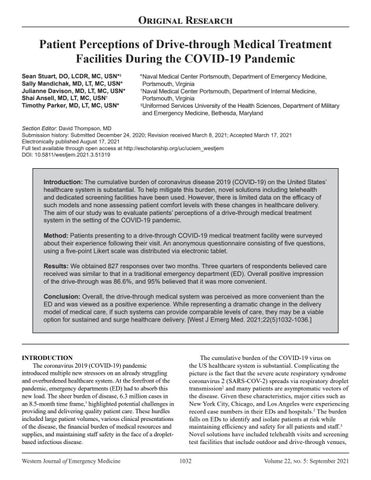
Original Research
Patient Perceptions of Drive-through Medical Treatment Facilities During the COVID-19 Pandemic Sean Stuart, DO, LCDR, MC, USN*‡ Sally Mandichak, MD, LT, MC, USN* Julianne Davison, MD, LT, MC, USN* Shai Ansell, MD, LT, MC, USN† Timothy Parker, MD, LT, MC, USN*
*Naval Medical Center Portsmouth, Department of Emergency Medicine, Portsmouth, Virginia † Naval Medical Center Portsmouth, Department of Internal Medicine, Portsmouth, Virginia ‡ Uniformed Services University of the Health Sciences, Department of Military and Emergency Medicine, Bethesda, Maryland
Section Editor: David Thompson, MD Submission history: Submitted December 24, 2020; Revision received March 8, 2021; Accepted March 17, 2021 Electronically published August 17, 2021 Full text available through open access at http://escholarship.org/uc/uciem_westjem DOI: 10.5811/westjem.2021.3.51319
Introduction: The cumulative burden of coronavirus disease 2019 (COVID-19) on the United States’ healthcare system is substantial. To help mitigate this burden, novel solutions including telehealth and dedicated screening facilities have been used. However, there is limited data on the efficacy of such models and none assessing patient comfort levels with these changes in healthcare delivery. The aim of our study was to evaluate patients’ perceptions of a drive-through medical treatment system in the setting of the COVID-19 pandemic. Method: Patients presenting to a drive-through COVID-19 medical treatment facility were surveyed about their experience following their visit. An anonymous questionnaire consisting of five questions, using a five-point Likert scale was distributed via electronic tablet. Results: We obtained 827 responses over two months. Three quarters of respondents believed care received was similar to that in a traditional emergency department (ED). Overall positive impression of the drive-through was 86.6%, and 95% believed that it was more convenient. Conclusion: Overall, the drive-through medical system was perceived as more convenient than the ED and was viewed as a positive experience. While representing a dramatic change in the delivery model of medical care, if such systems can provide comparable levels of care, they may be a viable option for sustained and surge healthcare delivery. [West J Emerg Med. 2021;22(5)1032-1036.]
INTRODUCTION The coronavirus 2019 (COVID-19) pandemic introduced multiple new stressors on an already struggling and overburdened healthcare system. At the forefront of the pandemic, emergency departments (ED) had to absorb this new load. The sheer burden of disease, 6.3 million cases in an 8.5-month time frame,1 highlighted potential challenges in providing and delivering quality patient care. These hurdles included large patient volumes, various clinical presentations of the disease, the financial burden of medical resources and supplies, and maintaining staff safety in the face of a dropletbased infectious disease. Western Journal of Emergency Medicine
The cumulative burden of the COVID-19 virus on the US healthcare system is substantial. Complicating the picture is the fact that the severe acute respiratory syndrome coronavirus 2 (SARS-COV-2) spreads via respiratory droplet transmission2 and many patients are asymptomatic vectors of the disease. Given these characteristics, major cities such as New York City, Chicago, and Los Angeles were experiencing record case numbers in their EDs and hospitals.2 The burden falls on EDs to identify and isolate patients at risk while maintaining efficiency and safety for all patients and staff.3 Novel solutions have included telehealth visits and screening test facilities that include outdoor and drive-through venues, 1032
Volume 22, no. 5: September 2021
Stuart et al.
Perceptions of Drive-through Medical Treatment During COVID-19
aimed at minimizing contact exposure and diverting less ill patients from the ED. Remote and drive-through COVID-19 screening facilities have become common place mechanisms that allow for the rapid testing of populations. Initial data from Korea demonstrated that such systems for COVID-19 are a feasible and efficient option for screening, testing, and counseling stable patients.4 However, most of the facilities are primarily for point-of-care testing, without the ability to evaluate and treat ill patients. To our knowledge few systems have expanded these drive-through systems to allow full clinician evaluations. Such systems represent a significant deviation from traditional healthcare delivery models. While data is being collected on the systemic advantages of a pandemic screening system, there is limited data of the efficacy of such models and none assessing patient comfort levels with this change in healthcare delivery. The aim of our study was to evaluate patients’ perceptions of a drive-through medical treatment facility (DMEF). METHODS Naval Medical Center Portsmouth (NMCP) is a 298-bed federal, academic hospital with nine branch clinics and an ED census of 86,000 annually. In response to the COVID-19 pandemic, NMCP’s ED established a DMEF in proximity to the ED. All adult patients presenting to the ED with symptoms of potential COVID-19 etiology and deemed non-critical were directed to the DMEF for initial evaluation. Drive-through Medical Treatment Facility Logistics The DMEF was designed to allow full evaluation, dispositioning and treatment of outpatient patients with potential COVID-19 symptoms. It was staffed Monday through Saturday, 9 am – 4 pm, by an emergency physician who oversaw up to four advanced practice providers (APP), each with a corpsman (medical assistant) and one nurse per APP pair. The facility consisted of three 40’ x 50’ temporary shelters erected in a parking lot adjacent to the ED. These structures allowed patients to drive their vehicles through, and the entire medical process was handled while the patients remained in their vehicles. On arrival patients were screened by a triage nurse using a pre-made screening form to determine appropriateness for DMEF evaluation vs diversion to the main ED. If appropriate, the patient was then registered, vital signs were recorded, and a paper medical chart was prepared. The patients then drove forward to a treatment station where a history and physical exam were conducted. Select pointof-care testing for COVID-19, influenza, and group B strep were also available. Upon completion of the evaluation and disposition, the standard discussion of diagnosis, treatment and follow-up plans occurred aided by preprinted discharge forms. Select medications including antipyretics and common “cold medications” formulations (guaifenesin, dextromethorphan, etc) were available for immediate dispensing, with traditional paper prescriptions used for other indicated medications. Volume 22, no. 5: September 2021
Population Health Research Capsule What do we already know about this issue? Non-traditional healthcare delivery systems have been utilized in the setting of coronavirus disease 2019 to extend healthcare resources and mitigate transmission with limited data on patient perceptions. What was the research question? What are patients’ impressions of medical care delivered via a drive-through treatment facility? What was the major finding of the study? Patients overall had positive impressions of medical care delivered via a drive-through system. How does this improve population health? These findings suggest nontraditional healthcare delivery mechanisms can be well received by patients, and their utility should be further explored to optimize medical system coverage.
Patient Perceptions We developed a three-part questionnaire to evaluate patient perceptions of a drive-through medical system. The questionnaire was piloted with a small group of professionals (two physicians, two nurses, two administrative personnel) to ensure clarity of the survey questions. To optimize feasibility and participation, the final questionnaire was limited to five questions, each using a five-point Likert scale. (Figure 1). Three questions pertained to perceptions of components of their care (clinician evaluation, explanation, and level of care delivered), one assessed convenience, and one the overall impression of the use of drive-through systems for medical evaluation. An optional free-response section was included to allow participants to provide additional comments. All patients completing medical evaluation at the NMCP’s DMEF were eligible to participate in the study. We excluded from participation any patients sent to the ED for further evaluation by DMEF providers. A convenience sample of patients from May 1–July 1, 2020 between 8 am – 4 pm were offered the opportunity to participate anonymously in the survey to evaluate their experience following their medical evaluation. Participants completed the survey via a provided electronic tablet. We examined all the data obtained and coded the responses. The data was then descriptively analyzed, and an appropriate test was applied in Excel (Microsoft Corp., Redmond, WA).
1033
Western Journal of Emergency Medicine
Perceptions of Drive-through Medical Treatment During COVID-19
Stuart et al.
68% were male. For patient perceptions of the components of their care, three-quarters of respondents (n = 617) believed the overall care they received was equivalent to what they would have received in the ED with an additional 13.1% (n = 108) rating their overall care as similar (Figure 2). A total of 86.6% (n = 715) of respondents gave positive overall impressions of the drive-through screening system compared to 3.0% (n = 25) responding negatively (Figure 3). In regard to convenience, 95.2% (n = 779) viewed the drivethrough system as “more convenient than going to the emergency department,” while 1.2% (n = 10) and 4.6% (n = 38) viewed it as “less” and “equivalently” convenient, respectively (Figure 4). DISCUSSION The COVID-19 pandemic has placed further strain on a medical system already struggling with access-to-care issues. In addition to the potential burden of new disease, the challenge of how to deliver healthcare in a way that is both efficient and effective while minimizing transmission risk to both healthcare workers and patients poses a challenge. This challenge has contributed to the rapid growth of pre-pandemic healthcare delivery mechanisms such as telemedicine. A
Figure 2. Patients’ perception of the quality of care received compared to their expected care in the emergency department. Figure 1. Patient perception survey of a drive-through medical evaluation system.
RESULTS Between May 1–July 1, 2020, we received a total of 827 responses. Given the anonymity of the survey, comprehensive data on demographics and comorbidities of respondents is not available. For the 2437 all comers to the DMEF, the median age was 32.5 (range 18-56 years old), and represented both active duty military and their dependents. Of the participants, Western Journal of Emergency Medicine
Figure 3. Overall patient impression of drive-through systems for medical evaluations.
1034
Volume 22, no. 5: September 2021
Stuart et al.
Perceptions of Drive-through Medical Treatment During COVID-19
Figure 4. Patients’ impression of the convenience of the drivethrough medical system compared to an emergency department visit.
report by the US Department of Health and Human Services found that telehealth adoption increased by nearly 50% in primary care from January through early June 2020.5 Likewise, countless drive-through COVID-19 screening centers were erected to facilitate mass population testing. Only a limited number appear to have offered traditional medical evaluation. While there is increasing evidence demonstrating the feasibility of these systems, there is limited evidence evaluating the quality of care provided and no consensus as to how patients perceive these dramatic changes in their healthcare delivery. Our study sought to aid in the understanding of how patients perceive medical care delivered in a drive-through venue. In our study, the vast majority of patients evaluated in our DMEF reported positive experiences as denoted by high marks in the areas of quality of provider evaluation, explanation of diagnosis and treatment plan, and overall level of care. Additionally, the DMEF was felt to be significantly more convenient than a visit to the ED. Overall, in our study the patients had positive impressions of the use of a drivethrough system for medical evaluations. Satisfaction studies have repeatedly found wait times to be a key component in a patient’s impression of their medical experience.6 Perhaps more noteworthy is evidence suggesting that increased wait time induced emotional disutility in already ill patients.7 This fourfold reduction in time was likely a prime contributor to the high ratings especially in the area of convenience. Interestingly, not only was convenience the highest rated item on the survey (mean 4.39/5), but even the vast majority of people who were not satisfied with other aspects of their care still positively endorsed the convenience of the drive-through system. Patient satisfaction is a complex and multifactorial process. However, it alone does not validate the quality of medical care provided nor is it directly linked to outcomes.8 However, patient satisfaction has become an increasingly used proxy indicator of the quality of healthcare delivery. Since the late 1990s the Centers for Medicare and Medicaid (CMS) has mandated the use of Consumer Assessment of Healthcare Providers and Systems (HCAHPS) surveys. The CMS then ties reimbursement to performance on this survey. However, Volume 22, no. 5: September 2021
it has been mentioned before that there is a noticeable absence of a single question pertaining to whether a patient felt they received adequate medical care.9 Our questionnaire attempted a cursory look at this gap by addressing the patient’s perception of their medical evaluation, their treatment plan explanation, and overall level of medical care. Here we found that despite the non-traditional setting and method, patients still felt they were receiving comparable levels of care from the providers. While all measures in our survey received positive responses, the lowest mean satisfaction value (4.33) was associated with the perception of providers’ explanations, which would entail diagnosis, expected course, return precautions, and follow-up planning. This correlates with the subjective comments as well: although predominantly positive, negative comments were largely centered on the patients not fully understanding what they should do next or their follow-up plan. While the unconventional setting of drive-through care may very well contribute to communication lapses, effective communication and transitions of care have been longstanding challenges in healthcare. In the 2020 CMS report on HCAHPS, transitions of care received by far the lowest overall ranking. Additionally, numerous studies have cited communication disconnects as a source of poor outcomes and periods of care transition as vulnerable periods.8 A consumer survey by Kyruus (Kyruus Inc., Boston, MA) found issues with communication during virtual appointments, in which less than half of respondents said they left their visits knowing what the next steps were.11 LIMITATIONS Our study was limited by survey anonymity preventing exact demographic assessment of our population and a smaller (five-question) questionnaire, which restricted the granularity of the data. These decisions were made pragmatically, as the surveys were conducted in a drivethrough venue, to minimize the Hawthrone effect and in an effort to increase recruitment, as shorter questionnaires have been shown to result in higher response rates.12 We were able to pull demographics for all patients who drove through the unit and maintain that the large number and consistency of the responses still allows for overall assessment. The DMEF was designed exclusively for the evaluation and treatment of COVID-19/influenzalike illness and would not be appropriate for all medical conditions. Even with these limitations, we believe the findings provide useful initial insight into patients’ perceptions of vehicle-based healthcare models. CONCLUSION While a drive-through medical facility represents a dramatic change in the delivery model of medical care, our study suggests these drive-through medical systems can
1035
Western Journal of Emergency Medicine
Perceptions of Drive-through Medical Treatment During COVID-19 be well received by patients. If such systems can provide comparable levels of care, they may represent a viable and critical option for sustained and surge healthcare delivery.
Stuart et al. coronavirus-us-cases.html#hotspots. Accessed December 4, 2020.
4. Chavez S, Long B, Koyfman A, et al. Coronavirus disease (COVID-19): a primer for emergency physicians. Am J Emerg Med. 2021;44:220-9 5. Kwon KT, Ko JH, Shin H, et al. Drive-through screening center for COVID-19: a safe and efficient screening system against massive
Address for Correspondence: Sean Stuart, DO, Naval Medical Center Portsmouth, Department of Emergency Medicine, 620 John Paul Jones Cir, Portsmouth, VA 23708. Email. sean.m.stuart4.mil@mail.mil.
community outbreak. J Korean Med Sci. 2020;35(11). 6. U.S. Department of Health & Human Services. Medicare beneficiary use of telehealth visits: early data from the start of the COVID-19 Pandemic. 2020. Available at: https://aspe.hhs.gov/pdf-report/
Conflicts of Interest: By the WestJEM article submission agreement, all authors are required to disclose all affiliations, funding sources and financial or management relationships that could be perceived as potential sources of bias. The views expressed here are those of the authors and do not reflect the official policy of the Department of the Army, the Department of Defense, or the U.S. Government. The authors disclosed none.
medicare-beneficiary-use-telehealth. Accessed September 24, 2020. 7. Woolen S, Kazerooni EA, Wall A, et al. Waiting for radiology test results: patient expectations and emotional disutility. J Am Coll Radiol. 2018;15(2):274-81. 8. Centers for Medicare and Medicaid Services. Joint Commission Center for Transforming Healthcare, Improving Transitions
Copyright: © 2021 Stuart et al. This is an open access article distributed in accordance with the terms of the Creative Commons Attribution (CC BY 4.0) License. See: http://creativecommons.org/ licenses/by/4.0/
of Care: Hand-Off Communications. Available at: http://www. centerfortransforminghealthcare.org/assets/4/6/CTH_Handoff_ commun_set_final_2010.pdf. Accessed December 4, 2020. 9. Boissy, Adrienne. “Getting to patient-centered care in a post–Covid-19 digital world: a proposal for novel surveys, methodology, and patient experience maturity assessment.” 2020. Available at: https://catalyst.
REFERENCES
nejm.org/doi/full/10.1056/CAT.19.1106/. Accessed September 23, 2020. 10. Prakash, B. Patient satisfaction. J Cutan Aesthet Surg.
1. Centers for Disease Control and Prevention. CDC COVID Data
2010;3(3):151-5.
Tracker. 2020. Available at: covid.cdc.gov/covid-data-tracker/#cases. Accessed November 28, 2020.
11. Hutton, D. Amid COVID-19 pandemic telehealth patient satisfaction high could drive future access. 2020. Available at: https://www.
2. Centers for Disease Control and Prevention. COVID-19 overview and infection prevention and control priorities in non-US healthcare
ophthalmologytimes.com/view/amid-covid-19-pandemic-telehealth-
settings. 2020. Available at: https://www.cdc.gov/coronavirus/2019-
patient-satisfaction-high-could-drive-future-access. Accessed
ncov/hcp/non-us-settings/overview/index.html#transmission.
September 23, 2020.
Accessed November 28, 2020.
12. Guo Y, Kopec JA, Cibere J, et al. Population survey features and response rates: a randomized experiment. Am J Public Health.
3. The New York Times. Covid in the U.S.: latest map and case count.
2016;106(8):1422-6.
2020. Available at: https://www.nytimes.com/interactive/2020/us/
Western Journal of Emergency Medicine
1036
Volume 22, no. 5: September 2021
Original Research
A Global Survey of Emergency Department Responses to the COVID-19 Pandemic Prashant Mahajan, MD, MPH, MBA* Chong Shu-Ling, MD, MBBS, MRCPCH, MCI, MPH† Camilo Gutierrez, MD‡ Emily White, MS§ Benjamin A.Y. Cher, MS¶ Elizabeth Freiheit, PhD§ Apoorva Belle, MA, MHA|| EMERGE NETWORK# Authors continued at end of article
*University of Michigan, Departments of Emergency Medicine and Pediatrics, Ann Arbor, Michigan † KK Women’s and Children’s Hospital, Department of Emergency Medicine, Singapore ‡ George Washington University School of Medicine and Health Sciences, Departments of Emergency Medicine and Pediatrics, Washington, District of Columbia § University of Michigan, SABER, Ann Arbor, Michigan ¶ University of Michigan Medical School, Ann Arbor, Michigan || University of Michigan EMERGE, Department of Emergency Medicine, Ann Arbor, Michigan # See supplemental file for full authorship
Section Editor: Heather Brown, MD, MPH Submission history: Submitted October 20, 2020; Revision received March 24, 2021; Accepted March 24, 2021 Electronically published August 21, 2021 Full text available through open access at http://escholarship.org/uc/uciem_westjem DOI: 10.5811/westjem.2021.3.50358
Introduction: Emergency departments (ED) globally are addressing the coronavirus disease 2019 (COVID-19) pandemic with varying degrees of success. We leveraged the 17-country, Emergency Medicine Education & Research by Global Experts (EMERGE) network and non-EMERGE ED contacts to understand ED emergency preparedness and practices globally when combating the COVID-19 pandemic. Methods: We electronically surveyed EMERGE and non-EMERGE EDs from April 3–June 1, 2020 on ED capacity, pandemic preparedness plans, triage methods, staffing, supplies, and communication practices. The survey was available in English, Mandarin Chinese, and Spanish to optimize participation. We analyzed survey responses using descriptive statistics. Results: 74/129 (57%) EDs from 28 countries in all six World Health Organization global regions responded. Most EDs were in Asia (49%), followed by North America (28%), and Europe (14%). Nearly all EDs (97%) developed and implemented protocols for screening, testing, and treating patients with suspected COVID-19 infections. Sixty percent responded that provider staffing/back-up plans were ineffective. Many sites (47/74, 64%) reported staff missing work due to possible illness with the highest provider proportion of COVID-19 exposures and infections among nurses. Conclusion: Despite having disaster plans in place, ED pandemic preparedness and response continue to be a challenge. Global emergency research networks are vital for generating and disseminating large-scale event data, which is particularly important during a pandemic. [West J Emerg Med. 2021;22(5)1037–1044.]
INTRODUCTION Emergency departments (ED) globally are on the front lines in addressing the COVID-19 pandemic, caused by the severe acute respiratory syndrome coronavirus 2 (SARS-CoV-2). Most EDs have disaster preparedness plans in place for health system responses to large-scale disasters, including infectious Volume 22, no. 5: September 2021
disease outbreaks. However, infectious disease pandemics pose a unique challenge due to their infrequency and the extended period over which they may occur. The incomplete and evolving knowledge of a novel pathogen limits early preparations for resource needs during a pandemic and predisposes individuals and communities
1037
Western Journal of Emergency Medicine
Global Survey of ED Responses to COVID-19
Mahajan et al.
to poor health outcomes. Critical evaluation of the global response to the 2009 H1N1 influenza pandemic identified substantial variability and poorly conceived or even absent preparedness plans in many emergency care systems.1 This missed opportunity to implement successful disaster response plans prior to the following major infectious outbreak highlights the need to study global ED responses and healthcare system preparedness on a continuous basis.2,3 With the ongoing COVID-19 pandemic, knowledge regarding presentation, prognosis, and response to therapies continues to evolve. It is imperative for data, lessons learned, and successful approaches used by EDs with a high pandemic burden to be made rapidly and reliably available to those in earlier stages. Emergency medicine networks are valuable for collection of data supporting research, administrative, and educational goals and can potentially be leveraged to collate and disseminate experiences from disasters.4 Emergency Medicine Education & Research by Global Experts (EMERGE) is a newly developed network of 26 EDs across 17 countries and six continents whose goal is to improve the care of acutely ill and injured patients by garnering the collective experiences of its member EDs.5,6 In this study we sought to leverage the EMERGE network and establish collaborations with non-EMERGE EDs to determine global ED preparedness for COVID-19 and, specifically, to identify successful processes and protocols that may be adopted and/or adapted by other EDs to improve patient outcomes. METHODS Study Design and Survey Development We performed a cross-sectional study of ED practices during the pandemic using a survey sent to all participating sites. We reported our results using elements from the Strengthening the Reporting of Observational Studies in Epidemiology; Survey Reporting Guidelines; and the Checklist for Reporting Results of Internet E-Surveys guidelines.7-10 We used the online survey platform Qualtrics (Qualtrics LLC, Provo, Utah) to characterize ED COVID-19 responses between April 3–June 1, 2020 along the following domains: pandemic preparedness plans and training; physical space; triage methods unique to the pandemic; staffing; supplies; and communication practices. The survey (Appendix A) was piloted and assessed for response process validity. Eleven emergency physicians at the University of Michigan evaluated the survey for construct and face-validity, and iteratively refined the questions. Survey questions were mainly closed-ended, with additional open-ended questions allowing participants to express opinions or to provide clarification on responses. The survey was translated using formal translation services into Mandarin Chinese and Spanish and reassessed for face validity in the translated language by EMERGE Executive Western Journal of Emergency Medicine
Population Health Research Capsule What do we already know about this issue? Emergency departments (EDs) globally are on the front lines in addressing the coronavirus disease 2019 pandemic. However, preparedness and effectiveness of responses remain unknown. What was the research question? We leveraged the 17-country, Emergency Medicine Education and Research by Global Experts (EMERGE) network and non-EMERGE EDs to study emergency preparedness globally. What was the major finding of the study? EDs had to rapidly update and modify preparedness plans. EDs developed innovative processes to respond, and most identified provider burnout as an important issue. How does this improve population health? Emergency research networks are vital for generating and disseminating solutions to improve patient outcomes in global emergencies.
Committee members who spoke those languages. The study was determined not to require regulation as human subjects research by the University of Michigan Institutional Review Board (HUM00178847). Participants and Survey Distribution Survey participation was voluntary, and respondents did not receive financial remuneration. The survey was distributed to EMERGE member institutions via email with unique links created for each participant. Attempts were made to involve non-EMERGE institutions by forwarding a one-page infographic (Appendix B) to contacts of EMERGE members and associates. Simultaneously, we contacted other international emergency associations for participation, including the Pan-Asian Resuscitation Outcomes Study, the World Academic Congress of Academic Medicine, the Michigan Emergency Department Improvement Collaborative, and the International Federation for Emergency Medicine.11-14 To encourage survey completion, we stated the deadline for survey responses and sent regular email reminders about survey closure. We also contacted participants electronically to obtain clarification on incomplete or partially complete responses. We specified that the medical director or 1038
Volume 22, no. 5: September 2021
Global Survey of ED Responses to COVID-19
Mahajan et al. emergency preparedness expert in the division/department should be the one to answer this questionnaire.
was 180 (IQR 100 - 300); 52/74 sites are both pediatric and adult EDs, 14 are adult only, and eight are pediatric only.
Statistical Analysis We tabulated descriptive statistics including absolute and relative frequencies for categorical variables and means (with standard deviations [SD]) or medians (with interquartile ranges [IQR]) for continuous variables, depending on normality, to compare all survey question responses. We defined ED characteristics by location, setting, and size. We grouped EDs by location into geographical categories: Asia; Europe; North America; South America; Africa; and Australia. Hospital setting was defined along two domains. First, we defined them as “public” or “government-funded” hospitals with the rest defined as “private” hospitals. Second, we categorized hospitals as “academic” vs “non-academic” based on presence of residency training programs. We used SAS 9.4 (SAS Institute, Cary, NC) for all quantitative analyses. ED characteristics stratified by country, continent, and income status (gross domestic product) as well as COVID-19 prevalence and death rates at time of survey completion are provided in Supplementary Table 1.
Pandemic Preparedness Most sites (71/74, 96%) reported having an ED protocol to guide the screening, testing, and managing of suspected COVID-19 cases, and 27 (36%) sites sent their protocols for other EDs across the globe to use. There were 43/74 EDs (58%) that had ED staffing back-up plans prior to the COVID-19 outbreak. Regarding supply availability, 59/71 (83%) reported stocking the ED with personal protective equipment (PPE) as a part of pre-existing disaster plans. However, when respondents answered questions regarding effectiveness of existing disaster plans only 59/74 (80%) replied. Of these, 48/59 (81%) responded that the plan was successful/effective. Regarding personnel and ED staffing back-up plans, 26 felt they were very effective, 33 somewhat effective, six not effective, and nine did not respond. Reasons for disaster plans being successful or not are described in Table 1.
RESULTS Respondent Characteristics We identified 129 EDs across 28 countries within all six World Health Organization (WHO) regions. Of these, 74 (57%) completed the survey, comprising 23/26 (88%) EMERGE EDs and 51/103 (49%) non-EMERGE EDs (Figure). There were 21 (28%) respondents from North America, 36 (49%) from Asia, 10 (14%) from Europe, two (3%) from South America, two (3%) from Africa, and three (4%) from Australia. With 69 sites providing their daily volumes, we approximated the total annual patient population of the represented EDs at 6,068,994. The median ED bed count was 42 (IQR 21–80) and median ED encounters daily
Figure. Survey responses among members of the Emergency Medicine Education & Research by Global Experts network (EMERGE) and non-EMERGE emergency departments.
Volume 22, no. 5: September 2021
COVID-19 Pandemic Response Nearly every ED (71/73, 97%) developed and implemented a protocol for screening, testing, and managing patients with suspected SARS-CoV-2 infections. The WHO recommendations for COVID-19 informed the pandemic response plans for 28/73 (38%) EDs in our sample. Outside the United States, 13/59 (22%) EDs based their pandemic response plans on the US Centers for Disease Control and Prevention (CDC) guidelines. The majority (45/73, 62%) based their plans on guidelines issued by their own countries. ED Triage and Capacity Screening criteria for COVID-19 were generally similar across the EDs in our survey, with less similarity across survey respondents in approaches for increasing treatment capacity. Screening criteria used are provided in Table 2 with the most common being fever (72/74, 97%), close contact with a confirmed case of COVID-19 (66/74, 89%), travel to a COVID-19 affected area (66/74, 89%), symptoms of upper respiratory illness (63/74, 85%), and signs of lower respiratory illness (71/74, 96%). However, 71/74 (96%) EDs reported that triage screening criteria had changed over time, and 58/74 (78%) mentioned criteria had changed more than two times. Of those responding, 68/74 (92%) created separate COVID-19 areas in ED waiting rooms, and 51/72 EDs (71%) increased capacity in response to COVID-19 surges, with 46 enhancing existing ED space by modifying/adding hallway beds, chairs/recliners or creating spaces separated by curtains. The results show that 45/74 (61%) increased capacity outside the ED by using non-traditional space for ED care such as subspecialty clinics or mobile tents. The most common measures used to increase hospital capacity were postponing elective/non-urgent surgical procedures (67/74, 91%), creating a dedicated COVID-19 patient care team (57/74,
1039
Western Journal of Emergency Medicine
Global Survey of ED Responses to COVID-19
Mahajan et al.
Table 1. Strengths and weaknesses reported from the pandemic/disaster plans. Strengths
Weaknesses
Communication
Communication with large number of employees, interdepartmental communication, ongoing patient/physician communication, telecommunication, health care workers’ communication with government
Failure in communicating logistics
Triage
ED triage tents, pre-triage bed reassignment, creating different zones for triage based on symptoms presented
Time-consuming efforts to organize the triage plans
Testing
Creating mobile testing unit, drive-through testing units
Testing capacity was low, slow process of government approval of in-house rapid testing, difficulty in obtaining official confirmation for the need for testing, long wait time for test results, bedside equipment shortage
Supplies
Resource allocation was conducted adequately, gradually increased supplies
Difficulty in mobilization of resource, PPE shortage faced at initial stages of the pandemic, planning to secure additional PPE was a slow process
Space
Creating separate areas for patients with COVID-19 like symptoms, creating field hospitals and dedicated COVID-19 centers, creating tents, halting elective procedures, and creating space for COVID-19 patients
Creation of surge capacity for the possibility of large volume of patients with respiratory distress
Staff
Staff pooling into categories to replace staff in critical areas, Staffing mobilization, hesitancy of certain smooth communication and coordination, efficient training, healthcare workers, mixing staff schedule to interdepartment training, cooperation with medical students and work on all zones simultaneously, no clear other health care workers, and great staff well-being initiatives direction for sick healthcare workers ED, emergency department; COVID-19, coronavirus disease 2019; PPE, personal protection equipment.
77%), and reassigning existing beds specifically for patients with COVID-19 (56/74, 76%).
response. Most respondents (52/74, 70%) developed new or separate staff backup plans specifically for COVID-19 while 22/74 EDs (30%) had activated their existing staff backup plans at the time the survey was completed. From the received responses 47/74 (64%) reported staff missing work due to illness, and 32/74 (43%) reported that ED provider staff had tested positive for SARS-CoV-2. Inability to work due to possible COVID-19 illness was reported in nurses in 26/32 (81%) responses, followed by physicians, 21/32 (66%), and residents, 20/32 (63%). Common measures to address staff wellness and prevent burnout included allowing staff to work remotely (57/72, 79%) and providing meals at work (45/72, 63%). If staff had a confirmed positive SARS-CoV-2 test, criteria for returning to work included a negative test (28/45, 62%) and/or being symptom-free for a site-determined duration of days (27/45, 60%).
ED Staffing and Staff Wellness/Burnout Many survey respondents identified staffing issues as a particularly challenging aspect of the COVID-19 pandemic Table 2. COVID-19 screening criteria used in participating EMERGE and non-EMERGE emergency departments. Fever 72 (97%) Signs/Symptoms of lower respiratory illness (cough, difficulty breathing)
71 (96%)
Close contact with a confirmed case of COVID-19
66 (89%)
Travel to affected areas
66 (89%)
Signs/Symptoms of upper respiratory illness (runny 63 (85%) nose, sore throat) Close contact with a suspected case of COVID-19
59 (80%)
Timely relation to a possible contact (ie, 14 days)
53 (72%)
Healthcare worker
40 (54%)
Signs/Symptoms of gastrointestinal illness (vomiting, diarrhea)
36 (49%)
Nonspecific symptoms (malaise, myalgias, headache)
32 (43%)
Testing for COVID-19 On a multiple-option question, 55/74 (74%) respondents selected that they were able to test for SARS-CoV-2 in their EDs, 23/74 (31%) selected that samples were sent to an external agency for testing, and 4/74 (5%) sites indicated that they did not perform any testing.
Immunocompromised 25 (34%) EMERGE, Emergency Medicine Education & Research by Global Experts; COVID-19, coronavirus disease 2019.
Western Journal of Emergency Medicine
Resources and Supplies Most EDs were able to provide face masks for patients with suspected COVID-19 or influenza-like illness at arrival
1040
Volume 22, no. 5: September 2021
Global Survey of ED Responses to COVID-19
Mahajan et al. (70/74, 95%). Supplies in EDs that were most likely to be depleted (defined as a <14-day supply) at the time of the survey included powered air purifying respirator systems (36/58, 62%) and N-95 masks (36/69, 52%). Communication Survey respondents exhibited wide variation regarding where they obtained information about the evolving pandemic and how they communicated with patients and local communities. The most common sources of information for EDs included local governments/health departments (47/70, 67%), hospital infection control practitioners (43/70, 61%), state governments (34/70, 49%), and the WHO (33/70, 47%). Common methods for communicating with the local community included social media (53/62, 85%), television (52/62, 84%), and newspapers (46/62, 74%). The most common methods for communicating updates to staff were email (58/69, 84%), website/intranet (52/69, 75%), and video conference (48/69, 70%). The most common methods for communicating updates to patients and families were flyers/ posters (41/64, 64%), in-hospital TV channels/displays (37/64, 58%), and social media (34/64, 53%). Innovation In an open-ended survey section, we recorded both successful and unsuccessful innovations developed in respondent EDs to address the pandemic (Table 3). Successful innovations generally included development of separate treatment spaces for COVID-19 patients and plans for local community engagement via electronic and social media. Respondents reported unsuccessful innovations related to testing capacity, PPE availability, and staffing plans. DISCUSSION In this global survey, we leveraged the EMERGE network to establish rapid collaborations with non-EMERGE EDs and obtained estimates of ED pandemic preparedness and response to COVID-19 from 74 EDs in 28 countries comprising the six WHO regions. Despite substantial differences among surveyed EDs, there were many similarities in how EDs are responding to the pandemic, especially with screening protocols, capacity expansion, and staffing. Despite having disaster plans in place, globally ED pandemic preparedness and response is difficult and variable. There was a substantial human cost to the pandemic as 43% of the EDs reported providers and staff had contracted COVID-19 and missed work, further impacting the ED’s ability to provide care. Finally, EDs were willing to share protocols, lessons learned, and innovative solutions that can be rapidly disseminated via research networks such as EMERGE, or via global organizations such as the WHO to benefit emergency care globally. Our survey identified multiple, latent patient-safety threats due to inadequate disaster preparedness. One third of respondents did not have a pandemic preparedness plan prior to the COVID-19 pandemic. These findings are consistent Volume 22, no. 5: September 2021
with another report surveying 102 pediatric EDs in Europe early in the COVID-19 pandemic, which revealed that nearly a third of EDs lacked a contingency plan for pandemics and never had simulated scenarios for such events.15 Second, the loss of the ED workforce, especially nursing and physician staff, either due to contracting infections with SARS-CoV-2 or required quarantine from exposure to patients with COVID-19 was very high. These results are consistent with reports from the CDC and other recent studies.16-19 Third, there was variability among EDs regarding staff backup plans. Although most EDs responded that their pre-pandemic disaster plan was a successful one, nearly half of the EDs did not have an ED backup plan for staffing during disasters, most had to create new or modify existing plans to respond to the current pandemic and reported that these plans were ineffective or only somewhat effective. Reassuringly, most EDs recognized the impact of the pandemic on staff wellness and had developed plans for improving provider well-being. These interventions included new guidelines for remote work whenever possible, meals during shifts, childcare support, and/or additional time away from work. Disaster management experts voice the importance of frontline workers’ protection through planning, availability of PPE, and mindful staff scheduling, as well as strongly encouraging mental health and peer support with wellness initiatives. Our findings highlight the need for a more cohesive and comprehensive evaluation of existing disaster plans. Lessons learned from our survey could potentially be used to develop multidisciplinary in situ simulations to find optimal solutions for adapting to COVID-19 and other highly complex and evolving epidemics/pandemics in the future.20 Nearly all EDs developed site-specific protocols for screening and triage during the pandemic. These protocols included provision of masks and separating patients on arrival to the waiting room. Triage and pre-ED arrival screening involved tele-triage, phone, and video screening, the use of alternative sites (such as triage tents, triage in the car), and use of other non-ED sites (such as outpatient clinics and community centers). One site reported a separate screening facility with app-based screening prior to patient registration. Leveraging technology can reduce ED demand and enhance patient understanding of COVID-19 risks and has been used extensively for screening and contact tracing tools, such as the CDC Self-Checker and Singapore’s TraceTogether.21,22 Consistent with lessons learned from prior disasters, most EDs had developed protocols for enhancing capacity by repurposing unused or non-ED spaces and adapting them for care of COVID-19 patients. Essentially, most EDs and their hospitals had re-engineered the entire ED arrival, triage, throughput, and disposition processes with a system-wide response, postponing non-emergent surgeries and creating and/or expanding intensive care capabilities. The ED and emergency medical services are an integral component of community-based health systems that require
1041
Western Journal of Emergency Medicine
Global Survey of ED Responses to COVID-19
Mahajan et al.
Table 3. Innovations reported and developed in response to COVID-19 across participating EMERGE* and non-EMERGE emergency departments. Communication
• • • • • •
Robots for communication Tele-consultation Developed vernacular language standees Dedicated call center facility (Run by medical & nursing students & doctors) Using Zoom meeting to interact with patients regarding clinic visits, questions, etc. Conducting community awareness sessions
Triage
• • • • • •
Teletriage system App-based screening Triage truck Designated COVID-19 center manned by ACE team Screening area with a Decon shower facility Formulated a ventilator triage protocol based on a scoring system devised from existing literature
Test
• • • •
PPE
• • • • • •
Ultraviolet sterilization of N95 masks Locally designed Intubation box Reusable ultraviolet sterilization of N95s, masks, and gowns Disposable aerosol box for airway management 3-D printer face shields and 3-D printed face masks. Visors used instead of masks Use of short-sleeved gowns instead of long sleeves due to the shortage
Area
• • • • • •
Isolated areas, fever clinic and COVID-19 tents Field hospitals Flu-screening isolation facility for staff employed in COVID-19 ward Ambulance hall rebuilt into extra patient rooms Negative pressure room ED restructured into zones
Staff
• • • • • •
Pre-triage screening station manned by non-medical ED staff EMCREWS team managed by a consultant (attending) working remotely Pooling of rotation forming the ACE team Hired medical students Hospital infection committee for training and certifying HCWs and allied staff in donning and doffing Fever clinics with volunteers helping in segregation and providing PPE
Other
• • • •
Provide shelter options for COVID-19 positive patients Creation of SARI cubicle Closure of AC ducts Use of separate lifts/elevators
Sampling booths Door-to-door screening for all people in the community Drive-through swab for COVID-19 Results available within 90 minutes for high urgency needs and number of high urgency tests is limited to 15/day • Biofire testing for patients requiring admission with results in 4-12 hours • Mobile vehicle for testing
3-D, three dimensional; Decon, decontamination; COVID-19, coronavirus 2019; ED, emergency department; SARI, severe acute respiratory infection; AC, air conditioner; Biofire, Biofire Diagnostics: Syndromic Infectious Disease Diagnostics (Salt Lake City, UT) ACE, anesthesia, critical care, and emergency medicine; HCW, healthcare workers; PPE, personal protective equipment.
strengthening to respond to pandemics; however, it is imperative that we first obtain high quality, global data in a timely manner to understand the impact and subsequent responses. This was the motivation for our survey, which revealed important insights on the state of global pandemic/ disaster preparedness. First, apart from regional EM organizations gathering local data, currently there is no infrastructure for assessing the state of ED systems across the globe and sharing experiences to provide rapid, reliable, and Western Journal of Emergency Medicine
actionable data. For instance, adaptation of shared protocols and data would substantially reduce the time to implementation of interventions, underscoring the importance of ED-based research networks. Our survey was initiated in the nascent EMERGE network and we immediately recognized that despite having a “global” footprint, EMERGE is still not representative of the global ED system. It was very reassuring that we were quickly able to reach out to several non-EMERGE EDs via referral, allowing us to expand the survey participant pool from 1042
Volume 22, no. 5: September 2021
Global Survey of ED Responses to COVID-19
Mahajan et al. 26 EMERGE EDs in 17 countries to include an additional 51 non-EMERGE EDs from 11 countries. Second, our higherthan-average 57% response rate highlights the willingness of healthcare institutions across the world to participate and share experiences for the global benefit.23 Third, the diversity of comments regarding innovations in the domains of triage, testing, communication, staffing, and capacity-building provided in Table 3 can be reviewed and potentially applied immediately as the world continues to grapple with the pandemic. For instance, use of unmanned robots for telepresence, use of mobile technology for communication between patients, caregivers, and providers, or use of a dedicated website and app-based screening have been rapidly deployed. Repurposing used radiographic films as face shields to three-dimensional printing of face shields, ultraviolet lights for sterilizing PPE to conserve supplies, negative pressure single-person hoods and tents to overcome lack of negative pressure rooms, and dedicated airway teams composed of emergency, critical care and anesthesia providers are all examples of local innovations that can be applied globally. Fourth, comments on whether pandemic plans were successful or not provide insight into how EDs, institutions, communities, and others can learn. For instance, sharing protocols and processes for COVID-19, such as airway management guidelines aimed at first-pass success with use of advanced airway placement devices (video laryngoscopes), and higher doses of paralytics to reduce risk of aerosol exposure, can be implemented globally. Sharing of ED mitigation strategies early in the pandemic will enhance cross-pollination of ideas that can promote both patient and healthcare worker safety. Conversely, evidence of inconsistent communication between providers within an institution or from regulatory agencies, inadequate PPE supplies, inability to scale testing to meet demand, and wasted PPE from improper training are examples of how plans could be improved in the future. LIMITATIONS Data obtained from surveys is inherently susceptible to selection and reporting bias. Furthermore, survey participation and response rates have declined over time due to limitations of the study design and inconvenience associated with completing poorly designed or frequent requests. This may be especially true during this pandemic, when multiple and often simultaneous requests for information were circulating broadly and a massive increase in scientific literature submissions related to COVID-19 were published.24 We mitigated some of these limitations by testing the survey for face, construct, and content validity before soliciting participation. In addition, we made it very convenient for expeditious completion by formatting most questions as closed-ended responses. We obtained a 57% response rate, which is better than most reported surveys.23 We also recognize that the two open-ended questions regarding effectiveness of existing disaster plans and interventions gave us rich anecdotal data on how individual Volume 22, no. 5: September 2021
EDs were responding, but we do not have details regarding their success/failure and/or impact. We plan to pursue these questions with follow-up interviews with ED leadership as our subsequent research project. Given the extremely dynamic nature of the COVID-19 pandemic and the fact that countries were experiencing different levels of disease burden and different phases of the outbreak, the survey results represent the situation at a single point in time for the responding institutions. Thus, responses to survey questions will likely be different if we were to conduct the survey at another point in time. For instance, responses regarding availability of PPE or effectiveness of preparedness plans may differ as institutions continue to respond and adapt in real time. Ultimately, this study is hypothesis-generating and intends to demonstrate the power of our network. CONCLUSION Our study cohort represents a large cross-sectional sample of ED responses to an ongoing global healthcare crisis. Despite having disaster plans in place, ED pandemic preparedness and response continue to be a challenge and there were multiple, latent safety threats to providers and patients. We believe global emergency research networks play an important role in near realtime collection of high-quality data on the epidemiology of largescale events and can disseminate experiences and solutions that will impact healthcare outcomes for individuals, communities, and even nations. AUTHORS CONTINUED Johanna Kaartinen, MD, PhD* Vijaya Arun Kumar, MD, MPH† Paul M. Middleton, MD‡ Chip Jin Ng, MD§ Daniel Osei-Kwame, MBChB¶ Dominik Roth, MD, PhD|| Tej Prakash Sinja, MBBS, MS# Sagar Galwankar, BBS, DNB, MPH** Michele Nypaver, MD†† Nathan Kuppermann, MD, MPH‡‡ Ulf EKelund, MD, PhD§§ *University of Helsinki/Helsinki University Hospital, Department of Emergency Medicine and Services, Helsinki, Finland † Wayne State University, Department of Emergency Medicine, Detroit, Michigan ‡ South Western Emergency Research Institute, Department of Emergency Medicine, Liverpool, England § Chang Gung Memorial Hospital, Department of Emergency Medicine, Taoyuan City, Taiwan ¶ Komfo Anokye Teaching Hospital, Department of Emergency Medicine, Kumasi, Ghana || Medical University of Vienna, Department of Emergency
1043
Western Journal of Emergency Medicine
Global Survey of ED Responses to COVID-19
Mahajan et al.
Medicine, Vienna, Austria # All India Institute of Medical Sciences, Department of Emergency Medicine, New Delhi, India **Sarasota Memorial Hospital, Department of Emergency Medicine, Sarasota, Florida †† University of Michigan, Department of Emergency Medicine, Ann Arbor, Michigan ‡‡ University of California, Davis School of Medicine, Departments of Emergency Medicine and Pediatrics, Davis, California §§ Skane University at Lund, Department of Emergency Medicine, Lund, Sweden
Health Organ. 2007;85(11):867-72. 8. Grimshaw J. SURGE (The SUrvey Reporting GuidelinE). In: Guidelines for Reporting Health Research: A User’s Manual. John Wiley & Sons, Ltd; 2014:206-13. 9. Turk T, Elhady MT, Rashed S, et al. Quality of reporting web-based and non-web-based survey studies: What authors, reviewers and consumers should consider. PLoS One. 2018;13(6):e0194239. 10. Eysenbach G. Correction: improving the quality of web surveys: the Checklist for Reporting Results of Internet E-Surveys (CHERRIES). J Med Internet Res. 2012;14(1):e8. 11. ePAROSTM. Eparos.org. Available at: https://eparos.org/. Accessed July 28, 2020. 12. WACEM. Available at: https://wacem.org/. Accessed July 28, 2020. 13. MEDIC. Available at: https://medicqi.org/. Accessed July 28, 2020.
Address for Correspondence: Prashant Mahajan, MD, MPH, MBA, University of Michigan, Department of Emergency Medicine, 1540 E Hospital Drive CW 2-737, Ann Arbor, Michigan 48109. Email: pmahajan@med.umich.edu.
14. IFEM. Available at: https://www.ifem.cc/. Accessed July 28, 2020. 15. Bressan S, Buonsenso D, Farrugia R, et al. Preparedness and response to pediatric COVID-19 in European emergency departments: a survey of the REPEM and PERUKI networks. Ann Emerg Med. 2020;76(6):788-800.
Conflicts of Interest: By the WestJEM article submission agreement, all authors are required to disclose all affiliations, funding sources and financial or management relationships that could be perceived as potential sources of bias. No author has professional or financial relationships with any companies that are relevant to this study. There are no conflicts of interest or sources of funding to declare.
16. Giuffrida A, Tondo L. “As if a storm hit”: more than 40 Italian health workers have died since crisis began. The Guardian, 2020. Available at: https://www.theguardian.com/world/2020/mar/26/as-if-a-stormhit-33-italian-health-workers-have-died-since-crisis-began. Accessed July 28, 2020.
Copyright: © 2021 Mahajan et al. This is an open access article distributed in accordance with the terms of the Creative Commons Attribution (CC BY 4.0) License. See: http://creativecommons.org/ licenses/by/4.0/
17. Cheng VCC, Wong S-C, Chen JHK, et al. Escalating infection control response to the rapidly evolving epidemiology of the coronavirus disease 2019 (COVID-19) due to SARS-CoV-2 in Hong Kong. Infect Control Hosp Epidemiol. 2020;41(5):493-8. 18. Ran L, Chen X, Wang Y, Wu W, Zhang L, Tan X. Risk factors of healthcare workers with coronavirus disease 2019: a retrospective
REFERENCES
cohort study in a designated hospital of Wuhan in China. Clin Infect
1. Fineberg HV. Pandemic preparedness and response--lessons from the H1N1 influenza of 2009. N Engl J Med. 2014;370(14):1335-42.
Dis. 2020;71(16):2218-21. 19. CDC COVID-19 Response Team. Characteristics of health care
2. McCarthy ML, Aronsky D, Kelen GD. The measurement of daily
personnel with COVID-19 - United States, February 12-April 9, 2020.
surge and its relevance to disaster preparedness. Acad Emerg Med. 2006;13(11):1138-41.
MMWR Morb Mortal Wkly Rep. 2020;69(15):477-81. 20. Jee M, Khamoudes D, Brennan AM, et al. COVID-19 outbreak
3. Stratton SJ, Tyler RD. Characteristics of medical surge capacity
response for an emergency department using in situ simulation.
demand for sudden-impact disasters. Acad Emerg Med. 2006;13(11):1193-7.
Cureus. 2020;12(4):e7876. 21. CDC. Symptoms of Coronavirus. 2020. Available at: https://www.
4. Dalziel SR, Thompson JM, Macias CG, et al. Predictors of severe
cdc.gov/coronavirus/2019-ncov/symptoms-testing/symptoms.html.
H1N1 infection in children presenting within Pediatric Emergency Research Networks (PERN): retrospective case-control study. BMJ.
Accessed July 28, 2020. 22. TraceTogether, safer together. https://www.tracetogether.gov.sg/
2013;347:f4836. 5. Mahajan P, Visclosky T, Bhoi S, et al. The importance of developing
index.html. Accessed July 29, 2020. 23. Advances in survey methodology: maximizing response rates and
global emergency medicine research network. Am J Emerg Med.
the representativeness of CAHPS ® Survey Data Meeting Summary.
2019;37(4):744-5.
2019. Available at: https://www.ahrq.gov/sites/default/files/wysiwyg/
6. EMERGE Network. Emergenetwork.org. Available at: https://www.
cahps/surveys-guidance/survey-methods-research/summary-
emergenetwork.org/. Accessed July 28, 2020. 7. von Elm E, Altman DG, Egger M, et al. The Strengthening the
research-meeting.pdf. Accessed July 29, 2020. 24. Bauchner H, Fontanarosa PB, Golub RM. Editorial evaluation and
Reporting of Observational Studies in Epidemiology (STROBE)
peer review during a pandemic: how journals maintain standards.
statement: guidelines for reporting observational studies. Bull World
JAMA. 2020;324(5):453-4.
Western Journal of Emergency Medicine
1044
Volume 22, no. 5: September 2021
Original Research
Efficacy of Various Facial Protective Equipment for Infection Control in a Healthcare Setting Jessica Dinsmore, MD Susan Brands, MD Steven Perry, MD Michael Lopez, MD Yutong Dong, MD Daniel Palasz, MD Jennifer Tucker, MD
Medical College of Georgia at Augusta University, Department of Emergency Medicine, Augusta, Georgia
Section Editor: Mark I Langdorf, MD, MHPE Submission history: Submitted October 30, 2020; Revision received March 29, 2021; Accepted March 31, 2021 Electronically published August 17, 2021 Full text available through open access at http://escholarship.org/uc/uciem_westjem DOI: 10.5811/westjem.2021.3.50516
Introduction: The coronavirus 2019 (COVID-19) pandemic has reinforced the importance of facial protection against droplet transmission of diseases. Healthcare workers wear personal protection equipment (PPE), including face shields and masks. Plastic face shields may have advantages over regular medical masks. Although many designs of face shields exist, there is a paucity of evidence regarding the efficacy of shield designs against droplet transmissions. There is even less published evidence comparing various face shields. Due to the urgency of the pandemic and the health and safety of healthcare workers, we aimed to study the efficacy of various face shields against droplet transmission. Methods: We simulated droplet transmission via coughing using a heavy-duty chemical spray bottle filled with fluorescein. A standard-adult sized mannequin head was used. The mannequin head wore various face shields and was positioned to face the spray bottle at either a 0°, 45°, or 90° angle. The spray bottle was positioned at and sprayed from 30 centimeters (cm), 60 cm, or 90 cm away from the head. These steps were repeated for all face shields used. Control was a mannequin that wore no PPE. A basic mask was also tested. We collected data for particle count, total area of particle distribution, average particle size, and percentage area covered by particles. We analyzed percent covered by particles using a repeated measures mixed-model regression with Tukey-Kramer pairwise comparison. Results: We used least square means to estimate the percentage area covered by particles. Wearing PPE regardless of the design reduced particle transmission to the mannequin compared to the control. The LCG mask had the lowest square means of 0.06 of all face-shield designs analyzed. Tukey-Kramer pairwise comparison showed that all PPEs had a decrease in particle contamination compared to the control. LCG shield was found to have the least contamination compared to all other masks (P < 0.05). Conclusion: Results suggest the importance of wearing a protective covering against droplet transmission. The LCG shield was found to decrease facial contamination by droplets the most of any tested protective equipment. [West J Emerg Med. 2021;22(5)1045–1050.]
INTRODUCTION Based on current evidence, coronavirus disease 2019 (COVID-19) is transmitted between people through close contact and respiratory droplets.1 Airborne transmission occurs
Volume 22, no. 5: September 2021
through coughing, sneezing, or talking with infected droplets landing on a mucosal surface or being inhaled into the lungs via nasal or oral passage.2 For the lay person, precautions such as maintaining a minimum of six feet distance from others,
1045
Western Journal of Emergency Medicine
Efficacy of Various Facial PPE in a Healthcare Setting
Dinsmore et al.
performing hand hygiene, and wearing a medical mask have been recommended.3 However, in healthcare settings providers frequently perform aerosolizing procedures (ie, tracheal intubation, non-invasive ventilation, bronchoscopy, etc) and provide clinical care requiring close physical contact. Because of additional risk factors for transmitting and contracting the disease in healthcare settings, the World Health Organization (WHO) has specific guidelines in place to prevent or limit COVID-19 transmission in these settings. The WHO guidelines include the following: early recognition and isolation of suspected and confirmed COVID-19 cases; applying standard precautions for all patients entering the facility; and applying empiric additional precautions for suspected and confirmed cases of COVID-19.4 The standard precautions are in place to reduce transmission from both recognized and unrecognized sources and should be used in the care of all patients: diligent hand washing; maintaining greater than six feet of distance if possible, etc. Additional precautions that are required if a patient is either a suspected or confirmed case include contact and droplet precautions, as well as airborne precautions in aerosolgenerating procedures.5 Although these precautions vary by hospital, contact precautions most commonly include a gown and gloves; droplet precautions include a gown, gloves, standard mask, and eye protection; and airborne precautions include all those of droplet in addition to donning of a fit-tested N-95 or higher-level respirator prior to room entry. Specific to the novel coronavirus, the US Centers for Disease Control and the Occupational Safety and Health Administration have recommended that healthcare workers use full-face shields to protect against exposure to COVID-19.6,7 This recommendation is secondary to their covering of the three major areas of transmissibility: the eyes, nose, and mouth. Given the critical areas of transmissibility they are protecting, it is important to understand how effective face shields act as physical barriers in limiting the spread of infectious particles. Although not always appearing complex, face shields are subject to strict regulation. The ANSI/ISEA Z.87.1-2015 standard in the US specifies physical features of a face shield that must maintain proper visual power, resistance to high-velocity impacts, and protection from droplets and splashes.8 However, given the national shortage of personal protection equipment (PPE) that developed during the pandemic, on March 2, 2020, the US Food and Drug Administration (FDA) granted an emergency use authorization (EUA) for personal respiratory protective devices during the COVID-19 outbreak. These EUAs are typically put in place in “disaster” situations, or when environmental demand outpaces medical response, or during public health emergencies with significant potential to affect the health and security of US citizens. On February 4, 2020, the Secretary of the Department of Health and Human Services (HHS) determined that the rapid increase in the spread of the novel coronavirus fit such a definition.9 Western Journal of Emergency Medicine
Population Health Research Capsule What do we already know about this issue? Face shields are effective pieces of health worker protective equipment and reduce exposure to droplet-borne pathogens, but relative efficacy is difficult to assess. What was the research question? What is the efficacy of a variety of face shields in reducing airborne droplet exposure for the wearer? What was the major finding of the study? We found that the LCG shield was the most protective of the face shields tested. How does this improve population health? We reinforce the protective value of simple, low-cost PPE, illustrate trends in efficacy between various designs, and develop a lowcost, reproducible testing method.
As a result, a variety of alternatives to traditional FDAcleared masks became available over the course of 2020, many of which were difficult to manufacture, financially unreasonable, or potentially less effective in preventing transmission of respiratory droplets to the wearer. The typical face shield design includes a flat plastic shield, a headband, and brow foam. Most are designed to be low cost, discarded after a single use, and mass-producible.10 Some, such as the Prusa shield, are intended for multiple use and considered superior in fit and function compared to disposable shields. However, as demand for face shields continued to increase and PPE shortages proliferated across the country, lower-quality face shields were less likely to be discarded after a single use, raising concern as to whether these lower quality shields maintained their efficacy and further increasing demand for more reliable, multi-use shields. While the benefit of a face shield as a whole has been confirmed through large review studies as a useful physical barrier in limiting the spread of infectious particles, such as in Roberge’s 2016 study, Roberge also found that fit, length, and type of face shield made a significant difference in barrier effectiveness.10 Other variables such as aerosolized particle size, distance from simulated cough, and air-time of aerosolized particles play a major role in determining effectiveness of face shields. Despite knowing that many factors contribute to an effective face shield, previous studies comparing shield efficacy have lacked a standard test or measure of face shield
1046
Volume 22, no. 5: September 2021
Efficacy of Various Facial PPE in a Healthcare Setting
Dinsmore et al. effectiveness. Therefore, the purpose of this study was to evaluate the efficacy of various face shields used in the healthcare setting for infection control at preventing droplet dispersal and contamination of the end user, as well as other PPE worn concomitantly with the face shields. METHODS We used a cough simulation model to evaluate the efficacy of various facial PPE. This simulation involved a heavy-duty chemical spray bottle filled with fluorescein to simulate the respiratory droplet dispersal of a cough as well as an anatomically correct, adult-mannequin head outfitted with each of the facial PPE devices that were being tested. The fluorescein dye allowed the droplets that landed on the mannequin’s face to be visualized and photographed under fluorescent light. We then analyzed these photographs to determine the percentage area of the mannequin head that the droplets covered. The spray bottle was positioned so that the nozzle was at the same height as the brow of the mannequin. This spray bottle stand was then positioned 30 centimeters (cm), 60 cm, or 90 cm away from the head. The head was positioned to face the spray bottle at a 0°, 45°, or 90° angle. This set-up was then used to perform five spray tests for each of the nine different angle and distance combinations. After each spray, the PPE was carefully removed from the mannequin’s head, and the resulting fluorescent droplet pattern was photographed from both a front facing and left-side facing view. The images were cropped in such a way that the edges of the mannequin’s face were equidistant from the edges of the picture’s frame in each analyzed photograph. We then used Image J, an open-source, Java-based image processing software developed at the National Institutes of Health, to calculate percentage area of the cropped face covered by fluorescent particles. All front-facing images were identical in area to allow for facial surface area covered in fluorescein to be accurately compared. The same was true for the sidefacing images. We ran the images through Image J’s color split function to ensure that only the green fluorescent particles would be read and analyzed by the program. We then applied the Otsu auto threshold function along with the B&W (black and white) setting to the images prior to using the “analyze particle” functions. The “analyze particle” function was then run with a threshold size of 0-infinity pixels squared and a circularity of 0.00-1.00. The results of this analysis included particle count, total area of particle distribution, average particle size, and percentage area covered by particles. This data output was then saved and compiled for each set of data. The statistical analyses were two-tailed and conducted at a significant level of 0.05 using SAS 9.4 (SAS Institute, Cary, NC). We used Tukey-Kramer pairwise multiple comparisons in repeated measures analysis based on mixed model regression to compare the “percentage area covered by particles” between a mask and the control and between the Volume 22, no. 5: September 2021
masks. These comparisons were performed on the average of the percentage area covered by the particles across the five spray tests that were performed on each control and mask set-up. We measured the average particle size of the droplets by including a ruler in the photograph of a 0° angle, frontfacing control at 30 cm, 60 cm, and 90 cm. The set scale function within Image J was then used to convert micrometers (μm) to pixels. The images were analyzed as above, but the distribution function was run after the particle analysis function. This generated the mode and range of the particle size for the droplets in micrometers squared. RESULTS The average percentage area covered by particles for each mask, angle, and spray distance are shown in Table 1
Table 1. Front view. Average percentage of facial area covered by fluorescein particles for mask type and spray distance. Mask type Control
Basic
Surgical
Medline
Prusa
LCG
Degree
Percent area 30cm
Percent area 60cm
Percent area 90cm
0
21.23
9.45
0.29
45
12.49
3.55
0.087
90
4.02
0.70
0.014
0
7.08
0.12
0.0038
45
5.11
1.31
0.016
90
2.89
0.58
0.021
0
0.011
0.0094
0.0029
45
1.59
0.70
0.0060
90
2.39
0.32
0.0027
0
0.0029
0.00034
0.0019
45
0.30
0.0023
0.00020
90
1.81
0.81
0.0048
0
0.023
0.012
0.003
45
1.29
0.36
0.0069
90
2.86
0.78
0.016
0
0.012
0.0021
0.00060
45
0.0095
0.0019
0.000086
90
0.0098
0.028
0.0011
cm, centimeter.
(front view) and Table 2 (side view). As the “percentage area covered by particles” represents the amount of contamination by respiratory droplets, this value will be simplified to particle contamination for the remainder of the paper. The model estimated least square means (LS means) for each facial PPE and the control is depicted in Table 3. These results demonstrate that all of the facial PPE had less particle contamination than the control. Of the facial PPE tested, the LCG mask (LCG Industries Ltd., Faridabad, Haryana, India)
1047
Western Journal of Emergency Medicine
Efficacy of Various Facial PPE in a Healthcare Setting Table 2. Side view. Average percentage of facial area covered by fluorescein particles for mask type and spray distance. Mask type Control
Basic
Surgical
Medline
Prusa
LCG
cm, centimeter.
Degree
Percent area 30cm
Percent area 60cm
Percent area 90cm
0
4.29
2.06
0.0070
45
15.64
4.92
0.078
90
16.63
5.67
0.11
0
0.97
0.0013
0.0030
45
9.16
2.00
0.11
90
14.49
5.16
0.205
0
0.00064
0.00080
0.00039
45
4.45
1.27
0.10
90
12.28
3.90
0.097
0
0.00047
0.00048
0.00036
45
0.69
0.012
0.0030
90
11.64
5.70
0.098
0
0.00056
0.00062
0.0013
45
3.25
1.08
0.038
90
14.89
4.79
0.098
0
0.00065
0.00039
0.000068
45
0.019
0.0040
0.00072
90
0.16
0.90
0.0074
Dinsmore et al. Table 4. Tukey-Kramer multiple pairwise comparison for percentage area covered of particles. Group
T-value
Adjusted P-value
Control
-7.54
0.0000**
LGG shield
6.98
0.0000**
Medline
4.08
0.0007**
Prusa
2.87
0.0493**
Surgical mask
3.21
0.0177**
14.52
0.0000**
Medline
11.63
0.0000**
Prusa
10.41
0.0000**
Surgical mask
10.75
0.0000**
Medline
-2.89
0.0459**
Prusa
-4.11
0.0007**
Surgical mask
-3.77
0.0025**
Prusa
-1.22
0.8273
Surgical mask
-0.88
0.9518
0.34
0.9994
Basic mask
Control LGG shield
LGG shield
Medline
Prusa Surgical mask **Significant value, p<0.05
Table 3. Least square (LS) means for each facial mask. LS means
Standard error
Basic mask
Group
2.74
0.75
Control
5.62
0.75
LGG shield
0.06
0.75
Medline
1.17
0.75
Prusa
1.64
0.75
Surgical mask
1.51
0.75
had the lowest amount of particle contamination with a LS mean of 0.06. Table 4 depicts the results of the Tukey-Kramer multiple pairwise comparison for the percentage area covered by particles. These results show that all the facial PPE had a statistically significant decrease in particle contamination when compared to the control. This table also depicts the relative efficacy of the facial PPE when compared against all the masks tested in this study. The facial PPE that had a shield – surgical mask, Medline, PRUSA, and LCG – were also shown to offer significantly more protection compared to the basic mask. When the PPE with shields were compared against each other, we found no statistically significant difference in the protection offered between the surgical mask, the PRUSA face shield Western Journal of Emergency Medicine
(which can be manufactured with a three-dimensional printer [Prusa Research, Czechoslovakia]), and the Medline face shield (Medline Industries, Inc., Northfield, IL). The LCG shield, however, was shown to be statistically more protective than all other forms of facial PPE tested in this study. The set scale function determined that there were 0.0125 pixels per μm, which can also be converted to 80 μm per pixel. As none of the particles on the mannequin face visually measured more than 2 millimeters (mm) in diameter, a limit of 6,250,000 μm squared (μm2) was set as the maximum size for the distribution function when analyzing these images for a second time. This limit excludes any particle greater than 2.5 mm in diameter and was imposed to exclude particles that the program mis-read as being one large particle with tiny gaps, rather than individual particles. Figures 1, 2, and 3 demonstrate that the smallest particle area is 6400 μm2, or 80 μm in diameter. This number also happens to be the mode for the particle area sizes across all three distances. DISCUSSION There is poor evidence and regulatory specificity as to the appropriate size, design, or performance standards for face shields for healthcare workers and others potentially exposed to contaminating respiratory and aerosol droplets. Previous 1048
Volume 22, no. 5: September 2021
Efficacy of Various Facial PPE in a Healthcare Setting
Dinsmore et al.
Figure 3. Particle distribution sizes for 90 centimeters spray in micrometers squared. StdDev, standard deviation; min, minimum.
Figure 1. Particle distribution sizes for 30 centimeters spray in micrometers squared. StdDev, standard deviation; min, minimum.
Figure 2. Particle distribution sizes for 60 centimeters spray in micrometers squared. StdDev, standard deviation; min, minimum.
studies have described the difficulty in accurately simulating the human cough and associated droplet size distribution, requiring complex equipment. Our study specifically employed a low-cost method to compare the efficacy of multiple. protective facial barriers by quantifying the volume of droplets reaching the face. Xie et al demonstrated that 63% of the particles in a cough were between 50-150 μm in diameter with 64% of the particles being less than 100 μm in diameter overall. After trial of multiple devices to simulate a cough, we found that a spray bottle designed for use in automotive detailing, the ACC_130 Professional (Chemical Guys, Gardena, CA) approximated a distribution of droplet sizes in a human cough. All face shields showed a statistically significant reduction in facial droplet coverage vs no mask. When shields were compared against one another, we found no significant difference between the protection offered by the surgical mask, Volume 22, no. 5: September 2021
the PRUSA face shield, and the Medline face shield. The LCG shield, however, was shown to be statistically more protective than all other forms of facial PPE tested in this study. The order of mask efficacy based on the smallest to greatest area of face covered by fluorescein droplets is as follows: the LCG shield (most effective); Medline face shield; surgical mask with attached eye shield; Prusa face shield; and basic surgical mask (least effective). Of note, the LCG shield extends significantly inferiorly beyond the chin and wraps posteriorly past the temples. Our literature review found no studies to similarly demonstrate an easily employable, low-cost method for comparing the efficacy of facial barriers and shields designed to protect the wearer. This approach may allow individuals and institutions to better select the PPE they acquire for their workers. Similar techniques may help to refine regulatory guidance regarding specifications and standards for such protective equipment to improve workplace safety for healthcare providers. Since the beginning of the COVID-19 pandemic and the healthcare system’s response, institutions and providers have encountered countless types of PPE with significant confusion about their relative efficacy or durability. Given the variation in design, quality, and efficacy observed within a limited set of face shields, we encourage employment of this technique by future researchers to better define the ideal design for face shields to protect against communicable diseases. LIMITATIONS Limitations of this study include limited statistical power, imperfect cough simulation, and difficulty detecting the smallest aerosol particles. Statistical power was limited by a limited number of trials performed on each mask from each position. Regarding droplet size detection, the Image J program cannot measure particles that are smaller than a pixel. As each pixel was 80 μm in diameter or 6400 μm2, the microscopic particles were often measured as one larger particle, especially when these smallest particles were
1049
Western Journal of Emergency Medicine
Efficacy of Various Facial PPE in a Healthcare Setting
Dinsmore et al.
clustered close together within the image. However, this is not expected to significantly affect surface area covered by particles between the different masks as the analysis of particles was done identically for every image. Previous studies have also identified another discrepancy with these smaller particles in that they are more likely to circulate in the air around face shields for a longer period of time than direct-trajectory, larger particles. Hence, the smallest particles can continue to settle on mucosa minutes after they are expelled. While we allowed an equal pause after each spray to allow for smaller particles to settle prior to stepping into the study zone and removing the PPE to capture our images, allowing adequate time for the settling of these smaller particles as well as the accurate recording of them is another limitation of this study. Regardless, we believe this limitation could be mitigated but not eliminated by using higher resolution cameras, taking multiple pictures of facial sub-areas at different focal lengths and zoom distances, allocating multiple minutes for particle settlement, and more numerous and distributed ultraviolet lighting sources to increase droplet fluorescence intensity. CONCLUSION The COVID-19 pandemic has emphasized the need to find a standardized method for measuring face shield effectiveness. It is challenging to simulate viral particle spread due to the many variables involved in the spread and visualization of microscopic particles. In this pilot study, we designed a simulated “head” and “cough,” along with a standard method of particle exposure and analysis, to quantify how well face shields can prevent the spread of aerosolized particles potentially carrying infectious contagions. We then compared the effectiveness of face shields with different sizes, shapes, and fits. Our method of analysis differentiated face shields quantitatively. We found that the LCG face shield was the most effective in reducing particle exposure because of its peripheral covering. The methods used here may also be useful in comparing other forms of personal protective equipment. This is critically important in its relevance not only to protection of high-risk persons during the COVID-19 pandemic, but also to the day-to-day safety of high-risk persons in all infectious disease settings.
Address for Correspondence: Jennifer Tucker, MD, Medical College of Georgia, Augusta University, Department of Emergency Medicine, 1120 15th Street BA 2701, Augusta, Georgia 30912. Email: jetucker@augusta.edu. Conflicts of Interest: By the WestJEM article submission agreement, all authors are required to disclose all affiliations, funding sources and financial or management relationships that could be perceived as potential sources of bias. No author has professional or financial relationships with any companies that are relevant to this study. There are no conflicts of interest or sources of funding to declare. Copyright: © 2021 Dinsmore et al. This is an open access article distributed in accordance with the terms of the Creative Commons Attribution (CC BY 4.0) License. See: http://creativecommons.org/ licenses/by/4.0/
August 10, 2020. 2. Xie X, Li Y, Sun H, et al. Exhaled droplets due to talking and coughing. J R Soc Interface. 2009;6(6):703-14. 3. Centers for Disease Control and Prevention. Social distancing, quarantine, and isolation. 2020. Available at: https://www.cdc.gov/ coronavirus/2019-ncov/prevent-getting-sick/social-distancing.html. Accessed August 10, 2020. 4. World Health Organization. Rational use of personal protective equipment for coronavirus disease (COVID-19) and considerations during severe shortages. 2020. Available at: https://www.who.int/ publications/i/item/rational-use-of-personal-protective-equipment-forcoronavirus-disease-(covid-19)-and-considerations-during-severeshortages. Accessed July 27, 2020. 5. World Health Organization. Infection prevention and control during health care when coronavirus disease (COVID-19) is suspected or confirmed. 2020. Available at: https://www.who.int/publications/i/item/ WHO-2019-nCoV-IPC-2020.4. Accessed July 27, 2020. 6. Roberge, RJ. Face shields for infection control: a review. J Occup Environ Hyg. 2016;13(4):235-42. 7. Centers for Disease Control and Prevention. Infection control: severe acute respiratory syndrome coronavirus 2 (SARS-CoV-2). 2020. Available at: https://www.cdc.gov/coronavirus/2019-ncov/hcp/ infection-control-recommendations.html. Accessed August 10, 2020. 8. Centers for Disease Control and Prevention. NIOSH personal protective equipment information (PPE-Info). 2015. Available at: https://wwwn.cdc.gov/PPEInfo/Standards/Info/ANSI/ISEAZ8712015. Accessed August 2, 2020. 9. U.S. Food and Drug Administration. Emergency Use Authorization.
REFERENCES
2021. Available at: https://www.fda.gov/emergency-preparedness-
1. World Health Organization. Modes of transmission of virus causing
and-response/mcm-legal-regulatory-and-policy-framework/
COVID-19. 2020. Available at: https://www.who.int/news-room/ commentaries/detail/modes-of-transmission-of-virus-causing-covid-
emergency-use-authorization. Accessed April 27, 2020. 10. Roberge RJ. Face shields for infection control: A review. J Occup
19-implications-for-ipc-precaution-recommendations. Accessed
Western Journal of Emergency Medicine
Environ Hyg. 2016;13(4):235-42.
1050
Volume 22, no. 5: September 2021
Original Research
Mortality Variations of COVID-19 from Different Hospital Settings During Different Pandemic Phases: A Multicenter Retrospective Study Eric H. Chou, MD*†° Chih-Hung Wang, MD, PhD‡§° Chu-Lin Tsai, MD, ScD‡§ John Garrett, MD¶ Toral Bhakta, DO* Andrew Shedd, MD* Dahlia Hassani, MD* Robert Risch, MD|| James d’Etienne, MD† Gerald O. Ogola, PhD, MPH# Matthew Huei-Ming Ma, MD, PhD‡§ Tsung-Chien Lu, MD, PhD‡§ Hao Wang, MD, PhD*†¶
*Baylor Scott and White All Saints Medical Center, Department of Emergency Medicine, Fort Worth, Texas † John Peter Smith Hospital, Department of Emergency Medicine, Fort Worth, Texas ‡ National Taiwan University Hospital, Department of Emergency Medicine, Taipei, Taiwan § National Taiwan University College of Medicine, Department of Emergency Medicine, Taipei, Taiwan ¶ Baylor University Medical Center, Department of Emergency Medicine, Dallas, Texas || Baylor Scott and White Medical Center at Grapevine, Department of Emergency Medicine, Grapevine, Texas # Baylor Scott & White Research Institute, Dallas, Texas °Co-first authors
Section Editor: Ioannis Koutroulis, MD Submission history: Submitted March 25, 2021; Revision received May 8, 2021; Accepted May 10, 2021 Electronically published September 2, 2021 Full text available through open access at http://escholarship.org/uc/uciem_westjem DOI: 10.5811/westjem.2021.5.52583
Introduction: Diverse coronavirus disease 2019 (COVID-19) mortalities have been reported but focused on identifying susceptible patients at risk of more severe disease or death. This study aims to investigate the mortality variations of COVID-19 from different hospital settings during different pandemic phases. Methods: We retrospectively included adult (≥18 years) patients who visited emergency departments (ED) of five hospitals in the state of Texas and who were diagnosed with COVID-19 between March– November 2020. The included hospitals were dichotomized into urban and suburban based on their geographic location. The primary outcome was mortality that occurred either during hospital admission or within 30 days after the index ED visit. We used multivariable logistic regression to investigate the associations between independent variables and outcome. Generalized additive models were employed to explore the mortality variation during different pandemic phases. Results: A total of 1,788 adult patients who tested positive for COVID-19 were included in the study. The median patient age was 54.6 years, and 897 (50%) patients were male. Urban hospitals saw approximately 59.5% of the total patients. A total of 197 patients died after the index ED visit. The analysis indicated visits to the urban hospitals (odds ratio [OR] 2.14, 95% confidence interval [CI], 1.41, 3.23), from March to April (OR 2.04, 95% CI, 1.08, 3.86), and from August to November (OR 2.15, 95% CI, 1.37, 3.38) were positively associated with mortality. Conclusion: Visits to the urban hospitals were associated with a higher risk of mortality in patients with COVID-19 when compared to visits to the suburban hospitals. The mortality risk rebounded and showed significant difference between urban and suburban hospitals since August 2020. Optimal allocation of medical resources may be necessary to bridge this gap in the foreseeable future. [West J Emerg Med. 2021;22(5)1051–1059.]
Volume 22, no. 5: September 2021
1051
Western Journal of Emergency Medicine
Mortality Variations of COVID-19
Chou et al.
INTRODUCTION Background The coronavirus disease 2019 (COVID-19) continues its spread rapidly around the world. While patients with COVID-19 may manifest with minor symptoms, some may progress to critical illness, leading to severe disabilities or even death.1 Diverse COVID-19 mortalities have been reported from different studies among different patient populations during the beginning of this pandemic.2-4 Higher in-hospital mortalities have been reported among Black and Hispanic patients in the US.5 Nearly 50% of mortality was found among critically ill geriatric patients in Italy.6 Mortality doubled among patients who had certain comorbidities (eg, diabetes, obesity, cancer, and chronic renal insufficiency).7 These mortality differences were found at the individual patient level during the early COVID-19 pandemic phase, data that is helpful in identifying susceptible patients at risk of more severe disease or death. However, it does not provide enough information to determine mortality differences and its dynamical changes during the COVID-19 pandemic among different healthcare settings, which would be useful for overall COVID-19 resource reallocation. Importance The surge in demand for hospital admissions and intensive care can quickly exceed the capacity of involved hospitals and deplete the available medical resources rapidly. The ability of each hospital to prioritize and mobilize its resources in response to medical needs may differ and may contribute to observed differences in mortality. However, certain changes can be dynamic at different pandemic phases. Determining different COVID-19 mortality patterns within different healthcare settings during different pandemic phases will help healthcare policymakers administer appropriate regulations to reasonably allocate medical resources, implement optimal care managements to flatten the surge waves, and minimize the mortality. Goals of This Investigation In this study we aimed to investigate the mortality variations of patients with COVID-19 from different hospital settings during different pandemic phases in 2020. For the purpose of this study, we dichotomized the included hospitals into urban or suburban hospital based upon their geographic location. METHODS Study Design and Setting Baylor Scott & White Health (BSWH) is the largest notfor-profit healthcare system in Texas, with 52 hospitals, more than 800 patient care sites, more than 7300 active physicians, and over 49,000 employees. This retrospective study was conducted by using data retrieved from the electronic health record (EHR) system of the five study hospitals affiliated with BSWH. Among these hospitals (Supplement Table S1), Western Journal of Emergency Medicine
Population Health Research Capsule What do we already know about this issue? Most of the published reports on coronavirus disease 2019 (COVID-19) focus on identifying susceptible patients at risk of more severe disease or death. What was the research question? Is there any mortality variation in patients with COVID-19 from different hospital settings during different pandemic phases? What was the major finding of the study? Visits to the urban hospital were associated with a higher risk of mortality in patients with COVID-19 when compared to visits to the suburban hospitals. How does this improve population health? Optimal reallocation of medical resources may be needed in locations where COVID-19 caseloads continue to increase
Baylor University Medical Center at Dallas (BUMC) and Baylor Scott & White All Saints Medical Center-Fort Worth (BAS) are categorized as urban hospitals, while Baylor Scott & White Medical Center-Grapevine (GRAP), Baylor Scott & White Medical Center-Irving (IRV), and Baylor Scott & White Medical Center-Waxahachie (WAX) are suburban hospitals. The treatment protocols did not vary between urban and suburban hospitals during the study period. This study was performed in accordance with the Declaration of Helsinki amendments. The institutional review board approved this study (reference number: 344143) and waived the requirement for informed consent because of the retrospective and noninterventional nature. The results are reported according to the Strengthening the Reporting of Observational Studies in Epidemiology (STROBE) guidelines.8 Selection of Participants Patients who made their visits to the emergency departments (ED) of the study hospitals between March– November 2020 were screened. All adult (age ≥18 years) patients who were tested positive for severe acute respiratory syndrome coronavirus 2 (SARS-CoV-2) by quantitative reverse transcription polymerase chain reaction (RTPCR) from samples collected through nasopharyngeal or oropharyngeal swabs during the index ED visit were included for analysis. If a single patient visited EDs of these study hospitals multiple times, only data of the first visit were
1052
Volume 22, no. 5: September 2021
Mortality Variations of COVID-19
Chou et al. extracted for analysis. We excluded patients with missing values of major variables (eg, mortality, or COVID-19 test results) from the final analyses. Because of limited capacity for quantitative RT-PCR testing during March and April 2020, COVID-19 screening was restricted to patients with contact or travel history or patients with suspicious laboratory or imaging findings. Since May 2020, the decision to have the RT-PCR test was left to the discretion of the ED attending physicians or advanced-practice providers who cared for the patient, without further limitations. Data Collection and Outcome Measures We extracted clinical data from the health system’s electronic health record (Epic Systems Corporation, Verona, WI) with the use of an enterprise data warehouse. The following data were retrieved: demographic characteristics (age, gender, self-reported ethnic group, insurance plan, smoking history, and pregnancy status); comorbidities documented through diagnosis codes linked to ambulatory primary care and specialty encounters (asthma, coronary artery disease, cancer, congestive heart failure, cirrhosis, chronic kidney disease, chronic obstruction pulmonary disease, dementia, diabetes mellitus, hepatitis, human immunodeficiency virus status, hypertension, transplant); body mass index recorded within the previous 12 months prior to the index ED visit; visiting hospital; date and time of ED visits; presenting vital signs and acuity level recorded at ED triage; and whether chest radiograph or blood tests were performed during ED stay. Modified early warning score (MEWS) and national early warning score (NEWS) were computed according to the variables recorded at triage.9-10 Visits during night shifts were defined as patient visits occurring from 8 pm until 8 am the next day. The primary outcome was all-cause mortality that occurred either during hospital admission or within 30 days after the index ED visit for patients with COVID-19. We checked the survival status of all included patients through hospital record on December 31, 2020, to ensure that all patients were followed up for at least one month.
RESULTS Characteristics of Study Subjects Between March–November 2020, a total of 7332 ED patient-visits were tested with RT-PCR for SARS-CoV-2 at the five study hospitals. Of them, 3018 adult (≥18 years) patient records with positive results were retrieved (Figure 1). After excluding 937 records due to repeated visits and 293 records
Primary Data Analysis Categorical variables are presented as counts with proportions, and continuous variables are presented as medians with interquartile ranges. Categorical variables were examined by chi-square test while continuous variables were compared by Wilcoxon’s rank-sum test. A two-tailed P-value < 0.05 was considered significant. We calculated the odds ratio (OR) as the outcome measure. Multivariable logistic regression analyses were used to investigate the associations between variables of interest and outcomes. We placed all available independent variables in the regression model for selection, irrespective of whether they were considered as significant in univariate analyses. Generalized additive models (GAM) were used to explore non-linear effects of the continuous variables on Volume 22, no. 5: September 2021
outcomes and to identify the optimal cut-off points to transform these variables into categorical variables.11 We developed the final regression model by stepwise variable selection procedure with iterations between the forward and backward steps. Significance levels for entry were defined at 0.15 to avoid exclusion of potential variables. We determined the final regression model by excluding non-significant variables sequentially until all regression coefficients were significant. The interaction between hospital settings and different periods was assessed during the model-fitting process. We assessed the goodness of fit of the regression models by c statistics, the adjusted generalized R2 and the Hosmer-Lemeshow goodness-of-fit test. We entered and processed data with Excel 2019 (Microsoft Corporation, Redmond, WA) and analyzed the data with SPSS version 27 (IBM Corporation, Armonk, NY) or R 3.3.1 (R Foundation for Statistical Computing, Vienna, Austria).
Figure 1. Patient inclusion flowchart. RT-PCR, reverse transcription polymerase chain reaction; SARSCoV-2, severe acute respiratory syndrome coronavirus 2; ED, emergency department.
1053
Western Journal of Emergency Medicine
Mortality Variations of COVID-19
Chou et al.
with major missing variables, we included the remaining 1788 patient records in the study for analysis. The monthly ED volume from 2019 to 2020 stratified by the study hospitals are provided in Supplement Figure S1.
The features of the included patients are presented in Table 1. The median patient age was 54.6 years, and 897 patients (50.2%) were male. The most common comorbidity was hypertension (758, 42.4%), followed by diabetes
Table 1. Characteristics of patients with COVID-19 presenting to the emergency department. Variables
Total (n=1,788)
Survival (n=1,591)
Death (n=197)
P value
Basic demographics Age, year Male Body mass index, kg/m
54.6 (41.9-68.2)
51.9 (40.5-65.6)
72.5 (64.5-80.3)
<0.001
897 (50.2)
780 (49)
117 (59.4)
0.006
31.3 (27.0-37.0)
31.5 (27.2-37.2)
29.4 (25.8-35.9)
0.005
Hispanic ethnicity
908 (50.8)
823 (51.7)
85 (43.1)
0.02
Smoking history
368 (20.6)
307 (19.3)
61 (31.0)
<0.001
Pregnancy
44 (2.5)
44 (2.8)
0 (0)
0.02
Asthma
125 (7.0)
116 (7.3)
9 (4.6)
0.16
Cancer
57 (3.2)
41 (2.6)
16 (8.1)
<0.001
Chronic kidney disease
330 (18.5)
233 (14.6)
97 (49.2)
<0.001
Chronic obstructive pulmonary disease
196 (11.0)
155 (9.7)
41 (20.8)
<0.001
Cirrhosis
112 (6.3)
96 (6.0)
16 (8.1)
0.25
Congestive heart failure
210 (11.7)
146 (9.2)
64 (32.5)
<0.001
Coronary artery disease
197 (11.0)
147 (9.2)
50 (25.4)
<0.001
Dementia
116 (6.5)
89 (5.6)
27 (13.7)
<0.001
Diabetes mellitus
491 (27.5)
399 (25.1)
92 (46.7)
<0.001
Hepatitis
15 (0.8)
7 (0.4)
8 (4.1)
<0.001
Human immunodeficiency virus status
4 (0.2)
4 (0.3)
0 (0)
0.48
Hypertension
758 (42.4)
628 (39.5)
130 (66.0)
<0.001
Transplant
44 (2.5)
44 (2.8)
0 (0)
0.02
2
Comorbidities
Insurance
<0.001
No insurance
352 (19.7)
340 (21.4)
12 (6.1)
Medicaid/Medicare
716 (40.0)
553 (34.8)
163 (82.7)
Commercial insurance
720 (40.3)
698 (43.9)
22 (11.2)
BUMC
699 (39.1)
591 (37.1)
108 (54.8)
BAS
330 (18.5)
288 (18.1)
42 (21.3)
GRAP
115 (6.4)
110 (6.9)
5 (2.5)
IRV
334 (18.7)
315 (19.8)
19 (9.6)
WAX
310 (17.3)
287 (18.0)
23 (11.7)
Urban hospital
1,314 (59.5)
1,139 (57.5)
175 (77.1)
<0.001
Visit made at night shift
1,209 (67.6)
1,077 (67.7)
132 (67.0)
0.85
March
49 (2.7)
43 (2.7)
6 (3.0)
April
69 (3.9)
52 (3.3)
17 (8.6)
Visiting hospital
<0.001
Monthly variation of visits
<0.001
May 158 (8.8) 145 (9.1) 13 (6.6) Data are presented as median (interquartile range) or counts (proportion). BAS, Baylor Scott & White All Saints Medical Center - Fort Worth; BUMC, Baylor University Medical Center at Dallas; ED, emergency department; GRAP, Baylor Scott & White Medical Center – Grapevine; IRV, Baylor Scott & White Medical Center – Irving; WAX, Baylor Scott & White Medical Center – Waxahachie.
Western Journal of Emergency Medicine
1054
Volume 22, no. 5: September 2021
Mortality Variations of COVID-19
Chou et al. Table 1. Continued. Variables
Total (n=1,788)
Survival (n=1,591)
Death (n=197)
P value
June
386 (21.6)
349 (21.9)
37 (18.8)
July
828 (46.3)
779 (49.0)
49 (24.9)
August
88 (4.9)
68 (4.3)
20 (10.2)
September
61 (3.4)
44 (2.8)
17 (8.6)
October
113 (6.3)
90 (5.7)
23 (11.7)
November
36 (2.0)
21 (1.3)
15 (7.6)
Temperature, °C
37.2 (36.8-37.9)
37.2 (36.9-37.9)
37.2 (36.8-38.1)
0.58
Heart rate, beats per minute
96 (84-110)
96 (84-109)
96 (85-112)
0.20
Respiratory rate, breaths per minute
20 (18-24)
20 (18-23)
22 (22-27)
<0.001
Mean blood pressure, mm Hg
96 (87-106)
96 (87-106)
93 (81-104)
0.001
SpO2, %
96 (92-98)
96 (93-98)
92 (83-96)
<0.001
Glasgow Coma Scale
15 (15-15)
15 (15-15)
15 (14-15)
<0.001
Vital signs at ED triage
Triage acuity
<0.001
Level 1
87 (4.9)
58 (3.6)
29 (14.7)
Level 2
785 (43.9)
660 (41.5)
125 (63.5)
Level 3
828 (46.3)
785 (49.3)
43 (21.8)
Level 4
81 (4.5)
81 (5.1)
0 (0)
Level 5
7 (0.4)
7 (0.4)
0 (0)
Supplemental oxygen supplied at ED triage
611 (34.2)
508 (31.9)
103 (52.3)
<0.001
MEWS
2 (1-4)
2 (1-3)
3 (2-5)
<0.001
NEWS
3 (2-6)
3 (1-6)
6 (4-9)
<0.001
CXR exam at ED
1,355 (75.8)
1,180 (74.2)
175 (88.8)
<0.001
Blood test at ED 1,568 (87.7) 1, 372 (86.2) 196 (99.5) <0.001 ED, emergency department; C, Celsius; SpO2, oxygen saturation; MEWS, modified early warning score; NEWS, national early warning score; CXR, chest radiograph.
mellitus (491, 27.5%). The proportions of patients with Medicaid/Medicare or commercial insurance were similar. Urban hospitals saw 59.5% of the total patients, and the majority of them made their visits to BUMC in this cohort. The number of COVID-19 patients reached its peak in July (828, 46.3%) and then gradually declined. The median body temperature and SpO2 measured at ED triage was 37.2℃ and 96%, respectively. Approximately 34.2% of patients needed supplemental oxygen supplied at triage. The median MEWS and NEWS were 2 and 3, respectively. Most patients received a chest radiograph (1,355, 75.8%) and blood tests (1,568, 87.7%) during the index ED visit. A total of 197 patients (11.0%) died one month after the index ED visit or during the same admission after the index ED visits. Main Results The GAM plots illustrate the monthly variation effect on patient mortality, represented as logit (p), where p was Volume 22, no. 5: September 2021
the probability of death (Figure 2A). If logit (p) was greater than zero, the odds of mortality would be greater than one. The study period was thus divided into three phases: March– April defined as phase 1; May– July as phase 2; and August– November as phase 3 during the pandemic in 2020. As shown in Table 2, the main analysis indicated that visits to the urban hospitals were positively associated with death (OR 2.14, 95% confidence interval [CI], 1.41, 3.23; P-value < 0.001). Also, compared with phase 2, visits made during phase 1 (OR 2.04, 95% CI, 1.08, 3.86; P-value = 0.03) and during phase 3 (OR, 2.15, 95% CI, 1.37, 3.38; P-value < 0.001) were also positively associated with death, respectively. As shown in Figure 2B and 2C, the GAM plots revealed different mortality patterns for different hospital settings during different pandemic phases. For suburban hospitals, the mortality risk increased only during phase 3 and, therefore, only phase 3 was tested in the interaction analysis. A significant interaction was noted between the hospital settings 1055
Western Journal of Emergency Medicine
Mortality Variations of COVID-19
Chou et al. Table 2. Multivariable logistic regression model with death as the dependent variable.
Odds ratio
95% confidence interval P value
Age (per year)
1.07
1.05-1.09
<0.001
NEWS
1.26
1.18-1.34
<0.001
Chronic kidney disease
2.11
1.42-3.14
<0.001
Urban hospital
2.14
1.41-3.23
<0.001
Visit made during phase 3
2.15
1.37-3.38
<0.001
Hispanic ethnicity
1.91
1.29-2.83
0.001
Medicaid/Medicare
2.22
1.30-3.78
0.003
Congestive heart failure
1.92
1.24-2.97
0.003
Respiratory rate >16 or <25
1.91
1.25-2.92
0.003
Glasgow Coma Scale (per unit increase)
0.89
0.82-0.96
0.004
CXR exam at ED
2.07
1.19-3.62
0.01
Transplant
2.91
1.08-7.85
0.03
Hepatitis
4.41
1.16-16.82
0.03
Visit made during phase 1
2.04
1.08-3.86
0.03
Body mass index >28 (kg/m ) 1.52
1.02-2.26
0.04
Independent variable
2
Dementia 0.53 0.29-0.96 0.04 Goodness-of-fit assessment: n = 1,788, adjusted generalized R2 = 0.44, estimated area under the receiver operating characteristic curve = 0.90, and Hosmer-Lemeshow goodness-of-fit chi-squared test P = 0.61. The display of independent variables is arranged in order of p value. chest radiograph; ED, emergency department; NEWS, national early warning score. Figure 2. Generalized additive model plots for nonparametric modelling of the mortality variation (represented as logit of the probability of death) during different pandemic phases. A. Total cohort; B. Urban hospitals; C. Suburban hospitals. Logit (p), where p represented the probability for death.
and different pandemic phases. Compared with visits made to the suburban hospitals during phase 1 or phase 2, visits made to the urban hospitals during phase 1 had the highest mortality risk (OR, 4.48, 95% CI, 2.11, 9.50; P-value < 0.001), followed by visits made to the urban hospitals during phase 3 (OR 3.72, 95% CI, 2.13, 6.49; P-value < 0.001) (Table 3). DISCUSSION Main Findings In the analysis we found that different hospital settings were significantly associated with mortality. That is, visits to the urban hospitals were associated with higher mortality, compared with visits to the suburban hospitals. We also noted a significant variation in mortality during different pandemic phases. The interaction analysis further revealed that urban hospitals were more sensitive to this mortality variation Western Journal of Emergency Medicine
during different pandemic phases. As shown in Figure 2B, the mortality risk for urban hospitals during phase 3 (August– November 2020) rebounded as compared to the risk during phase 1 (March–April 2020). During phase 3, the risk of COVID-19 mortality was as high as 2.6-fold greater for urban hospitals, compared with suburban hospitals. Mortality Variation during Different Pandemic Phases By using the GAM plots, our data revealed the mortality variation in COVID-19 as the pandemic was going on. As shown in Figure 2, there were two peaks in risk of mortality, ie, phase 1 and phase 3. The all-cause mortality during phase 1 was about 20% (23/118) in our study, similar to the mortality reported in New York City (21%) at the same time.4 The high mortality during this period was probably caused by the lack of understanding of a novel infectious disease, lack of wellequipped healthcare providers, and lack of proactive and prompt operational procedures in response to the pandemic. Furthermore, during phase 1, when the capacity for RT-PCR testing was limited in these study hospitals, it is likely that only those patients with clear contact or travel history or
1056
Volume 22, no. 5: September 2021
Mortality Variations of COVID-19
Chou et al. Table 3. Interaction analysis between hospital level and different phases during the pandemic. Independent variable
Odds ratio
Suburban hospital × Visits made at phase 1 or phase 2
95% confidence interval
P value
Reference
Suburban hospital × Visits made at phase 3
1.42
0.67-3.04
0.36
Urban hospital × Visits made at phase 2
1.77
1.06-2.93
0.03
Urban hospital × Visits made at phase 3
3.72
2.13-6.49
<0.001
Urban hospital × Visits made at phase 1 4.48 2.11-9.50 <0.001 Other variables adjusted in the model include: age, chronic kidney disease, congestive heart failure, chest radiograph exam at emergency department, dementia, Glasgow coma scale, hepatitis, Hispanic ethnicity, Medicaid/ Medicare, national early warning score, respiratory rate, SpO2, transplant. Goodness-of-fit assessment: n = 1,788, adjusted generalized R2 = 0.44, estimated area under the receiver operating characteristic curve = 0.90, and Hosmer and Lemeshow goodness-of-fit Chi-Squared test p = 0.61.
those with significant comorbidities received screening for COVID-19, resulting in a selection bias. Although some comorbidities might play important roles for mortality in this analysis, those unmeasured confounding factors may have led to falsely elevated mortality during phase 1. Beginning in May 2020, the capacity for RT-PCR testing increased and the restrictions on testing decreased, leading to a surge in patients with a confirmed diagnosis of COVID-19. Despite this substantially increased patient number, the mortality during phase 2 was only 7% (99/1372), which is much lower than the mortality rate during phase 1. It might be argued that the substantial increase in patients with nonsevere illness led to a relative decrease in mortality rate during phase 2. However, after the individual-level factors were considered in the analysis, patients presenting to EDs during phase 2 still had a lower risk of death. While the cause of this finding is likely multifactorial, one possibility is that hospitals experienced a reduction in care of other medical conditions, which increased their capacity to optimally care for patients with COVID-19. As the pandemic proceeded, the mortality rate rose during phase 3 (August: 23%, September: 28%, October: 20%, November: 42%) despite the number of COVID-19 patients decreasing substantially. One possible explanation for this is that previously delayed medical care for other medical conditions had a negatively impactful rebound effect on the availability of resources for patients with COVID-19. As shown in Supplement Figure S1, the monthly total ED patient volumes increased from a nadir in April (about 50% of previous baseline) to a plateau after August (about 80% of previous baseline during phase 3). The competition between COVID-19 and other non-COVID-19 conditions for resources may also explain the mortality variation between urban and suburban hospitals. Mortality Variation from Different Hospital Settings During phase 1, the initial epidemiologic data suggested that hospital mortality may not differ significantly across the United States.12-14 Nevertheless, a later multicenter study by Volume 22, no. 5: September 2021
Gupta et al indicated that one-month risk-adjusted mortality varied widely across 65 hospitals in the US, from 6.6% to 80.8%.15 Gupta et al identified substantial interhospital variation in the administration of medications and supportive therapies for treating COVID-19.15 This variation in clinical practice may have been caused by a lack of high-quality evidence in the optimal treatment during the initial period of the pandemic. For example, in the Gupta study, the proportion of patients who received hydroxychloroquine was 82.2% in average, with a range from 16.8% to 98.1%.15 Nonetheless, hydroxychloroquine was later found to be non-beneficial for hospitalized patients with COVID-19, and was not recommended in the latest treatment guidelines.16-17 Although there is no uniform recommendation for treating COVID-19, the treatment strategies may not be significantly different across the study hospitals given that regular meetings and discussion were held in our care system. In our study, the mortality variation was primarily associated with different hospital settings. Visits to the urban hospitals were associated with higher mortality, compared with visits to the suburban hospitals. This difference became even more significant when patients made their visits to the urban hospitals during phase 1 and phase 3. For urban hospitals, the mortality risk during phase 3 was approaching that of phase 1 (Table 3) and seemed to have the potential to exceed it (Figure 2B). In contrast, for suburban hospitals, the mortality risk seemed to decrease (Figure 2C) after October. During phase 3, the risk of death in urban hospitals (OR 3.72) increased to as high as 2.6 times that of the suburban hospitals (OR 1.42) (Table 3). One possible explanation may be that urban and suburban hospitals see patients with different socioeconomical backgrounds. Bambra et al reported significant variation in hospitalization rates and mortalities for COVID-19 across the New York City boroughs, with the highest rates of hospitalization and death happening to the borough with the highest proportion of racial/ethnic minorities and people living in poverty.18 Nevertheless, in our study we also took into account the influence of ethnicity and insurance plans,
1057
Western Journal of Emergency Medicine
Mortality Variations of COVID-19
Chou et al.
and found that patients of Hispanic ethnicity or patients with Medicaid/Medicare had higher risk of mortality after the infection of COVID-19. To some extent, the socioeconomic factors may be adjusted for in the regression analysis. In a large cohort study, Asch et al found no association between academic status or urban/nonurban setting and a hospital’s mortality.19 Nonetheless, Asch et al included patients with COVID-19 between January–June 2020. During phase 3, because of the competing needs of other non-COVID-19 patients, the relative amount of resources dedicated to patients with COVID-19 may have decreased. As demonstrated in Supplement Figure S1, after August (ie, during phase 3), the monthly total ED patient volume increased to approximately 80% of baseline while the number of COVID-19 patients decreased (Table 1). This condition may be more pronounced in urban hospitals because they may have more non-COVID-19 patients to manage. For physicians in urban hospitals, because of the competing medical needs of both COVID-19 and non-COVID-19 patients, the increased workload and fatigue may have led to the substantial increase in COVID-19 mortality.20 Future Applications Our study indicates that urban hospitals have had a more challenging time dealing with COVID-19 patients during recent months (phase 3), compared with suburban hospitals. Despite the fact that COVID-19 vaccinations are currently available, it may take several months to achieve large-scale immunization and obtain herd immunity.21 Reallocation of medical resources may remain a necessary consideration to tide over this difficult interlude. LIMITATIONS There were several limitations in this study. First, due to the retrospective nature of the study design, we could only establish an association, rather than a causal relationship, between the independent variables and outcomes. Second, the analyses were conducted based on data collected from a larger geographic location in Texas and may not be applicable to other population due to limited generalizability. Third, because not all the patients who visited the ED had laboratory or radiologic exams and not all of them were hospitalized, the influence of the exam results or course of hospitalization was unknown. Fourth, while we found mortality variations from different pandemic phases and different hospital settings in this study, we did not have detailed data to derive the exact mechanisms driving these variations. CONCLUSION Patients with COVID-19 who visited urban hospital EDs had a higher mortality rate than patients who presented to suburban hospital EDs. The mortality rates initially decreased but then rebounded during recent months. In phase 3, the Western Journal of Emergency Medicine
disparity in mortality between urban and suburban hospitals further increased and reached 2.6-fold. The consideration of optimal reallocation of medical resources may be necessary to bridge this gap for the foreseeable future in locations where COVID-19 caseloads continue to increase.
Address for Correspondence: Tsung-Chien Lu, MD, PhD, National Taiwan University Hospital, Department of Emergency Medicine, No. 7 Zhongshan S. Road, Zhongzheng District, Taipei City 100, Taiwan. Email: jonathanlu@ntuh.gov.tw. and Hao Wang, MD, PhD, Baylor Scott and White All Saints Medical Center, Department of Emergency Medicine, 1500 S. Main Street, Fort Worth, TX, 76104. Email: hwang@ies.healthcare. Conflicts of Interest: By the WestJEM article submission agreement, all authors are required to disclose all affiliations, funding sources and financial or management relationships that could be perceived as potential sources of bias. This study was funded by a grant from National Taiwan University Hospital (NTUH) for Chih-Hung Wang (110-S4808), and a grant from the Ministry of Science and Technology (MOST), Taiwan for Tsung-Chien Lu (109-2823-8-002013-CV). The funders had no role in the design and conduct of the study; collection, management, analysis, and interpretation of the data; preparation, review, or approval of the manuscript; and decision to submit the manuscript for publication. The authors report no conflict of interest. Copyright: © 2021 Chou et al. This is an open access article distributed in accordance with the terms of the Creative Commons Attribution (CC BY 4.0) License. See: http://creativecommons.org/ licenses/by/4.0/
REFERENCES 1. Gandhi RT, Lynch JB, Del Rio C. Mild or moderate Covid-19. N Engl J Med. 2020;383(18):1757-66. 2. Li Q, Guan X, Wu P, et al. Early transmission dynamics in Wuhan, China, of novel coronavirus-infected pneumonia. N Engl J Med. 2020;382(13):1199-207. 3. Zhou F, Yu T, Du R, et al. Clinical course and risk factors for mortality of adult inpatients with Covid-19 in Wuhan, China: a retrospective cohort study. Lancet. 2020;395(10229):1054-62. 4. Richardson S, Hirsch JS, Narasimhan M, et al. Presenting characteristics, comorbidities, and outcomes among 5700 patients hospitalized with covid-19 in the new york city area. JAMA. 2020;323(20):2052-59. 5. Mackey K, Ayers CK, Kondo KK, et al. Racial and ethnic disparities in COVID-19-related infections, hospitalizations, and deaths: a systematic review. Ann Intern Med. 2021;174(3):362-73. 6. Grasselli G, Greco M, Zanella A, et al. Risk factors associated with mortality among patients with COVID-19 in intensive care units in Lombardy, Italy. JAMA Intern Med. 2020;180(10):1345-55. 7. Noor FM, Islam MM. Prevalence and associated risk factors of mortality among COVID-19 patients: a meta-analysis. J Community
1058
Volume 22, no. 5: September 2021
Mortality Variations of COVID-19
Chou et al. Health. 2020;45(6):1270-82.
hospitalized adults with COVID-19 in an integrated health care
8. Vandenbroucke JP, von Elm E, Altman DG, et al. Strengthening
system in California. JAMA. 2020;323(21):2195-8.
the Reporting of Observational Studies in Epidemiology
15. Gupta S, Hayek SS, Wang W, et al. Factors associated with death in
(STROBE): explanation and elaboration. Ann Intern Med.
critically ill patients with coronavirus disease 2019 in the US. JAMA
2007;147(8):W163-194.
Intern Med. 2020;180(11):1436-47.
9. Subbe CP, Kruger M, Rutherford P, Gemmel L. Validation of
16. Cavalcanti AB, Zampieri FG, Rosa RG, et al. Hydroxychloroquine
a modified early warning score in medical admissions. QJM.
with or without azithromycin in mild-to-moderate Covid-19. N Engl J
2001;94(10):521-6.
Med. 2020;383(21):2041-52.
10. Smith GB, Prytherch DR, Meredith P, et al. The ability of the National
17. Siemieniuk R, Rochwerg B, Agoritsas T, et al. A living WHO guideline
Early Warning Score (NEWS) to discriminate patients at risk of early cardiac arrest, unanticipated intensive care unit admission, and
on drugs for Covid-19. BMJ. 2020;370:m3379. 18. Bambra C, Riordan R, Ford J, et al. The COVID-19 pandemic and
death. Resuscitation. 2013;84(4):465-70. 11. Hastie TJ, Tibshirani RJ. Generalized Additive Models. London:
health inequalities. J Epidemiol Community Health. 2020;74(11):964-8. 19. Asch DA, Sheils NE, Islam MN, et al. Variation in US hospital
Chapman & Hall/CRC, 1990.
mortality rates for patients admitted with Covid-19 during the first 6
12. McCarthy CP, Murphy S, Jones-O’Connor M, et al. Early clinical and sociodemographic experience with patients hospitalized with
months of the pandemic. JAMA Intern Med. 2021;181(4):471-8. 20. Bhatla A, Ryskina KL. Hospital and ICU patient volume per physician
covid-19 at a large american healthcare system. EClinicalMedicine.
at peak of COVID pandemic: state-level estimates. Healthc (Amst).
2020;26:100504. 13. Goyal P, Choi JJ, Pinheiro LC, et al. Clinical characteristics of
2020;8(4):100489. 21. Polack FP, Thomas SJ, Kitchin N, et al. Safety and efficacy
COVID-19 in New York City. N Engl J Med. 2020;382(24):2372-4.
of the BNT162b2 mRNA Covid-19 vaccine. N Engl J Med.
14. Myers LC, Parodi SM, Escobar GJ, et al. Characteristics of
Volume 22, no. 5: September 2021
2020;383(27):2603-15.
1059
Western Journal of Emergency Medicine
Original Research
Impact of COVID-19 and Shelter in Place on Volume and Type of Traumatic Injuries James Murrett, MD* Emily Fu, MD* Zoe Maher, MD† Crystal Bae, MD* Wayne A. Satz, MD* Kraftin E. Schreyer, MD*
*Temple University Hospital, Department of Emergency Medicine, Philadelphia, Pennsylvania † Temple University Hospital, Department of Surgery, Philadelphia, Pennsylvania
Section Editor: Pierre Borczuk, MD Submission history: Submitted September 21, 2020; Revision received May 26, 2021; Accepted May 23, 2021 Electronically published September 2, 2021 Full text available through open access at http://escholarship.org/uc/uciem_westjem DOI: 10.5811/westjem.2021.5.49968
Introduction: Very little is known about the effects of the novel coronavirus (COVID-19) pandemic and its associated social distancing practices on trauma presentations to the emergency department (ED). This study aims to assess the impact of a city-wide stay at home order on the volume, type, and outcomes of traumatic injuries at urban EDs. Methods: The study was a retrospective chart review of all patients who presented to the ED of an urban Level I Trauma Center and its urban community affiliate in the time period during the 30 days before the institution of city-wide shelter-in-place (preSIP) order and 60 days after the shelter-inplace (SIP) order and the date-matched time periods in the preceding year. Volume and mechanism of traumatic injuries were compared using paired T-tests. Results: There was a significant decrease in overall ED volume. The volume of certain blunt trauma presentations (motor vehicle collisions) during the first 60 days of SIP compared to the same period from the year prior also significantly decreased. Importantly, the volume of penetrating injuries, including gunshot wounds and stab wounds, did not differ for the preSIP and SIP periods when compared to the prior year. The mortality of traumatic injuries was also unchanged during the SIP comparison period. Conclusion: While there were significant decreases in visits to the ED and overall trauma volume, penetrating trauma, including gun violence, and other severe traumatic injuries remain a public health crisis that affects urban communities despite social distancing recommendations enacted during the COVID-19 pandemic. [West J Emerg Med. 2021;22(5)1060–1066.]
INTRODUCTION The novel coronavirus 2019 (COVID-19) pandemic has drastically changed healthcare utilization in the United States, in part, through a decreased presentation of many medical conditions. A poll by the American College of Emergency Physicians indicated that 29% of adults have “actively delayed or avoided seeking medical care due to concerns about contracting COVID-19.”1 Public avoidance of EDs in the face of critical illness is reflected in a decreased number
Western Journal of Emergency Medicine
of interventions. For example, a study of high-volume cardiac catheterization labs across the US showed a 38% reduction in ST-elevation myocardial infarction activations in March 2020 compared to prior months2 and neuroimaging for strokes decreased by 39% across 856 hospitals in all states.3 The pandemic’s impact on medical presentations to EDs in the US mirrors international trends. Reports from Canada,4 China,5 and Italy6 show reduced presentations of stroke, myocardial infarction, and acute heart failure, respectively.
1060
Volume 22, no. 5: September 2021
Murrett et al.
Impact of COVID-19 and Shelter in Place on Volume and Type of Traumatic Injuries
The decline in ED volume secondary to decreased presentations of non-COVID-19 medical illness is a widely acknowledged phenomenon, but less is known about the pandemic’s effect on patients with traumatic injuries. Studies at a large urban Italian hospital7 and a trauma center in New Zealand8 showed a 20% and 43% decline in trauma-related cases and injury-related admissions, respectively. Both studies attributed this to a decline in vehicular injuries, which had previously constituted a large part of their trauma census. This decline has also been reflected in data from US trauma centers. An early study of two Santa Clara Level I Trauma Centers showed a 4.8fold reduction in trauma activations compared to monthmatched cohorts from prior years, of which the majority were due to vehicular trauma.9 A Level II trauma center in New Hampshire similarly showed a 57.4% decrease in trauma admissions, largely driven by an 80% decrease in motor vehicle collisions (MVCs).10 However, the effects of the COVID-19 pandemic and subsequent stay-at-home orders on penetrating trauma are developing. In Philadelphia, an initial analysis of the first six weeks of the pandemic revealed a 20% decrease in trauma contacts compared to the prior year with a significant increase in the number and proportion of penetrating trauma cases.11 It cannot be extrapolated from international data, as the US as a whole carries a higher burden of gun violence than most other countries. In 2018, firearm homicide was the fifth leading cause of death in all age groups in the US with 13,957 deaths12; and in 2016 the US accounted for 35% of global firearm suicides with 22,936 deaths and 9% of global firearm homicides with 14,414 deaths.13 While it makes intuitive sense that restrictions on travel and commuting would decrease blunt trauma volumes, the effects of social distancing on penetrating trauma and specifically gun-related injury are much less predictable. Trends in trauma volumes vary largely across American cities. Gun violence, for example, increased 11.7% in New York City from January to April 2020, 2% in Baltimore, and 23% in Chicago, while it decreased 9.3% in Los Angeles14 compared to prior years. Nationwide trends have been concerning: March 2020, the month in which 30 states instituted stay-at-home orders,15 was also the second busiest month for gun sales in US history.16 At the same time, media sites in cities across the US including Detroit,17 Louisville,18 Chicago,19 and Philadelphia20 reported increases in shootings even after shelter-in-place (SIP) injunctions. However, there has been no published data on the consequences of stay-at-home orders on presentation of penetrating trauma to EDs in the US. Our goal in this study was to assess the impact of COVID-19 SIP orders on the volume of various categories of blunt and penetrating trauma at two urban EDs: a Level I trauma center, and a community affiliate. Volume 22, no. 5: September 2021
Population Health Research Capsule What do we already know about this issue? During the early stages of the coronavirus disease 2019 (COVID-19) pandemic, there was a decline in emergency department (ED) presentations of many medical illnessesconditions, but less is known about traumatic injuries. What was the research question? To assess the impact of a citywide stay-at-home order on traumatic injuries at urban EDs. What was the major finding of the study? While there was a significant decrease in overall ED volume, the volume of penetrating injuries did not change How does this improve population health? Penetrating trauma, including gun violence, remains a public health crisis despite social distancing recommendations enacted during the COVID-19 pandemic.
METHODS We conducted a retrospective, observational study of all patients who presented to the EDs of Study Site A and its community academic affiliate, Study Site B. Study Site A is a 50-bed ED at an urban, academic, Level I trauma center in an area with high rates of gun violence.21 Study Site B is a 19-bed urban, community-affiliate ED. Combined, these two sites have an annual volume of 140,000 visits and 2,700 trauma activations. We extracted all data from our electronic health record (EHR) (Epic Systems Corporation, Verona, WI). Included patients were those who presented with traumatic injuries and were identified by searching the diagnosis field of the EHR for specific text strings representing trauma diagnoses including, “gun shot,” “stab wound,” “motor vehicle collision,” “pedestrian,” “assault,” and “fall.” These diagnoses are manually entered by emergency or trauma surgery providers at time of disposition and are not mutually exclusive. The charts from the study periods were selected for analysis as seen in the Figure. Our study period included the 30 days prior to the SIP order (preSIP) and the first 60 days of the SIP order, which went into effect in Philadelphia on March 23, 2020. The order prohibited all public and private gatherings, limited in-person work at all but essential businesses, and discouraged leaving personal residences
1061
Western Journal of Emergency Medicine
Impact of COVID-19 and Shelter in Place on Volume and Type of Traumatic Injuries
Murrett et al.
Patient Records of ED visits to Site A and Site B 2/21/19-3/22/19 and 2/22/20-3/22/20 (n=64,026)
2019 Records: 2/21/19-3/22/19 (n=35,998)
2020 Records: 2/22/20-3/22/20 (n=28,028)
Records Excluded (n=32,351)
Records Excluded (n=25,037)
Any Traumatic Injury Diagnosis String or Trauma Activation (n=2,991)
Any Traumatic Injury Diagnosis String or Trauma Activation (n=3,647)
Records 2/21/19-3/22/19 Corresponds preSIP (n=1,106)
Records 3/23/19-4/21/19 Corresponds 1st 30 days of SIP (n=1264)
Records 4/22/19-5/21/19 Corresponds 2nd 30 days of SIP (n=1277)
Records 2/22/20-3/22/20 preSIP (n=1181)
Records 3/23/20-4/21/20 1st 30 days of SIP (n=777)
Records 4/22/20-5/21/20 2nd 30 days of SIP (n=1033)
Diagnosis with: “gun shot” (n=33) “stab wound” (n=14) “motor vehicle collision” (n=223) “pedestrian” (n=18) “assault” (n=183) “fall” (n=270) “head injury” (n=92) “fracture” (n=410) Trauma Activations (n=183)
Diagnosis with: “gun shot” (n=48) “stab wound” (n=21) “motor vehicle collision” (n=239) “pedestrian” (n=18) “assault” (n=223) “fall” (n=303) “head injury” (n=68) “fracture” (n=462) Trauma Activations (n=234)
Diagnosis with: “gun shot” (n=50) “stab wound” (n=29) “motor vehicle collision” (n=259) “pedestrian” (n=9) “assault” (n=226) “fall” (n=289) “head injury” (n=91) “fracture” (n=480) Trauma Activations (n=219)
Diagnosis with: “gun shot” (n=40) “stab wound” (n=20) “motor vehicle collision” (n=259) “pedestrian” (n=13) “assault” (n=198) “fall” (n=303) “head injury” (n=94) “fracture” (n=445) Trauma Activations (n=232)
Diagnosis with: “gun shot” (n=66) “stab wound” (n=15) “motor vehicle collision” (n=99) “pedestrian” (n=6) “assault” (n=172) “fall” (n=167) “head injury” (n=44) “fracture” (n=320) Trauma Activations (n=179)
Diagnosis with: “gun shot” (n=60) “stab wound” (n=29) “motor vehicle collision” (n=182) “pedestrian” (n=24) “assault” (n=253) “fall” (n=200) “head injury” (n=73) “fracture” (n=412) Trauma Activations (n=231)
Figure. Patient records identified during data extraction and analysis process. ED, emergency department; SIP, shelter in place; PreSIP, pre-shelter in place.
excepting in the case of life-sustaining activities.22 The PreSIP time period from February 22–March 22, 2020 was compared to a 30-day period in 2019 from February 21–March 22, 2019. The first 60 days of the SIP order were divided into the first 30 days from March 23–April 21, 2020 and the second 30 days from April 22–May 21, 2020 and were compared to the same dates from 2019. The daily frequency and type of trauma activations and patients presenting to the ED who received a diagnosis consistent with a traumatic injury in different time periods were then compared year-to-year using two-sample t-tests. By convention, significance was set at P <0.05. This study was approved by the study institution’s institutional review board. RESULTS Total Emergency Department Visits There were 11,979 visits in the preSIP period in 2020 compared to 11,956 for the 2019 comparison period. This difference was not significant. There were 7,948 visits during the first 30 days of the SIP period and 8,379 visits during the Western Journal of Emergency Medicine
second 30 days for the SIP period compared to 12,002 and 12,040 for the same periods of time in 2019. This represents a 32% decrease in ED volumes for the first 60 days of SIP. The difference between volumes in all the SIP periods (first 30 days, second 30 days, and first 60 days) were significant compared to 2019 (P <0.05). Summary data for trauma activations and traumatic injuries are shown in Table 1. The volume of trauma activations for the preSIP was higher in 2020 than in 2019. There were 232 trauma activations during the preSIP period compared to 179 in the first 30 days and 231 in the second 30 days of SIP. In 2019 the number of traumas increased from 183 in the 30 days prior to March 23 to 234 in the 30 days after and 219 in the subsequent 30 days. There was a significant difference in the number of trauma activations from year-to-year for the preSIP period compared to 2019 (P = 0.04). While the number of trauma activations was significantly different for the first 30 days of SIP compared to 2019 (P = 0.01), the differences were not significant for the second 30 days or considering the full first 60 days of SIP.
1062
Volume 22, no. 5: September 2021
Impact of COVID-19 and Shelter in Place on Volume and Type of Traumatic Injuries
Murrett et al.
Table 1. Traumatic injuries with percent change (2020 from 2019). Data reported as number with 95% confidence interval below, change reported as percent. Time period Pre SIP
First 30 days SIP Percent change
2019
2020
2019
Total ED visits
11,979 (11,52212,435)
11,956 (11,34912,563)
0%
12,002 (11,55312,451)
Trauma activations
183 (154-212)
232 (199-265)
27%
GSW
33 (19-47)
40 (28-52)
Stab
14 (6-22)
MVC
2020 7,948 (7,6888,208)
Second 30 days SIP
Percent change
2019
2021
Percent Change
-34%
12,040 (11,58812,521)
8,379 (8,0988660)
-30%
234 179 (204-264) (149-209)
-24%
219 (185-253)
231 (202-260)
5%
21%
48 (34-62)
66 (49-83)
38%
50 (30-70)
60 (42-78)
20%
20 (12-28)
43%
21 (13-29)
15 (6-24)
-29%
29 (18-40)
29 (18-24)
0%
223 (183-263)
259 (218-300)
16%
239 99 (202-276) (77-121)
-59%
259 (218-300)
182 (147-217)
-30%
Pedestrian
18 (10-26)
13 (6-20)
-28%
18 (9-27)
-67%
9 (3-14)
24 (13-35)
167%
Assault
183 (157-209)
198 (162-234)
8%
223 172 (194-252) (145-199)
-23%
226 (194-258)
253 (217-289)
12%
6 (1-11)
Fall
270 303 12% 303 167 -45% 289 200 -31% (242-298) (267-339) (264-342) (144-190) (262-316) (173-227) ED, emergency department; PreSIP, pre-shelter in place; SIP, shelter in place; GSW, gunshot wound; MVC, motor vehicle collision.
Demographic data for all traumatic injuries are shown in Table 2. The patients presenting with traumatic injuries in 2020 were, on average, two years older and more often male. The acuity and mortality were slightly higher in 2020 compared to 2019, but these differences were not statistically significant. Demographic data for penetrating injuries is shown in Table 3. Similar to the trends for all traumatic injuries, year-to-year trends are evident. There were, on average, 10 additional patients with traumatic injuries during 2020, compared to the same time periods in 2019. The patients presenting with traumatic injuries in 2020 were also, on average, older and more often male. Before the SIP order in 2020, 100% of patients with traumatic injuries were male. The first 30 days of SIP showed an average increase of three years in the age of patients presenting with gunshot wounds or stab wounds. While the acuity was similar year-to-year, the mortality demonstrated mixed trends. DISCUSSION Although other etiologies of trauma and overall trauma volume decreased in the weeks following SIP orders, we found no significant change in the incidence of penetrating trauma pre- and post-SIP. However, the proportion of penetrating trauma increased during the COVID-19 pandemic, including during a SIP order, despite a decrease in overall ED volume. The persistent volumes of penetrating trauma Volume 22, no. 5: September 2021
during the novel COVID-19 pandemic reflect the fact that gun violence is a public health crisis with multifactorial contributors not reduced by simple social distancing policies. In fact, it is likely that the pandemic has exacerbated key drivers of this public health crisis. Prior studies have shown a strong correlation between penetrating trauma and unemployment23 and poverty rates.24 While there are many sociodemographic factors that contribute to rates of penetrating trauma, the role of the rising US unemployment rate during the COVID-19 pandemic to rates comparable to the Great Recession25 cannot be overlooked. Regional gun homicide rates also correlate with income inequality, level of citizens’ trust in institutions, poverty levels, and concentrations of vacant housing.24 During the COVID-19 pandemic, the US wealth gap has widened,26 and one in three Americans reported inability to pay rent in April 2020, with up to 10% of those polled facing eviction.27 The above study also notes that gun homicide rates reflect socioeconomic determinants with a lag time of up to 17 years. Considering this, the socioeconomic effects of the coronavirus on gun violence bear further longitudinal study. In addition to the pandemic’s effect on socioeconomic drivers of gun violence, there is also an intangible element of emotional stress. Experts warn that the social isolation, anxiety, and fear caused by the disease are contributing to an unprecedented national mental health crisis, with a third of Americans displaying clinical signs of anxiety or depression
1063
Western Journal of Emergency Medicine
Impact of COVID-19 and Shelter in Place on Volume and Type of Traumatic Injuries
Murrett et al.
Table 2. Demographics of all injuries. Data reported as number; gender reported as percent (% male); age reported as mean; Emergency Severity Index (ESI) acuity reported as mean; and mortality reported as percent. Time period PreSIP 2019
First 30 days SIP 2020
2019
2020
Second 30 days SIP 2019
2020
All injuries
724
790
825
497
831
703
Gender
51%
57%
56%
63%
54%
63%
Age
43.1
45.6
44.9
47.1
43.8
45.8
ESI acuity Mortality SIP, shelter in place.
2.98
2.95
2.88
2.84
2.96
2.81
1.10%
1.14%
1.45%
2.82%
0.72%
1.71%
since the pandemic began.28 Those under financial duress are more likely to have both mental health issues and a lack of access to resources such as counseling or psychiatric care. One research institute predicts that this “perfect storm” of risk factors could lead to a 20-30% increase in firearm suicides based on rising unemployment rates.29 Many of the above factors likely contribute to the persistent high volume of gun trauma that we have reported in this study. Furthermore, they have a disproportionate effect on communities of color. Even prior to the economic downturn caused by the COVID-19 pandemic, the 2018 unemployment rate in the three districts surrounding Temple University Hospital Main Campus and Temple University Hospital Episcopal Campus was 18-23%, 14% above the national average. Within the study site service area, 26% of people live below the poverty line and 67.6% have a household income under $50,000.30 It is also notable that the service area of the two study sites is 75.9% Black and Latinx residents. Black and Latinx Americans have had significantly higher unemployment rates than the general public during the pandemic,31 are more likely to report housing insecurity,32 and less likely to use mental health resources.33 Historically these two populations also suffer a disproportionate share of gun homicides.34 A recent
Pennsylvania Department of Health study showed a 27.3% firearm homicide rate among Black residents of the city and a 62.7% firearm mortality rate among Black males.35 As these rates reflect violent crime prior to the pandemic, it is likely that the socioeconomic consequences of COVID-19 have only compounded the pre-existing racial disparities in penetrating trauma. Our findings for blunt trauma diagnoses are similar to those previously reported.7-10 The significant reduction in pedestrian accidents and MVCs is likely an indirect result of the SIP order, as fewer people were leaving their homes to walk or drive. The significant reduction in falls may also have been affected by reduced foot traffic during this time. While more study is required to understand the key influencers on changes in traumatic injury presentations to the ED during the novel coronavirus pandemic, it is clear that the pandemic’s disproportionate effect on key socioeconomic drivers of trauma bear further study. LIMITATIONS There are several limitations to our study. These are observational data from a single center that may or may not represent general trends. These data do not support SIP orders as an independent predictor of changes in trauma-related ED
Table 3. Demographics of patients presenting to emergency department with penetrating trauma (receiving diagnosis of “stab wound” or “gun shot”). Data reported as number (#), sex gender reported as percent (%) male, age reported as mean, Emergency Severity Index (ESI) acuity reported as mean, and mortality reported as (%). Time period PreSIP
First 30 days SIP
Second 30 days SIP
2019
2020
2019
2020
2019
2020
47
59
69
81
79
89
Gender
91%
100%
88%
88%
80%
87%
Age
34.0
35.5
35.0
42.1
34.6
36.6
ESI acuity
2.00
2.00
1.64
1.84
1.88
1.85
8.51%
6.78%
11.59%
9.88%
3.80%
5.62%
Penetrating trauma
Mortality SIP, shelter in place.
Western Journal of Emergency Medicine
1064
Volume 22, no. 5: September 2021
Murrett et al.
Impact of COVID-19 and Shelter in Place on Volume and Type of Traumatic Injuries
visits. Diagnoses are entered by physicians at time of admission and discharge and may fail to reflect all patients who present with a specific trauma diagnosis. While trauma activations were included, they are defined according to hospital protocol with one component of the protocol allowing for physician discretion and, therefore, inherent provider-level variability. Furthermore, there is some subjectivity in the selection of a diagnosis for each patient and some patients may appear in multiple categories. For example, a patient may have diagnoses of both “assault” and “stab wound.” While these text strings represent the majority of mechanisms that resulted in trauma activations some text strings analyzed failed to reach a number worth analysis. For example, “motorcycle” revealed too few patients to include. Additionally, an analysis of “hemorrhage” resulted in non-trauma diagnoses and was not included. CONCLUSION Although total ED volume decreased by one third after SIP orders were instituted as compared to the prior year, the volume of gunshot wounds and stab wounds did not significantly differ. While some categories of blunt trauma (motor vehicle collisions, falls) significantly decreased after SIP orders, both urban sites in this study continued to experience a similar volume of penetrating trauma despite restrictions on interpersonal gatherings and travel outside the home.
2020;383(4):400–1. 4. Bullrich MB, Fridman S, Mandzia JL, et al. COVID-19: stroke admissions, emergency department visits, and prevention clinic referrals. Can J Neurol Sci. 2020;47(5):693-6. 5. Tam C-CF, Cheung K-S, Lam S, et al. Impact of coronavirus disease 2019 (COVID-19) outbreak on ST-segment-elevation myocardial infarction care in Hong Kong, China. Circ Cardiovasc Qual Outcomes. 2020;13(4):e006631. 6. Colivicchi F, Di Fusco SA, Magnanti M, et al. The impact of the coronavirus disease-2019 pandemic and Italian lockdown measures on clinical presentation and management of acute heart failure. J Card Fail. 2020;26(6):464–5. 7. Comelli I, Scioscioli F, Cervellin G. Impact of the COVID-19 epidemic on census, organization and activity of a large urban emergency department. Acta Bio-Medica Atenei Parm. 202011;91(2):45–9. 8. Christey G, Amey J, Campbell A, et al. Variation in volumes and characteristics of trauma patients admitted to a level one trauma centre during national level 4 lockdown for COVID-19 in New Zealand. N Z Med J. 2020;133(1513):81–8. 9. Forrester JD, Liou R, Knowlton LM, et al. Impact of shelter-in-place order for COVID-19 on trauma activations: Santa Clara County, California, March 2020. 2020. Available at: https://www.ncbi.nlm.nih. gov/pmc/articles/PMC7228662/. Accessed August 11, 2020. 10. Kamine TH, Rembisz A, Barron RJ, et al. Decrease in trauma admissions with COVID-19 pandemic. West J Emerg Med. 2020;21(4):819–22.
Address for Correspondence: James Murrett, MD, Temple University Hospital, Department of Emergency Medicine, 1316 West Ontario Street, Philadelphia, Pennsylvania 19140. Email: james.murrett@tuhs.temple.edu.
11. Qasim, Z, Sjoholm L, Volgraf J, et al. Trauma center activity and surge response during the early phase of the COVID-19 pandemic – the Philadelphia story. J Trauma Acute Care Surg. 2020;89(4):821-8. 12. Centers for Disease Control and Prevention. Leading Causes of
Conflicts of Interest: By the WestJEM article submission agreement, all authors are required to disclose all affiliations, funding sources and financial or management relationships that could be perceived as potential sources of bias. No author has professional or financial relationships with any companies that are relevant to this study. There are no conflicts of interest or sources of funding to declare.
Death and Injury – PDFs |Injury Center| CDC. 2020. Available from: https://www.cdc.gov/injury/wisqars/LeadingCauses.html. Accessed August 11, 2020. 13. Global Burden of Disease 2016 Injury Collaborators, Naghavi M, Marczak LB, et al. Global mortality from firearms, 1990-2016. JAMA.
Copyright: © 2021 Murrett et al. This is an open access article distributed in accordance with the terms of the Creative Commons Attribution (CC BY 4.0) License. See: http://creativecommons.org/ licenses/by/4.0/
2018;320(8):792–814. 14. Sutherland M, McKenney M, Elkbuli A. Gun violence during COVID-19 pandemic: paradoxical trends in New York City, Chicago, Los Angeles and Baltimore. Am J Emerg Med. 2021;39:225-6. 15. Mervosh S, Lu D, Swales V. See which states and cities have told residents to stay at home. The New York Times. 2020. Available at:
REFERENCES
https://www.nytimes.com/interactive/2020/us/coronavirus-stay-at-
1. Emergency Physicians. Public poll: emergency care concerns amidst COVID-19. 2020. Available at: https://www.emergencyphysicians.
home-order.html. Accessed August 11, 2020. 16. Collins K, Yaffe-Bellany D. About 2 million guns were sold in the
org/article/covid19/public-poll-emergency-care-concerns-amidst-
U.S. as virus fears spread. The New York Times. 2020. Available
covid-19. Accessed August 11, 2020.
at: https://www.nytimes.com/interactive/2020/04/01/business/
2. Garcia S, Albaghdadi MS, Meraj PM, et al. Reduction in STsegment elevation cardiac catheterization laboratory activations in
coronavirus-gun-sales.html. Accessed August 11, 2020. 17. Coronavirus devastates Detroit police, from the chief on down.
the United States during COVID-19 pandemic. J Am Coll Cardiol.
The New York Times. 2020. Available at: https://www.nytimes.
2020;75(22):2871–2.
com/2020/04/20/us/coronavirus-detroit-police.html. Accessed August
3. Kansagra AP, Goyal MS, Hamilton S, et al. Collateral effect of Covid-19 on stroke evaluation in the United States. N Engl J Med.
Volume 22, no. 5: September 2021
11, 2020. 18. Martinez N. Shootings in Louisville up by more than 150 percent
1065
Western Journal of Emergency Medicine
Impact of COVID-19 and Shelter in Place on Volume and Type of Traumatic Injuries during coronavirus outbreak. 2020. Available at: https://www.wave3.
Murrett et al.
27. Gupta DB, Chun Y, Lee H, et al. Housing hardships reach
com/2020/04/16/shootings-louisville-up-by-more-than-percent-during-
unprecedented heights during the COVID-19 pandemic. 2020.
coronavirus-outbreak/. Accessed August 11, 2020.
Available at: https://www.brookings.edu/blog/up-front/2020/06/01/
19. Bates J. Gun violence continues in Chicago amid stay-at-home
housing-hardships-reach-unprecedented-heights-during-the-covid-
orders | Time. 2020. Available at: https://time.com/5818553/gun-
19-pandemic/. Accessed August 11, 2020.
violence-chicago-coronavirus/. Accessed August 11, 2020.
28. Beheshti N. 10 Eye-opening statistics on the mental health impact
20. Newall M, Palmer C, Purcell D. Even the coronavirus can’t slow
of the coronavirus pandemic. 2020. Available at: https://www.forbes.
Philly’s gun violence. 2020. Available at: https://www.inquirer.
com/sites/nazbeheshti/2020/05/28/10-eye-opening-statistics-on-
com/news/philadelphia-gun-violence-shootings-rise-coronavirus-
the-mental-health-impact-of-the-coronavirus-pandemic/. Accessed
pandemic-20200424.html. Accessed August 11, 2020.
August 11, 2020.
21. Philadelphia has a gun violence epidemic. What if it were treated
29. Everytown Research & Policy. Gun violence and COVID-19. 2020.
like a contagious disease? 2020. Available at: https://www.inquirer.
Available at: https://everytownresearch.org/report/gun-violence-and-
com/health/gun-violence-murder-victims-public-health-kenney-
covid-19-colliding-public-health-crises/. Accessed August 11, 2020.
philadelphia-20191202.htm. Accessed August 11, 2020.
30. Temple University Hospital. Temple Health University Hospital
22. City of Philadelphia Office of the Mayor Department of Public Health.
Community Health Needs Assessment. 2019. Available at: https://
Emergency Order Temporarily Prohibiting Operation of Non-Essential
www.templehealth.org/sites/default/files/inline-files/tuh-chna-2019.
Businesses and Congregation of Persons to Prevent the Spread of 2019
pdf. Accessed March 18, 2020.
Novel Coronavirus (COVID-19). 2020. Available at: https://www.phila.
31. The New York Times. Minority workers who lagged in a boom are hit
gov/media/20200322130746/Order-2-Business-And-Congregation-
hard in a bust. The New York Times. 2020. Available at: https://www.
Prohibition-Stay-At-Home.pdf. Accessed August 11, 2020.
nytimes.com/2020/06/06/business/economy/jobs-report-minorities.
23. Reed JA, Smith RS, Helmer SD, et al. Rates of unemployment and penetrating trauma are correlated. South Med J. 2003;96(8):772–4.
html. Accessed August 11, 2020. 32. Bazemore A, Petterson S, Kushel M. Adults with housing insecurity
24. Kim D. Social determinants of health in relation to firearm-related
have worse access to primary and preventive care. J Am Board Fam
homicides in the United States: a nationwide multilevel crosssectional study. PLoS Med. 2019;16(12):e1002978.
Med. 2019;32(4):521-30 33. National Institute of Mental Health. A new look at racial/ethnic
25. Pew Research Center. NW 1615 L. St, Suite 800 Washington,
differences in mental health service use among adults. 2020.
Inquiries D 20036 USA202-419-4300 | M-857-8562 | F-419-4372 |
Available at: https://www.nimh.nih.gov/news/science-news/2015/a-
M. Unemployment rose higher in three months of COVID-19 than it
new-look-at-racial-ethnic-differences-in-mental-health-service-use-
did in two years of the Great Recession. 2020. Available at: https:// www.pewresearch.org/fact-tank/2020/06/11/unemployment-rose-
among-adults.shtml. Accessed August 13, 2020. 34. Pew Research Center. Blacks suffer disproportionate share of firearm
higher-in-three-months-of-covid-19-than-it-did-in-two-years-of-the-
homicide deaths. 2013. Available at: https://www.pewresearch.org/
great-recession/. Accessed August 11, 2020.
fact-tank/2013/05/21/blacks-suffer-disproportionate-share-of-firearm-
26. News ABC. “Extreme inequality was the preexisting condition”: How COVID-19 widened America’s wealth gap. 2020. Available at:
homicide-deaths. Accessed August 11, 2020. 35. Oppel RA, Gebeloff R, Lai R, et al. The fullest look yet at the racial
https://abcnews.go.com/Business/extreme-inequality-preexisting-
inequity of the coronavirus. The New York Times. 2020. Available
condition-covid-19-widened-americas/story?id=71401975.
at: https://www.nytimes.com/interactive/2020/07/05/us/coronavirus-
Accessed August 11, 2020.
latinos-african-americans-cdc-data.html. Accessed August 11, 2020.
Western Journal of Emergency Medicine
1066
Volume 22, no. 5: September 2021
Original Research
Positive Toxicology Results Are Not Associated with Emergency Physicians’ Opioid Prescribing Behavior Jonathan B. Lee, MD* *University of California, Irvine, Department of Emergency Medicine, Orange, California † Ghadi Ghanem, BS* University of California, Irvine, Department of Anesthesiology & Perioperative Care, Soheil Saadat, MD, PhD* Orange, California Justin Yanuck, MD, MS* Brent Yeung, MD† Bharath Chakravarthy, MD, MPH* Ariana Nelson, MD† Shalini Shah, MD† Section Editor: Brandon Wills, MD Submission history: Submitted March 8, 2021; Revision received May 22, 2021; Accepted May 21, 2021 Electronically published August 30, 2021 Full text available through open access at http://escholarship.org/uc/uciem_westjem DOI: 10.5811/westjem.2021.5.52378
Introduction: Given the general lack of literature on opioid and naloxone prescribing guidelines for patients with substance use disorder, we aimed to explore how a physician’s behavior and prescribing habits are altered by knowledge of the patient’s concomitant use of psychotropic compounds as evident on urine and serum toxicology screens. Methods: We conducted a retrospective chart review study at a tertiary, academic, Level I trauma center between November 2017–October 2018 that included 358 patients who were discharged from the emergency department (ED) with a diagnosis of fracture, dislocation, or amputation and received an opioid prescription upon discharge. We extracted urine and serum toxicology results, number and amount of prescription opioids upon discharge, and the presence of a naloxone script. Results: The study population was divided into five subgroups that included the following: negative urine and serum toxicology screen; depressants; stimulants; mixed; and no toxicology screens. When comparing the 103 patients in which toxicology screens were obtained to the 255 patients without toxicology screens, we found no statistically significant differences in the total prescribed morphine milligram equivalent (75.0 and 75.0, respectively) or in the number of pills prescribed (15.0 and 13.5, respectively). Notably, none of the 103 patients who had toxicology screens were prescribed naloxone upon discharge. Conclusion: Our study found no association between positive urine toxicology results for psychotropically active substances and the rates of opioid prescribing within a single-center, academic ED. Notably, none of the 103 patients who had toxicology screens were prescribed naloxone upon discharge. More research on the associations between illicit drug use, opioids, and naloxone prescriptions is necessary to help establish guidelines for high-risk patients. [West J Emerg Med. 2021;22(5)1067–1075.]
INTRODUCTION In 2017 the opioid epidemic in the United States was declared a public health emergency.1 Opioid sales quadrupled from 1999 to 2012, possibly fueled by a marketing push
Volume 22, no. 5: September 2021
by pharmaceutical companies, research indicating that opioids were not addictive, and statements by medical boards advocating for better treatment of pain.2-5 In 2018, physicians wrote 51.4 opioid prescriptions per 100 people. On
1067
Western Journal of Emergency Medicine
Positive Toxicology Results Not Associated with EP Opioid Prescribing Behavior a population level, this amounted to 12.8% of men and 17.2% of women in the US having at least one prescription filled for an opioid in 2018.6 That same year, with these high rates of prescribing, an average of 3.6% of Americans 12 and older self-reported prescription opioid abuse, resulting in 41 deaths per day.6,7 A major push to curtail opioid prescriptions has been initiated nationwide, yielding volumes of research and effective strategies to limit prescriptions. Opioid prescriptions in the emergency department (ED) have been identified as a possible gateway for drug overuse or addiction. In a recent study of 53 patients who reported using heroin or nonmedical opioids, 59% of patients were first exposed to opioids by prescription, 29% of whom were first prescribed opioids in the ED.8 Furthermore, 12% of patients with acute pain who are prescribed opioids for the first time in the ED will continue to refill them after one year.9 The decision to prescribe opioids, and the quantity of opioids, can be subjective and may be influenced by the provider’s explicit and implicit biases. Studies have found that opioid prescription rates are dependent on the facility, physician, geographic location, and situational or workload factors.10-13 Other more implicit factors that have been identified may include a patient’s age, race, ethnicity, socioeconomic status, gender, insurance, clinical presentation, and physician’s judgment as to whether a patient may display drug-seeking behaviors.14-19 Physicians are often wary of prescribing opioids to patients who have a history of drug abuse or are taking illicit drugs that may cause an accidental overdose. However, this situation is further complicated when patients require opioids due to a major injury. Literature is sparse regarding guidelines on prescribing controlled medications to patients with suspected or confirmed illicit drug use.20 Previous literature has identified that individuals with alcohol, marijuana, hallucinogen, cocaine, stimulant, heroin, and sedative use disorders, as well as those with nicotine dependence, had a higher prevalence of prescription opioid use disorders.21 These individuals were also found to have used prescription opioids non-medically more often than those without substance use disorders, with an incidence rate ratio between 1.46 to 1.96. Conversely, individuals misusing prescription opioids had much higher odds of using illicit drugs, including heroin, crystal methamphetamine, and cocaine.22 Given that nearly two-thirds of prescription opioid deaths co-occurred with cocaine, methamphetamine, or benzodiazepines, this presents a challenge to physicians who are prescribing opioids to patients with evidence of illicit substance use.23 Furthermore, a population-based cohort study of adolescents determined that illicit drug use is a risk factor for future opioid misuse in that population.24 In light of this evidence, it would be prudent for physicians to adjust their opioid prescribing habits, or coprescribe an overdose-reversing agent such as naloxone to patients who require opioids but present with evidence of prior illicit substance use. Western Journal of Emergency Medicine
Lee et al.
Population Health Research Capsule What do we already know about this issue? Naloxone is an opioid antagonist designed to reverse overdose. Clinicians are encouraged to prescribe naloxone to patients who are at high risk for overdose. What was the research question? Does the presence of illicit drugs on drug screens have an association with naloxone or opioid prescriptions? What was the major finding of the study? The presence of illicit drugs did not have an association with rates of naloxone prescription or on the number of opioids prescribed. How does this improve population health? Clinicians should evaluate all protocolized labs ordered, as they may affect overall management. Naloxone should be y considered in the setting of high-risk, illicit drug use.
With the recent legalization and increase in the use of cannabis and cannabinoid products including tetrahydrocannabinol (THC) and cannabidiol (CBD) in many states, it is important to consider the implications for opioid prescriptions. The most psychoactive component in the majority of cannabis products is THC, and it has been identified as playing a principal role in the analgesic effects of cannabis.25-27 To date, research bridging the years before and after medicinal and recreational cannabis legalization has demonstrated that the introduction of cannabis has either had no effect or decreased the quantity and dosage of opioid prescriptions.28-31 However, pre-clinical evidence is mixed regarding the opioid-sparing effects of THC. High quality clinical trials in humans are lacking, and results from the trials that have been conducted are mixed.32 Given the general lack of literature on opioidprescribing guidelines for patients with substance use disorder, we aimed to explore how a physician’s behavior and opioid-prescribing habits may be altered by knowledge of the patient’s concomitant use of psychotropic compounds as evidenced on urine and serum toxicology screens. Additionally, our goal was to elucidate which patient populations are more likely to receive naloxone, and whether knowledge of recreational drug use through toxicology screens is associated with higher rates of naloxone prescriptions.
1068
Volume 22, no. 5: September 2021
Lee et al.
Positive Toxicology Results Not Associated with EP Opioid Prescribing Behavior
METHODS Study Design and Setting We conducted a retrospective chart review study in the ED of a tertiary, academic, Level I trauma center, between November 2017–October 2018. Selection of Participants Patients 18 years of age and older who were discharged from the ED with a diagnosis of fracture, dislocation, or amputation and received an opioid prescription upon discharge were included in the study. We excluded from the analysis patients who were admitted to the hospital, transferred to another hospital, or not discharged with an opioid prescription. The study was reviewed and approved by the university’s institutional review board as an exempt category (Protocol number: HS#2018-4529). Patient informed consent was not applicable. Measurements We obtained our data from the hospital’s health records database. We extracted the following information for each patient: age; gender; diagnosis (International Classification of Diseases, 10th Modification); urine and serum toxicology results; prescription medication (name and dose); and quantity (number of tablets). For each patient we calculated a total prescribed milligram (mg) morphine equivalent (MME) by multiplying the prescribed amount (in mg) by potency of prescribed medication. The data collection was performed by a single abstractor, a pharmacist trained in using structured query language and the Observational Medical Outcomes Partnership. The abstractor was blinded to the study hypothesis. Patient Drug Use Classification We divided the study population into five subgroups: patients with negative urine and serum toxicology screen; those who tested positive for depressants; stimulants; mixed; and no toxicology screens. A basic urine drug screen was used without confirmation testing. The drugs identified on the urine drug screen were amphetamines, barbiturates, cocaine, benzodiazepines, methadone, opiates, phencyclidine, THC, propoxyphene, and MDMA (3,4-methylenedioxy-methamphetamine). Alcohol was a quantitative test tested through serum. Depressants included patients who tested positive for alcohol, opiates, benzodiazepines, or methadone. Stimulants included patients with urine toxicology screens positive for methamphetamine or cocaine. The mixed subgroup contained urine or serum toxicology components from both the depressant and stimulant classes, as described above. Given that THC has a complex pharmacology and its effects can vary from having depressant or stimulant properties depending on the dose, type, and individual user, any patient found to be THC positive was categorized as Volume 22, no. 5: September 2021
“mixed.” Because opiates and benzodiazepines are often used in the ED to treat painful conditions or for conscious sedation for fracture or dislocation reductions, patients with urine toxicology screens obtained after the ED administration of opiates or benzodiazepines were presumed negative for the substance, and the data was analyzed accordingly. Nine cases were presumed negative due to the patients having received an opioid or benzodiazepine prior to obtaining a urine sample for drug screen analysis: seven patients were presumed negative for opioids and recategorized from the depressant group to the negative group; one patient was presumed negative due to both benzodiazepine and opioid administration and recategorized from the depressant group to the negative group; and one patient was presumed negative for opioids and recategorized from the mixed group (due to presence of amphetamines) to the stimulant group. Of 103 patients who had a urine toxicology screen, eight had opioids that could not be explained by a prior opioid prescription or ED administration of an opioid. None of the patients in the stimulants group had active prescriptions for amphetaminecontaining products such as dextroamphetamine for attention deficit hyperactivity disorder. All opioids and benzodiazepines identified to have been administered to these nine patients were confirmed by the institution’s lab to have been administered medications that are typically detected by the urine toxicology screen. Furthermore, for trauma activations, the trauma service was actively involved in the care of patients including decisions on imaging, inpatient analgesics, and disposition. Once a patient is deemed stable for discharge from the ED by the trauma service, the rest of the patient’s care is up to the discretion of the emergency physician, which includes any and all medication prescriptions and ultimate disposition decisions. Lastly, as a supplementary analysis to look more specifically into potential associations with THC use we compared opioid prescriptions against three separate groups that included patients with negative toxicology screens for THC, patients with positive screens for THC, and patients without a toxicology screen. Analysis Frequencies are reported as N (%). Continuous variables are reported as mean ± standard deviation (SD) or median (percentile 25 to percentile 75) if not distributed normally, as tested by the Kolmogorov-Smirnov test. Total prescribed MME was calculated by multiplication of medications’ MME by total mgs prescribed. We measured the amount of prescribed opioids by the number of pills (regardless of mg), or the volume of liquids (adjusted for concentration). We compared MME and prescribed amounts between subgroups of patients with urine toxicology by using the Kruskal-Wallis test. A P-value < 5% was considered statistically significant. We used SPSS Statistics 26 for Windows (IBM Corporation, Armonk, NY) for data analysis. 1069
Western Journal of Emergency Medicine
Positive Toxicology Results Not Associated with EP Opioid Prescribing Behavior RESULTS Characteristics of Study Subjects From November 2017–October 2018, we retrospectively obtained 2259 unique records from visits associated with an opioid prescription upon discharge from the ED. Of this population of patients, 358 had a diagnosis of fracture (n = 335), dislocation(n =17), or amputation(n = 6). Within this group, 103 had urine toxicology screens. Of these 103 patients, 96 fractures. 7 dislocations, and 0 amputations were identified. Figure 1 displays overall study enrollment and exclusion. The mean age was 45.16 ±19.24, 72.8% (n = 75) were White, and 14.5% (n = 15) Asian. Medicaid patients comprised 34.0% (n = 35) of patients, 31.1% (n = 32) had commercial insurance, and 17.5% (n = 18) had Medicare (Table 1). Comparison of Morphine Milligram Equivalent Prescriptions The study population was divided into five subgroups that included the following: negative urine and serum toxicology screen (none); depressants; stimulants; mixed; and no toxicology screens. The median total MME for the five separate subgroups was as follows: none (75.0); depressant
Figure 1. Study enrollment and exclusion November 2017– October 2018. Recruitment, enrollment, and exclusion of subjects. Flowchart indicates the study population and its categorization into the four groups: negative tox screen; positive for stimulants; “mixed”; and for depressants. In cases where the ED administered drugs known to affect the results of urine toxicology screens, patients were deemed presumptively negative for that substance and recategorized. † Opioid + refers to the number of patients who had opioids on urine toxicology screens that could not be explained by a prior opioid prescription or ED administration of an opioid.
Western Journal of Emergency Medicine
Lee et al.
(100.0); stimulants (100.0); mixed (75.0); and no toxicology screens (75.0) (Figure 2). The median total number of pills for the five separate subgroups was as follows: none (13.5); depressant (16.0); stimulants (15.0); mixed (15.0); and no toxicology screen (15.0) (Figure 3). When comparing the 103 patients from whom toxicology screens were obtained to the 255 patients without toxicology screens, we found no statistically significant differences in the total prescribed MME (75.0 and 75.0, respectively) or in the number of pills prescribed (15.0 and 13.5, respectively). Notably, none of the 103 patients who had toxicology screens were prescribed naloxone upon discharge. We also looked into whether the type of injury had any association with opioid prescriptions. Our data, shown in Table 2 below, indicates there was no statistically significant difference in total prescribed MME (P = 0.886) or amount of pills prescribed (P = 0.608) when comparing patients with fractures, dislocations, or amputations. As a supplementary analysis we aimed to determine whether or not the presence of THC on urine toxicology screens was associated with an increase or decrease in the amount and total MME prescribed (Appendix, Table 1). The median total prescribed MME for patients with urine toxicology screens positive for THC was 87.5. The median (total MME) for patients with urine toxicology screens negative for THC was 75.0, and there was no statistically significant difference between the two groups (P = 0.991). The median total number of pills for patients with urine toxicology screens positive for THC was 15.0. The median total number of pills for patients with urine toxicology screens negative for THC was 15.0, and there was no statistically significant difference between the two groups (P = 0.740). DISCUSSION At our Level I trauma center it is routine to obtain urine and serum toxicology screens for trauma activations. Most often, the results of these toxicology screens are not pertinent and will not significantly affect the patient’s disposition. However, previous reports have suggested that in some circumstances the urine drug screen is of utility in improving patient care by identifying patients who are at risk for diversion and mismanagement of controlled substances.33 Our results did not substantiate these reports. For context, providers in California must consult the Controlled Substance Utilization Review and Evaluation System (CURES), the state’s prescription drug monitoring program, prior to prescribing Schedules II-IV controlled substances for the first time and at least once every four months thereafter if the patient continues to use the controlled substances.34 However, if prescribed in the ED, providers do not have to consult CURES if the quantity of controlled substance does not exceed a nonrefillable seven-day supply. In fact, it is common practice to prescribe less than one week’s supply and to consult CURES only if the prescriber
1070
Volume 22, no. 5: September 2021
Lee et al.
Positive Toxicology Results Not Associated with EP Opioid Prescribing Behavior
Table 1. Baseline characteristics of patients with a diagnosis of fracture, dislocation, or amputation. Urine/serum toxicology obtained No Age (Mean ± SD)
Yes
44.7 ± 19.63
Total
45.2 ± 19.24
44.8 ± 19.50
Gender (N, %) Female
193
75.7%
71
68.9%
264
73.7%
Male
62
24.3%
32
31.1%
94
26.3%
Total
255
100.0%
103
100.0%
358
100.0%
American Indian or Alaska Native
1
0.4%
0
0.0%
1
0.3%
Asian
35
13.7%
6
5.8%
41
11.5%
Black or African American
3
1.2%
2
1.9%
5
1.4%
Multi-race
1
0.4%
7
6.8%
8
2.2%
Native Hawaiian or other Pacific Islander
2
0.8%
0
0.0%
2
0.6%
Other race
32
12.5%
11
10.7%
43
12.0%
White
181
71.0%
77
74.8%
258
72.1%
Total
255
100.0%
103
100.0%
358
100.0%
100
39.2%
43
41.7%
143
39.9%
Not Hispanic or Latino
153
60.0%
55
53.4%
208
58.1%
Unknown
2
0.8%
5
4.9%
7
2.0%
Total
255
100.0%
103
100.0%
358
100.0%
66
25.9%
42
40.8%
108
30.2%
Medicaid
106
41.6%
35
34.0%
141
39.4%
Medicare
43
16.9%
11
10.7%
54
15.1%
Other
24
9.4%
0
0.0%
24
6.7%
Other public
11
4.3%
14
13.6%
25
7.0%
Self-pay
5
2.0%
1
1.0%
6
1.7%
Total
255
100.0%
103
100.0%
358
100.0%
Race (N, %)
Ethnicity (N, %) Hispanic or Latino
Insurance (N, %) Commercial
has suspicion of diversion, misuse, or abuse. For these reasons we suspect CURES reports likely had limited to no effect on prescribing habits. A large-scale study based upon Medicaid States Drug Utilization Data found an associated decrease in the number of opioid prescriptions, dosages, and Medicaid spending in states that have legalized medical cannabis.30 A similar study found that in states that have legalized recreational marijuana, there was a notable decrease in opioid prescriptions of about 6.38%.35 Since then, several studies have failed to demonstrate similar findings in actual clinical practice, and many have actually found that cannabis use was associated with an increased risk of opioid use disorder and opioid misuse.36-39 In our study, we found no statistically significant difference in opioid prescriptions in terms of either total MME or number of pills prescribed between groups. Volume 22, no. 5: September 2021
Thus, we do not see that emergency physicians reduce or significantly change the quantity of prescribed opioids when urine toxicology screens are noted to be positive for THC. This was consistently true even when our study population was divided into different classes of toxicology results (stimulants, depressants, mixed, and negative results).There was also no difference in opioid prescriptions between these four separate groups. Thus, physician knowledge of prior drug use was not associated with a decrease in the total quantity (MME) of opioid prescriptions. This may be explained in part by the legal status of cannabis in the state of California and may portend an overall reduction in the stigma that was previously endured by patients who used cannabis medicinally or recreationally. Another salient finding within this data was the absence of naloxone prescriptions for any patient in this study. In the
1071
Western Journal of Emergency Medicine
Positive Toxicology Results Not Associated with EP Opioid Prescribing Behavior
Lee et al.
Table 2. Association between injury type and opioids prescribed. Injury type Amputation
Dislocation
Fracture
Total prescribed MME
Figure 2. The median total morphine milligram equivalents across drug classes. There was no statistically significant difference in the median total morphine milligram equivalent between the five subgroups (p=0.074). * Represents outliers. MME, morphine milligram equivalent.
Count
6
17
335
Minimum
50.0
25.0
15.0
Maximum
280.0
200.0
1800.0
Median
80.0
75.0
75.0
Mean
123.3
84.6
98.3
Standard deviation
95.64
47.09
120.06
Minimum
10.0
5.0
3.0
Maximum
40.0
25.0
72.0
Median
16.0
15.0
15.0
Amount prescribed (liquids are divided by concentration)
Mean 20.0 13.6 15.9 There was no statistically significant difference in total prescribed MME (P = 0.886) or amount prescribed (P = 0.608) between fracture, dislocation, and amputation groups. MME, morphine milligram equivalent.
Figure 3. The median total amount of medications prescribed across drug classes. There was no statistically significant difference in the median number of pills between the five subgroups (P = 0.684). *represents outliers. UToX, urine toxicology screen.
state of California, Assembly Bill No. 2760 was passed on September 10, 2018, and took effect January 1 2019. This bill mandates that opioid prescribers must offer a prescription of naloxone hydrochloride when the prescription dosage is 90 MME or more per day, when an opioid is prescribed concurrently with a benzodiazepine, and when the patient is at increased risk for overdose, which includes patients with a history of overdose, patients with substance use disorder, or patients at risk for returning to a high dose of opioid Western Journal of Emergency Medicine
medications.40 We collected the data for our study prior to the enactment of this law. However, it is prudent to recognize that even within this law, there is no clear mandate on prescribing naloxone based upon toxicology results that imply higher risk of illicit drug use, such as urine drug screens that are positive for both opioids and benzodiazepines. We also found that of the 103 patients who had toxicology screens performed, 57 (55.3%) were prescribed a total MME <90, and 46 (44.7%) were prescribed a total MME >90. Thus, had the law been in effect, 44.7% of these patients should have received a prescription for naloxone regardless of their drug screens, strictly due to the total MME prescribed. While this study was performed at an academic tertiary care center, if it were repeated at other community-based institutions, we could see similar patterns regarding the lack of naloxone prescriptions. Furthermore, we undertook this study in Orange County, California, a densely populated setting in Southern California that was ranked 17th out of 58 counties in the state for rates of prescription opioid deaths and unintentional injuries. Drug overdose was the largest contributor and the number 1 cause of death in patients between the ages of 15-44 years old.41-42 One study that surveyed emergency providers at an academic, urban, Level I trauma center found that the factors most commonly influencing providers’ willingness to prescribe naloxone were the prevalence of prescribing these medications in their institution, or if there was a strong mortality benefit.43 Sixty-two percent of prescribers endorsed 1072
Volume 22, no. 5: September 2021
Lee et al.
Positive Toxicology Results Not Associated with EP Opioid Prescribing Behavior
that lack of training was a barrier to prescribing, and 52% cited lack of knowledge as a barrier. Thus, it is pertinent that as a medical community, we focus on methods to improve research and education on naloxone so that prescribing can become a more common practice. Several initiatives have been developed and described in the literature aimed at improving naloxone prescription rates. Some examples include screening questionnaires for patients, pharmacy-led opioid overdose risk assessments, and multi-disciplinary teams with clinical nurse specialists for overdose education and naloxone distribution. In one study a program was implemented within the electronic health record (EHR) system to search for keywords within nursing assessment notes to identify patients who were at high risk for opioid overdose. This then prompted the physician to consider naloxone prescriptions. Overall, the study found that since implementation of this integrated EHR programming, there was an associated increase in the rate of take-home naloxone prescriptions.44 Implementation of similar programming in EHRs could be used to flag patients with toxicology results positive for high-risk illicit drug use such as benzodiazepines, other opiates, and alcohol. These flagged patients could then trigger a prompt to consider prescribing naloxone if the clinician attempts to prescribe an opioid. Given that some states have implemented mandates requiring the prescription of naloxone when prescribing opioid regimens greater than 90 MME, an additional prompt from the EHR recommending naloxone in these situations may prove useful to ensure compliance with local laws and practice guidelines.39 LIMITATIONS Limitations of this study include the small sample size and retrospective nature of the review. Given that we conducted the study in a single-center, urban, academic, tertiary care center, we cannot extrapolate the results to community-based EDs or EDs in other states with their own state-specific laws regarding medical and recreational cannabis use. Furthermore, our patient population is unique to the region and cannot be generalized to the general US population. In California, adult recreational use of cannabis was legalized in January 2018 under proposition 64.45 The study was conducted between November 2017–October 2018. Two months of data were collected prior to official legalization of adult-use recreational cannabis, and the remaining 10 months of data collection occurred after the January 1, 2018, start date of legal cannabis sales for recreational use. Given this, it is unclear how the new legislation might have affected physician perceptions of cannabis use. Future studies should expand the dataset to include data prior to legalization, and one full year after legalization to account for a washout period after which recreational use of cannabis was legalized. Our database only included data for patients who received an opioid prescription. We could not analyze how drug screens may have affected disparities in prescribing Volume 22, no. 5: September 2021
opioids vs non-opioid analgesics to patients. Additionally. several confounding variables regarding opioid prescribing were not accounted for, such as the severity of injury, presence of multiple or prior injuries, race/ethnicity, payor type, prescriptions of non-opioids, verbally obtained social history, or comorbid conditions. Lastly, although use of urine toxicology screening provides us with an objective measure of drug use, there are limitations given these screens cannot tell us how frequently substances are being used or whether a positive screen means the patient is under the drug’s effects or it had been used in the past. Patients who are daily users of recreational drugs or actively intoxicated upon evaluation in the ED have different risk profiles than the occasional user. CONCLUSION Our study at a single-center academic ED found no association between positive urine toxicology results for psychotropically active substances and significant difference in opioid prescriptions in terms of either total morphine milligram equivalent or the number of pills prescribed. The type of drug identified in urine toxicology screening did not have an association with the quantity of opioids prescribed or the rate of naloxone prescribing. Of note, our findings may act as a reminder that emergency physicians should evaluate all labs ordered by protocol-based order sets, as these often-overlooked tests may affect overall management and/or disposition. Further studies are needed to determine whether cannabis or illicit drug use influences the rate of opioid prescriptions, and how legalization of recreational use of cannabis has influenced physician prescribing habits and whether these findings can be generalized over larger populations and in states where cannabis has not been legalized. Overall, we observed a notable lack of naloxone prescriptions within a high-risk group of patients, underlining the need for further educational and/or institutional guidelines for naloxone prescribing.
Address for Correspondence: Jonathan Lee, MD, University of California, Irvine, Department of Emergency Medicine, 101 The City Drive S, Orange, California 92868. Email: jonathbl@hs.uci.edu. Conflicts of Interest: By the WestJEM article submission agreement, all authors are required to disclose all affiliations, funding sources and financial or management relationships that could be perceived as potential sources of bias. No author has professional or financial relationships with any companies that are relevant to this study. There are no conflicts of interest or sources of funding to declare. Copyright: © 2021 Lee et al. This is an open access article distributed in accordance with the terms of the Creative Commons Attribution (CC BY 4.0) License. See: http://creativecommons.org/ licenses/by/4.0/
1073
Western Journal of Emergency Medicine
Positive Toxicology Results Not Associated with EP Opioid Prescribing Behavior REFERENCES
Lee et al.
17. Weiner SG, Griggs CA, Mitchell PM, et al. Clinician impression versus prescription drug monitoring program criteria in the
1. U.S. Department of Health and Human Services. HHS Acting Secretary Declares Public Health Emergency to Address National
assessment of drug-seeking behavior in the emergency department.
Opioid Crisis. 2018. Available at: https://www.hhs.gov/about/
Ann Emerg Med. 2013;62(4):281-9. 18. Grover CA, Garmel GM. How do emergency physicians interpret
news/2017/10/26/hhs-acting-secretary-declares-public-healthemergency-address-national-opioid-crisis.html. Accessed:
prescription narcotic history when assessing patients presenting to
September 30, 2020.
the emergency department with pain? Perm J. 2012;16(4):32-6. 19. Santoro TN, Santoro JD. Racial bias in the US opioid epidemic:
2. Van Zee A. The promotion and marketing of oxycontin: commercial
a review of the history of systemic bias and implications for care.
triumph, public health tragedy. Am J Public Health. 2009;99(2):221-7.
Cureus. 2018;10:e3733.
3. The use of opioids for the treatment of chronic pain. A consensus
20. Cheatle M, Comer D, Wunsch M, et al. Treating pain in addicted
statement from the American Academy of Pain Medicine and the
patients: recommendations from an expert panel. Popul Health
American Pain Society. Clin J Pain. 1997;13(1):6-8.
Manag. 2014;17(2):79-89.
4. Porter J, Jick H. Addiction rare in patients treated with narcotics. N
21. Han B, Compton WM, Jones CM, et al. Nonmedical prescription
Engl J Med. 1980;302(2):123.
opioid use and use disorders among adults aged 18 through 64 years
5. Centers for Disease Control and Prevention. Vital signs: overdoses
in the United States, 2003-2013. JAMA. 2015;314(14):1468-78.
of prescription opioid pain relievers — United States, 1999—2008.
22. Faller RW, Erausquin JT, McCoy TP. Misuse of prescription and
MMWR. 2011;60(43):1487-92.
illicit drugs in middle adulthood in the context of the opioid epidemic.
6. Centers for Disease Control and Prevention. 2019 Annual
Subst Use Misuse. 2021;56(2):333-7.
Surveillance Report of Drug-Related Risks and Outcomes—United
23. Gladden RM, O’Donnell J, Mattson CL, et al. Changes in opioid-
States. Surveillance Special Report. 2019. Available at: www.cdc. gov/drugoverdose/pdf/pubs/2019-cdc-drug-surveillance-report.pdf.
involved overdose deaths by opioid type and presence of
Accessed September 30, 2020.
benzodiazepines, cocaine, and methamphetamine - 25 States, JulyDecember 2017 to January-June 2018. MMWR Morb Mortal Wkly
7. Wilson N, Kariisa M, Seth P, et al. Drug and opioid-involved overdose
Rep. 2019;68(34):737-44.
deaths — United States, 2017–2018. MMWR Morb Mortal Wkly Rep.
24. Pike JR, Fadardi JS, Stacy AW, et al. The prospective association
2020;69:290–7.
between illicit drug use and nonprescription opioid use among
8. Butler MM, Ancona RM, Beauchamp GA, et al. Emergency
vulnerable adolescents. Prev Med. 2021;143:106383.
department prescription opioids as an initial exposure preceding
25. Abrams DI, Jay CA, Shade SB, et al. Cannabis in painful HIV-
addiction. Ann Emerg Med. 2016;68(2):202-8.
associated sensory neuropathy: a randomized placebo-controlled
9. Hoppe JA, Kim H, Heard K. Association of emergency department
trial. Neurology. 2007;68(7):515-21.
opioid initiation with recurrent opioid use. Ann Emerg Med.
26. Wilsey B, Marcotte T, Deutsch R, et al. Low-dose vaporized cannabis
2015;65(5):493-9.e4. 10. Ward MJ, Kc D, Jenkins CA, et al. Emergency department provider
significantly improves neuropathic pain. J Pain. 2013;14(2):136-48.
and facility variation in opioid prescriptions for discharged patients.
27. Wallace M, Schulteis G, Atkinson JH, et al. Dose-dependent effects of smoked cannabis on capsaicin-induced pain and hyperalgesia in
Am J Emerg Med. 2019;37(5):851-8.
healthy volunteers. Anesthesiology. 2007;107(5):785-96.
11. Dhalla IA, Mamdani MM, Gomes T, et al. Clustering of opioid
28. Everson EM, Dilley JA, Maher JE, et al. Post-legalization opening of
prescribing and opioid-related mortality among family physicians in
retail cannabis stores and adult cannabis use in Washington State,
Ontario. Can Fam Physician. 2011;57(3):e92-e6.
2009-2016. Am J Public Health. 2019;109(9):1294-301.
12. McDonald DC, Carlson K, Izrael D. Geographic variation in opioid
29. Chihuri S, Li G. State marijuana laws and opioid overdose mortality.
prescribing in the U.S. J Pain. 2012;13(10):988-96.
Inj Epidemiol. 2019;6:38.
13. Smulowitz PB, Cary C, Boyle KL, et al. Variation in opioid
30. Liang D, Bao Y, Wallace M, et al. Medical cannabis legalization and
prescribing patterns between ED providers. Intern Emerg Med.
opioid prescriptions: evidence on US Medicaid enrollees during 1993-
2016;11(8):1121-4.
2014. Addiction. 2018;113(11):2060-70.
14. Singhal A, Tien YY, Hsia RY. Racial-ethnic disparities in opioid
31. Shi Y, Liang D, Bao Y, et al. Recreational marijuana legalization and
prescriptions at emergency department visits for conditions
prescription opioids received by Medicaid enrollees. Drug Alcohol
commonly associated with prescription drug abuse. PLoS One.
Depend. 2019;194:13-9.
2016;11(8):e0159224. 15. Richards LJ, Hopkins NJ, Colwell NA, et al. The association between
32. Nielsen S, Sabioni P, Trigo JM, et al. Opioid-sparing effect of cannabinoids: a systematic review and meta-analysis.
patient visit demographics and opioid analgesic received in the
Neuropsychopharmacology. 2017;42(9):1752-65.
emergency department. Cureus. 2019;11(9):e5678. 16. Pletcher MJ, Kertesz SG, Kohn MA, et al. Trends in opioid
33. Bahji A, Hargreaves T, Finch S. Assessing the utility of drug
prescribing by race/ethnicity for patients seeking care in US
screening in the emergency: a short report. BMJ Open Qual.
emergency departments. JAMA. 2008;299(1):70-8.
2018;7(4):e000414.
Western Journal of Emergency Medicine
1074
Volume 22, no. 5: September 2021
Lee et al.
Positive Toxicology Results Not Associated with EP Opioid Prescribing Behavior
34. Becerra X. “State of California department of justice,” 2018. Available
and other FDA-approved drugs (2017-2018). 2018. Available at:
at: https://oag.ca.gov/sites/all/files/agweb/pdfs/pdmp/cures-advisory-
https://leginfo.legislature.ca.gov/faces/billTextClient.xhtml?bill_
memo.pdf. Accessed September 30, 2020.
id=201720180AB2760. Accessed September 30, 2020.
35. Wen H, Hockenberry JM. Association of medical and adult-use
41. Premature Mortality in Orange County. Orange County Health
marijuana laws with opioid prescribing for Medicaid enrollees. JAMA
Care Agency, Santa Ana, California. 2014. Cited in Drug & Alcohol
Intern Med. 2018;178(5):673-9.
Overdose Hospitalization & Death in Orange County 2017 Jan 6.
36. Olfson M, Wall MM, Liu SM, et al. Cannabis use and risk of
42. Chandler J. Fatal drug overdoses reach 10 year high in Orange
prescription opioid use disorder in the United States. Am J
County. OC Register. [5.17.2016], 2016. Available at: http://www.
Psychiatry. 2018;175(1):47-53.
ocregister.com/articles/drug-716050-county-overdoses.html.
37. DiBenedetto D, Weed VF, Wawrzyniak KM, et al. The association
Accessed September 30, 2020.
between cannabis use and aberrant behaviors during chronic opioid
43. Dwyer KH, Samuels L, Moore RL, et al. Physician attitudes and
therapy for chronic pain. Pain Med. 2018;19(10):1997-2008.
perceived barriers to prescribing nasal naloxone rescue kits in the
38. Bhashyam AR, Heng M, Harris MB, et al. Self-reported marijuana
emergency department. Ann Emerg Med. 2013;62(4):S43.
use is associated with increased use of prescription opioids
44. Marino R, Landau A, Lynch M, et al. Do electronic health record
following traumatic musculoskeletal injury. J Bone Joint Surg Am.
prompts increase take-home naloxone administration for emergency
2018;100(224):2095-105.
department patients after an opioid overdose? Addiction.
39. Liang D, Wallace MS, Shi Y. Medical and non-medical cannabis use
2019;114(9):1575-1581.
and risk of prescription opioid use disorder: Findings from propensity
45. California Proposition 64. Marijuana Legalization Initiative Statute.
score matching. Drug Alcohol Rev. 2019;38(6):597-605.
Available at: https://vig.cdn.sos.ca.gov/2016/general/en/pdf/prop64-
40. AB-2760 Prescription drugs: prescribers: naloxone hydrochloride
Volume 22, no. 5: September 2021
title-summ-analysis.pdf. Accessed September 30, 2020.
1075
Western Journal of Emergency Medicine
Original Research
Emergency Department Visits by Patients with Substance Use Disorder in the United States Xingyu Zhang, PhD*# Ningyuan Wang, MS† Fengsu Hou, PhD‡ Yaseen Ali, BS† Aaron Dora-Laskey, MD§ Chin Hwa Dahlem, PhD¶ Sean Esteban McCabe, PhD¶||
*University of Michigan School of Nursing, Department of Systems, Populations, and Leadership, Ann Arbor, Michigan, United States of America † University of Michigan, College of Literature, Science, and the Arts; Ann Arbor, Michigan, United States of America ‡ Shenzhen Kangning Hospital, Department of Public Health, Shenzhen, Guangdong Province, China § Michigan State University College of Human Medicine, Department of Emergency Medicine, East Lansing, Michigan, United States of America ¶ University of Michigan School of Nursing, Department of Health Behavior and Biological Sciences, Ann Arbor, Michigan, United States of America || University of Michigan, Institute for Social Research, Ann Arbor, Michigan # University of Pittsburgh Medical Center, Thomas E. Starzl Transplantation Institute, Pittsburgh, Pennsylvania, United States of America
Section Editor: Tony Zitek, MD Submission history: Submitted November 9, 2020; Revision received March 16, 2021; Accepted March 15, 2021 Electronically published August 19, 2021 Full text available through open access at http://escholarship.org/uc/uciem_westjem DOI: 10.5811/westjem.2021.3.50839
Introduction: We aimed to characterize emergency department (ED) utilization and clinical characteristics of patients with substance use disorder (SUD) seeking emergency care for all reasons. Methods: Using 2016–2017 ED data from the National Hospital Ambulatory Medical Care Survey, we investigated demographics, ED resource utilization, and clinical characteristics of patients with SUD vs those without SUD. Results: Of all adult ED visits (N = 27,609) in the US in 2016–2017, 11.1% of patients had SUD. Among ED patients with SUD, they were mostly non-Hispanic White (62.5%) and were more likely to be male (adjusted odds ratio [aOR] 1.80 confidence interval [CI], 1.66-1.95). Emergency department patients with SUD were also more likely to return to the ED within 72 hours (aOR 1.32, CI, 1.09-1.61) and more likely to be admitted to the hospital (aOR 1.28, CI, 1.14-1.43) and intensive care unit (aOR 1.40, CI, 1.05-1.85). Conclusion: Patients with SUD have specific demographic, socioeconomic, and clinical characteristics associated with their ED visits. These findings highlight the importance of recognizing co-existing SUD as risk factors for increasing morbidity in acutely ill and injured patients, and the potential role of the ED as a site for interventions aimed at reducing harm from SUD. [West J Emerg Med. 2021;22(5)1076–1085.]
INTRODUCTION Studies have shown people with substance use disorders (SUD) are more likely to experience trauma, report lower quality of life, and be diagnosed with mental illness, cancer, and heart disease.1-3 According to the 2017 National Survey on Drug Use and Health,4 almost 74% of adults with a SUD had an alcohol use disorder and
Western Journal of Emergency Medicine
approximately 38% of adults with a SUD had an illicit drug use disorder. Substance use, misuse, and SUD cost American society more than $740 billion annually in lost workplace productivity, healthcare expenses, and crimerelated costs.5-10 Substance-related injuries, soft tissue infections, and overdoses often result in admissions to the emergency
1076
Volume 22, no. 5: September 2021
ED Visits by Patients with SUD
Zhang et al. department (ED), and therefore provide a window of opportunity to identify and connect people with SUD for treatment and referral services.11,12 Previous studies found that socioeconomic status influenced a person’s substance use.13-16 However, there is limited research using nationally representative samples to examine the association between patients with SUD and the characteristics of their ED visits.17 Through better understanding the medical care needs of people with SUDs, EDs can be the bridge to connect patients to evidence-based interventions to the community upon discharge.18 To better understand the relationship between SUDs and ED visits, we conducted a secondary analysis of a large nationally representative dataset. In particular, the current study aimed to do the following: 1) estimate ED use by patients with SUD; 2) characterize the clinical presentation of ED patients with SUD; and 3) examine factors associated with clinical outcome and resource utilization for ED patients with SUD. The goal of the study was to provide information that could potentially improve quality of ED care delivered to patients with SUD. METHODS Study Population We performed a cross-sectional study on the adult patients (age≥ 18 years) (N = 27,609) in the National Hospital Ambulatory Medical Care Survey-Emergency Department subfile (NHAMCS-ED) from 2016-2017.19 The NHAMCS-ED is a nationally representative, multistage, stratified probability sample of ED visits in the United States, administered by the National Center for Health Statistics, a branch of the US Centers for Disease Control and Prevention.20 The 2016-2017 NHAMCS-ED data were collected from about 600 hospitalbased EDs across all 50 states. The NHAMCS-ED survey uses a standardized template to collect detailed information from approximately 100 patients per hospital-based ED annually. This study was determined to be exempt by the institutional review board since we used publicly available data. Study Design and Variables The primary outcome for this study was the percentage of ED patients diagnosed with SUD. We identified SUD visits to US EDs by adults (age≥ 18 years) with a chief diagnosis or mental health condition relating to alcohol and/or other drug use disorder. The NHAMCS-ED collects up to three main diagnosis codes for ED visits and two health history codes relating to alcohol or other drug use disorder, using the International Classification of Diseases, Tenth Revision Clinical Modification (ICD-10-CM) codes. A patient was classified with SUD if an alcohol or other drug use disorder was identified using two approaches during the ED visit. First, an alcohol use disorder (AUD) was considered to be present when the box on the patient record form for the question “Does the patient have alcohol misuse, abuse, or dependence?” was checked from the Volume 22, no. 5: September 2021
Population Health Research Capsule What do we already know about this issue? Substance-related health issues often result in admissions to the emergency department (ED), however, the population’s characteristics of the ED visits related to substance use disorder (SUD) haven’t been systemically studied. What was the research question? What are the factors that associated emergency department (ED) use for ED patients with substance use disorders? What was the major finding of the study? 11.1% of ED patients had substance use disorder, and were more commonly male, non-Hispanic White, subject to repeat ED visits and more likely to be admitted and sent to the intesive care unit. How does this improve population health? These findings highlight the potential role of the emergency department as a site for interventions aimed at reducing harm from SUD.
patient’s electronic health record. Similarly, drug use disorder (DUD) was present when the box on the patient record form for the question “Does the patient have substance abuse or dependence?” was checked by the physician. Second, we classified patients as having SUD if one of the following ICD-10-CM codes were included in the three providers’ diagnosis codes listed on the patient record form: F10, F11, F12, F13, F14, F15, F16, F17, F18, F19, and corresponding pediatric codes.21 The above codes for SUD include codes for alcohol-related disorders, opioid-related disorders, cannabisrelated disorders, sedative-, hypnotic-, or anxiolytic-related disorders, cocaine-related disorders, other stimulant-related disorders, hallucinogen-related disorders, nicotine dependence, inhalant-related disorders, and other psychoactive substancerelated disorders. In this study, we classified four SUD statuses: alcohol use disorder (AUD only); other drug use disorder (DUD only, including nicotine dependence); alcohol or drug use disorder (SUD); and no alcohol or drug use disorder. Secondary outcomes included the Emergency Severity Index (ESI) score (a five-level ED triage algorithm assigning patients a score from 1 [most urgent] to 5 [least urgent] on the basis of acuity and resource needs); hospital admission; intensive care unit (ICU) admission; blood tests; imaging (including radiograph, computed tomography, ultrasound, and magnetic resonance imaging (MRI); procedures (bilevel positive airway pressure/
1077
Western Journal of Emergency Medicine
ED Visits by Patients with SUD
Zhang et al.
continuous positive airway pressure; bladder catheter; cast, splint, wrap; central line other; intravenous (IV) fluids; cardiopulmonary resuscitation; endotracheal intubation; incision and drainage; IV fluids; lumbar puncture; nebulizer therapy; pelvic exam; skin adhesives; suturing/staples; other); patient’s waiting time; whether the patient left before triage or treatment; and whether the patient died in the ED/hospital. Covariates included demographic characteristics (age, gender, race/ethnicity, region); socioeconomic status indicators, including residence (private home, nursing home, homeless, other) and insurance (private insurance, Medicare, Medicaid/ Children’s Health Insurance Program, uninsured, other); day and mode of arrival; triage vital signs (temperature, pain scale, blood pressure, etc); whether this visit related to an injury/trauma overdose/poisoning /adverse effect of medical/surgical treatment; and reason for the ED visit. To assign a primary reason for each ED visit, we synthesized 10 system-based symptom clusters from the nine symptom modules used in the NHAMCS (p. 23 in 2016 documentation).22 Note that, as per the NHAMCS modules, our “Reason for ED Visit – Psychiatric” cluster excluded the following: alcoholism; adverse effects of alcohol; drug (prescription and illicit) addiction/dependence; drug intoxication; intentional drug overdose; and unintentional overdose.
Statistical Analyses We described and compared population characteristics between ED patients with SUD vs those without SUD using Pearson’s chi-squared test for survey samples and RaoScott chi-squared test for weighted samples. After adjusting for confounding factors, we used logistic regression to test associations between SUD and the covariates. We also used logistic regression to investigate associations between SUDs and secondary outcomes, testing for mediation by covariates. The NHAMCS-ED dataset used in this analysis relies on a sequential hot-deck method to impute three-digit ICD-10CM codes for items such as age, gender, primary diagnosis, ED volume, and geographic region. Other variables were imputed with the median of the corresponding variables prior to generating the logistic regression models. We used SAS version 9.4 (SAS Institute Inc., Cary, NC) for our analysis, setting α = 0.05 as the statistical significance threshold. All odds ratios were calculated with 95% confidence intervals (CI). RESULTS The characteristics of ED visits made by SUD and non-SUD patients are shown in Table 1, Table 2, and Supplement Table 1. In 2016-2017, there were 27,609 adult
Table 1. Baseline characteristics of patients presenting to the emergency department, stratified by alcohol/ drugs substance use disorder, *NHAMCS 2016–2017(unweighted sample). All Male
DUD only
AUD only
SUD (DUD or AUD)
No SUD
27,609
2,668(9.7)
1,265(4.6)
3,282(11.9)
24,327(88.1)
2,031(43.6)
1,519(56.9)**
870(68.8)**
1,926(58.7)**
10,105(41.5)
Age
**
**
**
18-25
3,978(14.4)
402(15.1)
106(8.4)
449(13.7)
3,529(14.5)
26-39
7,598(27.5)
884(33.1)
300(23.7)
1,025(31.2)
6,573(27.0)
40–49
4,237(15.4)
505(18.9)
243(19.2)
624(19.0)
3,613(14.9)
50–59
4,338(15.7)
531(19.9)
384(30.4)
705(21.5)
3,633(14.9)
60–74
4,496(16.3)
293(11.0)
210(16.6)
408(12.4)
4,088(16.8)
≥ 75
2,962(10.7)
53(2.0)
22(1.7)
71(2.2)
2,891(11.9)
**
*
**
Race/ethnicity NH White
12,731(60.3)
1,226(63.2)
544(58.0)
1,494(62.5)
11,237(60.0)
H White
1,550(7.3)
102(5.3)
61(6.5)
137(5.7)
1,413(7.5)
NH Black
4,796(22.7)
450(23.2)
233(24.8)
557(23.3)
4,239(22.6)
H Black
70(0.3)
9(0.5)
4(0.4)
11(0.5)
59(0.3)
Hispanic (Other)
1,096(5.2)
81(4.2)
61(6.5)
109(4.6)
987(5.3)
Asian
548(2.6)
27(1.4)
15(1.6)
33(1.4)
515(2.8)
Other
325(1.5)
45(2.3)
20(2.1)
51(2.1)
274(1.5)
*NHAMCS, National Hospital Ambulatory Medical Care Survey. Note: the missing proportion for residency type and arriving by ambulance is less than 5%; for insurance, temperature and seen within 72h, 5% - 10 %; for race/ethnicity, 20% - 25%; for pain level, 29%; Independent test was performed on categories of drug use disorder (DUD), alcohol use disorder (AUD), and drug or alcohol use disorder (SUD). Pearson’s chi-squared test was performed on unweighted samples, and Rao-Scott corrected chi-squared test was performed on weighted samples. *P < 0.05, ** P < 0.01, NH, non-Hispanic; H, Hispanic.
Western Journal of Emergency Medicine
1078
Volume 22, no. 5: September 2021
ED Visits by Patients with SUD
Zhang et al. Table 1. Continued. All Residence type
DUD only
AUD only
SUD (DUD or AUD)
No SUD
**
**
**
Private residence
25,607(94.7)
2,303(89.0)
1,029(84.7)
2,829(88.8)
22,778(95.5)
Nursing home
506(1.9)
10(0.4)
12(1.0)
19(0.6)
487(2.0)
Homeless
485(1.8)
209(8.1)
138(11.4)
256(8.0)
229(1.0)
Other
434(1.6)
66(2.6)
36(3.0)
83(2.6)
351(1.5)
Insurance type
**
**
**
Private insurance
7,380(29.3)
521(21.6)
225(20.2)
635(21.6)
6,745(30.4)
Medicare
6,499(25.8)
366(15.2)
205(18.4)
494(16.8)
6,005(27.0)
Medicaid or CHIP
7,916(31.5)
1,153(47.9)
521(46.8)
1,377(46.7)
6,539(29.4)
Uninsured
2,482(9.9)
284(11.8)
123(11.0)
335(11.4)
2,147(9.7)
Other
889(3.5)
85(3.5)
40(3.6)
105(3.6)
784(3.5)
Day of ED visit
**
**
**
Weekend
7,277(26.4)
736(27.6)
368(29.1)
907(27.6)
6,370(26.2)
Weekdays
20,332(73.6)
1,932(72.4)
897(70.9)
2,375(72.4)
17,957(73.8)
Arrive by ambulance
5074(18.9)
756(28.9)**
596(48.3)**
1,034(32.2)**
4,040(17.1)
Seen within last 72 hours
870(3.4)
121(4.9)**
73(6.2)**
157(5.2)**
713(3.2)
**
**
**
Pain level at presentation No pain
4,831(24.8)
517(29.3)
333(41.7)
666(30.7)
4,165(24.0)
Mild
1,868(9.6)
120(6.8)
58(7.3)
156(7.2)
1,712(9.9)
Moderate
6,019(30.8)
476(27.0)
180(22.5)
576(26.6)
5,443(31.4)
Severe
6,801(34.8)
653(37.0)
228(28.5)
770(35.5)
6,031(34.8)
Temperature at presentation
36.8(0.4)
36.7(0.4)
36.7(0.4)
36.7(0.4)
36.8(0.4)
Heart rate at presentation
85.9(17.5)
89.6(17.6)
91.9(18.7)
90.1(18.0)
85.3(17.4)
DBP at presentation
80.4(14.7)
82.0(14.7)
82.7(15.1)
82.2(14.9)
80.1(14.6)
SBP at presentation
137.4(23.6)
134.9(21.7)
134.1(22.2)
135.0(22.0)
137.7(23.8)
Northeast
4,503(16.3)
388(14.5)
265(20.9)
507(15.4)
3,996(16.4)
Midwest
6,756(24.5)
814(30.5)
253(20.0)
940(28.6)
5,816(23.9)
South
9,720(35.2)
835(31.3)
343(27.1)
1,004(30.6)
8,716(35.8)
West
6,630(24.0)
631(23.7)
404(31.9)
831(25.3)
5,799(23.8)
Census region
Visit related to injury 8,493(30.8) 910(34.1)** 575(45.5)** 1,192(36.3)** 7,301(30.0) CHIP, Children’s Health Insurance Program; ED, emergency department; DUD, drug use disorder; AUD, alcohol use disorder; SUD, drug or alcohol use disorder; DBP, diastolic blood pressure; SBP, systolic blood pressure.
ED visits in the US, and 3282 (11.1%) involved SUD. Among all ED visits that involved SUD, 18.7% involved AUD only, and 61.5% involved DUD only. The proportion of ED visits by patients with SUD varied by US geographic areas: Northeast, 15.4%; Midwest, 28.6%; South, 30.6%; and West, 25.3% (P <0.01). The gender and race/ethnicity distributions of the sample varied across diagnostic groups. Male patients were more likely to have a SUD than females. Furthermore, Volume 22, no. 5: September 2021
non-Hispanic White patients were more likely to receive a diagnosis than other races or ethnicities. Patients aged 2639 were more heavily represented in DUD only, while ED patients aged 50-59 were more likely to be diagnosed as AUD only. Table 3 describes the association between ED patients’ characteristics (demographic, socioeconomic, and clinical) and their SUD status using multiple logistic regression analyses. We found that male patients with SUD status
1079
Western Journal of Emergency Medicine
ED Visits by Patients with SUD
Zhang et al.
Table 2. Selected reason for visit and emergency department diagnosis among patients with drugs/alcohol substance use disorder, *NHAMCS 2016-2017. All DUD only AUD only SUD (DUD or AUD) No SUD General
5,305(19.2)
533(20.0)
235(18.6)
638(19.5)
4,667(19.2)
Psychiatric
1,146(4.2)
343(12.9)
231(18.3)
428(13.1)
718(3.0)
Neurologic
2,031(7.4)
167(6.3)
77(6.1)
202(6.2)
1,829(7.5)
Cardiovascular and lymphatic
591(2.1)
47(1.8)
22(1.7)
57(1.7)
534(2.2)
Eyes and/or ears
563(2.0)
25(0.9)
4(0.3)
29(0.9)
534(2.2)
Respiratory
2,732(9.9)
202(7.6)
53(4.2)
233(7.1)
2,499(10.3)
Digestive
4,360(15.8)
382(14.3)
132(10.4)
468(14.3)
3,892(16.0)
Genitourinary
1,490(5.4)
66(2.5)
16(1.3)
78(2.4)
1,412(5.8)
Dermatologic
796(2.9)
73(2.7)
15(1.2)
81(2.5)
715(2.9)
Musculoskeletal
4,073(14.8)
315(11.8)
95(7.5)
370(11.3)
3,703(15.2)
695(21.2)
3,789(15.6)
Other 4,484(16.3) 512(19.2) 384(30.4) *NHAMCS, National Hospital Ambulatory Medical Care Survey. DUD, drug use disorder; SUD, substance use disorder; AUD, alcohol use disorder.
were more likely to be frequent users of EDs than female patients with SUD (adjusted odds ratio [aOR] 1.79, CI, 1.66-1.94). Among ED patients, Asians were 50% less likely (aOR 0.50, CI, 0.34–0.73) than non-Hispanic Whites to be diagnosed with a SUD. Among all SUD status patients, compared to ED patients inhabiting a private residence, homeless patients were 4.04 (aOR 4.04, CI, 3.29-4.96) times more likely to be in SUD status, while people living in nursing homes were 68% (aOR 0.32, CI, 0.20-0.52) less likely to have SUD. In terms of mode of arrival, ED visits by patients with SUD were 2.29 (aOR 2.29, CI, 2.09-2.52) times more likely to arrive via emeregency medical services. Further, ED patients with AUD were 3.36 (aOR 3.36, CI, 2.95-3.82) times more likely to arrive by ambulance, which was much higher than the ED patient with DUD. In terms of physical characteristics of ED visits, among ED patients with SUDs they were more likely to have faster heart rates compared to heart rates under 90 beats per minute (heart rate in 90-100, CI, 1.16-1.43; heart rate in 100-110, CI, 1.22-1.58; heart rate in 110-120, CI, 1.32-1.85; heart rate over 120, CI, 1.60-2.35). In addition, ED patients with SUDs were 1.32 (aOR 1.32, CI, 1.09-1.61) times more likely to have a revisit within 72 hours. Regarding reasons for ED visits classified by symptom modules, ED patients with SUD were 3.08 (aOR 3.08, CI, 2.62-3.62) times more likely to present with psychiatric symptoms than general symptoms, and their ED visits were 1.19 (aOR 1.19, CI, 1.07-1.33) more likely to be related to injury. Table 4, Table 5, and Supplement Table 2 illustrate the association of ED patients’ characteristics (ESI score, hospital admission, ICU admission, and medical resources utilization) and their status on SUD; the association has Western Journal of Emergency Medicine
been adjusted by demographic, socioeconomic, and clinical confounding factors. We found ED visits of patients with SUD were less likely to apply imaging diagnoses. For example, radiograph was 11% (aOR 0.89, CI, 0.82-0.97) less likely to be used for ED visits of patients with SUD. Other imaging diagnosis examinations, such as ultrasound and MRI, showed similar trends for patients with SUD. More details are shown in Table 5. Additionally, ED patients with SUD tended to have a higher hospitalization rate; they were 1.28 (aOR 1.28, CI, 1.14-1.43) and 1.40 (aOR 1.40, CI, 1.05-1.85) times more likely to be hospitalized and admitted to the ICU, respectively. In addition, ED visits by patients with SUD were 1.31 (aOR 1.31, CI, 1.15-1.49) times more likely to have mortality in the ED compared to other ED visits. DISCUSSION We present a comprehensive study describing the national characteristics of ED patients with SUD. As opposed to previous studies,17,23 we used a more recent national sample and included adult patients with both SUD medical history and with a SUD diagnosis at the current ED visits. It is estimated that out of 5.1 million drug-related ED visits, nearly one-half (49%) were due to drug misuse or abuse.17 Thus, the ED can be the initial entry point for people with SUD to receive and be referred for treatment and recovery support services. The study by Moulin et al showed that people with SUDs are more likely to experience homelessness, suffer from mental illness, require ambulance services, and return to the ED than people without SUDs24; and the results from the current study are consistent with these findings. Further, patients with SUD were more likely to be hospitalized and admitted
1080
Volume 22, no. 5: September 2021
ED Visits by Patients with SUD
Zhang et al.
Table 3. Association between alcohol/substance use disorder status in emergency department patients and their visit characteristics (*NHAMCS 2016–2017). SUD (AUD or DUD)
AUD only
DUD only
Crude OR (95% CI)
Adjusted OR (95% CI)
Crude OR (95% CI)
Adjusted OR (95% CI)
Crude OR (95% CI)
Adjusted OR (95% CI)
18–25
Reference [1]
Reference [1]
Reference [1]
Reference [1]
Reference [1]
26-39
1.23(1.09-1.38)
1.16(1.02-1.31)
1.50(1.20-1.88)
1.42(1.12-1.80)
1.17(1.03-1.33) 1.10(0.97-1.25)
40–49
1.36(1.19-1.55)
1.28(1.12-1.47)
2.22(1.76-2.80)
2.17(1.70-2.78)
1.20(1.05-1.38) 1.12(0.96-1.29)
50–59
1.53(1.34-1.73)
1.34(1.16-1.53)
3.55(2.85-4.42)
3.22(2.55-4.08)
1.24(1.08-1.42) 1.08(0.93-1.25)
60–74
0.78(0.68-0.90)
0.73(0.62-0.85)
1.79(1.41-2.27)
1.76(1.35-2.28)
0.62(0.53-0.73) 0.59(0.50-0.71)
≥ 75
0.19(0.15-0.25)
0.17(0.13-0.22)
0.27(0.17-0.43)
0.24(0.15-0.38)
0.16(0.12-0.22) 0.15(0.11-0.21)
2.00(1.86-2.15)
1.79(1.66-1.94)
3.00(2.65-3.38)
2.35(2.06-2.68)
1.82(1.67-1.97) 1.65(1.51-1.80)
NH White
Reference [1]
Reference [1]
Reference [1]
Reference [1]
Reference [1]
White
0.73(0.61-0.88)
0.64(0.53-0.78)
0.92(0.70-1.20)
0.81(0.61-1.08)
0.66(0.54-0.82) 0.59(0.48-0.74)
NH Black
0.99(0.89-1.10)
0.76(0.68-0.85)
1.14(0.98-1.34)
1.02(0.86-1.20)
0.97(0.87-1.09) 0.72(0.64-0.81)
Black
1.40(0.74-2.68)
0.98(0.48-1.96)
1.36(0.49-3.74)
0.96(0.32-2.89)
1.39(0.69-2.80) 0.94(0.44-1.97)
Hispanic
0.83(0.68-1.02)
0.64(0.52-0.80)
1.32(1.01-1.73)
0.96(0.71-1.29)
0.75(0.59-0.95) 0.60(0.47-0.77)
Asian
0.48(0.34-0.69)
0.50(0.34-0.73)
0.63(0.38-1.06)
0.52(0.30-0.91)
0.49(0.33-0.72) 0.55(0.37-0.82)
Other
1.40(1.03-1.90)
1.21(0.88-1.68)
1.47(0.93-2.33)
1.23(0.74-2.02)
1.51(1.10-2.08) 1.35(0.97-1.89)
Weekdays
Reference [1]
Reference [1]
Reference [1]
Reference [1]
Reference [1]
Weekends
1.08 (0.99-1.17)
1.10(1.01-1.20)
1.15(1.02-1.31)
1.19(1.04-1.37)
1.07(0.98-1.17) 1.10(1.00-1.20)
Private residence
Reference [1]
Reference [1]
Reference [1]
Reference [1]
Reference [1]
Reference [1]
Nursing home
0.31(0.20-0.50)
0.32(0.20-0.52)
0.58(0.33-1.03)
0.42(0.23-0.77)
0.20(0.11-0.38)
0.24(0.13-0.46)
Homeless
9.00(7.50-10.80)
4.05(3.30-4.96)
9.50(7.72-11.68) 2.76(2.17-3.53)
7.66(6.37-9.22) 3.78(3.07-4.64)
Other
1.90(1.49-2.43)
1.16(0.89-1.51)
2.16(1.53-3.06)
0.94(0.64-1.37)
1.82(1.39-2.37) 1.22(0.92-1.62)
Private insurance
Reference [1]
Reference [1]
Reference [1]
Reference [1]
Reference [1]
Medicare
0.87(0.77-0.99)
1.40(1.24-1.58)
1.04(0.86-1.26)
1.38(1.14-1.66)
0.79(0.68-0.90) 1.32(1.16-1.51)
Medicaid or CHIP
2.24(2.02-2.47)
2.11(1.90-2.35)
2.24(1.91-2.63)
1.89(1.59-2.25)
2.24(2.01-2.50) 2.11(1.88-2.37)
Uninsured
1.66(1.44-1.91)
1.48(1.28-1.73)
1.66(1.32-2.08)
1.50(1.18-1.92)
1.70(1.46-1.98) 1.50(1.28-1.76)
Other
1.42(1.14-1.77)
1.09(0.87-1.38)
1.50(1.06-2.11)
0.95(0.66-1.37)
1.39(1.09-1.77) 1.13(0.88-1.45)
36°C–38°C
Reference [1]
Reference [1]
Reference [1]
Reference [1]
Reference [1]
≤ 36°C
1.37(1.11-1.68)
1.24(0.99-1.55)
1.95(1.49-2.56)
1.67(1.24-2.25)
1.30(1.04-1.63) 1.21(0.95-1.54)
> 38°C
0.53(0.35-0.80)
0.50(0.32-0.77)
0.48(0.24-0.98)
0.46(0.22-0.96)
0.49(0.30-0.79) 0.48(0.30-0.79)
≤ 90
Reference [1]
Reference [1]
Reference [1]
Reference [1]
Reference [1]
90–100
1.42(1.29-1.57)
1.29(1.16-1.43)
1.53(1.32-1.77)
1.51(1.28-1.77)
1.39(1.25-1.55) 1.23(1.10-1.37)
100–110
1.54(1.37-1.74)
1.39(1.22-1.58)
1.70(1.42-2.03)
1.76(1.44-2.14)
1.47(1.29-1.67) 1.27(1.11-1.46)
Age
Male vs female
Reference [1]
Race/ethnicity Reference [1]
Day of week Reference [1]
Residence type
Insurance type Reference [1]
Temperature Reference [1]
Heart rate Reference [1]
110–120 1.76(1.51-2.06) 1.56(1.32-1.85) 2.14(1.71-2.68) 2.19(1.71-2.81) 1.57(1.32-1.88) 1.32(1.10-1.60) *NHAMCS, National Hospital Ambulatory Medical Care Survey. Note: The adjusted odds ratio (OR) was from a logistic regression including all variables in the table. DUD, drug use disorder; SUD, substance use disorder; AUD, alcohol use disorder; CI, confidence interval; OR, odds ratio NH, nonHispanic; H, Hispanic; CHIP, Children’s Health Insurance Program; C, celsius.
Volume 22, no. 5: September 2021
1081
Western Journal of Emergency Medicine
ED Visits by Patients with SUD Table 3. Continued.
Zhang et al.
SUD (AUD or DUD) Crude OR (95% CI)
AUD only
DUD only
Adjusted OR (95% CI)
Crude OR (95% CI)
Adjusted OR (95% CI)
2.17(1.82-2.58)
1.94(1.60-2.35)
2.68(2.10-3.41)
2.65(2.02-3.48)
1.88(1.55-2.29) 1.61(1.30-1.98)
60–80
Reference [1]
Reference [1]
Reference [1]
Reference [1]
Reference [1]
< 60
1.01(0.88-1.15)
1.06(0.92-1.23)
1.06(0.86-1.30)
1.08(0.86-1.35)
1.01(0.87-1.17) 1.08(0.93-1.26)
> 80
1.25(1.16-1.35)
1.06(0.97-1.15)
1.30(1.15-1.46)
1.04(0.91-1.19)
1.23(1.13-1.34) 1.06(0.97-1.16)
No pain
Reference [1]
Reference [1]
Reference [1]
Reference [1]
Reference [1]
Mild
0.57(0.47-0.68)
0.72(0.59-0.87)
0.43(0.33-0.58)
0.63(0.47-0.85)
0.57(0.47-0.70) 0.71(0.57-0.89)
Moderate
0.66(0.59-0.75)
0.91(0.82-1.02)
0.42(0.35-0.50)
0.73(0.63-0.85)
0.72(0.63-0.82) 0.97(0.86-1.09)
Severe
> 120
Crude OR (95% CI)
Adjusted OR (95% CI)
DBP Reference [1]
Pain level Reference [1]
0.80(0.72-0.89)
0.87(0.77-0.99)
0.47(0.39-0.56)
0.61(0.50-0.74)
0.89(0.79-1.00) 0.96(0.84-1.10)
72-hour revisit vs not
0.61(0.51-0.72)
1.32(1.09-1.61)
0.51(0.40-0.66)
1.46(1.10-1.93)
0.66(0.54-0.80) 1.21(0.98-1.50)
Arrival by ambulance versus not
2.30(2.12-2.49)
2.29(2.09-2.52)
4.41(3.92-4.95)
3.36(2.95-3.83)
1.87(1.71-2.05) 1.90(1.71-2.11)
Northeast
Reference [1]
Reference [1]
Reference [1]
Reference [1]
Reference [1]
Midwest
1.27(1.14-1.43)
1.53(1.35-1.73)
0.62(0.52-0.74)
0.76(0.63-0.92)
1.45(1.28-1.65) 1.71(1.49-1.96)
South
0.91(0.81-1.02)
1.07(0.95-1.21)
0.59(0.50-0.69)
0.70(0.58-0.84)
1.00(0.88-1.13) 1.16(1.02-1.33)
West
1.13(1.00-1.27)
1.06(0.93-1.21)
1.04(0.89-1.22)
1.05(0.88-1.26)
1.12(0.98-1.27) 1.01(0.88-1.17)
General
Reference [1]
Reference [1]
Reference [1]
Reference [1]
Reference [1]
Psychiatric
4.36(3.77-5.04)
3.08(2.62-3.62)
5.45(4.48-6.62)
3.26(2.62-4.04)
3.83(3.28-4.47) 2.73(2.31-3.24)
Neurologic
0.81(0.68-0.96)
0.79(0.66-0.94)
0.85(0.65-1.11)
0.86(0.66-1.14)
0.80(0.67-0.96) 0.78(0.65-0.94)
Cardiovascular and lymphatic
0.78(0.59-1.04)
0.89(0.66-1.21)
0.83(0.53-1.30)
0.88(0.55-1.40)
0.77(0.57-1.06) 0.93(0.67-1.28)
Eyes and/or ears
0.40(0.27-0.58)
0.45(0.30-0.66)
0.15(0.06-0.42)
0.22(0.08-0.61)
0.42(0.28-0.63) 0.44(0.29-0.66)
Respiratory
0.68(0.58-0.80)
0.73(0.62-0.86)
0.43(0.32-0.58)
0.47(0.34-0.64)
0.72(0.60-0.85) 0.76(0.64-0.91)
Digestive
0.88(0.78-1.00)
0.97(0.85-1.11)
0.67(0.54-0.84)
0.96(0.76-1.20)
0.86(0.75-0.99) 0.89(0.77-1.03)
Genitourinary
0.40(0.32-0.52)
0.49(0.38-0.63)
0.23(0.14-0.39)
0.41(0.25-0.70)
0.42(0.32-0.54) 0.46(0.35-0.60)
Dermatologic
0.83(0.65-1.06)
0.81(0.63-1.04)
0.41(0.25-0.70)
0.49(0.29-0.83)
0.90(0.70-1.17) 0.84(0.65-1.10)
Musculoskeletal
0.73(0.64-0.84)
0.71(0.61-0.82)
0.52(0.41-0.66)
0.52(0.40-0.68)
0.75(0.65-0.87) 0.72(0.62-0.84)
Other
1.34(1.20-1.51)
1.05(0.91-1.22)
2.02(1.71-2.39)
1.32(1.07-1.63)
1.15(1.02-1.31) 0.97(0.83-1.13)
Census Region Reference [1]
Reason for visit (by symptom module) Reference [1]
Visit related to injury 0.75(0.70-0.81) 1.19(1.07-1.33) 0.52(0.46-0.58) 1.60(1.36-1.89) 0.84(0.78-0.92) 1.08(0.96-1.21) versus not Note: The adjusted odds ratio (OR) was from a logistic regression including all variables in the table. DUD, drug use disorder; SUD, substance use disorder; AUD, alcohol use disorder; CI, confidence interval; OR, odds ratio; DBP, diastolic blood pressure; SBP, systolic blood pressure.
to the ICU and to experience higher mortality than people without SUDs. We found that male ED patients were more likely than females to be diagnosed with SUD, as were non-Hispanic Whites compared to other races/ethnicities, particularly Asians. These genders and racial/ethnic differences are consistent with demographic patterns in SUDs observed Western Journal of Emergency Medicine
beyond the ED setting in a survey of psychiatrists treating patients with SUDs.25 Compared to non-SUD patients in ED visits, patients with SUD in the ED are more likely to be uninsured. It is worth noting similarities between ED patients with SUD and ED patients with cancer, whose utilization is higher across many dimensions of care.26,27 People living in nursing homes were less likely to have SUD as nursing homes 1082
Volume 22, no. 5: September 2021
ED Visits by Patients with SUD
Zhang et al.
Table 4. Proportion of Emergency Severity Index, hospital admission, ICU admission, medical resources utilization, stratified by alcohol/ drugs substance use disorder, *NHAMCS 2016-2017. All DUD Only AUD Only SUD (DID or AUD) No SUD ESI score
**
**
**
1 (Immediate)
189(1.0)
20(1.0)
10(1.1)
21(0.9)
168(1.0)
2 (Emergent)
2,621(13.1)
348(17.8)
199(21.7)
439(18.3)
2,182(12.4)
3 (Urgent)
10,134(50.8)
999(51.1)
495(54.0)
1,231(51.2)
8,903(50.7)
4 (Semi-urgent)
6,046(30.3)
513(26.2)
181(19.8)
619(25.8)
5,427(30.9)
5 (Non-urgent)
959(4.8)
75(3.8)
31(3.4)
92(3.8)
867(4.9)
Hospital admission
3,854(14.0)
443(16.6)**
281(22.2)**
589(17.9)**
3,265(13.4)
ICU
469(1.7)
56(2.1)
37(2.9)**
74(2.3)**
395(1.6)
Death in ED or hospital
2857(10.4)
289(10.8)
192(15.2)**
395(12.0)**
2,462(10.1)
Left before/after triage
774(2.8)
88(3.3)
53(4.2)**
113(3.4)*
661(2.7)
Blood test performed
15,082(54.6)
1,610(60.3)**
924(73.0)**
2,054(62.6)**
13,028(53.6)
Any imaging performed
14,496(52.5)
1,181(44.3)**
578(45.7)**
1,505(45.9)**
12,991(53.4)
Radiograph in ED
9,805(35.5)
843(31.6)**
380(30.0)**
1,057(32.2)**
8,748(36.0)
CT in ED
5,737(20.8)
481(18.0)*
310(24.5)**
650(19.8)
5,087(20.9)
Ultrasound in ED
1,653(6.0)
107(4.0)**
47(3.7)**
136(4.1)**
1,517(6.2)
MRI in ED
307(1.1)
21(0.8)
6(0.5)*
25(0.8)*
282(1.2)
Other Imaging in ED
359(1.3)
30(1.1)
11(0.9)
36(1.1)
323(1.3)
Procedure 13,448(48.7) 1,254(47.0)* 591(46.7) 1,561(47.6) 11,887(48.9) *NHAMCS, National Hospital Ambulatory Medical Care Survey. Note: The missing proportion for waiting time is 15%, for ESI score is 28%. “Waiting time” refers to the time from arrival to seeing the physician Independent test was performed on categories of drug use disorder (DUD), alcohol use disorder (AUD), and drug or alcohol use disorder. (SUD). Pearson’s Chi-squared test was performed on unweighted samples, and Rao-Scott corrected Chi-squared test was performed on weighted samples. *P < 0.05, ** P < 0.01 DUD, drug use disorder; SUD, substance use disorder; AUD, alcohol use disorder; ESI, Emergency Severity Index; ICU, intensive care unit; ED, emergency department; CT, computed tomography; MRI, magnetic resonance imaging.
are largely profit-driven enterprises and tend to not accept (or remove) patients with SUD. It is also noticeable that ED patients with SUDs have a higher chance of revisiting the ED within 72 hours. Further examining the reasons for return ED visits among patients with SUD can facilitate the development of interventions and guidelines to improve the quality of care for people with SUDs. For instance, a study by Barata et al28 showed that EDbased interventions for people with AUD can reduce alcohol use and repeat ED visits. Additionally, ED-based initiation of buprenorphine for opioid use disorder with primary care follow-up was shown to increase treatment engagement and decrease self-reported, seven-day opioid use.11 Thus, given the substantial number of patients with SUD who frequent the ED, the ED remains a promising and understudied setting for linking people with SUD to care and treatment. Our study advances understanding of characteristics and clinical performance of patients with SUD in the ED setting. It is an initial step toward establishing a baseline and improving this population’s care and clinical outcomes in the ED and further reducing their ED burden. The study Volume 22, no. 5: September 2021
revealed the characteristics of ED patients with SUD in a diverse, national sample. In the ED, patients with SUD have significantly higher hospital admission, ICU admission, and mortality compared to those without SUD, indicating that patients with SUD may require a better understanding and higher level of emergency care and services. These findings argue for increasing recognition of the potential of the ED as a high-leverage setting for improving treatment and screening of SUD, by identifying characteristics and trajectories of patients presenting to the ED with SUD. LIMITATIONS Several limitations of this study should be noted. First, the data were unable to differentiate the drug-specific types of SUD exhibited by each patient with SUD in ED visits. Based on patient histories documented in the NHAMCSED data, patients with SUD were coded as AUD Only, DUD Only, and SUD. More information about the drugspecific type of SUD would allow for more characteristics of ED visits by adult patients with SUD to account for different drug patterns.29, 30 Second, study data came from
1083
Western Journal of Emergency Medicine
ED Visits by Patients with SUD
Zhang et al.
Table 5. Odds ratio of Emergency Severity Index, hospital admission, ICU admission, medical resources utilization for patients with vs without substance use disorder, *NHAMCS. SUD (AUD or DUD)
AUD Only
DUD Only
Crude OR (95% CI)
Adjusted OR (95% CI)
Crude OR (95% CI)
Adjusted OR (95% CI)
Crude OR (95% CI)
Adjusted OR (95% CI)
ESI Score: Immediate or Emergency vs semi to Non-urgent
1.73(1.53-1.97)
1.32(1.14-1.53)
2.58(2.12-3.13)
1.35(1.08-1.68)
1.65(1.43-1.89)
1.40(1.20-1.64)
ESI Score: Urgent vs. semi- or non-urgent
1.19(1.09-1.30)
1.19(1.08-1.31)
1.60(1.37-1.86)
1.40(1.19-1.66)
1.16(1.05-1.28)
1.20(1.08-1.33)
Hospital Admission
1.41(1.28-1.55)
1.28(1.14-1.43)
1.82(1.59-2.09)
1.23(1.05-1.44)
1.26(1.13-1.40)
1.22(1.08-1.38)
ICU
1.40(1.09-1.80)
1.40(1.05-1.85)
1.81(1.29-2.54)
1.18(0.81-1.73)
1.27(0.96-1.69)
1.46(1.07-1.99)
Death
1.22(1.09-1.36)
1.31(1.15-1.49)
1.59(1.36-1.86)
1.32(1.10-1.58)
1.06(0.93-1.20)
1.22(1.06-1.41)
Left before triage
1.28(1.04-1.56)
1.03(0.83-1.28)
1.55(1.17-2.07)
1.34(0.99-1.83)
1.21(0.96-1.51)
0.95(0.75-1.20)
Blood test
1.45(1.35-1.56)
1.58(1.44-1.73)
2.33(2.06-2.65)
2.46(2.13-2.86)
1.30(1.19-1.41)
1.40(1.27-1.54)
Any imaging
0.74(0.69-0.80)
0.84(0.77-0.91)
0.75(0.67-0.84)
0.80(0.71-0.91)
0.69(0.64-0.75)
0.81(0.74-0.89)
Radiograph
0.85(0.78-0.91)
0.89(0.82-0.97)
0.77(0.68-0.87)
0.70(0.61-0.80)
0.82(0.76-0.90)
0.91(0.82-1.00)
CT
0.93(0.85-1.02)
0.98(0.89-1.09)
1.25(1.10-1.43)
1.17(1.01-1.35)
0.82(0.74-0.91)
0.90(0.81-1.01)
Ultrasound
0.65(0.54-0.78)
0.89(0.73-1.07)
0.59(0.44-0.80)
1.10(0.80-1.50)
0.63(0.52-0.77)
0.82(0.67-1.02)
MRI
0.65(0.43-0.99)
0.79(0.51-1.21)
0.41(0.18-0.93)
0.43(0.19-0.98)
0.68(0.44-1.07)
0.85(0.53-1.35)
Procedure 0.93(0.86-1.00) 0.96(0.89-1.04) 0.91(0.82-1.02) 0.95(0.85-1.07) 0.90(0.84-0.98) 0.93(0.86-1.01) *NHAMCS, National Hospital Ambulatory Medical Care Survey. Note: “Demographic” includes gender, age group, and race/ethnicity; “socioeconomic” includes residence type, insurance type, and census region; “visiting & clinical” includes year, day of the week, arrival by ambulance, seen within last 72 hours, pain level, temperature, heart rate, diastolic blood pressure, injury status, and reason for visit. SUD, substance use disorder; AUD, alcohol use disorder; DUD, drug use disorder; OR, odds ratio; ESI, Emergency Severity Index; ICU, intensive care unit; ED, emergency department; CT, computed tomography; MRI, magnetic resonance imaging.
hospitals in the NHAMCS-ED database and the variables available for analysis were limited. Information such as reasons and duration of SUD for those patients would have been optimal. The data provided for the analysis was only from 2016–2017, and it was limited to illustrate trends and patterns of national characteristics of ED visits among patients with SUDs over time. And, finally, the SUD cases might be under-reported due to the degree of accuracy of diagnosis in the ED.
Address for Correspondence: Xingyu Zhang, PhD, University of Pittsburgh Medical Center, Thomas E. Starzl Transplantation Institute, UPMC Montefiore, N755.3,3459 Fifth Avenue,Pittsburgh, PA, 15213. Email: zhangx28@upmc.edu. Conflicts of Interest: By the WestJEM article submission agreement, all authors are required to disclose all affiliations, funding sources and financial or management relationships that could be perceived as potential sources of bias. No author has professional or financial relationships with any companies that are relevant to this study. There are no conflicts of interest or sources of funding to declare.
CONCLUSION This study describes the clinical characteristics of ED utilization in patients with substance use on a national scale, which enhanced our understanding of the characteristics of this population. We detected gender, racial/ethnic, and economic differences between ED patients with and without substance use disorder. Patients with SUD are more likely to be admitted to the hospital and ICU and are more likely to return to the ED. The findings highlight the importance of recognizing co-existing SUD as a risk factor for increased morbidity in acutely ill and injured patients, and the potential role of the ED as a site for interventions aimed at reducing harm from SUD. Western Journal of Emergency Medicine
Copyright: © 2021 Zhang et al. This is an open access article distributed in accordance with the terms of the Creative Commons Attribution (CC BY 4.0) License. See: http://creativecommons.org/ licenses/by/4.0/
REFERENCES 1. Schulte MT, Hser Y-I. Substance use and associated health conditions throughout the lifespan. Public Health Reviews. 2013;35(2):3. 2. Kristofersson GK. The effects of a mindfulness based intervention on
1084
impulsivity, symptoms of depression, anxiety, experiences and quality of life of persons suffering from substance use disorders and traumatic
Volume 22, no. 5: September 2021
ED Visits by Patients with SUD
Zhang et al. brain injury. 2012. Available at: https://conservancy.umn.edu/bitstream/
16. D’Onofrio G, Becker B, Woolard RH. The impact of alcohol, tobacco,
handle/11299/137859/1/Kristofersson_umn_0130E_13119.pdf.
and other drug use and abuse in the emergency department. Emerg
Accessed July 16, 2021.
Med Clin North Am. 2006;24(4):925-67.
3. Rhee TG, Rosenheck RA. Association of current and past opioid use
17. Crane EH. (2013). Highlights of the 2011 Drug Abuse Warning Network
disorders with health-related quality of life and employment among US
(DAWN) findings on drug-related emergency department visits. In: The
adults. Drug Alcohol Depend. 2019;199:122-8.
CBHSQ Report. edn.: Substance Abuse and Mental Health Services
4. Substance Abuse and Mental Health Services. 2017 NSDUH
Administration (US).
Annual National Report. Available at: https://www.samhsa.gov/data/
18. Hawk K, D’Onofrio G. Emergency department screening and
report/2017-nsduh-annual-national-report. Accessed July16, 2021.
interventions for substance use disorders. Addiction Science & Clinical
5. National Instiute on Drug Abuse. Trends & Statistics. Available at:
Practice 2018;13(1):1-6.
https://www.drugabuse.gov/related-topics/trends-statistics. Accessed
19. Maldonado T, Avner JR. Triage of the pediatric patient in the
July 16, 2021.
emergency department: Are we all in agreement? Pediatrics.
6. Courtney R. The Health Consequences of Smoking—50 Years of
2004;114(2):356-60.
Progress: A Report of the Surgeon General, 2014 Us Department
20. Hsiao CJ. Understanding and using NAMCS and NHAMCS data.
of Health and Human Services Atlanta, GA: Department of Health
2016. Available at: https://www.cdc.gov/nchs/ppt/nchs2010/03_hsiao.
and Human Services, Centers for Disease Control and Prevention,
pdf. Accessed on July 16, 2021.
National Center for Chronic Disease Prevention and Health Promotion,
21. Rockville M. The healthcare cost and utilization project: an overview.
Office on Smoking and Health, 2014. Drug and Alcohol Review.
Eff Clin Pract. 2002;5(3):143-51.
2015;34(6):694-5.
22. Zhang X, Kim J, Patzer RE, et al. Prediction of emergency department
7. Xu X, Bishop EE, Kennedy SM, et al. Annual healthcare spending
hospital admission based on natural language processing and neural
attributable to cigarette smoking: an update. Am J Prev Med.
networks. Methods Inf Med. 2017;56(05):377-89.
2015;48(3):326-33.
23. Chakravarthy B, Tenny M, Anderson CL, et al. Analysis of mental
8. Centers for Disease Control and Prevention. Excessive drinking is
health substance abuse–related emergency department visits from
draining the US economy. Atlanta, GA: National Center for Chronic
2002 to 2008. Substance Abuse 2013;34(3):292-7. 24. Moulin A, Evans EJ, Xing G, et al. Substance use, homelessness,
Disease Prevention and Health Promotion, Division of Population Health 2016. 2016. Available at: https://www.cdc.gov/alcohol/features/
mental illness and medicaid coverage: a set-up for high emergency
excessive-drinking.html. Accessed on July 16, 2021.
department utilization. West J Emerg Med. 2018;19(6):902-6.
9. Birnbaum HG, White AG, Schiller M, et al. Societal costs of prescription
25. Montoya ID, Herbeck DM, Svikis DS, et al. Demographic and practice
opioid abuse, dependence, and misuse in the United States. Pain
characteristics of psychiatrists who primarily treat patients with
Med. 2011;12(4):657-67.
substance use disorders. Am J Addict. 2003;12(3):181-92.
10. Florence C, Luo F, Xu L, et al. The economic burden of prescription
26. Hsu J, Donnelly JP, Moore JX, et al. National characteristics of
opioid overdose, abuse and dependence in the United States, 2013.
emergency department visits by patients with cancer in the United
Med Care. 2016;54(10):901-6.
States. Am J Emerg Med. 2018;36(11):2038-43.
11. D’Onofrio G, O’Connor PG, Pantalon MV, et al. Emergency
27. Rivera DR, Gallicchio L, Brown J, et al. Trends in adult cancer–
department–initiated buprenorphine/naloxone treatment for opioid
related emergency department utilization: an analysis of data from
dependence: a randomized clinical trial. JAMA. 2015;313(16):1636-44.
the Nationwide Emergency Department Sample. JAMA Oncol.
12. Duber HC, Barata IA, Cioè-Peña E,et al. Identification, management, and transition of care for patients with opioid use disorder in the
2017;3(10):e172450. 28. Barata IA, Shandro JR, Montgomery M, et al. Effectiveness of SBIRT
emergency department. Ann Emerg Med. 2018;72(4):420-31.
for alcohol use disorders in the emergency department: a systematic
13. Doran KM, Rahai N, McCormack RP, et al. Substance use and homelessness among emergency department patients. Drug Alcohol
review. Western J Emerg Med. 2017;18(6):1143-52. 29. Merchant E, Burke D, Shaw L, et al. Hospitalization outcomes of
Depend. 2018;188:328-33.
people who use drugs: one size does not fit all. J Subst Abuse Treat.
14. Collins SE. Associations between socioeconomic factors and alcohol outcomes. Alcohol Res. 2016;38(1):83-94.
2020;112:23-8. 30. Nordeck CD, Welsh C, Schwartz RP, et al. Rehospitalization and
15. Dickey B, Azeni H. Persons with dual diagnoses of substance abuse
substance use disorder (SUD) treatment entry among patients seen
and major mental illness: their excess costs of psychiatric care. Am J
by a hospital SUD consultation-liaison service. Drug Alcohol Depend.
Public Health. 1996;86(7):973-7.
2018;186:23-8.
Volume 22, no. 5: September 2021
1085
Western Journal of Emergency Medicine
Original Research
Mobile Crisis Outreach and Emergency Department Utilization: A Propensity Score-matched Analysis J. Priyanka Vakkalanka, ScM*† Ryan A. Neuhaus, MS* Karisa K. Harland, MPH, PhD*† Lance Clemsen, MS* Elaine Himadi, MD‡ Sangil Lee, MD, MS*
*University of Iowa Carver College of Medicine, Department of Emergency Medicine, Iowa City, Iowa † University of Iowa College of Public Health, Department of Epidemiology, Iowa City, Iowa ‡ University of Iowa Carver College of Medicine, Department of Psychiatry, Iowa City, Iowa
Section Editor: Leslie Zun, MD, MBA Submission history: Submitted February 26, 2021; Revision received May 4, 2021; Accepted June 8, 2021 Electronically published September 2, 2021 Full text available through open access at http://escholarship.org/uc/uciem_westjem DOI: 10.5811/westjem.2021.6.52276
Introduction: Mental health and substance use disorder (MHSUD) patients in the emergency department (ED) have been facing increasing lengths of stay due to a shortage of inpatient beds. Previous research indicates mobile crisis outreach (MCO) reduces long ED stays for MHSUD patients. Our objective was to assess the impact of MCO contact on future ED utilization. Methods: We conducted a retrospective chart review of patients presenting to a large Midwest university ED with an MHSUD chief complaint from 2015–2018. We defined the exposure as those who had MCO contact and any MHSUD-related ED visit within 30 days of MCO contact. The MCO patients were 2:1 propensity score–matched by demographic data and comorbidities matched to patients with no MCO contact. Outcomes were all-cause and psychiatric-specific reasons for return to the ED within one year of the index ED visit. We report descriptive statistics and odds ratios (OR) to describe the difference between the two groups, and hazard ratios (HR) to estimate the risk of return ED visit. Results: The final sample included 106 MCO and 196 non-MCO patients. The MCO patients were more likely to be homeless (OR 14.8; 95% confidence interval [CI],1.87, 117), less likely to have adequate family or social support (OR 0.51; 95% CI, 0.31, 0.84), and less likely to have a hospital bed requested for them in the index visit by ED providers (OR 0.50; 95% CI, 0.29, 0.88). For those who returned to the ED, the median time for all-cause return to the ED was 28 days (interquartile range [IQR]: 6–93 days) for the MCO patients and 88 days (IQR: 20–164 days) for non-MCO patients. The risk of all-cause return to the ED was greater among MCO patients (67%) compared to non-MCO patients (49%) (adjusted HR: 1.66; 95% CI, 1.22, 2.27). Conclusion: The MCO patients had less family and social support; however, they were less likely to require hospitalization for each visit, likely due to MCO involvement. Patients with MCO contact presented to the ED more frequently than non-MCO patients, which implies a strong linkage between the ED and MCO in our community. An effective referral to community service from the ED and MCO and collaboration could be the next step to improve healthcare utilization. [West J Emerg Med. 2020;21(5)1086–1094.]
INTRODUCTION It is estimated that one in every eight emergency department (ED) visits in the United States is related to mental Western Journal of Emergency Medicine
health and/or substance use disorders (MHSUD).1,2 Limited numbers of inpatient psychiatric beds force many patients with MHSUDs to stay in the ED for an extended time for
1086
Volume 22, no. 5: September 2021
Vakkalanka et al.
Mobile Crisis Outreach and Emergency Department Utilization: A Propensity Score-matched Analysis
placement and reassessment before release.3-5 This practice has the potential to affect the quality of care provided to patients with MHSUDs, increases ED crowding, places greater demands on emergency care providers, and leads to longer wait times for other ED patients. This demonstrates the need for greater community services to support this population.6 Mobile crisis outreach (MCO) is a community outreach program that provides de-escalation, support, assessment, and future safety planning for those with mental health concerns.7 The MCO providers can engage patients in the community to help ensure the patient’s safety and the safety of other community members, while working to reduce the number of MHSUD patients inappropriately presenting to the ED.8 Research has shown that MCO programs can be cost-effective, reduce costs associated with hospitalization and readmissions, and reduce expenses in the criminal justice system.7 Additionally, MCO services are sometimes used to connect MHSUD patients to stabilization services following discharge from the ED.9 Although several impacts have been reported, the effectiveness of the MCO and its effect on healthcare utilization in rural America has not been well reported. The role of the MCO could be very different for those who reside in rural area, as resources can be limited. Intervention by a MCO in a crisis may reduce the number of patients with an MHSUD presenting to the ED, because MCO providers may be able to de-escalate the current crisis and connect the patient to community mental health services.8 The objective of this study was to evaluate the effectiveness of an MCO program in a rural Midwestern county. We hypothesized that access to MCO services is associated with decreased ED utilization, psychiatric hospitalization, and suicide-related death. METHODS Study Design This study was a retrospective, propensity-score matched cohort study of patients presenting to a Midwestern ED between January 1, 2015–December 31, 2018. The study was approved by the local institutional review board under waiver of informed consent, and this article is in accordance with the STrengthening the Reporting of OBservational studies in Epidemiology (STROBE) statement.10 Data Sources Data sources included the health system’s electronic health records (EHR) and the call records from the local MCO. The study took place at an academic institution that provides tertiary care and has access to psychiatry service covering the majority of Johnson County, Iowa, and has an annual ED census of 60,000. Data from the hospital system’s EHR included demographic and clinical information regarding the patients. The MCO program of Johnson County provides a coverage of 600 square miles to a population of about Volume 22, no. 5: September 2021
Population Health Research Capsule What do we already know about this issue? Mobile crisis outreach (MCO has been used for crisis stabilization when patients with mental health conditions and substance use disorder (MHSUD) seek care in the ED. What was the research question? Is the MCO program associated with a change in all-cause and psychiatric-related ED visits? What was the major finding of the study? The MCO users had decreased hospitalizations but increased ED visits for all reasons and MHSUD reasons compared to non-MCO users. How does this improve population health? Access to a MCO program could be key to stabilizing a crisis situation in the community. The linkage between such an outreach program and the ED needs to be optimized.
150,000, by a 24/7 telephone hotline and dispatch service by two trained mental health professionals in a vehicle to a public place or private residence to aid those in need. A request for MCO may be initiated by the patient, family or caregiver, law enforcement, and healthcare provider. The goals of MCO are to stabilize the crisis, assess the need for referrals to other community services, reduce unnecessary hospitalizations and arrests, and admit the client to a crisis stabilization bed when clinically indicated. The referral to MCO occurred during or after ED visits, or the MCO program referred its clients to any EDs in the region (a community ED also covers Johnson County); however, from reviewing the MCO call log for ED referrals, we found that 80% of MCO cases presented to our ED during the study period from directly linking the two data sources. Information from the MCO call log indicated patient identification information, such as name, date of birth, and address, which we used to link to the hospital EHR. We accessed state death registry data to identify any fatality within one year after the index ED visit for both the MCO and non-MCO groups. Study Population We defined exposure group as patients who received MCO services, as identified from the MCO call log, and who presented to the ED ±30 days of the MCO contact (39% ED first, 35% MCO first, and 26% same day) with an MHSUD diagnosis. We chose 30 days to consider two possible scenarios in the sequence of events. First, an MCO exposure
1087
Western Journal of Emergency Medicine
Mobile Crisis Outreach and Emergency Department Utilization: A Propensity Score-matched Analysis could have occurred first, which subsequently led to a referral to be seen in the ED for additional care. Second, an ED visit could have occurred first, and the MCO was identified for follow-up upon discharge from the ED. Then, we conducted manual record review to identify a matching patient in our EHR who was listed in the MCO call log. We included those who were classified as having an MHSUD diagnosis if any diagnosis code matched to the Clinical Classification Software (CCS) Level 1 codes indicating “Mental Health” (CCS Level 1 code of “5”) using the International Classification of Diseases, 9th and 10th editions (ICD-9 and ICD-10).11 We additionally used the CCS Level 2 codes to classify other select psychiatric comorbidities that most frequently occurred within this sample including anxiety (5.2), mood disorders (5.8), suicide (5.13), and schizophrenia (5.10) using the CCS v2019.1 (beta version) files available from the Healthcare Cost and Utilization Project tools. These frequently occurring diagnostic codes are presented in Appendix A. The MCO-exposed individuals were then matched to unexposed patients (ie, non-MCO) in up to a 2:1 propensity-score match on demographics and the psychiatric diagnoses diagnosis from the EHR. Measurement of Primary Exposure The primary exposure of interest was any MCO contact. Patients who were seen in the ED but did not have any MCO contact were considered unexposed (non-MCO). A patient’s MCO status was identified deterministically by verifying the patient’s unique name, date of birth, and address from the MCO call list and EHR. Measurements of Covariates and Potential Confounders We obtained covariate data from administrative data files within the health system and manual data extraction from the ED chart at the time of the visit. Specifically, administrative data included demographic variables such as gender, age (<18, 18–34, 35–49, and >50 years), insurance (commercial, Medicaid, Medicare, and other such as military), and other co-morbidities documented as diagnostic codes from the EHR. Manually extracted covariate data from the ED visit included documentation of situational characteristics such as access to firearms, whether the patient was homeless or from a residential facility, had adequate family or social support based on the documentation of such support from providers and social workers, and was accompanied to the ED by another individual (family/friend, law enforcement, MCO, or other third party such as a social worker or teacher). We also determined healthcare access and utilization from chart review and included contact with the ED, a primary care provider, and psychiatry provider within the 12 months prior to the ED visit. Disposition from the ED was characterized by whether or not a bed request for any inpatient admission had been placed in the ED. We also included chief complaints and current medication list at the time of the ED visit. Western Journal of Emergency Medicine
Vakkalanka et al.
Key Outcome Measures The primary outcome in this study was time to all-cause return to the ED within one year (365 days) of the ED visit. We manually coded the return ED visit as psychiatric, suicide, medical, overdose (intoxication), or surgical (non-injury), and allowed for multiple choices. One year was chosen as the outcome to capture a rare outcome such as completed suicide. If the patient had multiple visits within 365 days of the index visit, time in days to the first ED visit was used. As a secondary outcome, we assessed time to return to the ED for an MHSUD-related visit if it included psychiatric, suicide, or overdose. We also accessed the State of Iowa death registry to identify any death and cause of death including suicide within one year of the ED visit. Statistical Analysis This analysis was conducted using time-to-event analyses of propensity-matched pairs. We analyzed covariates (clinical histories, presentation, and medications) obtained from medical chart review on the association with MCO and return to the ED for any reason. Sample Size Calculation To determine the appropriate sample size given a set number of patients who received MCO in the study period (N = 170), we used the return-to-ED proportion found in our previous work of 41.7% for MCO-positive (MCO+) patients and determined a priori that a 15% difference in the non-MCO group (56.7%) was clinically important. With 82.5% power and an alpha of 0.05 this resulted in a two non-MCO to one MCO match.4 Propensity Score Matching The MCO patients were matched to up to two nonMCO patients through optimal matching propensity score (PS) methodology (Table 1).12,13 All MCO patients had at least one control, although two controls were not identified for every MCO patient due to a limited pool of nonMCO patients. We determined a priori that all available variables in the administrative dataset would be used in the PS model. As a result, we calculated the PS for MCO utilization as an outcome based on three demographic variables (age, gender, and insurance) and several MHSUD-related conditions from diagnostic codes such as anxiety disorders, mood disorders, suicide, and substance dependence. We evaluated whether the confounders were balanced across PS-matched pairs using standardized differences and determined a priori that unbalanced covariates (with a standardized difference greater than 0.1) would be assessed for inclusion in final regression models. Evaluation of Covariates Within the matched cohort, we measured differences in the clinical histories, comorbidities, and presenting
1088
Volume 22, no. 5: September 2021
Vakkalanka et al.
Mobile Crisis Outreach and Emergency Department Utilization: A Propensity Score-matched Analysis
characteristics (obtained from chart extraction) between the MCO and non-MCO cohorts. Bivariate analyses for the association between MCO and each covariate were conducted using conditional logistic regression to determine unadjusted odds ratios (uOR) for each matched pair for binary outcomes, clustered on match ID. Those variables associated with MCO were later considered in developing final multivariable models for the time-to-event analyses of return to the ED.
selection. We included all covariates that were associated with the exposure status and the outcome from bivariate analyses, and those that were not balanced after PS matching. Variables were removed if they were not independently associated with the outcome in the adjusted model or did not significantly affect the MCO exposure measure. We additionally calculated E-values in sensitivity analyses of both outcomes to assess the potential effect of unmeasured confounders.13 All tests were considered significant at alpha <0.05 using two-tailed tests. We completed analyses using SAS version 9.4 (SAS Institute Inc, Cary, NC).
Evaluation of Outcomes We assessed Kaplan-Meier survival curves to estimate the time-to-event for both all-cause and psychiatric-specific return to the ED by MCO status. Log-rank tests were used to compare probabilities of survival by MCO status. The proportional hazards assumptions were assessed by evaluation of the negative log and log of the negative log survival plots. We evaluated the adjusted hazard ratios (aHR) of return to the ED through the Cox proportional hazards frailty model, clustering on the matched pair identified from the propensity score.
Demographics and Characteristics of Population Of the 222 patients who were identified from the MCO call log, 106 were seen in the ED for a MHSUD complaint (Figure 1). The final study sample included 302 patients (n = 106 MCO exposure patients, and n = 196 non-MCO exposure patients). The two cohorts were balanced by gender and mental health comorbidities, which included any diagnosis from the index ED visit after PS matching (Table 1).
Final Multivariable Models The final multivariable models for the association between MCO status and all-cause and psychiatric-specific return to the ED were evaluated for potential confounding by purposeful
Situational Factors and Clinical Presentation At the index ED visit, the proportion of homelessness was greater in MCO+ patients (uOR 14.8; 95% CI, 1.87, 117) (Table 2). The odds of reporting adequate family or
Table 1. Comparison of demographics between cohorts receiving and not receiving mobile crisis outreach consultation. Charactistics
Total N=302
MCO N=106
Standardized Difference
No MCO N=196
N
N
%
N
%
137
50
(47.2)
87
(44.4)
Demographics Female
0.06
Age < 18
19
7
(6.6)
12
(6.1)
0.02
18-34
131
42
(39.6)
89
(45.4)
-0.12
35-49
73
30
(28.3)
43
(21.9)
0.15
>50
79
27
(25.5)
52
(26.5)
-0.02
Commercial
134
20
(18.9)
114
(58.2)
-0.88
Medicaid
44
44
(41.5)
0
(0.0)
N/A
Medicare
86
23
(21.7)
63
(32.1)
-0.24
Other
38
19
(17.9)
19
(9.7)
0.24
Anxiety disorders
58
20
(18.9)
38
(19.4)
-0.01
Mood disorders
28
10
(9.4)
18
(9.2)
0.01
Substance dependence
32
18
(17.0)
14
(7.1)
0.31
Suicidal ideation
125
47
(44.3)
78
(39.8)
0.09
28
(14.3)
-0.06
Insurance
Comorbidities
Schizophrenia 41 13 (12.3) MCO, mobile crisis outreach; MHSUD, mental health and substance use disorder.
Volume 22, no. 5: September 2021
1089
Western Journal of Emergency Medicine
Mobile Crisis Outreach and Emergency Department Utilization: A Propensity Score-matched Analysis
Vakkalanka et al.
(IQR: 4–54 days) for the MCO patients and 64 days (IQR: 13–164) for non-MCO patients. The MCO exposure was associated with return to the ED (P <0.001). In the final multivariable model adjusting for the presence of previous visit for suicidal ideation/attempt, bed request at index visit, and schizophrenia, the risk of return to the ED for psychiatric reasons was greater among MCO patients compared to non-MCO patients (aHR: 1.70; 95% CI, 1.06, 2.74) (Table 3, Figure 2). In the sensitivity analysis of interpreting the E-value, the observed HR of 1.70 could be explained away by an unmeasured confounder that was associated with both the treatment and the outcome by a HR of 2.79-fold each, above and beyond the measured confounders, but weaker confounding could not do so. Figure 1. Flowchart of sample selection.
social support and being accompanied to the ED by a family member or friend were lower in MCO patients compared to non-MCO patients (uOR 0.51; 95% CI, 0.31, 0.84 and uOR 0.32; 95% CI, 0.16, 0.64, respectively). At the ED index visit, MCO patients presented less frequently with overdose (uOR 0.33; 95% CI, 0.11, 0.97) but presented more frequently for suicidal ideation/attempt (uOR 3.09; 95% CI, 1.47, 6.51). Analysis showed that suicide attempts involved nine (7.2%) cases of overdose. There was no difference in seeing a primary care provider between MCO and non-MCO patients, but MCO patients more often had contact with a psychiatry provider within the 12 months preceding the ED visit (OR 2.09; 95% CI, 1.22, 3.57). The MCO patients were less likely to have a hospital bed requested for them in the index visit by emergency care providers (OR 0.50; 95% CI, 0.29, 0.88). Primary Outcome: All-cause Return to the ED Among patients returning to the ED, the median time for all-cause return was 28 days (IQR range: 6–93 days) for the MCO patients and 88 days (IQR: 20–164) for non-MCO patients. In the final multivariable model adjusting for the presence of family support, the risk of all-cause return to the ED was greater among MCO patients (67%) compared to non-MCO patients (49%) (aHR: 1.66; 95% CI, 1.22, 2.27) (Table 3, Figure 2). In the sensitivity analysis of interpreting the E-value, the observed HR of 1.66 could be explained away by an unmeasured confounder that was associated with both the treatment and the outcome by a HR of 2.71-fold each, above and beyond the measured confounders, but weaker confounding could not do so. Secondary Outcome: Psychiatric Reason for Return to the Emergency Department Among patients returning to the ED for psychiatric reasons, the median time for return to the ED was 17 days Western Journal of Emergency Medicine
Secondary Outcome: Mortality There were four deaths due to natural causes and one death due to suicide in this cohort within one year of the index visit, all of which occurred in the non-MCO group; however, there was no statistically significant difference in the rate of death and suicide-related death between the two groups (P = 0.166). DISCUSSION Our study demonstrated the unique characteristics of patients who used the MCO program during the study period, such as higher rates of homelessness and limited family support. The use of MCO was associated with a decreased risk of hospitalization during the index ED visit. It also demonstrated increased ED utilization for any and psychiatricspecific reasons compared to those who did not use the MCO service. The proportion of deaths was not statistically significantly different between the two groups, although the sample size was likely too small to detect potential differences. Patients who had received MCO services were more likely to be homeless and less likely to have adequate social support than the control cohort. The proportion of homelessness in the MCO group was similar to that reported previously by Scott et al.7 Another study showed the effectiveness of MCO for the homeless population.15 Perhaps patients in our study who had MCO contact may have also been using MCO and ED resources to fulfill their social support needs, such as housing, day care, and shelter. Use of MCO services was associated with fewer bed requests made by ED providers. Our rates of MCO patient hospitalization were similar to those reported by Guo et al.16 Reductions in hospitalization with the use of MCO were found by Guo et al and Hugo et al.16, 17 Fisher et al found no difference in psychiatric admission rates between communities that provided mobile crisis services and those that did not.18 The disparity in results is likely due to differences in study populations. The methodology used by Guo et al and Hugo et al was similar to what we used in our study in that they compared hospitalization rates between
1090
Volume 22, no. 5: September 2021
Mobile Crisis Outreach and Emergency Department Utilization: A Propensity Score-matched Analysis
Vakkalanka et al.
patients who used MCO services with those who did not, while Fisher et al compared patients who had MCO services in their communities to those who did not have communitybased MCO services.16-18 We speculate that the ED used the MCO when a patient needed an alternative disposition other than hospitalization. Patients who received MCO services were more likely to return to the ED for all causes and for psychiatric causes. Currier et al reported that the MCO group continued to
experience persistent symptoms and risk for return visits.9 Fendrich et al found that youths who received MCO services had decreased odds of having a behavioral health ED visit.19 How MCO services may differentially affect adults vs youths is unknown. Our MCO program was focused on adult patients who had more limited family support, and that focus may have led to the increase in reported return visits. Our study finding demonstrated the MCO led to a referral to a higher level of care, in this case,
Table 2. Comparison of situational, clinical characteristics, and healthcare access and follow-up between cohorts with and without exposure to mobile crisis outreach. Characteristics
MCO Exposure (N=106)
Non-MCO Exposure (N=196)
n (%)
n (%)
N
uOR
95% CI
Situational Characteristics Access to firearms
18
7
(39)
11
(61)
1.23
0.42-3.66
Homeless
12
10
(83)
2
(17)
14.8
1.87-117.12
From residential facility
40
18
(45)
22
(55)
1.58
0.81-3.08
Adequate family or social support*
155
43
(28)
112
(72)
0.51
0.31-0.84
Family/Friend*
94
21
(22)
73
(78)
0.32
0.16-0.64
Law enforcement
40
14
(35)
26
(65)
0.98
0.46-2.07
MCO
45
45
(100)
0
(0)
--
--
Other third party (eg, social worker, teacher)
16
7
(44)
9
(56)
1.56
0.58-4.18
None
122
38
(31)
84
(69)
0.7
0.41-1.19
Unknown
12
2
(17)
10
(83)
0.23
0.03-1.91
Bed requested by ED (vs discharged)*
116
31
(27)
85
(73)
0.5
0.29-0.88
≥1 ED visit in past 12 months*
161
72
(45)
89
(55)
2.48
1.50-4.09
Regular follow-up by primary care provider
165
60
(36)
105
(64)
1.14
0.69-1.87
Regular follow-up by primary psychiatry provider*
98
44
(45)
54
(55)
2.09
1.22-3.57
12
2
(17)
10
(83)
0.35
0.07-1.73
Accompanied to ED by:
Healthcare Access and Follow-up
Chief Complaints # Agitation/Altered mental status Bipolar disorder
8
4
(50)
4
(50)
2.26
0.49-10.42
Depression
131
47
(36)
84
(64)
1.15
0.65-2.02
Hallucinations/Delusions
45
14
(31)
31
(69)
0.78
0.35-1.75
Injury
8
4
(50)
4
(50)
2
0.50-8.00
Overdose* (intentional and non-intentional)
32
7
(22)
25
(78)
0.33
0.11-0.97
Suicide* (suicidal ideation and attempt)
147
60
(41)
87
(59)
3.09
1.47-6.51
Antidepressants
127
50
(39)
77
(61)
1.4
0.86-2.27
Antipsychotics
79
27
(34)
52
(66)
0.96
0.53-1.73
Anxiolytics (benzodiazepines, non-benzodiazepines)
85
35
(41)
50
(59)
1.44
0.85-2.45
Drugs for substance use disorder
14
4
(29)
10
(71)
0.66
0.20-2.21
2.09
1.18-3.71
Current Medications
Hypnotics* 64 31 (48) 33 (52) * indicates significant result; # multiple entries allowed. MCO, mobile crisis outreach; uOR, unadjusted odds ratio; CI, confidence interval; ED, emergency department.
Volume 22, no. 5: September 2021
1091
Western Journal of Emergency Medicine
Mobile Crisis Outreach and Emergency Department Utilization: A Propensity Score-matched Analysis
Vakkalanka et al.
Table 3. Association between exposure to mobile crisis outreach and return to the emergency department. Outcome
MCO N (%) Non-MCO N (%)
Any Return to ED (N=167) 1
Any Psych-Related Return to ED (N=72) 2
uHR
95%CI
aHR
95% CI
71 (67)
96 (49)
1.75
1.29, 2.38
1.66
1.22, 2.27
34 (32)
38 (19)
1.87
1.18, 2.97
1.70
1.06, 2.74
Adjusted for indicator of family support. 2 Adjusted for schizophrenia, bed request at index visit, and previous visit for suicidal ideation. MCO, mobile crisis outreach; uHR: unadjusted odds ratio; aHR, adjusted hazard ratio; N, number of patients; CI, confidence interval; ED, emergency department. 1
to the ED. It also elucidated that while the crisis at the index ED visit was mitigated, post-MCO usage and postindex ED visits care need further improvement for this vulnerable population. Continued contact or follow-up with these individuals may perhaps be necessary to ensure they are appropriately and adequately navigating the healthcare system to meet their healthcare needs. Our study used a PS score to balance the prognosis of ED return visits between MCO patients and non-MCO patients. Because the PS matching procedure cannot account for unmeasured confounders, we used E-value to estimate a confounder’s role that could have led to our study conclusion.20 We evaluated many risk factors associated with ED return visits, as reported in the previous study.21 Most of the predictors were accounted for in this study, including frequent ED utilization status, which reported an OR of 5.6.21 Thus, concerns about validity or the extent of unmeasured confounding were mitigated in our assessment of the impact of MCO exposure on future ED utilization. The rate of mortality remained small in both MCO and non-MCO groups in our study. This is also similar to the finding in our previous study, where patients were reassessed and released after an ED provider or psychiatrist recommended hospitalization at the initial evaluation.4 The study was likely underpowered to detect any significant difference, but this is still vital knowledge to share, as a completed suicide is a devastating outcome for those discharged from the ED. The one case of suicide death
in our sample was a middle-aged male brought to the ED for a suicide attempt by running a car in a closed garage. Approximately three weeks after the index ED visit, he died by suicide with a discharge of a homemade, lowexplosive device in or around the oral cavity. Effective prevention of suicide remains a key challenge in ED psychiatric research. LIMITATIONS Our study has several limitations. First, it is a retrospective review of MCO contact and ED visits at a single hospital. Both MCO and non-MCO patients may have had ED visits at other hospitals within the year time frame that were not captured. The previous data showed that about 80% of MCO patients were referred to our institution when the MCO determined that a referral to the ED was needed. Second, given the observational study design, patients were not randomly assigned to the MCO and, therefore, there may be unmeasured confounding. To overcome this limitation we used propensity score methodology to create cohorts balanced on administrative characteristics; the cohorts were balanced following the PS match, reducing the likelihood of unmeasured confounding, and we added the component of the sensitivity analysis by introducing E-value. Third, the linkage between the ED utilization and the MCO exposure and matching procedure led to the loss of significant samples. Fourth, we used subjective rating of family and social support, so the rating could be prone to bias.
Figure 2. Survival curves of return to the emergency department by mobile crisis outreach exposure status. ED, emergency department; MCO, mobile crisis outreach.
Western Journal of Emergency Medicine
1092
Volume 22, no. 5: September 2021
Vakkalanka et al.
Mobile Crisis Outreach and Emergency Department Utilization: A Propensity Score-matched Analysis
CONCLUSION The mobile crisis outreach program has served as an alternative resource in the community for those with mental health/substance use disorders, and it shows a reduction of hospitalization but an increase in subsequent ED utilization. In the setting of constrained inpatient resources, the use of the MCO may be a reasonable alternative for those who present to the ED or those who have a crisis situation to benefit from assessment before ED referral. A strong linkage between the MCO program, ED, and outpatient resources is necessary to sustain high-quality mental healthcare, particularly after the MCO access and index ED visits.
5.
Nesper AC, Morris BA, Scher LM, et al. Effect of decreasing country mental health services on the emergency department. Ann Emerg Med. 2016;67(4):525-30.
6.
Derlet RW, Richards JR. Overcrowding in the nation’s emergency departments: complex causes and disturbing effects. Ann Emerg Med. 2000;35(1):63-8.
7.
Scott RL. Evaluation of a mobile crisis program: effectiveness, efficiency, and consumer satisfaction. Psychiatr Serv. 2000;51(9):1153-6.
8.
Simakhodskaya Z, Haddad F, Quintero M, et al. Innovative use of crisis intervention services with psychiatric emergency room patients. Prim Psychiatry. 2009;16:60-5.
9.
Currier GW, Fisher SG, Caine ED. Mobile crisis team intervention to enhance linkage of discharged suicidal emergency department patients to outpatient psychiatric services: a randomized controlled
Address for Correspondence: Sangil Lee, MD, MS, University of Iowa Carver College of Medicine, Department of Emergency Medicine, 200 Hawkins DR, Coralville, IA 52242. Email: sangillee@uiowa.edu.
trial. Acad Emerg Med. 2010;17(1):36-43. 10. von Elm E, Altman DG, Egger M, et al. The Strengthening the Reporting of Observational Studies in Epidemiology (STROBE) statement: guidelines for reporting observational studies. BMJ.
Conflicts of Interest: By the WestJEM article submission agreement, all authors are required to disclose all affiliations, funding sources and financial or management relationships that could be perceived as potential sources of bias. This project was supported by the Centers for Disease Control and Prevention, the University of Iowa Injury Prevention Research Center (Grant No. R49CE002108-05), a University of Iowa Carver College of Medicine Summer Research Fellowship Grant (National Institutes of Health Grant #T35HL007485), and the University of Iowa Institute for Clinical and Translational Science (NIH/CTSA grant #U54TR001356). The content of this article is solely the responsibility of the authors and does not necessarily represent the official views of our funders. The authors report no other conflicts of interest.
2007;335(7624):806-10. 11. Agency for Healthcare research and Quality. Healthcare Cost and Utilization Project Clinical Classification Software. 2015. Available at: https://www.hcup-us.ahrq.gov/toolssoftware/ccs10/ccs10.jsp. Accessed July 2, 2020. 12. SAS Institute Inc. SAS/STAT 14.2 User’s Guide - The PSMATCH Procedure. 2016. Available at: https://support.sas.com/ documentation/onlinedoc/stat/142/psmatch.pdf. Accessed December 16, 2019. 13. Austin PC. An introduction to propensity score methods for reducing
Copyright: © 2021 Vakkalanka et al. This is an open access article distributed in accordance with the terms of the Creative Commons Attribution (CC BY 4.0) License. See: http://creativecommons.org/ licenses/by/4.0/
the effects of confounding in observational studies. Multivariate Behav Res. 2011;46(3):399-424. 14. WanderWeele TJ, Ding P. Sensitivity analysis in observational research: introducing the E-value. Ann Intern Med. 2017;167(4):268-74. 15. Morris DW, Warnock JK. Effectiveness of a mobile outreach and crisis services unit in reducing psychiatric symptoms in a population
REFERENCES 1.
of homeless persons with severe mental illness. J Okla State Med Assoc. 2000;94(8):343-6.
Rui P, Kang K, Ashman JJ. National Hospital Ambulatory Medical Care Survey. 2016. Available at: https://www.cdc.gov/nchs/
16. Guo S, Biegel DE, Johnsen JA, et al. Assessing the impact of community-based mobile crisis services on preventing
data/nhamcs/web_tables/2016_ed_web_tables.pdf. Accessed
hospitalization. Psychiatr Serv. 2001;52(2):223-8.
December 16, 2019. 2.
Owens PL, Mutter R, Stocks C. Mental health and substance
17. Hugo M, Smout M, Bannister J. A comparison in hospitalization
abuse-related emergency department visits among adults, 2007.
rates between a community-based mobile emergency service
2007. Available at: https://www.hcup-us.ahrq.gov/reports/statbriefs/
and a hospital-based emergency service. Aust N Z J Psychiatry. 2002;36(4):504-8.
sb92.pdf. Accessed December 16, 2019. 3.
Wharff EA, Ginnis KB, Ross AM, et al. Predictors of psychiatric
18. Fisher WH, Geller JF, Wirth-Cauchon J. Empirically assessing the impact of mobile crisis capacity on state hospital admissions.
boarding in the pediatric emergency department: implications for
Community Ment Health J. 1990;26(3):245-53.
emergency care. Pediatr Emerg Care. 2011;27(6):483–9. 4.
Lee S, Harland KK, Swanson MB, et al. Safety of reassessment-
19. Fendrich M, Ives M, Kurz J, et al. Impact of mobile crisis services
and-release practice for mental health patients boarded in the
on emergency department use among youths with behavioral health
emergency department. Am J Emerg Med. 2018;36(11):1967-74.
service needs. Psychiatr Serv. 2019;70:881-7.
Volume 22, no. 5: September 2021
1093
Western Journal of Emergency Medicine
Mobile Crisis Outreach and Emergency Department Utilization: A Propensity Score-matched Analysis 20. Lee S, Herrin J, Bobo WV, et al. Predictors of return visits among
Vakkalanka et al.
21. Haneuse S, VanderWeele TJ, Arterburn D. Using the E-value
insured emergency department mental health and substance abuse
to assess the potential effect of unmeasured confounding in
patients, 2005-2013. West J Emerg Med. 2017;18(5):884-93.
observational studies. JAMA. 2019;321(6):602–3.
Western Journal of Emergency Medicine
1094
Volume 22, no. 5: September 2021
Original Research
National Survey of Point-of-Care Ultrasound Scholarly Tracks in Emergency Medicine Residency Programs Stephen Alerhand, MD* Elaine Situ-Lacasse, MD† Christine Ramdin, MD* Michael Gottlieb, MD‡
*Rutgers New Jersey Medical School, Department of Emergency Medicine, Newark, New Jersey † University of Arizona College of Medicine, Department of Emergency Medicine, Phoenix, Arizona ‡ Rush University Medical Center, Department of Emergency Medicine, Chicago, Illinois
Section Editor: Ryan Gibbons, MD Submission history: Submitted February 11, 2021; Revision received May 5, 2021; Accepted May 10, 2021 Electronically published August 21, 2021 Full text available through open access at http://escholarship.org/uc/uciem_westjem DOI: 10.5811/westjem.2021.5.52118
Introduction: Residency scholarly tracks are educational programs, designed to help trainees develop an area of expertise. Although the breadth of residency point-of-care ultrasound (POCUS) education has developed considerably in recent years, there is no literature to date describing scholarly tracks specifically in POCUS. In this study we sought to determine the prevalence, characteristics, and outcomes of POCUS scholarly tracks in emergency medicine (EM). Methods: This was a cross-sectional survey of EM residency programs accredited by the Accreditation Council for Graduate Medical Education. Surveys were distributed between MarchAugust 2020 using a listserv followed by targeted emails to residency and ultrasound leadership. We summarized data using descriptive statistics, and performed logistic regression to identify factors associated with a POCUS scholarly track. Results: Of 267 residency programs 199 (74.5%) completed the survey. Fifty-seven (28.6%) had a POCUS scholarly track as of the 2019-2020 academic year. Scholarly tracks in POCUS were more common in university-based/academic sites and larger residency programs. Of the 57 programs with POCUS scholarly tracks, 48 (84.2%) required residents to present at least one POCUS lecture, 45 (78.9%) required residents to serve as instructor at a hands-on workshop, and 42 (73.7%) required residents to participate in quality assurance of departmental POCUS scans. Only 28 (49.1%) tracks had a structured curriculum, and 26 (45.6%) required POCUS research. In total, 300 EM residents completed a POCUS scholarly track over the past three academic years, with a median of 4 (2-9) per program. Seventy-five (25.0%) proceeded to a clinical ultrasound fellowship after residency graduation, with a median of 1 (interquartile range 0-2) per program. A total of 139 POCUS-specific abstracts (median 2 [0-3]) and 80 peer-reviewed manuscripts (median 1 [0-2]) were published by scholarly track residents over the past three years. Conclusion: This survey study describes the current prevalence, characteristics, and outcomes of POCUS scholarly tracks across EM residency programs. The results may inform the decisions of residency programs to create these tracks. [West J Emerg Med. 2021;22(5)1095–1101.]
BACKGROUND Scholarly tracks in emergency medicine (EM) are educational programs or curricula within residency programs designed to help trainees develop a focused area of expertise.1 A 2017 survey found that the perceived benefits of scholarly Volume 22, no. 5: September 2021
tracks included advanced training (92%), career guidance (88%), mentorship (88%), and preparation for an academic career (80%).2 Residency programs with tracks were also more likely to graduate residents to an academic career.2 A 2018 search of residency program websites found that 33
1095
Western Journal of Emergency Medicine
Survey of Ultrasound Tracks in EM Residency Programs
Alerhand et al.
(21.2%) of 156 programs had some form of scholarly track, although this data was limited to general tracks.3 As the use of point-of-care ultrasound (POCUS) has expanded in EM, so has the breadth of residency POCUS education. A 2003 survey of POCUS training in EM residency programs found diverse curricular implementation.4 A subsequent 2010 survey found a discrepancy between EM residency programs’ POCUS curricula and perceived needs for proficiency.5 In 2016, however, the American College of Emergency Physicians (ACEP) published a policy statement delineating the EM scope of POCUS practice, learning objectives, and recommendations for residency POCUS education.6 By 2017, 88% of programs had a dedicated POCUS rotation.7 The desire and need for advanced training have also expanded, as evidenced by a 240% increase in clinical ultrasound fellowship graduates between 2009–2019 (R. Gaspari, personal communication, December 1, 2020). Despite the increasing interest in POCUS, no literature to date specifically describes scholarly tracks in POCUS. Their existence, individual characteristics, and standardization across EM residency programs remain unclear. To develop best practices in POCUS education and prepare residents for fellowship and academic careers, the current practice must first be understood. In this study we sought to assess the prevalence, characteristics, and outcomes of POCUS scholarly tracks in EM residency programs. METHODS Study Setting and Participants We compiled a list of all EM residency programs accredited by the Accreditation Council for Graduate Medical Education on March 1, 2020 (https://apps.acgme.org/ads/ Public/Reports/Report/1). All programs identified via this list were eligible for participation. Their geographic regions were defined according to the Society of Academic Emergency Medicine regional meeting designations (https://www.saem. org/docs/default-source/membership/2020-regionalmtgapplic_ current-revised-11-15-2019.pdf?sfvrsn=67fc01fd_0). We collected data from surveys completed between March-August 2020. The study was approved by the institutional review board at the Rutgers New Jersey Medical School. Study Design This was a cross-sectional survey study. We used several methods to contact the programs, as guided by the modified Dillman methodology.8 First, we sent the survey through the ACEP Ultrasound Section listserv. Then, for all programs that had not yet responded, we sent individualized emails to the ultrasound director, ultrasound fellowship director, residency program director, and associate residency program director. We emailed reminders one month and two months later to non-responders. In cases where the survey was completed by multiple respondents from the same institution, we only Western Journal of Emergency Medicine
Population Health Research Capsule What do we already know about this issue? Despite the breadth of residency point-of-care ultrasound (POCUS) education, no literature to date describes scholarly tracks specifically in POCUS. What was the research question? We sought to determine the prevalence, characteristics, and outcomes of POCUS scholarly tracks across EM residencies. What was the major finding of the study? Scholarly tracks in POCUS were present in 29% of programs and included variation in training components. How does this improve population health? The results may inform the decisions of ultrasound directors and residency program directors when considering the creation of POCUS scholarly tracks.
analyzed the data from one survey by prioritizing responses in the following order: ultrasound director, ultrasound fellowship director, residency program director, ultrasound resident education director, associate residency program director, ultrasound undergraduate medical education director, ultrasound research director, and other ultrasound faculty. Study data were collected and managed using Research Electronic Data Capture (REDCap, Vanderbilt University, Nashville, TN). Survey Development We designed the surveys in accordance with best practices in survey design.9 The initial questions were developed based upon a literature review and experience as directors of POCUS programs. We then sought additional input from other ultrasound educators. The survey was iteratively refined as a group. Then the survey was piloted with in-person feedback from residency program leaders and ultrasound division directors from various institutions. The survey was modified in accordance with this feedback (Appendix A). Statistical Analysis We summarized data using descriptive statistics, including proportions and either means with 95% confidence intervals (CI) or medians with interquartile ranges (IQR), depending upon the normality of the data. Data were categorized and tested for normality using the Shapiro-Wilk test. To determine what program characteristics were best associated with that
1096
Volume 22, no. 5: September 2021
Survey of Ultrasound Tracks in EM Residency Programs
Alerhand et al. program having a POCUS scholarly track, we used a binomial logistic regression. Categories with fewer than five responses were excluded. We used Mann-Whitney U tests to determine whether there was a relationship between having a research requirement and the number of POCUS-related abstracts and publications generated by the program. All P-values were reported at a significance level of 0.05. RESULTS There were 267 potentially eligible residency programs at the time of the study. After removal of duplicate responses (ie, multiple respondents from the same institution), 199 (74.5%) unique programs completed the survey (Table 1). More than half (53.8%) of surveys analyzed were completed by ultrasound division directors (Appendix B). Of programs that responded to the survey, 57 (28.6%) had a POCUS scholarly track as of the end of the 2019-2020 academic year. Using a binomial logistic regression, we found that characteristics associated with residencies having a POCUS scholarly track included the following: self-defining as a university-based/ academic site (odds ratio [OR] 5.32; 95% CI, 1.29-22.00]; and having a larger number of residents in the program (OR 1.04; 95% CI, 1.01-1.06) (Table 2). Among the 142 (71.4%) programs that did not have a POCUS scholarly track, the most indicated reason was that
there were no scholarly tracks in the residency at all (n = 77, 54.2%) (Table 3). Out of those programs, 25 (17.6%) indicated that they planned to have a POCUS scholarly track for the upcoming academic year. Of all 199 survey respondents, 114 (57.3%) indicated interest in receiving guidance on development of a POCUS scholarly track. Of the 57 programs with POCUS scholarly tracks, 48 (84.2%) required residents to present at least one POCUS lecture, 45 (78.9%) required residents to serve as an instructor at a hands-on workshop, and 42 (73.7%) required residents to participate in quality assurance of departmental POCUS images (Table 4). Only 28 (49.1%) tracks had a structured curriculum, and 26 (45.6%) required POCUS research. From the programs offering POCUS scholarly tracks, 300 total EM residents completed the track over the past three academic years, with a median of four (IQR 2-9) per program (Table 5). Of these 300 residents, 75 (25.0%) proceeded to a clinical ultrasound fellowship after residency graduation, with a median of 1 (IQR 0-2) per program. A total of 139 POCUSspecific abstracts were presented at academic conferences over the past three years by residents completing a POCUS scholarly track, with a median of two (IQR 0-3) per program. Over this time, a total of 80 POCUS-specific, peer-reviewed publications were generated, with a median of 1 (IQR 0-2) per program. Among programs with a track, having a research
Table 1. Demographics of responding residency programs (n = 199). Demographic variable
Number of respondents (%)
Region Great Plains (IA, IL, KS, MO, MN, NE, ND, SD, WI)
19 (9.5%)
Mid-Atlantic (DC, DE, MD, NJ, NY, PA, VA)
58 (29.1%)
Midwest (IN, KY, MI, OH, WV, IN)
30 (15.1%)
New England (CT, MA, ME, NH, RI, VT)
12 (6.0%)
South Central (AR, LA, OK, TX)
18 (9.0%)
Southeastern (AL, FL, GA, MS, NC, PR, SC, TN)
32 (16.1%)
Western (AK, AZ, CA, CO, HI, ID, NM, NT, NV, OR, UT, WA, WY)
30 (15.1%)
3-year residency
148 (74.4%)
4-year residency
51 (25.6%)
Number of residents (median [Q1-Q3])
33 [24-48]
Category of primary residency site* University-based/academic
116 (58.3%)
Non-university-based
67 (33.7%)
County/public hospital
29 (14.6%)
Military
4 (2.0%)
Other
3 (1.5%)
Number with an ultrasound image archiving system
142 (71.2%)
Number of clinical ultrasound fellowship-trained faculty (median [Q1-Q3]) Number with an associated clinical ultrasound fellowship *Responders were allowed to select more than one type of clinical site
Volume 22, no. 5: September 2021
1097
3 [1-4] 105 (52.8%)
Western Journal of Emergency Medicine
Survey of Ultrasound Tracks in EM Residency Programs
Alerhand et al.
Table 2. Factors associated with residency programs having a point-of-care ultrasound scholarly track (n = 57). Variable
Odds ratio (95% Confidence Interval)
University-based/academic site+
5.32 (1.29-22.00)*
Non-university-based site+
3.55 (0.79 - 15.93)
County/public hospital+
2.71 (0.88 - 8.35)
4-year residency
1.70 (0.75 - 3.85)
3-year residency
0.59 (0.26 - 1.34)
Number of clinical ultrasound fellowship-trained faculty
1.05 (0.88 - 1.24)~
Number of residents
1.04 (1.01 - 1.06)*~
Program has an associated clinical ultrasound fellowship *Statistically significant. +Responders were allowed to select more than one type of clinical site. ~Per additional faculty and resident, respectively.
requirement did not have an effect on the number of abstracts (P = 0.896) or publications generated (P = 1.000). Of programs with dedicated elective time to pursue track goals (n = 30; 52.6%), the length of dedicated time varied by program. Eleven (36.7%) programs provided their residents with > eight weeks, five (16.7%) programs provided six weeks, 8 (26.7%) programs provided four weeks, four (13.3%) programs provided two weeks, and two (6.7%) programs provided one week. DISCUSSION Our study is the first to assess the prevalence, characteristics, and outcomes of POCUS scholarly tracks across United States EM residency programs. We found that only 28.6% of responding programs had a POCUS scholarly track. This is slightly higher than the 2018 online search study in which 21.2% programs offered any type of scholarly track.3 The most common reason provided for not having a POCUS
1.05 (0.44 - 2.55)
track was that the residency had no tracks at all. Thus, this may reflect an issue not specific to POCUS but rather to all scholarly tracks in general. As might be expected, university-based/academic residency programs were more likely to have a POCUS scholarly track. Larger residency sizes were also more likely to have a POCUS scholarly track, which is consistent with the 2017 survey describing general scholarly tracks.2 In contrast, the duration of residency did not affect whether a program had a POCUS track. This differs from both the 2017 survey2 and 2018 online search study,3 both of which found higher rates in four-year programs. This result was surprising, as many four-year programs specifically advertise the extra year as an opportunity to develop a focused academic niche. Considering that clinical ultrasound fellowship programs have a positive impact on residents’ POCUS educational experiences,10 it was also surprising that neither the number of clinical ultrasound fellowship-
Table 3. Reasons provided for residency programs not having a point-of-care ultrasound scholarly track (n = 142). Reasons*
Number of respondents (%)
No scholarly tracks in the residency at all
77 (54.2%)
Insufficient faculty availability
36 (25.4%)
Insufficient faculty expertise
22 (15.5%)
Redundancy with other residency activities
22 (15.5%)
Insufficient time within resident schedule
19 (13.4%)
Insufficient funding
16 (11.3%)
Insufficient resident interest
15 (10.6%)
Program director preference
7 (4.9%)
Effort to maintain outweighs the products
6 (4.2%)
Trial was unsuccessful
1 (0.7%)
Chair preference
0 (0%)
Other *Responders were allowed to select more than one reason.
Western Journal of Emergency Medicine
21 (14.8%)
1098
Volume 22, no. 5: September 2021
Survey of Ultrasound Tracks in EM Residency Programs
Alerhand et al.
Table 4. Characteristics of existing point-of-care ultrasound scholarly tracks (n = 57). Characteristics
Yes (%)
No (%)
Not sure (%)
Required to perform a certain threshold number of POCUS scans?
30 (52.6%)
22 (38.6%)
5 (8.8%)
Required to complete an advanced POCUS elective (eg, regional anesthesia, transesophageal echocardiography)?
20 (35.1%)
34 (59.6%)
3 (5.3%)
Structured curriculum toward meeting goals or milestones?
28 (49.1%)
26 (45.6%)
3 (5.3%)
Clinical
Education Required to present a POCUS lecture to students, residents, and/or faculty?
48 (84.2%)
8 (14.0%)
1 (1.8%)
Required to serve as hands-on instructor at a POCUS workshop?
45 (78.9%)
10 (17.5%)
2 (3.5%)
Required to participate in quality assurance of emergency department POCUS scans?
42 (73.7%)
13 (22.8%)
2 (3.5%)
Required to participate in a POCUS-focused quality improvement project?
28 (49.1%)
27 (47.4%)
2 (3.5%)
Required to conduct POCUS-focused research?
26 (45.6%)
29 (50.9%)
2 (3.5%)
Required to attend a POCUS-focused conference?
23 (40.4%)
31 (54.4%)
3 (5.3%)
Required to present a POCUS-focused abstract at an ultrasound or emergency medicine conference?
12 (21.1%)
42 (73.7%)
3 (5.3%)
Required to contribute to a POCUS-focused manuscript in a peer-reviewed journal publication?
8 (14.0%)
45 (78.9%)
4 (6.9%)
33 (57.9%)
22 (38.6%)
2 (3.4%)
Administration
Research and Scholarly Activity
Dedicated non-clinical time to pursue scholarly track goals? POCUS, point-of-care ultrasound.
trained faculty nor the presence of a clinical ultrasound fellowship itself had an association with a residency offering a POCUS track. For programs without a POCUS track, the most significant contributing factor was the lack of scholarly tracks in general, whereas only 25.4% reported insufficient faculty availability and 15.5% reported inadequate faculty expertise as reasons. This differs from the 2017 survey of general scholarly tracks, in which the most common reason reported for not having tracks was insufficient faculty.2 Among the 57 residencies with POCUS scholarly tracks, there was significant variation in the individual components of these tracks. This is consistent with the 2003 survey finding diverse implementations of residency POCUS curricula.4 This variation in track components may reflect the wide range of interests, backgrounds, and resources of POCUS faculty across EM residency programs. Future research should determine which components are most valuable for learners, in order to guide programs seeking to create or improve existing scholarly tracks. In total, POCUS scholarly tracks led to 139 POCUSspecific abstracts and 80 POCUS-specific, peer-reviewed publications over the past three years by scholarly track residents. Scholarly tracks provide an opportunity for residents to gain experience with research and meet their residency scholarly requirement. A review of published research abstracts at the Society of Academic Emergency Medicine Annual Meeting found that from 1999–2015, there Volume 22, no. 5: September 2021
was a 10.2% increase in the number of accepted abstracts related to POCUS research, with a 26.6% increase in the number of unique authors.11 While our study did not find an association between a specific research requirement and abstracts or publications, a required research component to the track may still be of interest to residency program directors and ultrasound division directors looking to increase their department’s POCUS scholarly output. Despite the lower number of programs with a POCUS scholarly track, almost one-fifth of residency programs without a POCUS scholarly track responded that they would be developing one over the upcoming academic year. Over half of all total respondents also expressed interest in receiving guidance for developing a POCUS track. The only published model to date of a POCUS scholarly track describes a single program and may thus not be applicable to all EM residencies.12 A 2009 academic working group discussed general scholarly tracks and made the following recommendations for fostering successful implementation: creating clear goals and objectives for each track; matching track topics with faculty expertise; protecting time for both faculty and residents; providing adequate mentorship for residents; publicizing accomplishments internally and monitoring progress; and refining the tracks regularly.1 We found that 49.1% of POCUS scholarly tracks consisted of a structured curriculum toward meeting goals or milestones, and 52.6% of tracks provided dedicated time to pursue track goals.
1099
Western Journal of Emergency Medicine
Survey of Ultrasound Tracks in EM Residency Programs
Alerhand et al.
Table 5. Outcomes of point-of-care ultrasound scholarly tracks over the past three academic years (n = 57). Outcome
Median (IQR)
Range
Total
Number of graduates
4 (2-9)
1-25
300
Number of graduates who proceeded to clinical ultrasound fellowship
1 (0-2)
0-4
75
Number of abstracts presented externally at conferences
2 (0-3)
0-20
139
1 (0-2)
0-10
80
Number of peer-reviewed publications generated IQR, interquartile range.
Therefore, there is a need and desire to develop best practice consensus guidelines offering strategies for developing and sustaining successful POCUS residency scholarly tracks.
Address for Correspondence: Stephen Alerhand, MD, Rutgers New Jersey Medical School, Department of Emergency Medicine, 185 S Orange Avenue, Newark, New Jersey 07103. Email: stephen.alerhand@gmail.com.
LIMITATIONS The results of our survey study are subject to the limitations inherent to this form of data collection. For instance, there may have been selection bias toward those programs with POCUS tracks. However, we were able to achieve a response from three-quarters of programs by using serial surveys delivered through multiple distribution methods, leading to a higher response rate than the 2017 online survey of general scholarly tracks.2 In addition, as a cross-sectional study, only one time period was evaluated. The survey results may change as more EM residencies are created and POCUS continues to advance as a subspecialty. Thirdly, since we did not track the effectiveness of individual program components, we were unable to comment on which components are the most valuable to have in a POCUS scholarly track. We also did not compare the academic rigor or scholarly output between POCUS scholarly track residents and “POCUS-interested” residents in those programs without a POCUS scholarly track, as the standard or criteria for what constituted a “POCUS-interested” resident would vary widely among survey respondents from different types of residency programs. Finally, it is possible that some programs may have educational programs or curricula that may not be defined as scholarly tracks but share some overlap with scholarly tracks. While we asked programs to self-identify scholarly tracks based on the definition, some programs may not have selfidentified in that manner, leading to potential under-reporting in those programs. CONCLUSION This study describes the current prevalence, characteristics, and outcomes of POCUS scholarly tracks across United States EM residency programs. The results of this study may inform the decisions of ultrasound division directors and residency program directors when considering the creation of scholarly tracks in their own programs. The broad interest in receiving guidance on POCUS scholarly tracks also lends support to the future development of expert consensus guidelines. Western Journal of Emergency Medicine
Conflicts of Interest: By the WestJEM article submission agreement, all authors are required to disclose all affiliations, funding sources and financial or management relationships that could be perceived as potential sources of bias. No author has professional or financial relationships with any companies that are relevant to this study. There are no conflicts of interest or sources of funding to declare. Copyright: © 2021 Alerhand et al. This is an open access article distributed in accordance with the terms of the Creative Commons Attribution (CC BY 4.0) License. See: http://creativecommons.org/ licenses/by/4.0/
REFERENCES 1. Regan L, Stahmer S, Nyce A, et al. Scholarly tracks in emergency medicine. Acad Emerg Med. 2010;17 Suppl 2:S87-94. 2. Jordan J, Hwang M, Kaji AH, et al. Scholarly tracks in emergency medicine residency programs are associated with increased choice of academic career. West J Emerg Med. 2018;19(3):593-9. 3. Jordan J, Hwang M, Coates WC. Academic career preparation for residents: Are we on the right track? Prevalence of specialized tracks in emergency medicine training programs. BMC Med Educ. 2018;18(1):184. 4. Counselman FL, Sanders A, Slovis CM, et al. The status of bedside ultrasonography training in emergency medicine residency programs. Acad Emerg Med. 2003;10(1):37-42. 5. Ahern M, Mallin MP, Weitzel S, et al. Variability in ultrasound education among emergency medicine residencies. West J Emerg Med. 2010;11(4):314-8. 6. Ultrasound Guidelines. Emergency, point-of-care and clinical ultrasound guidelines in medicine. Ann Emerg Med. 2017;69(5):e27-e54. 7. Gottlieb M, Arno K, Kuhns M, et al. Distribution of clinical rotations among emergency medicine residency programs in the United States. AEM Educ Train. 2018;2(4):288-92. 8. Hoddinott SN, Bass MJ. The Dillman total design survey method. Can Fam Physician. 1986;32:2366-8. 9. Artino AR, La Rochelle JS, Dezee KJ, et al. Developing
1100
Volume 22, no. 5: September 2021
Survey of Ultrasound Tracks in EM Residency Programs
Alerhand et al. questionnaires for educational research: AMEE Guide No. 87. Med
ultrasound research in emergency medicine through a bibliometric
Teach. 2014;36(6):463-74.
analysis of accepted academic conference abstracts. J Ultrasound
10. Adhikari S, Raio C, Morrison D, et al. Do emergency ultrasound fellowship programs impact emergency medicine residents’
Med. 2018;37(12):2777-84. 12. Boulger C, Adams DZ, Hughes D, et al. Longitudinal ultrasound
ultrasound education? J Ultrasound Med. 2014;33(6):999-1004.
education track curriculum implemented within an emergency
11. Prats MI, Bahner DP, Panchal AR, et al. Documenting the growth of
Volume 22, no. 5: September 2021
medicine residency program. J Ultrasound Med. 2017;36(6):1245-50.
1101
Western Journal of Emergency Medicine
Original Research
Does the Medical Student Performance Evaluation Change the Decision to Invite Residency Applicants? Terra N. Thimm, MD* Christopher S. Kiefer, MD* Mara S. Aloi, MD† Moira Davenport, MD† Jared Kilpatrick, MD† Jeffrey S. Bush, MD‡ Lindsey Jennings, MD, MPH‡ Stephen M. Davis, PhD§ Kimberly Quedado, PhD* Erica B. Shaver, MD*
*West Virginia University School of Medicine, Department of Emergency Medicine, Morgantown, West Virginia † Allegheny General Hospital, Department of Emergency Medicine, Pittsburgh, Pennsylvania ‡ Medical University of South Carolina, Department of Emergency Medicine, Charleston, South Carolina § West Virginia University School of Public Health, Department of Health Policy, Management, and Leadership, Morgantown, West Virginia
Section Editor: Mark I. Langdorf, MD, MHPE Submission history: Submitted March 8, 2021; Revision received April 9, 2021; Accepted April 7, 2021 Electronically published August 21, 2021 Full text available through open access at http://escholarship.org/uc/uciem_westjem DOI: 10.5811/westjem.2021.4.52374
Introduction: Although emergency medicine (EM) residency program directors (PD) have multiple sources to evaluate each applicant, some programs await the release of the medical student performance evaluation (MSPE) to extend interview offers. While prior studies have demonstrated that MSPE content is variable and selectively positive, no prior work has evaluated the impact of the MSPE on the likelihood to invite (LTI) applicants for a residency interview. This study aimed to evaluate how information in the MSPE impacted LTI, with the hypothesis that changes in LTI would be relatively rare based on MSPE review alone. Methods: We conducted a prospective, observational study analyzing applications to three EM residency programs during the 2019-2020 match cycle. Reviewers assessed applications and rated the LTI on a five-point Likert scale where LTI was defined as follows: 1 = definitely no; 2 = probably no; 3 = unsure; 4 = probably yes; and 5 = definitely yes. The LTI was recorded before and after MSPE review. A change in LTI was considered meaningful when it changed the overall trajectory of the applicant’s likelihood to receive an invitation to interview. Results: We reviewed a total of 877 applications with the LTI changing ≥1 point on the Likert scale 160 (18.2%) times. The LTI was meaningfully impacted in a minority of applications – 48 total (5.5 %, p< 0.01) – with only 1 (0.11%) application changing from 1 or 2 (definitely/probably no) to 4 or 5 (probably/definitely yes) and 34 (3.8%) changing from 3 (unsure) to 4 or 5 (probably/definitely yes). Thirteen (1.5%) applications changed from 4 or 5 (probably/definitely yes) to 3 (unsure or probably/definitely no). Conclusion: Review of the MSPE resulted in a meaningful change in LTI in only 5.5% of applications. Given the time required for program leadership to review all parts of the variably formatted MSPEs, this finding supports a more efficient application review, where the PD’s focus is on succinct and objective aspects of the application, such as the Standardized Letter of Evaluation. [West J Emerg Med. 2021;22(5)1102–1109.]
Western Journal of Emergency Medicine
1102
Volume 22, no. 5: September 2021
Thimm et al.
Does the MSPE Change the Decision to Invite Residency Applicants
INTRODUCTION Emergency medicine (EM) program directors (PD) have multiple data points to review when screening applicants and extending interview offers. These data points include the curriculum vitae (CV), medical school transcript, United States Medical Licensing Examination (USMLE) results, personal statement, Standardized Letters of Evaluation (SLOE), and the medical student performance evaluation (MSPE). The MSPE is designed to be a letter of evaluation that provides an objective summary of a medical student’s personal attributes, experiences, and academic accomplishments, as well as a comparison to their institutional peers.1 The guidelines for writing the MSPE provided by the American Association of Medical Colleges (AAMC) illustrate that it should contain six sections: (1) identifying information; (2) noteworthy characteristics; (3) academic history; (4) academic progress; (5) summary; and (6) medical school information.1 Despite the intended purpose of the MSPE, previous literature has demonstrated that not all institutions follow the AAMC guidelines regarding letter construction.2,3 Given the average of 101 hours per year spent on application review by PDs, they desire objective and comparative data to differentiate between applicants as efficiently as possible.4 In EM, 83% of PDs cite the MSPE as one of many factors used to decide which applicant to invite.5 The potential value of the MSPE lies in the fact that it is the only place in the application where a PD can view narrative information outlining a student’s performance in both the pre-clinical and clinical curriculums, personal and professional attributes, and performance compared to peers at their institution.1 Unfortunately, in addition to the variability in the structure of the MSPE between institutions, prior work has demonstrated that MSPE content is selectively laudatory.6 The variability and overall positive tone may have contributed to prior survey data showing that EM PDs ranked the MSPE as 13th of the 16 most important application components with regard to resident selection.7 Although this survey was done prior to the most recent MSPE taskforce recommendations instituted in 2016, the most recent National Resident Matching Program survey of PDs in EM in 2018 continued to show that specialty letters of recommendation (i.e., the SLOE) are prioritized over the MSPE in selecting applicants for interview, with the SLOE ranked as the first most influential factor out of 33 total factors surveyed and tthe MSPE ranked 23rd out of those 33 factors.5 Prior literature regarding the MSPE has largely focused upon the summary section, which typically includes a summative adjective or statement regarding the overall performance of the medical student. Authors of MSPEs are advised that the adjective or statement should be included only if school-wide comparative data is available.1 Hom et al revealed limitations in availability of comparative data with regard to the summary adjective and demonstrated that 17% of institutions using a summary adjective did not provide a full list of potential adjective words or distribution data, and an additional 10% did not provide the distribution data for each adjective.8 In addition, this Volume 22, no. 5: September 2021
Population Health Research Capsule What do we already know about this issue? The medical student performance evaluation (MSPE) is known to be selectively laudatory and variable in content. Emergency medicine (EM) program directors value objective, concise information when reviewing applicants for residency. What was the research question? Does review of the MSPE provide information that results in meaningful change in a program’s likelihood to invite (LTI) an applicant for an EM interview? What was the major finding of the study? The MSPE results in meaningful change in LTI in approximately ~5% of application reviews. How does this improve population health? Our findings support Program Directors’ focus on succinct and objective aspects of the application rather than the MSPE, such as the Standardized Letter of Evaluation.
adjective tends to be universally positive with descriptors such as “outstanding,” “excellent,” “very good,” and “good” representing the most common categories.3 Program directors attempting to compare students on the basis of the summary adjectives face the challenge of incomplete comparative information, inconsistent terminology between institutions, and the usage of only positive adjectives to describe performance.9,10 Given these challenges, it is not surprising that EM PDs value more succinct and objective parts of the application, such as the SLOE, clerkship grades, and EM rotation performance, when deciding which students to interview.7,11 Despite the limitations of the MSPE outlined above, some programs wait two weeks after the Electronic Residency Application Service (ERAS) opens on September 15 for the traditional release of the MSPE on October 1 before beginning comprehensive application review. This leads to a compressed time frame for completion of application review and interview offers. In this study we aimed to evaluate whether information gained from review of the MSPE changed PDs likelihood to invite (LTI) applicants for interview.12 Our hypothesis was that MSPE review would not consistently result in meaningful change in the LTI. METHODS Three Accreditation Council of Graduate Medical Education-accredited EM residency programs (sites) participated in this prospective, observational study conducted
1103
Western Journal of Emergency Medicine
Does the MSPE Change the Decision to Invite Residency Applicants during the 2019-2020 application cycle, with data collection completed between October 1, 2019-November 1, 2019. Two of the sites were university-affiliated, and one site was university-affiliated and community-based. Reviewers from each of the three participating sites reviewed applications submitted through ERAS. The application reviewers, including three PDs, three associate/assistant PDs, and one chief resident, all made final decisions regarding applicant interview invitations in the 2019-2020 cycle. The chief resident who reviewed at one study site reviewed 19 total applications, and his decisions on inviting were re-reviewed by the site PD previous to making it final, thus ensuring that the review of applications remained consistent with other applications reviewed at this site. Table 1 provides further information related to site/program demographics, class size,
Table 1. Demographic characteristics of the three participating program sites and application reviewers at the respective sites. Site 1 Program length
3
Site 2
Site 3
3
3
Program class 12 size
10
10
Setting
Community/ universityaffiliated, urban
University, urban
University, rural
Total applications received
1,191
1,071
643
Applications reviewed n, (% of total)
244 (20.4%)
290 (27.1%)
343 (53.3%)
Reviewers
Program Director, Associate Program Director, Chief resident
Program Director, Assistant Program Director
Program Director, Associate Program Director
Years of experience of each reviewer
PD-20 years PD-13 years PD-9 years APD-10 years APD-4 years APD-8 years Chief resident-1 year, supervised by PD and APD PD, program directors; APD, assistant/associate program directors.
and total numbers of applications received and reviewed, as well as the site reviewers and associated years of experience. Inclusion criteria for the study were EM applications received via ERAS and reviewed by the three participating residency programs. Exclusion criteria included applicants already invited for interview prior to MSPE release, applications missing an MSPE, and applications that were Western Journal of Emergency Medicine
Thimm et al.
inadvertently reviewed by more than one reviewer at a single site. We excluded applicants who had been offered an interview prior to MSPE review, as the investigators felt that the impact of the information contained in the MSPE upon LTI could not be accurately assessed if the decision to invite had previously been made. We acknowledge that each site has a unique approach to application review and the decision to invite is individual and multifactorial. Given that the specific objective of the study was to determine the impact of the MSPE on LTI, each site was permitted to review applications via their standard processes, reviewing all other variables as they normally would, except for being blinded to the MSPE on the initial review. Blinding was accomplished by instructing site reviewers to not view the MSPE in ERAS on initial application review. After this initial review, reviewers recorded their initial LTI on the Likert scale, described in the following paragraph. Subsequently, the MSPE was reviewed and the LTI was re-recorded. The pre- and post-MSPE review LTI was determined on a five-point Likert scale: 1= definitely no; 2 = probably no; 3 = unsure; 4 = probably yes; and 5 = definitely yes. The “unsure” designation was intended for candidates placed on each program’s waitlist or those applications that the program was planning to review an additional time prior to making a final interview decision. The LTI and factors influencing the LTI on initial review were recorded on an internally derived survey developed through a secure Qualtrics platform (QualtricsRXM, Provo, UT) (Appendix 1). All reviewers worked collaboratively to develop and test the survey before official implementation to ensure it efficiently captured relevant data that outlined the application factors influencing the applicant’s LTI both before and after MSPE review. Through a conference call with all sites prior to the initiation of the review process, all reviewers received a brief tutorial of the process for survey completion. Daily email reminders were sent to all reviewers during the study period. Given that the same applicant could have applied to more than one of the institutions reviewing applications, each review counted as an individual data point in the study. The inclusion of multiple data points for a single applicant, derived from different review sites, was felt to be appropriate given that every program has its own system for application review and may differ in the factors that are most influential in deciding on the LTI for an applicant. When the LTI did change after MSPE review, the reviewer recorded what information obtained from the MSPE resulted in the change. Options presented to reviewers for information obtained from the MSPE included the following: narrative rotation comments; class rank; report of remediation/ probation; delay in completion of training; perception of professionalism; and a free-text box for other factors that influenced the LTI. Alternatively, when the LTI did not change after MSPE review, reviewers noted the primary source
1104
Volume 22, no. 5: September 2021
Thimm et al.
Does the MSPE Change the Decision to Invite Residency Applicants
of data from the ERAS application that influenced their initial LTI. Potential data points for selection included the SLOE global assessment rankings, personal statement, prior knowledge of the applicant (i.e., had rotated at the institution, was known from medical school, etc.), CV information, USMLE performance, and another free-text box for any additional influencing factors. Although all changes were recorded and analyzed, we only considered a change in LTI to be meaningful when it changed an applicant’s invitation status. For example, a change was considered meaningful when an interview offer was planned on initial application review (definitely yes/ probably yes), but after MSPE review, the candidate’s LTI was changed to a Likert scale anchor signifying the applicant would no longer likely be invited (unsure/ probably no/ definitely no). Conversely, a change was considered nonmeaningful when the change in LTI did not change the overall outcome of the applicant’s interview status. Specific examples of non-meaningful change in our study are demonstrated by a change from “probably yes” to “definitely yes” or “probably no” to “definitely no” that did not result in any change in the program’s LTI. Changes involving the LTI of “unsure” were considered meaningful when it resulted in a change in the applicant’s interview status. For example, “unsure” to “probably yes” or “definitely yes” resulted in a likely interview offer where one had not been previously planned/extended and was considered meaningful. A change from “unsure” to “probably no” or “definitely no” was not considered meaningful, as the applicant had never actually received an invite, and this didn’t change with the change in the LTI from an “unsure” to a “probably or definitely no.” To ensure that our definition of meaningful change was valid, we analyzed and recorded the real-world interview status of each applicant (interview offered or not offered) and compared it to the post-MSPE review “final” LTI to ensure that all applicants with a “probably yes”/ “definitely yes” were invited and all applicants with an “unsure”/ “probably no”/ “definitely no” were not invited. Data were extracted from Qualtrics and analyzed calculating for all variables. We assessed substantial differences in average LTI rankings between reviews that resulted in a meaningful LTI change vs non-meaningful change using analysis of variance or the nonparametric Wilcoxon test in the case of significant departures from normality. An alpha of 0.05 was selected as the threshold for statistical significance. The institutional review board at the main study site reviewed and approved this study. RESULTS The three institutions received a total of 2905 applications, with 1191, 1071, and 643 applications at each site, respectively (Table 1). Following each institution’s application of their individual screening process, there were a total of 1001 applications reviewed from the three institutions Volume 22, no. 5: September 2021
during the study period. Overall, 124 applications were excluded from review. Of these 124, 103 were offered an interview prior to MSPE review, and 19 were excluded due to inadvertent review by two investigators at the same institution. Two additional applications were excluded due to incomplete data entry. The remaining 877 applications – 244 from Site 1, 290 from Site 2, and 343 from Site 3 – were analyzed (Figure 1).
Figure 1. Flow of application review and analysis. MSPE, Medical Student Performance Evaluation.
The 877 applications reviewed were from 757 unique applicants, and the demographic characteristics of the unique applicants and the study sites are shown in Table 2. Residency programs received applications from medical schools across the country, with all regions being fairly equally represented. Although a slightly larger number of applicants are reported from the study site regions of the northeast and southeast, all regions of the country are represented in the data set. For further details regarding more specifics of applicant geographic demographics, please refer to appendix B. To determine whether the Likert scale described in the methods section correlated with the actual invite decision from programs, we analyzed the “real-world” final interview decision for each LTI rating, as displayed in Table 3. The LTI recorded in the survey instrument strongly correlated with the final interview decision by the program. In 160 (18.2%) of the total applications, pre/post LTI changed >1 point on the Likert scale, but in 91 of those applications (56.8%), the overall LTI was not meaningfully changed, as referenced in the criteria for meaningful, as defined above. Therefore, in 829 (94.5%) of the total applications, there was no meaningful change in LTI following MSPE review (P = <0.001).
1105
Western Journal of Emergency Medicine
Does the MSPE Change the Decision to Invite Residency Applicants Table 2. Demographic characteristics of the applicants. Total number of unique applicants reviewed
757
Age (range in years)
23-48
Mean Age, SD
27.8 ±3.2
Gender, n (%) Male
487 (64.4%)
Female
269 (35.5%)
Region, n (%) Northeast
182 (24.0%)
Southeast
234 (30.9%)
Midwest
201 (26.5%)
West
135 (17.8%)
International
4
(0.52%)
Medical school type, n (%) Public
509 (67.2%)
Private
179 (23.6%)
Osteopathic
64
(8.4%)
International
4
(0.52%)
Standardized examination scores, range (mean SD +/-) USMLE Step 1
192-265 (231 ± 15)
USMLE Step 2 CK
210-279 (244 ± 14)
COMLEX Level 1
451-730 (601 ± 68)
COMLEX Level 2 423-887 (625± 96) USMLE, United States Medical Licensing Examination; CK, clinical knowledge; COMLEX, Comprehensive Osteopathic Medical Licensing Examination; SD, standard deviation.
Only 48 (5.4%) of the total applicants had a meaningful LTI change, as defined above. One (0.11%) LTI changed from probably no (2) to probably yes (4). Thirty-four LTIs (3.8%) changed from unsure (3) to probably or definitely yes (>4), and 13 LTIs (1.5%) changed from probably yes or definitely yes (>4) to unsure, probably no, or definitely no (<3) (Figure 2, Table 4). In the 48 applications in which there was meaningful change, the most common factor cited for change was MSPE narrative comments in 26 (54.1%) reviews. When there was no meaningful change in LTI following MSPE review, the SLOE was the most frequently cited factor for the LTI in 521 (62.8%) of applications reviewed (Table 5). DISCUSSION The MSPE is the only source that provides a comprehensive and comparative assessment of a student’s medical school performance.13 Despite the intended purpose, prior work by Shea et al has demonstrated that a significant portion of MSPEs do not clearly state grades and are not Western Journal of Emergency Medicine
Thimm et al.
Table 3. Descriptive statistics correlating final Likert scale “likelihood to invite” ratings with “real-world” applicant interview status.* Final LTI after MSPE review
Received interview invitation (n, % of LTI category)
No interview invitation received (n, % of LTI category)
Definitely no
0 (0%)
106 (100%)
Probably no
3 (1.5%)
197 (98.5%)
Still unsure
27 (20.0%)
108 (80.0%)
Probably yes
217 (89.7%)
25 (10.3%)
Definitely yes
187 (96.4%)
7 (3.6%)
Total 434 443 *Note that interviews that were extended after the November 1 conclusion of this study were considered to be a “no invite received” for the purpose of this analysis. LTI, likelihood to invite; MSPE, Medical Student Performance Evaluation.
transparent regarding whether a student had completed remediation or had adverse actions taken during medical school.2 Even though the AAMC clearly outlined the suggested template for MSPE construction across three separate revisions, only 75% of MSPEs followed the proposed guidelines, making it difficult for reviewers to compare students from different medical schools.9 Given this variability, the utility of the MSPE in helping to decide which candidates to invite for an interview is likely limited. Our study is the first, to our knowledge, to
Figure 2. The degrees of change in “likelihood to invite” before and after Medical Student Performance Evaluation (MSPE) review for applications where MSPE review resulted in a change of at least 1 point on the Likert scale. *Indicates meaningful change in the likelihood to invite, defined by a change in the Likert scale from no (≤ 2) to yes (≥ 4); from yes (≥ 4) to no (≤ 2); from unsure (3) to yes (≥ 4); and from yes (≥ 4) to unsure (3). Those applicants who received a score of no (≤ 2) to unsure (3) or unsure (3) to no (≤ 2) never had a direct interview invitation offered in the course of the study, and thus this change was not considered meaningful. LTI, likelihood to invite; MSPE, Medical Student Performance Evaluation.
1106
Volume 22, no. 5: September 2021
Does the MSPE Change the Decision to Invite Residency Applicants
Thimm et al. Table 4. Effect of Medical Student Performance Evaluation on likelihood to invite (LTI) and characteristics of LTI change. N (%)
95% CI
P
MSPE review resulted in no meaningful change on LTI
829 (94.5%)
92.8-95.8
<0.001
MSPE review resulted in meaningful change on LTI overall
48 (5.5%)
4.1-7.2
LTI changed from definitely/probably no or unsure to definitely/ probably yes
35 (3.9%)
Table 5. Primary factor in decision to invite if there was no meaningful change in LTI after MSPE review and primary factor obtained from MSPE if meaningful LTI changed after MSPE review. Primary factor in decision to invite if no meaningful change (no change at all + insignificant-not meaningful change) in LTI after MSPE review (total n=829) Non-MSPE Factors SLOE global assessment
2.8-5.4
LTI changed from 13 (1.5%) 0.8-2.5 definitely/probably yes to unsure or from definitely/ probably yes or unsure to definitely/probably no LTI, likelihood to invite; MSPE, Medical Student Performance Evaluation; CI, confidence interval.
521 (62.8%)
USMLE performance
49 (6.0%)
Prior knowledge of applicant from rotation
24 (2.9%)
Aspects of CV (research, awards)
20 (2.4%)
Personal statement
15 (1.8%)
Other
90 (10.9%)
MSPE Factors
directly assess the impact of the MSPE on a program’s LTI a residency applicant for an interview. In addition, it is well recognized that code words used for ranking systems in the MSPE summary statement are largely positive adjectives, even for the lowest performing students. Across medical schools, there is no consistency in what subset of students these positively descriptive terms are referencing.3 Our results demonstrate that the MSPE review infrequently results in meaningful change in the LTI of an applicant for interview and is strongly suggestive that the utility of the MSPE, as currently constructed, is limited. Despite repeated guidance from the AAMC for the MSPE to be an evaluation, not a recommendation, there are incentives for medical schools to present their students in the best light possible.1, 2 Authors of MSPEs may feel that a student’s inability to match into a residency program reflects poorly on their medical school.14 The variability and laudatory nature of the MSPE for even the lowest performers can make it difficult for PDs to use the information provided to effectively screen candidates for interview. Previous literature has gone as far as to suggest that, given the pressure on medical schools to successfully match their students, authors of MSPEs should be an unbiased, knowledgeable group of writers who are not dually conflicted as both student advisors/ advocates and evaluators writing the MSPE.15 We also know from previous studies that objective factors, such as SLOEs and USMLE scores, have been more influential in a PD’s LTI an applicant for interview. A PD’s reliance upon this data may lie in the fact that these components, unlike the MSPE, are clearly presented and are more useful in quickly comparing applicants across institutions.8 Our study corroborates this finding, with the SLOEs driving the decision to extend interviews 62.8% of the Volume 22, no. 5: September 2021
N (%)
Additional character information
8 (1.0%)
Class ranking
23 (2.8%)
Delay in completion of training
1 (0.1%)
Narrative rotation comments
47 (5.7%)
Other
11 (1.3%)
Perception of professionalism Report of remediation
5 (0.6%) 15 (1.8%)
Primary factor obtained from MSPE if MSPE review resulted in meaningful change (total n = 48) Narrative rotation comments
26 (54.2%)
Class ranking
11 (23.0%)
Report of remediation or probation
3 (6.3%)
Additional character information (mission trips, background, volunteerism)
3 (6.3%)
Perception of professionalism
4 (8.3%)
Other 1 (2.1%) LTI, likelihood to invite; MSPE, Medical Student Performance Evaluation; SLOE, Standard Letter of Evaluation; USMLE, US Medical Licensing Examination; CV, curriculum vitae.
time when the MSPE review did not result in any meaningful change in LTI. We acknowledge that the true objectivity of the SLOE is still imperfect, as some authors cluster the majority of applicants in the upper tiers of the global assessment ranking and the perceived quality of the narrative is dependent upon the evaluators’ experience and reputation.16 Despite these SLOE imperfections, PDs crave succinct, objective, and comparative information when determining the LTI a candidate to interview. Our study reinforces previous work that the SLOE is the primary driver in making these decisions. In our study, the MSPE review did not frequently result in any meaningful change to LTI. In most cases where the MSPE resulted in any change on the Likert scale (n = 110), it was not a meaningful change, as determined by the applicant’s likelihood to receive an interview and simply confirmed the decision that
1107
Western Journal of Emergency Medicine
Does the MSPE Change the Decision to Invite Residency Applicants had been made prior to MSPE review. Interestingly, in both the smaller (n = 48) subset of applicants in which the MSPE did result in meaningful change and those where the MSPE resulted in a non-meaningful change, the most influential factor was the narrative rotation comments. Perhaps not so coincidentally, this is an area where MSPE authors have been shown to be compliant with the AAMC guidelines, likely reflecting that the information is presented in a format that is easy to interpret and compare between applicants.3 Additionally, narrative rotation performance often incorporates aspects of professionalism. Experienced program leaders understand that navigating professionalism issues is among the most challenging of issues to remediate. Given that PDs value high standards of professionalism, adherence to the 2016 AAMC guidelines to include information regarding deficient and exemplary professionalism performance offer an easy opportunity to enhance the utility of the MSPE. Although the 2020-2021 match cycle included a delayed opening of ERAS with a simultaneous release of the MSPE, traditionally, there has been at least a two-week lag time from the opening of ERAS on September 15 and the release of the MSPE. It is likely that some programs delayed application review during that lag period to wait on the MSPE. Our study results demonstrate that in the majority of applications (94.5%), the MSPE does not result in any meaningful change to the LTI, suggesting that PDs could begin application screening and extend interviews prior to MSPE release. The SLOEs are the primary factor influencing the decision to invite applicants, suggesting that the SLOE provides the desired comparative data for applicant reviewers that the MSPE may be lacking.5,17 It is likely that PDs preferentially appreciate the SLOE, given that it presents information on a student’s medical knowledge, clerkship performance, and professionalism in a succinct and objective format. As recently published data has shown, applicants have traditionally demonstrated a higher performance on their home rotation when compared to an away rotation.18 Traditionally, we have been afforded the opportunity to compare information from an applicant’s home SLOE and at least one away SLOE. Given the restrictions presented by COVID, away rotations were largely prohibited, which limited the ability for applicant reviewers to compare objective data from home versus away rotations. If these restrictions on away rotations continue and only the student’s home SLOE is available to the reviewer, these SLOEs may be perceived as giving a more subjective evaluation of the applicant, as the SLOE authors may want to increase the applicant’s success in matching in their dual roles as evaluators and advisors. If these changes are permanent, perhaps the MSPE, particularly the narrative comments, most closely resembling the narrative comments in the SLOE, will have a bigger impact on applicant LTI in the future. The MSPE has the potential to provide useful information, but as it currently stands, this letter does not result in meaningful change in the LTI for the majority of Western Journal of Emergency Medicine
Thimm et al.
applicants. Authors of MSPEs undoubtedly spend a significant amount of time constructing this review of a medical student’s performance. Given the time spent and dedication invested by MSPE authors, it would seem prudent that systems be put in place to ensure that the MSPE is truly a reflective evaluation that serves its intended purpose and increases the utility to its readers. If the MSPE were more standardized, objective, inclusive of both positive and negative performance regarding professionalism, easily accessible and discernible, and written by authors who abide by AAMC guidelines, we may obtain the MSPE we have all been yearning for. LIMITATIONS Residency programs have different methods of evaluating applicants and may value different data points when determining the LTI. To assess the impact of the MSPE, reviewers were instructed to view the application while remaining blinded to the MSPE until after they had assigned an LTI score. Reviewers were asked to self-report if they had made an interview decision before looking at the MSPE. Our methods were similar to those outlined in a study evaluating the impact of the standardized video interview and may suffer from similar limitations, most notably a pre-formed notion of the LTI based upon the other elements of the application that may have changed if the MSPE was viewed in a different order.12 The LTI and the invite status of an applicant reported in this study were determined from initial application review, and thus did not take into account the rare circumstances where an initial invite status was later changed due to specific applicant circumstances, such as an email expressing interest that prompted re-review of the application and ultimate invite or a program moving someone from an on-hold list to fill a last-minute cancellation in the schedule. In these cases, the change in ultimate invite status was not based on the MSPE, but on other extenuating circumstances that changed the application reviewer’s decision. However, given the few instances of these changes occurring, and the MSPE not being the driving factor for these changes, we do not feel that this limitation significantly impacted study results or the validity of the definition of meaningful change. Although it could be asserted that the definition of meaningful change based on the LTI scale is somewhat subjective, it was shown to accurately represent real-world interview invitation status as shown in Table 4. The applicants ranked as “probably/definitely no” largely ended up not receiving an interview (99.1% did not get an interview) and the applicants ranked “probably/ definitely yes” largely ended up receiving an interview (92.7% did get an interview). Therefore, a change from “probably no” to “definitely no” and “probably yes” to “definitely yes” was not a meaningful change, and further supports our definition of meaningful change as outlined above. We also acknowledge the potential for a Hawthorne effect, as reviewers were not blinded to the purpose of the study during application review. However, there was no effective
1108
Volume 22, no. 5: September 2021
Thimm et al.
Does the MSPE Change the Decision to Invite Residency Applicants
way for faculty members to be blinded, given that they were asked to determine LTI before and after review of the MSPE, with the only additional data point reviewed in determining the second LTI being the MSPE itself. Finally, although there were three sites in this study, they are all located in a relatively similar geographic location. However, our sample included applicants from 141 distinct institutions, representing all regions of the country. CONCLUSION In a multicenter, prospective, observational study reviewing 877 applications, 94.5% of applications had no meaningful change in the likelihood of being invited to interview following MSPE review. For those applications that did have a meaningful change, narrative rotation comments were cited as the primary factor. Although we acknowledge that 5% meaningful change is not completely insignificant, the extensive time involved in detailed MSPE review overall results in infrequent change in an applicant’s LTI. Perhaps a renewed call for MSPE authors to adhere to the guidelines, with an emphasis on providing consistently organized and objective content, would result in a higher frequency of meaningful change in LTI, justifying the time spent by program leaders in reviewing this document. In conclusion, although the MSPE has the potential to provide comparative and objective information regarding medical school performance, review of the MSPE in its current construct infrequently results in meaningful change in the likelihood to invite an applicant for interview.
evaluations in 2005: an improvement over the former dean’s letter? Acad Med. 2008;83:284-91. 3. Boysen-Osborn M, Yanuck J, Mattson J, et al. Who to interview? Low adherence by U.S. medical schools to medical student performance evaluation format makes resident selection difficult. West J Emerg Med 2017;18:50-5. 4. Van Dermark JF, Wald DA, Corker JR, et al. Financial implications of the emergency medicine interview process. AEM Educ Train. 2017;1:60-69. 5. National Resident Matching Program, Data Release and Research Committee. Result of the 2018 NRMP program director survey. Washington, DC: National Resident Matching Program; 2018. Available at: https://www.nrmp.org/wp-content/uploads/2018/07/ NRMP-2018-Program-Director-Survey-for-WWW.pdf. Accessed April 9, 2021. 6. Korn SL, Stanaro-Green A, Rose S. The dean’s letter summary statement: valuing scholarship, leadership, and academic achievement. Acad Med. 2001;76(10):S30-S32. 7. Green M, Jones P, Thomas J. Selection criteria for residency: results of a national program directors survey. Acad Med. 2009;84(3):362-7. 8. Hom J, Richman I, Hall P, et al. The state of medical student performance evaluations: improved transparency or continued obfuscation? Acad Med. 2016;91(11):1534-9. 9. Naidich JB, Lee JY, Hansen EC, et al. The meaning of excellence. Acad Radiol. 2007;14:1121-6. 10. Kiefer CS, Colletti JE, Bellolio MF, et al. The ‘good’ dean’s letter. Acad Med. 2010;85:1705-8. 11. Love JN, Smith J, Weizberg M, et al. Council of Emergency Medicine Residency Directors’ Standardized Letter of Recommendation: the
Address for Correspondence: Christopher Stephen Kiefer, MD, West Virginia University School of Medicine, Department of Emergency Medicine, 1 Medical Center Drive, Morgantown, West Virginia 26506. Email: ckiefer@hsc.wvu.edu. Conflicts of Interest: By the WestJEM article submission agreement, all authors are required to disclose all affiliations, funding sources and financial or management relationships that could be perceived as potential sources of bias. No author has professional or financial relationships with any companies that are relevant to this study. There are no conflicts of interest or sources of funding to declare. Copyright: © 2021 Thimm et al. This is an open access article distributed in accordance with the terms of the Creative Commons Attribution (CC BY 4.0) License. See: http://creativecommons.org/ licenses/by/4.0/
program director’s perspective. Acad Emerg Med 2014;21:680-7. 12. Husain A, Li I, Ardolic B, et al. The standardized video interview: How does it affect the likelihood to invite for a residency interview. AEM Educ Train. 2019;3:226-32. 13. Boysen Osborn M, Mattson J, Yanuck J, et al. Ranking practice variability in the medical student performance evaluation: so bad, it’s “good”. Acad Med. 2016;91(11):1540-5. 14. Edmond M, Roberson M, Hasan N. The dishonest dean’s letter: an analysis of 532 dean’s letters from 99 U.S. medical schools. Acad Med.1999;74:1033-5. 15. Hunt D. Student affairs officers should not oversee preparation of the medical student performance evaluation. Acad Med. 2011;86(11):1337. 16. Jackson JS, Bond M, Love JN, et al. Emergency medicine Standardized Letter of Evaluation (SLOE): findings from the new electronic SLOE format. J Grad Med Educ. 2019;11:182-6. 17. Negaard M, Assimacopoulos E, Harland K, et al. Emergency
REFERENCES
medicine residency selection criteria: an update and comparison.
1. Association of American Medical Colleges. Recommendations for
AEM Educ and Train. 2018;2:146-53.
revising the medical student performance evaluation (MSPE). 2017.
18. Boysen-Osborn M, Andrusaitis J, Clark C, et al. A retrospective
Available at: https://www.aamc.org/system/files/c/2/470400-mspe-
cohort study of the effect of home institution on emergency
recommendations.pdf. Accessed November 12, 2019.
medicine Standardized Letters of Evaluation. AEM Educ and Train.
2. Shea JA, O’Grady E, Morrison G, et al. Medical student performance
Volume 22, no. 5: September 2021
1109
2019;3:340-6.
Western Journal of Emergency Medicine
Original Research
Radiology Education Among Emergency Medicine Residencies: A National Needs Assessment Stephen E. Villa, MD Natasha Wheaton, MD Steven Lai, MD Jaime Jordan, MD, MA
University of California, Los Angeles, David Geffen School of Medicine, Department of Emergency Medicine, Los Angeles, California
Section Editor: John Burkhardt, MD, MA Submission history: Submitted March 24, 2021; Accepted June 3, 2021 Electronically published September 2, 2021 Full text available through open access at http://escholarship.org/uc/uciem_westjem DOI: 10.5811/westjem.2021.6.52470
Introduction: Radiology training is an important component of emergency medicine (EM) education, but its delivery has been variable. Program directors have reported a lack of radiology skills in incoming interns. A needs assessment is a crucial first step toward improving radiology education among EM residencies. Our objective was to explore the current state of radiology education in EM residency programs. Methods: This was a cross-sectional survey study of all Accreditation Council for Graduate Medical Education-accredited EM programs in the United States. Program leadership completed an online survey consisting of multiple choice, Likert scale, and free-response items. We calculated and reported descriptive statistics. Results: Of eligible EM programs, 142/252 (56%) completed the survey including 105 postgraduate year (PGY) 1-3 and 36 PGY 1-4 programs. One respondent opted out of answering demographic questions. 23/141 (16%) were from the Western region, 29/141 (21%) were from the North Central region, 14/141 (10%) were from the South-Central region, 28/141 (20%) were from the Southeast region, and 47/141 (33%) were from the Northeast region. A total of 88/142 (62%) of responding programs did not have formal radiology instruction. Of the education that is provided, 127/142 (89%) provide it via didactics/lectures and 115/142 (81%) rely on instruction during clinical shifts. Only 51/142 (36%) provide asynchronous opportunities, and 23/142 (16%) have a dedicated radiology rotation. The majority of respondents reported spending 0-2 hours per month on radiology instruction (108/142; 76%); 95/141 (67%) reported that EM faculty “often” or “always” provide radiology instruction; 134/142 (95%), felt that it was “extremely” or “very important” for ED providers to be able to independently interpret radiograph results; and 129/142 (90.84%) either “sometimes” or “always” rely on their independent radiograph interpretations to make clinical decisions. The radiology studies identified as most important to be able to independently interpret were radiographs obtained for lines/tubes, chest radiographs, and radiographs obtained for musculoskeletal-related complaints. Conclusion: A minority of EM residency programs have formal instruction in radiology despite the majority of responding program leadership believing that these are important skills. The most important curricular areas were identified. These results may inform the development of formal radiology curricula in EM graduate medical education. [West J Emerg Med. 2021;22(5)1110–1116.]
Western Journal of Emergency Medicine
1110
Volume 22, no. 5: September 2021
Radiology Education Among EM Residencies
Villa et al. INTRODUCTION In the acute setting, rapid and accurate interpretation of diagnostic imaging is critical to patient care, especially in clinical arenas that require real-time interpretation such as the emergency department (ED). Studies have also shown attending radiologist coverage is variably available, necessitating emergency physicians to make treatment decisions based on their own interpretation.1 Prior literature has shown wide variability in radiologist and emergency provider concordance with respect to interpretations of studies, which raises the question of accuracy of interpretation by emergency physicians.2-8 This may be due to inadequate training for such tasks. Radiology instruction is variable in undergraduate and graduate medical education, ranging from informal teaching to required educational experiences.9,10 This variability in exposure and training may lead to varying provider competency. In fact, a recent survey of emergency medicine (EM) attendings found that only 30% felt prepared to independently interpret plain films on their own at graduation from their residency.10 In 2015, members of the Society of Academic Emergency Medicine (SAEM) along with members from several radiology organizations met and agreed that the ability to select and interpret diagnostic imaging is an integral skill for EM providers and, therefore, recommended that a diagnostic imaging curriculum and tools to assess competency aimed at EM residency training be developed.11 It is unclear to what extent these recommendations have been implemented. As it stands, no standardized nationwide radiology curriculum aimed at EM residents exists. A national needs assessment of education leaders within our specialty is an important first step to developing optimal curricula in radiology for EM residents. In this study we aimed to explore the current state of radiology instruction in EM residency programs in the United States and to identify priorities for future curricula. METHODS Study Setting and Participants We identified US EM programs accredited by the Accreditation Council for Graduate Medical Education (ACGME) through the ACGME website in March 2020.12 We invited one member of the program leadership from each program to participate based on available contact information, with preference for program director over assistant/associate program director over medical student directors. We collected data between March–September 2020. This study was deemed exempt by the institutional review board of University of California, Los Angeles. Study Design This was a cross-sectional survey study. We identified contact information for potential participants through the ACGME website, the SAEM residency directory,13 programs’ individual websites, and study team members’ personal Volume 22, no. 5: September 2021
Population Health Research Capsule What do we already know about this issue? In 2015 members of the Society of Academic Emergency Medicine and other organizations recommended that radiology curricula to assess competency be developed. What was the research question? What is the current state of radiology education among emergency medicine residency programs? What was the major finding of the study? A minority of programs have formal instruction despite program leadership believing it is important. How does this improve population health? Understanding the current state of radiology education lays the foundation for improving radiology instruction, hopefully leading to better care for patients.
knowledge. We invited subjects to participate by email and provided them with a link to an internet-based survey administered through SurveyMonkey.14 We sent two follow-up email invitations at weekly intervals to non-responders. Informed consent was implied by those who chose to complete the survey. Instrument One author with advanced training in survey design (SV) developed the survey after literature review and input from other expert EM educators to maximize content validity. The survey consisted of Likert scale, multiple choice, and freeresponse items. The survey was read aloud and discussed among members of the study group and piloted with a small group of representative subjects to ensure response process validity. We made revisions for clarity and readability. To maximize response rate and minimize guessing on items that participants didn’t feel able to answer, respondents were not required to complete every question. The final version of the survey is available in Appendix A. Data Analysis We calculated and reported descriptive statistics for multiple choice and Likert items. We performed a thematic analysis of data from the single free-response item.
1111
Western Journal of Emergency Medicine
Radiology Education Among EM Residencies
Villa et al.
RESULTS We identified contact information for 252 ACGMEaccredited EM programs. A total of 142 (56.35%) completed the survey. Characteristics of participating programs are shown in Table 1. More than half, 88/142 (61.97%), of EM programs did not have formal instruction in radiology. Programs provide instruction through didactics/lectures (127/142, 89.44%), instruction during clinical shifts (115/142, 80.99%), and asynchronous education (23/142, 16.20%). Just 23 programs (16.20%) have a dedicated radiology rotation. When given the opportunity to elaborate on their responses through free text, 16 respondents offered other unique areas where radiology education was provided to their residents, which included ultrasound rotations (eight respondents), radiology electives (six respondents), orthopedics rotations (one respondent) and anesthesia rotations (one respondent). Programs dedicated varying amounts of time to radiology instruction outside of clinical shifts with the most common (108/142; 76.06%) being 0-2 hours per month. Four programs (2.82%) provided no instruction outside of clinical shifts. Twenty-one programs (14.97%) spent more than two hours but not more than four hours per month, seven programs (4.93%) spent more than four but not more than six hours per month, one program (0.70%) spent more than six but not more than eight hours per month, one program (0.70%) spent more than eight but not more than 10 hours per month, and no programs spent more than 10 hours per month. Emergency medicine faculty were the instructors most
commonly providing instruction in radiology to EM residents with 95/141 (67.38%) programs indicating that this group either “always” or “often” provided instruction. Of 138 programs, 60 (43.48%) indicated that EM residents (including self-study) either “always” or “often” provided instruction. Radiology faculty were noted to “sometimes” (47/137, 34.31%) or “rarely” (49/137, 35.77%) provide instruction. Radiology residents “sometimes” (20/139, 14.39%) or “rarely” (31/139, 22.3%) provided instruction. Other faculty/ residents noted to provide instruction included the following: neurology; sports medicine/orthopedics; obstetrics & gynecology; and surgery. See Table 2. The majority (134/142; 95.03%) of respondents felt that it was “extremely” or “very important” for ED providers to be able to independently interpret radiograph results. Sixty-eight of 142 (48.22%) felt it was “extremely” or “very important” for ED providers to independently interpret computed tomography (CT) images. See Figure and Table 3. Seventeen leaders responded with “It depends” for the importance of independent CT interpretation, with 12 commenting that CT head is more important than other types of CT. Additional free-text responses commented on the wording of “independently interpret,” elaborating that they expect residents to be familiar with but not experts in CT interpretations. With respect to magnetic resonance imaging (MRI), the majority of the respondents (87/142; 61.27%) stated it was “not at all important” or “not so important” for emergency care providers to be able to independently interpret those studies.
Table 1. Characteristics of emergency medicine residency programs. N* (% of total) Program Format PGY 1-3 years
105 (74.47%)
PGY 1-4 years
36 (25.53%)
Primary Clinical Site County
21 (14.89%)
University
58 (41.13%)
Community
54 (38.30%)
Other
8 (5.67%)
Program Region Western Region (AK, AZ, CA, CO, HI, ID, MT, NM, NV, OR, UT, WA, WY)
23 (16.31%)
North Central Region (IA, IL, IN, MI, MN, ND, NE, OH, SD, WI)
29 (20.57%)
South Central Region (AR, KS, LA, MO, OK, TX)
14 (9.93%)
Southeast Region (AL, FL, GA, KY, MS, NC, PR, SC, TN, VA, VI, WV)
28 (19.86%)
Northeast Region (CT, DC, DE, MA, MD, ME, NH, NJ, NY, PA, RI, VT)
47 (33.33%)
*1 respondent opted out of the demographic portion of the survey leaving 141 responses out of 142 responses. PGY, postgraduate year.
Western Journal of Emergency Medicine
1112
Volume 22, no. 5: September 2021
Radiology Education Among EM Residencies
Villa et al. Table 2. Personnel providing radiology instruction to emergency medicine residents. Never N (%)
Rarely N (%)
Sometimes N (%)
Often N (%)
Always N (%)
Total N*
Group EM faculty
1 (0.71%)
6 (4.26%)
39 (27.66%)
69 (48.94%)
26 (18.44%)
141
EM residents (includes self-study)
2 (1.45%)
12 (8.70%)
64 (46.38%)
50 (36.23%)
10 (7.25%)
138
Radiology faculty
25 (18.25%)
49 (35.77%)
47 (34.31%)
12 (8.76%)
4 (2.92%)
137
Radiology residents
84 (60.43%)
31 (22.30%)
20 (14.39%)
3 (2.16%)
1 (0.72%)
139
Other specialty faculty
43 (32.33%)
46 (34.59%)
37 (27.82%)
7 (5.26%)
0 (0%)
133
Other specialty residents 75 (57.69%) *Note, some questions were skipped by respondents. EM, emergency medicine.
31 (23.85%)
22 (16.92%)
2 (1.54%)
0 (0%)
130
Almost 9% (12/142) of respondents “always” relied on their own radiograph interpretation, while 52 respondents (36.6%, 52/142) “usually” relied on their own radiograph interpretation and 45.8% (65/142) “sometimes” relied on their own interpretation. With respect to CT, 1% (2/141) “always” relied on their own interpretation. Eight percent (12/141) “usually” relied on their own CT interpretation, and 42% (59/141) “sometimes” relied on their own interpretation. Regarding availability of attending radiology coverage, only half of responding programs (73/141, 51.77%) indicated that this was “always” available with 37.59% (53/141) noting it was “usually” and 10.64% (15/141) “sometimes” available. No programs reported that attending radiology coverage was “rarely” or “never” available. The most common radiology studies that respondents believed residents should be able to interpret independently at graduation were radiographs obtained for lines/tubes, chest radiographs and radiographs obtained for musculoskeletalrelated complaints (Table 4). Twenty-six participants provided additional free-text comments at the end of the survey. One major theme that emerged was the importance of being able to detect emergent, time-sensitive pathology. For example, one respondent commented: “the EM resident’s review [should] focus on identifying major abnormalities for the modality, intracranial hemorrhage (ICH) on head CT, appendicitis
on CT abdomen/pelvis, etc.” Another major theme was the expectation of basic familiarity, but not expertise, with imaging interpretation. As one respondent aptly put it: “basic radiology should be expected and … tested by ABEM [American Board of Emergency Medicine] for certification, complex reads should not be expected.” Lastly, respondents highlighted the need for EM radiology curricula. Exemplar quotes include the following: “We use several, albeit woefully lacking for our needs, websites for instruction. We are exploring creation of our own site.” “I have looked for some sort of turn-key EM resident radiology curriculum but have yet to find anything suitable. This is where the specialty of EM needs to come together to make a nationwide curriculum to teach our trainees what they need to know.” DISCUSSION Our study of EM education leaders demonstrates that a large number of residency programs do not have a formalized radiology curriculum despite respondents feeling that providers should be able to interpret many studies independently. Most programs in this study rely first on EM faculty followed by EM residents followed by other specialties for their radiology instruction. Our study also demonstrates that a variety of methods are being used to provide this education, which is likely somewhat reflective of
Table 3. Perceived importance of emergency care providers’ ability to independently interpret different radiology studies. Not at all important N (%)
Not so important N (%)
Somewhat important N (%)
Very important N (%)
Extremely important N (%)
It depends on the study N (%)
N*
Study type Radiograph CT
0 (0%)
0 (0%)
7 (4.96%)
45 (31.91%)
89 (63.12%)
0 (0%)
141
1 (0.71%)
9 (6.38%)
46 (32.62%)
48 (34.04%)
20 (14.18%)
17 (12.06%)
141
8 (5.63%)
1 (0.7%)
4 (2.82%)
142
MRI 24 (16.90%) 63 (44.37%) 42 (29.58%) *Note: 1 respondent skipped questions specific to radiograph and CT. CT, computed tomography; MRI, magnetic resonance imaging.
Volume 22, no. 5: September 2021
1113
Western Journal of Emergency Medicine
Radiology Education Among EM Residencies
Villa et al.
Figure. Perceived importance of independent interpretation of radiology studies. CT, computed tomography; MRI, magnetic resonance imaging.
Table 4. Percentage of agreement with the following statement: “Residents should be able to independently interpret the following radiology study at graduation.” Strongly disagree N (%)
Disagree N (%)
Neutral N (%)
Agree N (%)
Strongly agree N (%) Total N*
Radiograph for line or tube placement (central line, ET tube, NG/G tube)
2 (1.41%)
0 (0.00%)
0 (0.00%)
5 (3.52%)
135 (95.07%)
142
Chest radiograph
2 (1.42%)
0 (0.00%)
1 (0.71%)
5 (3.55%)
133 (94.33%)
141
MSK radiograph (ie, shoulder, elbow, wrist, hand, knee, ankle, foot, etc.)
2 (1.41%)
0 (0.00%)
3 (2.11%)
23 (16.20%)
114 (80.28)
142
Pelvis radiograph
2 (1.43%)
0 (0.00%)
6 (4.29%)
20 (14.29%)
112 (80.00%)
140
Soft tissue neck radiograph (ie, pediatric stridor)
2 (1.41%)
2 (1.41%)
16 (11.27%)
42 (29.58%)
80 (56.34%)
142
CT brain (non-contrast)
1 (0.70%)
5 (3.52%)
10 (7.04%)
54 (38.03%)
72 (50.70%)
142
Abdominal radiograph
2 (1.42%)
1 (0.71%)
22 (15.60%)
47 (33.33%)
69 (48.94%)
141
CT cervical spine
2 (1.42%)
17 (12.06%)
43 (30.50%)
52 (36.88%)
27 (19.15%)
141
CT abdomen/pelvis
3 (2.11%)
19 (13.38%)
42 (29.58%)
62 (43.66%)
16 (11.27%)
142
CT angiography chest (ie, PE)
5 (3.52%)
23 (16.20%)
48 (33.80%)
52 (36.62%)
14 (9.86%)
142
CT chest
7 (4.93%)
21 (14.79%)
56 (39.44%)
50 (35.21%)
8 (5.63%)
142
CT extremity
15 (10.56%)
45 (31.69%)
55 (38.73%)
20 (14.08%)
7 (4.93%)
142
CT/CT angiography (ie, stroke protocol)
15 (10.56%)
45 (31.69%)
52 (36.62%)
27 (19.01%)
3 (2.11%)
142
MRI brain
40 (28.17%)
49(34.51%)
36 (25.35%)
16 (11.27%)
1 (0.70%)
142
MRI spine
43 (30.28%)
50(35.21%)
33 (23.24%)
15 (10.56%)
1 (0.70%)
142
*Note, some questions were skipped by respondents. ET, endotracheal; NG, nasogastric tube; G, gastric; MSK, musculoskeletal; CT, computed tomography; MRI, magnetic resonance imaging; PE, pulmonary embolism .
the available resources at various institutions. Despite calls for formalizing a radiology curriculum in 2015,11 it appears that many programs have yet to achieve this goal. Currently, most programs deliver radiology curricula via didactics and on-shift teaching. While prior literature has demonstrated that confidence of radiology interpretation skills of recent Western Journal of Emergency Medicine
graduates can be improved by on shift teaching, this clinical education may be of variable quality and quantity depending on the individual training program.11 This is supported by literature demonstrating that EM attendings’ confidence in their own radiology interpretation skills is affected by the type of program they trained at as well as whether they were 1114
Volume 22, no. 5: September 2021
Radiology Education Among EM Residencies
Villa et al. required to independently interpret studies during residency.11 Our study found that the vast majority of programs dedicate less than four hours per month to radiology-related concepts, and without a structured educational plan including specific goals and objectives this training may be inadequate to prepare residents for future job tasks. Our findings support the call from Gunn et al for the creation of formalized curricula and tools to assess competency in this area.11 Finally, while asynchronous learning opportunities in radiology are available, our study highlights that many programs are not capitalizing on this additional teaching modality, despite some programs and prior studies demonstrating success with use of this modality.15,16 Many institutions in our study rely on their own interpretations, specifically for radiographs. This is in accordance with prior literature that has demonstrated attending radiology coverage is variable.1,17,18 Our results suggest that it is more common for emergency physicians to rely on their own interpretations of radiographs as compared to CT images, which may highlight why respondents felt that it was more important for graduating residents to be able to independently interpret radiographs as compared to CT. This emphasizes that radiograph interpretation should be a focus in future EM radiology curricula. While radiograph interpretation skills are essential, many respondents in our study also pointed out the importance of the ability to assess for critical, time-sensitive pathology on CT. For example, rapid interpretation of CT head and reassurance that it is negative for ICH is necessary for the decision to push tissue plasminogen activator (tPA)in suspected stroke.19 While hospitals may have a board-certified radiologist available for the interpretation of CT, many institutions use tele-radiology overnight and on weekends,1,17 and not all institutions have nighttime CT images read in time for patient care decisions.17 It is, therefore, necessary that future EM radiology curricula include education on how to assess for time-sensitive emergent pathologies on CT. More specifically, our results highlight that select imaging studies are seen as important for graduating residents to be able to independently interpret, which should further inform curricular development. While it would be ideal to provide a foundational understanding for all studies ordered in the ED, our findings demonstrate future radiology curricula should prioritize teaching interpretation of radiographs obtained for lines/tubes, chest radiographss and radiographs obtained for musculoskeletal related complaints, followed by specific CT studies, primarily CT head. These specific studies are in line with the time pressure of making a rapid decision affecting patient care (ie, pushing tPA for possible stroke or adjusting an endotracheal tube for a patient who was recently intubated, or whether a central line is suitable for use]). This time pressure coupled with the reality that ED providers are likely to be making interpretations independently therefore reinforces that these specific areas should be prioritized. Further comparative studies are needed to understand Volume 22, no. 5: September 2021
which methods or combination of methods are most effective for delivering this core content. While many curricula have focused on knowledge and skills with respect to interpretation, it may also be important to include other facets related to radiology, such as appropriateness of obtaining studies, associated risks, and cost/benefit assessments.20,21,22 We are hopeful that our results help inform the development of future radiology curricula for EM residents. LIMITATIONS This was a survey study, and the results must be considered within the limitations of this type of design. Despite collecting data from a large number of programs from diverse locations, institution types and program formats, we were not able to obtain data from all programs, which may limit the generalizability of our results. Another limitation is that we purposefully did not ask respondents about ultrasound, a commonly performed and ordered study in the ED. Given emergency ultrasound is recognized by the ACGME and the American Board of Emergency Medicine as a core competency and is a required milestone for graduates, many programs likely have dedicated curriculums to achieve competency for point-of-care ultrasound (POCUS). Given that other studies have characterized competency and needs in ultrasound teaching, we chose not to include ultrasound as a modality in our study to reduce confusion between radiologyassisted (or “formal”) ultrasound and POCUS.23,24 CONCLUSION A minority of EM residency programs in our study reported having formal training in radiology despite the majority of program leadership believing that these are important skills for residents to develop during training. The most important curricular areas were predominantly radiographs. These results should inform the development of formal radiology curricula within emergency medicine.
Address for Correspondence: Stephen E. Villa, MD, University of California, Los Angeles David Geffen School of Medicine, Department of Emergency Medicine, 924 Westwood Blvd, Suite 300, Los Angeles, CA 90095. Email: sevilla@mednet.ucla.edu. Conflicts of Interest: By the WestJEM article submission agreement, all authors are required to disclose all affiliations, funding sources and financial or management relationships that could be perceived as potential sources of bias. No author has professional or financial relationships with any companies that are relevant to this study. There are no conflicts of interest or sources of funding to declare. Copyright: © 2021 Villa et al. This is an open access article distributed in accordance with the terms of the Creative Commons Attribution (CC BY 4.0) License. See: http://creativecommons.org/ licenses/by/4.0/
1115
Western Journal of Emergency Medicine
Radiology Education Among EM Residencies
Villa et al.
REFERENCES
Reports/Report/1. Accessed 03/01/2020. 13. Society of Academic Medicine. Residency Directory. Available at: https://
1. Sellers A, Hillman B, Wintermark M. Survey of after-hours coverage
member.saem.org/SAEMIMIS/SAEM_Directories/ResidencyMap/
of emergency department imaging studies by US academic radiology
SAEM_Directories/P/ResidencyMap.aspx. Accessed 03/01/2020.
departments. J Am Coll Radiol 2014;11(7):725-30. 2. Petinaux B, Bhat R, Boniface, K, et al. Accuracy of radiographic readings
14. Survey Monkey Inc. Available at: https://www.surveymonkey.com/. Accessed 03/01/2020.
in the emergency department. Am J Emerg Med. 2011;29(1):18-25.
15. Minkowitz S, Leeman K, Giambrone A, et al. Emergency radiology
3. Alfaro D, Levitt MA, English DK, et al. Accuracy of interpretation of
“Boot Camp”: educating emergency medicine residents using e-learning
cranial computed tomography scans in an emergency medicine
radiology modules. AEM Educ Train. 2017;1(1):43-7.
residency program. Ann Emerg Med. 1995;25(2):169-74.
16. Pourmand A, Woodward C, Shokoohi H, et al. Impact of asynchronous
4. Tranovich M, Gooch C, Dougherty JM. Radiograph interpretation
training on radiology learning curve among emergency medicine
discrepancies in a community hospital emergency department. West J
residents and clerkship students. Perm J. 2018;22:17-055.
Emerg Med. 2019;20(4):626-32.
17. Lowe R, Abbuhl S, Baumritter A. et al. Radiology services in
5. Brunswick JE, IIkhanipour K, Seaberg D, et al. Radiographic
emergency medicine programs: a national survey. Acad Emerg Med.
interpretation in the emergency room. Am J Emerg Med.
2002;9(6):587-94.
1996;14(4):346-8.
18. Saketkhoo D, Bhargava M, Sunshine J, et al. Emergency department
6. Lufkin KC, Smith SW, Matticks CA, et al. Radiologist’s review
image interpretation services at private community hospitals. Radiology.
of radiographs interpreted confidently by emergency physicians
2004;231:190-7.
infrequently leads to changes in patient management. Ann Emerg Med.
19. Fonarow G, Smith E, Saver J, et al. Improving door-to-needle times in
1998;31(2):202-7.
acute ischemic stroke: the design and rationale for the American Heart
7. Klein EJ, Koenig M, Diekema DS, et al. Discordant radiograph
Association/American Stroke Association’s Target: Stroke initiative.
interpretation between emergency physicians and radiologists
Stroke. 201;42(10):2983-9.
20. in a pediatric emergency department. Pediatr Emerg Care.
20. Makary M, Von Ende E, Farrell J, et al. Single-center longitudinal
1999;15(4):245-8.
implementation of lecture series based on the American College of
8. Nitowski LA, O’Connor RE, Reese CL 4th. The rate of clinically significant plain radiograph misinterpretation by faculty in an emergency
Radiology appropriateness criteria for emergency medicine provider
medicine residency program. Acad Emerg Med. 1996;3(8):782-9.
education. Curr Probl Diagn Radiol. 2021;50(1):23-8. 21. Dym RJ, Burns J, Taragin B. Appropriateness of imaging studies ordered
9. Webb E, Naeger D, McNulty NJ, et al. Needs assessment for
by emergency medicine residents: results of an online survey. AJR Am J
standardized medical student imaging education. Acad Radiol.
Roentgenol. 2013;201(4):W619-25.
2015;22:1214-20.
22. Barbic D, Barbic S, Dankoff J. An exploration of Canadian emergency
10. Blazer E, Mitchell D, Townzen J. Radiology training in emergency
physicians’ and residents’ knowledge of computed tomography radiation
medicine residency as a predictor of confidence in an attending. Cureus.
dosing and risk. CJEM. 2015;17(2):131-9.
2020;12(1):e6615. 11. Gunn M, Marin J, Mills A, et al. A report on academic emergency
23. Adhikari S, Raio C, Morrison D, et al. Do emergency ultrasound fellowship programs impact emergency medicine residents’ ultrasound
medicine 2015 consensus conference “Diagnostic imaging in the
education. J Ultrasound Med. 2014;33(6):999-1004.
emergency department: a research agenda to optimize utilization.” Emerg Radiol. 2016;23:383-96.
24. Stolz L, Stolz U, Fields JM, et al. Emergency medicine resident assessment of the emergency ultrasound milestones and current
12. Accreditation Council for Graduate Medical Education. List of programs
training recommendations. Acad Emerg Med. 2017;24(3):353-61.
by specialty. 2021. Available at: https://apps.acgme-i.org/ads/Public/
Western Journal of Emergency Medicine
1116
Volume 22, no. 5: September 2021
Original Research
Cancer-related Emergency Department Visits: Comparing Characteristics and Outcomes Rahul V. Nene, MD, PhD* Jesse J. Brennan, MA* Edward M. Castillo, PhD, MPH* Peter Tran, MD* Renee Y. Hsia, MD, M.Sc.†‡ Christopher J. Coyne, MD, MPH*
*University of California, San Diego, Department of Emergency Medicine, San Diego, California † University of California, San Francisco, Department of Emergency Medicine, San Francisco, California ‡ University of California, San Francisco, Institute for Health Policy Studies, San Francisco, California
Section Editor: Kenneth Whitlow, DO Submission history: Submitted December 20, 2020; Revision received April 13, 2021; Accepted May 16, 2021 Electronically published August 21, 2021 Full text available through open access at http://escholarship.org/uc/uciem_westjem DOI: 10.5811/westjem.2021.5.51118
Introduction: There is increasing appreciation of the challenges of providing safe and appropriate care to cancer patients in the emergency department (ED). Our goal here was to assess which patient characteristics are associated with more frequent ED revisits. Methods: This was a retrospective cohort study of all ED visits in California during the 2016 calendar year using data from the California Office of Statewide Health Planning and Development. We defined revisits as a return visit to an ED within seven days of the index visit. For both index and return visits, we assessed various patient characteristics, including age, cancer type, medical comorbidities, and ED disposition. Results: Among 12.9 million ED visits, we identified 73,465 adult cancer patients comprising 103,523 visits that met our inclusion criteria. Cancer patients had a 7-day revisit rate of 17.9% vs 13.2% for non-cancer patients. Cancer patients had a higher rate of admission upon 7-day revisit (36.7% vs 15.6%). Patients with cancers of the small intestine, stomach, and pancreas had the highest rate of 7-day revisits (22-24%). Cancer patients younger than 65 had a higher 7-day revisit rate than the elderly (20.0% vs 16.2%). Conclusion: In a review of all cancer-related ED visits in the state of California, we found a variety of characteristics associated with a higher rate of 7-day ED revisits. Our goal in this study was to inform future research to identify interventions on the index visit that may improve patient outcomes. [West J Emerg Med. 2021;22(5)1117–1123.]
INTRODUCTION Providing emergency care to cancer patients presents a unique set of challenges for the healthcare system. In 2015 the National Institutes of Health established a consortium to advance knowledge in this area, with one specific, highlighted aim as the collection of epidemiologic data.1 According to the 2015 National Hospital Ambulatory Medical Care Survey, cancer patients accounted for 3.4% of emergency department (ED) visits across all age groups.2 A recently published survey found that patients with cancer who present to the ED are more likely to be older,
Volume 22, no. 5: September 2021
experience prolonged ED stays, and be admitted.3 However, there is a dearth of information regarding the epidemiology of those cancer patients who visit the ED and which factors lead to ED revisits. The short-term revisit rate is an increasingly analyzed quality metric as it is associated with worse outcomes, including morbidity and mortality.4-7 Furthermore, these early revisits may represent medical errors or failures in the healthcare delivery model and can help recognize targets for intervention.8 The ED operates as the primary healthcare access point for many of these cancer patients, and it is vital to understand
1117
Western Journal of Emergency Medicine
Cancer-related ED Visits
Nene et al.
how and why these patients present to the ED. Identification of the risk factors that lead to ED revisits can provide physicians who care for these patients with knowledge that might lead to improved patient outcomes. In this study our goal was to investigate which characteristics specific to cancer patients are associated with seven-day ED revisits, how this varies based on cancer type, and how age may affect ED revisits among the cancer population.
Population Health Research Capsule What do we already know about this issue? Cancer patients account for 3.4% of emergency department (ED) visits. They are more likely to be older, experience prolonged ED stays, and more likely to be admitted. What was the research question? Which characteristics specific to cancer patients are associated with 7-day ED revisits?
METHODS Study Design This multicenter, retrospective cohort study uses non-public data from January 1–December 31, 2016 from the California Office of Statewide Health Planning and Development (OSHPD). All non-military, licensed hospitals in the state are subject to mandatory reporting of utilization data in a standardized format to the OSHPD. The database includes 321 of the 334 hospitals (96.1%) in California with a licensed ED. We obtained approval for this study from the University of California at San Francisco institutional review board. This manuscript was developed and written in accordance with STROBE criteria.9 Data Collection and Processing We used data from two datasets for this study: the Patient Discharge Dataset and the Emergency Department Dataset. From the Patient Discharge Dataset we extracted data regarding patients who were admitted through the ED and then we merged that information with the Emergency Department Dataset to construct a complete ED utilization database. Data included the following: limited demographic characteristics; service date; hospital length of stay for admitted patients; discharge disposition; and primary diagnosis, plus up to 24 International Classification of Disease 10th Revision Clinical Modification (ICD-10-CM) diagnoses codes. Detailed information on these data sources is available elsewhere.10 We excluded patients < 18 years of age, patients without a valid patient identifier, and visits with a primary diagnosis of maternity. We identified cancer patients with having at least one cancer-related ED visit in the study period by the primary or any secondary diagnosis using National Cancer Institute recommendations included the following ICD-10-CM codes: C00x to C26x; C30x to C41x; C43x to C58x; C60x to C96x; C7Ax to C7Bx; and D46x to D47x.19 Comorbidity was determined by using the primary and secondary ICD10-CM codes to calculate a modified version of the Charlson Comorbidity Index (CMI) score,11 which were categorized as 0, 1, 2, and 3+. To compare CMI scores between cancer and non-cancer patients we excluded the categories of “Cancer” and “Metastatic Carcinoma.” Primary Data Analysis We report the number and proportion of non-cancer and cancer patients who returned to the ED within seven days as broken down by disposition, including admission to the Western Journal of Emergency Medicine
What was the major finding of the study? Cancer patients younger than 65 and those with gastrointestinal cancers had a higher 7-day ED revisit rate. How does this improve population health? Awareness of cancer-patient characteristics associated with more frequent ED revisits may help identify interventions on the index visit to improve patient outcomes.
hospital, or discharge to home or a skilled nursing facility (including rehabilitation facilities and intermediate care facilities). The CMI scores for the overall population and adjusted scored for the cancer cohort are reported for those with a seven-day revisit. We calculated revisit rates for each cancer type and used bivariate logistic regression to calculate odds ratios (OR) for the increased likelihood of seven-day return visit for each cancer type. We further compared noncancer and cancer patients by disposition from the ED after a revisit within seven days by age (< 65 vs 65 and older). All data analyses were completed at the visit level. We conducted statistical analyses using the SPSS Statistics 25.0 software package (IBM Corporation, Armonk, NY). Given the very large sample size and the associated power, we omitted P-values in our study results given that essentially all comparisons would appear significant. RESULTS ED Revisits There were 12.9 million ED visits during the 2016 calendar year for initial ED visits and subsequent revisits. A total of 73,465 adult cancer patients comprised 103,523 visits that met our inclusion criteria. Approximately 5% of patients had invalid patient identifiers and were excluded from this analysis. Among all adult cancer visits, 17.9% resulted in a seven-day ED revisit (18,491 subsequent visits), higher than the 13.2% revisit rate we found for non-cancer visits. Table 1 shows the demographics of cancer patients
1118
Volume 22, no. 5: September 2021
Cancer-related ED Visits
Nene et al. Table 1. Demographics of patients on initial emergency department (ED visit vs seven-day ED revisits). Initial ED Visit Non-Cancer Patient Encounters
7-Day ED Revisit
Cancer Patient Encounters N
%
Non-Cancer Patient Encounters N
Cancer Patient Encounters
N
%
%
N
%
Male
1,959,633
44.4
28,380
47.7
486,269
49.5
7,138
51.1
Female
2,452,122
55.6
31,106
52.3
496,935
50.5
6,839
48.9
18 - 44
2,101,554
47.7
5,036
8.5
464,031
47.2
1,411
10.1
45 - 65
1,358,362
30.8
19,371
32.6
339,465
34.6
4,922
35.2
65 - 84
760,255
17.2
27,648
46.5
140,844
14.3
6,294
45.0
85+
191,740
4.3
7,433
12.5
38,885
4.0
1,350
9.7
Hispanic
1,394,811
31.6
11,491
19.3
278,976
28.4
2,866
20.5
NH White
1,973,305
44.7
35,104
59.0
456,586
46.4
7,928
56.7
NH Black
462,675
10.5
5,402
9.1
160,926
16.4
1,456
10.4
NH Asian
319,354
7.2
5,072
8.5
41,287
4.2
1,185
8.5
Private
1,653,766
37.5
15,733
26.4
205,260
20.9
3,277
23.4
Medicare
1,025,847
23.3
34,423
57.9
254,138
25.8
7,706
55.1
Medi-Cal
1,367,867
31.0
8,245
13.9
448,134
45.6
2,744
19.6
8.3
1,087
1.8
75,693
7.7
250
1.8
Gender
Age
Race/Ethnicity
Payor Status
Self-pay/ Indigent 364,431 ED, emergency department; NH, Non-Hispanic.
vs non-cancer patients who had a seven-day ED revisit. On average, compared to non-cancer patients, cancer patients who returned to the ED were more likely to be older, White, and have insurance through Medicare. These demographic differences were also generally reflected among patients who did not have a seven-day revisit. When patients returned to the ED, the primary discharge diagnosis changed approximately 75% of the time, with that rate of adjustment slightly higher in cancer patients compared to their non-cancer cohort (82.2% vs 74.6%). For revisits, a higher proportion of cancer patients returned to the same ED than non-cancer patients (77.3% vs 67.8%). The five most common ED diagnoses among cancer patient revisits, in descending order, were sepsis (5.7%); abdominal pain (4.9%); other pain (3.2%); chest pain (2.3%); and nausea/vomiting (2.3%) (Supplemental Table 1). Compared to their non-cancer cohort, cancer patients were admitted much more often upon seven-day revisit (36.7% vs 15.6%) (Supplemental Table 2). The most prominent comorbidities for cancer patients at the revisit encounter included diabetes mellitus (23.9%); chronic pulmonary disease (14.9%); and vasculopathy (15.5%) among modified CMI categories (Supplemental Table 3). We also analyzed whether patients with multiple comorbidities accounted for more revisits (Table 2). Two-thirds of non-cancer Volume 22, no. 5: September 2021
patients with a seven-day revisit had no medical comorbidities, while this proportion decreased to one-half for cancer patients. Even corrected for presence of cancer, the CMI scores were still higher in the cancer population, emphasizing the fact that cancer patients who returned to the ED potentially had multiple factors contributing to an ED revisit compared to the non-cancer cohort. Specific Cancer Types with Higher Revisit Rates Cancers accounting for the most ED revisits included lung cancer, breast cancer, prostate cancer, and non-Hodgkin’s
Table 2. Comorbidity index score category associated with sevenday emergency department revisits. Non-Cancer Patient Encounters CMI Score
N
%
Cancer Patient Encounters N
%
0
668,472
68.0
9,302
50.3
1
183,437
18.7
4,195
22.7
2
58,268
5.9
2,059
11.1
3+
73,048
7.4
2,935
15.9
100.0
18,491
100.0
Total 983,225 CMI, comorbidity index.
1119
Western Journal of Emergency Medicine
Cancer-related ED Visits
Nene et al.
Table 3. Seven-day revisit rate by cancer type. Index Visits
7-Day Revisits
7-Day Revisit Rate
Bivariate OR (95% CI)
Breast (Female)
10,933
1,514
13.8%
0.74 (0.70, 0.79)
Lung
9,418
1,805
19.2%
1.10 (1.04, 1.16)
Prostate
9,405
1,549
16.5%
0.82 (0.78, 0.87)
Myelodysplastic syndrome
6,879
1,042
15.1%
0.81 (0.76, 0.87)
Non-Hodgkin’s lymphoma
5,711
982
17.2%
0.95 (0.89, 1.02)
Colon
4,818
912
18.9%
1.08 (1.00, 1.16)
Multiple myeloma
4,409
697
15.8%
0.86 (0.79, 0.93)
Lymphoid leukemia
3,757
613
16.3%
0.89 (0.82, 0.98)
Liver
3,480
840
24.1%
1.49 (1.37, 1.61)
Pancreas
3,409
800
23.5%
1.43 (1.32, 1.55)
Ovarian
2,623
475
18.1%
1.09 (0.98, 1.20)
Bladder
2,558
473
18.5%
1.04 (0.94, 1.16)
Lip, oral cavity, and pharynx
2,113
463
21.9%
1.30 (1.17, 1.44)
Kidney
1,981
351
17.7%
0.99 (0.88, 1.11)
Brain
1,968
321
16.3%
0.89 (0.79, 1.01)
Uterine
1,948
351
18.0%
1.08 (0.96, 1.21)
Myeloid and monocytic leukemia
1,917
413
21.5%
1.27 (1.14, 1.42)
Stomach
1,706
391
22.9%
1.38 (1.23, 1.54)
Esophagus
1,291
276
21.4%
1.25 (1.10, 1.43)
Cervical
1,249
277
22.2%
1.40 (1.23, 1.61)
Melanoma
1,017
166
16.3%
0.90 (0.76, 1.06)
Thyroid
1,000
140
14.0%
0.75 (0.62, 0.89)
Hodgkin’s lymphoma
888
141
15.9%
0.87 (0.72, 1.04)
Bones and joints
600
108
18.0%
1.01 (0.82, 1.24)
Neuroendocrine tumors
434
79
18.2%
1.02 (0.80, 1.31)
Larynx
341
76
22.3%
1.32 (1.02, 1.71)
Anus
277
68
24.5%
1.50 (1.14, 1.97)
Kaposi sarcoma
153
32
20.9%
1.22 (0.82, 1.80)
Small Intestine
152
37
24.3%
1.48 (1.02, 2.15)
91
19
20.9%
1.21 (0.73, 2.01)
Eye and orbit OR, odds-ratio; CI, confidence interval.
lymphoma, consistent with the high prevalence of these cancers in the community (Table 3). Compared to the revisit rate for all cancer patients, cancers of the gastrointestinal system had the highest revisit rates, including cancers of the small intestine (OR 1.48, confidence interval [CI], 1.02, 2.15); liver (OR 1.49, CI, 1.37, 1.61); and pancreas (OR 1.43, CI, 1.32, 1.55). In contrast, the more common breast and prostate cancers had significantly lower revisit rates (OR 0.72, CI, 0.68, 0.76 and OR 0.90, CI, 0.85, 0.95, respectively). Cancers traditionally considered to be higher risk, such as brain cancer, ovarian cancer, and melanoma12 did not have significantly increased or decreased rates of revisit relative to the overall revisit rate. We also assessed outcomes for the subset of patients who had secondary metastases (26,890 patients accounting for 44,075 Western Journal of Emergency Medicine
visits). Among this group we observed a higher rate of seven-day ED revisits (21.6% vs 17.9%), a higher rate of admission on the second ED visit (41.4% vs 36.7%), and a higher mortality during that admission (9.6% vs 8.4%), compared to cancer patients without metastases. The top five primary cancers that had the highest revisit rates when complicated by metastasis were as follows: myeloid leukemia (47.8%); testicular cancer (35.1%); Hodgkin’s lymphoma (32.8%); cervical cancer (29%); and stomach cancer (28.8%) (Supplemental Table 4). Variation in Outcomes Between Younger and Older Cancer Patients Of the 103,523 visits that met our inclusion criteria, 56% (57,955) were by patients ≥ 65 years of age. The
1120
Volume 22, no. 5: September 2021
Cancer-related ED Visits
Nene et al. seven-day revisit rate was lower for elderly cancer patients at 16.2% vs 20.0% in those younger than 65. However, during that seven-day ED revisit, elderly cancer patients had a higher rate of admission diagnosis than younger patients (6.8%) (Supplemental Table 6), while septicemia was the most common ED diagnosis in the elderly (6.7%) (Supplemental Table 7). The most common diagnosis resulting in admission for both age groups was septicemia (12.8% in younger patients and 16.4% in elderly patients) (Supplemental Tables 8 and 9). Furthermore, elderly cancer patients were more likely to expire during that admission (8.8% vs 8.0%). When discharged from either the ED or after an admission, the elderly were placed in a skilled nursing facility or discharged with home health services more often. Among cancer patients under 65, gastrointestinal cancers still accounted for the highest revisit rates, though were even higher at 25-28%. Among the elderly, cancers of the gastrointestinal system also accounted for the greatest rates of revisits (~17-20%). All cancers had higher revisit rates in the young, except for hematologic malignancies, which appeared to have equal rates in the elderly. DISCUSSION A recently published national survey identified factors that lead to adult cancer patient ED visits and subsequent hospital admission.14 Similar to that study, we found a much higher rate of admission for cancer patients compared to noncancer patients. We also found sepsis/infection was the most common reason for admission. However, in contrast to that prior study, which focused only on index visits, we chose to study which factors account for early ED revisits. We found that cancer patients have a significantly higher rate of \sevenday revisit compared to a non-cancer cohort and are twice as likely to be admitted upon that revisit. Unsurprisingly, the presence of metastatic disease was the most prominent feature among ED revisits. Other medical comorbidities also contributed significantly to the rates of ED revisits, including chronic pulmonary disease, poorly controlled diabetes, and renal disease. These data suggest that while the patient’s active cancer may be the most prominent factor leading to their ED visit, it is also important to address their additional medical diseases, which no doubt contribute to the patient’s morbidity and mortality. Breast, prostate, and lung cancers, being the most prevalent cancers in the population, also contributed to the greatest number of ED revisits. However, it was certain rarer cancers that had the highest percentage of revisits, particularly cancers of the small intestine, stomach, and pancreas. This likely reflects the increased morbidity and mortality of these cancers, and the more vigorous medical and surgical therapies they require, factors that providers should keep in mind on the index visit. Hematologic malignancies also contributed to high rates of revisits, especially acute myeloid leukemia. Again, this may be due to Volume 22, no. 5: September 2021
the aggressive nature of these cancers and their treatments, or due to the immunosuppression that leaves these patients particularly vulnerable to infection and other comorbidities. It is estimated that by 2030, 70% of all cancers will occur among patients aged > 65.13 Interestingly, it appears that younger cancer patients bounced back more frequently to the ED. Possible explanations include that ED providers feel more confident sending young patients home, or younger patients could have more aggressive cancers and receive more intensive chemotherapy, phenomena that are well characterized for breast and colorectal cancers.1517 Although elderly patients tend to return to the ED less often, those that do require a repeat visit appear to have a higher admission rate and an increased mortality during that admission. Sepsis was the most likely reason for admission upon revisit for both the young and elderly cohorts. Perhaps future studies can determine whether obtaining an expanded infectious workup may be warranted for these patients on index visits, particularly when they present with vague, nonspecific symptoms. We have identified several factors that are associated with higher rates of ED revisits for cancer patients and, in particular, we have highlighted factors that differentiate elderly cancer patients from a younger cohort. Emergency physicians, oncologists, primary care physicians, and all providers involved in the care of these patients should incorporate this knowledge into their disposition decisions and pay careful attention to those characteristics that place patients at the highest risk for repeat visit. For example, oncologists or primary care physicians could consider providing more detailed education regarding expected symptoms or even consider alternative care models where patients could bypass the ED. Emergency providers, for example, could consider keeping patients with a higher risk of deterioration for observation in the ED. The use of ED observational units has been particularly effective at avoiding unnecessary admissions in the treatment of chronic heart failure and atrial fibrillation.18-20 There is also an increasing utilization of observational units in the emergency care of geriatric patients, where a patient’s condition is allowed to evolve over the course of several hours, at which point a more informed decision can be made about admitting the patient or discharging with close follow-up.21 Alternatively, special efforts can be made to establish home health services for these patients and to coordinate urgent outpatient follow-up with their oncologists or primary care providers. These strategies have been proven to decrease ED revisits, particularly with geriatric care,22-24 while there is growing data on the effectiveness of these programs for cancer patients.25 LIMITATIONS The data accessed from a statewide database (OSHPD) had notable limitations including a small proportion of invalid
1121
Western Journal of Emergency Medicine
Cancer-related ED Visits
Nene et al.
patient identifiers (5%), the absence of federal healthcare facilities, and a lack of potentially important patient and visit characteristics including urgency, access to primary care, and cost, which would have been helpful to this study. Neither did we have access to visit-specific data, such as patient vitals, laboratory or imaging results, or provider rationale for admission vs discharge. And because these data were limited to facilities within California our findings may not be generalizable to other patient populations. This study was also limited to data captured by ED databases, thereby resulting in censoring whether patients died at home prior to a seven-day revisit. This censoring may have affected revisit rates among those with more aggressive/ advanced cancers and among the elderly. All revisit rates were calculated at the level of visits, thereby accounting for patients who had multiple ED visits during the study period. This potentially raises the issue of data being skewed by a small number of “super users” who have frequent revisits. We looked at this briefly at the overall cancer population level and found that of the 73,465 cancer patients who visited the ED in 2016, 13,977 had at least one seven-day revisit, for a revisit rate of 19.0%, which is slightly higher than (although similar to) the overall revisit rate of 17.9%. While generally reassuring, it is possible that there was skewing by frequent users in our subgroup analyses, such as revisit rates for the rarer gastrointestinal cancers. CONCLUSION We have conducted what is to our knowledge the first comprehensive analysis assessing ED revisits for cancer patients, and potential factors associated with revisits that occurred within seven days of the index visit. We hope these findings will serve as a steppingstone toward further studies that will help identify how we can better care for this highrisk population.
REFERENCES 1. Brown J, Grudzen C, Kyriacou DN, et al. The emergency care of patients with cancer: setting the research agenda. Ann Emerg Med. 2016;68(6):706-11. 2. Rui P, Kang K. National Hospital Ambulatory Medical Care Survey: 2015 Emergency Department Summary Tables. 2015. Available at: https:// www.cdc.gov/nchs/data/nhamcs/web_tables/2015_ed_web_tables.pdf. Accessed March 19, 2021. 3. Hsu J, Donnelly JP, Moore JX, et al. National characteristics of emergency department visits by patients with cancer in the United States. Am J Emerg Med. 2018;36(11):2038-43. 4. Schull MJ, Guttmann A, Leaver CA, et al. Prioritizing performance measurement for emergency department care: consensus on evidencebased quality of care indicators. CJEM. 2011;13(5):300-9. 5. Pierce JM, Kellerman AL, Oster C. “Bounces”: an analysis of short-term return visits to a public hospital emergency department. Ann Emerg Med. 1990;19(7):752-7. 6. Lyons TW, Olson KL, Palmer NP, et al. Patients visiting multiple emergency departments: patterns, costs, and risk factors. Acad Emerg Med. 2017;24(11):1349-57. 7. de Gelder J, Lucke JA, de Groot B, et al. Predictors and outcomes of revisits in older adults discharged from the emergency department. J Am Geriatr Soc. 2018;66(4):735-41. 8. Gabayan GZ, Asch SM, Hsia RY, et al. Factors associated with shortterm bounce-back admissions after emergency department discharge. Ann Emerg Med. 2013;62(2):136-44.e1. 9. von Elm E, Altman DG, Egger M, et al. The Strengthening the Reporting of Observational Studies in Epidemiology (STROBE) statement: guidelines for reporting observational studies. Ann Intern Med. 2007;147(8):573-7. 10. California Office of Statewide Health Planning and Development. MIRCal - Medical Information Reporting for California. Available at: http:// www.oshpd.ca.gov/HID/MIRCal. Accessed November 16, 2020. 11. Quan H, Sundararajan V, Halfon P, et al. Coding algorithms for defining comorbidities in ICD-9-CM and ICD-10 administrative data. Med Care. 2005;43(11):1130-9.
Address for Correspondence: Christopher Coyne, MD, MPH, UC San Diego School of Medicine, Department of Emergency Medicine, 200 W. Arbor Drive #8676, San Diego, California 92103. Email: cjcoyne@ucsd.edu. Conflicts of Interest: By the WestJEM article submission agreement, all authors are required to disclose all affiliations, funding sources and financial or management relationships that could be perceived as potential sources of bias. No author has professional or financial relationships with any companies that are relevant to this study. There are no conflicts of interest or sources of funding to declare. Copyright: © 2021 Nene et al. This is an open access article distributed in accordance with the terms of the Creative Commons Attribution (CC BY 4.0) License. See: http://creativecommons.org/ licenses/by/4.0/
Western Journal of Emergency Medicine
12. Budczies J, von Winterfeld M, Klauschen F, et al. The landscape of metastatic progression patterns across major human cancers. Oncotarget. 2015;6(1):570-83. 13. White MC, Holman DM, Boehm JE, et al. Age and cancer risk: a potentially modifiable relationship. Am J Prev Med. 2014;46(3 SUPPL. 1):S7-S15. 14. Rivera DR, Gallicchio L, Brown J, et al. Trends in adult cancerrelated emergency department utilization: an analysis of data from the Nationwide Emergency Department Sample. JAMA Oncol. 2017;3(10):e172450. 15. Abdelsattar ZM, Wong SL, Regenbogen SE, et al. Colorectal cancer outcomes and treatment patterns in patients too young for average-risk screening. Cancer. 2016;122(6):929-34. 16. Fredholm H, Eaker S, Frisell J, et al. Breast cancer in young women:
1122
poor survival despite intensive treatment. PLoS One. 2009;4(11):e7695.
Volume 22, no. 5: September 2021
Cancer-related ED Visits
Nene et al. 17. Anders CK, Johnson R, Litton J, et al. Breast cancer before age 40
22. Pines JM, Keyes V, Van Hasselt M, et al. Emergency department and
years. Semin Oncol. 2009;36(3):237-49.
inpatient hospital use by Medicare beneficiaries in patient-centered
18. Bellew SD, Bremer ML, Kopecky SL, et al. Impact of an emergency department observation unit management algorithm for atrial fibrillation.
medical homes. Ann Emerg Med. 2015;65(6):652-60. 23. Nyweide DJ, Bynum JPW. Relationship between continuity of
J Am Heart Assoc. 2016;5(2)e002984.
ambulatory care and risk of emergency department episodes among
19. Ross MA, Aurora T, Graff L, et al. State of the art: emergency department observation units. Crit Pathw Cardiol. 2012;11(3):128-38.
older adults. Ann Emerg Med. 2017;69(4):407-15.e3. 24. Woods LW, Snow SW. The impact of telehealth monitoring on acute
20. Blecker S, Ladapo JA, Doran KM, et al. Emergency department visits
care hospitalization rates and emergency department visit rates for
for heart failure and subsequent hospitalization or observation unit
patients using home health skilled nursing care. Home Heal Nurse.
admission. Am Heart J. 2014;168(6):901-8.e1.
2013;31(1):39-45.
21. Moseley MG, Hawley MP, Caterino JM. Emergency department
25. Colligan EM, Ewald E, Keating NL, et al. Two innovative cancer care
observation units and the older patient. Clin Geriatr Med.
programs have potential to reduce utilization and spending. Med Care.
2013;29(1):71-89.
2017;55(10):873-8.
Volume 22, no. 5: September 2021
1123
Western Journal of Emergency Medicine
Original Research
Inpatient Outcomes Following a Return Visit to the Emergency Department: A Nationwide Cohort Study Chu-Lin Tsai, MD, ScD*† Dean-An Ling, MD* Tsung-Chien Lu, MD, PhD*† Jasper Chia-Cheng Lin, BS*† Chien-Hua Huang, MD, PhD*† Cheng-Chung Fang, MD*†
*National Taiwan University Hospital, Department of Emergency Medicine, Taipei, Taiwan † National Taiwan University Hospital, College of Medicine, Department of Emergency Medicine, Taipei, Taiwan
Section Editor: Gary Johnson, MD Submission history: Submitted February 20, 2021; Revision received April 23, 2021; Accepted June 4, 2021 Electronically published August 30, 2021 Full text available through open access at http://escholarship.org/uc/uciem_westjem DOI: 10.5811/westjem.2021.6.52212
Introduction: Emergency department (ED) revisits are traditionally used to measure potential lapses in emergency care. However, recent studies on in-hospital outcomes following ED revisits have begun to challenge this notion. We aimed to examine inpatient outcomes and resource use among patients who were hospitalized following a return visit to the ED using a national database. Methods: This was a retrospective cohort study using the National Health Insurance Research Database in Taiwan. One-third of ED visits from 2012–2013 were randomly selected and their subsequent hospitalizations included. We analyzed the inpatient outcomes (mortality and intensive care unit [ICU] admission) and resource use (length of stay [LOS] and costs). Comparisons were made between patients who were hospitalized after a return visit to the ED and those who were hospitalized during the index ED visit. Results: Of the 3,019,416 index ED visits, 477,326 patients (16%) were directly admitted to the hospital. Among the 2,504,972 patients who were discharged during the index ED visit, 229,059 (9.1%) returned to the ED within three days. Of them, 37,118 (16%) were hospitalized. In multivariable analyses, the inpatient mortality rates and hospital LOS were similar between the two groups. Compared with the direct-admission group, the return-admission group had a lower ICU admission rate (adjusted odds ratio, 0.78; 95% confidence interval [CI], 0.72-0.84), and lower costs (adjusted difference, -5,198 New Taiwan dollars, 95% CI, -6,224 to -4,172). Conclusion: Patients who were hospitalized after a return visit to the ED had a lower ICU admission rate and lower costs, compared to those who were directly admitted. Our findings suggest that ED revisits do not necessarily translate to poor initial care and that subsequent inpatient outcomes should also be considered for better assessment. [West J Emerg Med. 2021;22(5)1124–1130.]
INTRODUCTION Return emergency department (ED) visits pose a significant burden on both patients and healthcare providers, with approximately 5-10% of the patients returning to the ED within three days.1-4 Return ED visits are not only burdensome but costly, as one study found that the total cost of return ED visits was even higher than the total cost of all initial visits.1
Western Journal of Emergency Medicine
Due to its clinical and economic ramifications, the rate of ED revisit has been used to measure potential lapses in initial emergency care.5 Recent studies, however, have begun to challenge this conventional wisdom. While the ED revisit rate is easy to measure, many factors may come into play, including factors related to the patient, the illness, the system, and finally to the clinician.6
1124
Volume 22, no. 5: September 2021
Inpatient Outcomes Following a Return Visit to the ED
Tsai et al. It is estimated that only 5-10% of return ED visits are associated with potential deficiencies in care.7-10 More recent studies have examined patient outcomes after return ED visits as an alternative quality metric, such as hospitalization rates after ED revisits11-16 or even inpatient outcomes during the hospitalization after an ED revisit.17,18 Hospitalization rates after an ED revisit may also be problematic because ED admission rates per se are highly variable across EDs.19 Moreover, if the subsequent hospitalization after an ED revisit did not result in worse inpatient clinical outcomes due to a delay in admission, the assumption of poor care at the initial ED visit may be questionable. Few studies to date (one of which focused on adults) have investigated inpatient outcomes among patients hospitalized during a return ED visit.17,18,20 The study with an adult cohort used data from two large, US states and found that patients who were admitted during an ED revisit had lower in-hospital mortality and intensive care unit (ICU) admission rates, compared with those who were admitted during the initial ED visit.17 To date, no studies have used nationwide data to address this issue. In the current study, we used nationwide data from a universal healthcare system to examine this topic. We investigated the patient characteristics, inpatient clinical outcomes, and resource use among patients who were admitted following a return visit to the ED, compared to those who were directly admitted during the index ED visit. We hypothesized that patients who were admitted after a revisit to the ED would experience similar inpatient outcomes and use similar inpatient resources. METHODS Study Design and Setting We conducted a retrospective cohort study using data from the National Health Insurance Research Database (NHIRD) in Taiwan. The NHIRD contains all medical claims records from all clinical care settings covered by the National Health Insurance (NHI) program. The NHI is a mandatory, single-payer, government-run health insurance program that provides comprehensive health insurance to more than 99% of the 23 million Taiwanese residents.21 The NHIRD, maintained by the Ministry of Health and Welfare, has recorded comprehensive claims data in the NHI since 2000, including patient demographics, diagnoses, examinations, procedures, medications, and costs.22 The NHIRD is deidentified but contains a unique, encrypted personal identifier that allows researchers to link claims between outpatient, ED, and inpatient databases. We received a waiver for this analysis from our institutional review board. Study Population We retrieved data from the registry of beneficiaries for the time period January 1, 2012–December 31, 2013. The sample for the current analysis contained approximately one-third of ED records, which were randomly extracted from the NHIRD Volume 22, no. 5: September 2021
Population Health Research Capsule What do we already know about this issue? Emergency department (ED) revisits are used to measure potential lapses in emergency care. However, in-hospital outcomes are seldom examined after an ED revisit. What was the research question? We aimed to examine inpatient outcomes and resource use among patients hospitalized following a return visit to the ED. What was the major finding of the study? Patients hospitalized after an ED revisit had a lower ICU admission rate and incurred lower costs, compared to those directly admitted after the index ED visit. How does this improve population health? Revisits to the ED do not necessarily translate to poor initial care. Subsequent inpatient outcomes should also be considered for better assessment.
via simple random sampling during the study period, including records of patients for their subsequent hospitalizations. This was the maximum amount of the data that could be requested. We excluded ED visits made by patients younger than 18 years, visits to urgent care clinics, ED transfers, or visits with unclear or missing time information. We defined an index ED visit as an ED visit without a prior visit or hospitalization during the preceding three days. A return visit was defined as an ED revisit within 72 hours after discharge from the index ED. For multiple revisits within 72 hours, we selected only the first revisit. The unit of analysis was the visit, and one patient could have had multiple index visits during the study period. We chose to investigate early rather than late revisits because early revisits/readmissions have been shown to be more preventable and amenable to hospital-based interventions.23 We divided the cohort into two groups for comparison depending on the timing of hospitalization: (1) direct admissions, ie, patients who were admitted to the hospital during the index visit; and (2) return admissions, ie, those who were discharged from the ED at the index visit and were later hospitalized during the return visit to the ED. Variables The NHIRD contains information on patient demographics, visit date and time, triage level, diagnostic codes (International Classification of Diseases, Ninth
1125
Western Journal of Emergency Medicine
Inpatient Outcomes Following a Return Visit to the ED
Tsai et al.
Revision, Clinical Modification [ICD-9-CM]), procedures, medications, ED disposition, hospital length of stay (LOS), and hospital disposition. We grouped the primary diagnosis field of ED and inpatient discharges into clinically meaningful categories using the ICD’s Clinical Classification Software.24 Comorbidities were also derived based on the ICD-9 codes using the Elixhauser Comorbidity index. This risk-adjustment tool has been validated extensively.25 In Taiwan, hospitals are classified into three distinct levels of accreditation according to the Joint Commission of Taiwan, including academic medical centers, regional hospitals, and community hospitals. The Taiwan Triage and Acuity Scales system is a computerized, five-level system with acuity levels 1 to 5 indicating resuscitation, emergent, urgent, less urgent, and non-urgent, respectively.26 The “untriaged” situation occurred in some of the psychiatric visits to community hospitals. The time of ED visit was classified as daytime (8 am – 4 pm), evening (4 pm – midnight), and nighttime (12 am - 8 am). Outcome Measures The outcome measures were inpatient mortality, intensive care unit (ICU) admission, LOS, and total inpatient costs in NT$ (New Taiwan dollar). We also examined the most common hospital discharge diagnoses among the two admission groups. Statistical Analysis Summary statistics are presented as proportions (with 95% confidence intervals [CI]), means (with standard deviations), or medians (with interquartile ranges). We examined bivariate associations using Student’s t-test, Mann-Whitney tests, and chi-square tests, as appropriate. The inpatient outcomes (mortality and ICU admission) and resource use (LOS and cost) were analyzed by comparing the direct-admission group with the return-admission group. We used multivariable logistic and linear regression models to adjust for differences in patient mix. Although LOS and cost data were skewed, we did not transform the data because parametric methods are robust to non-normality with large samples.27 Instead, the associated multivariable linearregression models were bootstrapped 1000 times to obtain the bias-corrected CIs.28 Potential confounding factors included age, gender, and Elixhauser comorbidities. All odds ratios (OR) and beta-coefficients are presented with 95% CIs. We performed all analyses using Stata 16.0 software (StataCorp, College Station, TX). All P values are two-sided, with P <0.05 considered statistically significant. RESULTS After applying the exclusion criteria, there were 3,019,416 index ED visits during the two-year study period (Figure 1). Of them, 477,326 patients (16%) were admitted to the hospital following the index ED visit. Among the 2,504,972 Western Journal of Emergency Medicine
Figure. Flow diagram of the patient selection process. ED, emergency department; y, years old; ED, emergency department.
ED discharges, 229,059 returned to the ED within three days. Of them, 37,118 (16%) were admitted to the hospital. Table 1 shows the characteristics of the two hospitalization groups stratified by ED revisit status. Compared with the direct-admission group, patients in the return-admission group were slightly younger, predominantly male, and more likely to be triaged at a lower level (ie, less urgent). When revisiting the ED, the patients in the returnadmission group were more likely to “move up” to regional hospitals or academic medical centers and were slightly more likely to show up at night, compared with the directadmission group. In terms of revisit characteristics, most revisits occurred on day 1 after discharge, with a median time to revisit of 23 hours. Within the return-admission group, the triage levels went up upon revisit, compared with those at the index visits. However, the triage levels upon revisit in the return-admission group still appeared to be lower than those in the direct-admission group. Concerning comorbidities, in general, the return-admission group had fewer comorbid conditions, such as diabetes, hypertension, and congestive heart failure, compared with the direct-admission group. Of note, slightly more alcohol abuse and depression were present in the return-admission group. Table 2 lists the hospital discharge diagnosis by ED visit status. The most common discharge diagnoses were quite similar between the two groups. Table 3 shows the study outcomes by ED revisit status. Compared with the directadmission group, the return-admission group had lower inpatient mortality, a lower ICU admission rate, a shorter LOS, and incurred lower costs. Table 4 shows the study outcomes by ED visit status, after adjusting for age, gender, and 29 comorbidities. The differences in inpatient mortality
1126
Volume 22, no. 5: September 2021
Inpatient Outcomes Following a Return Visit to the ED
Tsai et al. Table 1. Characteristics of hospitalizations stratified by revisit status. Variable Age, mean (SD), yr
Direct admission (n = 477,326)
Return admission (n = 37,118 )
64.1 (19.2)
60.5 (19.8)
18-64
220,490 (46.2)
19,904 (53.6)
65+
256,836 (53.8)
17,214 (46.4)
214,858 (45.0)
16,451 (44.3)
Age group, n (%)
Female gender, n (%)
P-value <0.0001 <0.0001
Triage level at the index visit, n (%)
0.0098 <0.0001
Level 1
27,579 (6.3)
774 (2.2)
Level 2
90,108 (20.5)
5,202 (14.3)
Level 3
258,554 (58.8)
23,813 (65.5)
Level 4
44,608 (10.1)
4,847 (13.3)
Level 5
2,869 (0.6)
264 (0.7)
Untriaged (some psychiatric visits)
16,154 (3.7)
1,452 (4.0)
Academic medical center
146,959 (30.8)
11,606 (31.3)
Regional hospital
250,217 (52.4)
20,846 (56.2)
Community hospital
80,150 (16.8)
4,666 (12.5)
142,882 (29.9)
11,004 (29.7)
Daytime (8 am – 4 pm)
215,492 (45.2)
16,713 (45.0)
Evening (4 pm – 12 am)
184,756 (38.7)
14,211 (38.3)
Night-time (12 am – 8 am)
77,078 (16.1)
6,194 (16.7)
Day 1
NA
19,499 (52.5)
Day 2
NA
11,205 (30.2)
Day 3
NA
6,414 (17.3)
NA
23 (12-43)
Level 1
NA
1,618 (4.9)
Level 2
NA
6,269 (18.8)
Level 3
NA
21,680 (64.9)
Level 4
NA
3,013 (9.0)
Level 5
NA
129 (0.4)
Untriaged (some psychiatric visits)
NA
686 (2.0)
191,821 (40.2)
13,732 (37.0)
<0.001
Congestive heart failure
33,599 (7.0)
2,192 (5.9)
<0.0001
Hypertension
96,283 (20.2)
7,240 (19.5)
0.0021
Chronic pulmonary disease
50,369 (10.5)
3,873 (10.4)
0.4757
Diabetes, uncomplicated
94,169 (19.7)
7,036 (19.0)
0.0003
Diabetes, complicated
19,235 (4.0)
1,398 (3.8)
0.0127
Liver disease
26,181 (5.5)
2,272 (6.1)
<0.0001
Metastatic cancer
25,224 (5.3)
1,732 (4.7)
<0.0001
Solid tumor without metastasis 61,675 (12.9) IQR, interquartile range; ED, emergency department; SD, standard deviation.
4,045 (10.9)
<0.0001
Volume 22, no. 5: September 2021
Western Journal of Emergency Medicine
Level of hospital accreditation, n (%)
Weekend or holiday, n (%)
<0.0001
Time of ED visit, n (%)
0.2434 0.0195
Day of revisit, n (%)
Time to ED revisit, median (IQR), hours Revisit triage level, n (%)
Two or more comorbidities, n (%) Selected comorbidity, n (%)
1127
Inpatient Outcomes Following a Return Visit to the ED Table 1. Continued. Variable
Tsai et al. Direct admission (n = 477,326)
Return admission (n = 37,118 )
P-value
Fluid and electrolyte disorders
41,834 (8.8)
3,268 (8.8)
0.7924
Alcohol abuse
3,817 (0.8)
403 (1.1)
<0.0001
Depression
2,255 (0.5)
219 (0.6)
0.0016
and length of hospital stay became statistically non-significant between the two groups, while the return-admission group still had a lower ICU admission rate (adjusted OR, 0.78; 95% CI, 0.72-0.84), and incurred lower costs (adjusted difference, -5,198 NT$, 95% CI, -6,224 to -4,172). DISCUSSION In this national ED and inpatient sample of 3,019,416 visits in Taiwan, we found that patients who were hospitalized after a return visit to the ED had a lower ICU admission rate and incurred lower costs, compared to those who were directly admitted during the index ED visit. Our data suggest that ED return admission does not necessarily reflect deficiencies in the initial ED care. Instead, because some clinical outcomes were better in the return-admission group than those in the direct-admission group, the clinicians at the initial ED encounter may have done what they were supposed to do, striking a balance between admitting sicker patients and safely discharging less-sick patients. Our findings are consistent with previous studies that reported a less-ill revisit cohort compared with those without a prior ED visit.17,29 Both studies indicated that patients who returned to the ED were more likely to be uninsured, had fewer comorbidities, lower triage acuity, and similar or lower hospital admission rates.17,29 Our study extends these findings to a non-US population with universal health insurance coverage, suggesting these findings were not likely to be explained by lack of insurance alone. Given universal coverage, patients may choose to return to the
Table 2. Most common hospitalization diagnoses by revisit status. Direct admission (n = 477,326) n (%)
Return admission (n = 37,118) n (%)
Pneumonia
43,782 (9.2)
2,984 (8.0)
Urinary tract infection
31,149 (6.5)
2,672 (7.2)
Sepsis
23,184 (4.9)
1,903 (5.1)
Acute cerebrovascular disease
19,588 (4.1)
1,406 (3.8)
Gastrointestinal hemorrhage
13,763 (2.9)
Discharge diagnosis
Biliary tract disease
Western Journal of Emergency Medicine
1,363 (3.7)
ED for a quick assessment instead of scheduled outpatient follow-up. Of note, it is estimated that one-third of the revisits occurred at a different ED.1,4 Our study included both same- and different-hospital revisits in the entire nation, which may increase the likelihood of capturing more revisits and frequent ED users who may prefer the ED as a site of care.30,31 Despite the suggestion that some revisit patients appeared less ill, they might still prefer hospitalization as demonstrated by the similar hospitalization rates between the two groups. Again, this may reflect a shared decision-making process between patients and providers, which adds to the variation of revisit admission rates, undermining its validity as a quality metric.19 As EDs worldwide are seeing more and sicker patients, emergency physicians must make an appropriate decision to admit patients who are most likely to benefit from inpatient resources. After prioritizing patients, some will be sent home with certain risks of treatment failure, for example, prescribing antibiotics for pneumonia with outpatient follow-up. As shown in our data, although revisit patients had a higher acuity level compared with their prior visits,32 the revisit acuity was still lower than those who were admitted in the first place,
Table 3. Study outcomes by revisit status (unadjusted). Variable
Direct admission Return (n = 477,326) admission (n = 37,118)
P value
In-hospital mortality, n (%)
20,003 (4.2)
1,447 (3.9)
0.0067
ICU admission, n (%)
13,056 (2.7)
793 (2.1)
<0.0001
Mean (SD)
9.4 (8.2)
9.1 (8.0)
<0.0001
Median (IQR)
7 (4-11)
7 (4-11)
<0.0001
55,758 (99,425)
47,954 (89,644)
<0.0001
Length of hospital stay, days
Total cost, NT$ Mean (SD)
Median 26,770 22,013 <0.0001 (IQR) (14,272-56,786) (11,468-46,875) IQR, interquartile range; SD, standard deviation; ICU, intensive care unit, NT$, New Taiwan dollar.
1128
Volume 22, no. 5: September 2021
Inpatient Outcomes Following a Return Visit to the ED
Tsai et al.
caution should be exercised when applying the results to other healthcare settings. Finally, while we have adjusted for age, gender, and comorbidities when assessing inpatient outcomes, potential unmeasured confounders may still exist.
Table 4. Study outcomes by revisit status, adjusted. Outcome measures, point estimate (95% CI)*
Direct admission
Return admission
In-hospital mortality, OR
Reference
1.06 (0.99-1.12)
ICU admission, OR
Reference
0.78 (0.72-0.84)
Length of hospital stay, days
Reference
0.03 (-0.05 to 0.12)
Total cost, NT$
Reference
-5,198 (-6,224 to -4,172) *Adjusted for age, gender, and 29 Elixhauser comorbidities. CI, confidence interval; OR, odds ratio; ICU, intensive care unit; NT$, New Taiwan dollar.
suggesting a small and reasonable fraction of outpatient treatment failure. Furthermore, the lower ICU admission rates among the revisits did not suggest a harmful effect resulting from the decision to discharge at the index ED visits. Consistent with a previous US study,17 we also found lower rates of ICU admission and costs among patients who returned to the ED, compared to those without a prior visit. Some of the mortality and LOS benefit among the revisit population was explained away by adjusting for age and comorbidities. Nonetheless, considering the additional evidence from ED revisits studies of inpatient outcomes, the ED revisit rate should not be used as a marker for ED quality.5 At a minimum, the subsequent inpatient outcome should be examined before adjudicating the initial ED quality of care. The slightly better inpatient outcomes among the revisit population also coincided with the finding of declined postED mortality among Medicare beneficiaries in the US who had visited an ED from 2009 to 2016.33 Taken together, these findings suggest that overall the post-ED outcomes of patients vising the ED have improved and that the rate of revisit as a quality metric must be evaluated from a patient outcome perspective. LIMITATIONS This study has some potential limitations. First, we included only a limited number of patient outcomes in our analysis. There were additional clinical outcomes worth investigating that require more granular data, such as patient safety events and patient-reported outcomes. Second, we could not ascertain deaths after ED discharge. However, given the small number of post-ED deaths (0.12%) estimated from a prior study,34 the results should not have materially changed. Third, the data were somewhat aged and contained approximately one-third of the ED visits instead of the entire ED visit universe. However, this was the maximum amount of data that could be requested. As there have been no major policy changes regarding ED revisit in the past few years in Taiwan, the age of the data should have little, if any, influence on our results. Fourth, because we included only adult ED visits our results may not be generalizable to children. Fifth, Volume 22, no. 5: September 2021
CONCLUSION In this national ED and inpatient database, patients who were hospitalized after a return visit to the ED within three days did not experience worse outcomes or use more resources than those who were directly admitted during the index ED visit. Our findings suggest that ED revisits per se do not necessarily translate to poor initial ED care and that inpatient outcomes should also be considered for better assessment. Further studies are needed to devise a feasible, sensitive, and specific quality-measure or screening algorithm (eg, return ICU admissions or return in-hospital mortality) for quality issues surrounding ED revisit.
Address for Correspondence: Cheng-Chung Fang, MD, National Taiwan University Hospital, Department of Emergency Medicine, 7 Zhongshan S. Taipei 100 Taiwan. Email: conrad@ntu.edu.tw. Conflicts of Interest: By the WestJEM article submission agreement, all authors are required to disclose all affiliations, funding sources and financial or management relationships that could be perceived as potential sources of bias. This project was supported by a grant from the Ministry of Science and Technology, Taiwan (109-2634F002-041). There are no conflicts of interest to declare. Copyright: © 2021 Tsai et al. This is an open access article distributed in accordance with the terms of the Creative Commons Attribution (CC BY 4.0) License. See: http://creativecommons.org/ licenses/by/4.0/
REFERENCES 1. Duseja R, Bardach NS, Lin GA, et al. Revisit rates and associated costs after an emergency department encounter: a multistate analysis. Ann Intern Med. 2015;162(11):750-6. 2. Rising KL, Victor TW, Hollander JE, et al. Patient returns to the emergency department: the time-to-return curve. Acad Emerg Med. 2014;21(8):864-71. 3. Montoy JCC, Tamayo-Sarver J, Miller GA, et al. Predicting emergency department “bouncebacks”: a retrospective cohort analysis. West J Emerg Med. 2019;20(6):865-74. 4. Lu TC, Ling DA, Tsai CL, et al. Emergency department revisits: a nation-wide database analysis on the same and different hospital revisits. Eur J Emerg Med. 2020;27(2):114-20. 5. Adams JG. Ensuring the quality of quality metrics for emergency care. JAMA. 2016;315(7):659-60. 6. Trivedy CR, Cooke MW. Unscheduled return visits (URV) in adults to
1129
the emergency department (ED): a rapid evidence assessment policy
Western Journal of Emergency Medicine
Inpatient Outcomes Following a Return Visit to the ED
Tsai et al.
review. Emerg Med J. 2015;32(4):324-9.
21. Lin LY, Warren-Gash C, Smeeth L, et al. Data resource profile: the
7. Abualenain J, Frohna WJ, Smith M, et al. The prevalence of quality
National Health Insurance Research Database (NHIRD). Epidemiol
issues and adverse outcomes among 72-hour return admissions in
Health. 2018;40:e2018062.
the emergency department. J Emerg Med. 2013;45(2):281-8.
22. Hsing AW, Ioannidis JP. Nationwide population science: lessons from
8. Cheng J, Shroff A, Khan N, et al. Emergency department return visits
the Taiwan National Health Insurance Research database. JAMA
resulting in admission: Do they reflect quality of care? Am J Med
Intern Med. 2015;175(9):1527-9.
Qual. 2016;31(6):541-51.
23. Graham KL, Auerbach AD, Schnipper JL, et al. Preventability of early
9. Easter JS, Bachur R. Physicians’ assessment of pediatric returns to
versus late hospital readmissions in a national cohort of general
the emergency department. J Emerg Med. 2013;44(3):682-8.
medicine patients. Ann Intern Med. 2018;168(11):766-74.
10. Jiménez-Puente A, Del Río-Mata J, Arjona-Huertas JL, et al. Which
24. Cowen ME, Dusseau DJ, Toth BG, et al. Casemix adjustment of
unscheduled return visits indicate a quality-of-care issue? Emerg
managed care claims data using the clinical classification for health
Med J. 2017;34(3):145-50.
policy research method. Med Care. 1998;36(7):1108-13.
11. Martin-Gill C, Reiser RC. Risk factors for 72-hour admission to the
25. Elixhauser A, Steiner C, Harris DR, et al. Comorbidity measures for
ED. Am J Emerg Med. 2004;22(6):448-53.
use with administrative data. Med Care. 1998;36(1):8-27.
12. Gabayan GZ, Asch SM, Hsia RY, et al. Factors associated with
26. Ng CJ, Yen ZS, Tsai JC, et al. Validation of the Taiwan triage and
short-term bounce-back admissions after emergency department
acuity scale: a new computerised five-level triage system. Emerg
discharge. Ann Emerg Med. 2013;62(2):136-144.e131.
Med J. 2011;28(12):1026-31.
13. Gabayan GZ, Sarkisian CA, Liang LJ, et al. Predictors of admission
27. Thompson SG, Barber JA. How should cost data in pragmatic
after emergency department discharge in older adults. J Am Geriatr
randomised trials be analysed? BMJ. 2000;320(7243):1197-200.
Soc. 2015;63(1):39-45.
28. Efron B, Tibshirani R. An Introduction to the Bootstrap. New York:
14. Hayward J, Hagtvedt R, Ma W, et al. Predictors of admission in adult unscheduled return visits to the emergency department. West J
Chapman & Hall; 1993. 29. Pham JC, Kirsch TD, Hill PM, et al. Seventy-two-hour returns may
Emerg Med. 2018;19(6):912-8.
not be a good indicator of safety in the emergency department: a
15. Hiti EA, Tamim H, Makki M, et al. Characteristics and determinants
national study. Acad Emerg Med. 2011;18(4):390-7.
of high-risk unscheduled return visits to the emergency department.
30. Shy BD, Kim EY, Genes NG, et al. Increased identification of
Emerg Med J. 2020;37(2):79-84.
emergency department 72-hour returns using multihospital health
16. Calder L, Pozgay A, Riff S, et al. Adverse events in patients with return emergency department visits. BMJ Qual Saf. 2015;24(2):142-8.
information exchange. Acad Emerg Med. 2016;23(5):645-9. 31. Shy BD, Loo GT, Lowry T, et al. Bouncing back elsewhere: multilevel
17. Sabbatini AK, Kocher KE, Basu A, et al. In-hospital outcomes
analysis of return visits to the same or a different hospital after
and costs among patients hospitalized during a return visit to the
initial emergency department presentation. Ann Emerg Med.
emergency department. JAMA. 2016;315(7):663-71. 18. Sills MR, Macy ML, Kocher KE, et al. Return visit admissions may
2018;71(5):555-63.e551. 32. Sauvin G, Freund Y, Saidi K, et al. Unscheduled return visits to the
not indicate quality of emergency department care for children. Acad
emergency department: consequences for triage. Acad Emerg Med.
Emerg Med. 2018;25(3):283-92.
2013;20(1):33-9.
19. Venkatesh AK, Dai Y, Ross JS, et al. Variation in US hospital
33. Burke LG, Epstein SK, Burke RC, et al. Trends in mortality for
emergency department admission rates by clinical condition. Med
Medicare beneficiaries treated in the emergency department from
Care. 2015;53(3):237-44.
2009 to 2016. JAMA Intern Med. 2019;180(1):1-9.
20. Chiang CY, Cheng FJ, Huang YS, et al. ICU admission following
34. Obermeyer Z, Cohn B, Wilson M, et al. Early death after discharge
an unscheduled return visit to the pediatric emergency department
from emergency departments: analysis of national US insurance
within 72 hours. BMC Pediatr. 2019;19(1):268.
claims data. BMJ. 2017;356:j239.
Western Journal of Emergency Medicine
1130
Volume 22, no. 5: September 2021
Original Research
Evaluation of the Initial General Ward Early Warning Score and ICU Admission, Hospital Length of Stay and Mortality Anneke Gielen, MD* Kristine Koekkoek, MD* Marijke van der Steen, MD* Martijn-Looijen, BSc† Arthur R.H. van Zanten, MD, PhD*‡
*Gelderse Vallei Hospital, Department of Intensive Care Medicine, Ede, The Netherlands † Gelderse Vallei Hospital, Department of Information Technology and Datawarehouse, Ede, Netherlands ‡ Wageningen University & Research, Division of Human Nutrition and Health, Wageningen, The Netherlands
Section Editor: Christopher Tainter, MD Submission history: Submitted February 26, 2021; Revision received June 10, 2021; Accepted June 2, 2021 Electronically published September 2, 2021 Full text available through open access at http://escholarship.org/uc/uciem_westjem DOI: 10.5811/westjem.2021.6.50657
Introduction: Despite widespread implementation of the Early Warning Score (EWS) in hospitals, its effect on patient outcomes remains mostly unknown. We aimed to evaluate associations between the initial EWS and in-hospital mortality, intensive care unit (ICU) admission, and hospital length of stay (LOS). Methods: We performed a retrospective cohort study of adult patients admitted to a general hospital ward between July 1, 2014–December 31, 2017. Data were obtained from electronic health records (EHR). The primary outcome was in-hospital mortality. Secondary outcomes were ICU admission and hospital LOS. We categorized patients into three risk groups (low, medium or high risk of clinical deterioration) based on EWS. Descriptive analyses were used. Results: After applying inclusion and exclusion criteria, we included 53,180 patients for analysis. We found that the initial (low- vs high-risk) EWS was associated with an increased in-hospital mortality (1.5% vs 25.3%, P <0.001), an increased ICU admission rate (3.1% vs 17.6%, P <0.001), and an extended hospital LOS (4.0 days vs 8.0 days, P <0.001). Conclusion: Our findings suggest that an initial high-risk EWS in patients admitted to a general hospital ward was associated with an increased risk of in-hospital mortality, ICU admission, and prolonged hospital LOS. Close monitoring and precise documentation of the EWS in the EHR may facilitate predicting poor outcomes in individual hospitalized patients and help to identify patients for whom timely and adequate management may improve outcomes. [West J Emerg Med. 2021;22(5)1131–1138.]
INTRODUCTION Early identification and management of critically ill adult patients admitted to general hospital wards may prevent inhospital mortality and unplanned intensive care unit (ICU) admission and decrease hospital length of stay (LOS).1-3 Several hours before ICU admission or cardiopulmonary arrest, changes in vital signs can be detected by medical and nursing staff.3-6 However, poor monitoring, misinterpretation of vital signs, and inadequate management by the clinical staff Volume 22, no. 5: September 2021
may contribute to “preventable” adverse events.2,3,7 To systematically monitor vital signs and recognize deteriorating patients in a timely fashion, Early Warning Score (EWS) systems have been developed. These systems are established to detect alarm signals (eg, hypoxia, hypotension, tachycardia, tachypnea, and changes in mental function) and thereby predict and prevent adverse events. The EWS is a simple-to-use bedside tool that helps to identify the critically ill patient at risk of acute clinical deterioration.1,2,8 These track-
1131
Western Journal of Emergency Medicine
Evaluation of Initial General Ward Early Warning Score
Gielen et al.
and-trigger systems use an algorithm that allocates points based on abnormal physiological variables. When the cumulative EWS reaches certain thresholds, it triggers a specific response, eg, more frequent monitoring, notification of the ward doctor, and/or a consult by a rapid response team (RRT).1,2 The purpose of an RRT is to provide early and adequate management of clinically deteriorating patients in general hospital wards.9 Despite the widespread implementation of RRT and EWS systems, the available evidence of the effect of these interventions is limited and of poor quality.2,9-11 The Committee of Practice Guidelines Development of the Dutch Society of Intensive Care Medicine (Nederlandse Vereniging voor Intensive Care, NVIC) concludes that early intervention by an RRT may prevent unplanned ICU admissions. The conmittee recommends distributing a table with early warning criteria in the hospital for early identification of the deteriorating patient, and early consultation by the RRT.12 Gelderse Vallei Hospital introduced a RRT in 2008. The RRT is comprised of medical and nursing staff from the ICU.13 Our hospital has implemented an EWS to timely detect the clinically deteriorating patient and hence improve patient prognosis. However, evidence for the effect of these interventions on patient outcomes is limited, and its exact effect remains mostly unknown. Therefore, this study aims to evaluate the effect of an EWS on patient outcomes by addressing the associations between the initial EWS and inhospital mortality, ICU admission, and hospital LOS. METHODS This study was a retrospective, observational, singlecenter cohort study of medical and surgical patients admitted to a general hospital ward between July 1, 2014–December 31, 2017. We included all adult patients (≥ 18 years old) admitted to a general hospital ward with one or more recorded EWS. Exclusion criteria were as follows: EWS with more than three missing variables; patients discharged within 72 hours after being admitted to the emergency department or day treatment; and patients with elective ICU admission. Elective ICU admissions were considered unrelated to the EWS recorded on a general ward because of their routine nature and the decision to admit to the ICU for other reasons such as surgical procedures (ie, comparable to the post-anesthesia care unit). Therefore, elective ICU admissions were considered outside the scope of this study. The institutional review board of the Gelderse Vallei Hospital approved the study and waived informed consent for the retrospective design and anonymization of patient identifiers before analysis. Early Warning Score The EWS is comprised of seven standard variables and two additional variables (Figure 1). The seven standard variables are supplemental oxygen, oxygen saturation, respiratory rate, heart rate, systolic blood pressure, level of Western Journal of Emergency Medicine
Population Health Research Capsule What do we already know about this issue? Despite widespread implementation of Early Warning Scores (EWS) and hospital rapid response teams, evidence of the effect on patient outcomes is limited. What was the research question? Is the initial, general ward EWS associated with ICU admission, hospital length of stay, and in-hospital mortality? What was the major finding of the study? An initial high EWS was associated with ICU admission, prolonged hospital stay, and high in-hospital mortality. How does this improve population health? Early EWS monitoring in general wards may facilitate predicting poor outcomes and identifying patients for whom timely management may improve outcomes.
consciousness, and temperature. For each of these variables, 0-3 points are allocated based on their value. Extra points are allocated for two additional variables, lactate levels and urine output: high lactate (lactate ≥ 2 millimoles per liter (mmol/L), 2 extra points; lactate ≥ 3 mmol/L, 3 extra points; lactate ≥ 4 mmol/L, 4 extra points); and reduced urine output (urine output < 15 milliliters in the last hour, 2 extra points). The sum of these points is automatically generated by the electronic health record (EHR), resulting in the cumulative EWS. When the EWS reaches certain thresholds, it triggers subsequent actions executed by nursing and medical staff (eg, more frequent monitoring or a consult by the RRT). In the EWS system implemented by Gelderse Vallei Hospital, these thresholds are set at low risk (EWS 0-5), medium risk (EWS 6-8), and high risk (EWS ≥ 9) of clinical deterioration. Per common practice, nurses check the vital signs of patients at the general hospital wards routinely once every eight hours. In cases where the EWS remains 0-2, this frequency could be reduced to once every 12-24 hours after consulting the ward physician.15 A mildly elevated low risk (EWS 3-5) or feelings of concern (ie, a sense of alarm) perceived by the nurses requires the nursing staff to check the vital signs once every four hours and to consult the ward physician.
1132
Volume 22, no. 5: September 2021
Evaluation of Initial General Ward Early Warning Score
Gielen et al.
Figure 1. The seven standard variables plus two additional variables and point allocation for each variable. A, alert; V, response to voice; P, response to pain; U, unresponsive; RRT, rapid response team; mL, milliliter.
A medium-risk EWS (EWS 6-8) requires the nursing staff to check the vital signs at least once every one to two hours, to perform an arterial blood gas analysis (including lactate), and to consult the ward physician. In case of a medium-risk EWS the ward physician needs to assess the patient within 30 minutes of consultation. A high-risk EWS (EWS ≥ 9) requires blood gas analysis (including lactate) and immediate consultation of the ward physician. In case of a high-risk EWS the ward physician must assess the patient within 15 minutes of consultation and call the RRT. Outcomes We categorized the initial EWS scores into low-risk (EWS 0-5), medium-risk (EWS 6-8), and high-risk (EWS ≥ 9) groups, and non-categorized (EWS 0-20). The primary outcome was in-hospital mortality. Secondary outcomes were unplanned ICU admission and hospital LOS. We subcategorized the outcome measure “unplanned ICU admission” into code status upon admission to a general ward. This subanalysis was performed because a negative ICU code status (not to be admitted to the ICU) could be a strong confounder in case of a high-risk EWS, causing a spurious association between the high-risk EWS and unplanned ICU admission. We performed a second subanalysis on all patients with a high-risk EWS who were not admitted to the ICU, despite a positive ICU code status (to be admitted to the ICU). Data Collection We performed data extraction using SAS Enterprise Guide queries (SAS Institute, Inc., Cary, NC). All data were obtained from the EHR. Registered nurses monitored and documented the EWS in the EHR. The first 50 serial recorded EWS in the first two weeks of admission were included in this database for analysis. Baseline characteristics included gender, age, admission type (medical or surgical), code status, and RRT consultation. The code status upon admission was registered. We categorized code status into full code (cardiopulmonary resuscitation and intubation if required, ie, positive ICU code Volume 22, no. 5: September 2021
status); Do Not Resuscitate [DNR], ie, positive ICU code status); or Do Not Resuscitate/Do Not Intubate (DNR/DNI, ie, negative ICU code status). The initial EWS was defined as the first EWS recorded for each patient upon admission to a general ward. We extracted the date of death from our electronic patient management system, which is connected to the municipal registration system. The patient was presumed alive if no date of death was registered. In-hospital mortality was defined as death during hospital admission. Elective ICU admission was defined as routine ICU admission, eg, after major surgery, while unplanned ICU admission was defined as an unanticipated transfer to the ICU during hospital admission.14 In the event of an ICU admission, RRT consultation was assumed according to standard practice in our hospital, and missing data of the RRT consultation were interpreted as incomplete registration. Days were defined as calendar days. We assessed the quality of the EWS database. Missing data were defined as empty cells or non-numerical data. We defined false entries as extreme values that were found to be highly implausible or outright impossible. Values with one or more decimal places for oxygen saturation, respiratory rate, heart rate, systolic blood pressure, and consciousness level were considered false entries. Data and Statistical Analysis We report descriptive data as frequencies and percentages or ranges (minimum-maximum), means and standard deviation for data with a normal distribution or median, and first and third quartile [Q1-Q3] for data with a skewed distribution. The Kolmogorov-Smirnov test was used to test for normality. We assessed differences in baseline characteristics and outcomes with a chi-square test or a Fisher’s exact test, and a one-way analysis of variance (ANOVA) where appropriate. If ANOVA showed a significant difference, we applied a Tukey post-hoc test to detect differences between risk categories. A P-value of less than 0.05 was considered statistically significant. All statistical
1133
Western Journal of Emergency Medicine
Evaluation of Initial General Ward Early Warning Score analyses were performed using IBM SPSS Statistics for Windows, version 24.0 (IBM Corporation, Armonk, NY). RESULTS Baseline Characteristics of the Study Population During the study period, 75,209 adult patients were admitted to a general hospital ward. We excluded 22,029 patient admissions (29.3%) because no EWS was recorded or more than three of the seven standard variables were missing (Figure 2). In total, 53,180 admissions were included for further analysis. The baseline characteristics of the study population are shown in Table 1. The final study population consisted of 53,180 patient admissions, including 33,628 individual patients with a total of 457,184 recorded EWS. Patients were categorized into three EWS risk groups: low, medium, or high risk of clinical deterioration. The median age was 68 years (range, 18-105), and 28,233 patients (53.1%) were female. Of all patient admissions 19,343 (36.4%) underwent a surgical procedure, and 33,837 (63.6%) were non-surgical admissions. The code status upon admission was full code in 39,369 (74.0%); DNR in 5331 (10.0%); and DNR/DNI in 8480 patient admissions (15.9%). In 1081 patient admissions (2.0%), the code status changed at least once during hospitalization. We documented RRT consultation in 1400 (2.6%) of all admissions. Significant differences between the three risk groups were observed in all variables.
Gielen et al. Primary Outcome The overall in-hospitality mortality was 2.3% (n = 1205), and 51,975 patients (97.7%) were discharged alive. A total of 758 (1.5%), 269 (10.5%), and 178 (25.3%) died during hospital admission in the low- (EWS 0-5), medium- (EWS 6-8) and high-risk (EWS ≥ 9) groups, respectively (Table 2). There was a statistically significant difference between the
Figure 2. Flowchart of the study population.
Table 1. Baseline characteristics of the study population. Total
EWS Risk Categories a Low
Medium
High
0-5
6-8
≥9
49,916 (93.9)
2561 (4.8)
703 (1.3)
EWS Total admissions, N (%)
53,180 (100)
P-value b
Individual patients, N (%)
33,628 (63.2)
32,448 (96.5)
939 (2.8)
241 (0.7)
Total recorded EWS, N (%)
457,184 (100)
415,489 (90.9)
31,678 (6.9)
10,017 (2.2)
Females, N (%)
28,233 (53.1)
26,550 (53.2)
1358 (53.0)
325 (46.2)
0.001
68 [18-105]
68 [18-103]
74 [18-105]
76 [18-98]
<0.001
Medical
33,837 (63.6)
30,906 (61.9)
2270 (88.6)
661 (94.0)
Surgical
19,343 (36.4)
19,010 (38.1)
291 (11.4)
42 (6.0)
39,369 (74.0)
37,940 (76.0)
1204 (47.0)
225 (32.0)
Age (year), median [min-max] Admission type, N (%)
<0.001
Code status, N (%) Full code DNR
5331 (10.0)
4839 (9.7)
380 (14.8)
112 (15.9)
DNR/DNI
8480 (15.9)
7137 (14.3)
977 (38.1)
366 (52.1)
Changed code status
1081 (2.0)
882 (1.8)
153 (6.0)
46 (6.5)
<0.001
1400 (2.6)
999 (2.0)
264 (10.3)
137 (19.5)
<0.001
RRT consultation, N (%)
Based on the initial EWS on a general hospital ward. b Calculated by Pearson’s chi square or Fisher’s exact test, and a one-way ANOVA where appropriate. N, number of patients; EWS, Early Warning Score; min, minimum; max, maximum; DNR/ DNI, Do Not Resuscitate/Do Not Intubate; RRT, rapid response team. a
Western Journal of Emergency Medicine
1134
Volume 22, no. 5: September 2021
Evaluation of Initial General Ward Early Warning Score
Gielen et al. three risk groups (P <0.001). Figure 3 shows the association between the initial EWS on a general hospital ward (categorized into risk groups and non-categorized) and the inhospital mortality compared to patients who were discharged alive. In general, for each point increase in the EWS the inhospital mortality increased as well. Secondary Outcomes Secondary outcomes for the three risk categories based on the initial EWS on a general ward are shown in Table 2. An
elevated initial EWS was associated with an increased ICU admission rate (3.1% vs 17.6%, P <0.001) and an extended hospital LOS (4.0 days vs 8.0 days, P <0.001). The difference in hospital LOS between de medium-risk and high-risk group was not significant (P = 0.103). The outcome measure “ICU LOS” for each risk group was not significant (P = 0.114). Figure 4A shows the total frequency of ICU admissions for each risk group. Figure 4B/C shows the total frequency of ICU admissions for each risk group, subcategorized into code status. In the high-risk group 579 admissions (83.4%)
Table 2. Outcomes for the Early Warning Score (EWS) risk categories based on the initial EWS. Total
EWS Risk Categories a
P-value b
Low
Medium
High
0-5
6-8
≥9
1205 (2.3)
758 (1.5)
269 (10.5)
178 (25.3)
51,975 (97.7)
49,158 (98.5)
2292 (89.5)
525 (74.7)
1930 (3.6)
1930 (3.6)
1568 (3.1)
238 (9.3)
<0.001
76 (0.1)
76 (0.1)
60 (0.1)
10 (0.4)
<0.001
ICU LOS (days), median [Q1-Q3]
2.6 [1.1-5.7]
2.6 [1.1-5.7]
2.5 [1.0-5.4]
2.9 [1.1-7.2]
0.114
Hospital LOS (days), median [Q1-Q3]
4.0 [3.0 -7.0]
4.0 [3.0 -7.0]
4.0 [3.0-7.0]
7.0 [5.0-11.0]
<0.001
EWS Primary outcome In-hospital mortality, N (%) Discharged alive, N (%)
<0.001
Secondary outcomes ICU admission, N (%) ≥1 ICU re-admission, N (%)
Based on the initial EWS on a general hospital ward. Calculated by Pearson’s chi square or Fisher’s exact test and a one-way ANOVA where appropriate. N, number of patients; EWS, Early Warning Score; ICU, intensive care unit; LOS, length of stay; Q1-Q3, first and third quartile. a b
Figure 3. Association between the initial Early Warning Score (EWS) on a general hospital ward and in-hospital mortality rates. Nonsurvivors died during hospital admission. Survivors were discharged alive. Bars represent mortality or survival rates. Numbers represent the actual number of cases in the specific EWS category depicted. A) EWS categorized in low- (EWS 0-5), medium- (EWS 6-8) and high-risk (≥ 9) groups. B) EWS non-categorized.
Volume 22, no. 5: September 2021
1135
Western Journal of Emergency Medicine
Evaluation of Initial General Ward Early Warning Score
Gielen et al.
were not admitted to the ICU (Figure 4B), and 124 admissions (17.6%) were admitted to the ICU (Figure 4C). In the highrisk group 147 patients (25.4%) with a full code were not admitted to the ICU (Figure 4B). In 3159 admissions (5.9% of all admissions), a high-risk EWS was recorded at least once during admission. In this high-risk EWS group, 1696 patients (53.7%) were admitted to a general ward with a positive ICU code status (full code or DNR) (Figure 5). In this high-risk group with positive ICU code status, 524 admissions (30.9%) were admitted to
the ICU. Of these patients, 105 (20%) died during hospital admission. In the same high-risk group with positive ICU code status, the remaining 1172 patients (69.1%) were not admitted to the ICU. Of these patients, 137 (11.7%) died during hospital admission. Of these 137 patients, 133 patients (97.1%) had their code status changed to a negative ICU code status. The remaining four admissions (2.9%) were patients with at least one high-risk EWS and a positive ICU code status, who were not admitted to the ICU and died during hospital admission.
Figure 4. Association between the initial Early Warning Score (EWS) on a general ward and admission to the intensive care unit (ICU). The initial EWS recorded on admission is categorized in low-, medium- and high-risk EWS. A) The percentage and total frequency of ICU admissions categorized into each risk group. Patients admitted to the ICU are depicted in blue, and patients not admitted to the ICU are depicted in green. B) The percentage and frequency of patients not admitted to the ICU categorized into each risk group and subcategorized into code status upon admission to a general ward. C) The percentage and frequency of patients admitted to the ICU categorized into each risk group and subcategorized into code status upon admission to a general ward.
Figure 5. Flowchart of patients with high-risk Early Warning Score (EWS). The “preventable” adverse events group was characterized by patients with a high-risk EWS and a positive ICU code status (to be admitted to the ICU), who were not admitted to the ICU and died during hospital admission.
Western Journal of Emergency Medicine
1136
Volume 22, no. 5: September 2021
Evaluation of Initial General Ward Early Warning Score
Gielen et al. DISCUSSION We found that the initial EWS on a general hospital ward was associated with an increased in-hospital mortality. This result suggests that an elevated initial EWS may help to predict poor outcomes in patients admitted to a general ward. Our study’s major strength is its large study population comprehending 53,180 adult patients admitted to a general hospital ward. Our results correspond with previous studies.8,16,17 Lee et al demonstrated that the National Early Warning Score (NEWS) effectively predicts in-hospital mortality in patients admitted to a general ward. They reported that 18.6% patients with a medium-risk NEWS and 32.6% patients with a highrisk NEWS died during hospital admission.8 This result was in agreement with our findings of 10.5% and 25.3%, respectively. In contrast to our study, Spagnolli et al solely included patients admitted to the emergency department. They reported an incidence of 15.6% medium-risk (NEWS 5-6) and 17.5% high-risk (NEWS ≥ 7) patients compared to our 4.8% and 1.3%, respectively. Despite their higher incidence of medium- and high-risk categories, the in-hospital mortality was 8.2% for medium-risk and 19.2% for high-risk groups compared to our 10.5% and 25.3%, respectively.17 This difference may be due to using different EWS systems, different thresholds for risk categories, and a non-similar study population. Comparing the results of studies investigating EWS is difficult because the methodological quality of available studies is diverse.2,9 The results of studies that have included solely patients admitted to a general ward seem to be more in line with our study.18 Van Galen et al considered a Modified Early Warning Score (MEWS) of more than three as a critical score,19 which is comparable to our medium-risk EWS. They reported that 7.0% of patients with a critical score and 1.3% of patients with a low-risk MEWS were admitted to the ICU.1.9 Their results are in line with our 9.3% and 3.1% ICU admission rates, respectively. As an elevated initial EWS can help to predict in-hospital mortality, unnecessary deaths could be prevented.20,21 In our study, these potentially preventable deaths (n = 4, 2.9% of patients with EWS ≥ 9, and <0.01% of the total study population) were identified as patients with at least one high-risk EWS and a positive ICU code status (to be admitted to the ICU), who were not admitted to the ICU and died during hospital admission (Figure 5). Remarkably, other factors were involved in the decision-making process to not admit the patient (with a positive ICU code status and a high-risk EWS) to the ICU. In this group not admitted to the ICU, in-hospital mortality rates were lower than in the group that was admitted to the ICU. This difference in mortality rates could suggest that some patients with high-risk EWS were not admitted to the ICU as they seemed to respond to treatment, although they had a single, high EWS before the intervention. This hypothesis needs to be addressed in further analysis. Although our study showed that EWS could help predict poor outcomes, any EWS should always be interpreted with caution and never can replace clinical judgment.22 Volume 22, no. 5: September 2021
LIMITATIONS A limitation of our study design was its retrospective, single-center nature, which may have allowed bias by indication and residual confounding. Furthermore, MEWS documentation tends to be more complete in patients with a total MEWS of three or more (corresponding with our medium-risk EWS).23 By excluding admissions without at least one recorded EWS or with three or more missing variables (in total 29.3% of all admissions), we potentially introduced selection bias. The variables that were missing most frequently in our database were level of consciousness, systolic blood pressure, and use of supplemental oxygen. It could well be that nurses did not appreciate the level of consciousness or the use of supplemental oxygen, because the patient was alert and responsive and did not require supplemental oxygen. In that case, these variables would not have contributed to their total EWS. CONCLUSION Our findings suggest that an initial high-risk Early Warning Score in patients admitted to a general hospital ward is associated with an increased risk of in-hospital mortality, ICU admission, and prolonged hospital length of stay. Therefore, an initial high-risk EWS should raise immediate awareness of the medical and nursing staff. Moreover, close monitoring and precise documentation of the EWS in the electronic health record may facilitate predicting poor outcomes in patients and help to identify patients for whom timely and adequate management may improve outcomes.
Address for Correspondence: Arthur R. H. van Zanten, MD, PhD, Gelderse Vallei Hospital, Department of Intensive Care, Will Brandtlaan 10, 6716 RP Ede, The Netherlands. Email: zantena@zgv.nl. Conflicts of Interest: By the WestJEM article submission agreement, all authors are required to disclose all affiliations, funding sources and financial or management relationships that could be perceived as potential sources of bias. No author has professional or financial relationships with any companies that are relevant to this study. There are no conflicts of interest or sources of funding to declare. Copyright: © 2021 Gielen et al. This is an open access article distributed in accordance with the terms of the Creative Commons Attribution (CC BY 4.0) License. See: http://creativecommons.org/ licenses/by/4.0/
REFERENCES 1. Smith GB, Prytherch DR, Meredith P, et al. The ability of the National Early Warning Score (NEWS) to discriminate patients at risk of early cardiac arrest, unanticipated intensive care unit admission, and death. Resuscitation. 2013;84(4):465–70. 2. Alam N, Hobbelink EL, van Tienhoven AJ, et al. The impact of the
1137
Western Journal of Emergency Medicine
Evaluation of Initial General Ward Early Warning Score
Gielen et al.
use of the Early Warning Score (EWS) on patient outcomes: a
IC- verpleegkundige (SIT/ CIV)’. 2017.
systematic review. Resuscitation. 2014;85(5):587–94.
14. Arts D, de Keizer N, Scheffer GJ, et al. Quality of data collected
3. Smith AF, Wood J. Can some in-hospital cardio-respiratory arrests be
for severity of illness scores in the Dutch National Intensive Care
prevented? A prospective survey. Resuscitation. 1998;37(3):133-7.
Evaluation (NICE) registry. Intensive Care Med. 2002;2(5):656–9.
4. Hillman KM, Bristow PJ, Chey T, et al. Duration of life-threatening
15. Petersen JA, Antonsen K, Rasmussen LS. Frequency of early
antecedents prior to intensive care admission. Intensive Care Med.
warning score assessment and clinical deterioration in hospitalized
2002;28(11):1629–34.
patients: a randomized trial. Resuscitation. 2016;101:91-6.
5. Kause J, Smith G, Prytherch D, et al. A comparison of antecedents to
16. Spångfors M, Bunkenborg G, Molt M, et al. The National Early
cardiac arrests, deaths and emergency intensive care admissions in
Warning Score predicts mortality in hospital ward patients with
Australia and New Zealand, and the United Kingdom-the ACADEMIA
deviating vital signs: a retrospective medical record review study. J
study. Resuscitation. 2004;62(3):275–82.
Clin Nurs. 2018;28(7-8):1–7.
6. Schein RM, Hazday N, Pena M, et al. Clinical antecedents to in-
17. Spagnolli W, Rigoni M, Torri E, et al. Application of the National
hospital cardiopulmonary arrest. Chest. 1990;98(6):1388-92.
Early Warning Score (NEWS) as a stratification tool on admission in
7. Subbe CP, Davies RG, Williams E, et al. Effect of introducing the
an Italian acute medical ward: a perspective study. Int J Clin Pract.
Modified Early Warning score on clinical outcomes, cardio-pulmonary arrests and intensive care utilisation in acute medical admissions.
2017;71(3-4):1–8. 18. Friman O, Bell M, Djärv T, et al. National Early Warning Score vs
Anaesthesia. 2003;58(8):797–802.
rapid response team criteria: prevalence, misclassification, and
8. Lee YS, Choi JW, Park YH, et al. Evaluation of the efficacy of the
outcome. Acta Anaesthesiol Scand. 2018;63(2):215–21.
National Early Warning Score in predicting in-hospital mortality via
19. Van Galen LS, Dijkstra CC, Ludikhuize J, et al. A protocolised once
the risk stratification. J Crit Care. 2018;47:222-226.
a day Modified Early Warning Score (MEWS) measurement is an
9. McGaughey J, Alderdice F, Fowler R, et al. Outreach and Early
appropriate screening tool for major adverse events in a general
Warning Systems (EWS) for the prevention of intensive care
hospital population. PloS One. 2016;11(8):e0160811.
admission and death of critically ill adult patients on general hospital
20. Dubois RW, Brook RH. Preventable deaths: who, how often and
wards. Cochrane Database Syst Rev. 2007;(3):CD005529.
why? Ann Intern Med. 1988;109(7):582–9.
10. Hillman K, Chen J, Cretikos M, et al. Introduction of the medical
21. Goldhill DR, White SA, Sumner A. Physiological values and
emergency team (MET) system: a cluster-randomised controlled trial.
procedures in the 24 h before ICU admission from the ward.
Lancet. 2005;365(9477):2091–7.
Anaesthesia. 1999;54(6):529–34.
11. Priestley G, Watson W, Rashidian A, et al. Introducing critical care
22. Kim WY, Shin YJ, Lee JM, et al. Modified Early Warning Score
outreach: a ward-randomised trial of phased introduction in a general
changes prior to cardiac arrest in general wards. PLoS One.
hospital. Intensive Care Med. 2004;30(7):1398–404.
2015;10(6):e0130523.
12. Van Vliet J. Guideline ‘Identificatie van de vitaal bedreigde patiënt’.
23. Ludikhuize J, Smorenburg SM, de Rooij SE, et al. Identification
2005. Available at: https://nvic.nl/richtlijnen/vitaal-bedreigde-
of deteriorating patients on general wards; measurement of vital
patient-2005. Accessed October 19, 2020.
parameters and potential effectiveness of the Modified Early Warning
13. Werkgroep SIT. Jaarverslag ‘Spoed Interventie Team/ Consulterend
Western Journal of Emergency Medicine
Score. J Crit Care. 2012;27(4):424.e7-13.
1138
Volume 22, no. 5: September 2021
Original Research
Toxicologic Exposures in California Emergency Departments in 2011 and Its Risk Factors Shahram Loftipour, MD*† Connie Au, BS‡ Soheil Saadat, MD, MPH, PhD* Tim Bruckner, BS§ Parvati Singh, BS§ Bharath Chakravarthy, MD, MPH*
*University of California, Irvine, Department of Emergency Medicine, Irvine, California † Eisenhower Health, Department of Emergency Medicine, Rancho Mirage, California ‡ University of California, Irvine, School of Medicine, Irvine, California § University of California, Irvine, Program in Public Health, Irvine, California
Section Editor: Brandon Wills, DO, MS Submission history: Submitted October 26, 2020; Revision received March 22, 2021; Accepted March 23, 2021 Electronically published August 22, 2021 Full text available through open access at http://escholarship.org/uc/uciem_westjem DOI: 10.5811/westjem.2021.3.50452
Introduction: Toxicologic exposures (TE) are a major preventable public health issue, with most cases due to unintentional causes. Although these cases are well documented and reported via the National Poison Data System, there is little information regarding toxicologic exposure cases in the emergency department (ED). The aim of this study was to identify demographic groups at risk for potential poisoning. Methods: This was a cross-sectional study. We used data from the California State Emergency Department Database (SEDD) 2011 for statistical analysis. Results: The study included 10,124,598 ED visits in California in 2011. The prevalence of TE was 383.4 (379.6-387.3) per 100,000 visits. Toxicologic exposures were most common among patients aged <10 years (555.4, 95% confidence interval [CI]: 544.5-566.5 per 100,000 visits). Overall, TE was more common among males. White patients showed the highest prevalence of TE compared to other racial groups (P <0.001). Subpopulation analysis showed Native American female patients ages 10-19 had a noticeably higher prevalence of TE (1,464.4, 95% CI: 802.9-2444.9 per 100,000). The prevalence of TE was higher in households of higher median income (P <0.001). Prevalence of TE among those with a history of substance use was also elevated. Conclusion: Toxicologic exposure cases in the ED are elevated in particular age and race/ethnicity groups, as well as among those with a diagnosis of substance use disorder. The strength of association between these factors and TE in the general population may be different because we examined ED visits only. Further preventive and education strategies are necessary and should target the demographic groups identified in this epidemiological study. [West J Emerg Med. 2021;22(5):1139–1145.]
INTRODUCTION Toxicologic exposures (TE) are a major preventable public health issue. Studies have shown that most exposure cases seen in the emergency department (ED) and reported to poison centers (PC) are unintentional.1-5 Vast efforts have been made in recent years to increase PC utilization as a method of reducing ED visits and decreasing unnecessary
Volume 22, no. 5: September 2021
healthcare costs for low-risk exposures.6 The use of a PC instead of the ED has averted an estimated $16.6-$24.4 million in unnecessary healthcare costs annually in the state of Utah alone.7 While the use of PCs has successfully reduced the number of poisoning cases that enter healthcare facilities, there has recently been a gradual increase in the rate of health center use in certain demographic groups.8
1139
Western Journal of Emergency Medicine
Toxicologic Exposures in California EDs and Its Risk Factors
Lotfipour et al.
Although much is known about exposure cases reported to PCs via the National Poison Data System (NPDS) published by the American Association of Poison Control Centers, there is little information regarding exposure cases from EDs.1 Many ED poisoning studies in the current literature have been conducted within isolated demographic groups, thus limiting their generalizability to the overall population.2,4,9 To develop and implement preventative strategies to decrease the rate of fatal and nonfatal TE, it is essential to identify demographic groups at higher risk. In addition, from a health policy perspective, full information on the characteristics of patients who visit the ED for TE can assist with understanding differences in population help-seeking between PCs and the more costly EDs. In this study we sought to identify people at possible risk of TE, based on discharge information from California EDs in 2011. METHODS The Agency for Healthcare Research and Quality produces the Statewide Emergency Department Database (SEDD). The Health Care Utilization Project makes available to researchers (for purchase) all visit-level data from hospitals that have an ED. Cross-validation with hospital identifiers from the American Hospital Association survey supports over 99% hospital coverage by SEDD in participating states. The SEDD contains encounter-level information on all hospital-affiliated ED visits that resulted in discharge. We obtained the most recent year of data at the time of the study with complete race/ethnicity information for the most populous state available in SEDD. Using these two criteria, we acquired California 2011 SEDD data. We included visits identified by at least one of the following International Classification of Diseases, 9th Revision (ICD-9) codes as a TE case: E85*, and E86*. The visit was classified as substance abuse related if at least one of the following ICD-9 codes were associated with the visit: 304.0*, 304.2*, 304.3*, 304.4*, 304.7*, 305.2*, 305.5*, 305.6*, 305.7*, 965.0*, 969.7*,970,970.1, 970.8*,970.9, E850.0, E850.1, E850.2, E854.2, E854.3, E935.0, E935.1, E935.2, E939.7, E940.0, E940.1, E940.8, E940.9. We calculated the prevalence of TE in discharged ED visits per patients’ gender, race, number of chronic conditions, number of visits per year, and the median household income state quartile for patient ZIP code (MHISQ), as reported in the SEDD. The MHISQ is a categorical variable that provides a quartile classification of the estimated median household income for each state. The cut-offs for the quartile designation are determined using ZIP code-demographic data obtained from Claritas. The assignment of MHISQ for a particular discharge is based on the median income of the patient’s ZIP code.10 We further categorized patients into 10-year age groups starting from 0-9 up to ≥60. Prevalence Western Journal of Emergency Medicine
Population Health Research Capsule What do we already know about this issue? Studies have suggested that there may be racial, gender, socioeconomic, and cultural disparities that impact poison control usage, resulting in avoidable emergency department (ED) visits What was the research question? Using ED discharge data, the study aims to identify demographic groups at risk of toxicologic exposures. What is the major finding? Prevalence of exposure cases in the ED are elevated in children less than 10 years old, Caucasians, and substance users. How does this improve population health? The identification of groups at risk of toxicologic exposure can guide poison control outreach and prevention education efforts in the public health sector.
proportions are reported as cases per 100,000 patients presenting to EDs including 95% confidence intervals (CI). We used SPSS Statistics 25 (IBM Corporation, Armonk, NY) for data analysis. RESULTS The study included 10,124,598 ED visits in California in 2011. The prevalence of TE was 383.4 (379.6-387.3) per 100,000 visits. Table 1 shows the prevalence of TE in different patient groups. A. Groups with highest TE prevalence A.1. Age and Gender We found that TE was most common among patients up to age 10 (555.4, 95% CI: 544.5-566.5 per 100,000). Prevalence of TE decreased to 330.5 (325.7-335.3) per 100,000 in patients aged 30 or more. Overall, TE was more common among males. Prevalence of TE in males 20-39 years of age was 434.4 (422.7-446.3) per 100,000 in comparison with 241.3 (234.5 – 248.2) per 100,000 females of the same age group (P <0.001) (Figure 1). A.2. Age and Gender and Race Overall, White patients experienced the highest prevalence of TE compared to other racial groups (P <0.001). 1140
Volume 22, no. 5: September 2021
Toxicologic Exposures in California EDs and Its Risk Factors
Lotfipour et al.
Table 1. Total number and prevalence of toxicological exposure (TE) cases per 100,000 emergency department (ED) visits. Prevalence (per 100,000) 95% Confidence Interval Groups
Patients in Outpatient ED
TE cases
Point estimate
Lower limit
Upper limit
Age group 0-9
1,768,544
9,823
555.4
544.5
566.5
10-19
1,127,002
4,523
401.3
389.7
413.2
20-29
1,667,254
6,026
361.4
352.4
370.7
30-39
1,320,133
4,044
306.3
297.0
315.9
40-49
1,307,667
4,507
344.7
334.7
354.9
50-59
1,152,790
4,365
378.7
367.5
390.0
≥60
1,722,942
5,272
306.0
297.8
314.4
Male
4,527,776
19,005
419.7
413.8
425.7
Female
5,461,450
19,301
353.4
348.4
358.4
White
4,164,268
19,976
479.7
473.1
486.4
Black
1,098,837
3,366
306.3
296.1
316.8
Hispanic
3,540,937
10,834
306.0
300.2
311.8
Asian/Pacific Islander
455,081
1,439
316.2
300.1
333.0
Native American
18,588
76
408.9
322.3
511.5
Other
324,032
1,205
371.9
351.2
393.4
0
5,872,776
21,118
359.6
354.8
364.5
1
2,088,472
8,462
405.2
396.6
413.9
2+
2,163,350
9,256
427.9
419.2
436.6
1
3,373,234
12,641
374.7
368.3
381.3
2
1,655,424
5,724
345.8
336.9
354.8
3
876,909
2,965
338.1
326.1
350.5
4+
1,874,603
6,407
341.8
333.5
350.2
1
3,126,047
10,867
347.6
341.1
354.2
2
2,708,825
10,150
374.7
367.5
382.1
3
2,308,298
9,060
392.5
384.5
400.7
4
1,713,820
7,612
444.2
434.3
454.2
Gender
Race
Number of chronic conditions
Number of visits per year
Median household income state quartile for patient ZIP Code
Native American female patients ages 10-19 showed a higher prevalence of TE (1,464.4, 95% CI: 802.9, 2,444.9 per 100,000) relative to all other racial groups and were the only subpopulation with a prevalence above 1,000 per 100,000 ED visits (Figure 2). A.3. Age, Gender and Chronic Conditions The prevalence of TE was elevated in people with chronic conditions. In patients aged 10-19, prevalence increased from Volume 22, no. 5: September 2021
312.1 (300.5-324.1) per 100,000 in those with no chronic conditions, to 616.6 (582.7-651.9) per 100,000 in those with one, and 977.5 (900.1-1,059.6) per 100,000 in those with twio or more chronic conditions. Likewise, the prevalence in patients aged 20-29 increased from 268.0 (258.6-277.7) per 100,000 in those with no chronic conditions to 503.6 (481.1526.9) per 100,000 in those with one chronic condition and 671.1 (632.7-711.1) per 100,000 in patients with two or more chronic conditions.
1141
Western Journal of Emergency Medicine
Toxicologic Exposures in California EDs and Its Risk Factors
Figure 1. Prevalence by age group and gender of toxicologic exposure (percentages) in patients presenting to the emergency department (ED).
Lotfipour et al.
Figure 3. Prevalence of toxicologic exposure cases presenting to emergency departments in different age groups and median household income state quartiles per patient Zip code. ED, emergency department; MHISQ, median household income state quartile.
to 540.0 (524.7-555.6) per 100,000 in the fourth MHISQ. Overall, the prevalence was similar in all MHISQ levels of patients above age 40 (Figure 3). B. Substance use The prevalence of TE among non-substance abusers was 324.2 (320.7-327.7) per 100,000 ED visits. On the other hand, prevalence of TE among substance abusers was 4,622.9 (4,513.5-4,734.3) per 100,000 ED visits ([odds ratio (OR)]:14.90, 95% CI: 14.50-15.31).
Figure 2. Prevalence by age group and race of toxicologic exposure cases presenting to emergency departments (ED).
A.4. Age and Gender and Median Household Income State Quartile Prevalence of TE increased by increasing the MHISQ (P <0.001). In patients aged up to 39 years, the prevalence of TE rose from 358.4 (350.0-366.9) per 100, 000 in the first MHISQ Western Journal of Emergency Medicine
DISCUSSION Toxicologic exposures remain an important public health issue in terms of lives lost and healthcare costs incurred.9 The use of PCs has successfully reduced the number of poisoning cases that enter healthcare facilities and has helped decrease healthcare costs.8 However, the use of PCs still underused, with one study reporting that 46.6% of pediatric patients who presented to the ED would have been redirected to an outpatient site had they initially called a PC.11 Furthermore, studies have suggested that there may be racial, gender, socioeconomic, and cultural disparities that impact PC usage.12 Considering the elevated healthcare costs of TE cases that present to the ED, the identification of high-risk groups in the ED is crucial for targeted exposure-prevention education. Analysis of all California ED visits for TE in 2011 that led to discharges—over 38,000 visits—highlighted several groups that are at a higher risk. These groups should be targeted for preventive measures in the public health
1142
Volume 22, no. 5: September 2021
Toxicologic Exposures in California EDs and Its Risk Factors
Lotfipour et al. sector. In addition, research that compares frequency of calls to PCs and visits to the ED among these subgroups may assist with targeted efforts to promote PC utilization when TE occurs. Consistent with other studies,1,13,14 children ages 0-9 are at the highest risk for TE compared to other age groups. Numerous studies have attempted to understand and investigate the cause of this epidemiological finding. However, there is disagreement in the literature regarding the most common substance unintentionally ingested in children. Several studies reported that younger children ages 0-3 are more likely to be poisoned by household and non-medicinal substances.5,15,16 In contrast, another study reported that the rate of unintentional poisoning in children from medication was twice that of non-pharmaceutical consumer products.4 These differences can likely be attributed to significant variations in geographic location as well as socioeconomic and cultural factors.14,16-18 Previous studies also suggest that children exhibit agerelated patterns with regard to the type of substance seen in TE.15,19,20 Furthermore, depending on their level of physical and cognitive development, young children differ widely in the severity of exposures.21 For children who are more physically capable of exploring their environment, it is the responsibility of the caregiver to provide greater supervision and better storage practices. Safe storage practices such as using child-resistant pill organizers and storing substances out of reach, as well as using dispensing systems, are vital in the prevention of childhood TE.18,22 A concerning finding in our results is the elevated prevalence of TE in Native American females between the ages of 10-19. Due to the limitations of our study, we could not provide a clear explanation for this finding. Future studies should analyze specific causes of TE within this subgroup. Our results show a direct association between chronic conditions and TE in nearly all age groups. Medication errors leading to potential poisoning events are more likely to occur with chronic conditions.23 Studies have shown that medication errors often occur in infants/children and the elderly (>65 years old).23 The most common error reported is taking more than one dose at a time.4,23 Improving health literacy and numeracy skills among caretakers and patients is necessary to prevent future TE cases. Health providers should implement targeted exposure-prevention educational measures for patients with chronic diseases and their caretakers. Our results suggest that a higher household income was associated with higher prevalence of TE in patients younger than 40 years old who presented to and were discharged from the ED. These results are inconsistent with numerous studies that have shown that TE in children occurred more frequently in lower socioeconomic groups.5,6,13,24 However, studies have suggested that higher socioeconomic status (SES) is associated with “party” drug abuse, such as γ-hydroxybutyrate (GHB), while injectable drugs are associated with lower Volume 22, no. 5: September 2021
SES.17,25 Further research can be done to analyze different potential poisoning exposures and SES. Substance use disorder is a major health problem with significant social, mental and medical consequences. In 2011, an estimated 2.5 million ED visits resulted from medical emergencies involving drug misuse or abuse.26 With the recent opioid epidemic, there has been a 183% increase in opioid overdoses that present to the ED from 2004 to 2011.27 Unsurprisingly, our results show that a history of substance use is associated with TE in ED patients. Drug poisoning as a result of substance use often leads to serious, sometimes fatal, health consequences. Primary and secondary prevention of substance use is already a public health priority. Prevention and treatment for substance use disorder should be used to decrease occurrence of TE. Moreover, such preventive measures could significantly decrease mortality due to TE, as substance use is a well-known risk factor for morbidity, disability, and premature mortality.9,28 LIMITATIONS Our study has several limitations. First, the use of administrative data includes the potential for errors in recording diagnoses. Although such errors are possible, the SEDD has been widely used in numerous studies.9 Second, our estimates are limited to TE cases that present to the ED and led to discharges. Our data likely underestimate all cases related to TE, among them patients who may have called a PC or who presented to physician offices and were subsequently hospitalized. Further research should focus on the analysis of demographic groups at risk for more severe TE cases that resulted in hospital admission. Third, our data does not provide outcome information and is limited in its clinical utility but may be useful in primary prevention of TE. We studied factors associated with ED presentation due to TE that resulted in discharge. The population observed in the ED does not necessarily reflect the general population, as the prevalence of medical conditions and the age of people who presented to an ED is greater than in the general population. Therefore, the associations we reported relate to help-seeking in the ED and may likely differ from prevalence in PCs and the “true” prevalence of TE as measured according to the entire state population. CONCLUSION Our study identifies demographic groups at high risk of toxicologic exposure using ED discharge data. It would not be possible in a cross-sectional study to establish a causality link between patients’ characteristics and the incidence of TE. However, this does not affect the application of our findings in specifying the populations at highest priority for preventive measures. Our findings suggest increased prevalence of TE in patients who are less than 10 years old, male, and Caucasian. Our study also shows higher
1143
Western Journal of Emergency Medicine
Toxicologic Exposures in California EDs and Its Risk Factors prevalence of TE in patients who have history of substance abuse and who have a higher median income. Further preventative and educational strategies are needed and should target the demographic groups identified in this study.
Lotfipour et al. 9.
Hasegawa K, Brown DFM, Tsugawa Y, et al. Epidemiology of emergency department visits for opioid overdose: a populationbased study. Mayo Clin Proc. 2014;89(4):462-71.
10. Agency for Healthcare Research and Quality. Project HC and U. HCUP Central Distributor SID Description of Data Elements - All States. Available at: https://www.hcup-us.ahrq.gov/db/vars/ siddistnote.jsp?var=medincstq. Accessed November 1, 2019.
Address for Correspondence: Bharath Chakravarthy, MD MPH, University of California, Irvine, Department of Emergency Medicine, 333 The City Blvd West, Suite 640, Orange, CA 92870. Email: bchakrav@uci.edu.
11. Johnson AR, Tak CR, Anderson K, et al. Poison-related visits in a pediatric emergency department: A retrospective analysis of patients who bypass poison control centers. Am J Emerg Med.
Conflicts of Interest: By the WestJEM article submission agreement, all authors are required to disclose all affiliations, funding sources and financial or management relationships that could be perceived as potential sources of bias. No author has professional or financial relationships with any companies that are relevant to this study. There are no conflicts of interest or sources of funding to declare. Copyright: © 2021 Lotfipour et al. This is an open access article distributed in accordance with the terms of the Creative Commons Attribution (CC BY 4.0) License. See: http://creativecommons.org/ licenses/by/4.0/
2020;38(8):1554-9. 12. Johnson A, Tak C, Mundorff M, et al. Unintentional Pediatric Poisoning Exposures in an Emergency Department: A Comparison of Poison Control Center Referrals and Caregiver Self-Referred Visits. Pediatr Emerg Care. 2020. In press. 13. Nalliah RP, Anderson IM, Lee MK, et al. Children in the United States make close to 200,000 emergency department visits due to poisoning each year. Pediatr Emerg Care. 2014;30(7):453-7. 14. Feiz Disfani H, Kamandi M, Mousavi SM, et al. Risk factors contributing to the incidence and mortality of acute childhood poisoning in emergency department patients in Iran: a hospitalbased case control study. Epidemiol Health. 2019;41:e2019016. 15. Schmertmann M, Williamson A, Black D, et al. Risk factors for unintentional poisoning in children aged 1-3 years in NSW
REFERENCES
Australia: a case-control study. BMC Pediatr. 2013;13:88. 16. Lee SH, Kim DH, Kang C, et al. The comparison of accidental
1. Gummin DD, Mowry JB, Spyker DA, et al. 2017 Annual Report of the American Association of Poison Control Centers’ National
poisonings between pharmaceuticals and nonpharmaceuticals
Poison Data System (NPDS): 35 Annual Report. Clin Toxicol
in children younger than 3 years. Pediatr Emerg Care.
th
2015;31(12):825-9.
(Phila). 2018;56(12):1213-415.
17. Anderson IB, Kim-Katz SY, Dyer JE, et al. Area-level socioeconomic
2. Albert M, McCaig LF, Uddin S. Emergency department visits for
status in relation to outcomes in gamma-hydroxybutyrate
drug poisoning: United States, 2008-2011. NCHS Data Brief.
intoxication. Clin Toxicol (Phila). 2009;47(1):48-57.
2015;(196):1-8.
18. Mull DS, Agran PF, Winn DG, et al. Household poisoning exposure
3. Behal N, Wong A, Mantara R, et al. Human poisoning through
among children of Mexican-born mothers: an ethnographic study.
atypical routes of exposure. J Community Health. 2016;41(1):105-8.
West J Med. 1999;171(1):16-9.
4. Schillie SF, Shehab N, Thomas KE, et al. Medication overdoses leading to emergency department visits among children. Am J
19. Schmertmann M, Williamson A, Black D. Stable age pattern supports role of development in unintentional childhood poisoning.
Prev Med. 2009;37(3):181-7.
Inj Prev. 2008;14(1):30-3.
5. Kline JN, Badolato GM, Goyal MK. Trends in pediatric poisoningrelated emergency department visits: 2001-2011. Pediatr Emerg
20. Deeths TM, Breeden JT. Poisoning in children: a statistical study of 1,057 cases. J Pediatr. 1971;78(2):299-305.
Care. 2021;37(1):e7-e12. 6. Nguyen MB, Pizon AF, Branas CC, et al. Regional variations
21. Agran PF, Winn D, Anderson C, et al. Rates of pediatric and adolescent injuries by year of age. Pediatrics. 2001;108(3):E45.
in pediatric medication exposure: Spatial analysis of poison center utilization in western Pennsylvania. Clin Toxicol (Phila).
22. Wang GS, Hoppe JA, Brou L, et al. Medication organizers (pill minders) increase the risk for unintentional pediatric ingestions.
2016;54(1):47-52.
Clin Toxicol (Phila). 2017;55(8):897-901.
7. Tak CR, Malheiro MC, Bennett HKW, et al. The value of a poison control center in preventing unnecessary ED visits and
23. Shah K, Barker KA. Out-of-hospital medication errors: a 6-year analysis of the national poison data system. Pharmacoepidemiol
hospital charges:aA multi-year analysis. Am J Emerg Med. 2017;
Drug Saf. 2009;18(11):1080-5.
35(3):438-43. 8. Dart RC, Bronstein AC, Spyker DA, et al. Poisoning in the United
24. Adejuyigbe EA, Onayade AA, Senbanjo IO, et al. Childhood
States: 2012 emergency medicine report of the National Poison
poisoning at the Obafemi Awolowo University Teaching Hospital,
Data System. Ann Emerg Med. 2015;65(4):416-22.
Ile-Ife, Nigeria. Niger J Med. 2002;11(4):183-6.
Western Journal of Emergency Medicine
1144
Volume 22, no. 5: September 2021
Lotfipour et al. 25. Williams CT, Latkin CA. Neighborhood socioeconomic status,
Toxicologic Exposures in California EDs and Its Risk Factors 27. DAWN. Drug Abuse Warning Network, 2011: National Estimates
personal network attributes, and use of heroin and cocaine. Am J
of Drug-Related Emergency Department Visits. HHS Publ No 13-
Prev Med. 2007;32(6 Suppl):S203-10. 26. Substance Abuse and Mental Health Services Administration.
4760, Daw Ser D-39. 2013. 28. Single E, Rehm J, Robson L, et al. The relative risks and etiologic
Drug Abuse Warning Network, 2011: National Estimates of Drug-
fractions of different causes of death and disease attributable
Related Emergency Department Visits. HHS Publ No 13-4760,
to alcohol, tobacco and illicit drug use in Canada. CMAJ.
Daw Ser D-39. 2013.
2000;162(12):1669-75.
Volume 22, no. 5: September 2021
1145
Western Journal of Emergency Medicine
Brief Research Report
Cannabis in Homes with Children: A Survey on Use, Storage, and Attitudes Alex Gimelli, MD* Anusha Deshpande, DO† Julia N. Magana, MD* Aimee Moulin, MD*
*UC Davis Medical Center, Department of Emergency Medicine, Sacramento, California † Scripps Mercy Hospital, Department of Internal Medicine, San Diego, California
Section Editor: Muhammed Waseem, MD Submission history: Submitted July 13, 2020; Revision received May 3, 2021; Accepted May 8, 2021 Electronically published September 2, 2021 Full text available through open access at http://escholarship.org/uc/uciem_westjem DOI: 10.5811/westjem.2021.5.49057
Introduction: The recent legalization of cannabis in California has the potential to affect cannabis prevalence in households with children. This eventuality, combined with suboptimal cannabis storage practices, could lead to adverse effects such as unintentional pediatric ingestion, which occurred in Colorado after legalization. Our objective was to assess prevalence and storage practices of cannabis in households with children, and attitudes on use and storage education in a state that has legalized cannabis. Methods: We administered electronic surveys to 401 adults in a pediatric emergency department in California. Participants were excluded if they were not English- or Spanish-speaking or did not live in a household with children <18 years old. They answered questions regarding cannabis use, storage, and attitudes on cannabis storage education. We used convenience sampling and analyzed data using descriptive statistics. Results: Research assistants approached 558 participants of whom 401 completed the survey. Three participants did not respond regarding past or current cannabis use, and 14.5% (58/401) reported cannabis use in their home in the prior six months. Both users and non-users rated safe storage of high importance in homes with children. Only 44.8% of home users (26/58) reported that their cannabis was both locked and hidden. Among home users, the most common source of storage advice was friends and family (21/58, 36.2%), and 45% of home users (26/58) received no storage information whatsoever. Most cannabis users (53/67, 79.1%) and non-users (241/330, 73%) reported that they would feel comfortable receiving cannabis education from their primary care provider. Conclusion: Cannabis is used and stored in homes with children; however, safe storage is not clearly defined in California, and storage education is lacking. Healthcare providers in primary care and the emergency department may play an important role in educating the public about cannabis use and safe storage. [West J Emerg Med. 2021;22(5)1146–1149.]
INTRODUCTION Legalization of cannabis use is increasingly widespread across the United States, but the ramifications are unknown. In 2016 California approved Proposition 64 legalizing recreational cannabis. Unintentional pediatric ingestion is one possible ramification, as occurred in Colorado after legalization in 2009. Regional poison center cases involving Western Journal of Emergency Medicine
marijuana increased by an average 34% per year from 2009 to 2015 in Colorado. During that time, 34% of cases involved self-reported cases of poor product storage.1 Colorado instituted safe storage guidelines to mitigate adverse effects in children from acute cannabis intoxication.2 Children who unintentionally ingest cannabis can present with lethargy, ataxia, tachycardia, mydriasis, and hypotonia, which can lead 1146
Volume 22, no. 5: September 2021
A Survey on Cannabis in Homes with Children
Gimelli et al. to preventable emergency department (ED) visits, invasive workups, and hospital admissions.3,4 Despite the institution of safe storage guidelines in Colorado, a recent study found continuing suboptimal storage practices in that state.5 This trend was mirrored in the use of medical marijuana, as oncology patients and their caregivers reported suboptimal storage practices and had received little storage education from healthcare providers.6 The 2016 California legislation did not include regulations on the safe storage and disposal of cannabis products, creating a potential for similarly unsafe storage practices. The purpose of this study, which was based on a community presenting to a pediatric ED, was to assess the prevalence of cannabis and how it is stored in the home and, secondly, to assess attitudes regarding use of cannabis and storage education among Californians who live in households with children. METHODS We conducted a cross-sectional survey with a goal enrollment of 400 adult visitors in an academic pediatric ED in California from June 8–August 16, 2018. During this time, a convenience sample between the hours of 8 am -10 pm was conducted daily in which all adult visitors were screened for eligibility and subsequently approached. The survey was generated and finalized by the investigators and research
assistants (RA) based on similar studies found during literature review. The survey contained 42 yes-no or Likert-scale questions regarding cannabis use and storage, and education on cannabis storage. Eligible participants were >18 years old and lived in a household with children <18 years old. Participants were excluded if they did not speak English or Spanish, or if the patient was critically ill. Only one survey was administered per household. All participants were notified that their responses were not shared with law enforcement or their care team, and they completed the survey in the absence of a RA. English-speaking participants filled out the survey electronically and submitted their responses directly into Research Electronic Data Capture (REDCap Consortium, Vanderbilt University, Nashville, TN). Spanish-speaking participants filled out a Spanish-language survey on paper, which was subsequently placed in a lockbox after which these de-identified surveys were uploaded to REDCap weekly. We used descriptive statistics to analyze data. Subjects who were screened but excluded were not tracked during this study. The UC Davis Institutional Review Board approved this study. RESULTS Research assistants approached 558 visitors who met inclusion criteria, and 401 (71.9%) consented to participate (Table 1). Seventeen percent of participants (67/401) reported
Table 1. Participant demographics and history of cannabis use. n= Total participants
% of Subgroup
Mean Age
SD
Mean # Children
SD
401
100%
35.3
9.9
2.4
1.4
Male
109
27.2%
37.2
11.0
2.3
1.7
Female
283
70.1%
34.8
9.2
2.2
1.2
Other gender
7
1.7%
34.8
10.7
2.6
1.4
Undisclosed gender
2*
0.2%
21*
0*
2*
0*
197
49.1%
34.7
9.9
2.2
1.3
Males
54
49.5%
35.9
10.8
2.1
1.4
Females
137
48.4%
34.3
9.4
2.3
1.2
5
71.4%
33.6
11.5
2.6
1.4
Tried at least once
Other Undisclosed gender*
1
50%
21
0
2
0
67
16.7
32.3
10.4
2.1
1.3
Males
23
21.1
33.3
12.2
1.7
1.4
Females
42
14.8
32.1
9.4
2.3
1.3
Other
1
14.3
28
0
5
0
Use in last 6 months
Undisclosed gender*
1
50%
21
0
2
0
58
14.5
32.9
10.3
2.1
1.3
Males
17
15.6
31.4
8.8
1.6
1.3
Females
40
14.1
33.9
10.7
2.3
1.3
Other
0 2
0
Use in home w/ child
Undisclosed gender* 1 50% 21 0 *Two participants did not disclose gender. One did not disclose any demographic information. SD, standard deviation.
Volume 22, no. 5: September 2021
1147
Western Journal of Emergency Medicine
A Survey on Cannabis in Homes with Children
Gimelli et al.
cannabis use in the last six months, and 14.5% (58/401) reported cannabis use in their home. The 82.3% (330/401) of respondents who denied use of cannabis within the last six months are referred to as non-users for the purposes of data analysis. Four respondents did not disclose their cannabis use within the last six months. Inhaled marijuana (46/57, 81%) and edibles (22/57, 39%) were reportedly the most common forms of cannabis used in the home (Table 2). On a scale of 1=Extremely unsafe to 10=Extremely safe, cannabis users had a mean safety score regarding use of cannabis around children at 6.72/10, whereas non-users felt cannabis use to be less safe around children with a mean score of 3.28/10. Over half of home users (32/58, 55.2%) reported keeping their cannabis in a locked container, and only 44.8% of home users (26/58) reported keeping their cannabis both locked and hidden. Among home users, the most common source of storage advice was friends and family (21/58, 36.2%), and 52% of these individuals (11/21) cited this as their lone source. Only
16% of home users (9/58) received safe storage information from a dispensary, and 45% of home users (26/58) received no storage information whatsoever or claimed they did not know of sources of storage information because the cannabis did not belong to them. Only 7% of home users received education on use and storage from their primary care provider (PCP) (4/58). Most of both cannabis users (53/67, 79.1%) and nonusers (241/330, 73%) were comfortable receiving education about cannabis from their PCP. Most cannabis users (42/67, 62.7%) and non-users (221/330, 67%) felt that PCPs should screen and educate their patients on cannabis use/safe storage. Similarly, both cannabis users (38/67, 56.7%) and non-users (188/330, 57%) felt that dispensaries should educate the public on cannabis use/safe storage. DISCUSSION A 2017 national survey indicated that as many as 11.5% of California adults reported regular cannabis use. Of adults
Table 2. Cannabis users’ products, storage practices, and sources of storage education. n=58
%
Edible cannabis products
22
37.9
Smoked marijuana
46
79.3
Cannabis product used in homes
Hashish
4
6.9
Hashish oil
10
17.2
Wax
18
31
Other
4
6.9
Locked
32
55.2
Hidden
42
72.4
Locked and hidden
26
44.8
Plain sight
4
6.9
Medicine cabinet
6
10.3
Within reach of children <12
4
6.9
Out of reach of children <12
23
40
Common areas
2
3.4
I don’t know where the cannabis is kept
5
8.6
Other locations
6
10.3
“I don’t know. It isn’t mine.”
17
29.3
Primary care provider (pediatrician, your primary doctor)
4
6.9
Guidelines
7
29.5
Cannabis dispensary
9
15.5
Friends/family
21
36.2
Online advice
6
10.3
Other unspecified
2
4.9
None
9
15.5
Cannabis storage
Sources of storage information among cannabis owners*
Western Journal of Emergency Medicine
1148
Volume 22, no. 5: September 2021
A Survey on Cannabis in Homes with Children
Gimelli et al. surveyed, 14.5% reported cannabis use in a home with children. Since the legalization of cannabis in California, there has been a steady rise in prevalence of use,7 likely due to increased availability. In our sample, users perceived cannabis to be significantly safer for both adult use and possession inside a home with children, as compared with non-users. Further study is warranted to investigate how the public perceives the risk of cannabis as more time passes since legalization. Currently, little research exists on cannabis storage in homes with children, and there is no research that describes sources of storage information. Both users and non-users strongly felt that safe storage was important despite poor compliance with safe storage practices. Our results suggest a lack of educational sources regarding safe storage despite 23 years of medical cannabis use in California.2 The Public Health Department of Colorado set guidelines including locking, hiding, and using child-resistant packaging, yet California does not currently define safe storage. Providing guidelines at a local or state level may provide a reference for cannabis users as well as healthcare providers. Based on participant responses, cannabis dispensaries may also serve as another point for the distribution of safe storage information. With the increasing prevalence of cannabis use in California,7,8 downstream effects on the pediatric population should be further investigated. Healthcare providers in primary care, pediatrics, and the ED should be prepared to screen and educate families on cannabis use and the importance of safe storage in homes with children.
Address for Correspondence: Alex Gimelli, MD, UC Davis Medical Center, Department of Emergency Medicine, 4150 V St, Sacramento, CA 95817. Email: agimelli@ucdavis.edu Conflicts of Interest: By the WestJEM article submission agreement, all authors are required to disclose all affiliations, funding sources and financial or management relationships that could be perceived as potential sources of bias. No author has professional or financial relationships with any companies that are relevant to this study. There are no conflicts of interest or sources of funding to declare. Copyright: © 2021 Gimelli et al. This is an open access article distributed in accordance with the terms of the Creative Commons Attribution (CC BY 4.0) License. See: http://creativecommons.org/ licenses/by/4.0/
REFERENCES 1. Wang GS, Roosevelt G, Heard K. Pediatric marijuana exposures in a medical marijuana state. JAMA Pediatr. 2013;167(7):630. 2. Safe storage. Colorado Marijuana. 2017. Available at: https://www. colorado.gov/pacific/marijuana/safe-storage. Accessed March 12, 2018. 3. Heard K, Marlin MB, Nappe T, et al. Common marijuana-related
LIMITATIONS Limitations of this study include the use of a single site for data collection. We used a convenience sample within the hours of 8 am - 10 pm, which may have incurred selection bias. The survey tool used was not rigorously validated by respondents or external experts. The study relied on selfreporting, and stigma regarding cannabis use may have skewed self-reporting and enrollment. Furthermore, the use of paper surveys for Spanish speakers due to the lack of an electronic survey may have altered results for the Spanishspeaking respondents. No ethnic and socioeconomic data was collected, and this may limit the application of this sample to the public.
cases encountered in the emergency department. Am J Health Syst Pharm. 2017;74(22):1904-8. 4. Richards JR, Smith NE, Moulin AK. Unintentional cannabis ingestion in children: a systematic review. J Pediatr. 2017;190:142-52. 5. Brooks-Russell A, Hall K, Peterson A, et al. Cannabis in homes with children: use and storage practices in a legalised state. Inj Prev. 2020;26(1):89–92. 6. Sznitman SR, Goldberg V, Sheinman-Yuffe H, et al. Storage and disposal of medical cannabis among patients with cancer: assessing the risk of diversion and unintentional digestion. Cancer. 2016;122(21):3363-70. 7. Center for Behavioral Health Statistics and Quality. Results from the 2017 National Survey on Drug Use and Health. 2018. Available
CONCLUSION Safe cannabis storage is not clearly defined in California, and there is a lack of safe storage education. In our sample we found that many children are exposed to cannabis use in their homes, and most cannabis users do not keep their cannabis both locked and hidden. Most cannabis users and non-users
Volume 22, no. 5: September 2021
alike felt comfortable discussing cannabis storage safety with their providers. Healthcare providers in primary care and the ED may play an important role in educating the public about cannabis use and safe cannabis storage.
at: https://www.samhsa.gov/data/sites/default/files/cbhsq-reports/ NSDUHDetailedTabs2017/NSDUHDetailedTabs2017.pdf. Accessed July 10, 2020. 8. Wall MM, Poh E, Cerdá M, et al. Adolescent marijuana use from 2002
1149
to 2008: higher in states with medical marijuana laws, cause still unclear. Ann Epidemiol. 2011;21(9):714-6.
Western Journal of Emergency Medicine
Original Research
Comparing Physician Assistant and Nurse Practitioner Practice in U.S. Emergency Departments, 2010–2017 Fred Wu, MHS, PA-C Michael A. Darracq, MD, MPH
University of California, San Francisco, Department of Emergency Medicine, Fresno, California
Section Editor: William Fernandez, MD, MPH Submission history: Submitted January 30, 2021; Revision received May 7, 2021; Accepted May 7, 2021 Electronically published August 21, 2021 Full text available through open access at http://escholarship.org/uc/uciem_westjem DOI: 10.5811/westjem.2021.5.51988
Introduction: We sought to compare physician assistant (PA) and nurse practitioner (NP) practice in United States emergency departments (ED) based on ED visits as reported by the National Hospital Ambulatory Medical Care Survey (NHAMCS). Methods: We performed a retrospective, secondary analysis of the 2010 to 2017 NHAMCS with analysis of ED visits, patient demographics, and hospital characteristics. Results: Between 2010 to 2017, 21.0% (95% confidence interval, [CI] +/-3.1%) of ED visits were seen by either a PA/NP (with and without physician involvement) and 8.6% (+/-2.9%) were seen by PA/NP alone. We identified an increase for NP visits between 2014–2016 and found that PA/NP visits share many of the same characteristics. Conclusion: While emergency medicine has predominately been a specialty for PAs, the number of ED visits with NPs has been increasing over the past several years. While there are some differences, PAs/NPs share many similar practice characteristics in the ED. [West J Emerg Med. 2021;22(5)1150–1155.]
INTRODUCTION Physician assistants (PA) and nurse practitioners (NP), commonly referred to as advanced practice clinicians, advanced practice providers or midlevel providers, are increasingly being used in US emergency departments (ED) and as a result are causing some controversy. Some have expressed concern that PAs and NPs are replacing emergency physicians with associated financial repercussions. Published literature regarding PA and NP “replacement” is generally anecdotal, without objective data, or applicable analysis.1-3 Approximately 14,000 NPs (representing 5.9% of the total US-licensed NPs) practice in the acute care setting according to the American Association of Nurse Practioners.4 Approximately 13% of certified PAs (which represents over 12,000 PAs) practice emergency medicine (EM).5 In 2009 an estimated 77.2% of US EDs used PAs and NPs in day-to-day patient care.6 According to the Emergency Department Benchmarking Alliance, a 39% increase in the use of NPs and PAs was observed between 2010– 2016 among US EDs.7 A secondary analysis of 2014 Medicare data determined that the ED workforce consisted of 58,641 Western Journal of Emergency Medicine
clinicians with 24.5% classified as advanced practice providers; 68.4% of these were PAs, and 31.5% were NPs.8 PAs and NPs have different clinical practice pathways.9 PAs are educated along a medical model similar to US medical students, while NPs are educated along a nursing model.10 PAs and NPs also have different scopes of practice, practice theories, and educational models.10,11 Independent practice as described by Full Practice Authority eliminates unnecessary contracts or agreements with physicians, along with elimination of oversight by the state medical board, and is supported by the American Association of Nurse Practitioners.12 In 2019, 28 states and the District of Columbia granted NPs Full Practice Authority to practice without physician supervision.13 The American Academy of Physician Assistants also supports the elimination of a legal requirement for a specific relationship between a PA and a physician.14 Prior studies analyzing the use of advanced practice or midlevel providers in the ED have not distinguished between NPs and PAs but rather present data in aggregate as “midlevel providers.”6,15,16 These previous studies have not directly compared PA to NP utilization in US EDs.
1150
Volume 22, no. 5: September 2021
Comparing Physician Assistant and Nurse Practitioner Practice
Wu et al. Thus, we believe comparison of these practice pathways in the ED is appropriate given the differences in education; desired scope of practice; practice theories; the absence of previous comparisons of PA and NP utilization in the published literature using National Hospital Ambulatory Medical Care Survey (NHAMCS) data; and the controversy regarding utilization of midlevel providers. We sought to compare PA to NP utilization in US EDs from 2010–2017 using publicly available data from the NHAMCS.17 Specifically, we sought to compare ED visits with physician involvement (PA with physician, NP with physician) and without physician involvement (PA only, NP only). We analyzed patient demographics and visit and hospital characteristics.
Population Health Research Capsule What do we already know about this issue? Physician assistants (PAs) and nurse practitioners (NPs) are widely used in US emergency departments (EDs). There has been no published work comparing the two groups using a national database. What was the research question? To compare PA and NP utilization (with and without physician involvement) in US EDs from 2010 to 2017 using a national database. What was the major finding of the study? NP utilization has significantly increased over this time. Practice characteristics are similar between the two groups. Between 2010 to 2017, 21.0% (95% confidence interval, [CI] +/-3.1%) of ED visits were seen by either a PA/NP (with and without physician involvement) and 8.6% (+/-2.9%) were seen by PA/NP alone.
METHODS The study methodology, including data analysis, is similar to that in a previously published paper in which we used NHAMCS data to compare PA ED visits with and without physician involvement to physician-only visits.18 Study Design The institutional review board reviewed and approved this study within an exempt protocol. The NHAMCS collects data on the utilization and delivery of ambulatory care services in hospital EDs. This initiative is sponsored by the US Centers for Disease Control and Prevention, National Center for Health Statistics. Each year since 1992 a four-stage probability sample of representative hospitals, exclusive of federal, military, and Veteran’s Administration hospitals, located in the 50 states and District of Columbia are identified to provide data on a sample of ED patient visits over a four-week reporting period. During this reporting period, onsite interviewers collect data on a computerized patient record form. The collected data include patient characteristics such as age, gender, race, ethnicity, along with visit characteristics such as patient’s reason for visit, provider’s diagnosis, service ordered or provided, and treatment including medications. Facility data are also collected. Because it is a representative sample, the collected data are weighted to produce national estimates. Further methodological details for the NHAMCS have been published elsewhere.19 The NHAMCS is also endorsed by multiple EM organizations.20 This current study is a retrospective secondary analysis based on a validated, national, cross-sectional survey. Study Protocol The NHAMCS data (available at https://www.cdc. gov/nchs/ahcd/datasets_documentation_related.htm) was downloaded and converted using SPSS Statistics version 25 (IBM Corporation, Armonk, NY). We queried the NHAMCS survey variable “provider seen” to identify all patient visits seen by PA or NP with or without physician Volume 22, no. 5: September 2021
How does this improve population health? There is concern that PAs/NPs are caring for patients independently. Nearly 60% of PA/NP ED visits are co-managed with physicians.
involvement. Although the dataset is extensive with multiple data points, we focused on demographic data including age, gender, race, ethnicity, insurance status, mode of arrival, acuity, diagnostic studies ordered (imaging and/or laboratory studies), procedures performed, ED length of stay, ED disposition, and hospital geographic region. The acuity was determined by a triage nurse when the patient presented to the ED, with patients assigned a number from 1-5 (1=immediate, 2=emergent, 3=urgent, 4=semi-urgent, 5=non-urgent). Emergency departments with a 3- or 4-level acuity system were rescaled to fit the 5-level system. The PA data presented here is the same as in a previously published manuscript.18 Data Analysis We calculated descriptive statistics, including sample standard errors, using IBM SPSS Statistics Complex Samples module. As described in the 2015 NHAMCS micro-data file documentation Appendix 1 (https://data.nber.org/nhamcs/ docs/nhamcsed2015.pdf), the stratum variable, the cluster variable, and the weighting variable were used to calculate the descriptive statistics. We used the standard errors to calculate 95% confidence intervals (CI), which are presented to aid in the interpretation of the results.
1151
Western Journal of Emergency Medicine
Comparing Physician Assistant and Nurse Practitioner Practice RESULTS An estimated one billion ED visits took place between 2010–2017. Five percent (CI, 2.3-7.7] of these visits were seen by a PA only; 8.2% (CI, 5.5-10.9) by a PA with physician involvement; 3.6% (CI, 0.7-6.5) by a NP only; and 4.2% (CI, 1.1-7.3) by a NP with physician involvement. There was a 7% increase in ED volume between 2010–2017. There was no difference in PAonly visits compared to NP-only visits (5.0% [CI, 2.37.7] v 3.6% [CI, 0.7-6.5]). There was a difference in PA with physician involvement visits compared to NP with physician involvement visits (8.2% [CI, 5.5-10.9] v 4.2% (CI, 1.1-7.3); P <0.001]. Figure 1 shows the percentage of US ED visits seen by either a PA or a NP, which includes visits with and without physician involvement, between 2010–2017. There was no difference in percentage of visits for PA visits when comparing 2010 to 2017 (11.8% [CI, 9.314.3] v 12.8% [CI, 12.1-13.4]). There was a difference of 6.2% in percentage of visits for NP visits when comparing 2010 to 2017 (5.5% [CI, 4.2-6.8] v 11.7% [CI, 11.3-12.1]; P <0.001). Table 1 displays aggregate patient and visit characteristics of ED visits by provider seen. Approximately 33% of the patients cared for by PA-only visits or PA with physician involvement were patients 2544 years old. We observed no difference between patients
Wu et al. 0-15 years old and 25-44 years old (28.8% [CI, 21.0-36.7] v 28.5% [CI, 20.6-36.4]) for patients cared for by a NP only. Individuals 25-44 years old (28.9%) comprised the most common cohort among patients cared for by NPs with physician involvement. More than 90% of NP-only and PA-only visits were for patients less than 65 years of age. More than 80% of PA with physician and NP with physician visits were for patients less than 65 years of age. Approximately 50% of visits by PAs and NPs were for patients with public insurance. Between 2010-2017, we observed no difference in the percentage of ambulance arrivals being cared for by PA only compared to NP only (5.8% [CI, 4.5-7.1] v 4.9% [CI, 3.1-6.7]). Similarly, no difference was observed between ambulance arrivals for PA with physician compared to NP with physician (14.7% [CI, 12.1-17.4] v 13.1% [CI, 10.4-15.8]). The most common acuity seen by PA-only and NPonly visits was for semi-urgent/non-urgent patients (56.4% [CI, 45.7-67.1]) and 48.8% [CI, 39.2-58.4]). A difference in immediate/emergent acuity, the sickest patients, was observed between PA only and NP only (3.2% [CI, 2.24.2] v 2.1% [CI, 1.2-3.0]; P <0.001]. There was also a difference in the percentage of urgent acuity seen by PA only compared to NP only (24.7% [CI, 19.1-30.] v 18.0% [CI, 13.0-23.0]; P <0.001]. No difference was observed between frequency of diagnostic screening, imaging, procedures performed, and medications ordered between
Figure 1: Percentage of US emergency department visits seen by physician assistants (PA) or nurse practitioners (NP), 2010-2017. Error bars represent 95% confidence intervals for annual estimates; PA or NP visits include with and without physician involvement.
Western Journal of Emergency Medicine
1152
Volume 22, no. 5: September 2021
Comparing Physician Assistant and Nurse Practitioner Practice
Wu et al.
Table 1: Characteristics of emergency department visits seen by physician assistant (PA) only, PA with physician, nurse practitioner (NP) only and NP with physician; 2010-2017. Characteristics
PA Only
PA with Physician
NP Only
NP with Physician
5.0 (2.3-7.7)
8.2 (5.5-10.9)
3.6 (0.7-6.5)
4.2 (1.1-7.3)
0-15
20.4 (16.0-24.9)
14.9 (12.0-17.9)
28.8 (21.0-36.7)
18.8 (14.7-22.9)
15-24
19.2 (15.5-22.9)
15.6 (12.8-18.4)
18.5 (12.7-24.2)
15.5 (12.4-18.5)
25-44
32.9 (26.7-39.1)
30.4 (25.5-35.3)
28.5 (20.6-36.4)
28.9 (23.3-34.5)
45-64
19.0 (15.5-22.5)
24.5 (20.7-28.3)
16.7 (12.1-21.3)
21.9 (17.8-26.1)
65-74
4.8 (3.7-6.0)
6.7 (5.4-7.9)
3.7 (1.8-5.7)
6.4 (4.8-7.9)
≥75
3.6 (2.8-4.5)
7.9 (6.4-9.4)
3.8 (1.4-6.2)
8.6 (6.6-10.6)
54.1 (44.4-63.7)
55.6 (46.4-64.8)
54.1 (39.5-68.7)
56.4 (46.1-66.6)
Non-Hispanic White
57.9 (47.4-68.3)
58.2 (46.6-69.8)
55.8 (38.5-73.1)
60.2 (48.4-72.0)
Non-Hispanic Black
23.3 (16.9-29.7)
22.4 (18.3-26.5)
24.7 (12.9-36.4)
23.9 (17.4-30.4)
Hispanic
13.9 (11.0-16.9)
12.8 (10.5-15.1)
12.6 (9.7-15.4)
14.9 (11.8-18.1)
Private
27.2 (21.6-32.7)
29.2 (23.6-34.8)
22.8 (16.9-28.8)
26.5 (22.0-31.0)
Public
46.2 (37.9-54.5)
46.7 (41.7-51.7)
46.9 (37.5-56.3)
48.7 (41.2-56.2)
Self-pay
13.1 (10.5-15.8)
10.8 (8.6-12.9)
13.4 (8.8-17.9)
10.7 (8.4-13.1)
12.6 (9.2-16)
12.5 (10.2-14.8)
15.7 (5.0-26.4)
12.5 (9.2-15.8)
Arrival by ambulance urgency
5.8 (4.5-7.1)
14.7 (12.1-17.4)
4.9 (3.1-6.7)
13.1 (10.4-15.8)
Immediate/emergent
3.2 (2.2-4.2)
9.1 (7.4-10.8)
2.1 (1.2-3.0)
8.0 (6.3-9.7)
Urgent
24.7 (19.1-30.3)
36.1 (29.4-42.8)
18.0 (13.0-23.0)
34.2 (28.0-40.5)
Semi-urgent/non-urgent
56.4 (45.7-67.1)
37.5 (31.5-43.5)
48.8 (39.2-58.4)
34.6 (29.0-40.2)
No triage/unknown
14.5 (9.0-20.0)
17.3 (13.4-21.2)
29.6 (8.4-50.8)
21.1 (14.8-27.4)
Diagnostic Screening
53.3 (43.1-63.5)
65.1 (54.7-75.6)
54.1 (38.2-69.9)
62.6 (51.9-73.2)
Any imaging
38.8 (32.2-45.4)
53.2 (45.1-61.4)
36.8 (24.8-48.8)
55.6 (45.4-65.7)
Any procedures performed
39.8 (32.8-46.8)
50.0 (42.2-57.9)
38.7 (26.3-51.1)
47.6 (39.0-56.3)
Any medications ordered
71.1 (57.9-84.2)
72.9 (61.3-84.4)
69.4 (52.3-86.4)
68.1 (56.8-79.4)
<1
20.4 (15.7-25.2)
14.8 (10.4-19.3)
22.1 (16.4-27.8)
12.5 (10.0-15.0)
1 – 1.9
32.9 (26.2-39.6)
22.4 (8.5-26.3)
34.3 (26.7-41.9)
21.9 (17.9-26.0)
2 – 2.9
21.3 (17.5-25.0)
19.3 (15.9-22.8)
21.3 (15.8-26.9)
20.5 (15.9-25.1)
≥3
25.4 (20.3-30.5)
43.5 (35.9-51.0)
22.2 (17.3-27.2)
45.1 (36.1-54.1)
1.7 (1.1-2.4)
11.1 (9.0-13.1)
1.5 (0.7-2.4)
11.1 (8.5-13.8)
Northeast
18.7 (14.1-23.4)
25.8 (19.4-32.2)
11.7 (8.1-15.4)
16.7 (11.2-22.2)
Midwest
26.3 (17.3-35.3)
28.0 (17.9-38.1)
36.6 (16.6-56.6)
18.3 (13.0-23.6)
South
34.6 (24.5-44.8)
34.0 (24.3-43.6)
38.0 (20.7-55.3)
41.1 (29.8-52.4)
West 20.3 (10.3-30.4) 12.3 (8.2-16.3) Data reported as % (95% CI). ED, emergency department; LOS, length of stay; CI, confidence interval.
13.7 (7.1-20.2)
23.9 (12.6-35.3)
Total ED visits Patient characterisitcs Age (year)
Female gender Race/ethnicity
Insurance
Other/unknown Visit characteristics
ED LOS (hours)
Hospital admission Hospital characteristics US region
Volume 22, no. 5: September 2021
1153
Western Journal of Emergency Medicine
Comparing Physician Assistant and Nurse Practitioner Practice PA-only and NP-only visits. This same pattern was also found when physicians were involved with PA and NP care. Hospital admission rates were similar between PAs and NPs. Most PA-only and NP-only visits resulted in a length of stay between 1-1.9 hours (32.9% [CI, 26.2-39.6} and 34.3% [CI, 26.7-41.9], respectively). More than one third of PA and NP ED visits occurred in the Southern US. DISCUSSION We sought to compare PA vs NP utilization between 2010–2017 using NHAMCS data to analyze trends in patients seen by provider type, patient demographics, visit characteristics, and hospital characteristics. Between 2010–2017, the number of ED visits involving NPs increased by greater than twofold (a 6.2% increase overall). As ED volume increased by 7.0% within this time, the increase in ED visits involving NPs nearly matches it. By 2017 there was a small difference between ED visits involving PAs vs NPs, which may indicate a narrowing of the gap. Between 2010–2017, there were more visits involving PAs alone than visits involving NPs alone. This same period shows an increase in PA with physician visits compared to NP with physician visits. The majority of ED visits involving PAs or NPs were for semi-urgent/non-urgent visits. PA and NP visits share many of the same characteristics such as diagnostic screening, imaging ordered, procedures performed, admission rate, and ED length of stay. The cause of the increase in NP visits between 2010– 2017 is not known. Further study is required to determine whether factors such as NP Full Practice Authority, hiring by administrators instead of physicians, or other reasons are responsible for the current trend. The NP supply may also be a significant contributing factor as more than 30,000 new NPs graduated in 2018-2019 compared to over 9000 PA graduates in 2018.21,22 However, determining why NP visits increased between 2010–2017 was not the primary purpose of the study, and the above factors are not contained within the NHAMCS data. Another concern among some is the perception that PAs and NPs are increasingly caring for higher acuity patients.2,3,23 According to the results of the present survey, the majority of ED visits involving PAs or NPs are for semi-urgent/non-urgent visits, while caring for immediate/ emergent visits represents the minority of ED visits. When PAs or NPs are involved with immediate/emergent visits, a statistically significant number of those visits involve PA or NP with physician rather than visits by PA or NP alone. Also, PAs and NPs mostly cared for patients younger than 65 years old. Patients older than 65 traditionally have more comorbidities and may be more complex or with higher acuity. In 2018 Phillips et al examined PA and NP practice patterns in the ED.24 They reported on the results of a survey administered to the American College of Emergency Physicians’ council, which showed that NPs used more Western Journal of Emergency Medicine
Wu et al. resources than PAs, regardless of years of experience. Our review of the NHAMCS data shows no difference between PAs and NPs, with and without physician involvement, regarding diagnostic screening, imaging ordered, procedures performed, and medications ordered. Besides reporting that NPs use more resources than PAs, Phillips et al also report from their physician survey that NPs needed additional clinical training more often than PAs and that EDs are more willing to hire less-experienced PAs than less-experienced NPs; thus concluding that PAs have more favorable work characteristics. Given this perspective by a group of EM leaders, it is interesting to note the growth of NPs within EM, a specialty traditionally staffed by a PA majority. In 2017, NP utilization nearly caught up to PA utilization and the difference was only by a small margin. LIMITATIONS The NHAMCS dataset is widely used by researchers to report various ED clinical conditions and characteristics. Unfortunately, as a survey, there are limitations such as errors in data collection and coding, which may alter interpretations and final conclusions. As described earlier, NHAMCS used to use paper instruments, where poor handwriting may have limited interpretation; however, those issues should have been resolved when computer versions of the survey were introduced after 2012. Coding and data errors are limited with trained research and survey staff but not completely eliminated. Surveyors may also not know with certainty which provider group was directly or indirectly involved with the patient’s care and whether “provider seen” is discussion or actual physical examination of the patient. However, this appears to be a consistent limitation throughout the surveys. We were not involved in ED survey site selection, but it is generally accepted that these sites are representative of US EDs. Neither were we involved in determining the weighting process used to produce national estimates. These limitations have been described in a previous study using the NHAMCS dataset.18 Cooper also expressed these concerns and others when using the NHAMCS dataset.25 CONCLUSION From 2010 to 2017, physician assistants and nurse practitionerss were involved with 21% of US ED visits. While EM has predominately been a specialty for PAs, the number of NPs has been increasing over the past several years. In fact, there has been a greater than twofold increase in the number of visits seen by NPs between 2010–2017. PA and NP visits share many of the same characteristics such as patient age, gender, insurance status, arrival by ambulance, diagnostic screening, procedures performed, imaging ordered, admission rate, and ED length of stay. Further study will be needed to determine whether these trends continue.
1154
Volume 22, no. 5: September 2021
Wu et al.
Comparing Physician Assistant and Nurse Practitioner Practice
Address for Correspondence: Fred Wu, MHS, PA-C, UCSF Fresno, Department of Emergency Medicine, 155 N. Fresno Street, Fresno, California 93701. Email: frederick.wu@ucsf.edu.
11. EP Monthly. Mid-level providers: Who they are, what they do, and
Nurs J. 2007;29(2):158-71. why they’re changing emergency medicine. 2014. Available at: https://epmonthly.com/article/mid-level-providers-who-they-are-what-
Conflicts of Interest: By the WestJEM article submission agreement, all authors are required to disclose all affiliations, funding sources and financial or management relationships that could be perceived as potential sources of bias. No author has professional or financial relationships with any companies that are relevant to this study. There are no conflicts of interest or sources of funding to declare.
they-do-and-why-they-re-changing-emergency-medicine/. Accessed May 9, 2020. 12. American Association of Nurse Practitioners. Issues at a Glance: Full Practice Authority. 2019. Available at: https://www.aanp.org/advocacy/ advocacy-resource/policy-briefs/issues-full-practice-brief. Accessed
Copyright: © 2021 Wu et al. This is an open access article distributed in accordance with the terms of the Creative Commons Attribution (CC BY 4.0) License. See: http://creativecommons.org/ licenses/by/4.0/
May 9, 2020. 13. California Health Care Foundation. Expanding the role of nurse practitioners in California: physician oversight in other states. 2019. Available at: https://www.chcf.org/wp-content/uploads/2019/05/ ExpandingNPOversightStates.pdf. Accessed May 9, 2020. 14. American Academy of PAs. Optimal team practice. Available at: https://
REFERENCES
www.aapa.org/advocacy-central/optimal-team-practice/. Accessed May 9, 2020.
1. The White Coat Investor. Midlevel providers taking physician jobs –
15. Wiler JL, Rooks SP, Ginde AA. Update on midlevel provider utilization
Financial impact. 2018. Available at: https://www.whitecoatinvestor. com/forum/the-lounge/5291-midlevel-providers-taking-physician-jobs-
in U.S. emergency departments, 2006 to 2009. Acad Emerg Med.
financial-impact. Accessed: May 9, 2020.
2012;19(8):986-9. 16. Ginde AA, Espinola JA, Sullivan AF, et al. Use of midlevel providers in
2. The Student Doctor Network. AAEM Position on APPs. 2019. Available
US EDs, 1993 to 2005: implications for the workforce. Am J Emerg Med.
at: https://forums.studentdoctor.net/threads/aaem-position-on-
2010;28(1):90-4.
apps.1363949/. Accessed May 9, 2020.
17. National Center for Health Statistics, Centers for Disease Control and
3. Emergency Medicine News. After the match: Invasion of the physician
Prevention. About the ambulatory health care surveys. 2019. Available at:
assistants. 2019. Available at: https://journals.lww.com/emnews/
https://www.cdc.gov/nchs/ahcd/about_ahcd.htm. Accessed May 9, 2020.
Fulltext/2019/12000/After_the_Match__The_Invasion_of_the_
18. Wu F, Darracq MA. Physician assistant utilization in U.S. emergency
Physician.2.aspx. Accessed May 9, 2020.
departments; 2010 to 2017. Am J Emerg Med. 2020;S0735-
4. American Association of Nurse Practitioners. Number of nurse
6757(20)30082-6.
practitioners hits new record high. 2018. Available at: https://www.aanp.
19. National Center for Health Statistics, Centers for Disease Control and
org/news-feed/number-of-nurse-practitioners-hits-new-record-high.
Prevention. Survey methods and analytic guidelines. 2019. Available
Accessed May 9, 2020.
at: https://www.cdc.gov/nchs/ahcd/survey_methods.htm. Accessed
5. National Commission on Certification of Physician Assistants, Inc.
May 9, 2020.
2018 Statistical profile of certified physician assistants by specialty: An
20. National Center for Health Statistics, Centers for Disease Control and
annual report of the National Commission on Certification of Physician Assistants. 2018. Available at: https://prodcmsstoragesa.blob.core.
Prevention. Ambulatory health care data – Professional endorsements.
windows.net/uploads/files/2018StatisticalProfileofCertifiedPAsbySpecial
2020. Available at: https://www.cdc.gov/nchs/ahcd/nhamcs_participant.
ty1.pdf. Accessed May 9, 2020.
htm. Accessed May 9, 2020. 21. American Association of Colleges of Nursing (AACN). (2020). 2019-
6. Menchine MD, Wiechmann W, Rudkin S. Trends in midlevel provider utilization in emergency departments from 1997 to 2006. Acad Emerg
2020 Enrollment and Graduations in Baccalaureate and Graduate
Med. 2009;16(10):963-69.
Programs in Nursing. Washington DC: AACN. 22. Physician Assistant Education Association. By the numbers: Program
7. ACEP Now, American College of Emergency Physicians. More advanced practice providers working in emergency departments. 2017.
report 34: Data from the 2018 program survey. 2018. Available at:
Available at: https://www.acepnow.com/article/advanced-practice-
https://paeaonline.org/wp-content/uploads/imported-files/program-
providers-working-emergency-departments/?singlepage=1. Accessed
report-34-20191002-1.pdf. Accessed May 9, 2020. 23. Emergency Medicine News. Are NPs and PAs taking EP jobs? 2017.
May 9, 2020.
Available at: https://journals.lww.com/em-news/Fulltext/2017/08000/
8. Hall MK, Burns K, Carius M, et al. State of the national emergency
News__Are_NPs_and_PAs_Taking_EP_Jobs_.2.aspx#pdf-link.
department workforce: Who provides care where? Ann Emerg Med.
Accessed May 9, 2020.
2018;72(3):302-7.
24. Phillips AW, Klauer KM, Kessler CS. Emergency physician evaluation of
9. Hass V. Physician assistants and nurse practitioners are not
PA and NP practice patterns. JAAPA. 2018;31(5):38-43.
interchangeable. JAAPA. 2016;29(4):9-12.
25. Cooper RJ. NHAMCS: does it hold up to scrutiny? Ann Emerg Med.
10. Bednar S, Atwater A, Keough V. Educational preparation of nurse practitioners and physician assistants: an exploratory review. Adv Emerg
Volume 22, no. 5: September 2021
1155
2012;60(6):722-5.
Western Journal of Emergency Medicine
Original Research
A Clinical Prediction Tool for MRI in Emergency Department Patients with Spinal Infection Steven R. Shroyer, MD* William T. Davis, MD‡ Michael D. April, MD, Dphil, MSc‡¶ Brit Long, MD‡ Greg Boys, MD† Sumeru G. Mehta, MD* Sarah F. Mercaldo, PhD¶
*Methodist Hospital System, Greater San Antonio Emergency Physicians, San Antonio, Texas † Methodist Hospital System, Department of Radiology, San Antonio, Texas ‡ Uniformed Services University of the Health Sciences, Department of Military and Emergency Medicine, Bethesda, Maryland § 4th Infantry Division, 2nd Brigade Combat Team, Fort Carson, Colorado ¶ Massachusetts General Hospital, Department of Radiology, Boston, Massachusetts
Section Editor: Rick Lucarelli, MD Submission history: Submitted February 2, 2021; Revision received May 24, 2021; Accepted May 15, 2021 Electronically published August 30, 2021 Full text available through open access at http://escholarship.org/uc/uciem_westjem DOI: 10.5811/westjem.2021.5.52007
Introduction: Patients with pyogenic spinal Infection (PSI) are often not diagnosed at their initial presentation, and diagnostic delay is associated with increased morbidity and medical-legal risk. We derived a decision tool to estimate the risk of spinal infection and inform magnetic resonance imaging (MRI) decisions. Methods: We conducted a two-part prospective observational cohort study that collected variables from spine pain patients over a six-year derivation phase. We fit a multivariable regression model with logistic coefficients rounded to the nearest integer and used them for variable weighting in the final risk score. This score, SIRCH (spine infection risk calculation heuristic), uses four clinical variables to predict PSI. We calculated the statistical performance, MRI utilization, and model fit in the derivation phase. In the second phase we used the same protocol but enrolled only confirmed cases of spinal infection to assess the sensitivity of our prediction tool. Results: In the derivation phase, we evaluated 134 non-PSI and 40 PSI patients; median age in years was 55.5 (interquartile range [IQR] 38-70 and 51.5 (42-59), respectively. We identified four predictors for our risk score: historical risk factors; fever; progressive neurological deficit; and C-reactive protein (CRP) ≥ 50 milligrams per liter (mg/L). At a threshold SIRCH score of ≥ 3, the predictive model’s sensitivity, specificity, and positive predictive value were, respectively, as follows: 100% (95% confidence interval [CI], 100-100%); 56% (95% CI, 48-64%), and 40% (95% CI, 36-46%). The area under the receiver operator curve was 0.877 (95% CI, 0.8290.925). The SIRCH score at a threshold of ≥ 3 would prompt significantly fewer MRIs compared to using an elevated CRP (only 99/174 MRIs compared to 144/174 MRIs, P <0.001). In the second phase (49 patient disease-only cohort), the sensitivities of the SIRCH score and CRP use (laboratory standard cut-off 3.5 mg/L) were 92% (95% CI, 84-98%), and 98% (95% CI, 94100%), respectively. Conclusion: The SIRCH score provides a sensitive estimate of spinal infection risk and prompts fewer MRIs than elevated CRP (cut-off 3.5 mg/L) or clinician suspicion. [West J Emerg Med. 2021;22(5)1156–1166.]
Western Journal of Emergency Medicine
1156
Volume 22, no. 5: September 2021
Shroyer et al.
Clinical Prediction Tool for MRI in ED Patients with Spinal Infection
INTRODUCTION Background Pyogenic spinal infection (PSI), which includes spinal epidural abscess, is an uncommon condition among patients with a common chief complaint of back or neck pain.1-3 Indeed, back pain is the fifth leading chief complaint among emergency department (ED) patients.4 While diagnosing some cases of this infection are simplified by an obvious presentation of back pain and fever, or back pain and intravenous drug use (IVDU), most cases are not easily diagnosed.1,2,3,5 The challenge of detecting this uncommon signal from a great deal of background noise can result in diagnostic delay, which can lead to the progression of unrecognized sepsis, permanent neurologic deficit for the patient, and increasing medicolegal risk for the physician.5-10 Although magnetic resonance imaging (MRI) with gadolinium contrast is 96% sensitive and 93% specific for PSI, it is not an easily administered test. It requires 4–8 hours for test results,11 is uncomfortable in some patients, contributes to ED crowding, and is not available at all facilities where back pain is evaluated.6,10,12,13 Currently there are no clinical prediction tools to estimate PSI risk,14-17 no agreement on C-reactive protein (CRP) cut-off levels to indicate imaging,18 and no uniform recommendations regarding MRI use.13,19 Recent publications recommend imaging spine pain patients who have any of the following PSI risk features: historical risk factors; fever; history of fever or progressive neurological deficit,2,6,7,17,20,21 and to consider an alternate diagnosis if none of these are present.2,6,20,21 Goals of this Investigation We aimed to develop an intuitive risk prediction score using history, physical examination, and CRP measurement that provides a sensitive assessment of the risk of PSI and appropriately recommends MRI. METHODS Design, Setting, Selection and Population This was a single-center, observational prospective cohort study conducted in a community ED of 50,000+ adult patients annually in a city of 2.3 million people located in the southwestern United States. Further description of cohort characteristics and methods can be found in earlier publications.22,23 We enrolled a convenience sample since enrollment required the availability of the primary investigator (PI). We developed a multivariable risk prediction tool in two phases. In the first phase (January 2004–March 2010), we enrolled patients whose emergency physicians suspected they had spinal infection; patients in this phase included both uninfected and PSI patients. From this phase, we selected predictors and derived a risk prediction score. In the second phase (April 2010–August 2018), we followed the same subject identification processes but enrolled only patients with PSI to assess the sensitivity of our prediction tool. Volume 22, no. 5: September 2021
Population Health Research Capsule What do we already know about this issue? Pyogenic spinal infection (PSI) is challenging and frequently not diagnosed on the patient’s first visit to a healthcare provider. What was the research question? Can a sensitive risk prediction tool be derived to identify PSI patients that also avoids overusing MRI resources? What was the major finding of the study? The novel spine infection risk calculation heuristic score was 100% sensitive and 56% specific for PSI in a derivation cohort and 92% sensitive in a sensitivity assessment cohort. How does this improve population health? This bedside tool may reduce missed PSI diagnoses, improving morbidity for patients and medical-legal risk for doctors compared to routine clinical evaluation.
Eligibility and Data Collection We considered patients for enrollment if they had back or neck pain (or radicular pain to the limbs or trunk), were ≥ 17 years old, and had no competing diagnoses such as pyelonephritis or pneumonia to explain their pain prior to MRI order. An additional inclusion criterion was that an emergency physician suspected PSI based on the presence of any of the following: historical risk factor6; fever (ED temperature ≥ 38˚C); recently measured fever before arrival; progressive neurologic deficit (PND), or other factors leading to clinician suspicion such as unusually severe spine pain or bounce-back (return visit following a previous spine-related visit either at our location or another facility). We defined PND as new or worsening weakness, numbness, abnormal reflexes, or urinary incontinence developing within two weeks of the index visit per neurological examination by the PI. We excluded patients who presented less than five days following a spinal surgical procedure;24,25 if they had a fungal or tuberculous spinal infection; if the diagnosis could not be determined; or if patients without spinal MRI could not be followed in the health record for more than six months after the index visit. We educated our emergency clinicians on cited PSI risks at the beginning of the study period using illustrative cases. The PI distributed this information by email and at department meetings periodically throughout the study period. Once emergency physicians ordered an MRI or CRP for the purpose
1157
Western Journal of Emergency Medicine
Clinical Prediction Tool for MRI in ED Patients with Spinal Infection of evaluating spinal infection, he or she simultaneously notified the PI. The PI evaluated all patients for enrollment, completed a standardized examination to obtain historical and physical examination findings and available laboratory data, and recorded these on a data collection form. The details of our hospital’s laboratory CRP autoanalyzer and MRI machines are available in prior publications.22,23 Each subject received usual care, which included counseling discharged patients to return to the ED if they had any symptom progression or development of any new or concerning symptoms. The PI reviewed health records to obtain CRP, imaging interpretations, blood culture results, operative findings, and culture results from surgery and needle aspiration samples. Our investigation followed the TRIPOD guidelines (transparent reporting of a multivariable prediction model for individual prognosis or diagnosis) for risk prediction model development.26 The hospital system’s institutional review board approved the study. Outcome Measures The outcome for our novel risk score SIRCH (spine infection risk calculation heuristic) was the presence or absence of PSI, which we defined as the presence of any of the following infections: spinal epidural abscess; vertebral osteomyelitis and/or discitis; paravertebral abscess/infection; paraspinal abscess/infection; or septic facet infection.3,22 We did not consider isolated psoas muscle infection without another spinal infection to be a PSI. Any of the following confirmed the presence of a PSI: 1) MRI evidence of spinal infection as read by a neuroradiologist; 2) surgical findings of spinal infection on the operative report; or 3) needle aspiration culture results consistent with a spinal infection. The pool of 10 neuroradiologists interpreting images only received patient data to include age, gender, and chief complaint, and we blinded interpreters to the data collected for the study. The MRI imaging was obtained with General Electric Healthcare (Chicago, IL) or Siemens Healthineers (Erlangen, Germany) 1.5 Tesla MRI machines. Our hospital system used the following MRI protocols: an “MRI with contrast” order included, with slight variation between spinal levels, sagittal and transverse views with T1W, T2W, spin ECHO, T2*GRE and STIR sequences, with additional T1W sagittal and transverse views that included fat suppression following the addition of gadolinium. An MRI order without contrast followed the same protocols except without additional contrast images. Due to the observational nature of our study, not all patients received spinal MRI. Clinical follow-up included a telephone call between two to four weeks after the patient’s index visit, and review of available medical and imaging records for 6-36 months after their index visit to verify that no findings of PSI had developed. We selected this extended follow-up time horizon due to the indolent course of some PSIs. We queried death records at 18 months from index visit on subjects who were lost to follow-up. Western Journal of Emergency Medicine
Shroyer et al.
Statistical Analysis Two investigators double entered all information from the data collection sheets into an Excel database version 14 (Microsoft Corporation, Redmond, WA) and then exported the data into R version 4.0.2 (Foundation for Statistical Computing, Vienna, Austria). We assessed the distributions of infected and uninfected patient characteristics and their differences using the Wilcoxon test for continuous variables and Pearson’s chi-squared test for categorical predictors. We selected candidate predictors and assessed all cases with univariable and multivariable models. We chose a final set of predictors based on those considered to have a biologically plausible association with PSI, while accounting for available degrees of freedom in our model. We explored several prediction models that included the following: 1) presence of at least one of 10 historical risk factors6; 2) fever (defined as ≥ 38˚C) on initial ED measurement or reported measurement prior to ED arrival; 3) presence of progressive neurologic deficit; and 4) elevated CRP level. We included CRP in the models as a continuous variable, at varied CRP cut-offs, and used it as a single predictor23 (standard laboratory cut-off, 3.5 milligrams per liter [mg/L]). We multiply imputed missing CRP variables using predicted mean matching (1000 imputations), and imputed models were combined using Rubin’s rules.27 We report all missing data in Appendix Table 3 and compare complete case, and multiply imputed model performance. To create a pragmatic model for use in a clinical setting at the patient’s bedside, we then simplified the derived full model by rounding the estimated regression coefficients and assigned these as points to each variable for an easily calculated risk score, understanding there would be a possible trade-off of predictive ability for convenience.28 To evaluate each model, we compared the estimated area under the receiver operating characteristic curve (AUROC), calibration intercept, and calibration slope, and we also assessed sensitivity, specificity, accuracy, and positive predictive value (PPV) at the best threshold defined by Youden’s index. We also estimated MRI utilization by calculating the number of MRIs prompted by the SIRCH score. In addition, we evaluated these performance metrics at every possible discrete cutoff of the SIRCH criterion. Finally, we examined our enrollment eligibility’s sensitivity (clinician suspicion) by comparing it to other published PSI screens.6,7,9 We calculated bootstrapped 95% confidence intervals (CI) for each performance metric. Since existing prevalence data for PSIs in an at-risk population was limited, we based our study size on obtaining at least 10 outcome events for each chosen clinical predictor. A post hoc analysis for sample size, based on an estimated PSI prevalence of 20%, a sensitivity of 95%, and a CI width of 8%, provided an estimated 143 subjects.
1158
Volume 22, no. 5: September 2021
Clinical Prediction Tool for MRI in ED Patients with Spinal Infection
Shroyer et al.
RESULTS Baseline characteristics The median age for non-PSI patients was 55.5 (interquartile range [IQR], 38-70), and 30% were male. Of the 89 PSI patients in both phases, the median age was 55 (IQR, 46.7-59.2), 75% were male, 82% had historical risk factors, 37% had a fever or history of measured fever, and 34% had a progressive neurological deficit (Table 1). Of 179 patients enrolled in the derivation phase (Figure
1), we excluded five patients (three lost to follow-up, one fungal infection, and one incomplete follow-up [died without autopsy available]). Thirteen of 134 patients without infection and two of 40 infected patients had no CRP test ordered. Of 134 uninfected patients, 113 (84.3%) had MRI or alternate imaging, and 21 (15.7%) were followed clinically without imaging. Thirty-nine of 40 PSI patients underwent MRI, and confirmation of one infection occurred in the operating room without imaging.
Table 1. Patient characteristics in 223 patients suspected of pyogenic spinal infection. Derivation Potential predictor variables
No infection N=134
%
Sensitivity assessment
PSI N=40
%
PSI N=49
P- value
%
Mean age, (IQR); years
55.5
(38-70)
51.5
(42-59)
0.577
57
(51-64)
Gender, male
40
30%
30
75%
<0.001
32
65%
Historical risk factors
84
63%
36
90%
0.001
37
76%
IVDU
0
0%
3
7.5%
0.001
7
14%
Dialysis
4
3.0%
3
7.5%
0.202
2
4.0%
Prolonged indwelling IV (PICC, temporary dialysis catheter etc.)
0
0%
4
10%
<0.001
7
14%
Hx consistent w/ bacteremia or SSTI within 2 wks of Sx onset
3
2.4%
15
38%
<0.001
13
27%
Immunocompromise
4
3%
2
4.1%
0.54
2
4.0%
Diabetes
39
29%
17
43%
0.112
19
39%
Cirrhosis
0
0%
3
7.5%
0.001
4
8.2%
Spinal implant present (spinal pump, cord simulator, etc.)
7
5.2%
0
0%
0.14
2
4.1%
Spinal fracture recently diagnosed (< 4 wks prior to presentation)
0
Spine procedure in past 3 months
45
34%
14
35%
0.868
15
31%
Fever in ED or Hx or measured fever
30
22%
23
58%
<0.001
10
20%
ED fever (≥38˚C in ED)†
18
13%
12
30%
0.017
5
10%
Hx of measured fever (≥38˚C) and no ED fever
12
9%
11
28%
0.002
5
10%
Any new (spine-related) neurological deficit
28
21%
15
38%
0.033
15
31%
New extremity weakness
21
16%
9
21%
0.316
8
16%
Overflow incontinence by Hx
8
6.0%
8
20%
0.007
7
14%
Extremity numbness
14
10%
6
15%
0.430
4
8.2%
Reflex abnormality
5
3.7%
5
13%
0.037
4
8.2%
Bounce-back within 2 wks
NA
NA
25
63%
34
69%
Temperature, median, (IQR); ˚C
36.8
(36.3-7.2)
37.3
(36.7-38.2) 0.01
36.8
(36.6-37.4)
Mean arterial pressure, (IQR); mm Hg
98.3
(88.2-109)
96.0
(81.3-107)
0.161
97
(86.3-106)
HR, median, (IQR); beats/minute
86
(74-103)
94
(80-107)
0.121
94
(84-103)
WBC, median, (IQR); cells/µL
8.8
(7.2-11.5)
11.1
(9.1-13.2)
0.001
12.1
(8.9-15)
0
0
CRP, median, (IQR); mg/L 14.0 (3.8-78) 120 (69-170) <0.001 130 (76.6-182) †ED fever = first temperature obtained in the ED ≥ 38˚ C (100.4˚ F). PSI, pyogenic spinal infection; ED, emergency department; IVDU, intravenous drug use; PICC, peripherally inserted central line; SSTI, skin and soft tissue infection; NA, not available; wks, weeks; Sx, symptoms; Hx, history; HR, heart rate; IQR, interquartile range; mm Hg, millimeters mercury; µL, microliters; mg, milligrams.
Volume 22, no. 5: September 2021
1159
Western Journal of Emergency Medicine
Clinical Prediction Tool for MRI in ED Patients with Spinal Infection Table 1. Continued.
Potential predictor variables
Shroyer et al.
Derivation No infection N=134
%
Sensitivity assessment
PSI N=40
%
PSI N=49
P-value
%
Spine pain character Worst pain ever
15
11%
9
23%
0.070
17
35%
Intermittent radicular
23
17%
2
5.0%
0.008
12
24%
Constant severe radicular
30
22%
7
18%
0.561
19
39%
Intermittent or constant radicular
51
38%
9
23%
0.070
27
56%
Unable to sit up independently due to pain
30
22%
15
38%
0.044
23
47%
Unable to ambulate due to pain
31
23%
16
40%
0.036
6
12%
PSI, pyogenic spinal infection.
Of 53 patients in the sensitivity assessment cohort (20102018), we excluded four (one adjudicated as a superficial post-op infection, one psoas infection without PSI, one retropharyngeal abscess without PSI, and one fungal infection), leaving 49 PSI patients (Figure 1). We imaged 48 patients and confirmed one infection in the operating room without imaging. Six of 49 infected patients had no CRP test ordered. Positive blood culture(s) occurred in 47/82, and a microorganism was isolated in 77/89 infected patients. A total of 189 MRIs and 30 computed tomography images were obtained among the 232 studied subjects. Model and Performance We compared models for statistical performance, discrimination, and calibration and derived the following full model (Table 2):
Figure 1. Flow chart of enrolled patients suspected of PSI (derivation) and PSI (sensitivity assessment) PSI, pyogenic spinal infection.
Western Journal of Emergency Medicine
Full PSI Model = PSI probability =1/(1 + e-logit function); logit function = -5.16 + (2.88xCRP) + (1.6xRF) + (1.27x(F or Hx of F)) + (0.84xPND). We then simplified this model for ease of use at the bedside by rounding regression coefficients to the nearest integer, resulting in the following scoring model to predict PSI probability, called SIRCH (Table 2): SIRCH score = (3 if CRP ≥ 50 mg/L) + (2 if any RF) + (1 if F or Hx of F) + (1 if PND) The SIRCH score (Figure 2) ranged from 0 to 7, and from its ROC we identified a Youden’s cut-off of ≥ 3. We compared the SIRCH score model to three other models (Table 2): full model using CRP continuously; full model with CRP at a cut-off of 3.5 mg/L; and full model with CRP cut-off of 50 mg/L. The SIRCH score had the highest sensitivity and had acceptable MRI utilization, discrimination, and calibration parameters compared to other models (SIRCH score AUROC and calibration plot, Appendix Figure 2 and 3). There was no evidence of a difference in performance metrics of the complete case and multiply imputed models (8.6% missing CRP results). Not shown in the table is the isolated use of the CRP at its standard laboratory cut-off of 3.5 mg/L to decide on imaging. This strategy had a sensitivity of 100% (40/40) and specificity of 22.3% (30/134) and indicated imaging in 144 of the 174 patients, significantly more MRIs compared to 99 (P < 0.001) using the SIRCH score. The SIRCH score predicted PSI at varied criterion cutoffs, as demonstrated in Table 3, (depicted graphically in Appendix Figure 1). In the second phase of our study (20102018), the SIRCH score’s sensitivity for PSI declined to 92% (95% CI, 84-98%), while the use of an elevated CRP above the standard cut-off, 3.5 mg/L, was 98% (95% CI, 94, 100%) sensitive. The median CRP among the 134 uninfected patients was 14 mg/L (IQR, 38-78) — significantly higher than the cut-off for our hospital system’s laboratory standard of 3.5 mg/L. The median CRP for the 40 PSI patients was 120 mg/L (IQR, 69-170) —nearly 50-fold higher. The median CRP for the 49 1160
Volume 22, no. 5: September 2021
Clinical Prediction Tool for MRI in ED Patients with Spinal Infection
Shroyer et al.
Table 2. Multivariable full prediction models and SIRCH score. Model variables
Model, continous CRP
Full model, CRP ≥ 3.5
Full PSI model, CRP ≥ 50
SIRCH, CRP ≥ 50
Intercept
-4.32 (-5.81, -2.84)
-8.23 (-55.19, 38.72)
-5.16 (-6.92, -3.40)
CRP
0.01 (0.01, 0.02)
4.72 (-42.25, 51.69)
2.88 (1.62, 4.15)
3
Any risk factor
1.78 (0.49, 3.06)
1.64 (0.48, 2.80)
1.60 (0.31, 2.89)
2
Fever
1.20 (0.28, 2.11)
1.68 (0.85, 2.51)
1.27 (0.33, 2.20)
1
Any neuro-deficit
0.80 (-0.18, 1.79)
1.22 (0.34, 2.11)
0.84 (-0.17, 1.85)
1
AUC
0.867 (0.813, 0.922)
0.778 (0.704, 0.852)
0.886 (0.839, 0.934)
0.877 (0.829, 0.925)
Cal int
0.034 (-0.489, 0.587)
0.008 (-0.526, 0.554)
0.039 (-0.440, 0.533)
-5.229 (-7.136, -3.769)
Cal slope
1.032 (0.705, 1.418)
1.002 (0.628, 1.434)
1.027 (0.719, 1.411)
0.938 (0.652, 1.295)
Threshold
-1.214 (-2.066, -0.727)
-0.670 (-1.851, -0.418)
-1.222 (-2.507, -0.794)
3.000 (3.000, 3.000)
Sensitivity
0.850 (0.725, 1.000)
0.725 (0.525, 0.900)
0.950 (0.850, 1.000)
1.000 (1.000, 1.000)
Specificity
0.813 (0.552, 0.918)
0.731 (0.597, 0.866)
0.754 (0.597, 0.851)
0.560 (0.478, 0.642)
Accuracy
0.816 (0.655, 0.891)
0.736 (0.632, 0.810)
0.793 (0.690, 0.862)
0.661 (0.598, 0.724)
PPV
0.569 (0.400, 0.732)
0.450 (0.348, 0.583)
0.529 (0.426, 0.648)
0.404 (0.364, 0.455)
MRIs indicated†
61/174
66/174
70/174
99/174
Performance
Sensitivity assessment ‡ 0.610 (0.470, 0.760) 0.310 (0.180, 0.450) 0.710 (0.590, 0.840) 0.920 (0.840, 0.980) † MRIs indicated= Number of patients identified as positive by the model recommending spinal MRI to evaluate for PSI. ‡Sensitivity assessment= second phase, infection only cohort, 2010-2018. SIRCH, spine infection risk calculation heuristic; PSI, pyogenic spinal infection; CRP, C-reactive protein; AUC, area under the curve; PPV, positive predictive value; MRI, magnetic resonance imaging.
patients in the second phase was similar to the derivation, 130 mg/L (IQR, 77-182), and consistent with recent studies.29,30 Of 89 infected patients, 87 had at least one of the following SIRCH criteria: historical risk factor; fever; or progressive neurologic deficit. Although severe pain prompted clinical suspicion of PSI and represented 43% (38/89, Table 1) of PSI patients, other risk features were present in all but two PSI patients. A SIRCH score ≥ 3 identified 85 of 89 (96%) of PSIs overall. In the derivation, the use of historical risk factors as defined by Davis6 and CRP above the standard cut-off of 3.5 mg/L had a 90% and 100% sensitivity, respectively. However, SIRCH score specificity (56%) compared favorably to both historical risk factors (37%) and any CRP elevation (22%). The SIRCH score had the best overall combination of high sensitivity (100%), and reasonable utilization, ordering 99 scans to find 40 PSIs (2.48:1). Characteristics of missed or nearly missed patients with PSIs are shown in Figure 4. The figure indicates that of all 89 infections, only four were missed by SIRCH. Furthermore, a SIRCH score equal to three detected seven infections, but five of these would have been missed if clinicians had used the CRP alone at a cut-off of 50 mg/L to indicate imaging (near-miss). This cautions against an independent use of CRP at this cut-off outside of a multiple variable scoring system. Lastly, the figure indicates “bounce-back” was present in most (10/11) of these patients. And of the 59 bounce-backs, SIRCH Volume 22, no. 5: September 2021
would detect all but four of these, implying that 93% (55/59) of these previously missed patients might have had their PSI identified on their prior visit if SIRCH had been available. Eighty-three percent (25/30) of PSI patients with neurological deficits had no fever to prompt consideration of infection among the 89 spinal infections, highlighting a key circumstance where infection could be overlooked. The algorithm in Figure 3 considers this by using current published recommendations of contrast-enhanced MRI in patients suspected of infection,3,9,10,12,13,21 as indicated by SIRCH score ≥3. For those with a neurological deficit, who are at low risk for infection (SIRCH score of <3), current recommendations indicate that MRI (without contrast) is the appropriate imaging modality. DISCUSSION The imaging prompts, back pain and fever or back pain and IVDU, would have failed to identify a dismal 70% (62/89) of PSIs in our cohort if either prompt were used to decide on MRI. This is in line with the finding by Davis et al that diagnostic failure occurred in 75% (47/63) of PSI patients, and delay in treatment was associated with worse sequelae.1 Similar to the Davis study, we found that two-thirds of PSI patients (59/89) in our cohort had a previous medical evaluation for a PSI-related complaint and were not diagnosed with infection (bounce-back). Our study’s derived SIRCH score was sensitive at detecting PSI in our patient population,
1161
Western Journal of Emergency Medicine
Clinical Prediction Tool for MRI in ED Patients with Spinal Infection
Shroyer et al.
low proportion of infections with fever (19% [17/89] vs 7.3%), and both studies focused on avoidance of MRI in patients at very low risk for infection, which is consistent with current guidelines.2,6,20,21,31 However, there are four critical differences between the two studies. The study by Davis et al had a high prevalence of IVDU compared to the current study (60% vs 4.5%); Secondly, the Davis screen, using risk factors6 only, was 82% (72/89) sensitive for PSI, compared to a SIRCH sensitivity of 96% (85/89). Third, the SIRCH algorithm considers progressive neurologic deficit a risk factor to be used in screening for PSI and recommends a contrast MRI for patients with a SIRCH score of ≥ 3, whereas the Davis protocol considers a CRP unnecessary in the case of neurologic deficit. However, adding contrast to the MRI in this instance avoids the following pitfall: Most patients presenting with a PSI in our study did not have a fever, and likewise, 83% (25/30) who had a neurological deficit did not have a fever either. Clinicians not actively looking for PSI may not suspect infection in this group and imaging an infected patient without contrast may lead to a missed PSI or an equivocal reading. This circumstance may prompt a neuroradiologist to recommend repeating the MRI but with the addition of contrast, which adds another 4-8 hours11 to the ED evaluation and the patient’s time in the ED. The fourth and final difference between the two studies is that Davis recommends using a CRP level after screening as the primary arbiter in PSI prediction, whereas our study derived a CRP cut-off and used the CRP as one of four elements in a scoring model to predict PSI. Authors have recommended various methods to improve clinical recognition of PSI, including the use of red flags.7,20,21,32 However, the red flags as defined by Bhise13 lacked adequate sensitivity (69%) for clinical use in our patient population. Inconsistencies in published guideline
Figure 2. Calculation for spinal infection risk calculation heuristic score. IVDU, intravenous drug use; Hx, history; SSTI, skin and soft tissue infection; Sx, symptoms; wks, weeks; ED, emergency department; CRP, C-reactive protein; mg/L, milligrams per liter.
including the 93% (55/59) of PSI patients not diagnosed on their prior visit, while limiting the number of MRIs compared to CRP use alone. Our study also supports several other findings from the seminal study by Davis and colleagues.6 Both studies are similar in size (89 PSIs vs 86 in Davis), both have a
Table 3. Probability of pyogenic spinal infection and number of magnetic resonance images indicated from SIRCH* score cut-off criterion . Performance
0
1
2
3
4
5
6
7
Sensitivity
1.00 (1.00, 1.00)
1.00 (1.00, 1.00)
1.00 (1.00, 1.00)
1.00 (1.00, 1.00)
0.93 (0.83, 1.00)
0.88 (0.77, 0.98)
0.60 (0.45, 0.75)
0.13 (0.03, 0.23)
Specificity
0.00 (0.00, 0.00)
0.23 (0.15, 0.29)
0.31 (0.23, 0.38)
0.56 (0.48, 0.64)
0.73 (0.66, 0.81)
0.77 (0.69, 0.84)
0.87 (0.81, 0.93)
0.99 (0.96, 1.00)
Accuracy
0.23 (0.23, 0.23)
0.40 (0.35, 0.45)
0.47 (0.41, 0.52)
0.66 (0.60, 0.72)
0.78 (0.71, 0.83)
0.79 (0.74, 0.85)
0.81 (0.75, 0.86)
0.79 (0.76, 0.82)
PPV
0.23 (0.23, 0.23)
0.28 (0.26, 0.30)
0.30 (0.28, 0.33)
0.40 (0.36, 0.46)
0.51 (0.44, 0.59)
0.53 (0.46, 0.62)
0.59 (0.47, 0.71)
0.73 (0.33, 1.00)
MRIs indicated
174/174
145/174
133/174
99/174
73/174
66/174
41/174
7/174
Sensitivity 1.00 (1.00, 0.960 (0.90, 0.94 (0.86, 0.92 (0.84, 0.84 (0.73, 0.710 (0.59, 0.270 (0.14, 0.02 (0.00, assessment† 1.00) 1.00) 1.00) 0.98) 0.94) 0.84) 0.39) 0.06) †Sensitivity assessment = 2nd phase cohort 2010-2018, infection only; SIRCH score uses all possible threshold cutpoints (0-7), multiply imputed models. *SIRCH, spinal infection risk calculation heuristic.
Western Journal of Emergency Medicine
1162
Volume 22, no. 5: September 2021
Shroyer et al.
Clinical Prediction Tool for MRI in ED Patients with Spinal Infection recommended in the literature. We selected a cut-off unique to our at-risk spine pain cohort to maximize its accuracy for this population, and clinicians using this cut-off should be aware of instances in which the CRP may be lower than our cut-off in PSI patients, especially those with cirrhotic liver disease or concurrent antibiotic use (5 of the 11 misses or near-misses in Figure 4).23-,25 In this study, the presence of other risk variables heightened suspicion of infection, which maintained our high sensitivity for these cases. Our study shows SIRCH is sensitive for the clinical detection of PSI and would limit the number of scans compared to using CRP after screening for PSI. However, it can be noted that reducing the number of MRIs in our cohort by 75 over our long study period may not have had a large impact on ED crowding. Nonetheless, the impact is likely to be magnified with any attempt to improve the sensitivity for this uncommon and challenging diagnosis without a method in place to limit false positives, leading to more overuse of MRI resources, not less.
Figure 3. SIRCH algorithm. †Clinical suspicion= enrollment criteria. ‡ Per published recommendations for patients at very low -risk for PSI.2,3,19,21 §Patients with a progressive neurologic deficit and a score < 3 require MRI without contrast. To avoid diagnostic delays in high-risk patients who require MRI regardless of CRP result, the authors recommend ordering an MRI with contrast immediately after evaluation and revising to a non-contrast study if SIRCH < 3 with the CRP result. PND, progressive neurological deficit; PSI, pyogenic spinal infection; MRI, magnetic resonance imaging.
recommendations and imprecise risk factor definitions14-16,19 may be responsible for incomplete adoption of any single recommendation for imaging decisions. The resulting indifference to their use may play a role in the high diagnostic failure rate cited by Bhise.7 Clinician specificity for PSI is also poor, with studies finding between 15-30 MRIs are ordered to find one infection.13,19 The use of MRI is an important factor since its lengthy turnaround time of 4-8 hours11 has been cited as “contributing to ED overcrowding.”13 Of the 134 uninfected patients in our derivation cohort, the SIRCH score would reduce the number of unnecessary imaging by 75 compared to clinician suspicion, while the Davis risk factors and any CRP elevation would reduce it by 50 and 30, respectively. And although CRP was 100% (40/40) sensitive for the infection, its specificity was considered unacceptable for clinical use (144 scans to find 40 infections), and given the ubiquity of back pain, CRP testing in unselected patients would likely result in increased MRI overuse. Various CRP cut-offs have been Volume 22, no. 5: September 2021
LIMITATIONS This study’s single-center design may restrict the generalizability of our findings. Our sample was not consecutive and only included patients when spinal infection was clinically suspected. Our convenience sample’s high PSI prevalence may subject our study to spectrum bias, which could result in overestimating the SIRCH score’s accuracy. Additionally, our enriched sample could overestimate the SIRCH score’s MRI utilization benefits (fewer false positives) compared to lower prevalence populations. The low prevalence of IVDU in our sample may restrict generalizability to settings with more PSI secondary to drug injection. Although blinding clinicians to the CRP results could have reduced potential work-up bias, this was inconsistent with the observational nature of our study. However, we believe the risk of this bias was minimal based on the following: there is no widely accepted cut-off recommendation for CRP use in predicting PSIs; no diagnostic accuracy study validating its value in PSI;18 and the test is widely known to have poor specificity. This knowledge may have led to fewer CRP test orders in PSI patients as the study progressed (CRP not ordered in two in the derivation and six in the second phase). Despite this, there is potential for this bias to overstate the accuracy of our prediction score. Not all patients were evaluated using a single reference standard (MRI); however, two investigators reviewed all radiology reports and images and confirmed equivocal MRI reads with culture and operating reports. We defined PSI precisely using the most contemporary nomenclature,3,34 and the 21 uninfected cases that had no MRI were followed clinically for a prolonged duration to verify no occurrence of infection. We contend that this protocol provided a robust reference standard. Despite telephone follow-up, extended health record follow-up, and death records search, the
1163
Western Journal of Emergency Medicine
Clinical Prediction Tool for MRI in ED Patients with Spinal Infection
Shroyer et al.
Figure 4. Patient characteristics in all SIRCH score misses or near-misses. 1= present, 0= absent. †Bounce-back= a prior ED/clinic visit related to current visit; ‡MRI ordered based on suspicion of central cord syndrome but adjudicated not a progressive neurological deficit. §Not considered a bounce-back since patient’s first visit unrelated to PSI; PSI, pyogenic spinal infection; SEA, spinal epidural abscess; VO, vertebral osteomyelistis; D, discitis, PVA, paravertebral abscess; PSA, paraspinous abscess; SF, septic facet; PA, psoas abscess; Abx, antibiotics; CRO, ceftriaxone; DOX, doxycycline; TMP, trimethoprimsulfamethoxazole; SSTI, skin and soft tissue infection; MSSA, methicillin sensitive Staphylococcus aureus; MRSA, methicillin resistant Staphylococcus aureus; S epi, Staphylococcus epidermidis; d, day; wk, week; incr, increasing; ESR, erythrocyte sedimentation rate; NASH, non alcoholic steatohepatitis; Pt, patient.
potential for improper classification of missed infections exists. The study’s 14-year duration may have subjected it to temporal bias due to increased MRI availability or improved clinician confidence in selecting and diagnosing spinal infection over this long period. Over this time, clinicians may have depended less on well-known high-risk features of PSI and more on acquired expertise, leading to the identification of more PSI patients in the second half of the study who had no fever, no historical risk factors, and who had more missing CRP orders. A single, experienced emergency physician collected the study data, so this prevents measurement of interobserver variability. We mitigated this by using the most objective variables available and those with previously published measurements of interobserver variability.35 A small number Western Journal of Emergency Medicine
of enrolled patients were later found to have posterior lower lobe pneumonia or pyelonephritis as the cause of their back pain. Had these conditions been recognized prior to spinal MRI order, the study would have resulted in greater CRP and SIRCH score specificities. Finally, our study’s small size required us to combine several variables into composite variables, possibly concealing the strength of crucial individual risk factors. CONCLUSION In 2020 Galliker et al wrote, “To date, there has been no risk prediction tool to assist [emergency] physicians in assessing patients with low back pain.”14 The SIRCH score was 100% sensitive for pyogenic spinal infection and prompted fewer MRIs than clinician suspicion or CRP use 1164
Volume 22, no. 5: September 2021
Shroyer et al.
Clinical Prediction Tool for MRI in ED Patients with Spinal Infection
in our derivation cohort but was less sensitive in the second phase (92%) compared to CRP (98%). This bedside scoring system, using clinical findings and CRP to inform spinal MRI decisions, requires external validation in other ED settings prior to clinical use.
2019;74(4):549-61. 6. Davis DP, Salazar A, Chan TC, et al. Prospective evaluation of a clinical decision guideline to diagnose spinal epidural abscess in patients who present to the emergency department with spine pain. J Neurosurg Spine. 2011;14(6):765-70. 7. Bhise V, Meyer AND, Singh H, et al. Errors in diagnosis of spinal epidural abscesses in the era of electronic health records. Am J Med. 2017;130(8):975-81.
Address for Correspondence: Steven Shroyer, MD, Southwest Texas Methodist Hospital, Department of Emergency Medicine, 7700 Floyd Curl Dr., San Antonio, TX 78229. Email: Stevenshroyermd@gmail.com.
8. Shantharam G, DePasse JM, Eltorai AEM, et al. Physician and patient factors associated with outcome of spinal epidural abscess related malpractice litigation. Orthop Rev. 2018;10(3):7693. 9. Babic M, Simpfendorfer CS, Berbari EF. Update on spinal epidural
Conflicts of Interest: By the WestJEM article submission agreement, all authors are required to disclose all affiliations, funding sources and financial or management relationships that could be perceived as potential sources of bias. The views expressed herein are those of the authors and do not reflect the official policy or position of Brooke Army Medical Center, the U.S. Army Medical Department, the U.S. Army Office of the Surgeon General, the 4th Infantry Division, the Fort Carson Post Command, the Department of the Army, the Department of the Air Force and Department of Defense or the U.S. Government. The views of the stated manufacturers are not necessarily the official views of, or endorsed by, the U.S. Government, the Department of Defense, or the Department of the Air Force. No Federal endorsement of the stated manufacturers is intended. The voluntary, fully informed consent of the subjects used in this research was obtained as required by 32 CFR 219 and DODI 3216.02_AFI 40-402. This original contribution has not been published, it is not under consideration for publication elsewhere, its publication is approved by all authors and tacitly or explicitly by the responsible authorities where the work was carried out, and that, if accepted, it will not be published elsewhere in the same form, in English or in any other language, including electronically without the written consent of the copyright holder. There are no conflicts of interest or sources of funding to declare.
abscess. Curr Opin Infect Dis. 2019;32(3):265-71. 10. Talbott JF, Shah VN, Uzelac A, et al. Imaging-based approach to extradural infection of the spine. Semin Ultrasound CT MR. 2018;39(6):570-86. 11. Madhuripan N, Hicks RJ, Feldmann E, et al. A protocol-based approach to spinal epidural abscess imaging improves performance and facilitate early diagnosis. J Am Coll Radiol. 2018;15(4):648-51. 12. Ledbetter LN, Salzman KL, Shah LM. Imaging psoas sign in lumbar spinal infections: evaluation of diagnostic accuracy and comparison with established imaging characteristics. AJNR Am J Neuroradiol. 2016;37(4):736-41. 13. El Sayed M, Witting MD. Low yield of ED magnetic resonance imaging for suspected epidural abscess. Am J Emerg Med. 2011;29(9):978-82. 14. Galliker G, Scherer DE, Trippolini MA, et al. Low back pain in the emergency department: prevalence of serious spinal pathologies and diagnostic accuracy of red flags Am J Med. 2020;133(1):60-72.e14. 15. Verhagen AP, Downie A, Popal N, et al. Red flags presented in current low back pain guidelines: a review. Eur Spine J.
Copyright: © 2021 Shroyer et al. This is an open access article distributed in accordance with the terms of the Creative Commons Attribution (CC BY 4.0) License. See: http://creativecommons.org/ licenses/by/4.0/
2016;25(9):2788-802. 16. Raison NT, Alwan W, Abbot A, et al. The reliability of red flags in spinal cord compression. Arch Trauma Res. 2014;3(1):e17850. 17. Premkumar A, Godfrey W, Gottschalk MB, et al. Red flags for back pain are not always really red. J Bone Joint Surg Am. 2018;100(5):368-74.
REFERENCES
18. Harris JC, Caesar DH, Davison C, et al. How useful are the laboratory investigations in emergency department evaluation
1. Davis DP, Wold RM, Patel RJ, et al. The clinical presentation and
of possible osteomyelitis? Suspected osteomyelitis. Emerg Med
impact of diagnostic delays on emergency department patients with
Australas. 2011;23(3):317-30.
spinal epidural abscess. J Emerg Med. 2004;26(3):285-91.
19. Street KJ, White SG, Vandal AC. Clinical prevalence and
2. Alerhand S, Wood S, Long B, et al. The time-sensitive challenge of diagnosing spinal epidural abscess in the emergency department.
population incidence of serious pathologies among patients
Intern Emerg Med. 2017;12(8):1179-83.
undergoing magnetic resonance imaging for low back pain. Spine J. 2020;20(1):101-11.
3. Babic M, Simpfendorfer CS. Infections of the spine. Infect Dis Clin
20. Singleton J, Edlow J. Acute nontraumatic back pain. Risk
North Am. 2017;31(2):279-97.
stratification, and review of serious pathologies. Emerg Med Clin N
4. Pitts SR, Niska RW, Xu J, et al. National Hospital Ambulatory Medical
Am. 2016;24:743-57.
Care Survey: 2006 emergency department summary. Natl Health Stat Rep. 2008;7(7):1-38.
21. Patel ND, Broderick DF, Burns J, et al. ACR appropriateness criteria low back pain. J Am Coll Radiol. 2016;13(9):1069-78.
5. Dubosh NM, Edlow JA, Goto T, et al. Missed serious neurologic conditions in emergency department patients discharged with
22. Davis WT, April MD, Mehta S, et al. High risk clinical characteristics for pyogenic spinal infection in acute neck or back pain: prospective
nonspecific diagnoses of headache or back pain. Ann Emerg Med.
Volume 22, no. 5: September 2021
1165
Western Journal of Emergency Medicine
Clinical Prediction Tool for MRI in ED Patients with Spinal Infection cohort study. Am J Emerg Med. 2020;38(3):491-6.
Rheumatol. 2017;46(1):64-8.
23. Davis WT, April M, Mehta S, et al. Sensitivity of C-reactive protein
30. Jeong DK, Lee HW, Kwon YM. Clinical value of procalcitonin patients
cut-off values for pyogenic spinal infection in the emergency
with spinal infection. J Korean Neurosurg. 2015;58(3):271-5.
department. CJEM. 2020;15:1-8.
31. Gurley K, Edlow J, Burstein J, et al. Errors in decisionmaking in
24. Meyer B, Schaller K, Rohde V, et al. The C-reactive protein for
emergency medicine: the case of the landscaper’s back and root
detection of early infections after lumbar microdiscectomy. Acta
cause analysis. Ann Emerg Med. 2020;2030402-9:S0196-S0644.
Neurochir. 1995;136(3-4):145-50.
32. Berbari E, Kanj S, Kowalski T, et al. Infectious Diseases Society of
25. Rosahl S, Gharbahi A, Zink P, et al. Monitoring blood parameters
America (IDSA) Clinical Practice Guidelines for the Diagnosis and
following anterior cervical fusion. J Neurosurg 2000;92(suppl):169-74.
Treatment of Native Vertebral Osteomyelitis in Adults. Clin Infect Dis.
26. Collins GS, Reitsma JB, Altman DG, et al. Transparent reporting of a multivariable prediction model for individual prognosis or
Shroyer et al.
2015;61(6):859-63. 33. Myers G, Rifai N, Tracy R, et al. CDC/AHA Workshop on Markers
diagnosis (TRIPOD): the TRIPOD statement. Ann Intern Med.
of Inflammation and Cardiovascular Disease: Application to Clinical
2015;162(1):55-63.
and Public Health Practice Report from the Laboratory Science
27. Rubin DB. Multiple Imputation for Nonresponse in Surveys. New York: John Wiley & Sons; 2004.
Discussion Group. Circulation. 2004;110(25):e545-e9. 34. Almansour H, Pepke W, Akbar M. Pyogenic spondylodiscitis; the
28. Stiell IG, Wells GA. Methodologic standards for the development
quest towards a clinical-radiological classification. Orthopade.
of clinical decision rules in emergency medicine. Ann Emerg Med. 1999;33(4):437-47.
2020;41(9):749-58. 35. Viikari-Juntura E, Takala EP, Riihimäki H, et al. Standardized physical
29. Jean M, Irisson JO, Gras G, et al. Diagnostic delay of pyogenic
examination protocol for low back disorders: feasibility of use and
vertebral osteomyelitis and its associated factors. Scand J
Western Journal of Emergency Medicine
validity of symptoms and signs. J Clin Epidemiol. 1998;51(3):245-55.
1166
Volume 22, no. 5: September 2021
Original Research
A Multivariable Model of Parent Satisfaction, Pain, and Opioid Administration in a Pediatric Emergency Department Candice D. Donaldson, PhD*† Theodore W. Heyming, MD‡ Louis Ehwerhemuepha, PhD‡ Brooke N. Jenkins, PhD*†§ Michelle A. Fortier, PhD†‡¶§ William Feaster, MD‡ Zeev N. Kain, MD†§‡||
*Chapman University, Department of Psychology, Orange, California † University of California, Irvine, Center on Stress & Health, Orange, California ‡ Children’s Hospital of Orange County, Orange, California § University of California, Irvine, Department of Anesthesiology and Perioperative Care, Orange, California ¶ University of California, Irvine, Sue & Bill Gross School of Nursing, Irvine, California || Yale Child Study Center, Yale University, New Haven, Connecticut
Section Editor: Gentry Wilkerson, MD Submission history: Submitted January 13, 2021; Revision received May 28, 2021; Accepted June 11, 2021 Electronically published September 2, 2021 Full text available through open access at http://escholarship.org/uc/uciem_westjem DOI: 10.5811/westjem.2021.6.51054
Introduction: Children and adolescents are not impervious to the unprecedented epidemic of opioid misuse in the United States. In 2016 more than 88,000 adolescents between the ages of 12–17 reported misusing opioid medication, and evidence suggests that there has been a rise in opioidrelated mortality for pediatric patients. A major source of prescribed opioids for the treatment of pain is the emergency department (ED). The current study sought to assess the complex relationship between opioid administration, pain severity, and parent satisfaction with children’s care in a pediatric ED. Methods: We examined data from a tertiary pediatric care facility. A health survey questionnaire was administered after ED discharge to capture the outcome of parental likelihood of providing a positive facility rating. We abstracted patient demographic, clinical, and top diagnostic information using electronic health records. Data were merged and multivariable models were constructed. Results: We collected data from 15,895 pediatric patients between the ages of 0–17 years (mean = 6.69; standard deviation = 5.19) and their parents. Approximately 786 (4.94%) patients were administered an opioid; 8212 (51.70%) were administered a non-opioid analgesic; and 3966 (24.95%) expressed clinically significant pain (pain score >/= 4). Results of a multivariable regression analysis from these pediatric patients revealed a three-way interaction of age, pain severity, and opioid administration (odds ratio 1.022, 95% confidence interval, 1.006, 1.038, P = 0.007). Our findings suggest that opioid administration negatively impacted parent satisfaction of older adolescent patients in milder pain who were administered an opioid analgesic, but positively influenced the satisfaction scores of parents of younger children who were administered opioids. When pain levels were severe, the relationship between age and patient experience was not statistically significant. Conclusion: This investigation highlights the complexity of the relationship between opioid administration, pain severity, and satisfaction, and suggests that the impact of opioid administration on parent satisfaction is a function of the age of the child. [West J Emerg Med. 2020;21(5)1167–1175.]
INTRODUCTION Background The United States is currently experiencing an unprecedented opioid crisis. More than 47,000 people die from an opioid-related overdose each year,1 and the annual Volume 22, no. 5: September 2021
economic burden is estimated to be $504 billion.2 Children and adolescents are not impervious to this epidemic. In 2016 alone, more than 88,000 adolescents between the ages of 12–17 years reported misusing opioid medications, making opioids the second most commonly abused illicit substance 1167
Western Journal of Emergency Medicine
Multivariable Model of Parent Satisfaction, Pain, and Opioid Administration in a Pediatric ED in the US.3 Physician prescribing is argued to be one driver of the opioid crisis.4 One major source of prescribed opioids is the emergency department (ED),5 with the treatment of pain identified as the most common reason for ED visits.6,7 Specifically, guidelines8 focused on improving the pain management of pediatric patients and reducing the undertreatment of pain in children with a variety of painful conditions9 may have influenced the increase in opioid prescriptions to children and adolescents.
Population Health Research Capsule What do we already know about this issue? In adults, research has identified a significant association between pain management and patient satisfaction; however, this relationship is understudied in pediatric populations.
Importance With a rising emphasis on patient-centered care, concerns over patient satisfaction may be one contributor to the increased opioid prescribing rates observed in the ED.10 Patient satisfaction is an important tool for assessing quality of care, and with the widespread availability of several commercially available surveys that capture patient experience, results of these questionnaires can now impact a facility’s reputation and profits. As a result, physicians may fear that insufficiently treating pain could lead to decreased patient satisfaction, which would contribute to the continued opioid prescribing habits of these providers.11 Research on the relationship between patient satisfaction and pain management in adult populations is mixed. Some studies have determined that analgesic administration does not correlate with patient satisfaction,12,13 whereas, a significant link between pain management and quality of care has been shown in other investigations.14-16 Studies examining this correlation in pediatric samples have received little attention,17,18 and there is an absence of research that addresses potential statistical interactions between pain severity and the administration of opioids in relation to patient satisfaction in one multivariable model. Margaret and associates found that pain resolution was associated with higher satisfaction; however, differences based on analgesic administration were not assessed.18 Similarly, Locke and colleagues showed that patients indicating their pain was controlled were more satisfied with their ED experience. But analgesic use was not examined in this investigation.17 Finally, given the great developmental differences among children ages 0–17 it is necessary to assess how the association between pain and opioid prescribing impacts satisfaction at different age levels. Goals of This Investigation The relationship between opioid administration, pain severity, and parent satisfaction (as a proxy of patient satisfaction) is complex and should be assessed using a multivariable analysis that simultaneously considers the impact of both analgesic administration and pain on parent satisfaction. Research that assesses only the role of either pain or opioid use, without including both, will fail to fully capture the complex contribution of opioid administration on perceived quality of care. Therefore, our goal was to determine the influence of opioid analgesic administration on Western Journal of Emergency Medicine
Donaldson et al.
What was the research question? We assessed statistical interactions between age, pain, and the prescription of opioids in relation to parental satisfaction with care. What was the major finding of the study? Parents of older patients were dissatisfied with their care when their child was prescribed opioids to treat a milder pain condition. How does this improve population health? Findings suggest that physicians should consider pediatric patient pain level and age when deciding whether to prescribe an opioid medication.
parent satisfaction for pediatric patients discharged from the ED, and to assess whether the pain management-satisfaction relationship was impacted by demographic, clinical, and diagnostic factors. METHODS Study Design and Setting The current study involved a retrospective cohort analysis of parent satisfaction with analgesia administration in the ED. We collected encounter data between May 2018–June 2019 from children who underwent treatment in a pediatric ED in a tertiary children’s hospital. This data source included demographic and clinical variables from an electronic health record (EHR) system and parent satisfaction data that we assessed using a NRC Health survey questionnaire (National Research Corporation, Markham, Ontario, Canada). In total, the parents of 85,804 ED patients began to answer survey questions, and of these 24,761 respondents completed the survey, representing a response rate of 28.9%. All survey data collection methods were approved by the hospital’s institutional review board. Selection of Participants The health questionnaire was sent to all parents after discharge from the ED facility. We linked the EHR data and survey responses using unique encounter identifiers present in
1168
Volume 22, no. 5: September 2021
Donaldson et al.
Multivariable Model of Parent Satisfaction, Pain, and Opioid Administration in a Pediatric ED
both data sources. Inclusion criteria were as follows: treated in the ED; being < 18 years; and with an ED stay of 12 hours or less. Because we aimed to assess differences in opioid prescribing for patients without cancer-associated chronic pain or a neoplasm diagnosis we excluded from the analysis International Classification of Diseases, 9th and 10th revisions, (ICD-9 and ICD-10) codes C00 through D49; n = 59).19,20
responses represented an undesirable facility rating (coded as 0 or “Not Satisfied”). This top-box methodology is the standard approach for assessing patient satisfaction in US hospitals that use the Hospital Consumer Assessment of Healthcare Providers and Systems.23-28
Measurements Patient age, ethnicity, gender, low-income insurance status (Medicare/Medi-Cal),* Emergency Severity Index score, length of stay (ranging from 16–716 minutes), and level of pain were abstracted from the EHR. Pain severity ranged from 0 (no pain) to 10 (severe pain), and was conceptualized as the maximum pain score recorded during the patient’s stay using developmentally and situationally appropriate measurement tools (ie, the Neonatal Pain, Agitation and Sedation scale; the Faces, Legs, Activity, Cry, Consolability behavioral pain scale; the faces pain scale, and numeric rating scale). Following the guidelines of Fortier et al,21 a pain score equal to or greater than 4 was determined to be clinically significant. Patient analgesic records during the ED visit were also obtained from the EHR. Specifically, we assessed information on whether the patient was administered an opioid (eg, codeine, hydrocodone, hydromorphone, meperidine, sufentanil, fentanyl, morphine, oxycodone, remifentanil, nalbuphine, methadone, tramadol) and/or non-opioid analgesic (eg, ibuprofen, acetaminophen, naproxen, gabapentin, pregabalin, celecoxib, and triptan). Administered opioids were dispensed during the patient’s ED stay and did not refer to after-visit administrations, as information on medications prescribed after the patient’s ED stay was not accessible in the EHR system. Top patient medical diagnoses were also retrieved and controlled for using the ICD-9 and ICD-10 revisions (0 = absence of a diagnosis, 1 = presence of a diagnosis). Diagnoses that captured less than 1% of patients (eg, sickle cell disease) were not controlled for in the analyses. We used responses to the health questionnaire after patient discharge to measure patient experience. Two items assessing satisfaction with pain and discomfort management were examined (ie, “Did the staff do everything they could to help your child with his/her discomfort?”; and “Did the care providers do everything they could to ease your child’s discomfort?”). Outcome We determined parent satisfaction with their child’s emergency care using an NRC Health questionnaire item assessed as an indicator of patient satisfaction in prior research.22 Specifically, parents were asked, “Using a number from 0 to 10, where 0 is the worst facility possible and 10 is the best facility possible, how would you rate this emergency department?” A top-box approach was used to recode this item, with a response of “9” or “10” indicating satisfaction with the ED facility (coded as 1 or “Satisfied”). All other Volume 22, no. 5: September 2021
Analytic Approach Bivariate analyses estimated associations between satisfaction with admittance acuity, pain severity, administered analgesics, and the two items assessing pain management experiences. We examined the proportions of patients with positive (Satisfied) and negative (Not Satisfied) facility rating scores across the levels of each variable. Odds ratios (OR) and chi-square P-values were calculated for each association. In addition, we assessed relationships between the two pain and discomfort management survey questions and opioid administration using a chi-square test of association. P-values < 0.05 were determined to be statistically significant in the bivariate analyses. A multivariable logistic regression model was then estimated to assess the relationship between each predictor and the outcome while controlling for all demographic, clinical, survey, and diagnosis variables. Two-way interactions between age, ethnicity, gender, insurance type, acuity score, length of stay, and pain with opioid use were simultaneously estimated. We also assessed three-way interactions between each covariate with pain and opioid use. We removed nonsignificant interaction terms before estimating the final model. A Bonferroni correction was applied to account for the estimation of two models, with P < 0.025 concluded to be statistically significant in the multivariable analyses. RESULTS Characteristics of the Study Subjects Respondents were 15,895 pediatric patients and their parents. Overall, 11,995 (75.46%) patients provided a positive ED facility rating, meaning that they were satisfied with their visit (providing a score of a 9 or 10 when asked how they would rate the ED facility). Approximately 3966 (24.95%) expressed clinically significant pain (pain score >/= 4; as defined by Fortier et al21); 786 (4.94%) patients were administered an opioid; and 8212 (51.70%) were administered a non-opioid analgesic. Additional descriptive information is displayed in Table 1. Main Results Bivariate Analyses Relationships between all key variables with satisfaction are shown in Table 2. Patients with an acuity score of 1 or 2 (Resuscitation/Emergent) were more likely to provide a positive facility rating than patients with an acuity score of 3 (Urgent) or 4/5 (Less Urgent/Non-Urgent; P = 0.002). Patients expressing more severe pain severities (P < 0.001) and those who were administered opioid analgesics (P = 0.018)
1169
Western Journal of Emergency Medicine
Multivariable Model of Parent Satisfaction, Pain, and Opioid Administration in a Pediatric ED
Donaldson et al.
Table 1. Pediatric patient sample characteristics (N = 15,895). Demographic and Clincal Predictors Age Range
0 – 17 years
M (SD)
6.69 (5.19)
Ethnicity Hispanic
5,786 (63.60%)
Non-Hispanic
10,109 (36.40%)
Male
8,494 (53.44%)
Female
7,401 (46.56%)
Sex
Low-income insurance (medicare/medi-cal) No
4,419 (27.80%)
Yes
11,476 (72.20%)
Acuity Score 1/2 (Resuscitation/Emergent)
1,192 (7.50%)
3 (Urgent)
5,516 (34.70%)
4/5 (Less Urgent/Non-Urgent)
9,187 (57.80%)
Length of stay (minutes) Range
16 – 716
M (SD)
170.00 (94.85)
Pain severity Range
0 – 10
M (SD)
1.86 (2.72)
Administered opioids No
15,109 (95.06%)
Yes
786 (4.94%)
Administered non-opioids No
7,683 (48.30%)
Yes
8,212 (51.70%)
Top International Classification of Diseases, Ninth/Tenth Revision Diagnoses Bacterial/viral infections (A00-A99)
1,149 (7.23%)
Circulatory system diseases (I00-I99)
159 (1.00%)
Congenital malformations, deformations and chromosomal abnormalities (Q00-Q99)
219 (1.38%)
Digestive and genitourinary system diseases (K00-K95, N00-N99)
1,764 (11.10%)
Ear and eye diseases (H00-H59, H60-H95)
1,351 (8.50%)
Endocrine, nutritional, and metabolic diseases (E00-E89)
253 (1.59%)
Mental and behavioral disorders (F01-F99)
556 (3.50%)
Diseases of the skin and subcutaneous tissue, musculoskeletal system, and connective tissue (L00-L99, M00-M99) Diseases of the nervous system (G00-G99)
2,050 (12.90%) 283 (1.78%)
Diseases of the respiratory system (J00-J99)
2,956 (18.60%)
Single body region traumatic injuries non-orthopedic (S00-S391)
1,717 (10.80%)
Orthopedic injury (S40-S991)
2,273 (14.30%)
Unspecified body regions, poisonings, other consequences of external causes, and all other trauma or injury (T00-T141, T15-T791)
741 (4.66%)
Note. Only top medical diagnoses that captured >/= 1% of patients were assessed. M, Mean; SD, standard deviation.
Western Journal of Emergency Medicine
1170
Volume 22, no. 5: September 2021
Multivariable Model of Parent Satisfaction, Pain, and Opioid Administration in a Pediatric ED
Donaldson et al.
were more likely to report they were satisfied with the ED facility. Parents who indicated that the staff and care providers “definitely” did everything they could to help the child with their discomfort were most likely to be satisfied with their patient experience in the ED (both P-values < 0.001). We also assessed associations between the two pain and discomfort management survey items and opioid administration. Parents of patients administered opioids were more likely to indicate that staff “definitely” did everything they could to help with the child’s discomfort (n = 563, 71.60%) than patients who were not given opioids (n = 9898, 65.50%; χ2 (4) = 14.54, P = 0.006). Similarly, compared to parents whose children did not receive an opioid (n = 6152, 40.70%), those whose child received an opioid analgesic were more likely to indicate that care providers “definitely” did everything they could to ease their child’s discomfort (n = 340, 43.30%, χ2 (4) = 11.52, P = 0.021). Multivariable Analysis A multivariable model (see Table 3) controlling for all demographic, clinical, and top diagnosis covariates showed that patients with an acuity score of 1 or 2 (Resuscitation/ Emergent) were more likely to provide a positive ED evaluation than patients with an acuity score of 4/5 (Less Urgent/Non-Urgent; P < 0.001). Staying in the ED for a shorter time (ie, shorter length of stay, P < 0.001) and being
administered an opioid analgesic (P = 0.007) were both associated with a greater likelihood of indicating a positive facility rating. Interestingly, the administration of nonopioid analgesics was not associated with parent satisfaction (P = 0.131). Also, parents who reported that staff and care providers “definitely” did everything they could to help the child manage their discomfort were more likely to be satisfied than parents that responded “Yes, mostly,” “Yes, somewhat,” or “No” (all P < 0.001). We assessed the complex relationships between pain, opioid administration, and parent satisfaction by estimating several interaction terms. Findings revealed a significant three-way interaction of age, pain severity, and opioid administration (Figure 1, P = 0.007). To decompose the threeway interaction, simple slopes of the relationship between age and facility rating were estimated and graphed on the pain severity moderator at one standard deviation (SD) below the mean, at the mean, and one SD above the mean for patients who were and were not administered an opioid analgesic during their ED stay.29 All covariates were controlled for in this model. For patients not administered an opioid analgesic, there was no statistically significant relationship between age and facility rating when pain severity was high (+1 SD; b = 0.01, 95% confidence interval [CI], 0.00, 0.03, p = 0.08] or moderate (Mean; b = 0.03, 95% CI, 0.02, 0.04, P = 0.07). However, when pain was mild (-1 SD; b = 0.03, 95% CI, 0.02,
Table 2. Results of bivariate analysis. Not Satisfied n (%) or M (SD)
Satisfied n (%) or M (SD)
Odds Ratio (95% CI)
1/2 (Resuscitation/ Emergent)
247 (20.83)
939 (79.17)
Reference
3 (Urgent)
1327 (24.07)
4187 (75.93)
0.83 (0.711, 0.966)
4/5 (Less Urgent/ Non-Urgent)
2326 (25.30)
6869 (74.70)
0.777 (0.669, 0.899)
Pain severity
-
1.73 (2.61)
1.91 (2.75)
1.026 (1.012, 1.04)
Administered opioids
No
3735 (24.72)
11374 (75.28)
Reference
Yes
165 (20.99)
621 (79.01)
1.236 (1.04, 1.477)
No
1926 (25.07)
5757 (74.93)
Reference
Yes
1974 (24.04)
6238 (75.96)
1.057 (0.983, 1.136)
Yes, definitely
1274 (32.67)
9187 (76.59)
Reference
Yes, mostly
1023 (26.23)
1768 (14.74)
0.240 (0.218, 0.264)
Yes, somewhat
845 (21.67)
730 (6.09)
0.120 (0.107, 0.134)
No
710 (18.21)
146 (1.22)
0.029 (0.024, 0.034)
Not applicable
48 (1.23)
164 (1.37)
0.474 (0.345, 0.664)
Yes, definitely
737 (18.90)
5755 (47.98)
Reference
Yes, mostly
607 (15.56)
1199 (10.00)
0.253 (0.223, 0.286)
Yes, somewhat
516 (13.23)
458 (3.82)
0.114 (0.098, 0.132)
Variables Acuity Score
Administered nonopioids Did the staff do everything they could to help your child with his/her discomfort? Did the care providers do everything they could to ease your child's discomfort?
Levels
No
455 (11.67)
94 (0.78)
0.026 (0.021, 0.033)
Not applicable
1585 (40.64)
4489 (37.42)
0.363 (0.329, 0.399)
Chi-square P-value
0.002*
< 0.001* 0.018* 0.131
< 0.001*
< 0.001*
Note. *denotes statistical significance at the p < 0.050 level.
Volume 22, no. 5: September 2021
1171
Western Journal of Emergency Medicine
Multivariable Model of Parent Satisfaction, Pain, and Opioid Administration in a Pediatric ED 0.04, P < 0.001) and patients did not receive an opioid, parents of older patients reported greater satisfaction than parents of younger patients. Specifically, for patients who did not receive an opioid, parents of older patients, expressing mild pain, were the most satisfied with their experience in the ED. For patients who were administered opioids, a different pattern emerged. The relationship between age and patient experience was not statistically significant when pain was more severe (+1 SD; b = -0.03, 95% CI, -0.07, 0.02, P = 0.26). Thus, for patients experiencing higher levels of pain, patient age did not impact parent satisfaction. However, when the level of pain was mild (-1 SD; b = -0.11, 95% CI, -0.19, -0.02, P = 0.01) or moderate (Mean; b = -0.07, 95% CI, -0.14, -0.01, P = 0.02) parents of younger children were more likely to provide a positive facility rating than parents of older patients. In other words, pain level did not strongly impact the parent satisfaction of the youngest patients. These patients were the most satisfied when their child received an opioid, regardless of pain severity. In contrast, pain level had an important influence on the parent satisfaction scores of the oldest patients who were given an opioid during their ED stay. The least satisfied group in this sample were parents of 17-yearold patients who were administered an opioid analgesic, despite expressing mild pain severity. For example, parents of the oldest patients (ie, 17-year-olds who were administered opioids were 9.43% more likely to provide a positive facility rating when their child was in more severe rather than mild pain (likelihood rating of 0.922 vs 0.839). DISCUSSION Under the conditions of this study, results from the multivariable regression model revealed that parents of patients admitted with a resuscitation or emergent acuity score were more likely satisfied with the ED facility than patients who were admitted with a less urgent or non-urgent acuity rating. A multivariable analysis controlling for demographic, clinical, and top diagnostic covariates showed that opioid analgesic administration was related with parent satisfaction in a pediatric ED setting but non-opioid analgesics were not. Specifically, parents of patients administered an opioid analgesic were more likely to provide a positive facility rating compared to parents of patients who did not receive an opioid. Further, relationships between opioid administration and parent satisfaction were shown to be multifaceted and complex, as demonstrated by the significant interaction of age, pain, and opioid administration. That is, parents of younger patients who received an opioid were the most satisfied with their quality of care, regardless of pain severity; whereas likelihood to provide a positive facility rating substantially decreased for parents of the oldest patients who were administered an opioid to manage mild pain. Additionally, it is important to emphasize that diagnosis (eg, orthopedic injury) did not impact the pattern of results shown in this study, as the regression analyses controlled for common medical aliments. Western Journal of Emergency Medicine
Donaldson et al.
With the current opioid epidemic, rates of pediatric opioid-related overdose and death continue to increase.30 Markedly, opioid prescribing has been identified as a risk factor of later misuse31 and persistent use32 in pediatric patients. Emergency medicine has been recognized as one of the top five specialties that prescribe prescription opioids,5 since most ED visits include the treatment of painful medical conditions.6,7 Consequently, concerns over patient satisfaction might be contributing to this epidemic,11as previous studies have supported a common belief that administering opioid analgesics will improve patient experience scores in the ED.1416 However, findings from this investigation indicate that the relationship between opioid administration and patient experience is more complex than originally believed, and depends on both the age of the patient and their level of pain. When older patients experienced severe pain and were treated with opioid analgesics, parents were satisfied with their ED experience; but, when these patients were given opioids when experiencing lower levels of pain, parents were unsatisfied with the care their child received. The finding that opioid administration negatively impacted the patient satisfaction of parents with adolescent children admitted to the ED with lower levels of pain should be interpreted in the context of the opioid public health crisis. Studies with different samples of youth patients show that adolescence represents a transitional developmental period characterized by an increase in risky health behaviors, including illicit substance use experimentation.33,34 Given the link between prescribed opioid use and later misuse shown in other studies,31 it seems logical to conclude that parents in this study were dissatisfied with their child’s quality of care when given opioids for a milder pain condition, as exposing the patient to opioid medications in the face of milder pain could represent an unnecessary developmental risk. This result implies that the administration of opioid medications does not always improve patient satisfaction, and that in some situations, it can actually make perceived clinical care worse. Thus, physicians should consider pain level and age when making decisions about whether to administer an opioid medication to pediatric patients. Also, from a methodological perspective, results of this study highlight the importance of examining pain, opioid use, and satisfaction simultaneously in one model, and imply that future studies should examine and control for all three variables to understand complex relationship between pain and discomfort management and patient experience. LIMITATIONS Findings should be interpreted in the context of several limitations. Patients in this study were admitted to the ED of a single, tertiary pediatric institution; thus, findings might not be generalizable to all pediatric ED facilities. Parent satisfaction was measured via self-report. Therefore, parent responses might be impacted by acquiescence bias. Specifically, parents
1172
Volume 22, no. 5: September 2021
Multivariable Model of Parent Satisfaction, Pain, and Opioid Administration in a Pediatric ED
Donaldson et al.
Table 3. Results of multivariate analyses. Main Effects Age ---
Odds Ratio (95% CI)
P-value
1.034 (1.022, 1.046)
< 0.001*
1.034 (1.022, 1.046)
< 0.001*
Ethnicity Hispanic
Reference
Non-Hispanic
0.644 (0.587, 0.706)
< 0.001*
Sex Female
Reference
Male
0.9715 (0.892, 1.058)
0.507
Low-income insurance (medicare/medi-cal) No
Reference
Yes
1.834 (1.660, 2.0260)
< 0.001*
Acuity Score 1/2 (Resuscitation/Emergent)
Reference
3 (Urgent)
0.545 (0.450, 0.658)
0.060
4/5 (Less Urgent/Non-Urgent)
0.545 (0.450, 0.658)
< 0.001*
0.996 (0.996, 0.997)
< 0.001*
1.034 (0.993, 1.076)
0.105
Length of stay --Pain severity --Administered opioids No
Reference
Yes
3.537 (1.458, 9.089)
0.007*
Administered non-opioids No
Reference
Yes
1.053 (0.963, 1.1535)
0.256
Did the staff do everything they could to help your child with his/her discomfort? Yes, definitely
Reference
Yes, mostly
0.304 (0.272, 0.340)
< 0.001*
Yes, somewhat
0.177 (0.154, 0.203)
< 0.001*
No
0.058 (0.047, 0.071)
< 0.001*
Not applicable
0.614 (0.440, 0.872)
0.005*
Did the care providers do everything they could to ease your child’s discomfort? Yes, definitely
Reference
Yes, mostly
0.515 (0.446, 0.596)
< 0.001*
Yes, somewhat
0.371 (0.310, 0.444)
< 0.001*
No
0.157 (0.120, 0.209)
< 0.001*
Not applicable
0.622 (0.559, 0.692)
< 0.001*
Odds Ratio (95% CI)
P-value
0.869 (0.796, 0.947)
0.001*
Age x pain severity
0.996 (0.992, 0.999)
0.023*
Opioid administration x pain severity
0.859 (0.718, 1.0257)
0.095
Age x pain severity x opioid administration
1.022 (1.006, 1.038)
0.007*
Interaction Effects Age x opioid administration
Note. ICD 9/10 diagnoses were controlled for in the multivariate model but are not depicted in this table to maintain conceptual clarity. *denotes statistical significance at the p < 0.025 level.
Volume 22, no. 5: September 2021
1173
Western Journal of Emergency Medicine
Multivariable Model of Parent Satisfaction, Pain, and Opioid Administration in a Pediatric ED
Donaldson et al.
Figure 1. Three-way interaction of age, pain severity, and opioid administration on parent likelihood to provide a positive facility rating controlling for all other demographic, clinical, and top diagnosis covariates. Age by pain severity interactions were graphed for patients were not given an opioid (left) and for those that were administered an opioid (right).
might have felt pressure to provide a positive ED rating although the survey was conducted after the parents left the ED . Information on opioid prescribing after discharge home could not be obtained, which might have served as a confounding variable potentially impacting parent satisfaction. The response rate in this study was 28.9%, which could have biased findings. However, research suggests a small association between response rates and nonresponse bias for surveys such as the NRC health questionnaire.35 Pain severity was recorded by care providers throughout the patient’s ED stay; thus, there could have been some error in the way that pain was interpreted and recorded. Additionally, timeliness of analgesia administration could not be captured in this study. Future investigations might assess changes in pain from triage to discharge to understand how pain management and medication administration impacts satisfaction. CONCLUSION Findings from this investigation point to the multifarious nature of the relationship between pain severity, opioid administration, and parent satisfaction, and highlight a potential conflict in patient-physician interactions at the intersection of parent satisfaction and controlled substance administration. Multivariable analyses showed that parents of patients who were given opioids during their stay in the ED were more satisfied but that this relationship was also impacted by pain level and the age of the patient. Parents of older adolescent patients were dissatisfied with their ED experience when Western Journal of Emergency Medicine
their child received opioids to treat a milder pain condition. Although encounters in the ED can be challenging due to time limitations and physician unfamiliarity with a patient’s background, our findings and the cited literature suggest that factors such as patient age, pain, acuity score, and possible risk of opioid misuse should be considered when administering opioid medications. Consequently, ED facilities might consider designing and implementing evidence-based policies and tools that help physicians quickly determine whether opioids should be administered for pain management based on the patient’s characteristics and unique risk of misuse. Address for Correspondence: Zeev N. Kain, MD, University of California, Irvine, Center on Stress & Health, 505 S. Main Street Suite 940, Orange, California 92868. Email: zkain@uci.edu. Conflicts of Interest: By the WestJEM article submission agreement, all authors are required to disclose all affiliations, funding sources and financial or management relationships that could be perceived as potential sources of bias. Dr. Zeev N. Kain serves as a consultant for Edwards Lifesciences, Medtronic and Huron consulting and is the President of the American College of Perioperative Medicine. Study analyses and manuscript preparation was funded by support from the Kay Family Foundation, Chapman University. Copyright: © 2021 Donaldson et al. This is an open access article distributed in accordance with the terms of the Creative Commons Attribution (CC BY 4.0) License. See: http://creativecommons.org/ licenses/by/4.0/
1174
Volume 22, no. 5: September 2021
Donaldson et al.
Multivariable Model of Parent Satisfaction, Pain, and Opioid Administration in a Pediatric ED
REFERENCES 1.
18. Magaret ND, Clark TA, Warden CR, et al. Patient satisfaction in the
Centers for Disease Control and National Center for Health
emergency department—a survey of pediatric patients and their
Statistics. National Vital Statistics System, Mortality. 2018. Available
parents. Acad Emerg Med. 2002;9(12):1379-88. 19. Donaldson CD, Kain ZN, Ehwerhemuepha L, et al. Anxiety and mood
at: https://wonder.cdc.gov. Accessed November 15th, 2019. 2.
The US Council of Economic Advisers. The underestimated cost of the
disorders impacting physician opioid prescribing in the pediatric
opioid crisis 2017. 2017. Available at: https://www.whitehouse.gov/sites/
hospital setting. J Clin Psychol Med Settings. 2021. In press. 20. Ehwerhemuepha L, Donaldson CD, Kain ZN, et al. Race, ethnicity,
whitehouse.gov/files/images/The%20Underestimated%20Cost%20
and insurance: the association with opioid use in a pediatric hospital
of%20the%20Opioid%20Crisis.pdf. Accessed November 15th, 2019. 3.
21. Fortier MA, MacLaren JE, Martin SR, et al. Pediatric pain
United States, 2017. MMWR Surveill Summ. 2018;67(8):1. 4.
setting. J Racial Ethn Health Disparities. 2020. In press.
Kann L, McManus T, Harris WA, et al. Youth risk behavior surveillance—
after ambulatory surgery: Where’s the medication? Pediatrics.
Barnett ML, Olenski AR, Jena AB. Opioid-prescribing patterns of
2009;124(4):e588-e95.
emergency physicians and risk of long-term use. N Engl J Med.
22. Lyu H, Wick EC, Housman M, et al. Patient satisfaction as a possible
2017;376(7):663-73. 5.
indicator of quality surgical care. JAMA Surg. 2013;148(4):362-67.
Volkow ND, McLellan TA, Cotto JH, et al. Characteristics of opioid
23. Ehwerhemuepha L, Feaster W, Kain Z. Impact of anesthesiologists
prescriptions in 2009. JAMA. 2011;305(13):1299-301. 6.
on parental perioperative satisfaction scores. Paediatr Anesth.
Pletcher MJ, Kertesz SG, Kohn MA, et al. Trends in opioid
2017;27(9):949-54.
prescribing by race/ethnicity for patients seeking care in us
24. Ehwerhemuepha L, Schultz S, Feaster W. Clinical and psychosocial
emergency departments. JAMA. 2008;299(1):70-78. 7.
Anderson JL, Funni S, Bellolio MF, et al. Prevalence of pediatric
factors associated with patient experience in pediatrics. Clin Pediat.
pain-related visits and opioid use in the emergency department. Ann
2018;57(8):937-44. 25. McClelland LE, Vogus TJ. Compassion practices and HCAHPS:
Emerg Med. 2018;72(4 Supplement):S91-S91. 8.
Fein JA, Zempsky WT, Cravero JP. Relief of pain and anxiety
Does rewarding and supporting workplace compassion influence
in pediatric patients in emergency medical systems. Pediatrics.
patient perceptions? Health Serv Res. 2014;49(5):1670-83. 26. Levin JM, Winkelman RD, Smith GA, et al. The association between
2012;130(5):e1391-e405. 9.
Goyal MK, Kuppermann N, Cleary SD, et al. Racial disparities
the Hospital Consumer Assessment of Healthcare Providers and
in pain management of children with appendicitis in emergency
Systems (HCAHPS) survey and real-world clinical outcomes in lumbar spine surgery. Spine J. 2017;17(11):1586-93.
departments. JAMA Pediatr. 2015;169(11):996-1002.
27. Godden E, Paseka A, Gnida J, et al. The impact of response rate on
10. Adams J, Bledsoe GH, Armstrong JH. Are pain management questions in patient satisfaction surveys driving the opioid epidemic?
Hospital Consumer Assessment of Healthcare Providers and System
Am J Public Health. 2016;106(6):985.
(HCAHPS) dimension scores. Patient Exp J. 2019;6(1):105-14. 28. Donaldson CD, Bharadwaj A, Giafaglione B, et al. Ethnicity and
11. Zgierska A, Miller M, Rabago D. Patient satisfaction, prescription drug abuse, and potential unintended consequences. JAMA.
language differences in patient experience: an analysis of the
2012;307(13):1377-8.
HCAHPS survey. J Racial Ethn Health Disparities. 2021. In press. 29. Aiken LS, West SG. (1991). Multiple Regression: Testing and
12. Schwartz TM, Tai M, Babu KM, et al. Lack of association between
Interpreting Interactions. Thousand Oaks, CA, US: Sage Publications.
Press Ganey emergency department patient satisfaction scores and emergency department administration of analgesic medications. Ann
30. Gaither JR, Shabanova V, Leventhal JM. US national trends in pediatric deaths from prescription and illicit opioids, 1999-2016.
Emerg Med. 2014;64(5):469-81.
JAMA Netw Open. 2018;1(8):e186558-e58.
13. Kim H, Lank P, Pang P, et al. ED opioid prescribing is not associated with higher patient satisfaction scores. Am J Emerg Med.
31. Miech R, Johnston L, O’Malley PM, et al. Prescription opioids in adolescence and future opioid misuse. Pediatrics.
2016;34(10):2032-34.
2015;136(5):e1169-77.
14. Bhakta HC, Marco CA. Pain management: association with patient satisfaction among emergency department patients. J Emerg Med.
32. Harbaugh CM, Lee JS, Hu HM, et al. Persistent opioid use among pediatric patients after surgery. Pediatrics. 2018;141(1):e20172439.
2014;46(4):456-64. 15. Shill J, Taylor DM, Ngui B, et al. Factors associated with high levels
33. Casey B, Jones RM. Neurobiology of the adolescent brain and
of patient satisfaction with pain management. Acad Emerg Med.
behavior: implications for substance use disorders. J Am Acad Child
2012;19(10):1212-15.
Adolesc Psychiatry. 2010;49(12):1189-201.
16. Jao K, McD Taylor D, Taylor SE, et al. Simple clinical targets
34. Donaldson CD, Nakawaki B, Crano WD. Variations in parental monitoring and predictions of adolescent prescription opioid and
associated with a high level of patient satisfaction with their pain
stimulant misuse. Addict Behav. 2015;45:14-21.
management. Emerg Med Australas. 2011;23(2):195-201. 17. Locke R, Stefano M, Koster A, et al. Optimizing patient/caregiver
35. Halbesleben JR, Whitman MV. Evaluating survey quality in health
satisfaction through quality of communication in the pediatric
services research: a decision framework for assessing nonresponse
emergency department. Pediatr Emerg Care. 2011;27(11):1016-21.
bias. Health Serv Res. 2013;48(3):913-30.
Volume 22, no. 5: September 2021
1175
Western Journal of Emergency Medicine
Brief Research Report
Enroller Experience and Parental Familiarity of Disease Influence Participation in a Pediatric Trial *University of Utah School of Medicine, Department of Pediatrics, Salt Lake Jeff E. Schunk, MD* Kammy K. Jacobsen, BS* City, Utah † Dilon Stephens, DPT* University of California Davis Health, Department of Pediatrics, Amy Watson, BS* Sacramento, California ‡ Cody S. Olsen, MS* University of California Davis Health, Department of Emergency Medicine, T. Charles Casper, PhD* Sacramento, California Nicole S. Glaser, MD† Nathan Kuppermann, MD, MPH†‡ for the DKA FLUID group of the Pediatric Emergency Care Applied Research Network Section Editor: Muhammed Waseem, MD Submission history: Submitted February 2, 2021; Revision received April 12, 2021; Accepted April 28, 2021 Electronically published September 2, 2021 Full text available through open access at http://escholarship.org/uc/uciem_westjem DOI: 10.5811/westjem.2021.4.54647
Introduction: Acquiring parental consent is critical to pediatric clinical research, especially in interventional trials. In this study we investigated demographic, clinical, and environmental factors associated with likelihood of parental permission for enrollment in a study of therapies for diabetic ketoacidosis (DKA) in children. Methods: We analyzed data from patients and parents who were approached for enrollment in the Pediatric Emergency Care Applied Research Network (PECARN) Fluid Therapies Under Investigation in DKA (FLUID) trial at one major participating center. We determined the influence of various factors on patient enrollment, including gender, age, distance from home to hospital, insurance status, known vs new onset of diabetes, glycemic control (hemoglobin A1c), DKA severity, gender of the enroller, experience of the enroller, and time of enrollment. Patients whose parents consented to participate were compared to those who declined participation using bivariable and multivariable analyses controlling for the enroller. Results: A total of 250 patient/parent dyads were approached; 177 (71%) agreed to participate, and 73 (29%) declined. Parents of patients with previous episodes of DKA agreed to enroll more frequently than those with a first DKA episode (94.3% for patients with 1-2 previous DKA episodes, 92.3% for > 2 previous episodes, vs 64.9% for new onset diabetes and 63.2% previously diagnosed but no previous DKA). Participation was also more likely with more experienced enrollers (odds ratio [95% confidence interval] of participation for an enroller with more than two years’ experience vs less than two years: 2.46 [1.53, 3.97]). After adjusting for demographic and clinical factors, significant associations between participation and both DKA history and enroller experience remained. Patient age, gender, distance of home from hospital, glycemic control, insurance status, and measures of DKA severity were not associated with likelihood of participation. Conclusion: Familiarity with the disease process (previously diagnosed diabetes and previous experience with DKA) and experience of the enroller favorably influenced the likelihood of parental permission for enrollment in a study of DKA in children. [West J Emerg Med. 2021;22(5)1176–1182.]
Western Journal of Emergency Medicine
1176
Volume 22, no. 5: September 2021
Schunk et al.
Enroller Experience and Parental Familiarity of Disease in a Pediatric Trial
INTRODUCTION Research involving human subjects requires informed consent to be obtained from participants. In human subjects research involving children, consent is generally obtained from parents or guardians. The decision-making process involving consent is complicated, and factors associated with participation in pediatric clinical research are poorly understood. These factors may include attributes intrinsic or extrinsic to the participants, including environmental factors. Understanding factors associated with successful enrollment has important implications for research. Reluctance of parents to involve their children in research studies may limit the researcher’s ability to enroll sufficient numbers of patients for optimal study validity. Difficulties in recruiting an adequate number of participants may impact study feasibility, extend study duration, and increase costs. Study generalizability may also be impacted by selection bias if patients with specific characteristics are more likely to enroll. Understanding factors influencing the consent process is important for maximizing participation in future trials. Previous studies have explored the consent process using surveys, interviews, hypothetical scenarios, focus groups, and comparisons between enrolled vs non-enrolled patients.1-10 A Cochrane review concluded that “it is not possible to predict the effect most interventions will have on recruitment.”11 Most studies have focused on parental characteristics (eg, education level or socioeconomic status) or their attitudes and beliefs about research in general (eg, trust in the investigators or attitudes about research involving children). We hypothesized that factors beyond parental characteristics and attitudes, such as aspects of the enrollment experience, the enroller, and characteristics of the patient’s illness, might play a role in the decision-making process. We investigated demographic, clinical, and environmental factors associated with parental permission to enroll in the Pediatric Emergency Care Applied Research Network’s (PECARN) Fluid Therapies Under Investigation in DKA (FLUID) trial.12,13 METHODS Overview of Clinical Trial The current substudy of the PECARN FLUID study was performed at a single institution, Primary Children’s Hospital (PCH), between 2011–2015. The hospital was one of 13 participating sites in a large, multicenter pediatric clinical trial, the PECARN FLUID study.13 The FLUID study compared intravenous (IV) fluid regimens for treatment of DKA and demonstrated that there were no differences in neurological outcomes for children rehydrated with more rapid vs slower fluid infusion rates, nor for 0.9% NaCl vs 0.45% NaCl rehydration solutions. The details of the study design and objectives are outlined elsewhere.12,13 Patients were eligible for the FLUID study if they were younger than 18 years, presented with DKA requiring IV insulin, and had a Glasgow Coma Scale (GCS) score of 12 or higher. The study included children with previously diagnosed and newly diagnosed type 1 diabetes (T1D). Only families who were English- or Spanish-speaking Volume 22, no. 5: September 2021
were considered for enrollment. Hospital-based interpreting services were used for Spanish-speaking families, as needed. Overview of Enrollment Process The study was briefly introduced to potential participants by a pediatric or general emergency physician, or pediatric emergency medicine fellow. Families that were willing to consider participation after this brief introduction were then approached by one of 12 trained research assistants (“enrollers”). Enroller training included standardized training in bioethics and good clinical practice as well as study-specific training and mock practice sessions prior to approaching any participants. All enrollers were paid employees of the university. Those with less than two years experience were classified as research assistants and generally worked 20 hours per week or less. Those with more than two years experience were classified as research coordinators and were more likely to work full time (more than 30 hours per week). A total of 12 enrollers (10 female, 2 male) were used during the course of the study with three of them moving from research assistant to research coordinator during the study period. Parents or guardians reviewed the consent form, and questions were answered by the enroller. Questions unable to be answered by the enroller were answered by the attending physician or pediatric emergency medicine fellow. Data Abstraction The current study was an unplanned secondary analysis that involved data abstracted from the health records, the enrollment debriefing form (used by enrollers to document interactions with the parents of potential study patients), and the FLUID trial dataset. Enrollment debriefing forms included information about the consent experience such as questions asked by parents/participants, the amount of time spent conducting consent, the outcome of the consent process, and the enroller’s comments regarding the consent process. Patient demographic factors including gender, age, distance of patient’s home from hospital, and insurance status (categorized as insured, uninsured, government insurance) were recorded. Distance of patient’s home from the hospital was calculated using an average distance based on ZIP code and Google Maps estimate. Calculations of distance traveled to the hospital assumed that all patients would be traveling by car, given the very limited public transportation in the region of the study site. Other clinical factors (new onset T1D or previously diagnosed T1D, hemoglobin A1c (HbA1c) in known T1D patients, biochemical indicators of DKA severity, GCS score at presentation), and environmental factors (gender of enroller, experience of enroller, time of day) were recorded. The sample size calculations for the parent study are described in detail in previous publications.12,13 Individual sites did not have specific quotas to contribute but rather the study continued until the necessary sample size was achieved across all sites. We included all available data from PCH in this analysis. Statistical Analyses We estimated the overall consent rate and consent rates for subsets of patients based on patient and enroller characteristics.
1177
Western Journal of Emergency Medicine
Enroller Experience and Parental Familiarity of Disease in a Pediatric Trial
Schunk et al.
RESULTS Among 250 patients approached for participation in the FLUID study at PCH, guardians consented to participate in 177 cases (71%, Table 1, Figure). Patient age, gender, insurance status, distance of the patient’s home from the hospital, severity of DKA and mean HbA1c (for previously diagnosed T1D patients) were not significantly associated with enrollment decisions in bivariable analyses (Table 2). Patients with one or more previous episodes of DKA were more likely to participate than new onset or previously diagnosed T1D patients with first episodes of DKA (OR [95% CI] comparing 1-2 previous DKA episodes to new onset patients: 8.3 [3.0, 22.8]; and comparing three or more previous DKA to new onset patients: 5.8 [1.6, 21.1]. Greater experience of the enroller (more than two years’ experience enrolling patients in clinical studies) also favorably influenced participation rates: 2.5 [1.5, 4.0]. The gender of the enroller and time of day did not significantly influence participation. In a multivariable model (adjusting for enroller experience, diabetes and DKA history, and initial pH), diabetes and DKA history and enroller experience remained significantly associated with enrollment (Table 2). In that analysis, greater enroller experience was associated with 2.4 times the odds of participation (95% CI, 1.4, 4.3). Previous episodes of DKA also remained significantly associated with increased adjusted odds of enrollment.
Figure. Consent rates by patient and enroller characteristics. DKA, diabetic ketoacidosis; ED, emergency department, GCS, Glasgow Coma Scale.
We estimated means and standard deviations of continuous characteristics for patients whose parents consented to participate and those who declined. We compared patient and enroller characteristics between groups using logistic regression models fit using the generalized estimating equation (GEE) method.14 Multivariable associations between parent/patient participation and both patient and enroller characteristics were additionally estimated using multivariable logistic GEE models. We chose factors for inclusion in multivariable models based on bivariable associations (P <0.20). All GEE models assumed exchangeable working correlation among subjects approached by the same enroller. We estimated unadjusted and adjusted odds ratios (OR) and 95% confidence intervals (CI) and used a significance level of 0.05 for all statistical tests. We performed analyses using SAS/STAT software version 9. (SAS Institute, Inc., Cary, NC). The study was approved through the University of Utah School of Medicine and PCH institutional review boards as a sub-study to the original, parent FLUID study. Participants were not re-approached for additional consent to collect data for this sub-analysis. Western Journal of Emergency Medicine
DISCUSSION Our data suggest that familiarity with the disease process substantially influences decisions about enrollment in clinical research. We found that children with previously diagnosed T1D and previous episodes of DKA were enrolled at significantly higher rates than those with first DKA episodes and those with newly diagnosed T1D. Study participation was also more likely with more experienced enrollers. Gender of the enroller, time of day, patient age, gender distance from home to hospital, glycemic control, insurance status, and measures of DKA severity did not significantly influence likelihood of enrollment. To our knowledge, this study is the first to document that familiarity with the disease process is a strong predictor of likelihood of enrollment in a research study. Furthermore, some factors that might intuitively seem likely to influence research participation, such as the severity of the child’s illness or the differences in the burden to the family resulting from travel to the hospital, did not have a substantial effect. Parental decisions to allow child participation in prospective clinical trials is complicated by perceptions regarding “experimentation,” attitudes toward research, altruism, desires for the best care for their child, and other personal beliefs and attributes. The research setting often plays an important role in decision-making. Parents are more likely to endorse research in the non-emergency setting and perceive emergency research as more risky.8 Parents of children with oncologic and other lifethreatening conditions tend to view the risks of research involving these conditions less negatively than research involving healthy children.15 Parents’ characteristics also may influence decision-
1178
Volume 22, no. 5: September 2021
Schunk et al.
Enroller Experience and Parental Familiarity of Disease in a Pediatric Trial
Table 1. Patient demographic and clinical characteristics and enroller characteristics. Overall N (%) or Mean (SD)
Declined N (%) or Mean (SD)
Consented N (%) or Mean (SD)
250
73
177
10.9 (4.42)
10.5 (4.60)
11.1 (4.34)
Male
124 (49.6%)
38 (52.1%)
86 (48.6%)
Female
126 (50.4%)
35 (47.9%)
91 (51.4%)
White, not Hispanic or Latino
194 (77.6%)
55 (75.3%)
139 (78.5%)
Hispanic or Latino
32 (12.8%)
10 (13.7%)
22 (12.4%)
Other / unknown
24 (9.6%)
8 (11.0%)
16 (9.0%)
Less than 15 miles
91 (36.4%)
27 (37.0%)
64 (36.2%)
15 to <30 miles
65 (26.0%)
20 (27.4%)
45 (25.4%)
30 to <60 miles
65 (26.0%)
18 (24.7%)
47 (26.6%)
60 miles or more
29 (11.6%)
8 (11.0%)
21 (11.9%)
Government
62 (24.8%)
16 (21.9%)
46 (26.0%)
Non-government
170 (68.0%)
52 (71.2%)
118 (66.7%)
18 (7.2%)
5 (6.8%)
13 (7.3%)
New onset, no previous DKA
148 (59.9%)
52 (74.3%)
96 (54.2%)
Previously diagnosed, no previous DKA
38 (15.4%)
14 (20.0%)
24 (13.6%)
Previously diagnosed, 1-2 previous DKA
35 (14.2%)
2 (2.9%)
33 (18.6%)
Previously diagnosed, 3 or more previous DKA
26 (10.5%)
2 (2.9%)
24 (13.6%)
10.6 (2.3)
10.6 (2.6)
10.6 (2.3)
Initial glucose (mg/dL): mean (SD)
531 (154.8)
548 (175.6)
524 (145.2)
Initial pH: mean (SD)
7.17 (0.11)
7.18 (0.10)
7.17 (0.11)
Initial BUN (mg/dL): mean (SD)
16.6 (7.4)
16.6 (8.7)
16.6 (6.9)
13 or less
5 (2.0%)
1 (1.4%)
4 (2.3%)
14
19 (7.6%)
4 (5.5%)
15 (8.5%)
15
226 (90.4%)
68 (93.2%)
158 (89.3%)
07:00-15:00
100 (40.0%)
27 (37.0%)
73 (41.2%)
15:00-23:00
124 (49.6%)
38 (52.1%)
86 (48.6%)
23:00-07:00
26 (10.4%)
8 (11.0%)
18 (10.2%)
Male
74 (30.2%)
24 (35.3%)
50 (28.2%)
Female
171 (69.8%)
44 (64.7%)
127 (71.8%)
Total Age at screening: mean (SD) Gender
Race/ ethnicity
Distance from hospital (miles)
Insurance status
None/unknown Diabetes/DKA history*
12 month average HbA1c (known T1D only): mean (SD)*
ED Evaluation GCS score
Time of day
Enroller gender*
*Diabetes/DKA history was missing for three declined, HbA1c was missing for six previously diagnosed consented, and enroller gender was missing for five declined parent/patient dyads. SD, standard deviation; DKA, diabetic ketoacidosis; HbA1c, hemoglobin A1c; T1D, type 1 diabetes; ED, emergency department; mg/dL, milligrams per deciliter; BUN, blood urea nitrogen; ED, emergency department; GCS, Glasgow Coma Scale.
Volume 22, no. 5: September 2021
1179
Western Journal of Emergency Medicine
Enroller Experience and Parental Familiarity of Disease in a Pediatric Trial
Schunk et al.
Table 1. Continued. Overall N (%) or Mean (SD)
Declined N (%) or Mean (SD)
Consented N (%) or Mean (SD)
187 (79.9%)
38 (66.7%)
149 (84.2%)
Enroller experience** ≥ 2 years
< 2 years 47 (20.1%) 19 (33.3%) 28 (15.8%) **For 11 patients, the family declined to hear more information about the study after the initial introduction to the study by the physician; enroller experience was undocumented in another five parent/patient dyads who declined consent; these 16 were not included in analyses of enroller characteristics or in multivariable models. SD, standard deviation.
making. Higher levels of benevolence and altruism, higher levels of trust, introversion, lower self-esteem, and less decisional anxiety and uncertainty are associated with higher likelihood of research participation.2,3,5,16 Better understanding of randomization and of the medical system in general are also associated with higher rates of participation.2,3 Environmental and study-related factors may also influence study enrollment. Clarity of information provided, adequacy of time to make the decision, and the amount of privacy provided have been previously found to influence enrollment decisions.3 In the current study, enroller experience significantly impacted likelihood of enrollment. In a survey of parents of children with T1D, trust in the provider, comfort with consent by proxy, and ease of understanding of the information were important factors influencing study enrollment.7 These findings are consistent with our results as more experienced enrollers typically have increased familiarity and comfort with study details and methods, contents of informed consent form, and family interactions during a time of medical crisis. These factors would allow for a more relaxed, comfortable, and informative interaction, increasing the likelihood of enrollment. Notably, our study highlighted that parents who have previous experience with the condition being studied (DKA or T1D in this study) are more likely to participate. Factors that might influence parents’ perceptions of their children’s vulnerability (such as severity of illness and younger age) did not appear to impact enrollment. Neither did longer distance from home to hospital (with more inconvenient follow-up) affect likelihood of participation. These findings have important implications for estimating participation rates in future research. LIMITATIONS The study is subject to several limitations. First, the focus of the PECARN FLUID trial was to investigate neurological outcomes of different rehydration strategies in children with DKA. The study did not include assessments of parental beliefs or attitudes about research, and data about some demographic variables that might be of interest, such as parents’ age, gender, and educational level, were not recorded. It is therefore possible that factors not assessed in this study also contributed to parental decision-making regarding participation. The relatively small sample size of the study also limited our ability to assess some variables Western Journal of Emergency Medicine
that might exert a more modest influence on parental decision-making. In addition, the current analysis involved a single study center with a narrower cultural, socioeconomic, and ethnic range than that of the full cohort of patients in the multicenter study. The patient population in this sub-study was predominantly White and non-Hispanic. It is possible that results may differ in populations with different characteristics, although most patients with T1D meet this racial/ethnic profile.17 The number of research personnel approaching patients for enrollment also was relatively small, limiting our ability to detect some associations between enroller characteristics and likelihood of consent. In addition, the data from this study pertains to patients with exacerbations of a chronic condition. Factors associated with likelihood of enrollment in studies pertaining to conditions that are unlikely to recur may differ from those identified in this study. Finally, the current study was federally funded and enrollers were highly trained. Factors influencing enrollment in unfunded studies, which may involve less rigorous enroller training and be viewed with less confidence by parents considering enrollment, might differ. CONCLUSION Our study underscores the importance of parental familiarity with the disease being studied and experience of the enroller in influencing parental decisions regarding research participation of children. These data have important implications for future pediatric clinical trial designs and expectations regarding enrollment to promote successful completion of study objectives. Additional studies involving observation of recruitment/enrollment and open-ended questions about opinions regarding research participation could be helpful to further explore the observed phenomena. ACKNOWLEDGMENTS DKA FLUID study group of the Pediatric Emergency Care Applied Research Network (PECARN) not included in the study authorship list: Michael J. Stoner, MD, Division of Emergency Medicine, Department of Pediatrics, Nationwide Children’s Hospital, The Ohio State University School of Medicine Arleta Rewers, MD, PhD, Division of Emergency Medicine,
1180
Volume 22, no. 5: September 2021
Enroller Experience and Parental Familiarity of Disease in a Pediatric Trial
Schunk et al.
Table 2. Unadjusted and adjusted odds-ratio estimates for successful enrollment.* Characteristic
Odds ratio (95% CI)
Age at screening (per 1 year increase)
Adjusted odds ratio (95% CI)†
1.03 (0.96, 1.11)
Gender Male
[Reference]
Female
1.19 (0.82, 1.72)
Race/Ethnicity White, not Hispanic or Latino
[Reference]
Hispanic or Latino
0.87 (0.42, 1.83)
Other / unknown
0.80 (0.42, 1.53)
Distance from hospital (miles) Less than 15 miles
[Reference]
15 to <30 miles
0.95 (0.48, 1.86)
30 to <60 miles
1.08 (0.61, 1.90)
60 miles or more
1.12 (0.63, 2.02)
Insurance status Government
1.16 (0.78, 1.73)
Non-government
[Reference]
None/unknown
1.13 (0.35, 3.63)
Diabetes/DKA History New onset, no previous DKA
[Reference]
[Reference]
Previously diagnosed, no previous DKA
0.91 (0.53, 1.58)
1.05 (0.49, 2.23)
Previously diagnosed, 1-2 previous DKA
8.29 (3.01, 22.82)
11.26 (2.55, 49.60)
Previously diagnosed, 3 or more previous DKA
5.76 (1.57, 21.13)
5.32 (1.37, 20.70)
12-month average HbA1c result (known T1D only) (per 1% increase)
1.01 (0.83, 1.24)
Initial glucose (per 100 mg/dL increase)
0.92 (0.83, 1.01)
0.99 (0.86, 1.15)
Initial pH (per 0.1 increase)
0.86 (0.72, 1.01)
0.86 (0.69, 1.07)
Initial BUN (per 1 mg/dL increase)
1.00 (0.97, 1.03)
ED evaluation GCS score 13 or less
1.82 (0.33, 10.04)
14
1.48 (0.60, 3.65)
15
[Reference]
Time of day 07:00-15:00
1.21 (0.57, 2.58)
15:00-23:00
1.09 (0.49, 2.44)
23:00-07:00
[Reference]
Enroller gender Male
[Reference]
Female
1.39 (0.71, 2.74)
Enroller experience 2 or more years
2.46 (1.53, 3.97)
2.42 (1.37, 4.28)
Less than 2 years [Reference] [Reference] *Odds ratios and 95% CIs were estimated from logistic regression models fit using generalized estimating equations and controlled for correlation between subjects approached by the same enroller using an exchangeable working correlation. Odds ratios >1 signify increased odds of parent/patient consent to participate. † Multivariable model variables were selected based on unadjusted associations with P <0.20. CI, confidence interval; DKA, diabetic ketoacidosis; HbA1c, hemoglobin A1c; T1D, type 1 diabetes; ED, emergency department; mg/dL, milligrams per deciliter; BUN, blood urea nitrogen; ED, emergency department; GCS, Glasgow Coma Scale.
Volume 22, no. 5: September 2021
1181
Western Journal of Emergency Medicine
Enroller Experience and Parental Familiarity of Disease in a Pediatric Trial Department of Pediatrics, The Colorado Children’s Hospital, University of Colorado-Denver School of Medicine Julie K. McManemy, MD, Division of Emergency Medicine, Department of Pediatrics, Texas Children’s Hospital, Baylor College of Medicine Sage R. Myers, MD Division of Emergency Medicine, Department of Pediatrics, Children’s Hospital of Philadelphia, Perelman School of Medicine at the University of Pennsylvania Lise E. Nigrovic, MD, MPH, Division of Emergency Medicine, Department of Pediatrics, Boston Children’s Hospital, Harvard Medical School Aris Garro, MD, Departments of Emergency Medicine and Pediatrics, Hasbro Children’s Hospital, Brown University School of Medicine Kathleen M. Brown, MD, Division of Emergency Medicine, Department of Pediatrics, Children’s National Medical Center, The George Washington School of Medicine and Health Sciences Kimberly S. Quayle, MD, Division of Emergency Medicine, Department of Pediatrics, St. Louis Children’s Hospital, Washington University School of Medicine Jennifer L. Trainor, MD, Division of Emergency Medicine, Department of Pediatrics, Children’s National Medical Center, The George Washington School of Medicine and Health Sciences Leah Tzimenatos, MD, Department of Emergency Medicine, University of California Davis Health, University of California Davis, School of Medicine, Department of Pediatrics, University of California Davis Health, University of California Davis, School of Medicine Jonathan E. Bennett, MD, Division of Emergency Medicine, Department of Pediatrics, Dupont Children’s Hospital, Thomas Jefferson School of Medicine Andrew D. DePiero, MD, Division of Emergency Medicine, Department of Pediatrics, Dupont Children’s Hospital, Thomas Jefferson School of Medicine Maria Y. Kwok, MD, MPH, Division of Emergency Medicine, Department of Pediatrics, Morgan Stanley Children’s Hospital of New York, Columbia University College of Physicians and Surgeons
Schunk et al.
REFERENCES 1. Wiley FM, Ruccione K, Moore IM, et al. Parents’ perceptions of randomization in pediatric clinical trials. Children Cancer Group. Cancer Pract. 1999;7(5):248-56. 2. Hoberman A, Shaikh N, Bhatnagar S, et al. Factors that influence parental decisions to participate in clinical research: consenters vs nonconsenters. JAMA Pediatr. 2013;167(6):561-6. 3. Tait AR, Voepel-Lewis T, Malviya S. Participation of children in clinical research: factors that influence a parent’s decision to consent. Anesthesiology. 2003;99(4):819-25. 4. Rothmier JD, Lasley MV, Shapiro GG. Factors influencing parental consent in pediatric clinical research. Pediatrics. 2003;111(5 Pt 1):1037-41. 5. Sammons HM, Atkinson M, Choonara I, et al. What motivates British parents to consent for research? A questionnaire study. BMC Pediatr. 2007;7:12. 6. Tait AR, Voepel-Lewis T, Malviya S. Factors that influence parents’ assessments of the risks and benefits of research involving their children. Pediatrics. 2004;113(4):727-32. 7. Buscariollo DL, Davidson MA, Black M, et al. Factors that influence parental attitudes toward enrollment in type 1 diabetes trials. PLoS One. 2012;7(8):1-8. 8. Morris MC, Besner D, Vazquez H, et al. Parental opinions about clinical research. J Pediatr. 2007;151(5):532-7. 9. Wendler D, Jenkins T. Children’s and their parents’ views on facing research risks for the benefit of others. Arch Pediatr Adolesc Med. 2008;162(1):9-14. 10. Caldwell PY, Butow PN, Craig JC. Parents’ attitudes to children’s participation in randomized controlled trials. J Pediatr. 2003;142(5):554-9. 11. Mapstone J, Elbourne D, Roberts I. Strategies to improve recruitment to research studies (Review). Cochrane Database Syst Rev. 2007;(2):MR000013. 12. Glaser NS, Ghetti S, Casper TC, et al. Pediatric Emergency Care Applied Research Network (PECARN) DKA FLUID Study Group. Pediatric diabetic ketoacidosis, fluid therapy, and cerebral injury: The design of a factorial randomized controlled trial. Pediatr Diabetes. 2013;14(6):435-46. 13. Kuppermann N, Ghetti S, Schunk JE, et al. Clinical trial of fluid
Address for Correspondence: Nathan Kuppermann, MD, MPH, University of California, Davis School of Medicine, Department of Emergency Medicine, 2315 Stockton Boulevard, Stockton, California 95817. Email: nkuppermann@ucdavis.edu
infusion rates for pediatric diabetic ketoacidosis. N Engl J Med. 2018;378(24):2275-87. 14. Liang, KY, and Zeger, SL. “Longitudinal data analysis using generalized linear models.” Biometrika. 73:13–22.
Conflicts of Interest: By the WestJEM article submission agreement, all authors are required to disclose all affiliations, funding sources and financial or management relationships that could be perceived as potential sources of bias. No author has professional or financial relationships with any companies that are relevant to this study. There are no conflicts of interest or sources of funding to declare.
15. Fisher HR, McKevitt C, Boaz A. Why do parents enroll their children in research: a narrative synthesis. J Med Ethics. 2011;37(9):544-51. 16. Harth SC, Johnstone RR, Thong YH. The psychological profile of parents who volunteer their children for clinical research: a
Copyright: © 2021 Schunk et al. This is an open access article distributed in accordance with the terms of the Creative Commons Attribution (CC BY 4.0) License. See: http://creativecommons.org/ licenses/by/4.0/
Western Journal of Emergency Medicine
controlled study. J Med Ethics. 1992;18(2):86-93. 17. Valenzuela JM, Records SE, Mueller KA, et al. Racial ethnic
1182
disparities in youth with type 1 diabetes participating in diabetes summer camps. Diabetes Care. 2020;43(4):903-5.
Volume 22, no. 5: September 2021
Brief Research Report
Outcomes Associated with Lower Doses of Ketamine by Emergency Medical Services for Profound Agitation Shaila K. Coffey, MD* J. Priyanka Vakkalanka, PhD*† Haley Egan,BS* Kelli Wallace, MS* Karisa K. Harland, PhD, MPH*† Nicholas M. Mohr, MD, MS*†‡ Azeemuddin Ahmed, MD, MBA*§
*University of Iowa Carver College of Medicine, Department of Emergency Medicine, Iowa City, Iowa † University of Iowa Carver College of Public Health, Department of Epidemiology, Iowa City, Iowa ‡ University of Iowa Carver College of Medicine, Department of Anesthesia, Iowa City, Iowa § University of Iowa Tippie College of Business, Iowa City, Iowa
Section Editor: Joshua Gaither, MD Submission history: Submitted November 10, 2020; Revision received May 25, 2021; Accepted May 25, 2021 Electronically published August 30, 2021 Full text available through open access at http://escholarship.org/uc/uciem_westjem DOI: 10.5811/westjem.2021.5.50845
Introduction: Ketamine is commonly used to treat profound agitation in the prehospital setting. Early in ketamine’s prehospital use, intubation after arrival in the emergency department (ED) was frequent. We sought to measure the frequency of ED intubation at a Midwest academic medical center after prehospital ketamine use for profound agitation, hypothesizing that intubation has become less frequent as prehospital ketamine has become more common and prehospital dosing has improved. Methods: We conducted a retrospective cohort study of adult patients receiving ketamine in the prehospital setting for profound agitation and transported to a midwestern, 60,000-visit, Level 1 trauma center between January 1, 2017–- March 1, 2021. We report descriptive analyses of patient-level prehospital clinical data and ED outcomes. The primary outcome was proportion of patients intubated in the ED. Results: A total of 78 patients received ketamine in the prehospital setting (69% male, mean age 36 years). Of the 42 (54%) admitted patients, 15 (36% of admissions) were admissions to the intensive care unit. Overall, 12% (95% confidence interval [CI]), 4.5-18.6%)] of patients were intubated, and indications included agitation (n = 4), airway protection not otherwise specified (n = 4), and respiratory failure (n = 1). Conclusion: Endotracheal intubation in the ED after prehospital ketamine use for profound agitation in our study sample was found to be less than previously reported. [West J Emerg Med. 2021;22(5)1183–1189.]
INTRODUCTION Profound agitation is a high-risk medical condition that left untreated can progress to hypertension, tachycardia, hyperthermia, and altered mental status and can lead to rhabdomyolysis. The risk of death due to excited delirium syndrome has been reported to be between 8.3%-16.5%.1 Recognition and understanding of the disease have led emergency medical services (EMS) systems to develop commensurate treatment protocols.
Volume 22, no. 5: September 2021
Ketamine has emerged as a frontline medication in the treatment of profound agitation. Its intramuscular (IM) route of administration and short and predictable onset has led to widespread use in the EMS community.2 Burnett et al reported that complications such as hypoxia, laryngospasm, hypersalivation, and excessive depth of sedation were common after prehospital ketamine administration, and 15% of patients were intubated on emergency department (ED) arrival.3 Risk was further
1183
Western Journal of Emergency Medicine
Outcomes Associated with Lower Doses of Ketamine
Coffey et al.
questioned by a cohort study reporting 63% of cases required intubation.4 A follow-up, prospective study identified 57% of cases intubated on ED arrival.5 The objective of this study was to measure the incidence of intubation after prehospital ketamine use. We hypothesized that intubation has become less frequent as ketamine has become more routinely used in the prehospital setting and prehospital dosing has improved.
Population Health Research Capsule
METHODS Study Design, Setting, and Sample We conducted a retrospective cohort analysis of all adult patients (≥18 years) transferred by a single advanced life support (ALS) ambulance service with a catchment area of 623 square miles to a 60,000-visit midwestern university Level 1 trauma center between January 1, 2017–March 1, 2021. The service is the sole 911 ALS response agency in the catchment area transporting all qualifying patients to the study destination. We based the inclusion date on when EMS started using its current, discoverable charting system and ended when we reached our goal sample size according to our sample-size calculation. All patients receiving prehospital ketamine (ie, on scene or during transport) for profound agitation were included in the study. Local protocol allowed for the administration of 3 milligrams per kilogram (mg/kg) ketamine IM for adults exhibiting concerns of profound agitation.6 We obtained data from the ambulance medical record and the linked receiving hospital’s electronic health record (EHR) system. The local institutional review board approved this study under waiver of informed consent, and the study is reported in accordance with the Strengthening the Reporting of Observational Studies in Epidemiology (STROBE) guidelines.7 Measurements of Exposures and Covariates of Interest Data were extracted from medical records by two investigators using a standardized data collection form. Both investigators were unblinded (one medical student and one EMS physician familiar with both the local EMS and hospital EHR protocols). We entered data into an electronic database with standard data reporting formats (REDCap, Vanderbilt University, Nashville, TN).8 We selected prehospital charts based on a search criterion of ketamine medication administration. From that point, each chart was reviewed for indication of ketamine administration and was included in the study if ketamine had been administered for profound agitation defined as “patient exhibiting behavior (violent, combative, uncooperative) deemed to present a danger to self, EMS personnel, or bystanders despite verbal de-escalation attempts” per local prehospital protocols. Ketamine administration was abstracted from the ambulance medical record with the dose, route, need for redosing, and coadministration with other medications. Demographic variables assessed included patient age, gender, and race. Selected comorbidities from the patients’ past Western Journal of Emergency Medicine
What do we already know about this issue? Ketamine is commonly used to treat profound agitation in the prehospital setting. Early in ketamine’s prehospital use, intubation after arrival in the emergency department (ED) was frequent. What was the research question? What is the incidence of intubation after prehospital ketamine as it has become more routinely used in the prehospital setting? What was the major finding of the study? Intubation in the ED was found to be less than previously reported (12%), using 3.1 milligrams/kilogram prehospital ketamine dose. How does this improve population health? Ketamine has been associated with higher intubation rates rates previously. At lower doses it may still be an effective and safe option for prehospital sedation for profound agitation.
medical histories included schizophrenia, depression, bipolar disorder, hypertension, asthma, and traumatic brain injury. The patients’ vital signs during their EMS transport as well as those measured in the ED were recorded. Blood pressure was categorized based on systolic blood pressure values (>160 millimeters mercury (mm Hg): hypertensive; 100-160 mm Hg: normotensive; and <100 mm Hg; hypotensive). We identified select medications administered in the ED that may have been associated with the outcome of interest such as benzodiazepines, opioids, or additional doses of ketamine. Weight-based dosing was based on EMS dose of ketamine divided by the actual measured weight obtained in the ED. Laboratory test results included blood glucose, lactate, venous blood gas, creatine kinase levels, and blood alcohol levels. Outcomes of Interest The primary outcome was the proportion of patients intubated in the ED. If patients were intubated, we identified the primary indication for intubation (eg, agitation, airway protection, or respiratory failure) from the emergency physician note in the procedures section under “indication for procedure.” Secondary outcomes included presence of complications due
1184
Volume 22, no. 5: September 2021
Outcomes Associated with Lower Doses of Ketamine
Coffey et al. to ketamine (eg, decreased level of consciousness, somnolence, and need for supplemental oxygen).
Table 1. Characteristics of patients receiving ketamine in the prehospital setting. Demographics and clinical history
Statistical Data Analysis We reported patient demographics, comorbidities, and prehospital and ED vital signs descriptively. We estimated the proportion of patients who were intubated and a 95% binomial proportion confidence interval (CI) test. The means and standard deviations of ketamine dosing were calculated, and mean differences and 95% CIs are reported. We compared proportions of concomitant administration of benzodiazepines between intubated and non-intubated patients and reported relative risks and 95% CIs. Complications due to ketamine were assessed descriptively. For quality assurance, a 20% random sample of patients was generated for review of key study variables including intubation, EMS medications administered, ED medications administered, and ED disposition. A third study investigator independently assessed these charts and a kappa statistic (with 95% CI) was used to measure interrater agreement within this sample. Analyses were completed using SAS version 9.4 (SAS Institute, Cary, NC).
Age - mean (SD)
36
(15.3)
Male - N (%)
54
(69.2)
White/Caucasian
60
(76.9)
Black/African American
10
(12.8)
Asian
6
(7.7)
Other
2
(2.6)
Bipolar disorder
12
(15.4)
Schizophrenia
8
(10.3)
Depression
25
(32.1)
Other mental health diagnosis
22
(28.2)
Hypertension
11
(14.1)
Asthma
8
(10.3)
Traumatic brain injury
3
(3.9)
Benzodiazepines
13
(16.7)
Other
1
(1.3)
Benzodiazepines
29
(37.2)
Ketamine
7
(9.0)
Other
17
(21.8)
9
(11.5)
Amphetamines
21
(41.2)
Opioids
1
(2.0)
Other
11
(21.6)
THC
20
(39.2)
ICU admission
15
(19.2)
Inpatient admission
27
(34.6)
Discharge
36
(46.2)
Race - N (%)
Previous medical history - N (%)
Clinical management and outcomes EMS medication administration - N (%)
RESULTS A total of 95 patients received ketamine for profound agitation during the study period. Of those patients, two were excluded as they were transported to other receiving facilities, 14 were excluded because they were minors, and one was excluded as the patient did not have any patient-level identifiers. The final study sample included 78 patients who received ketamine in the prehospital setting for profound agitation during the study period (Figure). Demographics and clinical presentations are identified in Table 1, and vital statistics and laboratory values are presented in Table 2. Most patients were male (69%) and White (77%). Depression (32%)
ED medication administration - N (%)
Intubation - N (%) Urine drug screen results
1
Hospital disposition - N (%)
Among 51 patients who had a urine drug screening performed. ED, emergency department; EMS, emergency medical services; THC, tetrahydrocannabinol; ICU, intensive care unit. 1
Figure. Flow chart of study sample.
Volume 22, no. 5: September 2021
and other mental health diagnoses (28%) were prevalent in past medical history. Overall, 12% (95% CI, 4.5, 18.6%) of patients were intubated, and indications for intubation included agitation (n = 4), airway protection not otherwised specified (NOS) (n = 4), and respiratory failure (n = 1). Possible complications for ketamine included the need for supplemental oxygen 1185
Western Journal of Emergency Medicine
Outcomes Associated with Lower Doses of Ketamine
Coffey et al. in the average dose of ketamine between intubated (3.1 mg/ kg) patients and non-intubated patients (3.0 mg/kg) (mean difference = 0.05; 95% CI, -0.68, 0.78). Of those patients who were intubated, 6 of 9 (67%) had received one or more doses of a benzodiazepine (not including benzodiazepines to assist with intubation) in addition to the ketamine either by EMS (n = 2), in the ED (n = 2), or by EMS and in the ED (n = 2). Among patients who were not intubated, 31 of 69 (45%) received additional benzodiazepines overall by EMS (n = 6), in the ED (n = 22), or by EMS and in the ED (n = 3). Overall, there was no significant difference in the odds of receiving concomitant administration of benzodiazepines between intubated and non-intubated patients (odds ratio [OR]: 1.48; 95% CI, 0.87, 2.52). Thirty-six patients (46%) who received ketamine by prehospital personnel were discharged home directly from the ED, while 27 (35%) were admitted to the general medical floor and 15 (19%) required admission to the intensive care unit (ICU). Of the 15 patients admitted to the ICU, 6 (40%) were not intubated in the ED and did not require intubation in the ICU subsequently. The reason for ICU admission in the six nonintubated patients were concomitant foreign body ingestion (n = 1); ischemic stroke diagnosed by computed tomography (n = 1); significant anemia (n = 1); decreased mental status requiring close monitoring but not intubation (n = 1); psychosis with need for repeated intravenous sedation (n = 1); and hyperglycemia with concern for possible seizure (n = 1). The results from the quality assurance review and interrater agreement are presented in Table 3. Briefly, nearly all components assessed had 100% concordance.
Table 2. Vital statistics and laboratory test values for patients receiving ketamine in the prehospital setting. N Measure included1 Mean SD EMS Vitals Temperature (°F)
18
99.1
(1.7)
Heart rate (beats per minute)
74
121
(23.2)
Respiratory rate (breaths per minute)
67
21
(6.5)
Pulse oximetry (%)
66
95.1
(8.5)
29
(37.2)
32
(41.0)
Hypotensive
1
(1.3)
Missing
16
(20.5)
Blood pressure
2
Hypertensive Normotensive
78
ED vitals Temperature (°F)
75
98.6
(1.2)
Heart rate (beats per minute)
77
108.7
(23.7)
Respiratory rate (breaths per minute)
76
20.3
(8.9)
Pulse oximetry (%)
77
95.7
(3.3)
21
(26.9)
57
(73.1)
Blood pressure Hypertensive Normotensive
78
0
(0.0)
Ketamine dosage administered (mg/kg)
Hypotensive 74
3.1
(1.1)
Blood glucose (mg/dL)
74
142.2
(107.1)
Lactate (mmol/L)
25
4.7
(4.8)
pH
22
7.3
(0.1)
pCO2
22
44.7
(8.1)
pO2
22
99.3
(80.6)
Bicarbonate (mmol/L)
22
20.7
(4.5)
Creatine kinase (U/L)
22
849.2
(943.5)
Venous blood gas
Table 3. Assessment of 20% sample for interrater agreement (N = 16). Measure
Western Journal of Emergency Medicine
95% CI
1.0
1.0-1.0
Benzodiazepines
1.0
1.0-1.0
Other
1.0
1.0-1.0
Benzodiazepines
1.0
1.0-1.0
More ketamine
1.0
1.0-1.0
Other
0.7
0.3-1.0
ICU admission
1.0
1.0-1.0
Inpatient admission
1.0
1.0-1.0
Intubation EMS medications
Blood alcohol level (mg/dL) 66 80.3 (119.8) 1 Refers to number of patients with a value reported. 2 Blood pressure was categorized based on systolic blood pressure values (>160 – hypertensive, 100-160 – normotensive, and <100 – hypotensive). SD, standard deviation; ED, emergency department; EMS, emergency medical services; F, Fahrenheit; mg/kg, milligrams per kilogram; THC, tetrahydrocannabinol; pCO2, partial pressure of carbon dioxide; pO2, partial pressure of oxygen; mmol/L, millimoles per liter; U/L, units per liter; mg/dL, milligrams per deciliter.
(n = 9), prolonged decreased level of consciousness (n = 1), and somnolence (n = 1). For patients whose weight had been recorded in the ED (n = 74), there was no difference
Kappa statistic1
ED medications
ED disposition
Discharge 1.0 1.0-1.0 Kappa statistic of 1 presented indicate no discordant pairs between the two data abstractors. CI, confidence interval; ED, emergency department; EMS, emergency medical services; ICU, intensive care unit. 1
1186
Volume 22, no. 5: September 2021
Outcomes Associated with Lower Doses of Ketamine
Coffey et al. DISCUSSION In our study the proportion of patients intubated after receiving prehospital ketamine for profound agitation was lower than previously reported in the literature. Previous studies showed rates of intubation in the ED after prehospital ketamine administration at 23%-63%.4,5,9-13 Cole et al found that 57% of ketamine patients were intubated and over onethird of those intubations were attributed to one physician and that the night shift was a prognostic factor of intubation.5 They acknowledged that several studies that reported prehospital ketamine use for profound agitation were from their institution and may have been biased by their local practice variation.4,9 In studying our local practice, we found that the ED intubation proportion after administration of prehospital ketamine (12%) was much lower than previously reported and there was no specific association between certain providers or time of day and intubation proportion. The lower intubation proportions are important because the prevalence of agitation in patients presenting to the ED has been quoted at 2.6%, with 84% requiring physical restraint and 72% requiring chemical sedation.14 Ketamine used for the treatment of profound agitation has a quick onset of action with peak sedation in less than five minutes.15 It is an effective sedating agent in the prehospital treatment of profound agitation with a 90% success rate.5 Its clinical effectiveness makes it suitable for use in the prehospital setting but must be weighed against its potential risks including intubation in the ED. There may be several reasons why other reports noted larger proportions of patients receiving ED intubations after prehospital ketamine for profound agitation. Our local ambulance protocol suggested that EMS personnel administer 3 mg/kg doses of ketamine, which was on the lower end of the dosing scale compared to previous studies. In the published literature, the mean ketamine doses were between 4.9-5.3 mg/kg.5,11 The mean ketamine dose in our sample was 3.1 mg/kg. This lower dose as compared to previous studies may play a role in the decreased, allcause ED intubation proportions after prehospital ketamine administration for profound agitation. With a lower dose administered, there may be concern for decreased effectiveness. Upon further investigation of our patient sample, repeat dosing was needed in seven patients (9%) suggesting that the majority of patients were sedated adequately to allow safe transport with one dose (91%). One previous study used a similar mean ketamine dose (3.0 mg/kg) to ours, with a decreased intubation proportion of 8.7% while describing an adequate decrease in agitation with an average agitation score of 1.25 at five minutes.16 This study had a smaller sample size (n = 23), and its focus was not to estimate the proportion of intubated patients but to compare ketamine to other medications in the treatment of agitation in the ED. Another study with a lower dose of ketamine (3.8 mg/kg) also found similar results of decreased intubation proportion of Volume 22, no. 5: September 2021
6.2%.17 These previous studies as well as ours, using a lower dose per kilogram of ketamine, suggest that a lower dose of ketamine may reduce intubation proportions. Our reported proportion of patients who required redosing is similar to the reported proportion in the metaanalysis by Mankowitz et al.18 In their meta-analysis, they found that 24.4% of included patients required further sedation with either additional ketamine, benzodiazepine, or an antipsychotic. The mean ketamine dose administered throughout the included literature was 4.9 mg/kg, which was higher than our observed ketamine dose. This suggests that despite differing initial ketamine dosages, redosing and the need for additional sedation occurs and that higher initial dosage may not prevent the need for redosing. Looking further at our data, we found no significant difference in the odds of receiving concomitant administration of benzodiazepines between intubated and non-intubated patients (OR: 1.48; 95% CI, 0.87, 2.52). Few other studies have explicitly addressed this; however, Olives et al did evaluate this concept in their study and reported similar results with no association between concomitant administration of further sedating medications in addition to ketamine and intubation proportions.4 In fact, some reports in the literature have suggested that benzodiazepines can be used to minimize emergence reactions.19 However, other studies have refuted this finding20 and have shown that benzodiazepines cause suppression of ketamine metabolism,21 which prolongs ketamine recovery time in addition to the dose-dependent respiratory depression that benzodiazepines cause.22 Our findings suggest that the addition of benzodiazepines to ketamine in the treatment of profound agitation does not increase the risk of intubation when compared to ketamine administration alone. Cole et al found that the most common indication for intubation was “airway unprotected NOS,” which they identified as vague and suggested that there were other deciding factors, such as Glasgow Coma Scale (GCS), driving the decision to intubate.5 Ketamine produces a catatonic-like state in patients23 while having the unique properties of retained airway reflexes, hemodynamic stability, and maintenance of spontaneous respirations.24 Previously, emergency physicians may have observed a patient under the effects of ketamine with a GCS of <8 and intubated these patients solely due to decreased GCS when, in fact, a decreased GCS as a primary indication for intubation has been refuted.25 Another association that had been previously noted was the risk of intubation and time of day as well as the emergency physician performing the procedure. Cole et al found that one-third of their recorded intubations were attributed to one physician and that the night shift was a prognostic factor of intubation.5 In our sample size, we did not see similar results. A later time of day (9 pm – 7
1187
Western Journal of Emergency Medicine
Outcomes Associated with Lower Doses of Ketamine
Coffey et al.
am) occurred in four out of nine intubations, an additional four intubations occurred between 7 am – 3 pm, and one intubation occurred between 3 pm - 9 pm. With regard to physicians at our facility, only two of the nine intubations were performed by one physician and the indication for intubation in both was agitation. Prehospital use of ketamine for profound agitation has previously been associated with heterogenous results such as hypoxia, hypersalivation, and high intubation rates3,5; however, our study has shown that few prehospital ketamine patients require endotracheal intubation. This finding suggests that prehospital personnel can more comfortably consider the use of ketamine in the treatment of profound agitation while they customize their care to individual patients, give lower doses of ketamine, and avoid concomitant doses of benzodiazepines.
Address for Correspondence: Shaila K. Coffey, MD, Nebraska Medical Center, Department of Emergency Medicine, 981150 Nebraska Medical Center, Omaha, Nebraska 68198-1150. Email: shaila.coffey@unmc.edu. Conflicts of Interest: By the WestJEM article submission agreement, all authors are required to disclose all affiliations, funding sources and financial or management relationships that could be perceived as potential sources of bias. The University of Iowa Department of Emergency Medicine provided financial support for this study. This work was supported by the Institute for Clinical and Translational Science under NIH/CTSA grant # UL1TR002537. There are no conflicts of interest to declare. Copyright: © 2021 Coffey et al. This is an open access article distributed in accordance with the terms of the Creative Commons Attribution (CC BY 4.0) License. See: http://creativecommons.org/ licenses/by/4.0/
LIMITATIONS There are several limitations to consider. First, as a retrospective study there may be unmeasured confounding variables. Details of the prehospital presentation were often incomplete, and we could only measure associations and not causation. Being limited to only what was documented in the EHR, we were unable to obtain in-depth description of the patients’ mental status longitudinally during their ED stay. The low frequency of profound agitation occurrence and limited availability of cases restricted our sample size and thereby limit our ability to make broad, generalizable conclusions. In addition, as a single-center study, our results may only infer local practice variations. Another limitation is that we were unable to directly discuss the indication for intubation and the details of decision-making behind intubation after prehospital ketamine administration for profound agitation, as was done in a few other studies. Due to the retrospective design of our study, we were unable to have such conversations with the emergency physicians performing the intubations to have this insight. This led to less knowledge of the circumstances driving the decision to intubate. Lastly, chart review was performed by two people, and only a 20% sample was reviewed for interrater agreement. Because our criteria for inclusion and outcomes were objective (ketamine use vs not, intubation vs not, disposition type, medications administered) this objectivity decreases this risk but does not eliminate it. Review of the interrater agreement with high concordance across several measures alleviated concerns associated with manual data extraction. CONCLUSION The incidence of intubation after prehospital ketamine in this single-center, retrospective review was found to be less frequent then previously reported. This result may be because ketamine has become more routinely used in the prehospital setting with decreased prehospital dosing. Western Journal of Emergency Medicine
REFERENCES 1. Gonin P, Beysard N, Yersin B, et al. Excited delirium: a systematic review. Acad Emerg Med. 2018;25(5):552-65. 2. ACEP Excited Delirium Task Force. White Paper Report on Excited Delirium Syndrome. 2009. Available at: https://www.fmhac.org/ uploads/1/2/3/9/123913996/krelsteinexciteddelirium.pdf. Accessed October 21, 2019. 3. Burnett AM, Salzman JG, Griffith KR, et al. The emergency department experience with prehospital ketamine: a case series of 13 patients. Prehosp Emerg Care. 2012;16(4):553-9. 4. Olives TD, Nystrom PC, Cole JB, et al. Intubation of profoundly agitated patients treated with prehospital ketamine. Prehosp Disaster Med. 2016;31(6):593-602. 5. Cole JB, Klein LR, Nystrom PC, et al. A prospective study of ketamine as primary therapy for prehospital profound agitation. Am J Emerg Med. 2018;36(5):789-96. 6. Johnson County Ambulance Service. JCAS Adult and Pediatic Protocols, 2018. Available at: https://www.johnsoncountyiowa.gov/ department-of-ambulance. Accessed November 1, 2019. 7. von Elm E, Altman DG, Egger M, et al. The Strengthening the Reporting of Observational Studies in Epidemiology (STROBE) statement: guidelines for reporting observational studies. Epidemiology. 2007;18(6):800-4. 8. Obeid JS, McGraw CA, Minor BL, et al. Procurement of shared data instruments for Research Electronic Data Capture (REDCap). J Biomed Inform. 2013;46(2):259-65. 9. Cole JB, Moore JC, Nystrom PC, et al. A prospective study of ketamine versus haloperidol for severe prehospital agitation. Clin Toxicol (Phila). 2016;54(7):556-62. 10. Hollis GJ, Keene TM, Ardlie RM, et al. Prehospital ketamine use by paramedics in the Australian Capital Territory: a 12 month retrospective analysis. Emerg Med Australas. 2017;29(1):89-95. 11. Burnett AM, Peterson BK, Stellpflug SJ, et al. The association between ketamine given for prehospital chemical restraint with intubation and
1188
Volume 22, no. 5: September 2021
Outcomes Associated with Lower Doses of Ketamine
Coffey et al. hospital admission. Am J Emerg Med. 2015;33(1):76-9.
19. Lilburn JK, Dundee JW, Nair SG, et al. Ketamine sequelae.
12. Keseg D, Cortez E, Rund D, et al. The use of prehospital ketamine
Evaluation of the ability of various premedicants to attenuate its
for control of agitation in a metropolitan firefighter-based ems system. Prehosp Emerg Care. 2015;19(1):110-5.
psychic actions. Anaesthesia. 1978;33(4):307-11. 20. Sherwin TS, Green SM, Khan A, et al. Does adjunctive midazolam
13. Sullivan N, Chen C, Siegel R, et al. Ketamine for emergency sedation
reduce recovery agitation after ketamine sedation for pediatric
of agitated patients: a systematic review and meta-analysis. Am J
procedures? A randomized, double-blind, placebo-controlled trial.
Emerg Med. 2020;38(3):655-61.
Ann Emerg Med. 2000;35(3):229-38.
14. Miner JR, Klein LR, Cole JB, et al. The characteristics and
21. Strayer RJ, Nelson LS: Adverse events associated with ketamine for
prevalence of agitation in an urban county emergency department.
procedural sedation in adults. Am J Emerg Med. 2008;26(9):985-1028.
Ann Emerg Med. 2018;72(4):361-70.
22. Chudnofsky CR, Weber JE, Stoyanoff PJ, et al. A combination of
15. Normandin PA, Khorey SJ, Donahue MA, et al. Use of intranasal
midazolam and ketamine for procedural sedation and analgesia
ketamine for the severely agitated or violent ED patient. J Emerg
in adult emergency department patients. Acad Emerg Med.
Nurs. 2016;42(1):61-63.
2000;7(3):228-35.
16. Riddell J, Tran A, Bengiamin R, et al. Ketamine as a first-line
23. Mion G, Le Masson J, Granier C, et al. A retrospective study of
treatment for severely agitated emergency department patients. Am J
ketamine administration and the development of acute or post-
Emerg Med. 2017;35(7):1000-4.
traumatic stress disorder in 274 war-wounded soldiers. Anaesthesia.
17. Holland D, Glober N, Christopher S, et al. Prehospital sedation with ketamine vs. midazolam: repeat sedation, intubation, and hospital
2017;72(12):1476-83. 24. Linder LM, Ross CA, Weant KA. Ketamine for the acute management
outcomes. Am J Emerg Med. 2020;38(9):1748-53.
of excited delirium and agitation in the prehospital setting.
18. Mankowitz SL, Regenberg P, Kaldan J, et al. Ketamine for rapid sedation of agitated patients in the prehospital and emergency
Pharmacotherapy. 2018;38(1):139-51. 25. Duncan R, Thakore S. Decreased Glasgow Coma Scale score does
department settings: a systematic review and proportional meta-
not mandate endotracheal intubation in the emergency department. J
analysis. J Emerg Med. 2018;55(5):670-81.
Emerg Med. 2009;37(4):451-55.
Volume 22, no. 5: September 2021
1189
Western Journal of Emergency Medicine
Brief Research Report
Cervical Spine Injuries in Older Patients with Falls Found on Magnetic Resonance Imaging After Computed Tomography Corinne H. Cushing, BS James F. Holmes, MD, MPH Katren R. Tyler, MD
University of California, Davis School of Medicine, Department of Emergency Medicine, Sacramento, California
Section Editor: Cameron Gettel, MD Submission history: Submitted January 22, 2021; Revision received May 26, 2021; Accepted May 5, 2021 Electronically published September 2, 2021 Full text available through open access at http://escholarship.org/uc/uciem_westjem DOI: 10.5811/westjem.2021.5.51844
Introduction: In this study we aimed to determine the rate of traumatic abnormalities on cervical spine magnetic resonance imaging (MRI) after a normal cervical spine computed tomography (CT) in older patients with ground-level falls. We hypothesized that MRI is low yield following a normal physical examination and normal CT after a ground-level fall. Methods: This was a retrospective cohort study of patients 65 years and older evaluated with a cervical spine MRI following a ground-level fall. Inclusion criteria included age 65 years and older, ground-level fall, normal cervical spine CT followed by a cervical spine MRI. We abstracted data following accepted methodologic guidelines. Patients with any focal neurological finding were considered to have an abnormal neurological examination. Imaging studies were considered to be abnormal if there was a report of an acute traumatic injury. The primary outcome was a traumatic abnormality identified on MRI. We described data with simple descriptive statistics. Results: Eighty-seven patients with a median age of 74 (interquartile range [IQR] 69, 83]) years had an MRI following a normal cervical spine CT. Median emergency department length of stay was 8.2 hours (IQR 5.3, 13.5). Sixty-four (73.6%) patients had a normal neurological examination on arrival; eight of these patients (12.5% (95% confidence interval [CI], 5.6-23.2%) had an abnormal cervical spine MRI. Twenty-three patients (26.4%) had an abnormal neurological examination on arrival; two of these patients (8.7%, 95% CI, 1.1-28%) had an abnormal cervical spine MRI. Overall, 10 patients (11.5%) had an abnormal cervical spine MRI. One patient underwent operative intervention due to an unstable injury. Of the remaining nine patients with acute findings on cervical spine MRI, there were no other unstable injuries; two patients were managed with cervical orthosis, and seven patients had no additional management. Conclusion: In this study of older patients with ground-level falls and normal, atraumatic, cervical spine CT, a small portion had traumatic abnormalities on MRI, with few requiring further intervention. Further study is required to identify criteria to determine when MRI should be performed in older patients after a ground-level fall. [West J Emerg Med. 2021;22(5)1190–1195.]
INTRODUCTION As the population ages, ground-level falls in older adults are an increasing presentation to emergency departments (ED).1,2 These visits are costly and often involve extensive diagnostic evaluations.3 Evaluating older patients following a ground-level fall with a suspected Western Journal of Emergency Medicine
acute cervical spine injury can be challenging due to pre-existing neurologic deficits, frailty, and cognitive impairment. Furthermore, degenerative and osteoporotic changes frequently occurring in the elderly make cervical spine radiographic interpretations difficult. These factors along with limited research contribute to uncertainty in the 1190
Volume 22, no. 5: September 2021
C-Spine Injuries in Older Patients Found on MRI
Cushing et al. appropriate radiologic evaluation of the cervical spine in this population. Previous studies have evaluated the incidence of positive cervical spine magnetic resonance imaging (MRI) findings after negative cervical spine computed tomography (CT) in the general trauma population with mixed results.4 The incidence of clinically significant injuries identified on a cervical spine MRI after a negative cervical spine CT is very low in both alert and obtunded patients.5,6 Several studies have concluded that the routine use of cervical spine MRI after a negative cervical spine CT is not cost effective and not recommended.4,7,8 Recent studies evaluating the utility of cervical spine MRI after a negative cervical spine CT have focused on the general trauma population with substantially younger patients and all trauma evaluations, and have variably defined clinically significant cervical spine injuries.9-13 These studies found little benefit in cervical spine MRI after a negative cervical spine CT in the general trauma population; however, results from these studies may not be generalizable to older patients who have fallen. The appropriate imaging pathway for evaluating the cervical spine of older patients with low velocity, ground-level falls remains unknown. We sought to determine the rate of acute traumatic abnormalities on cervical spine MRI after a normal cervical spine CT in older patients following a groundlevel fall. We hypothesized that a cervical spine MRI is low yield and therefore unnecessary in older patients with a normal physical examination on initial, or repeat, physical examination, following a normal cervical spine CT after a ground-level fall. METHODS Study Design This was a retrospective, observational cohort study using data from the site’s electronic health record (EHR). The study was approved by the institutional review board. Study Setting and Population The study site is an urban, academic, Level I trauma center. The annual ED volume is approximately 66,000 adult patients. The trauma service admits approximately 3500 patients annually. Inclusion criteria consisted of patients 65 years of age and older who had a ground-level fall with a cervical spine CT without evidence of an acute injury and then underwent sequential cervical spine MRI. Exclusion criteria included interfacility transfers, prisoners, patients without falls, those being evaluated for advanced malignancy or other established pathology, or whose initial CT showed an acute injury. Study Protocol We identified eligible patients from an EHR search for cervical spine MRI orders placed in the ED from May Volume 22, no. 5: September 2021
Population Health Research Capsule What do we already know about this issue? Older patients sustain significant cervical spine injuries after ground level falls. The optimal pathway for evaluating the cervical spine of older patients who have fallen is unknown. What was the research question? Is a negative computed tomography (CT) sufficient to exclude clinically significant injuries in older patients who have fallen? What was the major finding of the study? Magnetic resonance imaging (MRI) in older patients who have fallen is generally unnecessary after a normal, atraumatic CT scan. How does this improve population health? MRI after a normal cervical spine CT scan rarely contributes clinically significant information in older patients after a fall and adds time and expense to the emergency department stay.
23, 2017–May 22, 2019. The following elements were directly extracted from the EHR: gender; age; date and time of presentation; and MRI cervical spine order. The EHR was manually reviewed for inclusion and exclusion criteria; 341 patient charts were reviewed, and 87 patients met the final criteria. Manual abstraction of data from the EHR followed the Gilbert methodologic guidelines.14,15 The primary abstractor was trained prior to data abstraction, and investigators met after abstracting 10 charts for abstraction review. The following elements were manually abstracted from the EHR using a standardized form designed a priori: ground-level fall; trauma team activation; midline cervical spine tenderness; documentation of focal neurological deficit; history of cognitive impairment; altered mental state; evidence of intoxication; Charlson Comorbidity Index including anticoagulation use; CT and MRI reports; hospital admission; outcomes; and cervical spine interventions.16 Clinical findings not explicitly stated as present were considered absent. We calculated ED length of stay, Injury Severity Score (ISS) and revised trauma score from data directly and manually abstracted from the EHR. Ground-level falls were defined as falls from standing, falls from less than three feet or fewer than five stairs. Imaging studies were considered to be normal if there was no evidence of any acute traumatic injury on the radiology report. We defined an abnormal MRI as any acute traumatic injury
1191
Western Journal of Emergency Medicine
C-Spine Injuries in Older Patients Found on MRI
Cushing et al.
including acute fracture, spinal cord injury, or ligamentous injury on MRI report. Patients with any focal neurological finding on initial examination were considered to have an abnormal neurological examination, and patients with no focal neurological findings were considered to have a normal neurological examination. One reviewer who was blinded to the study’s hypothesis abstracted patient data for all outcomes. An independent reviewer randomly selected 20 charts to measure abstractor reliability. Study data were collected and managed using Research Electronic Data Capture tools (REDCap, Vanderbilt University, Nashville, TN) hosted at the University of California, Davis.17,18 The primary outcome was any acute traumatic injury identified on the cervical MRI. Data Analysis We desctibe data with simple descriptive statistics. Continuous data are described with the median and interquartile range (IQR). We calculated 95% confidence intervals (CI) where appropriate. Inter-rater agreement for duplicate data abstraction was measured with the kappa statistic. RESULTS A total of 341 older patients underwent cervical spine MRI imaging ordered in the ED during the 24-month study period. This study included 87 patients who met all the inclusion/exclusion criteria (Figure); there were no duplicate encounters. The median age was 74 (IQR 69, 83) years, and 48 (55%, 95% CI, 44-66%) were female. The median ED length of stay was 8.2 (IQR 5.3, 13.5) hours. Overall, 72 patients (82.75%) received a trauma team activation on ED arrival. Indications for cervical spine MRI were not consistently documented in the EHR. A total of 64 patients (73.6%) presented with a normal neurological examination, and eight (12.5% [95% CI, 5.623.2%]) of these patients had an abnormal cervical spine MRI (Table). There were 23 patients (24.6%) presenting with an abnormal neurological examination; two of these patients had an abnormal cervical spine MRI (8.7%, [1.1, 28.0%]). All injuries identified by MRI were ligamentous injuries of the cervical spine. One patient (1.1%) was ultimately diagnosed with an unstable cervical spine injury and received the highest level trauma activation on arrival to the ED for mild weakness in the upper extremities and severe bilateral lower extremity weakness. Initial cervical spine CT did not show evidence of an acute injury. Cervical spine MRI revealed radiologic evidence of a central cord syndrome with a large C4 disc protrusion with cord compression and edema. The patient subsequently underwent a C3-C6 laminectomy. In the other 22 patients with an initial abnormal neurological examination, the initial focal deficit either resolved or was found to be nonacute/chronic. Inter-rater agreement for duplicate abstraction ranged from kappa = 0.47 (moderate) to 1.0 (perfect). Western Journal of Emergency Medicine
Figure 1. Flow diagram for chart review.
DISCUSSION Despite the large number of older adults who fall and are evaluated in health systems, the best pathway for evaluating potential injuries of the cervical spine of older patients with low-velocity, ground-level falls remains unknown. Extrapolating results from younger trauma patients suffering from all types of mechanisms to older patients after groundlevel falls is inappropriate. In our small retrospective sample we found that traumatic abnormalities on cervical spine MRI were uncommon after a normal cervical spine CT, challenging the utility of performing a cervical spine MRI following a normal cervical spine CT. We evaluated a variety of variables, including ambulation prior to arrival, cognitive impairment, initial focal neurological deficit, intoxication, and midline cervical spine tenderness, but none were associated with an abnormal cervical spine MRI. The trauma team activation pathway prioritizes patients receiving anticoagulant medications, and almost all the patients in this study were
1192
Volume 22, no. 5: September 2021
C-Spine Injuries in Older Patients Found on MRI
Cushing et al.
Table 1. Patient characteristics of cervical spine magnetic resonance imaging ordered from the emergency department following a ground-level fall. MRI without acute injury (n = 77) MRI with acute injury (n = 10) Difference in rates/means (95% CI) Patient characteristics Age (years)
76.3
78.2
1.9 (-4.0, 7.7)
Female gender
42 (55%)
6 (60%)
5% (-27, 38%)
Charlson Comorbidity Index
8.2
9.6
1.4 (-0.7, 3.5)
Injury severity score
8.1
10
1.8 (-1.2, 4.9)
Revised trauma score
7.9
8
0.1 (0.1, -0.4)
Cognitive impairment
17 (22%)
2 (20%)
-2% (-29, 24%)
Anticoagulant medications
30 (39%)
6 (60%)
21% (-11, 54%)
Do not resuscitate
11 (14%)
1 (10%)
-4% (-24, 16%)
Ambulatory after fall
25 (32%)
2 (20%)
-12 (-39, 14%)
Intoxicated
5 (6%)
1 (10%)
4% (-16, 23%)
Midline C-spine tenderness
29 (38%)
5 (50%)
12% (-20, 45%)
Altered mental status
15 (19%)
0 (0%)
-19% (-28, -10%)
Focal neurological deficit
21 (27%)
2 (20%)
7% (-34, 19%)
Trauma team activation
62 (81%)
10 (100%)
19% (10, 28%)
Sedatives administered
28 (36%)
1 (10%)
-26% (-47, -5%)
Head CT
70 (91%)
9 (90%)
-1% (-21, 19%)
Operative stabilization
0 (0%)
1 (10%)
10% (-9, 29%)
Cervical orthosis
0 (0%)
2 (20%)
20% (-5, 45%)
Additional C-spine intervention
0 (0%)
0 (0%)
0
Under-triage
0 (0%)
0 (0%)
0
ED length of stay (hours)
9.7
12.7
3.0 (-1.4, 7.5)
Admission
68 (88%)
9 (90%)
2% (-18, 22%)
History
Physical Examination
ED Evaluation or treatment
Interventions
Outcomes
Discharged alive 77 (100%) 10 (100%) 0 MRI, magnetic resonance imaging; C-spine, cervical spine; ED, emergency department; CT, computed tomography. Continuous data reported as a mean. Under triage = Injury Severity Score >16 and no trauma team activation.
initially evaluated after trauma team activation. As expected in this older age group, many patients had degenerative changes identified on cervical spine CT probably contributing to cervical spine MRI requests. One patient presented with clinical evidence of an unstable cervical injury; the cervical spine CT did not show acute injuries, even on repeat radiological interpretation, and the MRI revealed a large C4 disc protrusion with cord compression and edema. The patient ultimately underwent operative stabilization for this injury. Patients with acute traumatic injuries on cervical spine CT routinely undergo MRI for further injury delineation and evaluation of the spinal cord. In addition, cervical spine Volume 22, no. 5: September 2021
MRI continues to be recommended in obtunded patients after a nondiagnostic cervical spine CT if concerns for a cervical ligamentous injury exist.19 The EAST trauma practice guidelines for advanced imaging and cervical spine clearance in obtunded trauma patients, however, were recently revised, recognizing that high-quality CT identifies the majority of clinically significant injuries and noting that injuries found only on MRI are of uncertain clinical significance.20 This recommendation questions the utility of MRI after a normal CT. Older patients with dementia are usually not obtunded and can identify and communicate tenderness when carefully examined. The process of obtaining a cervical spine MRI in any trauma patient is complicated by prolonged cervical spine
1193
Western Journal of Emergency Medicine
C-Spine Injuries in Older Patients Found on MRI
Cushing et al.
precautions, claustrophobia during the scan and, typically, delays in disposition while the MRI is obtained and resulted. Sedation was provided to one-third of this study’s patients during their ED stay, in many instances to facilitate cervical spine MRI. Sedating elderly patients should be avoided when not necessary as complications may occur. Clinical decision rules can be used to distinguish between those who require advanced imaging and those who do not, but decision rules often exclude older patients.21,22 Because older patients may experience significant injuries following ground-level falls, caution is warranted, and decision rules may not perform as well in older patients following a fall as they do in younger patients.23,24,25 This has generated concerns that decision rules should be modified to better recognize injury patterns in older adults.26,27 In the current study, the reasons for an adjunctive cervical spine MRI being ordered after a normal cervical spine CT were not well documented. Almost all our patients received a trauma team evaluation on arrival, as the activation pathway prioritizes trauma patients receiving anticoagulation. Most of the patients were admitted to the hospital, despite low ISS. In this study population, baseline cognitive impairment was uncommon, few patients had an altered mental state, and very few patients were found to be intoxicated. A large minority of patients were documented to have midline cervical spine tenderness. Nearly a quarter of patients had a neurological deficit on initial examination, which was often the initial trauma examination in the resuscitation room, focused on identifying traumatic injuries. Many of these neurological deficits, however, either resolved or were found to be nonacute and did not contribute further to the admission. There is no literature to support any specific approach to imaging potential cervical spine injuries in older patients with pre-existing neurological deficits such as prior cerebrovascular accidents, and this remains an area of future research. In older patients with ground-level falls, following a normal cervical spine CT, the patient should be carefully re-examined focusing on midline cervical spine tenderness and focal neurological deficits. If these signs and symptoms have resolved, or found to be non-acute, then cervical spine MRI is unlikely to benefit the patient and is not recommended. LIMITATIONS This was a retrospective medical record review and subject to the limitations of this methodology. We followed the Gilbert methodologic guidelines for retrospective medical record review to limit the introduction of bias.14,15 In addition, this was a single-site study with a small sample size, limiting the generalizability of the findings. Furthermore, indications for cervical spine MRI were not defined and not consistently recorded in the EHR. Patients with similar mechanisms and ages did not all proceed with advanced imaging of the cervical spine, and some of these patients may have had MRI abnormalities if imaged. Although distracting injuries were Western Journal of Emergency Medicine
not specifically identified in this review, all patients were ultimately discharged, and low ISS suggest the absence of other substantial injuries. CONCLUSION In this study of older patients with ground-level falls and normal cervical spine CT, a small portion had traumatic abnormalities on MRI, with very few patients requiring further intervention. Further study is required to identify criteria to determine when cervical spine MRI should be performed in older patients after a ground-level fall.
Address for Correspondence: Katren R. Tyler, MD, University of California, Davis School of Medicine, Department of Emergency Medicine, 4150 V Street PSSB 2100, Sacramento, California 95817. Email: krtyler@ucdavis.edu. Conflicts of Interest: By the WestJEM article submission agreement, all authors are required to disclose all affiliations, funding sources and financial or management relationships that could be perceived as potential sources of bias. No author has professional or financial relationships with any companies that are relevant to this study. There are no conflicts of interest or sources of funding to declare. Copyright: © 2021 Cushing et al. This is an open access article distributed in accordance with the terms of the Creative Commons Attribution (CC BY 4.0) License. See: http://creativecommons.org/ licenses/by/4.0/
REFERENCES 1. Bergen G, Stevens MR, Burns ER. Falls and fall injuries among adults aged ≥65 years - United States, 2014. MMWR. 2016;65(37):993-8. 2. Shankar KN, Liu SW, Ganz DA. Trends and characteristics of emergency department visits for fall-related injuries in older adults, 2003-2010. West J Emerg Med. 2017;18(5):785-93. 3. Florence CS, Bergen G, Atherly A, et al. Medical costs of fatal and nonfatal falls in older adults. J Am Geriatr Soc. 2018;66(4):693-8. 4. Malhotra A, Durand D, Wu X, et al. Utility of MRI for cervical spine clearance in blunt trauma patients after a negative CT. Eur Radiol. 2018;28(7):2823-9. 5. Tan LA, Kasliwal MK, Traynelis VC. Comparison of CT and MRI findings for cervical spine clearance in obtunded patients without high impact trauma. Clin Neurol Neurosurg. 2014;120:23-6. 6. Badhiwala JH, Lai CK, Alhazzani W, et al. Cervical spine clearance in obtunded patients after blunt traumatic injury. Ann Intern Med. 2015;162(6):429-37. 7. Malhotra A, Wu X, Kalra VB, et al. Utility of MRI for cervical spine clearance after blunt traumatic injury: a meta-analysis. Eur Radiol. 2017;27(3):1148-60. 8. Wu X, Malhotra A, Geng B, et al. Cost-effectiveness of magnetic resonance imaging in cervical spine clearance of neurologically intact
1194
Volume 22, no. 5: September 2021
C-Spine Injuries in Older Patients Found on MRI
Cushing et al. patients with blunt trauma. Ann Emerg Med. 2018;71(1):64-73.
18. Harris PA, Taylor R, Minor BL, et al. The REDCap consortium:
9. Fennessy J, Wick J, Scott F, et al. The utility of magnetic resonance
building an international community of software platform partners. J
imaging for detecting unstable cervical spine injuries in the
Biomed Inform. 2019;95:103208.
neurologically intact traumatized patient following negative computed
19. Beckmann NM, West OC, Nunez D Jr, et al. ACR appropriateness
tomography imaging. Int J Spine Surg. 2020;14(6):901-7.
criteria suspected spine trauma. J Am Coll Radiol. 2019;16(5):S264-85.
10. Onoue K, Farris C, Burley H, et al. Role of cervical spine MRI in
20. Patel MB, Humble SS, Cullinane DC, et al. Cervical spine collar
the setting of negative cervical spine CT in blunt trauma: critical
clearance in the obtunded adult blunt trauma patient: a systematic
additional information in the setting of clinical findings suggestive of
review and practice management guideline from the Eastern
occult injury. J Neuroradiol. 2021;48(3):164-9.
Association for the Surgery of Trauma. J Trauma Acute Care Surg.
11. Novick D, Wallace R, DiGiacomo JC, et al. The cervical spine can
2015;78(2):430-41.
be cleared without MRI after blunt trauma: a retrospective review of
21. Stiell IG, Wells GA, Vandemheen KL, et al. The Canadian C-spine
a single level 1 trauma center experience over 8 years. Am J Surg.
Rule for radiography in alert and stable trauma patients. JAMA.
2018;216(3):427-30.
2001;286(15):1841-8.
12. Schoenfeld AJ, Tobert DG, Le HV, et al. Utility of adding magnetic
22. Hoffman JR, Mower WR, Wolfson AB, et al. Validity of a set of clinical
resonance imaging to computed tomography alone in the evaluation
criteria to rule out injury to the cervical spine in patients with blunt
of cervical spine injury: a propensity-matched analysis. Spine.
trauma. National Emergency X-Radiography Utilization Study Group.
2018;43(3):179-84.
N Engl J Med. 2000;343(2):94-9.
13. Wu X, Tu L, Malhotra A. TO THE EDITOR. Spine. 2017;42(19):305-8.
23. Jawa RS, Singer AJ, Rutigliano DN, et al. Spinal fractures in older
14. Gilbert EH, Lowenstein SR, Koziol-McLain J, et al. Chart reviews in
adult patients admitted after low-level falls: 10-year incidence and
emergency medicine research: Where are the methods? Ann Emerg Med. 1996;27(3):305-8.
outcomes. J Am Geriatr Soc. 2017;65(5):909-15. 24. Denver D, Shetty A, Unwin D. Falls and Implementation of NEXUS in
15. Worster A, Bledsoe RD, Cleve P, et al. Reassessing the methods of medical record review studies in emergency medicine research. Ann
the elderly (The FINE Study). J Emerg Med. 2015;49(3):294-300. 25. Bhattacharya B, Maung A, Schuster K, et al. The older they are the
Emerg Med. 2005;45(4):448-51.
harder they fall: Injury patterns and outcomes by age after ground
16. Charlson ME, Pompei P, Ales KL, et al. A new method of classifying prognostic comorbidity in longitudinal studies: development and
level falls. Injury. 2016;47(9):1955-9. 26. Tran J, Jeanmonod D, Agresti D, et al. Prospective validation of
validation. J Chronic Dis. 1987;40(5):373-83.
Modified NEXUS Cervical Spine Injury Criteria in low-risk elderly fall
17. Harris PA, Taylor R, Thielke R, et al. Research electronic data capture (REDCap): a metadata-driven methodology and workflow
patients. West J Emerg Med. 2016;17(3):252-7. 27. Evans D, Vera L, Jeanmonod D, et al. Application of National
process for providing translational research informatics support. J
Emergency X-Ray Utilizations Study low-risk C-spine criteria in high-
Biomed Inform. 2009;42(2):377-81.
risk geriatric falls. Am J Emerg Med. 2015;33(9):1184-7.
Volume 22, no. 5: September 2021
1195
Western Journal of Emergency Medicine
Expert Commentary
Balancing Efficiency and Access: Discouraging Emergency Department Boarding in a Global Budget System Benoit Stryckman, MA Diane Kuhn, MD, PhD Daniel B. Gingold, MD, MPH Kyle R. Fischer, MD, MPH J. David Gatz, MD Stephen M. Schenkel, MD, MPP Brian J. Browne, MD
University of Maryland School of Medicine, Department of Emergency Medicine, Baltimore, Maryland
Section Editor: Christopher Kang, MD Submission history: Submitted January 26, 2021; Revision received N/A; Accepted May 12, 2021 Electronically published September 2, 2021 Full text available through open access at http://escholarship.org/uc/uciem_westjem DOI: 10.5811/westjem.2021.5.51889
Reducing cost without sacrificing quality of patient care is an important yet challenging goal for healthcare professionals and policymakers alike. This challenge is at the forefront in the United States, where per capita healthcare costs are much higher than in similar countries around the world. The state of Maryland is unique in the hospital financing landscape due to its “capitation” payment system (also known as “global budget”), in which revenue for hospital-based services is set at the beginning of the year. Although Maryland’s system has yielded many benefits, including reduced Medicare spending, it also has had unintentional adverse consequences. These consequences, such as increased emergency department boarding and ambulance diversion, constrain Maryland hospitals’ ability to fulfill their role as emergency care providers and act as a safety net for vulnerable patient populations. In this article, we suggest policy remedies to mitigate the unintended consequences of Maryland’s model that should also prove instructive for a variety of emerging alternative payment mechanisms. [West J Emerg Med. 2021;22(5)1196–1201.]
Maryland’s Unique Hospital Financing System that Caps Revenue, Incentivizing Cost Savings For over 40 years, Maryland’s hospitals have occupied a unique niche in the US healthcare financing landscape. Under a Medicare waiver in 1977, Maryland began setting the prices hospitals can charge for services, known as an all-payer ratesetting system, with all third parties paying the same rate. In 2014 the Centers for Medicare and Medicaid Services (CMS) and the state of Maryland announced a new model that limits per capita expenditures for hospital services, with the aim to incentivize more deliberate spending decisions, to use hospital resources more efficiently, and improve quality of care. Maryland converted from a regulated fee-for-service model to a quasi-state-managed capitated payment system, ie, global budget, in which revenue for hospital-based services is set at the beginning of the year. In 2019 the state of Maryland and CMS agreed to reform the concept as the “Total Cost of Care
Western Journal of Emergency Medicine
Model.” This reform continues the global budgeting system while adding new programs to incentivize collaborations between hospital and non-hospital providers, as well as expands the role of primary care providers in prevention, chronic disease management, and reduction of unnecessary hospital utilization.1-3 In principle, the global budget is relatively simple; in practice, the financing mechanism is dynamic and requires careful monitoring by the state’s regulatory body, the Health Services Cost Review Commission (HSCRC).4 The HSCRC manages the global budget across a number of domains to ensure hospital revenue is distributed accurately, regularly adjusting for factors such as “changes in service levels, market share shifts, or shifts of services to unregulated settings.”5 In addition, payment based on a variety of quality metrics can increase or decrease hospital revenue. Managed at a state rather than a federal level, these quality metrics can be
1196
Volume 22, no. 5: September 2021
Balancing Efficiency and Access
Stryckman et al. adjusted for local or state needs and may differ from metrics familiar to the rest of the country.6 Since implementation, Maryland’s model has slowed Medicare spending in the state’s hospitals compared to the rest of the nation.7 Maryland hospitals achieved this reduction through cost savings, shifting care to the outpatient setting, increasing hospital investment in care coordination, targeting potentially avoidable admissions, and minimizing wasteful use of resources.4,8 Maryland’s global budget system, which shifts financial risk from payers to hospitals, is designed to incentivize cost savings through efficient use of hospital resources. Unfortunately, inefficiencies may be difficult for hospital administrators to identify and address in practice. Instead, hospitals may respond to global budget incentives by taking an easier and more predictable approach: allocating fewer “capitated” funds to services with high cost-saving potential (such as 24/7 staffed inpatient beds). This is the opposite of the incentive structure under a traditional fee-for-service model, where an empty bed represents an opportunity for additional revenue. Absent compensatory policy guardrails, this response to global budget incentives can be expected to have downstream negative consequences on outpatient services with less cost-saving potential such as the emergency department (ED). Hospital Cost Savings May Unintentionally Contribute to Emergency Department Boarding and Ambulance Diversion Well-intended interventions often come with unintended consequences after implementation in the real world. Hospital funding is no exception. While Maryland’s global budget model has helped slow the growth of healthcare costs, it has also impacted access to timely emergency care. First, ED boarding causes reduced access to emergency services. “Boarding” occurs when patients admitted to the hospital wait in the ED until a staffed inpatient bed is available. The consequent crowding of the ED delays the evaluation of newly arriving patients. “Crowding” occurs when patients’ needs exceed available ED resources. Maryland has historically had high rates of ED boarding compared to other states (mean of 6 vs 5 hours in 2014).9 Still, these metrics worsened after the implementation of the capitation system. Between 2014–2018, the cumulative change in average time admitted patients boarded in the ED increased by an average of eight minutes annually in Maryland, whereas it decreased by an average of four minutes annually in other parts of the country (Figure 1). A recent study concluded that the global budget resulted in a statistically significant increase in ED boarding.10 This is unlikely to have been due to changes in utilization, as ED visits per 1000 residents decreased from 2012 to 2017 in Maryland.11 Another recent study indicated that the global budget led to modest declines in ED utilization the year after implementation in Maryland.12 Increased Volume 22, no. 5: September 2021
Figure 1. Cumulative absolute change in time from emergency department (ED) arrival to ED departure for admitted ED patients since 2013. Note. Emergency department boarding was 367 minutes in Maryland and 295 minutes in all other states, in 2012. Source: Hospital Compare.9
ED boarding in Maryland since 2014 coincides with the payment structure change and places the state on a divergent trajectory from other states, where boarding has been stable or decreasing over the same period. Second, ED boarding affects not only patients already in the hospital, but those with emergencies outside the hospital as well. Hospitals place themselves on “diversion” status when the hospital and/or ED are overloaded. The emergency medical services (EMS) system may place a hospital on “re-route” status if ED crowding prevents ambulances from quickly unloading patients. These statuses signal EMS providers to take patients to another hospital, even if the initial hospital is closer or the patient has a previous care relationship there. The Maryland Institute for Emergency Medical Services System (MIEMSS) has a tracking system that uses “yellow” alerts to indicate a facility is overwhelmed and unable to receive patients in urgent need of medical evaluation, and “red” alerts to indicate there are no available monitored beds in the hospital (including telemetry and critical care). While MIEMSS defines criteria for alerts, hospitals are responsible for placing themselves on and off alert, and not all hospitals follow the criteria in the same way.13 There is, therefore, variability in the use of these statuses when one compares hospital to hospital. However, hospital policies are unlikely to change very much across years. Total diversion hours are a good measure of state ED availability, and relative changes in diversion hours are likely a good proxy for trends in ED crowding. Re-route assignment, which is largely controlled by EMS and not by the hospitals, provides an alternative mechanism to measure ED crowding. The average total hours of yellow and red alert diversion status in Maryland rose by 23% and 32%, respectively, after the implementation of the global budget in 2014. Similarly, EMS-designated re-route diversion times have grown by 32% in the same period (Figure 2). Higher rates of diversion disrupt
1197
Western Journal of Emergency Medicine
Balancing Efficiency and Access
Stryckman et al.
Figure 2. Cumulative absolute change in ambulance diversion time by diversion type in Maryland since 2013. Note. Diversion hours were yellow alert =17,377, red alert = 7648, and re-route = 1396 in 2012. Source: Maryland Institute for Emergency Medical Services Systems.13
continuity of care and have been associated with delays in hospital arrival and increased mortality.14 Emergency Department Boarding and Ambulance Diversion Have Significant Negative Consequences on Patient Care The ED plays a critical function in the healthcare system. With 24/7 access to a hub of medical services, the ED is an entry point to the hospital for critically ill and injured patients and serves as the safety net for patients facing barriers to care in other parts of the system. Promptly transitioning patients from the ED to an inpatient setting allows new ED patients to be evaluated and admitted patients to have their care assumed by appropriate specialists and tertiary care teams. Delays in transitioning patients, as well as boarding admitted patients in the ED, result in increased ED crowding, itself a significant threat to patient safety and equity. This crowding in turn can lead to ambulance diversions and decreased access to emergency care. An expanding body of evidence demonstrates the significant burden that ED boarding places on both individual patients—through delayed inpatient care and medical errors— and the hospital system through ambulance diversions. A 2018 systematic review of ED boarding found that nearly every one of the 102 reviewed studies observed worse quality of care for boarding patients,15 including delays in patient assessment and definitive treatment for conditions such as sepsis, pneumonia, myocardial infarction, and fractures.16-18 Medical errors are more common, and mortality rates are higher for patients admitted to the hospital when the ED is crowded.19 Crowding exacerbates health disparities by disproportionally impacting patient populations with barriers to care outside the ED, including patients who are poor, minorities, immigrants, and those insured by Medicare or Medicaid.20 Finally, boarding impairs an ED’s ability to respond to unexpected disasters that cause a large number of individuals to become ill or injured. Western Journal of Emergency Medicine
Just as the boarding patients themselves are negatively affected, so too are other patients in the ED awaiting workup and disposition. Although practices vary among hospitals and admitting services, it is common for the ED to retain some or most of the responsibility for patients who are admitted to an inpatient service but boarding in the ED: • ED nurses monitor these patients’ clinical status and administer their medications. • ED providers must remain aware of boarding patients’ clinical status and sign out their presence and needs at every shift change. • In some cases, ED providers still place the patients’ orders and perform the necessary procedures for their care until the patient is physically transferred. • ED staff receive calls from family members, lab technicians, and imaging specialists regarding boarding patients. This responsibility impacts other ED patients as it places a burden on ED staff to care for both new patients as well as admitted patients, delaying evaluation and management for all ED patients. Patients waiting to be seen may also choose to leave the ED without full evaluation and treatment. Not only is this an important quality metric for EDs, but patients who leave without being seen are at higher risk for adverse outcomes.21 Patient privacy, confidentiality, and satisfaction are also negatively affected.18 Discussion and Future Directions The Maryland global budget approach is designed to incentivize cost savings from efficient use of hospital resources with a focus on population health. While cost savings is an essential component of managing growth in health expenditures, action must be taken to ensure that hospitals’ cost-saving initiatives do not adversely affect access to emergency services and patient care. Given the established relationship between a shortage of available staffed inpatient beds and ED boarding, it is necessary to examine how the cost-saving incentives of Maryland’s global budget system relate to hospital bed availability.22 The lack of a bed can be the result of either infrastructure or staffing limitations. Infrastructure limitations imply too few beds in the system and can only be resolved by limiting admissions or adding beds. Staffing limitations, on the other hand, often result from hospital administrators’ decision to balance bed availability with labor costs; this type of bed shortage is both more theoretically likely to result from the incentives of a global budget system and more amenable to rapid re-evaluation and correction. Of note, boarding should not be confused with deliberately keeping patients in outpatient observation status. Both the HSCRC and MIEMSS have recognized ED boarding as a problem in Maryland. Since part of Maryland’s formula for hospital payment is based on individual hospital
1198
Volume 22, no. 5: September 2021
Balancing Efficiency and Access
Stryckman et al. quality metrics, a 2017 Performance Measurement Work Group explored the addition of ED boarding metrics into Maryland’s Quality-Based Reimbursement (QBR) program. In 2017, the HSCRC proposed adding the Hospital Consumer Assessment of Healthcare Providers and Systems metric ED-2b (admit decision time to ED departure time for admitted patient) from the CMS to hospital reimbursement under the QBR program for rate year 2020. The MIEMSS has also written in favor of such metrics.11 Data for the ED-2b metric was collected as part of CMS’s Hospital Compare dataset. However, CMS removed the ED2b metric in the process of revising measures from its hospital Inpatient Quality Reporting program “to focus measurement on the most critical quality issues with the least burden for clinicians and providers.”23 The HSCRC felt that if CMS wasn’t going to require collection of ED-2b, this change “necessitat[ed] its removal” from the Maryland QBR program as well. One reason for this sense of necessity was that the CMS Hospital Compare data was the source of reporting for Maryland’s QBR program, and without these data, HSCRC would need to establish its own ED data reporting infrastructure. Furthermore, HSCRC noted that in the short time ED-2b was included in Maryland’s QBR program, little progress was made in the state.24 For these reasons, in February 2020 the HSCRC announced the metric would no longer be part of the QBR program. Although the first effort at including an ED boarding metric in HSCRC’s QBR program was short-lived, the inclusion of such a metric should be reconsidered. Several possible explanations exist for the lack of improvement in ED boarding despite previous inclusion of the ED-2b metric in Maryland’s QBR program. Most simply, shifting hospital operations and workflow is a difficult process that requires time. Second, given public notice of CMS’s proposed rule change, hospital executives had a diminished incentive to react to a quality metric that they perceived as transient. Lastly, the financial penalties tied to excessive ED-2b times may have simply been too small to matter. The solution to all these potential issues may be similar. A meaningful financial incentive tied to ED boarding metrics that is implemented on a long-term basis is highly likely to encourage hospital innovation to optimize patient access to emergency services. Funding for the HSCRC Quality Pay-for-Performance programs comes from “at risk” global budget revenue. For rate year 2020, HSCRC allocated -2%/+2% of this revenue to QBR of which 50% was for “person and community engagement,” which included Hospital Consumer Assessment of Healthcare Providers and Systems survey domains and two ED wait-time metrics.24 While not explicitly partitioned, a rough estimate suggests that this placed less than a tenth of a percent of the global budget revenue at risk for ED wait time. Balanced against other quality measures, this incentive was arguably too small to prevent ED boarding. The HSCRC has the flexibility to pick and choose not just which measures to include but how heavily they are weighted. Volume 22, no. 5: September 2021
The state’s regulatory authority for emergency services, MIEMSS, has also proposed strategies to reduce delays in emergency care. In November 2019 a Joint Chairmen’s Report directed MIEMSS to work with the HSCRC to provide a status update on various initiatives aiming to mitigate ED crowding.11 In addition to adding ED boarding measures to hospital quality reimbursement incentives, the report proposed that hospitals formulate action plans for improving efficiency, re-evaluating the use of yellow alerts for indicating diversionary status, identifying a standard for ambulance unloading time that would adapt to real-time ED crowding, and developing new models of EMS care delivery, such as mobile integrated health and community paramedicine. The use of yellow alerts should indeed be reevaluated and perhaps standardized at the state level rather than based on hospital policy, so that there is less variability in these alerts’ use. This revision could be implemented in parallel with the financial incentive previously discussed. Addressing the underlying causes of shortages in staffed inpatient beds will support additional innovations and strategies to reduce ED boarding. Previous research suggests that one cause of inpatient bed shortages may be day-today variation in bed availability.25 This variation can occur due to elective surgeries being scheduled early in the week during times of higher ED demand, or fewer discharges occurring on the weekend due to decreased staffing. Guidelines or incentives could be considered for increased weekend staffing of personnel such as social workers, physical therapists, and case managers to improve weekend discharge efficiency. Notably, prior work has demonstrated that interventions aimed at smoothing surgical schedules and discharge planning improve ED throughput.26 While these administrative innovations can improve hospital flow in any reimbursement environment, they are particularly appealing under a global budget system. Financial incentives may induce hospitals to avoid using ED boarding to compensate for excess inpatient volumes, improving efficient patient flow, and use of hospital resources. Research to better understand causal linkages between the current global budget system, shortages of inpatient hospital beds, and increases in ED boarding will inform the potential interventions discussed above. Further work uncovering these linkages is likely to have impacts even beyond improving emergency care in the state of Maryland. Maryland’s global budget model has garnered interest elsewhere in the country as a means of controlling healthcare costs. Thus, it is crucial to understand and improve on imbalanced incentives before implementation of similar models in other states. Under current policy structure, cost savings from global budgets need to be weighed against the potential of decreased patient access to emergency health services. However, while this research is ongoing, our recommendations would be that a financial incentive tied to ED crowding be reconsidered and yellow alerts be standardized at the state level.
1199
Western Journal of Emergency Medicine
Balancing Efficiency and Access
Stryckman et al.
CONCLUSION Maryland’s model of hospital financing has evolved over 40 years with a largely successful implementation of global budgeting, decreasing Medicare spending and meeting quality targets across several domains. However, evidence suggests that increased ED boarding and ambulance diversion have emerged as unanticipated consequences of the policy. This limits the ED’s ability to provide high-quality care for all patients and decreases access to care for vulnerable patient populations. These unintended consequences are likely to diminish the capacity to fulfill critical emergency care and safety net functions and may widen existing health disparities. Policymakers and hospitals alike should take actions to remedy the unintended consequences of the global budget.
adjustments.aspx. Accessed June 30, 2020. 6. Health Services Cost Review Commission. Quality Based Reimbursement (QBR). 2018. Available at: https://hscrc.maryland. gov/Pages/init_qi_qbr.aspx. Accessed August 4, 2020. 7. Sabatini NJ, Antos J, Haft H, et al. Maryland’s all-payer model— achievements, challenges, and next steps. 2017. Available at: https:// www.healthaffairs.org/do/10.1377/hblog20170131.058550/full/. Accessed August 31, 2020. 8. Haber S, Beil H, Amico P, et al. Evaluation of the Maryland allpayer model: third annual report. 2018. Available at: https:// downloads.cms.gov/files/cmmi/md-all-payer-thirdannrpt.pdf. Accessed August 4, 2020. 9. United States Centers for Medicare and Medicaid Services. Hospital Compare data archive. Available at: https://data.medicare.gov/data/ archives/hospital-compare. Accessed June 30, 2020.
ACKNOWLEDGEMENT Deborah M. Stein, ELS, provided language and technical editing of the manuscript.
10. Ren A, Golden B, Alt F, et al. Impact of global budget revenue policy on emergency department efficiency in the state of Maryland. West J Emerg Med. 2019;20(6):885-92. 11. Maryland Institute for Emergency Medical Services Systems, Health Services Cost Review Commission. Emergency department
Address for Correspondence: Benoit Stryckman, MA, University of Maryland School of Medicine, Department of Emergency Medicine, 6th floor, Suite 200, 110 South Paca Street, Baltimore, Maryland 21201. Email: bstryckman@som.umaryland.edu.
overcrowding update. 2019. Available at: https://www.miemss.org/ home/Portals/0/Docs/LegislativeReports/miemss-ed-overcrowdingupdate-10-31-19.pdf?ver=2019-11-19-174743-763. Accessed August 31, 2020.
Conflicts of Interest: By the WestJEM article submission agreement, all authors are required to disclose all affiliations, funding sources and financial or management relationships that could be perceived as potential sources of bias. No author has professional or financial relationships with any companies that are relevant to this study. There are no conflicts of interest or sources of funding to declare. Copyright: © 2021 Stryckman et al. This is an open access article distributed in accordance with the terms of the Creative Commons Attribution (CC BY 4.0) License. See: http://creativecommons.org/ licenses/by/4.0/
12. Galarraga JE, Black B, Pimentel L, et al. The effects of global budgeting on emergency department admission rates in Maryland. Ann Emerg Med. 2020;75(3):370-81. 13. Maryland State Archives. Maryland Institute for Emergency Medical Services Systems. 2020. Available at: https://msa.maryland.gov/msa/ mdmanual/25ind/html/31emer.html. Accessed August 31, 2020. 14. Tuller D. Ambulance diversion. 2016. Available at: https://www. healthaffairs.org/do/10.1377/hpb20160602.353150/full/. Accessed: August 31, 2020. 15. Morley C, Unwin M, Peterson GM, et al. Emergency department crowding: a systematic review of causes, consequences and solutions. PLoS One. 2018;13(8):e0203316. 16. Bond K, Ospina MB, Blitz S, et al. Frequency, determinants and
REFERENCES
impact of overcrowding in emergency departments in Canada: a national survey. Healthc Q. 2007;10(4):32-40.
1. United States Centers for Medicare and Medicaid Services. Maryland
17. Hwang U, Richardson LD, Sonuyi TO, et al. The effect of emergency
Total Cost of Care Model. Available at: https://innovation.cms.gov/
department crowding on the management of pain in older adults with
innovation-models/md-tccm. Accessed June 30, 2020.
hip fracture. J Am Geriatr Soc. 2006;54(2):270-5.
2. Sharfstein JM, Kinzer D, Colmers JM. An update on Maryland’s allpayer approach to reforming the delivery of health care. JAMA Intern
18. Moskop JC, Geiderman JM, Marshall KD, et al. Another look at the persistent moral problem of emergency department crowding. Ann
Med. 2015;175(7):1083-4.
Emerg Med. 2019;74(3):357-64.
3. Maryland Department of Health. Maryland Primary Care Program. 2020. Available at: https://health.maryland.gov/mdpcp/Pages/home.
19. Singer AJ, Thode HC Jr, Viccellio P, et al. The association between length of emergency department boarding and mortality. Acad Emerg
aspx. Accessed June 30, 2020.
Med. 2011;18(12):1324-9.
4. Health Services Cost Review Commission. HSCRC overview. 2019. Available at: https://hscrc.maryland.gov/Pages/default.aspx.
20. Hsia RY, Sarkar N, Shen YC. Impact of ambulance diversion: Black patients with acute myocardial infarction had higher mortality than
Accessed June 30, 2020.
Whites. Health Aff (Millwood). 2017;36(6):1070-7.
5. Health Services Cost Review Commission. Global Budget Revenue adjustments. Available at: https://hscrc.maryland.gov/Pages/gbr-
Western Journal of Emergency Medicine
21. Li DR, Brennan JJ, Kreshak AA, et al. Patients who leave the
1200
Volume 22, no. 5: September 2021
Balancing Efficiency and Access
Stryckman et al. emergency department without being seen and their follow-up
recommendations for updating the quality-based reimbursement
behavior: a retrospective descriptive analysis. J Emerg Med.
program for rate year 2020. 2017. Available at: https://hscrc.
2019;57(1):106-13.
maryland.gov/Documents/Quality_Documents/QBR/RY2020/
22. Institute of Medicine (IOM). Hospital-Based Emergency Care: At the
QBR-Recommendation-12-13-17-FINAL_Updated_Approved-by-
Breaking Point. Washington, DC: National Academies Press; 2007.
Commission.pdf. Accessed May 14, 2021.
23. Health Services Cost Review Commission. Draft recommendations
25. Rathlev NK, Chessare J, Olshaker J, et al. Time series analysis of
for updating the Quality-Based Reimbursement program for rate year
variables associated with daily mean emergency department length
2021. 2018. Available at: https://hscrc.maryland.gov/Documents/ November%202018%20Public%20Post-Meeting%20Materials.pdf.
of stay. Ann Emerg Med. 2007;49(3):265-71. 26. Powell ES, Khare RK, Venkatesh AK, et al. The relationship between
Accessed August 31, 2020.
inpatient discharge timing and emergency department boarding. J
24. Health Services Cost Review Commission. Final
Volume 22, no. 5: September 2021
Emerg Med. 2012;42(2):186-96.
1201
Western Journal of Emergency Medicine
Original Research
The Use of Dexmedetomidine in the Emergency Department: A Cohort Study Joseph Sinnott, MD* Christopher V. Holthaus, MD* Enyo Ablordeppey, MD, MPH*† Brian T. Wessman, MD*† Brian W. Roberts, MD, MSc‡ Brian M. Fuller, MD, MSCI*†
*Washington University School of Medicine in St. Louis, Department of Emergency Medicine, St. Louis, Missouri † Washington University School of Medicine in St. Louis, Department of Anesthesiology, St. Louis, Missouri ‡ Cooper University Hospital, Department of Emergency Medicine, Camden, New Jersey
Section Editor: Christopher Tainter, MD Submission history: Submitted November 19, 2020; Revision received April 6, 2021; Accepted April 8, 2021 Electronically published August 22, 2021 Full text available through open access at http://escholarship.org/uc/uciem_westjem DOI: 10.5811/westjem.2021.4.50917
Introduction: Management of sedation, analgesia, and anxiolysis are cornerstone therapies in the emergency department (ED). Dexmedetomidine (DEX), a central alpha-2 agonist, is increasingly being used, and intensive care unit (ICU) data demonstrate improved outcomes in patients with respiratory failure. However, there is a lack of ED-based data. We therefore sought to: 1) characterize ED DEX use; 2) describe the incidence of adverse events; and 3) explore factors associated with adverse events among patients receiving DEX in the ED. Methods: This was a single-center, retrospective, cohort study of consecutive ED patients administered DEX (January 1, 2017–July 1, 2019) at an academic, tertiary care ED with an annual census of ~90,000 patient visits. All included patients (n= 103) were analyzed for characterization of DEX use in the ED. The primary outcome was a composite of adverse events, bradycardia and hypotension. Secondary clinical outcomes included ventilator-, ICU-, and hospital-free days, and hospital mortality. To examine for variables associated with adverse events, we used a multivariable logistic regression model. Results: We report on 103 patients. Dexmedetomidine was most commonly given for acute respiratory failure, including sedation for mechanical ventilation (28.9%) and facilitation of noninvasive ventilation (17.4%). Fifty-four (52.4%) patients experienced the composite adverse event, with hypotension occurring in 41 patients (39.8%) and bradycardia occurring in 18 patients (17.5%). Dexmedetomidine was stopped secondary to an adverse event in eight patients (7.8%). Duration of DEX use in the ED was associated with an increase adverse event risk (adjusted odds ratio, 1.004; 95% confidence interval, 1.001, 1.008). Conclusion: Dexmedetomidine is most commonly administered in the ED for patients with acute respiratory failure. Adverse events are relatively common, yet DEX is discontinued comparatively infrequently due to adverse events. Our results suggest that DEX could be a viable option for analgesia, anxiolysis, and sedation in ED patients. [West J Emerg Med. 2021;22(5)1202–1209.]
INTRODUCTION The management of sedation, analgesia, and anxiolysis are critically important principles in the emergency department (ED). Dexmedetomidine (DEX) is a centrally acting and selective alpha-2 adrenoreceptor agonist, which inhibits
Western Journal of Emergency Medicine
norepinephrine release by binding to presynaptic alpha-2 receptors. It provides sedation, anxiolysis, and analgesia via receptors in the brainstem and spinal cord.1,2 Furthermore, DEX does not cause respiratory depression, making it an attractive agent for the management of multiple patient populations.
1202
Volume 22, no. 5: September 2021
Use of Dexmedetomidine in the ED
Sinnott et al. In patients with acute respiratory failure, data from mechanically ventilated intensive care unit (ICU) patients have demonstrated improved outcomes with DEX, when compared to benzodiazepines, including a reduction in delirium and ventilator duration.2-4 In ICU patients who cannot tolerate non-invasive positive pressure ventilation (NIPPV), DEX has been shown to be effective at facilitating NIPPV and may be associated with improved outcomes (ie, reduced intubation rates and ICU length of stay).1,5 However, there is a lack of data from the ED domain regarding DEX use in patients with acute respiratory failure. Other descriptions of DEX use in the ED include alcohol withdrawal and procedural sedation. Although the data are limited, a few studies have shown that DEX may reduce the need for endotracheal intubation in patients with alcohol withdrawal, and be a safe and effective procedural sedation agent.6-9 Given the lack of data and trials regarding DEX use in the ED, there is a significant knowledge gap and lack of familiarity regarding the use of this agent. Furthermore, as DEX has consistently been shown to increase the incidence of hypotension and bradycardia, its safety profile in the ED during routine use is unknown as well. We conducted this study with several objectives in mind: 1) to characterize the use of DEX in the ED; 2) describe the incidence of adverse events in the ED population; and 3) explore factors associated with adverse events among patients receiving DEX in the ED. METHODS Study Design This was a single-center, retrospective, cohort study and is reported in accordance with the Strengthening the Reporting of Observational Studies in Epidemiology (STROBE) Statement (see supplemental Table S1).10 The study was approved by the Human Research Protection Office at the principal investigator’s institution with waiver of informed consent. There was no financial support or funding organization associated with the study.
What do we already know about this issue? Dexmedetomidine (DEX) provides sedation, anxiolysis, and analgesia and is effective in various clinical situations. However, data is sparse from the emergency department (ED) domain. What was the research question? How is DEX used in the ED, and what is the incidence of adverse events associated with its use? What was the major finding of the study? Dexmedetomidine is used primarily in respiratory failure (46.3% of cases). While adverse events are common (52.4% of cases), they are of questionable clinical significance. How does this improve population health? The use of dexmedetomidine could be an important adjunct in the care of multiple patient cohorts in the ED.
were eligible for inclusion. Inclusion criteria were 1) age ≥ 18 years; and 2) the receipt of DEX in the ED for any indication.
Study Setting and Population The study was conducted at an academic, universityaffiliated teaching hospital with an annual ED census of approximately 90,000 patient visits. Given the clinical outcome data regarding DEX, an order-set and protocol was introduced in the ED in 2017. This protocol advocated for a static DEX dose of 0.4 micrograms/kilogram/hour (mcg/kg/hour) in nonintubated patients. In mechanically ventilated patients, the protocol advocated for a starting dose of 0.7 mcg/kg/hour, with a recommended titration of 0.1 mcg/kg/hour every 45 minutes, up to a maximum dose of 1.5 mcg/kg/hour. Titration was by physician order, and not titratable by the nurse. Bolus doses of DEX were not recommended by the protocol, nor given during the study period. Over a 30-month period (January 1, 2017–July 1, 2019), all consecutive patients with an order to receive DEX were identified via electronic health record (EHR) query and Volume 22, no. 5: September 2021
Population Health Research Capsule
Study Protocol Participant Selection and Data Collection We identified patients with an order for DEX as receiving DEX in the ED by registry query, which was verified by review of the EHR. We excluded patients who did not actually receive DEX , as well as duplicate patients in the registry. All measurement and clinical data were gathered from the EHR using a standardized data collection form (created a priori), collated into an Excel 2016 (Microsoft Corporation, Redmond, WA, 2016) data management file, and exported to SPSS version 26, 2019 (IBM Corporation, Armonk, NY,) for management and data analysis. Prior to analysis, we checked the database for out-of-range and implausible values, and rechecked data as needed in the EHR to ensure accuracy. Baseline characteristics included the following: age; gender; race; body mass index; pre-existing comorbid conditions; disposition data; initial vital signs in the ED; and select laboratory values. Comorbid conditions were dementia, diabetes mellitus, cirrhosis, heart failure, end-stage renal disease, chronic obstructive pulmonary disease, immunosuppression, malignancy, alcohol abuse, and psychiatric illness (ie, schizophrenia, bipolar disorder, major depression, or generalized anxiety disorder). Laboratory values included lactate, creatinine, bilirubin, platelets,
1203
Western Journal of Emergency Medicine
Use of Dexmedetomidine in the ED
Sinnott et al.
hemoglobin, and blood gases. The ED process of care variables included length of stay, vasopressor use, and need for mechanical ventilation. We collected all DEX-related data in the ED including the following: indication for its use (per clinician documentation in the ED); time from ED arrival to order and time from order to drug administration; duration of use in the ED; dosing; and mental status (Richmond Agitation-Sedation Scale [RASS[ or Glasgow Coma Scale [GCS] at initiation. Additionally, we collected vital signs at initiation and their lowest values during drug infusion, and the number of patients in whom DEX was stopped in the ED, as well as co-administered analgesics and sedatives in the ED. We collected details on adverse events and the treatment variables surrounding adverse events. The primary adverse events of interest included the incidence of hypotension and bradycardia. Similar to a prior large, randomized trial, hypotension was defined as a systolic blood pressure <80 millimeters mercury (mm Hg), a diastolic blood pressure <50 mm Hg, or > 30% decrease from baseline (systolic, diastolic, or mean arterial pressure).3 Bradycardia was also defined based on prior trials, and included a heart rate < 40 beats per minute, < 60 beats per minute, or > 30% decrease from baseline.3,4 We also collected data regarding the need for vasoactive medications or fluid boluses after DEX initiation. If vasoactive medications or fluid boluses were given prior to DEX inititation, this was not counted as event secondary to DEX use. Finally, the cessation of DEX due to an adverse event was obtained from clinician documentation, and determined in the following manner: cessation due to hypotension and/or bradycardia, as defined in adverse events; or if cessation occurred due to inadvertent extubation. An a priori subgroup of interest were the patients requiring mechanical ventilation in the ED. Outcomes We analyzed all included patients for characterization of DEX in the ED. The primary outcome of interest was the incidence of hypotension and bradycardia related to DEX use. Other clinical outcomes of interest included the incidence of acute brain dysfunction on ICU day 1 (delirium and coma), ventilator-, ICU- and hospital-free days, and hospital mortality. Coma was defined as having a RASS of -4 or -5 for every measurement while in the ICU. “Free” days account for both time (ie, duration of ventilation or lengths of stay) and mortality and are indexed to study day 28. In participants who survived 28 days, “-free” days are defined as 28 minus duration of ventilation (ventilator-free days) or length of stay (ICU- and hospital-free days). Participants who did not survive 28 days were assigned zero “-free” days. Analysis Patient characteristics are reported using descriptive statistics, including mean (standard deviation [SD]) and median (interquartile range [IQR]), and frequency Western Journal of Emergency Medicine
distributions. We compared continuous variables using independent samples t-test or Mann-Whitney U test, whereas categorical variables were compared using chi-square test or Fisher’s exact test. We assessed the normality of the data by inspection of Q-Q plots and the Kolmogorov-Smirnov test. For the purposes of this analysis, the primary outcome of adverse events was a composite outcome of hypotension or bradycardia. To examine for potential variables associated with adverse events we used a multivariable logistic regression model. In anticipation of a small number of events, we chose a parsimonious model and followed recommendations to select covariates a priori.11 We therefore selected the following predictors for the model: 1) vasopressor infusion in the ED; 2) DEX duration in the ED; 3) heart rate at initiation of DEX; and 4) mechanical ventilation use in the ED. These variables were chosen for the following reasons: 1) Patients in shock may be more prone to experience hypotension related to DEX use; 2) a longer duration of use would allow greater time for adverse events to occur; 3) a lower baseline heart rate may lead to a higher incidence of bradycardia; and 4) mechanically ventilated patients are sicker and typically require more sedation than non-intubated patients, therefore predisposing them to a higher complication rate. All tests were two-tailed with an alpha of 0.05 for statistical significance. As the study design is a retrospective cohort study over a fixed time frame, the sample size was limited to the number of patients receiving DEX during the course of routine care in the ED. Based on randomized trials examining DEX use in mechanically ventilated patients, we expected an adverse event rate ranging anywhere from 20-50%.2-4 Assuming an estimated event (ie, composite adverse event) per covariable ratio of 10:1 necessary for multivariable logistic modeling, we assumed a sample size of 100 patients would be adequate to describe DEX use in the ED and explore factors associated with adverse events, in a hypothesis-generating multivariable model.12,13 RESULTS A total of 103 patients were included in the study, and Figure 1 shows the study flow and final study population. Baseline characteristics are reported in Table 1. There was a
Figure 1. Flow diagram of included patients who had orders for dexmedetomidine. ED, emergency department.
1204
Volume 22, no. 5: September 2021
Use of Dexmedetomidine in the ED
Sinnott et al. Table 1. Characteristics of included study participants. Baseline characteristics
All subjects (n = 103)
No adverse event (n = 54)
Adverse event (n = 49)
P
Age (years)
54 (37-65)
55 (42-65)
54 (35-65)
0.692
Female, n (%)
39 (32.2)
23 (42.6)
16 (32.7)
0.299
BMI
27.0 (22.4-35.0)
29.1 (23.8-35.0)
25.1 (21.1-35.8)
0.248
Black
52 (43.0)
27 (50.0)
25 (51.0)
0.918
White
51 (42.1)
27 (50.0)
24 (49.0)
Dementia
3 (2.5)
1 (1.9)
2 (4.1)
0.502
Diabetes mellitus
31 (25.6)
17 (31.5)
14 (28.6)
0.748
Cirrhosis
7 (5.8)
4 (7.4)
3 (6.1)
0.796
Heart failure
16 (13.2)
10 (18.5)
6 (12.2)
0.380
ESRD
5 (4.9)
4 (7.4)
1 (2.0)
0.206
COPD
22 (18.2)
14 (25.9)
8 (16.3)
0.235
Alcohol abuse
27 (22.3)
16 (29.6)
11 (22.4)
0.408
Illicit drug abuse
29 (24.0)
17 (31.5)
12 (24.5)
0.431
Psychiatrica
16 (13.2)
6 (11.1)
10 (20.4)
0.193
ICU
97 (80.2)
50 (92.6)
47 (95.9)
Floor
Race, n (%)
Comorbidities, n (%)
Disposition Data, n (%) Admit Location
0.472 6 (5.0)
4 (7.4)
2 (4.1)
Temperature (oC)
36.7 (36.4-37.1)
36.6 (36.3-37.0)
36.7 (36.5-37.2)
0.164
Heart rate (bpm)
107 (23)
104 (23)
109 (22)
0.249
Respiratory Rate (bpm)
23 (7)
23 (7)
23 (7)
0.684
Systolic pressure (mm Hg)
145 (30)
143 (26)
146 (33)
0.646
Diastolic pressure (mm Hg)
89 (22)
89 (21)
88 (23)
0.848
Peripheral oxygen saturation (%)
94 (8)
96 (50)
93 (10)
0.018
Lactate (mmol/L)
2.3 (1.4-3.6)
2.3 (1.4-3.5)
2.2 (1.3-4.7)
0.900
Creatinine (mg/dL)
1.0 (0.8-1.3)
1.1 (0.8-1.3)
1.0 (0.7-1.2)
0.289
Bilirubin (mg/dL)
0.4 (0.3-0.6)
0.4 (0.3-0.6)
0.4 (0.3-0.8)
0.616
pH (n = 78)
7.31 (0.13)
7.31 (0.11)
7.30 (0.14)
0.560
Partial pressure arterial oxygen (n=34)
150 (76)
144 (61)
157 (93)
0.628
Partial pressure arterial or venous carbon dioxide (n = 78)
48 (17)
45 (11)
52 (21)
0.086
SOFA score
1.0 (0-4.0)
1.0 (0-3.0)
1.0 (1.0-4.0)
0.697
Length of stay (hours)
7.1 (4.7-9.6)
6.7 (4.5-8.7)
7.9 (5.2-10.3)
0.101
Vasopressor infusion, n (%)
14 (11.6)
4 (7.4)
10 (20.4)
0.055
ED process of care variables
Mechanically ventilated, n (%) 40 (33.1) 24 (44.4) 16 (32.7) 0.220 a Psychiatric if diagnosed with schizophrenia, bipolar, major depression, or generalized anxiety disorder Continuous variables are reported as mean (standard deviation) and median (interquartile range). BMI, body mass index; ESRD, end-stage renal disease; COPD, chronic obstructive pulmonary disease; ICU, intensive care unit; C, Centigrade; bpm, beats per minute; bpm, breaths per minute; mm Hg, millimeters mercury; mmol/L, millimoles per liter; mg/dL, milligrams per deciliter; SOFA, sequential organ failure assessment; ED, emergency department.
Volume 22, no. 5: September 2021
1205
Western Journal of Emergency Medicine
Use of Dexmedetomidine in the ED
Sinnott et al.
statistical difference in peripheral oxygen saturation (mean [SD]) between patients experiencing an adverse event vs those who did not (93 [10] vs 96 [50], P = 0.018]. There were no other significant differences between patients experiencing an adverse event vs those who did not. Dexmedetomidine-related variables are shown in Table 2. Acute respiratory failure, including mechanical ventilation
(28.9%) and NIPPV (17.4%), was the most common indication for DEX, followed by control of agitation (14.9%) and anxiety (11.6%). The median starting dose in the ED was 0.4 mcg/kg/hour (0.2 – 0.4). However, variability in starting dose did exist, as 16 patients were started at a dose of 0.7 mcg/kg/hour or higher (3 patients ≥ 1.0 mcg/kg/hour). Median infusion rate remained at 0.4 mcg/kg/hour for the
Table 2. Dexmedetomidine dosing and sedation characteristics. All subjects (n = 103)
Variable
No adverse event (n = 54)
Adverse event (n = 49)
P
Indication for dexmedetomidine, n (%)*
0.847
Procedural sedation
4 (3.3)
2 (3.7)
2 (4.1)
Alcohol withdrawal
9 (7.4)
5 (9.3)
4 (8.2)
Anxiolysis
14 (11.6)
5 (9.3)
9 (18.4)
Psychosis/agitation
18 (14.9)
10 (18.5)
8 (16.3)
Facilitation of NIPPV
21 (17.4)
10 (18.5)
11 (2.4)
Sedation for mechanical ventilation
35 (28.9)
21 (38.9)
14 (28.6)
Other
2 (1.7)
1 (1.9)
1 (2.0)
Time from ED arrival to order (minutes)
156 (64 – 317)
170 (73 – 317)
136 (42 – 333)
0.722
Time from order to administration (minutes)
26 (11 – 55)
42 (16 – 60)
21 (9 – 32)
0.021
Duration of dexmedetomidine in ED (minutes)
139 (74 – 211)
122 (69 – 207)
164 (96 – 240)
0.041
Starting dose in ED (mcg/kg/hour)
0.4 (0.2 – 0.4)
0.4 (0.2 – 0.5)
0.4 (0.2 – 0.4)
0.267
RASS at initiation of dexmedetomidine (n= 29)
1 (0 – 3)
1 (-1 to 3)
1 (0 - 2)
0.811
GCS at initiation of dexmedetomidine (n= 40)
13 (10 – 15)
13 (11 – 15)
13 (9 – 14)
0.366
Co-administered analgesics and sedatives, n (%)
0.248
Fentanyl
41 (39.8)
23 (42.6)
18 (36.7)
Propofol
28 (27.2)
16 (29.6)
12 (24.5)
Midazolam
34 (33.0)
17 (31.5)
17 (34.7)
Ketamine
38 (36.9)
18 (33.3)
20 (40.8)
Lorazepam
32 (31.1)
15 (27.8)
17 (34.7)
Haloperidol
25 (24.3)
14 (25.9)
11 (22.4)
Vital signs
At initiation
Lowest during infusion
At Initiation
Lowest during infusion
At Initiation
Lowest during infusion
At initiation
Lowest during infusion
Heart rate (bpm)
105 (23)
86 (21)
102 (21)
91 (22)
108 (25)
81 (19)
0.163
0.010
Respiratory rate (bpm)
23 (7)
20 (18)
24 (7)
20 (6)
23 (7)
18 (5)
0.697
0.051
Systolic blood pressure (mm Hg)
140 (29)
112 (25)
141 (27)
124 (21)
138 (32)
99 (22)
0.606
<0.001
Diastolic blood pressure (mm Hg)
85 (24)
68 (18)
86 (20)
77 (16)
84 (27)
58 (16)
0.740
<0.001
Mean arterial pressure (mm Hg)
101 (24)
82 (19)
102 (21)
92 (16)
100 (27)
71 (16)
0.796
<0.001
Dexmedetomidine infusion stopped in ED, n (%)a
22 (18.2)
11 (20.4)
11 (22.4)
0.797
Eighteen patients were documented as having an additional secondary indication for dexmedetomidine use. NIPPV, non-invasive positive pressure ventilation; ED, emergency department; mcg/kg/hour, micrograms/kilogram/hour; RASS, Richmond Agitation-Sedation Scale; GCS, Glasgow Coma Scale; bpm, beats per minute; bpm, breaths per minute; mm Hg, millimeters mercury. a
Western Journal of Emergency Medicine
1206
Volume 22, no. 5: September 2021
Use of Dexmedetomidine in the ED
Sinnott et al. first four hours, and the highest median infusion rate was 0.7 (0.4 – 0.9), demonstrating that, overall, relatively low doses of DEX were used in the ED. Dexmedetomidine was stopped in the ED in 22 (18.2%) patients. Co-administered analgesics and sedatives included fentanyl (39.8%); ketamine (36.9%); midazolam (33%); lorazepam (31.1%); haloperidol (28.2%); and propofol (27.2%). Adverse events and clinical outcomes are reported in Table 3. Fifty-four (52.4%) patients experienced the composite adverse event, with hypotension occurring in 41 patients
patients with no adverse event (mean [SD]), were as follows: ventilator-free days, (20.4 [10.5] vs 22.6 [8.7], P = 0.44); ICUfree days, (21.7 [8.1] vs 21.3 [8.4], P = 0.83),; and hospitalfree days (18.5 [8.1] vs 17.5 [8.7], P = 0.53). Mortality among patients experiencing an adverse event when compared to those with no adverse event was 10.2% vs 9.3%, P = 0.87. Table 4 shows the multivariable logistic regression analysis for predictors of the composite primary outcome. Duration of DEX use in the ED was associated with an increased risk for hypotension or bradycardia (adjusted odds ratio [aOR], 1.004; 95% CI, 1.001, 1.008), while vasopressor infusion in the ED was associated with a decrease risk (aOR, 0.21; 95% CI, 0.05, 0.82).
Table 3. Adverse events and clinical outcomes. Variable All subjects (n = 103) Hypotension, n (%)
Table 4. Multivariable logistic regression analysis with a composite of hypotension and bradycardia as the dependent variable.
41 (39.8)
SBP <80 mm Hg
8 (7.8)
DBP <50 mm Hg
14 (13.6)
>30% decrease from baseline*
19 (18.4)
Vasopressor infusion in the ED
0.21
0.05 – 0.82
0.70
0.025
<60 bpm
18 (17.5)
1.001 – 1.008
0.01
0.022
0 (0.0)
Dexmedetomidine duration in the ED
1.004
<40 bpm
Heart rate at initiation of dexmedetomidine
1.01
0.99 – 1.03
0.01
0.238
Variables
Bradycardia, n (%)*
Vasoactive medication given after dexmedetomidine initiated, n (%)
8 (7.8)
Fluid bolus given after dexmedetomidine initiation, n (%)
12 (11.7)
Cessation of dexmedetomidine due to adverse event, n (%)
8 (7.8)
Starting dose in ED (mcg/kg/hour)
0.4 (0.2 – 0.4)
63 (61.2)
Coma
0
ICU-free days**
21.5 (8.2)
Hospital-free days
18.0 (8.4)
Hospital mortality, n (%)
10 (9.7)
Standard error
P
Details regarding the mechanically ventilated subgroup are provided in supplemental tables S2-4. Overall, the dosing characteristics and adverse events experienced by mechanically ventilated patients were similar to the entire cohort.
*Refers to a decrease in systolic, diastolic, or mean arterial pressure. **Refers to the 97 patients admitted to the intensive care unit from the emergency department. Continuous variables are reported as mean (standard deviation) and median (interquartile range). SBP, systolic blood pressure; DBP, diastolic blood pressure; bpm, beats per minute; ED, emergency department; mcg/kg/hour, micrograms/kilogram/hour; ICU, intensive care unit.
(39.8%) and bradycardia occurring in 18 patients (17.5%). Patients experiencing an adverse event were given a fluid bolus (20.4% vs 3.7%, P <0.01) and vasoactive medications (12.2% vs 3.7%, P = 0.11) more frequently when compared to patients without an adverse event. Dexmedetomidine was stopped secondary to an adverse event in eight patients (7.8%). Clinical outcomes for patients experiencing an adverse event vs those in Volume 22, no. 5: September 2021
95% CI
Mechanical 1.63 0.60 – 0.51 0.341 ventilation in the ED 4.40 ED, emergency department; aOR, adjusted odds ratio; CI, confidence interval.
Acute brain dysfunction on day 1 ICU, n (%) Delirium
aOR
DISCUSSION As sedation and pain control are cornerstone therapies provided in the ED, and with the increase in use of DEX, information regarding its use in the ED is critical before quality improvement or future research can occur. The current study provides some new information regarding DEX use in the ED and builds on prior work by examining this agent in the ED domain. With respect to our first objective, DEX is used for diverse indications in the ED, and most commonly for patients with respiratory failure. This is congruent with prior work and facilitated by DEX’s analgesic and sedative properties, without suppression of respiratory drive. The coadministration of other sedatives and analgesics was common, and could be driven by the known limitations of DEX, such as slower onset of action. There was a delay in administration of DEX (156 minutes) and relatively static dosing in the ED. This is likely driven by the lack of DEX in the ED (ie, ordered
1207
Western Journal of Emergency Medicine
Use of Dexmedetomidine in the ED
Sinnott et al.
from pharmacy), as well as the institutional protocol, which called for no titration (in non-intubated patients) or physicianordered titration (in mechanically ventilated patients). Going forward, areas for potential improvement could be as follows: 1) earlier identification of patients who may benefit from DEX, given the 2.5 hours of elapsed time from patient arrival to order; and 2) titrated dosing if DEX is tolerated, yet sedation goals have not been achieved. Our most important finding relates to the adverse events experienced by ED patients given DEX. Prior work in difficultto-sedate patients (n = 13) stated that DEX “is not safe in the ED setting.”14 Our results would suggest otherwise, and demonstrate that an ED-based DEX protocol can be effectively implemented. While adverse events were relatively common, the event rate for DEX use is congruent with that experienced in large randomized trials.2-4 Also, when placed in the context of the reported incidence of hypotension with midazolam (11.6% to 55.7%) and propofol (13.4% to 52.4%) described in the literature, our results further suggest that DEX compares favorably in the ED setting.3,15,16 Furthermore, in only eight patients (7.8%) did physicians stop DEX due to an adverse event, suggesting that while hypotension and bradycardia were relatively common, these events were clinically well tolerated as judged by the treating team. Patients experiencing adverse events did require more intensive therapy in the ED, as demonstrated by the administration of more fluid boluses and vasoactive medications. There was no statistical difference in patient-centered clinical outcomes between patients experiencing an adverse event when compared to those who did not. However, we urge caution in interpreting these clinical outcome data, given the small sample size. Contrary to our rationale for including vasopressors in the multivariable model, vasopressor infusion in the ED was associated with a lower chance for adverse events. It is possible that vasopressor titration reduced the risk of reported hypotension. While our study lacks granular detail on pressor requirements during DEX infusion, this finding is congruent with prior work showing that DEX is well tolerated in patients with shock.17A potentially important finding is the fact that duration of DEX exposure in the ED was associated with adverse events. While we lack specific detail on the exact timing of events, these data suggest the need for ongoing diligent monitoring for safety while DEX is being used in the ED. Finally, in our subgroup of mechanically ventilated patients, the dosing of DEX and adverse events were comparable to non-intubated patients. While no definitive conclusions can be drawn from this small sample size, our findings suggest that DEX use in the ED could be a viable option going forward.
generalizing these results to other centers, especially those where DEX use is infrequent in both the ED and ICU. While to our knowledge this is the largest ED-based DEX study to date, the small sample size limits any conclusions that can be drawn from these data. We further emphasize that point with respect to the subanalysis with an even smaller sample size and commensurate power limitations secondary to that. Due to an overall lack of sedation depth documentation, we cannot comment on the efficacy of DEX use in the ED. Future studies will need to assess for sedation depth, pain control, and anxiolysis in a much more granular fashion. We defined our adverse events based on prior work from randomized trials on DEX in mechanically ventilated patients. While our adverse event rate was congruent with prior work, had our definition differed, the incidence of hypotension and bradycardia experienced in the ED could be lower than our current definition. This is especially important when considering that only eight patients had their DEX infusion stopped because of an adverse event. We also do not have details on why DEX was stopped outside of adverse events. It is possible that DEX was stopped because of inefficacy, or improving clinical trajectory. Due to the study design, it is impossible to ascribe causation for the adverse events, as multiple agents were used in addition to DEX, and we can only describe associations. Finally, due to the overall low event rate and small sample size, the results of our multivariable model should be considered exploratory and hypothesis-generating at this point.
LIMITATIONS This study has several limitations. This was a retrospective, single-center study that carries with it all of the limitations of that design, including limits with respect to
Copyright: © 2021 Sinnott et al. This is an open access article distributed in accordance with the terms of the Creative Commons Attribution (CC BY 4.0) License. See: http://creativecommons.org/ licenses/by/4.0/
Western Journal of Emergency Medicine
CONCLUSION Dexmedetomidine is most commonly administered in the ED for patients with acute respiratory failure (ie, those requiring mechanical ventilation or NIPPV). While adverse events are relatively common, they are of questionable clinical significance. Our results suggest that dexmedetomidine can be incorporated effectively into clinical care in the ED and be a viable option for analgesia, anxiolysis, and sedation in ED patients, similar to its role in the ICU.
Address for Correspondence: Brian M. Fuller, MD, MSCI, Washington University School of Medicine, Department of Emergency Medicine/Department of Anesthesiology, 660 S Euclid Avenue, St. Louis, Missouri 63110. Email: fullerb@wustl.edu. Conflicts of Interest: By the WestJEM article submission agreement, all authors are required to disclose all affiliations, funding sources and financial or management relationships that could be perceived as potential sources of bias. No author has professional or financial relationships with any companies that are relevant to this study. There are no conflicts of interest or sources of funding to declare.
1208
Volume 22, no. 5: September 2021
Use of Dexmedetomidine in the ED
Sinnott et al. REFERENCES
Clin Trials. 2019;14(4):269-74. 10. von Elm E, Altman DG, Egger M, et al. The Strengthening the
1. Huang Z, Chen Y-S, Yang Z-l, et al. Dexmedetomidine versus midazolam for the sedation of patients with non-invasive ventilation
Reporting of Observational Studies in Epidemiology (STROBE)
failure. Intern Med. 2012;51(17):2299-305.
Statement: Guidelines for Reporting Observational Studies. Ann Intern Med. 2007;147(8):573-7.
2. Jakob S, Ruokonen E, Grounds RM, et al. Dexmedetomidine
11. Leisman DE, Harhay MO, Lederer DJ, et al. Development and
vs midazolam or propofol for sedation during prolonged mechanical ventilation: two randomized controlled trials. JAMA.
reporting of prediction models: guidance for authors from editors
2012;307(11):1151-60.
of respiratory, sleep, and critical care journals. Crit Care Med. 2020;48(5):623.
3. Riker R, Shehabi Y, Bokesch P. SEDCOM (Safety and Efficacy
12. Peduzzi P, Concato J, Feinstein AR, et al. Importance of events per
of Dexmedetomidine Compared with Midazolam) Study Group Dexmedetomidine vs midazolam for sedation of critically ill patients: a
independent variable in proportional hazards regression analysis II.
randomized trial. JAMA. 2009;3015:489-99.
Accuracy and precision of regression estimates. J Clin Epidemiol. 1995;48(12):1503-10.
4. Pandharipande PP, Pun BT, Herr DL, et al. Effect of sedation with
13. Peduzzi P, Concato J, Kemper E, et al. A simulation study of the
dexmedetomidine vs lorazepam on acute brain dysfunction in
number of events per variable in logistic regression analysis. J Clin
mechanically ventilated patients: the MENDS randomized controlled
Epidemiol. 1996;49(12):1373-9.
trial. JAMA. 2007;298(22):2644-53.
14. Calver L, Isbister GK. Dexmedetomidine in the emergency
5. Senoglu N, Oksuz H, Dogan Z, et al. Sedation during noninvasive
department: assessing safety and effectiveness in difficult-to-sedate
mechanical ventilation with dexmedetomidine or midazolam: a
acute behavioural disturbance. Emerg Med J. 2012;29(11):915-8.
randomized, double-blind, prospective study. Curr Ther Res Clin Exp.
15. Jakob SM, Lubszky S, Friolet R, et al. Sedation and weaning from
2010;71(3):141-53.
mechanical ventilation: effects of process optimization outside a
6. Long D, Long B, Koyfman A. The emergency medicine management
clinical trial. J Crit Care. 2007;22(3):219-28.
of severe alcohol withdrawal. Am J Emerg Med. 2017;35(7):1005-11.
16. Zhou Y, Jin X, Kang Y, et al. Midazolam and propofol used alone
7. Godwin SA, Burton JH, Gerardo CJ, et al. Clinical policy: procedural sedation and analgesia in the emergency department. Ann Emerg
or sequentially for long-term sedation in critically ill, mechanically
Med. 2014;63(2):247-58e18.
ventilated patients: a prospective, randomized study. Crit Care. 2014;18(3):1-9.
8. Jewett J, Phillips WJ. Dexmedetomidine for procedural sedation in
17. Morelli A, Sanfilippo F, Arnemann P, et al. The effect of propofol
the emergency department. Eur J Emerg Med. 2010;17(1):60.
and dexmedetomidine sedation on norepinephrine requirements
9. Masoumi K, Maleki SJ, Forouzan A, et al. Dexmedetomidine versus midazolam-fentanyl in procedural analgesia sedation for reduction of
in septic shock patients: a crossover trial. Crit Care Med.
anterior shoulder dislocation: a randomized clinical trial. Rev Recent
2019;47(2):e89-e95.
Volume 22, no. 5: September 2021
1209
Western Journal of Emergency Medicine
Erratum
This Article Corrects:”Assessment of Physician Well-being, Part One: Burnout and Other Negative States” Michelle D. Lall, MD, MHS* Theodore J. Gaeta, DO, MPH† Arlene S. Chung, MD, MACM‡ Erin Dehon, PhD§ William Malcolm, MD* Adam Ross, MD¶ David P. Way, MEd|| Lori Weichenthal, MD# Nadine T. Himelfarb, MD**
*Emory University School of Medicine, Department of Emergency Medicine, Atlanta, Georgia †New York-Presbyterian Brooklyn Methodist Hospital, Department of Emergency Medicine, New York, New York ‡Maimonides Medical Center, Department of Emergency Medicine, Brooklyn, New York §University of Mississippi Medical Center, Department of Emergency Medicine, Jackson, Mississippi ¶University of Louisville School of Medicine, Department of Emergency Medicine, Louisville, Kentucky ||The Ohio State University College of Medicine, Department of Emergency Medicine, Columbus, Ohio #University of San Francisco-Fresno, Department of Emergency Medicine, Fresno, California **Alpert Medical School of Brown University, Department of Emergency Medicine, Providence, Rhode Island
Electronically published September 2, 2021 Full text available through open access at http://escholarship.org/uc/uciem_westjem DOI: 10.5811/westjem.2021.9.54611
West J Emerg Med. 2019;20(2)278–290. Assessment of Physician Well-being, Part One: Burnout and Other Negative States Lall M, Gaeta TJ, Chung AS, Dehon E, Malcolm W, Ross A, Weichenthal L, Himelfarb NT [West J Emerg Med. 2021;22(5)1210.] Copyright Correction for Subset of Maslach Burnout Inventory (MBI) items. The MBI is a copyrighted instrument. © 1981 Christina Maslach & Susan E. Jackson. All rights reserved in all media. Use or reproduction of MBI items requires license purchase from Mind Garden, Inc. www.mindgarden.com.
Western Journal of Emergency Medicine
1210
Volume 22, no. 5: September 2021
CALL FOR SUBMISSIONS Team Based Learning Podcasts Lectures Small Group Learning and Workshops Oral Boards Simulation Curricula Innovations
CALL FOR REVIEWERS
JETem is an online, open access, peerreviewed journalrepository for EM educators. VISIT JETem.org to learn more about submissions or if you’re interested in being a JETem reviewer.
N M! I JO AE /A L CA
Championing individual physician rights and workplace fairness BENEFITS
-
Western Journal of Emergency Medicine Subscription CAL/AAEM News Service email updates Free and discounted registration to CAL/AAEM events And more!
CAL/AAEM NEWS SERVICE
-
Healthcare industry news Public policy Government issues Legal cases and court decisions
In collaboration with our official journal
Join the CAL/AAEM Facebook Group to stay up-to-date: www.facebook.com/groups/calaaem www.aaem.org/calaaem AAEM-0720-255
CALIFORNIA ACEP
50 ANNIVERSARY